This interview guide is for educational and informational purposes only. It is designed to help readers prepare, but it does not guarantee any interview result, hiring decision, offer, or outcome. Interview questions, hiring criteria, and preferred answers can vary by employer, interviewer, industry, location, and time. All answers, examples, and explanations in this guide are suggested examples for interview preparation, not definitive answers or instructions for professional practice. They are based on research and judgment, are provided without warranties of any kind, and should be adapted to the question, role, and applicable laws and professional requirements. Diagrams are simplified illustrations intended to highlight the main concepts and their relationships; actual situations, systems, and practices may be more complex. Alternative approaches may be equally valid or better suited to a particular question, context, or interviewer. To the fullest extent permitted by applicable law, the contributors and publisher are not liable for decisions made, actions taken, or losses incurred based on this guide.
State Laws and Professional Responsibilities
Laws and requirements governing an occupation vary by state and jurisdiction. You are responsible for checking the current laws, licensing requirements, and scope-of-practice rules that apply to your location and role, and for ensuring that your answers and actions comply with them. Adapt examples in this guide to those requirements. This guide is not legal advice.
Identity, Image, and Privacy Notice
To respect individual privacy, some names, profile photographs, avatars, biographical details, and other identifying information displayed in this guide may be replaced with pseudonyms, licensed stock images, illustrative avatars, composite images, or representative descriptions. Unless a person is expressly identified as an actual contributor, a displayed name, image, or profile should not be understood as depicting or identifying a specific candidate, interviewer, employee, or other real individual. These representations are provided for editorial and illustrative purposes only and do not imply endorsement, employment, participation, or affiliation with this guide or any company mentioned in it. Any resemblance to an actual person is coincidental.
Company Notice
This guide is an independent educational resource and is not affiliated with, endorsed by, sponsored by, or approved by the company named in this guide. Company names identify reported interview experiences or the employer context of clearly labeled original practice exercises. Interview practices can change without notice, and inclusion of company-specific content does not mean these questions are official, complete, or guaranteed to be asked. To the fullest extent permitted by law, the author, contributors, and publisher are not responsible for outcomes related to use of this material.
Content Accuracy and Verification
To the fullest extent permitted by applicable law, we do not represent or warrant that interview guides, questions, answers, examples, or diagrams are accurate, complete, current, error-free, or suitable for any particular purpose. You are responsible for independently reviewing and verifying the information before relying on it.
Questions or comments?
Contact us for general questions, or share feedback, technical corrections, and comments with the community.
1. Do you have experience with critical care?Critical Care FoundationsEasyNyu Langone Health
i Question Details
Describe your actual critical care experience, the patient acuity you have managed, and the bedside nursing responsibilities you performed without overstating your role or qualifications.
Short Interview Answer (30-60 seconds)
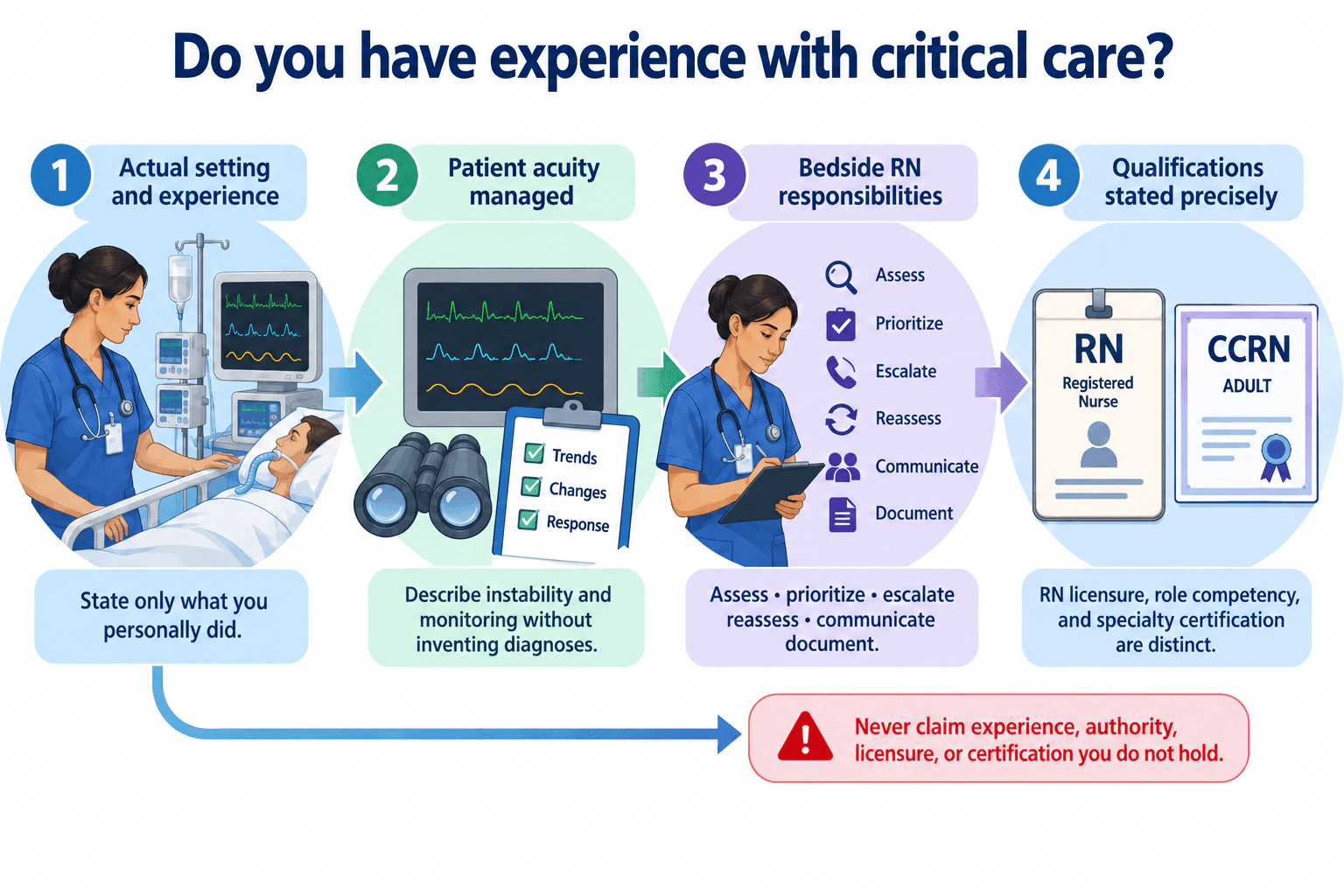
Yes, if that accurately reflects your background. I would state my actual critical care setting and length of experience, describe the acuity I personally managed, and explain my bedside responsibilities. Those responsibilities may include assessment, prioritization, escalation of concerning changes, reassessment, communication, and documentation. I would describe monitoring in terms of trends, changes, and patient response without inventing diagnoses or findings, and I would state my RN licensure, competencies, and any specialty certification accurately.
Detailed Explanation
The strongest response is specific, truthful, and centered on what you personally did. Begin with your actual critical care setting and experience. Then describe the acuity you managed and the bedside nursing responsibilities you performed. Do not make the answer sound more advanced by inventing patient findings, diagnoses, treatments, credentials, or authority.
Useful Questions to Ask the Interviewer
What patient populations and levels of acuity are most common in this unit?
How does the unit validate role specific competencies for bedside RNs?
What responsibilities are expected of the bedside RN when a patient shows a significant change in condition?
How to Explain It in an Interview
Actual Setting and Experience
Start with where you actually worked and how much critical care experience you have. State only responsibilities and experiences you personally had.
Patient Acuity Managed
Describe how closely patients required assessment and monitoring. Explain acuity through observations such as trends, clinical changes, and patient response rather than claiming a diagnosis or specific finding that was not part of your experience.
Bedside RN Responsibilities
Describe your nursing reasoning as a connected sequence: assess the patient, prioritize nursing needs, escalate concerning changes to the appropriate clinician or team, reassess the patient after care or prescribed interventions, communicate relevant information, and document the patient's status and response. New York describes registered professional nursing as including assessment, nursing diagnosis, planning, implementation, and evaluation of nursing care. aacn.org
Qualifications
Keep qualifications precise. RN licensure, role specific competency, and specialty certification are distinct concepts. A nurse should perform only services that are within professional scope and for which the nurse is competent. Specialty certification is separate from RN licensure. AACN identifies CCRN Adult as a specialty certification and requires qualifying RN or APRN licensure and relevant clinical practice for its Direct Care Eligibility Pathway. aacn.org
Closing
Finish by showing that your experience supports safe bedside practice through accurate assessment, recognition of change, prioritization, appropriate escalation, reassessment, communication, and documentation. The goal is to describe your real experience clearly, not to claim responsibilities or qualifications you do not have.
Why Interviewers Ask This
Interviewers are evaluating whether you can describe genuine high acuity bedside experience accurately and understand the responsibilities and limits of the RN role. They want to hear what level of acuity you have actually managed, how you recognize and respond to changes, how you communicate and document, and whether you distinguish licensure, demonstrated competency, and specialty certification.
Common interview mistakes
Common mistakes include giving a vague answer without describing actual acuity or responsibilities, listing equipment without explaining nursing judgment, inventing diagnoses or patient findings, claiming responsibilities outside the bedside RN role, presenting exposure as proof of competency, or implying that specialty certification such as CCRN Adult is the same as RN licensure or is held by every critical care nurse.
Interview tip
Use one truthful description of your actual setting and explain what you personally did. Organize the answer around four ideas: your setting and experience, the acuity you managed, your bedside responsibilities, and your qualifications. Clearly distinguish what you independently performed within nursing scope, what occurred under an authorized protocol, and what required an order or another professional.
Interviewer may ask next
How would you verify the experience and qualifications you describe?
I would make sure every statement matches my employment history, actual unit experience, competency records, current RN license status, and any active specialty certification I claim. I would distinguish observing or assisting with an activity from being independently competent to perform it. If I mention CCRN Adult, I would do so only if I actually hold that certification. AACN treats CCRN Adult as a separate specialty certification with defined licensure and clinical practice eligibility requirements. aacn.org
How would your answer change if your experience were in progressive care rather than an adult ICU?
I would identify progressive care as my actual setting rather than calling it ICU experience. I would describe the acuity, monitoring, assessment, escalation, reassessment, communication, and documentation responsibilities I genuinely performed there, then explain which of those skills are relevant to critical care. I would not claim ICU experience or ICU specific competency that I have not actually obtained.
2. Tell me about your professional career as a nurse.BehavioralEasyNyu Langone Health
i Question Details
Summarize your actual nursing background, relevant patient care experience, current responsibilities, and the progression that prepared you for this role.
Interview tip:
Use STAR to structure your answer: briefly explain the Situation and Task, make Action the most detailed part, and finish with the Result. For example, describe how your nursing career progressed, the types of patient care responsibilities you developed, how you prepared for more complex clinical situations, how you worked with the care team, and how those experiences prepared you for critical care nursing.
Situation
I would describe my nursing career by focusing on the foundation I have worked to build in direct patient care and on the skills that are most relevant to critical care. Those include recognizing changes in a patient's condition, organizing care carefully, and communicating clearly when a patient may need more attention.
Task
My goal has been to grow into a nurse who can manage greater patient complexity while still providing safe, organized, and compassionate care. That means strengthening assessment skills, improving how I prioritize competing needs, and becoming more confident communicating important changes to the care team.
Action
I focus on being systematic in how I approach patient care. I review the patient's current condition, recent changes, treatments, and expected plan so I understand what requires the closest attention. During assessments, I look for trends instead of relying on a single finding. If I notice a meaningful change, I would reassess the patient, gather the most relevant information, and communicate the change clearly to the appropriate team members. I organize care around the most urgent patient needs while continuing routine care safely. I also value working closely with physicians, advanced practice providers, respiratory therapists, pharmacists, and other nurses. I ask questions when something is unclear and use feedback from experienced colleagues to improve my judgment. My focus is to become more deliberate about reassessment, communication, documentation, and preparation for possible changes in condition.
Result
That approach reflects the kind of nurse I aim to be in a critical care setting: organized, attentive, and prepared for patients whose conditions can change quickly. It also reinforces that strong critical care nursing depends on careful assessment, early communication, teamwork, and consistent reassessment. Those are the principles I would bring to a Critical Care Nurse role.
Why Interviewers Ask This
Interviewers ask this question to understand how the candidate's nursing experience has developed and whether that progression has prepared the candidate for the demands of critical care. A strong answer shows growing responsibility, sound clinical judgment, clear communication, teamwork, and an understanding of how earlier nursing experience supports safe care for patients with complex needs.
Interviewer may ask next
What part of your nursing experience best prepared you for critical care?
The most relevant preparation is developing a disciplined approach to recognizing changes in a patient's condition and responding in an organized way. I focus on reassessing the patient, looking at trends, identifying the most important information, and communicating concerns clearly to the care team. That approach reflects how important early recognition and teamwork are when a patient's condition can change quickly.
How has your approach to patient care changed as you gained more experience?
My approach has become more focused on looking at the whole clinical picture instead of only completing individual tasks. I pay close attention to trends, priorities, possible changes in condition, and what information the team may need. I still focus on completing care safely, but I also emphasize anticipation, communication, and reassessment.
3. What are your job responsibilities at your current job?BehavioralEasyNyu Langone Health
i Question Details
Describe your actual current responsibilities, patient population, routine nursing duties, collaboration expectations, and any relevant responsibilities that prepare you for this role.
Interview tip:
Use STAR to structure your answer: briefly explain the Situation and Task, make Action the most detailed part, and finish with the Result. For example, describe your current patient population, your main bedside responsibilities, how you assess and prioritize changing patient needs, how you communicate with the care team and families, and how those responsibilities prepare you to care for high acuity patients.
Situation
In my current role, I provide bedside nursing care for patients who need close assessment, frequent reassessment, and coordinated care. My responsibilities include understanding each patient's current condition, identifying important changes, carrying out the nursing plan of care, and communicating clearly with the rest of the care team. These responsibilities match the New York RN role of assessing patients and planning, implementing, and evaluating nursing care.
Task
My main responsibility is to provide safe and organized care while keeping the patient's most urgent needs first. I need to know what is changing, what I can address through nursing care, what is covered by an authorized order or protocol, and what needs prompt communication with the appropriate clinician. I also need to keep patients and families informed in a clear and respectful way.
Action
At the start of care, I review the patient's condition, recent events, orders, medications, monitoring needs, and immediate risks. I perform focused assessments and compare new findings with the patient's previous condition so I can recognize meaningful changes early. I organize care by urgency rather than simply completing tasks in order. I carry out nursing interventions within my RN scope and execute medical regimens when appropriately ordered. I reassess the patient after important interventions because the response helps show whether the plan is working or whether the team needs to reevaluate it. I communicate changes clearly to the appropriate clinician and share relevant information with other nurses and members of the care team so everyone is working from the same picture. Collaboration and clear communication are also recognized parts of current critical care nursing practice. I document assessments, care, communication, and the patient's response so the next person caring for the patient has accurate information. Throughout the shift, I also explain care to the patient and family in simple language and raise concerns when I believe the patient's needs are changing.
Result
These responsibilities have taught me to stay organized while continuously looking at the whole patient rather than focusing only on individual tasks. They have also strengthened my assessment, prioritization, communication, collaboration, and reassessment habits. Those are important responsibilities in critical care because patients can have complex needs and their condition can change quickly.
Why Interviewers Ask This
Interviewers ask this question to understand the candidate's actual level of bedside responsibility and whether the candidate can clearly explain how they assess patients, set priorities, communicate changes, collaborate with the care team, and remain accountable for nursing care. A strong answer shows that the candidate understands both daily nursing duties and the judgment behind those duties.
Interviewer may ask next
How do you decide which responsibility needs your attention first when several patient needs occur at the same time?
I start with the issue that presents the greatest immediate risk to the patient. I use my assessment findings, recent changes, monitoring information, and the patient's overall condition to set priorities. I address what is within my nursing role, communicate urgent changes to the appropriate clinician, and then reassess so I know whether the patient's condition is improving or whether the plan needs to change.
How do you communicate an important change in a patient's condition to the rest of the care team?
I communicate the most important change clearly and promptly. I explain what I observed, how it differs from the patient's earlier condition, what nursing actions I have already taken, and how the patient responded. I make sure the appropriate clinician receives the information, clarify the next steps when needed, document the communication, and continue reassessing the patient.
4. Why did you become a nurse and why NYU?BehavioralEasyNyu Langone Health
i Question Details
Explain your genuine motivation for entering nursing and connect it to your current interest in NYU Langone Health without inventing personal history.
Interview tip:
Use STAR to structure your answer: briefly explain the Situation and Task, make Action the most detailed part, and finish with the Result. For example, describe what drew you to nursing, how caring for patients in serious situations confirmed that choice, what you value in critical care practice, and why NYU Langone Health's focus on clinical excellence, patient safety, collaboration, and professional growth fits the kind of nurse you want to be.
Situation
I became interested in nursing because I wanted work where I could combine clinical knowledge with direct responsibility for helping people during difficult moments. I am drawn to caring for patients with serious and changing conditions because a nurse can influence safety, comfort, communication, and the overall care experience.
Task
I wanted to build a career where I could keep developing my clinical judgment while also being a steady advocate for patients and families. Critical care is especially meaningful to me because it requires close assessment, clear priorities, careful communication, and strong teamwork when a patient's condition can change quickly.
Action
The way I want to practice nursing reflects those priorities. I pay close attention to changes in a patient's condition, organize care around the most urgent needs, communicate concerns clearly, and work closely with the interdisciplinary team. I also make time to explain what is happening to patients and families in simple language when the situation allows. Those responsibilities are a major reason I chose nursing. I value being able to combine technical care with human connection. I am interested in NYU Langone Health because its nursing model emphasizes clinical excellence, patient safety, meaningful relationships, collaboration, and continued professional growth. Those priorities match how I want to practice in critical care and how I want to continue developing as a nurse.
Result
Nursing has become the career I want to continue building because it allows me to make practical decisions that support patients while constantly learning from complex situations and from the team around me. At NYU Langone Health, I would hope to contribute that same sense of responsibility and collaboration while continuing to strengthen my critical care practice.
Why Interviewers Ask This
Interviewers ask this question to understand whether the candidate has a genuine and sustainable reason for choosing nursing and whether that motivation connects with the organization they are interviewing with. A strong answer shows self awareness, commitment to patient care, understanding of critical care nursing, and a specific reason the candidate sees alignment with NYU Langone Health.
Interviewer may ask next
What part of critical care nursing has most reinforced your decision to stay in nursing?
The strongest reason is the opportunity to use careful nursing assessment and communication to support what happens next for a seriously ill patient. I value noticing changes, organizing the immediate priorities, communicating clearly with the team, and helping the patient and family understand what is happening. That combination of clinical responsibility and direct human support is what makes nursing meaningful to me.
What specifically about NYU Langone Health fits what you are looking for in your next role?
I am looking for an environment where clinical excellence, patient safety, teamwork, and professional growth are part of everyday nursing practice. NYU Langone Health describes a nursing culture built around those priorities, including close collaboration with the healthcare team and meaningful relationships with patients and families. That is consistent with how I want to practice and continue developing in critical care.
5. Why NYU?BehavioralEasyNyu Langone Health
i Question Details
Explain why you are interested in NYU Langone Health using your actual professional goals and what you know about the role, without inventing experience or qualifications.
Interview tip:
Use STAR to structure your answer: briefly explain the Situation and Task, make Action the most detailed part, and finish with the Result. For example, describe why NYU Langone Health fits your professional goals, how its focus on clinical excellence, high acuity care, rapid recognition of patient deterioration, and team based care connects with the kind of Critical Care Nurse you want to be, and what you hope to contribute and continue learning in the role.
Situation
As I think about the next step in my critical care nursing career, I want to work in an environment where strong clinical judgment, careful patient assessment, and teamwork are important every day. I am especially interested in caring for high acuity patients whose condition can change quickly.
Task
My goal is to join an organization where I can contribute as a bedside Critical Care Nurse while continuing to strengthen my ability to recognize changes early, communicate clearly, and work closely with the care team.
Action
NYU Langone Health interests me because the role connects well with those goals. I am drawn to its focus on clinical excellence and team based care. In critical care, I believe good nursing means more than completing tasks. I need to watch trends in the patient's condition, recognize possible deterioration, communicate concerns clearly, and help the team respond in a coordinated way. I also value an environment where nurses work closely with physicians and other professionals because critically ill patients often need decisions from several disciplines. I would bring a careful and organized approach to assessment, communication, reassessment, and patient safety. At the same time, I would want to keep learning from experienced colleagues and become stronger in managing complex high acuity situations.
Result
Comparing NYU Langone Health with my professional goals made it clearer to me that I want to continue my career in a critical care environment that emphasizes strong clinical judgment, teamwork, and close attention to changes in the patient's condition. That evaluation strengthened my interest in the role and helped me identify what matters most to me in my next position. I learned that I am most motivated by an environment where I can contribute consistently at the bedside while continuing to grow as a Critical Care Nurse.
Why Interviewers Ask This
Interviewers ask this question to understand whether the candidate has a clear and realistic reason for choosing NYU Langone Health and whether the role fits the candidate's professional goals. A strong answer shows that the candidate understands the demands of critical care, values clinical excellence and teamwork, and can explain how those priorities connect with the way the candidate wants to practice and grow.
Interviewer may ask next
What part of critical care nursing at NYU Langone Health interests you most?
I am most interested in caring for high acuity patients whose condition can change quickly. I value the need for close assessment, early recognition of changes, clear communication, and coordinated teamwork. That kind of environment would let me contribute at the bedside while continuing to strengthen my clinical judgment.
What would you hope to contribute to the critical care team?
I would contribute a careful approach to patient assessment, clear communication, and reliable follow through. I would focus on recognizing changes, sharing concerns promptly, reassessing after interventions, and working respectfully with the rest of the care team. I would also come ready to learn from experienced colleagues and use feedback to keep improving my practice.
6. Why do you want to leave your present position?BehavioralMediumNyu Langone Health
i Question Details
Explain your real reason for considering a change in a professional way, focusing on your goals and the type of nursing opportunity you are seeking.
Interview tip:
Use STAR to structure your answer: briefly explain the Situation and Task, make Action the most detailed part, and finish with the Result. For example, describe how your present role has helped you grow, what you want to develop next as a Critical Care Nurse, why you are seeking a new opportunity, and how you can explain the change in a positive and professional way.
Situation
I have learned a great deal in my present position and I value the experience I have gained there. It has helped me strengthen my nursing judgment, communication, and ability to stay organized while caring for patients with complex needs.
Task
As I thought about my next step, I wanted to be clear about what would help me continue growing as a Critical Care Nurse. My goal was not simply to leave my current role. I wanted to find an opportunity where I could continue developing in high acuity care, learn from a strong clinical team, and take on greater responsibility as my experience grows.
Action
I reflected on the parts of critical care nursing that motivate me most. I enjoy careful assessment, recognizing changes in a patient's condition, communicating concerns clearly, and working closely with the care team. I also considered the type of environment where I can keep building those skills through challenging patient care, collaboration, and continued learning. That is what led me to explore a new position. I am approaching the change positively because my present role has given me a useful foundation. I am looking for a setting where I can build on that foundation rather than simply move away from something I dislike. NYU Langone Health interests me because this opportunity is focused on high acuity nursing, clinical excellence, and team based care, which are areas that match the direction I want my career to take.
Result
This process helped me become very clear about why I am considering a change. I am grateful for what I have learned in my present position, and I am ready for an opportunity that offers continued growth in critical care. I would bring the experience and habits I have already developed while remaining open to learning from a new team.
Why Interviewers Ask This
Interviewers ask this question to understand the candidate's motivation for changing jobs and whether the decision is thoughtful and professional. A strong answer shows appreciation for previous experience, a clear reason for seeking growth, realistic career goals, and genuine interest in the new opportunity rather than focusing on complaints about the current employer.
Interviewer may ask next
What are you hoping to gain in your next Critical Care Nurse position?
I want to continue strengthening my judgment in high acuity care and become more confident managing complex patient situations with the support of an experienced team. I am also looking for continued learning, strong collaboration, and opportunities to take on more responsibility as I grow.
Is there anything about your current position that you are unhappy with?
My decision is not based on one negative issue. I appreciate the experience my present role has given me. I am considering a change because I have become clearer about the kind of critical care environment and professional growth I want next, and I am ready to build on what I have already learned.
7. Do you want to further your nursing education?BehavioralEasyNyu Langone Health
i Question Details
Describe your actual education plans, how continued learning fits your nursing goals, and how you would balance development with safe current practice.
Interview tip:
Use STAR to structure your answer: briefly explain the Situation and Task, make Action the most detailed part, and finish with the Result. For example, describe how you developed a realistic plan for continued nursing education, chose learning that supports your critical care goals, protected your current patient care responsibilities, and planned future study without letting education interfere with safe bedside practice.
Situation
Yes, I do want to further my nursing education. As I have developed in critical care, I have seen that continued learning is important because the work requires strong clinical judgment, communication, and the ability to keep building knowledge over time. I started thinking carefully about how I could continue my education while still giving my full attention to my current bedside responsibilities.
Task
My goal was to create an education plan that supported my long term nursing growth without taking on more than I could manage safely. I wanted my learning to strengthen my current practice first, while also preparing me for more formal education in the future.
Action
I decided to approach that goal in stages. My immediate focus is continuing nursing education that is relevant to critical care and helps me strengthen areas I use at the bedside. I choose learning based on gaps I identify in my own knowledge and on topics that can improve how I assess patients, communicate changes, and work with the care team. I also make sure that studying does not compete with the preparation, rest, and attention I need for clinical shifts. For longer term development, I would like to pursue additional formal nursing education when I can give both work and school the attention they require. Before starting a program, I would review the time commitment, clinical expectations, and my work schedule. If the combination could affect my ability to practice safely, I would adjust the course load or delay the program rather than allow either responsibility to suffer. I see education as a way to become a stronger nurse, not as something that should distract me from caring for the patients who depend on me now.
Result
This approach has given me a clear and realistic direction for continued learning. I can keep developing my critical care knowledge now while planning future education responsibly. It has also reinforced that professional growth works best when I connect new learning to patient care and remain honest about how much I can safely take on at one time.
Why Interviewers Ask This
Interviewers ask this question to understand whether a nurse is committed to continued professional growth and can make thoughtful decisions about education while maintaining current responsibilities. A strong answer shows clear goals, realistic planning, self awareness, and a commitment to keeping safe patient care the priority while developing professionally.
Interviewer may ask next
What type of nursing education would you like to pursue next?
My immediate priority is continuing nursing education that strengthens my critical care practice. Over the longer term, I am interested in additional formal nursing education that can deepen my clinical knowledge and broaden my professional options. I would choose the specific program after reviewing how well it fits my nursing goals and whether I can complete it while maintaining my bedside responsibilities.
How would you balance school with the demands of critical care nursing?
I would plan my course load around my clinical responsibilities rather than assume I could simply add school to an already full schedule. I would look carefully at study time, clinical requirements, work shifts, and the rest I need to practice safely. If the workload became too heavy, I would reduce my course load or change the timing of the program instead of allowing fatigue or competing demands to affect patient care.
8. Where do you see yourself in 5 years?BehavioralEasyNyu Langone Health
i Question Details
Describe a realistic professional direction based on your actual goals, including how you hope to grow in nursing practice without claiming credentials or roles you do not have.
Interview tip:
Use STAR to structure your answer: briefly explain the Situation and Task, make Action the most detailed part, and finish with the Result. For example, describe how you plan to build deeper critical care knowledge, strengthen your clinical judgment, take on appropriate responsibilities as your competence grows, support your team, and continue developing without assuming a future title or credential.
Situation
At this point in my nursing career, I want to keep building a strong foundation in critical care. I see the next several years as a period of steady growth rather than trying to reach a specific title as quickly as possible.
Task
My goal is to become a more experienced and dependable critical care nurse. I want to strengthen my clinical judgment, recognize changes in a patient's condition early, communicate clearly with the care team, and continue improving how I support patients and families during serious illness.
Action
Over the next five years, I plan to learn from each patient assignment and actively identify areas where I need more knowledge or practice. I would seek feedback from experienced nurses and other members of the clinical team because that helps me understand both what I am doing well and where I can improve. I would continue professional education that is relevant to my role and use current evidence and standards to strengthen my practice. As my competence grows, I would be interested in taking on additional responsibilities that are appropriate for my experience and within my nursing scope. I also want to become someone newer nurses can approach for support. I would not want to rush that step. I would first make sure that my own practice is consistent, safe, and reliable. Throughout that growth, I would keep patient safety, clear communication, teamwork, and continuous learning at the center of my work.
Result
In five years, I hope to be known as a strong and dependable critical care nurse who can manage complex situations with sound judgment, communicate well with the team, and contribute positively to the unit. I also hope to have a clearer sense of where I want to grow next based on the experience I have gained. For me, success would mean continuing to develop while staying focused on excellent bedside nursing and the needs of critically ill patients.
Why Interviewers Ask This
Interviewers ask this question to understand whether the candidate has realistic professional goals and a thoughtful approach to long term growth. A strong answer shows commitment to developing clinical competence, accepting increasing responsibility appropriately, continuing to learn, and contributing to the team without claiming future roles or credentials that have not been earned.
Interviewer may ask next
What would you do during those five years to make sure you continue growing as a critical care nurse?
I would regularly ask for feedback, reflect on challenging patient situations, and identify specific areas where I need more knowledge or experience. I would use relevant continuing education and current professional standards to support that learning. I would also pay attention to how experienced nurses assess changes, communicate concerns, and coordinate care. As I become more experienced, I would take on additional responsibilities only when they are appropriate for my competence and role.
Would you want to move away from bedside critical care during that time?
My main goal is to keep developing as a bedside critical care nurse. I value the clinical judgment, teamwork, and direct patient care involved in that role. I am open to learning where my strengths may lead over time, including opportunities to support newer nurses or contribute more to the team, but I would not want to assume a future position before I have the experience and competence for it.
9. Tell me about your sickest patient.BehavioralMediumNyu Langone Health
i Question Details
Use a real deidentified patient experience to explain the acuity you encountered, your own nursing responsibilities, how you communicated with the team, and what you learned without revealing identifiable information.
Interview tip:
Use STAR to structure your answer: briefly explain the Situation and Task, make Action the most detailed part, and finish with the Result. For example, describe a critically ill patient with rapid deterioration, your bedside responsibilities, the changes you recognized, how you escalated concerns, how you carried out ordered treatment and monitoring, how you communicated with the critical care team, and what the experience taught you about managing high acuity care.
Situation
I would describe a deidentified adult ICU scenario in New York involving a patient whose condition became critically unstable during a shift. I would keep the patient details broad to protect confidentiality. The key issue would be rapid deterioration that required close nursing assessment, prompt escalation, and coordinated team care.
Task
My responsibility would be to recognize further deterioration early, keep the patient safe, carry out the ordered plan of care, and make sure the critical care team had clear and current information. I would also need to reassess the patient after each intervention so the team could understand whether treatment was helping or whether the plan needed to change.
Action
I would start with a focused nursing reassessment and review the patient's overall clinical trend rather than reacting to one monitor value in isolation. I would verify that monitoring and equipment were functioning as expected, review available assessment findings and relevant results, and identify the changes that required escalation. I would promptly contact the appropriate critical care provider and give a concise update about the deterioration, the current nursing findings, and my concerns. I would continue nursing measures that were within my scope and carry out medical treatments only when supported by a valid patient specific order or an applicable authorized protocol. I would reassess the patient's response after each intervention and communicate any meaningful change promptly. I would also coordinate closely with the bedside team so everyone had the same current picture of the patient's condition. Throughout the event, I would document my assessments, escalation, authorized interventions, communication, and the patient's response. This approach would keep independent nursing assessment and escalation separate from medical treatment decisions that required an authorized prescriber or applicable protocol.
Result
The deterioration would be recognized and communicated without delay, the team would receive current information for treatment decisions, and I would continue close reassessment as the patient's condition changed. The experience would reinforce for me that caring for the sickest patients is not about one dramatic action. It is about noticing meaningful changes early, communicating them clearly, carrying out authorized care safely, and reassessing continuously. I would stay organized under pressure and keep asking whether the patient was actually responding to what we were doing.
Why Interviewers Ask This
Interviewers ask this question to understand how a nurse functions when a patient is extremely unstable. They are evaluating clinical judgment, prioritization, recognition of deterioration, communication, teamwork, ownership, and the ability to remain organized during high acuity care. A strong answer also shows that the nurse understands the limits of the nursing role and reassesses the patient after interventions.
Interviewer may ask next
What was the most important decision you made while caring for that patient?
The most important decision would be to escalate a meaningful pattern of deterioration early instead of waiting for one severe change. I would gather the relevant information, reassess the patient, and communicate the changes clearly to the critical care provider. That would help the team evaluate the patient using the full clinical picture rather than reacting to a single number.
What did that experience change about the way you care for critically ill patients now?
It would make me more deliberate about watching trends and reassessing after every important intervention. I would not assume that an ordered treatment had solved the problem just because it was completed. I would look at how the patient's overall condition responded and communicate meaningful changes early. It would also reinforce the value of clear teamwork when several disciplines are caring for the same unstable patient.
10. Tell us about a time when you had an unexpected outcome when working with a patient.BehavioralMediumNyu Langone Health
i Question Details
Describe a real deidentified situation, what outcome was unexpected, how you recognized and responded to it within your role, how you communicated, and what you learned.
Interview tip:
Use STAR to structure your answer: briefly explain the Situation and Task, make Action the most detailed part, and finish with the Result. For example, describe a patient whose condition changed unexpectedly, how you recognized the change, protected the patient, communicated your assessment to the care team, responded within your nursing role, and explained what you learned from the outcome.
Situation
In a previous adult intensive care role, I was caring for a patient who had been stable during my earlier assessments. During a planned mobility activity, the patient suddenly became pale, less responsive, and had a significant change in blood pressure. This was unexpected because the patient had tolerated routine care earlier without a similar response.
Task
My responsibility was to stop the activity, protect the patient from injury, quickly assess what had changed, and communicate the findings so the team could evaluate the cause and decide on the medical plan.
Action
I immediately stopped the mobility activity and called for assistance. I returned the patient safely to bed and reassessed responsiveness, breathing, pulse, oxygen saturation, blood pressure, and the cardiac monitor. I also checked the monitoring equipment and visible lines so I could separate a possible equipment problem from a true change in the patient. I compared the new findings with the earlier assessment and reviewed what had happened just before the change. I gave the provider a concise update that included the sudden change, the current assessment findings, and the actions I had already taken. I stayed with the patient, continued frequent reassessment, and carried out the ordered plan while the team evaluated the patient. I also explained to the patient what we were doing once the patient was able to respond, and I documented the event, my assessments, the communication, and the response to care.
Result
The patient became more alert after being returned to bed, and the team continued evaluating the cause before attempting further activity. The experience reinforced for me that a patient who appears stable can still change quickly. I learned to treat an unexpected outcome as new clinical information, reassess the patient from the beginning, communicate objective findings early, and avoid assuming that the original plan is still appropriate.
Why Interviewers Ask This
Interviewers ask this question to evaluate how a nurse responds when patient care does not go as expected. A strong answer shows situational awareness, patient safety, sound nursing judgment, timely escalation, clear communication, accountability, and the ability to learn from an unexpected clinical event.
Interviewer may ask next
Why did you reassess the patient before focusing on what caused the change?
My first priority was the patient's immediate condition. I needed current information about responsiveness, breathing, circulation, vital signs, and the monitor before trying to explain why the change happened. That assessment also gave me objective information to communicate to the provider and helped the team decide what needed to happen next.
What did you learn that you would apply to a similar situation now?
I would again stop the activity, protect the patient, reassess immediately, and communicate the change early. I also learned not to let an earlier stable assessment create false reassurance. In critical care, I need to respond to what the patient is showing me now and continue reassessing as the situation changes.
Critical Care Nurse Resume Examples
Explore the resume examples below to find the one that best matches your target Critical Care Nurse role.
New Graduate Critical Care Nurse0-1 years; supervised transition to critical care
Disclaimer: This interview guide is for educational and informational purposes only. It is designed to help readers prepare, but it does not guarantee any interview result, hiring decision, offer, or outcome. Interview questions, hiring criteria, and preferred answers can vary by employer, interviewer, industry, location, and time. All answers, examples, and explanations in this guide are suggested examples for interview preparation, not definitive answers or instructions for professional practice. They are based on research and judgment, are provided without warranties of any kind, and should be adapted to the question, role, and applicable laws and professional requirements. Diagrams are simplified illustrations intended to highlight the main concepts and their relationships; actual situations, systems, and practices may be more complex. Alternative approaches may be equally valid or better suited to a particular question, context, or interviewer. To the fullest extent permitted by applicable law, the contributors and publisher are not liable for decisions made, actions taken, or losses incurred based on this guide.
State Laws and Professional Responsibilities: Laws and requirements governing an occupation vary by state and jurisdiction. You are responsible for checking the current laws, licensing requirements, and scope-of-practice rules that apply to your location and role, and for ensuring that your answers and actions comply with them. Adapt examples in this guide to those requirements. This guide is not legal advice.
Company Notice: This guide is an independent educational resource and is not affiliated with, endorsed by, sponsored by, or approved by the company named in this guide. Company names identify reported interview experiences or the employer context of clearly labeled original practice exercises. Interview practices can change without notice, and inclusion of company-specific content does not mean these questions are official, complete, or guaranteed to be asked. To the fullest extent permitted by law, the author, contributors, and publisher are not responsible for outcomes related to use of this material.
Content Accuracy and Verification: To the fullest extent permitted by applicable law, we do not represent or warrant that interview guides, questions, answers, examples, or diagrams are accurate, complete, current, error-free, or suitable for any particular purpose. You are responsible for independently reviewing and verifying the information before relying on it.