This interview guide is for educational and informational purposes only. It is designed to help readers prepare, but it does not guarantee any interview result, hiring decision, offer, or outcome. Interview questions, hiring criteria, and preferred answers can vary by employer, interviewer, industry, location, and time. All answers, examples, and explanations in this guide are suggested examples for interview preparation, not definitive answers or instructions for professional practice. They are based on research and judgment, are provided without warranties of any kind, and should be adapted to the question, role, and applicable laws and professional requirements. Diagrams are simplified illustrations intended to highlight the main concepts and their relationships; actual situations, systems, and practices may be more complex. Alternative approaches may be equally valid or better suited to a particular question, context, or interviewer. To the fullest extent permitted by applicable law, the contributors and publisher are not liable for decisions made, actions taken, or losses incurred based on this guide.
State Laws and Professional Responsibilities
Laws and requirements governing an occupation vary by state and jurisdiction. You are responsible for checking the current laws, licensing requirements, and scope-of-practice rules that apply to your location and role, and for ensuring that your answers and actions comply with them. Adapt examples in this guide to those requirements. This guide is not legal advice.
Identity, Image, and Privacy Notice
To respect individual privacy, some names, profile photographs, avatars, biographical details, and other identifying information displayed in this guide may be replaced with pseudonyms, licensed stock images, illustrative avatars, composite images, or representative descriptions. Unless a person is expressly identified as an actual contributor, a displayed name, image, or profile should not be understood as depicting or identifying a specific candidate, interviewer, employee, or other real individual. These representations are provided for editorial and illustrative purposes only and do not imply endorsement, employment, participation, or affiliation with this guide or any company mentioned in it. Any resemblance to an actual person is coincidental.
Company Notice
This guide is an independent educational resource and is not affiliated with, endorsed by, sponsored by, or approved by the company named in this guide. Company names identify reported interview experiences or the employer context of clearly labeled original practice exercises. Interview practices can change without notice, and inclusion of company-specific content does not mean these questions are official, complete, or guaranteed to be asked. To the fullest extent permitted by law, the author, contributors, and publisher are not responsible for outcomes related to use of this material.
Content Accuracy and Verification
To the fullest extent permitted by applicable law, we do not represent or warrant that interview guides, questions, answers, examples, or diagrams are accurate, complete, current, error-free, or suitable for any particular purpose. You are responsible for independently reviewing and verifying the information before relying on it.
Questions or comments?
Contact us for general questions, or share feedback, technical corrections, and comments with the community.
41. What is delirium in a critically ill patient?Neurological Care Sedation And DeliriumEasy
i Question Details
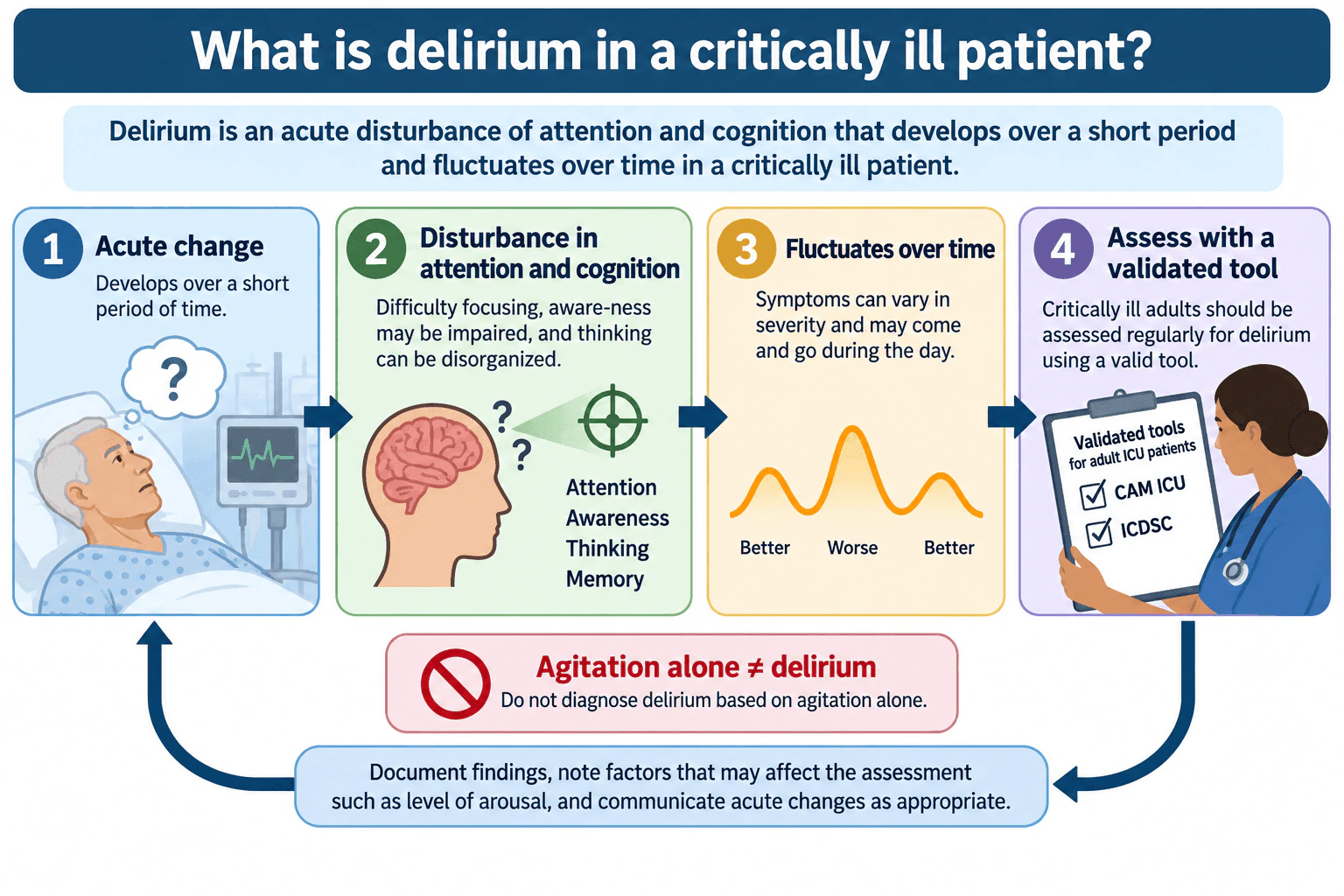
Explain delirium as an acute disturbance in attention and cognition that fluctuates and requires a validated assessment rather than diagnosis from agitation alone.
Short Interview Answer (30-60 seconds)
Delirium is an acute disturbance in attention and cognition that develops over a short period and fluctuates over time. In an adult ICU patient, I would assess for an acute change from baseline and use a validated tool such as CAM ICU or ICDSC rather than identifying delirium from agitation alone. I would also consider factors such as level of arousal, document the findings and limitations, and communicate significant acute changes.
Detailed Explanation
Delirium is an acute disturbance in attention and cognition that develops over a short period and fluctuates over time. A critically ill patient may have periods when attention, awareness, thinking, or memory appear better and periods when they are worse. Agitation by itself is not enough to identify delirium.
Useful Questions to Ask the Interviewer
Which validated delirium assessment tool does your ICU use for adult patients?
How is delirium assessment documented when level of arousal or another factor limits testing?
What is the expected communication process when a nurse identifies an acute mental status change?
How to Explain It in an Interview
For an adult ICU patient in the United States, I would describe delirium as an acute disturbance in attention and cognition that develops over a short period and has a fluctuating course. I would compare the patient's current mental status with the known baseline and look for changes in attention, awareness, thinking, and cognition.
I would not identify delirium simply because the patient is agitated. Instead, I would use the validated delirium assessment tool adopted by the unit, such as the Confusion Assessment Method for the ICU, called CAM ICU, or the Intensive Care Delirium Screening Checklist, called ICDSC. These tools provide a structured approach to delirium assessment in critically ill adults.
I would also consider whether level of arousal or another clinical factor affects the assessment and document any limitation. Because delirium can fluctuate, one apparently normal interaction does not exclude it. Repeated assessment according to established ICU practice and comparison with prior findings help identify the trend.
If I identify an important acute change, I would document the findings and communicate the change to the appropriate clinical team while continuing to review factors that may be affecting the assessment. The key point is that delirium is an acute, fluctuating disturbance of attention and cognition that requires structured assessment rather than an assumption based on agitation alone.
Why Interviewers Ask This
Interviewers want to know whether the nurse recognizes delirium as an acute and fluctuating disturbance in attention and cognition rather than equating it with agitation. They are also assessing whether the nurse uses a validated ICU delirium assessment tool, considers factors that can affect the assessment, recognizes changes from baseline, and communicates clinically important changes appropriately.
Common interview mistakes
Common mistakes include calling any agitation delirium, overlooking an acute change from the patient's baseline, relying only on an informal impression instead of a validated assessment tool, ignoring fluctuation over time, and failing to document when level of arousal or another factor affects the assessment.
Interview tip
Define delirium first, then explain the four ideas in order: acute change, impaired attention and cognition, fluctuation over time, and assessment with a validated ICU tool. Finish by stating that agitation alone does not establish delirium and that significant acute changes should be documented and communicated.
Interviewer may ask next
How would you verify suspected delirium in an adult ICU patient?
I would compare the patient's current mental status with baseline, assess for an acute or fluctuating change, and use the validated delirium tool used by the unit, such as CAM ICU or ICDSC. I would consider whether level of arousal or another factor affects the assessment, document those limitations, and communicate clinically important acute changes.
What would change if the patient were calm rather than agitated?
I would still assess for delirium because agitation is not required. A calm patient can still have impaired attention or cognition and a fluctuating course. I would use the same validated assessment process, compare findings with baseline and prior assessments, document any limitations, and communicate significant acute changes.
42. How do you assess pain in a patient who cannot reliably self report?Neurological Care Sedation And DeliriumMedium
i Question Details
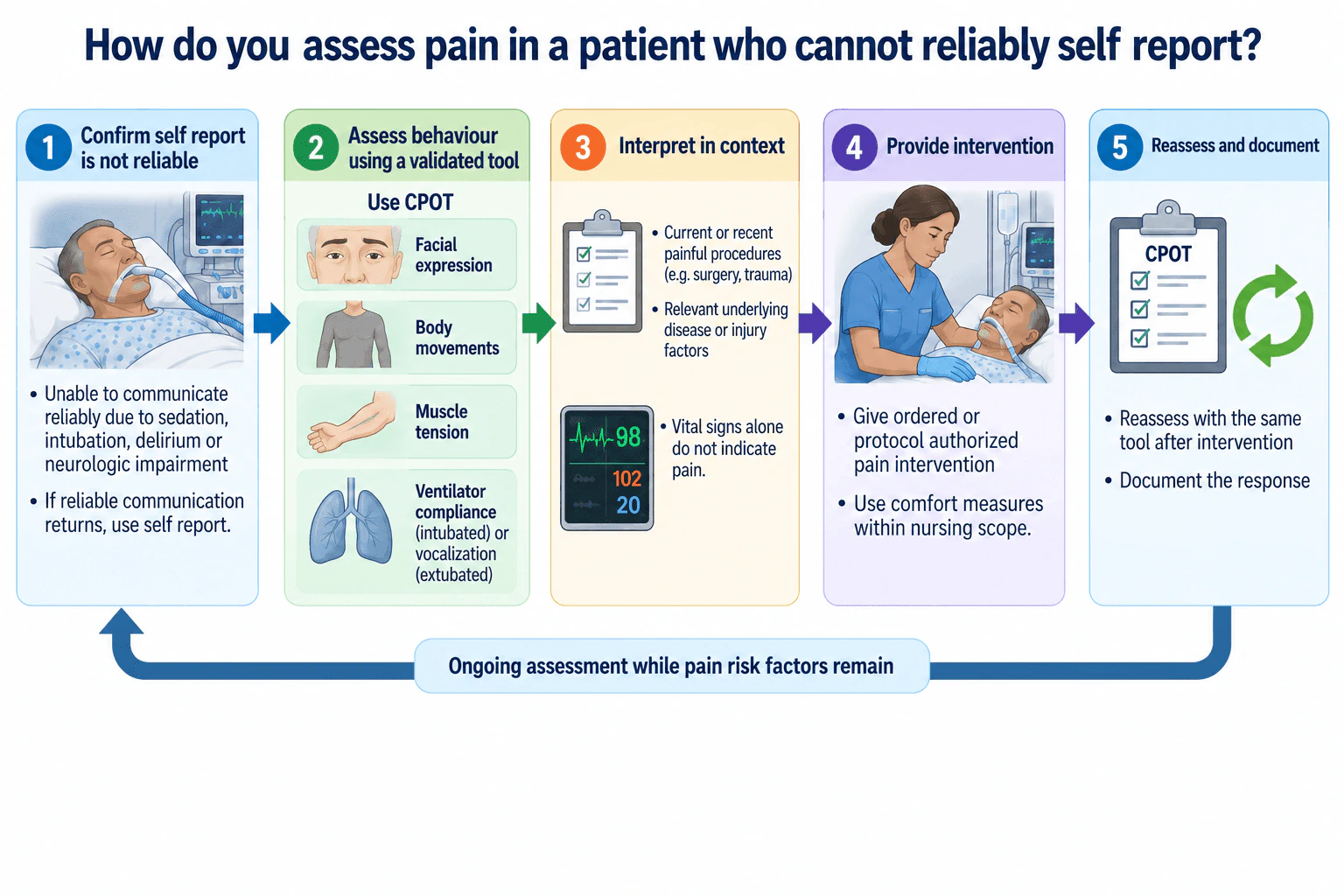
Describe using a validated behavioral pain tool, observing facial expression and movement, considering procedures and disease factors, and reassessing after intervention.
Short Interview Answer (30-60 seconds)
If a patient cannot reliably self report, I confirm why and use a validated behavioral tool such as CPOT when behaviors are observable. I assess facial expression, body movements, muscle tension, and ventilator compliance or vocalization, then consider recent painful procedures and the underlying disease or injury. I do not use vital signs alone as evidence of pain. I provide appropriate comfort measures and ordered or protocol authorized treatment, then reassess with the same tool and document the response. sccm.org
Detailed Explanation
For adult bedside ICU practice in the United States, the key idea is to replace an unreliable self report with a validated behavioral assessment while continuing to interpret the patient's behavior in clinical context. When behaviors are observable, CPOT is an appropriate tool for critically ill adults who cannot self report. It evaluates facial expression, body movements, muscle tension, and ventilator compliance for an intubated patient or vocalization for an extubated patient. I also consider recent painful procedures, surgery, trauma, or disease factors that could contribute to pain. Vital signs alone are not valid indicators of pain, although a change in vital signs can prompt further assessment. After an intervention, I reassess with the same tool, document the response, and continue assessment while pain risk factors remain. If reliable communication returns, self report again becomes the reference standard. sccm.org
Useful Questions to Ask the Interviewer
Which validated behavioral pain tool does your ICU use for adults who cannot reliably self report?
What is your unit process for reassessment and documentation after a pain intervention?
Which comfort measures are commonly performed by bedside nurses within unit policy and RN scope?
How to Explain It in an Interview
I would start by confirming that the patient cannot reliably self report because of factors such as intubation, sedation, delirium, or neurologic impairment. If behaviors are observable, I would use CPOT rather than trying to infer pain from vital signs alone.
With CPOT, I assess facial expression, body movements, muscle tension, and either ventilator compliance or vocalization. I interpret those behaviors together with the clinical context, including a recent painful procedure, surgery, trauma, or an underlying disease process.
I would not call a change in heart rate or blood pressure proof of pain. Those findings can prompt me to assess further, but they do not replace a validated behavioral assessment. sccm.org
Once I have assessed the patient, I provide comfort measures within nursing scope and give ordered or protocol authorized pain treatment when appropriate. I then reassess with the same tool after the intervention, compare the patient's behavioral response with the earlier assessment, document the response, and communicate or escalate persistent concerns as appropriate.
If the patient later becomes able to communicate reliably, I return to self report because that is the reference standard for pain assessment. sccm.org
Why Interviewers Ask This
Interviewers are evaluating whether you can recognize pain when self report is unavailable, choose an appropriate validated behavioral tool, interpret behavior in clinical context, avoid relying on vital signs alone, act within bedside RN scope, and reassess and document the patient's response. These are central nursing judgments for safe pain management in critically ill adults. sccm.org
Common interview mistakes
Common mistakes include relying on vital signs alone, skipping a validated behavioral pain tool, ignoring recent procedures or underlying disease factors, assuming that a quiet or sedated patient has no pain, failing to reassess with the same tool after intervention, and failing to document the patient's response.
Interview tip
Give the answer as one bedside sequence: confirm that self report is unreliable, use CPOT when behaviors are observable, interpret the behaviors in context, provide appropriate intervention within RN scope, reassess with the same tool, document the response, and return to self report if reliable communication becomes possible.
Interviewer may ask next
How do you verify that your pain intervention was effective?
I reassess the patient with the same behavioral pain tool used before the intervention, compare the current behaviors with the previous assessment, document the response, and consider whether the painful trigger is still present. If pain related behaviors persist or worsen, I continue appropriate nursing measures and communicate or escalate according to the clinical situation and applicable orders or protocols.
What changes if the patient becomes awake enough to communicate reliably?
I return to the patient's self report because self report is the reference standard when reliable communication is possible. For a critically ill adult who can communicate, a 0 to 10 numeric rating scale can be used. If communication later becomes unreliable again, I return to an appropriate validated behavioral tool. sccm.org
43. A sedated ventilated patient becomes newly restless. How would you assess the cause?Neurological Care Sedation And DeliriumHard
i Question Details
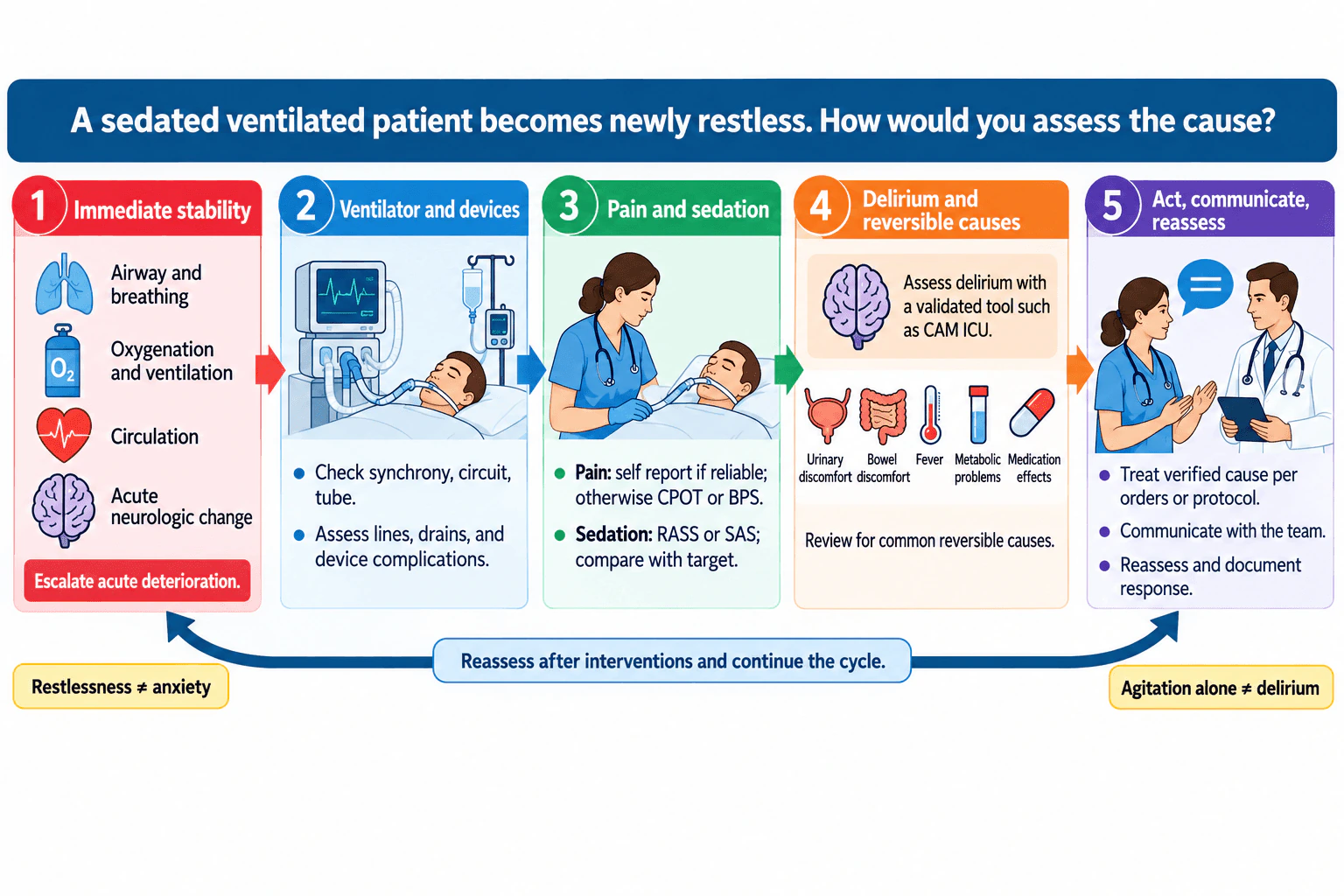
Check oxygenation and ventilation, pain, sedation level, delirium, urinary or bowel discomfort, fever, metabolic problems, medication effects, and device complications before assuming anxiety.
Short Interview Answer (30-60 seconds)
I would not assume the patient is anxious. I would first assess airway and breathing, oxygenation and ventilation, circulation, and any acute neurologic change. Then I would check ventilator synchrony, the circuit and airway tube, lines, drains, and other devices. I would assess pain using self report when reliable or CPOT or BPS when it is not, and assess sedation with RASS or SAS against the target. I would assess for delirium with a validated tool such as CAM ICU and look for urinary or bowel discomfort, fever, metabolic problems, and medication effects. I would address the verified cause within orders or protocol, communicate important findings, and reassess and document the response.
Detailed Explanation
New restlessness in a sedated ventilated patient is a clinical change, not a diagnosis of anxiety. I would use a rapid, organized assessment that first excludes immediate physiologic deterioration, then evaluates ventilator and device problems, pain and sedation, delirium, and other reversible causes.
Useful Questions to Ask the Interviewer
Does the unit use RASS or SAS as its standard sedation scale?
Which validated delirium tool is routinely used, such as CAM ICU or ICDSC?
What nurse driven protocols are available for ventilator, sedation, pain, and device assessment?
How to Explain It in an Interview
I would start with immediate stability. I would assess airway and breathing, oxygenation and ventilation, circulation, and whether there is an acute neurologic change. Any acute deterioration would be escalated promptly while I continue reviewing possible causes.
Next I would assess the ventilator and connected devices. I would look at patient ventilator synchrony, the breathing circuit and airway tube, and inspect lines, drains, and other devices for complications that could cause discomfort or instability.
I would then separate pain from sedation. If the patient can communicate reliably, self report is the preferred pain assessment. If not, I would use a validated behavioral tool such as the Critical Care Pain Observation Tool, CPOT, or Behavioral Pain Scale, BPS. I would assess sedation with the Richmond Agitation Sedation Scale, RASS, or Riker Sedation Agitation Scale, SAS, and compare the result with the prescribed sedation target rather than assuming that movement means inadequate sedation.
I would also assess for delirium using a validated ICU tool such as CAM ICU when the patient's level of arousal permits valid assessment. Agitation alone does not establish delirium. At the same time, I would review common reversible contributors, including urinary discomfort, bowel discomfort, fever, metabolic abnormalities, and medication effects.
After identifying the most likely cause, I would address it within nursing scope and applicable orders or protocols, communicate significant findings to the appropriate clinician, and reassess the patient. I would document the assessment findings, interventions, communication, and response. The key is to continue reassessment because restlessness can have more than one contributing cause.
Why Interviewers Ask This
This question evaluates whether the nurse recognizes restlessness as a potentially important clinical change and uses systematic bedside reasoning instead of labeling it as anxiety. It tests prioritization of oxygenation and ventilation, recognition of ventilator and device problems, validated pain and sedation assessment, appropriate delirium assessment, review of reversible causes, escalation, communication, and reassessment.
Common interview mistakes
Common mistakes include assuming restlessness is anxiety before checking oxygenation, ventilation, pain, sedation, devices, and reversible physiologic causes; treating agitation alone as proof of delirium; relying only on vital signs to judge pain when a validated pain assessment is appropriate; changing sedation without comparing the patient's score with the prescribed target; overlooking ventilator synchrony, the airway tube, circuit, lines, drains, urinary or bowel discomfort, fever, metabolic problems, or medication effects; and failing to reassess after an intervention.
Interview tip
Present the assessment in the same priority order you would use at the bedside: immediate stability, ventilator and devices, pain and sedation, delirium and reversible causes, then intervention, communication, reassessment, and documentation. Emphasize that restlessness is a finding that requires investigation rather than an automatic diagnosis of anxiety.
Interviewer may ask next
How would you verify whether the patient's restlessness represents delirium?
I would first assess the patient's level of arousal and determine whether delirium testing can be performed validly. When appropriate, I would use a validated ICU delirium tool such as CAM ICU rather than diagnose delirium from agitation alone. I would also review acute changes and reversible contributors such as fever, metabolic abnormalities, medication effects, pain, and discomfort, then communicate and document significant findings.
What would you do differently if the patient could not reliably self report pain?
I would not assume absence of pain. I would use a validated behavioral pain assessment appropriate for a critically ill adult, such as CPOT or BPS, while considering the patient's condition and any limitations of the tool. I would keep pain assessment separate from sedation assessment, use RASS or SAS for sedation as appropriate, address verified causes within orders or protocol, and reassess the response.
44. What is acute kidney injury?Renal Metabolic And Nutrition SupportEasy
i Question Details
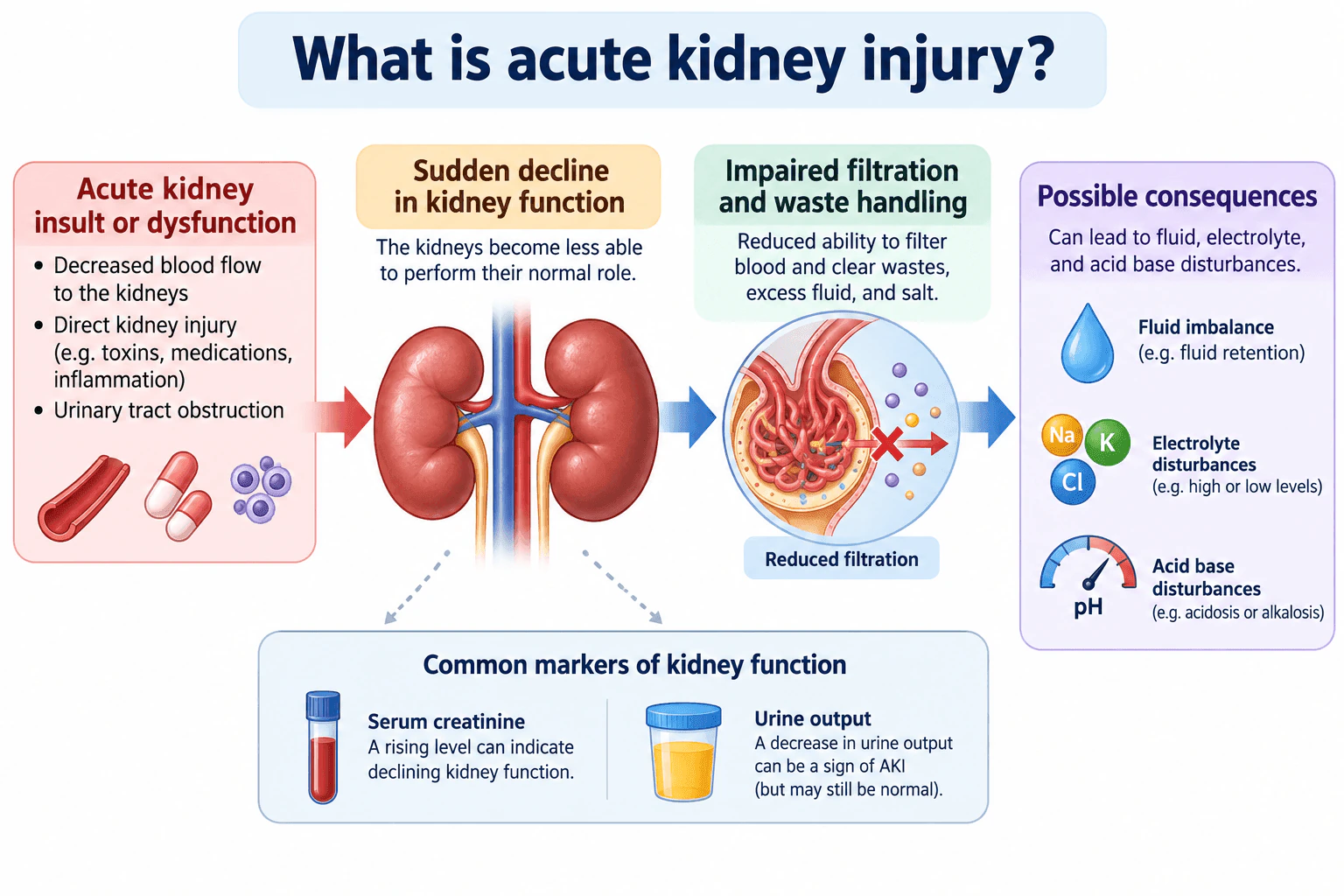
Define acute kidney injury as a sudden decline in kidney function associated with impaired filtration and possible fluid, electrolyte, and acid base disturbances.
Short Interview Answer (30-60 seconds)
Acute kidney injury, or AKI, is a sudden decline in kidney function that impairs filtration and waste handling. It can cause fluid, electrolyte, and acid base disturbances. Common causes include decreased blood flow to the kidneys, direct kidney injury, and urinary tract obstruction. In critical care, I would trend serum creatinine and urine output together with the clinical context because AKI can occur even when urine output is still present.
Detailed Explanation
Acute kidney injury, or AKI, is a sudden decline in kidney function. As kidney function worsens, the kidneys become less able to filter blood, clear waste products, and regulate fluid, electrolytes, and acid base balance. This can lead to fluid retention, electrolyte abnormalities, and acid base disturbances.
The major mechanisms include decreased blood flow to the kidneys, direct kidney injury from processes such as toxins, medications, or inflammation, and urinary tract obstruction. At the bedside, serum creatinine and urine output are important markers of kidney function. A rising serum creatinine can indicate declining kidney function, while decreasing urine output can be a sign of AKI. However, urine output may remain present in some patients with AKI. KDIGO continues to use changes in serum creatinine and urine volume as major functional criteria for identifying AKI. kdigo.org
Useful Questions to Ask the Interviewer
How does your ICU communicate significant changes in serum creatinine and urine output during handoff and rounds?
What process does the unit use for escalating new or worsening kidney dysfunction?
What renal support resources are available when a patient requires specialized kidney replacement therapy?
How to Explain It in an Interview
I would define AKI as a sudden decline in kidney function that causes impaired filtration and waste handling. The kidneys may become less able to control fluid, electrolytes, and acid base balance.
I would explain that AKI can develop from decreased kidney perfusion, direct injury to kidney tissue, or obstruction of urine flow. I would then connect the definition to bedside assessment by trending serum creatinine and urine output over time rather than relying on one isolated result. Urine output is useful, but normal or preserved urine output does not exclude AKI because nonoliguric AKI can occur. kdigo.org
For a critically ill patient, I would place those findings in context with fluid balance, hemodynamics, potential kidney insults, and signs of electrolyte or acid base disturbance. If the trend suggests worsening kidney function or complications, I would communicate and escalate the change promptly while continuing reassessment. Treatment decisions and kidney replacement therapy settings remain with the authorized clinical team and applicable protocols.
Why Interviewers Ask This
Interviewers want to confirm that the nurse understands AKI as an acute decline in kidney function rather than simply one abnormal laboratory result. They are also assessing whether the nurse connects impaired filtration with possible fluid, electrolyte, and acid base disturbances and understands why serum creatinine and urine output are interpreted as trends within the clinical context.
Common interview mistakes
Common mistakes include defining AKI only as low urine output, relying on one serum creatinine result without considering baseline and time course, assuming preserved urine output excludes AKI, or discussing dialysis as though it defines AKI. Another mistake is overlooking the connection between impaired kidney function and fluid, electrolyte, and acid base disturbances.
Interview tip
Give the definition first, then connect it to impaired filtration and waste handling, possible fluid, electrolyte, and acid base consequences, and the two major bedside markers shown in the diagram: serum creatinine and urine output. Keep treatment separate from the definition unless the interviewer asks a follow up question.
Interviewer may ask next
How would you verify that a patient may have acute kidney injury?
I would compare the current serum creatinine with previous values and trend urine output over time rather than relying on one measurement. Published KDIGO criteria identify AKI using an acute increase in serum creatinine or reduced urine output, interpreted in the appropriate clinical context. kdigo.org I would also assess for likely mechanisms such as decreased kidney perfusion, direct kidney injury, or urinary obstruction and communicate concerning trends to the responsible clinical team.
How would your assessment change if the patient still had normal appearing urine output?
I would not rule out AKI. Kidney dysfunction can occur with preserved urine output, so I would continue trending serum creatinine, urine output, fluid balance, electrolytes, acid base status, and the clinical context while escalating evidence of worsening kidney function or related complications. kdigo.org
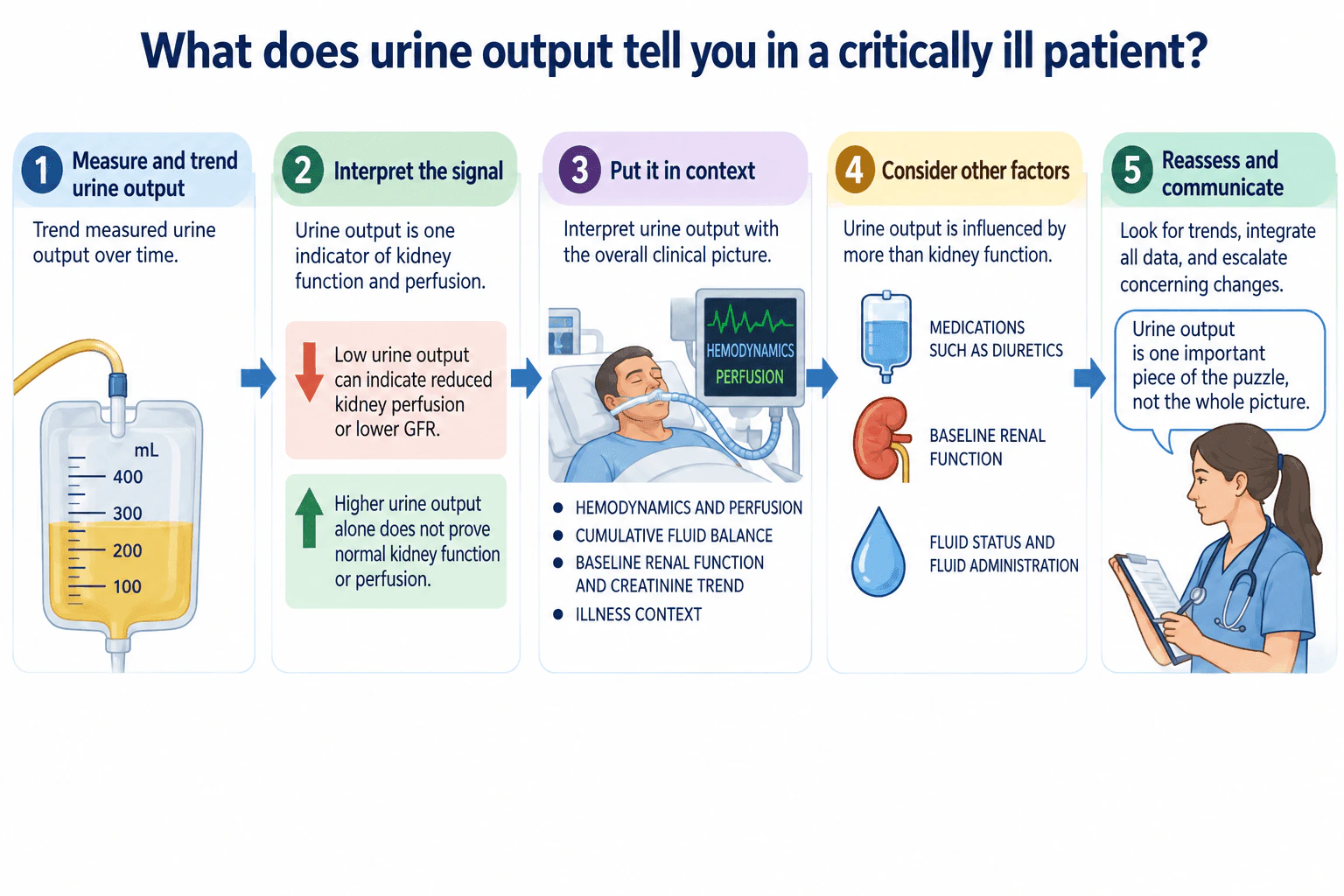
45. What does urine output tell you in a critically ill patient?Renal Metabolic And Nutrition SupportEasy
i Question Details
Explain how urine output is one indicator of kidney function and perfusion that must be interpreted with fluid balance, medications, baseline renal function, and other clinical data.
Short Interview Answer (30-60 seconds)
Urine output is one indicator of kidney function and perfusion, but it is not the whole picture. I trend it over time and interpret it with hemodynamics, cumulative fluid balance, baseline renal function, creatinine trends, medications such as diuretics, fluid administration, and the overall illness context. Low output can suggest reduced perfusion or filtration, while higher output alone does not prove normal kidney function.
Detailed Explanation
Urine output gives useful bedside information about kidney function and perfusion, but one value cannot explain the patient's renal status by itself. In an adult United States ICU, I would focus on the trend and interpret it with the rest of the clinical picture.
Useful Questions to Ask the Interviewer
How does your ICU document and trend urine output and cumulative fluid balance?
What is the usual communication and escalation process when urine output changes significantly?
How are baseline renal function, creatinine trends, and medication effects incorporated into renal assessment?
How to Explain It in an Interview
I would first confirm that the urine output measurement and time period are reliable, then look at the trend rather than reacting to a single observation.
I would interpret that trend with hemodynamics and perfusion, cumulative fluid balance, baseline renal function, the serum creatinine trend, fluid administration, medications such as diuretics, and the overall illness context. Low urine output can indicate reduced kidney perfusion or lower glomerular filtration, but urine output alone cannot establish the cause of a change in kidney function. Likewise, higher urine output does not by itself prove that kidney function or perfusion is normal, especially when diuretics or fluid administration may be influencing output.
As the bedside ICU nurse, I would continue reassessment, compare urine output with the other available clinical data, document meaningful trends, communicate concerning changes, and escalate according to authorized protocols and provider orders when indicated. I would not independently prescribe fluid replacement, diuretic therapy, dialysis settings, or other renal treatment.
Why Interviewers Ask This
Interviewers want to know whether the nurse understands that urine output is useful clinical information without treating it as an isolated measure of kidney function. They are evaluating whether the nurse can recognize trends, connect urine output with perfusion and cumulative fluid balance, account for baseline renal function and medications, and communicate concerning changes appropriately.
Common interview mistakes
Common mistakes include judging kidney function from one urine output value, assuming low output always means intrinsic kidney injury, assuming higher output proves normal kidney function, ignoring cumulative fluid balance, overlooking diuretic exposure or fluid administration, and failing to compare the finding with baseline renal function, creatinine trends, hemodynamics, and the overall illness context.
Interview tip
Emphasize that urine output is one indicator, not the whole picture. Then explain that you trend it over time, connect it with perfusion, cumulative fluid balance, baseline renal function, creatinine, medications, fluid administration, and illness context, and communicate concerning changes.
Interviewer may ask next
How would you verify a low urine output finding before interpreting it?
I would confirm the recorded volume and time interval, verify that the urine collection system is measuring output correctly, and review the recent trend. I would then interpret the verified finding with hemodynamics, perfusion, cumulative fluid balance, baseline renal function, creatinine trends, medications, fluid administration, and the overall clinical condition.
How would your interpretation change if the patient had recently received a diuretic?
I would recognize that a diuretic can increase urine output, so higher output would not by itself prove normal kidney function or perfusion. I would interpret the response together with the patient's hemodynamics, cumulative fluid balance, baseline renal function, creatinine trend, fluid status, and overall illness context, then continue reassessment and communicate concerning changes.
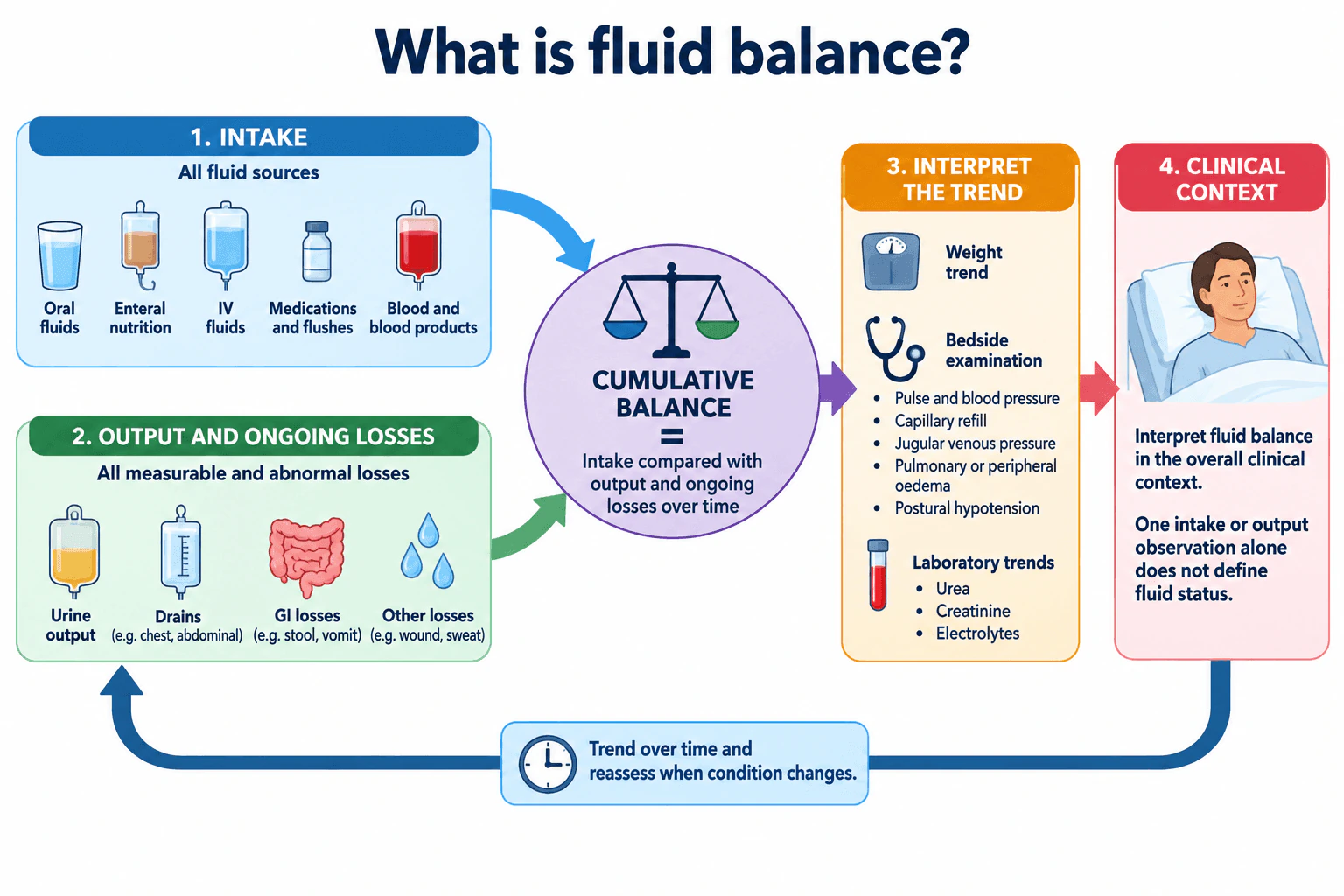
46. What is fluid balance?Renal Metabolic And Nutrition SupportEasy
i Question Details
Explain fluid balance as comparison of intake, output, and ongoing losses together with weight, examination, laboratory values, and clinical context.
Short Interview Answer (30-60 seconds)
Fluid balance compares total fluid intake with output and ongoing losses over time. I include sources such as oral fluids, enteral nutrition, intravenous fluids, medications and flushes, and blood products, then compare them with urine, drains, gastrointestinal losses, and other losses. I do not interpret one intake or output value in isolation. I look at the cumulative balance together with weight trends, bedside findings, laboratory trends, and the patient's overall clinical context, and I reassess when the condition changes.
Detailed Explanation
Fluid balance is the cumulative relationship between fluid intake and fluid output or ongoing losses over time. A charted number helps quantify that relationship, but it does not by itself establish the patient's fluid status.
Useful Questions to Ask the Interviewer
How is fluid intake and output documented and reconciled in your ICU?
Which findings does your team emphasize when evaluating a change in fluid balance?
How are unexpected fluid balance trends communicated and escalated?
How to Explain It in an Interview
For an adult bedside ICU nurse in the United States, I would begin by identifying all relevant fluid entering and leaving the patient during the defined time period.
Intake can include oral fluids, enteral nutrition, intravenous fluids, medications and flushes, and blood or blood products. Output and ongoing losses can include urine, drains, gastrointestinal losses such as stool or vomiting, and other losses such as wound drainage or sweating.
I then consider the cumulative balance rather than relying on one intake or output observation. A positive or negative charted balance has to be interpreted alongside the patient's trend and clinical findings.
I correlate the balance with weight trends and bedside assessment, including pulse, blood pressure, capillary refill, jugular venous pressure when clinically appropriate, pulmonary or peripheral oedema, and postural symptoms when assessment is appropriate and safe. I also review relevant laboratory trends such as urea, creatinine, and electrolytes.
The key is clinical context. A fluid balance total can be misleading if intake or losses were missed, measurements were inaccurate, or the time period was incomplete. I would verify unexpected data, compare it with the patient's examination and trends, document relevant findings, communicate significant changes, and reassess as the clinical condition changes. I would escalate concerns through the appropriate clinical pathway rather than independently prescribing fluid replacement or removal.
Why Interviewers Ask This
Interviewers are assessing whether a critical care nurse understands that fluid balance is more than subtracting output from intake. Safe nursing judgment requires accurate measurement, recognition of ongoing losses, interpretation of cumulative trends, and correlation with weight, examination findings, laboratory results, and the patient's clinical condition.
Common interview mistakes
Common mistakes include treating one urine output value as the entire fluid balance, overlooking fluid from enteral nutrition, medications, flushes, or blood products, failing to include drains or gastrointestinal and other ongoing losses, and interpreting the cumulative total without checking weight, bedside examination, laboratory trends, and clinical context. Another mistake is accepting an unexpected chart value without first checking whether the measurements and time period are complete.
Interview tip
Define fluid balance first as cumulative intake compared with output and ongoing losses. Then show stronger critical care judgment by explaining that the number must be interpreted with weight, bedside examination, laboratory trends, clinical context, and reassessment over time.
Interviewer may ask next
What would you verify if the recorded fluid balance did not match the patient's clinical condition?
I would verify the time period, individual intake and output entries, measurement units, oral and enteral intake, intravenous fluids, medications and flushes, blood products, urine, drains, gastrointestinal losses, and other ongoing losses. I would then compare the corrected cumulative balance with the weight trend, bedside examination, and laboratory trends. If the discrepancy or clinical concern remained significant, I would document the findings and escalate them through the appropriate clinical pathway.
How would your interpretation change if the patient's weight increased while urine output decreased?
That combination would make me more concerned that fluid may be accumulating, especially if the cumulative balance is also positive. I would not rely on those findings alone. I would reassess the patient, review pulse and blood pressure, capillary refill, jugular venous pressure when appropriate, pulmonary or peripheral oedema, and relevant laboratory trends such as urea, creatinine, and electrolytes. I would verify the intake and output record, communicate significant deterioration or discordant findings, and continue reassessment rather than independently prescribing fluid removal or replacement.
47. What is metabolic acidosis?Renal Metabolic And Nutrition SupportEasy
i Question Details
Define metabolic acidosis as a primary decrease in bicarbonate with acidemia or compensatory changes and explain that the cause must be determined from the clinical context.
Short Interview Answer (30-60 seconds)
Metabolic acidosis is an acid base disorder caused by a primary decrease in bicarbonate, HCO₃⁻. In a simple disorder, the pH is usually low. The lungs compensate by increasing ventilation, which lowers PCO₂ and moves the pH toward normal without correcting the underlying metabolic problem. I would interpret pH, PCO₂, HCO₃⁻, the anion gap, trends, and clinical context together to determine the cause.
Detailed Explanation
Metabolic acidosis means the primary acid base change is a reduction in bicarbonate, HCO₃⁻. In a simple metabolic acidosis, this usually lowers the blood pH and causes acidemia. The respiratory system compensates by increasing ventilation, which lowers PCO₂ and moves the pH toward normal. Compensation does not correct the underlying metabolic disturbance, and a near normal pH can occur when compensation or another acid base disorder is present.
The next step is to identify why bicarbonate is low. I would interpret the pH, PCO₂, HCO₃⁻, anion gap, laboratory trends, and clinical context together. The anion gap helps classify the metabolic acidosis and narrow the cause. Important mechanisms include increased acid production or ingestion, reduced renal acid excretion, and gastrointestinal or renal bicarbonate loss.
Useful Questions to Ask the Interviewer
Would you like me to focus on recognizing the blood gas pattern or also discuss common causes?
Should I explain how the anion gap helps classify metabolic acidosis?
Would you like an ICU example showing how I would interpret the trend over time?
How to Explain It in an Interview
I would explain that metabolic acidosis is a primary decrease in bicarbonate. In a simple disorder, the pH is usually low. The respiratory response is increased ventilation, which lowers PCO₂ and moves the pH toward normal without correcting the primary metabolic problem.
I would then look for the cause rather than interpreting one value alone. I would review pH, PCO₂, HCO₃⁻, the anion gap, laboratory trends, and the patient's clinical context. Common mechanisms include increased acid production or ingestion, reduced renal acid excretion, and bicarbonate loss through the gastrointestinal tract or kidneys.
As the bedside critical care nurse, my role is to recognize and trend the abnormal pattern, assess for related clinical deterioration, communicate significant changes, and support evaluation and prescribed treatment of the underlying cause within authorized orders and local protocols.
Why Interviewers Ask This
Interviewers want to know whether a critical care nurse can recognize the primary metabolic disturbance, distinguish respiratory compensation from the primary problem, and connect the acid base pattern with assessment of the underlying cause rather than interpreting one laboratory value in isolation.
Common interview mistakes
Common mistakes include calling any low pH metabolic acidosis without identifying the primary disturbance, assuming a low PCO₂ is always a separate respiratory disorder when it may represent compensation, interpreting one bicarbonate value without its trend and clinical context, and using the anion gap without integrating the rest of the acid base findings.
Interview tip
State the primary change first: decreased HCO₃⁻. Then explain that pH is usually low in a simple metabolic acidosis, increased ventilation lowers PCO₂ as respiratory compensation, and the cause is determined from the blood gas findings, anion gap, laboratory trends, and clinical context.
Interviewer may ask next
How would you verify that the pattern is metabolic acidosis?
I would confirm that HCO₃⁻ is decreased and interpret it together with pH and PCO₂ rather than using one value alone. A low pH with a primary decrease in HCO₃⁻ supports metabolic acidosis, while a lower PCO₂ can represent respiratory compensation. I would also review the anion gap, serum electrolytes, trends, and clinical context because an unexpected compensation pattern can suggest an additional acid base disorder.
What if the bicarbonate is low but the pH is near normal?
A near normal pH does not exclude metabolic acidosis. Respiratory compensation can move the pH toward normal, and another simultaneous acid base disturbance can also alter the pH. I would review PCO₂, HCO₃⁻, the anion gap, previous results, and the clinical context to determine whether the findings fit compensation or suggest a mixed disorder.
48. What is the nursing purpose of enteral nutrition monitoring?Renal Metabolic And Nutrition SupportEasy
i Question Details
Describe checking tube position and system integrity according to policy, tolerance, aspiration risk, bowel function, glucose, fluid balance, and prescribed delivery without independently changing the feeding prescription.
Short Interview Answer (30-60 seconds)
The purpose is to make sure enteral nutrition is being delivered safely as prescribed and that the patient is tolerating it. I check tube position and system integrity according to policy, assess for nausea, vomiting, distension, respiratory changes, bowel function, and aspiration concerns, monitor glucose and fluid balance, compare actual delivery with the prescription, document interruptions or discrepancies, and escalate concerns. I do not independently change the feeding prescription.
Detailed Explanation
Enteral nutrition monitoring helps the bedside nurse confirm that prescribed nutrition is being delivered safely while identifying intolerance, aspiration concerns, metabolic changes, or delivery problems early. The assessment includes both the feeding system and the patient's response. ASPEN identifies nurses as having a critical role in enteral nutrition delivery and complication prevention, while current NICE guidance includes tube position and integrity, gastrointestinal tolerance, actual feed delivered, fluid balance, clinical condition, and glucose among relevant monitoring parameters. nutritioncare.org
Useful Questions to Ask the Interviewer
What local policy does the unit use for verifying enteral tube position before use?
How does the unit document interruptions and actual enteral nutrition delivered?
Which findings require bedside nurses to escalate or follow an authorized feeding protocol?
How to Explain It in an Interview
For a United States adult ICU interview, I would organize my answer as five nursing checks.
First, I verify access and system integrity. I confirm tube position using the approved method in local policy and check the tubing, connections, formula, and delivery equipment. Verification matters because tube displacement can create serious feeding risks. aacnjournals.org
Second, I assess tolerance and aspiration risk. I look for nausea, vomiting, abdominal distension, respiratory change, bowel function changes, and other signs that the patient may not be tolerating the feeding. Aspiration prevention and assessment of feeding tolerance are established critical care nursing concerns. aacnjournals.org
Third, I trend metabolic and fluid response. I monitor glucose as ordered or clinically indicated, track intake and output, assess cumulative fluid balance, and interpret these findings with the patient's overall clinical course. Current nutrition guidance includes glucose and fluid balance monitoring during nutrition support. nice.org.uk
Fourth, I compare actual delivery with the prescribed regimen. I check whether the feeding being delivered matches the prescription and document interruptions or discrepancies.
Finally, I reassess, document, communicate, and escalate. If tube position is uncertain, system integrity is compromised, intolerance or aspiration concern develops, or prescribed delivery cannot be maintained, I follow local policy and notify the appropriate clinician. I do not independently change the formula, feeding rate, or overall prescription unless an authorized protocol specifically permits that action.
Why Interviewers Ask This
Interviewers are evaluating whether I understand enteral nutrition as an active therapy that requires ongoing nursing assessment rather than simply operating a feeding pump. They want to hear safe verification, recognition of intolerance and aspiration concerns, attention to metabolic and fluid trends, comparison of actual delivery with the prescription, appropriate documentation, and escalation within bedside nursing scope.
Common interview mistakes
Common mistakes include focusing only on the pump rate, failing to verify tube position and system integrity according to policy, overlooking gastrointestinal or respiratory signs of intolerance, treating one intake or output measurement as the complete fluid assessment, failing to compare actual delivery with the prescription, and changing the feeding plan independently instead of following an authorized protocol and escalating concerns.
Interview tip
Use the same five step sequence as the clinical workflow: verify access and system integrity, assess tolerance and aspiration risk, trend glucose and fluid response, compare actual delivery with the prescription, then reassess, document, and escalate. Finish by stating that prescription changes require appropriate authorization.
Interviewer may ask next
How would you verify that enteral nutrition is being delivered safely?
I would verify tube position using the approved method in local policy, inspect the tubing, connections, formula, and delivery equipment, compare actual delivery with the prescribed regimen, and assess the patient for gastrointestinal, respiratory, metabolic, and fluid related concerns. I would document the findings and escalate any uncertainty or discrepancy rather than assuming the system is safe. aacnjournals.org
What would change if the patient developed new vomiting, abdominal distension, or respiratory deterioration during enteral feeding?
Those findings would increase concern for feeding intolerance or aspiration. I would reassess the patient, review tube position and system integrity according to policy, review the current feeding delivery and related clinical trends, communicate the change promptly, document the findings, and follow the authorized unit protocol or clinician orders. I would not independently prescribe a new formula or feeding rate. aacnjournals.org
49. What is ultrafiltration in kidney replacement therapy?Renal Metabolic And Nutrition SupportEasy
Short Interview Answer (30-60 seconds)
Ultrafiltration is the process of removing water from the blood across a semipermeable membrane during kidney replacement therapy. A pressure difference across the membrane drives that fluid movement. In the ICU, I would monitor the prescribed fluid removal plan, cumulative fluid balance, blood pressure, perfusion, patient tolerance, vascular access, and circuit function. I would report unexpected fluid removal or signs of intolerance and follow authorized orders and protocols rather than independently changing the prescription.
Detailed Explanation
Ultrafiltration means removing fluid from the patient's blood during kidney replacement therapy. Blood is separated from dialysis or effluent fluid by a semipermeable membrane. A pressure difference across that membrane moves water out of the blood. This differs from diffusion, in which dissolved substances move down a concentration gradient.
Useful Questions to Ask the Interviewer
Which kidney replacement therapy modalities are most commonly used in your ICU?
What responsibilities do bedside nurses have for monitoring continuous kidney replacement therapy in this unit?
What is the escalation process when a patient does not tolerate the prescribed fluid removal?
How to Explain It in an Interview
Ultrafiltration is one of the mechanisms kidney replacement therapy uses to remove excess fluid. Pressure across a semipermeable membrane moves water from the blood compartment into the dialysis or effluent compartment.
From the bedside nursing perspective, I would not look at one intake, output, or machine value in isolation. I would compare the prescribed fluid removal plan with cumulative intake and output, urine output when present, reliable weight trends when available, blood pressure, perfusion findings, respiratory status, edema, and the patient's response over time. I would also monitor the vascular access and circuit because treatment problems can interfere with effective therapy.
If the patient develops hypotension, worsening perfusion, new symptoms, or an unexpected difference between prescribed and observed fluid removal, I would assess the patient and circuit promptly, verify the treatment information, and escalate according to authorized orders and local protocols. Excessive fluid removal can contribute to hypotension and worsening organ function, so ongoing reassessment of tolerance is important. I would not independently prescribe a new ultrafiltration target or kidney replacement therapy setting.
Why Interviewers Ask This
Interviewers want to know whether the nurse understands that ultrafiltration specifically refers to fluid removal during kidney replacement therapy and can distinguish it from solute removal by diffusion. They are also assessing whether the nurse connects fluid removal with cumulative fluid balance, hemodynamic tolerance, reassessment, and timely escalation without assuming authority to prescribe the treatment.
Common interview mistakes
Common mistakes include describing ultrafiltration as simply removing toxins, confusing it with diffusion, judging fluid balance from a single intake or output value, ignoring hemodynamic tolerance, and implying that the bedside nurse independently selects the fluid removal prescription. Ultrafiltration specifically refers to fluid movement across a membrane driven by pressure.
Interview tip
Give the definition first, then connect it to bedside surveillance. Explain that ultrafiltration removes fluid across a semipermeable membrane, then discuss cumulative fluid balance, hemodynamic tolerance, access and circuit monitoring, reassessment, and escalation without claiming authority to prescribe the ultrafiltration target.
Interviewer may ask next
How would you verify that ultrafiltration is producing the intended fluid removal?
I would compare the prescribed fluid removal plan with the treatment data and the patient's cumulative fluid balance rather than relying on one machine value or one urine output measurement. I would review intake and output, urine output when present, reliable weight trends when available, hemodynamics, perfusion, respiratory findings, edema, and circuit function. If the treatment data or patient response does not match the expected plan, I would verify the information and escalate the discrepancy according to authorized orders and protocols.
What changes if a patient becomes hypotensive during continuous kidney replacement therapy?
Hypotension makes patient tolerance the immediate concern. I would assess blood pressure and perfusion trends, symptoms and other clinical changes, review cumulative fluid balance and the prescribed fluid removal plan, and check the vascular access and circuit for problems. I would promptly communicate the change and follow the authorized order set or protocol for treatment adjustments. I would not independently choose a new ultrafiltration prescription unless that action is specifically authorized by protocol.
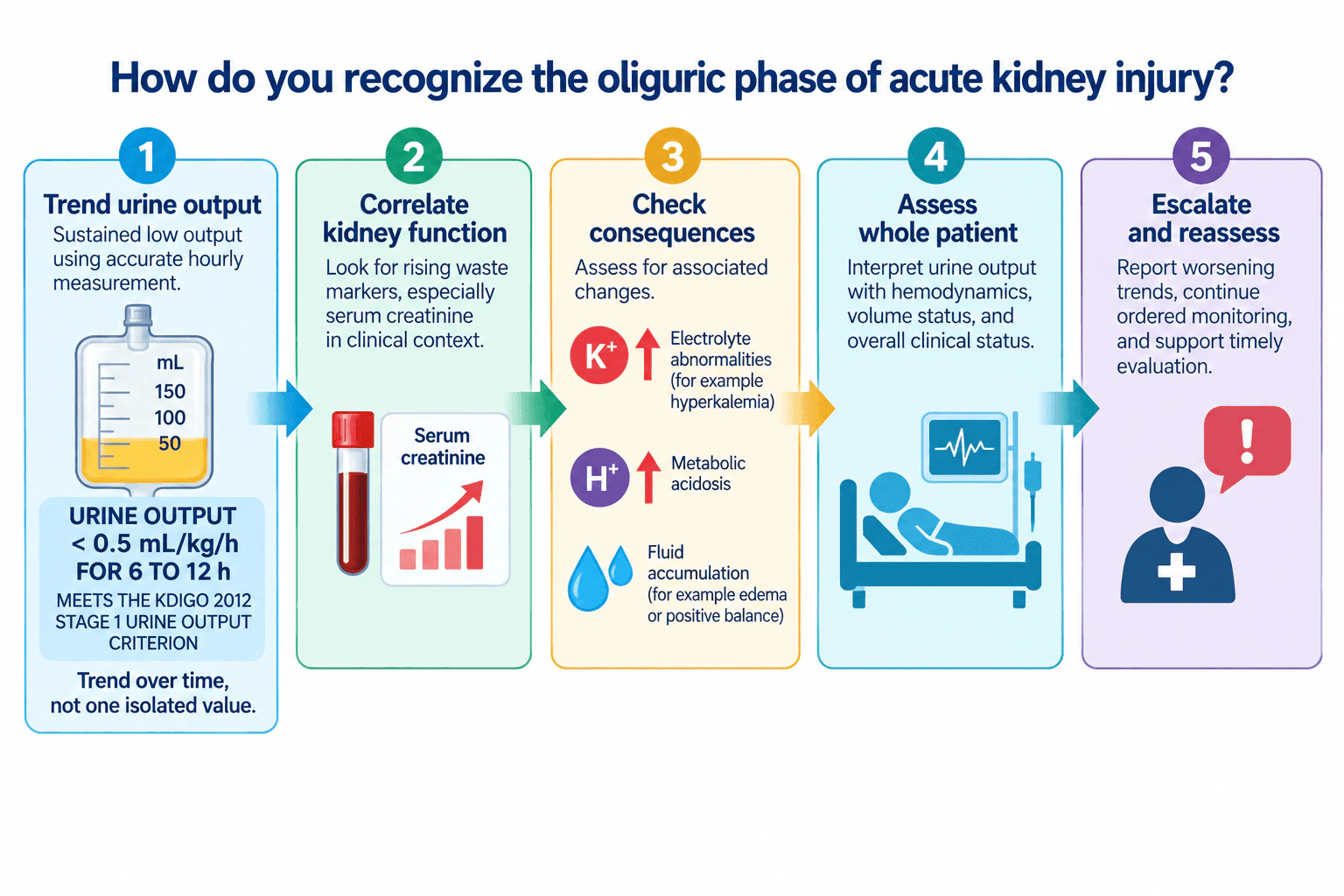
50. How do you recognize the oliguric phase of acute kidney injury?Renal Metabolic And Nutrition SupportMedium
i Question Details
Use urine output trend with rising waste markers, electrolyte changes, fluid accumulation, and overall clinical status rather than one isolated value.
Short Interview Answer (30-60 seconds)
I recognize oliguric acute kidney injury by trending urine output over time. In an adult, urine output below 0.5 mL/kg/h for 6 to 12 hours meets the KDIGO 2012 Stage 1 urine output criterion. I correlate the urine output trend with serum creatinine, electrolyte abnormalities such as hyperkalemia, metabolic acidosis, fluid accumulation, hemodynamics, volume status, and the overall clinical picture. Persistent or worsening findings require prompt communication, continued ordered monitoring, and reassessment.
Detailed Explanation
Oliguria in acute kidney injury is recognized from sustained low urine output interpreted together with kidney function and the patient's overall clinical condition. For an adult, urine output below 0.5 mL/kg/h for 6 to 12 hours meets the KDIGO 2012 Stage 1 urine output criterion. The key is to trend the output over time rather than react to one isolated value.
Useful Questions to Ask the Interviewer
How is hourly urine output measured and documented for critically ill patients in this unit?
What escalation process is used when urine output or renal laboratory trends worsen?
How are fluid balance and renal laboratory trends reviewed during multidisciplinary rounds?
How to Explain It in an Interview
Trend Urine Output
I first confirm that urine output is being measured accurately and review the hourly trend. Sustained urine output below 0.5 mL/kg/h for 6 to 12 hours meets the KDIGO 2012 Stage 1 urine output criterion. I would not interpret one isolated low measurement as the whole clinical picture.
Correlate Kidney Function
I correlate the urine output trend with kidney function, especially serum creatinine. A rising creatinine trend in the appropriate clinical context increases concern for worsening acute kidney injury.
Check Consequences
I look for associated complications, including electrolyte abnormalities such as hyperkalemia, metabolic acidosis, and fluid accumulation. These findings can accompany impaired renal function and help show whether the patient's condition is worsening.
Assess the Whole Patient
I interpret urine output with hemodynamics, volume status, cumulative fluid balance, and the patient's overall clinical condition. Oliguria alone does not identify the cause, so I avoid assuming that every patient with low urine output is volume depleted.
Escalate and Reassess
If oliguria persists or the renal, electrolyte, acid base, fluid, or hemodynamic picture worsens, I report the trend promptly and continue ordered monitoring and reassessment. I communicate objective findings and their time course so the responsible clinical team can evaluate the cause and determine treatment. I do not independently prescribe fluid replacement, electrolyte replacement, dialysis settings, or other renal support.
Why Interviewers Ask This
Interviewers are evaluating whether the nurse recognizes oliguria as a sustained trend, connects urine output with renal laboratory and bedside findings, recognizes complications of declining kidney function, and escalates deterioration appropriately without making conclusions from one isolated value or independently prescribing treatment.
Common interview mistakes
Common mistakes include reacting to one low urine output value without checking the trend, overlooking measurement accuracy, focusing only on serum creatinine, missing electrolyte or acid base changes, assuming oliguria always means volume depletion, overlooking fluid accumulation or hemodynamic status, and delaying escalation when the overall pattern is worsening.
Interview tip
Structure the answer around the same recognition sequence used at the bedside: trend urine output, correlate kidney function, check for electrolyte, acid base, and fluid consequences, assess the whole patient, then communicate worsening findings and reassess.
Interviewer may ask next
How would you verify that an apparent fall in urine output represents true oliguria?
I would confirm the documented time period and the patient weight used for the mL/kg/h calculation, verify that urine collection and charting are accurate, and review the output trend rather than one measurement. I would then correlate it with serum creatinine, fluid balance, hemodynamics, volume status, electrolyte and acid base trends, and the overall clinical condition.
What changes if the patient has low urine output but also has evidence of fluid accumulation?
I would not assume the patient needs additional fluid simply because urine output is low. I would assess the urine output trend together with cumulative fluid balance, edema or other evidence of fluid accumulation, hemodynamics, volume status, serum creatinine, electrolytes, acid base status, and the overall clinical condition. Persistent oliguria with fluid accumulation should be reported promptly while ordered monitoring and reassessment continue and the responsible clinical team determines treatment.
More questions load as you scroll
Disclaimer: This interview guide is for educational and informational purposes only. It is designed to help readers prepare, but it does not guarantee any interview result, hiring decision, offer, or outcome. Interview questions, hiring criteria, and preferred answers can vary by employer, interviewer, industry, location, and time. All answers, examples, and explanations in this guide are suggested examples for interview preparation, not definitive answers or instructions for professional practice. They are based on research and judgment, are provided without warranties of any kind, and should be adapted to the question, role, and applicable laws and professional requirements. Diagrams are simplified illustrations intended to highlight the main concepts and their relationships; actual situations, systems, and practices may be more complex. Alternative approaches may be equally valid or better suited to a particular question, context, or interviewer. To the fullest extent permitted by applicable law, the contributors and publisher are not liable for decisions made, actions taken, or losses incurred based on this guide.
State Laws and Professional Responsibilities: Laws and requirements governing an occupation vary by state and jurisdiction. You are responsible for checking the current laws, licensing requirements, and scope-of-practice rules that apply to your location and role, and for ensuring that your answers and actions comply with them. Adapt examples in this guide to those requirements. This guide is not legal advice.
Content Accuracy and Verification: To the fullest extent permitted by applicable law, we do not represent or warrant that interview guides, questions, answers, examples, or diagrams are accurate, complete, current, error-free, or suitable for any particular purpose. You are responsible for independently reviewing and verifying the information before relying on it.