This interview guide is for educational and informational purposes only. It is designed to help readers prepare, but it does not guarantee any interview result, hiring decision, offer, or outcome. Interview questions, hiring criteria, and preferred answers can vary by employer, interviewer, industry, location, and time. All answers, examples, and explanations in this guide are suggested examples for interview preparation, not definitive answers or instructions for professional practice. They are based on research and judgment, are provided without warranties of any kind, and should be adapted to the question, role, and applicable laws and professional requirements. Diagrams are simplified illustrations intended to highlight the main concepts and their relationships; actual situations, systems, and practices may be more complex. Alternative approaches may be equally valid or better suited to a particular question, context, or interviewer. To the fullest extent permitted by applicable law, the contributors and publisher are not liable for decisions made, actions taken, or losses incurred based on this guide.
State Laws and Professional Responsibilities
Laws and requirements governing an occupation vary by state and jurisdiction. You are responsible for checking the current laws, licensing requirements, and scope-of-practice rules that apply to your location and role, and for ensuring that your answers and actions comply with them. Adapt examples in this guide to those requirements. This guide is not legal advice.
Identity, Image, and Privacy Notice
To respect individual privacy, some names, profile photographs, avatars, biographical details, and other identifying information displayed in this guide may be replaced with pseudonyms, licensed stock images, illustrative avatars, composite images, or representative descriptions. Unless a person is expressly identified as an actual contributor, a displayed name, image, or profile should not be understood as depicting or identifying a specific candidate, interviewer, employee, or other real individual. These representations are provided for editorial and illustrative purposes only and do not imply endorsement, employment, participation, or affiliation with this guide or any company mentioned in it. Any resemblance to an actual person is coincidental.
Company Notice
This guide is an independent educational resource and is not affiliated with, endorsed by, sponsored by, or approved by the company named in this guide. Company names identify reported interview experiences or the employer context of clearly labeled original practice exercises. Interview practices can change without notice, and inclusion of company-specific content does not mean these questions are official, complete, or guaranteed to be asked. To the fullest extent permitted by law, the author, contributors, and publisher are not responsible for outcomes related to use of this material.
Content Accuracy and Verification
To the fullest extent permitted by applicable law, we do not represent or warrant that interview guides, questions, answers, examples, or diagrams are accurate, complete, current, error-free, or suitable for any particular purpose. You are responsible for independently reviewing and verifying the information before relying on it.
Questions or comments?
Contact us for general questions, or share feedback, technical corrections, and comments with the community.
21. How would you design a timer API?API DesignMediumNvidia
i Question Details
Design a timer API and explain start, stop, scheduling, cancellation, and reuse.
Short Interview Answer (30-60 seconds)
At a high level, I would make this a thread-safe timer API inside one Java process. The app creates a Timer, schedules one-time or recurring tasks, and gets back a ScheduledTask handle for cancel or status checks. A scheduler coordinator owns state changes, a delay queue or timing wheel finds due work, and worker threads run the task. The main trade-off is simplicity versus durability: an in-memory timer is easy and fast, while optional persistence helps recovery after restart.
Detailed Explanation
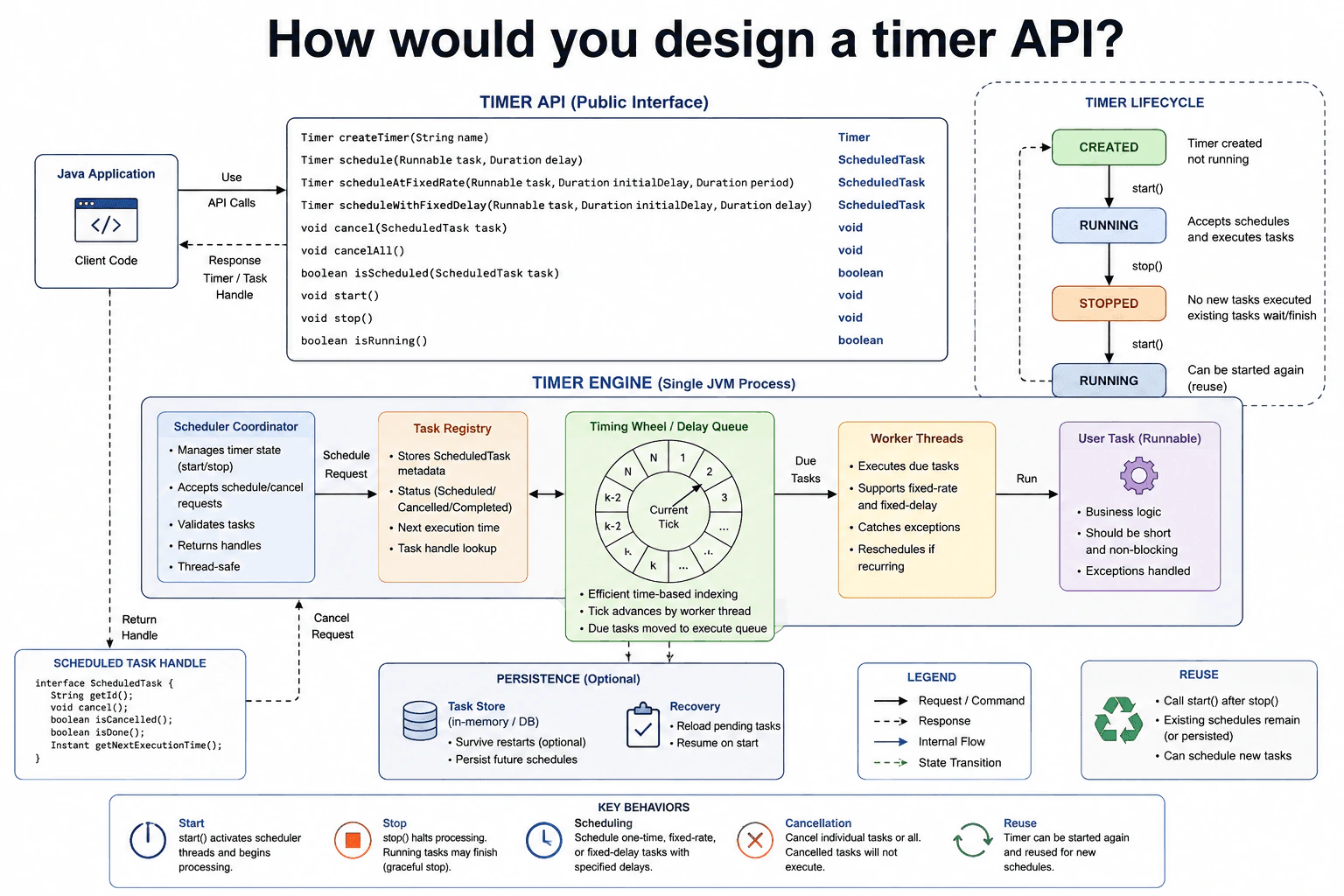
We are designing a timer for a program. It lets the app set work to happen later, repeat work, stop or start again, and cancel tasks. The goal is to keep the public API easy while the internal scheduler does the timing work. The hard part is choosing clear task handles and safe state changes, especially when many tasks run at once. I will follow the diagram from the public API to the engine, then cover cancellation, reuse, and optional recovery.
Useful Questions to Ask the Interviewer
Should scheduled tasks survive a process restart?
Do you want the timer to stay inside one Java process only, or should it later grow to a shared service?
How to Explain It in an Interview
1. Goal and API boundary
At a high level, I would separate the public Timer API (Public Interface) from the internal Timer Engine (Single JVM Process). The public side gives the app a clean way to create a timer, schedule work, cancel work, and check state. The internal side owns the scheduler coordinator, the task registry, the timing wheel or delay queue, and the worker threads. That split matters because the app should not manage time indexing or thread handling itself. The API keeps the caller simple, while the engine does the hard timing work.
2. Public API and task handles
I would expose methods like createTimer(String name), schedule(Runnable task, Duration delay), scheduleAtFixedRate(Runnable task, Duration initialDelay, Duration period), scheduleWithFixedDelay(Runnable task, Duration initialDelay, Duration delay), cancel(ScheduledTask task), cancelAll(), isScheduled(ScheduledTask task), start(), stop(), and isRunning(). The diagram also shows a ScheduledTask handle with getId(), cancel(), isCancelled(), isDone(), and getNextExecutionTime(). This handle is important because the caller needs a stable way to track one task after scheduling. The timer returns the handle, and later the app can use that same handle for cancel or status checks.
3. How scheduling works inside the engine
The request first reaches the Scheduler Coordinator. That component accepts schedule and cancel requests, validates them, returns handles, and keeps timer state thread-safe. Next, the Task Registry stores task metadata such as scheduled, cancelled, or completed state, plus the next execution time and handle lookup. The Timing Wheel / Delay Queue gives efficient time-based indexing, so the engine can find due tasks without scanning everything all the time. Then the Worker Threads execute the due tasks and catch exceptions. The task itself is shown as User Task (Runnable), so the business logic should be short and non-blocking.
4. Lifecycle, cancellation, and reuse
The lifecycle is simple: CREATED becomes RUNNING after start(), then STOPPED after stop(), and it can go back to RUNNING again. This is the reuse story in the diagram. stop() pauses new execution, but running tasks may still finish gracefully. cancel(ScheduledTask task) removes one task, while cancelAll() removes all scheduled work. Fixed-rate and fixed-delay tasks are both supported, but they behave differently. Fixed-rate tries to keep the same pace. Fixed-delay waits after each run finishes. That difference matters when a task sometimes runs slowly.
5. Optional persistence and recovery
The diagram marks Persistence (Optional) with a task store in memory or a database. I would only use that when task state must survive a restart. The recovery path can reload pending tasks and resume on start. That gives better durability, but it also adds more code and more state to manage. If persistence is not used, the design is faster and simpler, but scheduled tasks are lost when the process restarts. The trade-off is clear: keep the default timer light, and add recovery only when the product really needs it.
Practical Complexity & Trade-offs
This design is simple because the app talks to one timer object with clear methods. The benefit is that it is easy to understand, easy to test, and fast in one Java process. The timer engine then hides the hard parts, like finding the next task, running it on worker threads, and keeping task state safe. The downside is that an in-memory timer can lose work if the process stops. That is why the diagram adds optional persistence and recovery. This is safer, but it adds more code, more storage, and more recovery logic. We accept that cost only when restart durability matters.
Why Interviewers Ask This
The interviewer is checking whether I can design a small API that still feels clean in real use. They want to see correct method design, clear task handles, and a good split between public API and internal scheduler work. They also want to know if I understand lifecycle state, cancellation, recurring tasks, and safe reuse. Just as important, they are testing whether I can explain trade-offs in simple words, especially the difference between a lightweight in-memory timer and an optional persistent one.
Interviewer may ask next
What changes if the process restarts while tasks are scheduled?
I would keep the API the same, but I would rely on the optional Persistence block. The Task Store (in-memory / DB) would save future schedules and next execution time, and Recovery would reload pending tasks when the timer starts again. That keeps the public behavior stable and makes restart behavior more reliable. The downside is extra storage work and more recovery logic. If persistence is turned off, the timer stays simpler and faster, but scheduled tasks are lost on restart.
How do stop() and cancelAll() differ in this design?
stop() changes the timer lifecycle, while cancelAll() changes task state. With stop(), the scheduler stops accepting new execution work, but running tasks may still finish gracefully. With cancelAll(), every scheduled task is marked cancelled, so those tasks will not execute later. The API stays thread-safe because the Scheduler Coordinator owns both actions. The main downside is that stop() is not the same as instant shutdown, so some running work may still complete after the call.
22. How do you improve a relationship with stakeholders?BehavioralMediumNvidia
i Question Details
Describe a practical approach for improving stakeholder relationships, including communication, alignment, and follow-through.
Interview tip:
Use STAR to structure your answer: briefly explain the Situation and Task, make Action the most detailed part, and finish with the Result. For example, describe a situation where communication with stakeholders was not working well, how you learned their priorities, aligned expectations, improved communication, followed through on commitments, and built a more productive working relationship.
Situation
In my last role, I worked on a Java service that supported an important business process. The relationship between the development team and several business stakeholders had become difficult. They felt that technical updates were unclear and that they often learned about changes or delays too late. The development team also received changing requests without always understanding which business needs were most important.
Task
I was responsible for implementing part of the service, but I also wanted to improve how I worked with the stakeholders. My goal was to create clearer communication, make priorities easier to understand, and build confidence that I would follow through on what I committed to.
Action
I first spoke with the stakeholders directly and asked what information they needed from the engineering team to make decisions. I listened carefully instead of immediately defending our existing process. I learned that they did not need deep Java implementation details. They mainly wanted to understand what was changing, why it mattered, what risks existed, and when they could expect the next update. I then started explaining technical work in business terms. For example, instead of only saying that we were changing service logic, I explained how the change affected the business process and what behavior users should expect. I also confirmed priorities before starting work so that the team and stakeholders had the same understanding of what mattered most. When I saw a risk that could affect an agreed expectation, I raised it early and explained the available options instead of waiting until the end. After meetings, I summarized important decisions, owners, and next steps so that everyone had the same reference. Most importantly, I made sure that I completed the actions I had accepted or clearly communicated when something changed. This consistent follow through helped show that my updates could be trusted.
Result
Over time, the conversations became more constructive and there was less confusion about priorities and technical changes. Stakeholders started involving me earlier when discussing requirements because they trusted that I would listen, explain tradeoffs clearly, and communicate problems early. I learned that improving a stakeholder relationship is not mainly about having more meetings. It comes from understanding what the other person needs, creating clear expectations, and consistently doing what you say you will do.
Why Interviewers Ask This
Interviewers ask this question to understand how a candidate builds trust with people who may have different goals, knowledge, and priorities. A strong answer shows that the candidate listens, communicates technical information clearly, aligns expectations, handles problems early, and follows through consistently.
Interviewer may ask next
How did you handle a stakeholder who disagreed with your technical recommendation?
I first made sure I understood the concern behind the disagreement. Then I explained the technical options in terms of business impact, risk, and expected behavior rather than focusing only on implementation details. If the stakeholder still preferred another option, I worked with the team to confirm whether it was technically safe and supported the agreed decision once everyone understood the tradeoffs.
What would you do differently if you faced the same situation again?
I would establish the communication approach earlier instead of waiting until the relationship became difficult. At the start of the work, I would agree with stakeholders on priorities, the type of updates they need, how decisions will be recorded, and when risks should be raised. That would help prevent misunderstandings before they grow.
23. Tell me about a time you had to deal with a condescending teammate?BehavioralMediumNvidia
i Question Details
Describe a real situation with a condescending teammate, how you responded, and what the outcome was.
Interview tip:
Use STAR to structure your answer: briefly explain the Situation and Task, make Action the most detailed part, and finish with the Result. For example, describe a situation where a teammate spoke to you in a condescending way, how you stayed professional, addressed the behavior directly, kept the discussion focused on the work, and improved the working relationship.
Situation
In my last role, I was working with another developer on changes to a Java service. During code reviews and technical discussions, the teammate sometimes responded to my questions in a condescending way. Instead of explaining a concern, he would make comments that suggested the answer should have been obvious. It started making our discussions less productive.
Task
I needed to keep the project moving while maintaining a professional working relationship. I also wanted to address the communication problem before it affected collaboration with the rest of the team.
Action
I did not challenge him during a group discussion because I did not want the conversation to become personal or defensive. I asked to speak with him privately. I explained specific examples of how some of his comments were coming across and told him that I wanted our reviews to focus on the code and the reasoning behind our decisions. I also asked whether there was anything about my communication that was making our discussions difficult. He explained that he tended to be very direct when he believed a technical issue was straightforward. I acknowledged that direct feedback was useful, but I explained that comments about what someone should already know did not help us solve the problem. After that conversation, I changed my own approach as well. When I disagreed with him, I brought concrete examples such as the relevant Java code, test behavior, or service requirements so we could discuss evidence instead of personal opinions. In later reviews, if either of us saw a problem, we explained the technical reason and suggested a specific alternative. This kept the discussion centered on the work and made it easier for both of us to contribute.
Result
Our communication became more respectful and our code reviews became easier to work through. We were able to collaborate without the same tension, and the issue did not need to be escalated. I learned that when someone communicates in a difficult way, addressing the behavior privately and specifically is usually more effective than reacting in the moment. I also learned to keep technical disagreements focused on evidence and shared goals.
Why Interviewers Ask This
Interviewers ask this question to understand how a candidate handles interpersonal conflict without becoming defensive or damaging the team relationship. A strong answer shows emotional control, respectful communication, willingness to address uncomfortable behavior directly, and the ability to keep disagreements focused on productive work.
Interviewer may ask next
Why did you choose to speak with the teammate privately instead of raising the issue with your manager?
I wanted to give us a chance to resolve the issue directly first. The problem was mainly about how we communicated, not misconduct that required immediate escalation. A private conversation also reduced the chance that he would feel embarrassed or defensive. If the behavior had continued after that conversation, I would have involved my manager.
What would you do if the teammate continued acting the same way after your conversation?
I would continue documenting specific examples and keep my own communication professional. I would then speak with my manager and explain the pattern, the conversation I had already tried, and how the behavior was affecting collaboration. I would focus on finding a workable solution rather than asking the manager to take sides.
24. What is important to customers in the chip sector? Do you know who our customers are?BehavioralMediumNvidia
i Question Details
Explain what matters most to customers in the chip sector and how you would identify NVIDIA’s customers for the role.
Interview tip:
Use STAR to structure your answer: briefly explain the Situation and Task, make Action the most detailed part, and finish with the Result. For example, describe a previous software project where you learned what technical customers valued, translated those needs into reliable Java services, worked closely with other teams, and used that experience to explain the needs of NVIDIA customers such as cloud providers, system manufacturers, enterprises, automotive companies, developers, and end users.
Situation
In my last role, I worked on a Java service that supported a technical platform used by other engineering teams. I learned that technical customers do not judge a product only by raw performance. They also care about reliability, compatibility, predictable behavior, clear interfaces, security, support, and whether the product solves their real workload needs.
Task
My responsibility was to make the service dependable for the teams using it and to understand which requirements mattered most to them. I also needed to avoid making technical decisions based only on what looked good from the development side.
Action
I first spoke with the teams that consumed our service and reviewed the problems they were seeing in normal use. I grouped their needs into practical priorities such as stable behavior, fast response, backward compatibility, clear error handling, and good documentation. I then used those priorities when making changes to the Java service. For example, before changing an interface, I checked how existing consumers depended on it and worked with the team to preserve compatibility where possible. I also treated reliability issues as customer issues, not just engineering defects, because an unstable dependency can block another team's product. That experience shapes how I think about the chip sector. Customers care about performance, but they also need power efficiency, reliability, software compatibility, security, availability, support, and a platform that works well with their applications. For NVIDIA, I understand the customer base is broad. It includes cloud providers, computer and system manufacturers, enterprises, automotive companies, software developers, researchers, and people using products built on NVIDIA technology. For a Java Developer role, I would also identify which of those groups directly consumes the software or services my team supports, then learn their workloads, integration needs, and operational problems before deciding what to optimize.
Result
The service became easier for the consuming teams to use and maintain because our decisions were tied more closely to their actual needs. I learned that understanding the customer means looking beyond the immediate technical requirement and asking how reliability, compatibility, performance, and support affect the customer's complete product. I would bring that same customer focused approach to NVIDIA.
Why Interviewers Ask This
Interviewers ask this question to see whether the candidate understands that semiconductor customers evaluate a complete technology platform, not only chip specifications. A strong answer shows customer awareness, practical engineering judgment, knowledge of NVIDIA's broad customer groups, and the ability to connect software decisions to reliability, compatibility, performance, and real customer workloads.
Interviewer may ask next
How would you learn which customer requirements matter most for your Java service at NVIDIA?
I would start with the teams and customers that directly consume the service. I would review their workloads, integration patterns, support issues, reliability concerns, and performance needs. Then I would work with product and engineering partners to rank those needs by customer impact before deciding what the Java service should optimize.
Why did you prioritize compatibility instead of simply improving the interface?
I knew that an interface improvement could still hurt customers if it broke existing integrations. I first checked how consumers were using the service, then worked with the team to preserve existing behavior where possible. That taught me to evaluate improvements from the customer's operational point of view, not only from the developer's point of view.
25. How do you prioritize your work when dealing with tight deadlines?BehavioralMediumNvidia
i Question Details
Describe how you rank tasks, manage deadlines, and keep delivery quality high under pressure.
Interview tip:
Use STAR to structure your answer: briefly explain the Situation and Task, make Action the most detailed part, and finish with the Result. For example, describe a realistic project where you ranked work by user impact and dependency, protected the most important delivery, communicated tradeoffs early, and kept testing and code quality strong under a tight deadline.
Situation
In my last role, I was working on a Java service that supported an important application flow. Near the end of a release cycle, we had several development tasks, a few defects, and a fixed delivery date. There was not enough time to complete every requested improvement safely.
Task
I was responsible for completing my part of the release while making sure the most important functionality was reliable. I needed to decide what to work on first, make the tradeoffs clear to the team, and avoid creating quality problems just to meet the deadline.
Action
I first reviewed each task based on user impact, release risk, dependencies, and the effort needed to complete it safely. I gave the highest priority to work that blocked the main application flow or other developers. I then separated required release work from improvements that could wait. I discussed that order with the team so everyone understood what I was prioritizing and why. For my Java changes, I kept the implementation focused instead of adding optional refactoring during the deadline. I still completed unit tests, reviewed error handling, and checked the important integration paths because removing basic quality checks would only move the problem into production. I also shared progress early when I saw a task taking longer than expected. That gave the team time to adjust scope instead of discovering the issue at the end. As I finished each high priority item, I reviewed the remaining work again because priorities could change as blockers were removed.
Result
We delivered the important release work on time with the critical application flow protected. Lower priority improvements were moved to later work instead of being rushed into the release. I learned that tight deadlines are easier to manage when priorities are based on impact and risk, and when tradeoffs are communicated early rather than hidden.
Why Interviewers Ask This
Interviewers ask this question to understand how a candidate makes decisions when time and resources are limited. A strong answer shows that the candidate can identify the most important work, manage risk, communicate tradeoffs, protect quality, and take ownership of delivery under pressure.
Interviewer may ask next
How did you decide which tasks could be moved to later work?
I looked at whether each task affected the main user flow, blocked another task, reduced release risk, or was required for a safe delivery. Work that was useful but did not affect those areas was a better candidate to move. I also discussed those choices with the team before changing the planned scope.
What would you do differently if the deadline became even tighter?
I would raise the risk earlier and reduce scope more aggressively around the essential user flow. I would still keep the minimum testing and review needed for a safe release. I would also make the remaining tradeoffs visible to the team so the deadline decision was based on clear impact rather than simply working faster.
26. Why do you want to work at NVIDIA?BehavioralMediumNvidia
i Question Details
Describe your motivation for joining NVIDIA and connect it to the role, team, and the work you want to do.
Interview tip:
Use STAR to structure your answer: briefly explain the Situation and Task, make Action the most detailed part, and finish with the Result. For example, describe a previous Java project that made you interested in building reliable and high performance systems, explain what you personally contributed, and connect what you learned from that experience to why the Java Developer role, engineering environment, and technical work at NVIDIA interest you.
Situation
In my last role, I worked on a Java service that handled a large amount of application data and supported other services through APIs. As the system grew, I became more interested in the engineering problems behind performance, reliability, concurrency, and efficient use of computing resources.
Task
My responsibility was to improve the service while keeping it stable and easy for the team to maintain. I also wanted to understand the system more deeply instead of only completing individual feature requests.
Action
I studied the request flow, reviewed the Java code around the busiest operations, and used application metrics and profiling information to understand where time and resources were being spent. I improved parts of the processing logic, reduced unnecessary work, and paid close attention to thread safety because several requests could execute at the same time. I discussed the changes with other engineers so that we could challenge assumptions before making changes to important code. I also learned more about how software performance depends on the underlying computing platform. That experience made me realize that I enjoy working where software engineering and high performance computing meet. This is a major reason NVIDIA interests me. As a Java Developer, I would like to work on reliable services and platforms that support demanding technical workloads. I am also attracted to an environment where engineers need to understand performance carefully, collaborate across technical areas, and keep learning as the systems become more complex.
Result
The service became more stable and efficient, and the team had a clearer understanding of the important performance paths. More importantly for me, the experience clarified the kind of work I want to continue doing. I want to build strong Java systems while learning from engineers who work on challenging computing problems, which is why the opportunity at NVIDIA is especially interesting to me.
Why Interviewers Ask This
Interviewers ask this question to understand whether the candidate has a thoughtful reason for choosing NVIDIA and whether the role fits the candidate's technical interests and career direction. A strong answer connects genuine motivation to Java engineering work, shows awareness of the type of technical environment the company offers, and explains how the candidate hopes to contribute and grow.
Interviewer may ask next
What part of the Java Developer role at NVIDIA interests you most?
I am most interested in building reliable Java services that support technically demanding systems. My previous experience showed me that I enjoy investigating performance, concurrency, and system behavior instead of treating a service as a black box. I would like to continue developing those skills while contributing to software that has strong reliability and performance requirements.
How did your previous project influence what you want in your next role?
It showed me that I am most engaged when I can combine application development with deeper engineering work. I enjoyed tracing how requests moved through the service, understanding performance problems, making careful Java changes, and discussing tradeoffs with other engineers. In my next role, I want more opportunities to solve that kind of problem while learning about the computing systems underneath the application layer.
27. If you were to be designated as a go to person or SME, which specific skills could others draw from you?BehavioralMediumNvidia
i Question Details
Describe the specific strengths or subject-matter expertise that others can rely on you for.
Interview tip:
Use STAR to structure your answer: briefly explain the Situation and Task, make Action the most detailed part, and finish with the Result. For example, describe a previous project where teammates relied on your Java expertise, explain the specific technical skills you became known for, show how you helped others solve difficult problems and make sound decisions, and describe how your support improved the team's ability to deliver reliable software.
Situation
In my last role, I worked on a Java service that handled important business workflows. As the service grew, developers often needed help understanding unexpected application behavior, reviewing changes, and deciding how to solve issues without making the code harder to maintain. Over time, I became someone the team regularly approached for Java debugging, application design, and code quality questions.
Task
My responsibility was not only to complete my own development work, but also to help teammates solve difficult problems efficiently. I wanted to make sure that people could draw from my knowledge of Java, Spring based applications, debugging, testing, and clean code practices without becoming dependent on me for every decision.
Action
I focused on a few skills where I could provide practical value. First, I helped with Java debugging. When someone brought me an issue, I did not immediately give them an answer. I worked through the evidence with them, such as logs, stack traces, which show the sequence of calls leading to an error, request flow, which shows how a request moves through the application, thread behavior, which shows how separate paths of work are running, and the relevant code path. This helped us find the actual cause instead of changing code based on assumptions. Second, teammates relied on me for designing clear Java services and reviewing code. I looked for simple class responsibilities, understandable interfaces, safe error handling, and code that could be tested easily. I explained why I recommended a change so the developer could apply the same reasoning later. Third, I helped with Spring application behavior, especially dependency management, which controls how required application objects are provided, transaction boundaries, which define where a group of database changes starts and ends, configuration, and service integration issues. When the same type of question appeared more than once, I documented the reasoning and shared examples with the team. I also encouraged developers to bring alternatives when asking for advice. We could then compare the tradeoffs together instead of treating my opinion as the only solution. This made my role as a go to person more about transferring knowledge than controlling decisions.
Result
The team became more comfortable diagnosing Java issues and making design decisions without always needing help. Reviews also became more focused because we had a clearer shared understanding of maintainable Java code. I learned that the most useful SME is not simply the person who knows an answer. It is someone who can explain the reasoning clearly, help others build the same skill, and remain open to better ideas from the team.
Why Interviewers Ask This
Interviewers ask this question to understand where a candidate has genuine depth and whether that expertise can benefit a wider engineering team. A strong answer identifies specific skills, shows that coworkers can rely on those skills in real situations, and demonstrates the ability to teach, communicate, and support good technical decisions rather than simply claiming to be an expert.
Interviewer may ask next
How did you avoid becoming a bottleneck when teammates frequently came to you for help?
I tried to solve the knowledge gap instead of repeatedly solving the same problem myself. I explained my reasoning while working with the developer, documented recurring issues, and encouraged teammates to investigate and bring possible solutions before we discussed them. That helped people become more independent while still knowing that I was available for difficult cases.
Which of those skills would you consider your strongest area of expertise?
I would choose Java debugging and application design. I am comfortable tracing behavior from a symptom through logs, stack traces, which show the sequence of calls leading to an error, framework behavior, and the code path to find the underlying cause. I also enjoy turning that understanding into a simple design that is easier to test and maintain, and explaining the reasoning so other developers can use the same approach.
28. Please list all products, applications, or technologies in which you have hands-on experience working with as they relate to the position you are applying for.BehavioralMediumNvidia
i Question Details
List the products, applications, or technologies you have worked with and explain how they connect to the role.
Interview tip:
Use STAR to structure your answer: briefly explain the Situation and Task, make Action the most detailed part, and finish with the Result. For example, describe the Java products, applications, and technologies you used on a real project, explain your responsibility for choosing and applying them, show how you worked with the team to build and support the application, and connect that hands on experience to the Java Developer role.
Situation
In my last role, I worked on a Java based backend application that handled business requests through REST APIs and communicated with databases and other services. My hands on technology experience included Java, Spring Boot, Spring MVC, Spring Data JPA, Hibernate, REST APIs, SQL, PostgreSQL, Kafka, Maven, JUnit, Mockito, Git, Docker, Kubernetes, Jenkins, and Linux.
Task
My responsibility was to develop and maintain backend services, make sure the application could exchange data reliably with other systems, write tests, investigate production issues, and support the application through the build and deployment process. I also needed to understand how these technologies worked together instead of treating each one as an isolated tool.
Action
I used Java as the main programming language and Spring Boot to build the application services. I used Spring MVC to create REST endpoints and Spring Data JPA with Hibernate to read and write relational data. I wrote SQL when I needed to understand queries directly or investigate database behavior in PostgreSQL. For asynchronous communication between services, I worked with Kafka and made sure message processing handled failures safely. I used Maven to manage dependencies and builds. I wrote unit tests with JUnit and Mockito so I could verify business logic before changes moved further through the delivery process. I used Git for source control and code reviews. I worked with Docker to package the application consistently and Kubernetes to understand how the service was deployed and operated. Jenkins supported our automated build and deployment flow, and I used Linux commands regularly when checking logs, application processes, and runtime problems. These technologies connect closely to this Java Developer position because they cover the full path from writing Java code to testing, integration, deployment, and production support.
Result
This experience gave me practical knowledge of the complete Java application lifecycle rather than experience with only the programming language. I became more effective at choosing the right place to investigate an issue, communicating with teammates who owned different parts of the system, and making changes with an understanding of how they could affect the application from development through production. I also learned that strong Java development requires understanding the surrounding platform and tools, not only writing correct Java code.
Why Interviewers Ask This
Interviewers ask this question to understand the depth and relevance of the candidate's hands on technical experience. A strong answer shows which technologies the candidate has actually used, what responsibility they had with each one, and whether that experience matches the development, testing, integration, deployment, and support work expected in the Java Developer role.
Interviewer may ask next
Which of these technologies did you use most deeply, and what did you personally do with it?
Java and Spring Boot were the technologies I used most deeply because I worked with them directly when implementing backend services. I wrote business logic, created REST endpoints, integrated persistence code with Spring Data JPA and Hibernate, added validation and error handling, and wrote tests with JUnit and Mockito. I also investigated defects in this code, so my experience included both new development and ongoing support.
How did your experience with Docker and Kubernetes help you as a Java Developer?
Docker and Kubernetes helped me understand what happened to my Java service after the code was built. I could check how the application was packaged, review configuration and logs, and understand whether a problem came from application code, configuration, or the runtime environment. That made it easier for me to work with the team during deployment and production troubleshooting instead of treating deployment as something completely separate from development.
29. What does NVIDIA do, how would you describe it?BehavioralMediumNvidia
i Question Details
Explain NVIDIA’s business in simple terms and tailor the explanation to the role you are discussing.
Interview tip:
Use STAR to structure your answer: briefly explain the Situation and Task, make Action the most detailed part, and finish with the Result. For example, describe how you would explain NVIDIA’s business in simple terms, connect its computing platforms and software to real customer problems, and relate that work to the responsibilities of a Java Developer.
Situation
While preparing for this interview, I wanted to understand NVIDIA beyond simply thinking of it as a company that makes graphics processors. I looked at what problems its technology solves and how those products fit together.
Task
My goal was to explain NVIDIA in simple terms and connect its business to the Java Developer role I am discussing, instead of repeating product names without explaining why they matter.
Action
I would describe NVIDIA as a computing company focused on accelerated computing and artificial intelligence. It designs powerful processors and complete computing platforms that help computers perform demanding work faster. Its technology is used in areas such as AI data centers, gaming, professional graphics, autonomous vehicles, and robotics. NVIDIA also combines computing hardware with networking and software, so customers can build and run large AI and high performance computing systems as complete platforms rather than treating each part separately. For a Java Developer, I would connect that mission to the software around those platforms. Large computing environments still need reliable backend services, APIs, distributed systems, automation, monitoring, and tools that coordinate work between users and infrastructure. Java is useful for building services where reliability, concurrency, maintainability, and clear interfaces matter. I would therefore see the role as helping turn powerful computing infrastructure into software systems that developers and customers can use reliably.
Result
That understanding gives me a clearer way to describe NVIDIA. I see it as a company building computing platforms that combine processors, networking, and software to solve demanding computing problems, especially in AI. It also helps me explain why a Java Developer can contribute even when the most visible NVIDIA products are hardware. The lesson for me is to understand the complete system and the customer problem, not only the individual technology.
Why Interviewers Ask This
Interviewers ask this question to see whether the candidate understands NVIDIA’s business and can explain technical ideas clearly. For a Java Developer, a strong answer also shows that the candidate can connect backend software engineering work to the larger computing platforms and customer problems the company addresses.
Interviewer may ask next
How do you think a Java Developer contributes to NVIDIA’s business?
I think a Java Developer can contribute by building reliable services and APIs around computing platforms. That can include backend systems that manage workloads, expose platform capabilities, process data, automate operations, or provide monitoring. I would focus on making those services reliable, scalable, observable, and easy for other engineers or customers to use.
What part of NVIDIA’s business interests you most?
The accelerated computing and AI platform side interests me most because it combines difficult infrastructure problems with practical software engineering. I like the idea of working on Java services that sit around large computing systems, where good API design, concurrency, reliability, and distributed system decisions can make powerful infrastructure easier to use.
30. What tools do you use in your current role?BehavioralMediumNvidia
i Question Details
Describe the tools you use today, why you use them, and how they help you deliver work.
Interview tip:
Use STAR to structure your answer: briefly explain the Situation and Task, make Action the most detailed part, and finish with the Result. For example, describe the tools you use in your current Java development work, why you chose them for coding, testing, debugging, collaboration, and delivery, how you use them together, and how they help you deliver reliable work.
Situation
In my current role, I work on Java services that need to be developed, tested, reviewed, and released reliably. I use a small set of tools throughout that workflow rather than treating each tool separately.
Task
My responsibility is to turn requirements into maintainable Java code, find problems early, work smoothly with the team, and make sure changes are safe to release.
Action
For development, I mainly use IntelliJ IDEA because its Java support helps me navigate large codebases, refactor code safely, run tests, and debug problems. I use Maven to manage dependencies and build the application in a consistent way. I use Git for version control, so I can keep changes focused, review differences before committing, and collaborate through code reviews. For testing, I use JUnit and Mockito to check business logic and isolate dependencies when needed. When I investigate an issue, I first reproduce it locally when possible, then use the IntelliJ debugger, application logs, and API tools such as Postman to trace the request and understand where the behavior changes. I also use our continuous integration system to run builds and tests automatically before changes are merged. I do not choose a tool only because it is familiar. I use each one for a clear purpose, and I try to keep the workflow simple so another developer can understand and repeat it.
Result
This toolset helps me move from coding to testing and review in a consistent way. It also helps me catch problems earlier, explain my changes clearly during reviews, and release code with more confidence. I have learned that knowing why and when to use a tool is more important than simply knowing many tools.
Why Interviewers Ask This
Interviewers ask this question to understand whether the candidate has practical experience with the tools used in modern Java development and whether the candidate can explain why each tool matters. A strong answer shows sound engineering judgment, an organized development workflow, and the ability to use tools to improve code quality, collaboration, debugging, testing, and delivery.
Interviewer may ask next
Which of these tools is most important when you are debugging a Java issue?
I usually start with application logs because they help me understand the request path and identify where the unexpected behavior begins. If I can reproduce the issue locally, I then use the IntelliJ debugger to inspect values and follow the code step by step. I may also use Postman when the problem involves an API request. I choose the tool based on the type of evidence I need rather than using the debugger for every problem.
How do these tools help you maintain code quality before a change is released?
I use IntelliJ IDEA to catch code problems while developing, JUnit and Mockito to test the behavior, Maven to build the application consistently, and Git to review exactly what changed. The continuous integration system then runs the build and tests again before the change is merged. Together, these tools give me several chances to catch mistakes before the code reaches a release.
More questions load as you scroll
Disclaimer: This interview guide is for educational and informational purposes only. It is designed to help readers prepare, but it does not guarantee any interview result, hiring decision, offer, or outcome. Interview questions, hiring criteria, and preferred answers can vary by employer, interviewer, industry, location, and time. All answers, examples, and explanations in this guide are suggested examples for interview preparation, not definitive answers or instructions for professional practice. They are based on research and judgment, are provided without warranties of any kind, and should be adapted to the question, role, and applicable laws and professional requirements. Diagrams are simplified illustrations intended to highlight the main concepts and their relationships; actual situations, systems, and practices may be more complex. Alternative approaches may be equally valid or better suited to a particular question, context, or interviewer. To the fullest extent permitted by applicable law, the contributors and publisher are not liable for decisions made, actions taken, or losses incurred based on this guide.
State Laws and Professional Responsibilities: Laws and requirements governing an occupation vary by state and jurisdiction. You are responsible for checking the current laws, licensing requirements, and scope-of-practice rules that apply to your location and role, and for ensuring that your answers and actions comply with them. Adapt examples in this guide to those requirements. This guide is not legal advice.
Company Notice: This guide is an independent educational resource and is not affiliated with, endorsed by, sponsored by, or approved by the company named in this guide. Company names identify reported interview experiences or the employer context of clearly labeled original practice exercises. Interview practices can change without notice, and inclusion of company-specific content does not mean these questions are official, complete, or guaranteed to be asked. To the fullest extent permitted by law, the author, contributors, and publisher are not responsible for outcomes related to use of this material.
Content Accuracy and Verification: To the fullest extent permitted by applicable law, we do not represent or warrant that interview guides, questions, answers, examples, or diagrams are accurate, complete, current, error-free, or suitable for any particular purpose. You are responsible for independently reviewing and verifying the information before relying on it.