This interview guide is for educational and informational purposes only. It is designed to help readers prepare, but it does not guarantee any interview result, hiring decision, offer, or outcome. Interview questions, hiring criteria, and preferred answers can vary by employer, interviewer, industry, location, and time. All answers, examples, and explanations in this guide are suggested examples for interview preparation, not definitive answers or instructions for professional practice. They are based on research and judgment, are provided without warranties of any kind, and should be adapted to the question, role, and applicable laws and professional requirements. Diagrams are simplified illustrations intended to highlight the main concepts and their relationships; actual situations, systems, and practices may be more complex. Alternative approaches may be equally valid or better suited to a particular question, context, or interviewer. To the fullest extent permitted by applicable law, the contributors and publisher are not liable for decisions made, actions taken, or losses incurred based on this guide.
State Laws and Professional Responsibilities
Laws and requirements governing an occupation vary by state and jurisdiction. You are responsible for checking the current laws, licensing requirements, and scope-of-practice rules that apply to your location and role, and for ensuring that your answers and actions comply with them. Adapt examples in this guide to those requirements. This guide is not legal advice.
Identity, Image, and Privacy Notice
To respect individual privacy, some names, profile photographs, avatars, biographical details, and other identifying information displayed in this guide may be replaced with pseudonyms, licensed stock images, illustrative avatars, composite images, or representative descriptions. Unless a person is expressly identified as an actual contributor, a displayed name, image, or profile should not be understood as depicting or identifying a specific candidate, interviewer, employee, or other real individual. These representations are provided for editorial and illustrative purposes only and do not imply endorsement, employment, participation, or affiliation with this guide or any company mentioned in it. Any resemblance to an actual person is coincidental.
Company Notice
This guide is an independent educational resource and is not affiliated with, endorsed by, sponsored by, or approved by the company named in this guide. Company names identify reported interview experiences or the employer context of clearly labeled original practice exercises. Interview practices can change without notice, and inclusion of company-specific content does not mean these questions are official, complete, or guaranteed to be asked. To the fullest extent permitted by law, the author, contributors, and publisher are not responsible for outcomes related to use of this material.
Content Accuracy and Verification
To the fullest extent permitted by applicable law, we do not represent or warrant that interview guides, questions, answers, examples, or diagrams are accurate, complete, current, error-free, or suitable for any particular purpose. You are responsible for independently reviewing and verifying the information before relying on it.
Questions or comments?
Contact us for general questions, or share feedback, technical corrections, and comments with the community.
31. What's the difference between let and var in Swift, and why does the compiler push you toward let?System DesignHardApple
i Question Details
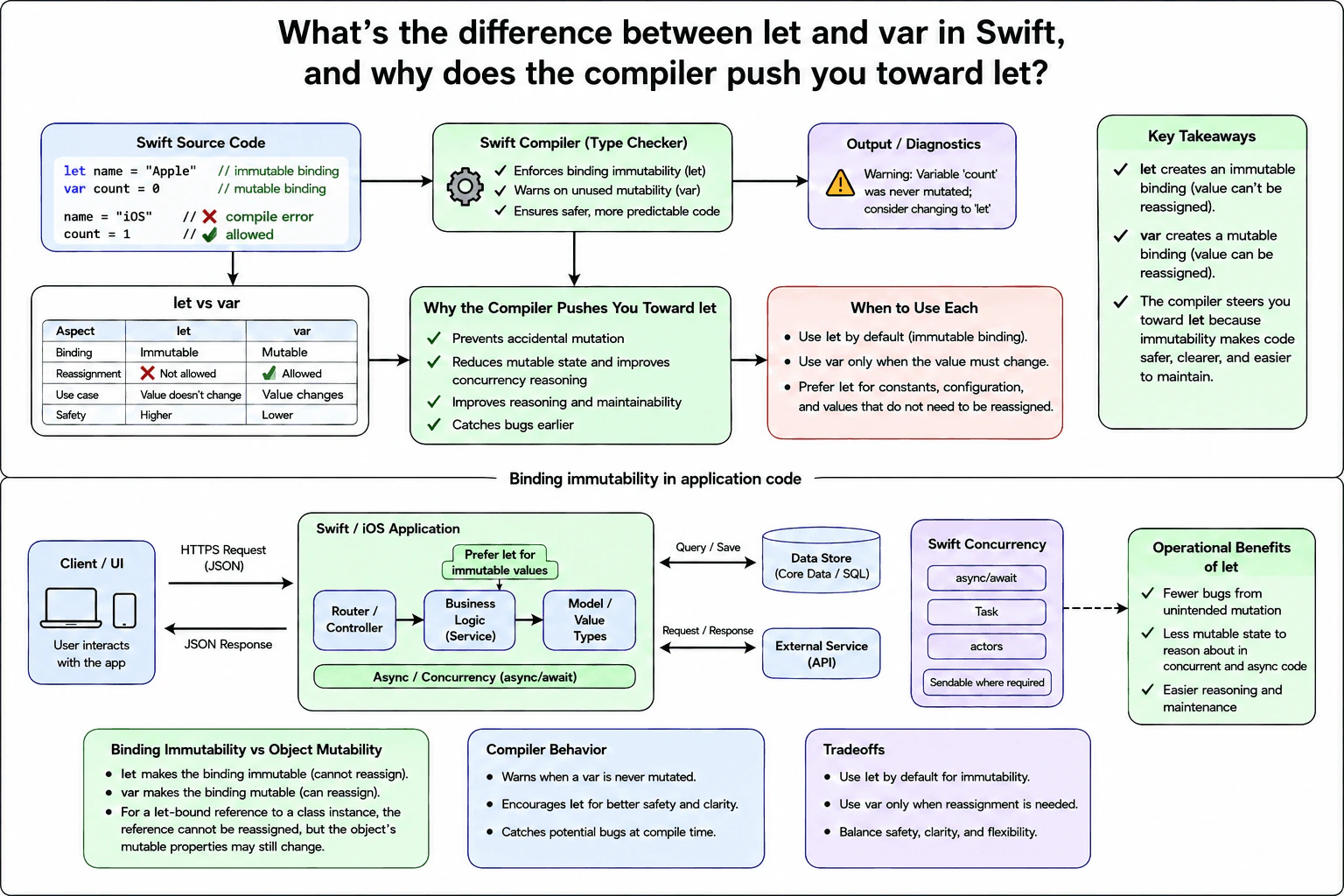
Explain binding immutability versus object mutability, why the compiler warns on unused mutability, and how that prevents bugs.
Short Interview Answer (30-60 seconds)
At a high level, let and var control whether a Swift binding can be reassigned. The main challenge is separating binding immutability from an object's internal mutability. I would explain this in three parts: how let and var behave, why the compiler prefers let, and how this helps application code. let blocks accidental reassignment, while var allows reassignment when needed. The trade-off is simple: let gives clearer intent and less mutable state, while var gives necessary flexibility.
Detailed Explanation
The question asks when a Swift name should stay attached to the same value and when it may be reassigned. The important part is that a fixed binding does not always mean the object behind it can never change. The compiler also notices when we choose var but never reassign it. The diagram explains this first with simple code, then with compiler behavior, and finally with examples inside application and concurrent code. The goal is to show why choosing the least mutability possible prevents mistakes and makes the programmer's intent easier to understand.
Useful Questions to Ask the Interviewer
Should I explain both value types and reference types?
Should I include how let and var relate to concurrent Swift code?
Do you want examples from normal Swift application code as well as basic syntax?
How to Explain It in an Interview
1. Start with the binding rule
I would first say that let creates a binding that cannot be reassigned. var creates a binding that can be reassigned.
For example, the diagram shows let name = "Apple". Trying to assign name = "iOS" is a compile-time error. It also shows var count = 0, where changing count to 1 is allowed.
The comparison table says the same thing. let is for a binding that should stay fixed. var is for a binding that must be allowed to change.
2. Explain why the compiler pushes toward let
The compiler warns when a local variable declared with var is never mutated. It suggests changing that variable to let.
This is useful because unnecessary mutability creates more possible changes. A later line of code could accidentally reassign something important. Using let removes that type of mistake at compile time.
The benefit is clearer intent. A reader immediately knows the binding should stay stable. This also reduces mutable state and makes concurrent code easier to reason about.
3. Separate binding immutability from object mutability
This distinction is very important. A let binding cannot be reassigned, but that does not always freeze the object behind it.
For a class instance, a let-bound reference cannot be replaced with a different instance. However, mutable properties inside that same instance may still change when their declarations allow it.
Value types behave differently. When a value type is stored in a let binding, that stored value cannot be mutated through that binding.
4. Show how this appears in application code
The lower flow shows a Client/UI calling a Swift/iOS Application. Inside the application, Router/Controller passes work to Business Logic, which works with Model/Value Types.
The application can query or save data through the Data Store and make requests to an External Service. These components are application examples. They do not change the language rule.
The diagram recommends preferring let for bindings that do not need reassignment. var should be used only when reassignment is part of the required behavior.
5. Explain concurrency and the trade-off
The Swift Concurrency box shows async/await, Task, actors, and Sendable where required. let does not guarantee thread safety or Sendable behavior by itself.
Its benefit is narrower and more precise. Fewer mutable bindings mean fewer accidental changes to reason about during concurrent and async work. Actors and Sendable solve different concurrency problems.
So my default is let. I use var only when reassignment is required. The trade-off is that let gives stronger protection against accidental reassignment and clearer intent, while var gives the flexibility needed for changing state.
Engineering Considerations / Design Trade-offs
The benefit is that let makes accidental reassignment impossible. That removes one possible source of bugs and makes code easier to read. It also reduces the amount of mutable state we must think about during async or concurrent work. The downside is that some bindings really do need to change, so var is still necessary. let also does not make a class object's internal properties fixed. It does not automatically make code thread-safe or make a type Sendable. We accept this because the rule stays simple: use let when the binding should stay stable, and use var only when reassignment is required.
Why Interviewers Ask This
Interviewers ask this to see whether the candidate understands more than Swift syntax. They want to know if you can separate binding reassignment from object mutation, explain the compiler's unused-mutability warning, and connect reduced mutability to safer code. They also want good judgment. A strong answer shows that you prefer let for clear intent but still understand when var is necessary.
Interviewer may ask next
What changes if the business logic must update shared state from several concurrent tasks?
I would keep the same basic application flow, but I would be more careful about where mutable state lives. The Client/UI, Router/Controller, Business Logic, Model/Value Types, Data Store, and External Service can stay the same.
Inside concurrent work, I would still prefer let for bindings that do not need reassignment. That reduces the number of changing bindings we must reason about. For shared mutable state, the Swift Concurrency part becomes more important. The diagram already shows actors and Sendable where required. Actors can isolate mutable state so concurrent tasks do not freely change it at the same time. Sendable is used where values must safely cross concurrency boundaries.
The important point is that let alone does not make shared state safe. A let-bound class reference may still point to an object with mutable properties. The downside is that concurrency rules add more structure and sometimes more code, but they make ownership and mutation clearer.
What if a let constant refers to a class instance whose properties must change?
I would keep the let binding if the reference itself should stay attached to the same class instance. The diagram's Binding Immutability vs Object Mutability section shows this exact case.
A let-bound class reference cannot be reassigned to a different instance. However, mutable properties inside that class may still change when their declarations allow it. That means let protects the binding, not every piece of state inside the object.
This is different from using var for the reference. var would also allow the reference itself to be replaced with another instance. If replacing the object is not required, let expresses the intent more clearly and prevents that extra kind of change.
The main downside is that developers can wrongly assume let makes the entire object fixed. The code must still control mutable properties carefully, especially when the object is used by concurrent tasks.
32. How do you choose between guard let, if let, and the nil-coalescing operator when unwrapping an optional?System DesignHardApple
i Question Details
Explain early exit versus branching versus defaulting, and cover the common bug pattern around force-unwrapping.
Short Interview Answer (30-60 seconds)
At a high level, this question is about choosing the clearest and safest way to handle a Swift optional. The main decision is what nil should mean. If the function cannot continue, I use guard let and exit early. If nil and non-nil need different behavior, I use if let. If a valid fallback exists, I use ??. I avoid force-unwrapping with ! unless a strong invariant guarantees the value exists, because nil would cause a runtime crash.
Detailed Explanation
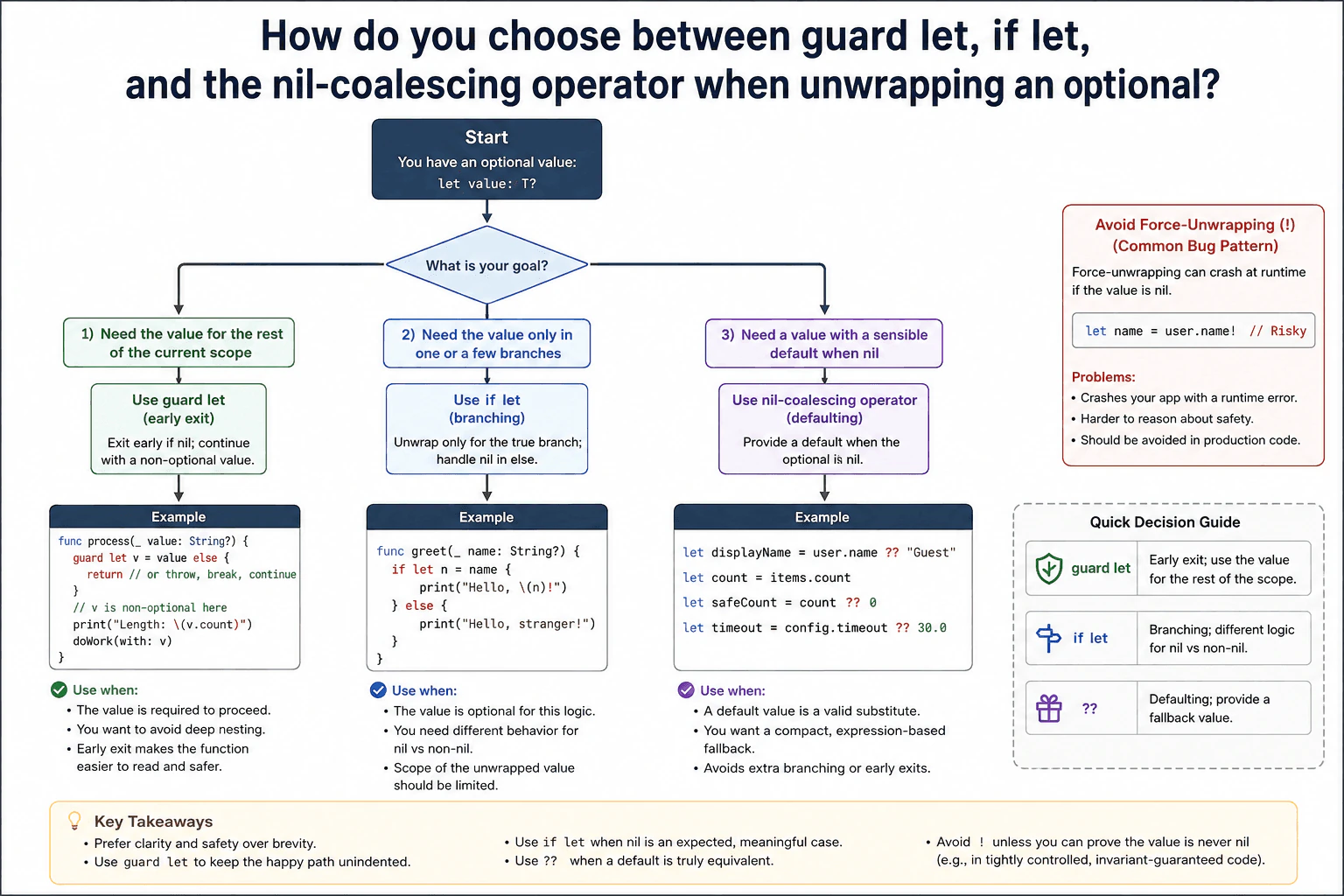
The goal is to handle a Swift value that may be missing without making the code unsafe or difficult to read. The key question is what the program should do when the optional is nil. Sometimes the current work must stop. Sometimes nil is a normal case that needs different logic. Sometimes a safe fallback value is enough. The diagram organizes these choices into three paths: early exit with guard let, branching with if let, and defaulting with the nil-coalescing operator ??. It also warns that force-unwrapping with ! can crash when the value is nil.
Useful Questions to Ask the Interviewer
Should the current operation stop when the value is nil?
Do the nil and non-nil cases need different behavior?
Is there a sensible default value when the optional is nil?
How to Explain It in an Interview
1. Start with what nil should mean
I would begin by deciding what should happen when the optional has no value. That behavior determines which construct is easiest to understand. If the value is required, I want an early exit. If both cases matter, I want a branch. If a fallback is valid, I want a default. This keeps the choice based on program behavior rather than personal style.
2. Use guard let for early exit
I use guard let when the value is required for the rest of the current scope. The else block must leave that scope, such as with return or throw. After the guard succeeds, the unwrapped value is available after the statement. This keeps the normal path unindented and avoids deeply nested code. It is a good fit when continuing without the value would be incorrect or unsafe.
3. Use if let for branching
I use if let when the nil and non-nil cases both have meaningful behavior. The unwrapped value is available inside the successful branch. An else branch can handle the nil case. This is useful when a missing value is expected rather than treated as a reason to stop the whole operation. The code makes both paths visible, which often makes the decision easier to understand.
4. Use ?? for a sensible default
I use the nil-coalescing operator ?? when a valid fallback can replace the missing value. For example, a missing display name could become "Guest", or a missing optional count could become 0. This is concise because it produces one non-optional result without a separate branch. I only use a default when that value has the correct meaning. I would not use ?? merely to hide a missing-value bug.
5. Avoid force-unwrapping unless nil is impossible
The common bug is using ! because the programmer assumes the optional is not nil. If that assumption is wrong, Swift traps at runtime and the app can terminate. I prefer guard let, if let, or ?? in normal production code because each one makes the nil behavior explicit. I only force-unwrap when a strong invariant guarantees the value exists. The trade-off is a little more explicit code in exchange for much safer behavior.
Engineering Considerations / Design Trade-offs
The benefit of guard let is that failure is handled early and the normal path stays simple. The downside is that it fits only when leaving the current scope is the correct nil behavior. The benefit of if let is that both cases can have clear logic. The downside is that branching can add nesting. The benefit of ?? is short, readable fallback code. The downside is that a bad default can hide a real problem. Force-unwrapping with ! is very short, but it is risky because nil causes a runtime trap.
Why Interviewers Ask This
Interviewers ask this to see whether the candidate understands optional handling as a design decision, not only as Swift syntax. They want to see whether the candidate can choose early exit, branching, or defaulting based on behavior. They also want to test judgment around scope, readability, safe defaults, and the runtime risk of force-unwrapping.
Interviewer may ask next
What would you change if a missing optional should produce an error instead of simply returning?
I would keep the same early-exit design and change what the guard let else block does. Instead of returning silently, I would throw an error when the optional is nil. The successful path stays simple because the unwrapped value is still available after the guard statement. This works well when the caller needs to know why the operation could not continue. For example, required configuration data could produce a clear missing-value error instead of letting the program continue with invalid state. I would not replace guard let with force-unwrapping. Using ! would turn a condition we can handle into a runtime trap. Correctness stays clear because the function cannot continue without the required value. The main downside is that callers now need to handle or pass along the error, so the failure path becomes more explicit through the call chain.
When would you prefer if let over ?? even when a default value is available?
I would prefer if let when nil needs different behavior rather than only a replacement value. The ?? operator is best when the program can continue through the same path after choosing the real value or a safe default. If nil should trigger logging, recovery, a different message, or another action, if let makes that branch explicit. For example, if a user name exists, the app might show a personal greeting. If it is nil, the app might show onboarding guidance instead of simply substituting "Guest". This keeps the same branching path shown in the diagram and makes the intent easy to read. The main downside is that if let takes more code and can introduce nesting, while ?? is shorter when a simple fallback is genuinely enough.
33. What happens to your app's state when it moves to the background, and how do you request extra time to finish work?System DesignHardApple
i Question Details
Explain the lifecycle callback sequence, the short background execution window, and how you request and end extra time correctly.
Short Interview Answer (30-60 seconds)
At a high level, the app gets only a short time to react when it moves to the background. The main challenge is finishing important work without assuming a fixed duration. I would explain this in three parts: the lifecycle callbacks, the short background window, and requesting extra time. BeginBackgroundTask can briefly delay suspension. We keep its taskId, provide an expiration handler, and call EndBackgroundTask on completion or expiration. The trade-off is that extra time is limited and never guaranteed.
Detailed Explanation
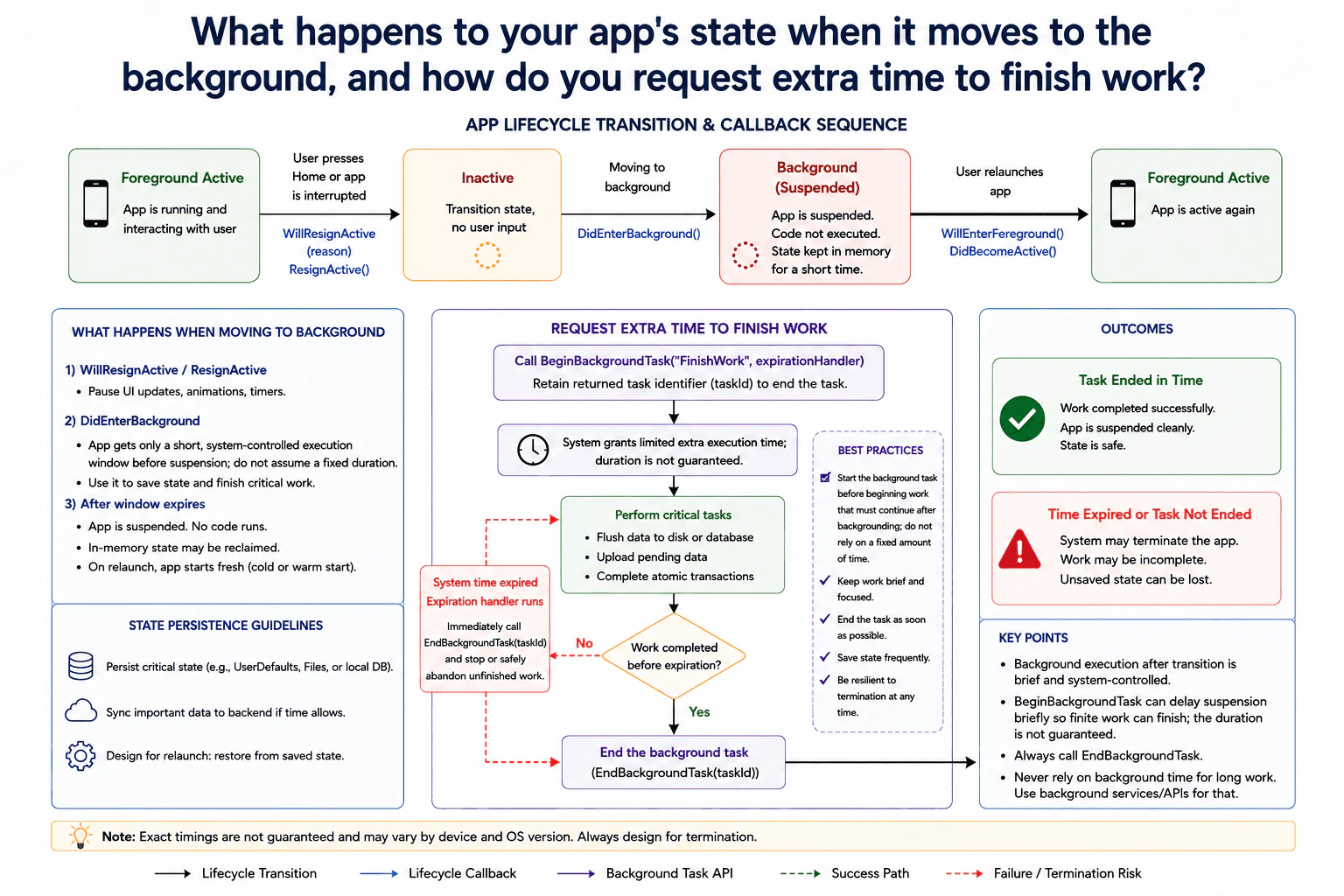
When the user leaves the app, the app does not simply keep running normally. It moves through several states, and the system gives it only a short chance to finish important work. The difficult part is that this time is controlled by the system. We cannot depend on a fixed duration. We also need to protect important state before execution stops. The diagram explains the lifecycle callbacks first, then the short background window, and finally how BeginBackgroundTask can briefly delay suspension while important work finishes.
Useful Questions to Ask the Interviewer
Are we discussing the normal app background transition shown in the diagram?
Should unfinished work stop safely if the extra background time expires?
Which app state must be saved before suspension?
How to Explain It in an Interview
1. Start with the lifecycle transition
A natural way to begin is, "First, I would explain what happens when the app leaves the foreground."
The app starts in Foreground Active. When the user leaves or an interruption happens, WillResignActive or ResignActive runs. The app then becomes Inactive. At this point, it should pause UI updates, animations, and timers.
Next, DidEnterBackground runs as the app moves toward Background. This callback is where the app prepares for suspension.
2. Explain the short background window
The important point is that background execution is brief and system-controlled. The app should not assume a fixed number of seconds.
During this window, the app can save state and finish small critical tasks. The diagram shows flushing data to disk or a database, uploading pending data, and completing atomic transactions. An atomic transaction means the work is handled as one safe unit.
After the window ends, the app becomes suspended. No application code runs while suspended. In-memory state may later be reclaimed, so important state should already be saved.
3. Request extra time for finite work
If important work must continue after backgrounding, I would start a background task before beginning that work. The diagram uses BeginBackgroundTask("FinishWork", expirationHandler).
The call returns a task identifier named taskId. The app keeps it because EndBackgroundTask(taskId) needs the same identifier later.
The system may grant limited extra execution time. Its duration is not guaranteed, so the work must stay short and focused.
4. Handle completion and expiration correctly
If the work finishes before expiration, the app immediately calls EndBackgroundTask(taskId). This tells the system that the extra execution time is no longer needed.
If the system time expires first, the expiration handler runs. It immediately calls EndBackgroundTask(taskId), then stops or safely abandons unfinished work. The app must be ready for termination at any time.
5. Save state and design for relaunch
Important state should be saved outside temporary memory. The diagram shows UserDefaults, files, or a local database. Important data may also be synced to a backend when time allows.
When the user returns, WillEnterForeground and DidBecomeActive move the app back toward Foreground Active. If the system terminated the app, it can restore from saved state on relaunch. The main trade-off is simple: extra background time helps small work finish, but it is not reliable long-running execution.
Engineering Considerations / Design Trade-offs
The benefit is that BeginBackgroundTask gives important work a little more time before suspension. This can help finish a small save, upload, cleanup, or transaction safely. The downside is that the system controls the available time. The app cannot assume a fixed duration. State should therefore be saved often, and unfinished work must be safe to stop. EndBackgroundTask must be called when normal work finishes and when the expiration handler runs. For longer work, the diagram says not to depend on this short background window. That keeps the app correct even if suspension or termination happens sooner than expected.
Why Interviewers Ask This
Interviewers ask this to see whether you understand app lifecycle behavior, not just API names. They want to know when code stops running, how state should be protected, and why background time cannot be trusted. They also test whether you use BeginBackgroundTask, its expiration handler, and EndBackgroundTask correctly, including the failure path when work does not finish in time.
Interviewer may ask next
What would you change if the work may take several minutes instead of finishing quickly?
I would not use the same short BeginBackgroundTask window for work that may take several minutes. The diagram treats that API as a brief way to delay suspension so finite work can finish.
I would keep the same lifecycle flow. When DidEnterBackground runs, the app should save important state and finish only the small work that must happen immediately. If a short operation is already in progress, BeginBackgroundTask can protect that final piece of work. The app must still keep taskId and call EndBackgroundTask when the work finishes or the expiration handler runs.
For work that needs much more time, the diagram says not to rely on background time. That work should use the appropriate background services or APIs instead. State should be saved so the operation can continue or restart safely later.
The downside is more complexity. Longer work must be separated from the simple foreground-to-background transition instead of being treated as one uninterrupted operation.
What happens if the system expires the background task before the work finishes?
The expiration handler becomes the important path. The app should stop depending on the extra execution window as soon as the system says that time has expired.
In the diagram, the expiration handler immediately calls EndBackgroundTask(taskId). It also stops or safely abandons unfinished work. That keeps the app from acting as if it still owns background execution time.
The work should therefore be designed so an interruption does not corrupt important state. Critical state should already be saved to UserDefaults, files, or a local database when needed. Pending data can be synced to a backend when time allows.
If the system later terminates the app, unsaved in-memory state can be lost. On a later launch, the app should restore from saved state. The downside is that some work may remain incomplete, but the application stays correct and does not depend on time that the system never guaranteed.
34. Why Apple? What specifically draws you to this team and this role?BehavioralEasyApple
i Question Details
Connect your background to the team's work, explain why Apple fits the problems you want to solve, and avoid generic praise.
Interview tip:
Use STAR to structure your answer: briefly explain the Situation and Task, make Action the most detailed part, and finish with the Result. For example, describe a previous .NET project that showed what kind of engineering problems motivate you, explain your responsibility, the actions and decisions you made, how you communicated with the team, connect those experiences to the work this team does, and explain the result and why Apple is a strong fit for the problems you want to solve next.
Situation
In my last role, I worked on a .NET service that supported an important user workflow. The system had to be reliable, easy to maintain, and responsive because problems in the service could directly affect the user experience. That project helped me understand that I enjoy engineering work where strong backend design has a clear impact on the product people use.
Task
My responsibility was to improve the service while keeping existing behavior stable. I needed to understand the current design, identify the most important technical risks, and make changes that improved reliability without creating unnecessary complexity for the rest of the team.
Action
I first traced the request flow through the .NET application so I could understand where failures and delays could happen. I reviewed the service boundaries, error handling, logging, and data access patterns. I then worked with the team to separate the most important user needs from changes that were only technical preferences. I focused my own work on making the code easier to reason about, improving failure handling, and adding clearer diagnostics so we could understand problems faster. I also explained my design choices during reviews instead of only submitting code. That mattered because I wanted the team to understand why a change improved the product, what tradeoffs it introduced, and how we would support it later. I enjoyed that combination of backend engineering, product thinking, quality, and collaboration. That is what draws me to this Apple role. I am interested in working on systems where software quality and technical decisions are closely connected to the experience delivered to users. I am also drawn to this team because the role gives me a chance to apply my .NET background while solving problems that require careful engineering, strong ownership, and close collaboration across disciplines.
Result
The service became easier for the team to understand and support, and we had clearer information when issues occurred. More importantly, the project showed me the type of work I want to continue doing. I want to build reliable software where backend decisions matter to the final product. That is why Apple and this role are especially interesting to me rather than simply being another .NET opportunity.
Why Interviewers Ask This
Interviewers ask this question to understand whether the candidate has a thoughtful reason for choosing Apple, the specific team, and the role. A strong answer connects relevant experience and technical interests to the work, shows that the candidate understands what motivates them, and demonstrates genuine interest beyond general praise for the company.
Interviewer may ask next
What part of this team's work is most important to you when choosing your next role?
The most important part is the connection between backend engineering and the user experience. In my previous project, I found that I was most engaged when reliability, maintainability, and clear technical decisions directly supported an important user workflow. I want my next role to give me more opportunities to solve that kind of problem while working closely with people across different disciplines.
How does your .NET background prepare you for the work you want to do at Apple?
My .NET background has taught me to think carefully about service design, data access, error handling, diagnostics, and maintainable code. In the project I described, I used those skills to understand an existing service, improve its reliability, and make it easier for the team to support. I would bring the same approach here by first understanding the product need, then choosing simple technical changes that improve quality without adding unnecessary complexity.
35. Tell me about a project where privacy was a real constraint, not an afterthought.BehavioralMediumApple
i Question Details
Explain the privacy requirement, the technical choices it forced, and how you preserved utility while reducing data exposure.
Interview tip:
Use STAR to structure your answer: briefly explain the Situation and Task, make Action the most detailed part, and finish with the Result. For example, describe a project where sensitive user data created a strict privacy requirement, explain the technical choices that reduced data collection and access, show how you worked with the team to preserve useful product behavior, and describe the resulting balance between privacy and utility.
Situation
In my last role, I worked on an ASP.NET Core application that processed user activity data to provide useful account insights. Privacy was a core requirement because some of the raw data could reveal sensitive information about individual users. The team needed the feature, but we could not treat broad data collection as the default and try to protect it later.
Task
I was responsible for the backend design and needed to make sure we collected and exposed only the information the feature actually required. My goal was to preserve the useful account insights while reducing how much personal data moved through our APIs, logs, and database.
Action
I started by reviewing each data field with the product and security teams and asking what user value depended on it. If a field was not required for the feature, I removed it from the request model instead of collecting it just in case. For information we did need, I avoided storing raw values when a derived value was enough. For example, when the application only needed a category or summary, I calculated that in the service layer and stored the less sensitive result. I also separated sensitive fields from the main response models so normal API calls could not return them by accident. I used authorization checks in ASP.NET Core to limit access to endpoints that still needed sensitive data, and I made sure application logs recorded identifiers and operation results without recording private payload values. For database access, I kept queries focused on the columns needed for each operation rather than loading complete records. I also worked with the team to review failure cases, because exception handling can expose private values if request bodies or database objects are written into logs. Before release, I walked through the full data flow with the security team so we could confirm where information entered the system, where it was transformed, where it was stored, and who could retrieve it.
Result
We delivered the feature without depending on unnecessary raw user data. The application still provided the intended account insights, while the amount of sensitive information collected, stored, returned, and logged was reduced. The project taught me that privacy works best when it shapes the data model and service design from the beginning, rather than being added as a final security check.
Why Interviewers Ask This
Interviewers ask this question to see whether a developer treats privacy as an engineering constraint that affects architecture and implementation choices. A strong answer shows good judgment about data minimization, access control, logging, collaboration, and the tradeoff between protecting user information and preserving useful product behavior.
Interviewer may ask next
How did you decide which user data the application truly needed?
I reviewed each field against a specific product behavior and asked what would stop working if we removed it. When the team could not identify a clear need, I did not collect the field. When we needed information only to calculate a category or summary, I preferred storing that derived result instead of the raw value.
What would you do differently if you handled a similar privacy sensitive project now?
I would make the data flow review an explicit design step even earlier. I would document each sensitive field, why it is needed, where it is stored, who can access it, and when it can be removed. That would make privacy decisions easier to review as the application changes and would help prevent unnecessary data collection from returning later.
36. Describe a time you had to give a peer difficult feedback on their code in review.BehavioralHardApple
i Question Details
Focus on the specific technical concern, how you delivered the feedback, and the result for the codebase and relationship.
Interview tip:
Use STAR to structure your answer: briefly explain the Situation and Task, make Action the most detailed part, and finish with the Result. For example, describe a code review where you found a meaningful technical risk, explained the concern respectfully with evidence, worked with your peer on a safer approach, and improved both the code and the working relationship.
Situation
In my last role, I reviewed a pull request from a peer who had added a new data access path to a .NET service. The code worked for the normal case, but I noticed that it loaded a large set of records into memory and then filtered them in C# instead of applying the filter in the database. I was concerned that this could create unnecessary memory use and slower responses as the amount of data grew.
Task
My responsibility was to protect the quality of the codebase while giving feedback in a way that respected my peer. I wanted to make the technical risk clear without making the review feel personal or turning it into an argument about coding style.
Action
I first verified the concern before leaving a strong comment. I traced the LINQ query and confirmed that the data was being materialized before the filter was applied. In the review, I explained the specific behavior I saw and why it mattered. I focused on the code rather than the person. I wrote that the current query could bring more rows into application memory than needed and suggested moving the filter into the database query before materialization. I also included a small example of how the query could be changed so the intent was clear. Because I knew the feedback could feel significant after my peer had already completed the feature, I spoke with them directly instead of relying only on written comments. I asked them to walk me through their reasoning first. That showed me they had chosen the approach because it was simple and easy to read, not because they had ignored performance. I acknowledged that goal and explained that we could keep the code readable while still letting the database do the filtering. We reviewed the revised query together and checked that it still returned the expected results. I also made it clear that my concern was about the long term behavior of the service, not about their ability as a developer.
Result
My peer updated the query so the filtering happened before the data was loaded into the application. The final code kept the same business behavior while reducing unnecessary data processing. The review stayed constructive, and our working relationship remained strong because the discussion was based on evidence and respect. I learned that difficult code review feedback is most effective when I verify the issue first, explain the impact clearly, listen to the other developer's reasoning, and work toward a solution together.
Why Interviewers Ask This
Interviewers ask this question to understand whether a candidate can protect code quality while handling disagreement with respect. A strong answer shows technical judgment, clear communication, empathy, and the ability to give specific feedback without making it personal.
Interviewer may ask next
Why did you choose to speak with your peer directly instead of handling everything in the code review comments?
The technical change was meaningful, and I did not want a short written comment to sound harsher than I intended. Speaking directly gave my peer a chance to explain their reasoning, and it let me explain the risk with more context. We could then agree on the change together instead of treating the review as a simple rejection.
What would you have done if your peer still disagreed with your feedback?
I would have kept the discussion focused on observable behavior. I would have compared the two approaches using the query behavior, expected data growth, and a simple test if needed. If we still could not agree and the risk was important, I would have asked another experienced engineer for a neutral technical opinion rather than turning the disagreement into a personal conflict.
37. Describe a conflict with a designer or product manager about a feature and how you resolved it.BehavioralMediumApple
i Question Details
Use one concrete disagreement, show how you balanced user goals and technical constraints, and explain the compromise.
Interview tip:
Use STAR to structure your answer: briefly explain the Situation and Task, make Action the most detailed part, and finish with the Result. For example, describe a disagreement about a feature where you understood the user goal, explained the technical constraints clearly, worked with the designer or product manager on alternatives, agreed on a practical compromise, and delivered a reliable result.
Situation
In my last role, I was building a feature in an ASP.NET Core application that allowed users to edit several related settings from one screen. The designer wanted every change to be saved immediately as the user edited each field. I was concerned because some of the settings depended on each other, and saving partial changes could leave the data in an invalid state if one request failed.
Task
My responsibility was to find a solution that kept the experience simple for users while protecting data consistency. I also wanted to resolve the disagreement without treating the technical concern as more important than the designer's user experience goal.
Action
I first asked the designer to explain why immediate saving was important. The main goal was to make the screen feel fast and remove the risk of users forgetting to press a save button. I then explained my concern with a concrete example. If one setting was saved but a related setting failed validation, the server could temporarily store a combination that our business rules did not allow. Instead of rejecting the design, I proposed that we keep the fast editing experience in the browser but send the related changes to the API together when the user finished editing that section. I also suggested showing a clear saving status so users could see when their changes were being processed. We reviewed the flow together and discussed a few edge cases, including validation errors and network failures. I updated the ASP.NET Core endpoint so the related changes were validated as one request and saved together only when the full request was valid. The designer adjusted the interaction slightly so the interface still felt responsive while making the save behavior clear. We agreed on that compromise because it protected the user goal without creating inconsistent server data.
Result
We delivered the feature with the simple editing experience the designer wanted and with safer server side validation and saving. The disagreement also improved how we worked together because we focused on the user problem and the technical risk instead of defending our original solutions. I learned that conflicts are easier to resolve when I first understand the reason behind a request, explain constraints with a concrete example, and then offer an alternative that protects the same user goal.
Why Interviewers Ask This
Interviewers ask this question to understand how a candidate handles disagreement across product, design, and engineering. A strong answer shows that the candidate listens to the other person's goals, explains technical constraints clearly, avoids unnecessary conflict, and works toward a practical solution that protects both the user experience and system reliability.
Interviewer may ask next
Why did you choose to group the related changes into one API request instead of saving every field separately?
I chose one request because the settings depended on each other. Validating and saving them together allowed the server to accept a complete valid state or reject the change without storing only part of it. That gave us stronger data consistency while still allowing the interface to feel responsive.
What would you do differently if the designer still disagreed with your proposed compromise?
I would make the tradeoff even more concrete by walking through the user flow and the failure cases together. If we still disagreed, I would suggest a small prototype or involve the product manager so we could compare the options against the user goal, technical risk, and delivery needs. I would keep the discussion focused on evidence and the product outcome rather than on who proposed each solution.
38. Tell me about a time you disagreed with a technical decision made by your manager or a senior engineer.BehavioralMediumApple
i Question Details
Describe the evidence you used, how you pushed back respectfully, and how you committed once the decision was final.
Interview tip:
Use STAR to structure your answer: briefly explain the Situation and Task, make Action the most detailed part, and finish with the Result. For example, describe a technical decision you disagreed with, the evidence you gathered to explain your concern, how you raised it respectfully with your manager or senior engineer, how the final decision was reached, and how you fully supported the chosen approach afterward.
Situation
In my last role, our team was updating a .NET service that handled an important business workflow. A senior engineer proposed adding several new responsibilities directly into an existing service class because it was the fastest way to meet the immediate need. I was concerned that this would make the class harder to test and maintain because it already handled validation, data access coordination, and business rules.
Task
My responsibility was to implement part of the change, but I also wanted to make sure I raised the maintainability risk before we committed to the design. I needed to challenge the decision professionally, support my concern with evidence, and avoid turning the discussion into a personal disagreement.
Action
I first reviewed the existing code so I could explain the issue with specific examples instead of giving only an opinion. I looked at the current responsibilities of the service, the unit tests around it, and the places where changes had already become difficult because several concerns were mixed together. I then created a small alternative showing how the new logic could be placed in a separate component with a clear interface. This kept the existing service focused and made the new behavior easier to test independently. I shared both options with the senior engineer and explained the practical difference. I said that I understood why the direct change was attractive because it required less work immediately, but I was concerned about future changes and testing. I asked questions instead of insisting that my approach was the only correct one. During the discussion, the senior engineer explained that we had a near term delivery constraint and that a larger refactoring could increase risk for the current release. We agreed to keep the immediate implementation smaller than my proposed design, but we also separated the most complex new logic into its own class so the service would not grow as much. Once that decision was final, I committed to it fully. I implemented the agreed design, added tests around the new behavior, and did not continue arguing for my original proposal after the team had made the decision.
Result
We completed the change with a design that met the delivery need while still improving separation of responsibilities in the most important area. The discussion also strengthened my working relationship with the senior engineer because the disagreement stayed focused on evidence and project needs. I learned that good technical judgment is not only about identifying the cleanest design. It also means understanding delivery constraints, presenting concerns clearly, listening to other information, and supporting the final team decision once it is made.
Why Interviewers Ask This
Interviewers ask this question to see whether a candidate can disagree without becoming defensive or difficult to work with. A strong answer shows that the candidate uses evidence, communicates respectfully, listens to constraints they may not initially know, helps the team reach a practical decision, and supports that decision even when their preferred approach is not fully chosen.
Interviewer may ask next
What evidence was most useful when you explained your concern?
The most useful evidence came from the existing code and tests. I showed that the service already had several responsibilities and that adding more logic would increase the amount of behavior that had to be understood and tested together. I also created a small alternative so the discussion could compare two concrete designs instead of two personal opinions.
What would you do differently if you faced a similar disagreement now?
I would still gather evidence and present an alternative, but I would ask about delivery constraints earlier. In that situation, I understood the technical problem before I fully understood the release pressure. Asking about time, risk, and business priorities at the start would help me shape a proposal that balances maintainability with the immediate needs of the team.
39. What's a mistake you made that changed how you approach engineering work?BehavioralEasyApple
i Question Details
Use one real mistake, explain the root cause and the change in your process afterward, and avoid a fake humility answer.
Interview tip:
Use STAR to structure your answer: briefly explain the Situation and Task, make Action the most detailed part, and finish with the Result. For example, describe a real engineering mistake, explain the root cause, show how you took ownership and corrected it, and explain the process change you now use to prevent the same problem.
Situation
In my last role, I was working on a .NET API change that added a new field to a response used by another application. I tested the main success path locally and the feature worked as expected. I assumed the change was safe because it looked small, but I did not verify how every existing consumer handled the updated response.
Task
I was responsible for delivering the API change without breaking existing behavior. After the change reached a shared environment, we found that one older consumer had stricter response handling and failed when it received the new data. My mistake was treating a small contract change as low risk instead of checking compatibility before release.
Action
I took ownership of the issue and first reviewed the failing request and logs with the team so I could understand the exact cause instead of guessing. I confirmed that the API itself was returning valid data, but the consumer expected a narrower response shape. I worked with the consumer team to understand their dependency and changed the implementation so the new field could be introduced without breaking their existing flow. I also added automated tests that covered the previous response behavior as well as the new behavior. The bigger change was in my process. Since then, when I change an API contract, database schema, shared model, or other interface used outside my code, I identify the consumers before implementation. I check compatibility, discuss the change early with affected developers, and add tests for existing behavior before I add the new behavior. I also make contract impact part of my code review notes so reviewers can challenge assumptions that I may have missed.
Result
We corrected the issue and the consumer was able to continue using the API while the new functionality moved forward. More importantly, the mistake changed how I think about engineering risk. I learned that the size of a code change does not always match the size of its impact. I now spend more time understanding dependencies and compatibility before changing shared interfaces, which has made my changes more deliberate and easier for other teams to adopt safely.
Why Interviewers Ask This
Interviewers ask this question to see whether a candidate can take ownership of a real mistake, identify the root cause without blaming others, and turn the lesson into a lasting improvement. A strong answer shows self awareness, sound engineering judgment, and a practical change in how the candidate works.
Interviewer may ask next
What was the root cause of the mistake?
The root cause was not the code itself. It was my assumption that a small API response change had low risk. I focused on whether my service still worked and did not check how existing consumers depended on the response. That taught me to review dependencies and compatibility whenever I change a shared contract.
How would you handle a similar API change now?
I would first identify the current consumers and understand how they use the contract. I would discuss any compatibility risk early, preserve existing behavior where possible, and add automated tests for both the old and new cases. I would also call out the contract impact clearly during code review so the team can verify the change before release.
40. How do you mentor junior engineers?BehavioralEasyApple
i Question Details
Give one concrete example of helping a junior engineer grow, including what you taught, how you coached, and the outcome for the person or team.
Interview tip:
Use STAR to structure your answer: briefly explain the Situation and Task, make Action the most detailed part, and finish with the Result. For example, describe a time when you helped a junior engineer understand an important .NET concept, gave them a safe way to practice, reviewed their work with clear feedback, encouraged them to solve problems independently, and helped them become more confident and effective.
Situation
In my last role, a junior engineer joined our team and was having difficulty understanding how to structure an ASP.NET Core service. They could complete small tasks, but they often depended on senior engineers when working with dependency injection, service boundaries, and error handling.
Task
I wanted to help them build stronger technical judgment instead of simply giving them answers. My goal was to teach the core ideas, give them practical experience, and help them become comfortable making reasonable implementation decisions on their own.
Action
I first worked with them on a small feature so I could understand where they were getting stuck. I explained dependency injection using the actual service they were editing and showed why separating responsibilities made the code easier to test and change. Instead of rewriting their code for them, I asked questions about what each class should own and what could happen when an external dependency failed. I then asked them to propose the next change before I gave my opinion. During code reviews, I kept my comments focused on a few important ideas at a time and explained why each suggestion mattered. I also encouraged them to write a small unit test for the service so they could see how good boundaries made testing easier. As their confidence improved, I gave them more ownership and stayed available when they needed guidance. I also made it clear that asking questions was welcome, but I encouraged them to bring their own first idea so we could discuss their reasoning together.
Result
Over time, the junior engineer became more comfortable designing and testing small .NET features without needing constant help. Their code reviews became more focused on refinement instead of basic structure, and they started explaining their own design choices clearly. The team also spent less time answering the same questions repeatedly. I learned that effective mentoring is not about giving fast answers. It is about teaching someone how to reason through a problem and then giving them enough space to practice that skill.
Why Interviewers Ask This
Interviewers ask this question to understand whether a candidate can help other engineers grow while still supporting team delivery. A strong answer shows patience, clear communication, technical judgment, useful feedback, and the ability to increase another engineer's independence instead of creating dependence.
Interviewer may ask next
Why did you ask the junior engineer to propose a solution before giving your own answer?
I wanted them to practice the reasoning process, not just copy my solution. When they explained their first idea, I could see how they were thinking and guide the specific part that needed improvement. It also helped them build confidence in making technical decisions independently.
What would you do differently if the junior engineer was still struggling after your coaching?
I would make the learning steps smaller and check whether I was explaining the concept in a way that matched how they learned best. I would use another simple example, pair with them on one focused task, and then let them repeat the same type of decision independently. I would keep the goal of building independence, but I would adjust the pace and teaching approach.
More questions load as you scroll
Disclaimer: This interview guide is for educational and informational purposes only. It is designed to help readers prepare, but it does not guarantee any interview result, hiring decision, offer, or outcome. Interview questions, hiring criteria, and preferred answers can vary by employer, interviewer, industry, location, and time. All answers, examples, and explanations in this guide are suggested examples for interview preparation, not definitive answers or instructions for professional practice. They are based on research and judgment, are provided without warranties of any kind, and should be adapted to the question, role, and applicable laws and professional requirements. Diagrams are simplified illustrations intended to highlight the main concepts and their relationships; actual situations, systems, and practices may be more complex. Alternative approaches may be equally valid or better suited to a particular question, context, or interviewer. To the fullest extent permitted by applicable law, the contributors and publisher are not liable for decisions made, actions taken, or losses incurred based on this guide.
State Laws and Professional Responsibilities: Laws and requirements governing an occupation vary by state and jurisdiction. You are responsible for checking the current laws, licensing requirements, and scope-of-practice rules that apply to your location and role, and for ensuring that your answers and actions comply with them. Adapt examples in this guide to those requirements. This guide is not legal advice.
Company Notice: This guide is an independent educational resource and is not affiliated with, endorsed by, sponsored by, or approved by the company named in this guide. Company names identify reported interview experiences or the employer context of clearly labeled original practice exercises. Interview practices can change without notice, and inclusion of company-specific content does not mean these questions are official, complete, or guaranteed to be asked. To the fullest extent permitted by law, the author, contributors, and publisher are not responsible for outcomes related to use of this material.
Content Accuracy and Verification: To the fullest extent permitted by applicable law, we do not represent or warrant that interview guides, questions, answers, examples, or diagrams are accurate, complete, current, error-free, or suitable for any particular purpose. You are responsible for independently reviewing and verifying the information before relying on it.