21. how would you describe your design thinking?
Use the Meta Product Designer interview question exactly and explain your approach to framing problems, weighing tradeoffs, and iterating on a design.
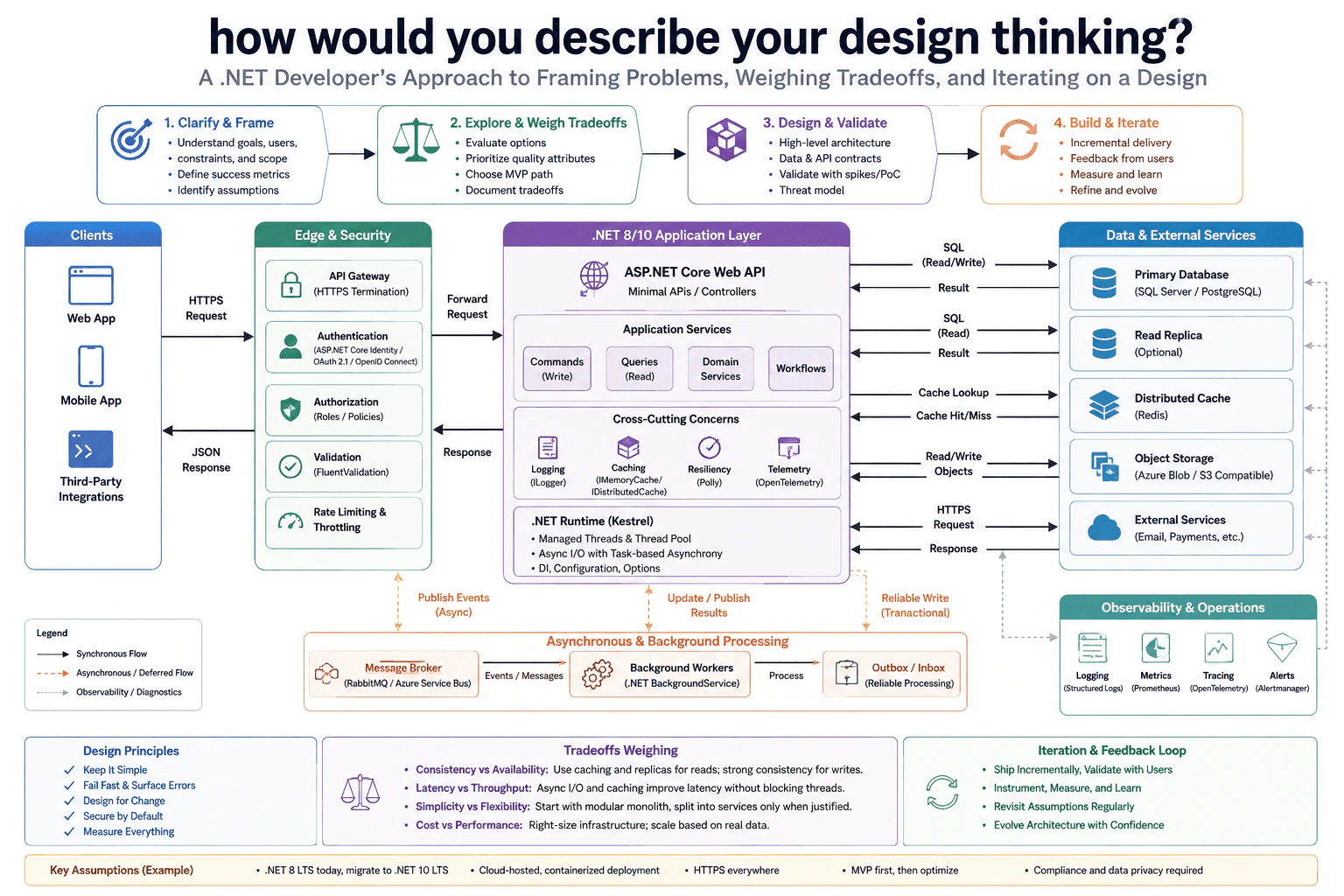
At a high level, my design thinking starts with understanding the user problem before choosing technology. The main challenge is balancing correctness, speed, security, cost, and simplicity without overbuilding. I organize the work into four steps: clarify and frame, explore trade-offs, design and validate, then build and iterate. The .NET architecture in the diagram is one example of applying those choices. I start simple, measure results, and add complexity only when the evidence supports it.
This question is asking how I make design decisions when there is no single perfect answer. I need to show that I understand the user problem before choosing technology. I should compare reasonable options, explain why one choice fits better, test risky assumptions, and improve the design after learning from real use. The diagram shows this as four connected stages: clarify and frame, explore and weigh trade-offs, design and validate, then build and iterate. The .NET architecture below those stages is a concrete example of how those decisions can become a working system.
- Who are the main users, and what problem matters most to them?
- What does success look like for this product or system?
- Which matters most here: correctness, latency, availability, security, cost, or simplicity?
- What scale and traffic pattern should I assume?
- Are there privacy or compliance requirements I must protect?
I would start by saying, "Before choosing an architecture, I want to understand the user goal and the constraints." I define the scope, success measures, and important assumptions. I also identify risks early. This prevents me from solving the wrong problem or adding technology that does not help.
Next, I compare a few reasonable choices against the same goals. The diagram calls out consistency versus availability, latency versus throughput, simplicity versus flexibility, and cost versus performance. I prefer an MVP path first. For example, I would start with a modular monolith and split services only when there is a clear reason. The important part is explaining why the trade-off fits the current need.
Then I turn those choices into a high-level design and define the important data and API contracts. I validate risky areas with a spike or proof of concept before committing to a larger build. I also think about the threat model, which means asking how the system could be misused or attacked.
In the example architecture, clients send HTTPS requests through the Edge & Security layer. The API Gateway terminates HTTPS. Authentication checks identity. OpenID Connect can provide sign-in, while OAuth 2.1 can control delegated access. Authorization checks roles or policies. Validation checks input, and rate limiting controls excessive requests.
Validated requests reach the ASP.NET Core Web API and its Application Services. Commands handle writes, while Queries handle reads. The application can use the Primary Database, optional Read Replica, Distributed Cache, Object Storage, and External Services as shown.
Task-based asynchronous I/O lets .NET wait for I/O without holding a worker thread during that wait. Separate background work goes through the Message Broker to Background Workers using .NET BackgroundService. The Outbox / Inbox path supports reliable processing around transactional work. This keeps suitable background activity away from the main response path.
I would ship in small steps and measure what actually happens. Logging, metrics, tracing, and alerts provide that feedback. I revisit assumptions and refine the design as real data arrives. The main principle is simple: add caching, replicas, queues, resilience, or extra services only when they solve a measured problem. These tools can improve performance or reliability, but each one also adds cost and operational complexity.
The benefit is that this approach keeps the design focused on the real problem. Starting with an MVP avoids unnecessary complexity. Caching can make repeated reads faster, and a Read Replica can move suitable read work away from the Primary Database. Background Workers can keep slower work away from the main response. The downside is that every extra part needs more testing, monitoring, and maintenance. Cached data or replica reads may also be behind the latest write. More services, queues, and resilience rules cost more to run. I accept those costs only when measurements show that the simpler design is no longer enough.
Interviewers want to see how I make decisions when several answers could work. They are testing whether I can frame the problem, compare trade-offs, challenge assumptions, and explain why a design fits the user need. They also want to see whether I can validate risky ideas, keep the first version simple, think about security and failures, and use measurements and feedback to improve the design instead of treating the first architecture as final.