This interview guide is for educational and informational purposes only. It is designed to help readers prepare, but it does not guarantee any interview result, hiring decision, offer, or outcome. Interview questions, hiring criteria, and preferred answers can vary by employer, interviewer, industry, location, and time. All answers, examples, and explanations in this guide are suggested examples for interview preparation, not definitive answers or instructions for professional practice. They are based on research and judgment, are provided without warranties of any kind, and should be adapted to the question, role, and applicable laws and professional requirements. Diagrams are simplified illustrations intended to highlight the main concepts and their relationships; actual situations, systems, and practices may be more complex. Alternative approaches may be equally valid or better suited to a particular question, context, or interviewer. To the fullest extent permitted by applicable law, the contributors and publisher are not liable for decisions made, actions taken, or losses incurred based on this guide.
State Laws and Professional Responsibilities
Laws and requirements governing an occupation vary by state and jurisdiction. You are responsible for checking the current laws, licensing requirements, and scope-of-practice rules that apply to your location and role, and for ensuring that your answers and actions comply with them. Adapt examples in this guide to those requirements. This guide is not legal advice.
Identity, Image, and Privacy Notice
To respect individual privacy, some names, profile photographs, avatars, biographical details, and other identifying information displayed in this guide may be replaced with pseudonyms, licensed stock images, illustrative avatars, composite images, or representative descriptions. Unless a person is expressly identified as an actual contributor, a displayed name, image, or profile should not be understood as depicting or identifying a specific candidate, interviewer, employee, or other real individual. These representations are provided for editorial and illustrative purposes only and do not imply endorsement, employment, participation, or affiliation with this guide or any company mentioned in it. Any resemblance to an actual person is coincidental.
Company Notice
This guide is an independent educational resource and is not affiliated with, endorsed by, sponsored by, or approved by the company named in this guide. Company names identify reported interview experiences or the employer context of clearly labeled original practice exercises. Interview practices can change without notice, and inclusion of company-specific content does not mean these questions are official, complete, or guaranteed to be asked. To the fullest extent permitted by law, the author, contributors, and publisher are not responsible for outcomes related to use of this material.
Content Accuracy and Verification
To the fullest extent permitted by applicable law, we do not represent or warrant that interview guides, questions, answers, examples, or diagrams are accurate, complete, current, error-free, or suitable for any particular purpose. You are responsible for independently reviewing and verifying the information before relying on it.
Questions or comments?
Contact us for general questions, or share feedback, technical corrections, and comments with the community.
1. What is emergency department triage, and how does it differ from diagnosis?Clinical KnowledgeEasy
i Question Details
Explain the concept or decision in ED nursing scope. State relevant assumptions, missing information and when additional clinical authority is required.
Short Interview Answer (30-60 seconds)
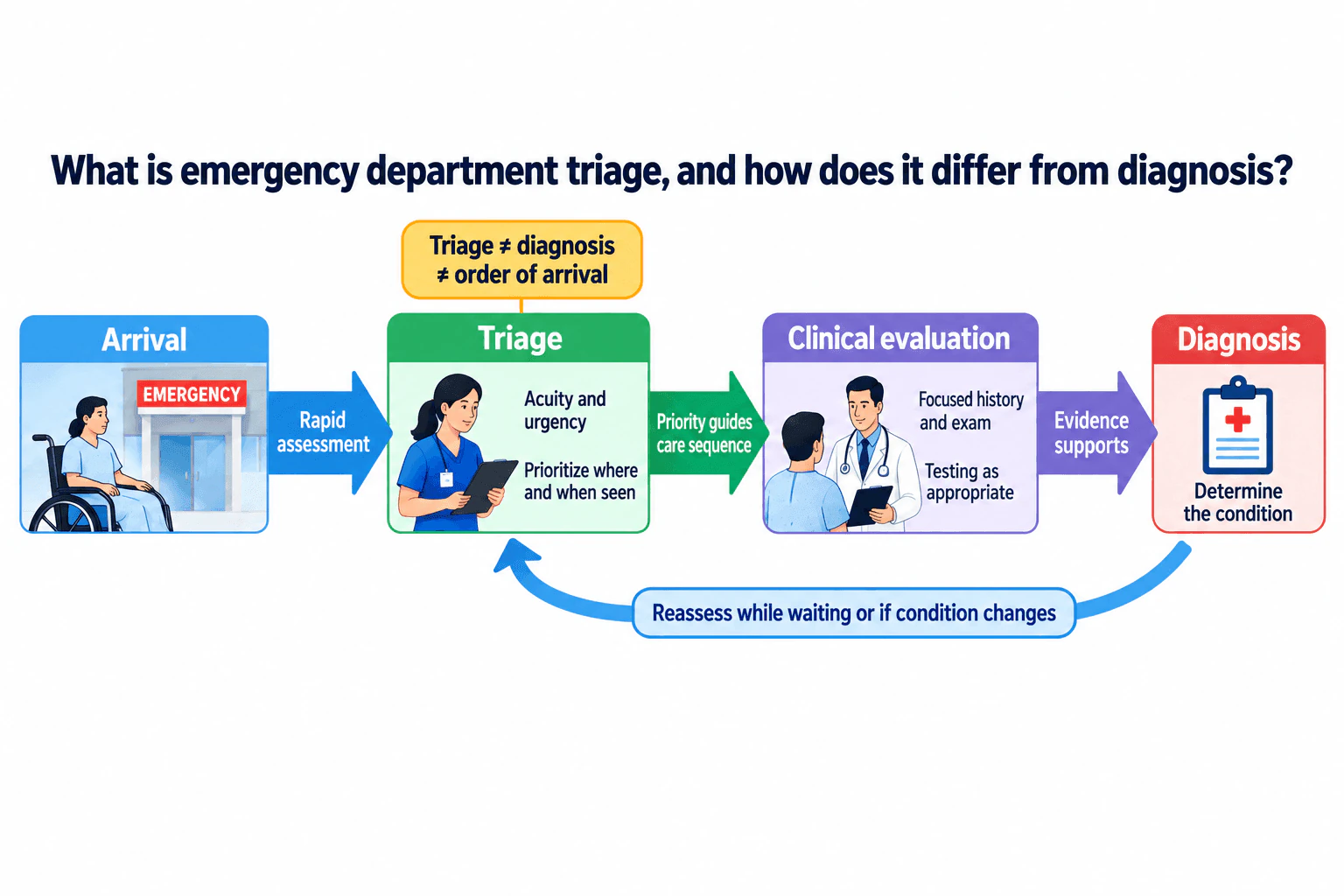
ED triage is a rapid assessment used to determine acuity and urgency so patients are prioritized by clinical need, not simply by who arrived first. A validated method such as the Emergency Severity Index can support that decision. Triage is not a medical diagnosis. Diagnosis addresses what condition explains the findings after further clinical evaluation, which may include focused history, examination, and testing. If a waiting patient's condition changes, the nurse should reassess the patient's priority and escalate care as indicated.
Useful Questions to Ask the Interviewer
Which validated triage method does this emergency department use?
What is the department's process for reassessing patients who remain in the waiting area?
What escalation pathway should the triage nurse use when a patient's condition becomes more urgent?
Detailed Explanation
How to Explain It in an Interview
Core Concept
Emergency department triage is a rapid point of entry assessment used to determine how urgently a patient needs care. Its purpose is prioritization. Patients are prioritized according to acuity and clinical need rather than simply according to order of arrival.
Triage Meaning
The triage nurse rapidly gathers relevant information, assesses the patient's presentation, and assigns an urgency level using the validated triage method used by that emergency department. In many United States emergency departments, the Emergency Severity Index is used. It is a five level triage algorithm that incorporates acuity and, at appropriate decision points, anticipated resource needs. It helps determine priority for care. It does not establish a medical diagnosis.
How Diagnosis Is Different
Diagnosis answers a different question: what condition best explains the patient's findings? That determination generally depends on a more complete clinical evaluation, which can include focused history, physical examination, and diagnostic testing when appropriate. The emergency nurse contributes assessment findings, recognizes changes, communicates concerns, and follows authorized protocols. Medical diagnosis remains within the authority of the appropriately credentialed clinician.
Reassessment and Limits
Triage reflects the information available at that time. If a patient remains in the waiting area, the patient's condition can change. Reassessment allows the nurse to identify deterioration, update urgency when supported by new findings, and escalate care when indicated. The timing and process for routine reassessment depend on the validated triage process and local policy.
In an interview, I would summarize the distinction this way: triage determines acuity, urgency, and priority for care, while diagnosis determines the condition responsible for the findings. Triage is therefore not a diagnosis and is not simply order of arrival.
Why Interviewers Ask This
Interviewers want to know whether the nurse understands the purpose and limits of triage, can prioritize patients by acuity rather than arrival time, avoids confusing an urgency decision with a medical diagnosis, and recognizes the need for reassessment and escalation when a patient's condition changes.
Common interview mistakes
Common mistakes include treating triage as a medical diagnosis, assuming patients are seen strictly in order of arrival, assigning urgency from an assumed diagnosis instead of the available assessment findings, failing to reassess a patient whose condition may have changed, or describing Emergency Severity Index as a disaster or mass casualty triage system.
Interview tip
Keep the distinction simple: triage answers how urgent the situation is and how the patient should be prioritized, while diagnosis answers what condition best explains the findings. Then mention reassessment because acuity can change while a patient waits.
Interviewer may ask next
How would you verify that your triage decision remains appropriate?
I would use the emergency department's validated triage method and document the assessment findings supporting the assigned priority. If the patient remains waiting, I would reassess according to the department's process and sooner when the patient's condition changes. New symptoms, changes in vital signs, appearance, mental status, or other relevant findings can require a revised urgency level and escalation to the appropriate clinician or care area.
Would your approach change during a mass casualty incident?
Yes. Routine emergency department triage and mass casualty triage have different purposes and systems. During a mass casualty incident, I would follow the designated disaster triage method, incident command structure, and local emergency procedures rather than using Emergency Severity Index as though it were the disaster triage system.
2. What is the Emergency Severity Index, and what are its limits?Clinical KnowledgeEasy
i Question Details
Explain the concept or decision in ED nursing scope. State relevant assumptions, missing information and when additional clinical authority is required.
Short Interview Answer (30-60 seconds)
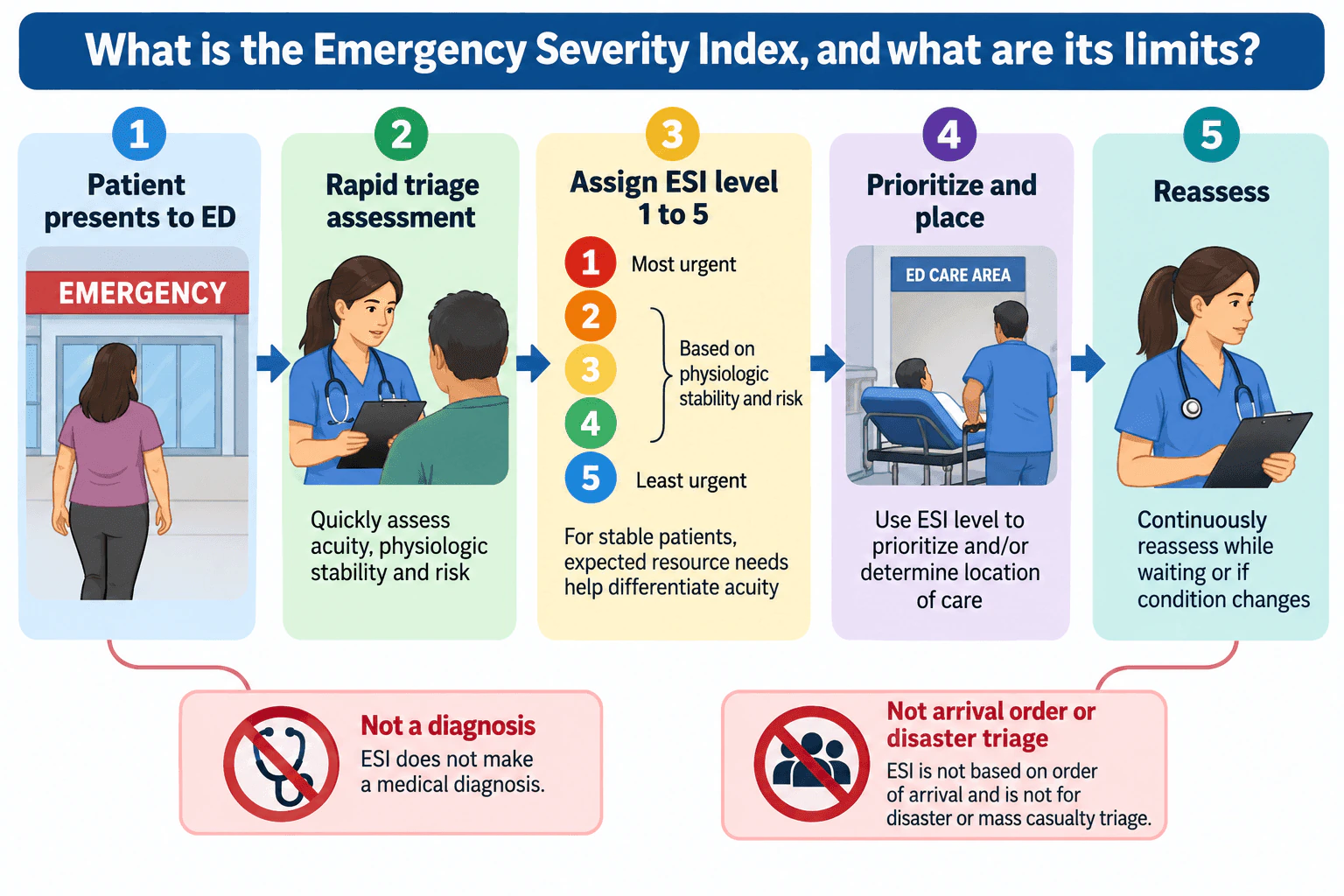
ESI is a validated five level emergency department triage acuity system, with level 1 representing the most urgent patients and level 5 the least urgent. The nurse rapidly considers physiologic stability and risk of deterioration. After higher acuity criteria are excluded, expected resource needs help distinguish the lower acuity levels. ESI helps prioritize care and placement, but it does not diagnose the patient, it is not based simply on arrival order, and it is not a disaster or mass casualty triage system. Patients must be reassessed if their condition changes while waiting.
Detailed Explanation
ESI is a structured method for prioritizing patients who present to an emergency department. It supports a rapid triage assessment and an acuity assignment from level 1, most urgent, through level 5, least urgent. It does not replace focused assessment, clinical judgment, or reassessment.
Useful Questions to Ask the Interviewer
Which current ESI education and triage process does this emergency department use?
How are patients reassessed while they remain in the waiting area?
What escalation process is used when a patient's condition worsens after initial triage?
How to Explain It in an Interview
Core Concept
The Emergency Severity Index is a validated five level emergency department triage acuity scale. The triage clinician performs a rapid assessment and first considers physiologic stability, need for immediate lifesaving intervention, and risk of deterioration. After higher acuity criteria are excluded, anticipated resource needs help differentiate the lower acuity levels.
Prioritization and Placement
The assigned ESI level helps establish the priority and potentially the location in which the patient should receive clinical assessment. This means triage is based on acuity rather than simply on order of arrival. A patient who arrives later may appropriately receive earlier attention if that patient's presentation is more urgent.
Reassessment
An ESI level reflects the patient's condition when the triage assessment is performed. If the patient remains waiting, the nurse continues observation and reassessment according to the patient's condition and the applicable emergency department process. New instability, worsening symptoms, or other concerning findings should prompt renewed assessment and appropriate escalation.
Limits
ESI is not a medical diagnosis and does not identify the underlying disease. It does not replace a focused nursing assessment, clinician evaluation, clinical judgment, or local escalation procedures. It also should not be treated as a disaster or mass casualty triage system, because those situations require a triage approach designed for that context. When findings are unclear, the patient's condition exceeds the nurse's scope or competence, or a change in condition requires additional evaluation or intervention, the nurse should obtain appropriate clinical support through the emergency department's established process.
Why Interviewers Ask This
Interviewers want to know whether the nurse understands ESI as an acuity and prioritization framework rather than a diagnosis or a substitute for clinical judgment. A strong answer shows that the nurse assesses physiologic stability and risk before using anticipated resource needs, understands that triage determines priority rather than first come first served order, and recognizes the need for reassessment when a patient's condition changes.
Common interview mistakes
Common mistakes include treating the ESI level as a diagnosis, assuming patients should be seen strictly in arrival order, using anticipated resource needs before excluding higher acuity criteria, failing to reassess a patient whose condition changes, and treating ESI as a disaster or mass casualty triage system.
Interview tip
Describe ESI as a dynamic prioritization tool. Explain that the nurse rapidly assesses physiologic stability and risk first, uses anticipated resource needs only after higher acuity criteria are excluded, and reassesses patients whose condition changes while waiting. Clearly state that ESI does not diagnose the patient and does not replace clinical judgment or a separate disaster triage process.
Interviewer may ask next
How would you verify that you are applying ESI correctly?
I would use the current Emergency Nurses Association ESI guidance and the emergency department's approved triage process, apply the decision points in the correct sequence, and document the findings supporting the acuity assignment. If the presentation is unclear or outside my competence, I would obtain appropriate clinical support rather than guess.
What would you do if a patient's condition changed after the initial ESI assignment?
I would promptly reassess the patient, repeat relevant observations such as vital signs and focused clinical findings, reconsider the patient's urgency, and escalate through the appropriate emergency department process when the new findings indicate greater acuity. The original ESI assignment should never prevent recognition of a worsening condition.
3. What is a focused nursing assessment in the emergency department?Clinical KnowledgeEasy
i Question Details
Explain the concept or decision in ED nursing scope. State relevant assumptions, missing information and when additional clinical authority is required.
Short Interview Answer (30-60 seconds)
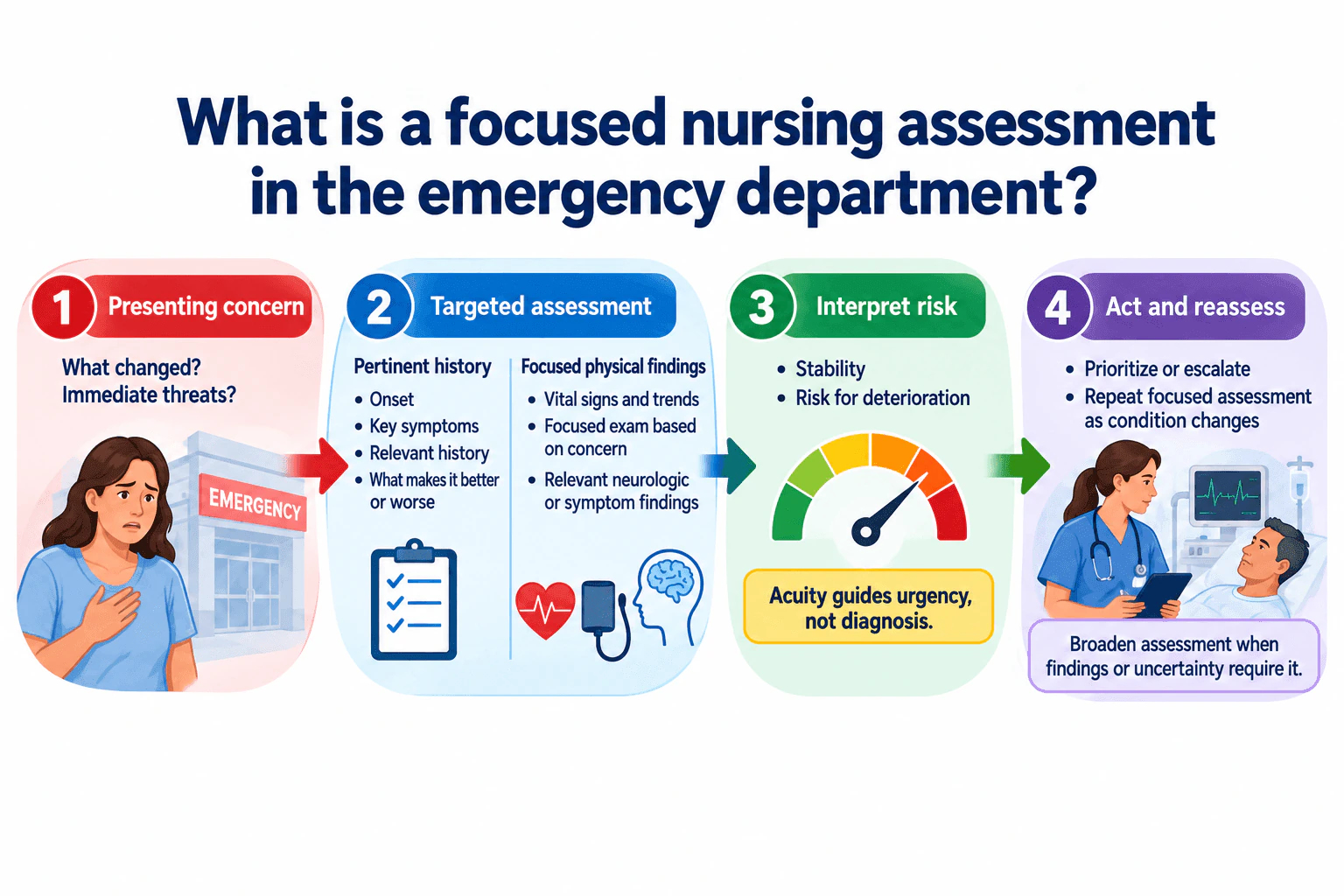
A focused nursing assessment is a targeted history and examination based on the patient's presenting concern. I would first identify what changed and whether there are immediate threats, then gather pertinent history, assess relevant vital signs and trends, and perform physical or neurologic assessment related to the concern. I would use those findings to judge stability, urgency, and risk for deterioration, prioritize or escalate concerning findings, and reassess as the condition changes. Acuity guides urgency, not diagnosis or order of arrival, and unclear findings should prompt a broader assessment.
Detailed Explanation
A focused nursing assessment is a targeted evaluation of the problem that brought the patient to the emergency department. It is narrower than a complete head to toe assessment, but it still begins with patient safety. The nurse identifies the presenting concern, asks what changed, looks for immediate threats, and then gathers only the history and findings needed to understand the current risk.
Useful Questions to Ask the Interviewer
Which validated triage framework does this emergency department use?
Which assessment findings require immediate escalation under local policy?
How are reassessment expectations documented for patients who remain in the waiting area or whose condition changes?
How to Explain It in an Interview
Presenting Concern
I would start by identifying why the patient came to the emergency department, what changed, and whether there is an immediate threat. Emergency department triage is intended to determine acuity and priority, not to establish the final diagnosis. Current joint ACEP and ENA guidance supports focused initial questioning that is pertinent to the patient's condition so that triage does not delay care. acep.org
Targeted Assessment
I would obtain pertinent history such as onset, key symptoms, relevant medical history, and factors that make the problem better or worse. I would obtain relevant vital signs and look at trends when previous measurements are available. I would then perform a focused physical assessment based on the presenting concern and include neurologic findings when clinically relevant. I would not invent findings that have not been reported or observed.
Interpret Risk
I would interpret the findings for physiologic stability, urgency, and risk for deterioration. If the department uses the Emergency Severity Index, I would apply it as a validated five level emergency department triage tool according to training and local practice. ESI helps categorize acuity and is not a diagnosis or a disaster triage system. Its current handbook describes physiologic stability and risk for deterioration as central to acuity decisions. emscimprovement.center
Act and Reassess
I would prioritize or escalate concerning findings and repeat the focused assessment as the patient's condition changes. If findings are unclear or do not fit the initial concern, I would broaden the assessment rather than force an assumed diagnosis. Independent RN actions include assessment, reassessment, prioritization, communication, and documentation within scope. Protocol authorized actions follow applicable local policy. Diagnostic or treatment decisions requiring an order or another licensed clinician are escalated appropriately. ENA guidance specifically includes reevaluating waiting patients and timely decision making as triage competencies. ena.org
Why Interviewers Ask This
Interviewers are evaluating whether the nurse can rapidly identify the information that matters most, recognize immediate threats and deterioration risk, distinguish acuity from diagnosis, and reassess rather than relying on a single initial impression. They also want to hear appropriate escalation and awareness of nursing scope, validated triage practice, and local policy. ENA competency guidance emphasizes clinical judgment, expert assessment, timely decisions, prioritization, communication, and reevaluation of waiting patients. ena.org
Common interview mistakes
Common mistakes include performing an unnecessarily broad assessment before addressing immediate threats, treating acuity as a diagnosis, prioritizing strictly by order of arrival, overlooking vital sign trends, failing to reassess when the condition changes, inventing missing findings, and delaying escalation because the initial assessment appeared reassuring. Another mistake is presenting a local protocol or treatment authority as universal nursing practice.
Interview tip
Organize the answer in the same four part sequence shown in the clinical workflow: presenting concern, targeted assessment, interpretation of stability and deterioration risk, then action and reassessment. State clearly that acuity guides urgency rather than diagnosis, and explain that uncertainty or unexpected findings should broaden the assessment and trigger appropriate escalation.
Interviewer may ask next
How would you verify that your focused assessment and acuity judgment are appropriate?
I would compare the patient's reported symptoms, focused findings, vital signs and trends, and observed stability with the emergency department's validated triage framework and my current assessment. I would document the findings supporting the urgency decision, reassess if the patient remains waiting or the condition changes, and escalate uncertainty or concerning changes to the appropriate clinician. ENA competency guidance emphasizes accurate assessment, clinical judgment, timely decisions, and reevaluation of waiting patients. ena.org
How would your approach change if new symptoms or abnormal findings appeared after the initial focused assessment?
I would promptly repeat the focused assessment, compare the new findings with the earlier findings and vital sign trends, and decide whether stability or urgency has changed. I would broaden the assessment to address the new concern and escalate through the appropriate emergency department pathway rather than relying on the original impression. Protocol authorized actions would follow local policy, while decisions requiring an order or another licensed clinician would be referred appropriately.
4. What is reassessment, and why can an initial triage decision change?Clinical KnowledgeEasy
i Question Details
Explain the concept or decision in ED nursing scope. State relevant assumptions, missing information and when additional clinical authority is required.
Short Interview Answer (30-60 seconds)
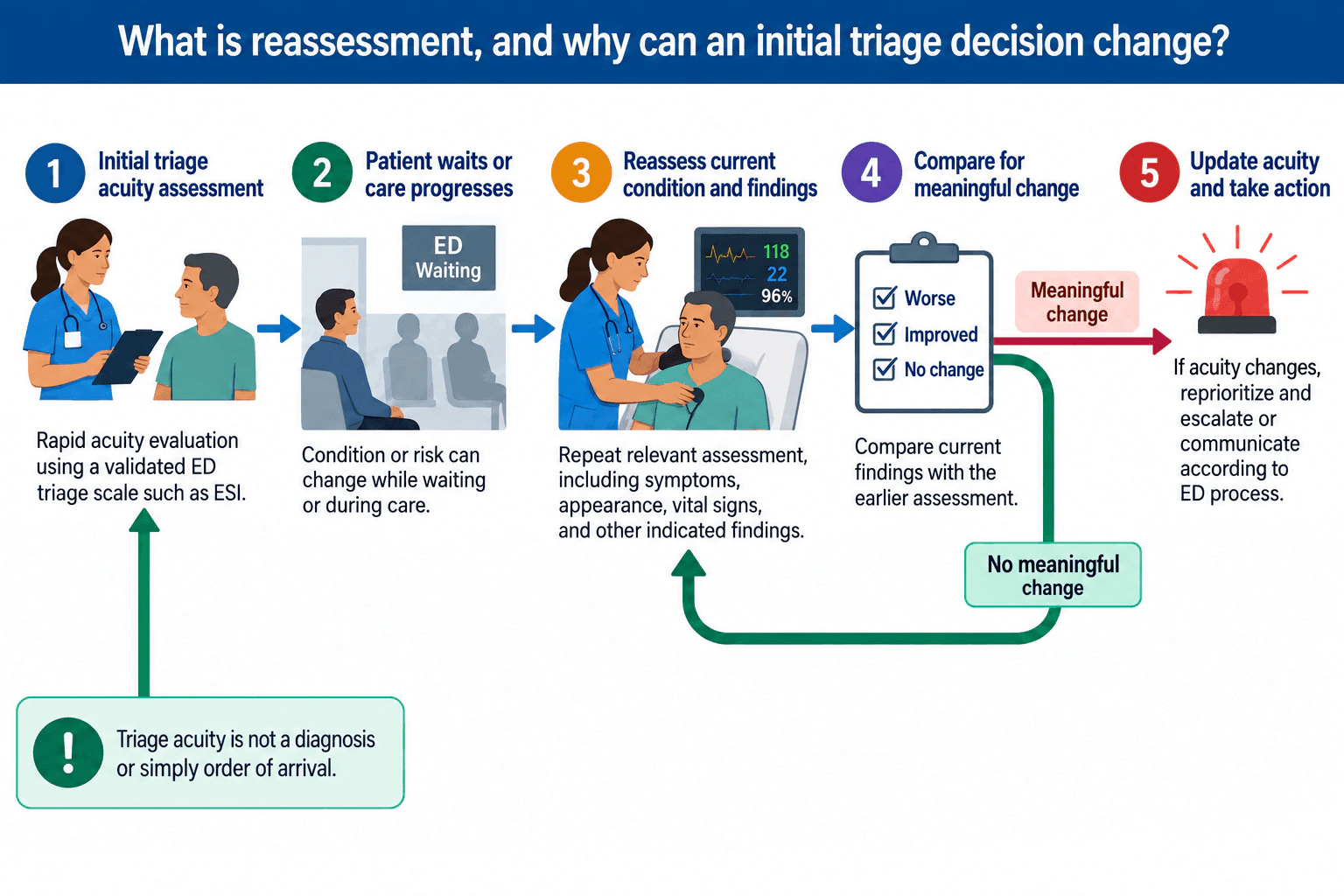
Reassessment means repeating the relevant evaluation after the initial triage decision and comparing the patient's current condition with earlier findings. A triage decision can change because symptoms, appearance, vital signs, or overall risk may change while the patient waits or receives care. If there is no meaningful change, appropriate reassessment continues. If acuity changes, the nurse reprioritizes and communicates or escalates according to the emergency department process.
Detailed Explanation
Reassessment is a repeat evaluation of the patient's current condition and relevant findings after the initial triage assessment. The initial triage decision reflects the information available at that time, so it can change when the patient's condition or risk changes. Triage acuity is a prioritization decision, not a diagnosis and not simply order of arrival. A validated emergency department triage system such as the Emergency Severity Index supports acuity assignment, while reassessment helps determine whether that assignment still reflects the patient's current condition. ena.org
Useful Questions to Ask the Interviewer
Which validated triage acuity system does this emergency department use?
What is the department process for reassessing patients who remain in the waiting area?
How should a nurse communicate and document a change in acuity here?
How to Explain It in an Interview
Initial Triage
I would explain that initial triage is a rapid acuity evaluation based on the patient's presentation and relevant assessment findings. In the United States, a validated system such as the Emergency Severity Index may be used to support prioritization. ena.org
Reassessment
A patient's condition or risk can change while waiting or during care. I would repeat the relevant focused assessment, including symptoms, appearance, vital signs, and other indicated findings, then compare those findings with the earlier assessment. ENA competency guidance includes reevaluating waiting patients as part of triage practice. ena.org
Decision Point
If there is no meaningful change, I would continue appropriate reassessment based on the patient's condition and the emergency department process. If the findings show that acuity has changed, I would reprioritize the patient and communicate or escalate the change through the appropriate clinical pathway.
Scope and Limitations
I would not use the triage level as a diagnosis or assume that arrival order determines priority. I would also avoid inventing findings that have not been observed. Nursing assessment, reassessment, prioritization, communication, and escalation should remain within applicable nursing scope. Actions requiring an order, another clinician's authority, or a locally authorized protocol would follow those requirements. The exact timing and documentation process for reassessment can depend on the patient's condition, the triage system, applicable standards, and facility policy.
Why Interviewers Ask This
Interviewers are evaluating whether the nurse understands that triage acuity reflects the patient's current presentation and must be reconsidered when the clinical picture changes. A strong answer demonstrates focused reassessment, comparison of findings over time, recognition of changing risk, appropriate reprioritization, communication, escalation, and awareness of nursing scope.
Common interview mistakes
Common mistakes include treating the initial triage acuity as permanent, confusing acuity with a diagnosis, assuming patients are prioritized only by arrival order, failing to repeat relevant assessment while the patient waits, failing to compare current findings with earlier findings, inventing clinical findings, or failing to communicate and escalate a meaningful change in acuity.
Interview tip
Explain reassessment as a continuous clinical loop that matches the diagram: establish the initial acuity, recognize that condition or risk may change, repeat the relevant assessment, compare current findings with the earlier assessment, then either continue reassessment when there is no meaningful change or update acuity and communicate or escalate when acuity changes. Keep the answer focused on nursing assessment and prioritization rather than diagnosis.
Interviewer may ask next
How would you verify that the original triage priority is still appropriate?
I would repeat the relevant focused assessment, review current symptoms, appearance, vital signs, and other indicated findings, and compare them with the earlier triage assessment. I would also consider any new information that has become available. If there is no meaningful change, I would continue appropriate reassessment. If the patient's acuity has changed, I would reprioritize and communicate or escalate according to the emergency department process.
What would you do if a patient who initially appeared stable develops new concerning findings while waiting?
I would promptly reassess the patient, identify the new findings, compare them with the earlier assessment, and determine whether they change the patient's acuity. If acuity has changed, I would reprioritize the patient and communicate or escalate through the appropriate emergency department process. Protocol authorized actions would follow the applicable protocol, while interventions requiring an order or another clinician's authority would be referred to the appropriate clinician.
5. How would you distinguish a concerning vital sign trend from a single questionable reading?Clinical KnowledgeMedium
i Question Details
Explain the concept or decision in ED nursing scope. State relevant assumptions, missing information and when additional clinical authority is required.
Short Interview Answer (30-60 seconds)
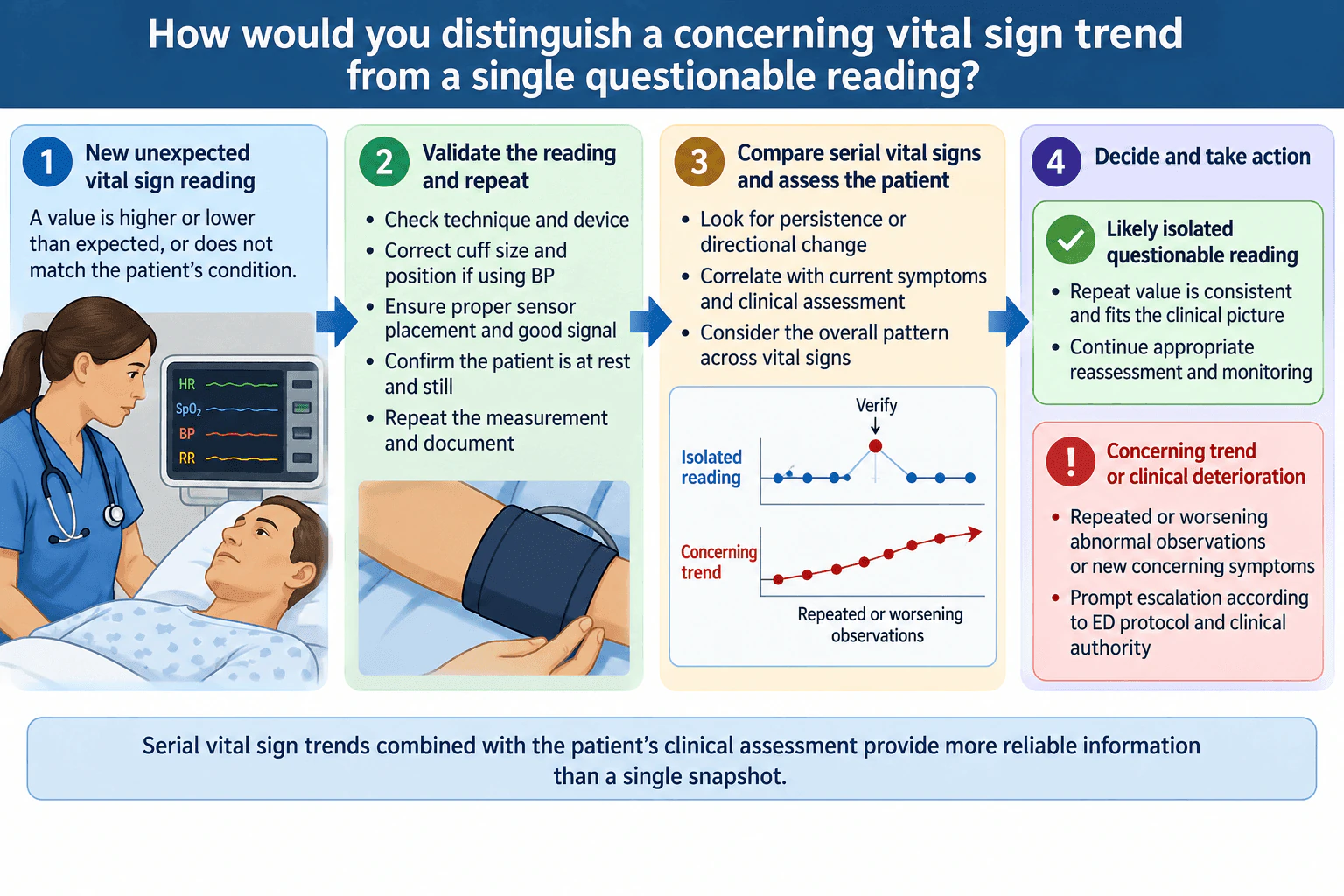
I would not judge a single unexpected vital sign in isolation. I would assess whether it fits the patient's condition, check the device and measurement technique, correct any obvious measurement problem, and repeat the measurement. Then I would compare serial vital signs and the focused assessment. If the abnormal value does not persist and the repeat fits the clinical picture, it may have been an isolated questionable reading. If abnormalities persist, worsen, show a directional change, or occur with new concerning symptoms, I would treat that as a concerning trend, reassess promptly, and escalate within emergency nursing scope and local protocol.
Detailed Explanation
A concerning trend is identified from repeated observations together with the patient's clinical condition, not from one number alone. An unexpected reading can represent true deterioration or a measurement problem, so I would first assess the patient, verify how the value was obtained, repeat it correctly, and compare it with serial observations. For blood pressure, technique such as appropriate cuff size and positioning matters. For pulse oximetry, sensor placement, signal quality, movement, perfusion, and known device limitations can affect interpretation. The patient's symptoms and focused assessment remain essential context.
Useful Questions to Ask the Interviewer
Does the scenario include previous vital signs or only the current reading?
Are there any new symptoms or assessment findings accompanying the change?
Is there a known measurement concern such as movement, positioning, cuff size, or sensor placement?
How to Explain It in an Interview
Core Concept
I would separate measurement verification from clinical interpretation. One unexpected value may be real or may reflect a measurement problem, so I would not assume either conclusion without checking the patient and the measurement.
Verify and Repeat
I would assess whether the reading fits the patient's condition, check the device and technique, and correct an identifiable problem. For blood pressure, I would consider cuff size and positioning. For pulse oximetry, I would consider sensor placement, signal quality, movement, perfusion, and other recognized limitations. I would then repeat the measurement and document the reassessment.
Compare Serial Observations
I would compare the repeat value with prior and subsequent vital signs. I would look for persistence, worsening, or a directional change and correlate that pattern with current symptoms and the focused assessment. I would also consider the overall pattern across vital signs instead of interpreting one parameter alone.
Decide and Act
If the repeat value is consistent with the patient's condition and the unexpected abnormality does not persist, the original result may represent an isolated questionable reading. I would continue appropriate reassessment and monitoring.
If repeated observations remain abnormal, worsen, or occur with new concerning symptoms or assessment findings, I would treat the pattern as possible clinical deterioration. I would promptly reassess, communicate the change, and escalate according to emergency department protocol and the appropriate clinical authority. Further diagnostic or treatment decisions that require an order or another professional would proceed through the applicable local process.
Limitations
The question does not provide age, baseline vital signs, diagnosis, medications, pregnancy status, comorbidities, symptoms, or specific measurements. Those details can materially change interpretation. I would therefore avoid inventing a universal threshold or diagnosis and base urgency on the verified measurements, serial pattern, focused assessment, and available clinical context.
Why Interviewers Ask This
Interviewers are assessing whether the nurse can distinguish measurement error or an isolated observation from meaningful clinical change. They want to see disciplined measurement verification, interpretation of serial observations with the bedside assessment, recognition of possible deterioration, appropriate reassessment, and timely escalation without diagnosing from a single number.
Common interview mistakes
Common mistakes include treating one abnormal number as proof of deterioration without verifying the measurement, dismissing an abnormal value simply because it is isolated, failing to compare serial observations, focusing on one vital sign without assessing the patient, overlooking measurement technique or device limitations, inventing a universal cutoff that was not provided, and delaying escalation when repeated abnormalities or new concerning symptoms appear.
Interview tip
Use the same sequence shown in the clinical reasoning flow: assess whether the value fits the patient, verify and repeat the measurement, compare serial observations, correlate the pattern with the focused assessment, then continue monitoring or escalate according to the patient's condition. This demonstrates both measurement discipline and emergency nursing judgment.
Interviewer may ask next
How would you verify that an unexpected vital sign is not simply a bad measurement?
I would assess the patient and review the measurement technique and device. For blood pressure, I would check cuff size, placement, positioning, and whether movement or talking could have affected the result. For pulse oximetry, I would check sensor placement, signal quality, movement, perfusion, and other recognized limitations. I would correct an identifiable issue, repeat the measurement, compare it with serial observations, and document the reassessment. If the repeated value remains abnormal or does not fit the clinical picture, I would investigate further and escalate as appropriate.
What would change if the repeated vital sign remained abnormal and the patient developed new concerning symptoms?
That would increase concern for clinical deterioration rather than an isolated questionable reading. I would perform a prompt focused reassessment, compare the current findings with the serial trend, communicate the change, and escalate according to emergency department protocol and the appropriate clinical authority. I would not delay escalation merely to collect additional readings when the patient's clinical condition is worsening.
6. How do you gather a focused history when a patient cannot give a complete account?Clinical KnowledgeMedium
i Question Details
Explain the concept or decision in ED nursing scope. State relevant assumptions, missing information and when additional clinical authority is required.
Short Interview Answer (30-60 seconds)
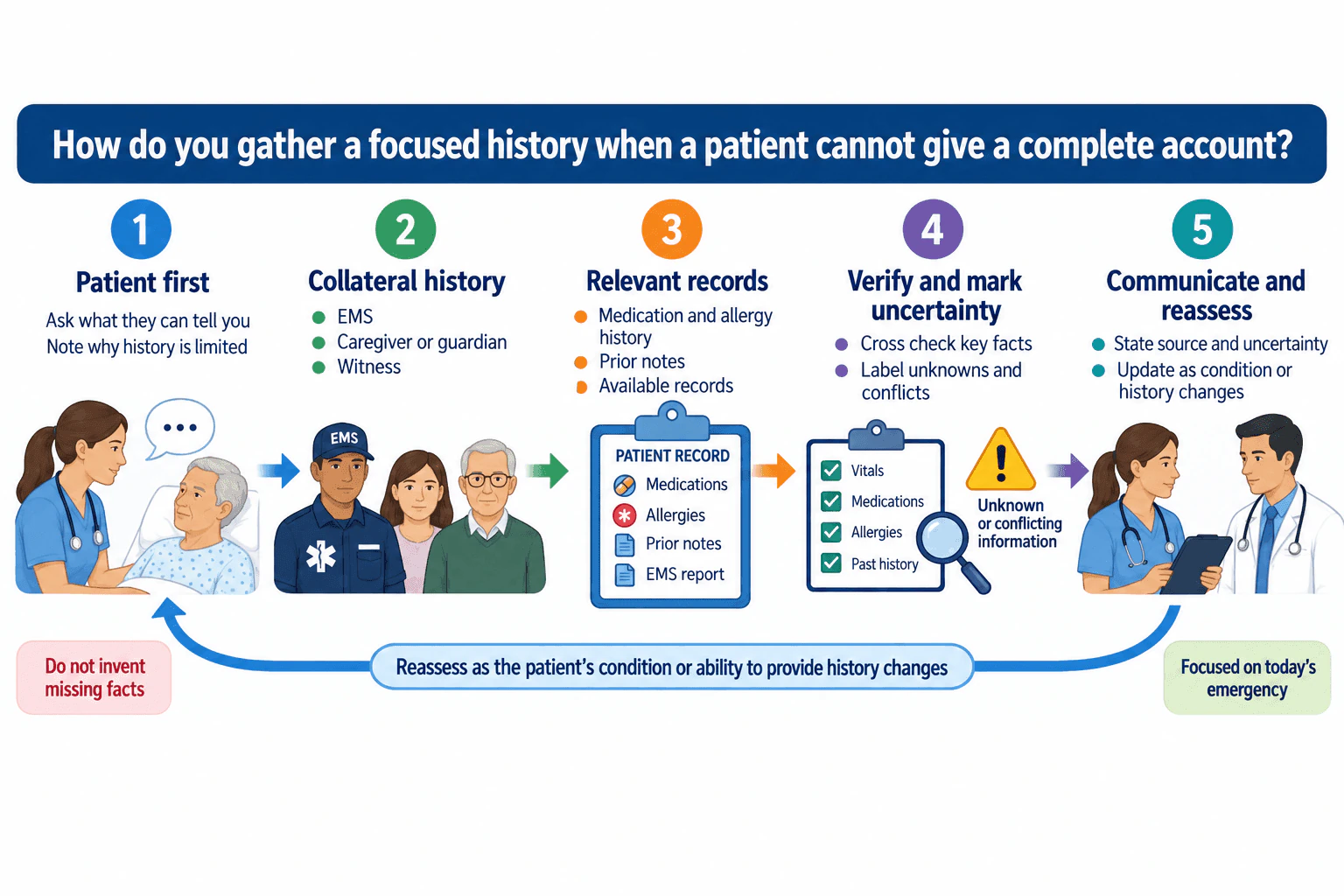
I first ask the patient what they can reliably tell me and identify why the history is limited. Then I gather focused collateral information from sources such as EMS, a caregiver, guardian, or witness and review relevant records, especially medications, allergies, prior notes, and available EMS information. I cross check key facts, clearly identify unknown or conflicting information, communicate the source and uncertainty, and reassess as the patient's condition or ability to provide history changes. If an unresolved gap could affect immediate care, I escalate it to the appropriate clinician.
Detailed Explanation
A focused history uses the best available information without pretending that missing information is known. I start with the patient because someone who cannot give a complete account may still provide useful details. I keep the history centered on the current emergency and make uncertainty visible.
Useful Questions to Ask the Interviewer
Does your emergency department have a standard process for documenting collateral history and its source?
What electronic or external records are routinely available to the bedside nurse?
How does the team communicate unresolved or conflicting history during handoff and escalation?
How to Explain It in an Interview
I would describe the process as five connected steps.
First, I start with the patient. I ask what they can tell me and note why the history is limited, such as altered mental status, impaired communication, clinical urgency, or reduced ability to recall events. I do not assume that an incomplete history is automatically inaccurate.
Second, I obtain collateral history when needed. Depending on who is available, that may include EMS, a caregiver, guardian, or witness. I focus on information relevant to the current emergency, such as what happened before arrival, recent changes, known conditions, medications, allergies, and usual baseline when available.
Third, I review relevant records available within my nursing role and the clinical system. Useful sources can include medication and allergy information, prior notes, and EMS documentation. I compare those sources rather than assuming that one source is automatically correct.
Fourth, I cross check important facts and explicitly identify uncertainty. If sources disagree about a medication, allergy, event, or past history, I communicate and document the discrepancy rather than choosing an answer without support. I do not invent missing findings.
Fifth, I communicate the source and degree of certainty of the history to the clinical team. If the patient's condition changes or the patient later becomes able to provide more information, I reassess and update the history. If unresolved information could affect immediate clinical decisions, I promptly escalate it to the appropriate clinician and follow applicable department procedures.
The central principle is to build the most reliable focused history possible from the patient, collateral sources, and records while keeping uncertainty visible and staying focused on today's emergency.
Why Interviewers Ask This
Interviewers want to assess whether the nurse can gather clinically useful information without filling gaps with assumptions. The question tests focused assessment, use of collateral sources and records, recognition of uncertainty, communication, documentation, escalation when needed, and reassessment while remaining within bedside emergency nursing scope.
Common interview mistakes
Common mistakes include ignoring information the patient can still provide, relying on one collateral source without checking other available information, treating an unverified record as current fact, failing to identify the source of the history, hiding conflicting information, inventing missing details, collecting an exhaustive history instead of focusing on the current emergency, failing to escalate an unresolved issue that could affect immediate care, and failing to reassess when the patient's condition or ability to communicate changes.
Interview tip
Organize the answer in the same sequence shown in the clinical workflow: patient first, collateral history, relevant records, verification and explicit uncertainty, then communication and reassessment. Emphasize that unknown information remains unknown until it can be verified.
Interviewer may ask next
How would you verify information when different sources give conflicting histories?
I would identify exactly which facts conflict and compare available sources such as the patient's account, EMS information, caregiver or guardian information, medication and allergy records, and prior documentation. I would state which source provided each important fact and keep the discrepancy visible rather than choosing one version without support. If the unresolved difference could affect immediate care, I would promptly communicate it to the appropriate clinician and continue seeking clarification through available clinical channels.
What would you do if the patient's condition changes or the patient later becomes able to provide a better history?
I would reassess the patient and repeat the focused history, giving the patient an opportunity to confirm, clarify, or correct earlier information. I would compare the new account with collateral information and records, update relevant documentation and team communication, and clearly identify any remaining uncertainty. A change in condition or ability to provide history is a reason to reassess rather than treating the original incomplete account as final.
7. How would you assess a patient whose reported symptoms and initial observations appear inconsistent?Clinical KnowledgeMedium
i Question Details
Explain the concept or decision in ED nursing scope. State relevant assumptions, missing information and when additional clinical authority is required.
Short Interview Answer (30-60 seconds)
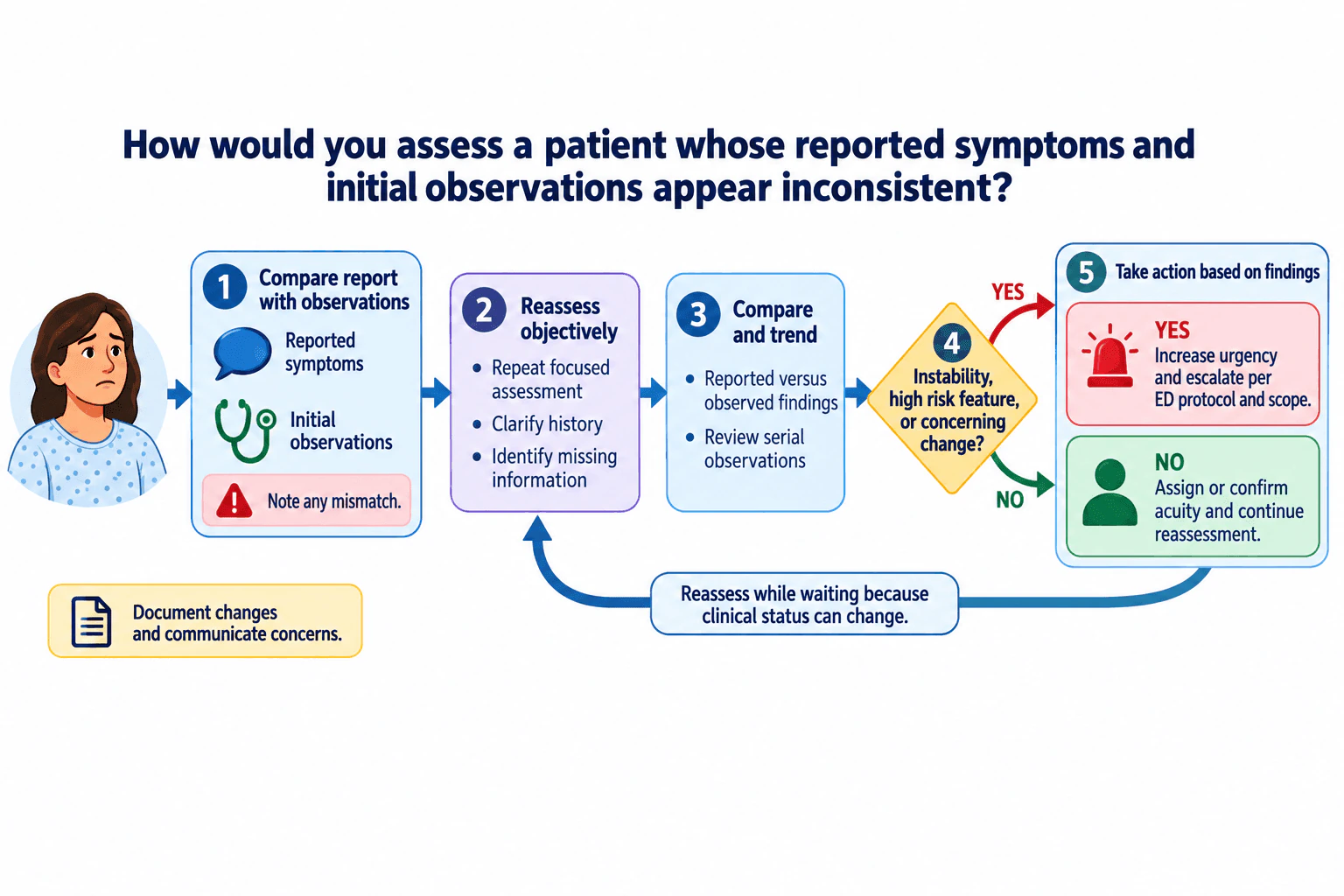
I would not assume that either the patient report or the first observation is wrong. I would compare the two, repeat a focused assessment, clarify the history, identify missing information, and review serial observations for change. If I found instability, a high risk feature, or a concerning change, I would increase urgency and escalate within emergency department protocol and nursing scope. If the patient remained appropriate to wait, I would assign or confirm acuity, continue reassessment, document changes, and communicate concerns.
Detailed Explanation
When a patient's reported symptoms and initial observations do not align, I would treat the mismatch as a reason for objective reassessment. I would not dismiss the patient's report or assume that one reassuring observation settles the clinical picture. Triage is used to determine acuity and priority for care, not to establish a diagnosis. In a United States emergency department, a validated five level triage method such as the Emergency Severity Index may be used according to local practice.
Useful Questions to Ask the Interviewer
Which validated triage system does this emergency department use?
What is the local process for escalating a change in acuity while a patient is waiting?
How are repeat assessments and changes in condition documented and communicated here?
How to Explain It in an Interview
I would first compare the patient's reported symptoms with the initial observations and note the mismatch without assuming either source is inaccurate.
Next, I would reassess objectively. I would repeat a focused assessment, clarify the history and symptom timeline, and identify information that is missing or uncertain. These assessment and communication steps are within bedside nursing responsibilities.
I would then compare the repeated findings with the patient's report and review serial observations for trends. A single observation can be incomplete, while a change over time may reveal increasing urgency.
The next decision is whether the reassessment shows instability, a high risk feature, or a concerning change. Emergency Severity Index guidance specifically considers physiologic stability and risk for deterioration when determining acuity. If concerning findings are present, I would increase the urgency of care and escalate according to emergency department protocol and nursing scope. Protocol authorized actions would follow the applicable department process, while diagnostic testing, treatment, medications, and other interventions requiring an order or another clinician would proceed under the appropriate authority.
If the patient remains appropriate to wait, I would assign or confirm acuity using the department's validated triage method and continue reassessment because clinical status can change after the initial encounter. I would document material changes and communicate concerns to the appropriate clinician.
The key is to avoid anchoring on the first impression. I would compare, reassess, trend, decide whether urgency has changed, and then either escalate or continue reassessment.
Why Interviewers Ask This
This question tests whether the nurse can respond to conflicting clinical information without anchoring on an initial impression. It evaluates focused assessment, recognition of deterioration, appropriate triage judgment, reassessment, communication, and escalation. It also tests whether the nurse understands that triage acuity establishes priority for care rather than making a diagnosis.
Common interview mistakes
Common mistakes include dismissing the patient's symptoms because the initial observations appear reassuring, assuming the first observation is definitive, anchoring on an early impression, treating acuity as a diagnosis, failing to repeat a focused assessment, ignoring serial changes, inventing findings that were not obtained, delaying escalation when concerning findings emerge, and failing to document or communicate a meaningful change.
Interview tip
Use the same sequence as the clinical reasoning flow: compare the report with observations, reassess objectively, identify missing information, review serial observations, decide whether instability or another concerning change is present, and then escalate or continue reassessment. Make clear that your goal is safe prioritization, not making a diagnosis from limited triage information.
Interviewer may ask next
How would you verify that the apparent inconsistency is real rather than an assessment or information problem?
I would repeat the focused assessment, clarify the patient's description and timeline, verify observations and measurements when appropriate, identify missing information, and compare repeated findings with available serial observations. If clinically important uncertainty remained, I would communicate the concern and obtain additional clinical evaluation through the appropriate emergency department process.
What would you do if the patient's condition changed while waiting?
I would promptly reassess the patient, compare the new findings with the previous assessment, and reconsider acuity. If there were instability, a high risk feature, or another concerning change, I would increase urgency and escalate according to emergency department protocol and nursing scope. I would document the change, communicate it to the appropriate clinician, and continue reassessment as indicated.
8. How do you communicate uncertainty in your clinical impression without delaying assessment?Clinical KnowledgeHard
i Question Details
Explain the concept or decision in ED nursing scope. State relevant assumptions, missing information and when additional clinical authority is required.
Short Interview Answer (30-60 seconds)
I would be explicit about both the findings and the uncertainty. I might say, "I am concerned because of these observed findings, but I do not yet have enough information to determine the cause." I would continue the focused assessment, obtain and trend relevant vital signs, reassess for deterioration, and escalate concerning changes rather than waiting for diagnostic certainty. As the bedside RN, I can assess, reassess, communicate, document, and escalate within my nursing scope. I would use authorized protocols when applicable and involve the appropriate clinician when diagnostic decisions, orders, or treatment exceed my authority.
Detailed Explanation
Uncertainty in emergency nursing should be communicated as a clinical limitation, not as a reason to stop or postpone assessment. I would state what is known, what remains unknown, why the uncertainty matters, and what I am doing next.
Useful Questions to Ask the Interviewer
Which nurse initiated protocols are authorized in this emergency department?
What escalation process is expected when a nurse is concerned about deterioration but the diagnosis remains uncertain?
How is reassessment of patients who are still waiting for evaluation handled here?
How to Explain It in an Interview
Core Concept
I separate observation from interpretation. I report the actual symptoms, examination findings, mental status, vital signs, and changes over time before describing a provisional impression. I avoid presenting an unconfirmed diagnosis as fact.
For example, I might say, "I cannot determine the cause from the available information yet, but these findings concern me for possible deterioration, so I am continuing assessment and escalating the concern now."
Clinical Priorities
Diagnostic uncertainty does not delay assessment of immediate threats. I continue focused assessment and prioritize airway, breathing, circulation, neurologic status, appearance, vital sign trends, and other findings relevant to the presentation. If the patient is waiting, I reassess because acuity can change after the initial triage encounter.
Triage acuity is different from diagnosis and from order of arrival. The Emergency Severity Index is a validated five level emergency department triage acuity scale. It considers physiologic stability, risk of deterioration, and, for patients who are stable enough to reach that part of the algorithm, anticipated resource needs. It does not establish a medical diagnosis.
Assessment Factors
I identify important missing information rather than filling gaps with assumptions. Depending on the presentation, this can include symptom onset and progression, medications, relevant history, examination findings, repeat vital signs, response to prior interventions, and diagnostic information that has not yet been obtained.
I also communicate whether my concern comes from a new finding, a trend, or a change from the previous assessment.
Care Rationale
In a United States bedside RN role, assessment, reassessment, communication, documentation, and escalation are performed within the nurse practice act, individual competency, and applicable policy. Nurse initiated protocols may permit specific actions when authorized. Diagnostic decisions, prescribing, and other actions requiring additional authority are referred to the appropriate physician, advanced practice clinician, or other authorized professional.
The goal is not to sound certain when evidence is incomplete. The goal is to communicate observable risk clearly while continuing assessment and appropriate escalation without delay.
Why Interviewers Ask This
Interviewers are evaluating whether the nurse can use sound clinical judgment when the diagnosis is not yet established. They want to hear that uncertainty does not become hesitation. Safe emergency nursing judgment includes communicating objective findings clearly, identifying risk, continuing focused assessment, reassessing for change, and involving the appropriate clinician when additional diagnostic or treatment authority is required.
Common interview mistakes
Common mistakes include presenting a suspected diagnosis as confirmed, saying only that the nurse is unsure without explaining the concerning findings, waiting for complete diagnostic information before escalating deterioration, assuming that an initial triage acuity cannot change, confusing Emergency Severity Index acuity with a diagnosis, confusing routine emergency department triage with disaster triage, inventing missing patient information, and implying authority to order or prescribe beyond the RN role.
Interview tip
Use a concise communication pattern: state the observed findings, identify the concern, name what remains unknown, explain what assessment or reassessment is continuing, and state when you would escalate. This demonstrates clinical judgment without overstating certainty or delaying care.
Interviewer may ask next
How would you verify that your clinical concern is supported rather than relying only on an impression?
I would return to objective information. I would verify the history and current symptoms, repeat relevant assessments and vital signs, compare findings with earlier measurements, review available records or results within my role, and determine whether the patient has developed new signs of deterioration. I would communicate the verified findings and any remaining uncertainty to the appropriate clinician. I would not invent missing findings or wait for complete diagnostic certainty before escalating a significant change.
What changes if the patient initially appears stable but develops new respiratory distress while waiting?
The new respiratory distress changes the immediate priority. I would promptly reassess airway, breathing, circulation, mental status, oxygenation, and other relevant vital signs, obtain appropriate assistance, and escalate the patient for urgent evaluation. I would initiate only nursing measures or protocols authorized by my scope, competency, and local policy and obtain clinician orders when required. I would not treat the previous triage assessment as fixed because acuity can change as the patient's condition changes.
9. How would you avoid anchoring on the initial triage label when new findings emerge?Clinical KnowledgeHard
i Question Details
Explain the concept or decision in ED nursing scope. State relevant assumptions, missing information and when additional clinical authority is required.
Short Interview Answer (30-60 seconds)
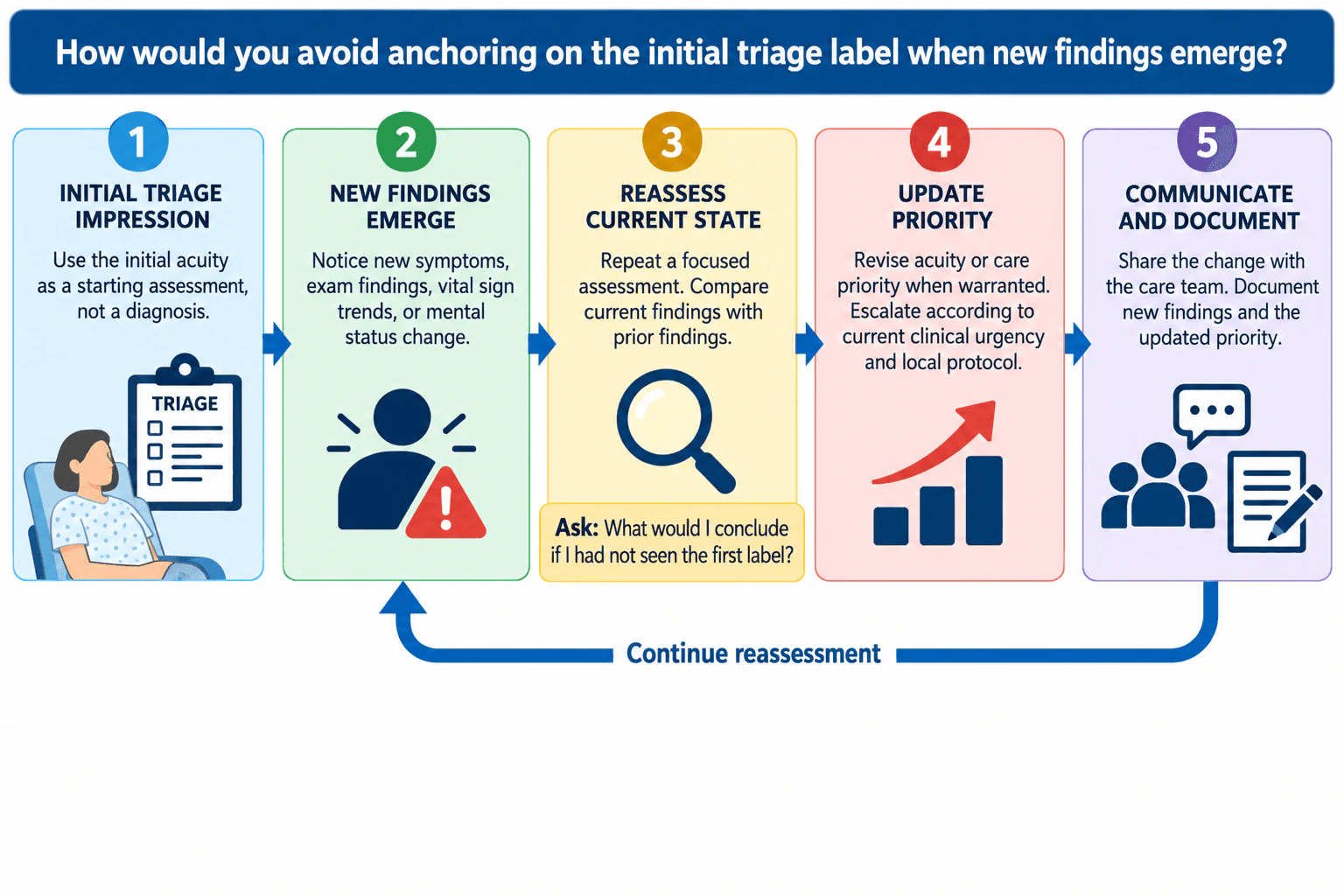
I would treat the initial triage label as provisional, not as a diagnosis. When new findings appear, I would repeat a focused assessment, review relevant symptoms, examination findings, vital sign trends, and mental status, then compare them with the earlier findings. I would deliberately ask what I would conclude if I had not seen the first label. If the current assessment shows greater urgency, I would update the priority according to the validated triage process and local policy, escalate appropriately, communicate and document the change, and continue reassessment.
Detailed Explanation
The central idea is that an initial triage classification is a snapshot of acuity at one point in time. It helps determine priority for clinical assessment, but it is not a diagnosis and should not prevent the nurse from responding to new evidence. When the patient changes, the nurse should reassess the current state rather than force new findings to fit the original impression.
Useful Questions to Ask the Interviewer
Which validated triage system does this emergency department use?
What is the local process for updating acuity when a patient's condition changes while waiting?
Which nurse initiated protocols may be used when reassessment identifies an urgent concern?
How to Explain It in an Interview
Initial Triage Impression
I would use the initial acuity as a starting assessment, not as a diagnosis or a permanent label. Triage determines urgency and priority based on the information available at that time.
New Findings
If new symptoms, examination findings, vital sign trends, mental status changes, or other clinically relevant observations emerge, I would treat them as new evidence rather than trying to explain them away because of the original triage impression.
Reassess Current State
I would repeat a focused assessment appropriate to the presentation and compare the current findings with the prior findings. A useful cognitive check is, What would I conclude if I had not seen the first label? That helps me challenge anchoring and reconsider the situation from the current evidence.
Update Priority
If the reassessment shows greater urgency, I would revise the triage or care priority according to the validated triage process and local policy. I would escalate according to the patient's current clinical urgency. Nursing assessment and recognition of change are within bedside registered nurse practice. Protocol authorized actions would be used only within the applicable protocol, while diagnostic decisions, treatments requiring an order, and decisions outside nursing authority would be referred to the appropriate clinician.
Communicate, Document, and Reassess
I would communicate the change to the appropriate care team member, document the new findings, reassessment, updated priority when applicable, and relevant notifications, then continue reassessment. The important point is that triage is dynamic. Current findings should drive urgency rather than the original label or order of arrival.
Why Interviewers Ask This
This question evaluates whether the nurse can recognize anchoring bias, distinguish triage acuity from diagnosis, detect changing clinical risk, perform an objective reassessment, reprioritize appropriately, escalate concerns, and communicate and document changes without allowing the original label to delay care.
Common interview mistakes
Common mistakes include treating the triage category as a diagnosis, assuming the original acuity cannot change, focusing only on findings that support the first impression, ignoring serial vital sign or neurologic changes, waiting for a routine reassessment despite obvious deterioration, changing priority without reassessing the patient, or failing to communicate and document clinically meaningful changes.
Interview tip
Present the reasoning as one continuous loop: initial triage impression, new findings, focused reassessment, updated priority when warranted, communication and documentation, then continued reassessment. Emphasize that current evidence determines urgency and that any protocol authorized or clinician ordered actions remain within local policy and bedside registered nurse scope.
Interviewer may ask next
How would you verify that you are not simply confirming the original triage impression?
I would deliberately look for findings that do not fit the original impression, repeat the relevant focused assessment, compare current findings with prior findings, and ask what conclusion I would reach if the original label were hidden from me. If the current evidence and original classification no longer agree, I would reassess acuity and obtain the appropriate clinical review rather than dismissing the discrepancy.
What would change if the patient developed a new time critical finding while still waiting?
I would respond to the patient's current urgency rather than the previous triage category or order of arrival. I would perform the immediately relevant nursing assessment, reprioritize or relocate the patient according to the department's triage and escalation process, notify the appropriate emergency clinician or response pathway, initiate only actions authorized within nursing scope or protocol, document the change and response, and continue reassessment.
10. What are Standard Precautions in emergency nursing?Patient SafetyEasy
i Question Details
Explain the concept or decision in ED nursing scope. State relevant assumptions, missing information and when additional clinical authority is required.
Short Interview Answer (30-60 seconds)
Standard Precautions are the baseline infection prevention practices I use for every patient. I perform hand hygiene at the appropriate times, select gloves, gown, mask, and eye protection according to the anticipated exposure, use respiratory hygiene and cough etiquette, follow safe injection and sharps practices, and clean, disinfect, or reprocess equipment appropriately. If a suspected or confirmed infection requires additional measures, I add the appropriate Transmission Based Precautions.
Detailed Explanation
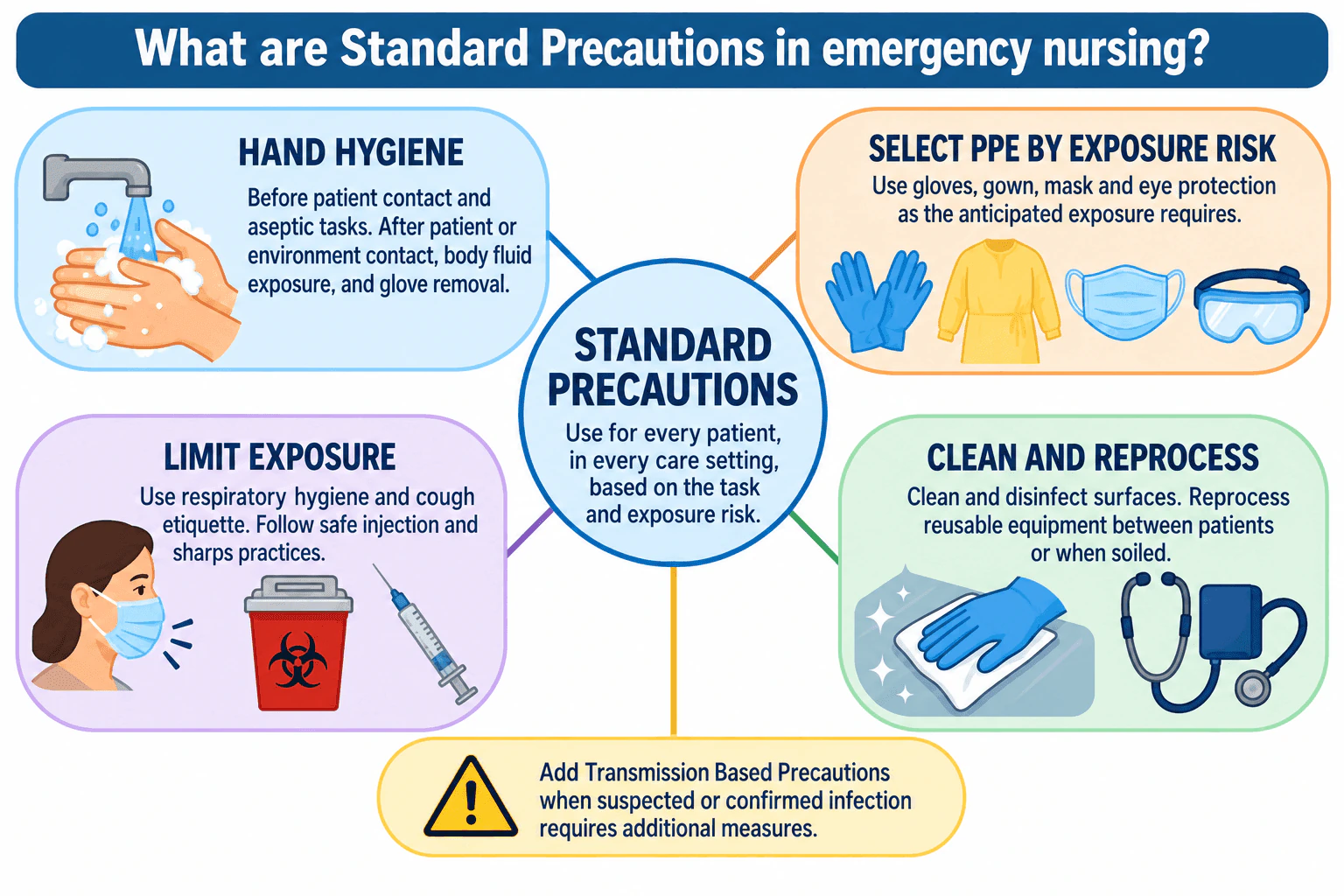
Standard Precautions are baseline infection prevention practices used for every patient in the emergency department. They are not a sequence of steps. They are a coordinated set of practices selected according to the care activity and anticipated exposure risk.
Useful Questions to Ask the Interviewer
Which infection prevention policies and isolation workflows does this emergency department use?
How are precaution needs communicated when patients move between triage, treatment areas, diagnostic services, and inpatient units?
What clinical or infection prevention resource should nurses use when the required precaution is unclear?
How to Explain It in an Interview
I would explain that Standard Precautions apply to every patient and that I match the precautions to the task and anticipated exposure risk.
Hand Hygiene
I clean my hands immediately before touching a patient and before an aseptic task. I also clean them after touching a patient or the patient surroundings, after contact with blood, body fluids, or contaminated surfaces, and immediately after glove removal. Gloves do not replace hand hygiene.
Select PPE By Exposure Risk
I select personal protective equipment according to the exposure I anticipate. Depending on the task, that may include gloves, a gown, a mask, and eye protection. I would not automatically use every item for every patient.
Limit Exposure
I use respiratory hygiene and cough etiquette and follow safe injection and sharps practices. These actions reduce exposure to infectious material and help protect both patients and healthcare personnel.
Clean And Reprocess
I make sure patient care equipment is cleaned, disinfected, or reprocessed appropriately before reuse and that environmental surfaces are cleaned as required. Shared equipment should not become a route of transmission between patients.
Additional Precautions
Standard Precautions remain the baseline. If a patient has a suspected or confirmed infection that requires additional controls, I add the appropriate Transmission Based Precautions and follow current local infection prevention requirements. If the required precaution is uncertain, I clarify with the appropriate clinical or infection prevention authority rather than guessing.
Why Interviewers Ask This
Interviewers want to know whether the nurse understands that infection prevention starts with consistent precautions for every patient rather than only patients with a known infection. They are also assessing whether the nurse can select personal protective equipment according to exposure risk, perform hand hygiene at the correct times, reduce respiratory and sharps exposure, handle reusable equipment safely, and recognize when additional precautions are required.
Common interview mistakes
Common mistakes include treating Standard Precautions as something used only for patients with a known infection, assuming gloves replace hand hygiene, using personal protective equipment without considering the anticipated exposure, handling sharps unsafely, inadequately cleaning or reprocessing shared equipment, and forgetting that additional Transmission Based Precautions may be required for some suspected or confirmed infections.
Interview tip
Organize the answer around the same four concepts shown in the diagram: hand hygiene, selecting personal protective equipment by exposure risk, limiting exposure through respiratory hygiene and safe injection and sharps practices, and cleaning or reprocessing. Finish by explaining that appropriate Transmission Based Precautions are added when additional infection controls are required.
Interviewer may ask next
How would you verify that you are using the correct precautions for a patient?
I would assess the care activity and anticipated exposure, review available information about known or suspected infection, and follow the current facility infection prevention policy. If the required precaution is unclear, I would clarify with the charge nurse, infection prevention team, or other appropriate clinical authority before proceeding with a nonurgent activity.
What changes if the patient is suspected of having an infection that requires additional precautions?
I would continue Standard Precautions and add the appropriate Transmission Based Precautions for the suspected route of transmission. The additional measures may affect personal protective equipment, patient placement, transport, and equipment handling according to current guidance and local policy. I would also communicate the precaution status clearly during transfers of care.
More questions load as you scroll
Emergency Department Nurse Resume Examples
Explore the resume examples below to find the one that best matches your target Emergency Department Nurse role.
New Graduate Emergency Department Nurse0-1 years; supervised transition to emergency nursing
Disclaimer: This interview guide is for educational and informational purposes only. It is designed to help readers prepare, but it does not guarantee any interview result, hiring decision, offer, or outcome. Interview questions, hiring criteria, and preferred answers can vary by employer, interviewer, industry, location, and time. All answers, examples, and explanations in this guide are suggested examples for interview preparation, not definitive answers or instructions for professional practice. They are based on research and judgment, are provided without warranties of any kind, and should be adapted to the question, role, and applicable laws and professional requirements. Diagrams are simplified illustrations intended to highlight the main concepts and their relationships; actual situations, systems, and practices may be more complex. Alternative approaches may be equally valid or better suited to a particular question, context, or interviewer. To the fullest extent permitted by applicable law, the contributors and publisher are not liable for decisions made, actions taken, or losses incurred based on this guide.
State Laws and Professional Responsibilities: Laws and requirements governing an occupation vary by state and jurisdiction. You are responsible for checking the current laws, licensing requirements, and scope-of-practice rules that apply to your location and role, and for ensuring that your answers and actions comply with them. Adapt examples in this guide to those requirements. This guide is not legal advice.
Content Accuracy and Verification: To the fullest extent permitted by applicable law, we do not represent or warrant that interview guides, questions, answers, examples, or diagrams are accurate, complete, current, error-free, or suitable for any particular purpose. You are responsible for independently reviewing and verifying the information before relying on it.