This interview guide is for educational and informational purposes only. It is designed to help readers prepare, but it does not guarantee any interview result, hiring decision, offer, or outcome. Interview questions, hiring criteria, and preferred answers can vary by employer, interviewer, industry, location, and time. All answers, examples, and explanations in this guide are suggested examples for interview preparation, not definitive answers or instructions for professional practice. They are based on research and judgment, are provided without warranties of any kind, and should be adapted to the question, role, and applicable laws and professional requirements. Diagrams are simplified illustrations intended to highlight the main concepts and their relationships; actual situations, systems, and practices may be more complex. Alternative approaches may be equally valid or better suited to a particular question, context, or interviewer. To the fullest extent permitted by applicable law, the contributors and publisher are not liable for decisions made, actions taken, or losses incurred based on this guide.
State Laws and Professional Responsibilities
Laws and requirements governing an occupation vary by state and jurisdiction. You are responsible for checking the current laws, licensing requirements, and scope-of-practice rules that apply to your location and role, and for ensuring that your answers and actions comply with them. Adapt examples in this guide to those requirements. This guide is not legal advice.
Identity, Image, and Privacy Notice
To respect individual privacy, some names, profile photographs, avatars, biographical details, and other identifying information displayed in this guide may be replaced with pseudonyms, licensed stock images, illustrative avatars, composite images, or representative descriptions. Unless a person is expressly identified as an actual contributor, a displayed name, image, or profile should not be understood as depicting or identifying a specific candidate, interviewer, employee, or other real individual. These representations are provided for editorial and illustrative purposes only and do not imply endorsement, employment, participation, or affiliation with this guide or any company mentioned in it. Any resemblance to an actual person is coincidental.
Company Notice
This guide is an independent educational resource and is not affiliated with, endorsed by, sponsored by, or approved by the company named in this guide. Company names identify reported interview experiences or the employer context of clearly labeled original practice exercises. Interview practices can change without notice, and inclusion of company-specific content does not mean these questions are official, complete, or guaranteed to be asked. To the fullest extent permitted by law, the author, contributors, and publisher are not responsible for outcomes related to use of this material.
Content Accuracy and Verification
To the fullest extent permitted by applicable law, we do not represent or warrant that interview guides, questions, answers, examples, or diagrams are accurate, complete, current, error-free, or suitable for any particular purpose. You are responsible for independently reviewing and verifying the information before relying on it.
Questions or comments?
Contact us for general questions, or share feedback, technical corrections, and comments with the community.
51. How would you manage a second deteriorating patient while resuscitation resources are occupied?Scenario BasedHard
i Question Details
Explain the concept or decision in ED nursing scope. State relevant assumptions, missing information and when additional clinical authority is required.
Short Interview Answer (30-60 seconds)
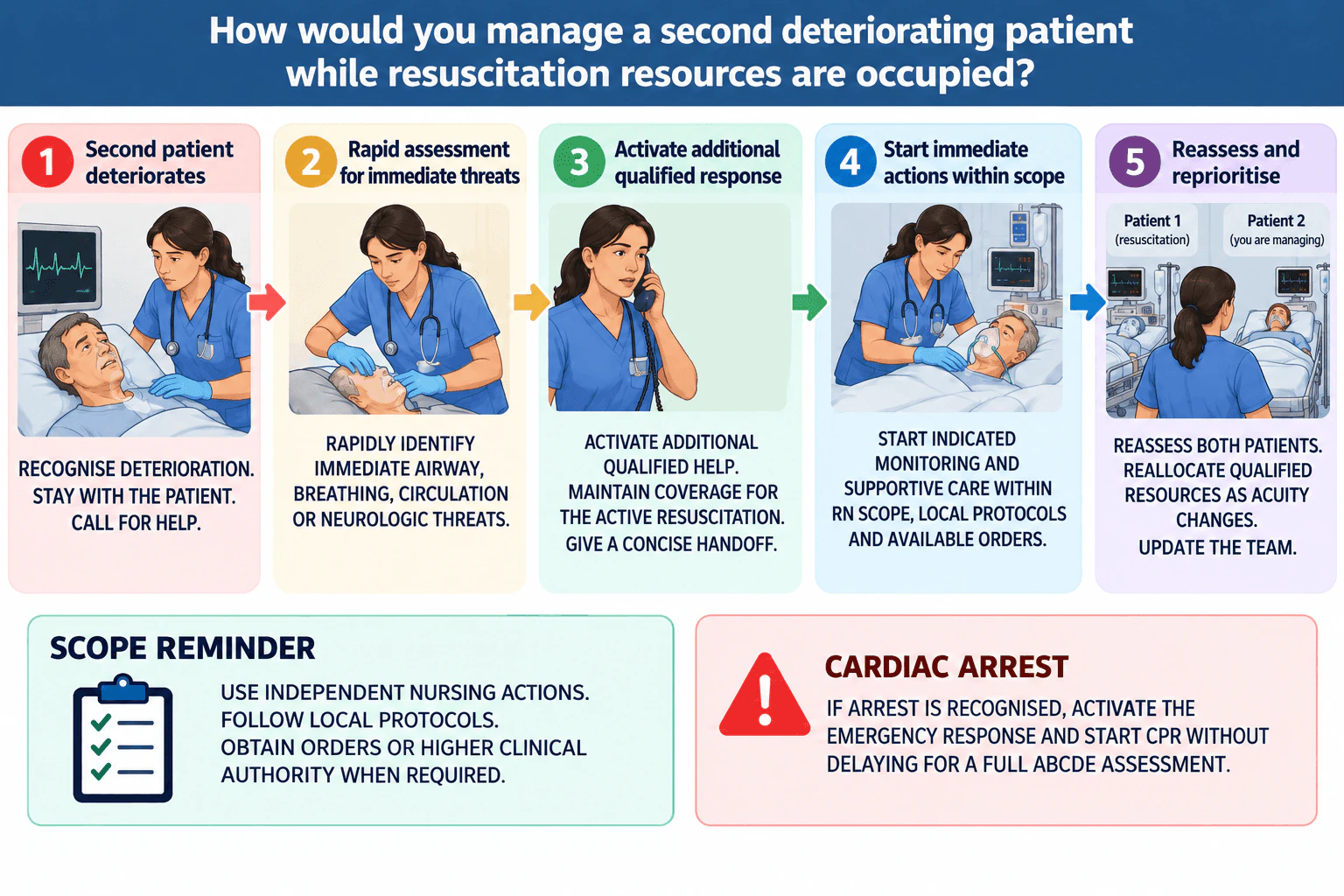
I would stay with the deteriorating patient, call for additional qualified help, and rapidly identify immediate airway, breathing, circulation, or neurologic threats while maintaining qualified coverage for the active resuscitation. I would start indicated monitoring and supportive care within my RN scope, local protocols, and available orders, give a concise handoff, and repeatedly reassess both patients. Resources should be reallocated as acuity changes. If cardiac arrest is recognized, I would activate the emergency response and start CPR without delaying for a full ABCDE assessment.
Detailed Explanation
The key is to respond to the second patient's immediate threat without leaving the first resuscitation inadequately covered. I would prioritize according to current clinical acuity rather than arrival order. Because the patient's age, pregnancy status, vital signs, diagnosis, level of consciousness, and cause of deterioration are not provided, I would not assume specific findings or treatments. My actions would also depend on my competence, applicable nursing regulations, local protocols, available orders, and the resources immediately available.
Useful Questions to Ask the Interviewer
What qualified staff and escalation resources are immediately available while the first resuscitation continues?
What change has occurred in the second patient's airway, breathing, circulation, neurologic status, or overall condition?
Which immediate interventions are authorized by local nursing protocols, and which require an order or additional clinical authority?
How to Explain It in an Interview
Immediate Actions
I would recognize the deterioration, stay with the second patient, and call for qualified help. I would rapidly identify any immediate airway, breathing, circulation, or neurologic threat. This focused assessment should guide the next action without delaying an intervention that is already clearly indicated.
Resource Escalation
I would activate the appropriate local escalation pathway and clearly communicate that another patient is deteriorating while the first resuscitation remains in progress. I would confirm that qualified coverage continues for the first patient and give the responding team a concise handoff describing the change, immediate threats, actions already taken, and help required.
Nursing Priorities
I would start indicated monitoring and supportive care that is within my RN scope and competence. Protocol authorized interventions would follow the applicable local protocol. If an intervention requires an order or another clinician's authority, I would obtain that authority rather than assuming it is independently authorized. Nursing scope depends on licensure, competence, jurisdictional regulation, and practice setting requirements.
Reassessment
I would repeatedly reassess both patients, update the team, and redirect qualified resources as acuity changes. Emergency department prioritization is based on clinical acuity and risk, so the second patient's deterioration may require immediate reprioritization even while another resuscitation continues.
If the second patient is recognized to be in cardiac arrest, I would activate the emergency response and begin CPR according to current population appropriate resuscitation guidance. I would not delay CPR to complete a full ABCDE assessment. The goal is safe parallel care: address the new immediate threat, maintain coverage for the ongoing resuscitation, escalate early, work within scope, and continually reassess both patients.
Why Interviewers Ask This
This scenario tests whether an emergency nurse can recognize deterioration, prioritize immediate threats, escalate early when resources are constrained, protect the patient already being resuscitated, work within nursing scope, communicate clearly, and repeatedly reprioritize competing patients according to current acuity.
Common interview mistakes
Common mistakes include leaving the active resuscitation without qualified coverage, delaying escalation while trying to manage both patients alone, using arrival order instead of current acuity to prioritize, completing a prolonged assessment before responding to recognized cardiac arrest, assuming treatments are independently authorized without checking scope or protocol, inventing patient findings that were not provided, and failing to reassess both patients after resources are redistributed.
Interview tip
Organize the answer around the same five decisions shown in the diagram: recognize deterioration, identify the immediate threat, activate additional qualified help while maintaining coverage for the active resuscitation, provide authorized nursing care, and reassess both patients as acuity changes. State clearly when local protocols, orders, or higher clinical authority are required.
Interviewer may ask next
How would you verify that both patients remain safely covered after you escalate?
I would confirm who is responsible for each patient, verify that requested help has been acknowledged or has arrived, reassess both patients at the bedside, review the response to any immediate interventions, and use closed loop communication to update the team. If either patient worsens or adequate resources are still unavailable, I would escalate again through the appropriate local pathway.
What changes if the second patient becomes unresponsive and is not breathing normally?
That raises immediate concern for cardiac arrest. For an adult, I would activate the emergency response, assess breathing and pulse rapidly according to current adult basic life support guidance, and if no definite pulse is felt within 10 seconds, start CPR and obtain defibrillation capability as soon as available. I would not delay CPR to complete a full ABCDE assessment, and additional qualified staff would be mobilized so both patients continue to receive appropriate care.
52. How would you identify and communicate a barrier to effective resuscitation without disrupting urgent care?Scenario BasedHard
i Question Details
Explain the concept or decision in ED nursing scope. State relevant assumptions, missing information and when additional clinical authority is required.
Short Interview Answer (30-60 seconds)
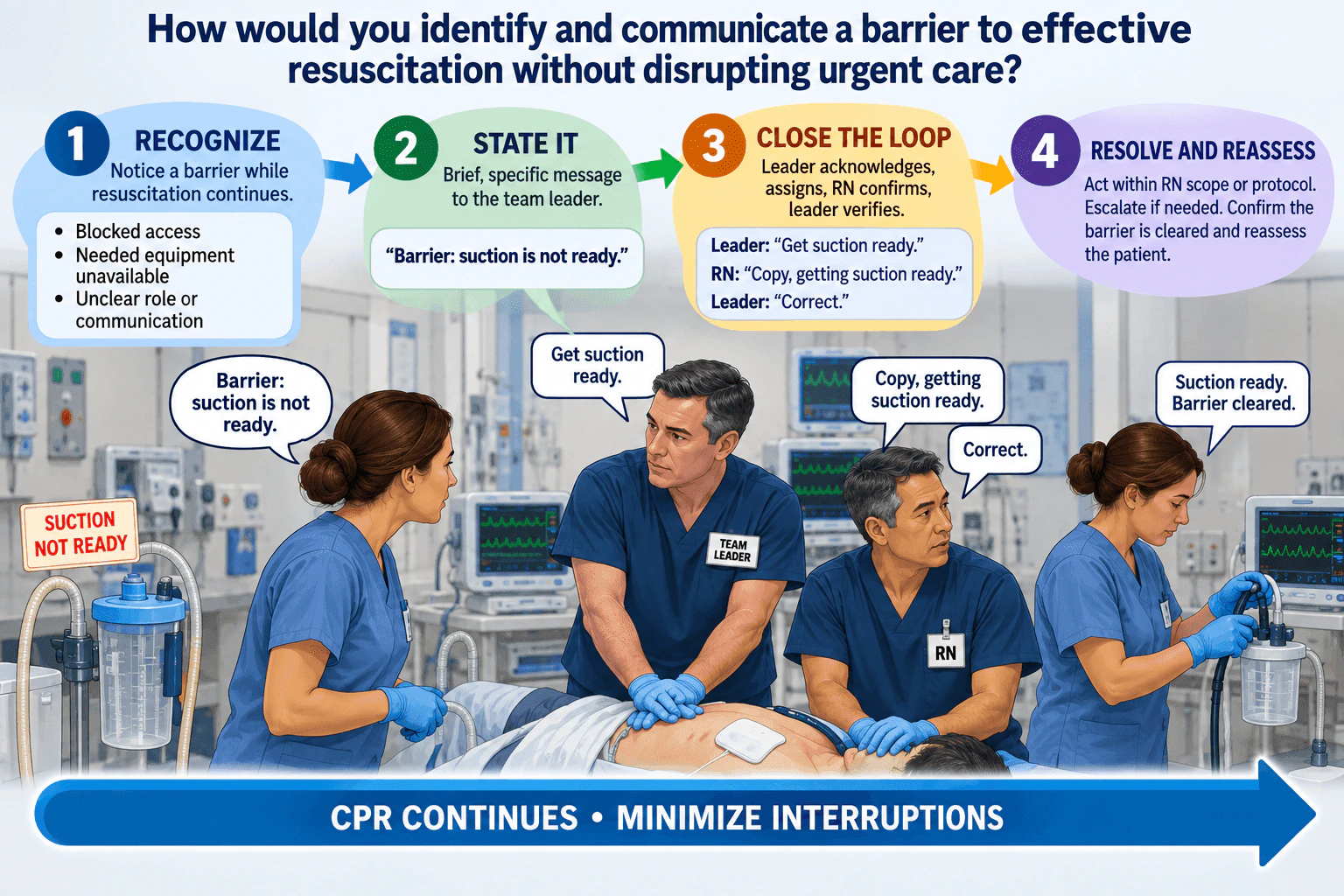
I would first recognize whether the barrier is affecting an immediate resuscitation priority while indicated lifesaving care continues. I would state the problem briefly to the team leader, such as, "Barrier: suction is not ready." The leader assigns the task, the receiving nurse repeats it back, and the leader verifies it. I would address what is within my RN scope or an applicable authorized protocol, escalate anything requiring additional clinical authority, confirm that the barrier is cleared, and reassess the patient without creating an unnecessary interruption in CPR or other urgent care.
Detailed Explanation
A barrier during resuscitation should be recognized, communicated, assigned, resolved, and reassessed without distracting the team from the patient's immediate lifesaving needs. For an adult cardiac arrest, the 2025 American Heart Association guidance identifies minimizing interruptions in chest compressions as an important feature of high quality CPR. cpr.heart.org Closed loop communication is also appropriate because a check back requires the receiver to acknowledge the message and the original sender to confirm that the message was understood correctly. ahrq.gov
Useful Questions to Ask the Interviewer
Should I assume an adult bedside emergency department resuscitation in the United States?
May I assume the department has established resuscitation protocols and a designated team leader?
Should I distinguish independent RN actions from protocol authorized actions and actions requiring an order or additional clinical authority?
How to Explain It in an Interview
I would start by identifying the barrier while keeping attention on the immediate resuscitation priority. Relevant barriers could include blocked access, needed equipment being unavailable, or an unclear role or communication problem. I would not stop indicated CPR simply to explain the barrier.
I would state the problem in one specific sentence to the team leader. If suction is needed for the current resuscitation but is unavailable, I might say, "Barrier: suction is not ready." That identifies the problem without creating unnecessary discussion.
Next, I would use closed loop communication. The leader might say, "Get suction ready." The assigned nurse would respond, "Copy, getting suction ready." The leader would verify the message with, "Correct." That makes task ownership explicit and confirms that the instruction was received as intended.
I would perform nursing actions that are within my RN scope. If an action is permitted under an applicable authorized protocol, I would follow that protocol. If the response requires an order, prescribing authority, or another professional decision, I would escalate to the appropriate clinician while indicated urgent care continues.
Finally, I would confirm that the barrier is actually resolved and reassess the patient and current resuscitation priorities. If suction remains unavailable or the problem creates another immediate safety concern, I would state that clearly and escalate again. The goal is not merely to report a problem. The goal is to remove the barrier while protecting the continuity and quality of urgent care.
Why Interviewers Ask This
Interviewers are evaluating whether the nurse can recognize an operational or communication barrier during a high acuity event without losing focus on the patient's immediate threat. They also want to see concise communication, correct closed loop communication, clear task ownership, awareness of RN scope, appropriate escalation, and reassessment after corrective action.
Common interview mistakes
Common mistakes include interrupting an indicated lifesaving intervention merely to explain the barrier, giving a vague statement without naming the actual problem, announcing a task without making ownership clear, failing to use a check back, assuming authority outside RN scope, and moving on without confirming that the barrier was resolved or reassessing the patient's current priorities.
Interview tip
Keep the answer centered on four actions that match the resuscitation flow: recognize the barrier, state it briefly, close the communication loop, then resolve and reassess while urgent care continues. Use one concrete example, such as unavailable suction, and distinguish independent RN actions, protocol authorized actions, and actions requiring additional clinical authority.
Interviewer may ask next
How would you verify that your communication actually resolved the barrier?
I would verify both communication and task completion. The receiving team member repeats the assignment and the sender confirms that it was understood correctly. I would then look for direct evidence that the barrier is resolved, such as the needed suction equipment being available and ready for appropriate use. If the problem remains unresolved, I would state that clearly, escalate again, and reassess the patient and current resuscitation priorities.
What would change if this were a pediatric resuscitation instead of an adult resuscitation?
The communication process would remain concise and closed loop, but the clinical actions would follow current pediatric resuscitation guidance rather than adult guidance. I would still identify the immediate threat, avoid unnecessary interruption of indicated lifesaving care, act within RN scope and applicable protocols, obtain additional clinical authority when required, and reassess after the barrier is addressed.
53. What is an EMTALA medical screening examination, and how does it differ from triage?Documentation ComplianceEasy
i Question Details
Explain the concept or decision in ED nursing scope. State relevant assumptions, missing information and when additional clinical authority is required.
Short Interview Answer (30-60 seconds)
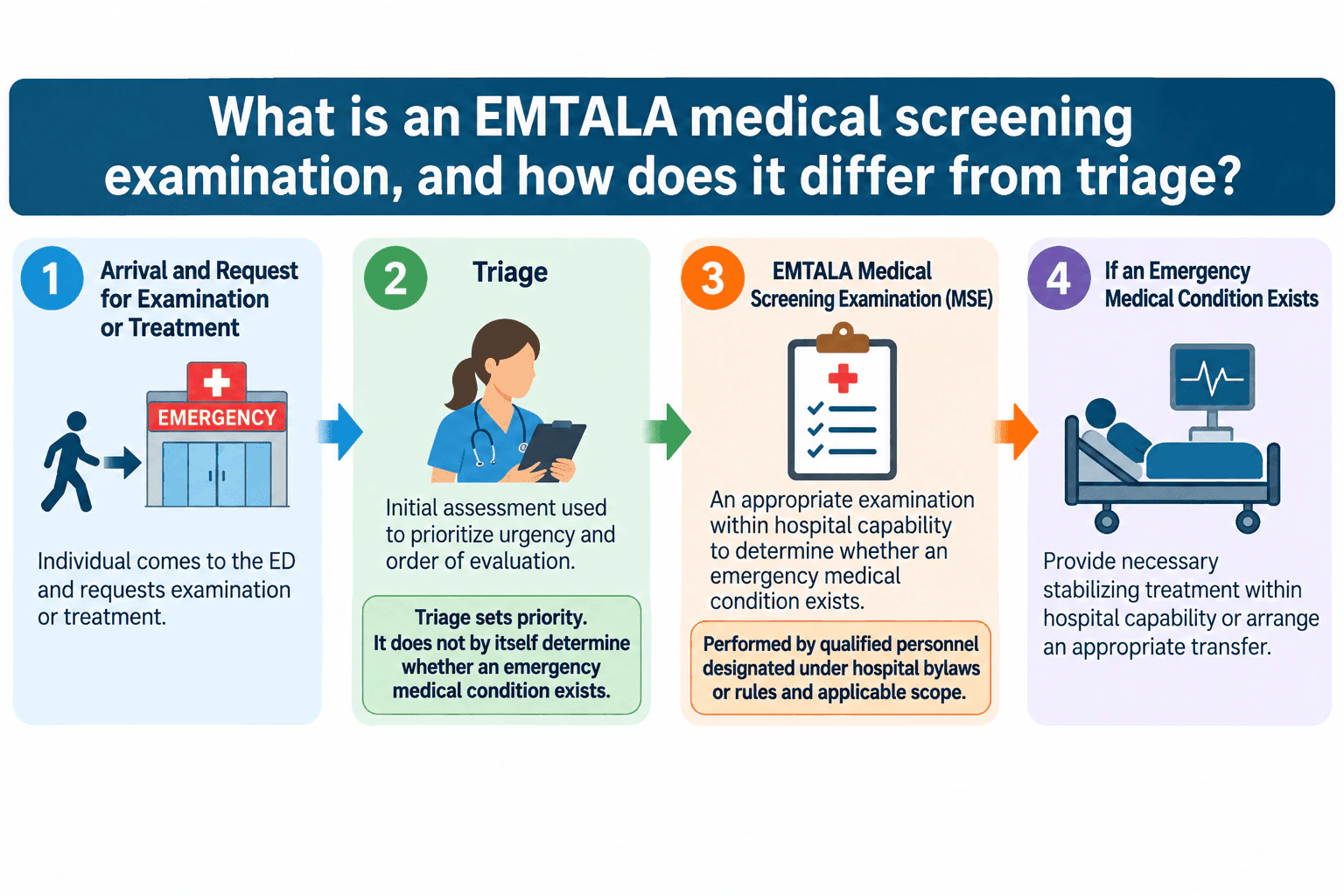
Triage and an EMTALA medical screening examination have different purposes. Triage is an initial assessment that helps prioritize how urgently a patient should be evaluated. The EMTALA medical screening examination is the appropriate examination needed, within the hospital's capability, to determine whether an emergency medical condition exists. It must be performed by personnel the hospital has designated as qualified and who are acting within applicable scope. An RN may be authorized in some settings, but that authority should never be assumed. If an emergency medical condition is found, the hospital must provide necessary stabilizing treatment within its capability or arrange an appropriate transfer when required.
Detailed Explanation
An EMTALA medical screening examination, or MSE, answers a specific question: does this individual have an emergency medical condition? It must be appropriate to the person's presenting signs and symptoms and the capabilities routinely available to the emergency department. Triage serves a different function. It identifies urgency and helps establish the order in which patients should be evaluated. Triage may contribute clinical information to the process, but it does not by itself determine whether an emergency medical condition exists or substitute for the required MSE.
Useful Questions to Ask the Interviewer
Who is designated by this hospital to perform EMTALA medical screening examinations?
How does the department document the transition from triage to the medical screening examination?
What is the escalation process when a patient's condition changes while awaiting further evaluation?
How to Explain It in an Interview
I would explain that triage and the EMTALA MSE should not be treated as interchangeable. Triage is used to prioritize urgency and order of evaluation. The MSE is the appropriate examination used to determine whether an emergency medical condition exists.
The MSE must be performed by qualified personnel designated under the hospital's bylaws or rules and consistent with applicable professional scope. Depending on state law, training, and hospital designation, qualified personnel may include an appropriately trained RN acting within applicable scope. I would verify local authority rather than assume that every emergency nurse can independently perform the MSE.
Documentation should clearly reflect what was actually observed and performed. I would record relevant assessment findings, times, actions, communication, reassessment, and patient response without documenting care that did not occur. The record should make the roles of triage and the MSE distinguishable rather than suggesting that a triage note automatically establishes whether an emergency medical condition is present.
If the MSE identifies an emergency medical condition, the hospital must provide necessary stabilizing treatment within its capability or arrange an appropriate transfer when required. If the patient's condition changes during the process, I would reassess, communicate the change promptly, escalate according to clinical authority and local procedure, and document the updated findings and actions.
Why Interviewers Ask This
Interviewers want to know whether the nurse understands the difference between clinical prioritization and the hospital's EMTALA screening obligation. They are also evaluating whether the nurse respects professional scope, designated qualified personnel, accurate documentation, escalation, and safe disposition rather than treating triage as a substitute for the medical screening examination.
Common interview mistakes
Common mistakes include describing triage as the EMTALA medical screening examination, assuming every RN is authorized to perform an MSE, failing to verify who the hospital designates as qualified personnel, documenting an examination or action that was not actually performed, and failing to distinguish prioritization from the determination of whether an emergency medical condition exists.
Interview tip
Use one clear contrast: triage prioritizes urgency, while the EMTALA MSE determines whether an emergency medical condition exists. Then add the scope point that the MSE must be performed by hospital designated qualified personnel, followed by the disposition point that an identified emergency medical condition requires necessary stabilization within capability or an appropriate transfer when required.
Interviewer may ask next
How would you verify whether an RN is authorized to perform an EMTALA medical screening examination at your hospital?
I would verify the hospital's approved bylaws, rules, or other governing documents that identify qualified personnel, confirm the RN's required training and competency, and confirm that performing the MSE is permitted under the applicable state scope of practice. I would not rely only on job title, custom, or an informal verbal assumption.
What changes if a patient becomes more unstable after triage but before the medical screening examination is completed?
The patient should be promptly reassessed and reprioritized based on the new clinical condition. The nurse should communicate and escalate the change to the appropriate qualified clinician, initiate any independently authorized or protocol authorized nursing actions within scope, and document the new findings, times, notifications, actions, and response. The change in urgency does not make triage itself the EMTALA medical screening examination.
54. What is the purpose of documenting changes in an ED patient's condition?Documentation ComplianceEasy
i Question Details
Explain the concept or decision in ED nursing scope. State relevant assumptions, missing information and when additional clinical authority is required.
Short Interview Answer (30-60 seconds)
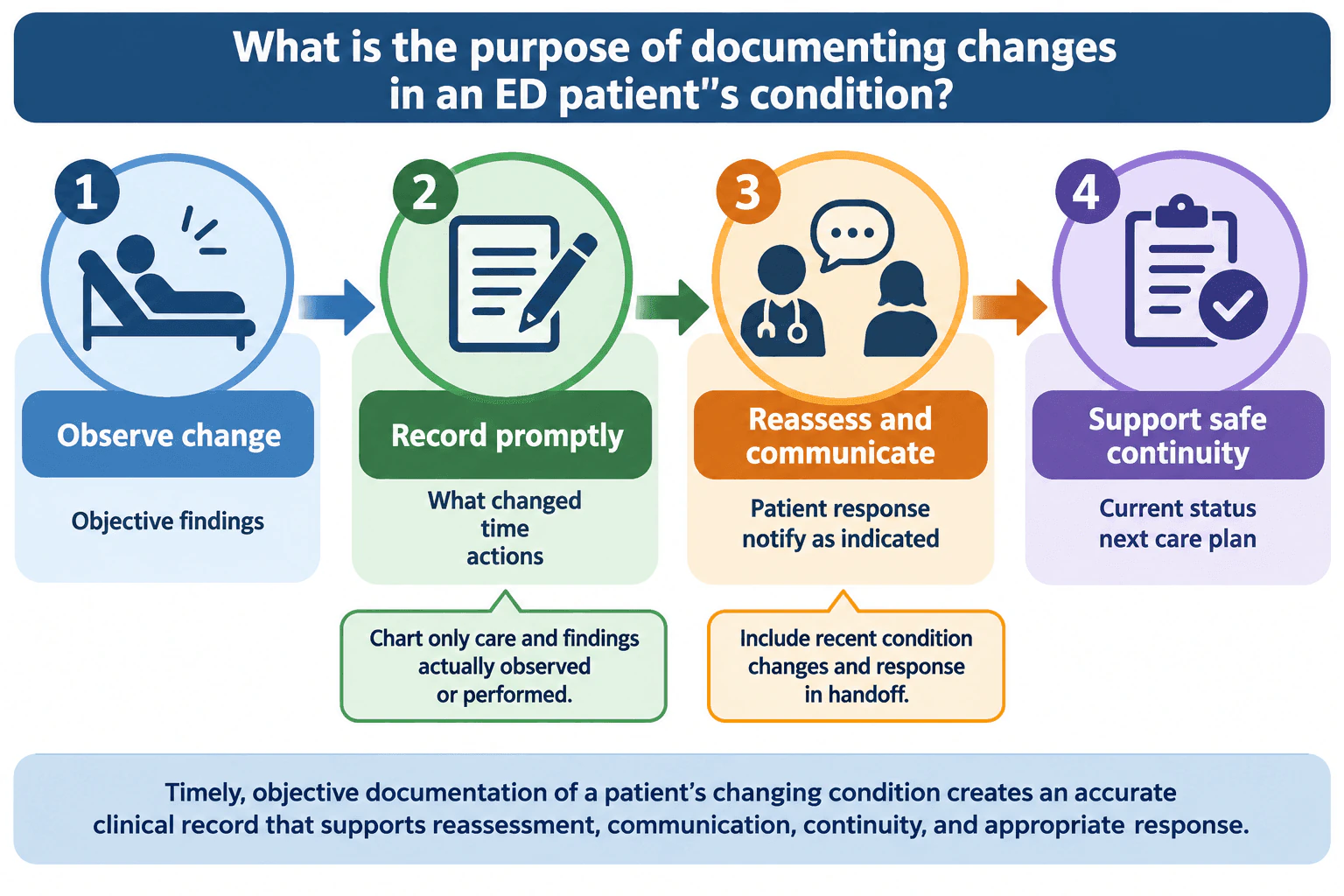
Documenting changes creates an accurate timeline of the patient's condition so clinicians can reassess, respond appropriately, communicate important changes, and continue care safely. I would record objective findings, the time, relevant actions, the patient's response, and any indicated communication. I would chart only findings and care actually observed or performed.
Detailed Explanation
Documenting changes in an ED patient's condition creates a reliable clinical timeline. The record should show what changed, when it changed, what was observed, what actions occurred, how the patient responded, and what information was communicated. In United States hospitals, medical records must be accurately written and promptly completed and include nursing notes, vital signs, and other information needed to monitor the patient's condition.
Useful Questions to Ask the Interviewer
What documentation and escalation process does this emergency department use when a patient's condition changes?
How does the department confirm receipt of important information and responsibility for pending follow up during handoff?
What reassessment and notification requirements are defined by hospital policy or approved nursing protocols?
How to Explain It in an Interview
Observe And Record
I would start with objective findings. If the patient's condition changes, I would document what I actually observed, the relevant time, nursing actions that actually occurred, and the patient's response. I would not chart care that was not performed or present assumptions as facts. Prompt documentation helps create an accurate sequence for later reassessment.
Reassess And Communicate
The next step is reassessment and communication. If the change requires notification or escalation, I would follow the patient's clinical needs, my nursing scope, approved protocols, applicable orders, and facility procedures. The record should show the relevant patient response and communication so the next clinician can understand what happened and what still needs attention.
Support Safe Continuity
Handoff should include recent changes in condition, response to care, current status, the care plan, and responsibility for pending actions. The receiving clinician should have an opportunity to acknowledge and clarify important information. This supports continuity instead of relying on memory or an incomplete verbal report.
Privacy, Scope, And Disposition
I would protect confidential information and use the approved medical record and communication channels. Triage is not automatically the same as an Emergency Medical Treatment and Labor Act medical screening examination, and an RN should not imply authority to perform that examination unless designated as qualified under applicable requirements. At transfer or discharge, documenting current status, education provided, follow up needs, and return precautions when applicable helps support a safe disposition.
Overall, objective and timely documentation connects observation to action, reassessment, communication, and safe continuity of care.
Why Interviewers Ask This
Interviewers are assessing whether the nurse understands documentation as a patient safety and communication responsibility rather than merely an administrative task. A strong answer connects objective observation, prompt recording, reassessment, appropriate notification, patient response, handoff, privacy, and safe continuity while staying within nursing scope.
Common interview mistakes
Common mistakes include vague or subjective charting, missing the time of an important change, omitting reassessment or patient response, documenting care that was not performed, failing to record indicated communication, leaving responsibility for pending follow up unclear during handoff, disclosing protected information inappropriately, or implying authority outside nursing scope.
Interview tip
Use the same four step flow shown in the clinical sequence: observe the change, record promptly, reassess and communicate, then support safe continuity. Emphasize objective findings, actual care performed, the patient's response, and clear responsibility for what happens next.
Interviewer may ask next
How would you verify that documentation of a significant change is complete?
I would verify that the record identifies the objective change, relevant time, assessment or reassessment, actions actually taken, patient response, and any indicated communication. During handoff, I would also confirm that important information was received and that responsibility for pending follow up is clear. I would apply applicable hospital policy, approved protocols, and nursing scope rather than assuming every situation uses the same notification process.
What would you do if the patient's condition worsened after your initial documentation?
I would reassess the patient, address immediate nursing priorities within my scope, and communicate or escalate according to the patient's condition, approved protocols, applicable orders, and facility procedures. I would then document the new objective findings, time, actions, communication, and patient response so the record accurately shows the patient's evolving condition and supports the next clinical decision.
55. What is a safe transfer of care, and what information must be clarified?Documentation ComplianceEasy
i Question Details
Explain the concept or decision in ED nursing scope. State relevant assumptions, missing information and when additional clinical authority is required.
Short Interview Answer (30-60 seconds)
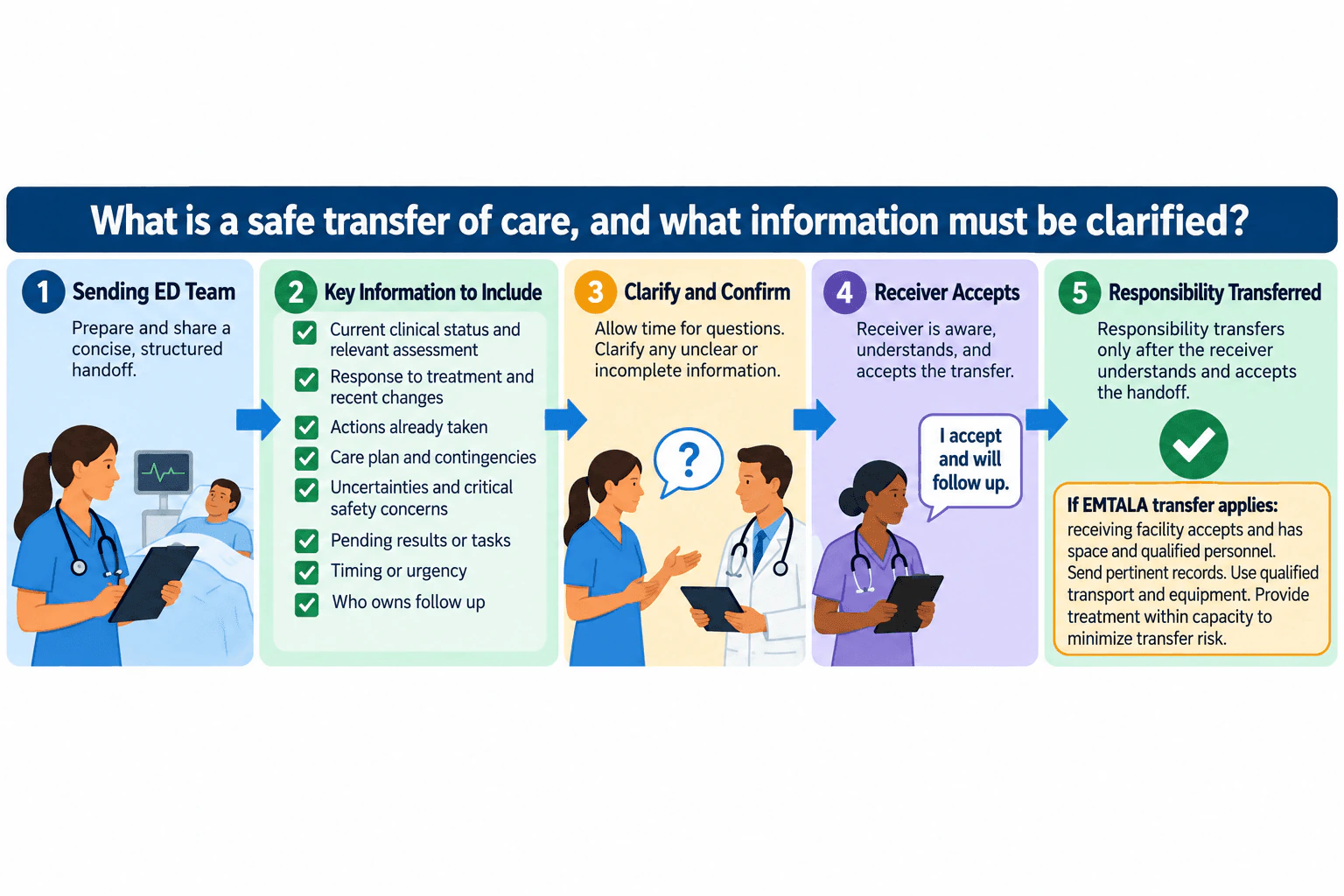
A safe transfer of care uses a structured handoff followed by clarification and explicit receiver acceptance. I would communicate the patient's current status and relevant assessment, response to treatment and recent changes, actions already taken, care plan and contingencies, safety concerns, pending results or tasks, urgency, and who owns follow up. I would allow questions and confirm that the receiving clinician understands and accepts responsibility before treating the handoff as complete. If EMTALA transfer requirements apply, I would also verify the required receiving facility acceptance, pertinent records, qualified transfer personnel and equipment, and treatment within the sending hospital's capacity to minimize transfer risk.
Detailed Explanation
A safe transfer of care is a closed communication process. The sending team gives a concise structured handoff, the receiving clinician has an opportunity to clarify unclear or incomplete information, the receiver confirms understanding and acceptance, and responsibility for ongoing care and follow up is then transferred. I would not assume that sending a message or entering a note by itself completes the handoff.
Useful Questions to Ask the Interviewer
What structured handoff method does this emergency department use for transfers of care?
How are pending results, unresolved tasks, and follow up ownership documented during handoff?
What is the escalation process if the receiving clinician or facility cannot accept the transfer?
How to Explain It in an Interview
I would describe the transfer in five connected steps. First, the sending ED team prepares a concise structured handoff. Second, I communicate the essential information: current clinical status and relevant assessment, response to treatment and recent changes, actions already taken, the care plan and contingencies, uncertainty or critical safety concerns, pending results or tasks, timing or urgency, and who owns follow up.
Third, I give the receiving clinician time to ask questions and clarify anything incomplete or ambiguous. Fourth, I confirm that the receiving clinician is aware of the handoff, understands the important information, and accepts it. Fifth, responsibility for ongoing care and follow up is treated as transferred only after that acceptance is clear.
I would document the handoff objectively, including relevant communication, unresolved items, and assigned follow up responsibility according to the clinical record and local workflow. I would not document care that was not performed or imply that a message was received when receipt was not confirmed.
For an interfacility transfer when EMTALA requirements apply, additional requirements are relevant. The receiving facility must have available space and qualified personnel and must agree to accept the transfer. The sending hospital must provide treatment within its capacity to minimize transfer risk, send pertinent available medical records, and arrange transfer through qualified personnel and transportation equipment as required by the patient's condition, including medically appropriate support when necessary.
As the bedside RN, I would communicate, clarify, document, reassess when clinically indicated, and escalate concerns within my scope. I would not assume authority for transfer certifications or other decisions reserved to a physician or appropriately designated qualified medical personnel. Applicable federal requirements, state scope rules, and facility policy determine those responsibilities.
Why Interviewers Ask This
Interviewers are evaluating whether the nurse understands that safe transfer of care is more than sending a report. It requires accurate clinical communication, clarification of uncertain or incomplete information, explicit ownership of pending work, confirmation that the receiver understands and accepts the handoff, and appropriate transfer documentation. They also want to see that the nurse recognizes when an interfacility transfer involves EMTALA requirements or decisions that require a physician, other qualified medical personnel, or organizational authority rather than assuming independent RN authority.
Common interview mistakes
Common mistakes include giving an incomplete handoff, failing to communicate recent changes or critical safety concerns, omitting pending results or follow up ownership, not allowing clarification, assuming that responsibility transferred merely because a message was sent, failing to confirm receiver acceptance, documenting care that was not performed, or overlooking applicable EMTALA requirements during an interfacility transfer.
Interview tip
Explain the handoff in the same sequence shown in the clinical workflow: send a structured summary, include essential information, clarify questions, confirm receiver acceptance, then transfer responsibility. Explicitly mention pending tasks and follow up ownership. For an interfacility transfer, distinguish the RN's communication and documentation responsibilities from certifications or decisions that require other qualified clinical authority.
Interviewer may ask next
How would you verify that the handoff was received and understood?
I would obtain direct acknowledgement from the receiving clinician, provide an opportunity for questions, clarify uncertain or incomplete information, and confirm who is accepting responsibility for ongoing care and pending follow up. I would document the communication according to the clinical record and local workflow rather than assuming that an electronic message alone proves receipt or acceptance.
What changes when the patient is being transferred to another hospital?
The same structured handoff and clarification principles still apply, but an interfacility transfer may add EMTALA and transport requirements. When EMTALA transfer requirements apply, the receiving facility must agree to accept the patient and have available space and qualified personnel, pertinent records must be sent, treatment within the sending hospital's capacity must minimize transfer risk, and transfer must use qualified personnel and transportation equipment appropriate to the patient's condition. The RN should complete communication, documentation, and escalation within scope and involve the appropriate physician, qualified medical personnel, or organizational authority when their authorization is required.
56. How do you distinguish observed findings from information reported by a family member in the record?Documentation ComplianceEasy
i Question Details
Explain the concept or decision in ED nursing scope. State relevant assumptions, missing information and when additional clinical authority is required.
Short Interview Answer (30-60 seconds)
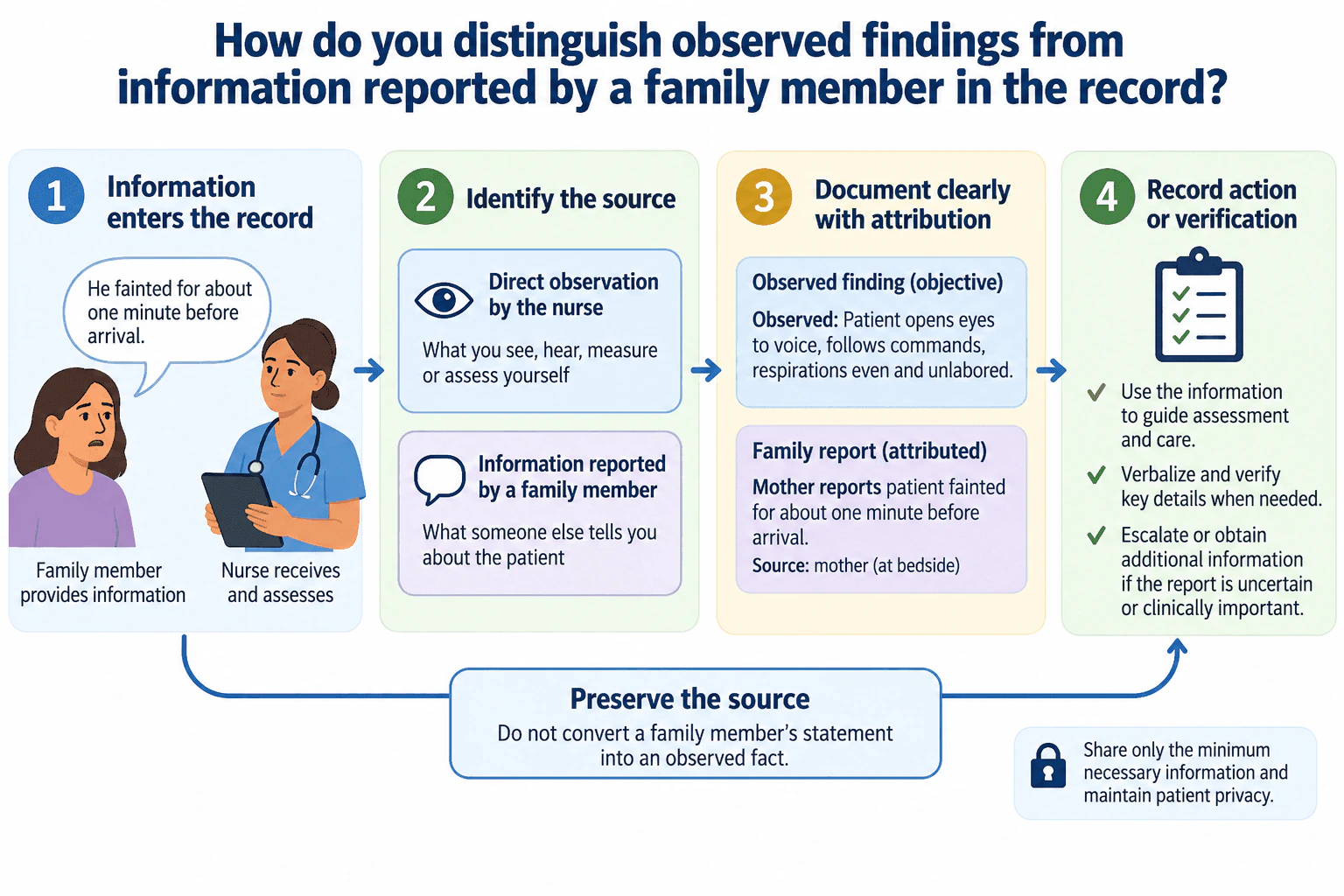
I document my own observations and assessment findings as direct nursing findings, while clearly attributing information from a family member to that source. For example, I could document that the patient opens eyes to voice, follows commands, and has even, unlabored respirations as observed findings. Separately, I could document, "Mother reports patient fainted for about one minute before arrival." I preserve the source rather than converting the family statement into an observed fact, and I document any assessment, verification, communication, or follow up that occurs.
Detailed Explanation
The key is to preserve the source of the information. What I personally see, hear, measure, or assess can be documented as my nursing finding. Information supplied by a family member remains an attributed report unless I independently establish the relevant finding.
For example, I could document, "Observed: patient opens eyes to voice, follows commands, respirations even and unlabored." Separately, I could document, "Mother reports patient fainted for about one minute before arrival." If the mother is at the bedside and that detail is relevant, I can identify her as the source. I would not rewrite the reported fainting episode as though I personally witnessed it.
Useful Questions to Ask the Interviewer
What documentation standard does this emergency department use for identifying information supplied by family members or other collateral sources?
How does the department document clarification or verification when collateral information affects an urgent assessment?
What privacy procedures should nurses follow when communicating with family members involved in care?
How to Explain It in an Interview
Separate Observation From Report
I first identify where each piece of information came from. Direct findings are things I personally see, hear, measure, or assess. A family member's statement is recorded as information supplied by that person.
Attribute The Source
I use explicit wording such as "mother reports" or "family member states." This keeps the record objective and prevents someone reading the chart later from assuming I witnessed the event. I document only care, observations, communication, and verification that actually occurred.
Assess And Verify When Needed
A family report can still be clinically important. I use it to guide assessment, clarify key details when appropriate, and document the patient's current findings. If the report is uncertain, conflicts with other information, or suggests a clinically significant change, I obtain additional information and communicate or escalate through the appropriate clinical team. I do not present an unverified report as an established finding.
Recognize Scope And Missing Information
The exact next step depends on the patient's condition, available history, reliability of the source, local policy, and what additional assessment is needed. A bedside registered nurse can collect, assess, communicate, and document information within nursing scope. Decisions requiring diagnosis, prescribing, orders, or another designated professional remain with the appropriately authorized clinician.
Protect Privacy
Receiving clinically useful information from a family member does not automatically permit unrestricted disclosure back to that person. In the United States, when the patient is present and able to decide, information may generally be shared with an involved family member when the patient agrees, does not object, or professional judgment supports that the patient does not object. When the patient is unavailable or incapacitated, applicable HIPAA provisions allow relevant disclosure based on professional judgment and the patient's best interests. Information shared should be limited to what is directly relevant to that person's involvement in the patient's care.
The principle is simple: preserve the source, distinguish direct findings from reported information, assess the patient yourself, and record the actions and patient response that actually occurred.
Why Interviewers Ask This
Interviewers are evaluating whether the nurse can maintain an accurate clinical record by distinguishing direct nursing assessment from collateral information. They also want to see appropriate source attribution, clinical follow up, privacy awareness, and recognition of when information requires additional assessment or escalation.
Common interview mistakes
Common mistakes include charting a family member's statement as though the nurse witnessed the event, failing to identify who supplied the information, adding assumptions that were never established, documenting verification or care that did not occur, failing to act on clinically significant reported information, and disclosing patient information without considering applicable privacy requirements.
Interview tip
Use a paired example. Give one direct nursing finding and one family report with explicit attribution. Then explain that you preserve the source, assess the patient independently, verify important details when appropriate, and document any communication or follow up that actually occurred.
Interviewer may ask next
What would you do if a family member reports something clinically important that you cannot immediately verify?
I would document the statement with clear attribution, assess the patient for findings relevant to the concern, clarify available details, and communicate or escalate the information when clinically important. I would not convert the report into an established fact. I would document the assessment, communication, verification efforts, and patient response that actually occurred.
How would your approach change if the patient were unable to provide a history?
Collateral information from family members or other available sources may become especially important, but I would still identify the source of each statement and distinguish it from my own assessment. I would document the patient's inability to provide the relevant history when appropriate, continue independent nursing assessment, obtain additional clinical information through appropriate channels, and use professional judgment and applicable privacy requirements when communicating with people involved in the patient's care.
57. How would you document escalation when the first clinician contacted has not responded?Documentation ComplianceMedium
i Question Details
Explain the concept or decision in ED nursing scope. State relevant assumptions, missing information and when additional clinical authority is required.
Short Interview Answer (30-60 seconds)
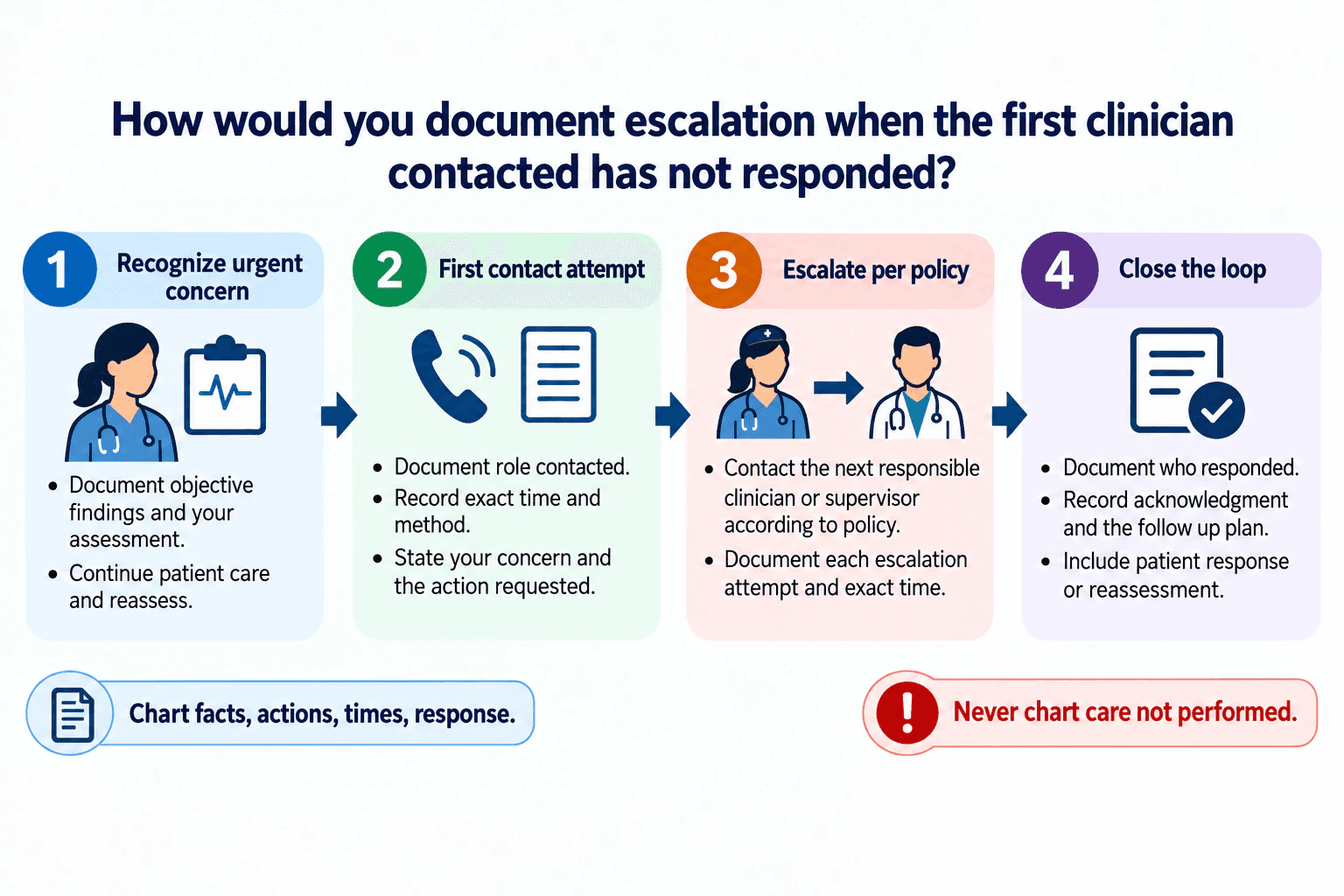
I would document the objective findings and my assessment, continue appropriate care and reassessment, and record the first contact attempt with the role contacted, exact time, communication method, concern communicated, and action requested. If the clinician does not respond and the concern remains unresolved, I would escalate to the next responsible clinician or supervisor according to hospital policy and document every attempt and exact time. Once someone responds, I would document who responded, acknowledgment of the concern, the follow up plan or responsibility, and the patient's response or reassessment. I would never document care or communication that did not occur.
Detailed Explanation
The central idea is to create a factual timeline while continuing to care for the patient. Documentation does not replace reassessment or escalation, and the nurse should not wait for charting to be complete before acting on an urgent patient safety concern.
For this answer, I would assume a bedside emergency department RN in a United States hospital. No patient specific findings, urgency level, staffing structure, or hospital escalation policy are provided, so those details should not be invented. The exact person contacted next and the emergency response pathway depend on the patient's condition and local policy.
Useful Questions to Ask the Interviewer
What escalation or chain of command process does this emergency department use when the first clinician does not respond?
How should urgent contact attempts and acknowledgment be documented in the electronic health record?
When should the nurse activate an emergency response pathway rather than continue routine escalation?
How to Explain It in an Interview
I would start by documenting the patient's objective findings and my assessment, then continue appropriate nursing care and reassessment. If the patient's condition changes, I would document the new findings and the time they were observed.
For the first contact attempt, I would record the role contacted, exact time, communication method, the clinical concern communicated, and the action requested. Federal hospital record requirements state that records must be accurately written and promptly completed and that entries must be complete, dated, timed, and authenticated. ecfr.gov
If the first clinician does not respond and the concern remains unresolved, I would escalate according to hospital policy and the urgency of the patient's condition. That may mean contacting the next responsible clinician, charge nurse, supervisor, or another level in the chain of command. AHRQ TeamSTEPPS guidance states that when a safety concern remains unresolved, staff should take a stronger course of action, engage other team members, or use the supervisor or chain of command. ahrq.gov I would document every escalation attempt and its exact time.
When someone responds, I would close the communication loop by documenting who responded, what concern was acknowledged, the follow up plan or responsibility, and the patient's subsequent response or reassessment. AHRQ describes closed loop communication as the receiver acknowledging the message and the sender confirming that it was received as intended. ahrq.gov
If the patient deteriorates or needs authority beyond my nursing scope, I would obtain the appropriate additional clinical authority or activate the applicable emergency response process rather than simply continue waiting for the original clinician. Throughout the sequence, I would document only facts, actions, communications, and care that actually occurred.
Why Interviewers Ask This
Interviewers are evaluating whether the nurse can recognize an unresolved safety concern, continue patient assessment and care, communicate clearly, escalate without unnecessary delay, and document an accurate sequence of events. They also want to see that the nurse follows local policy and obtains additional clinical authority when needed rather than acting outside nursing scope.
Common interview mistakes
Common mistakes include documenting that a clinician was notified without recording when or how contact was attempted, failing to document additional escalation attempts, recording acknowledgment that was never received, omitting reassessment after the concern continues, using subjective or judgmental wording instead of objective findings, allowing documentation to delay urgent patient care, assuming a local chain of command applies universally, and documenting care or communication that did not occur.
Interview tip
Explain the sequence in the same order you would manage it: recognize and document the concern, continue care and reassessment, record the first contact attempt, escalate according to policy when there is no response, and close the loop by documenting the responder, acknowledgment, follow up responsibility, and patient response.
Interviewer may ask next
How would you verify that the escalation communication was actually received?
I would obtain acknowledgment from the receiving clinician or responsible team member using the communication process required by local policy. AHRQ describes closed loop communication as the sender initiating the message, the receiver accepting it and providing feedback, and the sender confirming that the message was received as intended. ahrq.gov I would document who responded, the acknowledgment, the follow up plan or responsibility, and the relevant time.
What changes if the patient's condition deteriorates while you are waiting for a response?
I would immediately reassess the patient, document the changed objective findings and time, continue nursing actions within my scope, and escalate according to the urgency of the situation and the hospital's emergency response and chain of command processes. I would not continue waiting solely because the first clinician had already been contacted. Any additional notifications, responses, interventions, and patient responses would be documented only as they actually occurred.
58. How do you record the patient's understanding of discharge instructions?Documentation ComplianceMedium
i Question Details
Explain the concept or decision in ED nursing scope. State relevant assumptions, missing information and when additional clinical authority is required.
Short Interview Answer (30-60 seconds)
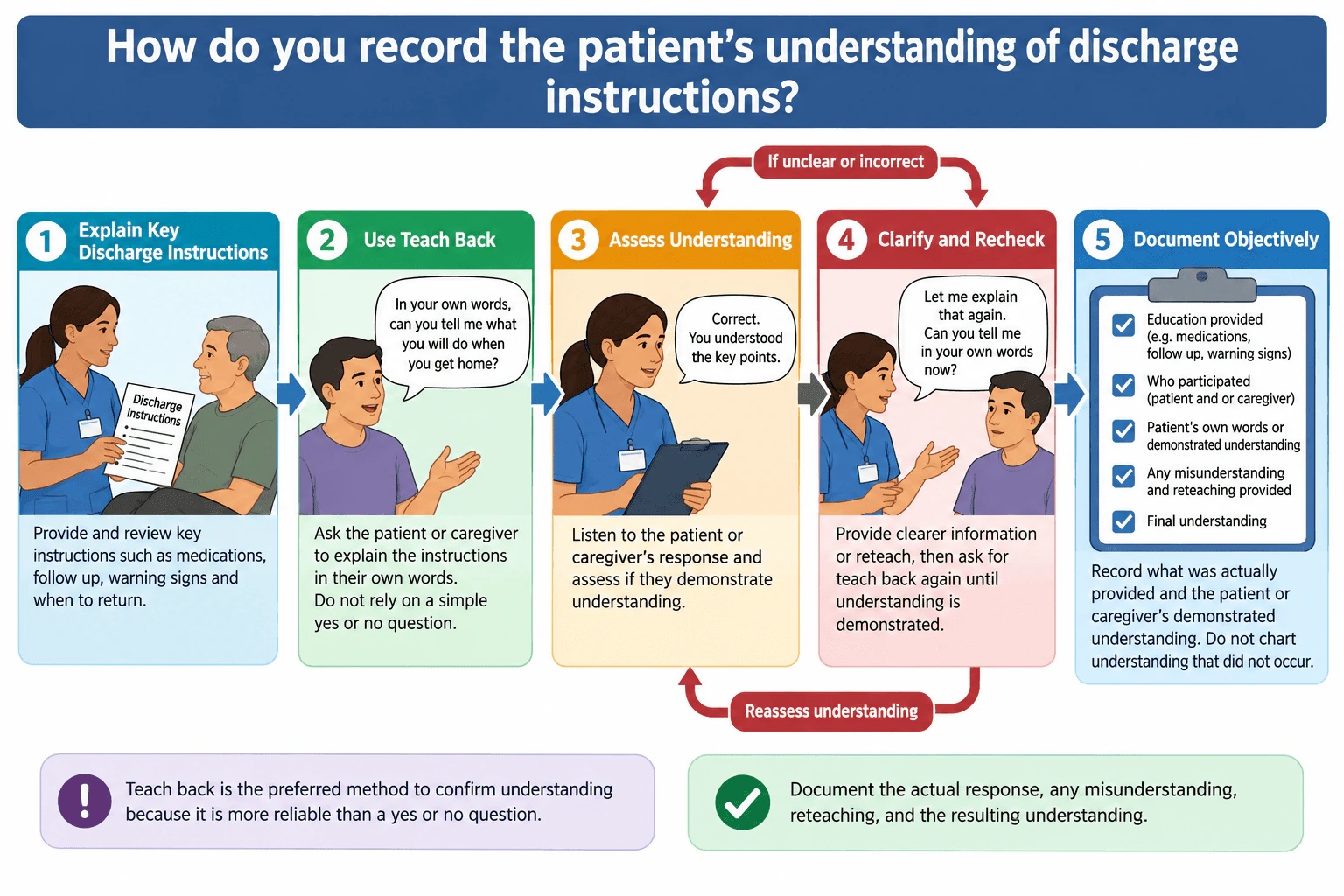
I record what discharge education was actually provided, who participated, and the patient's or caregiver's response. I use teach back by asking them to explain the key instructions in their own words rather than relying on a yes or no question. I document what they correctly explained or demonstrated. If anything is unclear or incorrect, I clarify or reteach, repeat teach back, and document the misunderstanding, additional teaching, reassessment, and final demonstrated understanding. I chart only what actually occurred.
Detailed Explanation
The goal is to record demonstrated understanding, not simply that discharge instructions were given. For a bedside emergency department RN in the United States, I would explain the key discharge instructions, use teach back, assess the response, clarify and recheck when needed, and then document the actual education and demonstrated understanding. Exact documentation fields and escalation processes depend on local policy and the patient's clinical situation.
Useful Questions to Ask the Interviewer
What elements of discharge education and teach back does your organization expect nurses to document?
How should interpreter participation or caregiver involvement be documented?
What is the escalation process when a patient cannot demonstrate adequate understanding before discharge?
How to Explain It in an Interview
I would first explain the key discharge instructions in clear language, including the relevant medication plan, follow up, warning signs, and return precautions. I would then use teach back by asking the patient or caregiver to explain the important instructions in their own words rather than asking only whether they understand.
Next, I would listen to the response and assess what the patient or caregiver can accurately explain or demonstrate. In the record, I would document the education actually provided, who participated, and the person's actual response. Instead of writing only "patient understands," I would record the demonstrated understanding, such as accurately explaining the medication plan or when to return for care.
If the response is unclear or incorrect, I would provide clearer information or reteach the point, then ask for teach back again. I would document the misunderstanding, the additional education, the reassessment, and the resulting understanding. This matches the clinical sequence of explain, teach back, assess, clarify and recheck, then document objectively.
If a language, cognitive, clinical, or other barrier prevents reliable verification, I would use appropriate resources such as interpreter services when needed and follow local policy for escalation and safe disposition. I would not invent, assume, or document understanding that was not demonstrated.
Why Interviewers Ask This
Interviewers are evaluating whether the nurse can provide discharge education, verify comprehension rather than assume it, respond safely to misunderstandings, and create an objective record of what was actually taught and demonstrated. The question also tests whether the nurse recognizes when communication or clinical barriers require additional resources or escalation.
Common interview mistakes
Common mistakes include documenting only "patient verbalized understanding" without describing how understanding was verified, relying only on a yes or no question, failing to document an identified misunderstanding and subsequent reteaching, omitting who participated in the education, or charting education or understanding that did not actually occur.
Interview tip
Explain the process in the same order you would perform it: explain the key instructions, use teach back, assess the response, clarify and recheck if needed, and document the actual response and final demonstrated understanding. Emphasize objective charting rather than a vague statement that the patient understood.
Interviewer may ask next
How would you verify that the patient truly understands the discharge instructions?
I would use teach back by asking the patient or caregiver to explain the important instructions in their own words or demonstrate a task when appropriate. I would assess the actual response rather than relying on a yes or no question. If the response is incomplete or incorrect, I would clarify or reteach and ask for teach back again, then document both the reassessment and the resulting understanding.
What would you do differently if the patient could not demonstrate understanding because of a language or cognitive barrier?
I would identify the barrier, use appropriate communication resources such as interpreter services when needed, involve an appropriate caregiver when clinically and legally suitable, and continue verification when possible. I would document the education provided, who participated, the observed response, any remaining limitation, and any escalation required for safe disposition. I would not assume or falsely document understanding.
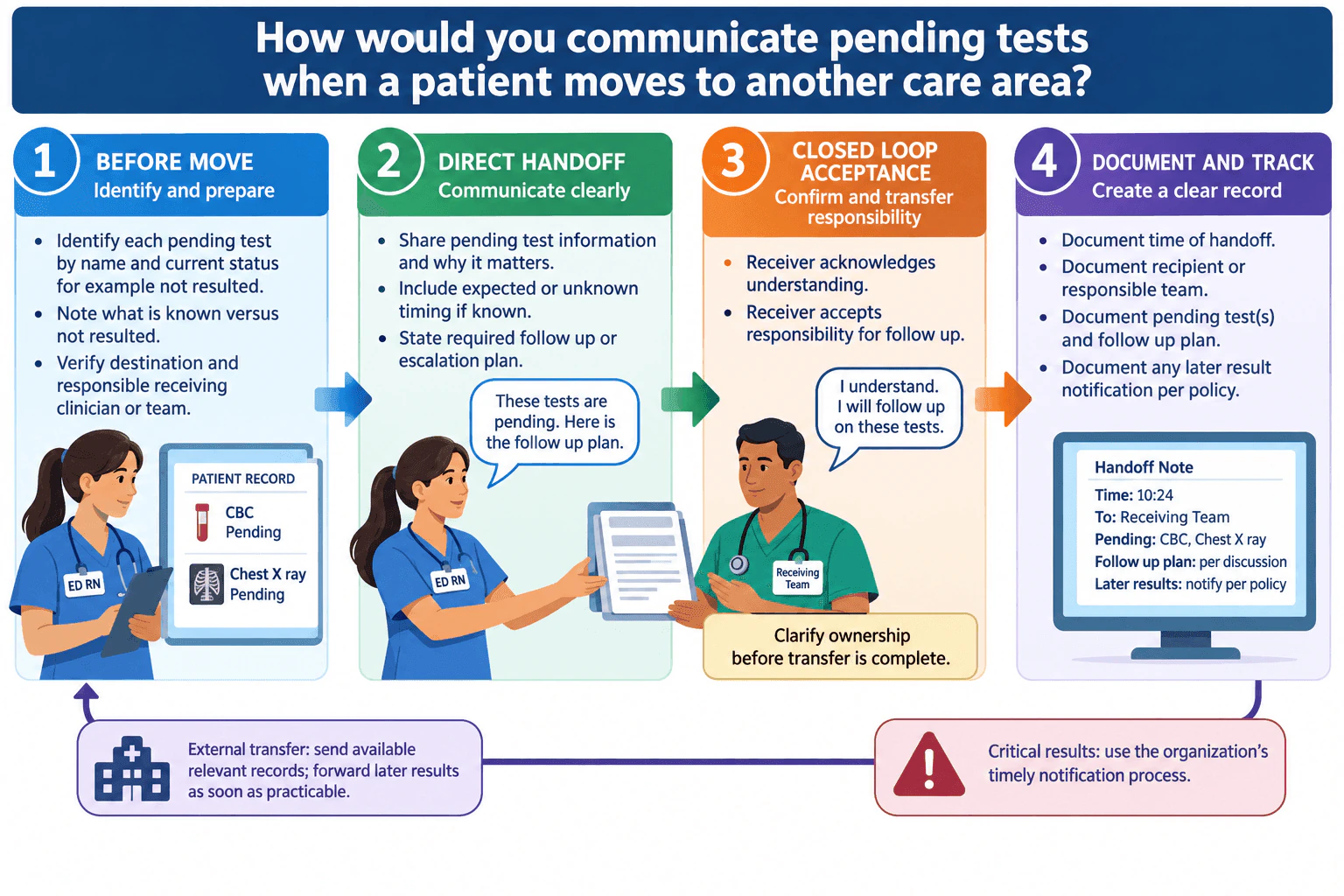
59. How would you communicate pending tests when a patient moves to another care area?Documentation ComplianceMedium
i Question Details
Explain the concept or decision in ED nursing scope. State relevant assumptions, missing information and when additional clinical authority is required.
Short Interview Answer (30-60 seconds)
I would identify each pending test and its current status before the move, then give a direct handoff to the receiving clinician or team. I would state what is pending, any known timing, and the follow up or escalation plan. I would use closed loop communication to confirm that the receiver understands and accepts responsibility for follow up. Finally, I would document the handoff time, recipient or responsible team, pending tests, ownership, and plan. If a critical result becomes available later, I would use the organization's required timely notification process and document that communication.
Detailed Explanation
The key principle is that a pending test should not become an unowned task when a patient changes care areas. The handoff should transfer both the information and clear responsibility for follow up.
Useful Questions to Ask the Interviewer
What handoff process does this emergency department use when patients move between care areas?
How does the organization assign and document responsibility for pending results?
What is the required notification and escalation process for critical results that return after a patient moves?
How to Explain It in an Interview
Before the move
I would identify each test that is still pending and verify its current status in the record. I would distinguish what is already known from what has not resulted. If expected timing is available, I would communicate it without guessing when a result will appear. I would also identify the receiving clinician or team expected to assume responsibility.
Direct handoff
I would communicate the pending tests directly to the receiving clinician or team and explain why each matters, along with any known follow up or escalation plan. An electronic record supports the handoff, but I would not assume that another clinician has seen or understood an entry when responsibility is changing.
Confirm ownership
I would use closed loop communication. The receiver should acknowledge the pending information and accept responsibility for reviewing the result and acting on it. If ownership is unclear, I would clarify it before considering the handoff complete. If responsibility cannot be resolved within my nursing role, I would involve the appropriate clinical authority.
Document and track
I would document the handoff time, the recipient or responsible team, the pending tests, and the agreed follow up plan. If a critical result becomes available later, I would follow the organization's required timely notification and escalation process and document the communication accurately.
For an external transfer, the transferring hospital should send available records related to the emergency condition to the receiving facility. Records or test results that were unavailable at the time of transfer should be sent as soon as practicable after transfer. I would follow applicable transfer requirements and organizational procedure rather than treating an internal movement and an interfacility transfer as identical.
Throughout the process, I would limit patient information to appropriate care communication and document only actions and communications that actually occurred. The goal is a clear chain of communication, acknowledged responsibility, and an accurate record of what remains pending and who will follow it.
Why Interviewers Ask This
Interviewers are assessing whether the nurse can maintain continuity and accountability when diagnostic results cross a transition in care. They want to hear that the nurse identifies what remains pending, communicates it directly, confirms receipt and ownership, documents the transfer of responsibility, protects patient information, and escalates critical results through the appropriate clinical pathway rather than assuming another clinician will notice them.
Common interview mistakes
Common mistakes include listing pending tests without assigning follow up responsibility, relying only on an electronic entry without confirming receipt, assuming the receiving team will discover the result, failing to document the handoff and ownership, guessing when a result will return, failing to use the required escalation pathway for a critical result, treating an internal move as though it were automatically an EMTALA transfer, or documenting communication that did not actually occur.
Interview tip
Describe the handoff as a transfer of both information and responsibility. A strong answer follows the same sequence as the diagram: identify what is pending, communicate it directly, confirm understanding and ownership, document the handoff, and use the required notification process if a critical result becomes available later.
Interviewer may ask next
How would you verify that responsibility for a pending test was actually transferred?
I would name the pending test and follow up need during the handoff, have the receiving clinician or team acknowledge the information, and confirm who is responsible for reviewing and acting on the result. I would document the handoff time, recipient or responsible team, pending test, and follow up plan. If responsibility remained unclear, I would not assume the transfer was complete and would involve the appropriate clinical authority.
What would change if the patient were transferred to another hospital instead of another care area within the same hospital?
An interfacility transfer adds formal transfer requirements. The receiving facility must have agreed to accept an appropriate EMTALA transfer when those requirements apply, and available medical records related to the emergency condition should be sent to the receiving facility. Records or test results that are unavailable at the time of transfer should be sent as soon as practicable afterward. I would clearly communicate the pending tests and responsibility, document the transfer communication, protect patient information during transmission, and follow applicable EMTALA requirements, organizational procedure, and any required physician or other authorized clinical involvement.
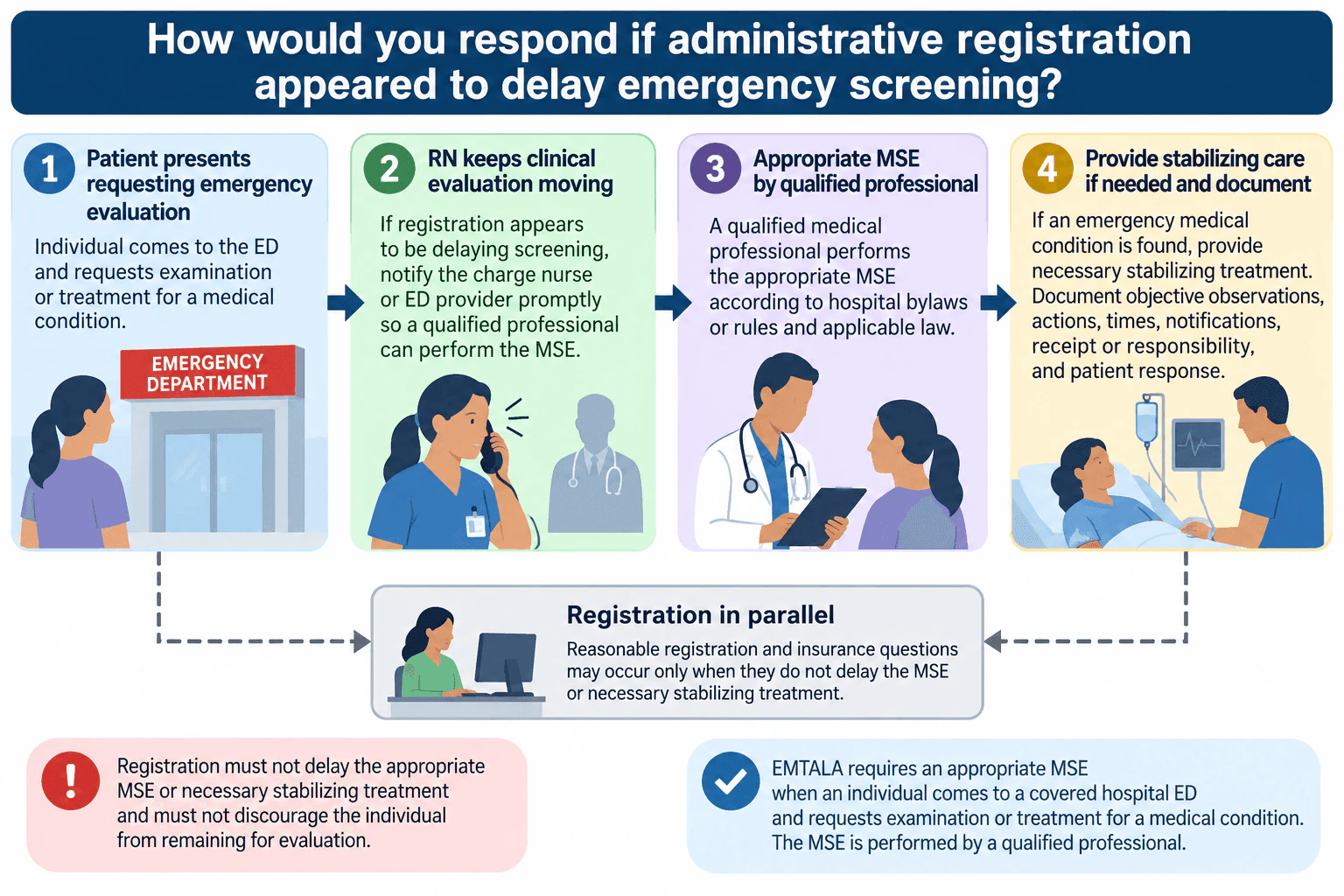
60. How would you respond if administrative registration appeared to delay emergency screening?Documentation ComplianceHard
i Question Details
Explain the concept or decision in ED nursing scope. State relevant assumptions, missing information and when additional clinical authority is required.
Short Interview Answer (30-60 seconds)
If registration appeared to delay emergency screening, I would keep the clinical evaluation moving and promptly escalate the delay through the ED clinical chain. Registration and insurance questions may occur only when they do not delay the appropriate medical screening examination or necessary stabilizing treatment. I would continue nursing assessment within my scope, notify the charge nurse or appropriate ED clinician, facilitate evaluation by qualified personnel, and document the observed delay, actions, times, notifications, receipt of information, responsibility for follow up, and patient response.
Detailed Explanation
The central issue is that administrative registration must not become a barrier to emergency screening or necessary stabilizing care. Assuming the setting is a United States Medicare participating hospital with a dedicated emergency department and the individual is requesting examination or treatment for a medical condition, EMTALA requires an appropriate medical screening examination. Reasonable registration and insurance questions can occur only when they do not delay screening or treatment or unduly discourage the individual from remaining for evaluation. cms.gov
Useful Questions to Ask the Interviewer
Who is designated by this hospital to perform EMTALA medical screening examinations under its bylaws or rules?
What is the expected escalation pathway when registration or another administrative process appears to delay clinical evaluation?
How does the department document notification and responsibility for pending follow up?
How to Explain It in an Interview
Keep Clinical Evaluation Moving
I would continue nursing assessment, prioritization, and reassessment within my RN scope while making sure the administrative process does not obstruct the clinical pathway. I would facilitate evaluation by the personnel qualified to perform the medical screening examination.
Escalate The Delay
If registration appeared to be delaying screening, I would promptly notify the charge nurse, ED provider, or other designated clinical authority. If I did not know who was authorized to perform the medical screening examination, that would be missing information I would verify immediately rather than assuming universal RN authority.
Keep Registration Parallel
Reasonable registration and insurance questions may proceed in parallel only when they do not delay screening or treatment. They also may not unduly discourage the individual from remaining for further evaluation. cms.gov
Verify Scope And Authority
The medical screening examination must be performed by personnel determined qualified under the hospital's bylaws or rules and applicable scope requirements. A nonphysician practitioner may be designated when the hospital has formally authorized that role and the practitioner acts within applicable scope. cms.gov
Document Objectively
I would record what I actually observed and did, including relevant times, nursing findings, actions, who was notified, confirmation that the information was received, assigned responsibility for follow up when known, and the patient's response. I would not document care that was not performed or add unsupported conclusions.
Why Interviewers Ask This
This question tests whether the nurse recognizes when an administrative process may interfere with required emergency evaluation, protects timely patient care, escalates appropriately, distinguishes nursing assessment from the EMTALA medical screening examination, respects professional scope, and creates an objective record of what occurred.
Common interview mistakes
Common mistakes include allowing registration or insurance questions to delay clinical evaluation, assuming routine triage automatically satisfies the EMTALA medical screening examination, assuming every RN is independently authorized to perform that examination, failing to escalate an apparent delay, documenting conclusions instead of objective observations, omitting notification times or confirmation that information was received, and charting actions that were not performed.
Interview tip
Frame the response around one priority: administrative work may proceed in parallel, but it must not obstruct emergency screening or necessary stabilizing care. Then show nursing judgment by describing continued assessment, prompt escalation, verification of who is authorized to perform the medical screening examination, and objective time stamped documentation.
Interviewer may ask next
How would you verify who is allowed to perform the EMTALA medical screening examination?
I would verify the hospital's current bylaws or rules identifying personnel qualified to perform the medical screening examination and confirm that the person's role is consistent with applicable scope requirements. I would not assume that the RN title alone establishes authority to perform the examination. cms.gov
What would change if the patient became clinically unstable while registration was still incomplete?
The urgency of the clinical response would increase. I would prioritize immediate nursing assessment, escalation, monitoring, and actions authorized within my scope or applicable protocols while obtaining the appropriate clinician and qualified medical personnel. Registration would remain secondary and could proceed only when it did not interfere with screening or necessary stabilizing treatment. I would document the changing condition, actions, times, notifications, responses, and transfer of responsibility accurately.
More questions load as you scroll
Disclaimer: This interview guide is for educational and informational purposes only. It is designed to help readers prepare, but it does not guarantee any interview result, hiring decision, offer, or outcome. Interview questions, hiring criteria, and preferred answers can vary by employer, interviewer, industry, location, and time. All answers, examples, and explanations in this guide are suggested examples for interview preparation, not definitive answers or instructions for professional practice. They are based on research and judgment, are provided without warranties of any kind, and should be adapted to the question, role, and applicable laws and professional requirements. Diagrams are simplified illustrations intended to highlight the main concepts and their relationships; actual situations, systems, and practices may be more complex. Alternative approaches may be equally valid or better suited to a particular question, context, or interviewer. To the fullest extent permitted by applicable law, the contributors and publisher are not liable for decisions made, actions taken, or losses incurred based on this guide.
State Laws and Professional Responsibilities: Laws and requirements governing an occupation vary by state and jurisdiction. You are responsible for checking the current laws, licensing requirements, and scope-of-practice rules that apply to your location and role, and for ensuring that your answers and actions comply with them. Adapt examples in this guide to those requirements. This guide is not legal advice.
Content Accuracy and Verification: To the fullest extent permitted by applicable law, we do not represent or warrant that interview guides, questions, answers, examples, or diagrams are accurate, complete, current, error-free, or suitable for any particular purpose. You are responsible for independently reviewing and verifying the information before relying on it.