Amazon JavaScript Frontend Developer Interview Questions & Answers

amazon icon

Questions with Detailed ExplanationsWith Detailed Explanations

(Last Updated: August 28, 2026)

11. How would you preserve authorization and analytics-event integrity in an infinite product-listing frontend?SecurityHardAmazon

Question Details

An infinite product-listing frontend records impressions and clicks while pages load asynchronously. Define which events the browser may propose and which facts the server must verify, how item and page identities prevent replay or attribution to the wrong query, how consent and privacy affect analytics payloads, and how offline queues, retries, duplicate events, tampered clients, and logout are handled.

Short Interview Answer (30-60 seconds)

I would treat every browser analytics event as an untrusted proposal. The server would verify authorization, query-page-item relationships, consent, freshness, and duplicate status. Stable event IDs make retries idempotent, while bounded offline queues and logout-aware identity scoping prevent stale, replayed, or misattributed events.

Detailed Explanation

The main idea is that the web page can report what it believes happened, but it cannot prove that the report is true. The system should check that the person was allowed to receive the product, that the product really belonged to the list and page being shown, and that the same report is not counted twice. It should also collect only necessary information and respect the person's privacy choices. If the device loses its connection, retries later, sends duplicate reports, is modified by the user, or another person signs in, old activity must not be incorrectly counted or assigned.

Useful Questions to Ask the Interviewer
  1. Are impressions and clicks used only for analytics, or can they affect billing, ranking, recommendations, experiments, or fraud decisions?
  2. Can different users receive different products because of authorization or account state?
  3. Must analytics survive offline periods and page reloads, or is best-effort delivery acceptable?
  4. Which consent categories control analytics collection, and what must happen to already queued events when consent is withdrawn?
  5. How long should query and page identities remain valid for delayed or offline events?
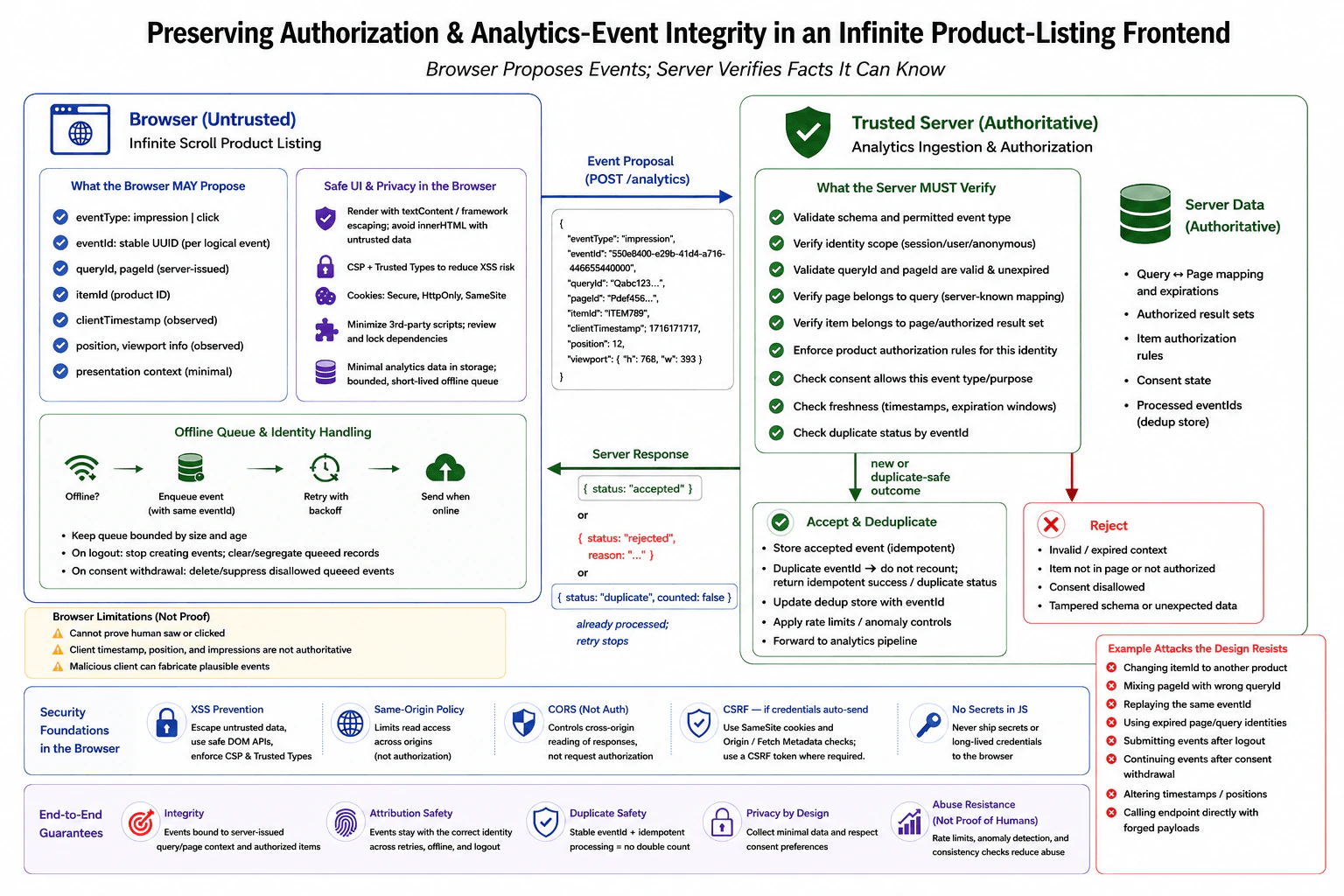
How would you preserve authorization and analytics-event integrity in an infinite product-listing frontend? diagram
How to Explain It in an Interview

I would start with the trust boundary: JavaScript running in the browser is not trusted. A user can modify the application, alter network requests, call the analytics endpoint directly, replay captured requests, change product IDs, invent timestamps, or automate events. The browser may therefore propose that an impression or click happened, but it cannot be authoritative evidence that pixels were genuinely visible or that a human genuinely clicked them.

Authentication answers, "Who is making this request?" Authorization answers, "Is this identity allowed to access this product or operation?" The trusted server must enforce authorization. A valid login does not prove that every product ID supplied by the browser is authorized for that user.

When the server returns a listing, I would give that response an opaque server-issued query identity and page identity. The server keeps or can reconstruct the relationship among the authenticated or anonymous session, normalized listing context, page, authorized result set, and expiration time. The identities should be unpredictable or integrity-protected so a client cannot successfully manufacture another valid listing context merely by editing fields.

The browser can propose observations such as event type, a stable event ID, query ID, page ID, item ID, client-observed time, visible position, and limited presentation information. These are claims, not trusted facts. In particular, a client timestamp is not proof of when an event really occurred, a position is not proof that the item was visible, and an impression event is not proof that a human actually saw the item.

The server should verify the facts it can know. It validates the event schema and permitted event type, checks that the query and page identities are valid and unexpired, confirms that the page belongs to the expected query context, confirms that the item belongs to that page or authorized result set, and applies the required product authorization rules. If the analytics endpoint is associated with an authenticated session, the supplied listing context must also match the appropriate identity or session scope.

That binding prevents simple attribution attacks. If an attacker changes an item ID to another product, the server can reject it because that item was not part of the referenced page or authorized result set. If the attacker combines a page ID with an unrelated query ID, the server rejects the mismatched relationship. The system should not trust raw browser-provided query text as proof of which search produced an event.

I would be explicit about the remaining limitation: server validation can prove that an event refers to a legitimate listing context and an authorized item, but it cannot make an untrusted browser a trustworthy sensor. A malicious client may still generate plausible impressions or clicks for items it legitimately received. If these events affect money, ranking, fraud decisions, or another sensitive system, I would add server-side abuse controls such as rate limits, anomaly detection, aggregate consistency checks, and downstream trust weighting. Those controls reduce abuse but still should not be described as proof of human behavior.

For retries, every logical event should keep the same unique event ID. The ingestion service should be idempotent, meaning that processing the same logical event more than once produces one accepted result rather than multiple counts. The server keeps enough deduplication state for the required retry window and ignores or returns success for an already accepted event without counting it again.

An attacker can create many new event IDs, so deduplication alone is not an anti-fraud mechanism. It solves accidental duplicates caused by retries, reconnects, or repeated delivery. Abuse involving many distinct events needs separate server-side rate, anomaly, or business-rule controls.

If offline support is required, I would use a bounded queue. Each queued entry contains only the minimum analytics data required for later delivery and retains its original event ID and server-issued listing context. Retries use backoff and reuse that event ID rather than creating a new logical event. The queue has limits on age and size so old or excessive data does not remain indefinitely. The server still performs freshness and context validation when delayed events eventually arrive.

Logout is an identity boundary. When logout starts, the frontend should stop producing authenticated analytics events and clear or segregate queued records associated with that identity. A later user must never inherit those events. If policy explicitly permits pre-logout events to be delivered afterward, they retain their original identity and listing context and are validated against that original context; they must never be relabeled as belonging to the newly authenticated user.

Consent is also important. The frontend should stop creating analytics that the current consent state does not allow. If consent is withdrawn, queued events that are no longer permitted should be deleted or suppressed according to the application's privacy policy. Server-side analytics processing should also enforce applicable consent rules when the required consent state is available there. Analytics payloads should contain only necessary data and should avoid unnecessary personal information.

I would never put server secrets, private signing keys, long-lived credentials, or other authoritative secrets in frontend JavaScript. Anything shipped to the browser must be considered observable by the user. If the server uses integrity-protected listing tokens, creation or signing must happen on the trusted server.

Browser storage also needs care. localStorage and IndexedDB are readable by JavaScript running in the application's origin, so an XSS vulnerability can expose queued analytics stored there. I would keep the queue minimal, avoid secrets and unnecessary sensitive information, limit retention, and clear identity-scoped records when appropriate.

If authentication uses cookies, sensitive session cookies should normally use Secure, HttpOnly, and an appropriate SameSite setting. HttpOnly prevents normal page JavaScript from reading the cookie, Secure restricts transmission to HTTPS, and SameSite helps reduce some cross-site request risks.

If a cookie-authenticated analytics endpoint performs security-sensitive or state-changing processing, I would also assess CSRF. SameSite cookies, CSRF tokens where appropriate, and checks such as Origin or Fetch Metadata can help. CORS is not authorization. CORS controls which browser origins can read certain cross-origin responses; it does not stop an attacker from sending arbitrary requests with a custom client. The same-origin policy is also a browser restriction, not proof that requests reaching the server came from trusted application code.

XSS matters because injected JavaScript executes inside the page's security context and can fabricate analytics or read browser-accessible data. Product names and other untrusted strings should be rendered with textContent, safe DOM APIs, or normal framework escaping. I would not use innerHTML with untrusted content. If intentionally allowing HTML, I would sanitize it with a well-maintained sanitizer appropriate for that context. A restrictive Content Security Policy and Trusted Types can provide additional defense against injection mistakes where the application architecture supports them.

Third-party scripts and dependencies increase the attack surface because code running in the page may observe application data and generate requests. I would minimize third-party analytics and tag scripts, give them only the data they need, restrict script sources with Content Security Policy where practical, review dependency changes, lock dependency versions appropriately, keep dependencies patched, and avoid exposing authentication material or sensitive analytics data to unnecessary third-party code.

Safe failure means malformed, expired, context-mismatched, unauthorized, disallowed, or duplicated events do not become accepted analytics records. Error responses should not reveal sensitive authorization details. Security logging should capture useful information such as rejection categories and opaque correlation IDs without recording credentials, session secrets, private signing material, or unnecessary personal data.

I would verify the design with adversarial tests: change an item ID, combine a page with the wrong query, use an expired page identity, replay the same event ID, retry after timeouts, create many different event IDs, send delayed offline records, withdraw consent before delivery, log out and sign in as another user, request an unauthorized product, modify timestamps and positions, and call the endpoint without using the normal frontend. I would also monitor duplicate, rejection, expiration, and abuse signals. The goal is that modifying browser code cannot turn client-supplied claims into trusted authorization or trusted server facts.

Technical Approach
  1. Define the browser as an untrusted event proposer and the server as the authorization and acceptance authority.
  2. For each listing response, create opaque or integrity-protected server-issued query and page identities tied to the real listing context, authorized result set, session or identity scope, and expiration.
  3. Let the browser submit only minimal observations plus those server-issued identities and one stable event ID per logical event.
  4. Validate schema, event type, identity scope, query-page relationship, item membership, authorization, consent, and freshness on the server.
  5. Accept that genuine human visibility or clicking cannot be proven solely from an untrusted browser; add rate, anomaly, or business-rule controls when analytics has sensitive downstream effects.
  6. Deduplicate accepted event IDs so normal retries are idempotent.
  7. Keep offline queues bounded, privacy-minimized, short-lived, and associated with their original identity and consent context.
  8. On logout or consent withdrawal, stop new disallowed events and clear or segregate queued events that must no longer be delivered.
  9. Reject invalid events safely, log non-sensitive reasons, and test tampering, replay, retries, offline delivery, consent changes, and identity transitions.
Practical Insights

Creating one event in the browser is normally constant work. A client offline queue uses storage proportional to the number and size of pending events, so it should have strict size and age limits. Server processing needs a small set of validations or lookups for listing context, item membership, authorization, expiration, consent, and duplicate detection. Deduplication needs temporary state proportional to the number of event IDs retained during the retry window. At high analytics volume, storage, lookup traffic, abuse detection, and retention become the main operational costs. Strong validation adds server work, but it prevents attacker-controlled browser claims from being treated as trusted authorization or attribution facts. Maintenance cost comes from keeping event schemas, authorization rules, listing-context formats, expiration policies, consent handling, and deduplication behavior consistent.

Why Interviewers Ask This

This tests whether the candidate understands the browser-server trust boundary, the difference between authentication and authorization, what analytics facts a client can only claim versus what a server can verify, replay and attribution threats, privacy-aware analytics, asynchronous frontend behavior, retry and deduplication design, and safe handling of tampered clients, offline queues, consent changes, and logout.

Common interview mistakes

Common mistakes include trusting browser fields such as authorized=true; treating authentication as item-level authorization; accepting arbitrary item IDs without verifying their relationship to the referenced query and page; trusting raw query text, client timestamps, viewport positions, or impression claims as authoritative facts; claiming that a server can prove a human actually saw or clicked something from an untrusted browser alone; using deduplication as if it prevents an attacker from creating many new event IDs; generating a new event ID on every retry and double-counting events; allowing listing identities to remain valid indefinitely; replaying one user's offline queue after another user logs in; continuing disallowed analytics after consent withdrawal; storing secrets, long-lived credentials, or unnecessary sensitive data in analytics payloads or browser storage; assuming CORS is authorization; ignoring CSRF when cookie-authenticated state-changing endpoints require protection; using innerHTML with untrusted product data; giving third-party scripts unnecessary access to sensitive information; relying only on client-side validation; logging secrets in rejection diagnostics; and treating input filtering alone as a complete security control.

Interview tip

Lead with: "The browser proposes events; the server verifies the facts it can actually know." Then explain query-page-item binding, server-side authorization, the limitation that human visibility cannot be proven from an untrusted client, idempotent retries, privacy and consent, offline queues, logout, and concrete tampering tests.
Interviewer may ask next
How would you prevent a malicious client from replaying a valid impression thousands of times?

For accidental retries, I would give each logical event a stable unique event ID and make ingestion idempotent, so replaying that same ID is counted once. I would also enforce expiration and verify the original query, page, item, identity, and authorization context. However, a malicious client can generate many distinct IDs, so deduplication is not sufficient anti-fraud protection. If event integrity matters beyond ordinary analytics, I would add server-side rate limits, anomaly detection, aggregate consistency checks, and downstream trust rules. I would still avoid claiming these prove that a human actually viewed the item.

What should happen to queued analytics events when the user logs out and a different user logs in on the same browser?

The queue must not silently transfer to the new identity. Logout should stop authenticated event creation and clear or partition queued records associated with the previous identity. If policy permits sending a pre-logout event later, it must keep its original server-issued listing and identity context and pass validation against that original context. It must never be relabeled as belonging to the next user. The same principle applies to consent changes: events that are no longer permitted should be suppressed or removed rather than delivered later.

12. Design a contract for recursively filtering a nested object.API DesignHardAmazon

Question Details

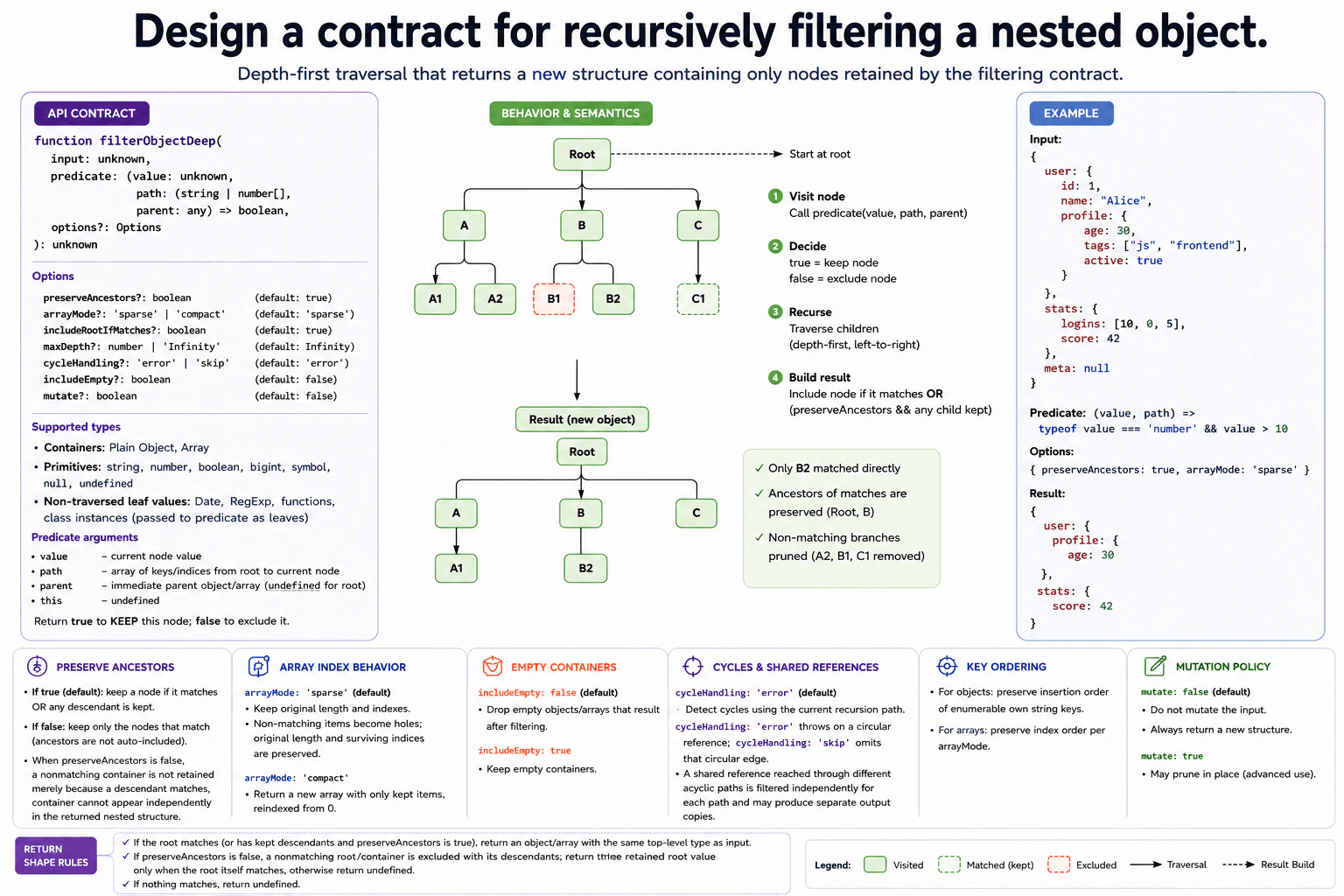
The reported task filters a nested object with a predicate in the spirit of Array.prototype.filter. Define the supported container and primitive types, whether matching descendants preserve their ancestors, array-index behavior, empty containers, cycles, shared references, predicate arguments, key ordering, mutation policy, and the exact shape returned for an object with both matching and nonmatching branches.

Short Interview Answer (30-60 seconds)

I would define filterObjectDeep as a clear, pure contract for recursively filtering plain objects and arrays. The predicate receives the current value, its path, and its parent. By default, matching descendants preserve their ancestors, sparse arrays keep their original indexes, empty containers are removed, cycles throw, and the input is not mutated. Shared references reached through separate acyclic paths are filtered independently. The function builds a new result, preserves object key order, and returns undefined when the root is not retained or nothing remains.

Detailed Explanation

This question is mainly about defining clear rules before writing recursion. We start with a nested value and decide which parts remain. Plain objects and arrays are traversed. Primitive and other leaf values are tested but not opened. The contract must explain parents, array indexes, empty containers, cycles, shared references, ordering, mutation, and the final return shape. The approved design uses filterObjectDeep. It normally builds a new structure. Its defaults make difficult cases predictable instead of leaving them to accidental JavaScript behavior.

Useful Questions to Ask the Interviewer
  • Should matching descendants preserve nonmatching ancestors?
  • Should arrays preserve original indexes or compact retained values?
  • Should empty containers remain after filtering?
  • Should circular references throw or be skipped?
  • Should the root itself be tested by the predicate?
  • Is there a maximum traversal depth?
Design a contract for recursively filtering a nested object. diagram
How to Explain It in an Interview
1. Define the contract

I would expose filterObjectDeep(input, predicate, options).

The traversed containers are plain objects and arrays. The primitive values are string, number, boolean, bigint, symbol, null, and undefined. Date, RegExp, functions, and class instances are treated as leaf values. They can be passed to the predicate, but their internals are not recursively traversed.

The predicate receives value, path, and parent. value is the current node. path is an array of property keys or array indexes from the root. parent is the immediate containing object or array. For the root, parent is undefined. The predicate runs with this set to undefined. A true result means that node matches. A false result means that node does not directly match.

2. Traverse the nested value

Traversal is depth-first and left-to-right. The function visits a node, evaluates the predicate when required, traverses supported children, and then decides what belongs in the result.

The default preserveAncestors value is true. A container stays when it matches directly or when any descendant is retained. This keeps the path needed to reach a matching nested value.

If preserveAncestors is false, a nonmatching container is not kept just because a deeper descendant matches. That excluded container and its descendants cannot appear independently in the returned nested structure.

The maxDepth option limits how deeply traversal may continue. Its default is Infinity, so there is no practical depth limit from the contract unless the caller supplies one.

3. Define root behavior

includeRootIfMatches is true by default. With this option enabled, the predicate is evaluated for the root. A matching root may be retained, but that does not bypass recursive filtering of its descendants.

When preserveAncestors is true, a root container may also remain because it contains retained descendants. When preserveAncestors is false, a nonmatching root is excluded with its descendants. In that case, the function returns undefined unless the root itself is retained.

4. Define array index behavior

The default arrayMode is sparse. Sparse mode preserves the original array length and surviving indexes. Removed elements become holes. They do not become explicit undefined values.

The other mode is compact. Compact mode creates a new array containing only retained elements. Those elements are reindexed starting from zero.

This is an important contract choice. Sparse mode preserves positional meaning. Compact mode gives a simpler consecutive list, but original indexes are lost.

5. Handle empty containers

includeEmpty is false by default. If an object or array becomes empty after filtering, that empty container is removed.

If includeEmpty is true, empty containers may remain in the result. This option is useful when an empty object or array still has meaning to the caller.

6. Handle cycles and shared references

cycleHandling defaults to error. The function detects cycles using the current recursion path. If following an edge would revisit an object already on that active path, error mode throws for the circular reference.

With cycleHandling set to skip, only that circular edge is omitted. The rest of the structure can still be filtered.

A shared reference is not automatically a cycle. If the same object is reached through two different acyclic paths, each path is filtered independently. The new result may therefore contain separate copies produced from that shared input object.

7. Preserve ordering

For plain objects, the result preserves insertion order for enumerable own string keys. This makes traversal and output deterministic for the supported object contract.

For arrays, index order is preserved during traversal. The final positions depend on arrayMode. Sparse mode preserves surviving original indexes. Compact mode reindexes retained values from zero.

8. Define mutation policy

mutate is false by default. The input is not changed. The function builds and returns a new structure.

The contract also allows mutate to be true for advanced use. In that mode, pruning may happen in place. This can reduce some allocations, but it makes ownership and later debugging harder because callers can observe changes to their original data.

9. Show the exact example shape

The diagram uses a predicate that keeps numbers greater than 10. It runs against an input containing user and stats branches.

The retained result is { user: { profile: { age: 30 } }, stats: { score: 42 } }. Values such as user.id, user.name, profile.tags, profile.active, stats.logins, and meta do not remain. The user and profile objects stay because preserveAncestors is true and age is retained. The stats object stays because score is retained.

This example shows the main rule clearly. Matching descendants keep the ancestor path needed to reach them.

10. Define the final return shape

If the root matches, or it has retained descendants while preserveAncestors is true, the result keeps the same top-level container kind as the retained root.

If preserveAncestors is false, a nonmatching root or container is excluded together with its descendants. Only a retained root value can become the returned root in that mode.

If nothing is retained, the function returns undefined. These return rules make the result shape explicit instead of making callers guess what an empty filtering result means.

Practical Complexity & Trade-offs

Let n be the number of visited nodes. The main traversal is O(n) because each visited node is processed once for its current path. Building a new result also needs memory for the retained structure. The active recursion path needs space proportional to nesting depth. Sparse arrays preserve original positions but can contain holes. Compact arrays use consecutive indexes but change positions. Cycle detection adds path tracking. Shared references can cause the same input object to be processed again through another acyclic path. The default no-mutation policy uses extra memory, but it is easier and safer for callers to understand.

Why Interviewers Ask This

Interviewers ask this question to test whether you can turn an ambiguous recursive task into a precise API contract. They care about decisions for supported types, predicate arguments, ancestor preservation, array indexes, empty containers, cycles, shared references, ordering, mutation, depth, and return shape. The goal is not just writing recursion. It is showing that you can identify edge cases, choose consistent behavior, explain trade-offs, and make the contract predictable for callers.

Interviewer may ask next
What would you change if the input can contain circular references and the caller does not want an exception?

I would keep the same filterObjectDeep contract and set cycleHandling to skip. The recursive traversal is the only affected part. Before following a child container, the function checks whether that exact object is already on the current active recursion path. If it is, the function omits only that circular edge and continues with the remaining branches.

I would not use one global seen set for this rule. A shared object reached through another acyclic path is not necessarily a cycle. That shared value should still be filtered independently for that second path and may create another output copy.

All other rules stay unchanged. The same predicate arguments are used. preserveAncestors still controls ancestor retention. arrayMode still controls array indexes. includeEmpty still controls empty containers. Key ordering and mutation behavior also remain the same.

The main downside is visibility. Skipping a cycle can hide unexpected data problems. The default error mode is stricter because it makes circular input immediately visible.

What changes if callers want retained array values to have consecutive indexes?

I would use arrayMode set to compact instead of the default sparse mode. Only array result construction changes. The traversal still visits the original array in index order, and the predicate still receives paths based on the input being traversed.

When an element is removed, compact mode does not leave a hole. The function creates a new array containing only retained elements. The surviving values are assigned indexes starting from zero.

Everything else remains unchanged. preserveAncestors still decides whether matching descendants retain their containers. includeEmpty still controls empty arrays. cycleHandling still handles circular references. Shared references still use independent acyclic paths. Object key ordering is unchanged. With mutate false, the original array is still not modified.

The main downside is that positional identity changes. If original indexes have business meaning, compact mode can be unsafe for that use case. Sparse mode is better when callers need stable original positions.

13. Design the public API for a JavaScript event bus.API DesignEasyAmazon

Question Details

The reported example exposes registerListener(type, handler) and emit(type, payload). Define the event-name and payload contract, registration return value or unsubscription method, listener ordering, duplicate registrations, mutation during emission, error behavior, and cleanup. Include how the API should behave when an event has no listeners and how consumers avoid retaining obsolete handlers.

Short Interview Answer (30-60 seconds)

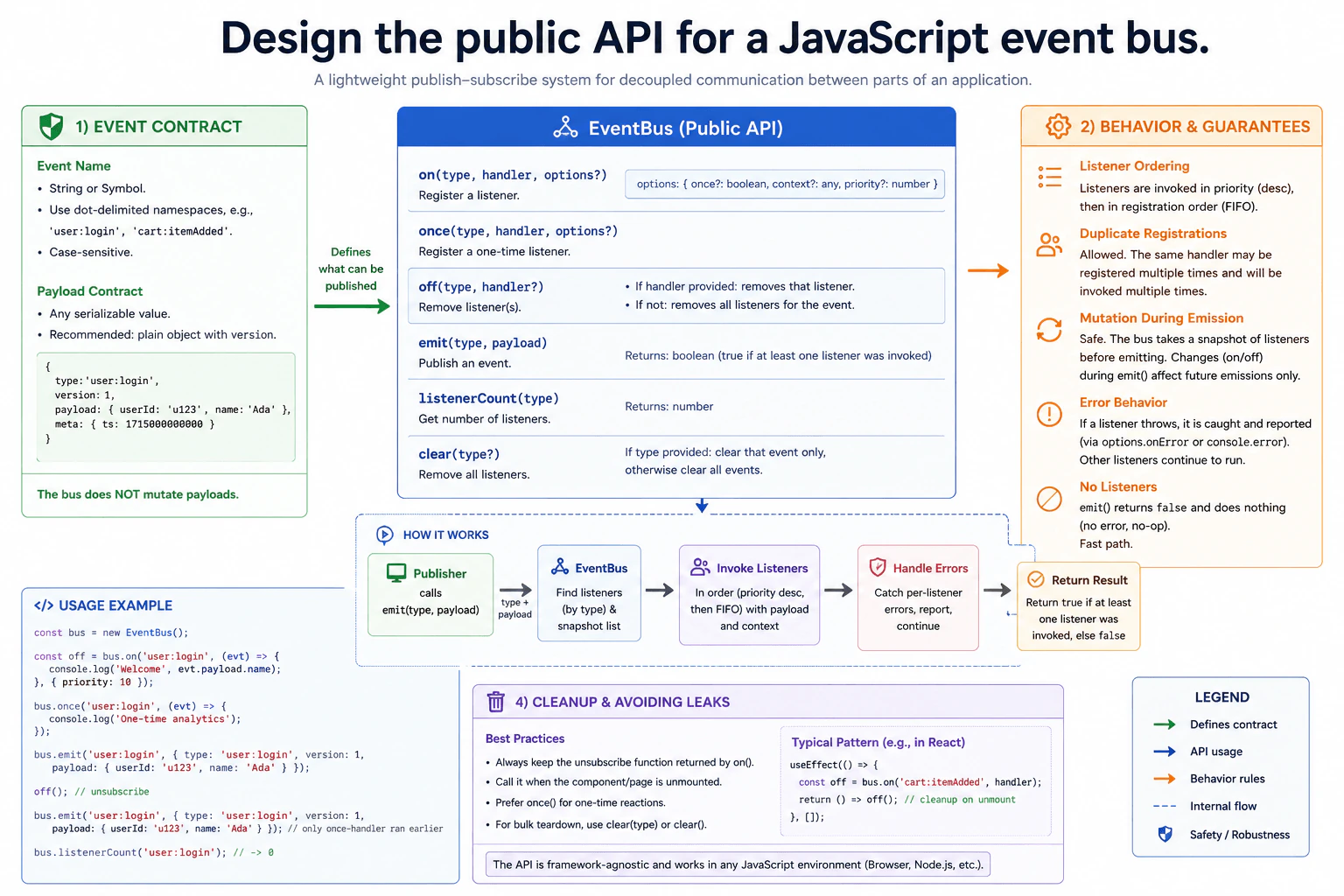
I would keep the event bus small and predictable. on(type, handler, options?) registers a listener and returns an unsubscribe function. emit(type, payload) takes a snapshot of matching listeners, runs them by priority and then FIFO order, catches each listener error, and returns true if at least one listener ran. With no listeners, it returns false and does nothing. Duplicate registrations are allowed. Consumers call the returned unsubscribe function during cleanup. There is no network security boundary because this is an in-memory JavaScript API.

Detailed Explanation

This question asks us to design a small JavaScript event bus. One part of an application publishes an event. Other parts register functions that should run for that event. The important part is making every rule clear. We need rules for event names, payloads, ordering, duplicates, errors, changes during emission, and cleanup. The API should also make old listeners easy to remove. That prevents obsolete handlers from staying in memory longer than needed. The approved design keeps the API framework-agnostic and predictable.

Useful Questions to Ask the Interviewer
  • Should one EventBus instance live for the whole application, or should features own shorter-lived instances?
  • Do payload versions need a compatibility policy between independently updated modules?
  • Should listener errors only be reported, or should callers also receive collected error details?
Design the public API for a JavaScript event bus. diagram
How to Explain It in an Interview
1. Define the event contract

Event names can be strings or Symbols. String names are case-sensitive. The diagram recommends organized names such as user:login and cart:itemAdded.

A payload can be any serializable value. A plain object with a version is a useful default. For example, the diagram shows an object containing type, version, payload, and optional metadata. The EventBus does not mutate the payload.

2. Register listeners

The main method is on(type, handler, options?). It registers one listener and returns an unsubscribe function. Consumers should save that returned function.

The shown options are once, context, and priority. once means the listener should run one time. priority controls which listeners run first. context provides the configured calling context.

The API also exposes once(type, handler, options?). It is a convenient way to register a one-time listener.

Duplicate registrations are allowed. Registering the same handler twice creates two registrations. Both registrations can run.

3. Remove listeners and clean up

off(type, handler?) removes listeners. When a handler is provided, it removes that listener registration. When the handler is omitted, it removes listeners for that event.

clear(type?) supports bulk cleanup. With a type, it clears that event. Without a type, it clears all events.

listenerCount(type) returns the number of listeners for an event.

The safest normal cleanup pattern is the unsubscribe function returned by on(). A component or page calls that function when it no longer needs the listener. This avoids retaining obsolete handlers and objects captured by those handlers.

For one-time work, once() reduces cleanup work because that listener is removed after its first call.

4. Emit an event

emit(type, payload) publishes an event. The EventBus finds listeners for that event type and takes a snapshot before invoking them.

Listeners run by descending priority. Listeners with the same priority run in registration order, which is FIFO.

The snapshot makes changes during emission predictable. Calling on() or off() while an emission is running does not change that current snapshot. Those changes affect future emissions.

The EventBus then calls each listener with the payload and its configured context.

5. Handle errors and the no-listener case

Each listener error is isolated. If one listener throws, the EventBus catches the error and reports it through the shown error path, such as options.onError or console.error. Other listeners continue to run.

If an event has no listeners, emit() returns false and does nothing else. This is a normal no-op, not an error.

If at least one listener is invoked, emit() returns true.

6. Verify the behavior

I would test string and Symbol event names. I would test duplicate registrations and listener ordering. I would verify descending priority and FIFO order for equal priorities.

I would test once(), the unsubscribe function, off(), clear(), and listenerCount().

I would also test mutation during emission. Adding or removing listeners during one emission must not change the snapshot already being processed.

Finally, I would test error isolation and the no-listener path. One throwing listener must not stop later listeners. An event with no listeners must return false without failing.

Practical Complexity & Trade-offs

The EventBus keeps listeners in memory, grouped by event name. Emitting an event requires finding that event's listeners, copying them into a snapshot, and invoking them in the defined order. The snapshot uses extra temporary memory, but it makes on() and off() behavior predictable during emission. Priority ordering adds some implementation cost, while FIFO gives a clear tie-break rule. Allowing duplicate registrations keeps the API simple, but every obsolete registration still needs cleanup. Error isolation improves reliability, but reported errors must not be ignored. This design has no HTTP, remote API, authentication, CORS, or CSRF boundary because it is an in-memory JavaScript event bus.

Why Interviewers Ask This

Interviewers use this question to test whether you can turn a small API into a precise behavioral contract. They look for clear choices about event names, payloads, registration, ordering, duplicates, mutation, errors, and cleanup. They also want to see whether you understand lifecycle and memory risks. A strong answer keeps the surface small while defining edge cases clearly. The main skill is engineering judgment: simple methods, predictable behavior, and trade-offs that consumers can understand.

Interviewer may ask next
What should happen if a listener adds or removes listeners while an event is being emitted?

The current snapshot should remain unchanged. When emit(type, payload) starts, the EventBus first finds the matching listeners and creates a snapshot. It then processes that fixed snapshot. If a running listener calls on() or off(), that change affects future emissions only. A newly registered listener does not join the current emission. A listener removed during the current emission can still run if it is already present in the snapshot. The affected flow is the EventBus step that finds listeners before the Invoke Listeners step. Priority ordering, FIFO ordering, duplicate behavior, error isolation, and the boolean return value stay unchanged. There is no new security boundary because everything remains inside the same JavaScript EventBus API. The main downside is that unsubscribe is not retroactive for an emission already in progress. Consumers must understand that cleanup prevents future delivery, not delivery from a snapshot that already exists.

How should consumers clean up listeners so the event bus does not retain obsolete handlers?

Consumers should keep and call the unsubscribe function returned by on(). When a component, page, or feature stops needing an event, it calls that function during its normal cleanup lifecycle. The diagram shows the same pattern with a React-style effect that returns the unsubscribe function. For one-time work, once() is simpler because the listener is removed after its first call. For broader cleanup, off(type) removes listeners for one event, while clear(type?) can clear one event or the whole bus. The affected parts are listener registration and the Cleanup & Avoiding Leaks flow. Event emission, ordering, duplicate handling, snapshots, and error behavior remain unchanged. Correctness is maintained because obsolete handlers no longer appear in future listener snapshots. There is no remote security change because the bus stays in-memory. The main downside is lifecycle discipline. If consumers forget cleanup, handlers and captured objects may remain reachable longer than intended.

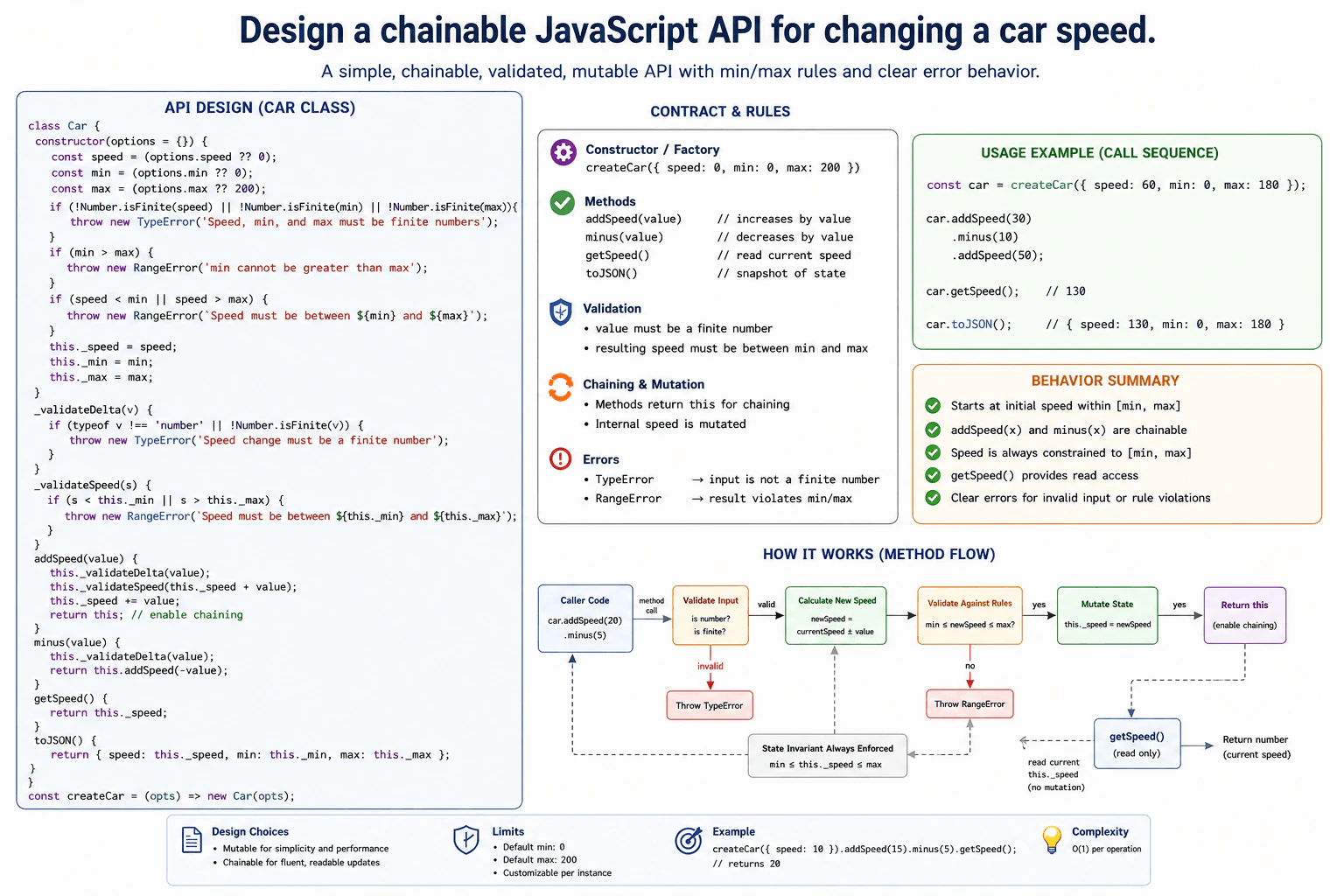
14. Design a chainable JavaScript API for changing a car speed.API DesignEasyAmazon

Question Details

The reported task uses calls such as car.addSpeed(value).minus(value). Define the constructor or factory, method names, numeric validation, minimum or maximum rules if the product requires them, return values that preserve chaining, read access to the current speed, mutation versus immutability, and error behavior. Provide a short call sequence that makes the chosen contract unambiguous.

Short Interview Answer (30-60 seconds)

I would use a small mutable Car API created with createCar(options). The object stores speed, min, and max. addSpeed(value) increases speed, while minus(value) decreases it. Both methods return this, so calls can be chained. Every supplied number must be finite, and every resulting speed must stay inside the configured range. getSpeed() reads the current speed without changing state, and toJSON() returns a snapshot. Invalid numeric input throws TypeError, while invalid ranges or out-of-range speeds throw RangeError. There is no network or browser security boundary here because this design is only an in-memory JavaScript object. The trade-off is simple fluent code versus shared mutable state.

Detailed Explanation

This question asks us to design a small JavaScript object that changes a car speed. The key is making its behavior clear and predictable. We must define how to create the object, which methods change speed, what values are valid, what each method returns, and how callers read the current value. The approved design keeps one mutable object. Successful calls update that same object. It also gives each car a minimum and maximum speed. Bad values fail clearly instead of being silently converted or silently corrected.

Useful Questions to Ask the Interviewer
  • Should each car have configurable minimum and maximum speeds?
  • Should an out-of-range result be rejected or clamped? This design rejects it.
  • Should callers read speed through a method or a public property? This design uses getSpeed().
  • Should updates mutate one object or return new objects? This design mutates one object.
Design a chainable JavaScript API for changing a car speed. diagram
How to Explain It in an Interview
1. Define the constructor and factory

I would expose createCar(options), which returns a Car instance. The constructor defaults speed to 0, min to 0, and max to 200. It reads those raw values without using Number(...) coercion. Then it checks speed, min, and max with Number.isFinite(). If any value is not a finite JavaScript number, it throws TypeError. If min is greater than max, it throws RangeError. If the initial speed is below min or above max, it also throws RangeError. Only after those checks does it store _speed, _min, and _max.

2. Define the chainable update methods

addSpeed(value) first checks that value is a finite number. It computes current speed plus value. The new speed must remain between min and max. If it does not, the method throws RangeError before changing state. Otherwise it stores the new speed and returns this. minus(value) validates the original value before negating it. It then performs the same update rule with the negative value. Returning this from both mutating methods makes calls like car.addSpeed(30).minus(10) work on the same Car instance.

3. Keep read methods separate

getSpeed() is read-only. It simply returns the current _speed number. It does not validate a delta, change state, or return this. toJSON() is also read-only. It returns a plain snapshot with speed, min, and max. These read methods stay outside the mutation flow shown in the diagram.

4. Make error behavior explicit

TypeError means an input that should be numeric is not a finite number. RangeError means a numeric rule was broken. Examples are min being greater than max, an initial speed outside the configured range, or an update that would move speed outside the range. The API rejects those cases before mutation. This preserves the invariant min <= _speed <= max at all times after construction.

5. Show the exact call sequence

A clear example is createCar({ speed: 60, min: 0, max: 180 }). Calling car.addSpeed(30).minus(10).addSpeed(50) changes speed from 60 to 90, then 80, then 130. car.getSpeed() then returns 130. car.toJSON() returns { speed: 130, min: 0, max: 180 }. Another diagram example is createCar({ speed: 10 }).addSpeed(15).minus(5).getSpeed(), which returns 20.

6. Explain the flow and trade-off

The mutating flow is simple: validate the input, calculate the new speed, validate the range, update _speed, and return this. A failed validation throws before state changes. getSpeed() follows a separate read-only path and returns the current number. There is no Fetch request, remote API, authentication, CORS, CSRF, or retry behavior in this design because the approved diagram shows a local JavaScript object only. Each shown operation is O(1). Mutation keeps the API fluent and easy to use, but shared references can make state changes harder to track.

Practical Complexity & Trade-offs

Each shown operation does constant work, so it is O(1) time and uses O(1) extra space. The main design concerns are correctness and clarity. The API accepts only finite numbers. It rejects invalid min and max settings. It rejects a speed change that would leave the allowed range. addSpeed() and minus() return this because they are chainable mutating methods. getSpeed() and toJSON() only read state. There is no network, authentication, caching, retry, or browser security boundary in the approved design. The main trade-off is mutation: it makes fluent calls simple, but every reference to the same Car object observes later changes.

Why Interviewers Ask This

Interviewers use this question to check whether you can turn a small behavior into a precise JavaScript API contract. They want to see clear method names, careful numeric validation, predictable error behavior, correct chaining, and a clear choice between mutable and immutable state. They also test whether you understand JavaScript coercion risks. A strong answer explains why mutating methods return this, why read methods stay separate, and how the object always keeps a valid speed range.

Interviewer may ask next
What would you change if out-of-range speed updates should clamp instead of throw?

I would keep the same Car object, createCar(options) factory, finite-number validation, method names, chaining rule, and read methods. The change would be only in the range step used by addSpeed(value) and minus(value). Today, the method computes a new speed and throws RangeError if that result is below min or above max. With clamping, the method would replace an out-of-range result with the nearest valid boundary. For example, if max is 180 and the current speed is 170, addSpeed(30) would set speed to 180 and return this. A non-finite input would still throw TypeError. An invalid configuration such as min greater than max would still throw RangeError. The invariant min <= _speed <= max would still hold after every successful call. No network or security flow changes because this remains a local JavaScript object. The main downside is that clamping can hide caller mistakes. A caller may ask for an impossible value and not notice that the API changed the requested result.

How would the design change if the API had to be immutable?

I would keep the same factory idea, numeric validation, min and max rules, read methods, and error meanings. The affected parts would be addSpeed(value) and minus(value). Instead of changing this._speed, each successful method would create and return a new Car with the calculated speed and the same limits. The original instance would remain unchanged. Chaining would still work because each call would return the next Car value. For example, car.addSpeed(30).minus(10) would operate on two newly returned objects instead of mutating one shared object. getSpeed() and toJSON() would still be read-only. TypeError would still mean a non-finite numeric input, and RangeError would still mean a broken range rule. No browser security behavior changes because this is still local state. The main benefit is easier reasoning when values are shared. The main downside is extra object allocation and a less direct mental model than updating one instance in place.

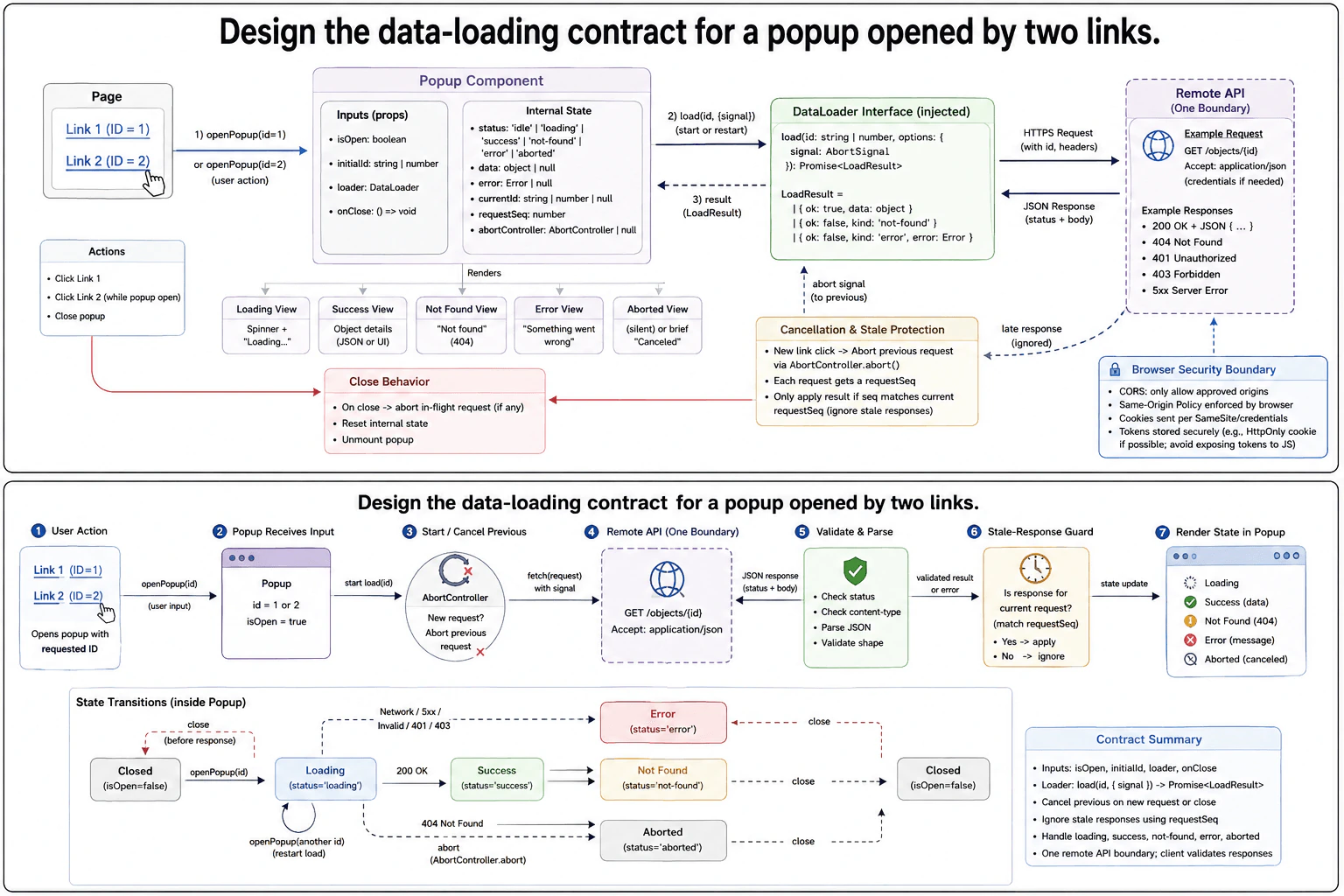
15. Design the data-loading contract for a popup opened by two links.API DesignEasyAmazon

Question Details

The reported UI has Link 1 load the object with ID 1 and Link 2 load the object with ID 2 into a popup. Define the popup component inputs, data-loader interface, loading and not-found results, cancellation when another link is chosen, stale-response handling, close behavior, and the rendered state after each action. Keep the contract usable from either React or framework-neutral JavaScript.

Short Interview Answer (30-60 seconds)

I would use one popup component for both links. Link 1 opens it with ID 1, and Link 2 opens it with ID 2. The popup enters loading and calls an injected load(id, { signal }) function. A new click aborts the previous request and creates a new request sequence number. The popup only applies a result when its sequence is still current, so a late response cannot replace newer data. The loader sends GET /objects/{id}, validates the response, and returns success, not-found, or error. Closing aborts active work, resets state, and unmounts the popup. Browser CORS and credential rules still apply.

Detailed Explanation

This question is about one popup that can show two objects. Link 1 should show object

  1. Link 2 should show object
  2. The important problem happens when the user clicks quickly. An older request must not replace newer data. The popup therefore owns its visible state and request control. It calls a separate data loader for network work. The loader stays independent from React or another framework. The design also handles loading, missing data, errors, cancellation, closing, and late responses in a clear way.
Useful Questions to Ask the Interviewer
  • What exact fields should a valid object contain?
  • Does this API require browser credentials for these requests?
  • When a request is aborted, should the popup stay silent or briefly show Canceled?
Design the data-loading contract for a popup opened by two links. diagram
How to Explain It in an Interview
1. Define the browser contract

Both links use the same popup component. Link 1 calls openPopup(id=1). Link 2 calls openPopup(id=2).

The popup inputs are isOpen, initialId, loader, and onClose. The diagram uses string | number for the object ID.

The popup keeps status, data, error, currentId, requestSeq, and an AbortController. These values describe what the popup should currently render.

The injected loader exposes load(id, { signal }) -> Promise<LoadResult>. This makes the network contract usable from React or framework-neutral JavaScript.

The loader sends GET /objects/{id} to one remote API boundary. The request accepts JSON. Credentials are included only when needed by the application.

The remote API can return 200 with JSON data, 404 Not Found, 401 Unauthorized, 403 Forbidden, or a 5xx server error. The browser-side code maps those responses into the popup result and state model shown in the diagram.

2. Start and control the request

When the user clicks a link, the popup opens for that ID. The popup immediately enters the loading state.

The popup then starts load(id, { signal }). The signal comes from a new AbortController.

If another link is chosen while a request is running, the popup aborts the previous request first. It then starts the new load with a new request sequence number.

For example, suppose Link 1 starts request sequence

  1. Before it finishes, the user clicks Link
  2. The popup aborts request 1 and starts request sequence 2 for ID 2.

Cancellation helps stop unnecessary work. The request sequence provides the final correctness check.

3. Validate the response

When a response returns, the loader checks the HTTP status first. It also checks the content type, parses the JSON, and validates the expected data shape.

A valid 200 response becomes a successful result with object data. A 404 response becomes the not-found result.

A 401, 403, 5xx response, network failure, parsing problem, or validation problem follows the error path shown in the diagram.

Fetch does not reject only because an HTTP response has an error status. The loader must inspect the response status before treating the body as successful data.

The loader returns its LoadResult to the popup. The popup then decides whether that result is still current.

4. Prevent stale responses

Every request receives a request sequence number. The popup remembers the newest sequence in requestSeq.

Before applying a result, the popup compares that result with the current request sequence. It updates the UI only when the sequence still matches.

This protects against a stale response. A stale response means an older request finishes after a newer request has already become current.

For example, Link 1 may start first. Link 2 may then start and finish quickly. If Link 1 later returns, its result is ignored because its request sequence is no longer current.

This guard is important even when AbortController is used. Cancellation and stale-response protection solve related but different problems.

5. Render the popup state

The popup has clear visible states.

loading shows a spinner and Loading....

success shows the returned object details.

not-found shows Not found for a 404 response.

error shows an error message such as Something went wrong.

aborted represents canceled work. The diagram allows this state to stay silent or briefly show Canceled.

Only the newest valid result may update these states. An ignored stale response does not change the visible popup.

6. Close and reopen safely

When the user closes the popup, the popup aborts any request still in flight. It then resets its internal state and unmounts.

A late response must not reopen or update the closed popup. The request-sequence guard prevents that stale update.

If the popup is opened again later, it starts a fresh load. The new request gets fresh request-control state.

The same rule also applies when the user chooses another ID while the popup remains open. The previous request is canceled, and the new object becomes current.

7. Protect the browser boundary

The remote API remains one external boundary. The diagram does not define server internals.

CORS controls whether browser JavaScript may read an approved cross-origin response. CORS is not authentication.

The browser also enforces the same-origin policy. Cookies follow browser SameSite and credentials rules.

If the application uses tokens, they should not be exposed to JavaScript unnecessarily. The diagram notes an HttpOnly cookie when that approach fits the application.

8. Verify the behavior

I would test the exact state transitions shown in the diagram.

Clicking Link 1 should enter loading and then show object 1 after success. Clicking Link 2 should do the same for object 2.

If Link 2 is clicked while Link 1 is loading, the first request should be aborted. Only the Link 2 result may update the popup.

A 404 should show the not-found state. Other supported failures should show the error state. An abort should not be treated as a normal application failure.

Closing should abort active work, reset state, and leave the popup closed. Reopening should begin a fresh request. These checks verify the contract required by the question and the approved diagram.

Practical Complexity & Trade-offs

This design normally makes one active object request at a time. Parsing work grows with the JSON response size. Rendering work grows with the amount of object data shown. The popup keeps only a small amount of client state, including the current ID, status, data or error, request sequence, and AbortController. AbortController reduces wasted work when another link is chosen or the popup closes. The request-sequence check adds a small amount of code, but it prevents older responses from corrupting the current UI. The browser boundary also adds security rules. CORS controls cross-origin reads, and cookies or tokens must follow the application's credential rules. The main trade-off is slightly more client-side state and cleanup logic in exchange for predictable behavior during fast clicks and closing.

Why Interviewers Ask This

The interviewer is checking whether I can separate UI behavior from network behavior. They want a clear popup contract, a framework-neutral loader, correct HTTP handling, and simple visible states. They also want to see whether I understand request cancellation, stale responses, response validation, cleanup, and browser security boundaries. The important skill is engineering judgment: keeping the design small while still preventing race conditions and incorrect UI updates.

Interviewer may ask next
What happens if Link 2 is clicked before the request for Link 1 finishes?

The Link 1 request must stop being allowed to update the popup. The affected flow is the popup component, its AbortController, the injected loader, and the stale-response guard. When Link 2 is clicked, the popup aborts the previous request and starts a new request for ID 2. It also advances requestSeq, so the new request becomes the only current request. The popup returns to the loading state while object 2 is being fetched. If the older request for object 1 still produces a late result, that result is ignored because its request sequence no longer matches the current sequence. The same response validation and browser security rules still apply to the new request. A valid result for ID 2 can become success, not-found, or error. An aborted old request is not treated like a normal application failure. The main downside is additional client-side request-control state. However, it prevents the common race where slower old data replaces the object the user most recently selected.

What should happen when the popup is closed while a request is still loading?

The popup should abort the in-flight request and move to the closed state. The affected flow is the popup component, its AbortController, the close behavior, and the stale-response guard. When onClose is triggered, the current request is aborted if one exists. The popup then resets its internal state and unmounts. If a network result arrives after closing, it must not update the UI. The request sequence protects this path by allowing only the current request to apply a result. Because the popup is closed, the old result is stale and is ignored. The remote API boundary, response validation rules, and browser security behavior do not change. Opening the popup again starts a fresh request for the selected ID instead of continuing the old operation. The main downside is that reopening may require another network request. The benefit is simple lifecycle behavior and no chance that an old response changes a popup that the user already closed.

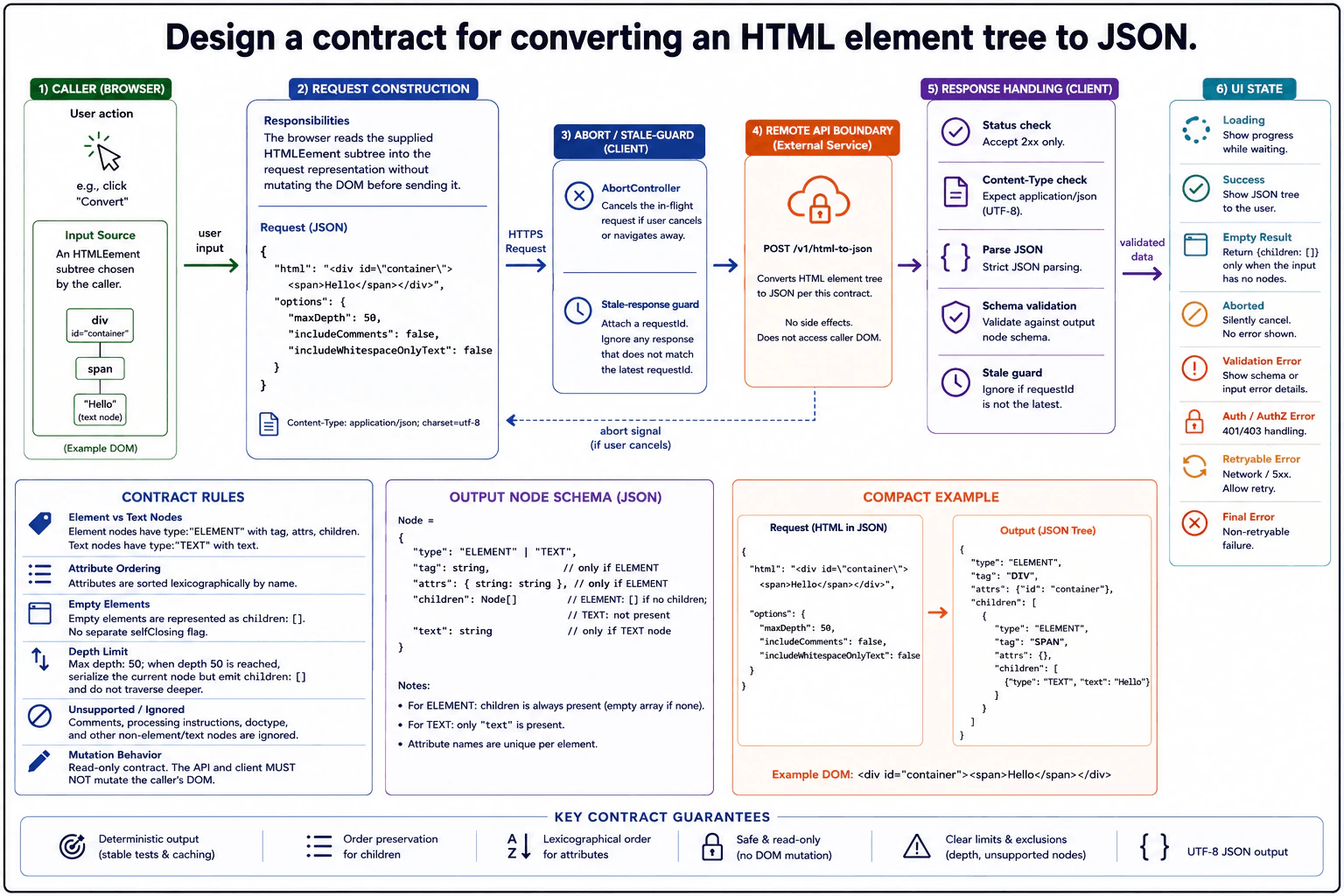
16. Design a contract for converting an HTML element tree to JSON.API DesignMediumAmazon

Question Details

The reported task converts supplied HTML into a JSON tree containing tag names, attributes, and children. Define the input root, output node schema, attribute ordering, element versus text-node treatment, empty elements, depth limits, unsupported node types, and mutation behavior. Include a compact example such as a div with an id and one child so the serialized shape is fully determined.

Short Interview Answer (30-60 seconds)

I would start when the user clicks Convert and receives a chosen HTMLElement subtree. The browser reads that subtree without changing the DOM. It builds a JSON request and sends POST /v1/html-to-json over HTTPS. The body contains the HTML plus maxDepth, includeComments, and includeWhitespaceOnlyText. AbortController handles explicit cancellation, while a requestId stops stale responses from changing the UI. When the response returns, I check for 2xx, verify application/json, parse JSON, and validate the node schema. Then I show success, empty, aborted, validation, authentication, authorization, retryable-error, or final-error state. The main trade-off is simplicity versus losing ignored or depth-limited content.

Detailed Explanation

This problem asks us to turn one chosen HTML element subtree into a predictable JSON tree. The browser owns the real DOM. The remote API cannot read that DOM directly. The browser first reads the selected HTMLElement without changing it. It then sends an HTML representation and conversion options to one external API. The API returns JSON nodes for elements and text. The browser must also handle cancellation, stale responses, response validation, and clear UI states.

Useful Questions to Ask the Interviewer
  • Should the returned element tags stay uppercase, such as DIV and SPAN?
  • Is maxDepth: 50 fixed, or can callers choose another supported value?
  • Should retryable network or 5xx failures retry automatically, or wait for user action?
  • What should the UI do with an earlier successful result after a 401 or 403 response?
Design a contract for converting an HTML element tree to JSON. diagram
How to Explain It in an Interview
1. Define the browser contract

The user clicks Convert.

The caller supplies an HTMLElement subtree.

The browser reads that subtree into a request representation. It does not mutate the caller's DOM.

The browser sends:

POST /v1/html-to-json

The request travels over HTTPS.

The request content type is application/json; charset=utf-8.

The body contains the HTML representation:

html: "<div id=\"container\"><span>Hello</span></div>"

It also contains these options:

maxDepth: 50

includeComments: false

includeWhitespaceOnlyText: false

The remote API is one external boundary. It converts the supplied HTML representation into JSON. It has no side effects. It does not access the caller's DOM.

2. Define the output node schema

The response is a JSON tree.

An element node has:

type: "ELEMENT"

tag: string

attrs: { string: string }

children: Node[]

A text node has:

type: "TEXT"

text: string

For an element, tag, attrs, and children are present.

For a text node, text is present instead of element fields.

Children keep document order.

Attribute names are unique on each element. The contract emits attribute keys in lexicographical name order. This makes the serialized output deterministic.

An empty element still has children: []. There is no self-closing flag.

3. Apply the conversion rules

Element nodes become ELEMENT nodes.

Normal text becomes TEXT nodes.

Comments are ignored because includeComments is false.

Whitespace-only text is ignored because includeWhitespaceOnlyText is false.

Processing instructions, doctypes, and other unsupported non-element or non-text nodes are ignored.

The maximum depth is 50.

When depth 50 is reached, the current node is serialized. Its children becomes an empty array. Traversal does not continue deeper.

The conversion is read-only. The client and API must not mutate the caller's DOM.

4. Start and control the request

After request construction, the client sends the HTTPS request.

The UI enters the loading state while it waits.

The client creates an AbortController for the in-flight request.

If the user explicitly cancels or navigates away, the client aborts that request.

The client also attaches a requestId.

The latest requestId represents the newest conversion request.

If an older response arrives later, its requestId does not match. The client ignores that stale response.

This prevents old work from overwriting a newer result.

5. Validate the response

When the HTTP response arrives, the client first checks its status.

Only a 2xx response is accepted as success.

The client then checks for application/json with UTF-8 JSON content.

Next, it parses the body as strict JSON.

A successful HTTP status alone does not prove the body is valid.

After parsing, the client validates the runtime value against the node schema.

Element nodes must contain valid element fields.

Text nodes must contain valid text fields.

Before updating the UI, the stale-response guard checks the requestId again.

6. Handle success and failure

On success, the UI shows the JSON tree.

An empty HTML element is still an element node with children: [].

The diagram also has an Empty Result UI state for a result containing no nodes.

If the user cancels, the UI enters the aborted state. It does not show that as a normal failure.

If input or response validation fails, the UI shows a validation error.

The diagram separates authentication and authorization handling with 401 and 403 responses.

Network failures and 5xx responses are retryable errors. The UI may allow retry.

Other non-retryable failures enter the final-error state.

A stale response is different from an error. It is simply ignored.

7. Walk through the compact example

The input is:

<div id="container"><span>Hello</span></div>

The root becomes an ELEMENT node with tag DIV.

Its attrs object contains id: "container".

Its child becomes another ELEMENT node with tag SPAN.

The SPAN has an empty attrs object.

Its child becomes a TEXT node containing Hello.

The result is:

{"type":"ELEMENT","tag":"DIV","attrs":{"id":"container"},"children":[{"type":"ELEMENT","tag":"SPAN","attrs":{},"children":[{"type":"TEXT","text":"Hello"}]}]}

This example shows the main guarantees. Child order is preserved. Attributes are emitted deterministically. Empty child lists stay explicit. The response is UTF-8 JSON.

8. Verify the behavior

I would first test the conversion contract.

One test uses an element with an attribute and text child.

One test uses an empty element and expects children: [].

One test verifies lexicographical attribute ordering.

One test verifies comments are excluded.

Another verifies whitespace-only text is excluded.

A depth test reaches level 50. It must keep that node but stop traversing deeper.

I would then test browser behavior.

An explicit cancel must produce the aborted state.

An old requestId must not overwrite a newer result.

A non-2xx response must not become success.

A wrong content type must be rejected.

Invalid JSON must be rejected.

A parsed value with the wrong node shape must also be rejected.

Why Interviewers Ask This

The interviewer is checking whether I can turn a vague tree-conversion task into a precise browser API contract. They want clear input and output modeling, deterministic serialization, limits, and correct element-versus-text handling. They also want good browser judgment around cancellation, stale responses, HTTP validation, and visible error states. The key skill is deciding what the contract guarantees, what it deliberately ignores, and how to explain those choices clearly.

Interviewer may ask next
What would you change if users click Convert many times very quickly?

I would keep the same POST /v1/html-to-json contract and rely on the existing stale-response protection. Every conversion request gets a requestId. The newest requestId becomes the one the UI considers current. If an older request finishes later, the response handler compares its requestId with the latest value. When they differ, it ignores that response instead of updating the UI. The existing AbortController behavior also stays unchanged. It is used when the user explicitly cancels or navigates away. I would not require every new click to abort the previous request because that behavior is not part of the current contract. Status checks, content-type checks, JSON parsing, schema validation, and HTTPS all remain the same. Correctness is preserved because an older result cannot overwrite newer work. The main downside is that an older request may still consume network or remote-service work until it completes. The requestId guard protects the UI, but it does not automatically stop that remote work.

What happens when the HTML tree reaches the depth limit?

I would keep the existing maxDepth: 50 rule. The affected part is the conversion performed behind POST /v1/html-to-json. When traversal reaches depth 50, the converter still serializes the current node. If that node is an element, its children becomes an empty array. The converter does not traverse any deeper descendants. Earlier nodes keep their normal tags, attributes, and ordered children. Element and text rules stay unchanged. Comments, whitespace-only text, doctypes, and other unsupported nodes are still ignored according to the current options and contract. The caller's DOM also remains read-only. When the response returns, the browser still performs the same 2xx, content-type, JSON, schema, and stale-request checks before updating the UI. This rule protects against unbounded deep traversal and very large results. The downside is information loss. An empty children array at the depth boundary may represent truncation instead of a naturally empty source element.

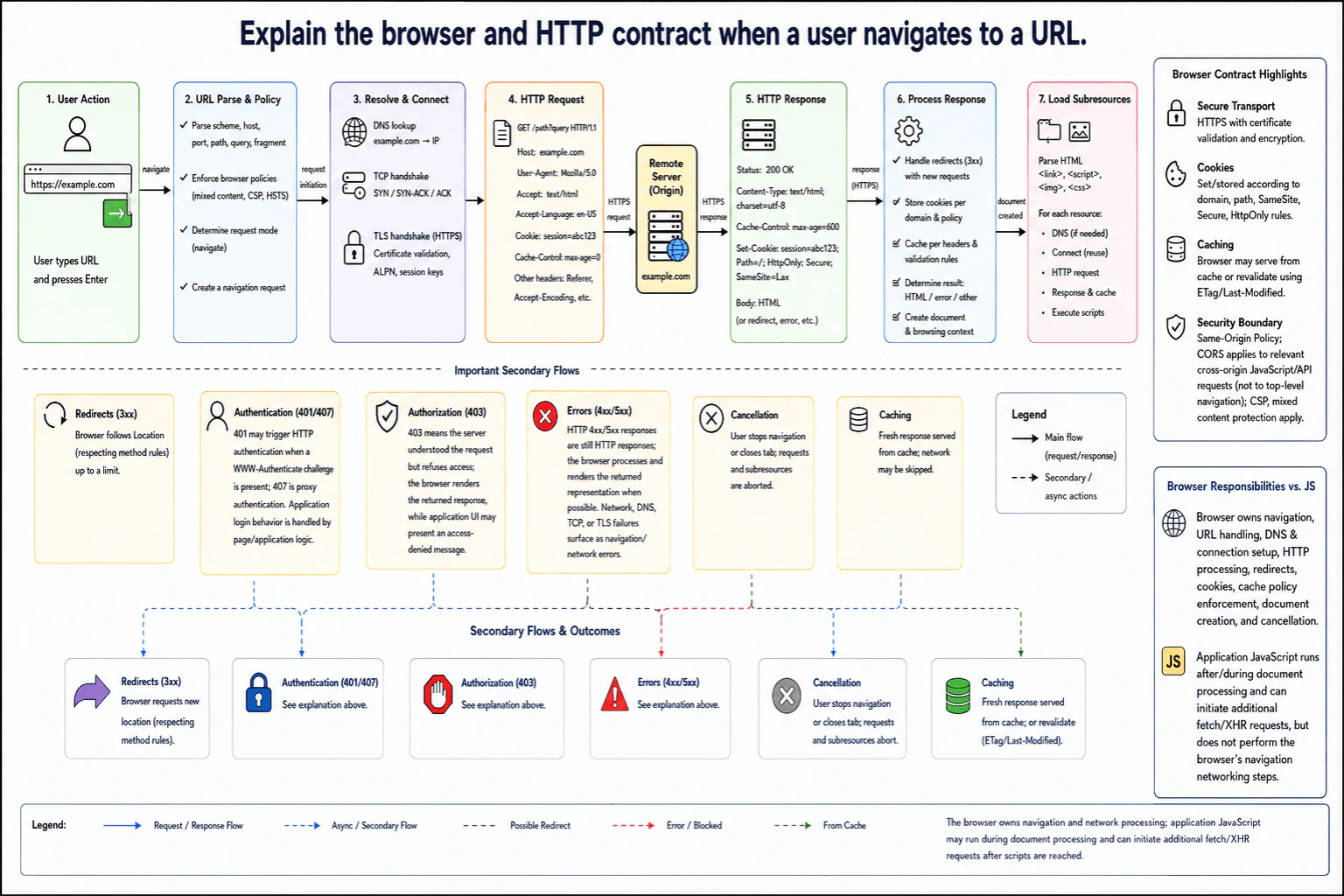
17. Explain the browser and HTTP contract when a user navigates to a URL.API DesignEasyAmazon

Question Details

Use the reported question about typing a URL and pressing Enter. Describe the observable contract across URL parsing, navigation, DNS and connection setup, HTTP request and response handling, redirects, cookies, caching, status and content type, document creation, and subresource requests. Distinguish browser behavior from application JavaScript and identify where authentication, errors, and cancellation are surfaced.

Short Interview Answer (30-60 seconds)

I would describe this as a browser-owned navigation flow. The user enters a URL, and the browser parses it, resolves the host with DNS, opens TCP, and uses TLS for HTTPS. It sends the HTTP request to the remote origin, then receives the status, headers, and body. The browser handles redirects, cookies, caching, content type, document creation, and subresource requests. It can cancel obsolete navigation work and surface network failures. Application JavaScript runs during or after document processing and can make additional fetch or XHR requests. Same-origin rules and CORS protect relevant JavaScript access without controlling normal top-level navigation.

Detailed Explanation

When a user types a URL and presses Enter, the browser owns the main navigation. It first understands the URL and checks browser policies. Then it resolves the host, creates the connection, and sends an HTTP request to the remote origin. The origin sends an HTTP response back to the browser. The browser checks the status, headers, content type, cookies, and cache rules. It may follow redirects or show a returned error document. It then creates the document and loads CSS, JavaScript, images, fonts, and other subresources.

Useful Questions to Ask the Interviewer
  • Should I discuss cross-origin redirects, or keep the main navigation on one origin?
  • Should I explain cache revalidation in detail, or focus on fresh cache hits and normal validation rules?
Explain the browser and HTTP contract when a user navigates to a URL. diagram
How to Explain It in an Interview
1. Define the browser contract

The user begins by entering a URL and pressing Enter. The browser parses its scheme, host, port, path, query, and fragment. It also applies browser policies such as HSTS, CSP, and mixed-content protection when relevant.

The browser then starts a navigation request. It performs a DNS lookup for the hostname and gets an IP address. Next, it opens a TCP connection. For HTTPS, it performs a TLS handshake, validates the certificate, and establishes encrypted transport.

The diagram shows the browser sending a GET navigation request to the remote origin. The request contains the path and normal browser-managed headers. These include Host, User-Agent, Accept, Accept-Language, cookies, cache controls, and other supported headers.

The request travels from the browser to the remote server. The HTTP response travels back from the remote server to the browser.

2. Send the HTTP request and receive the response

The request boundary is the remote origin. The browser sends the HTTPS request across the established connection.

The remote origin returns an HTTP response. The diagram shows a 200 OK example. The response contains headers and a body. Important headers shown include Content-Type, Cache-Control, and Set-Cookie.

The browser does not treat the body alone as the contract. It first considers the status and response headers. The Content-Type tells the browser how the returned bytes should be handled. For HTML, the browser can create a document and browsing context.

3. Process redirects, cookies, and caching

A 3xx response can contain a new location. The browser may follow that location and begin another navigation request. It follows the redirect rules, including the relevant method rules, and stops after its redirect limit.

Cookies are managed by browser policy. They can be stored and sent according to domain, path, Secure, HttpOnly, and SameSite rules. HttpOnly means application JavaScript cannot read that cookie.

The browser also owns the HTTP cache. A fresh cached response can be reused without contacting the network again. When validation is needed, validators such as ETag or Last-Modified can help decide whether stored content can still be used.

Caching improves speed and reduces network work. The trade-off is that cached content can become less fresh.

4. Handle authentication, authorization, and failures

Authentication and authorization are different.

A 401 response may trigger HTTP authentication when a WWW-Authenticate challenge is present. A 407 response is for proxy authentication. Application login behavior belongs to page or application logic.

A 403 response means the server understood the request but refuses access. The browser still receives and processes that response. Application code may present an access-denied message when the returned page supports that behavior.

HTTP 4xx and 5xx results are still HTTP responses. The browser can process and render the returned representation when possible. Network, DNS, TCP, or TLS failures are different because a normal HTTP response may never arrive.

If application JavaScript later uses fetch, an HTTP 4xx or 5xx normally still produces a Response. Network failure or cancellation is what normally rejects the fetch operation.

5. Create the document and load subresources

For an HTML response, the browser creates the document and browsing context. It parses the HTML and discovers subresources.

These resources can include CSS, JavaScript, images, and fonts. Each resource can require its own HTTP request and response. The browser may reuse an existing connection. It may also reuse a fresh cached response.

Scripts can run during document processing when the browser reaches them. After that point, application JavaScript can start additional fetch or XHR requests.

Application JavaScript does not perform the browser's main DNS lookup, TCP connection setup, TLS handshake, or navigation networking steps. Those responsibilities stay with the browser.

6. Protect the browser boundary

The browser enforces several security rules.

HTTPS protects data in transit and requires certificate validation. HSTS can force secure transport for supported origins. CSP and mixed-content rules limit unsafe content behavior.

The same-origin policy limits how one origin can access data from another origin. CORS is mainly a browser read-control mechanism for relevant cross-origin JavaScript or API requests. It is not authentication, and it does not control ordinary top-level navigation.

Cookie rules also protect the browser boundary. Secure limits transmission to secure connections. HttpOnly prevents JavaScript from reading the cookie. SameSite controls when cookies are automatically sent in relevant cross-site situations.

7. Handle cancellation and visible outcomes

The browser owns navigation cancellation. If the user presses Stop, closes the tab, or starts another navigation, obsolete requests can be aborted. Related subresource requests can also be stopped.

The visible outcome depends on what happened. A successful HTML response can become a rendered document. A redirect can start another navigation. A returned HTTP error representation can be rendered when possible. A DNS, TCP, TLS, or other network failure surfaces as a navigation or network error.

Application-specific success, empty, or error UI belongs to page JavaScript. That is separate from the browser's own navigation state.

8. Verify the browser contract

I would verify the behavior with browser developer tools. I would inspect the navigation request, remote origin, status, headers, redirect chain, cookies, and cache behavior.

I would confirm that request arrows go from browser to origin. Response arrows must return from origin to browser. I would also verify document creation and the later subresource requests.

For failures, I would test a returned HTTP error separately from a network failure. I would also test cancellation by navigating away while requests are active.

For security, I would verify HTTPS certificate handling, cookie attributes, same-origin behavior, and CORS only for relevant JavaScript cross-origin requests.

Practical Complexity & Trade-offs

The main browser costs are request count, transferred bytes, parsing work, rendering work, and memory. More subresources mean more HTTP work, although connections and cached responses can be reused. Caching improves speed, but older content can remain usable longer. Revalidation improves freshness but may add network work. Redirects can add another navigation step. Cancellation avoids wasting work after the user leaves. HTTPS adds connection and certificate work but protects data in transit. Cookies make browser-managed state convenient, but their domain, path, Secure, HttpOnly, and SameSite rules must be correct. The design should keep navigation correct, secure, understandable, and reasonably fast.

Why Interviewers Ask This

The interviewer is testing whether the candidate understands the boundary between the browser, HTTP, and application JavaScript. They want correct reasoning about URL parsing, DNS, TCP and TLS setup, request and response direction, redirects, cookies, caching, status codes, and content type. They also look for clear separation of authentication, authorization, network failures, cancellation, and browser security rules. The goal is practical engineering judgment and clear communication, not memorizing a long browser checklist.

Interviewer may ask next
What happens if the user navigates away while the document or subresources are still loading?

The browser should cancel work that belongs to the old navigation when it is no longer useful. The affected flow is the main browser navigation and any subresource requests started for that document. If the user presses Stop, closes the tab, or starts another navigation, the browser can abort in-flight requests and stop creating the old page.

The browser still owns URL handling, DNS and connection setup, HTTP processing, redirects, cookies, caching, document creation, and cancellation. If application JavaScript has already started a fetch or XHR request, that application should also avoid applying an old result after its page is no longer active.

Correctness comes from tying visible work to the current navigation. The existing HTTPS, cookie, same-origin, and relevant CORS rules do not change.

The main downside is wasted work that may already have started. Some bytes may already have crossed the network. Still, cancellation is better than allowing obsolete work to continue and possibly update a page the user has already left.

How does HTTP caching change the browser navigation flow?

HTTP caching can let the browser reuse a stored response instead of always contacting the remote origin. The affected components are the browser HTTP cache, the main request path, the response-processing step, and later subresource requests.

Before sending a network request, the browser can decide whether an existing cached response is still fresh. If it is fresh, the network step may be skipped. When validation is needed, validators such as ETag or Last-Modified can help the browser decide whether stored content remains usable. The browser then continues with normal content-type handling, document creation, and subresource loading.

Security ownership does not change. A cache is not authentication or authorization. Cookie rules, HTTPS protection, and same-origin behavior still apply where relevant. Application JavaScript also does not automatically take ownership of the browser's HTTP cache.

The main downside is freshness. Reusing cached content improves speed and reduces network traffic, but users can see older content. More frequent validation improves freshness but adds latency and network work.

18. Design the frontend architecture for a flashcard study application.System DesignEasyAmazon

Question Details

The reported task is a flashcard application implemented with React or browser JavaScript. Design the frontend around decks, cards, reveal/hide behavior, moving through a study session, and retaining progress. Explain component boundaries, state ownership, persistence, loading and empty states, keyboard operation, and how a later server synchronization layer could be added without coupling every card component to networking.

Short Interview Answer (30-60 seconds)

At a high level, this is a client-rendered React SPA for opening decks, studying cards, revealing answers, rating recall, and keeping progress. The main challenge is putting each kind of state in the right place. Routes use code splitting, shared study data stays in client state, and progress is saved in IndexedDB. A service worker supports offline use. Later, Sync / API can add server updates without putting network calls inside card components. The downside is extra offline and sync complexity.

Detailed Explanation

The goal is to make flashcard study fast and easy on desktop, tablet, and mobile. A user should open a deck, start a study session, reveal a card, move forward or backward, rate recall, and continue later. The main frontend challenge is state ownership. Temporary UI state, URL state, shared study state, remote data, and saved browser data should not become mixed together. I would explain the design through delivery, components, state, failure handling, accessibility, and safe releases.

Useful Questions to Ask the Interviewer
  • Must the first version work when the network is unavailable?
  • Do users need accounts now, or only when sync is added?
  • Should progress later sync across several devices?
  • Is search-engine indexing important for this application?
  • Which browsers and accessibility level must we support?
  • Do we need multiple languages and right-to-left layouts?
Design the frontend architecture for a flashcard study application. diagram
How to Explain It in an Interview
1. Deliver a client-rendered application

I would use the React and TypeScript SPA shown in the diagram. DNS leads to the CDN edge, which serves the static HTML, JavaScript, CSS, images, and fonts. The browser then runs the application with client-side rendering, or CSR.

The app uses route-based code splitting and prefetching. Code splitting means loading only the JavaScript needed for a route. Lazy loading and image optimization help reduce unnecessary work. Because the design uses CSR, there is no server-rendered page that needs hydration.

2. Keep routes and component boundaries clear

React Router owns Home, Decks, Deck Details, Study Session, Statistics, Settings, and Not Found. The App Shell owns shared navigation, theme, global toasts, and the offline banner.

The Study Session Page combines the Flashcard view, Navigation Controls, Progress and Stats, and keyboard hints. Modals and drawers handle actions such as adding or editing cards. Shared buttons, inputs, cards, icons, typography, spacing, colors, and dark mode come from the Design System.

3. Give each kind of state one owner

Local UI state keeps small temporary values such as whether a card is flipped or a menu is open. URL state keeps shareable values such as deckId, sessionId, cardIndex, filters, and sorting.

Shared client state keeps session progress, deck-list cache, user preferences, and theme. Remote data represents decks, cards, the user profile, and progress sync from the external Sync / API boundary.

Persisted browser state survives reloads. IndexedDB stores cards, sessions, and progress. LocalStorage stores small settings such as theme. The service worker cache keeps offline assets.

4. Handle loading, stale data, failures, and offline use

The UI has explicit Loading, Empty, Partial / Stale, Error, Offline, and Aborted states. Loading can show skeletons or spinners. Empty decks show a clear empty state. Cached data may remain visible while a newer result is being fetched.

If a request is no longer useful, it should be cancelled. Errors show friendly messages and retry actions. Offline study continues from browser data, and queued work can sync later when connectivity returns.

5. Make the experience accessible and safe to evolve

Keyboard operation is part of the main study flow. Arrow keys move between cards. Space can reveal a card. Number keys can rate recall. Focus management, ARIA labels, and screen-reader labels keep controls accessible.

The layout is mobile-first and adapts to larger screens. Localization supports externalized strings and right-to-left layouts. Performance monitoring tracks route loading and Web Vitals. Analytics records user and study events. Error reporting captures JavaScript errors and unhandled rejections. Feature flags support gradual rollout and quick rollback. HTTPS, CSP, and XSS protection remain part of the browser security boundary. External Auth Provider, Sync / API, Analytics, Error Reporting, and Feature Flags stay outside the browser application.

Engineering Considerations / Design Trade-offs

The benefit is that each part has one clear job. Components handle the screen. Shared state handles study data used by several components. IndexedDB keeps progress after a refresh and supports offline study. Code splitting makes the first load smaller because each route loads only what it needs. The downside is more frontend work. Offline data can become different from remote data. Sync needs retries and conflict rules. A service worker also has its own browser lifecycle. Feature flags and monitoring make releases safer, but they add more code and testing.

Why Interviewers Ask This

The interviewer wants to see whether the candidate can break a frontend problem into clear parts. They are checking judgment about component boundaries, state ownership, browser storage, routing, offline behavior, accessibility, and failures. They also want to see whether future server synchronization can be added without tightly coupling every flashcard component to networking.

Interviewer may ask next
How would you change this design if users must study offline for several days and later sync progress across devices?

I would keep the same basic design, but I would make the offline path more important. IndexedDB would keep the cards, sessions, and progress needed for study. User actions would update local browser state first, so revealing cards and rating recall still feel immediate without a network.

The service worker would keep the offline fallback and sync queue shown in the diagram. When connectivity returns, the Sync / API boundary would send queued progress updates to the remote system. Flashcard components would still not call the network directly. They would update shared client state, while the sync layer handles remote work.

I would also add a clear sync status in the UI. If two devices changed the same progress, the sync layer would need a simple conflict rule before shared state is updated.

The main downside is complexity. Queues, retries, conflicts, and browser lifecycle limits need careful testing.

How would you change the frontend if one user can have thousands of decks and very large card collections?

I would keep the same routes, components, and state boundaries, but I would avoid loading or rendering everything at once. The Decks Page could load smaller groups of decks. For a very long visible list, I would use list virtualization, which means the browser renders only the rows currently near the screen.

Large deck and card collections can stay in IndexedDB until the current route needs them. Shared client state should keep only the data needed by active screens. Route-based code splitting still helps because the browser should not load Study Session code while the user is only browsing decks.

For search, I would wait briefly after typing before starting work and cancel older requests when a newer search begins. Cached results can stay visible as Partial / Stale data until fresh results arrive.

The main downside is more coordination. Pagination, virtualization, caching, and cancellation make the frontend harder to test.

19. Design a frontend for restaurant browsing and customizable ordering.System DesignEasyAmazon

Question Details

Design the reported restaurant-listing application in which a user selects a restaurant, browses menu items, and customizes an order with options such as toppings or salads. Cover navigation, menu and cart state, validation of required choices, price presentation, loading and unavailable-item states, responsive interaction, accessibility, and the browser-to-service boundary for submitting the final order.

Short Interview Answer (30-60 seconds)

At a high level, the frontend helps users find a restaurant, browse its menu, customize items, review the cart, and place an order. I would use CSR with route-level code splitting, with optional SSR for the first page. Routes separate listing, menu, customization, cart, and confirmation. Client state holds menu, cart, options, loading, and errors. The browser calls external services over HTTPS. The main trade-off is a simpler client experience versus extra SSR and offline complexity.

Detailed Explanation

The goal is to make restaurant ordering simple on desktop, tablet, and mobile. A user should open the app, choose a restaurant, browse its menu, customize an item, review the cart, and submit the order. The main frontend challenge is keeping navigation, cart data, prices, validation, and loading states clear while remote requests are running. I would divide the design into rendering, routes and components, client state, remote data flow, failure handling, accessibility, performance, and safe release controls.

Useful Questions to Ask the Interviewer
  • Do restaurant pages need strong SEO?
  • Which browsers and devices must we support?
  • Should the cart survive a page refresh?
  • How much offline browsing is required?
  • Which languages, currencies, and date formats are needed?
  • Is sign-in optional or required before ordering?
Design a frontend for restaurant browsing and customizable ordering. diagram
How to Explain It in an Interview
1. Start with rendering and navigation

I would use CSR for the interactive application. CSR means JavaScript updates the page inside the browser. I would use route-level code splitting, which loads only the JavaScript needed for the current route. The first page can optionally use SSR when faster first content or SEO matters.

The routes are / for restaurant listing, /restaurant/:id for restaurant details and menu, /restaurant/:id/item/:id for item customization, /cart for cart and checkout, and /order/confirmation after a successful order.

2. Keep clear component and state boundaries

The main components are RestaurantCard, MenuList, MenuItem, CustomizationOptions, CartDrawer / CartPage, OrderSummary, and LoadingState / ErrorState. A shared design system provides reusable buttons, inputs, and other controls.

Client state keeps menu and restaurant data, cart items, selected options, calculated prices, modal state, loading flags, and errors. Persisted browser state uses localStorage for the cart and preferences. URL state keeps the current route, selected restaurant, selected item, and shareable deep links.

3. Follow one clear data flow

The browser sends REST requests over HTTPS to the Restaurant API. It fetches restaurants and menu items, checks item availability, validates item options, and submits the final order. JSON responses update the visible UI.

When a user customizes an item, CustomizationOptions records choices such as toppings or salads. The UI shows the updated price and blocks progress when a required choice is missing. The Restaurant API still validates item options before accepting the order.

The optional Identity Provider handles user sign-in and sign-up as a separate external boundary.

4. Handle loading, unavailable items, errors, and offline use

While data loads, the UI shows spinners or skeletons. Empty results get a clear empty state. Failed requests show an error and retry option. Unavailable items remain visible but are disabled when appropriate.

The browser cache stores static assets. A service worker can cache assets and some previously loaded data for offline use. Cached data may become stale, which means it may be older than the newest remote result. Final order submission still requires the remote service.

5. Make the experience responsive and accessible

The layout is mobile-first and adapts to desktop, tablet, and phone screens. Controls support touch and keyboard navigation. Screen readers receive useful ARIA information where needed. Focus is managed when dialogs open or errors appear. Forms have accessible labels, readable errors, and adequate color contrast.

Localization supports multiple languages, currencies, and date formats. RTL layout can be supported where needed.

6. Deliver, measure, and release safely

The CDN serves JavaScript, CSS, images, and fonts. Browser caching reduces repeated downloads. Images and components can load lazily to improve performance.

Monitoring records frontend errors and performance measurements. Feature flags allow gradual rollout. If a release causes problems, the team can disable the feature or roll back. The downside is extra monitoring, testing, and release complexity.

Engineering Considerations / Design Trade-offs

The benefit of CSR is fast navigation after the application loads. The downside is that the first page may need more JavaScript. Optional SSR can improve the first view and SEO, but it adds more complexity. Code splitting reduces the JavaScript loaded for each route, but creates more bundles to manage. Browser caching and a service worker make repeat visits faster and can help offline users. The downside is stale data and harder cache rules. Saving the cart is convenient, but prices and availability must be checked again before the final order.

Why Interviewers Ask This

The interviewer wants to see whether the candidate can turn a real user journey into clear frontend boundaries. They want good decisions about routes, state, loading behavior, accessibility, caching, remote requests, and failures. They also want to see whether the candidate can explain trade-offs instead of choosing technology without a reason. The focus is practical frontend judgment, not memorizing system-design terms.

Interviewer may ask next
What would you change if restaurant pages must rank well in search engines and SEO becomes very important?

I would keep the same routes, components, client state, and external services, but I would use SSR more consistently for the restaurant listing and restaurant detail pages. SSR means useful HTML is created before the browser finishes loading the JavaScript. This gives search engines meaningful restaurant and menu content earlier and can improve the first visible page.

After that HTML reaches the browser, JavaScript makes the page interactive. The same RestaurantCard, MenuList, and MenuItem components can still be used. Later navigation can continue with CSR, so moving between pages stays fast.

The CDN would still serve JavaScript, CSS, images, and fonts. Route-level code splitting would still limit how much JavaScript each page loads. Client state would continue to own the cart and customization choices.

The main downside is extra complexity. The initial rendering path becomes harder to test, operate, and keep consistent with browser behavior.

What would you change if users must keep browsing restaurant menus during unreliable or offline network conditions?

I would keep the same frontend architecture, but I would use the service worker more heavily for cached assets and previously loaded restaurant data. The browser cache would still hold static files such as JavaScript, CSS, images, and fonts. The service worker could return cached menu data when the network is unavailable.

The Loading & Data States behavior becomes more important. The UI should show a clear offline state and explain that cached menu information may be stale. Unavailable actions should not look usable. A user may browse cached items, but submitting the final order still requires the Restaurant API.

The cart can remain in localStorage, so selected items survive a refresh or temporary connection loss. When connectivity returns, the frontend should check availability, options, and current prices again before submission.

The main downside is more cache and state complexity, especially when saved menu information becomes old.

20. Design a mobile playlist page for a music-streaming frontend.System DesignEasyAmazon

Question Details

Design the reported mobile playlist page. Explain the page and component structure for playlist metadata, track rows, current-track state, play controls, and navigation to a persistent player. Address long lists, artwork and media loading, unavailable tracks, recovery from interrupted requests, responsive behavior, keyboard and screen-reader controls, and which state should survive route changes or reloads.

Short Interview Answer (30-60 seconds)

At a high level, the page lets a listener open a playlist, browse many tracks, start music, and keep playback visible while moving between routes. The main frontend challenge is keeping the page responsive on a mobile device with a variable network. I would use client-side rendering with a focused PlaylistPage and shared playback state. URL, local, shared, and persisted browser state have separate jobs. Virtualization, caching, cancellation, and accessible controls improve the experience, but offline support adds complexity.

Detailed Explanation

The goal is to make a mobile playlist page fast, clear, and reliable. A listener should see playlist details, browse a long track list, start playback, and move to another route without losing the current track. Mobile networks may be slow or interrupted, so loading and recovery matter. I would use client-side rendering, or CSR, because this page is highly interactive. I would separate routing, page components, browser state, remote services, recovery, accessibility, and delivery so each part has one clear job.

Useful Questions to Ask the Interviewer
  • How important is search-engine visibility for playlist pages?
  • Should playback continue when the listener changes routes?
  • How much offline behavior should the page support?
  • Which mobile browsers and screen sizes must we support?
  • Should unavailable tracks remain visible with a disabled state?
  • Do we need localization and right-to-left layouts?
Design a mobile playlist page for a music-streaming frontend. diagram
How to Explain It in an Interview
1. Start with rendering, routing, and page structure

I would use CSR for the playlist experience. The first load downloads the application JavaScript. After that, route changes can feel fast because the browser updates the page without a full reload. SEO is less important for this highly interactive view, so CSR is a reasonable tradeoff.

The main route is /playlist/:id. The application also has /search, /library, and /player. PlaylistPage contains PlaylistHeader, PlayControlsBar, TrackList, and NowPlayingMiniBar. The shared layout provides TopAppBar and BottomNav. The design system keeps typography, spacing, icons, buttons, cards, and list items consistent.

2. Give each kind of state one clear owner

URL state holds values that belong in the address bar, including playlist ID, sort, filter, and page. Local UI state keeps short-lived details such as an open sheet, UI mode, or focus position.

Shared client state keeps playlist data, tracks, the current track, playback queue, playback state, and feature flags. This state survives route changes while the application stays open. Persisted browser state survives reloads. IndexedDB can keep library or cached data. Local storage can keep small settings and recent values. Cookies can hold session information.

3. Follow one complete playlist and playback flow

When the listener opens a playlist, routing moves to /playlist/:id. The frontend requests playlist metadata and track data from the external Music API. While waiting, the page shows loading skeletons. A successful response updates client state and renders the playlist.

Actions such as play, shuffle, or adding a track update the relevant client state. Playback uses the external Playback Service to request a stream URL and playback status. NowPlayingMiniBar stays in the shared experience so the current track remains visible while the listener moves between routes. Authentication comes from the external Auth Service. Remote systems remain external boundaries; the frontend does not design their internal storage or workers.

4. Handle long lists, media, and unavailable tracks

TrackList uses virtualization, which means only rows near the visible screen are rendered. More tracks can load incrementally by page or cursor. The application should preserve scroll position when list data changes.

Artwork uses responsive image sizes and lazy loading. Off-screen artwork waits until needed. A low-quality placeholder can appear before the final image. Images, audio segments, fonts, and other static assets can come through the CDN and browser cache.

An unavailable or region-blocked track stays visible but disabled. The UI should explain why it cannot play. The listener can remove or replace it when that action is supported, while playback continuity is preserved for available tracks.

5. Recover from slow, failed, stale, or offline work

The page supports loading, empty, partial, error, aborted, stale, and offline states. AbortController cancels a request when navigation makes that work unnecessary. This also reduces the chance that an old response replaces newer state.

Retryable failures can use exponential backoff, which waits longer between repeated attempts. Stale-while-revalidate can show cached content first and refresh it in the background. The service worker can cache suitable application assets and API responses for supported offline behavior. When connectivity returns, the application can resume playback or queued actions only where the product contract allows it.

6. Finish with accessibility, responsive behavior, and safe delivery

The layout is mobile first. It supports different screen sizes, orientation changes, safe areas, and usable touch targets. Semantic HTML gives controls the correct meaning. ARIA labels and live regions announce changes when needed. Keyboard users can use Enter, Space, and arrow keys, while focus management keeps navigation predictable for screen-reader users. Localization can adapt strings and right-to-left layout where required.

Route-based code splitting loads only the JavaScript needed for routes such as playlist, player, and library. Static assets use the CDN and browser cache with appropriate cache control. Performance monitoring tracks Core Web Vitals such as LCP, INP, and CLS. Analytics and error reporting capture useful events, errors, traces, and sessions with privacy-safe telemetry. Feature flags support gradual rollout, and a kill switch allows a risky feature to be disabled quickly.

Engineering Considerations / Design Trade-offs

The benefit of CSR is fast navigation after the first application load. The downside is that the first JavaScript load can be larger. Virtualizing the track list keeps very long playlists smooth, but scrolling and focus behavior need more care. Browser caching and a service worker improve repeat visits and offline use, but cached data can become stale. Shared client state keeps playback stable across routes, but too much shared state can couple components. Feature flags make rollout safer, but every flag creates another path that must be tested.

Why Interviewers Ask This

The interviewer wants to see whether you can turn a mobile user experience into clear frontend boundaries. They want to know how you choose rendering, split components, assign state, handle long lists, recover from failed requests, and keep playback stable across routes. They also look for accessibility, browser performance, caching, and safe rollout judgment. The important skill is explaining useful tradeoffs instead of memorizing one architecture.

Interviewer may ask next
How would you change the design if the playlist must work much better during poor or lost network connections?

I would keep the same architecture, but I would give the service worker and persisted browser state a larger role. The service worker would cache suitable application assets and selected API responses. IndexedDB would keep recently used playlist and library data. The playlist could then show cached tracks when the network disappears.

The existing offline and stale states would become more important. The UI would clearly say when content came from cache instead of pretending it is fresh. Network-only actions should be disabled unless the product explicitly supports queueing them for later.

I would still use AbortController to cancel requests that become unnecessary during navigation. After connectivity returns, stale-while-revalidate can show the cached playlist immediately while requesting a newer copy from the Music API. Playback or queued actions can resume only when the Playback Service supports that behavior.

The main downside is complexity. We must carefully decide what can be cached, how long it stays useful, and which actions are safe offline.

What would you change if a playlist can contain tens of thousands of tracks?

I would keep the same TrackList, but virtualization and incremental loading would become essential. The browser should render only rows close to the visible screen. That keeps DOM size, layout work, and memory use much smaller than rendering every track.

The Music API requests would fetch tracks in pages or by cursor instead of downloading the whole playlist at once. Shared client state would keep the pages already loaded, while URL state could continue to hold values such as playlist ID, sort, filter, and page when useful. The list should also preserve scroll position as new data arrives.

Artwork would remain lazy loaded so off-screen images do not use unnecessary bandwidth or memory. Loading and partial states would appear while later pages arrive. Keyboard focus must also remain predictable as virtual rows are reused.

The main downside is implementation complexity. Virtualized lists need careful testing for row measurement, scrolling, focus, screen readers, and incremental loading.

More questions load as you scroll

Disclaimer: This interview guide is for educational and informational purposes only. It is designed to help readers prepare, but it does not guarantee any interview result, hiring decision, offer, or outcome. Interview questions, hiring criteria, and preferred answers can vary by employer, interviewer, industry, location, and time. The examples and explanations reflect the authors' research and judgment, are provided without warranties of any kind, and should not be treated as the only correct approach. Diagrams are simplified illustrations intended to highlight the main components and their interactions; actual systems and implementations may be more complex. Alternative approaches may be equally valid or better suited to a particular question, context, or interviewer. To the fullest extent permitted by applicable law, the author, contributors, and publisher are not liable for decisions made, actions taken, or losses incurred based on this guide.

Company Notice: This guide is an independent educational resource and is not affiliated with, endorsed by, sponsored by, or approved by the company named in this guide. Company names are used only to identify interview experiences commonly reported by candidates. Interview practices can change without notice, and inclusion of company-specific content does not mean these questions are official, complete, or guaranteed to be asked. To the fullest extent permitted by law, the author, contributors, and publisher are not responsible for outcomes related to use of this material.