Amazon JavaScript Frontend Developer Interview Questions & Answers

amazon icon

Questions with Detailed ExplanationsWith Detailed Explanations

(Last Updated: August 28, 2026)

21. Design the frontend for a bike-sharing application.System DesignEasyAmazon

Question Details

Design the reported bike-sharing frontend. The browser should help a rider discover stations, inspect current bike and dock availability, select a station, and understand an active trip. Discuss map and list views, geolocation permission, freshness of availability data, route and state ownership, weak-network behavior, accessible alternatives to the map, and how the UI prevents duplicate rental actions.

Short Interview Answer (30-60 seconds)

At a high level, the frontend helps riders find stations, check live bike and dock availability, select a station, start or end a rental, and follow an active trip. I would use a React single-page application with client-side rendering and route-based code splitting. URL state owns routes and filters, while shared client state owns auth, stations, trip, and UI data. A service worker and browser cache help on weak networks. The main trade-off is more browser complexity for faster navigation and better resilience.

Detailed Explanation

The goal is to give riders a fast and reliable bike-sharing experience on mobile and desktop. A rider should discover nearby stations, see current bikes and docks, open a station, start or end a rental, and understand an active trip. The hard part is keeping availability fresh while mobile networks may be slow or unstable. I would organize the frontend around delivery, routes and components, state ownership, remote data, weak-network behavior, and accessible interaction.

Useful Questions to Ask the Interviewer
  • How fresh must bike and dock availability be?
  • Should the app remain useful when the rider is offline?
  • Which mobile and desktop browsers must we support?
  • Must every map action also be available through the station list?
  • Does the Bike-sharing Backend API support idempotent start and end rental requests?
  • How many languages must the frontend support?
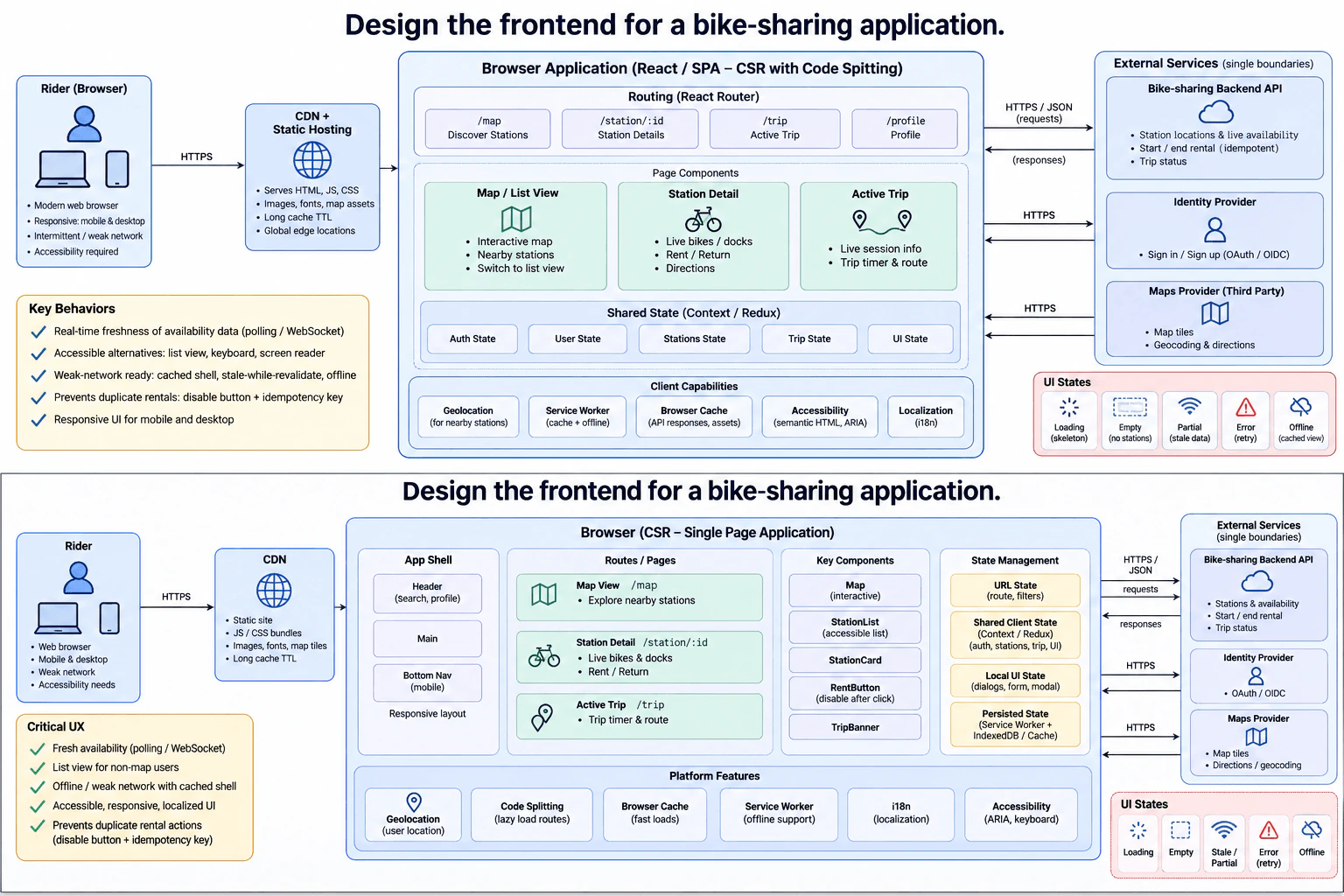
Design the frontend for a bike-sharing application. diagram
How to Explain It in an Interview
1. Deliver and render the application

The rider downloads the frontend from the CDN. It serves the static site, JavaScript and CSS bundles, images, fonts, and map tiles. Long cache times can be used for versioned static files.

The browser runs a React single-page application using client-side rendering. This works well because the experience is highly interactive. Code splitting means each route loads only the JavaScript it needs.

The App Shell contains the Header, Main area, and mobile Bottom Nav. It gives all routes one responsive layout.

2. Define routes and visible components

The main routes are /map, /station/:id, /trip, and /profile. The Map View helps riders explore nearby stations. The Station Detail route shows live bikes and docks and provides rent or return actions. The Active Trip route shows the trip timer and route.

Important reusable components include Map, StationList, StationCard, RentButton, and TripBanner. The StationList is also the accessible alternative to the map. A rider can use it with a keyboard or screen reader without depending on map interaction.

3. Give each kind of state a clear owner

URL state owns the current route and filters. This makes navigation and filtered views shareable and predictable.

Shared client state, such as Context or Redux, owns auth, stations, trip information, and shared UI data. Local UI state owns short-lived values such as dialogs, forms, and modal state. Persisted state can use browser storage and cached data for useful information that should survive reloads.

Geolocation is a browser capability. The app asks for permission before using the rider's location to find nearby stations.

4. Fetch and refresh remote information

The browser sends HTTPS and JSON requests to the Bike-sharing Backend API. That external service provides stations, availability, rental actions, and trip status. The Identity Provider handles sign-in through OAuth or OIDC. The Maps Provider supplies map tiles, directions, and geocoding.

Availability can change quickly. The frontend can use polling or a WebSocket for fresh bike and dock counts. Shared Stations State then updates the Map View, StationList, and Station Detail from the same data.

5. Handle weak networks and safe rental actions

The UI has clear loading, empty, partial or stale, error, and offline states. Stale means the displayed information may be older than the latest remote result. The app should show this state instead of presenting old availability as current.

The browser cache speeds up assets and useful responses. The service worker supports cached application files and offline behavior. This helps the shell remain usable when connectivity is poor.

To prevent duplicate rentals, the RentButton becomes disabled after the first click while the request is pending. The request also carries an idempotency key so repeated submissions can represent the same operation. The backend remains responsible for enforcing the real rental rule.

6. Keep the experience accessible and responsive

The layout adapts to mobile and desktop screens. The frontend uses semantic HTML, ARIA where needed, keyboard support, and screen-reader friendly controls. Localization, or i18n, lets the same interface support different languages.

The main trade-off is complexity. Shared state, live updates, browser caching, and a service worker make the client harder to build and test. The benefit is faster navigation and a more dependable experience on real mobile networks.

Engineering Considerations / Design Trade-offs

The benefit of a client-rendered single-page app is fast navigation after the first load. The downside is that the browser must download and run more JavaScript. Code splitting reduces this by loading JavaScript only for the current route. Live availability gives riders better information, but frequent polling or a WebSocket uses more network and battery. Browser caching and a service worker help on weak networks, but cached information can become stale. Shared state keeps station and trip data consistent across pages, but too much shared state makes the frontend harder to maintain.

Why Interviewers Ask This

The interviewer wants to see whether the candidate can turn a real rider journey into a clear frontend design. They are testing judgment about routes, component boundaries, state ownership, fresh remote data, weak networks, accessibility, and duplicate actions. They also want to see whether the candidate understands the browser's responsibilities and keeps trusted rental and authorization rules inside the remote systems.
Interviewer may ask next
How would you change the design if bike and dock availability must update almost immediately while the rider watches the map?

I would keep the same routes, components, and shared state, but I would make the live availability path more active. The Map View, StationList, and Station Detail would still read station data from the shared Stations State.

I would prefer a WebSocket when the Bike-sharing Backend API supports it. A WebSocket keeps one connection open so new availability can arrive without waiting for another page request. If the connection fails, the frontend can fall back to short-interval polling.

Each update should change only the affected station in shared state. That keeps the map, list, and station page consistent. If updates stop arriving, the UI should show the partial or stale state instead of pretending the counts are current.

The browser can still use cached information during brief network problems, but cached counts must be clearly marked as old.

The main downside is extra complexity. A long-lived connection also uses more battery and network resources than slower polling.

What would you change if riders often lose connectivity during an active trip?

I would keep the same Browser Application, Active Trip route, Browser Cache, and Service Worker. I would make their offline behavior more important.

The service worker should keep the application shell and needed static files available. The Browser Cache can keep the most recent useful trip response. The Active Trip page can then continue showing the last known trip timer and route information, but the UI must clearly show the Offline state.

For a rental action such as ending the trip, the frontend should not claim success until the Bike-sharing Backend API confirms it. If the network is unavailable, the control can explain that the rider must reconnect and retry.

When the request is sent, the RentButton or related trip action stays disabled while it is pending. The idempotency key still protects against repeated submissions after reconnecting.

The main downside is more state and testing. The team must clearly separate cached information from remote results that the backend has actually confirmed.

22. Design the architecture of a browser JavaScript SDK with throttling and retries.System DesignMediumAmazon

Question Details

The reported system-design question asks for a JavaScript SDK that implements throttling and retry strategies and defines contracts consumers must follow. Design module boundaries, configuration, request scheduling, retry eligibility and backoff, cancellation, error surfaces, observability hooks, browser lifecycle cleanup, and compatibility. Explain how the SDK prevents callers from bypassing its limits while remaining testable and usable by several applications.

Short Interview Answer (30-60 seconds)

At a high level, I would make the SDK the only supported path for this application traffic. The main challenge is applying the same throttling, retries, cancellation, and browser lifecycle rules across several apps. Every SDK call goes through normalization, rate limiting, scheduling, retry handling, and transport. Browser storage supports offline recovery when needed. The trade-off is more SDK complexity, but callers get consistent limits, errors, cleanup, and observability.

Detailed Explanation

The goal is to give several browser applications one safe way to call remote services. Sending one HTTP request is simple. The harder problem is controlling many requests when the network is slow, the browser goes offline, a tab becomes hidden, or the service returns errors. I would solve this with one browser JavaScript SDK that owns the complete request pipeline. Applications use its public API. The SDK then applies configuration, throttling, scheduling, retries, cancellation, error handling, persistence, and observability.

Useful Questions to Ask the Interviewer
  • Which browsers must the SDK support?
  • Which requests are safe to retry?
  • Do we need offline queueing?
  • Are throttling limits global or different by endpoint?
  • Which writes require an idempotency key?
  • Which logging and metrics hooks must applications provide?
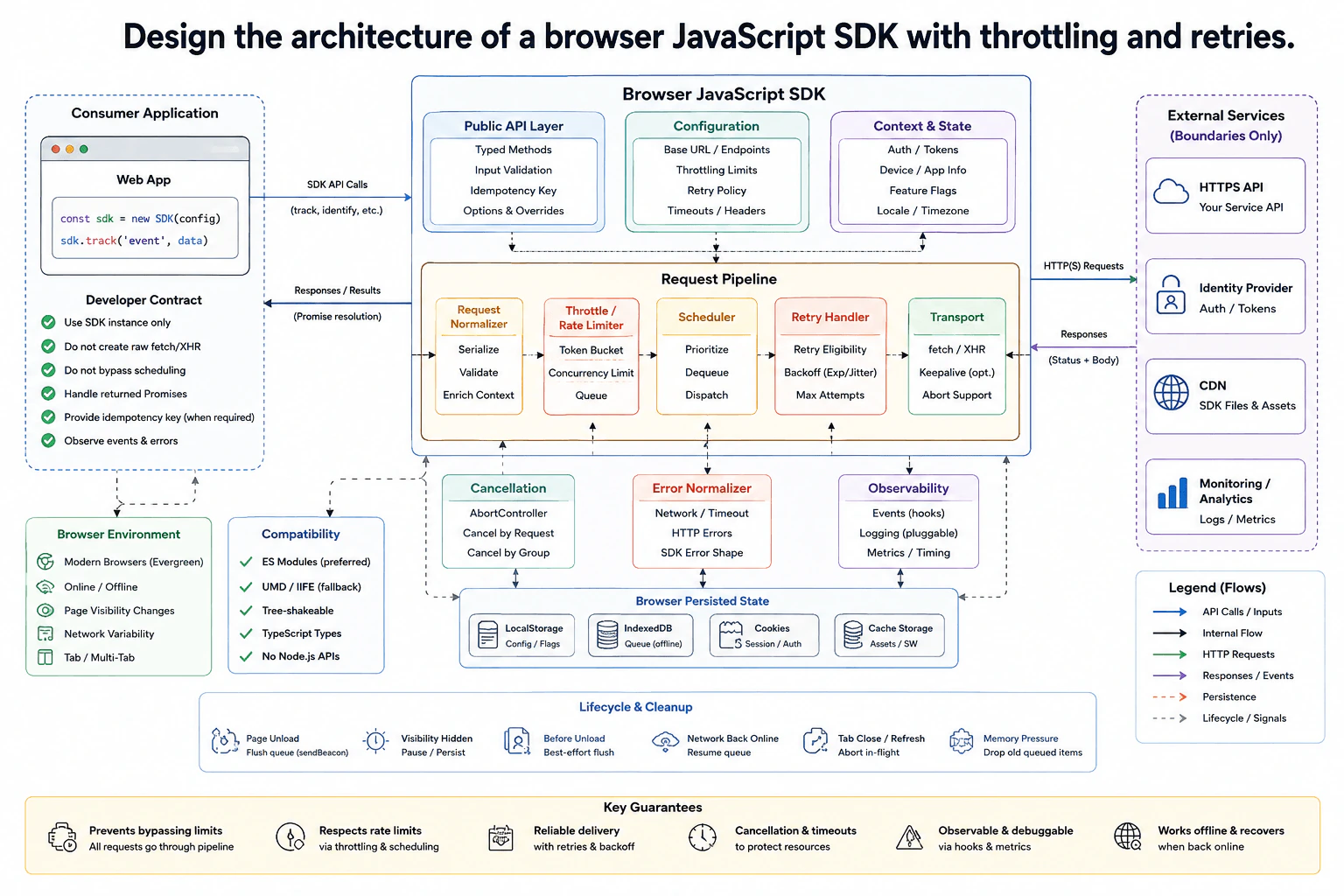
Design the architecture of a browser JavaScript SDK with throttling and retries. diagram
How to Explain It in an Interview
1. Keep one public entry point

The consumer web app creates one SDK instance. It calls typed SDK methods instead of raw fetch or XHR for this traffic. This developer contract prevents callers from bypassing throttling and scheduling.

The Public API Layer validates inputs and accepts options. Configuration contains base URLs, throttling limits, retry policy, timeouts, and headers. Context and State adds auth data, device or app information, feature flags, locale, and timezone.

2. Put every request through one pipeline

The Request Normalizer serializes, validates, and enriches each request. The Throttle and Rate Limiter then applies a token bucket, a concurrency limit, and a queue. A token bucket controls how quickly work may start.

The Scheduler prioritizes queued work, dequeues the next item, and dispatches it. Because all SDK traffic uses this path, applications cannot skip the shared limits.

3. Retry only eligible work

The Retry Handler first checks whether a failed request may be retried. It uses exponential backoff with jitter, so later retries wait longer and include a small random delay. Retries stop after the configured maximum attempts.

For operations that need protection against repeated effects, callers provide an idempotency key when required. The SDK does not assume every request or every error is safe to retry.

4. Send, cancel, and normalize failures

The Transport uses fetch or XHR. It supports abort behavior and optional keepalive behavior. Cancellation uses AbortController and can cancel one request or a request group.

Responses return to the application as Promise results. Network, timeout, and HTTP failures pass through the Error Normalizer. This gives applications one stable SDK error shape.

5. Handle browser state and lifecycle

The Browser Environment tracks online or offline state, visibility changes, network variability, and multi-tab conditions. Browser Persisted State can use LocalStorage for config or flags, IndexedDB for an offline queue, cookies for session or auth data, and Cache Storage for assets or service-worker data.

Lifecycle handling covers page unload, hidden tabs, before-unload work, reconnecting, tab close or refresh, and memory pressure. The SDK can pause, persist, resume, flush best-effort work, or abort in-flight requests when appropriate.

6. Keep the SDK observable and compatible

Observability exposes events, pluggable logging, metrics, and timing hooks. These signals can flow to external monitoring or analytics systems. The SDK prefers ES modules, can offer UMD or IIFE fallbacks when needed, remains tree-shakeable, provides TypeScript types, and avoids Node.js-only APIs. The downside is more SDK code, but applications get consistent behavior and easier debugging.

Engineering Considerations / Design Trade-offs

The benefit is consistency. Every application follows the same throttling, retry, cancellation, and error rules. This makes behavior easier to test and debug. The downside is that the SDK becomes more complex. Offline queues and lifecycle handling add more browser state. Retries can improve best-effort delivery, but they can also increase traffic during failures. Strong throttling protects the remote service, but queued work may wait longer. Compatibility fallbacks help more applications, but they add package and release work.

Why Interviewers Ask This

The interviewer wants to see whether you can turn browser network problems into clear module boundaries. They also want good judgment about throttling, retries, cancellation, offline behavior, compatibility, and failures. A strong answer shows that you understand browser lifecycle limits, can prevent callers from bypassing shared rules, and can explain important trade-offs without inventing unnecessary server internals.

Interviewer may ask next
How would the design change if the SDK must queue eligible requests while offline and send them after the browser reconnects?

I would keep the same request pipeline, but I would rely more on the existing IndexedDB offline queue. When the browser is offline, eligible work would be persisted instead of being sent immediately. The Browser Environment already detects online and offline changes. When the network comes back, lifecycle handling can resume queued work through the same Throttle and Rate Limiter, Scheduler, Retry Handler, and Transport.

Offline work must not bypass normal limits. Replayed requests still need throttling and prioritization. Retry eligibility also stays the same. If an operation can cause repeated server effects, the caller should provide an idempotency key when required.

Cancellation should remove queued work when possible. Observability should record queued, resumed, succeeded, cancelled, and failed requests.

The main downside is more persistent state. We must handle storage limits, stale queued work, old SDK versions, and cleanup carefully.

What would you change if several applications need different throttling and retry policies?

I would keep the same architecture, but I would make Configuration explicit for each SDK instance. Each application could provide allowed throttling limits, retry policy, timeouts, headers, and endpoint settings when it creates the SDK. The Request Pipeline would stay the same.

The important rule is that configuration changes policy, not the path. Applications still cannot bypass the Throttle and Rate Limiter or Scheduler. Every request must enter through the Public API Layer. That keeps the developer contract consistent.

I would validate configuration when the SDK starts. Invalid retry counts, unsupported values, or unsafe options should fail early. Tests can create SDK instances with controlled configuration and a replaceable transport. Observability hooks can report the active policy so teams understand why a request waited or retried.

The main downside is configuration complexity. Too many per-application options can create inconsistent behavior, so the SDK should provide safe defaults and keep the option set small.

23. Design a frontend architecture for a large news website.System DesignMediumAmazon

Question Details

The reported question emphasizes schema and API design, backend interaction, video rendering, and advertisements. Design page and module boundaries for article lists, article detail, media, and ad slots; choose rendering and caching strategies; and cover navigation, partial failures, content updates, performance, accessibility, analytics, and safe isolation of third-party media or advertising code.

Short Interview Answer (30-60 seconds)

At a high level, I would make the news site fast to open, easy to navigate, and resilient when outside services fail. I would use hybrid rendering: SSR or streaming for article detail and other time-sensitive pages, SSG for static pages, and CSR for rich interactions and client transitions. React components own the UI, TanStack Query or SWR owns remote data, URL state owns navigation choices, and local or shared state handles UI preferences. CDN caching, accessible components, fallback states, and feature flags keep the experience fast and safe.

Detailed Explanation

The goal is to help readers find and read news quickly on mobile and desktop, even on weak networks. The hard part is balancing fresh content, SEO, fast rendering, video, advertising, and reliable navigation. I would use a React and TypeScript application with hybrid rendering. The delivery path uses DNS, a CDN and edge layer, static assets, browser caching, and a service worker. Inside the app, I would separate routes, reusable modules, state ownership, remote data, resilience, accessibility, observability, and rollout controls.

Useful Questions to Ask the Interviewer
  • How fresh must breaking-news pages be?
  • Which routes need strong SEO?
  • Should recently visited articles work offline?
  • What accessibility and localization targets are required?
  • How much third-party advertising and video code is expected?
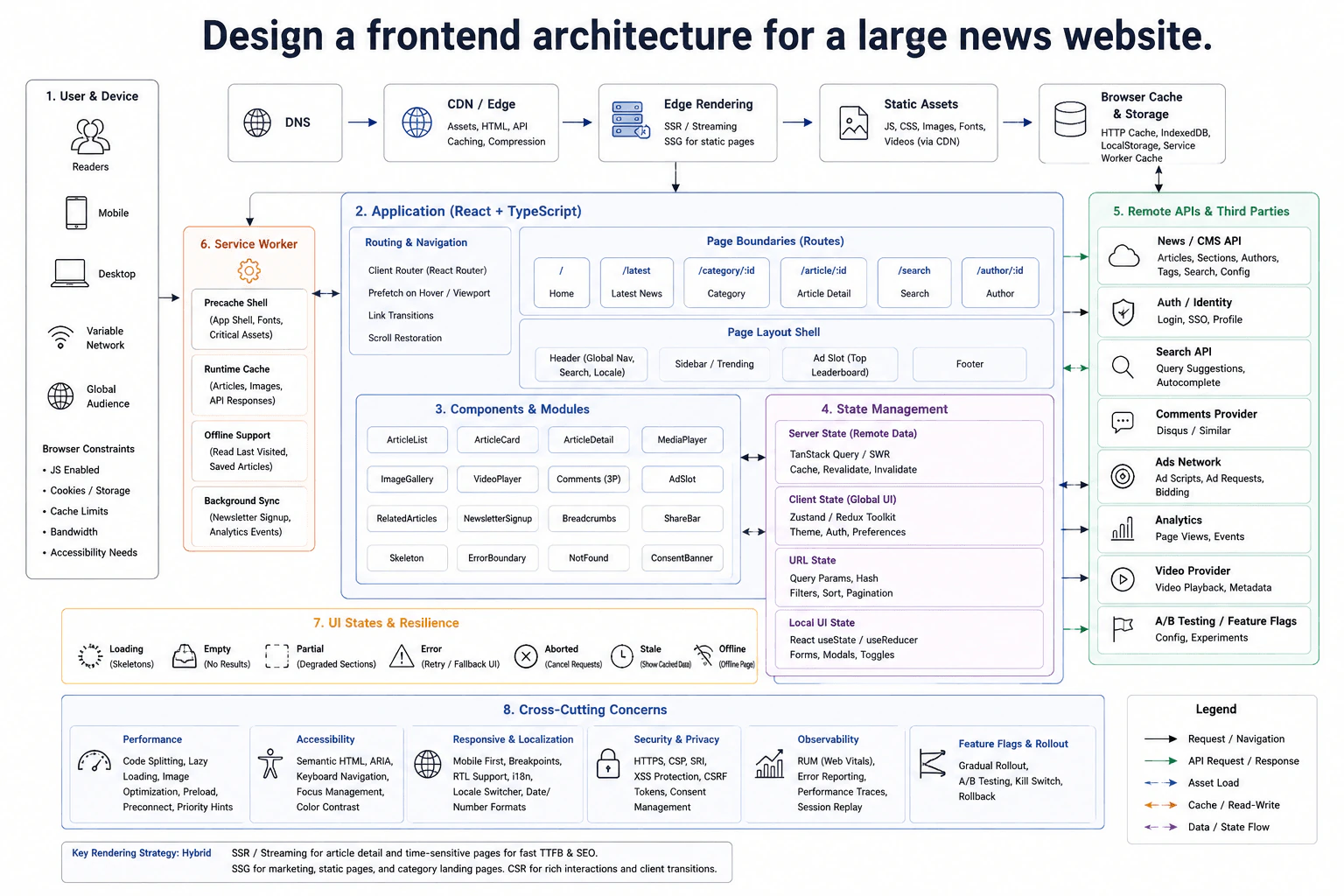
Design a frontend architecture for a large news website. diagram
How to Explain It in an Interview
1. Choose rendering and delivery

For the first load, the browser reaches the site through DNS and the CDN or edge layer. Article detail and other time-sensitive pages use SSR or streaming, which sends useful HTML early. Static pages can use SSG, which prepares HTML before the request. Rich interactions and later route changes use CSR.

Static JavaScript, CSS, images, fonts, and video assets come through the CDN. The browser cache stores reusable files. Code splitting means loading only the JavaScript needed for the current route.

2. Define routes and reusable modules

The routes are /, /latest, /category/:id, /article/:id, /search, and /author/:id. The shared shell contains the header, sidebar or trending area, top ad slot, and footer.

Reusable modules include ArticleList, ArticleCard, ArticleDetail, MediaPlayer, ImageGallery, VideoPlayer, Comments, AdSlot, RelatedArticles, NewsletterSignup, Breadcrumbs, ShareBar, Skeleton, ErrorBoundary, NotFound, and ConsentBanner.

3. Give each state type one owner

Remote data uses TanStack Query or SWR for caching, revalidation, and invalidation. Shared client state can hold theme, authentication, and preferences. URL state keeps query parameters, filters, sorting, and pagination. Local React state handles forms, modals, and toggles.

4. Fetch data through external boundaries

The frontend calls the News or CMS API for articles, sections, authors, tags, search, and configuration. Auth, Search, Comments, Ads, Analytics, Video, and A/B Testing or Feature Flags remain separate external boundaries.

A request can end in success, empty, partial, error, aborted, stale, or offline state. When navigation replaces old work, the app should cancel requests where possible and ignore stale responses, meaning older results that arrive after newer work.

5. Handle failures, offline use, and third parties

Loading uses skeletons. A failed section can degrade without breaking the whole page. ErrorBoundary protects larger UI areas, while NotFound handles missing content.

The service worker precaches the shell and can keep runtime copies of articles, images, and API responses. Offline users can read saved or recently visited articles. Ad and video code should be isolated, such as with sandboxed frames when appropriate, so a slow provider does not break article content.

6. Cover accessibility, performance, and safe rollout

The UI uses semantic HTML, ARIA where needed, keyboard navigation, focus management, good contrast, responsive breakpoints, RTL support, and localization. Performance work includes lazy loading, image optimization, preload or preconnect hints, and route-level code splitting.

Real User Monitoring tracks Web Vitals. Error reporting captures frontend failures. Feature flags support gradual rollout, A/B testing, a kill switch, and rollback. The downside is complexity because more rendering modes, caches, fallback states, and integrations need careful testing.

Engineering Considerations / Design Trade-offs

The benefit is a fast first page and good SEO for important news pages. CDN and browser caching reduce repeat downloads. The downside is that cached content can become stale, so the app must revalidate it. SSR and streaming improve the first load, but they make rendering rules more complex. Service-worker caching helps offline readers, but it adds another cache to manage. Separate state types make the app easier to understand, but developers must choose the correct owner. Feature flags make rollback safer, but each active variation adds more testing work.

Why Interviewers Ask This

The interviewer wants to see whether the candidate can break a large frontend into clear flows. They are looking for judgment about rendering, caching, state ownership, failures, accessibility, and third-party code. They also want to know whether the candidate can explain tradeoffs instead of using one technique everywhere. The key skill is designing a browser application that stays fast, understandable, and reliable as requirements grow.

Interviewer may ask next
How would you change this design if breaking-news article pages must show updates much faster?

I would keep the same architecture, but I would change how article data is refreshed. The /article/:id route would still use SSR or streaming for the first load because that gives readers useful content quickly and supports SEO. After the page becomes interactive, TanStack Query or SWR would revalidate breaking-story data more often.

I would also reduce how long time-sensitive article data stays cached. Static JavaScript, CSS, fonts, and stable images can still use longer CDN and browser caching because those files do not change with the story text.

The UI should keep showing the current article while fresh data is requested. If that refresh fails, the reader can continue seeing the older result with a stale state instead of losing the whole page. If navigation starts newer work, the frontend should cancel the old request when possible or ignore its late response.

The main downside is more network traffic and more frequent visible content changes.

What would you do if the advertising or video provider becomes slow or starts failing?

I would keep article content independent from those third-party systems. ArticleDetail, ArticleList, the header, navigation, and other core modules should still work when an AdSlot or VideoPlayer fails.

The AdSlot should have its own loading and error behavior. A failed ad can leave a safe empty area or remove the slot without breaking the article. Advertising code should stay isolated from the main application, using a safe boundary such as a sandboxed frame when appropriate.

The VideoPlayer should follow the same idea. If the Video Provider is slow, the page can show a poster, loading state, or fallback message while the article remains readable. Error reporting should record the problem without blocking the reader.

A feature flag can disable a broken integration quickly through the existing rollout controls. The main downside is that isolation and fallback behavior create more component states and more partial-failure cases to test.

24. Design a typeahead search experience at scale.System DesignHardAmazon

Question Details

Start from the reported typeahead behavior: prefix-matched suggestions update on each keystroke, empty input hides the dropdown, selecting a result fills the input, and keyboard navigation is a follow-up. Extend the design to production scale by covering debounce, request cancellation, stale responses, caching, result identity, loading and error states, accessibility, latency measurement, and graceful behavior on slow networks.

Short Interview Answer (30-60 seconds)

The goal is to show useful search suggestions quickly while the user types. The main challenge is keeping results correct when typing and networks are slow. I would deliver an SSR or SSG initial shell, then let the browser Typeahead Component handle interaction. Each query is debounced, cached, and sent through cancellable fetch logic. Old responses are ignored. The UI covers loading, empty, error, stale, and offline states. The trade-off is that caching improves speed but can return older suggestions.

Detailed Explanation

The user should see useful prefix-matched suggestions while typing into the /search page. Empty input should hide the dropdown, and selecting a result should fill the input. The main frontend problem is keeping suggestions fast and correct when users type quickly or connections are slow. I would deliver an SSR or SSG initial HTML shell with critical CSS, then let browser JavaScript handle the interactive typeahead. I would divide the design into component state, request handling, caching, resilience, accessibility, delivery, and measurement.

Useful Questions to Ask the Interviewer
  • How fresh must suggestions be?
  • Which browsers, devices, and network conditions matter most?
  • Should suggestions depend on locale or personalization?
  • Do we need useful offline behavior?
  • What accessibility target must we support?
  • How safely must new frontend versions be rolled out?
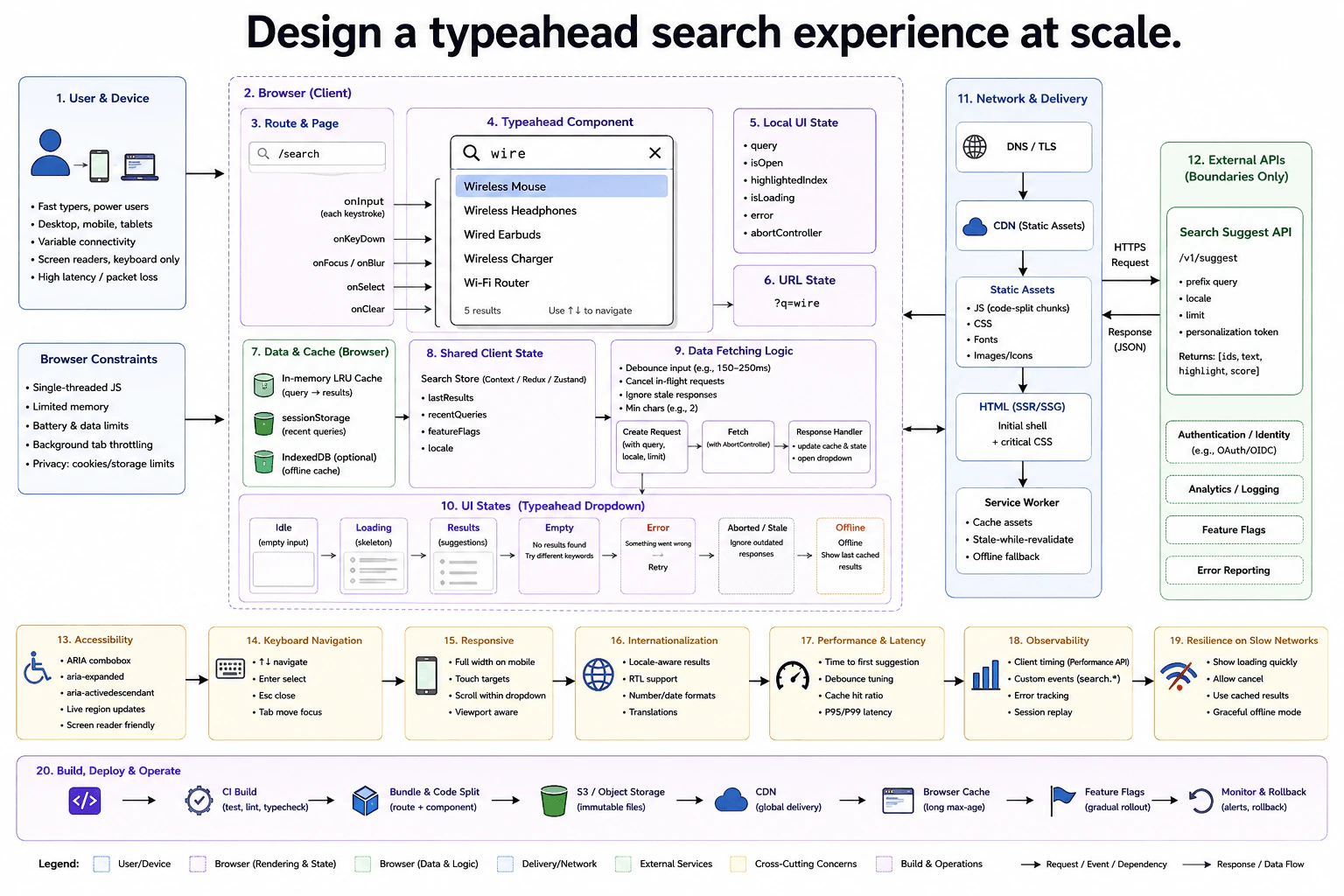
Design a typeahead search experience at scale. diagram
How to Explain It in an Interview
1. Start with delivery and the page boundary

The browser reaches the application through DNS and TLS. Static assets come from the CDN. These include JavaScript code-split chunks, CSS, fonts, images, and icons.

The initial shell can be produced with SSR or SSG. After loading, browser JavaScript owns the typeahead interaction. A service worker can cache assets and help with offline fallback.

2. Keep state close to its owner

The /search route contains the Typeahead Component. Its local UI state contains query, isOpen, highlightedIndex, isLoading, error, and abortController.

The URL can keep the query, such as ?q=wire. Shared client state keeps lastResults, recentQueries, featureFlags, and locale. The browser also has an in-memory LRU cache, sessionStorage for recent queries, and optional IndexedDB for offline results.

3. Make every keystroke safe

The component waits about 150 to 250 milliseconds before sending a request. This debounce reduces unnecessary calls while the user is still typing. Very short prefixes, such as fewer than two characters, do not send a request.

Before a new fetch starts, the client cancels the previous in-flight request with AbortController. The request sends query, locale, and limit to the Search Suggest API. The API returns stable ids, text, highlight data, and score.

If an older response arrives late, the client ignores it. A valid response updates the cache and state, then opens the dropdown. Stable result IDs help the UI keep each visible suggestion tied to the correct result.

4. Handle every visible state

Empty input keeps the dropdown hidden. Loading shows a skeleton. Success shows suggestions. No matches shows an empty state.

A real failure shows an error and retry action. Aborted or stale work is ignored because newer input has replaced it. When offline, the browser can show the last cached results when available.

5. Make it accessible and responsive

The input uses ARIA combobox behavior. aria-expanded reports whether the list is open. aria-activedescendant points to the highlighted suggestion, and live-region updates help screen readers.

Arrow keys move through results. Enter selects one. Escape closes the list. The design also supports mobile widths, touch targets, scrolling inside the dropdown, locale-aware text, RTL layouts, translated labels, and local number or date formats when needed.

6. Measure and release safely

I would measure time to first suggestion, debounce delay, cache-hit ratio, and P95 or P99 latency. Client timing can use the Performance API.

Analytics can record typed, fetched, shown, selected, aborted, and error events. Error reporting and session replay help diagnose problems. Feature flags support gradual rollout. The build path runs CI checks, creates route and component bundles, publishes immutable files to object storage and CDN, uses browser caching, and supports monitoring and rollback.

Engineering Considerations / Design Trade-offs

The benefit of debounce is fewer requests while the user types. The downside is a small delay before suggestions appear. Cancelling old requests avoids wasted work, but it adds request-control code. Caching makes repeated searches faster and helps slow networks. The downside is that cached suggestions may be older than the latest remote answer. Offline support gives users something useful without a connection, but service workers and IndexedDB add complexity. Feature flags make gradual rollout and rollback safer, but they create more states that must be tested.

Why Interviewers Ask This

The interviewer wants to see whether you can turn a simple search box into a reliable browser experience. They are testing how you handle fast typing, caching, request cancellation, stale responses, slow networks, accessibility, and failures. They also want to see whether you can separate browser responsibilities from remote services, measure real user latency, and explain clear trade-offs without over-designing the server side.

Interviewer may ask next
What would you change if many users had very slow or intermittent network connections?

I would keep the same architecture, but I would depend more on the browser caches and service worker. The Typeahead Component would still debounce input, cancel older requests, and ignore stale responses. Those rules remain important because slow networks make late responses more common.

Before waiting for the remote Search Suggest API, the browser can check the in-memory LRU cache. Recent queries can also come from sessionStorage. If the browser is offline, optional IndexedDB can provide the last cached suggestions when available.

The UI should show loading quickly and never block typing. It should also make offline results understandable instead of pretending they are fresh remote results. The resilience path in the diagram already allows cached results and graceful offline behavior.

I would measure cache hits separately from remote latency. That tells us whether users are fast because of the network or because of local data.

The main downside is extra browser-storage and service-worker complexity. Cached suggestions can also become older than remote results.

How would you add complete keyboard navigation without changing the basic design?

I would keep the same Typeahead Component and extend the existing highlightedIndex state. The Search Suggest API, cache, and request flow do not need to change.

When the dropdown is open, ArrowDown moves to the next suggestion and ArrowUp moves to the previous one. Enter selects the highlighted result and fills the input. Escape closes the dropdown. Tab should continue normal focus movement instead of trapping the user.

The input keeps ARIA combobox semantics. aria-expanded tells assistive technology whether suggestions are open. aria-activedescendant points to the stable ID of the highlighted suggestion. Live-region updates announce important changes without moving focus away from the input.

When new results arrive, the component should preserve the highlighted item only if that result still exists. Otherwise, highlightedIndex should reset safely. This keeps visual state and keyboard state consistent.

The main downside is more focus-management logic. It also needs careful testing with browsers, keyboards, and screen readers.

25. Tell me about a time you improved a process or made it more efficient.BehavioralEasyAmazon

Question Details

Describe a recurring engineering or delivery process that consumed unnecessary time, produced inconsistent results, or created avoidable handoffs. Establish a baseline, explain how you found the actual bottleneck, and describe the change you personally designed or drove. Cover how you involved the people who used the process, how you tested the change before broad adoption, and what metric or observable behavior improved. Include any cost, resistance, or unintended effect you had to correct, and explain why the new process remained useful after the initial rollout rather than becoming another manual burden.

Interview tip:

Use STAR to structure your answer: briefly explain the Situation and Task, make Action the most detailed part, and finish with the Result. For example, describe a recurring frontend delivery process that took too much time or produced inconsistent results, explain how you identified the real bottleneck, show the improvement you personally designed and tested with the people using it, and describe the clear change you observed after adoption. Include how you handled resistance or an unintended issue and how you made the improved process easy to maintain.

Situation

In my last role, our frontend team had a repeated release check before changes could move forward. Developers manually checked several browser views, reviewed common user flows, and shared results through messages. The checks were useful, but the process was inconsistent. Different people checked different things, and developers often repeated the same work when information was missing.

Task

I wanted to make the process faster and more reliable without removing important quality checks. My responsibility was to understand where time was being lost, propose a practical improvement, and make sure the new process worked for the developers who would use it every day.

Action

I first observed several releases and asked the developers involved which parts caused the most delay. I found that the main problem was not the actual testing. The bigger problem was that there was no shared definition of what had already been checked. This caused repeated work and extra handoffs. I created a simple release checklist based on the checks the team already performed. I then moved the repeatable technical checks into our existing frontend automation. For example, I added automated linting, unit tests, and build validation so developers did not need to confirm those steps manually. I kept browser behavior and important user flows as clear manual checks because those still needed human judgment. Before using the process across the team, I tested it on a small set of changes and asked the developers using it for feedback. One concern was that the checklist initially felt too long, so I removed items that duplicated automated checks and grouped related steps in a clearer order. I also documented why each remaining manual check mattered. This made the process easier to understand instead of making it another form developers had to complete.

Result

The release process became more consistent and required fewer repeated checks and clarification messages. Developers could see what automation had already verified and what still needed human review. The process also remained useful because most repeatable checks ran automatically and the manual part stayed short. I learned that improving a process is not only about adding automation. It is also about finding the real source of wasted effort, involving the people who use the process, and keeping the final solution simple enough that the team will continue using it.

Why Interviewers Ask This

Interviewers ask this question to understand whether a candidate notices inefficient work, finds the real cause instead of treating symptoms, and takes ownership of practical improvements. A strong answer also shows good judgment about automation, collaboration, testing changes before wider adoption, and creating a process that remains useful over time.

Interviewer may ask next
How did you know the new process was actually better?

I looked for observable changes in the same release workflow. Developers repeated fewer checks, there were fewer clarification messages about what had already been tested, and the steps were more consistent between developers. I also asked the people using the process whether any part still created unnecessary work. That feedback helped me confirm that the improvement solved the original problem rather than only moving the work somewhere else.

How did you handle the concern that the new checklist added more work?

I treated that concern as useful feedback. I reviewed the checklist with the developers using it and found that some items repeated checks already handled by automation. I removed those items, grouped the remaining manual checks more clearly, and explained why each one was still needed. That kept the process focused and made it easier for the team to adopt.

26. Tell me about a time you strongly disagreed with a manager or peer about something important to the business.BehavioralMediumAmazon

Question Details

Choose a consequential disagreement where the stakes and competing reasoning were clear. Explain the decision being made, the evidence behind your position, and what you did to understand the other person's constraints before challenging them. Describe how you communicated the disagreement, which data or experiment changed the discussion, how the decision was reached, and what you did afterward. Include the business or customer outcome and whether any part of your initial view proved wrong. The example should demonstrate conviction and respect, not persistence for its own sake.

Interview tip:

Use STAR to structure your answer: briefly explain the Situation and Task, make Action the most detailed part, and finish with the Result. For example, describe a consequential disagreement about a frontend decision, explain the business stakes and both viewpoints, show how you understood the other person's constraints, present evidence or a small experiment, communicate your disagreement respectfully, support the final decision, and explain the customer or business outcome and what you learned.

Situation

In my last role, our team was preparing an important update to a customer facing web application. A manager wanted us to release a new frontend experience quickly by replacing the existing page in one step. I strongly disagreed because the new page had several complex interactions, and I believed replacing everything at once created too much risk for an important customer flow.

Task

I was responsible for much of the JavaScript frontend work, so I needed to explain my concern clearly without turning the discussion into a personal conflict. I also needed to understand why my manager preferred the faster approach and help the team find a solution that protected both the business deadline and the customer experience.

Action

I first spoke with my manager privately and asked about the reasons behind the proposed approach. I learned that the business had an important launch window and that maintaining two versions of the page for a long time would create extra work. I agreed that those were valid concerns. I then explained that my concern was not about avoiding the launch. It was about reducing the chance that a frontend problem would affect a critical customer action. Instead of continuing the disagreement based only on opinion, I suggested a small experiment. I built the most complex interaction in the new design and tested it with the same browser conditions and application data used by the existing page. The test showed several edge cases around loading state, failed requests, and repeated user actions that our original plan had not covered. I shared the results with my manager and the team in simple terms. I also proposed a compromise. We could still meet the planned launch window, but we would move the most important customer flow first, keep the existing experience available as a temporary fallback, and remove the fallback after we confirmed the new flow was stable. My manager also pointed out that part of my original proposal involved keeping both versions longer than necessary, which would have increased maintenance work. I accepted that point and shortened the transition plan. Once we agreed on the final approach, I supported it fully and worked with the team to define the failure states, testing steps, and removal plan for the temporary fallback.

Result

We released the new experience while keeping the important customer flow protected during the transition. The issues found in the experiment were handled before the wider release, and the temporary fallback was removed after the team was comfortable with the new flow. I learned that strong disagreement is most useful when I first understand the other person's constraints, bring evidence instead of repeating my opinion, and remain willing to change the parts of my own position that are not supported by the facts.

Why Interviewers Ask This

Interviewers ask this question to understand how a candidate handles important disagreement when business stakes are high. A strong answer shows that the candidate can challenge a decision with evidence, listen to other constraints, communicate with respect, make practical tradeoffs, and support the final decision even when the original views were different.

Interviewer may ask next
What did you do when your manager still preferred the faster approach at the start of the discussion?

I avoided repeating the same argument. I asked what business constraint mattered most and learned that the launch window and maintenance cost were major concerns. I then changed the discussion from opinion to evidence by proposing a small frontend experiment. That gave us something concrete to evaluate and helped us find an approach that protected the important customer flow without ignoring the deadline.

What part of your original position would you change if you faced the same situation again?

I would propose the shorter transition period earlier. My original idea kept both frontend versions available longer because I was focused heavily on reducing release risk. My manager correctly pointed out that this would add unnecessary maintenance work. Now I would still use a controlled transition, but I would define clear conditions for removing the fallback from the beginning.

27. Tell me about a time you went above and beyond for a customer.BehavioralEasyAmazon

Question Details

Use a real customer or user problem whose importance was not fully captured by the original request. Explain what you learned directly or indirectly about the customer's need, what ordinary completion would have delivered, and why you chose additional action. Separate your contribution from the team's, describe the cost or tradeoff you considered, and give evidence of the customer outcome. Include how you made the improvement sustainable instead of relying on a one-time heroic effort, and note any boundary you deliberately did not cross because it would have created disproportionate risk or delay.

Interview tip:

Use STAR to structure your answer: briefly explain the Situation and Task, make Action the most detailed part, and finish with the Result. For example, describe a customer issue where the original request covered only one visible problem, but you investigated the full user journey, found the deeper need, made a practical improvement beyond the basic fix, considered the cost and risk, worked with the team, added tests and documentation so the improvement would last, and avoided unnecessary changes that could delay a safe release.

Situation

In my last role, a customer reported that an error message on an important web form was confusing. The original request was simply to improve the message. When I reviewed the customer feedback and walked through the same flow myself, I realized the larger problem was not only the wording. After a validation error, the page did not clearly show the user where the problem was, so the customer could easily become stuck.

Task

I was responsible for the frontend change. Completing only the requested work would have meant changing the text and closing the issue. I wanted to solve the actual customer problem without turning a small request into a large redesign or delaying other committed work.

Action

I first reproduced the issue and followed the complete form flow instead of looking only at the error message. I checked how validation behaved for different fields and how the page behaved when a user submitted invalid information. I then shared what I found with the product designer and the engineer responsible for the related service. I explained that I could make a small frontend improvement within the existing design rather than asking the team to rebuild the form. I updated the message so it clearly explained what the user needed to correct. I also changed the frontend behavior so the first invalid field received focus after submission and its error was clearly connected to the field. This made the next action easier to understand. I added automated tests for the validation behavior so a later code change would not silently remove it. I also documented the expected behavior for similar forms so the team could apply the same pattern in future work. I chose not to redesign the whole validation system because that would have increased the testing scope and delayed a useful improvement for the customer. The team reviewed and released the change through our normal process, while my contribution was identifying the deeper user problem, proposing the limited solution, implementing the frontend changes, and adding the tests and documentation.

Result

The customer was able to complete the flow without the confusion that caused the original report, and the support team confirmed that the revised behavior addressed the problem they had observed. The solution also gave our team a reusable pattern instead of a one time fix. I learned that going above and beyond does not always mean doing much more work. It can mean understanding the real customer need, making a focused improvement that lasts, and knowing where to stop so the extra effort does not create unnecessary risk.

Why Interviewers Ask This

Interviewers ask this question to understand how strongly a candidate focuses on customers and whether they look beyond the literal request to solve the real problem. A strong answer shows curiosity, ownership, practical judgment, collaboration, and the ability to provide extra value without creating unnecessary cost or risk.

Interviewer may ask next
How did you decide that the extra work was worth doing?

I focused on the customer impact and the size of the change. The original text update would not have solved the main reason the user became stuck. The additional frontend behavior was small enough to implement and test within the existing design, so it gave meaningful customer value without creating a large delivery risk. I also discussed the scope with the team before making the change.

What would you do if the deeper solution required a much larger redesign?

I would separate the immediate customer need from the larger improvement. I would deliver the safest small change that meaningfully helps the customer, then document the broader problem and discuss it with product and engineering before committing to a redesign. In this case, I deliberately avoided rebuilding the validation system because the focused change solved the customer problem without adding disproportionate risk or delay.

28. Why do you want to work at Amazon?BehavioralEasyAmazon

Question Details

Connect your answer to real experiences and to the work of a JavaScript frontend developer rather than giving a generic company compliment. Explain which customer, product, engineering, or scale problems interest you, what you have learned about the role, and how your recent choices demonstrate a credible fit. Be ready to distinguish what attracts you to this opportunity from what would apply equally to any large technology company, and identify both what you can contribute now and what you expect to learn. Keep the answer grounded in evidence from your own background and do not claim familiarity with confidential team details.

Interview tip:

Use STAR to structure your answer: briefly explain the Situation and Task, make Action the most detailed part, and finish with the Result. For example, describe a frontend experience that showed you how much customer trust depends on simple, reliable interfaces, explain the responsibility you took, the technical and product decisions you made, how you worked with others, and how that experience connects to the customer focus, engineering scale, ownership, and learning opportunities that attract you to Amazon.

Situation

In my last role, I worked on a customer facing web experience where users needed to complete an important task quickly and with very little confusion. The project made me see that frontend engineering is not only about making a page look good. Small decisions about loading states, accessibility, error handling, and clear feedback can directly affect whether a customer trusts the product.

Task

My responsibility was to improve the frontend experience while keeping the code maintainable for the team. I wanted to make the main user path simpler, reduce avoidable confusion, and make sure the interface behaved well when data was slow or an action failed.

Action

I first walked through the experience from the user's point of view instead of starting with code. I identified places where the interface gave weak feedback or asked users to think too much. I then worked with the product and design team to confirm which problems mattered most. On the frontend, I simplified component behavior, made loading and error states explicit, improved keyboard and screen reader support, and kept shared logic in reusable JavaScript components instead of duplicating it across screens. I also reviewed how the interface communicated with backend services so that failures were handled clearly rather than leaving the user unsure about what happened. I explained my technical choices to the team and asked for feedback before making larger changes. That experience is one reason I am interested in Amazon. I am attracted to work where frontend decisions affect many customers and where engineers are expected to think about the full customer experience, not only their assigned code. Amazon also interests me because the scale creates engineering problems that are harder to experience in a smaller product, such as keeping interfaces fast, accessible, reliable, and easy to change across large systems. I can contribute now with practical JavaScript frontend skills, customer focused thinking, and ownership of the complete user flow. I also want to learn how strong teams make these decisions at much larger scale without assuming that I know confidential details about any specific Amazon team.

Result

The project produced a clearer and more dependable experience for users, and the frontend became easier for the team to understand and extend. More importantly, I learned to connect technical decisions with customer impact. That is the type of work I want to continue doing, which is why this Amazon JavaScript Frontend Developer opportunity is especially interesting to me.

Why Interviewers Ask This

Interviewers ask this question to understand whether the candidate has a specific and credible reason for choosing Amazon instead of giving a generic answer that could apply to any large technology company. A strong answer connects real frontend experience with customer focus, engineering scale, ownership, and a clear view of what the candidate can contribute and learn.

Interviewer may ask next
What specifically about Amazon is different from what attracts you to other large technology companies?

The strongest connection for me is the combination of customer focus and engineering scale. My previous project taught me to think about every frontend decision from the user's point of view, including loading, accessibility, errors, and clarity. At Amazon, I would have the chance to apply that same thinking to products used at much larger scale. I am also interested in an environment where frontend engineers are expected to take ownership beyond the visual layer and think about reliability, performance, and the complete customer experience.

What would you hope to learn if you joined Amazon?

I would like to learn how experienced teams keep large frontend systems fast, accessible, reliable, and maintainable as products grow. In my previous project, I improved these areas within a smaller scope. I now want to understand how the same principles are applied when many teams, services, and customer flows are involved. I would bring my current JavaScript experience and customer focused approach while learning stronger ways to make frontend decisions at larger scale.

29. Tell me about a time you took on significant work outside your area of responsibility.BehavioralEasyAmazon

Question Details

Choose a real situation where the need was important but not formally assigned to you. Explain how you recognized the gap, why acting was better than waiting, which stakeholders or owners you consulted, and the specific work you personally accepted. Describe how you avoided creating confusion about ownership, how you balanced the extra responsibility with existing commitments, and the measurable or observable result. Include any long-term mechanism, handoff, or documentation that kept the solution from depending permanently on you. The example should show company-level ownership rather than simply doing an extra small task.

Interview tip:

Use STAR to structure your answer: briefly explain the Situation and Task, make Action the most detailed part, and finish with the Result. For example, describe Choose a real situation where the need was important but not formally assigned to you. Explain how you recognized the gap, why acting was better than waiting, which stakeholders or owners you consulted, and the specific work you personally accepted. Describe how you avoided creating confusion about ownership, how you balanced the extra responsibility with existing commitments, and the measurable or observable result. Include any long-term mechanism, handoff, or documentation that kept the solution from depending permanently on you. The example should show company-level ownership rather than simply doing an extra small task.

Situation

In my last role, our frontend team was preparing a major update to an account settings experience. During testing, I noticed that several important user flows depended on an internal API that had unclear response rules and almost no practical documentation. The backend team owned that API, so documenting it was outside my normal frontend responsibility. However, the missing information was already causing repeated questions, inconsistent error handling, and delays for both frontend developers and testers.

Task

My main responsibility was still to finish my assigned frontend work on time. I also believed the API gap needed attention because waiting for someone else to solve it would keep slowing the project. I wanted to help without taking ownership away from the backend team. My goal was to clarify the API behavior, document what the frontend actually needed, and create a handoff that the correct owners could maintain after the release.

Action

I first spoke with the backend engineer who maintained the API and my frontend lead. I explained the problems I had found and asked whether it would be useful for me to draft practical documentation from the frontend point of view. This made the ownership clear before I started. The backend engineer agreed to review the technical details, while I agreed to organize the information and test the behavior. I then listed the requests our interface made, the expected successful responses, common error cases, and the fields the frontend depended on. I compared those notes with the actual API responses in our development environment and raised questions whenever the behavior was unclear. For example, I found that two similar error cases returned different response shapes. Instead of hiding that difference inside frontend code, I discussed it with the backend owner so we could agree on how the client should handle each case. I created a simple reference document with request examples, response examples, error behavior, and notes about which team owned each part. I also updated our frontend integration code so related error handling followed the same pattern. To protect my existing commitments, I did this work in small blocks around my assigned development tasks and kept my lead informed about progress. Before the release, I asked the backend owner to review the document so it became shared team knowledge rather than something that depended only on me. We then added the document to the normal engineering location and agreed that future API changes should include an update to it.

Result

The team had a clear reference for the API, which reduced repeated questions and made frontend testing and error handling more consistent. The backend owner remained responsible for the API, so my extra work did not create confusion about long term ownership. I also completed my original frontend responsibilities. I learned that taking ownership does not always mean becoming the permanent owner. Sometimes it means recognizing an important gap, helping the right people solve it, and leaving behind a simple mechanism that continues to work after your immediate involvement ends.

Why Interviewers Ask This

Interviewers ask this question to understand whether a candidate notices important problems beyond a narrow job description and takes responsible action without creating confusion. A strong answer shows judgment about when to step in, respect for existing owners, clear communication, careful prioritization, and the ability to leave behind a lasting solution instead of becoming a permanent dependency.

Interviewer may ask next
How did you make sure you were helping rather than taking ownership away from the backend team?

I spoke with the backend owner before doing the extra work and agreed on clear roles. I drafted and tested the practical documentation because I understood the frontend needs, while the backend engineer reviewed the API details and remained the final owner. I also placed the document in our shared engineering location and agreed that future API changes would be maintained by the appropriate owner.

How did you balance this extra responsibility with your existing frontend work?

I kept my assigned frontend work as the first priority and divided the documentation work into small pieces that fit around those commitments. I also kept my lead informed so there were no surprises. That approach let me address the broader team problem without putting my original delivery at risk.

30. Tell me about a time you challenged a decision and then committed fully after a different decision was made.BehavioralHardAmazon

Question Details

Use a real high-stakes decision where you believed another course was better. Explain the issue, your evidence, how directly and respectfully you challenged the proposal, and what you learned from opposing views. Describe the decision mechanism and the moment the choice became final. Then show how your behavior changed from advocacy to full execution, including how you spoke about the decision to others and what result followed. If later evidence supported your original view, explain how you raised it without quietly undermining the agreed plan. The story must demonstrate both backbone and commitment.

Interview tip:

Use STAR to structure your answer: briefly explain the Situation and Task, make Action the most detailed part, and finish with the Result. For example, describe a significant frontend decision where you believed another approach would better protect users or reduce technical risk, explain the evidence you used to challenge the proposal respectfully, show how the final choice was made, and describe how you then supported that choice fully, communicated it consistently, handled later evidence, and helped the team deliver the agreed plan.

Situation

In my last role, my team was preparing a major update to a JavaScript web application. We needed to replace an older page with a new frontend flow. The proposed plan was to release the whole new experience at once. I was concerned because several parts of the page depended on new client state logic and new API behavior. Based on our testing, I believed a gradual release would give us a safer way to find problems before every user received the change.

Task

I was responsible for a large part of the frontend implementation and for helping the team make the release reliable. I needed to raise my concern clearly without blocking progress. I also needed to respect that the final decision belonged to the wider engineering and product group, not only to me.

Action

I first collected specific evidence instead of arguing from preference. I showed the team the areas where the new JavaScript state flow was more complex than the existing page. I also explained several failure cases we had found during testing, such as the user interface showing old data after a request failed or after a user moved quickly between steps. I proposed releasing the new experience gradually so we could limit the effect of an unexpected problem. During the review meeting, I challenged the full release plan directly but respectfully. I explained the risk, showed the examples, and recommended the gradual approach. Other team members explained that the release process already had strong rollback controls and that maintaining two frontend paths during a gradual release would add its own complexity. I asked questions and made sure I understood those concerns instead of repeating my position. The engineering lead reviewed both options with the product and engineering team. The group decided to proceed with the full release while adding stronger monitoring and a clear rollback process. Once that decision was final, I stopped advocating for my preferred release method. I helped improve the agreed plan. I added clearer frontend error handling, worked with the team to define the signals we would watch after release, reviewed the rollback steps, and helped test the final build. When other developers asked about the decision, I did not say that the team had chosen the wrong approach. I explained the agreed reasoning and focused on what we needed to do to make it successful. After release, we noticed one user interface issue that was similar to a risk I had raised earlier. I brought it to the team through the agreed monitoring process with the evidence we had. I did not use it to reopen the old argument. We fixed the issue and continued supporting the release plan.

Result

The release moved forward successfully, and the team handled the frontend issue quickly because we had prepared monitoring and rollback steps before launch. I learned that challenging a decision means presenting useful evidence and being willing to hear why others may see the tradeoff differently. I also learned that once a reasonable decision is made, commitment means helping that decision succeed rather than continuing the debate in smaller conversations.

Why Interviewers Ask This

Interviewers ask this question to see whether a candidate can balance independent judgment with teamwork. A strong answer shows that the candidate can challenge an important decision with evidence, listen to opposing views, respect a clear decision process, and then support the final choice fully instead of quietly resisting it.

Interviewer may ask next
What made you decide to challenge the original release plan?

I challenged it because I had specific evidence from our frontend testing, not because I simply preferred another approach. The new client state logic had several failure cases that could affect the user experience, so I believed the risk was important enough to raise clearly before the release decision became final.

What did you do when the later frontend issue supported part of your original concern?

I treated it as a new operational problem rather than proof that I had been right. I shared the evidence through the monitoring process we had already agreed on, helped the team fix the issue, and stayed focused on making the chosen release successful. That allowed me to raise the new information without undermining the earlier decision.

Disclaimer: This interview guide is for educational and informational purposes only. It is designed to help readers prepare, but it does not guarantee any interview result, hiring decision, offer, or outcome. Interview questions, hiring criteria, and preferred answers can vary by employer, interviewer, industry, location, and time. The examples and explanations reflect the authors' research and judgment, are provided without warranties of any kind, and should not be treated as the only correct approach. Diagrams are simplified illustrations intended to highlight the main components and their interactions; actual systems and implementations may be more complex. Alternative approaches may be equally valid or better suited to a particular question, context, or interviewer. To the fullest extent permitted by applicable law, the author, contributors, and publisher are not liable for decisions made, actions taken, or losses incurred based on this guide.

Company Notice: This guide is an independent educational resource and is not affiliated with, endorsed by, sponsored by, or approved by the company named in this guide. Company names are used only to identify interview experiences commonly reported by candidates. Interview practices can change without notice, and inclusion of company-specific content does not mean these questions are official, complete, or guaranteed to be asked. To the fullest extent permitted by law, the author, contributors, and publisher are not responsible for outcomes related to use of this material.