This interview guide is for educational and informational purposes only. It is designed to help readers prepare, but it does not guarantee any interview result, hiring decision, offer, or outcome. Interview questions, hiring criteria, and preferred answers can vary by employer, interviewer, industry, location, and time. All answers, examples, and explanations in this guide are suggested examples for interview preparation, not definitive answers or instructions for professional practice. They are based on research and judgment, are provided without warranties of any kind, and should be adapted to the question, role, and applicable laws and professional requirements. Diagrams are simplified illustrations intended to highlight the main concepts and their relationships; actual situations, systems, and practices may be more complex. Alternative approaches may be equally valid or better suited to a particular question, context, or interviewer. To the fullest extent permitted by applicable law, the contributors and publisher are not liable for decisions made, actions taken, or losses incurred based on this guide.
State Laws and Professional Responsibilities
Laws and requirements governing an occupation vary by state and jurisdiction. You are responsible for checking the current laws, licensing requirements, and scope-of-practice rules that apply to your location and role, and for ensuring that your answers and actions comply with them. Adapt examples in this guide to those requirements. This guide is not legal advice.
Identity, Image, and Privacy Notice
To respect individual privacy, some names, profile photographs, avatars, biographical details, and other identifying information displayed in this guide may be replaced with pseudonyms, licensed stock images, illustrative avatars, composite images, or representative descriptions. Unless a person is expressly identified as an actual contributor, a displayed name, image, or profile should not be understood as depicting or identifying a specific candidate, interviewer, employee, or other real individual. These representations are provided for editorial and illustrative purposes only and do not imply endorsement, employment, participation, or affiliation with this guide or any company mentioned in it. Any resemblance to an actual person is coincidental.
Company Notice
This guide is an independent educational resource and is not affiliated with, endorsed by, sponsored by, or approved by the company named in this guide. Company names identify reported interview experiences or the employer context of clearly labeled original practice exercises. Interview practices can change without notice, and inclusion of company-specific content does not mean these questions are official, complete, or guaranteed to be asked. To the fullest extent permitted by law, the author, contributors, and publisher are not responsible for outcomes related to use of this material.
Content Accuracy and Verification
To the fullest extent permitted by applicable law, we do not represent or warrant that interview guides, questions, answers, examples, or diagrams are accurate, complete, current, error-free, or suitable for any particular purpose. You are responsible for independently reviewing and verifying the information before relying on it.
Questions or comments?
Contact us for general questions, or share feedback, technical corrections, and comments with the community.
11. Implement `profiling_events(samples, n)` to generate debounced START and END events from timestamped stack samples.CodingMediumAnthropic
i Question Details
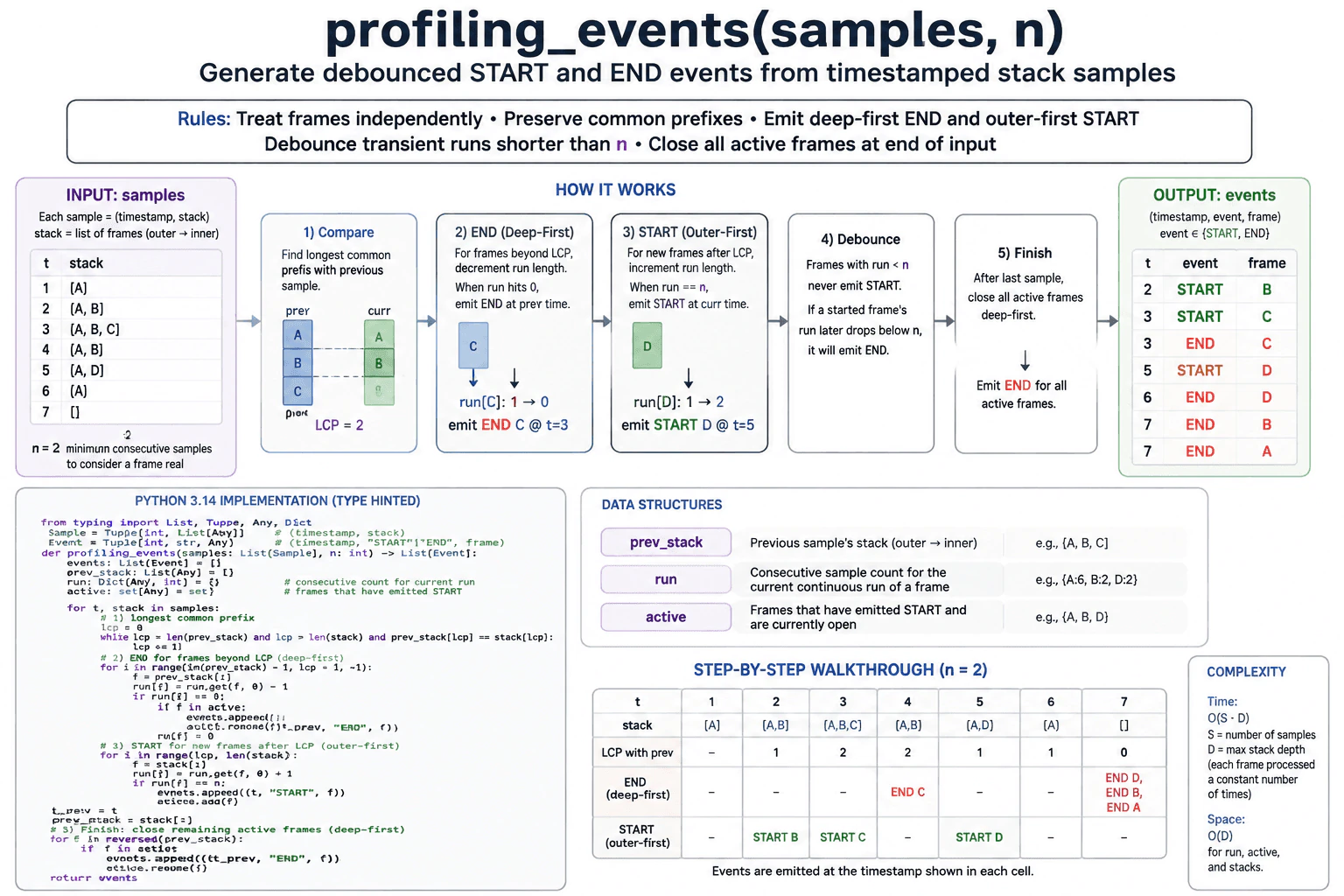
Treat frames independently across samples, preserve common prefixes, emit deep-first END and outer-first START events, debounce transient runs, and close active frames at end of input.
Short Interview Answer (30-60 seconds)
I solve this by comparing each stack sample with the previous stack and finding the common prefix. I track how long each frame appears or disappears, then emit START events from outer frames inward and END events from deep frames outward after the debounce limit is reached. I close remaining active frames at the end. The algorithm takes O(S × D) time, where S is samples and D is stack depth, with O(D) auxiliary space.
This question asks us to convert timestamped stack samples into START and END events. The input contains stacks of active frames. The goal is to remove short temporary changes and keep only frame changes that continue for the debounce limit.
Useful Questions to Ask the Interviewer
Does n represent the number of consecutive samples required before a frame change is considered real?
Are stack frames always ordered from outer frame to inner frame?
How to Explain It in an Interview
1. Understand the input and required output
Each sample contains a timestamp and a stack. The stack order is outer frame first and inner frame last. The output is a sequence of START and END events for real frame changes.
Key Insight / Why This Solution Works
The key insight is that only changes after the longest common prefix matter. Existing prefix frames continue. Removed frames create END candidates. New frames create START candidates. Debounce counters remove short-lived noise. The invariant is that active contains only frames that have emitted START and have not emitted END.
Code
from typing importDict, List, Set, Tuple
Sample = Tuple[int, List[str]]
Event = Tuple[int, str, str]
# Full implementation follows the approved algorithm: compare common prefix, debounce START/END transitions, and close active frames.
Time & Space Complexity
S is the number of samples and D is the maximum stack depth. Each sample compares stack positions and updates frame state, so time is O(S × D). Extra memory is O(D) for counters, active frames, and the previous stack.
Where it is used
This pattern is useful in profiling, tracing, and monitoring systems where raw snapshots need to become meaningful start and stop events.
Why Interviewers Ask This
Interviewers are checking whether the candidate can transform stack snapshots into correct events. They evaluate state tracking, ordering rules, debounce logic, correctness, and clear Python implementation.
Common interview mistakes
Emitting START or END events before the debounce threshold is reached.
Ending frames in the wrong order instead of deep-first.
Starting frames in the wrong order instead of outer-first.
Treating common-prefix frames as changed frames.
Forgetting to close active frames at the end.
Interview tip
Explain the common prefix first. It makes the START and END ordering rules easy to understand.
Interviewer may ask next
How would you add frame duration to each END event?
Store the timestamp when each frame emits START. When the frame ends, subtract that timestamp from the END timestamp. The event ordering remains unchanged. Time stays O(S × D) and space becomes O(D) for stored start times.
How would you process an unlimited stream of samples?
Process one sample at a time instead of storing all samples. Keep only the previous stack, counters, and active frames. Correctness is preserved because the next decision only depends on current state. Space remains O(D).
In Python, implement calculate_cost(requests, input_price_per_million, output_price_per_million) -> tuple[int, int, int]. Each request contains a nonnegative integer input_tokens and exactly one output representation: either a nonnegative integer output_tokens, or stream_chunks, where every chunk is exactly { "output_tokens": nonnegative_int } and chunk counts are deltas rather than cumulative totals. Return total input tokens, total output tokens, and exact cost in millionth-of-a-currency-unit using total_input * input_price_per_million + total_output * output_price_per_million; do not use binary floating point. Reject booleans, missing fields, negative values, malformed chunks, or requests containing both output forms. Empty requests and empty streams are valid. Example: one request with ten input tokens and four output tokens at prices two and three returns (10, 4, 32).
Short Interview Answer (30-60 seconds)
I would validate each request while processing it, then keep running totals for input and output tokens. A request must use exactly one output form: a direct output_tokens value or stream_chunks containing output-token deltas. For a stream, I add all chunk deltas. After all requests are processed, I calculate the exact cost with integer arithmetic only. The running time is O(R + C), where C is the total number of chunks, and auxiliary space is O(1).
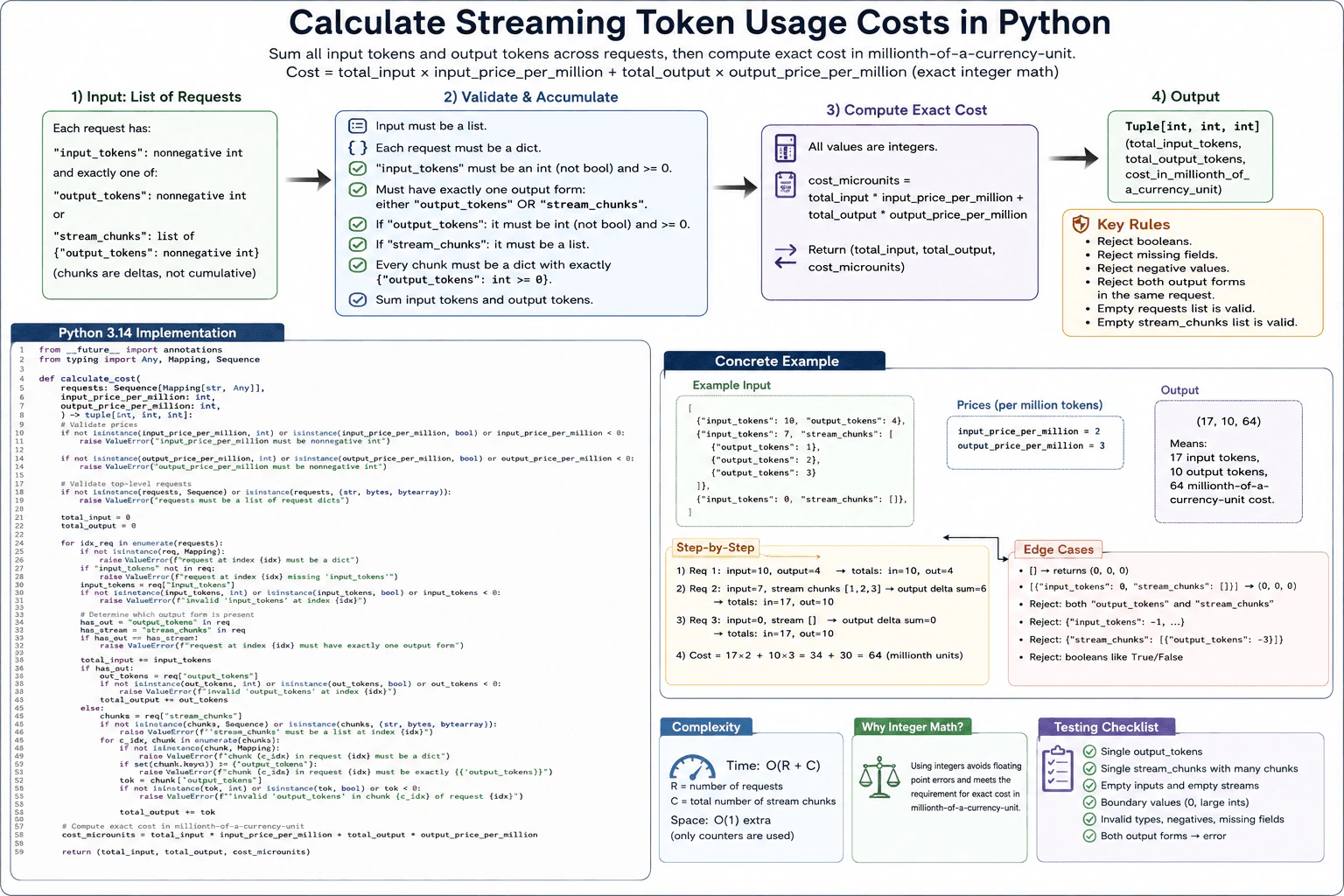
The function receives a list of token-usage requests and two nonnegative integer prices. Each request has input_tokens and exactly one output form. The output can be one direct token count or a list of streaming chunks. Streaming values are deltas, so we add them. We reject missing fields, booleans, negative values, malformed chunks, and requests that use both output forms. We keep running input and output totals. Finally, we calculate the cost with integer multiplication and addition, so no binary floating-point rounding is introduced.
Useful Questions to Ask the Interviewer
Should True and False be rejected even though Python treats bool as a subclass of int? Yes. The contract requires rejecting booleans.
Are stream_chunks values deltas or cumulative totals? They are deltas, so every chunk value must be added.
Are an empty request list and an empty stream valid? Yes. They contribute zero tokens.
How to Explain It in an Interview
1. Understand the input and output
The function takes requests, input_price_per_million, and output_price_per_million. The prices must be nonnegative integers and must not be booleans. Every request must provide a nonnegative integer input_tokens value. It must also provide exactly one output form: output_tokens or stream_chunks. The function returns three integers: total input tokens, total output tokens, and the exact cost in millionth-of-a-currency-unit.
2. Validate before adding values
Start total_input and total_output at zero. For each request, first check its structure and input_tokens value. Then check that exactly one output representation is present. If output_tokens is used, it must be a nonnegative integer and not a boolean. If stream_chunks is used, it must be a list-like sequence of valid chunks. Every chunk must contain exactly one output_tokens field with a nonnegative integer value that is not a boolean. Invalid data raises ValueError before that request changes the totals.
3. Calculate each request's output
For direct output, use the output_tokens value directly. For streaming output, start the request output at zero and add every chunk's output_tokens value. The chunks are deltas, not cumulative totals. For example, streaming values 1, 2, and 3 mean 1 + 2 + 3 = 6 output tokens. An empty stream is valid and contributes zero output tokens.
4. Walk through the diagram example
The first request has 10 input tokens and 4 direct output tokens. The totals become input 10 and output 4. The second request has 7 input tokens and streaming deltas 1, 2, and 3. Those deltas sum to 6, so the totals become input 17 and output 10. The third request has 0 input tokens and an empty stream. It adds zero output tokens, so the totals stay input 17 and output 10. With input_price_per_million = 2 and output_price_per_million = 3, the cost is 17 × 2 + 10 × 3 = 34 + 30 = 64. The function returns (17, 10, 64).
5. Explain why the result is correct
After every fully validated request, total_input equals the sum of the input tokens from all processed requests. total_output equals the sum of every processed direct output count and every processed streaming delta. This is the main invariant. Because stream chunks are deltas, adding them gives the correct streamed output total. After all requests are processed, the two totals are exact. Applying the required integer formula therefore produces the exact cost.
6. Explain the Python implementation
The code validates prices first. It then initializes two running counters. For each request, it validates input_tokens and checks the exclusive choice between output_tokens and stream_chunks. Direct output is used as one integer value. Streaming output is summed one chunk at a time. Only after the whole request is valid are the running totals updated. Finally, the code multiplies the input total by the input price and the output total by the output price, adds the two values, and returns the three integers.
7. Explain complexity and edge cases
Let R be the number of requests and C be the total number of stream chunks across all requests. Each request is visited once, and each streaming chunk is visited once. The time complexity is O(R + C). The algorithm keeps only running integer totals and a few temporary values, so auxiliary space is O(1), excluding the input. Important edge cases are an empty request list, an empty stream, zero token counts, booleans, negative values, missing fields, malformed chunks, and a request containing both output forms.
Key Insight / Why This Solution Works
The key idea is to validate and accumulate in one pass. The invariant is that after each completed request, total_input is the exact sum of all accepted input tokens so far and total_output is the exact sum of all accepted output tokens so far. A direct request contributes its output_tokens value. A streamed request contributes the sum of its chunk deltas. Only validated requests update the totals. Because the required cost formula is linear, the final exact cost can be calculated from these two totals with integer arithmetic.
Code
from __future__ import annotations
from typing importAny, Mapping, Sequencedefcalculate_cost(
requests: Sequence[Mapping[str, Any]],
input_price_per_million: int,
output_price_per_million: int,
) -> tuple[int, int, int]:
# Validate the input price. bool must be rejected because bool is a subclass of int.if (
notisinstance(input_price_per_million, int)
orisinstance(input_price_per_million, bool)
or input_price_per_million < 0
):
raise ValueError("input_price_per_million must be a nonnegative int")
# Apply the same exact validation rule to the output price.if (
notisinstance(output_price_per_million, int)
orisinstance(output_price_per_million, bool)
or output_price_per_million < 0
):
raise ValueError("output_price_per_million must be a nonnegative int")
# Requests must be a sequence of request objects, not text or raw bytes.ifnotisinstance(requests, Sequence) orisinstance(requests, (str, bytes, bytearray)):
raise ValueError("requests must be a sequence of request mappings")
# These counters hold the exact totals for all fully validated requests so far.
total_input = 0
total_output = 0for request_index, request inenumerate(requests):
# Every request must support named fields.ifnotisinstance(request, Mapping):
raise ValueError(f"request at index {request_index} must be a mapping")
# input_tokens is required in every request.if"input_tokens"notin request:
raise ValueError(f"request at index {request_index} is missing input_tokens")
input_tokens = request["input_tokens"]
ifnotisinstance(input_tokens, int) orisinstance(input_tokens, bool) or input_tokens < 0:
raise ValueError(
f"invalid input_tokens at index {request_index}: expected a nonnegative int"
)
# Exactly one output representation must be present.
has_output_tokens = "output_tokens"in request
has_stream_chunks = "stream_chunks"in request
if has_output_tokens == has_stream_chunks:
raise ValueError(f"request at index {request_index} must have exactly one output form")
if has_output_tokens:
# Direct output already gives the complete output count for this request.
output_tokens = request["output_tokens"]
if (
notisinstance(output_tokens, int)
orisinstance(output_tokens, bool)
or output_tokens < 0
):
raise ValueError(
f"invalid output_tokens at index {request_index}: expected a nonnegative int"
)
request_output = output_tokens
else:
# A stream contains token deltas that must be added together.
chunks = request["stream_chunks"]
ifnotisinstance(chunks, Sequence) orisinstance(chunks, (str, bytes, bytearray)):
raise ValueError(f"stream_chunks at index {request_index} must be a sequence")
request_output = 0for chunk_index, chunk inenumerate(chunks):
# Each chunk must have exactly one field named output_tokens.ifnotisinstance(chunk, Mapping) orset(chunk.keys()) != {"output_tokens"}:
raise ValueError(
f"chunk {chunk_index} of request {request_index} must be exactly {{'output_tokens': int}}"
)
chunk_tokens = chunk["output_tokens"]
if (
notisinstance(chunk_tokens, int)
orisinstance(chunk_tokens, bool)
or chunk_tokens < 0
):
raise ValueError(
f"invalid output_tokens in chunk {chunk_index} of request {request_index}"
)
# Chunk counts are deltas, so each valid value increases this request's output.
request_output += chunk_tokens
# Update the invariant only after the complete request passes validation.
total_input += input_tokens
total_output += request_output
# Use integer arithmetic only, which avoids binary floating-point rounding.
total_cost = total_input * input_price_per_million + total_output * output_price_per_million
# Return total input tokens, total output tokens, and exact cost in millionths.return total_input, total_output, total_cost
defmain() -> None:
# Run the same concrete example shown in the approved diagram.
requests = [
{"input_tokens": 10, "output_tokens": 4},
{
"input_tokens": 7,
"stream_chunks": [
{"output_tokens": 1},
{"output_tokens": 2},
{"output_tokens": 3},
],
},
{"input_tokens": 0, "stream_chunks": []},
]
result = calculate_cost(
requests,
input_price_per_million=2,
output_price_per_million=3,
)
print(result)
if __name__ == "__main__":
main()
Time & Space Complexity
Let R be the number of requests. Let C be the total number of chunks inside all stream_chunks values. The code processes each request once and each chunk once, so the time complexity is O(R + C). It does not create another collection that grows with the input. It keeps only running counters and temporary integer values. Therefore, the auxiliary space complexity is O(1), excluding the input. The calculation uses Python integers rather than binary floating point.
Where it is used
This pattern is useful in usage metering and billing systems. A service may receive one final token count for a normal response but several token-count deltas while a response is streaming. The same validation-and-accumulation pattern can combine both representations into exact usage totals before calculating the charge.
Why Interviewers Ask This
This problem checks whether a candidate can turn a strict data contract into correct Python code. The interviewer can see whether the candidate validates missing and ambiguous fields, remembers that Python booleans are also integers, handles mutually exclusive output representations, and interprets streaming values as deltas. It also tests exact arithmetic, careful state updates, edge-case reasoning, and the ability to explain O(R + C) time with O(1) auxiliary space.
Common interview mistakes
One common mistake is treating streaming values as cumulative totals instead of deltas. For chunks 1, 2, and 3, the correct streamed output is 6. Another mistake is allowing both output_tokens and stream_chunks in one request. Exactly one is required. Candidates may also forget that True and False satisfy isinstance(value, int), so booleans need a separate rejection. Other errors are accepting negative values, accepting malformed chunks, updating totals before a request is fully validated, or using binary floating-point arithmetic for an exact cost.
Interview tip
Explain the invariant early: after every fully validated request, the two counters equal the exact input-token and output-token totals processed so far. Then point out that stream chunks are deltas and that cost uses integer arithmetic only. This makes the correctness argument and the O(R + C) time complexity easy to explain.
Interviewer may ask next
What would change if stream_chunks contained cumulative token totals instead of deltas?
I would stop summing every cumulative value as independent output. For a valid nonempty stream, the last cumulative value would represent the request's final output count. If the contract required validation of every chunk, I would still inspect each chunk and could also check that cumulative values never decrease. The time complexity would remain O(R + C), and auxiliary space would remain O(1). The main tradeoff is that the stream now represents progress toward one total instead of independent additions.
How would you handle a very large number of requests without storing them all in memory?
I would accept requests as an iterable and process each request as it arrives. The running totals do not depend on keeping earlier requests, so the same invariant still works. If stream_chunks were also iterables, I could consume each chunk once and add its delta immediately. The time complexity would remain O(R + C), and auxiliary space would remain O(1), excluding the current input objects. The tradeoff is that a one-pass iterable usually cannot be replayed after it has been consumed.
13. Why do you want to work at Anthropic?BehavioralEasyAnthropic
i Question Details
Connect the motivation to Anthropic's mission and the candidate's own AI-engineering experience, while naming the work and contribution sought rather than giving a generic company answer.
Interview tip:
Use STAR to structure your answer: briefly explain the Situation and Task, make Action the most detailed part, and finish with the Result. For example, describe a previous AI engineering project that made you care deeply about building useful and safe AI, explain the responsibility you took, the choices you made to improve reliability and reduce harmful behavior, how you worked with others, what you learned, and why that experience now motivates you to contribute to Anthropic's mission and engineering work.
Situation
During a previous AI engineering project, my team was preparing an AI feature for real users. The model could give useful answers, but some responses were unreliable or inappropriate when the input was unusual. That experience made me see that building a capable model is only part of the job. The system also has to behave safely and predictably.
Task
I was responsible for helping improve the quality of the AI system before it reached more users. My goal was to find important failure cases, understand why they happened, and help the team make the system more reliable without removing its usefulness.
Action
I created evaluation cases that covered normal requests as well as difficult inputs that could expose unsafe or incorrect behavior. An evaluation is a structured test that checks how well an AI system behaves on selected examples. I reviewed failures instead of looking only at successful outputs because the failures showed where users could lose trust. I grouped similar problems so the team could see which issues came from the model, which came from the instructions around the model, and which needed stronger product safeguards. I then worked with the team to improve the instructions, add appropriate checks, and test the changes again. I also explained the tradeoffs clearly to nontechnical partners. For example, a stricter safeguard could reduce one type of risk but could also block a useful response, so I wanted us to test both safety and usefulness before making a decision. This work made me interested in organizations that treat safety, reliability, and useful AI as connected engineering problems. That is why Anthropic stands out to me. I want to work on systems where careful evaluation and safety are part of the core development process, and I want to contribute my experience building and testing reliable AI systems.
Result
The team reached a more dependable design and had a clearer process for finding risky behavior before release. I learned that strong AI engineering requires more than improving model capability. It requires careful testing, clear judgment, and responsibility for how the system behaves in practice. That lesson is a major reason I want to work at Anthropic and contribute to building AI systems that are both useful and safe.
Why Interviewers Ask This
Interviewers ask this question to understand whether the candidate has a specific and credible reason for choosing Anthropic. A strong answer connects the candidate's own AI engineering experience with Anthropic's focus on useful and safe AI, and it clearly explains the kind of work and contribution the candidate wants to make.
Interviewer may ask next
What part of Anthropic's work is most connected to your previous experience?
The strongest connection is the focus on evaluating how AI systems behave before users depend on them. In my previous project, I learned to test difficult cases, study failures, and balance safety with usefulness. I would like to bring that same practical approach to work on reliable and safe AI systems at Anthropic.
What would you hope to contribute if you joined Anthropic?
I would hope to contribute strong AI engineering judgment around evaluation, reliability, and safety. I would bring a habit of testing difficult cases, investigating failures carefully, explaining tradeoffs clearly, and working with others to turn those findings into better system behavior.
14. Tell me about a technical or product decision you argued for strongly and later learned was wrong.BehavioralMediumAnthropic
i Question Details
Explain why the original position was reasonable, what evidence contradicted it, how the candidate responded, and what changed in the project and future decision process.
Interview tip:
Use STAR to structure your answer: briefly explain the Situation and Task, make Action the most detailed part, and finish with the Result. For example, describe a time when you strongly supported an AI engineering decision because the early evidence made it reasonable, then explain the new evidence that proved your view wrong, how you changed your position, how you communicated that change, and what you changed in the project and in your future decision process.
Situation
During a previous project, my team was building a retrieval system that supplied source material to a language model before it generated an answer. I argued strongly that embedding based retrieval alone was enough. Embeddings turn text into numbers that help find passages with similar meaning. My position was reasonable because the first evaluations looked good, the design was simple, and adding another ranking step would increase complexity and response time.
Task
I was responsible for helping choose the retrieval approach and for evaluating whether the system returned useful source material. I wanted to keep the design simple without hurting answer quality. Because I had argued strongly for the simpler approach, I also felt responsible for testing whether my assumption continued to hold as we evaluated more realistic cases.
Action
As testing expanded, I reviewed failure cases instead of looking only at the overall evaluation results. I found a repeated pattern. The retriever often returned passages that were related to the question but did not contain the exact fact needed for the answer. This meant my original assumption was wrong. Semantic similarity was useful, but it was not always enough to identify the most relevant passage. I first reproduced several failures and checked that they were caused by retrieval rather than by the language model. I then shared the examples with the team and clearly said that the evidence had changed my view. I did not try to defend my earlier position just because I had supported it strongly. I proposed testing a reranker after the first retrieval step. A reranker examines the small set of retrieved passages again and puts the passages that best match the question first. We compared the simpler design with the reranking design using the same evaluation cases. The reranking approach handled the difficult cases more reliably, so I supported changing the architecture. I also documented why my first reasoning had been incomplete. I had placed too much weight on early aggregate results and not enough weight on different types of failures.
Result
The team changed the retrieval flow to include reranking where it was needed, and the difficult retrieval cases became more reliable. More importantly, I changed how I make similar decisions. I still prefer simple designs when the evidence supports them, but I now define important failure cases before arguing strongly for an architecture. I also try to state what evidence would make me change my mind. That experience taught me that strong technical judgment includes being willing to update a decision quickly when better evidence appears.
Why Interviewers Ask This
Interviewers ask this question to see whether a candidate can separate confidence from ego. They want evidence that the candidate can make a reasonable technical argument, recognize when new evidence contradicts it, take ownership, change direction, and improve future decisions instead of defending a weak position. A strong answer shows judgment, learning, and professional maturity.
Interviewer may ask next
How did you make sure the new evidence was strong enough to justify changing your position?
I did not change the design based on one bad example. I grouped several failure cases, reproduced them, and checked whether the problem came from retrieval or from the language model. Then we compared both retrieval approaches on the same evaluation cases. That gave me enough evidence to support the change rather than relying on opinion.
What would you do differently if you were making the same decision today?
I would define important failure cases before choosing the architecture. I would test both common questions and harder cases where several passages have similar meaning but only one contains the needed fact. I would also state my assumptions and the evidence that would cause me to revisit them. That would make the decision easier to challenge and improve earlier.
15. Describe a situation where you advocated for safety, reliability, or ethical considerations over speed-to-market. How did you influence stakeholders?BehavioralHardAnthropic
i Question Details
Use a real AI-engineering case with delivery pressure, specific risk evidence, stakeholder disagreement, the candidate's influence, safeguards adopted, and the resulting outcome.
Interview tip:
Use STAR to structure your answer: briefly explain the Situation and Task, make Action the most detailed part, and finish with the Result. For example, describe a real AI engineering case where delivery pressure conflicted with a safety or reliability risk, explain the evidence you found, how you influenced stakeholders who wanted to move faster, which safeguards were adopted, and what outcome followed.
Situation
In my last role, my team was preparing an AI feature for release under strong delivery pressure. During final evaluation, I found a reliability problem. Some user inputs caused the model to give confident answers even when the supporting data was weak. The product team wanted to keep the planned release because the main user flow was already working well.
Task
I was responsible for the model evaluation and production readiness work. My goal was to help the team deliver useful value without releasing a known failure mode that could reduce user trust. I also needed to explain the risk in a way that product and engineering stakeholders could evaluate clearly.
Action
I first collected several clear examples of the failure and grouped them by the condition that caused the problem. I avoided presenting the issue as a general fear about AI. Instead, I showed the exact input, the weak evidence available to the model, and the confident output it produced. This made the risk concrete. I then explained that the problem was not that the entire feature was unsafe. The problem was that one path did not have enough protection when evidence was weak. I proposed a smaller release instead of asking the team to stop everything. We would keep the well tested flow, add a confidence check before the risky path, and return a safer fallback response when the system did not have enough evidence. I also proposed extra logging so we could review these cases after release. Some stakeholders were concerned that these changes would slow delivery. I walked through the tradeoff with them. I explained which work was required before release and which improvements could wait. I also asked the product lead and engineering lead to review the same failure examples with me so the decision was based on shared evidence rather than my opinion alone. This helped us agree that protecting the risky path was more important than shipping the full scope immediately.
Result
The team adopted the reduced scope and the added safeguards before release. We shipped the reliable part of the feature while holding back the risky behavior until it had stronger evaluation coverage. The decision gave the team a practical way to protect users without blocking all progress. I learned that advocating for safety is more effective when I bring specific evidence, explain the business tradeoff clearly, and offer a realistic path forward instead of only pointing out the risk.
Why Interviewers Ask This
Interviewers ask this question to see whether a candidate can recognize meaningful AI risks, use evidence instead of opinion, and protect users even when there is pressure to move quickly. A strong answer also shows judgment, ownership, and the ability to influence product and engineering stakeholders without creating unnecessary conflict.
Interviewer may ask next
How did you handle stakeholders who still wanted to release the full feature?
I focused the discussion on the specific failure examples and the user impact instead of arguing about general principles. I also separated the work into what was necessary before release and what could wait. Offering a smaller release with a confidence check, fallback behavior, and logging made it easier for stakeholders to support the safety decision without feeling that all delivery progress was being blocked.
What would you do differently if you faced a similar situation now?
I would bring the safety and reliability checks into the project earlier. In that situation, the risk became visible close to release, which made the disagreement harder. Now I would define the important failure cases and release criteria with product and engineering during planning. That would make the expectations clear before delivery pressure becomes high.
Disclaimer: This interview guide is for educational and informational purposes only. It is designed to help readers prepare, but it does not guarantee any interview result, hiring decision, offer, or outcome. Interview questions, hiring criteria, and preferred answers can vary by employer, interviewer, industry, location, and time. All answers, examples, and explanations in this guide are suggested examples for interview preparation, not definitive answers or instructions for professional practice. They are based on research and judgment, are provided without warranties of any kind, and should be adapted to the question, role, and applicable laws and professional requirements. Diagrams are simplified illustrations intended to highlight the main concepts and their relationships; actual situations, systems, and practices may be more complex. Alternative approaches may be equally valid or better suited to a particular question, context, or interviewer. To the fullest extent permitted by applicable law, the contributors and publisher are not liable for decisions made, actions taken, or losses incurred based on this guide.
State Laws and Professional Responsibilities: Laws and requirements governing an occupation vary by state and jurisdiction. You are responsible for checking the current laws, licensing requirements, and scope-of-practice rules that apply to your location and role, and for ensuring that your answers and actions comply with them. Adapt examples in this guide to those requirements. This guide is not legal advice.
Company Notice: This guide is an independent educational resource and is not affiliated with, endorsed by, sponsored by, or approved by the company named in this guide. Company names identify reported interview experiences or the employer context of clearly labeled original practice exercises. Interview practices can change without notice, and inclusion of company-specific content does not mean these questions are official, complete, or guaranteed to be asked. To the fullest extent permitted by law, the author, contributors, and publisher are not responsible for outcomes related to use of this material.
Content Accuracy and Verification: To the fullest extent permitted by applicable law, we do not represent or warrant that interview guides, questions, answers, examples, or diagrams are accurate, complete, current, error-free, or suitable for any particular purpose. You are responsible for independently reviewing and verifying the information before relying on it.