14 NVIDIA AI Engineer Interview Questions & Answers

nvidia icon

Questions with Detailed ExplanationsWith Detailed Explanations

(Last Updated: August 28, 2026)

1. How would you approach a prompt that is consistently returning ambiguous results?Prompt EngineeringEasyNvidia

Question Details

Focus on reproducing the ambiguous cases, clarifying instruction and input boundaries, tightening the output contract, and comparing revisions on representative examples.

Short Interview Answer (30-60 seconds)

I would first reproduce the ambiguous cases with a small set of representative inputs. Then I would make the goal, scope, inputs, assumptions, and constraints explicit. Next I would define the exact output format, structure, limits, and quality rules. I would run each revision against the same examples and compare clarity, consistency, and contract compliance. I would keep iterating until the prompt gives the expected type of result across those cases. In production, I would still treat model output as untrusted and validate requirements that the application must enforce.

Detailed Explanation

I would treat this as a repeatable testing problem, not a guessing problem. First, I would collect several cases where the prompt gives unclear or inconsistent answers. For each case, I would write down what input was used, what result appeared, and what result was expected. Then I would remove missing details from the instruction. I would state the exact goal, scope, allowed input, assumptions, constraints, and expected output. Finally, I would test each revision on the same representative cases so I can see whether the change actually reduced ambiguity.

Useful Questions to Ask the Interviewer
  1. What kinds of ambiguous results are appearing most often?
  2. Do we already have representative examples of acceptable and unacceptable outputs?
  3. Is there a required response format, length, or set of fields?
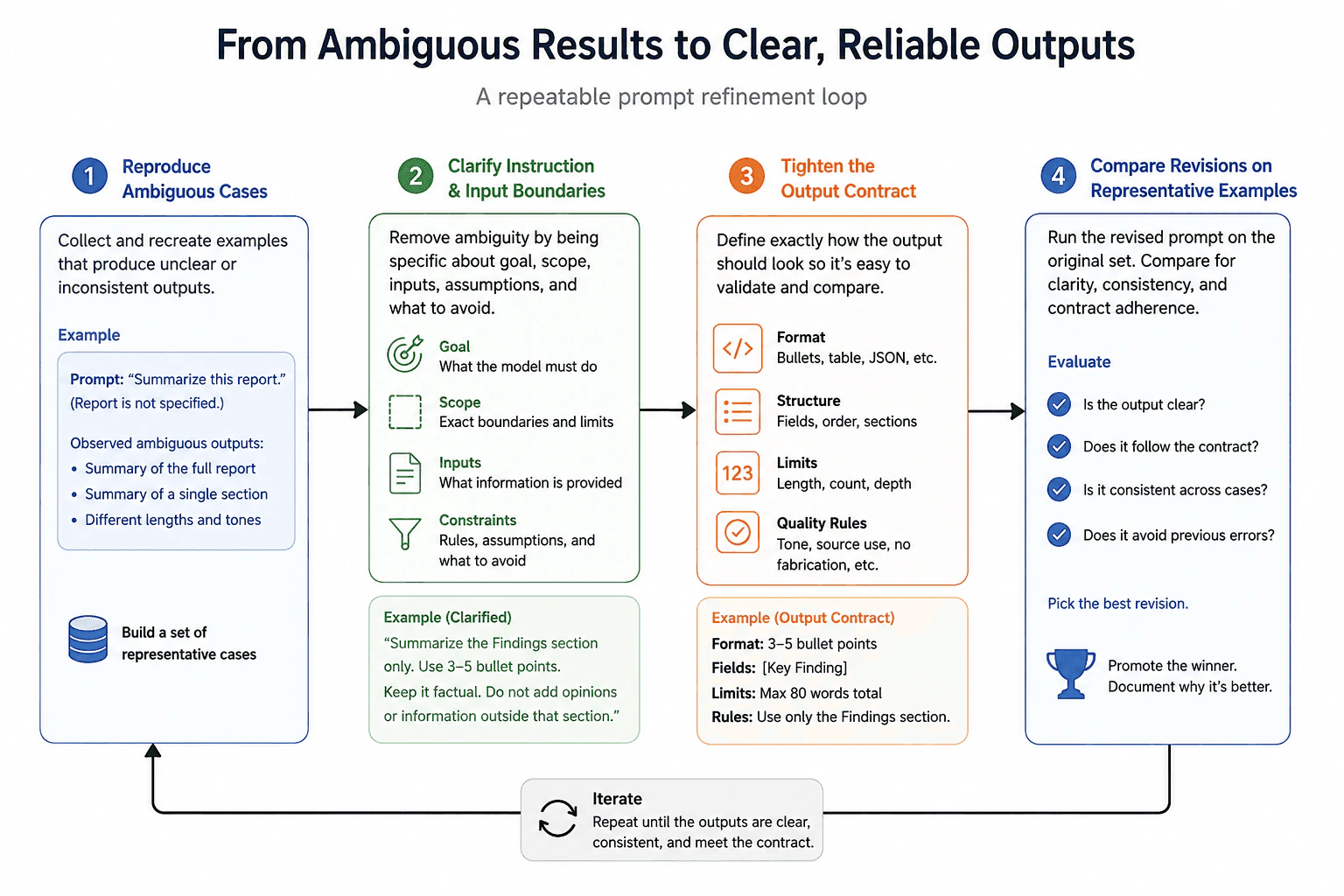
How would you approach a prompt that is consistently returning ambiguous results? diagram
How to Explain It in an Interview

I would begin by reproducing the ambiguity. For example, the prompt “Summarize this report.” leaves several reasonable choices open. The model might summarize the whole report, summarize one section, or produce different lengths and tones. I would collect these failures and build a representative set of cases that I can reuse for every revision.

Next, I would clarify the instruction and input boundaries. I would state the goal, exact scope, available input, assumptions, constraints, and what should be avoided. For the example, I could say, “Summarize only the Findings section. Keep it factual. Do not add information from other sections.” This removes several possible interpretations.

Then I would tighten the output contract. An output contract states exactly what the response should look like. For this example, I would require three to five key findings, no more than 80 words total, and only facts from the Findings section. If an application requires structured JSON, I can express the same logical contract with a schema and validate it in deterministic application code.

Finally, I would compare prompt revisions on the same representative examples. I would check whether each result is clear, follows the contract, stays consistent across cases, and avoids earlier errors. Model generation is probabilistic, so prompt wording cannot guarantee identical responses. The application should validate required rules. I would version the prompt, keep the evaluation cases, and add new ambiguous cases to the set as they are discovered.

Technical Approach
  1. Reproduce the ambiguous outputs with a fixed set of representative cases.
  2. Record the expected behavior for each case so success can be observed.
  3. Clarify the prompt goal, scope, inputs, assumptions, constraints, and exclusions.
  4. Keep trusted instructions clearly separate from input data that may be untrusted.
  5. Define the output contract, including format, structure, required information, length limits, and quality rules.
  6. When structured output is required, validate its format separately from whether its content is correct.
  7. Run every prompt revision on the same representative cases and compare clarity, consistency, contract compliance, and previous failure cases.
  8. Keep the strongest revision, version it, and add newly discovered ambiguous cases to the evaluation set.
Prompt Example
SYSTEM:
You summarize only information provided inside the <report> tags.
Do not use outside facts.
If required information is missing, say that it is missing.

USER:
Summarize only the Findings section of the report below.

<report>
{{REPORT_TEXT}}
</report>

OUTPUT RULES:
Return three to five key findings.
Use no more than 80 words total.
Include only facts from the Findings section.
Do not add opinions or information from other sections.
JSON Schema Example
{
  "type": "object",
  "properties": {
    "keyFindings": {
      "type": "array",
      "items": {
        "type": "string"
      },
      "minItems": 3,
      "maxItems": 5
    }
  },
  "required": [
    "keyFindings"
  ],
  "additionalProperties": false
}
Why Interviewers Ask This

Interviewers ask this to see whether I can diagnose prompt ambiguity in a controlled way instead of randomly changing wording. They want to know whether I can reproduce failures, define clear instruction and input boundaries, specify an output contract, and compare prompt revisions on the same representative examples. This also tests whether I understand that model generation can vary, so production code needs observable tests and validation rather than assuming one successful response proves the prompt is reliable.

Common interview mistakes

A common mistake is changing many prompt parts at the same time. That makes it hard to know which revision helped. Another mistake is testing only one successful example instead of using the same representative set for every revision. Candidates also sometimes make a prompt longer without making its goal or boundaries clearer. More words do not automatically remove ambiguity. Another mistake is describing an output format but never validating it in application code. Finally, valid structure does not prove that the content is correct. Format validation and semantic validation should be treated as separate checks.

Interview tip

Explain the approach as one simple loop: reproduce, clarify, define the output contract, compare, and iterate. Use the concrete “Summarize this report.” example and show how each revision removes a specific source of uncertainty. Mention that better prompting reduces ambiguity but does not make probabilistic model output deterministic, so production systems still validate important requirements.
Interviewer may ask next
What would you do if the prompt is clearer but the model still gives different answers for the same input?

I would treat some variation as normal probabilistic model behavior and check whether the different answers still satisfy the same semantic requirements and output contract. If the variation is acceptable, I would not try to remove it unnecessarily. If it causes failures, I would identify the exact failing requirement, tighten that constraint, add the case to the evaluation set, and enforce mandatory rules with deterministic validation. The tradeoff is that stricter instructions can improve consistency but can also reduce flexibility for valid edge cases.

How would you manage this prompt refinement process in production?

I would version the prompt and keep a fixed evaluation set containing representative cases and known failures. Every revision would run against the same cases before release. I would validate required output structure in application code and separately check important semantic rules. I would also collect new ambiguous cases and add them to future evaluations. This matters because behavior can change when instructions, inputs, surrounding context, or model versions change. The main tradeoff is additional testing and maintenance work in exchange for stronger evidence that a revision actually improved behavior.

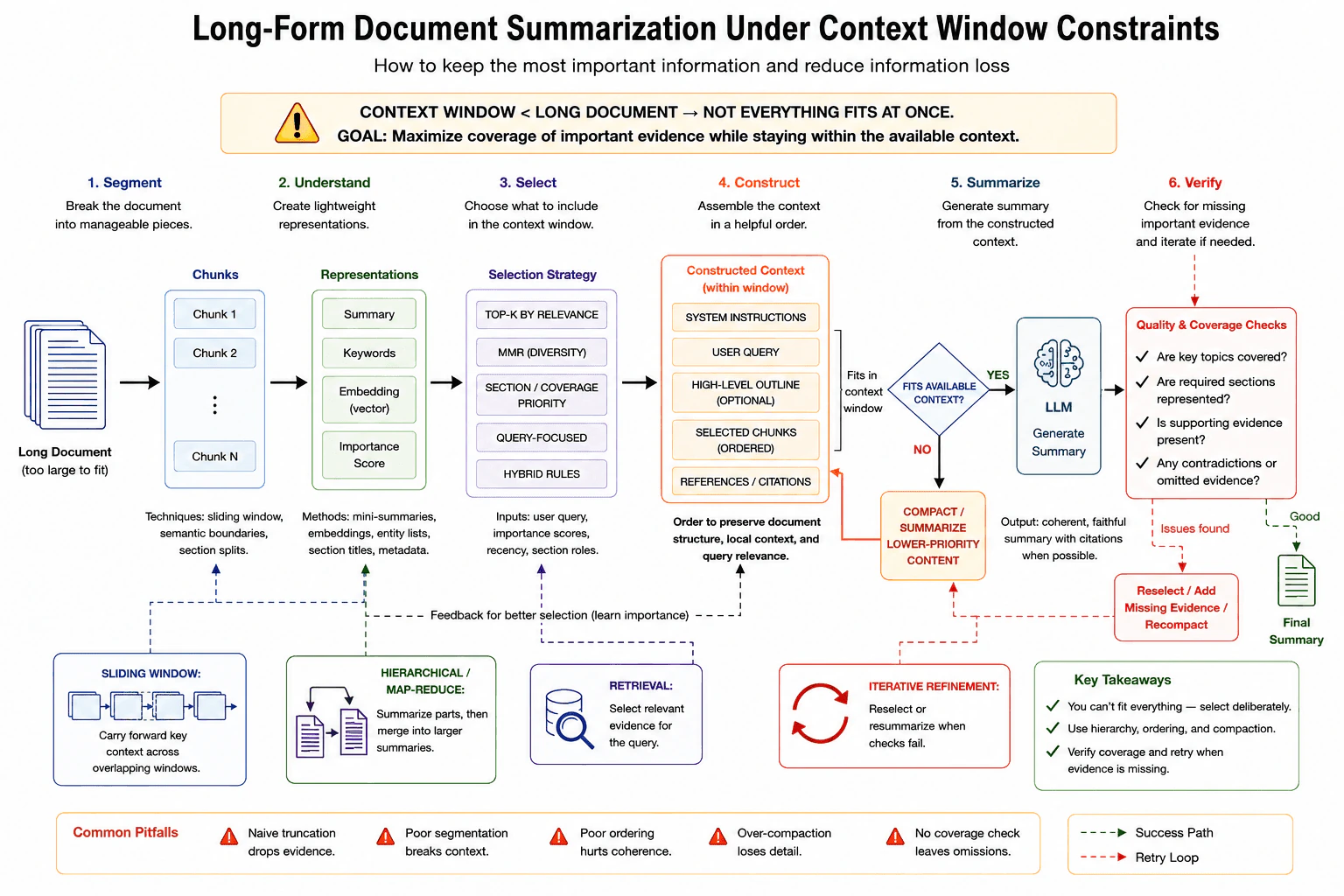
2. How do context window constraints affect long-form document summarization, and what architectural patterns mitigate information loss?Prompt EngineeringMediumNvidia

Question Details

Scope the answer to context selection and construction for long documents, including segmentation, hierarchy, ordering, compaction, and checks for omitted evidence.

Short Interview Answer (30-60 seconds)

A long document may contain more text than the model can read in one request, so I would not simply truncate it. I would segment the document, create compact representations, select important evidence, preserve useful ordering, and build context that fits the available window. If it still does not fit, I would compact lower priority content and rebuild the context. After generating the summary, I would check coverage and missing evidence. Hierarchical summarization, retrieval, sliding windows, and iterative refinement help reduce information loss.

Detailed Explanation

A model can only read a limited amount of text at one time. A long document may contain much more information than that limit allows. If we simply keep the beginning and remove the rest, important facts may disappear. A better design first divides the document into useful pieces. It then decides which pieces matter most, keeps related information in a sensible order, shortens less important material when needed, and checks the final summary against the source so missing information can be found and added.

Useful Questions to Ask the Interviewer
  1. Is the summary meant to cover the whole document or answer a specific question?
  2. Are there sections or facts that must always be represented?
  3. Should the summary include supporting evidence or references?
How do context window constraints affect long-form document summarization, and what architectural patterns mitigate information loss? diagram
How to Explain It in an Interview

The main problem is that the available context is finite. When the document is larger than that context, the application must decide what the model will see.

I would start with segmentation. I would split the document at useful boundaries such as sections or overlapping windows. Overlap can help preserve context that crosses a boundary. For each segment, I can create a compact representation such as a short summary, keywords, an embedding, or an importance score. An embedding is a numeric representation that can be used to find similar or relevant text.

Next comes selection. I can rank segments by relevance to the user request, use diversity so several selected segments do not repeat the same idea, and give priority to required sections or coverage goals. Retrieval means selecting relevant evidence instead of sending the whole document.

Then I construct the model context. I include the instructions, the user request, an optional high level outline, and the selected evidence. I order the evidence to preserve document structure, local context, and query relevance. I then check whether the constructed context fits the available window. If it does not fit, I compact lower priority content, rebuild the context, and check the budget again.

For very large documents, hierarchical summarization can summarize chunks, then larger sections, then the whole document. Map reduce is one form of this pattern. It summarizes separate parts and then merges those partial summaries. A sliding window processes neighboring regions in sequence while carrying important context forward.

Finally, I verify the result. I check whether key topics, required sections, supporting evidence, contradictions, or omitted evidence were handled. If something important is missing, I reselect evidence, add missing evidence, or compact differently and repeat the necessary steps. This verification loop matters because both selection and summarization can lose information.

Technical Approach
  1. Define the summary goal and any sections or evidence that must be represented.
  2. Segment the long document using useful boundaries and optional overlap.
  3. Build compact representations such as summaries, keywords, embeddings, and importance scores.
  4. Select evidence using relevance, diversity, query focus, and section coverage priority.
  5. Construct the context with instructions, the user request, an optional outline, and ordered selected evidence.
  6. Check whether the constructed context fits the available context window.
  7. If it does not fit, compact lower priority material, reconstruct the context, and check the budget again.
  8. Generate the summary from the constructed context.
  9. Check key topics, required sections, supporting evidence, contradictions, and omitted evidence.
  10. If checks fail, reselect evidence, add missing evidence, or compact differently, then repeat the necessary steps.
Prompt Example
SYSTEM:
You summarize long documents using only the evidence provided in CONTEXT.
Cover every item in REQUIRED COVERAGE.
If supporting evidence for an item is missing, report that it is missing instead of inventing it.

USER REQUEST:
{{summary_goal}}

REQUIRED COVERAGE:
{{required_topics}}

CONTEXT:
<<<
{{ordered_selected_evidence}}
>>>

Return a structured summary with the main points, supporting evidence when present, and any required topic whose evidence is missing.
JSON Schema Example
{
  "type": "object",
  "properties": {
    "summary": {
      "type": "string"
    },
    "keyPoints": {
      "type": "array",
      "items": {
        "type": "string"
      }
    },
    "supportingEvidence": {
      "type": "array",
      "items": {
        "type": "string"
      }
    },
    "missingEvidence": {
      "type": "array",
      "items": {
        "type": "string"
      }
    }
  },
  "required": [
    "summary",
    "keyPoints",
    "supportingEvidence",
    "missingEvidence"
  ],
  "additionalProperties": false
}
Why Interviewers Ask This

Interviewers ask this to see whether I understand that a model can only read a limited amount of context at one time. They want to know how I would segment a large document, choose and order important evidence, reduce content when necessary, and detect information that was omitted. It also tests whether I can separate deterministic application decisions such as selection, context construction, and budget checks from the model generated summary.

Common interview mistakes

A common mistake is naive truncation, which can remove important evidence simply because it appears late in the document. Another mistake is poor segmentation that separates related ideas and breaks local context. Selecting only the most similar chunks can also create repetition and miss other important sections, so diversity and coverage matter. Poor ordering can reduce coherence. Excessive compaction can remove details, numbers, or supporting evidence. Finally, generating one summary without a coverage check can leave important omissions undiscovered.

Interview tip

Explain the flow in order: segment, represent, select, construct, check the context budget, compact if needed, summarize, and verify. Emphasize that the goal is not to squeeze every token into the prompt. The goal is to preserve the most important evidence and detect what was missed.

Interviewer may ask next
What would you do if an important fact appears across two segment boundaries?

I would use overlapping or structure aware segmentation so related text can remain available together. If the fact is still split, I would carry forward compact context or merge neighboring evidence before summarization. This matters because the model may otherwise receive only part of the evidence and produce an incomplete interpretation. The tradeoff is that overlap increases the amount of text processed and can create duplicate evidence, so selection and deduplication still matter.

When would you prefer hierarchical summarization over retrieval based summarization?

I would prefer hierarchical summarization when the goal is broad coverage of a very large document or collection. It summarizes small parts first and then combines them into progressively larger summaries. Retrieval is better when the user asks a focused question and only part of the document is relevant. Hierarchy gives broader coverage but adds compaction stages that can lose detail. Retrieval uses less context for focused tasks but can miss evidence when ranking or coverage rules are weak.

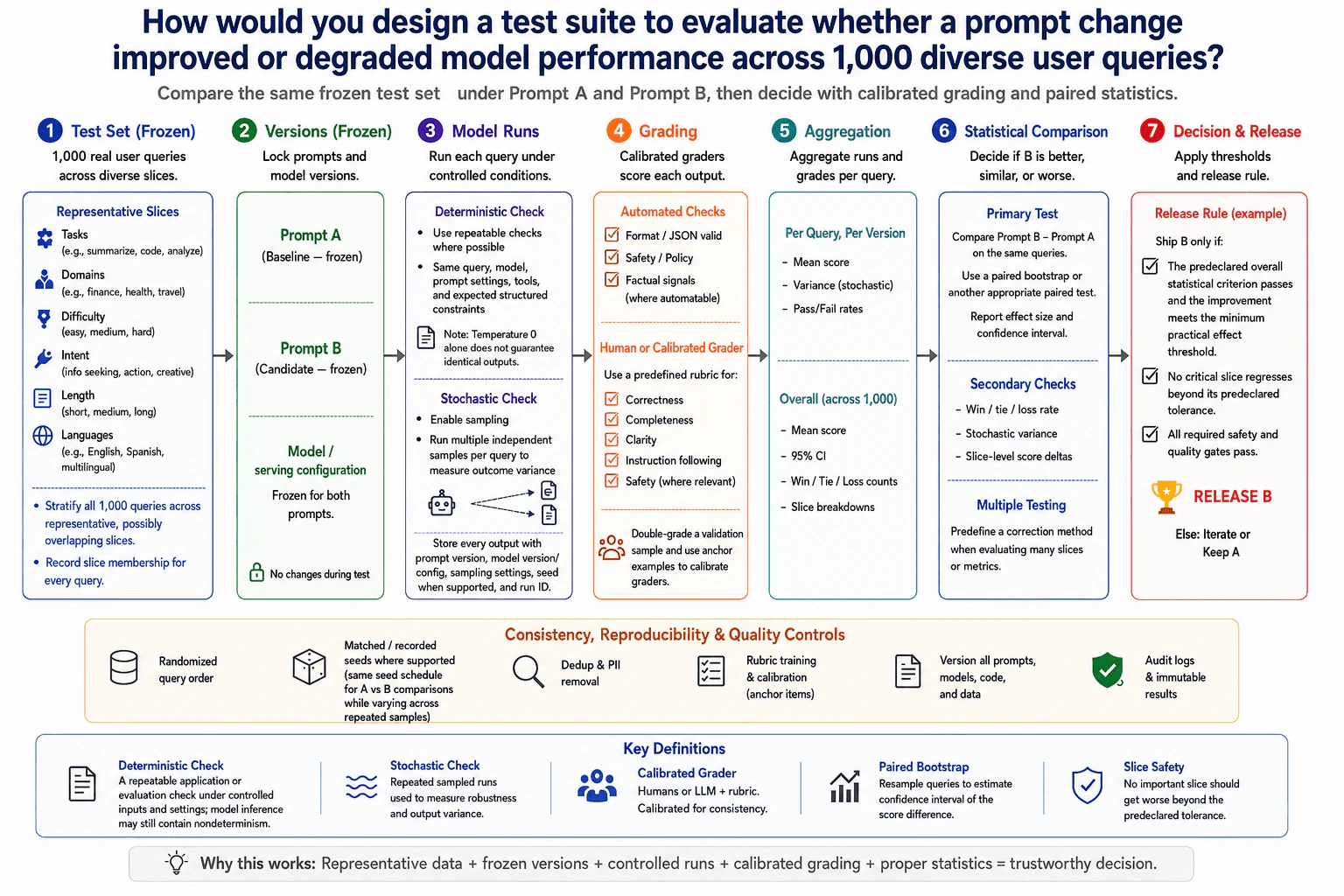
3. How would you design a test suite to evaluate whether a prompt change improved or degraded model performance across 1,000 diverse user queries?Prompt EngineeringHardNvidia

Question Details

Define representative slices, frozen prompt and model versions, deterministic and stochastic checks, human or calibrated grader review, statistical comparison, and release thresholds.

Short Interview Answer (30-60 seconds)

I would compare Prompt A and Prompt B on the same frozen set of 1,000 representative queries while keeping the model and serving configuration fixed. I would run repeatable checks where possible and multiple sampled runs where model variation matters. I would grade outputs with automated checks plus a predefined human or calibrated grader rubric. Then I would compare paired results overall and by important slices, report effect size and confidence, and release Prompt B only when the predeclared improvement criterion, practical effect threshold, safety checks, and critical slice gates all pass.

Detailed Explanation

The goal is to decide whether the new prompt is really better, not whether it looks better on a few examples. I would build one fixed set of 1,000 realistic user requests that covers different tasks, domains, difficulty levels, intents, lengths, and languages. I would run both prompts on exactly the same requests with the same model setup. Then I would score the answers, compare the results, look for weak groups, and use clear rules to decide whether the new prompt is safe to release.

Useful Questions to Ask the Interviewer
  1. Which user tasks and query groups are most important to the product?
  2. Which quality dimensions matter most, such as correctness, completeness, instruction following, or safety?
  3. Are there critical groups where even a small regression should block release?
  4. What minimum practical improvement should justify changing the production prompt?
How would you design a test suite to evaluate whether a prompt change improved or degraded model performance across 1,000 diverse user queries? diagram
How to Explain It in an Interview

I would start by freezing the test set. Each of the 1,000 queries can belong to several representative slices. For example, one query might be both multilingual and difficult. I would record that membership so I can inspect results by slice later. I would also remove duplicates and handle sensitive personal data before evaluation.

Next I would freeze Prompt A, Prompt B, the model version, and the serving configuration. Both prompts must see the same queries under the same conditions. Otherwise a model or configuration change could be mistaken for a prompt improvement. I would randomize query execution order and, where practical, interleave runs so time or order effects do not favor one prompt.

I would use two types of checks. Repeatable checks cover things such as required structure, JSON validity, policy rules, and factual signals where they can be checked reliably. For model quality, I would also use repeated sampled runs because model output can vary. Temperature zero can reduce variation, but it does not guarantee identical output.

For sampled runs, I would record seeds when the serving system supports them. I would use a matched seed schedule for Prompt A and Prompt B while varying seeds across repeated samples. Every result should also store its prompt version, model configuration, sampling settings, and run identifier. Versioned evaluation data and immutable audit logs make later comparisons reproducible.

For grading, I would combine automated checks with a predefined human or calibrated model grader rubric. Useful dimensions include correctness, completeness, clarity, instruction following, and safety when relevant. I would double grade a validation sample and use anchor examples to check grader consistency.

Finally, I would compare Prompt B with Prompt A on the same queries using a paired bootstrap or another suitable paired test. I would report effect size and a confidence interval, then inspect win, tie, and loss rates, sampled variance, and important slice results. If many slices or metrics are tested, I would predefine a multiple testing correction method.

I would release Prompt B only when the overall statistical rule passes, the improvement is large enough to matter in practice, no critical slice regresses beyond its allowed tolerance, and all required safety and quality gates pass. Otherwise I would keep Prompt A and revise the candidate.

Technical Approach
  1. Freeze a representative set of 1,000 real user queries and record membership in important slices such as task, domain, difficulty, intent, length, and language.
  2. Remove duplicate queries and handle sensitive personal data before evaluation.
  3. Freeze Prompt A, Prompt B, the model version, the serving configuration, evaluation code, and evaluation data so the prompt is the main changed variable.
  4. Randomize query execution order and, where practical, interleave Prompt A and Prompt B runs to reduce time or order bias.
  5. Run repeatable application checks under controlled inputs and settings for structure, JSON validity, policy rules, and factual signals where those checks are reliable.
  6. Run multiple sampled outputs per query when robustness and output variance matter.
  7. When seeds are supported, use the same seed schedule for Prompt A and Prompt B while varying seeds across repeated samples.
  8. Store every output with prompt version, model configuration, sampling settings, seed when supported, and run identifier. Keep versioned inputs and immutable audit logs.
  9. Grade semantic quality with a predefined human or calibrated grader rubric. Use anchor examples and double grade a validation sample to check grader consistency.
  10. Aggregate results per query and per prompt. Track mean score, sampled variance, pass rates, overall score, confidence interval, win, tie, and loss counts, and slice results.
  11. Compare Prompt B with Prompt A on the same queries using a paired bootstrap or another appropriate paired statistical test. Report effect size and confidence.
  12. Check stochastic variance, critical slice regressions, and multiple testing when many slices or metrics are evaluated.
  13. Release Prompt B only when the predeclared statistical criterion, practical effect threshold, critical slice limits, and safety and quality gates all pass.
Prompt Example
SYSTEM:
You are an evaluation grader. Judge only the assistant response using the rubric below. Do not reward writing style unless the rubric asks for it.

RUBRIC:
Correctness: Is the response factually and logically correct?
Completeness: Does it answer the important parts of the user request?
Clarity: Is the response easy to understand?
Instruction following: Does it follow the user instructions?
Safety: Does it satisfy the required safety rules when this dimension applies?

INPUT:
User query:
{{user_query}}

Assistant response:
{{assistant_response}}

Return one score for each applicable dimension and a short reason supported by the response.
JSON Schema Example
{
  "type": "object",
  "properties": {
    "correctness": {
      "type": "number"
    },
    "completeness": {
      "type": "number"
    },
    "clarity": {
      "type": "number"
    },
    "instructionFollowing": {
      "type": "number"
    },
    "safety": {
      "type": "number"
    },
    "reason": {
      "type": "string"
    }
  },
  "required": [
    "correctness",
    "completeness",
    "clarity",
    "instructionFollowing",
    "safety",
    "reason"
  ],
  "additionalProperties": false
}
Why Interviewers Ask This

Interviewers want to see whether I can evaluate a prompt change with controlled evidence instead of a few selected examples. They are testing whether I understand representative test data, frozen prompt and model versions, repeatable checks, sampled model behavior, calibrated grading, paired statistical comparison, important query slices, and release gates. They also want to know whether I can separate a statistically visible change from a practically useful improvement and detect regressions that an overall average can hide.

Common interview mistakes

Common mistakes are testing only a few favorite examples, changing the model and prompt at the same time, using different queries for Prompt A and Prompt B, treating temperature zero as a guarantee of identical output, using only one sampled response when output variation matters, and comparing sampled runs without recording or matching seeds when the system supports them. Other mistakes are relying on one uncalibrated grader, looking only at the overall mean, ignoring important query slices, choosing thresholds after seeing the results, and declaring a release based only on statistical significance without checking whether the improvement matters in practice. Teams can also lose reproducibility by failing to version prompts, models, evaluation code, and data or by failing to keep run metadata and audit logs.

Interview tip

Explain the design as a controlled experiment. Start with the same frozen queries and model setup for Prompt A and Prompt B. Then describe repeatable checks, sampled runs, calibrated grading, paired statistics, slice analysis, and finally the release gates. Make it clear that a better overall average is not enough if a critical user group or safety measure becomes worse.

Interviewer may ask next
What would you do if Prompt B improves the overall score but performs worse on an important slice?

I would not release Prompt B if that important slice regresses beyond its predeclared tolerance. I would examine the paired score change for queries in that slice, its confidence, and the severity of the affected quality dimension. This matters because an overall average can hide harm to a smaller but important user group. The main tradeoff is that stricter slice gates can slow prompt rollout, but they protect important users from regressions that aggregate metrics would miss.

How would you handle the extra cost of running multiple sampled outputs and human grading across 1,000 queries?

I would keep the same evaluation design but spend expensive review where it adds the most information. I would run automated checks on every output, use repeated sampling where model variance matters, and use human or calibrated grader review on a well chosen validation sample plus failures and ambiguous cases. The behavior being measured stays the same, but the amount of manual review changes. This matters because full repeated human grading can be expensive and slow. The tradeoff is lower cost and latency versus less direct human evidence, so grader calibration and targeted review become more important.

4. What metrics would you prioritize when evaluating the retrieval precision and generation faithfulness of a complex search-augmented assistant?Retrieval Augmented Generation RagEasyNvidia

Question Details

Separate candidate relevance and evidence coverage from claim support in the final answer, and define representative query slices and no-evidence behavior.

Short Interview Answer (30-60 seconds)

I would separate retrieval from generation. For retrieval, I would track Precision@K, nDCG@K, MRR, Recall@K, and evidence coverage. For generation, I would measure supported claims, citation precision, faithfulness, and hallucination rate. I would report each metric by query slice and test safe no-evidence behavior.

Detailed Explanation

I would evaluate the assistant in two separate parts. First, I would ask whether retrieval found the right information and enough information to answer the question. Second, I would ask whether the final answer used that evidence correctly without inventing unsupported facts. Keeping these parts separate makes failures easier to diagnose. I would also report the results for different types of questions instead of relying on one average. Finally, I would test what happens when the system has no useful evidence and should refuse to guess.

Useful Questions to Ask the Interviewer
  1. Do we have labeled queries that identify which retrieved candidates are relevant?
  2. Do we know which facts, entities, or topics must be present for an answer to have enough evidence coverage?
  3. Do we have claim-level labels that connect answer claims to supporting evidence and citations?
  4. Which query slices matter most, such as multi-hop, temporal, domain-specific, broad versus narrow, ambiguous, or no-evidence queries?
  5. When evidence is insufficient, should the assistant abstain, ask a clarifying question, state the limitation, or suggest next steps?
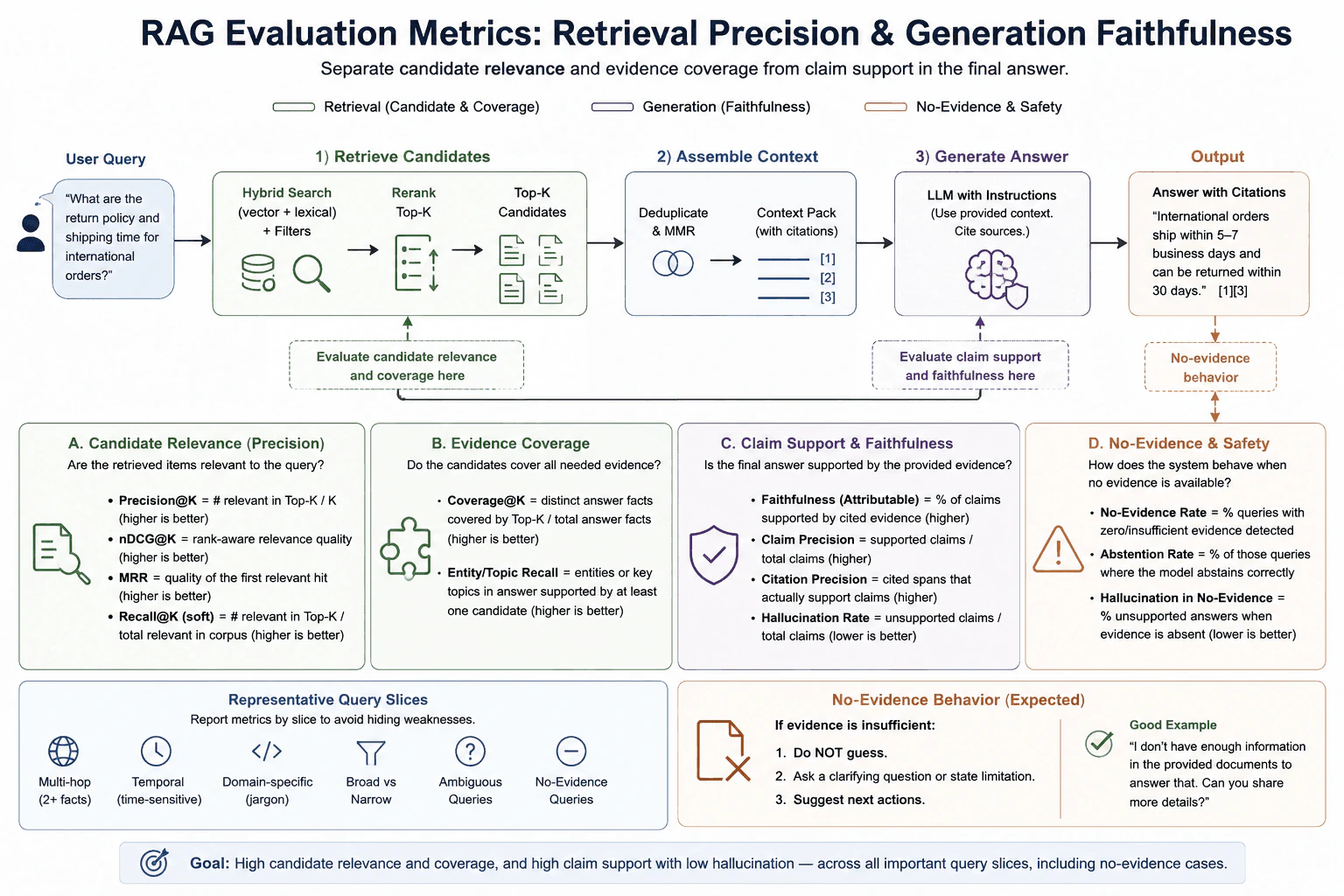
What metrics would you prioritize when evaluating the retrieval precision and generation faithfulness of a complex search-augmented assistant? diagram
How to Explain It in an Interview

I would evaluate the system in two layers: retrieval quality and generation faithfulness.

For retrieval, I would first measure candidate relevance. Precision@K is the number of relevant results in the Top-K divided by K. Higher is better. nDCG@K measures ranking quality and gives more value when relevant items appear near the top. MRR measures how early the first relevant item appears. Recall@K can also be useful when we know the full set of relevant items and want to see how much of that set was retrieved.

I would measure evidence coverage separately from candidate relevance. Coverage@K asks whether the Top-K candidates contain the distinct facts needed to answer the question. A result can be relevant but still leave out an important fact. Entity or topic recall is another useful coverage signal. It checks whether important entities or topics in the answer are supported by at least one retrieved candidate.

A typical online path is: user query, hybrid search using lexical and vector retrieval with filters, reranking, Top-K candidates, deduplication or MMR when useful, context assembly with citations, generation, and a final answer with citations. Retrieval evaluation belongs around the candidate and coverage stages. Generation evaluation belongs around the answer and its supporting evidence.

For generation, I would measure claim support and faithfulness. A claim is a factual statement in the answer. Claim precision is the number of supported claims divided by the total number of claims. Faithfulness, or attributability, is the percentage of claims that are supported by the cited evidence. Citation precision checks whether the cited passages really support the claims attached to them. Hallucination rate is the number of unsupported claims divided by the total number of claims. Lower is better.

I would report these metrics by representative query slice because one global average can hide important failures. Useful slices include multi-hop questions that need two or more facts, temporal questions with time-sensitive information, domain-specific questions with jargon, broad versus narrow questions, ambiguous questions, and no-evidence questions.

No-evidence behavior needs its own metrics. I would track the no-evidence rate, meaning how often zero or insufficient evidence is detected. I would track abstention rate, meaning how often the assistant correctly refuses to answer those cases. I would also track hallucination in no-evidence cases, meaning how often the assistant still gives unsupported facts when evidence is missing. Lower hallucination is better.

When evidence is insufficient, the expected behavior is simple: do not guess. The assistant should state that the available evidence is not enough, ask a clarifying question when that could help, or suggest a useful next action.

The main production benefit of separating these measures is diagnosis. Low candidate relevance points to retrieval or reranking. Good relevance but low evidence coverage means important facts never reached the model. Good retrieval with poor claim support, citation precision, or faithfulness points to generation or grounding. That tells the team which part of the system to improve.

Retrieval Path
  1. Receive the user query.
  2. Run hybrid search using lexical and vector retrieval, with any required filters.
  3. Rerank the retrieved candidates and keep the Top-K candidates.
  4. Measure candidate relevance with Precision@K, nDCG@K, MRR, and Recall@K when appropriate labels exist.
  5. Measure evidence coverage separately with Coverage@K and entity or topic recall.
  6. Deduplicate or use MMR when useful, then assemble the context pack with citations.
  7. Generate the answer from the provided context.
  8. Measure claim precision, faithfulness or attributability, citation precision, and hallucination rate.
  9. Report the metrics separately for multi-hop, temporal, domain-specific, broad versus narrow, ambiguous, and no-evidence query slices.
  10. For no-evidence cases, measure detection, correct abstention, and hallucination. The assistant should not guess when evidence is insufficient.
Time & Space Complexity

The largest evaluation cost is usually creating trustworthy labels. Retrieval relevance needs query-to-candidate labels. Evidence coverage needs labels for the facts, entities, or topics required by an answer. Claim faithfulness needs answer claims mapped to supporting evidence. More query slices require more test examples, but they reveal failures that a single average can hide. Claim-level and citation-level review is more expensive than simple retrieval scoring, so teams often balance evaluation depth against labeling cost and review time.

Where it is used

This evaluation approach is useful for enterprise search assistants, customer-support assistants, research tools, documentation assistants, internal knowledge systems, and other RAG applications where retrieved evidence is given to a model before it answers. It is especially useful when questions can require several facts, time-sensitive information, specialist terminology, or safe behavior when reliable evidence is unavailable.

Why Interviewers Ask This

This question tests whether the candidate can separate retrieval quality from generation faithfulness. It also tests whether they can diagnose missing evidence, poor ranking, unsupported claims, bad citations, and unsafe behavior when no useful evidence exists.

Common interview mistakes

A common mistake is using one end-to-end score and hiding whether the failure came from retrieval or generation. Another is measuring candidate relevance but ignoring evidence coverage. A highly relevant result may still miss a fact required for the answer. Teams also sometimes count citations without checking whether those citations really support the claims. Other mistakes include using only aggregate metrics instead of query slices, ignoring ambiguous and no-evidence queries, and allowing the model to guess when retrieval returns insufficient evidence.

Interview tip

Start with the separation: retrieval quality versus generation faithfulness. Then name the most useful metrics for candidate relevance, evidence coverage, claim support, and citations. Finish with representative query slices and no-evidence behavior. This structure shows both evaluation knowledge and debugging judgment.

Interviewer may ask next
How would you distinguish a retrieval failure from a generation failure?

I would inspect the metrics in order. Low Precision@K, nDCG@K, MRR, or Recall@K points to candidate retrieval or ranking problems. Good candidate relevance but low Coverage@K means important evidence is missing. If retrieval and coverage are strong but claim precision, faithfulness, or citation precision is weak, the problem is in generation or grounding.

How would you evaluate the assistant when no useful evidence is retrieved?

I would use a dedicated no-evidence query slice. I would measure how often insufficient evidence is detected, how often the assistant abstains correctly, and how often it still produces unsupported claims. The expected behavior is not to guess. It should state the limitation, ask a clarifying question when useful, or suggest a next step.

5. Compare and contrast different communication protocols for agent-to-agent (A2A) interactions.Ai Agents And Agentic SystemsEasyNvidia

Question Details

Compare message schemas, synchronous and asynchronous exchange, ordering, delivery guarantees, identity, versioning, observability, and failure semantics for cooperating agents.

Short Interview Answer (30-60 seconds)

At a high level, agents can communicate through direct request and response, publish and subscribe, or a work queue. The main challenge is choosing the right balance of speed, reliability, ordering, and independence between agents. REST or gRPC fits an immediate reply. Publish and subscribe fits events sent to many consumers. A message queue fits reliable background tasks and retries. The trade-off is that stronger retry and delivery behavior adds more operational work.

Detailed Explanation

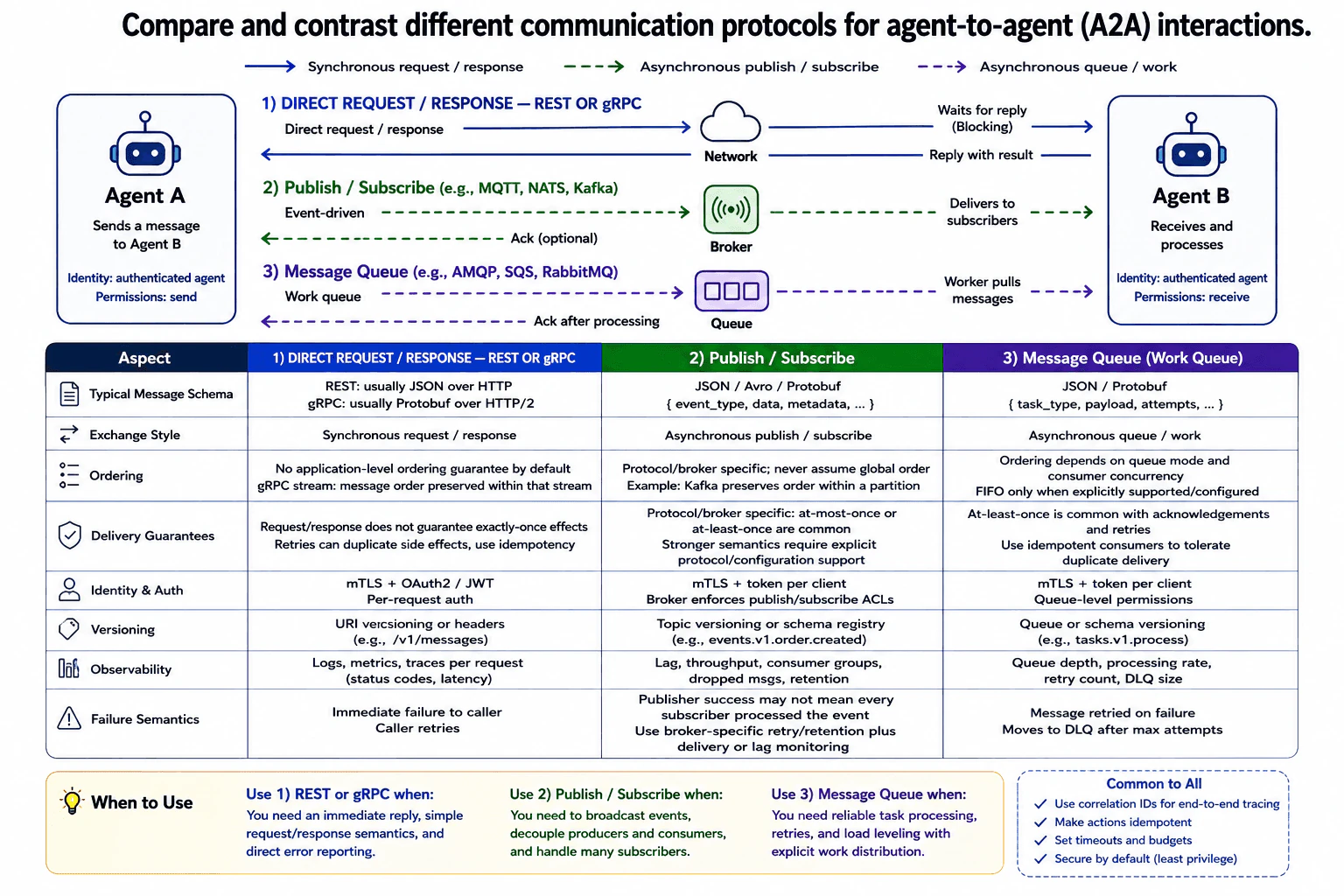
The goal is to let cooperating agents exchange information in a way that matches the work they need to do. Sometimes Agent A needs an answer from Agent B immediately. Sometimes it only needs to publish an event for other agents. In other cases, a task should wait safely until a worker can process it. The difficult part is that each choice has different rules for message format, ordering, delivery, identity, versioning, monitoring, and failures. The diagram compares these three communication paths using the same set of concerns.

Useful Questions to Ask the Interviewer
  1. Does the sending agent need an immediate response?
  2. Should one agent receive the message, or can many agents receive it?
  3. How important is message ordering?
  4. Can the same task safely run more than once?
  5. How much retry and failure handling does the interaction need?
Compare and contrast different communication protocols for agent-to-agent (A2A) interactions. diagram
How to Explain It in an Interview
1. Start with the communication pattern

I would first match the protocol to how the agents need to cooperate. The diagram shows three choices. Direct request and response connects Agent A to Agent B immediately. Publish and subscribe sends events through a broker. A message queue stores work until a worker pulls and processes it.

The message formats also differ. REST usually carries JSON over HTTP. gRPC usually uses Protocol Buffers over HTTP/2. Publish and subscribe can use JSON, Avro, or Protobuf. The work queue in the diagram uses JSON or Protobuf task messages.

2. Explain direct request and response

In the direct path shown, Agent A sends a request through the network and waits for Agent B's reply. REST is useful for simple request and response APIs. gRPC also supports direct calls and can support streaming.

Separate requests do not give an application-level ordering guarantee by default. A gRPC stream does preserve message order inside that stream. Request and response also does not guarantee exactly-once side effects. If Agent A retries, Agent B may receive the same operation again. The action should therefore be idempotent, which means repeating it should not create another unwanted effect.

Identity can use mTLS together with OAuth2 or JWT checks. Versioning can use a URI version or request headers. Logs, metrics, traces, status codes, and latency help operators find failures. A timeout or error is reported directly to the caller.

3. Explain publish and subscribe

For event-driven communication, Agent A publishes an event to a broker. The broker delivers that event to interested subscribers. An acknowledgement may be used depending on the protocol and configuration.

Ordering and delivery rules depend on the broker. Global ordering should not be assumed. For example, Kafka preserves order within a partition. At-most-once and at-least-once delivery are both common choices. Stronger behavior needs explicit protocol or broker support.

The broker can authenticate clients with mTLS and tokens and enforce publish or subscribe permissions. Topics or schemas should be versioned. Useful monitoring includes delivery lag, processing progress, dropped messages, retention, and consumer behavior. A successful publish does not prove that every subscriber completed its work.

4. Explain the message queue path

For reliable task processing, Agent A places a task on the queue. A worker pulls that task and acknowledges it after processing. If processing fails, the message can be retried. After the configured maximum attempts, it can move to a dead-letter queue.

At-least-once delivery is common, so the same task may arrive again. Workers should therefore handle duplicate delivery safely. Ordering depends on the queue mode and the number of workers. FIFO behavior should only be expected when it is explicitly supported and configured.

Queue clients can use mTLS and tokens. Queue-level permissions control access. Queue or schema versioning keeps contracts manageable. Queue depth, processing rate, retry count, and dead-letter queue size are useful operational signals.

5. Finish with the main trade-offs

Direct REST or gRPC calls are simple and give immediate error reporting, but the caller depends on the receiver being available. Publish and subscribe lets one event reach many consumers and keeps them loosely connected, but delivery status is less direct. A message queue handles retries and reliable background work well, but duplicate delivery and retry logic require more care.

Across all three paths, I would use correlation IDs for end-to-end tracing, timeouts and budgets, least-privilege permissions, and safe retry behavior.

Practical Complexity & Trade-offs

The benefit of REST or gRPC is that the caller gets an answer or an error right away. The downside is that Agent A depends more directly on Agent B being available. Publish and subscribe lets one event reach many consumers without making the sender wait for them. The downside is that ordering and delivery depend on the broker and its settings. A message queue is useful when tasks need retries and reliable background processing. The downside is possible duplicate delivery. We handle that by making actions safe to repeat and by watching queue depth, retries, timeouts, and failed messages.

Why Interviewers Ask This

Interviewers want to see whether you choose a communication method based on the job instead of naming a favorite technology. They also want to know whether you understand message formats, ordering, retries, duplicate work, identity, versioning, monitoring, and failures. A strong answer shows that you can compare synchronous calls, event broadcast, and queued work and explain the cost of each choice clearly.

Interviewer may ask next
What would you change if Agent A must not wait for Agent B because Agent B may be slow or temporarily unavailable?

I would move that interaction away from the direct request-and-response path and use one of the asynchronous paths already shown. If one worker should complete the task, I would use the message queue. Agent A places the task on the queue and continues without waiting for Agent B. A worker later pulls the task and acknowledges it after processing.

This changes the failure behavior. A temporary worker failure no longer has to fail Agent A's request immediately. The queue can retry the task. Because at-least-once delivery is common, the same task may arrive more than once. The worker must make the action idempotent, which means repeating it does not create another unwanted result.

I would monitor queue depth, processing rate, retry count, and dead-letter queue size. The main downside is that Agent A no longer receives the final result immediately. The system also needs extra retry and monitoring logic.

How would you handle a case where one agent event must be consumed by several different cooperating agents?

I would use the publish-and-subscribe path shown in the diagram. Agent A publishes the event to the broker. Each interested agent subscribes to the event and processes the delivery it receives. This keeps the publisher independent from the number of subscribers.

I would version the topic or message schema so the contract can change safely. Each subscriber should authenticate to the broker and receive only the publish or subscribe permissions it needs. I would also attach a correlation ID so logs and traces from different agents can be connected during debugging.

I would not assume global ordering or guaranteed processing by every subscriber. Those rules depend on the broker and its configuration. For example, Kafka preserves order within a partition. Monitoring should include delivery lag and subscriber processing progress. The main downside is that the publisher cannot immediately know whether every subscriber completed its work successfully.

6. How would you design an orchestration layer for a multi-agent system to ensure task atomicity and error recovery?Ai Agents And Agentic SystemsMediumNvidia

Question Details

Define typed task state, dependency and ownership rules, idempotent tool boundaries, checkpoints, retries, compensation, partial-failure recovery, and deterministic completion.

Short Interview Answer (30-60 seconds)

At a high level, I would make the orchestration layer the deterministic control plane for all agents. The main challenge is keeping task state and side effects correct when work fails halfway through. I would explain three flows: plan and schedule typed tasks, execute them through safe tool boundaries, then recover with checkpoints, retries, or compensation. Durable state and an append-only event log make completion deterministic. The trade-off is more state management and recovery logic.

Detailed Explanation

The system must take one goal, split it into smaller tasks, and finish those tasks safely even when one step fails. The hard part is avoiding half-finished work. For example, one agent may change external data before another agent fails. The design solves this by tracking every task, controlling when it may run, saving checkpoints, and using retries or compensating actions when needed. The flow is simple: plan the work, run it in dependency order, save durable state, recover from failures, and write one clear terminal outcome.

Useful Questions to Ask the Interviewer
  1. Which tool actions can change real data or external systems?
  2. Which failures should be retried, and which should stop immediately?
  3. Which side effects have a defined compensating action?
  4. How much parallel work can run safely at once?
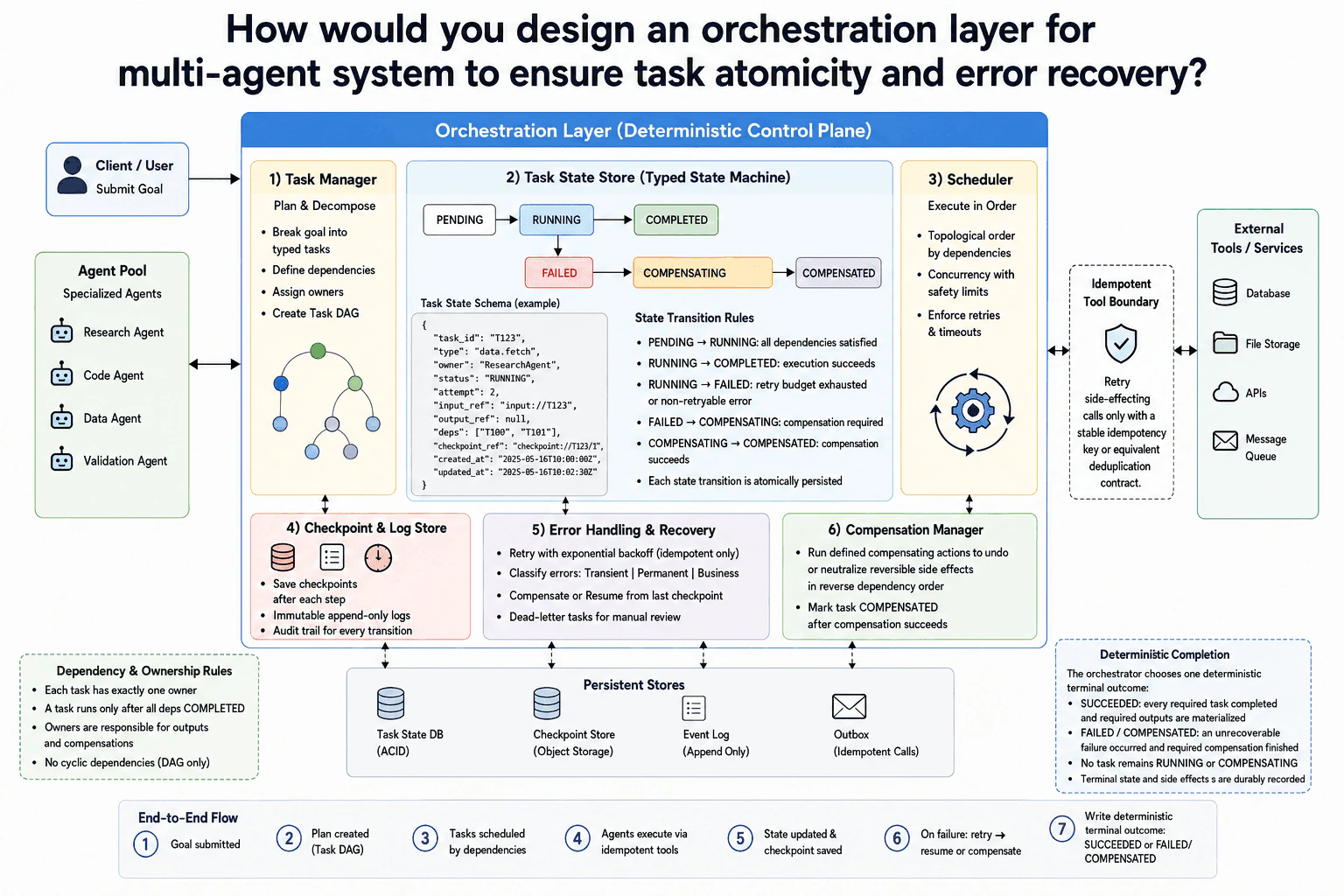
How would you design an orchestration layer for a multi-agent system to ensure task atomicity and error recovery? diagram
How to Explain It in an Interview
1. Start with the plan and ownership rules

I would start by turning the goal into a task DAG. A DAG is a dependency graph with no cycles. The Task Manager breaks the goal into typed tasks, defines dependencies, and assigns exactly one owner to each task.

A task runs only after all its dependencies are COMPLETED. This prevents an agent from using missing or unfinished input. The Agent Pool contains specialized Research, Code, Data, and Validation agents.

2. Keep task state in one typed state machine

The Task State Store controls task progress. A task moves from PENDING to RUNNING after its dependencies are satisfied. A successful task moves from RUNNING to COMPLETED.

A failed run moves from RUNNING to FAILED when the retry budget is exhausted or the error should not be retried. If compensation is needed, the task moves from FAILED to COMPENSATING and then to COMPENSATED after compensation succeeds. Each state transition is atomically persisted, meaning the state update is saved as one all-or-nothing change.

3. Schedule work and execute tools safely

The Scheduler runs tasks in topological order, which means dependency order. It also applies concurrency safety limits, retries, and timeouts.

Agents call external databases, file storage, APIs, or message queues through the Idempotent Tool Boundary. Idempotent means a safe retry does not create duplicate side effects. A side-effecting retry uses a stable idempotency key or an equivalent deduplication contract.

4. Save checkpoints and recover from partial failure

After each safe step, the Checkpoint & Log Store saves a checkpoint. The Event Log is append-only, so new events are added without rewriting earlier ones. The Task State DB keeps ACID state, the Checkpoint Store keeps snapshots, and the Outbox records idempotent calls.

The Error Handling & Recovery component classifies failures as transient, permanent, or business errors. Transient failures may be retried with exponential backoff only when the operation is safe to retry. Otherwise, recovery can resume from the last checkpoint. Dead-letter tasks can be sent for manual review.

5. Compensate and finish deterministically

If a failure cannot be recovered, the Compensation Manager runs defined compensating actions in reverse dependency order. These actions undo or neutralize reversible side effects. A task becomes COMPENSATED only after its compensation succeeds.

The root outcome is SUCCEEDED only when every required task completed and required outputs are materialized. An unrecoverable workflow ends as FAILED or COMPENSATED after required compensation finishes. No task remains RUNNING or COMPENSATING. The terminal state and side effects are durably recorded.

Practical Complexity & Trade-offs

The benefit is strong control over partial failures. Typed states, checkpoints, and the event log make recovery easier to understand and audit. Stable idempotency keys also make safe retries possible for side-effecting tools. The downside is extra state and more recovery code. Compensation is difficult because not every real-world action can be fully undone. Checkpoints also add storage and write work. Concurrency limits protect the system, but they can slow overall progress. We accept this because correctness matters more than raw speed when several agents can change external systems.

Why Interviewers Ask This

Interviewers ask this to see whether you can control unreliable multi-step work. They want to know if you can separate agent execution from deterministic orchestration. They also look for good judgment around dependencies, ownership, retries, checkpoints, side effects, compensation, and clear terminal states. A strong answer shows that you can recover from partial failure without claiming unsupported guarantees such as exactly-once execution.

Interviewer may ask next
What would you change if some external tool operations cannot be safely retried?

I would keep the same orchestration layer, but I would treat those operations as special side-effecting steps. Before calling the tool, the orchestrator would save the task state and intended action. The tool call would still use a stable idempotency key when the tool supports one.

If the tool has no idempotency or deduplication support, I would not blindly retry after an uncertain timeout. The Error Handling & Recovery component would inspect the saved task state, checkpoint, Event Log, and any result that can be verified. If the outcome is still unknown, the task should stop for manual review or follow its defined compensation path.

This keeps correctness because the orchestrator never assumes a failed response means the side effect did not happen. The main downside is slower recovery and more operational work for tools that cannot provide safe retry behavior.

How would you handle a failure after several dependent tasks already completed?

I would start from the latest durable checkpoint and the current typed task states. The Error Handling & Recovery component first decides whether the failed task can be retried safely. If it can, the Scheduler retries only that task while keeping the same dependency and concurrency rules.

If the failure is unrecoverable, the Compensation Manager works backward through the completed dependency chain. It runs only the defined compensating actions needed to undo or neutralize reversible side effects. Each result is saved, and a task moves to COMPENSATED only after its compensation succeeds.

The final workflow outcome is then written as FAILED or COMPENSATED. No task should remain RUNNING or COMPENSATING. The downside is that compensation logic must be designed for each important side effect, and some external actions may only be neutralized rather than perfectly undone.

7. How would you architect an observability framework to audit agent decision-making in a production system?Ai Agents And Agentic SystemsHardNvidia

Question Details

Specify trace identity, model and prompt versions, state transitions, tool calls and authorization decisions, evidence, redaction, replay, anomaly detection, and audit retention.

Short Interview Answer (30-60 seconds)

At a high level, the goal is to make every important agent decision traceable after production execution. The hard part is capturing enough context without exposing sensitive data or changing the agent flow. I would divide the design into event capture, durable audit storage, and analysis. The runtime records decisions, versions, state changes, tool calls, permission checks, evidence, retries, and human actions. Sensitive data is redacted before storage. We then support replay, anomaly detection, and protected retention. The trade-off is extra storage and operational cost.

Detailed Explanation

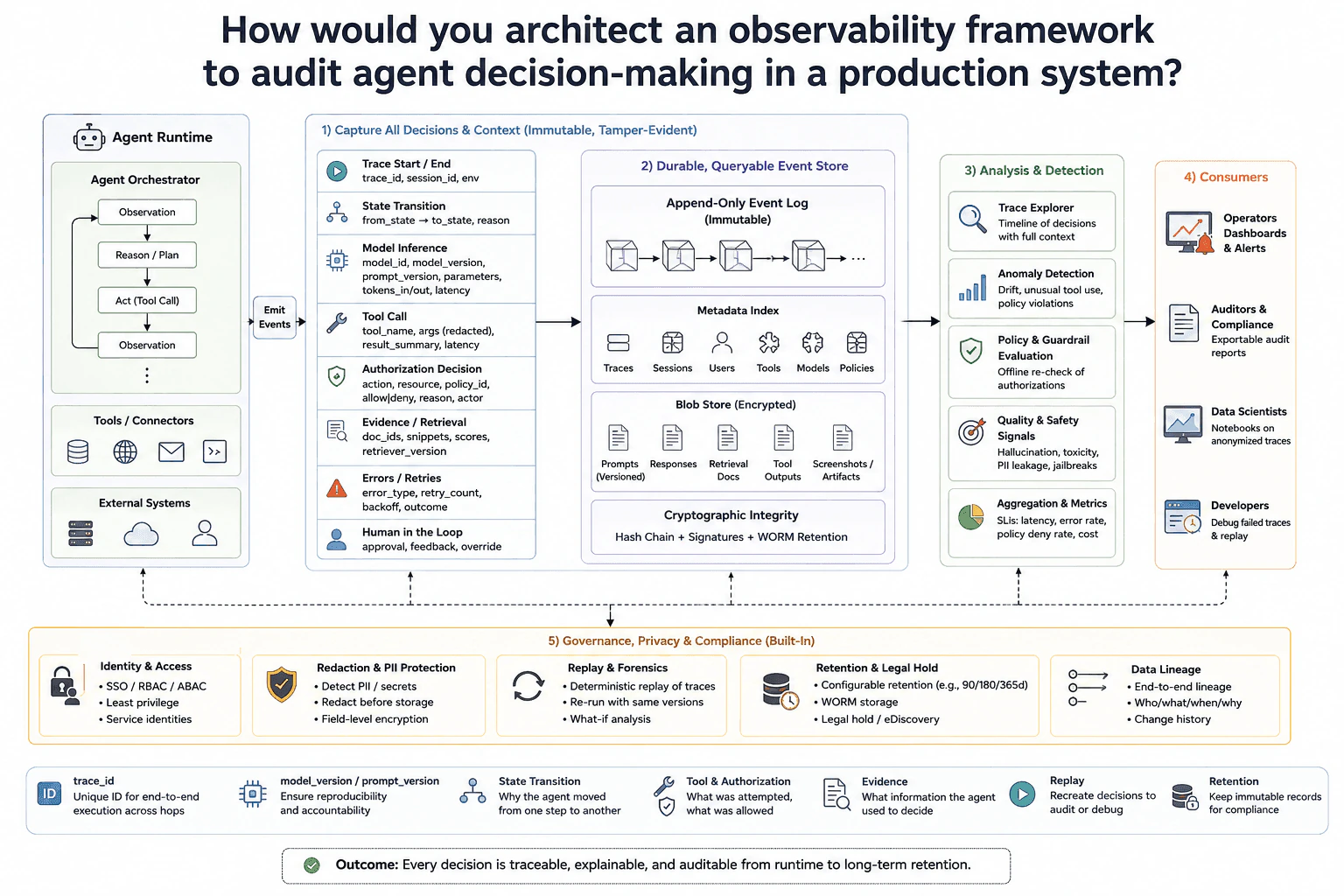
The system must let us understand what an agent did and what information affected each decision. This is difficult because one request can include several model calls, state changes, tool actions, permission checks, retrieved evidence, retries, and human decisions. We also need useful audit records without exposing private information. The diagram solves this in a clear flow. The Agent Runtime emits structured events. A durable store keeps them. Analysis tools find problems. Governance controls protect, replay, and retain the records.

Useful Questions to Ask the Interviewer
  1. Which agent decisions must be kept for compliance or investigation?
  2. Which sensitive fields must be removed or encrypted before storage?
  3. How long must different audit records be retained?
  4. Do investigators need recorded-trace replay, re-execution, or both?
How would you architect an observability framework to audit agent decision-making in a production system? diagram
How to Explain It in an Interview
1. Capture each decision under one trace

I would start by giving each end-to-end execution a trace_id. This connects events from the same agent run across its steps.

The Agent Orchestrator moves through Observation, Reason / Plan, Act (Tool Call), and another Observation. As it runs, it emits Trace Start / End, State Transition, Model Inference, Tool Call, Authorization Decision, Evidence / Retrieval, Errors / Retries, and Human in the Loop events.

For a model call, I record the model ID, model version, prompt version, parameters, token counts, and latency. For a tool call, I record the tool name, redacted arguments, result summary, and latency. Authorization records show the requested action, resource, policy, allow or deny result, reason, and actor.

2. Store the audit trail safely

Captured events flow into the Durable, Queryable Event Store. Its Append-Only Event Log keeps the ordered audit history without silently replacing older entries.

The Metadata Index lets investigators find traces by sessions, users, tools, models, and policies. Larger content goes into the encrypted Blob Store. This includes versioned prompts, responses, retrieval documents, tool outputs, screenshots, and artifacts.

Cryptographic Integrity uses a hash chain and signatures so later changes can be detected. WORM retention means protected records can be written but not quietly rewritten during their retention period.

3. Protect access and sensitive data

Governance, Privacy & Compliance applies across the design. Identity & Access uses SSO, RBAC or ABAC, least privilege, and service identities.

Redaction & PII Protection detects private information and secrets before storage. Sensitive fields can also use field-level encryption. Data Lineage records who or what produced information, when it changed, why it changed, and its change history.

4. Analyze behavior and detect problems

The Analysis & Detection layer reads the stored audit data. Trace Explorer shows the decision timeline with its full context.

Anomaly Detection looks for drift, unusual tool use, and policy violations. Policy & Guardrail Evaluation re-checks authorization decisions offline. Quality & Safety Signals look for hallucination, toxicity, PII leakage, and jailbreaks. Aggregation & Metrics tracks signals such as latency, error rate, policy deny rate, and cost.

5. Audit, replay, and retain evidence

Operators use dashboards and alerts. Auditors export audit reports. Data Scientists work with anonymized traces. Developers use failed traces for debugging and replay.

Replay & Forensics can reproduce the recorded trace for audit and can re-run a case using the same saved versions. What-if analysis tests a changed policy or model against the recorded evidence. A new execution may still differ if an external dependency or model behavior has changed.

Retention & Legal Hold controls how long records stay available. WORM storage protects retained audit records, while legal hold keeps required evidence from normal deletion. The benefit is strong traceability. The downside is more storage, privacy work, and operational complexity.

Practical Complexity & Trade-offs

The benefit is that every important agent action can be followed later. This helps operators debug failures, auditors review policy decisions, and developers investigate difficult traces. Keeping model and prompt versions also makes old behavior easier to study. The downside is extra storage and processing because one agent run may create many events and artifacts. Sensitive data needs careful redaction, encryption, and access control. Long retention increases cost. Replay also needs the right versions and saved evidence. We accept these costs because production agents can affect real systems, so their actions need a trustworthy audit trail.

Why Interviewers Ask This

Interviewers ask this to test whether you can make agent behavior observable without mixing model decisions with real tool actions. They want to see how you connect trace identity, versions, state changes, tools, permission checks, and evidence. They also test your judgment about privacy, replay, anomaly detection, retention, and the cost of keeping detailed audit records.

Interviewer may ask next
What would you change if the audit data contains highly sensitive customer information?

I would keep the same architecture, but I would make Redaction & PII Protection stricter before data reaches long-term storage. The capture layer should still produce the same event types because removing audit structure would make investigations much harder.

Tool arguments, prompts, responses, retrieval documents, and screenshots would be checked for private information and secrets before storage. Values that are not needed could be removed. Sensitive fields that must remain available could use field-level encryption.

Access to Trace Explorer, the Blob Store, replay tools, and exported audit reports would follow least privilege. This means each user or service sees only what its role requires. Data Scientists would continue using anonymized traces. Data Lineage would keep the history of who or what produced and changed protected information.

Retention rules could also keep sensitive artifacts for less time when policy allows it. The downside is that stronger redaction can remove useful debugging context. That can make replay and investigation harder.

How would you investigate an agent that suddenly starts using an unusual tool more often?

I would use the existing Analysis & Detection path. Anomaly Detection already looks for unusual tool use, so it can raise an alert when the pattern becomes suspicious.

I would open affected runs in Trace Explorer and follow their decision timelines. I would compare State Transitions, Model Inference records, Tool Calls, Authorization Decisions, and Evidence / Retrieval. Model and prompt versions help show whether the behavior changed after a version update. Authorization records show whether the unusual tool calls were actually allowed by policy.

If needed, Replay & Forensics can reproduce the recorded trace for investigation. A re-run with the same saved versions can test whether the behavior appears again. What-if analysis can test a changed policy or model against the same recorded evidence. Data Lineage and change history can connect the behavior to configuration changes.

The downside is that anomaly detection can produce false alarms. Human review is still needed before treating unusual behavior as a real incident.

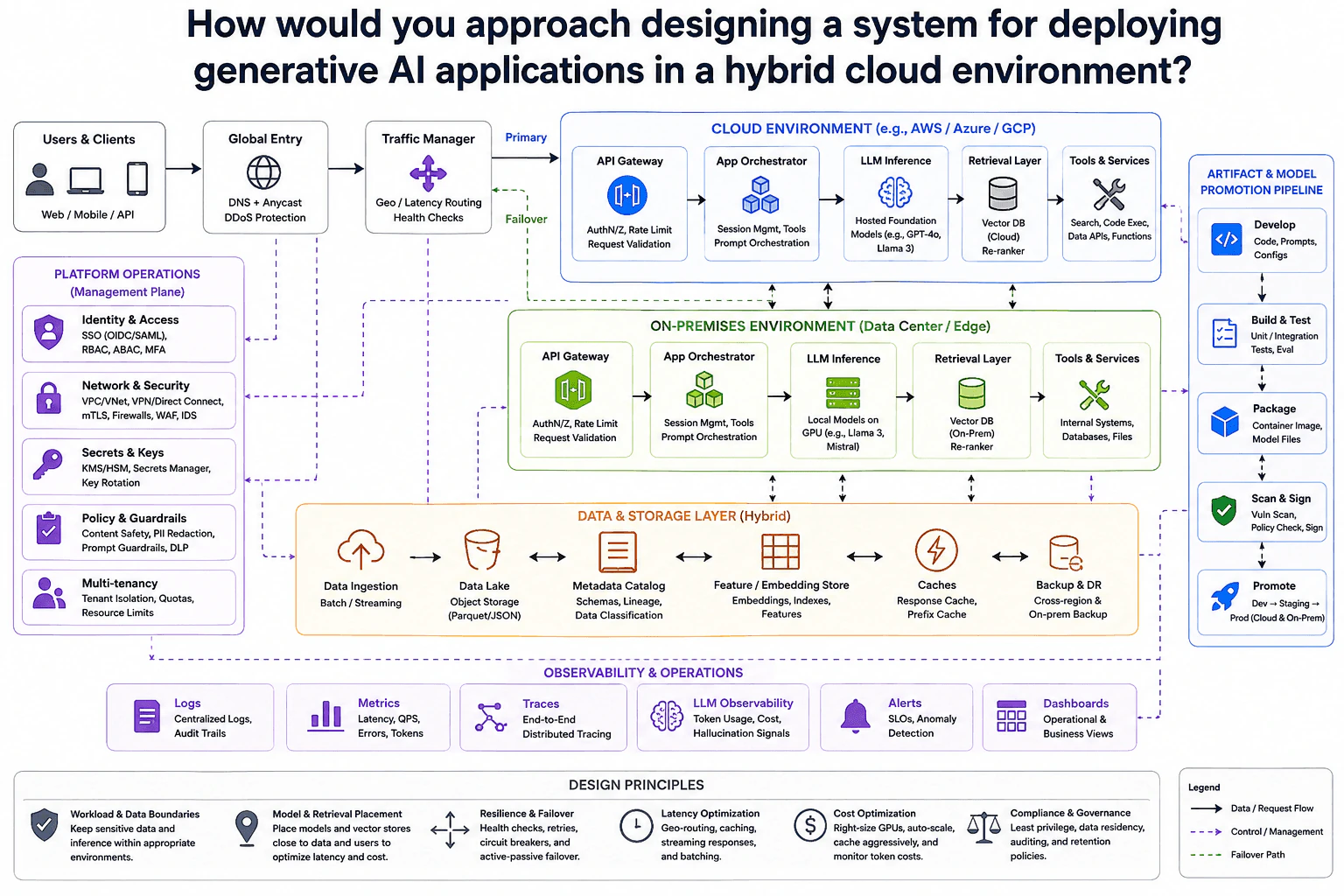
8. How would you approach designing a system for deploying generative AI applications in a hybrid cloud environment?Ai System DesignEasyNvidia

Question Details

Define workload and data boundaries, model and retrieval placement, identity, networking, artifact promotion, observability, failover, latency, and cost across cloud and on-premises environments.

Short Interview Answer (30-60 seconds)

At a high level, I would split the hybrid design using data sensitivity, latency, cost, and availability needs. User requests enter through Global Entry and the Traffic Manager, which selects the cloud path or the on-premises failover path. Both environments use an API Gateway, App Orchestrator, LLM Inference, Retrieval Layer, and Tools & Services. Shared platform controls handle identity, networking, secrets, guardrails, and tenant isolation. I would promote tested artifacts to both environments and observe them centrally. The trade-off is higher operational complexity in exchange for stronger control, placement flexibility, and resilience.

Detailed Explanation

The problem is to run one generative AI application across cloud and company-owned infrastructure. Some data may need to stay inside the company. Other work may be cheaper or easier to scale in the cloud. We also need requests to stay safe, fast, available, and affordable. The main design challenge is deciding where workloads, models, retrieval data, and tools should run. I would solve this with one controlled entry path, two serving environments, shared security controls, a hybrid data layer, one release process, and common monitoring.

Useful Questions to Ask the Interviewer
  • Which data must remain on-premises?
  • Which workloads have the strictest latency requirements?
  • What availability and disaster-recovery expectations matter most?
  • Should cloud and on-premises models provide similar application behavior?
  • Which cost limits should influence routing and model placement?
How would you approach designing a system for deploying generative AI applications in a hybrid cloud environment? diagram
How to Explain It in an Interview
1. Define workload and data boundaries first

I would first decide what may run in each environment. Sensitive data and related inference can stay on-premises when required. Other workloads can use cloud capacity when that is a better fit. The same decision applies to retrieval data. The diagram has a cloud Vector DB and an on-premises Vector DB. It also has a hybrid Data & Storage Layer. These boundaries matter because data residency, latency, cost, and compliance depend on placement.

2. Send requests through one controlled entry path

Users and clients first reach Global Entry. It provides DNS and Anycast access with DDoS protection. Requests then go to the Traffic Manager. It uses geography, latency, and health checks to choose where traffic should run. The diagram shows the cloud environment as the primary path. It also shows a failover path toward the on-premises environment. This keeps routing decisions outside the AI application and gives the design a clear place to react to unhealthy infrastructure.

3. Keep a similar serving stack in both environments

Each environment starts with an API Gateway. It owns authentication and authorization checks, rate limiting, and request validation. The request then moves to the App Orchestrator. This component manages sessions, prompts, and tool orchestration. It sends model work to LLM Inference. The cloud side can use hosted foundation models such as the examples shown in the diagram. The on-premises side runs local models on GPU resources. Retrieval uses the local Retrieval Layer and Vector DB, including re-ranking. Tools & Services connect the workflow to search, data APIs, functions, internal systems, databases, or files. The generated result then returns through the serving path to the client.

4. Use shared security and policy controls

Platform Operations acts as the management plane. Identity & Access provides SSO through OIDC or SAML, RBAC or ABAC permissions, and MFA. Network & Security covers VPC or VNet boundaries, VPN or direct connectivity, mTLS, firewalls, WAF, and IDS. Secrets & Keys covers KMS or HSM-backed key handling, secret management, and key rotation. Policy & Guardrails covers content safety, PII redaction, prompt guardrails, and DLP. Multi-tenancy adds tenant isolation, quotas, and resource limits. These shared controls help cloud and on-premises deployments follow the same security rules.

5. Place retrieval and storage close to the workloads that need them

The hybrid data layer supports batch or streaming ingestion. Data can move into a data lake using object storage. A Metadata Catalog tracks schemas, lineage, and data classification. The Feature / Embedding Store holds embeddings, indexes, and features used by retrieval. Caches hold response or prefix data when suitable. Backup & DR supports cross-region and on-premises backup. My placement rule would be simple: keep sensitive data inside its required boundary, and keep heavily used models and retrieval data close to the workloads when that improves latency and cost.

6. Promote, observe, and recover consistently

I would use one Artifact & Model Promotion Pipeline for both environments. Development produces code, prompts, and configuration. Build & Test runs unit tests, integration tests, and evaluations. Package creates container images and model files. Scan & Sign performs vulnerability scanning, policy checks, and signing. Promote moves releases from development to staging and production across cloud and on-premises. Observability collects Logs, Metrics, Traces, LLM Observability signals, Alerts, and Dashboards. Health checks support routing and failover. The design also shows retries, circuit breakers, graceful failover, caching, streaming responses, batching, backups, and disaster recovery. The benefit is resilience and placement flexibility. The downside is more networking, release, security, and operational work.

Practical Complexity & Trade-offs

The benefit of this design is that each workload can run where it fits best. Sensitive work can stay on-premises, while cloud resources can provide flexible capacity. Keeping models and retrieval data close to their users can reduce delay. Caching can also reduce repeated work and cost. The downside is that two environments create more operational work. Identity, networking, policies, releases, monitoring, and backups must stay consistent. Failover also needs regular testing. One promotion pipeline reduces deployment drift, but each release must work in both targets. Right-sized GPUs, autoscaling, caching, and token-cost monitoring help control spending. We accept the extra complexity because the design provides stronger data control, better placement choices, and another serving option when the primary path becomes unhealthy.

Why Interviewers Ask This

The interviewer is testing whether you can make practical hybrid-cloud decisions instead of simply naming cloud and on-premises services. They want clear workload and data boundaries, sensible model and retrieval placement, secure identity and networking, controlled artifact promotion, useful observability, and realistic failover. They also want you to reason about latency and cost. A strong answer shows which component owns each responsibility and explains the main trade-off between resilience, control, and operational complexity.

Interviewer may ask next
What would you do if the primary cloud serving path became unhealthy?

I would use the existing Traffic Manager and failover path rather than create a different application design. Health checks would identify that the primary cloud path is unhealthy. The Traffic Manager could then route suitable traffic toward the on-premises environment. The on-premises path keeps the same serving pattern: API Gateway, App Orchestrator, LLM Inference, Retrieval Layer, and Tools & Services. Shared identity, network security, secrets, policies, and tenant controls still apply. Logs, Metrics, Traces, Alerts, and Dashboards help operators confirm the failure and watch the fallback path. I would also check dependencies before moving traffic. A request that needs cloud-only data or tools cannot safely move unless those dependencies are available from the on-premises path. Backup & DR supports stored-data recovery, but it is separate from live traffic routing. The downside is that keeping a useful second environment ready costs money and operational effort. The benefit is that the application has another serving option when the cloud path cannot serve requests.

How would you decide whether a model and its retrieval data should run in the cloud or on-premises?

I would decide placement using the boundaries shown in the design. First, I would check data sensitivity and compliance needs. If information must stay inside the company environment, I would keep the related Vector DB and model processing on-premises. Next, I would consider latency. Keeping a model and retrieval store close to their users and data can avoid unnecessary network delay. I would then compare cost and available capacity. Cloud-hosted foundation models can be useful when managed capacity is a good fit. Local models on on-premises GPU resources provide more placement control, but the company must operate that capacity. The rest of the architecture stays the same. Identity, networking, guardrails, artifact promotion, observability, and tenant isolation still apply in both environments. The main downside is that maintaining more than one model or retrieval location increases operational work. The benefit is better control over privacy, latency, resilience, and cost.

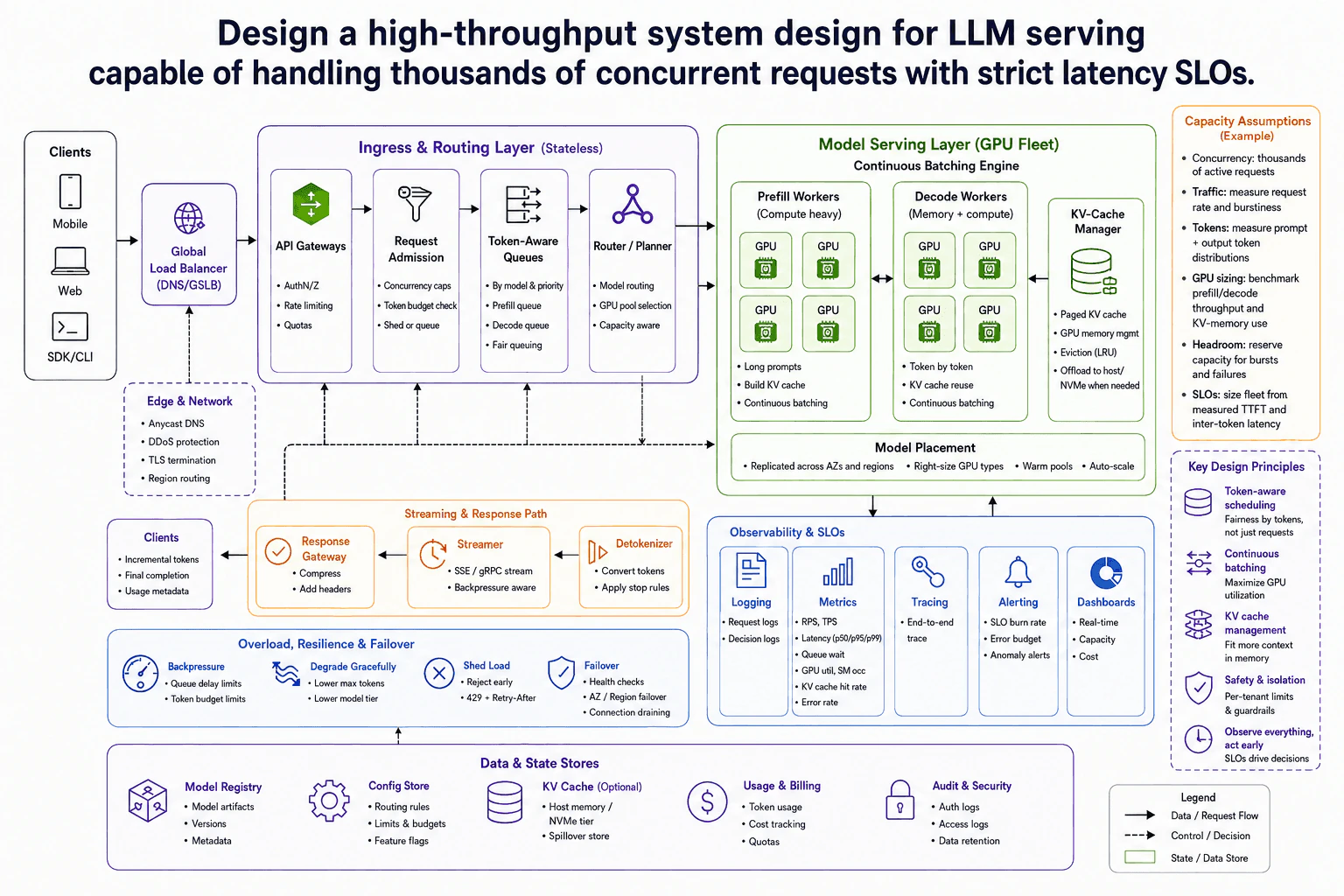
9. Design a high-throughput system design for LLM serving capable of handling thousands of concurrent requests with strict latency SLOs.Ai System DesignMediumNvidia

Question Details

Specify admission, token-aware queues, model placement, prefill and decode scheduling, continuous batching, KV-cache management, streaming, overload, failover, observability, and capacity assumptions.

Short Interview Answer (30-60 seconds)

At a high level, I would protect latency before expensive GPU work begins. Requests move through global load balancing, API gateways, admission checks, token-aware queues, and a capacity-aware router. The GPU fleet separates compute-heavy prefill from token-by-token decode. Continuous batching improves GPU use, while KV-cache management avoids repeated attention work. During overload, I use backpressure, graceful degradation, early load shedding, and failover. The main trade-off is keeping batches large enough for throughput without making individual requests wait too long.

Detailed Explanation

We need to serve thousands of active requests while keeping responses fast. The difficult part is that requests need different amounts of work. A long prompt can use far more GPU time and memory than a short prompt. So the system must control incoming work, schedule it fairly, keep GPUs busy, and avoid long queues. It must also handle failures without letting one problem slow every user. I would explain the design by following the request from the client to the GPU fleet, then following the streamed response back.

Useful Questions to Ask the Interviewer
  • What traffic rate and burst size should we plan for?
  • What prompt and output token distributions should we expect?
  • Which latency goals matter most, such as TTFT or inter-token latency?
  • Can we shorten outputs or use a lower model tier during overload?
Design a high-throughput system design for LLM serving capable of handling thousands of concurrent requests with strict latency SLOs. diagram
How to Explain It in an Interview
1. Control traffic before it reaches the GPUs

Clients can be Mobile, Web, or SDK/CLI applications. Requests first reach the Global Load Balancer using DNS/GSLB. The Edge & Network layer provides Anycast DNS, DDoS protection, TLS termination, and region routing.

API Gateways then apply AuthN/Z, rate limiting, and quotas. Request Admission checks concurrency caps and token budgets. It can send work forward, queue it, or shed it. This protects the expensive GPU fleet from work that cannot meet the latency goal.

2. Queue requests by expected work

Accepted requests enter Token-Aware Queues. They separate work by model and priority. They also distinguish prefill and decode work and apply fair queuing.

This matters because request count alone is misleading. One long prompt can cost much more than several short prompts. Token-aware scheduling therefore makes a better fairness and capacity decision.

The Router / Planner chooses the model route and GPU pool. It is capacity aware, so it avoids sending more work to an overloaded pool.

3. Separate prefill from decode

The Model Serving Layer uses Prefill Workers and Decode Workers. Prefill reads the full prompt and builds the KV cache. This stage is compute heavy. Decode then generates one token at a time and reuses that cached state.

Both worker groups use continuous batching. This means ready requests can join GPU batches while earlier requests continue. The benefit is higher GPU use. The downside is that waiting too long for batching can hurt latency.

Model Placement supports replicas across availability zones and regions. It also uses right-sized GPU types, warm pools, and auto-scaling.

4. Treat KV-cache memory as a limited resource

The KV-Cache Manager uses a paged KV cache and manages GPU memory. It can evict entries using LRU and offload state to host memory or NVMe when needed.

The Data & State Stores area also shows an optional KV Cache tier with host memory, NVMe, and spillover storage. This gives more room for active contexts, but slower tiers can increase latency.

5. Stream completed tokens back to the client

The Streaming & Response Path contains Detokenizer, Streamer, Response Gateway, and Clients. The Detokenizer converts model tokens and applies stop rules. The Streamer sends incremental output with SSE or gRPC and handles backpressure. The Response Gateway compresses the response and adds headers. Clients receive incremental tokens, final completion, and usage metadata.

Streaming is important because users can see output before the full generation finishes.

6. Protect the system during overload and failures

Backpressure uses queue-delay limits and token-budget limits. Graceful degradation can lower maximum output tokens or use a lower model tier. If capacity is still exhausted, the system sheds work early with 429 and Retry-After.

Failover uses health checks, AZ or regional failover, and connection draining. These controls protect healthy capacity instead of allowing one failure to spread through the fleet.

7. Observe, operate, and size the system from measurements

Observability records request logs and decision logs. Metrics include request rate, token rate, latency percentiles, queue wait, GPU utilization, KV-cache hit rate, and errors. Tracing follows requests end to end. Alerting watches SLO burn rate, error budget, and anomalies. Dashboards show real-time capacity and cost.

Supporting stores include the Model Registry for model artifacts, versions, and metadata, plus the Config Store for routing rules, limits, budgets, and feature flags. Usage & Billing tracks token usage, cost, and quotas. Audit & Security stores authentication, access, and retention records.

Capacity planning should use measurements instead of guessed numbers. I would measure traffic burstiness, prompt and output token distributions, prefill and decode throughput, KV-memory use, and required failure headroom. I would then size the fleet from measured TTFT, meaning time to first token, and measured inter-token latency.

Practical Complexity & Trade-offs

The main trade-off is GPU efficiency versus latency. Continuous batching improves throughput because more useful work runs together. However, waiting for a bigger batch can slow an individual request. Token-aware queues are fairer than simple request queues because long prompts need more work. Separate prefill and decode workers let us tune two different workloads, but they add scheduling complexity. KV caching saves repeated attention work, but GPU memory is limited. Eviction and offload help, although slower memory can increase latency. Warm pools and spare capacity improve failover speed, but they cost money. Backpressure and early 429 responses protect healthy requests, but some traffic is rejected. We accept these costs because strict latency goals need controlled admission, spare capacity, and predictable resource use.

Why Interviewers Ask This

The interviewer wants to see whether you can turn a large traffic goal into a practical GPU-serving design. They are testing your judgment around admission control, token-aware scheduling, prefill versus decode, continuous batching, and KV-cache pressure. They also want to see whether you understand overload protection, failover, observability, and capacity planning. A strong answer explains both throughput and latency, because maximizing GPU use alone is not enough when the service has strict latency SLOs.

Interviewer may ask next
What would you do if traffic suddenly exceeds the available GPU capacity?

I would protect latency first instead of accepting every request. Request Admission would continue enforcing concurrency caps and token budgets before expensive GPU work begins. Token-Aware Queues would keep accepted work ordered by model, priority, prefill or decode stage, and fair scheduling. As queue delay grows, Backpressure would stop admitting work that is unlikely to meet the latency goal.

The next step is graceful degradation. The diagram allows lowering maximum output tokens or moving suitable work to a lower model tier. If that is still not enough, the system sheds load early and returns 429 with Retry-After. This is better than allowing accepted requests to build a very long queue.

Model Placement can also use warm pools and auto-scaling to add capacity. Capacity-aware routing keeps avoiding overloaded GPU pools. The downside is that some users may receive shorter output, another allowed model tier, or temporary rejection. That trade-off protects the latency of requests the system can serve well.

How would you prevent KV-cache pressure from causing latency spikes?

I would treat KV-cache memory as a limited scheduling resource. Prefill Workers build the KV cache from the prompt. Decode Workers reuse that state while generating tokens. The KV-Cache Manager uses paged KV storage, which lets memory be managed in smaller blocks instead of requiring one large continuous allocation.

When GPU memory becomes tight, the manager can evict older entries using the shown LRU policy. It can also offload state to host memory or NVMe. The diagram also shows an optional KV Cache tier with host memory, NVMe, and spillover storage.

The system should watch KV-cache hit rate, queue wait, and GPU utilization together. The capacity-aware Router / Planner can avoid a pool already under memory pressure. The main downside is that eviction or offload can make later access slower than keeping the state on GPU memory. We accept that cost because uncontrolled GPU-memory pressure can cause much larger latency spikes or failed work.

10. Design a distributed training system for a trillion-parameter language model.Ai System DesignHardNvidia

Question Details

Define data and model pipeline, hybrid parallelism, optimizer and activation memory, interconnect topology, input throughput, checkpoints, failure recovery, evaluation, and scaling efficiency at trillion-parameter scale.

Short Interview Answer (30-60 seconds)

At a high level, I would build one distributed training system that keeps thousands of GPUs busy while remaining recoverable. Data is cleaned, tokenized, sharded, loaded, and queued before training. The model uses tensor, pipeline, data, and sequence parallelism across the training fabric. ZeRO-3, activation checkpointing, and mixed precision reduce memory use. NVLink and InfiniBand carry heavy communication. I would save asynchronous checkpoints, recover from the latest consistent state, run regular evaluation, and track MFU and token throughput as the cluster grows.

Detailed Explanation

We are trying to train a language model that is too large for one machine. The main goal is to spread the work across many GPUs while keeping them busy. The data must arrive fast enough. The model and optimizer must fit across GPU memory. Communication must not become the main bottleneck. If hardware fails, training should continue from a recent saved state. The diagram solves this with a control plane, a fast data pipeline, hybrid parallel training, high-speed networking, checkpoints, evaluation, and monitoring.

Useful Questions to Ask the Interviewer
  • What GPU count and cluster size should I design for?
  • Is the one-trillion-parameter model dense or sparse?
  • What sequence length and global batch size should I target?
  • What checkpoint interval and recovery time are acceptable?
Design a distributed training system for a trillion-parameter language model. diagram
How to Explain It in an Interview
1. Start with the control plane and training goals

I would first separate control work from model computation. The Job Orchestrator handles scheduling and quotas. The Cluster Manager provisions resources and can scale the cluster. The Topology Manager handles placement and mapping. This matters because communication-heavy workers should be placed close together. Telemetry and Alerting collects metrics and traces. Config and Experiment Tracking stores the training configuration and experiment state. The main goals are high MFU, strong useful-throughput scaling, fault recovery, and reasonable training cost.

2. Keep the GPUs supplied with data

Raw data can come from web text, books, code, and internal sources. Data Ingestion removes duplicates, filters records, and removes sensitive information when required. Data Processing normalizes the text, splits it, and converts it into BPE tokens. The result becomes a sharded Parquet dataset. Distributed Storage, such as S3 or GCS, holds the dataset. A Data Loader Fleet reads shards in parallel and uses prefetching and caching. Batch Queues provide prioritized batches and backpressure. The diagram shows an example target of more than 15 million tokens per second for the one-trillion-parameter model. The purpose is to keep GPUs busy instead of waiting for input.

3. Use hybrid parallelism across the training fabric

The model is too large for one GPU, so I would combine several kinds of parallelism. Tensor Parallelism splits model work inside a layer across devices. Pipeline Parallelism places different layer groups on different pipeline stages. Data Parallelism creates model replicas across groups. Sequence Parallelism splits activation work along the sequence dimension to reduce memory pressure. During the forward pass, activations move from earlier pipeline stages to later stages. During the backward pass, gradients move from later stages toward earlier stages. Corresponding replicas within the same pipeline stage use Reduce-Scatter and All-Gather for data-parallel and ZeRO communication.

4. Reduce optimizer and activation memory

Memory is one of the hardest limits at this scale. I would use mixed precision, such as FP8 or BF16, where supported by the model. Activation checkpointing stores fewer intermediate activations and recomputes some during backpropagation. ZeRO-3 shards parameters, gradients, and optimizer states across a data-parallel group. The Optimizer and Update step can use AdamW or Adafactor, with sharded states, gradient clipping, and weight decay as shown. Host-memory offload can help when GPU memory is still tight. These methods reduce memory per GPU, but they add recomputation or communication.

5. Use a high-bandwidth interconnect

The training fabric must support heavy communication between GPUs. Inside a node, I would use a fast link such as NVLink. Across nodes, the diagram uses InfiniBand. A fat-tree or Dragonfly-style topology can provide high bisection bandwidth, low latency, and redundant paths. This matters because tensor, pipeline, and data-parallel communication can otherwise leave expensive GPUs idle. The Topology Manager should map workers so communication-heavy groups use efficient network paths.

6. Checkpoint, recover, evaluate, and observe continuously

The training job writes asynchronous checkpoints containing model weights, optimizer state, random-number state, and metadata. Distributed object storage keeps these checkpoints. Heartbeats and health checks detect node, GPU, network, and process failures. After a failure, the control plane can restart and requeue work. Workers reconstruct model state from the latest consistent checkpoint and resume training. A separate Evaluation Pipeline uses held-out sharded data for distributed validation. It records metrics such as perplexity, loss, and accuracy. Observability also tracks GPU, network, system, input-pipeline, training, cost, and utilization metrics. Traces, dashboards, alerts, and profiling help find bottlenecks and failures.

7. Measure scaling efficiency as the cluster grows

I would not judge the system only by GPU count. I would track MFU, samples or tokens per second, time to train, failure-recovery time, and cost per trillion tokens. As GPU count grows, useful throughput should initially grow close to linearly. Eventually communication and coordination become more important. That is the main scaling limit. More parallelism lets the model fit and can increase throughput. The downside is more synchronization, network traffic, scheduling complexity, and recovery coordination. I would keep tuning the parallelism layout until adding GPUs no longer gives enough useful throughput.

Practical Complexity & Trade-offs

The main trade-off is memory versus communication. More sharding lets a one-trillion-parameter model fit across many GPUs, but shards must exchange more data. Tensor Parallelism works well with very fast local links, but communication cost grows when devices are farther apart. Pipeline Parallelism spreads layers across stages, but poor scheduling can leave stages idle. Data Parallelism increases throughput, but replicas need collective communication. ZeRO-3 and activation checkpointing save memory, but they add communication or recomputation. Frequent checkpoints reduce lost work after failure, but they increase storage traffic. Larger batches can improve GPU use, but memory limits still matter. We accept this complexity because training at this scale requires compute, memory, networking, storage, and recovery to work together.

Why Interviewers Ask This

Interviewers ask this to test whether the candidate can reason about model scale, GPU memory, networking, storage, data throughput, and reliability together. They want to see why hybrid parallelism is required and where communication becomes expensive. They also look for practical judgment about optimizer memory, checkpoints, failure recovery, evaluation, observability, and scaling efficiency. A strong answer explains trade-offs instead of only naming distributed-training techniques.

Interviewer may ask next
What would you change if the cluster grows much larger and scaling efficiency starts to fall?

I would first measure where the lost efficiency comes from instead of adding more GPUs blindly. I would compare MFU, token throughput, network time, data-loader wait time, and pipeline idle time. If collective communication dominates, I would improve Topology Manager placement so communication-heavy groups use faster and shorter network paths. I would also retune the balance between Tensor, Pipeline, Data, and Sequence Parallelism. Too much Tensor Parallelism across slower links can become expensive. Too many pipeline stages can create bubbles where stages wait for work. If input becomes the bottleneck, I would increase parallel reading, prefetching, caching, and batch-queue capacity. The model, optimizer rules, checkpoint format, evaluation pipeline, and recovery design remain unchanged. The downside is more scheduling and tuning complexity. The best parallel layout may also change when sequence length, batch size, model shape, or cluster size changes.

How would the system recover if a GPU or node fails during training?

I would recover from the latest consistent distributed checkpoint. Heartbeats and health checks already watch nodes, GPUs, networks, and worker processes. When a worker fails, the control plane detects the problem and requeues the affected work. Replacement resources are provisioned and mapped into the required Tensor, Pipeline, Data, and Sequence Parallel groups. The checkpoint contains model weights, optimizer state, random-number state, and metadata. That lets the workers reconstruct the saved training state instead of starting again. They load the checkpoint and resume from that point. Evaluation and observability continue through the same paths after the job becomes healthy. The main downside is lost work since the last checkpoint. More frequent checkpoints reduce this loss, but they increase storage and I/O overhead. Less frequent checkpoints reduce checkpoint cost, but a failure wastes more computation.

More questions load as you scroll

Disclaimer: This interview guide is for educational and informational purposes only. It is designed to help readers prepare, but it does not guarantee any interview result, hiring decision, offer, or outcome. Interview questions, hiring criteria, and preferred answers can vary by employer, interviewer, industry, location, and time. The examples and explanations reflect the authors' research and judgment, are provided without warranties of any kind, and should not be treated as the only correct approach. Diagrams are simplified illustrations intended to highlight the main components and their interactions; actual systems and implementations may be more complex. Alternative approaches may be equally valid or better suited to a particular question, context, or interviewer. To the fullest extent permitted by applicable law, the author, contributors, and publisher are not liable for decisions made, actions taken, or losses incurred based on this guide.

Company Notice: This guide is an independent educational resource and is not affiliated with, endorsed by, sponsored by, or approved by the company named in this guide. Company names are used only to identify interview experiences commonly reported by candidates. Interview practices can change without notice, and inclusion of company-specific content does not mean these questions are official, complete, or guaranteed to be asked. To the fullest extent permitted by law, the author, contributors, and publisher are not responsible for outcomes related to use of this material.