This interview guide is for educational and informational purposes only. It is designed to help readers prepare, but it does not guarantee any interview result, hiring decision, offer, or outcome. Interview questions, hiring criteria, and preferred answers can vary by employer, interviewer, industry, location, and time. All answers, examples, and explanations in this guide are suggested examples for interview preparation, not definitive answers or instructions for professional practice. They are based on research and judgment, are provided without warranties of any kind, and should be adapted to the question, role, and applicable laws and professional requirements. Diagrams are simplified illustrations intended to highlight the main concepts and their relationships; actual situations, systems, and practices may be more complex. Alternative approaches may be equally valid or better suited to a particular question, context, or interviewer. To the fullest extent permitted by applicable law, the contributors and publisher are not liable for decisions made, actions taken, or losses incurred based on this guide.
State Laws and Professional Responsibilities
Laws and requirements governing an occupation vary by state and jurisdiction. You are responsible for checking the current laws, licensing requirements, and scope-of-practice rules that apply to your location and role, and for ensuring that your answers and actions comply with them. Adapt examples in this guide to those requirements. This guide is not legal advice.
Identity, Image, and Privacy Notice
To respect individual privacy, some names, profile photographs, avatars, biographical details, and other identifying information displayed in this guide may be replaced with pseudonyms, licensed stock images, illustrative avatars, composite images, or representative descriptions. Unless a person is expressly identified as an actual contributor, a displayed name, image, or profile should not be understood as depicting or identifying a specific candidate, interviewer, employee, or other real individual. These representations are provided for editorial and illustrative purposes only and do not imply endorsement, employment, participation, or affiliation with this guide or any company mentioned in it. Any resemblance to an actual person is coincidental.
Company Notice
This guide is an independent educational resource and is not affiliated with, endorsed by, sponsored by, or approved by the company named in this guide. Company names identify reported interview experiences or the employer context of clearly labeled original practice exercises. Interview practices can change without notice, and inclusion of company-specific content does not mean these questions are official, complete, or guaranteed to be asked. To the fullest extent permitted by law, the author, contributors, and publisher are not responsible for outcomes related to use of this material.
Content Accuracy and Verification
To the fullest extent permitted by applicable law, we do not represent or warrant that interview guides, questions, answers, examples, or diagrams are accurate, complete, current, error-free, or suitable for any particular purpose. You are responsible for independently reviewing and verifying the information before relying on it.
Questions or comments?
Contact us for general questions, or share feedback, technical corrections, and comments with the community.
1. Do we persist full prompt and output history per run, or metadata only, and what are the retention and privacy requirements?Prompt EngineeringEasyOpenai
i Question Details
Clarify the prompt-experiment record needed for reproducibility while distinguishing sensitive prompt or response bodies from metadata, ownership, configurable retention, deletion, and access controls.
Short Interview Answer (30-60 seconds)
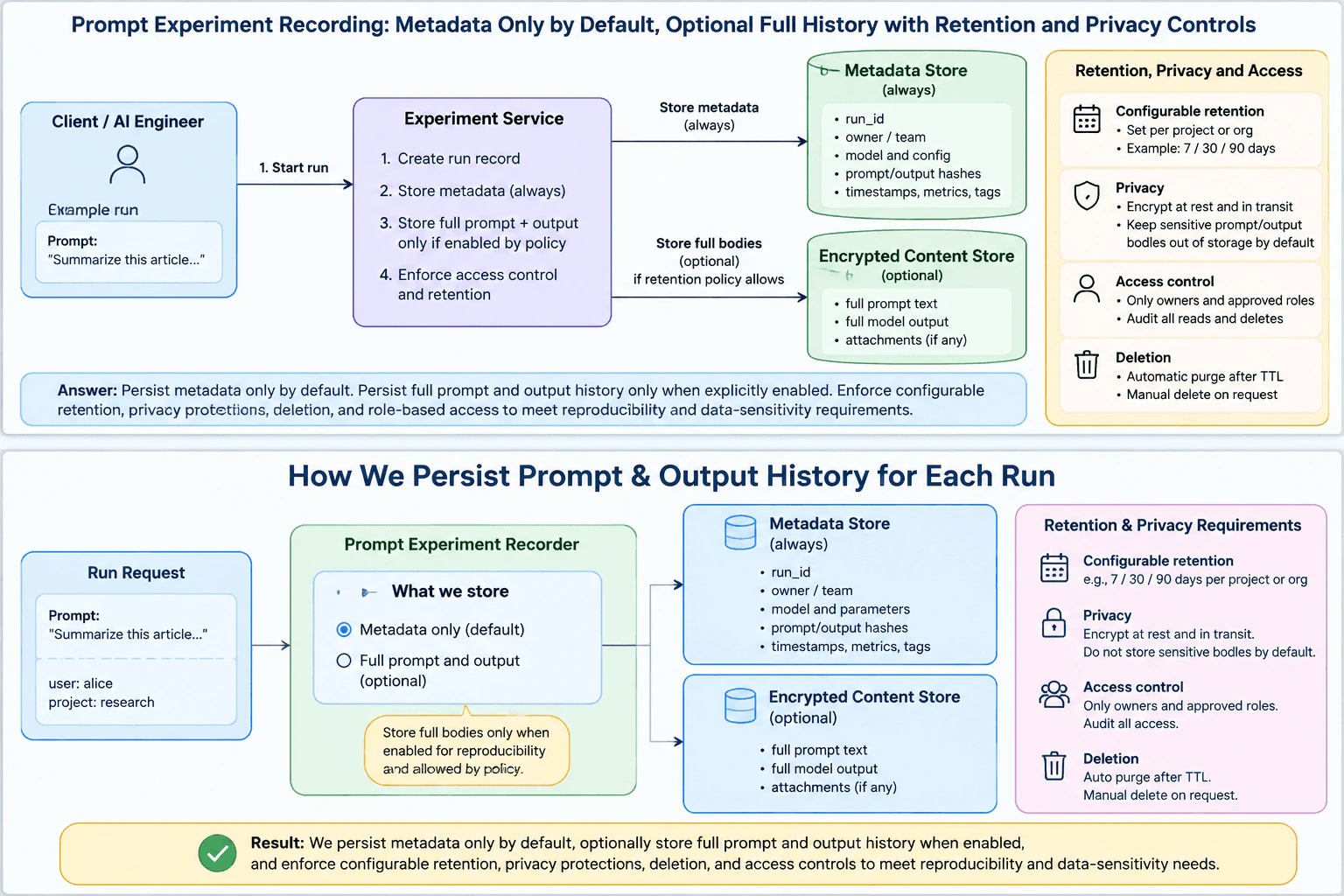
I would persist metadata for every run by default and store full prompt and output history only when there is a clear need and the policy allows it. Metadata supports tracking and comparison without storing sensitive content. If full bodies are stored, I would separate them into an encrypted store with retention rules, deletion support, and restricted access.
Detailed Explanation
This question asks how a system should save records from prompt experiments. The main choice is saving basic information about each run or saving the complete prompt and model response. The decision depends on whether we need to reproduce results and whether the saved content contains private information.
Useful Questions to Ask the Interviewer
Are prompt and output bodies considered sensitive data in this system?
Do users need exact reproduction of previous runs, or is metadata enough?
How to Explain It in an Interview
I would design the system to store metadata for every prompt experiment run. The metadata store contains the run identifier, owner, model configuration, parameters, timestamps, metrics, and references to any stored content.
Full prompt and output history should be optional because these fields may contain confidential information or user data. When full bodies are needed for debugging or reproducibility, the system should store them in a separate encrypted content store. Access should be limited to approved users and tracked through audit records.
Retention should be configurable because different teams have different requirements. Metadata can usually have longer retention because it contains less sensitive information. Prompt and output bodies should have shorter retention periods or remain disabled by default.
The system should also support deletion. Records should expire automatically according to retention policy, and owners or users should be able to request deletion when required.
The main tradeoff is reproducibility versus privacy and storage cost. Full history makes debugging easier, but increases security risk and storage usage. Metadata only reduces risk but may make detailed investigation harder.
Prompt Example
User request: Summarize this article.

System stores:
Metadata:
run_id: "123"
owner: "team-a"
model: "example-model"
parameters: {"temperature": 0.2}

Optional content storage:
Prompt: "Summarize this article."
Output: "Article summary..."

The content store is used only when enabled and allowed by policy.
Interviewers ask this question to evaluate whether the candidate understands how to design a production prompt experiment system. They want to see if the candidate can balance reproducibility, privacy, storage cost, retention rules, and access control.
Common interview mistakes
A common mistake is storing every prompt and response without considering privacy. Another mistake is storing full content without metadata, which makes experiments difficult to track. Teams also often forget encryption, deletion policies, and access controls for sensitive prompt and output data.
Interview tip
Start with the main decision: metadata by default and optional full history. Then explain the tradeoff between reproducibility and privacy. Mention retention, deletion, and access control to show production awareness.
Interviewer may ask next
What if a prompt contains sensitive customer information that is needed for debugging?
I would not store the sensitive prompt by default. If debugging requires it, I would store it only with approval, encryption, restricted access, and a defined retention period. This matters because debugging value must be balanced with privacy risk.
How would you design storage if teams need long term prompt experiment comparison?
I would keep long term metadata and prompt version information while limiting full prompt and output storage. This allows teams to compare experiments while reducing storage cost and privacy risk.
2. A user reloads the page mid-generation. How do you let them reconnect to or recover an in-flight prompt run?Prompt EngineeringMediumOpenai
i Question Details
Define the run identity and lifecycle, persisted versus ephemeral stream state, replay or resume boundary, token ordering, cancellation, and the client behavior when the original generation has already terminated.
Short Interview Answer (30-60 seconds)
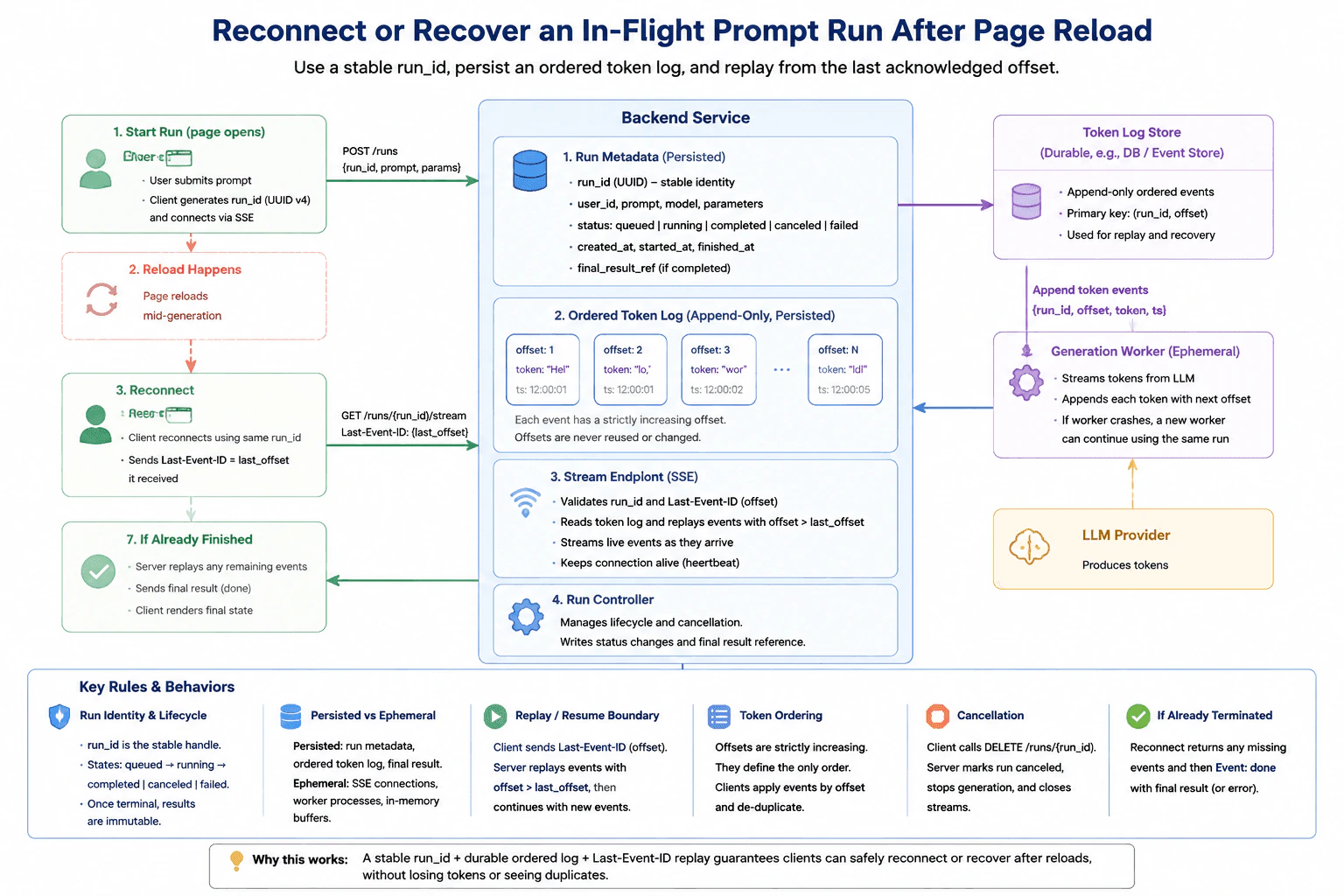
I would create a stable run_id for every prompt run and store the run lifecycle, metadata, and ordered token progress on the server. If the user reloads the page, the client reconnects with the same run_id and the last received token offset. The server replays missing events and continues streaming new tokens if the run is still active. If the run already finished, the server returns the saved final result instead of starting generation again.
Detailed Explanation
This question asks how an AI application can continue a prompt generation after a user reloads the page. The goal is to keep the same generation running and avoid losing progress or creating a second result.
Useful Questions to Ask the Interviewer
Should recovery support only browser reloads, or also network disconnects and reconnects from another device?
How long should an unfinished prompt run remain available for recovery?
How to Explain It in an Interview
I would separate the temporary browser connection from the actual prompt run. When a user starts a generation, the application creates a unique run_id. This identifier stays the same throughout the run lifecycle.
The backend stores run metadata, current status, and the generated token stream. The token stream is stored as ordered events with increasing offsets. The browser connection can disappear, but the prompt run state remains available.
If the page reloads, the client reconnects using the same run_id and sends the last token offset it received. The server checks the stored stream state and sends only missing events after that offset. This prevents duplicate tokens and prevents lost output.
If the run is still active, the server continues streaming new tokens. If the generation completed while the user was away, the server returns the stored final result. If the user cancels the run, the backend updates the lifecycle state and stops generation.
The tradeoff is that storing run metadata and token events requires additional storage. The benefit is reliable recovery from browser failures and network interruptions without restarting expensive model work.
Interviewers ask this question to evaluate whether the candidate understands how to design reliable AI applications when a long running prompt generation is interrupted. They want to see knowledge of run identity, lifecycle management, persisted state, streaming recovery, ordering, cancellation, and production reliability.
Common interview mistakes
A common mistake is storing generation state only in browser memory because a reload removes that state. Another mistake is creating a new model request after reconnecting, which can produce different output and extra cost. Systems can also fail when they do not preserve token ordering, causing duplicate or missing tokens. Another mistake is treating completed runs as active streams instead of returning the saved final result.
Interview tip
Start with the main design decision: the browser connection and the prompt run should be separate. Then explain run_id, persisted state, replay using token offsets, active versus completed runs, and the main tradeoff.
Interviewer may ask next
What happens if the user reconnects after the generation has already completed?
The server returns the stored final result instead of starting a new generation. The completed run state is final, so the client can recover the answer without duplicate model work. This matters because completed results should remain stable and reusable.
How do you balance reliable recovery with the storage cost of keeping token streams?
The system stores enough token history to support the required recovery period. Keeping more token events improves replay ability but increases storage cost. The tradeoff is between stronger recovery guarantees and the amount of persisted stream data.
3. How do you enforce per-user and per-organization prompt-run cost and rate limits without adding latency to time to first token?Prompt EngineeringHardOpenai
i Question Details
Cover the fast-path quota decision, token and cost estimation, atomic usage accounting, burst behavior, concurrent generations, rejection or degradation, and reconciliation when actual output differs from the reservation.
Short Interview Answer (30-60 seconds)
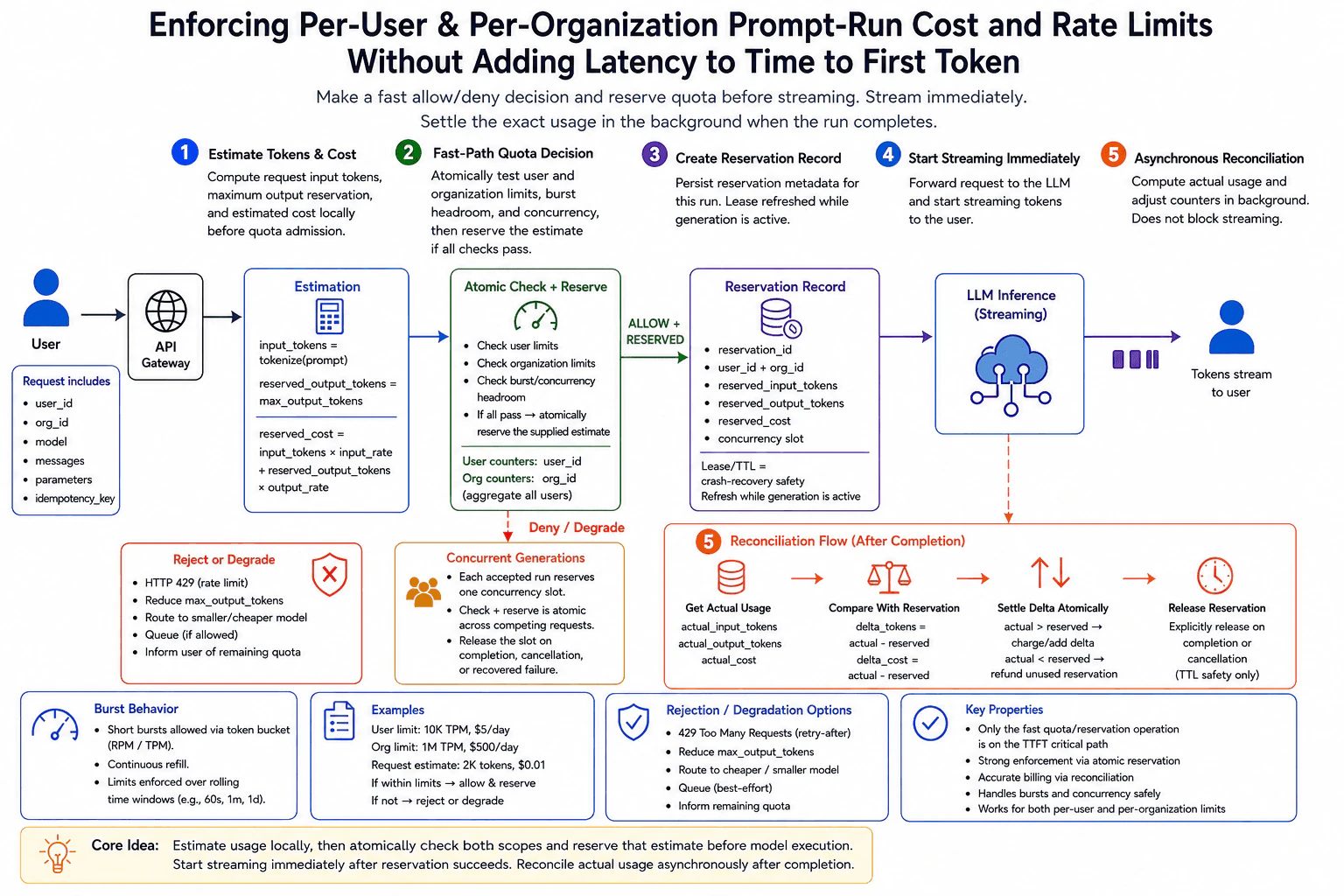
I estimate the request usage locally, then atomically check both the user quota and the organization quota and reserve that estimate. If the reservation succeeds, I start model streaming immediately. Each accepted generation also reserves one concurrency slot. After the generation finishes, I compare actual token and cost usage with the reservation, settle the difference atomically, and release the reservation. This keeps exact reconciliation off the time to first token critical path while still protecting rate and cost limits.
Detailed Explanation
The key idea is to do only the minimum admission work before calling the model. First, estimate how many input and output tokens the request may use and what that may cost. Then check both the user allowance and the organization allowance. If both have enough room, reserve the estimate in the same atomic operation. After that succeeds, start the model request and stream the answer. When the run finishes, compare the real usage with the reservation and correct the counters.
Useful Questions to Ask the Interviewer
Are cost limits enforced for each user and for the whole organization?
Should short bursts be allowed when the normal rate is temporarily exceeded?
Should an over limit request be rejected, queued, or sent to a cheaper model?
Do we need a separate limit for concurrent generations?
How to Explain It in an Interview
I would keep local estimation and one fast quota reservation operation on the request critical path. Exact final accounting happens later.
First, estimate input tokens locally from the prompt. Reserve output capacity using the configured maximum output tokens. Estimate cost with separate input and output rates when those rates differ.
Next, run one atomic check and reserve operation. It checks the user limits, the organization limits, burst headroom, and the concurrency limit. If every check passes, it reserves the estimated token and cost budget plus one concurrency slot. Atomic means competing requests cannot both observe the same remaining quota and spend it twice.
User counters are tracked by user. Organization counters are shared by all users in that organization. This lets the service enforce both scopes together.
After reservation succeeds, persist a reservation record with the reservation identifier and reserved amounts, then start model streaming immediately. A renewable lease can protect against abandoned reservations after a crash. An active generation refreshes that lease so its quota is not released while work is still running.
If admission fails, return a rate limit response or apply an allowed degradation policy. The diagram shows options such as reducing the maximum output size, choosing a cheaper model, or queueing the request.
For bursts, a token bucket style allowance can permit short spikes while still enforcing usage over time. Concurrent requests still need the same atomic reservation so a burst cannot oversubscribe the budget.
After completion or cancellation, read actual input tokens, output tokens, and cost. Compare them with the reservation. If actual usage is higher, charge the extra amount. If it is lower, refund the unused reservation. Then release the concurrency slot and reservation. This reconciliation happens after streaming, so it does not delay the first token beyond the fast admission work.
Technical Approach
Read the user identifier, organization identifier, selected model, prompt, and generation settings.
Estimate input tokens locally and reserve output tokens from the configured maximum output size.
Estimate reserved cost using the input rate and output rate.
Atomically check user limits, organization limits, burst headroom, and available concurrency.
If every check passes, reserve the estimated usage and one concurrency slot in that same atomic operation.
Persist a reservation record with the reservation identifier, user identifier, organization identifier, reserved input tokens, reserved output tokens, reserved cost, and concurrency slot.
Start model inference and stream tokens immediately after reservation succeeds.
If admission fails, reject the request or apply the configured degradation policy.
After completion or cancellation, obtain actual input tokens, output tokens, and cost.
Compare actual usage with the reservation and settle the difference atomically.
Release unused reserved capacity and the concurrency slot.
Use a renewable lease as crash recovery protection, and refresh it while the generation is active.
Interviewers ask this to test whether I can combine prompt token estimation, cost control, quota accounting, concurrency control, and streaming in one safe production design. They want to see whether I know what must happen before model execution and what can wait until after streaming starts. They also want to see whether I can stop concurrent requests from spending the same remaining quota.
Common interview mistakes
A common mistake is checking quota first and reserving later. Two concurrent requests can both pass the check before either updates the counters. Another mistake is using only a combined user and organization key instead of separate user counters and shared organization counters. It is also wrong to reserve tokens but ignore cost or concurrency. Another mistake is waiting for exact final usage before starting the response, which puts reconciliation on the streaming path. A fixed lease that expires during a valid long generation is also unsafe, so active reservations should refresh the lease and release it explicitly on completion or cancellation.
Interview tip
Explain the order clearly: estimate locally, atomically check and reserve both scopes, stream immediately after success, then reconcile actual usage. Emphasize that atomic reservation prevents concurrent overspending and that exact reconciliation stays outside the time to first token critical path.
Interviewer may ask next
What happens if the actual model output uses more tokens than the amount reserved?
Settle the difference after completion. Compare the actual input tokens, output tokens, and cost with the reservation. If actual usage is higher, atomically add the extra usage. If actual usage is lower, refund the unused reservation. This matters because output length is not known exactly before generation. The reservation protects the budget before execution, while reconciliation makes the final accounting accurate.
How do you prevent concurrent generations from all passing the quota check at the same time?
Use one atomic check and reserve operation. It tests the user limits, organization limits, burst headroom, and concurrency availability and reserves the estimated usage in the same operation. Each accepted run also reserves one concurrency slot. This matters because separate check and update steps can race. The tradeoff is that the quota store must support a fast atomic operation, but that is safer than allowing concurrent requests to oversubscribe the same quota.
4. Your retrieval metrics look green but users are unhappy. How do you root-cause one bad answer to the stage that failed?Retrieval Augmented Generation RagEasyOpenai
i Question Details
Use replayable evidence to determine whether the required chunk was absent from the candidate set, survived retrieval but was mis-ranked out of the final context, or reached the prompt but was ignored or contradicted by generation; name the stage-specific diagnostic and corrective regression test.
Short Interview Answer (30-60 seconds)
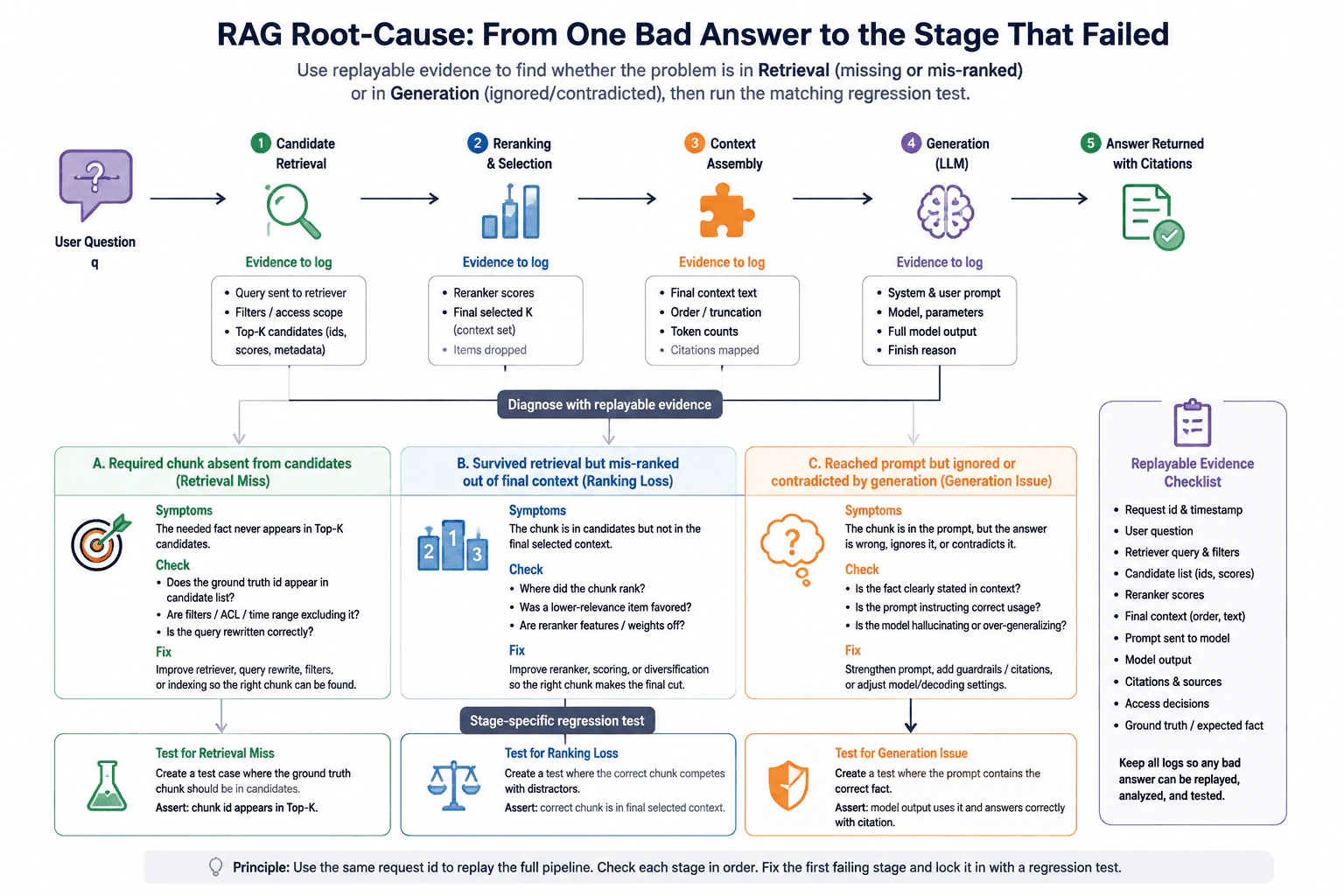
I replay the bad request and inspect each RAG stage. I check candidate retrieval, reranking, final context, and generation separately. This tells me whether the chunk was missing, filtered out, or ignored by the model. Then I apply a targeted fix and add a regression test.
Detailed Explanation
A bad RAG answer can fail at different stages. I first replay the exact user request and collect evidence from the pipeline.
Useful Questions to Ask the Interviewer
Do we store logs for the query, retrieved candidates, reranker scores, final context, and model response?
Can we replay the same request with the same retrieval and generation settings?
How to Explain It in an Interview
First, I check retrieval. The question is: did the correct chunk appear in the candidate set? If not, retrieval failed. I inspect query rewriting, filters, metadata, chunking, embeddings, and index freshness.
Next, I check reranking and context assembly. The chunk may exist but be removed before reaching the model. I compare retrieved candidates with the final selected context and inspect reranker scores.
Finally, I check generation. If the correct information reached the prompt but the answer is wrong, the model may have ignored or contradicted the context. I inspect the final prompt, citations, and model output.
The fix should match the failed stage. A retrieval failure needs retrieval improvements, a ranking failure needs reranking changes, and a generation failure needs grounding or prompt improvements. Each fix should have a regression test.
Retrieval Path
Replay the exact failed request.
Check if the required chunk exists in retrieval candidates.
Check if reranking keeps the chunk in final context.
Check if generation follows the provided context.
Apply the stage-specific fix and add a regression test.
Time & Space Complexity
Debugging one request is usually fast if evidence is stored. Logging every stage increases storage cost but makes failures easier to diagnose. Regression tests add maintenance cost but prevent repeated failures.
Where it is used
Used in production RAG assistants, enterprise search, document question answering, and support systems where incorrect answers must be traced and fixed.
Why Interviewers Ask This
This question tests whether the candidate can debug a RAG system using evidence instead of relying only on aggregate retrieval metrics.
Common interview mistakes
Common mistakes include trusting retrieval metrics alone, changing prompts before proving the failing stage, and ignoring reranking or context assembly failures.
Interview tip
Explain the debugging flow from retrieval to generation. Focus on evidence, the first failing stage, the targeted fix, and the regression test.
Interviewer may ask next
What if the correct chunk is retrieved but the final answer is still incorrect?
I would inspect the final context and generation step. If the evidence is present but the answer ignores or contradicts it, the failure is in grounding or generation. I would add a regression test that verifies the answer uses the supplied evidence.
How do you stop the same RAG failure from returning later?
I add a stage-specific regression test. Retrieval tests verify the correct chunk appears in candidates. Ranking tests verify it survives selection. Generation tests verify the answer is supported by the provided context.
5. Which tools and permissions exist for the agent, and can they be simulated or replayed?Ai Agents And Agentic SystemsEasyOpenai
i Question Details
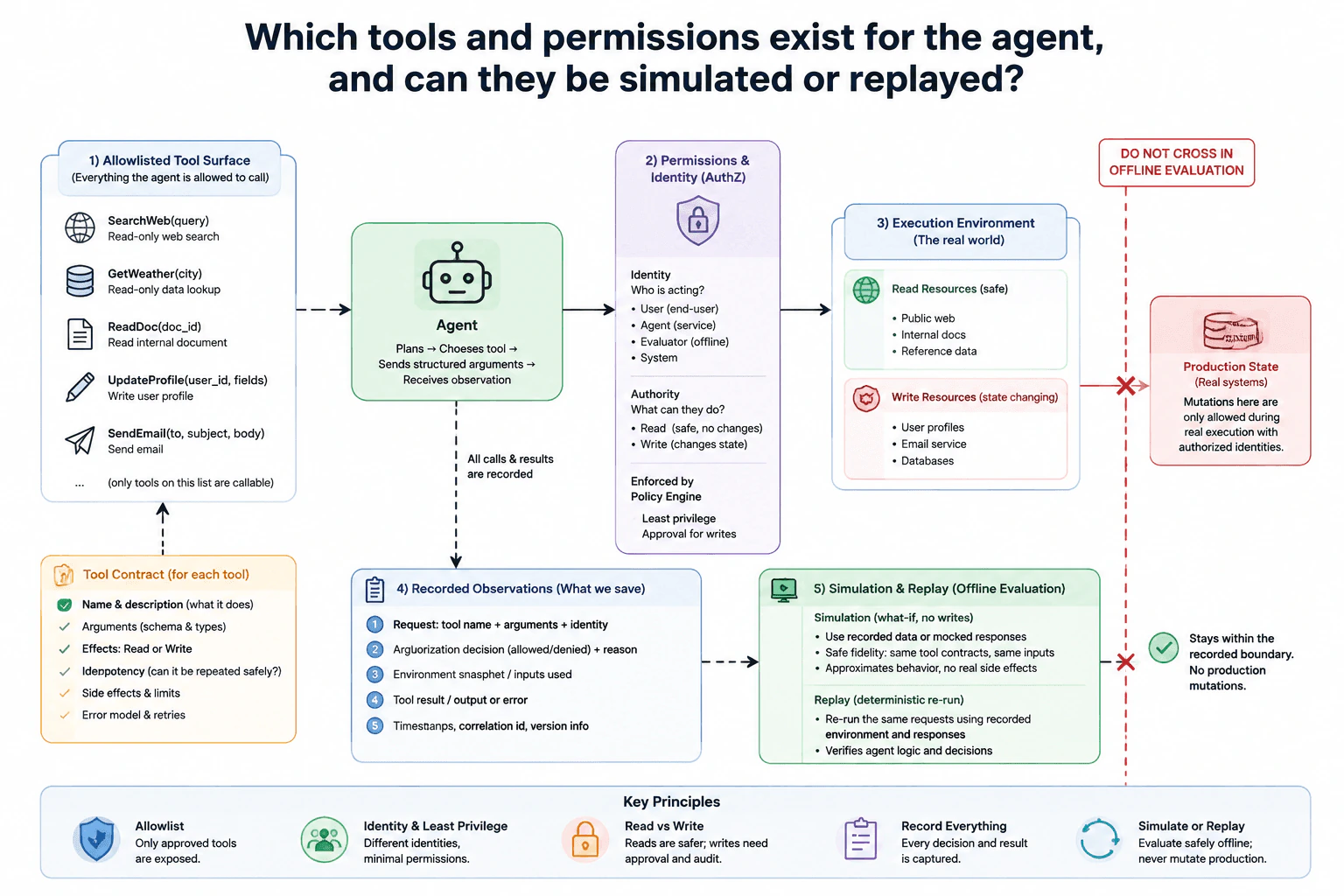
Use the answer to define an allowlisted tool surface, user and evaluator identity, read versus write authority, safe simulation fidelity, recorded observations, and the boundary beyond which offline evaluation must not mutate production state.
Short Interview Answer (30-60 seconds)
At a high level, this system lets an agent use approved tools while keeping actions safe and controlled. The main challenge is allowing the agent to choose useful actions without giving unlimited access to real systems. I would explain it in three parts: the allowlisted tools and permissions, the real execution rules, and the safe simulation or replay flow. The trade-off is that stronger safety checks add more steps before write actions.
Detailed Explanation
The goal is to let an agent use tools while making sure each action has the correct permission and can be reviewed later. The difficult part is balancing automation with safety because the agent can suggest actions, but it should not directly change important systems without rules. The solution is organized around approved tools, identity checks, execution controls, recorded observations, and offline simulation or replay.
Useful Questions to Ask the Interviewer
Which tools are allowed for the agent, and which tools can change real data?
Which users or evaluators can run the agent, and what permissions should they have?
Should offline evaluation only simulate actions, or should it replay previous tool results?
How to Explain It in an Interview
1. Explain the goal and the main idea
At a high level, the agent should only use tools that it is allowed to call. The allowlisted tool surface defines these available tools. Each tool has a clear purpose, input format, and expected behavior. This prevents unknown actions from being executed.
The model can decide a possible action, but application code controls permissions. A model suggestion does not grant access by itself.
2. Explain tools, identity, and permissions
The system checks who is acting before a tool runs. The diagram shows user, agent, evaluator, and system identities. The authorization layer applies least privilege, which means giving only the access that is needed.
Read actions only view information. Write actions can change state, so they need stronger checks and approval. Tool contracts define names, arguments, effects, limits, and error behavior.
3. Explain the execution flow
The agent sends structured arguments when it chooses a tool. The runtime checks the permission rules before execution. The execution environment contains read resources and write resources.
Read resources return information without changing state. Write resources can update systems such as user profiles, email services, or databases. Production changes only happen with authorized identities.
4. Explain recording, simulation, and replay
The system records tool calls and results. The records include the request, arguments, identity, permission decision, results, errors, and timestamps. This helps teams understand what happened.
Simulation can use mock tools or recorded data without real side effects. Replay can run previous requests again using saved observations. Both approaches help test agent behavior without changing production state.
5. Explain scale, failures, and trade-offs
The key safety boundary is between offline evaluation and production systems. Offline evaluation must not mutate production state. This protects important systems from accidental changes.
The benefit is safer testing and better auditing. The downside is that simulations may not perfectly match real systems, and permission checks add extra complexity.
Practical Complexity & Trade-offs
The benefit is that the agent can automate tasks while following safety rules. Approved tools limit available actions. Permission checks protect important systems. Recording actions helps debugging and review. Simulation and replay allow testing without changing real data. The downside is that this design adds more checks before write actions. Offline simulations may also behave differently from real systems. We accept this because protecting production data is more important than making every test identical.
Why Interviewers Ask This
Interviewers ask this question to see if the candidate understands safe agent design. They want to know if the candidate can separate model decisions from real permissions. They also check whether the candidate understands tools, auditing, testing, and production boundaries. The goal is to evaluate engineering judgment instead of only framework knowledge.
Interviewer may ask next
What changes if the agent needs to perform more write actions in production?
I would keep the same basic design, but I would add stronger controls around write tools. The allowlisted tool surface would still define available actions. The permission layer would check identity, role, and approval before a write happens.
Recorded observations would become more important because every state-changing action needs a clear history. Simulation and replay would remain separate from real execution so tests cannot change production data.
The benefit is safer automation for powerful actions. The downside is that users may need more approvals and the workflow becomes slower.
How would you improve testing when simulation does not perfectly match the real environment?
I would keep the same simulation and replay design, but improve the quality of recorded observations and test data. Simulation should use the same tool contracts and input formats as the real environment.
Replay would use previous tool calls and results to check whether the agent makes similar decisions. The production boundary would still prevent offline tests from changing real systems.
This keeps testing safe while making results closer to real behavior. The downside is that maintaining accurate simulation data requires extra work when tools change.
6. What is the release decision the agent evaluation must support?Ai Agents And Agentic SystemsMediumOpenai
i Question Details
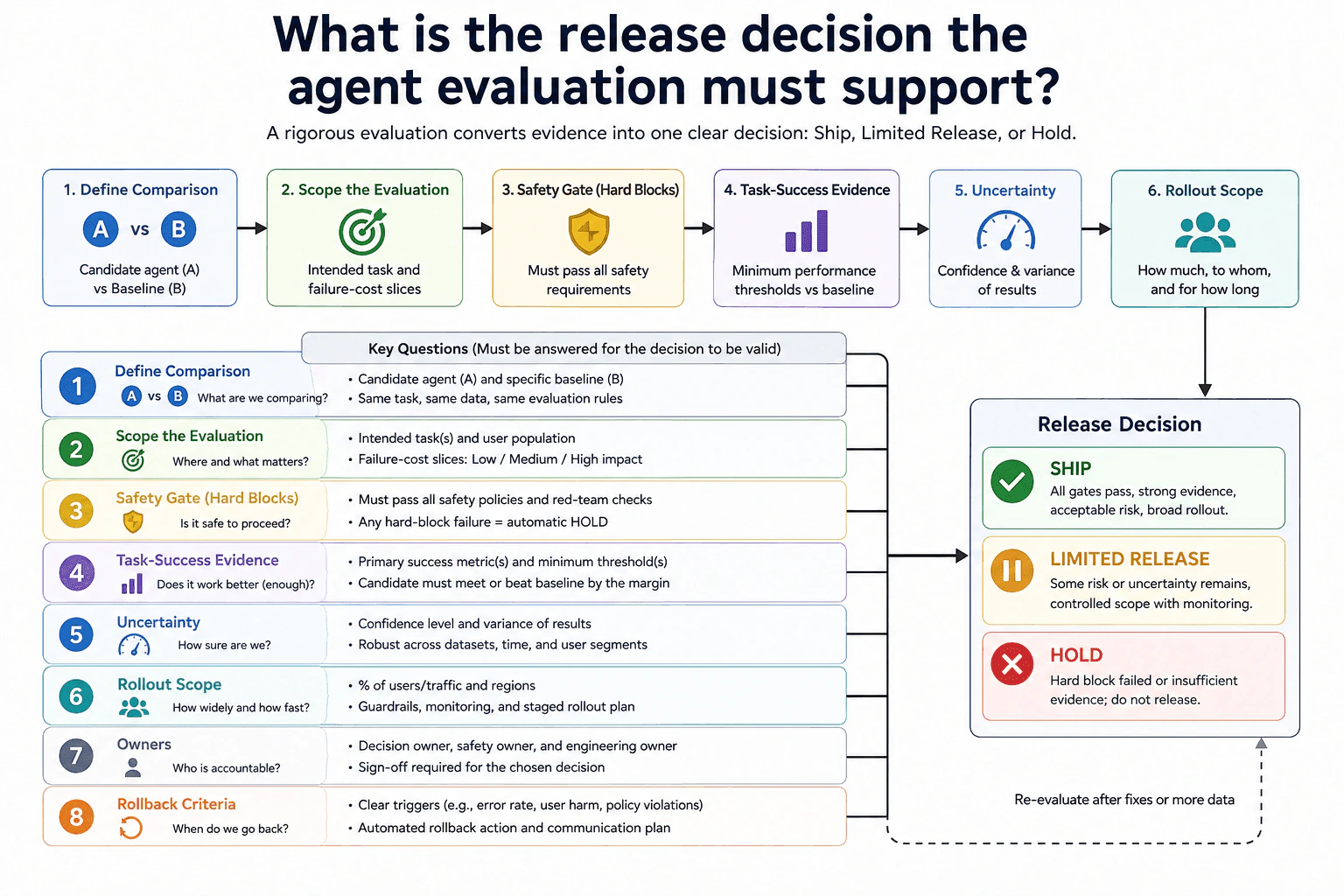
Define the candidate and baseline being compared, intended task and failure-cost slices, hard safety blocks, minimum task-success evidence, uncertainty, rollout scope, owners, and rollback criteria so the evaluation answers a concrete ship, hold, or limited-release decision.
Short Interview Answer (30-60 seconds)
At a high level, the evaluation should turn evidence into one clear release decision for the agent. The hard part is balancing useful task performance with safety, uncertainty, and costly failures. I would explain it in three parts: compare the candidate with a baseline, check safety and task-success evidence, then choose rollout scope and rollback rules. The trade-off is that broader release creates more value, but it needs stronger evidence and lower uncertainty.
Detailed Explanation
The goal is to decide whether a candidate agent should ship, stay on hold, or launch only to a limited group. The difficult part is that one overall score is not enough. The agent may work well on common tasks but fail badly on a high-cost slice. The evaluation therefore compares the candidate with a clear baseline, checks hard safety rules, measures task success by slice, looks at uncertainty, and then connects that evidence to rollout scope, owners, and rollback criteria.
Useful Questions to Ask the Interviewer
What exact candidate agent and baseline are we comparing?
Which tasks, user groups, and failure-cost slices matter most?
Which safety failures are automatic hard blocks?
What minimum task-success threshold must each required slice meet?
What uncertainty is acceptable for a broad release?
How much rollout exposure is allowed, to whom, and for how long?
Who owns the release decision, safety approval, engineering work, and rollback?
How to Explain It in an Interview
1. Define the comparison
I would start by making the comparison fair. The diagram compares Candidate agent A with Baseline B. Both should use the same task, data, and evaluation rules. This matters because a release decision only makes sense when we know exactly what changed. This step gives us a clear candidate-versus-baseline test.
2. Scope the evaluation
Next, I would test the intended tasks and the people affected. I would also separate failure-cost slices into low, medium, and high impact. A slice is simply a group of cases that needs its own result. This prevents a good average score from hiding a serious failure in an important group.
3. Apply the Safety Gate
Safety is a hard gate, not a score we can trade away. The candidate must pass all required safety policies and red-team checks. If any hard-block condition fails, the decision is HOLD. Better task performance cannot override that failure. This gives the evaluation a clear stop condition before broader rollout is considered.
4. Check task-success evidence and uncertainty
If safety passes, I would check the primary success metrics and minimum thresholds. The candidate must meet or beat the baseline by the required margin on the required slices. Then I would look at confidence and variance. In simple words, I want to know how sure we are and how much the results change across data, time, and user segments. Weak evidence or high uncertainty can justify a limited release instead of a full ship.
5. Turn the evidence into a release decision
The final decision is SHIP, LIMITED RELEASE, or HOLD. SHIP means all gates pass with strong evidence and acceptable risk. LIMITED RELEASE means some risk or uncertainty remains, so rollout stays controlled with monitoring. HOLD means a hard block failed or the evidence is not strong enough.
For SHIP or LIMITED RELEASE, I would define how much traffic is included, which users or regions are included, and how long the stage lasts. I would add guardrails, monitoring, and a staged rollout plan. I would name the decision owner, safety owner, and engineering owner, with sign-off for the chosen decision.
Finally, I would define rollback criteria before release. Triggers can include error rate, user harm, or policy violations. When a trigger fires, the rollback action should automatically return the system to the baseline, and the communication plan should notify the responsible owners. After fixes or more evidence, the candidate can be evaluated again.
Practical Complexity & Trade-offs
The benefit is that the release decision is tied to clear evidence instead of one vague score. Hard safety blocks stop a release even when task results look strong. Slice-level checks also stop good averages from hiding costly failures. The downside is that stronger evidence takes more time and evaluation work. Uncertainty may remain even after testing. A limited release helps the team learn with less exposure. Rollback rules reduce risk after launch, but they need reliable monitoring, clear owners, and fast action when a trigger is reached.
Why Interviewers Ask This
Interviewers ask this to see whether you can turn evaluation results into a real product decision. They want to know if you can define a fair baseline, notice costly failure slices, treat safety as a hard gate, reason about uncertainty, and connect evidence to rollout and rollback. The main skill is judgment: knowing when to ship, limit exposure, or hold.
Interviewer may ask next
What would you change if the candidate passes overall, but one high-cost slice has weak evidence?
I would not treat the overall pass as enough. The high-cost slice should stop the release from becoming a broad SHIP decision. I would keep the same evaluation flow, but choose LIMITED RELEASE or HOLD depending on the risk.
First, I would gather more evidence for that slice using the same candidate, baseline, task, data, and evaluation rules. The Safety Gate would stay unchanged. I would also keep a clear minimum threshold for that slice and check confidence and variance around the result.
If the remaining risk is acceptable, I could use a limited rollout that excludes the risky slice or exposes only a small, monitored group. I would define the rollout duration, owners, guardrails, and rollback triggers before release.
The main downside is slower release and more testing. That cost is reasonable because a high-cost failure can matter much more than a good overall average.
How should the decision change if task-success results are strong but uncertainty is still high?
I would avoid a broad SHIP decision until the uncertainty is lower. Strong task-success results are useful, but the diagram treats uncertainty as a separate part of the release decision. High variance means the result may not stay stable across data, time, or user segments.
I would keep the same Safety Gate and task-success thresholds. Then I would choose LIMITED RELEASE with a small rollout scope, a defined duration, clear guardrails, active monitoring, named owners, and predefined rollback criteria. This lets the team collect more evidence without exposing everyone at once.
If the limited rollout stays healthy, the scope can expand in stages. If error rate, user harm, policy violations, or another rollback trigger appears, the rollback action should return the system to the baseline and notify the responsible owners.
The downside is slower expansion. The benefit is that the rollout scope matches the confidence we actually have.
7. Which dimensions besides task success, such as latency, cost, safety, and user effort, should gate an agent release?Ai Agents And Agentic SystemsHardOpenai
i Question Details
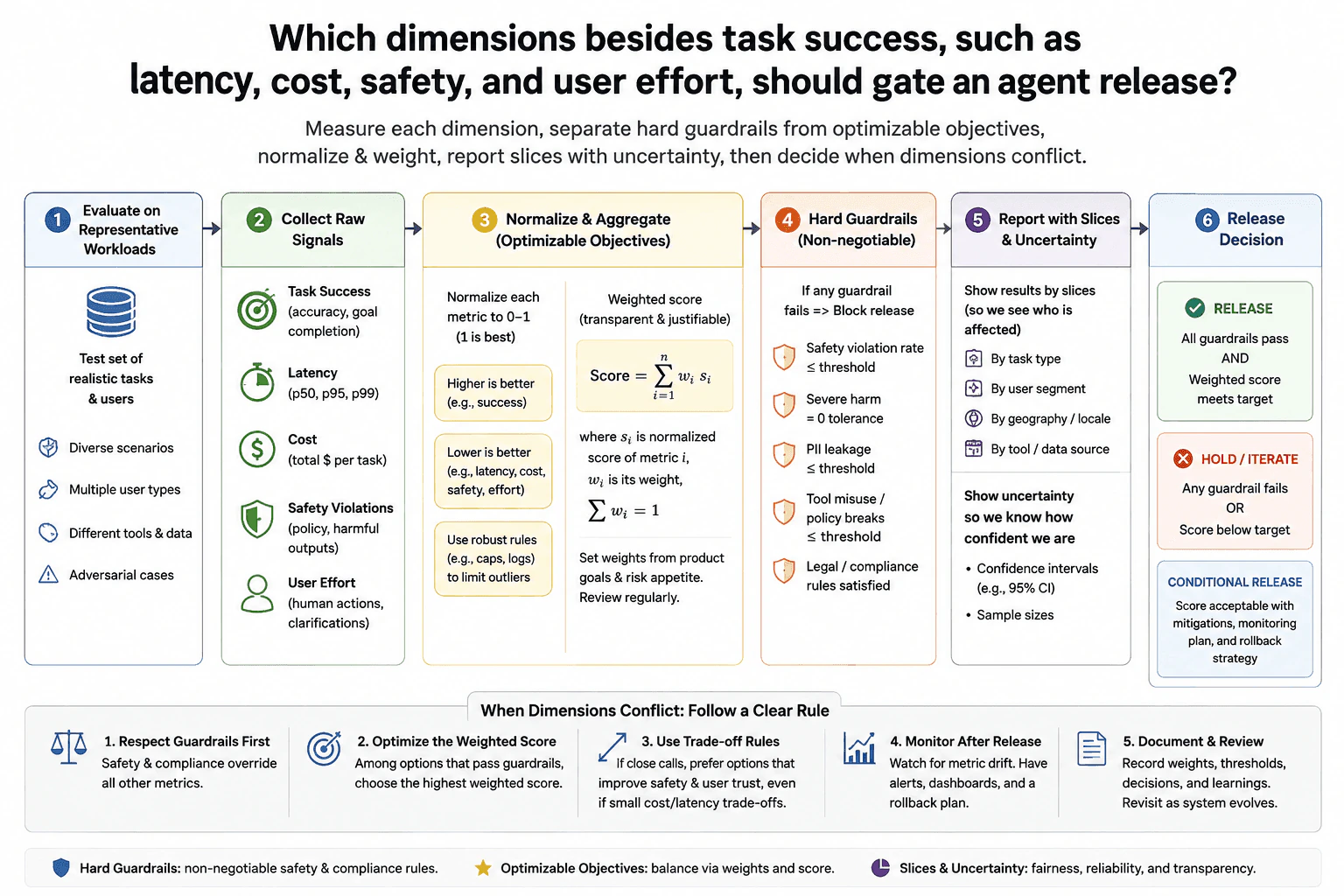
Keep task success, latency, cost, safety violations, and user effort as separately inspectable outcomes; distinguish hard guardrails from optimizable objectives, justify any normalization or weighting, report slices and uncertainty, and define the release decision when the dimensions conflict.
Short Interview Answer (30-60 seconds)
At a high level, I would not release an agent based on task success alone. The main challenge is balancing quality with speed, cost, safety, and user effort. I would explain the decision in three steps: measure each outcome separately, apply hard guardrails that can block release, then compare the remaining objectives using justified normalization and weights. I would also report slices and uncertainty. The trade-off is that a combined score helps comparison, but it can hide important differences between users or tasks.
Detailed Explanation
The goal is to decide whether an agent is ready for release without looking at task success alone. A useful agent must also respond fast enough, cost an acceptable amount, avoid unsafe behavior, and require reasonable effort from users. The difficult part is that these outcomes can conflict. A faster agent may cost more, while a cheaper agent may require more user corrections. The diagram handles this by measuring each outcome separately, comparing optimizable objectives, applying hard guardrails, reporting slices and uncertainty, and then making a clear release decision.
Useful Questions to Ask the Interviewer
Which safety or compliance rules are strict release blockers?
Which objectives may trade off against each other?
Which user or task slices are important enough to inspect separately?
How much uncertainty is acceptable before we delay a release?
How to Explain It in an Interview
1. Evaluate representative workloads
I would start with realistic tasks and users rather than one easy benchmark. The evaluation should include diverse scenarios, multiple user types, different tools and data, and adversarial cases. This matters because an agent can look strong on average while failing badly in one important situation. These workloads create the evidence used by every later release check.
2. Collect each outcome separately
Next, I would collect task success, latency, cost, safety violations, and user effort as separate results. Task success shows whether the agent completed the goal correctly. Latency shows how long users wait. Cost measures total expense per task. Safety captures policy problems or harmful outputs. User effort measures actions such as corrections and clarifications. Keeping these outcomes visible prevents one strong metric from hiding a serious weakness elsewhere.
3. Normalize and compare optimizable objectives
These metrics use different units, so the diagram normalizes them to a common 0-to-1 scale. Normalization means converting different measurements into comparable scores. The direction must be consistent, so higher normalized values mean better results. A weighted score can then reflect product goals and risk appetite. The weights must add to one and should be transparent and justified. Robust rules, such as caps or logarithmic transforms, can limit the effect of extreme values.
4. Apply hard guardrails
Hard guardrails are non-negotiable release checks. If one fails, the release is blocked even when the weighted score looks strong. The diagram includes a safety violation threshold, zero tolerance for severe harm, a privacy leakage threshold, limits for tool misuse or policy breaks, and legal or compliance requirements. This ordering matters because safety and compliance should not be traded away for lower latency, lower cost, or higher task success.
5. Report slices and uncertainty
Before deciding, I would inspect results by task type, user segment, geography or locale, and tool or data source. I would also report uncertainty using confidence intervals and sample sizes. This helps show whether an apparent improvement is reliable. It also prevents a strong overall average from hiding weak results for one important group.
6. Make the release decision with a clear conflict rule
If every hard guardrail passes and the weighted score meets its target, the agent can be released. If a guardrail fails or the score is below target, I would hold the release and iterate. A conditional release can be reasonable when the score is acceptable and there are clear mitigations, monitoring, and rollback plans. When dimensions conflict, guardrails come first. Among options that pass them, choose the strongest justified weighted result. After release, monitor for drift and document thresholds, weights, decisions, and lessons.
Practical Complexity & Trade-offs
The benefit is that this process keeps one strong metric from hiding a serious weakness. Safety and compliance stay non-negotiable, while success, latency, cost, and user effort can be balanced more flexibly. The downside is that normalization and weighting require judgment. Different weights can change which candidate looks best. A combined score can also hide weak results for one user group or task type. That is why the diagram keeps the individual outcomes visible and also reports slices and uncertainty. Conditional release adds flexibility, but it requires monitoring, mitigation steps, a rollback plan, and clear documentation.
Why Interviewers Ask This
Interviewers ask this to see whether you can make release decisions with several competing goals. They want to know if you separate hard safety rules from objectives that can be optimized. They also look for judgment around weighting, uncertainty, user segments, and conflicting results. A strong answer shows that you do not hide important risks inside one average score.
Interviewer may ask next
What would you change if the new agent improves task success but increases latency and cost?
I would keep the same release process and compare the trade-off explicitly. First, I would confirm that all hard guardrails still pass. Better task success cannot compensate for a safety, privacy, policy, or compliance failure.
Then I would keep task success, latency, and cost separately visible. I would normalize them using the same documented rules and apply the agreed weights. If the higher success score creates enough value to justify the slower and more expensive behavior, the weighted result may still meet the release target. I would also inspect slices because the latency increase may affect some tasks or user groups much more than others.
If the result is close, I would follow the diagram's conflict rule. Guardrails come first, then the weighted score. A conditional release may be reasonable with clear monitoring, mitigations, and rollback. The downside is that the decision depends on product priorities, so weights and thresholds must remain transparent and regularly reviewed.
How would you handle a release whose average metrics look good but one user segment has poor safety or user-effort results?
I would not rely on the overall average. The diagram explicitly asks us to report results by slices, so I would inspect that user segment separately. A slice means a smaller group, such as one user type, locale, task type, or tool source.
If that segment fails a hard safety guardrail, I would block the release. A good global average cannot cancel a serious safety failure in one group. If safety still passes but user effort is much worse, I would check the confidence interval and sample size. These show how certain we are that the difference is real.
If the problem is confirmed, I would hold the release, iterate, or use a conditional release only with specific mitigations, monitoring, and rollback plans. I would keep tracking that slice after release and document the decision. The downside is that slice-based evaluation needs enough examples, so small groups can have wider uncertainty.
8. How would you resume a streamed conversational AI response after a mobile connection drops?Ai System DesignEasyOpenai
i Question Details
Define request and stream identity, durable versus replayable state, acknowledged offsets, bounded buffering, reconnect authorization, token ordering, cancellation, expiry, and user-visible behavior when exact resumption is impossible.
Short Interview Answer (30-60 seconds)
At a high level, I would keep the stream state so a user can continue an AI response after a mobile connection drops. The client starts a stream with a stream identity, and the Stream Service tracks ordered tokens and the last acknowledged offset. The service stores durable state and a bounded buffer for recovery. When the client reconnects, it sends the same identity and offset. The service validates the reconnect, resumes from the correct token, or explains when exact recovery is not possible. The trade-off is better reliability with extra state storage and cleanup work.
Detailed Explanation
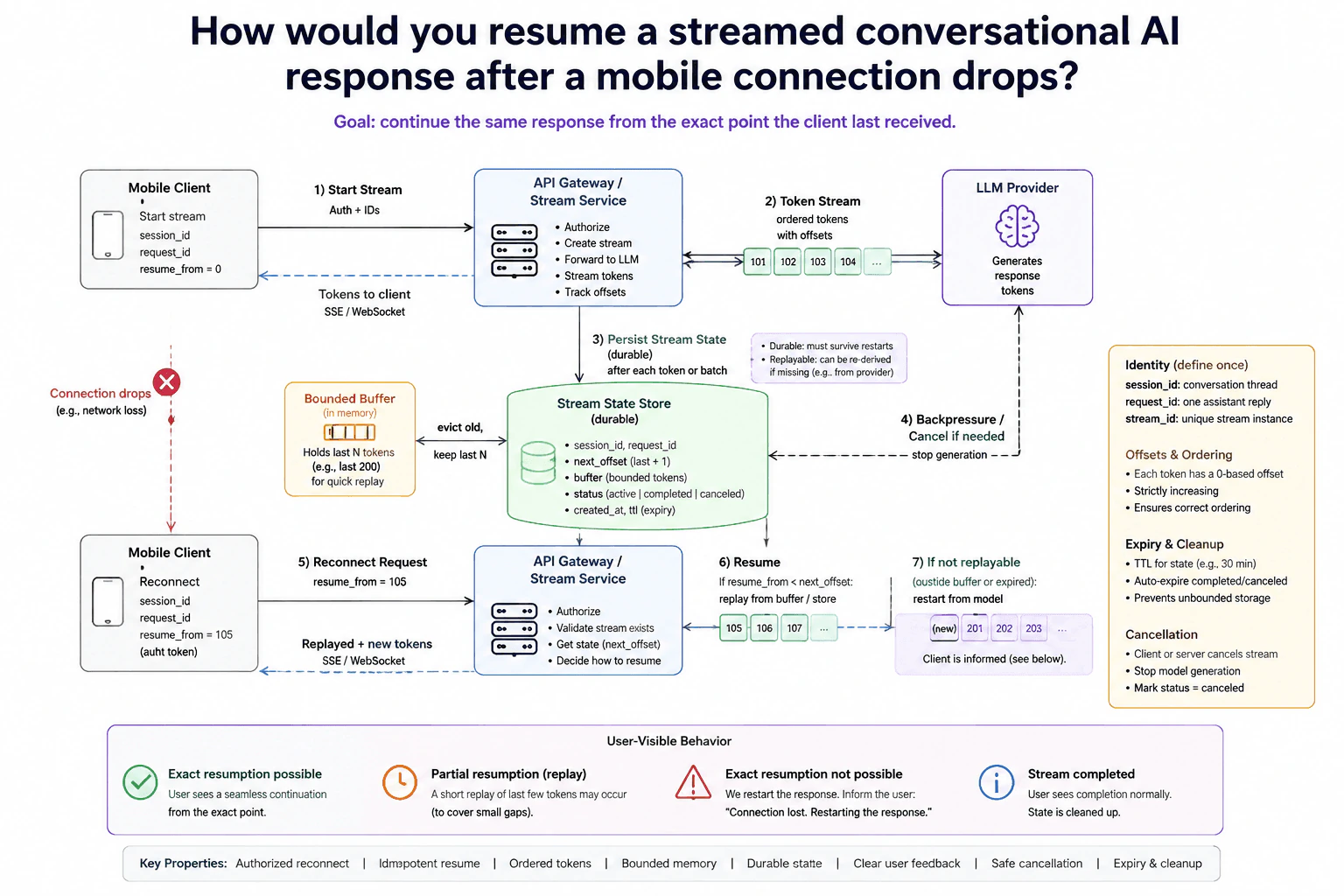
This question is about continuing an AI answer after a mobile network failure. The goal is to avoid losing the user's progress when the connection drops. The system needs to know what the user already received and safely continue from that point. The main challenge is storing enough state for recovery without keeping unlimited data. I will explain the design using the Mobile Client, API Gateway / Stream Service, LLM Provider, Stream State Store, and Bounded Buffer from the diagram.
Useful Questions to Ask the Interviewer
How long should a disconnected stream remain available for resume?
Is partial replay acceptable when exact resumption is impossible?
How to Explain It in an Interview
1. Start the stream and define identity
The Mobile Client starts a stream with session_id, request_id, and stream identity. The API Gateway / Stream Service creates the stream and forwards the request to the LLM Provider.
The stream identity separates one AI response from another. It helps the service know which saved state belongs to the reconnecting client.
2. Stream tokens and save progress
The LLM Provider generates response tokens. The Stream Service sends tokens back to the Mobile Client through SSE or WebSocket streaming.
Each token has an ordered offset. The service tracks the latest acknowledged offset because this tells the system what the client already received.
The Stream State Store keeps durable stream information. It stores stream identity, request identity, next offset, bounded tokens, status, creation time, and expiry information.
The Bounded Buffer keeps recent tokens for quick replay. Older tokens are removed to avoid unlimited storage growth.
3. Recover after a connection drop
When the mobile connection fails, the server keeps the saved stream state. The client reconnects using the same stream identity and its last acknowledged offset.
The API Gateway / Stream Service validates the reconnect request, checks that the stream exists, and reads the stored state.
The service compares the client offset with the saved offset to decide where recovery should begin.
4. Resume tokens in order
If the missing tokens are available, the Stream Service replays them and continues streaming new tokens. Token ordering is important because the user should see the response in the correct sequence.
The service resumes from the next expected offset instead of sending duplicate tokens.
5. Handle missing state or expired streams
Exact resumption is not always possible. The stream may have expired, been canceled, or no longer have the required buffered tokens.
In that case, the service informs the user and restarts generation when possible. The system should not claim exact recovery when it cannot provide it.
6. Cancellation and expiry
The client or server can cancel a stream. The Stream Service stops generation and marks the stream as canceled.
Expiry removes old stream state and releases resources. This prevents storage from growing without limits.
7. Trade-off
The design improves user experience because short connection failures recover smoothly. The downside is additional storage, cleanup logic, and state management complexity.
Practical Complexity & Trade-offs
This design balances recovery ability and system cost. Durable stream state allows recovery after service restarts, while the bounded buffer keeps only recent tokens for fast replay. The benefit is that users can continue an interrupted AI response instead of starting again. The downside is extra storage and cleanup work. The Stream Service must manage offsets, ordering, expiry, and cancellation correctly. Keeping more history improves recovery but costs more resources. Keeping less history reduces cost but makes long disconnects harder to recover. We accept this trade-off because a practical system needs reliable recovery without unlimited storage.
Why Interviewers Ask This
Interviewers ask this question to evaluate reliability and system design judgment. They want to see if the candidate understands streaming failures, state ownership, recovery flow, and user experience. A strong answer explains how identity, offsets, storage, ordering, cancellation, and expiry work together. It also shows awareness that reliability improvements create operational trade-offs.
Interviewer may ask next
What happens if the user reconnects after the stream state has expired?
If the stream state has expired, the system cannot provide exact resumption. The API Gateway / Stream Service checks the Stream State Store and finds that the previous state is no longer available. It informs the user that the old response cannot continue exactly and starts a new response from the LLM Provider when allowed.
The affected components are the Stream State Store and Stream Service recovery flow. The service still validates the reconnect request before taking action. The original identity checks, ordering rules, and cancellation behavior remain unchanged.
The benefit of expiry is that the system avoids unlimited storage growth. The downside is that users with very long disconnects may need to restart their response instead of continuing from the old point.
How would you handle a large number of reconnect requests after a network outage?
I would keep the same recovery design but protect the Stream Service from a sudden reconnect spike. The reconnect flow still validates the stream identity and reads the Stream State Store before resuming.
The Stream Service can limit reconnect processing so it does not overload the system. The Bounded Buffer helps because it avoids storing unlimited response history. Durable state continues to provide recovery information.
Correctness is maintained because the service still uses acknowledged offsets and ordered tokens. Security remains the same because reconnect requests must pass validation.
The downside is that some users may wait longer during a large outage. This trade-off protects the service and improves overall availability.
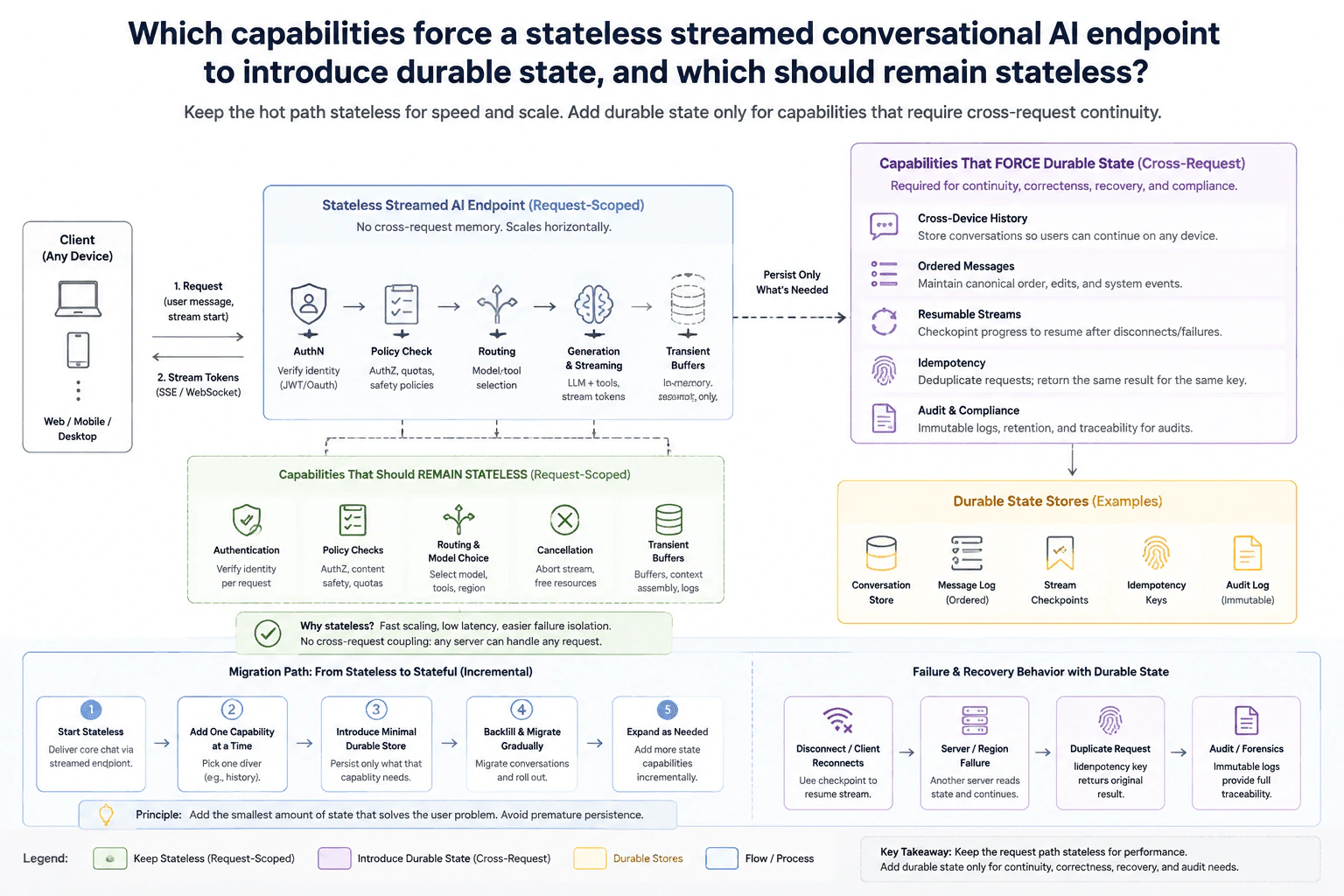
9. Which capabilities force a stateless streamed conversational AI endpoint to introduce durable state, and which should remain stateless?Ai System DesignMediumOpenai
i Question Details
Separate cross-device history, ordered messages, resumable streams, idempotency, and audit requirements from request-scoped authentication, policy checks, routing, cancellation, and transient buffers; define the migration and failure behavior when persistence is added.
Short Interview Answer (30-60 seconds)
At a high level, I would keep the streamed conversational AI endpoint stateless for work that only belongs to one request. Authentication, policy checks, routing, cancellation, and temporary buffers do not need durable storage. I would add durable state only for capabilities that need information after the request ends. These include cross-device history, ordered messages, resumable streams, idempotency, and audit records. This keeps the request path fast and easy to scale. The trade-off is that durable state improves continuity and correctness, but adds storage cost and operational complexity.
Detailed Explanation
The question is about deciding what an AI conversation system should remember and what it should forget after a request finishes. We want users to continue conversations, recover from failures, and keep important records when needed. At the same time, we do not want every request to depend on stored data. The goal is to keep the streaming path simple and add memory only when a feature truly needs it. The answer follows the diagram by separating request-scoped work from cross-request durable state.
Useful Questions to Ask the Interviewer
Do users need conversation history across multiple devices?
How long should conversation and audit data be stored?
Should interrupted streams be resumable?
What behavior is expected if durable storage is unavailable?
How to Explain It in an Interview
1. Separate Stateless and Durable Responsibilities
I would first divide the system into request-scoped work and cross-request state. The client sends a request to the streamed AI endpoint. The endpoint handles authentication, policy checks, routing, generation, streaming, and temporary buffers. These operations only exist during the active request, so they should remain stateless.
The benefit is that any server replica can handle a request. The service does not depend on memory from a previous request.
2. Keep the Streamed AI Endpoint Stateless
The endpoint verifies the user identity and checks policies before processing the request. Routing selects the correct model or tool path. Generation creates the AI output, and streaming sends tokens back to the client. Cancellation only affects the current stream. Temporary buffers store short-lived request data.
These responsibilities stay stateless because they do not require future requests to know what happened before.
3. Add Durable State for Required Continuity
Some features require information after the request ends. Cross-device history needs a conversation store because users may open the same conversation on another device. Ordered messages need stored message order. Resumable streams need checkpoints so interrupted sessions can continue.
Idempotency needs stored request keys and results so repeated requests can avoid duplicate work. Audit and compliance need immutable records for review.
4. Use Durable State Stores Only When Needed
The durable state layer contains conversation stores, ordered message logs, stream checkpoints, idempotency keys, and audit logs. The main request path should not depend on these stores unless the requested capability needs them.
This keeps the normal streaming experience fast while still supporting features that require memory.
5. Migrate from Stateless to Stateful Gradually
I would start with a fully stateless endpoint. Then I would add one durable capability at a time. A minimal durable store can be introduced behind the existing interface. Existing conversations can be migrated gradually, and more state-based features can be enabled later.
This reduces migration risk because every new state dependency can be tested independently.
6. Handle Failures After Adding Persistence
Durable state introduces new failure cases. If the state store is unavailable, features like history or resume may not work correctly. The system should not claim that data was stored when a write failed.
The design should keep request processing separate from optional state features when possible. The trade-off is better reliability and user experience with additional storage and operational complexity.
Practical Complexity & Trade-offs
This design keeps the AI endpoint simple by separating temporary request work from long-term information. Stateless processing improves scaling because servers do not need previous conversation memory. Durable state is added only for history, ordering, resume support, idempotency, and audits. The benefit is better continuity and correctness. The downside is more storage, more failure cases, and more operational work. A gradual migration is safer because the team can add one state feature at a time. The main trade-off is between simplicity and richer user features. We accept extra complexity only when the user experience or system correctness requires stored information.
Why Interviewers Ask This
Interviewers ask this question to evaluate system design judgment. They want to know if a candidate understands when state is required and when it creates unnecessary complexity. A strong answer separates request processing from durable storage, explains failure behavior, and communicates trade-offs between scalability, reliability, and user experience.
Interviewer may ask next
What changes if users need to resume a stream after a connection failure?
I would add durable stream checkpoints because the system needs saved progress after the original connection ends. The streamed AI endpoint would still keep authentication, policy checks, routing, generation, and streaming logic stateless. The new durable state flow would store checkpoint information and read it when the client reconnects.
Correctness is maintained by saving enough information to identify the conversation and continue from the correct point. Security remains unchanged because the new request still passes through authentication and policy checks. The main downside is additional storage dependency and more failure handling. Other request-scoped capabilities remain unchanged.
How would you add audit requirements without making every response depend on audit storage?
I would keep audit logging separate from the main streaming response path. The AI endpoint would continue processing user requests, while required activity records would be written to the audit log store.
Correctness is maintained by recording important actions with enough information for later review. Security decisions and system activity can be inspected without slowing every response with audit processing. The main downside is that audit storage creates another operational dependency. The rest of the design remains the same because authentication, policy checks, routing, generation, and temporary buffers continue to stay request-scoped.
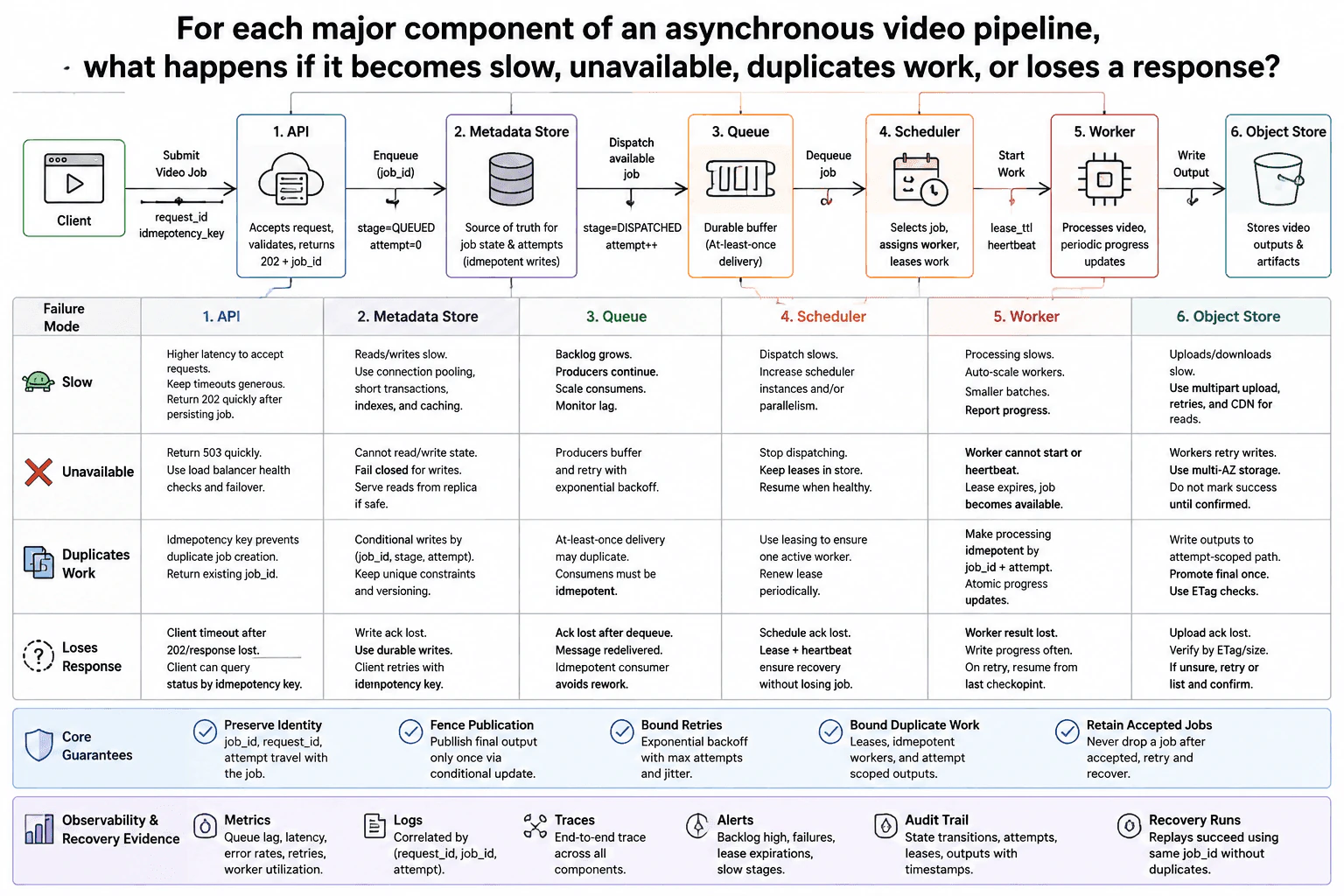
10. For each major component of an asynchronous video pipeline, what happens if it becomes slow, unavailable, duplicates work, or loses a response?Ai System DesignHardOpenai
i Question Details
Walk the API, metadata store, queue, scheduler, worker, and object store through each named failure mode; preserve request, stage, and attempt identity; fence publication; bound retries and duplicate GPU work; retain accepted jobs; and define observability and recovery evidence.
Short Interview Answer (30-60 seconds)
At a high level, I would design the video pipeline as a durable asynchronous workflow. The API accepts the video job and creates a job identity. The metadata store tracks the job state, stage, and attempts. The queue, scheduler, and workers process the job step by step. The object store keeps the final outputs. The key reliability decisions are preserving job identity, using idempotent processing, bounding retries, and fencing publication so duplicate work does not create incorrect results. The trade-off is more system complexity, but we get better recovery and correctness.
Detailed Explanation
This question asks how to keep a video processing system reliable when different parts fail. A video job can take a long time, so the user should not wait for one request to finish. We need to accept the job, remember its progress, and complete it safely even when parts become slow or unavailable. The main challenge is avoiding lost jobs and duplicate results. I will explain the design by following the diagram from the client, API, metadata store, queue, scheduler, worker, and object store.
Useful Questions to Ask the Interviewer
What is the expected video processing time and traffic level?
How long should failed jobs and completed job records be retained?
Do users need live progress updates during processing?
How to Explain It in an Interview
1. Accept the job through the API
The request first reaches the API. The API accepts the video job, creates a job identity, and returns quickly because processing is asynchronous. The client does not keep an open request while the video is processed. The request identity and idempotency key help prevent duplicate job creation. If the API is slow, we use timeouts and return after the job is safely stored. If the API is unavailable, the client can retry safely.
2. Track state in the metadata store
The metadata store is the source of truth for job state. It stores the job ID, stage, and attempts. Each component can understand what happened and what should happen next. If the metadata store becomes slow, updates may lag, so we monitor latency and keep writes safe. Duplicate updates are handled with idempotent writes using job identity.
3. Buffer work with the queue
The queue stores jobs until workers can process them. This protects the system when many videos arrive together. If the queue becomes slow, backlog grows, so we monitor queue depth and apply backpressure. If messages are delivered more than once, consumers must handle duplicate delivery safely.
4. Schedule work for workers
The scheduler selects queued jobs and assigns them to workers. It uses leases and heartbeats to know which worker owns the work. If a scheduler response is lost, the job can recover using the stored state and lease information. This avoids losing accepted jobs.
5. Process videos with workers
Workers perform the expensive video processing. A worker can become slow because GPU work takes time. We can scale workers and monitor progress. If duplicate workers process the same job, job ID and attempt identity help prevent incorrect updates. Retries are limited so duplicate GPU work stays controlled.
6. Store outputs safely
The worker writes completed video outputs to the object store. Fenced publication ensures only the correct attempt publishes the final output. If two workers finish the same job, only the valid result becomes visible. If an upload succeeds but the response is lost, the system verifies the stored result before retrying.
7. Observe and recover from failures
Metrics show queue depth, latency, retries, and worker health. Logs and traces connect request IDs, job IDs, and attempts across the pipeline. Audit history records state changes. Recovery runs use this evidence to understand failures and safely retry work. The trade-off is additional operational complexity, but the system becomes safer for long-running video jobs.
Practical Complexity & Trade-offs
This design chooses reliability over simplicity. A direct synchronous API would be easier, but it would fail for long video jobs because requests can take too long. The metadata store adds more work, but it provides one place to track progress. The queue adds delay, but it protects workers from traffic spikes. Idempotency prevents duplicate jobs and duplicate processing. Bounded retries prevent unlimited GPU usage. Fenced publication prevents an older worker from overwriting the correct result. The downside is more components to operate and monitor. We accept this because video processing needs recovery, visibility, and safe failure handling.
Why Interviewers Ask This
Interviewers ask this question to evaluate system design judgment. They want to know if the candidate understands component ownership, asynchronous processing, retries, duplicate work, and recovery. They also evaluate whether the candidate can explain reliability trade-offs and observability for long-running AI workloads.
Interviewer may ask next
What changes if video traffic increases and the queue backlog keeps growing?
The main change is scaling the processing path. The queue becomes the buffer for accepted jobs while more workers are added. The scheduler manages worker assignment and concurrency so GPU resources are not overloaded. The metadata store continues tracking job state, stage, and attempts. Correctness is maintained because workers remain idempotent and publication remains fenced. More workers can process jobs faster without creating incorrect final outputs. The downside is higher infrastructure cost and more operational complexity. We also need stronger monitoring because queue delay and worker utilization become important signals.
What happens if a worker finishes processing but loses its response before completion is recorded?
The system treats the result as uncertain and checks the stored state before retrying. The worker uses job ID and attempt identity when updating progress and publishing output. The metadata store and object store provide evidence of whether the work already completed. Fenced publication prevents duplicate final outputs. The API, queue, scheduler, and worker flow remain unchanged. The downside is extra verification work and storage reads, but this avoids repeating expensive GPU processing and improves recovery after communication failures.
More questions load as you scroll
AI Engineer Resume Examples
Explore the resume examples below to find the one that best matches your target AI Engineer role.
Disclaimer: This interview guide is for educational and informational purposes only. It is designed to help readers prepare, but it does not guarantee any interview result, hiring decision, offer, or outcome. Interview questions, hiring criteria, and preferred answers can vary by employer, interviewer, industry, location, and time. All answers, examples, and explanations in this guide are suggested examples for interview preparation, not definitive answers or instructions for professional practice. They are based on research and judgment, are provided without warranties of any kind, and should be adapted to the question, role, and applicable laws and professional requirements. Diagrams are simplified illustrations intended to highlight the main concepts and their relationships; actual situations, systems, and practices may be more complex. Alternative approaches may be equally valid or better suited to a particular question, context, or interviewer. To the fullest extent permitted by applicable law, the contributors and publisher are not liable for decisions made, actions taken, or losses incurred based on this guide.
State Laws and Professional Responsibilities: Laws and requirements governing an occupation vary by state and jurisdiction. You are responsible for checking the current laws, licensing requirements, and scope-of-practice rules that apply to your location and role, and for ensuring that your answers and actions comply with them. Adapt examples in this guide to those requirements. This guide is not legal advice.
Company Notice: This guide is an independent educational resource and is not affiliated with, endorsed by, sponsored by, or approved by the company named in this guide. Company names identify reported interview experiences or the employer context of clearly labeled original practice exercises. Interview practices can change without notice, and inclusion of company-specific content does not mean these questions are official, complete, or guaranteed to be asked. To the fullest extent permitted by law, the author, contributors, and publisher are not responsible for outcomes related to use of this material.
Content Accuracy and Verification: To the fullest extent permitted by applicable law, we do not represent or warrant that interview guides, questions, answers, examples, or diagrams are accurate, complete, current, error-free, or suitable for any particular purpose. You are responsible for independently reviewing and verifying the information before relying on it.