This interview guide is for educational and informational purposes only. It is designed to help readers prepare, but it does not guarantee any interview result, hiring decision, offer, or outcome. Interview questions, hiring criteria, and preferred answers can vary by employer, interviewer, industry, location, and time. All answers, examples, and explanations in this guide are suggested examples for interview preparation, not definitive answers or instructions for professional practice. They are based on research and judgment, are provided without warranties of any kind, and should be adapted to the question, role, and applicable laws and professional requirements. Diagrams are simplified illustrations intended to highlight the main concepts and their relationships; actual situations, systems, and practices may be more complex. Alternative approaches may be equally valid or better suited to a particular question, context, or interviewer. To the fullest extent permitted by applicable law, the contributors and publisher are not liable for decisions made, actions taken, or losses incurred based on this guide.
State Laws and Professional Responsibilities
Laws and requirements governing an occupation vary by state and jurisdiction. You are responsible for checking the current laws, licensing requirements, and scope-of-practice rules that apply to your location and role, and for ensuring that your answers and actions comply with them. Adapt examples in this guide to those requirements. This guide is not legal advice.
Identity, Image, and Privacy Notice
To respect individual privacy, some names, profile photographs, avatars, biographical details, and other identifying information displayed in this guide may be replaced with pseudonyms, licensed stock images, illustrative avatars, composite images, or representative descriptions. Unless a person is expressly identified as an actual contributor, a displayed name, image, or profile should not be understood as depicting or identifying a specific candidate, interviewer, employee, or other real individual. These representations are provided for editorial and illustrative purposes only and do not imply endorsement, employment, participation, or affiliation with this guide or any company mentioned in it. Any resemblance to an actual person is coincidental.
Company Notice
This guide is an independent educational resource and is not affiliated with, endorsed by, sponsored by, or approved by the company named in this guide. Company names identify reported interview experiences or the employer context of clearly labeled original practice exercises. Interview practices can change without notice, and inclusion of company-specific content does not mean these questions are official, complete, or guaranteed to be asked. To the fullest extent permitted by law, the author, contributors, and publisher are not responsible for outcomes related to use of this material.
Content Accuracy and Verification
To the fullest extent permitted by applicable law, we do not represent or warrant that interview guides, questions, answers, examples, or diagrams are accurate, complete, current, error-free, or suitable for any particular purpose. You are responsible for independently reviewing and verifying the information before relying on it.
Questions or comments?
Contact us for general questions, or share feedback, technical corrections, and comments with the community.
1. What is the difference between sensible heat and latent heat in HVAC?Hvac FundamentalsEasy
i Question Details
Define sensible and latent heat in the context of conditioned air and explain what physical property changes in each case and why both matter to cooling-coil performance.
Short Interview Answer (30-60 seconds)
Sensible heat is the portion of heat that changes air temperature. In a sensible only process, the humidity ratio stays constant. Latent heat is associated with a moisture phase change, such as water vapor condensing on a cooling coil. During cooling and dehumidification, sensible cooling lowers dry bulb temperature while latent cooling removes moisture. Both matter because total cooling coil capacity must handle the combined sensible and latent load.
Detailed Explanation
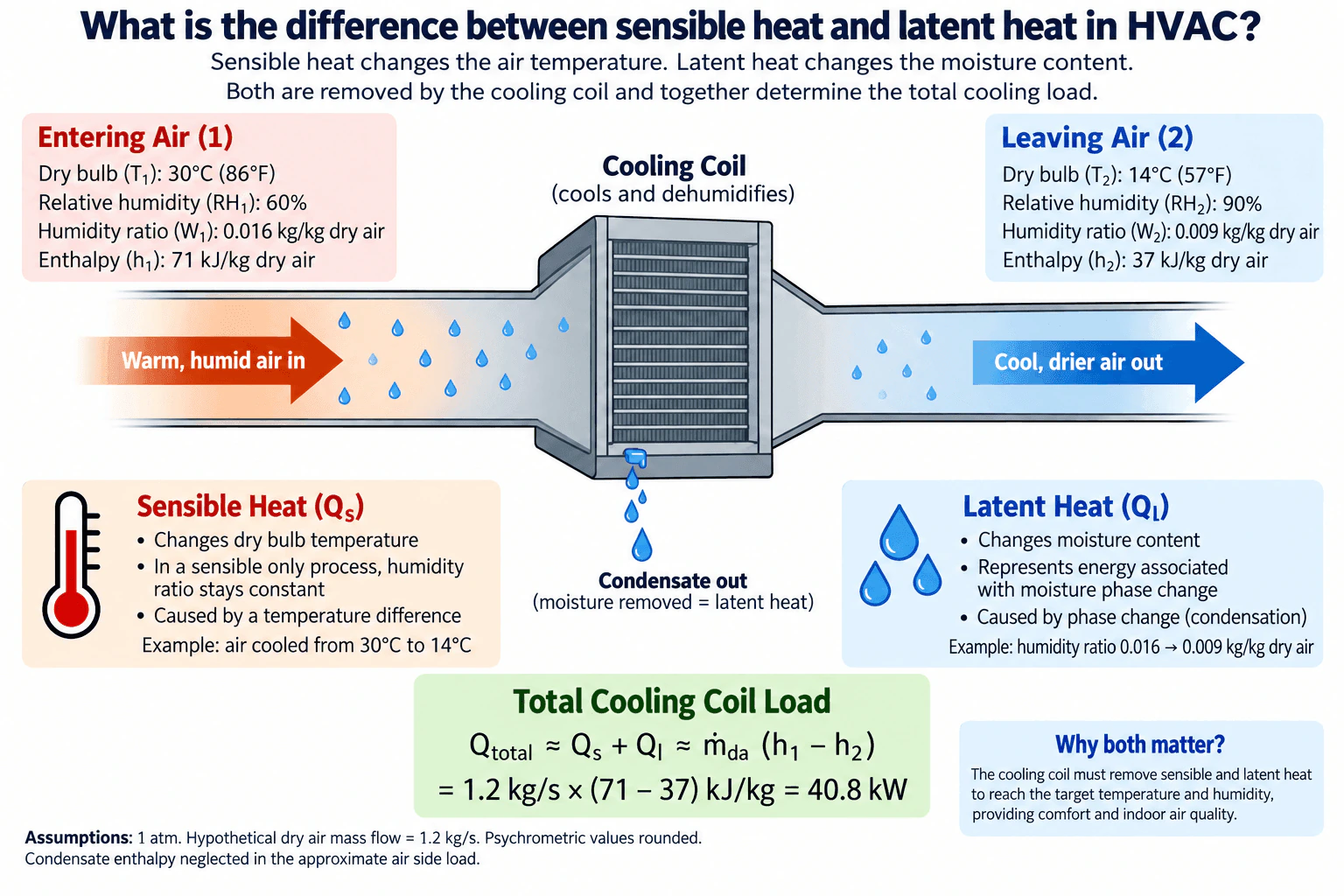
Sensible heat and latent heat describe two different effects of heat transfer in conditioned air. Sensible heat changes dry bulb temperature. In a sensible only process, the humidity ratio remains constant. Latent heat is associated with a moisture phase change. During cooling and dehumidification, water vapor condenses on the cooling coil, so the humidity ratio decreases.
Dry bulb temperature is the ordinary air temperature measured by a standard thermometer. Wet bulb temperature reflects the combined effects of temperature and moisture through evaporative cooling. Humidity ratio, W, is the mass of water vapor per mass of dry air. Relative humidity compares the actual water vapor condition with saturation at the same temperature, so relative humidity can change even when humidity ratio does not.
Useful Questions to Ask the Interviewer
Should I explain this as a general psychrometric concept or use a cooling coil example?
May I assume standard atmospheric pressure for the example?
Should I discuss only air side performance or also relate the load to refrigeration capacity?
How to Explain It in an Interview
Start with the physical distinction. Sensible heat changes temperature. For a sensible only process, the humidity ratio remains constant. Latent heat is associated with moisture phase change. During cooling and dehumidification, water vapor condenses, so the humidity ratio decreases.
A useful hypothetical cooling coil example is air entering at 30°C and 60% relative humidity with a humidity ratio of about 0.016 kg water per kg dry air and an enthalpy of about 71 kJ per kg dry air. Suppose it leaves at 14°C and 90% relative humidity with a humidity ratio of about 0.009 kg water per kg dry air and an enthalpy of about 37 kJ per kg dry air. These values assume approximately 1 atm pressure and are rounded psychrometric values.
The dry bulb temperature falls from 30°C to 14°C, showing sensible cooling. The humidity ratio falls from 0.016 to 0.009 kg water per kg dry air, showing moisture removal and latent cooling. The leaving relative humidity is higher even though the humidity ratio is lower because relative humidity depends strongly on temperature as well as moisture content.
For a hypothetical dry air mass flow rate, ṁda, of 1.2 kg/s, the approximate air side coil load is Qtotal ≈ ṁda(h1 − h2). Using the rounded enthalpies gives Qtotal ≈ 1.2 kg/s × (71 − 37) kJ/kg = 40.8 kW. This simplified calculation neglects condensate enthalpy.
Both components matter because a coil that handles only sensible cooling might reach the temperature target but fail to remove enough moisture. Cooling coil performance should therefore be evaluated using both entering and leaving air conditions, dry air mass flow, and the required temperature and humidity targets.
Why Interviewers Ask This
Interviewers want to see whether you understand how an HVAC cooling coil controls both air temperature and moisture, can distinguish dry bulb temperature from humidity ratio and relative humidity, and can connect psychrometric state changes to total coil capacity.
Common interview mistakes
Common mistakes include treating relative humidity as the same property as humidity ratio, assuming sensible cooling always removes moisture, saying latent heat during a real cooling coil process must occur with no dry bulb temperature change, ignoring condensation when the cooling surface is below the air dew point, and considering only dry bulb temperature when evaluating coil performance.
Interview tip
State the distinction first, then connect it to one cooling coil example. Say that sensible heat changes dry bulb temperature, latent heat is associated with moisture phase change, and total coil performance depends on both. Mention humidity ratio rather than relying only on relative humidity because humidity ratio directly shows whether moisture was removed.
Interviewer may ask next
How would you verify that a cooling coil is actually removing latent heat?
Compare the entering and leaving humidity ratios. If the leaving humidity ratio is lower, moisture has been removed from the air. You can also confirm condensate formation and verify that the cooling surface reaches a temperature below the dew point of the air contacting it. Relative humidity alone is not sufficient because it also changes with air temperature.
What happens if the sensible load decreases but the latent load remains high?
The space may reach its temperature setpoint before enough moisture is removed. If cooling is reduced or stopped at that point, indoor humidity can remain too high. The HVAC system therefore needs adequate moisture removal capability and appropriate control so that temperature and humidity requirements can both be satisfied.
2. What is a ton of refrigeration, and how is it used when discussing HVAC capacity?Hvac FundamentalsEasy
i Question Details
State what a ton of refrigeration represents as a cooling-capacity unit and relate it to the way HVAC equipment capacity is commonly specified.
Short Interview Answer (30-60 seconds)
A ton of refrigeration is a unit of cooling capacity, not a measure of mass. One ton represents 12,000 Btu per hour of heat removal, which is about 3.517 kW. HVAC equipment is commonly rated in tons to indicate its cooling capacity. For example, a 3 ton air conditioner has a nominal cooling capacity of 36,000 Btu per hour, or about 10.55 kW. That cooling capacity is different from the electrical power the unit consumes.
Detailed Explanation
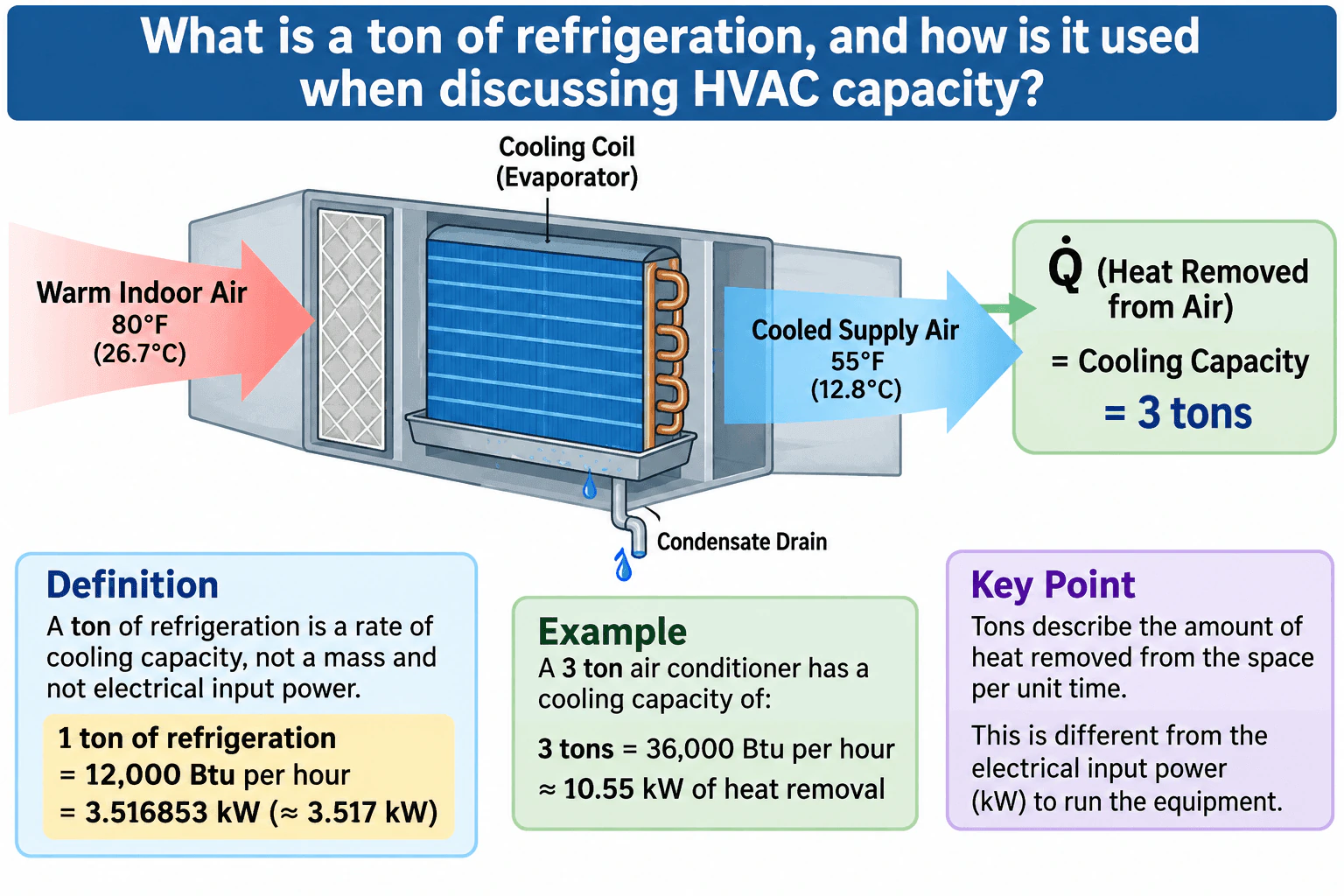
A ton of refrigeration represents a rate of heat removal. It is used to describe how much cooling HVAC equipment can provide over time. One ton of refrigeration equals 12,000 Btu per hour, which is approximately 3.517 kW of cooling capacity.
In the illustrated example, warm indoor air at 80°F, or 26.7°C, passes across the evaporator cooling coil and leaves as cooled supply air at 55°F, or 12.8°C. Heat is removed from the air at the coil. If the coil surface is below the air dew point, moisture can also condense and leave through the condensate drain. The diagram uses a 3 ton example, which represents a nominal cooling capacity of 36,000 Btu per hour, or about 10.55 kW of heat removal. This cooling capacity is not the same as the electrical input power required to run the equipment.
Useful Questions to Ask the Interviewer
Should I explain the answer only in Btu per hour, or also convert the capacity to kW?
Would you like a simple equipment example to show how tonnage is used in practice?
How to Explain It in an Interview
Start with the definition: one ton of refrigeration is 12,000 Btu per hour of cooling capacity, which is about 3.517 kW of heat removal.
Then connect the unit to HVAC equipment. If an air conditioner is rated at 3 tons, its nominal cooling capacity is:
3 × 12,000 Btu per hour = 36,000 Btu per hour
Using the equivalent SI value:
3 × 3.516853 kW ≈ 10.55 kW of cooling capacity
The physical meaning is a rate of heat removal. In the diagram, warm indoor air passes across the evaporator cooling coil, heat is transferred from the air to the refrigerant, and cooler supply air leaves the coil. Moisture may also condense at the coil and drain away when dehumidification occurs.
The important distinction is that tons describe refrigeration capacity. They do not directly state electrical input power. A system that provides about 10.55 kW of cooling does not necessarily consume 10.55 kW of electricity because equipment efficiency determines the required input power.
I would finish by saying that tonnage is a convenient way to specify and compare HVAC cooling capacity, while actual delivered capacity depends on operating and rating conditions.
Why Interviewers Ask This
Interviewers want to confirm that the candidate understands a basic HVAC capacity unit, can convert tons into Btu per hour or kW, and can distinguish the rate of heat removal from the electrical input power required to operate the equipment.
Common interview mistakes
Common mistakes include treating a ton of refrigeration as a mass, confusing cooling capacity with electrical input power, forgetting that one ton equals 12,000 Btu per hour, or assuming that equipment always delivers its nominal tonnage regardless of operating conditions.
Interview tip
State the conversion first, then give a quick equipment example. Saying that a 3 ton unit represents 36,000 Btu per hour of nominal cooling capacity and then distinguishing that value from electrical input power demonstrates both unit knowledge and physical understanding.
Interviewer may ask next
How would you verify the cooling capacity of a system instead of relying only on its nominal tonnage?
I would identify the applicable operating and rating conditions and use measured performance data or manufacturer performance information. For an air side check, I would measure entering and leaving air conditions and airflow, then determine the total heat removed using appropriate air property data. I would compare that result with the expected equipment capacity while accounting for measurement uncertainty and operating conditions.
If two air conditioners are both rated at 3 tons, do they necessarily use the same electrical power?
No. Both units may have the same nominal cooling capacity of 36,000 Btu per hour, or about 10.55 kW of heat removal, but their electrical input can differ because their efficiencies can differ. Cooling capacity and electrical input power are separate quantities, so efficiency measures such as COP or EER are needed to relate useful cooling to energy consumption.
3. How do relative humidity and dew point differ when evaluating moisture risk?Hvac FundamentalsMedium
i Question Details
Compare relative humidity with dew point as moisture indicators and explain why one can change when air temperature changes even if the absolute moisture content does not.
Short Interview Answer (30-60 seconds)
Relative humidity compares the actual water vapor pressure with the saturation vapor pressure at the current air temperature, so it can change when temperature changes even if no moisture is added or removed. Dew point is the temperature at which that air would become saturated if cooled without changing its moisture content, so it is a more direct indicator of the amount of moisture present. For condensation risk, I compare the surface temperature with the air dew point. If the surface is at or below the dew point, condensation can begin.
Detailed Explanation
Relative humidity and dew point describe moisture in different ways. Relative humidity depends on both the amount of water vapor present and the current dry bulb temperature. Dew point is determined by the water vapor partial pressure, so it tracks the moisture condition more directly. That is why sensible heating can reduce relative humidity even when no moisture is removed.
Useful Questions to Ask the Interviewer
Are we evaluating condensation on a particular surface or general indoor moisture conditions?
Should I assume the air pressure and moisture content remain essentially constant while temperature changes?
Are the stated temperatures dry bulb air temperatures or surface temperatures?
How to Explain It in an Interview
For relative humidity, I use RH = Pᵥ / Pₛₐₜ(T) × 100%, where Pᵥ is the actual water vapor partial pressure and Pₛₐₜ(T) is the saturation vapor pressure at the current dry bulb temperature. Saturation vapor pressure rises as temperature rises. Therefore, if the same air parcel is sensibly heated with no moisture added or removed and pressure remains essentially constant, Pᵥ remains approximately constant while Pₛₐₜ increases, so relative humidity decreases.
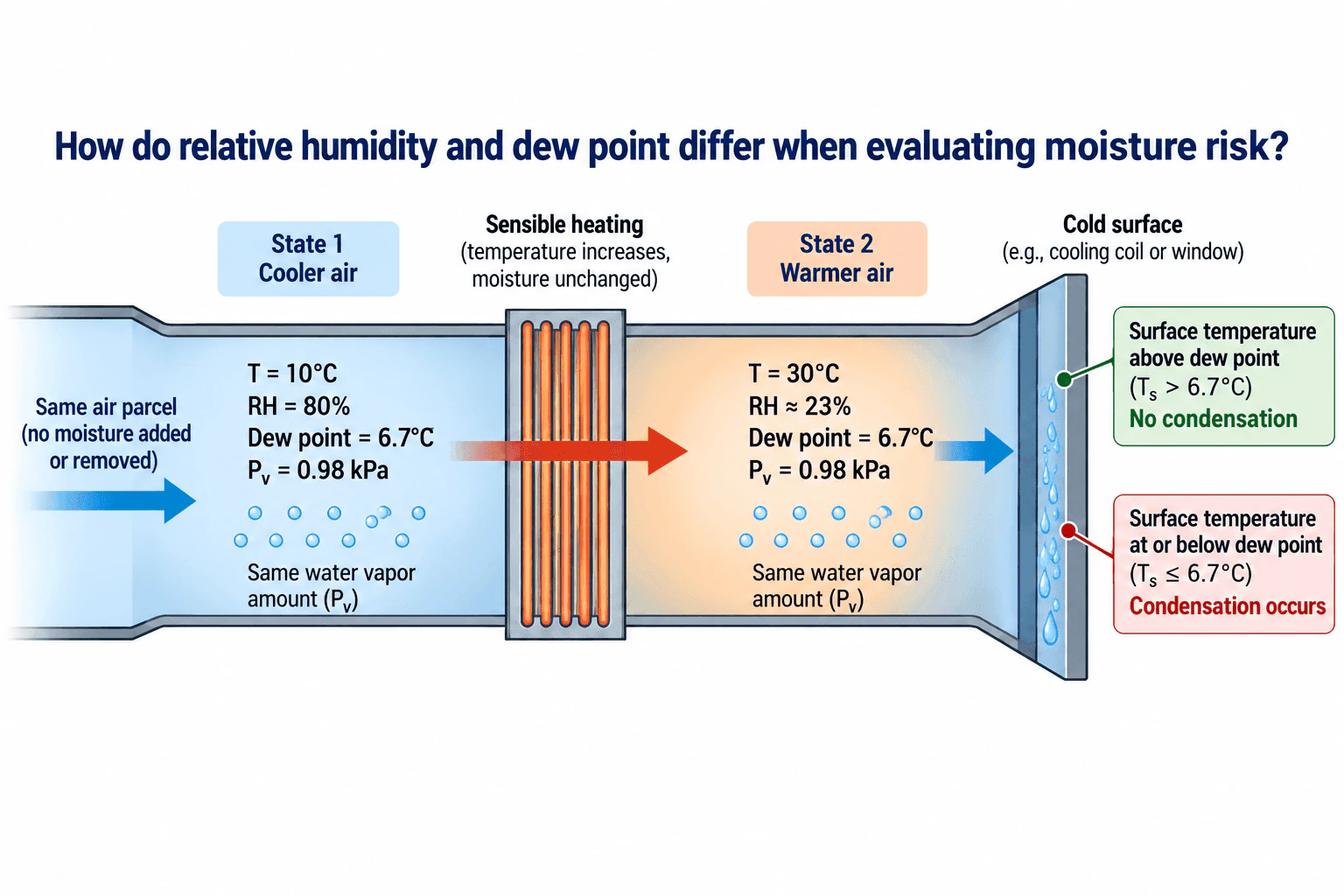
A hypothetical example matching the diagram starts at 10°C and 80% relative humidity. The water vapor partial pressure is about 0.98 kPa and the dew point is about 6.7°C. If that same air parcel is sensibly heated to 30°C without adding or removing moisture, its water vapor partial pressure remains about 0.98 kPa and its dew point remains about 6.7°C, but its relative humidity falls to about 23%.
Dew point answers a different question. It is the temperature to which the air must be cooled, at essentially constant pressure and moisture content, before it becomes saturated. Because sensible heating does not change the moisture content, the dew point remains essentially unchanged in this example even though the relative humidity changes substantially.
For moisture risk, dew point is especially useful when evaluating a cold surface. If the surface temperature is above 6.7°C in this example, the adjacent air has not yet reached its dew point and condensation is not expected. At about 6.7°C, condensation can begin. Below 6.7°C, condensation is expected if the surface remains exposed to that moist air.
The practical conclusion is that relative humidity describes how close air is to saturation at its current temperature, while dew point is more direct for judging moisture content and condensation risk against a known surface temperature.
Why Interviewers Ask This
Interviewers want to know whether the candidate understands psychrometric moisture properties well enough to distinguish temperature dependent relative humidity from dew point and to use the correct property when assessing condensation risk.
Common interview mistakes
Common mistakes include treating relative humidity as a direct measure of total moisture, assuming relative humidity stays constant during sensible heating, assuming dew point changes merely because dry bulb temperature changes, and checking condensation risk using relative humidity alone instead of comparing the surface temperature with the dew point.
Interview tip
State the distinction in one sentence first: relative humidity depends on both temperature and moisture, while dew point reflects the water vapor condition more directly. Then use one constant moisture sensible heating example and finish by comparing surface temperature with dew point for condensation risk.
Interviewer may ask next
How would you validate that the moisture content really stayed constant during the temperature change?
I would confirm that there was no humidification, dehumidification, condensation, evaporation, or air mixing across the process boundary. I would then compare measured humidity ratio or water vapor partial pressure before and after the sensible heating step. If pressure is essentially unchanged and those moisture properties remain the same within measurement uncertainty, the constant moisture assumption is reasonable.
What changes if moisture is added while the air is being heated?
Then the process is no longer purely sensible. The humidity ratio and water vapor partial pressure increase, so the dew point rises. Relative humidity could rise, fall, or remain similar depending on how strongly moisture content and dry bulb temperature change. Condensation risk must therefore be reassessed using the new dew point and the actual surface temperature.
4. What is superheat, and why is it measured in a refrigeration system?Hvac FundamentalsMedium
i Question Details
Explain where superheat is measured, what it indicates about refrigerant condition entering the compressor, and what unusually low or high superheat can imply.
Short Interview Answer (30-60 seconds)
Superheat is the amount by which refrigerant vapor temperature is above its saturation temperature at the same pressure. I measure suction pressure and refrigerant temperature near the evaporator outlet or suction line, determine the saturation temperature for that refrigerant at the measured pressure, and subtract it from the measured temperature. Adequate superheat indicates that vapor is entering the compressor. Very low superheat can suggest overfeeding or flooding and possible liquid return, while high superheat can indicate a starved evaporator or restricted refrigerant flow.
Detailed Explanation
Superheat tells us how far refrigerant vapor has been heated above its saturation temperature after the liquid has evaporated. The basic relationship is Superheat = measured vapor temperature − saturation temperature at the measured pressure. Because saturation temperature depends on both refrigerant and pressure, the suction pressure must be interpreted using the correct refrigerant pressure temperature data. For a refrigerant blend, the appropriate saturation reference for superheat must be used according to the refrigerant data.
Useful Questions to Ask the Interviewer
Are we discussing superheat at the evaporator outlet or farther downstream at the compressor inlet?
Is a specific refrigerant or expansion device assumed?
Are we diagnosing an operating problem or only explaining the refrigeration principle?
How to Explain It in an Interview
Engineering Basis
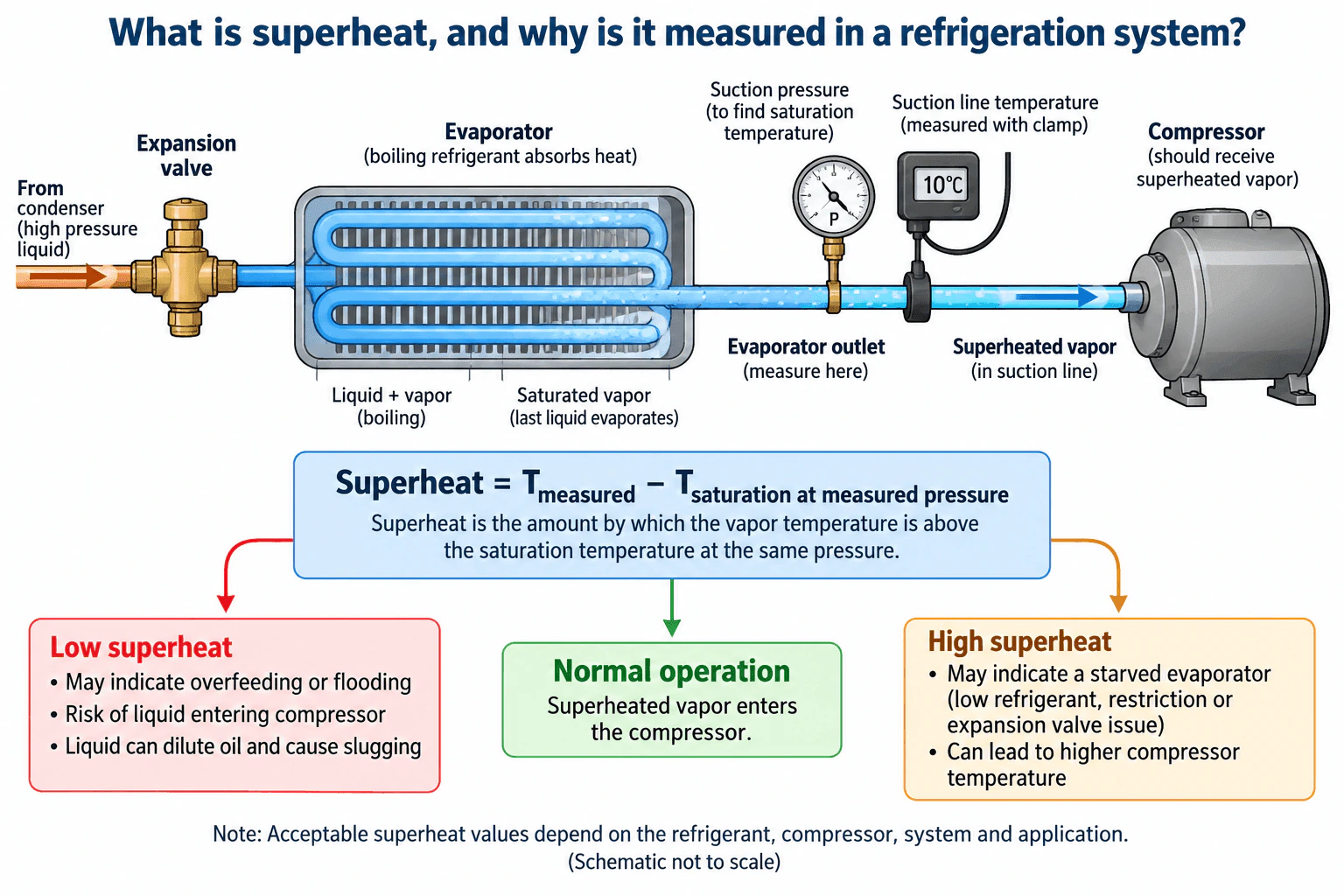
At the evaporator, refrigerant enters as a liquid and vapor mixture and absorbs heat as it boils. Near the outlet, the remaining liquid should have evaporated. Continued heat absorption then raises the vapor temperature above its saturation temperature. That temperature difference is superheat.
To determine it, I measure suction pressure and refrigerant line temperature at approximately the same location. I use the suction pressure to determine the refrigerant saturation temperature, then calculate:
Superheat = T measured − T saturation
For example, if the measured vapor temperature is 10 °C and the saturation temperature corresponding to the measured suction pressure is 4 °C, the superheat is 6 °C. This is a hypothetical example, not a target value.
Technical Reasoning
Superheat indicates the refrigerant condition leaving the evaporator and approaching the compressor. When the measured vapor temperature is above the saturation temperature at the same pressure, the refrigerant is superheated vapor. The compressor should receive vapor rather than liquid refrigerant.
Unusually low superheat can mean the evaporator is being overfed and liquid refrigerant may remain near the outlet. If liquid reaches the compressor, it can dilute compressor oil and may contribute to damaging liquid return or slugging.
Unusually high superheat can mean the evaporator is starved. Possible causes include insufficient refrigerant flow, a restriction, or an expansion valve problem. A starved evaporator can reduce effective evaporator use and may contribute to higher compressor inlet and discharge temperatures.
Key HVAC Factors
The acceptable superheat depends on the refrigerant, equipment, expansion device, operating conditions, and manufacturer requirements. I would not judge the system from one generic target value. I would verify the refrigerant, measure pressure and temperature at consistent locations, compare the result with equipment requirements, and check related operating conditions before diagnosing a fault.
Why Interviewers Ask This
Interviewers want to see whether the candidate understands refrigerant phase behavior, can relate pressure and temperature to saturation conditions, knows where superheat is measured, and can use the result to judge evaporator feeding and compressor protection.
Common interview mistakes
Common mistakes include using the wrong refrigerant pressure temperature data, measuring pressure and temperature at widely separated locations without considering pressure drop or heat gain, confusing superheat with subcooling, assuming one superheat value is correct for every system, and treating low suction pressure alone as proof of high superheat.
Interview tip
Explain superheat as a pressure and temperature relationship, not just a temperature reading. State where both measurements are taken, show the subtraction from saturation temperature, then connect low and high superheat to evaporator feeding and compressor protection.
Interviewer may ask next
How would you validate a superheat measurement before diagnosing a refrigerant problem?
I would confirm the refrigerant type, verify that the pressure and temperature measurements are taken at approximately the same location, check that the instruments are suitable and reading plausibly, allow the system to reach representative operating conditions, and compare the calculated superheat with the equipment or manufacturer requirements. I would also check related symptoms before concluding that refrigerant charge or flow is the cause.
What changes if superheat is measured at the compressor inlet instead of directly at the evaporator outlet?
The suction vapor can gain heat and experience pressure drop as it travels from the evaporator to the compressor, so compressor inlet superheat can differ from evaporator outlet superheat. The measurement location must match the purpose of the check and the applicable equipment guidance. Evaporator outlet superheat is especially useful for judging evaporator feeding, while compressor inlet conditions help confirm the refrigerant state actually reaching the compressor.
5. How would you compare COP, EER, and seasonal efficiency when evaluating equipment performance?Hvac FundamentalsHard
i Question Details
Compare the physical meaning and test context of the three efficiency measures and explain how steady-state and seasonal operation can lead to different conclusions about equipment performance.
Short Interview Answer (30-60 seconds)
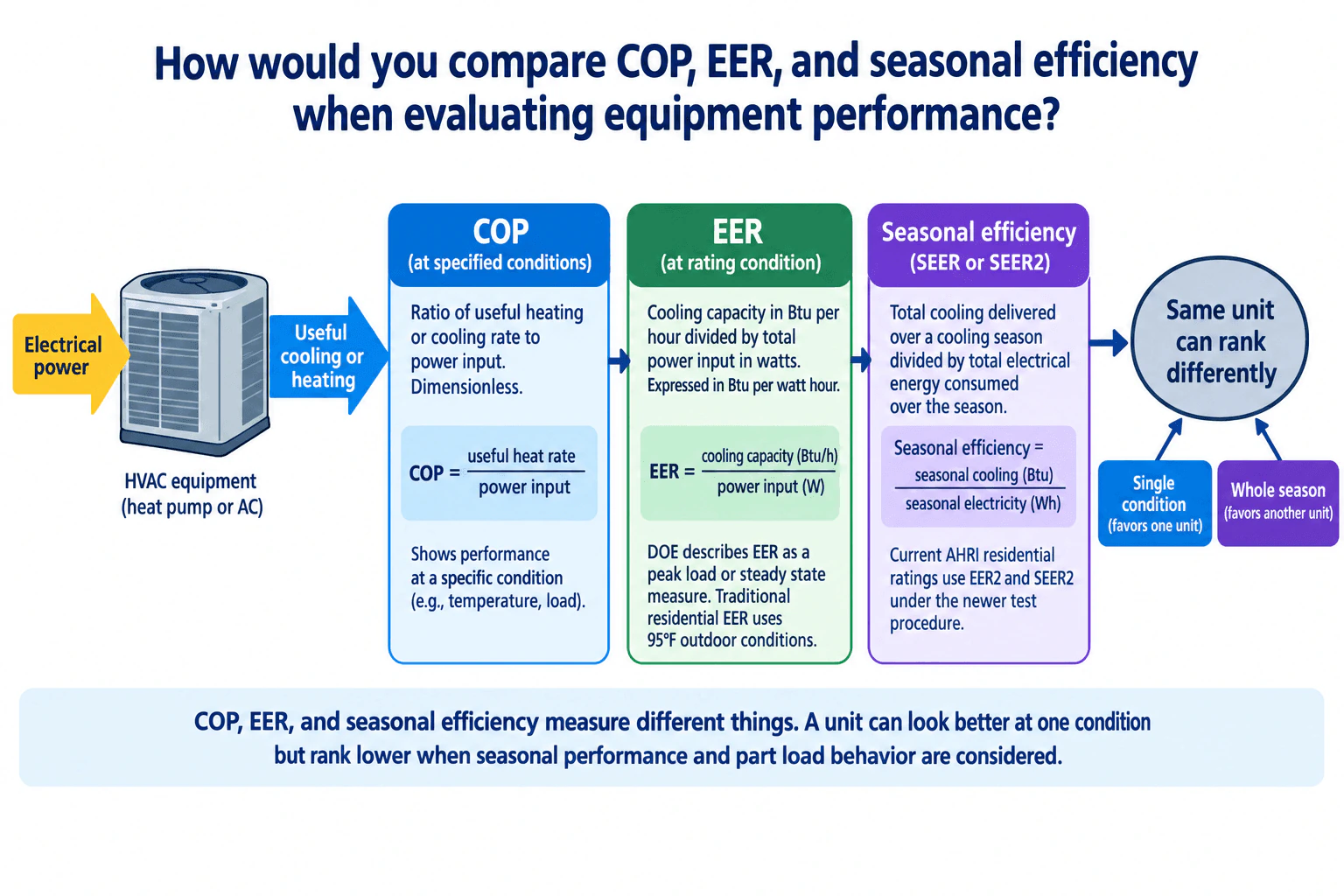
I would compare what each metric measures and the conditions behind it. COP is useful heating or cooling rate divided by power input using consistent units, so it is dimensionless. EER is cooling capacity in Btu/h divided by electrical input in watts at a defined rating condition. Seasonal efficiency, such as SEER or SEER2, is total cooling delivered over a prescribed season divided by total electrical energy consumed. A unit can therefore perform very well at one condition yet rank differently over a season because temperatures, loads, cycling, and part load behavior vary.
Detailed Explanation
COP, EER, and seasonal efficiency all relate useful HVAC output to energy input, but they answer different performance questions. The key distinction is whether the metric represents performance at specified conditions or accumulated performance across a prescribed cooling season.
Useful Questions to Ask the Interviewer
Are we comparing cooling only, or both heating and cooling performance?
Are the ratings based on comparable operating conditions and test procedures?
Is the decision focused on one rating condition or expected performance across a full season?
How to Explain It in an Interview
COP is the ratio of useful heating or cooling rate to power input when both quantities use consistent units:
COP = useful heat rate / power input
The units cancel, so COP is dimensionless. It describes equipment performance at specified operating conditions. For a heat pump, heating COP and cooling COP refer to different useful outputs, so I would first confirm the operating mode.
EER is primarily a cooling metric:
EER = cooling capacity in Btu/h / electrical power input in W
Its units are Btu/Wh. EER therefore describes cooling performance at a defined rating condition. It is useful when comparing how equipment performs at that particular condition rather than across an entire season.
Seasonal efficiency, such as SEER or SEER2, represents accumulated cooling performance:
Seasonal efficiency = seasonal cooling delivered in Btu / seasonal electrical energy in Wh
This matters because HVAC equipment does not operate at one temperature and one load for an entire cooling season. Outdoor conditions, building load, cycling, capacity modulation, and part load behavior change. A unit that looks better at one COP or EER condition may not keep the same advantage when seasonal operation is considered.
I would therefore compare equipment only after confirming that the metrics refer to compatible operating modes, test procedures, and rating conditions. COP and EER are useful for specified condition performance. Seasonal efficiency provides a broader measure across prescribed seasonal operation. That is why the same unit can rank differently depending on whether the comparison uses a single condition metric or a seasonal metric.
Why Interviewers Ask This
Interviewers want to see whether the candidate understands that an efficiency value has meaning only when its physical definition, units, operating condition, and test context are understood. They are also testing whether the candidate can distinguish performance at one specified condition from performance accumulated across seasonal operation.
Common interview mistakes
Common mistakes include treating COP, EER, and seasonal efficiency as interchangeable values, comparing ratings based on different operating conditions or test procedures, forgetting that COP is dimensionless when consistent units are used, treating EER as a seasonal metric, and assuming that the equipment with the best single condition result must also have the best seasonal result. Another mistake is comparing heating COP directly with a cooling seasonal rating without first defining the operating mode.
Interview tip
Define the numerator, denominator, units, and test context for each metric first. Then state the central distinction clearly: COP and EER describe performance at specified conditions, while seasonal efficiency represents accumulated performance across prescribed seasonal conditions. Finish by explaining that this difference can change the ranking of two pieces of equipment.
Interviewer may ask next
What would you verify before comparing the published efficiency ratings of two HVAC units?
I would verify that both ratings refer to the same operating mode, comparable equipment type, applicable test procedure, and compatible rating conditions. I would also check the units and determine whether each value represents a specified operating condition or seasonal operation. Without those checks, a numerical comparison can be misleading even when both ratings are individually valid.
Why might a unit with a better EER not have the better seasonal efficiency?
EER describes cooling performance at a defined rating condition, while seasonal efficiency reflects operation across a prescribed range of loads and outdoor conditions. Cycling behavior, capacity modulation, and part load efficiency can therefore change total seasonal energy use. A unit that is more efficient at the EER rating point may perform less favorably during other portions of the seasonal profile, which can change the ranking.
6. Why is outdoor-air ventilation required in occupied buildings?Ventilation And Indoor Air QualityEasy
i Question Details
Explain how outdoor air supports indoor air quality by diluting occupant-generated and building-generated contaminants, while recognizing that required rates depend on occupancy and applicable requirements.
Short Interview Answer (30-60 seconds)
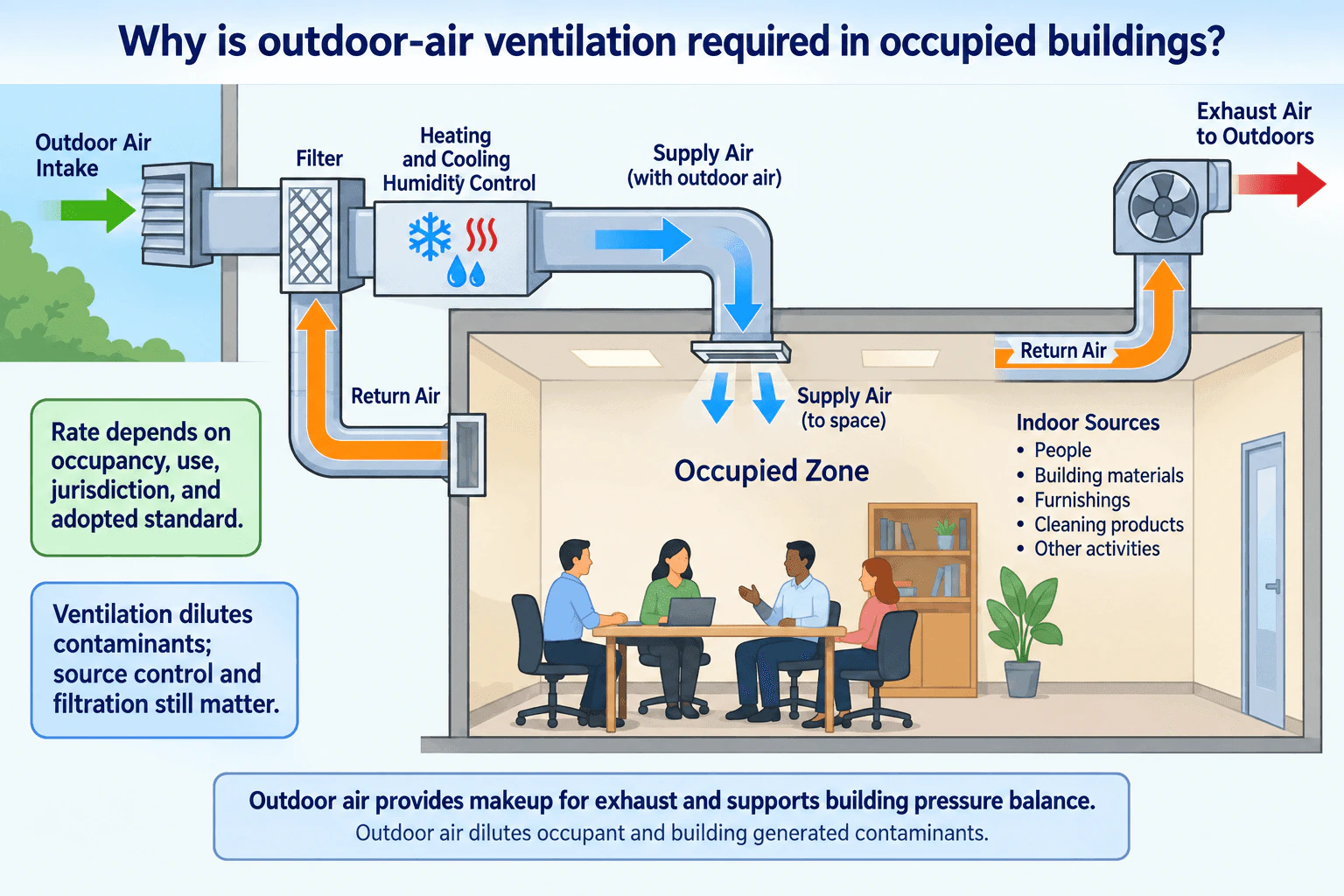
Outdoor air ventilation is required to dilute contaminants generated by occupants and the building and to provide makeup air for exhaust. This helps maintain acceptable indoor air quality and supports the intended building pressure balance. The required rate is not universal. It depends on occupancy, building use, ventilation effectiveness, jurisdiction, and the applicable adopted standard. Ventilation should also be coordinated with filtration, source control, humidity control, comfort, and energy use.
Detailed Explanation
Outdoor air improves indoor air quality by replacing part of the indoor air with controlled outdoor air so contaminants generated inside an occupied space do not continue to accumulate. Typical sources include people, building materials, furnishings, cleaning products, and other activities. Outdoor air is different from recirculated return air because return air has already been inside the building and does not by itself provide the same dilution with outdoor air.
Useful Questions to Ask the Interviewer
What building type and occupancy should I assume?
Which jurisdiction and adopted ventilation standard apply?
Are there significant exhaust loads, humidity concerns, or contaminant sources that affect the ventilation strategy?
How to Explain It in an Interview
Ventilation Basis
I would first identify the building use, occupancy, contaminant sources, jurisdiction, adopted standard, and indoor environmental objectives. For commercial buildings, ASHRAE Standard 62.1 may be applicable, while residential applications may use ASHRAE Standard 62.2 when applicable. I would not apply one occupancy requirement to every building type.
The central idea is dilution. Outdoor air enters through the intake, passes through filtration and conditioning as required, and becomes part of the supply air delivered to the occupied zone. This outdoor air lowers the concentration of occupant generated and building generated contaminants. The required amount depends on factors such as occupancy, space use, ventilation effectiveness, system distribution, and applicable requirements.
Indoor Environment Reasoning
I would distinguish outdoor air from total supply air. Supply air may contain both outdoor air and recirculated return air, so total supply airflow is not the same as outdoor ventilation airflow.
I would also check the air balance. Exhaust air leaving the building must be considered with outdoor air, return air, transfer air, and other makeup air so the intended building pressure relationship is maintained. Excessive negative pressure can increase uncontrolled infiltration, while excessive positive pressure can create unwanted pressure across the building enclosure.
Air Quality Checks
Ventilation is only one control. Source control and filtration still matter because ventilation does not remove every contaminant equally. I would also consider humidity control, condensation risk, thermal comfort, and the energy needed to condition outdoor air.
I would not use indoor CO2 by itself as proof that ventilation is adequate. It can be supporting information in suitable occupied spaces, but the ventilation decision still depends on occupancy, contaminant sources, airflow distribution, system operation, and applicable requirements.
Before implementation, I would verify the selected ventilation method, outdoor airflow, supply distribution, return airflow, exhaust balance, filtration, humidity control, pressure relationship, and adopted requirements for the actual building.
Why Interviewers Ask This
Interviewers want to know whether the candidate understands the purpose of outdoor air ventilation and can distinguish it from recirculated return air. They are also testing whether the candidate considers contaminant dilution together with exhaust makeup, building pressure, filtration, source control, humidity, comfort, and applicable ventilation requirements.
Common interview mistakes
Common mistakes include treating total supply air as outdoor ventilation air, assuming one ventilation rate applies to every occupancy, ignoring exhaust makeup and building pressure, relying on filtration as a substitute for required outdoor air, overlooking humidity and condensation effects, and assuming that an acceptable CO2 reading alone proves adequate ventilation.
Interview tip
Start with the main purpose: outdoor air dilutes indoor contaminants. Then explain that the required quantity depends on occupancy and applicable requirements. Finish by connecting outdoor air to exhaust makeup, building pressure, filtration, source control, humidity control, comfort, and energy use.
Interviewer may ask next
How would you verify that an occupied space is receiving the intended outdoor air?
I would confirm the applicable ventilation basis, review the airflow paths and control sequence, verify the outdoor air intake and damper operation, and measure or otherwise confirm the outdoor airflow using an appropriate field method. I would compare the result with the design requirement and also check supply distribution, return airflow, exhaust operation, building pressure, occupancy assumptions, filtration, and humidity conditions. Indoor CO2 can provide supporting information in suitable applications, but I would not use it alone to prove that the required outdoor airflow is being delivered.
What changes if the building has a large exhaust requirement?
A large exhaust requirement increases the importance of makeup air and building pressure balance. I would determine the exhaust airflow, identify the intended outdoor air and transfer air paths, and confirm that sufficient makeup air is provided without creating excessive negative pressure. The additional outdoor air can also increase heating, cooling, and humidity control loads, so equipment capacity, energy use, comfort, and condensation risk must be evaluated together.
7. What is dew point, and why does it matter for indoor air quality and condensation control?Ventilation And Indoor Air QualityEasy
i Question Details
Define dew point as the temperature at which moisture condenses and relate it to surfaces, ducts, chilled-water components, mold risk, and humidity control.
Short Interview Answer (30-60 seconds)
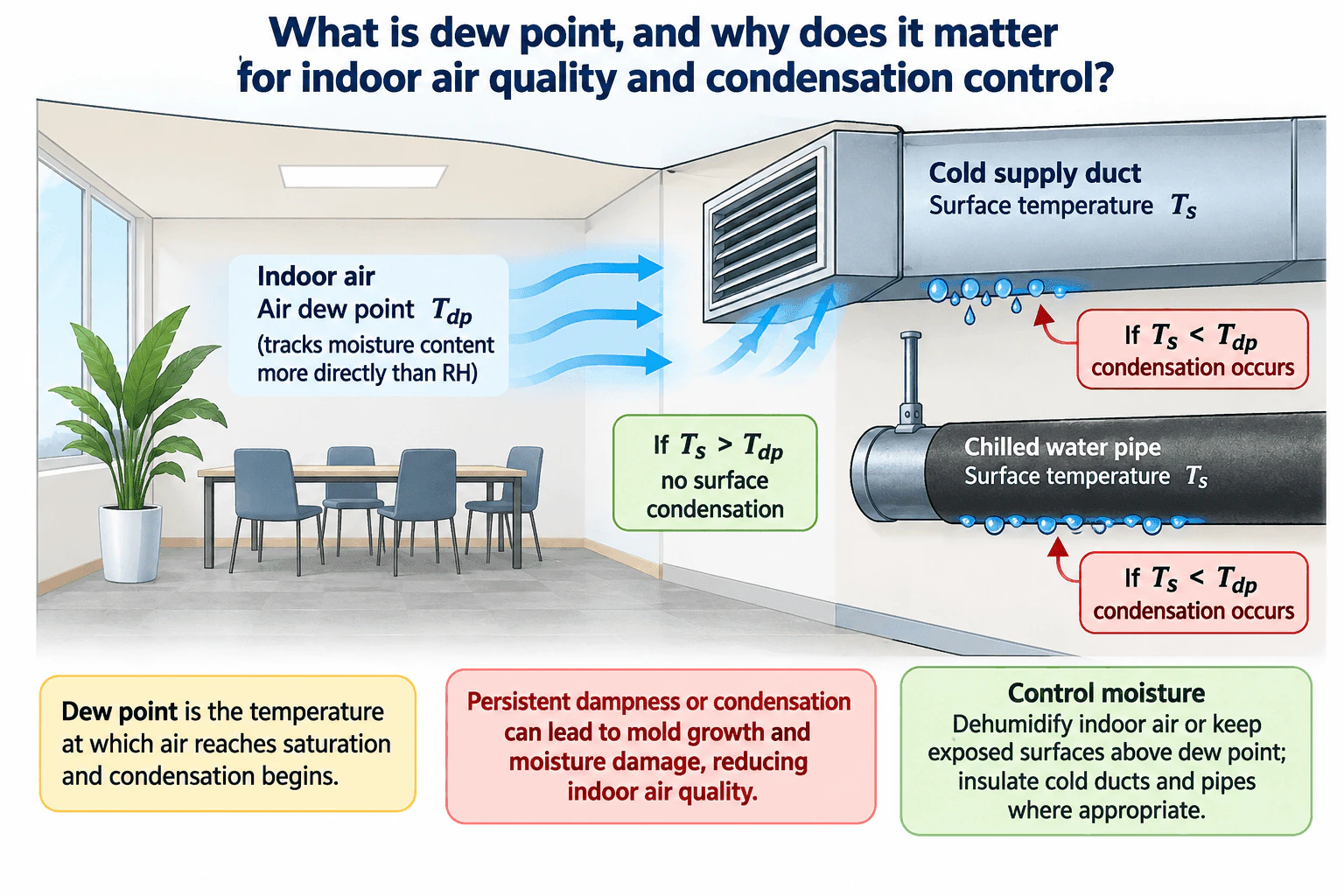
Dew point is the temperature at which air becomes saturated with water vapor and condensation can begin. In HVAC work, I compare the dew point of the surrounding air with the temperature of a surface. If the surface temperature Ts falls below the air dew point Tdp, moisture can condense on that surface. If Ts stays above Tdp, surface condensation does not occur under those air conditions. This matters on cold supply ducts, chilled water pipes, and similar components because persistent moisture can damage materials and support mold growth. Condensation control therefore means reducing the air moisture level, keeping exposed surfaces above the dew point, or properly insulating cold surfaces.
Detailed Explanation
Dew point describes the moisture condition of air in temperature terms. It is the temperature at which the air reaches saturation and water vapor can begin condensing. For condensation control, the key comparison is between the surrounding air dew point, Tdp, and the exposed surface temperature, Ts.
Useful Questions to Ask the Interviewer
Are we discussing condensation on a duct, chilled water pipe, building surface, or another HVAC component?
What indoor temperature and humidity conditions should the system maintain?
Are the cold surfaces exposed to occupied space air or located inside another environmental zone?
How to Explain It in an Interview
I would start with the basic condition. If Ts < Tdp, the surface is colder than the dew point and moisture from the surrounding air can condense. If Ts > Tdp, surface condensation does not occur under those air conditions. At Ts = Tdp, the surface is at the condensation threshold.
For example, a cold supply duct or chilled water pipe can have a surface temperature below the indoor air dew point. Water can then appear on the outer surface even though there is no plumbing leak. The moisture source is water vapor in the surrounding air.
This matters for indoor air quality because persistent dampness can support mold growth and can damage nearby materials. The problem is therefore not only thermal performance. It is also a moisture management issue.
I would control the risk in three main ways. First, reduce the moisture content of the indoor air through appropriate cooling and dehumidification. Second, keep exposed surface temperatures above the expected dew point where practical. Third, insulate cold ducts and chilled water components so the exposed outer surface stays above the dew point and humid air does not readily reach the cold component surface.
I would verify actual indoor temperature, humidity, calculated or measured dew point, cold surface temperatures, insulation condition, and signs of existing moisture. I would also consider operating extremes rather than checking only one normal condition.
The key interview point is that relative humidity alone does not tell me whether a particular surface will condense. I need the air dew point and the surface temperature. When Ts < Tdp, condensation risk exists, and the HVAC design should control either the moisture level, the exposed surface temperature, or both.
Why Interviewers Ask This
Interviewers want to know whether the candidate understands the relationship between air moisture, surface temperature, condensation, and moisture related indoor air quality problems. They are also testing whether the candidate can connect psychrometric concepts to practical HVAC decisions involving ducts, chilled water piping, insulation, dehumidification, and mold prevention.
Common interview mistakes
Common mistakes include treating relative humidity alone as the condensation criterion, comparing dew point with supply air temperature instead of the actual exposed surface temperature, assuming visible water must come from a leak, ignoring damaged or missing insulation, and overlooking periods when indoor moisture increases enough to raise the dew point.
Interview tip
State the temperature comparison clearly: if Ts < Tdp, condensation can occur. Then connect that condition to cold ducts or chilled water piping, explain the indoor air quality consequence of persistent dampness, and finish with practical controls such as dehumidification, keeping exposed surfaces above dew point, and insulating cold components.
Interviewer may ask next
How would you verify that condensation on a chilled water pipe is caused by dew point conditions rather than a water leak?
I would measure the surrounding air temperature and humidity, determine the air dew point, and measure the pipe surface temperature. If the surface temperature is below the dew point and moisture appears broadly on the cold exterior surface, condensation is physically plausible. I would still inspect joints, valves, fittings, and the piping system for leakage because the dew point comparison confirms condensation risk but does not by itself rule out a leak.
What changes if indoor humidity rises while the chilled water pipe temperature stays the same?
A rise in indoor moisture generally raises the air dew point. That reduces the margin between the pipe surface temperature and the dew point and can create condensation where none occurred before. The response could include stronger dehumidification, correcting moisture sources, or improving pipe insulation so the exposed insulation surface remains above the expected dew point.
8. How do you calculate outdoor-air ventilation for a zone?Ventilation And Indoor Air QualityMedium
i Question Details
Use occupancy and floor-area ventilation components required by the applicable adopted standard or code, then account for zone air-distribution effectiveness and actual design occupancy.
Short Interview Answer (30-60 seconds)
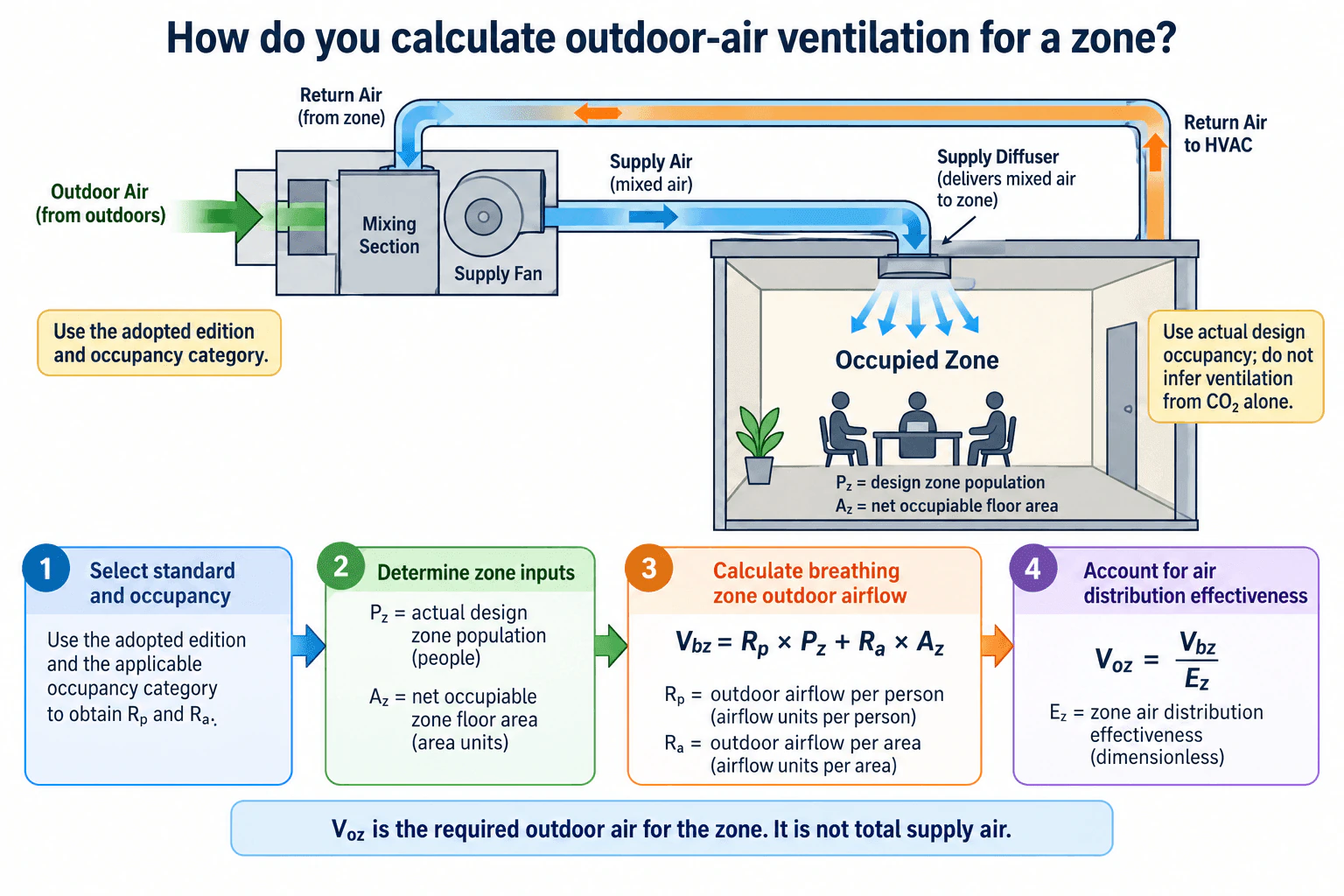
First identify the applicable adopted ventilation standard, edition, and occupancy category. Obtain Rp, the required outdoor airflow rate per person, and Ra, the required outdoor airflow rate per unit floor area. Using the design zone population Pz and net occupiable floor area Az, calculate Vbz = Rp × Pz + Ra × Az. Then account for zone air distribution effectiveness Ez using Voz = Vbz / Ez. Voz is the required outdoor airflow for the zone. It is not the total supply airflow, which may contain both outdoor air and recirculated return air.
Detailed Explanation
Outdoor air ventilation for a zone is calculated from two ventilation components: one associated with people and one associated with the occupiable floor area. The required rates must come from the applicable adopted standard or code for the actual building use and edition.
Useful Questions to Ask the Interviewer
Which adopted ventilation standard, edition, and occupancy category apply to this zone?
What are the design zone population Pz and net occupiable floor area Az?
What supply and return air arrangement applies when selecting the zone air distribution effectiveness Ez?
How to Explain It in an Interview
First define the ventilation zone and identify the applicable occupancy category. From the adopted standard, obtain Rp, the outdoor airflow rate required per person, and Ra, the outdoor airflow rate required per unit floor area.
Calculate the breathing zone outdoor airflow:
Vbz = Rp × Pz + Ra × Az
Pz is the design zone population for the condition being evaluated. Az is the net occupiable floor area. Rp × Pz represents the people related ventilation component, while Ra × Az represents the area related component. Both terms must use compatible units so their sum is an airflow rate.
Next account for the effectiveness of the zone air distribution:
Voz = Vbz / Ez
Ez is the zone air distribution effectiveness for the actual supply and return configuration. If Ez is less than 1, Voz must be greater than Vbz to provide the required airflow to the breathing zone.
Voz is the required outdoor airflow for the zone. It is not the total supply airflow. In the illustrated recirculating arrangement, outdoor air mixes with return air in the mixing section, the supply fan moves the mixed air toward the zone, and the supply diffuser delivers that mixed air to the occupied space.
Before accepting the result, I would verify the adopted occupancy category, Pz, Az, Rp, Ra, Ez, and all units. I would also check whether unusual contaminant sources or other applicable code requirements require additional ventilation or source control. CO2 monitoring can provide useful operating information, but CO2 alone does not demonstrate that the required outdoor airflow has been satisfied.
Why Interviewers Ask This
Interviewers want to see whether you can translate an adopted ventilation requirement into a zone outdoor airflow value, correctly combine the people and floor area components, account for zone air distribution effectiveness, and distinguish required outdoor air from total supply air.
Common interview mistakes
Common mistakes include selecting Rp and Ra from the wrong occupancy category or edition, using an occupancy value that does not match the applicable design condition, using the wrong floor area basis, omitting either the people or area component, forgetting Ez, mixing unit systems, and confusing Voz with total supply airflow.
Interview tip
State the two equations early, define every symbol, and emphasize that the final Voz value is required outdoor airflow rather than total supply airflow. Also explain that Rp, Ra, and Ez must match the applicable adopted standard and the actual zone conditions.
Interviewer may ask next
How would you validate the outdoor airflow after the system is installed?
I would compare measured outdoor airflow with the calculated design requirement under the relevant operating condition, confirm outdoor air damper and fan operation, verify the design population and zone air distribution assumptions, and check that the intended airflow path through the mixing section, supply fan, diffuser, occupied zone, and return path is operating as designed. I would not rely on a single CO2 reading as proof that the required ventilation airflow is being delivered.
What happens if the zone air distribution effectiveness decreases?
Because Voz = Vbz / Ez, decreasing Ez increases the required outdoor airflow Voz for the same breathing zone requirement. I would first confirm that the selected Ez correctly represents the actual supply and return arrangement, then recalculate Voz and evaluate whether the air distribution can be changed to improve effectiveness before simply increasing outdoor airflow.
9. When is demand-controlled ventilation appropriate, and what are its limitations?Ventilation And Indoor Air QualityMedium
i Question Details
Explain how occupancy-related sensing can reduce outdoor air under suitable conditions while maintaining minimum ventilation and recognizing that a single contaminant proxy does not represent every pollutant.
Short Interview Answer (30-60 seconds)
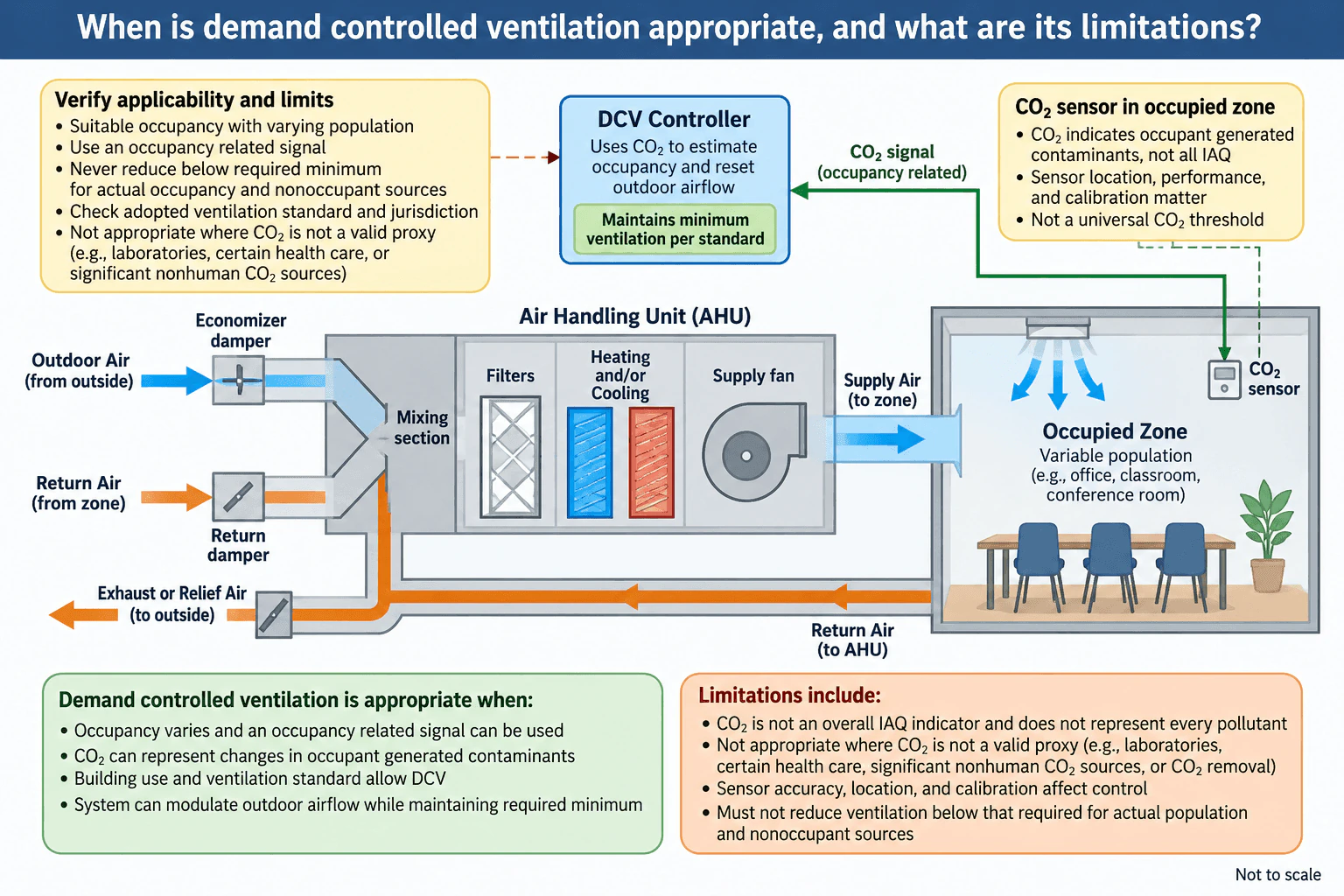
Demand controlled ventilation is appropriate where occupancy varies significantly and an occupancy related signal, commonly zone CO₂, can reasonably represent changes in occupant generated contaminants. The controller can reduce the occupancy related outdoor airflow during lower occupancy and increase it as occupancy rises, but ventilation must not fall below the minimum required for the actual population and nonoccupant contaminant sources. CO₂ does not represent every pollutant, so DCV cannot replace source control, filtration, exhaust, humidity control, or other required ventilation. Sensor location, performance, calibration, building use, and the adopted ventilation requirements also matter.
Detailed Explanation
Demand controlled ventilation adjusts outdoor airflow as occupancy changes instead of maintaining the same occupancy related outdoor airflow at all times. In the illustrated system, outdoor air enters through a controlled damper and mixes with return air in the air handling unit. The mixed air passes through filtration and heating or cooling equipment before the supply fan delivers it to the occupied zone. Return air flows back to the air handling unit, with part of the airflow leaving as exhaust or relief air.
A zone CO₂ sensor sends an occupancy related signal to the DCV controller. The controller resets outdoor airflow according to demand while maintaining the required minimum ventilation. The objective is to reduce unnecessary outdoor air treatment when occupancy is lower without compromising the ventilation required for occupants or nonoccupant contaminant sources.
Useful Questions to Ask the Interviewer
What type of space and occupancy pattern are we controlling?
What important contaminant sources exist besides occupants?
Which ventilation requirements, jurisdiction, and adopted standard edition apply?
How to Explain It in an Interview
Ventilation Basis
I would first confirm that occupancy varies enough for DCV to provide value and that the chosen sensing method is appropriate for the space. Offices, classrooms, and conference rooms are common examples when occupancy changes substantially. The controller may then reduce the occupancy related outdoor airflow during lower occupancy and increase it as occupancy rises.
The critical constraint is minimum ventilation. Outdoor airflow must not be reduced below the amount required for the actual population and nonoccupant sources such as materials, furnishings, equipment, or other building contaminants.
Indoor Environment Reasoning
CO₂ can be useful as an occupancy related proxy when people are the dominant variable source, but it is not a complete indoor air quality indicator. A normal CO₂ reading does not demonstrate that particles, volatile contaminants, process pollutants, moisture, or other contaminants are acceptable. There is also no single universal CO₂ threshold that proves adequate ventilation for every building or occupancy.
DCV therefore works with source control, filtration, exhaust, makeup air, humidity control, and pressure management rather than replacing them. Laboratories, certain health care spaces, and areas with significant nonhuman CO₂ sources require different reasoning because CO₂ may not be a valid occupancy proxy.
Air Quality Checks
I would verify sensor location, performance, and calibration, then confirm that the outdoor air damper and controller actually deliver the intended airflow. I would also check the return and relief air paths, exhaust and makeup air balance, building pressure, filtration, humidity, condensation risk, and thermal comfort.
The final decision is to use DCV where occupancy varies and the sensing method represents the load being controlled, while always maintaining required minimum ventilation and separately controlling contaminants that the occupancy signal cannot detect.
Why Interviewers Ask This
Interviewers want to see whether the candidate can identify when occupancy related ventilation control is appropriate, maintain required minimum outdoor air, and recognize that CO₂ is an occupancy related proxy rather than a complete measure of indoor air quality.
Common interview mistakes
Common mistakes include treating CO₂ as a complete indoor air quality indicator, assuming one universal CO₂ threshold applies everywhere, reducing outdoor airflow below the required minimum, ignoring nonoccupant contaminant sources, using poorly located or poorly calibrated sensors, confusing outdoor air with total supply air, and changing ventilation without checking exhaust, makeup air, pressure, filtration, humidity, condensation risk, and comfort.
Interview tip
Start by stating when DCV is appropriate, then immediately state the minimum ventilation constraint. Explain that CO₂ can be an occupancy related control signal but does not represent every pollutant. Finish by mentioning sensor quality, source control, filtration, exhaust, makeup air, humidity, and building pressure.
Interviewer may ask next
How would you validate that a CO₂ based demand controlled ventilation sequence is working correctly?
I would verify the CO₂ sensor location, performance, calibration, and response, then compare the controller command with the outdoor air damper response and measured outdoor airflow. I would test representative low and high occupancy conditions and confirm that airflow never drops below the required minimum. I would also check supply, return, exhaust, and relief airflow relationships, building pressure, humidity, comfort, and important contaminants that are not represented by CO₂.
What would change if the space had a significant contaminant source unrelated to occupancy?
I would not rely on occupancy related CO₂ control to manage that contaminant. The source would need its own control strategy, such as source capture, dedicated exhaust, filtration, or a minimum outdoor airflow that remains independent of occupancy. DCV could still control an appropriate occupancy related portion of ventilation if the application permits it, but it must not reduce the airflow needed for the nonoccupant source.
10. How would you evaluate displacement ventilation for indoor air quality in a large occupied space?Ventilation And Indoor Air QualityHard
i Question Details
Assess contaminant sources, supply-air location and temperature, stratification, occupied-zone air quality, ceiling height, load distribution, exhaust location, and comfort constraints.
Short Interview Answer (30-60 seconds)
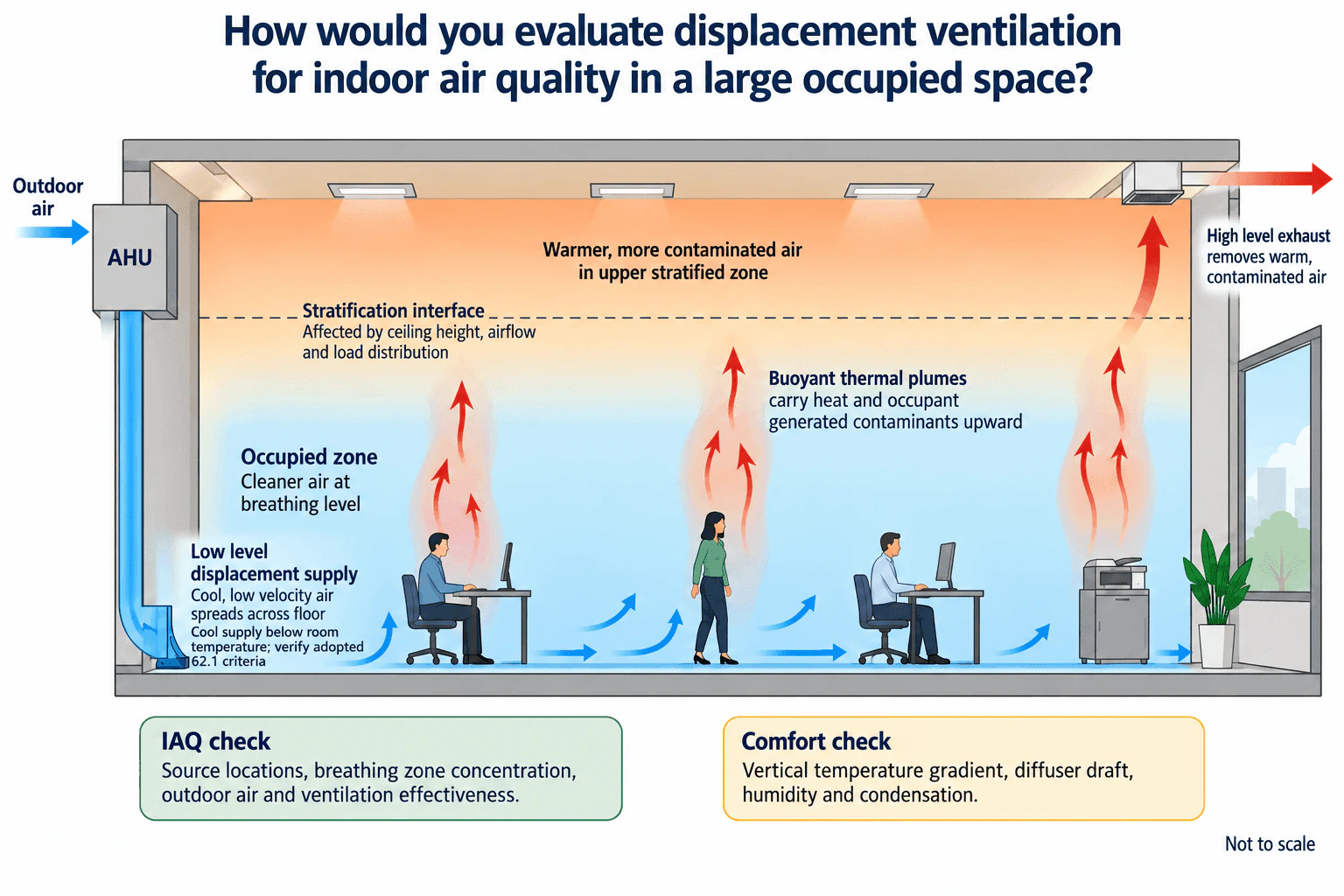
I would first identify the occupancy, contaminant sources, ceiling height, load distribution, and applicable ventilation and comfort requirements. Then I would verify that cool low velocity supply air enters near floor level, spreads through the occupied zone, and is lifted by buoyant thermal plumes so heat and contaminants move toward the upper stratified zone and high level exhaust. I would check breathing zone air quality, outdoor air and exhaust balance, humidity, condensation, vertical temperature gradient, diffuser draft, filtration, and building pressure before deciding whether displacement ventilation is appropriate.
Detailed Explanation
Displacement ventilation works best when the room can maintain useful vertical stratification. Cool low velocity air enters near floor level, spreads through the occupied zone, and is warmed by occupants and equipment. Buoyant thermal plumes then carry heat and many occupant generated contaminants upward toward a warmer upper zone, where high level exhaust can remove them. The evaluation therefore has to consider both indoor air quality and thermal comfort rather than airflow quantity alone.
Useful Questions to Ask the Interviewer
What is the space use, occupant density, and what are the important contaminant sources?
What are the ceiling height, sensible load distribution, low level supply locations, and high level exhaust locations?
What ventilation, humidity, pressure, filtration, and comfort requirements apply under the adopted jurisdiction and standard editions?
How to Explain It in an Interview
I would evaluate the system in five steps.
Ventilation basis. I would identify the occupancy, contaminant sources, outdoor air requirement, applicable ventilation method, and indoor environmental objectives. I would distinguish required outdoor air from total supply air and consider ventilation effectiveness where applicable.
Low level supply. I would confirm that conditioned supply air enters at low level with low velocity and at a temperature suitable for displacement operation. It should spread across the floor without creating excessive draft or immediately mixing the full room volume.
Stratification and loads. I would examine occupants, equipment, lighting, envelope loads, ceiling height, and their locations. These heat sources should create buoyant plumes that carry warmer air and relevant contaminants upward. Uneven loads, strong mixing, or insufficient height can weaken the intended stratification.
Occupied zone air quality and exhaust. I would evaluate contaminant concentration in the breathing zone and verify that the warmer contaminated air reaches the upper zone and is removed through high level exhaust. I would also check exhaust, makeup air, transfer air, and building pressure relationships. Source control and appropriate filtration remain necessary because displacement ventilation is an air distribution strategy, not a substitute for contaminant control.
Comfort and validation. I would check vertical temperature gradient, local diffuser draft, humidity, condensation risk, and the applicable thermal comfort criteria. I would validate supply and exhaust airflow, temperatures, pressure relationships, and representative breathing zone conditions during commissioning or testing. CO2 can support ventilation assessment for appropriate occupancy related conditions, but I would not use CO2 alone to prove acceptable indoor air quality.
I would select displacement ventilation only if the occupied zone remains acceptably clean and comfortable while stable stratification and effective high level removal can be maintained across expected operating conditions.
Why Interviewers Ask This
They want to see whether you understand the physical behavior of displacement ventilation and can judge its suitability rather than simply recognizing the system type. The key professional judgment is whether the proposed air distribution can maintain acceptable breathing zone air quality and comfort while accounting for contaminant sources, thermal loads, ventilation requirements, exhaust, moisture, and building pressure.
Common interview mistakes
Common mistakes include treating total supply air as outdoor air, assuming CO2 alone proves acceptable indoor air quality, ignoring contaminant source location, overlooking ceiling height and load distribution, using high supply velocity that destroys stratification, placing exhaust where it cannot remove the upper contaminated layer, ignoring makeup air and building pressure, and failing to check vertical temperature gradient, diffuser draft, humidity, condensation, source control, and filtration.
Interview tip
Explain the room physics in sequence: low level cool supply air enters the occupied zone, heat sources create buoyant plumes, contaminants move upward into the warmer stratified zone, and high level exhaust removes that air. Then show engineering judgment by checking breathing zone air quality, ceiling height, load distribution, comfort, humidity, filtration, and air balance before giving a final recommendation.
Interviewer may ask next
How would you validate that displacement ventilation is actually maintaining good occupied zone air quality?
I would verify supply and exhaust airflow, outdoor air quantity, temperatures at representative heights, building pressure, and contaminant conditions at breathing level and in the upper zone. Where appropriate, I would use representative contaminant measurements or tracer testing to confirm the airflow pattern and removal behavior. I would also check comfort conditions and compare measured performance with the applicable design criteria. I would not rely on a single CO2 reading as proof of overall indoor air quality.
What would make you reject displacement ventilation for this space?
I would reconsider it if the ceiling is too low to maintain a useful upper stratified zone, if strong internal mixing or unfavorable load distribution destroys stratification, if required heating operation causes unacceptable comfort problems, if contaminant sources cannot be carried safely toward the upper exhaust, or if the required airflow creates draft or excessive vertical temperature differences. In those cases I would compare another air distribution strategy that can meet ventilation, comfort, humidity, and pressure requirements more reliably.
More questions load as you scroll
Hvac Engineer Resume Examples
Explore the resume examples below to find the one that best matches your target Hvac Engineer role.
Disclaimer: This interview guide is for educational and informational purposes only. It is designed to help readers prepare, but it does not guarantee any interview result, hiring decision, offer, or outcome. Interview questions, hiring criteria, and preferred answers can vary by employer, interviewer, industry, location, and time. All answers, examples, and explanations in this guide are suggested examples for interview preparation, not definitive answers or instructions for professional practice. They are based on research and judgment, are provided without warranties of any kind, and should be adapted to the question, role, and applicable laws and professional requirements. Diagrams are simplified illustrations intended to highlight the main concepts and their relationships; actual situations, systems, and practices may be more complex. Alternative approaches may be equally valid or better suited to a particular question, context, or interviewer. To the fullest extent permitted by applicable law, the contributors and publisher are not liable for decisions made, actions taken, or losses incurred based on this guide.
State Laws and Professional Responsibilities: Laws and requirements governing an occupation vary by state and jurisdiction. You are responsible for checking the current laws, licensing requirements, and scope-of-practice rules that apply to your location and role, and for ensuring that your answers and actions comply with them. Adapt examples in this guide to those requirements. This guide is not legal advice.
Content Accuracy and Verification: To the fullest extent permitted by applicable law, we do not represent or warrant that interview guides, questions, answers, examples, or diagrams are accurate, complete, current, error-free, or suitable for any particular purpose. You are responsible for independently reviewing and verifying the information before relying on it.