This interview guide is for educational and informational purposes only. It is designed to help readers prepare, but it does not guarantee any interview result, hiring decision, offer, or outcome. Interview questions, hiring criteria, and preferred answers can vary by employer, interviewer, industry, location, and time. All answers, examples, and explanations in this guide are suggested examples for interview preparation, not definitive answers or instructions for professional practice. They are based on research and judgment, are provided without warranties of any kind, and should be adapted to the question, role, and applicable laws and professional requirements. Diagrams are simplified illustrations intended to highlight the main concepts and their relationships; actual situations, systems, and practices may be more complex. Alternative approaches may be equally valid or better suited to a particular question, context, or interviewer. To the fullest extent permitted by applicable law, the contributors and publisher are not liable for decisions made, actions taken, or losses incurred based on this guide.
State Laws and Professional Responsibilities
Laws and requirements governing an occupation vary by state and jurisdiction. You are responsible for checking the current laws, licensing requirements, and scope-of-practice rules that apply to your location and role, and for ensuring that your answers and actions comply with them. Adapt examples in this guide to those requirements. This guide is not legal advice.
Identity, Image, and Privacy Notice
To respect individual privacy, some names, profile photographs, avatars, biographical details, and other identifying information displayed in this guide may be replaced with pseudonyms, licensed stock images, illustrative avatars, composite images, or representative descriptions. Unless a person is expressly identified as an actual contributor, a displayed name, image, or profile should not be understood as depicting or identifying a specific candidate, interviewer, employee, or other real individual. These representations are provided for editorial and illustrative purposes only and do not imply endorsement, employment, participation, or affiliation with this guide or any company mentioned in it. Any resemblance to an actual person is coincidental.
Company Notice
This guide is an independent educational resource and is not affiliated with, endorsed by, sponsored by, or approved by the company named in this guide. Company names identify reported interview experiences or the employer context of clearly labeled original practice exercises. Interview practices can change without notice, and inclusion of company-specific content does not mean these questions are official, complete, or guaranteed to be asked. To the fullest extent permitted by law, the author, contributors, and publisher are not responsible for outcomes related to use of this material.
Content Accuracy and Verification
To the fullest extent permitted by applicable law, we do not represent or warrant that interview guides, questions, answers, examples, or diagrams are accurate, complete, current, error-free, or suitable for any particular purpose. You are responsible for independently reviewing and verifying the information before relying on it.
Questions or comments?
Contact us for general questions, or share feedback, technical corrections, and comments with the community.
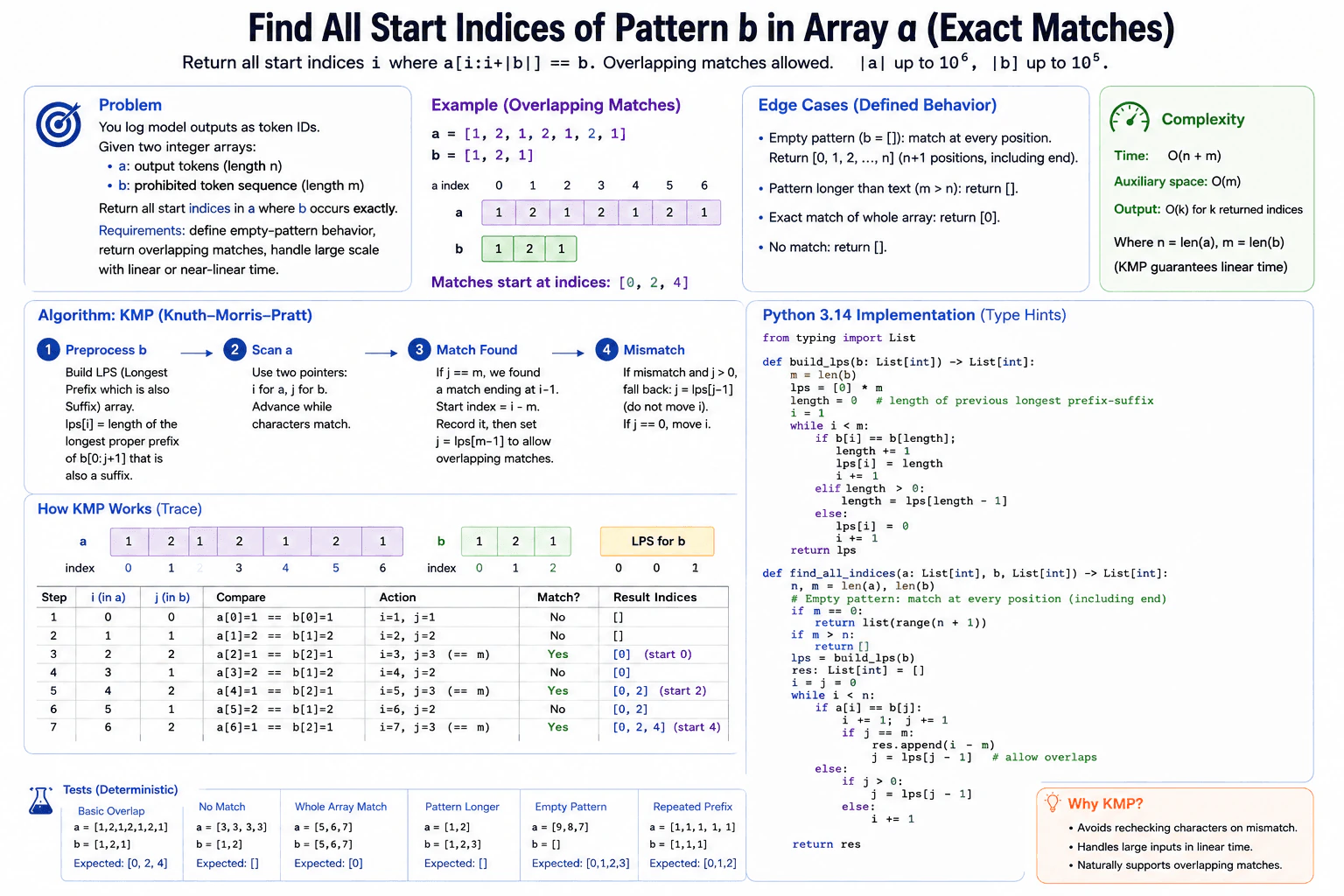
11. In a DeepMind eval run, you log model outputs as token IDs; given two integer arrays a (output tokens) and b (a prohibited token sequence), return all start indices in a where b occurs exactly. Constraints: |a| up to 10^6, |b| up to 10^5.CodingMediumGoogle Deepmind
i Question Details
The implementation must define empty-pattern behavior, return overlapping matches, respect the stated scale with linear or near-linear matching, and test repeated-prefix and no-match inputs.
Short Interview Answer (30-60 seconds)
I would use KMP, or Knuth-Morris-Pratt, because the inputs can be very large and we need all exact matches, including overlaps. I first build the LPS array for pattern b. Then I scan a with indices i and j. On a mismatch, LPS tells me how far the pattern can fall back without moving i backward. After a full match, I record i - m and reset j using LPS so overlaps still work. Time is O(n + m). Auxiliary space is O(m).
We have two integer arrays. Array a is the model output. Array b is the prohibited token sequence. We must return every position in a where the whole pattern b starts. Matches may overlap. Because a can contain up to 10^6 tokens and b up to 10^5 tokens, repeatedly checking the pattern from every position can be too slow. KMP fits well because it reuses information from earlier pattern matches and runs in linear time.
Useful Questions to Ask the Interviewer
For an empty pattern, should I return every position from 0 through len(a), including the end?
Should overlapping matches be included in the result?
Should the returned start indices be zero-based and in increasing order?
How to Explain It in an Interview
1. Understand the input and required output
The input is two integer arrays, a and b. Let n = len(a) and m = len(b). We return a list of zero-based start indices. At each returned index s, the slice a[s:s + m] is exactly equal to b. For the diagram example, a = [1, 2, 1, 2, 1, 2, 1] and b = [1, 2, 1]. The correct result is [0, 2, 4].
2. Build the LPS array for b
KMP first preprocesses b. LPS means longest proper prefix that is also a suffix. For each pattern position, it tells us how much of the pattern can still be reused after a mismatch. For b = [1, 2, 1], the LPS array is [0, 0, 1]. The last value is 1 because the prefix [1] is also the suffix [1].
3. Scan a with two indices
Index i points into a. Index j points into b. If a[i] equals b[j], both indices move forward. If they differ and j is greater than zero, we set j = lps[j - 1]. We do not move i backward. If they differ and j is zero, we move i forward.
4. Walk through the example
Start with i = 0 and j = 0. Values 1, 2, 1 match b completely, so i becomes 3 and j becomes 3. Because j equals m, the first match starts at i - m = 0. We append 0. Then j becomes lps[2] = 1, which keeps the shared prefix and allows an overlapping match. The same process finds matches starting at 2 and 4. The final result is [0, 2, 4].
5. Explain why the result is correct
The important invariant is that before each comparison, b[0:j] matches the suffix of a that ends just before i. When a mismatch happens, LPS gives the longest smaller prefix that could still match that suffix. So KMP never skips a possible match. After a full match, using lps[m - 1] keeps any useful suffix and lets overlapping matches be found.
6. Explain the Python implementation and edge cases
The helper builds the LPS array. The main function first handles special cases. If b is empty, it returns every position from 0 through n. If m is greater than n, it returns an empty list. Otherwise it builds LPS and scans a. A complete match appends i - m. The deterministic tests cover the diagram example, no match, whole-array match, a pattern longer than a, an empty pattern, and a repeated-prefix pattern.
7. Explain complexity
Building LPS takes O(m) time. Scanning a takes O(n) time because i never moves backward and j only follows LPS links. Total time is O(n + m). The LPS array uses O(m) auxiliary space. The returned result uses O(k) output space for k matches.
Key Insight / Why This Solution Works
The key idea is to avoid restarting the pattern from the beginning after every mismatch. KMP preprocesses b into an LPS array. LPS tells us the longest prefix of b that is also a suffix of the part we just matched. During the scan, i never moves backward. On a mismatch, j falls back through LPS. The invariant is that b[0:j] always matches the suffix of a ending just before i. This keeps every possible match while avoiding repeated comparisons. After a full match, j = lps[j - 1] allows overlapping matches.
Code
from typing importListdefbuild_lps(b: List[int]) -> List[int]:
"""Build the LPS table for pattern b."""
m = len(b)
lps: List[int] = [0] * m
# length is the size of the current reusable prefix.
length = 0
i = 1# Fill LPS from left to right.while i < m:
if b[i] == b[length]:
# The current value extends the previous prefix-suffix match.
length += 1
lps[i] = length
i += 1elif length > 0:
# Reuse a shorter known prefix instead of restarting from zero.
length = lps[length - 1]
else:
# No reusable prefix exists at this position.
lps[i] = 0
i += 1return lps
deffind_all_indices(a: List[int], b: List[int]) -> List[int]:
"""Return every zero-based start index where b occurs exactly in a."""
n = len(a)
m = len(b)
# An empty pattern matches at every position, including after the last item.if m == 0:
returnlist(range(n + 1))
# A longer pattern cannot occur inside a shorter input.if m > n:
return []
# Preprocess the pattern once so mismatches can reuse earlier work.
lps = build_lps(b)
result: List[int] = []
# i scans a. j tracks how many values of b currently match.
i = 0
j = 0while i < n:
if a[i] == b[j]:
# Matching values extend the current candidate match.
i += 1
j += 1if j == m:
# A complete match ends at i - 1, so it starts at i - m.
result.append(i - m)
# Keep the longest reusable suffix so overlaps are allowed.
j = lps[j - 1]
else:
if j > 0:
# Fall back inside the pattern without moving i backward.
j = lps[j - 1]
else:
# Nothing in the pattern can be reused, so advance a.
i += 1return result
defrun_tests() -> None:
# Basic overlapping case from the diagram.assert find_all_indices([1, 2, 1, 2, 1, 2, 1], [1, 2, 1]) == [0, 2, 4]
# No-match case required by the question and shown in the diagram.assert find_all_indices([3, 3, 3, 3], [1, 2]) == []
# The pattern can match the whole input exactly.assert find_all_indices([5, 6, 7], [5, 6, 7]) == [0]
# A pattern longer than the input cannot match.assert find_all_indices([1, 2], [1, 2, 3]) == []
# The empty pattern matches every position, including the end.assert find_all_indices([9, 8, 7], []) == [0, 1, 2, 3]
# Repeated prefixes must still return overlapping matches correctly.assert find_all_indices([1, 1, 1, 1], [1, 1, 1]) == [0, 1]
defmain() -> None:
# Run deterministic checks before the visible example.
run_tests()
# Exact example from the diagram.
a: List[int] = [1, 2, 1, 2, 1, 2, 1]
b: List[int] = [1, 2, 1]
matches: List[int] = find_all_indices(a, b)
print(matches) # [0, 2, 4]if __name__ == "__main__":
main()
Time & Space Complexity
Let n = len(a) and m = len(b). Building the LPS array takes O(m) time. Searching through a takes O(n) time. So total time is O(n + m). The algorithm uses O(m) auxiliary space for the LPS array. If there are k matches, the returned list also stores k indices, so the output space is O(k).
Where it is used
KMP is useful when software must find an exact sequence inside a much larger sequence efficiently. Here it can detect prohibited token patterns inside model output token IDs. The same idea also works for exact pattern matching in text, event streams, logs, protocol sequences, and other ordered data.
Why Interviewers Ask This
This problem checks whether you can recognize that a naive repeated comparison may be too slow at the given scale. It tests whether you know a linear-time pattern-matching method, can build and use an LPS table correctly, and can reason about repeated prefixes and overlapping matches. It also checks edge-case handling, index correctness, Python implementation skill, and whether you can explain time and auxiliary space accurately.
Common interview mistakes
A common mistake is using a simple nested scan, which can take O(nm) time on repeated prefixes. Another mistake is resetting j to zero after every mismatch instead of using LPS. That loses KMP's main benefit. Candidates also forget to set j = lps[j - 1] after a full match, which can miss overlapping matches. Another mistake is returning token values instead of start indices. It is also easy to forget to define the empty-pattern result or to claim O(1) extra space even though the LPS array uses O(m) memory.
Interview tip
Explain the LPS meaning before discussing the scan. Then use b = [1, 2, 1] and show why its LPS is [0, 0, 1]. That makes the overlap behavior easy to explain because after finding a full match, j falls back to 1 instead of zero.
Interviewer may ask next
How would this change if a arrived as a stream and you could not store the full array?
KMP can still work in streaming form. Build the LPS array for b once, which costs O(m) space. Keep j and the current stream index. Emit a match when j reaches m, or store the returned indices if the caller needs a list. Each incoming token is processed without moving backward in the stream. Total time remains O(n + m), and auxiliary space remains O(m), not counting stored output. For an empty pattern, positions can be emitted as the stream advances, with the final end position emitted when the stream ends.
Can we reduce the O(m) auxiliary space used by KMP?
Not while keeping this exact KMP approach in its usual form, because the scan needs the LPS values to know where j should fall back after mismatches. The LPS table uses O(m) auxiliary space. A different matching algorithm could have a different memory tradeoff, but that would replace the solution shown in the diagram. For this implementation, O(m) auxiliary space is the intended design.
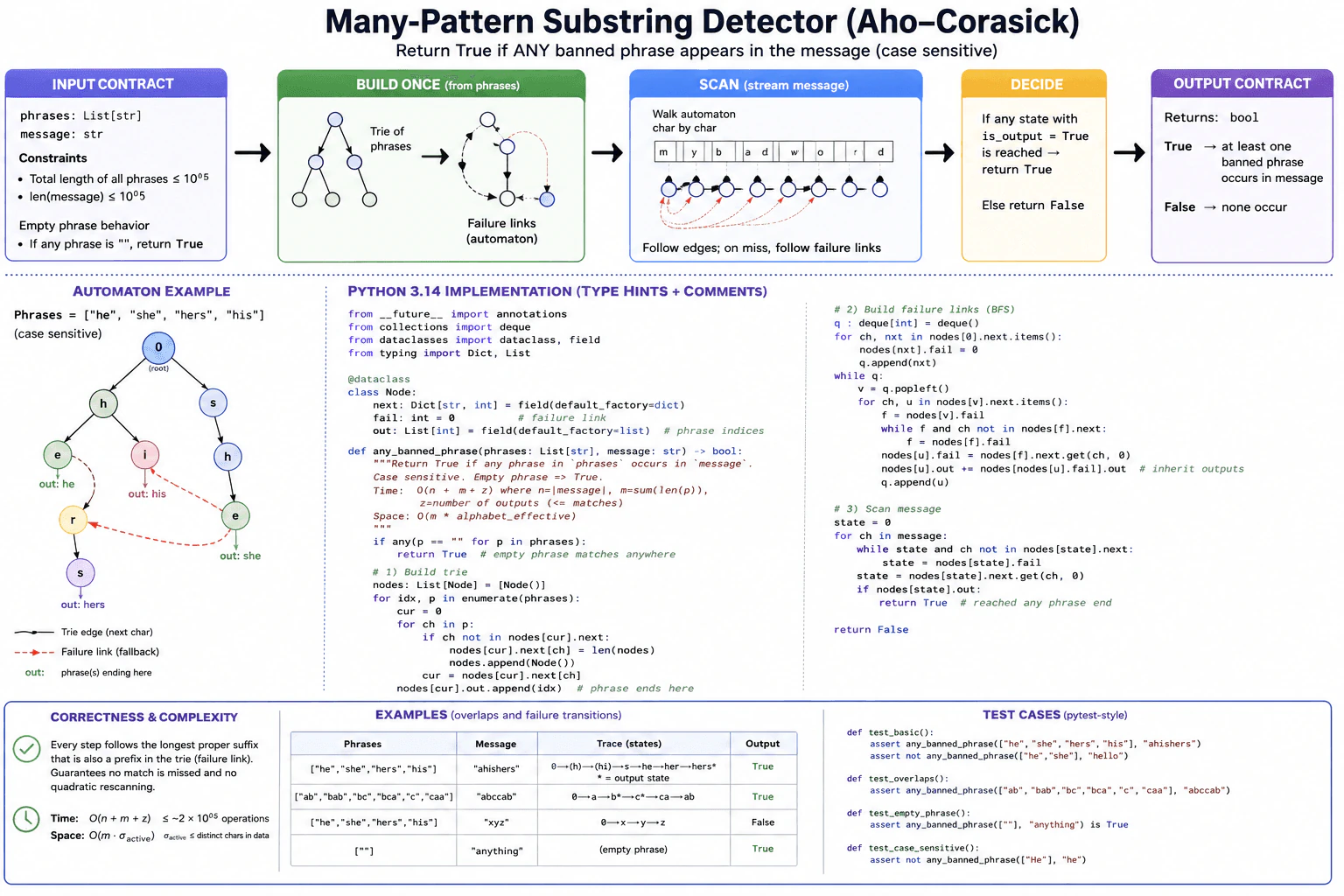
12. You are building a safety filter for a Gemini-style chat app and need to detect whether any banned phrase appears in a user message; implement a function that returns true if any phrase in a list occurs as a substring (case sensitive) in the message. Constraints: total length of all phrases can be 10^5 and message length can be 10^5.CodingHardGoogle Deepmind
i Question Details
The implementation must support many-pattern matching within the stated bounds, define empty-phrase behavior, preserve case sensitivity, avoid quadratic rescanning, and test overlapping prefixes and failure transitions.
Short Interview Answer (30-60 seconds)
I would use the Aho-Corasick algorithm. I first build one trie from all banned phrases, then build failure links with BFS. I scan the message from left to right. On a missing edge, I follow failure links instead of restarting the search. If the current state ends any banned phrase, I return true immediately. An empty phrase also returns true, and matching stays case sensitive. Using the diagram’s notation, time is O(N + M + Z), with auxiliary space shown as O(M · σ_active).
We have one message and many banned phrases. We must return True if any complete phrase appears as consecutive characters inside the message. Matching is case sensitive, so "he" and "He" are different. An empty phrase matches every message. Searching for each phrase separately can repeat the same work many times. Aho-Corasick avoids that repeated rescanning by putting all phrases into one shared trie and adding failure links for mismatches.
Useful Questions to Ask the Interviewer
Should an empty phrase count as a match? In this solution, yes. If "" is present, return True immediately.
Is matching case sensitive? Yes. Characters are compared exactly as given.
Do we only need a Boolean answer? Yes. We return whether at least one banned phrase occurs.
How to Explain It in an Interview
1. Understand the input and required output
The function receives phrases: list[str] and message: str. It returns bool. We return True as soon as any phrase appears as a substring of the message. A substring uses consecutive characters. If no phrase appears, we return False.
2. Build one trie for all phrases
A trie is a tree of string prefixes. Each edge represents one character. Phrases that share a prefix also share trie nodes. For the diagram example, the phrases are ["he", "she", "hers", "his"]. The h branch is shared by he, hers, and his. Each final node records which phrase or phrases end there.
3. Build failure links with BFS
A failure link tells us where to continue after a mismatch. Instead of starting again from the beginning of the message, we move to the longest proper suffix that is also a trie prefix. We build these links breadth first. Each node also inherits output information from its failure target, so a suffix match is not lost.
4. Scan the exact example
The diagram uses phrases ["he", "she", "hers", "his"] and message "ahishers". Start at the root. Character a has no root edge, so the state stays at the root. Character h moves to the h state. Character i moves to hi. Character s moves to the state that ends "his". The Boolean implementation now returns True immediately. The later h, e, r, and s characters are not processed by this early-return function. The diagram also illustrates that "she" and "hers" are valid automaton outputs if scanning were allowed to continue for match enumeration.
5. Explain why it is correct
After every processed character, the current state represents the longest suffix of the processed message prefix that is also a trie prefix. A normal trie edge extends that suffix. A failure link moves to the next longest useful suffix after a mismatch. Therefore, when a state has a non-empty output list, at least one complete banned phrase ends at the current character. Returning True at that point is correct.
6. Explain the Python implementation
The code first handles the empty-phrase rule. It then inserts every phrase into the trie. Next, a deque builds failure links in BFS order. During the message scan, missing transitions follow failure links until a valid transition is found or the root is reached. A non-empty output list causes an immediate True return. If the message finishes without a match, the function returns False.
7. Complexity and important edge cases
Using the notation shown in the diagram, let N be the message length, M be the total length of all phrases, and Z represent output-related work. The diagram states time O(N + M + Z). It shows auxiliary space as O(M · σ_active), where σ_active is the active character set. The shown Python implementation uses sparse dictionaries, so it stores only transitions that actually exist. Important edge cases are an empty phrase, no match, case-sensitive differences, overlapping prefixes, and transitions that require one or more failure links.
Key Insight / Why This Solution Works
The key insight is to search for all banned phrases together instead of starting a new search for every phrase. Aho-Corasick first stores the phrases in a trie. It then adds failure links so a mismatch can reuse a useful suffix of the text already read. The central invariant is: after each processed character, the current state represents the longest suffix of the processed message prefix that is also a trie prefix. If that state has output information, a banned phrase has ended there, so the Boolean function can return True immediately.
Code
from __future__ import annotations
from collections import deque
from dataclasses import dataclass, field
@dataclassclassNode:
# Map each outgoing character to the index of the next trie node.next: dict[str, int] = field(default_factory=dict)
# Store the fallback node used when the next character is missing.
fail: int = 0# Store indexes of phrases that end at this state.
out: list[int] = field(default_factory=list)
defany_banned_phrase(phrases: list[str], message: str) -> bool:
# The empty string is a substring of every message, including an empty one.ifany(phrase == ""for phrase in phrases):
returnTrue# Node 0 is the root of the trie and the starting scan state.
nodes: list[Node] = [Node()]
# Insert every banned phrase into the shared trie.for phrase_index, phrase inenumerate(phrases):
state = 0for char in phrase:
# Create a new trie node only when this prefix edge is missing.if char notin nodes[state].next:
nodes[state].next[char] = len(nodes)
nodes.append(Node())
# Advance to the node for the current prefix.
state = nodes[state].next[char]
# Record that this phrase ends at the final trie state.
nodes[state].out.append(phrase_index)
# Build failure links in breadth-first order.
queue: deque[int] = deque()
# A direct child of the root falls back to the root on a mismatch.for child in nodes[0].next.values():
nodes[child].fail = 0
queue.append(child)
while queue:
state = queue.popleft()
for char, child in nodes[state].next.items():
# Begin with the failure state of the current parent node.
fallback = nodes[state].fail
# Move through failure links until this character can continue,# or until the root is reached.while fallback and char notin nodes[fallback].next:
fallback = nodes[fallback].fail
# Use the matching fallback transition when one exists.# Otherwise, this child fails back to the root.
nodes[child].fail = nodes[fallback].next.get(char, 0)
# Inherit phrase endings from the failure state.# This keeps suffix matches visible without rescanning the message.
nodes[child].out.extend(nodes[nodes[child].fail].out)
# Process this child later so its failure target is already known.
queue.append(child)
# Scan the message from left to right using the completed automaton.
state = 0for char in message:
# If the current state cannot use this character, follow failure links.while state and char notin nodes[state].next:
state = nodes[state].fail
# Take the matching edge when it exists. Otherwise stay at the root.
state = nodes[state].next.get(char, 0)
# Stop immediately when any banned phrase ends at this state.if nodes[state].out:
returnTrue# The whole message was processed and no banned phrase was found.returnFalsedefmain() -> None:
# Run the same primary example shown in the diagram.
phrases: list[str] = ["he", "she", "hers", "his"]
message: str = "ahishers"
result: bool = any_banned_phrase(phrases, message)
print(result) # True: the early-return scan first reaches "his".if __name__ == "__main__":
main()
Time & Space Complexity
Use the diagram’s notation: N is the message length, M is the total length of all phrases, and Z is output-related work. The diagram gives time O(N + M + Z). Building the trie uses the phrase characters. Failure links are built once. The message is then processed from left to right, with failure links preventing quadratic rescanning. The diagram gives auxiliary space O(M · σ_active), where σ_active is the active character set. In the shown Python code, transitions are sparse dictionaries, so only existing edges are actually stored.
Where it is used
Aho-Corasick is useful when software must search the same text for many fixed patterns. It fits safety filters, content moderation rules, malware-signature scanners, keyword alerts, log scanners, and rule-based text detection. It is especially useful when many patterns share prefixes and separate substring searches would repeat work.
Why Interviewers Ask This
This question tests whether you recognize a many-pattern string-matching problem instead of using repeated naive substring searches. It checks whether you can build a trie, construct failure links with BFS, maintain a clear scan invariant, and stop correctly on the first match. It also tests practical details such as empty phrases, case sensitivity, overlapping prefixes, failure transitions, Python data structures, and accurate complexity reasoning under large input limits.
Common interview mistakes
One mistake is searching for every phrase separately, which repeats work and can become too slow for large inputs. Another is building a trie but forgetting failure links, so the scan cannot recover correctly after a partial match fails. A third mistake is failing to inherit output information through failure links, which can miss suffix matches. Candidates may also ignore the empty-phrase rule or accidentally lowercase the text even though matching is case sensitive. Finally, once an output state is reached, this Boolean version should return immediately instead of describing later characters as processed.
Interview tip
Explain one invariant clearly: the current automaton state is the longest useful suffix of the text read so far. Then show one normal trie transition and one failure transition. This makes it easy to justify both correctness and why the algorithm avoids restarting a separate search for each phrase.
Interviewer may ask next
How would this work if the message arrived in streaming chunks?
Build the same Aho-Corasick automaton once. Keep the current automaton state between chunks instead of resetting it to the root. Then process every new character from that saved state. A phrase can therefore begin near the end of one chunk and finish in the next. Empty-phrase and case-sensitive behavior stay unchanged. Using the diagram’s notation, total processing remains O(M + N + Z) across the stream, with the same automaton storage. The tradeoff is that the caller must keep one small piece of scan state between chunks.
What changes if we need every matched phrase instead of only true or false?
Keep using the out lists already stored in the automaton. Instead of returning on the first non-empty out, emit every phrase index in that list together with the current position. Continue scanning to find later matches. Correctness is unchanged because each output marks a phrase ending at that character. Time becomes O(M + N + Z), where Z now directly represents the number of reported matches. Extra output memory is needed if all matches are collected instead of streamed to the caller.
13. Describe a time you had to pivot your technical approach due to a change in research direction or product requirements.BehavioralEasyGoogle Deepmind
i Question Details
Use an AI engineering example that identifies the changed evidence or requirement, the candidate's original plan, the pivot decision, stakeholder alignment, protected quality or safety constraints, and measured outcome.
Interview tip:
Use STAR to structure your answer: briefly explain the Situation and Task, make Action the most detailed part, and finish with the Result. For example, describe an AI engineering project where new evidence or a changed product requirement made your original technical plan unsuitable, explain how you chose a new approach, aligned stakeholders, protected important quality or safety constraints, and evaluated the outcome.
Situation
In my last role, I was working on an AI feature that used a more complex model because our original goal was to maximize answer quality. During evaluation, we learned that the product direction had changed. The feature now needed faster and more predictable responses for an interactive user experience. Our existing approach was accurate enough, but it was too slow and had more variation in response time than the new requirement allowed.
Task
I was responsible for adapting the technical approach without losing the quality and safety checks that were already important to the product. I also needed to explain the tradeoff clearly so the product and research teams could agree on the new direction.
Action
I first separated the new requirement from our earlier assumptions. Instead of asking how to make the existing model slightly faster, I asked which parts of the original design were still necessary. I reviewed our evaluation results and identified the quality checks that we could not remove. I then compared a simpler model path with the original approach using the same evaluation set. The simpler path reduced unnecessary processing and gave more consistent response time while still meeting our important quality checks. I shared the comparison with the research and product teams in simple terms. I explained what quality we were protecting, what complexity we were removing, and what risk remained. I also suggested keeping the original approach available for cases where the harder task truly needed it. This helped us agree on a pivot instead of treating the change as a failure of the original work. After the decision, I updated the evaluation plan so the new response time requirement and the existing quality and safety checks were tested together before release.
Result
We moved to the simpler approach for the main product flow and kept the more complex option only where it added clear value. The team was able to support the new product direction without dropping the quality and safety checks we had already agreed were important. I learned to treat a change in requirements as a reason to revisit assumptions early, rather than trying to protect an original technical design after the problem itself has changed.
Why Interviewers Ask This
Interviewers ask this question to understand how you respond when technical work must change because new evidence or product needs appear. A strong answer shows that you can question earlier assumptions, make practical tradeoffs, protect important quality or safety constraints, communicate clearly with different stakeholders, and take ownership of the new direction.
Interviewer may ask next
How did you decide which quality checks could not be compromised during the pivot?
I used the checks that were already tied to important user quality and safety expectations as fixed constraints. I did not remove them just to improve speed. I compared the new approach against the same evaluation set so the team could see whether the simpler design still met those expectations before we changed the product flow.
What would you do differently if you faced a similar change again?
I would define the most important product constraints earlier and review them regularly with research and product partners. That would make it easier to notice when the problem has changed. I would also design the evaluation plan so quality, safety, speed, and other important product needs are visible together instead of being reviewed separately.
14. How do you balance modularity with performance requirements in a large-scale robotics codebase?BehavioralMediumGoogle Deepmind
i Question Details
Describe a concrete architecture decision, the modularity and latency or resource constraints, profiling evidence, interfaces or optimizations chosen, collaboration across owners, and the maintainability and performance result.
Interview tip:
Use STAR to structure your answer: briefly explain the Situation and Task, make Action the most detailed part, and finish with the Result. For example, describe a robotics architecture decision where clean module boundaries added too much latency, how you used profiling evidence to find the real bottleneck, how you worked with component owners to simplify the critical interfaces, and how you kept the code maintainable while meeting the performance requirement.
Situation
In my last role, I worked on a large robotics software stack where perception, planning, and control were kept as separate modules. This made each part easier to test and change. However, we started seeing delays in a critical control path. The first reaction was to combine several modules, but that would have made ownership and future changes much harder.
Task
I was responsible for finding a design that kept clear module boundaries while reducing the delay in the critical path. I also needed to work with the engineers who owned the surrounding components because any interface change could affect their code and tests.
Action
I first profiled the full request path instead of assuming that modularity itself was the problem. Profiling means measuring where the program actually spends its time. The data showed that most of the delay came from repeated data conversion and copying between a few modules, not from the number of modules alone. I shared those findings with the component owners so we could agree on the problem before changing the architecture. We kept the main perception, planning, and control boundaries because those boundaries matched clear responsibilities. For the critical path, I changed the interfaces so the modules could pass data in a form that required less conversion and less copying. I also moved some repeated setup work outside the time sensitive path. I avoided creating a special fast path that bypassed normal ownership rules because that would have been difficult to test and maintain. We added clear interface tests so each team could still change its module safely. I then profiled the flow again after each change to confirm that the optimization helped the real bottleneck and did not simply move the cost somewhere else.
Result
The control path became fast enough for the system requirement while the major module boundaries stayed clear. Teams could still test and change their own components without understanding the entire robotics stack. I learned that modularity and performance are not usually opposing goals by default. The better approach is to measure the real cost, optimize the expensive boundary or operation, and preserve useful separation wherever it is not causing a meaningful problem.
Why Interviewers Ask This
Interviewers ask this question to see whether a candidate can make practical architecture tradeoffs instead of treating clean design or speed as an absolute rule. A strong answer shows that the candidate can use profiling evidence, understand interface costs, protect clear ownership, collaborate across teams, and optimize only the parts that truly affect system performance.
Interviewer may ask next
Why did you keep the main module boundaries instead of combining the modules for maximum speed?
The profiling results showed that the main cost came from data conversion and copying at specific boundaries. Combining whole modules would have removed useful separation without addressing the problem in a focused way. I kept the boundaries that matched clear responsibilities and optimized only the expensive interactions.
What would you do differently if the performance problem returned after the system grew?
I would profile the complete path again before making another architecture change. Growth can create a different bottleneck, so I would not assume the old cause still applies. I would compare the new evidence with the current module responsibilities, discuss the tradeoffs with the relevant owners, and make the smallest change that meets the performance need without creating unnecessary coupling.
15. You are asked to build an LLM evaluation and data pipeline for a new AI agent that edits code in a large monorepo, but requirements change weekly and there is no single owner; how do you drive execution without thrashing? Be concrete about the artifacts you create, the milestones, and how you keep researchers and PMs aligned.BehavioralHardGoogle Deepmind
i Question Details
Show how the candidate creates decision and ownership artifacts, defines milestones and evaluation evidence, absorbs weekly requirement changes, aligns researchers and product managers, and prevents rework while delivering the agent pipeline.
Interview tip:
Use STAR to structure your answer: briefly explain the Situation and Task, make Action the most detailed part, and finish with the Result. For example, describe a project where you created clear decision and ownership artifacts, set milestones tied to evaluation evidence, handled weekly requirement changes through a controlled process, kept researchers and product managers aligned, and protected the team from repeated rework while delivering the agent pipeline.
Situation
In my last role, I worked on an evaluation and data pipeline for an AI agent that edited code in a large monorepo. The research team was still learning which agent behaviors mattered most, while product managers were changing requirements as they learned more about user needs. There was no single owner who could make every decision. Without a clear process, the team risked rebuilding evaluation sets, changing data formats, and shifting priorities every week.
Task
I was responsible for turning that uncertainty into an execution plan that researchers, product managers, and engineers could use together. My goal was not to freeze the requirements. That would have been unrealistic. My goal was to make changes visible, give each decision a clear owner, protect completed work from unnecessary changes, and make every milestone produce evidence that could guide the next decision.
Action
I started by creating a short decision log. For every important open question, I recorded the decision needed, the available options, the person responsible for making the decision, the evidence needed, and the date when we needed an answer. I also created an ownership table for the pipeline. It made clear who owned the evaluation tasks, dataset rules, agent integration, review process, and product acceptance. This removed the problem where several people discussed an issue but nobody knew who had the final responsibility. Next, I divided delivery into small milestones. The first milestone was a stable pipeline skeleton with versioned input and output formats. The next milestone was a small evaluation set covering important code editing behaviors such as making the requested change, preserving unrelated code, and producing a result that could be tested. Later milestones expanded the data and evaluation coverage only after the earlier flow worked. For each milestone, I wrote the evidence required to call it complete. This included successful pipeline runs, reviewed examples, known failure cases, and clear notes about what the evaluation did and did not measure. I then introduced a weekly change review with researchers and product managers. New requests went into one shared change list instead of immediately becoming engineering work. During the review, I asked what new evidence caused the request, whether it changed the current milestone, and what existing work it would invalidate. Small changes that did not break the current contract could enter the active milestone. Larger changes went into the next milestone unless there was a strong reason to interrupt current work. When research questions were still open, I preferred reversible choices. For example, I kept evaluation definitions and dataset versions separate from the execution code so we could change what we measured without rebuilding the whole pipeline. I also sent a short written update after each review. It listed what changed, what stayed fixed, who owned each open decision, and what evidence we expected before the next meeting. This gave researchers and product managers the same source of truth and reduced repeated discussions.
Result
The team was able to keep moving even while the requirements continued to change. Researchers could update evaluation ideas without forcing the engineering pipeline to restart each time, and product managers could see the cost of changing an active milestone before making that choice. The shared decision log, ownership table, milestone evidence, and weekly change review gave the team a stable operating rhythm. I learned that when requirements are uncertain, execution improves when you make decisions, ownership, and evidence explicit rather than trying to remove the uncertainty itself.
Why Interviewers Ask This
Interviewers ask this question to see whether the candidate can create structure when ownership and requirements are unclear. A strong answer shows practical judgment, clear ownership, disciplined handling of change, evidence based milestones, and the ability to keep research, product, and engineering moving toward the same goal without creating unnecessary rework.
Interviewer may ask next
How did you decide whether a new requirement should interrupt the current milestone?
I looked at the evidence behind the request and the cost of delaying it. If the change affected a core assumption or made the current evaluation misleading, I brought it into the active milestone. If it improved coverage but did not invalidate the current work, I placed it in the next milestone. I also made the impact visible to researchers and product managers before changing the plan, so the interruption was an explicit decision rather than an automatic reaction.
What would you do if researchers and product managers still disagreed about a major evaluation requirement?
I would turn the disagreement into a concrete decision with clear options and evidence. I would write down what each side was trying to protect, identify which assumption we could test with the smallest useful evaluation, and assign an owner for the final decision. If the answer was still uncertain, I would choose a reversible implementation and keep the pipeline contract stable. That would let the team continue delivering while the disputed requirement was tested instead of blocking the whole project.
Disclaimer: This interview guide is for educational and informational purposes only. It is designed to help readers prepare, but it does not guarantee any interview result, hiring decision, offer, or outcome. Interview questions, hiring criteria, and preferred answers can vary by employer, interviewer, industry, location, and time. All answers, examples, and explanations in this guide are suggested examples for interview preparation, not definitive answers or instructions for professional practice. They are based on research and judgment, are provided without warranties of any kind, and should be adapted to the question, role, and applicable laws and professional requirements. Diagrams are simplified illustrations intended to highlight the main concepts and their relationships; actual situations, systems, and practices may be more complex. Alternative approaches may be equally valid or better suited to a particular question, context, or interviewer. To the fullest extent permitted by applicable law, the contributors and publisher are not liable for decisions made, actions taken, or losses incurred based on this guide.
State Laws and Professional Responsibilities: Laws and requirements governing an occupation vary by state and jurisdiction. You are responsible for checking the current laws, licensing requirements, and scope-of-practice rules that apply to your location and role, and for ensuring that your answers and actions comply with them. Adapt examples in this guide to those requirements. This guide is not legal advice.
Company Notice: This guide is an independent educational resource and is not affiliated with, endorsed by, sponsored by, or approved by the company named in this guide. Company names identify reported interview experiences or the employer context of clearly labeled original practice exercises. Interview practices can change without notice, and inclusion of company-specific content does not mean these questions are official, complete, or guaranteed to be asked. To the fullest extent permitted by law, the author, contributors, and publisher are not responsible for outcomes related to use of this material.
Content Accuracy and Verification: To the fullest extent permitted by applicable law, we do not represent or warrant that interview guides, questions, answers, examples, or diagrams are accurate, complete, current, error-free, or suitable for any particular purpose. You are responsible for independently reviewing and verifying the information before relying on it.