This interview guide is for educational and informational purposes only. It is designed to help readers prepare, but it does not guarantee any interview result, hiring decision, offer, or outcome. Interview questions, hiring criteria, and preferred answers can vary by employer, interviewer, industry, location, and time. All answers, examples, and explanations in this guide are suggested examples for interview preparation, not definitive answers or instructions for professional practice. They are based on research and judgment, are provided without warranties of any kind, and should be adapted to the question, role, and applicable laws and professional requirements. Diagrams are simplified illustrations intended to highlight the main concepts and their relationships; actual situations, systems, and practices may be more complex. Alternative approaches may be equally valid or better suited to a particular question, context, or interviewer. To the fullest extent permitted by applicable law, the contributors and publisher are not liable for decisions made, actions taken, or losses incurred based on this guide.
State Laws and Professional Responsibilities
Laws and requirements governing an occupation vary by state and jurisdiction. You are responsible for checking the current laws, licensing requirements, and scope-of-practice rules that apply to your location and role, and for ensuring that your answers and actions comply with them. Adapt examples in this guide to those requirements. This guide is not legal advice.
Identity, Image, and Privacy Notice
To respect individual privacy, some names, profile photographs, avatars, biographical details, and other identifying information displayed in this guide may be replaced with pseudonyms, licensed stock images, illustrative avatars, composite images, or representative descriptions. Unless a person is expressly identified as an actual contributor, a displayed name, image, or profile should not be understood as depicting or identifying a specific candidate, interviewer, employee, or other real individual. These representations are provided for editorial and illustrative purposes only and do not imply endorsement, employment, participation, or affiliation with this guide or any company mentioned in it. Any resemblance to an actual person is coincidental.
Company Notice
This guide is an independent educational resource and is not affiliated with, endorsed by, sponsored by, or approved by the company named in this guide. Company names identify reported interview experiences or the employer context of clearly labeled original practice exercises. Interview practices can change without notice, and inclusion of company-specific content does not mean these questions are official, complete, or guaranteed to be asked. To the fullest extent permitted by law, the author, contributors, and publisher are not responsible for outcomes related to use of this material.
Content Accuracy and Verification
To the fullest extent permitted by applicable law, we do not represent or warrant that interview guides, questions, answers, examples, or diagrams are accurate, complete, current, error-free, or suitable for any particular purpose. You are responsible for independently reviewing and verifying the information before relying on it.
Questions or comments?
Contact us for general questions, or share feedback, technical corrections, and comments with the community.
11. Implement SFT sample packing.CodingMediumMicrosoft Ai
i Question Details
Implement deterministic sequence packing with loss masks, segment ranges, answer-span localization, truncation, padding, and boundary tests.
Short Interview Answer (30-60 seconds)
I solve this by packing tokenized SFT examples into one fixed-length sequence using deterministic greedy packing. I process examples in order and copy tokens while space is available. I track segment ranges, answer spans, and loss masks during packing so the training labels stay correct. If an example does not fully fit, I keep the prefix that fits and then pad the remaining space. The algorithm runs in O(e + t) time and uses O(max_length + e) auxiliary space.
This question asks us to combine multiple supervised fine-tuning examples into a single fixed-length training sequence. The goal is to keep token positions, answer locations, and loss calculation correct after packing. The solution must be deterministic, so examples stay in their original order. Greedy packing fits this requirement because it processes examples once and records all required metadata.
Useful Questions to Ask the Interviewer
Should examples always remain in the original order during packing?
When an example is larger than the remaining space, should we truncate the example or skip it?
How to Explain It in an Interview
1. Understand the input and required output
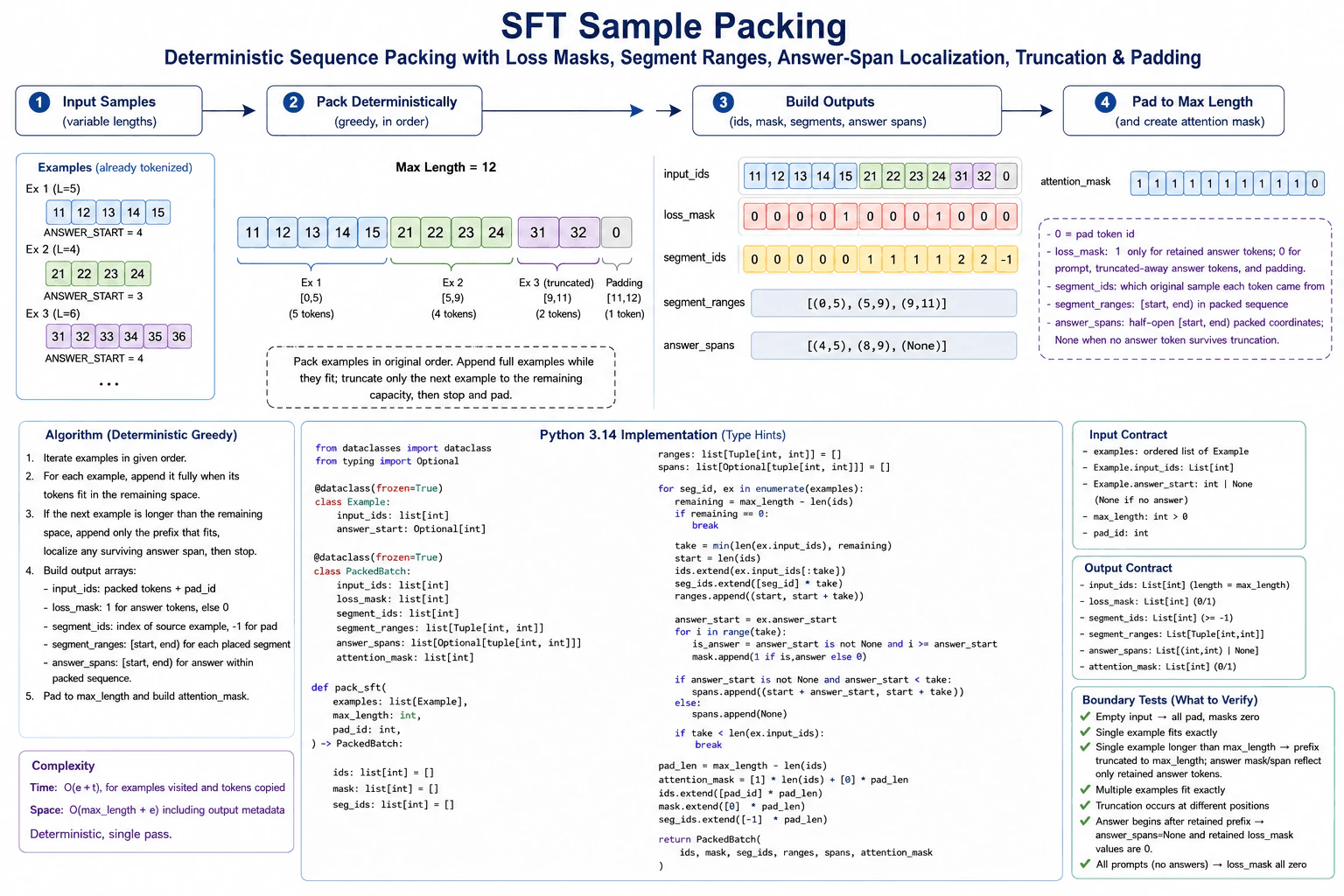
The input is an ordered list of tokenized examples. Each example contains input tokens and an optional answer start position. The output is a fixed-length packed sequence with input IDs, loss masks, segment IDs, segment ranges, answer spans, and an attention mask.
2. Choose the algorithm and data structure
I use deterministic greedy packing. The algorithm reads examples in order and places tokens into the packed sequence. Lists store the packed tokens and metadata. Segment IDs show which original example created each token. Segment ranges show each example boundary. Answer spans show answer token locations after packing.
3. Initialize the state
The algorithm starts with empty lists for input IDs, loss masks, segment IDs, ranges, and answer spans. The invariant is that every packed token has correct metadata describing its source example and whether it contributes to loss.
4. Walk through the example
The diagram uses max length 12. Example 1 contains tokens 11, 12, 13, 14, 15 and occupies packed range [0,5). Example 2 contains tokens 21, 22, 23, 24 and occupies [5,9). Example 3 contains tokens 31, 32, 33, 34, 35, 36, but only two positions remain, so the algorithm keeps 31 and 32 and stops. Its range is [9,11). The final position is padding.
The final input IDs are [11, 12, 13, 14, 15, 21, 22, 23, 24, 31, 32, 0]. The loss mask marks only retained answer tokens. The segment IDs identify the original example for every token. The answer spans are [(4,5), (8,9), None] because the third example answer is not available after truncation.
5. Explain why the result is correct
The invariant is that every copied token keeps correct source information and label information. Because metadata is created at the same time tokens are copied, segment ranges, loss masks, and answer spans match the final packed sequence.
6. Explain the Python implementation
The function calculates remaining space, copies the allowed token prefix, updates metadata, creates loss masks, and records answer spans. After packing, it adds padding tokens and creates the attention mask.
7. Explain complexity and edge cases
The algorithm processes examples and copied tokens once. The time complexity is O(e + t), where e is the number of examples visited and t is the number of non-padding tokens copied. The auxiliary space is O(max_length + e). Important cases are exact fit, truncation, empty input, and examples where no answer tokens remain.
Key Insight / Why This Solution Works
The key insight is to pack examples deterministically in their original order. The algorithm uses greedy packing because it only needs to fill the current sequence and track metadata during copying. The invariant is that every packed token has the correct segment ID, loss-mask value, and answer-span information. If the next example is too large, only the prefix that fits is retained and the remaining space is padded.
Code
from dataclasses import dataclass
from typing importOptional@dataclass(frozen=True)classExample:
input_ids: list[int]
answer_start: Optional[int]
@dataclass(frozen=True)classPackedBatch:
input_ids: list[int]
loss_mask: list[int]
segment_ids: list[int]
segment_ranges: list[tuple[int, int]]
answer_spans: list[Optional[tuple[int, int]]]
attention_mask: list[int]
defpack_sft(examples: list[Example], max_length: int, pad_id: int) -> PackedBatch:
# Store packed tokens and metadata created during deterministic packing.
input_ids: list[int] = []
loss_mask: list[int] = []
segment_ids: list[int] = []
segment_ranges: list[tuple[int, int]] = []
answer_spans: list[Optional[tuple[int, int]]] = []
# Process examples in original order to keep deterministic output.for segment_id, example inenumerate(examples):
remaining = max_length - len(input_ids)
if remaining == 0:
break# Copy only the tokens that fit in the remaining sequence space.
take = min(len(example.input_ids), remaining)
start = len(input_ids)
input_ids.extend(example.input_ids[:take])
segment_ids.extend([segment_id] * take)
segment_ranges.append((start, start + take))
# Mark only retained answer tokens for training loss.if example.answer_start isnotNoneand example.answer_start < take:
for index inrange(take):
loss_mask.append(1if index >= example.answer_start else0)
answer_spans.append((start + example.answer_start, start + take))
else:
loss_mask.extend([0] * take)
answer_spans.append(None)
# Stop because later examples are not processed after truncation.if take < len(example.input_ids):
break# Pad the sequence and hide padding from attention.
padding = max_length - len(input_ids)
input_ids.extend([pad_id] * padding)
loss_mask.extend([0] * padding)
segment_ids.extend([-1] * padding)
attention_mask = [1] * (max_length - padding) + [0] * padding
return PackedBatch(
input_ids, loss_mask, segment_ids, segment_ranges, answer_spans, attention_mask
)
if __name__ == "__main__":
examples = [
Example([11, 12, 13, 14, 15], 4),
Example([21, 22, 23, 24], 3),
Example([31, 32, 33, 34, 35, 36], 4),
]
result = pack_sft(examples, 12, 0)
print(result)
Time & Space Complexity
The time complexity is O(e + t). e is the number of examples visited. t is the number of non-padding tokens copied. The algorithm uses O(max_length + e) auxiliary space because it stores the packed output sequence and metadata such as ranges and spans.
Where it is used
This pattern is useful when preparing supervised fine-tuning data for language models. It combines shorter examples into fixed-size training sequences while keeping labels and token boundaries correct.
Why Interviewers Ask This
Interviewers ask this question to evaluate whether a candidate can build reliable AI data-processing pipelines. They are checking sequence-boundary handling, label correctness, metadata tracking, implementation quality, and whether complexity is explained accurately.
Common interview mistakes
Candidates may forget that segment IDs must identify the original example. They may mark prompt tokens as loss tokens. They may continue processing after a truncated example even though the algorithm stops. They may also confuse answer spans with original example positions instead of packed sequence positions.
Interview tip
Explain the packing flow first: input examples, copied tokens, metadata updates, and final padding. Showing that every token keeps its source and label information makes the correctness argument easier.
Interviewer may ask next
What changes if an example is longer than the maximum sequence length?
The algorithm keeps only the prefix that fits and updates loss masks and answer spans using the retained tokens. Correctness is preserved because metadata describes the final packed sequence. The time complexity remains O(e + t), and auxiliary space remains O(max_length + e). The tradeoff is that some tokens are discarded.
How would you support streaming input with many examples?
The same greedy packing logic can process examples as they arrive. The current packed sequence and metadata become the maintained state until the sequence is full. Correctness is preserved because token order and metadata updates stay the same. The tradeoff is more state management between emitted batches.
12. What motivates you in your work?BehavioralEasyMicrosoft Ai
i Question Details
Connect motivation to a concrete AI-engineering responsibility, the users or outcome it serves, and evidence that the motivation sustained difficult execution.
Interview tip:
Use STAR to structure your answer: briefly explain the Situation and Task, make Action the most detailed part, and finish with the Result. For example, describe a realistic AI engineering project where improving reliability for users gave you a clear sense of purpose, explain the responsibility you owned, show how that motivation helped you stay focused through difficult technical work, and describe the useful outcome and lesson.
Situation
In my last role, I worked on an AI feature that helped users get useful answers from internal information. During testing, we found that the system sometimes produced answers that sounded confident even when the available information was weak. What motivated me was knowing that users needed answers they could trust, not just answers that sounded good.
Task
I was responsible for improving the quality and reliability of the AI workflow before it moved further toward production. My goal was to understand where the weak answers came from and make the system more dependable for the people using it.
Action
I started by reviewing failed examples instead of only looking at successful ones. I grouped the problems into simple categories, such as poor source retrieval, unclear prompts, and answers that went beyond the available evidence. This helped me focus on the real causes instead of making random changes. I then improved the evaluation set so we could test the same important cases after each change. I worked with the team to improve how relevant information was selected and how the model was instructed to use that information. I also added checks for cases where the system had too little evidence to give a confident answer. I shared what I was finding with the product team in simple terms so we could agree on which user problems mattered most. The work required repeated testing and investigation, but I stayed engaged because each improvement made the system more useful and trustworthy for the user. That connection between technical work and a real user outcome is a strong source of motivation for me.
Result
The system became more consistent in the cases we were testing, and the team had a clearer way to evaluate future changes. I learned that I am most motivated when I can connect detailed engineering work to a meaningful user outcome. Difficult debugging does not feel like isolated technical work to me when I understand who benefits from solving the problem.
Why Interviewers Ask This
Interviewers ask this question to understand what gives a candidate energy and whether that motivation fits the daily work of an AI Engineer. A strong answer shows that the candidate is motivated by meaningful outcomes, can stay engaged through difficult technical work, and understands how engineering decisions affect users.
Interviewer may ask next
What part of that project kept you motivated when the work became difficult?
The strongest motivation came from seeing a clear connection between the technical problem and user trust. When an evaluation failed, I did not see it as just another test to fix. I saw it as evidence that a user could receive an answer that was not dependable. That made the investigation feel important and helped me stay focused through repeated testing.
How do you stay motivated when the impact of your work is not immediately visible?
I create smaller signs of progress that connect to the final user outcome. In this project, I used the evaluation cases to see whether each change improved a specific type of failure. Even before the full system was ready, that gave me evidence that the work was moving in the right direction. I also kept the user need clear so the technical details always had a purpose.
13. You depend on another team to complete work, but they are not prioritizing your request. How do you move the project forward?BehavioralMediumMicrosoft Ai
i Question Details
Identify the dependency and incentives, clarify impact and deadlines, offer alternatives, establish ownership, escalate proportionately, and report the outcome.
Interview tip:
Use STAR to structure your answer: briefly explain the Situation and Task, make Action the most detailed part, and finish with the Result. For example, describe a project where another team owned an important dependency, how you clarified the impact and deadline, understood their priorities, offered practical alternatives, established clear ownership, escalated only when needed, and communicated the final outcome.
Situation
In my last role, I was working on an AI feature that needed a production data feed owned by another team. My work could not move into final evaluation until that dependency was ready. The other team had several urgent priorities, so my request was not near the top of their list.
Task
I was responsible for keeping the AI project moving without creating unnecessary conflict. I needed to understand why the dependency was delayed, explain the impact clearly, and find a path that respected both teams' priorities while protecting our delivery plan.
Action
I first spoke with the other team's owner to understand their workload and what was preventing them from prioritizing the request. I learned that they saw my request as useful but not urgent because they did not know which parts of our work were blocked. I explained the dependency in simple terms and showed which evaluation and release steps could not continue without it. I also clarified the deadline and the impact of further delay. Instead of only asking them to work faster, I offered alternatives. I asked whether they could provide a smaller version of the data feed first, while the full solution came later. I also identified work my team could do in parallel, such as preparing validation checks and testing the integration with sample data. We agreed on one owner from each team, a clear next step, and a time to review progress. I shared the updated plan with my project stakeholders so they understood the remaining risk. When the dependency still needed more attention, I raised the issue through the normal project leads with the facts, the impact, the options we had already tried, and the decision we needed. I treated escalation as a way to align priorities, not as a complaint about the other team.
Result
The teams agreed on a smaller first delivery that allowed us to continue our evaluation work while the complete data feed was finished. The project kept moving, and the relationship with the other team stayed constructive. I learned that dependency problems are easier to solve when I make the impact visible, understand the other team's incentives, offer workable options, create clear ownership, and escalate only when a decision truly needs broader support.
Why Interviewers Ask This
Interviewers ask this question to see how a candidate handles dependencies that they do not directly control. A strong answer shows ownership, clear communication, respect for another team's priorities, practical problem solving, and good judgment about when escalation is appropriate.
Interviewer may ask next
Why did you offer a smaller first delivery instead of immediately escalating the issue?
I wanted to solve the problem at the working level before asking leaders to change priorities. A smaller first delivery reduced the effort for the other team and gave my team enough data to continue evaluation. It also showed that I was trying to find a solution that worked for both teams rather than only pushing my own deadline.
What would you do differently if a similar dependency happened again?
I would identify the dependency and its owner earlier in planning. I would also agree on the expected delivery, impact, and review points before the dependency became critical. That would make the priority clearer sooner and give both teams more time to adjust if competing work appeared.
14. Describe a time you had a significant disagreement with another engineer or stakeholder on technical design or implementation.BehavioralHardMicrosoft Ai
i Question Details
Present the competing designs and evidence, the candidate's influence, how alignment or escalation occurred, what shipped, and the measured technical and relationship outcome.
Interview tip:
Use STAR to structure your answer: briefly explain the Situation and Task, make Action the most detailed part, and finish with the Result. For example, describe a realistic AI project where you and another engineer preferred different technical designs, compared both options with evidence, worked through the disagreement respectfully, reached alignment through a design review or experiment, shipped the agreed solution, and evaluated both the technical result and the working relationship.
Situation
In my last role, I worked on an AI assistant that used internal documents to answer user questions. Another engineer and I had a significant disagreement about how to improve answer quality. They wanted to fine tune the model using examples from our existing data. I preferred improving retrieval first, which meant finding better source documents before asking the model to answer. My concern was that many of our failures came from missing or weak source context, so changing the model alone would not solve the main problem.
Task
I was responsible for helping choose a design that improved answer quality without making the system harder to update or operate. I also wanted to make sure the disagreement did not become personal. We needed a decision based on evidence because both approaches had reasonable technical arguments.
Action
I first asked the other engineer to walk me through their design and the failures they believed fine tuning would solve. I wrote down the areas where we agreed and the areas where our assumptions were different. Then I reviewed examples from our evaluation set and grouped the failures by cause. Many weak answers were linked to poor document retrieval or missing context, while a smaller group involved how the model used good context. I shared those examples instead of simply arguing for my preferred design. I also explained the tradeoff in simple terms. Fine tuning could help the model follow repeated answer patterns, but it would not make missing source information appear. Retrieval changes could address the larger failure group and were easier to test and reverse. The other engineer raised a fair concern that retrieval work might still leave some response quality problems. I agreed with that point. I proposed a small experiment that tested both ideas against the same evaluation cases. We reviewed the results together and brought the evidence to our design review. I did not ask the reviewer to choose between two people. I framed the decision around which failure types each design addressed, the operational cost, and how easily we could measure and reverse the change. Based on that discussion, we aligned on improving retrieval first and keeping targeted fine tuning as a later option if evaluation still showed model behavior problems.
Result
We shipped the retrieval improvements and saw better performance on the failure cases that had been caused by weak context. The system also remained easier to update because new documents could be indexed without retraining the model. Just as important, the disagreement improved our working relationship. The other engineer and I had a clearer way to discuss future design conflicts using shared evidence instead of personal preference. I learned that a strong technical disagreement is useful when I separate the person from the proposal, make assumptions visible, and create a fair way to test competing ideas.
Why Interviewers Ask This
Interviewers ask this question to see how a candidate handles technical conflict when reasonable people prefer different solutions. A strong answer shows that the candidate can listen, use evidence, explain tradeoffs, influence without becoming defensive, reach alignment through a clear decision process, and preserve a productive working relationship.
Interviewer may ask next
How did you handle the other engineer continuing to disagree with your approach?
I did not try to win the discussion by repeating my position. I asked which assumptions or evaluation cases made them uncomfortable with the retrieval approach. That helped us identify their valid concern about model behavior after good context was found. I included that concern in the experiment and in the design review. This made the final decision feel like a shared technical decision rather than one person defeating the other.
What would you do differently if you faced a similar disagreement again?
I would create the shared evaluation criteria even earlier. We spent some time discussing designs before we had clearly agreed on what evidence would decide the issue. Starting with the failure categories, success criteria, and tradeoffs would make the discussion faster and reduce the chance that either person becomes attached to a solution before the evidence is clear.
Disclaimer: This interview guide is for educational and informational purposes only. It is designed to help readers prepare, but it does not guarantee any interview result, hiring decision, offer, or outcome. Interview questions, hiring criteria, and preferred answers can vary by employer, interviewer, industry, location, and time. All answers, examples, and explanations in this guide are suggested examples for interview preparation, not definitive answers or instructions for professional practice. They are based on research and judgment, are provided without warranties of any kind, and should be adapted to the question, role, and applicable laws and professional requirements. Diagrams are simplified illustrations intended to highlight the main concepts and their relationships; actual situations, systems, and practices may be more complex. Alternative approaches may be equally valid or better suited to a particular question, context, or interviewer. To the fullest extent permitted by applicable law, the contributors and publisher are not liable for decisions made, actions taken, or losses incurred based on this guide.
State Laws and Professional Responsibilities: Laws and requirements governing an occupation vary by state and jurisdiction. You are responsible for checking the current laws, licensing requirements, and scope-of-practice rules that apply to your location and role, and for ensuring that your answers and actions comply with them. Adapt examples in this guide to those requirements. This guide is not legal advice.
Company Notice: This guide is an independent educational resource and is not affiliated with, endorsed by, sponsored by, or approved by the company named in this guide. Company names identify reported interview experiences or the employer context of clearly labeled original practice exercises. Interview practices can change without notice, and inclusion of company-specific content does not mean these questions are official, complete, or guaranteed to be asked. To the fullest extent permitted by law, the author, contributors, and publisher are not responsible for outcomes related to use of this material.
Content Accuracy and Verification: To the fullest extent permitted by applicable law, we do not represent or warrant that interview guides, questions, answers, examples, or diagrams are accurate, complete, current, error-free, or suitable for any particular purpose. You are responsible for independently reviewing and verifying the information before relying on it.