This interview guide is for educational and informational purposes only. It is designed to help readers prepare, but it does not guarantee any interview result, hiring decision, offer, or outcome. Interview questions, hiring criteria, and preferred answers can vary by employer, interviewer, industry, location, and time. All answers, examples, and explanations in this guide are suggested examples for interview preparation, not definitive answers or instructions for professional practice. They are based on research and judgment, are provided without warranties of any kind, and should be adapted to the question, role, and applicable laws and professional requirements. Diagrams are simplified illustrations intended to highlight the main concepts and their relationships; actual situations, systems, and practices may be more complex. Alternative approaches may be equally valid or better suited to a particular question, context, or interviewer. To the fullest extent permitted by applicable law, the contributors and publisher are not liable for decisions made, actions taken, or losses incurred based on this guide.
State Laws and Professional Responsibilities
Laws and requirements governing an occupation vary by state and jurisdiction. You are responsible for checking the current laws, licensing requirements, and scope-of-practice rules that apply to your location and role, and for ensuring that your answers and actions comply with them. Adapt examples in this guide to those requirements. This guide is not legal advice.
Identity, Image, and Privacy Notice
To respect individual privacy, some names, profile photographs, avatars, biographical details, and other identifying information displayed in this guide may be replaced with pseudonyms, licensed stock images, illustrative avatars, composite images, or representative descriptions. Unless a person is expressly identified as an actual contributor, a displayed name, image, or profile should not be understood as depicting or identifying a specific candidate, interviewer, employee, or other real individual. These representations are provided for editorial and illustrative purposes only and do not imply endorsement, employment, participation, or affiliation with this guide or any company mentioned in it. Any resemblance to an actual person is coincidental.
Company Notice
This guide is an independent educational resource and is not affiliated with, endorsed by, sponsored by, or approved by the company named in this guide. Company names identify reported interview experiences or the employer context of clearly labeled original practice exercises. Interview practices can change without notice, and inclusion of company-specific content does not mean these questions are official, complete, or guaranteed to be asked. To the fullest extent permitted by law, the author, contributors, and publisher are not responsible for outcomes related to use of this material.
Content Accuracy and Verification
To the fullest extent permitted by applicable law, we do not represent or warrant that interview guides, questions, answers, examples, or diagrams are accurate, complete, current, error-free, or suitable for any particular purpose. You are responsible for independently reviewing and verifying the information before relying on it.
Questions or comments?
Contact us for general questions, or share feedback, technical corrections, and comments with the community.
11. Design Grok inference serving across X, the API, and Grok.com with different latency and traffic profiles.Ai System DesignMediumXai
i Question Details
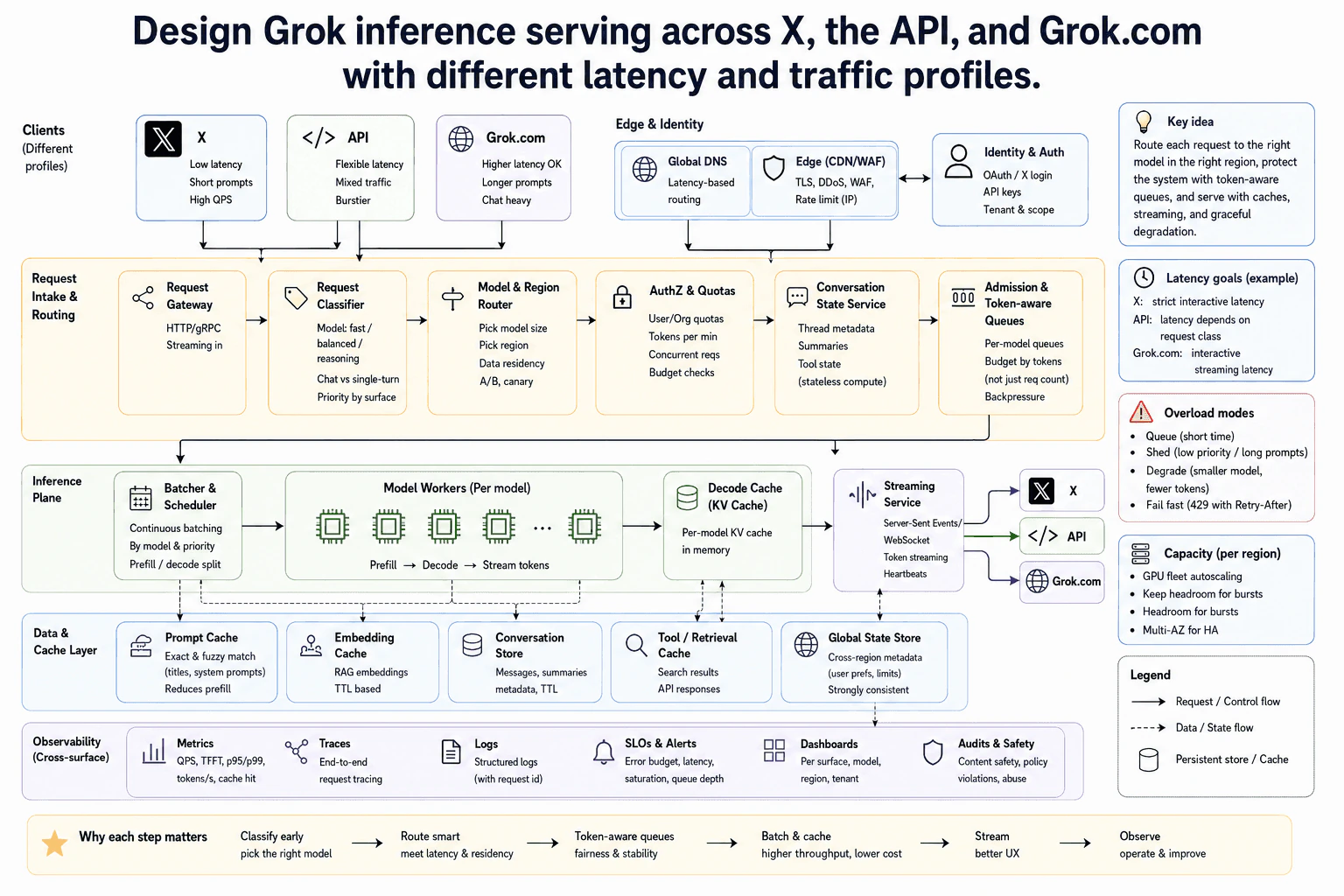
Specify edge and identity handling, request classification, model and region routing, conversation state, admission and token-aware queues, batching, cache ownership, streaming, quotas, overload modes, capacity, and cross-surface observability.
Short Interview Answer (30-60 seconds)
At a high level, I would use one shared Grok inference platform for X, the API, and Grok.com, but classify each request by its traffic and latency needs. Requests pass through edge protection and identity, then through classification, model and region routing, quotas, conversation state, and token-aware admission. Accepted work is continuously batched and sent to model workers. Workers use per-model KV cache during generation, and tokens stream back to the original surface. The main trade-off is low latency versus GPU efficiency and fairness.
Detailed Explanation
The problem is to serve the same Grok system through three different surfaces without treating every request equally. X has short, high-volume requests and needs very fast interaction. API traffic is more mixed and can arrive in bursts. Grok.com often has longer conversations. The design must choose suitable models and regions, protect shared capacity, remember conversation state, and stream responses back to the correct user. I would explain the design by following one request from the client, through routing and inference, and then back to that same surface.
Useful Questions to Ask the Interviewer
Which surface should get the highest priority during overload?
Are there data-residency limits on region selection?
How much quality reduction is acceptable before rejecting requests?
How to Explain It in an Interview
1. Start with the three traffic profiles
I would first separate traffic by surface. X has low-latency, short-prompt, high-QPS traffic. The API has flexible latency and bursty mixed traffic. Grok.com accepts higher latency and often carries longer chat requests.
Global DNS performs latency-based routing. The Edge layer provides TLS, DDoS protection, WAF filtering, and IP rate limiting. Identity & Auth handles OAuth or X login, API keys, tenant identity, and scope. The Request Gateway then accepts HTTP or gRPC traffic and supports streaming input.
2. Classify the request and choose where it runs
The Request Classifier identifies the request type before expensive GPU work begins. It distinguishes fast, balanced, or reasoning work. It also separates chat from single-turn traffic and assigns priority by surface.
The Model & Region Router then chooses the model size and region. It considers latency, data residency, and A/B or canary routing. This lets one shared platform serve different user experiences without forcing every request onto the same model or location.
3. Enforce quotas and load conversation state
AuthZ & Quotas protects shared capacity. It checks user or organization quotas, tokens per minute, concurrent requests, and budget limits. This prevents one tenant from consuming an unfair share of the system.
The Conversation State Service provides thread metadata, summaries, and tool state. The service itself is stateless compute, while conversation data is kept in the supporting data layer. That makes the request-processing service easier to scale horizontally.
4. Admit work with token-aware queues
Admission & Token-aware Queues decide whether work can enter inference. The diagram uses per-model queues and budgets work by tokens instead of only request count. A very long prompt therefore represents more load than a small request.
Backpressure slows or rejects new work when capacity is tight. Admitted requests move to the Batcher & Scheduler. It uses continuous batching, groups work by model and priority, and separates prefill from decode scheduling. This improves GPU use while still respecting latency-sensitive traffic.
5. Run inference, use caches, and stream the result
Model Workers perform prefill and decode. During generation, they use a per-model Decode Cache, or KV cache. A KV cache keeps attention state in memory so decoding does not recompute earlier token state on every step.
The generated token stream then reaches the Streaming Service. It uses Server-Sent Events or WebSocket connections and sends heartbeats. Separate response paths return the output to X, the API, or Grok.com.
The supporting data layer also contains a Prompt Cache, Embedding Cache, Conversation Store, Tool or Retrieval Cache, and Global State Store. The Prompt Cache can reuse matching titles or system prompts and reduce prefill work. The Global State Store keeps cross-region metadata such as user preferences and limits strongly consistent.
6. Protect the service during overload
When demand is too high, the system can queue briefly, shed low-priority or long prompts, use a smaller model or fewer output tokens, or fail fast with 429 and Retry-After. These choices stop queues from growing without control.
Capacity is managed per region. GPU fleets autoscale, the platform keeps headroom for bursts, and multiple availability zones improve availability. The trade-off is cost because spare capacity is intentionally kept available.
7. Observe every surface separately
Cross-surface observability measures QPS, TTFT, p95 and p99 latency, tokens per second, cache hit rate, saturation, queue depth, and error budgets. Traces follow requests end to end. Structured logs include a request ID. Dashboards break results down by surface, model, region, and tenant. Audits & Safety record content-safety, policy, and abuse signals. This makes one shared platform operable without hiding problems that affect only one surface.
Practical Complexity & Trade-offs
The hardest part is balancing low latency, fairness, and GPU efficiency. Token-aware queues are fairer than request-count queues because one very long prompt consumes more work than one short prompt. Continuous batching improves GPU throughput, but waiting for a batch can add latency. Regional routing can reduce response time and support data-residency needs, but it makes capacity planning harder. Caches reduce repeated work and cost, but each cache needs clear ownership and lifetime rules. Keeping spare GPU headroom costs money, but it helps absorb sudden bursts. Graceful degradation protects availability by using smaller models or fewer tokens. The downside is lower quality for some requests. Strong per-surface observability is needed because X, API, and Grok.com can fail in different ways.
Why Interviewers Ask This
The interviewer is testing whether the candidate can design one inference platform for very different traffic patterns. They want to see sound judgment around classification, model and region routing, quotas, token-aware queueing, batching, caching, streaming, overload handling, and capacity. They also want correct request and response flow. A strong answer explains how latency, fairness, GPU use, reliability, and cost affect each other instead of only listing infrastructure components.
Interviewer may ask next
What would you change if X traffic suddenly became much larger than normal?
I would keep the same architecture and make the existing admission and overload controls more aggressive. The affected flow is Request Classifier, Model & Region Router, AuthZ & Quotas, and Admission & Token-aware Queues. X traffic already has a surface priority, so short interactive requests can receive preference while tenant quotas still remain active. The region router can place work where capacity exists, while still respecting data-residency rules. Token-aware queues prevent long requests from hiding their real GPU cost. If the spike continues, the system can queue briefly, shed lower-priority or long prompts, or degrade to a smaller model or fewer tokens. If capacity is still unavailable, it can fail fast with 429 and Retry-After. GPU autoscaling and reserved headroom help absorb the burst. Metrics such as TTFT, queue depth, saturation, and error budgets show when overload policies are active. The downside is that lower-priority users may see slower answers, reduced quality, or rejected requests during the spike.
How would you stop one API tenant from hurting X and Grok.com traffic?
I would enforce isolation before expensive inference work begins. AuthZ & Quotas already checks user or organization quotas, tokens per minute, concurrent requests, and budget limits. Admission & Token-aware Queues then applies per-model queues and token budgets. This means a tenant sending very large prompts cannot consume unlimited GPU capacity simply by keeping its request count low. The Request Classifier also carries surface priority, so the scheduler can protect latency-sensitive X traffic while still serving API and Grok.com work fairly. The Batcher & Scheduler continues grouping compatible requests by model and priority for efficiency. Cross-surface dashboards should break QPS, latency, queue depth, tokens per second, and saturation down by tenant and surface. Structured logs keep a request ID for investigation. The main downside is that strict quotas can leave some capacity unused when a tenant reaches its limit while other capacity is free. We accept that because predictable isolation is more important than allowing one tenant to dominate shared GPU capacity.
12. Design an audit-ready Grok chat system for classified-adjacent work where raw prompts cannot be stored but answers must be reproducible.Ai System DesignHardXai
i Question Details
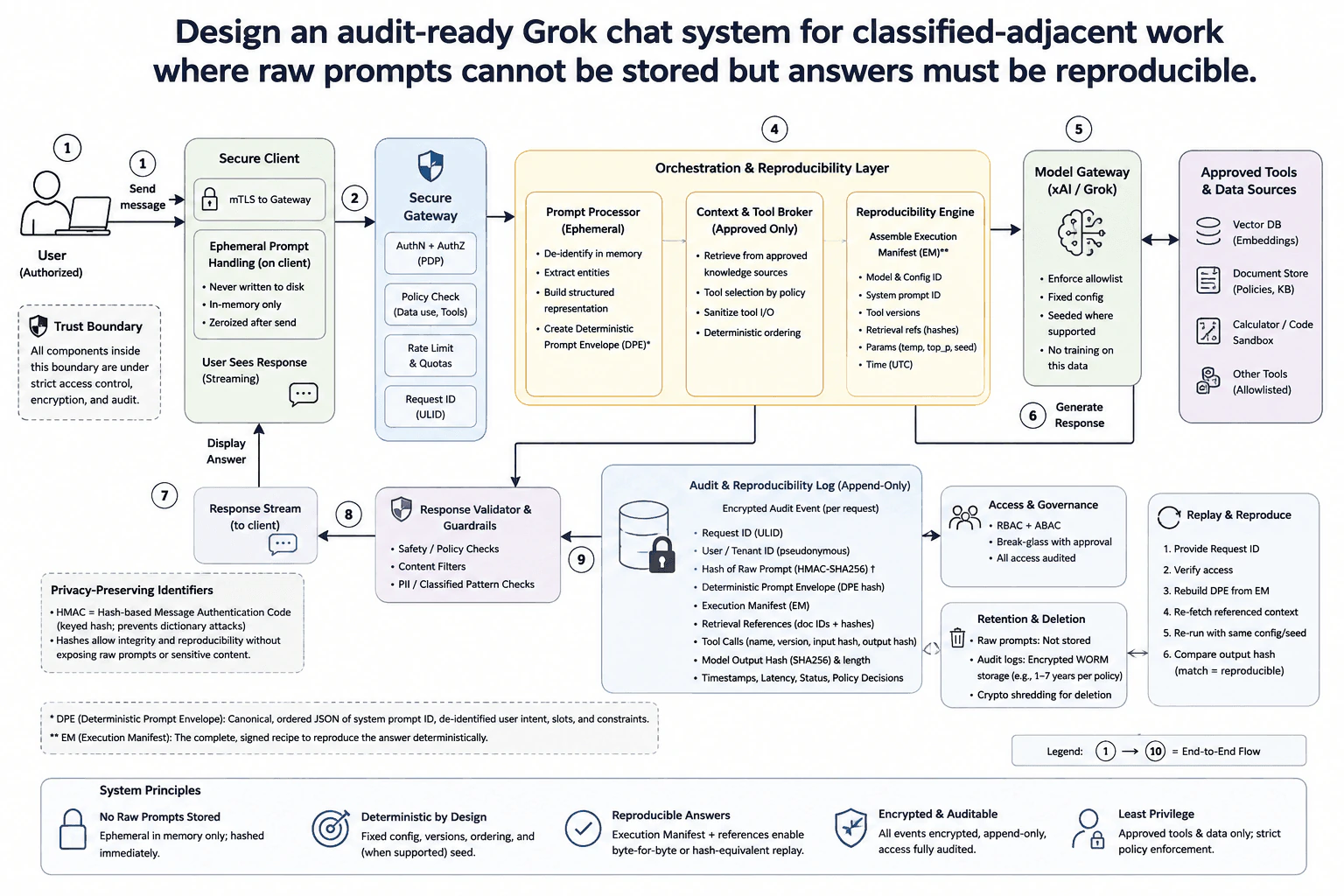
Define the trust boundary, ephemeral prompt handling, approved context and tools, model and configuration identity, privacy-preserving hashes or references, deterministic artifacts where possible, encrypted audit events, access, replay limits, retention, and incident recovery.
Short Interview Answer (30-60 seconds)
At a high level, I would keep every raw prompt temporary while recording enough safe evidence to audit and replay an answer. The authorized user sends the message through the Secure Client and Secure Gateway. The prompt stays in memory, while approved context and tools are selected. The Reproducibility Engine records the model identity, configuration, references, hashes, and Execution Manifest before Grok runs. Guardrails check the answer and stream it back. The trade-off is more audit and access-control work in exchange for stronger privacy and reproducibility.
Detailed Explanation
The system must let a person use Grok for sensitive work without saving the words they typed. At the same time, an auditor must later understand how an answer was produced and try to reproduce it. The difficult part is keeping enough evidence without keeping the raw prompt. The diagram solves this with temporary memory, approved context and tools, stable references, keyed hashes, recorded model settings, and encrypted audit records. I would explain the design from the user request through generation, response checking, auditing, controlled replay, and retention.
Useful Questions to Ask the Interviewer
Which users and data types may enter this classified-adjacent environment?
Which knowledge sources and tools are approved for each role?
What retention policy applies to encrypted audit records?
How to Explain It in an Interview
1. Start with the authorized user and secure client
I would first protect the raw prompt before it reaches the AI system. The authorized user enters the message in the Secure Client. The client never writes the raw prompt to disk. It keeps the prompt only in memory and zeroizes that memory after sending. The client uses mTLS to the Secure Gateway. mTLS means the connection is encrypted and the two sides can verify each other. The diagram also marks a trust boundary for components that require strict access, encryption, and auditing.
2. Let the Secure Gateway enforce entry controls
The request next reaches the Secure Gateway. This component owns the entry checks shown in the diagram. It performs authentication and authorization through the policy decision point. Authentication checks the caller's identity. Authorization decides what that identity may do. The gateway also applies the data-use and tool policy, rate limits, quotas, and a ULID request ID. These controls stop an unapproved request from reaching the AI workflow and give each accepted request a stable audit identifier.
3. Process the prompt only in memory
The Prompt Processor handles the sensitive prompt ephemerally. Ephemeral means temporary and not stored for later use. It de-identifies information in memory, extracts entities, and builds a structured representation. It also creates the Deterministic Prompt Envelope, or DPE. The diagram defines the DPE as canonical ordered JSON containing the system prompt ID, de-identified user intent, slots, and constraints. The raw prompt itself is still not written to persistent storage.
4. Use only approved context and tools
The Context and Tool Broker selects approved knowledge and tools. It may use the Vector DB, Document Store, Calculator or Code Sandbox, and other allowlisted tools shown in the diagram. It retrieves only approved knowledge sources. It sanitizes tool input and output and keeps ordering deterministic where possible. This matters because reproducibility depends on knowing exactly which external information and tool behavior affected the answer.
5. Record the execution recipe before generation
The Reproducibility Engine assembles the Execution Manifest, or EM. The EM is the recorded recipe for the run. It contains the model and configuration ID, system prompt ID, tool versions, retrieval references and hashes, generation parameters such as temperature, top-p, and seed, plus the recorded time. The Model Gateway then enforces the allowlist and fixed configuration. It uses deterministic settings where the runtime supports them and applies the shown rule that this data is not used for training.
6. Generate, validate, and return the response
The Model Gateway sends the controlled request to the xAI Grok model and receives the generated response. The answer then passes through Response Validator and Guardrails. This layer performs safety and policy checks, content filtering, and PII or classified-pattern checks. PII means information that can identify a person. An accepted response is streamed back to the Secure Client, which displays it to the user. The audit system is a side path and does not own the business response.
7. Record an encrypted audit event
For each request, the system writes an encrypted event to the append-only Audit and Reproducibility Log. Append-only means existing records are not silently rewritten. The event includes the request ID, pseudonymous user or tenant ID, HMAC-SHA256 of the raw prompt, DPE hash, Execution Manifest, retrieval references, tool calls and their hashes, model output hash and length, timestamps, latency, status, and policy decisions. HMAC is a keyed hash. The secret key makes offline guessing of sensitive prompt values much harder than using a plain hash alone.
8. Restrict access, replay, and retention
Audit access uses RBAC and ABAC. RBAC limits actions by role. ABAC adds rules based on attributes and context. Break-glass access requires approval, and every access is audited. Replay starts with the Request ID, verifies access, rebuilds the recorded DPE from the Execution Manifest as shown, re-fetches the referenced context, reruns the recorded configuration and seed, and compares the new output hash. Rate limits and quotas also bound use of the system. Raw prompts are never retained. Audit logs use encrypted WORM storage for the policy-defined retention period, followed by cryptographic shredding when deletion is required. During an incident, the same audited access and replay records provide the evidence available for investigation without exposing a stored raw prompt.
Practical Complexity & Trade-offs
The benefit is strong privacy because raw prompts are not stored. The downside is that reproducibility needs much more metadata. The system must keep stable model and configuration IDs, tool versions, retrieval references, hashes, and the Execution Manifest. HMAC-SHA256 gives a privacy-preserving prompt fingerprint because it uses a secret key. Encrypted append-only WORM logs make silent changes harder, but they add storage, key-management, and access-control work. Deterministic settings improve replay, but only where the model runtime supports them. Strict allowlists, RBAC, ABAC, and rate limits reduce risk, but they also reduce flexibility. The design accepts this extra operational cost because the work is sensitive and must remain auditable.
Why Interviewers Ask This
The interviewer is testing whether you can balance privacy, reproducibility, and security without saving sensitive prompts. They want clear trust boundaries, correct ownership of gateway controls, temporary prompt handling, approved context and tools, stable model identity, privacy-preserving hashes, encrypted audit records, controlled replay, retention, and incident investigation. They are also testing judgment about limits: reproducibility needs careful metadata and deterministic settings, but the design should not claim guarantees the model runtime cannot provide.
Interviewer may ask next
What happens if replay produces a different output hash even with the recorded configuration and seed?
I would treat the mismatch as an audit finding instead of hiding it. The affected component is Replay & Reproduce. First, the operator provides the Request ID and passes the same access checks. The system then uses the Execution Manifest shown in the diagram to rebuild the recorded DPE, re-fetch the referenced context, and rerun the recorded model configuration, tool versions, parameters, and seed. After generation, it compares the new output hash with the stored model output hash. If they differ, the audit record should preserve that fact. The raw prompt still remains unavailable because the design never stored it. Security stays unchanged because replay still requires RBAC, ABAC, audited access, and the existing rate limits and quotas. The main downside is that deterministic settings cannot always force identical model output. That is why the system records both the execution recipe and the original output hash instead of claiming perfect reproducibility.
How would the design support an emergency investigation without weakening the privacy rule?
I would use the existing Access & Governance and audit paths rather than create a separate unrestricted path. The investigator first passes normal identity and authorization checks. If ordinary access is not enough, the diagram allows break-glass access with approval. Break-glass means temporary emergency access that is granted only for a controlled reason. Every such access is itself audited. The investigator can use the Request ID to inspect the encrypted append-only audit record, including the Execution Manifest, policy decisions, retrieval references, tool-call hashes, and model output hash. When authorized, Replay & Reproduce can rerun the recorded configuration and compare the resulting output hash. The raw prompt still cannot be retrieved because it was never stored. Encrypted WORM storage protects retained audit records from silent rewriting, and cryptographic shredding handles deletion under policy. The downside is slower incident work because approvals and least-privilege controls add friction, but that friction protects sensitive information.
13. Implement `merge_eval_metrics` for duplicate request records and aggregate pass-rate, p95 latency, and token-weighted pass-rate.CodingEasyXai
i Question Details
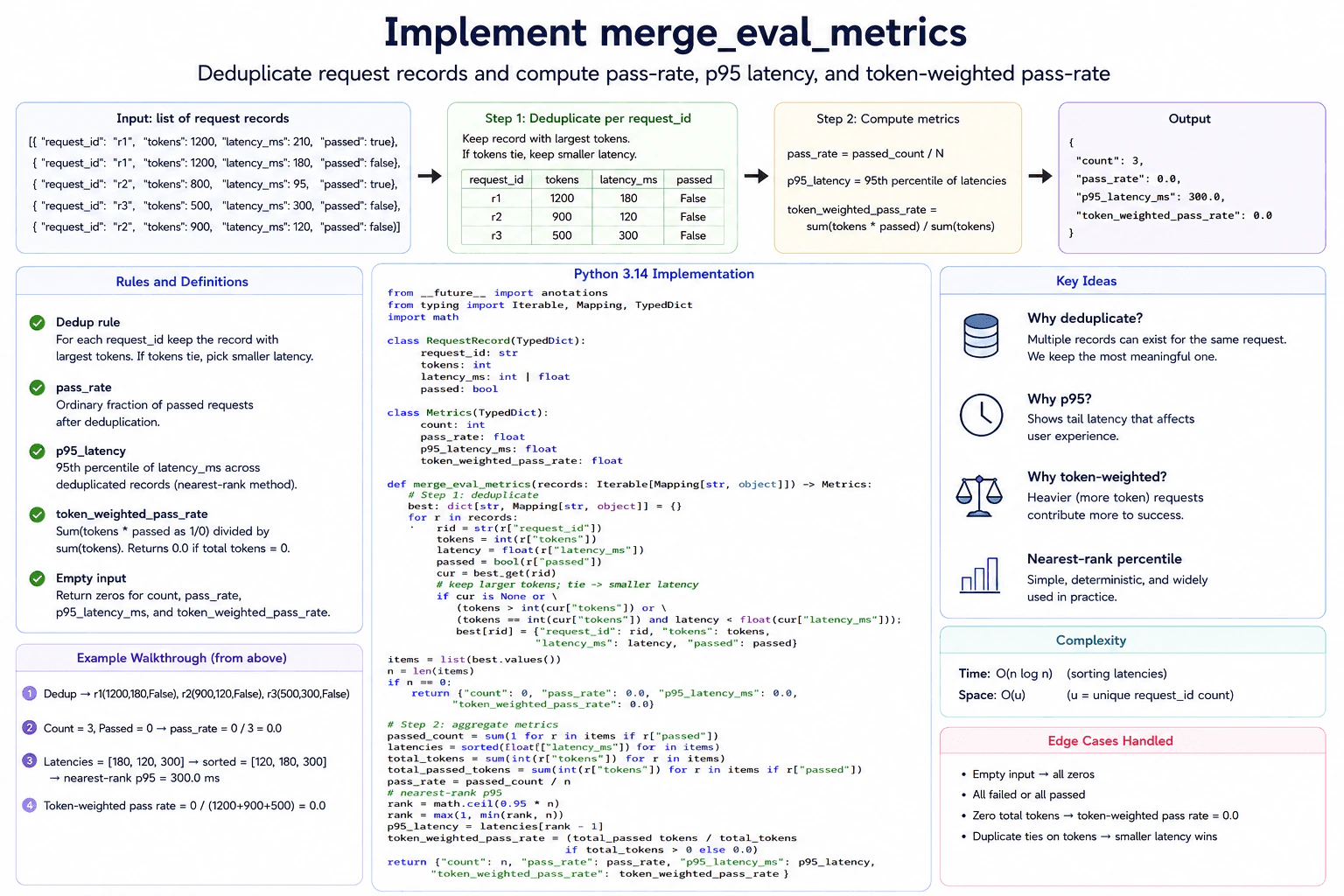
In Python, for each request_id, retain the record with the largest token count and break token ties by smaller latency; then return count, ordinary pass rate, p95 latency and token-weighted pass rate, with defined empty-input and numeric behavior.
Short Interview Answer (30-60 seconds)
I would first keep one best record for each request_id in a dictionary. A record replaces the current winner when it has more tokens, or when the token counts tie and it has lower latency. Then I calculate count, ordinary pass rate, nearest-rank p95 latency, and token-weighted pass rate from only those retained records. Sorting the retained latencies makes the total time O(n log n). The auxiliary space is O(u), where u is the number of unique request IDs.
The input may contain more than one result for the same request. We first choose one result for each request. The result with more tokens wins. If the token counts are equal, the result with the smaller latency wins. After this cleanup, we calculate four values. We return how many requests remain, the fraction that passed, the p95 latency, and a pass rate where requests with more tokens have more weight. A dictionary is a good fit because it keeps one current winner for each request.
Useful Questions to Ask the Interviewer
Should p95 use the nearest-rank method shown in the example?
Should the token-weighted pass rate be 0.0 when the retained total token count is zero?
Should empty input return zero for all four output fields?
How to Explain It in an Interview
1. Understand the input and required output
Each input record contains request_id, tokens, latency_ms, and passed. The same request_id can appear more than once. We must keep exactly one record for each request_id before calculating the metrics. The output contains count, pass_rate, p95_latency_ms, and token_weighted_pass_rate. Empty input returns zeros for all four fields.
2. Choose the data structure and deduplication rule
I use a dictionary called best. Its key is request_id. Its value is the currently selected record for that request. When a new record has more tokens, it replaces the current record. If the token counts tie, the record with smaller latency wins. The important invariant is that after each input record is processed, best contains the correct winner seen so far for every request_id.
3. Walk through the exact example
The input contains five records. For r1, the two records both have 1200 tokens. Their latencies are 210 ms and 180 ms, so the 180 ms record wins. Its passed value is False. For r2, the records have 800 and 900 tokens, so the 900-token record wins even though its latency is higher. Its latency is 120 ms and passed is False. r3 has one record with 500 tokens, 300 ms latency, and passed False. The retained records are therefore r1=(1200, 180, False), r2=(900, 120, False), and r3=(500, 300, False).
4. Calculate the four metrics
There are three retained records, so count is 3. None of them passed, so pass_rate is 0 / 3 = 0.0. The retained latencies are [180, 120, 300]. After sorting, they are [120, 180, 300]. Nearest-rank p95 uses rank = ceil(0.95 * 3) = 3, so p95_latency_ms is 300.0. The passed-token total is 0, while total retained tokens are 1200 + 900 + 500 = 2600. Therefore token_weighted_pass_rate is 0 / 2600 = 0.0.
5. Explain why the result is correct
The dictionary invariant makes the deduplication correct. For every request_id, the stored record is always the best one seen so far under the required rule. A record with more tokens always wins. Smaller latency is considered only when token counts are equal. After all records are processed, the dictionary therefore contains exactly the records that should be used for the metrics.
6. Explain the Python implementation
The code first fills the best dictionary. It then collects the retained records. If there are no retained records, it returns zeros. Otherwise, it counts passed records, sorts the retained latencies, calculates nearest-rank p95, sums all retained tokens, and sums tokens belonging to passed retained records. It then returns the four requested values.
7. Explain complexity and edge cases
The dictionary pass takes O(n) expected time because Python dictionary lookup and update are O(1) on average. Sorting the retained latency values dominates the final bound, so the diagram's overall time complexity is O(n log n). Auxiliary space is O(u), where u is the number of unique request_id values. Important edge cases are empty input, all passed or all failed records, equal-token duplicates, and zero total retained tokens.
Key Insight / Why This Solution Works
The solution has two clear stages. First, deduplicate the records by request_id with a dictionary. The dictionary stores one current winner for each request_id. The invariant is that each stored value is the best record seen so far for that request according to the exact rule: larger tokens wins, and smaller latency breaks an equal-token tie. Second, calculate all four metrics only from those winners. This separation is important because duplicate records must not affect the final statistics.
Code
from __future__ import annotations
import math
from typing import Iterable, Mapping, TypedDict
classRequestRecord(TypedDict):
request_id: str
tokens: int
latency_ms: int | float
passed: boolclassMetrics(TypedDict):
count: int
pass_rate: float
p95_latency_ms: float
token_weighted_pass_rate: floatdefmerge_eval_metrics(records: Iterable[Mapping[str, object]]) -> Metrics:
# Keep one current winner for each request_id.# More tokens wins. Smaller latency breaks an equal-token tie.
best: dict[str, RequestRecord] = {}
for record in records:
# Read the fields needed for comparison and final aggregation.
request_id = str(record["request_id"])
tokens = int(record["tokens"])
latency_ms = float(record["latency_ms"])
passed = bool(record["passed"])
current = best.get(request_id)
# Replace the current winner only when the required rule says so.if (
current isNoneor tokens > current["tokens"]
or (tokens == current["tokens"] and latency_ms < current["latency_ms"])
):
best[request_id] = {
"request_id": request_id,
"tokens": tokens,
"latency_ms": latency_ms,
"passed": passed,
}
# Every metric below is calculated only from the deduplicated winners.
retained = list(best.values())
count = len(retained)
# Empty input has the defined all-zero result.if count == 0:
return {
"count": 0,
"pass_rate": 0.0,
"p95_latency_ms": 0.0,
"token_weighted_pass_rate": 0.0,
}
# Ordinary pass rate gives every retained request equal weight.
passed_count = sum(1for record in retained if record["passed"])
pass_rate = passed_count / count
# Nearest-rank p95 needs the retained latency values in sorted order.
latencies = sorted(float(record["latency_ms"]) for record in retained)
rank = math.ceil(0.95 * count)
rank = max(1, min(rank, count))
p95_latency_ms = latencies[rank - 1]
# Token-weighted pass rate gives requests with more tokens more weight.
total_tokens = sum(int(record["tokens"]) for record in retained)
passed_tokens = sum(int(record["tokens"]) for record in retained if record["passed"])
# Return 0.0 instead of dividing by zero when total retained tokens are zero.
token_weighted_pass_rate = passed_tokens / total_tokens if total_tokens > 0else0.0# Return exactly the four requested metrics.return {
"count": count,
"pass_rate": pass_rate,
"p95_latency_ms": p95_latency_ms,
"token_weighted_pass_rate": token_weighted_pass_rate,
}
defmain() -> None:
# Run the exact example shown in the approved diagram.
records: list[RequestRecord] = [
{"request_id": "r1", "tokens": 1200, "latency_ms": 210, "passed": True},
{"request_id": "r1", "tokens": 1200, "latency_ms": 180, "passed": False},
{"request_id": "r2", "tokens": 800, "latency_ms": 95, "passed": True},
{"request_id": "r3", "tokens": 500, "latency_ms": 300, "passed": False},
{"request_id": "r2", "tokens": 900, "latency_ms": 120, "passed": False},
]
# Expected output:# {'count': 3, 'pass_rate': 0.0, 'p95_latency_ms': 300.0,# 'token_weighted_pass_rate': 0.0}print(merge_eval_metrics(records))
if __name__ == "__main__":
main()
Time & Space Complexity
Let n be the number of input records and u be the number of unique request_id values. The dictionary work takes O(n) expected time because Python dictionary lookup and update are O(1) on average. The retained latency values are sorted for p95. That gives the overall O(n log n) time shown in the diagram. The auxiliary space is O(u) because the dictionary, retained records, and retained latency values grow with the number of unique requests.
Where it is used
This pattern is useful in evaluation and monitoring systems where the same request can produce duplicate records. A system may need to choose one canonical record using a priority rule before calculating summary metrics. The same approach is useful in batch analytics, experiment evaluation, log cleanup, and reporting pipelines where duplicate events must be resolved before aggregation.
Why Interviewers Ask This
This question tests whether you can translate a precise data rule into correct Python. The interviewer can see whether you handle duplicates in the right priority order, maintain a useful dictionary invariant, calculate a defined percentile correctly, and distinguish ordinary pass rate from token-weighted pass rate. It also checks empty and zero-token behavior, clear type usage, and whether you include the sorting cost when explaining complexity.
Common interview mistakes
A common mistake is calculating the metrics before removing duplicates. Another is using lower latency as the main rule instead of using it only when token counts tie. A candidate may also calculate p95 without sorting the retained latencies or use a different percentile definition. Another mistake is calculating token-weighted pass rate from all original records instead of only the retained winners. Finally, the code must avoid division by zero when the total retained token count is zero.
Interview tip
Explain the deduplication priority before discussing any metric. Say: larger token count wins first, and lower latency is only the tie-breaker. Then make it clear that every metric is calculated from the retained winners, not from the original duplicate-filled input.
Interviewer may ask next
How would this work if the records arrived as a stream?
The deduplication step already works with streaming input. I would keep only the current winner for each request_id in the best dictionary as records arrive. I would not need to store the full original stream. At the end, I would calculate the metrics from the retained winners. Exact nearest-rank p95 still requires the retained latency values to be sorted. The overall time remains O(n log n), and auxiliary space remains O(u). The main tradeoff is that exact p95 still needs the retained latency values.
What happens if every retained record has zero tokens?
Count, ordinary pass rate, and p95 latency are calculated normally. The token-weighted pass rate cannot divide by the total token count because that total is zero. The implementation therefore returns 0.0 for token_weighted_pass_rate. The deduplication rule does not change. The time complexity remains O(n log n), and auxiliary space remains O(u).
14. Tell me about yourself. How do you approach your work?BehavioralEasyXai
Interview tip:
Use STAR to structure your answer: briefly explain the Situation and Task, make Action the most detailed part, and finish with the Result. For example, describe a previous AI engineering project where you took ownership of a model quality problem, understood the user need, checked the data and model behavior carefully, worked with the team, made clear technical decisions, and improved the reliability of the final solution.
Situation
In my last role, I worked on an AI feature that used a model to generate answers for users. During testing, we saw that some answers looked reasonable but were not reliable enough for production. This type of problem interests me because I like understanding how an AI system behaves before deciding how to improve it.
Task
My responsibility was to help make the feature more reliable before release. I needed to understand where the weak answers came from, decide which problems mattered most, and work with the team on practical improvements. I also wanted our decisions to be based on evidence instead of assumptions.
Action
I started by looking at real examples of good and bad model outputs. I grouped the failures into simple categories so we could see patterns. Then I checked the input data, the instructions given to the model, and the evaluation process. I changed one important thing at a time because this made it easier to understand what actually improved the result. I created a small evaluation set with representative cases and used it to compare each change consistently. When I found a problem that involved data or product behavior, I discussed it with the relevant team members instead of treating it as only a model problem. I explained what I was seeing in simple terms and shared examples so everyone could understand the tradeoffs. I also considered reliability, safety, user value, and engineering cost before recommending a change. My general approach to work is similar. I first understand the goal, break the problem into smaller parts, test my assumptions, communicate early, and keep improving the solution based on evidence.
Result
We reached a more reliable solution and had a clearer way to evaluate future changes before release. The team also had a shared understanding of the main failure patterns and how to test them. I learned that good AI engineering is not only about improving a model. It is also about careful evaluation, clear communication, practical judgment, and taking ownership of the complete system.
Why Interviewers Ask This
Interviewers ask this question to understand both your professional background and the way you solve problems. For an AI Engineer, a strong answer shows that you work in a structured way, use evidence to make decisions, communicate clearly, take ownership, and think about the whole AI system instead of focusing only on the model.
Interviewer may ask next
Why do you prefer changing one important thing at a time?
I do this because I want to know what caused the result. If I change the data, model instructions, and evaluation process together, it becomes difficult to know which change helped. Testing one important change at a time gives me clearer evidence and helps me make better engineering decisions.
What would you do differently if you worked on a similar problem now?
I would define the evaluation cases even earlier. In that project, reviewing failures helped us build a useful evaluation set. Now I would try to agree on representative examples and expected behavior near the start. That would give the team a clearer definition of quality and make later decisions easier.
15. Describe a time you scaled a data pipeline or model improvement through external contractors. How did you ensure consistency?BehavioralMediumXai
i Question Details
Identify the model or data objective, contractor roles, instructions and examples, quality sampling, agreement and rework metrics, accountability, the candidate’s own decisions, escalation, and measured model or pipeline outcome.
Interview tip:
Use STAR to structure your answer: briefly explain the Situation and Task, make Action the most detailed part, and finish with the Result. For example, describe a data or model improvement that required external contractors, the work you gave them, the instructions and examples you created, how you sampled quality, how you tracked agreement and rework, how you assigned accountability, when you escalated problems, and how you checked that the final data improved the pipeline or model.
Situation
In my last role, we were improving a retrieval model that needed more reliable relevance labels. Our internal team could define the labeling rules and evaluate the model, but we did not have enough capacity to label the larger data set ourselves. We decided to use external contractors for the labeling work.
Task
I was responsible for turning our model objective into a process that contractors could follow consistently. I also needed to make sure that increasing labeling volume did not reduce data quality. My goal was to give contractors clear rules, detect inconsistent work early, and confirm that the accepted labels were useful for the model.
Action
I first defined exactly what each label meant and wrote simple instructions with examples of clear cases and difficult cases. I included examples that showed why two similar query and document pairs could need different labels. Before increasing the workload, I asked the contractor team to complete a small calibration set. A calibration set is a shared group of examples used to check whether everyone understands the rules in the same way. I reviewed disagreements with the contractor lead and changed any instruction that could be interpreted in more than one way. Once the process was running, I sampled completed work instead of assuming that higher volume meant good progress. I compared contractor labels with reviewed reference examples and also checked agreement between people who labeled similar cases. Agreement showed whether different people were applying the same rules. I tracked repeated mistakes and rework because a high amount of rework usually meant that an instruction, example, or review step was unclear. I kept ownership clear. Contractors were responsible for following the written rules, the contractor lead was responsible for correcting repeated process problems, and I owned the labeling policy and final technical decisions. When a difficult case exposed a missing rule, I did not let each contractor make a different personal choice. I paused that type of case, decided the correct treatment with our internal team, updated the instructions, and shared a new example before work continued. I also reviewed samples from each new batch before those labels entered the model pipeline. Finally, I compared model evaluation results using the accepted data with our previous baseline so that we were measuring useful model improvement, not just labeling volume.
Result
The contractor workflow scaled the labeling effort while keeping the rules consistent across batches. Agreement remained stable, repeated rework became less common after the instructions were improved, and the accepted data produced a clear improvement in our model evaluation compared with the earlier baseline. The main lesson I learned was that external work scales well only when the internal team makes quality rules, ownership, review, and escalation very clear.
Why Interviewers Ask This
Interviewers ask this question to see whether a candidate can scale AI work without losing quality or control. A strong answer shows that the candidate can translate a technical goal into clear instructions, create practical quality checks, manage external accountability, resolve unclear cases, and verify that more data or work actually improves the model or pipeline.
Interviewer may ask next
How did you decide when a contractor quality issue needed escalation?
I escalated when the same type of mistake appeared repeatedly or when the written rule did not clearly cover the case. I did not treat every disagreement as a contractor error. I first checked whether our own instructions were unclear. If the rule was missing, I made the decision with the internal team, updated the guidance, and asked the contractor lead to make sure the new rule was understood before that work continued.
What would you do differently if you had to scale the same process again?
I would invest even earlier in calibration examples for difficult cases. In this project, some rework happened because edge cases became clear only after larger batches started. Next time, I would collect more difficult examples during the initial trial, review them with the contractor lead, and make the decision rules clearer before increasing volume.
Disclaimer: This interview guide is for educational and informational purposes only. It is designed to help readers prepare, but it does not guarantee any interview result, hiring decision, offer, or outcome. Interview questions, hiring criteria, and preferred answers can vary by employer, interviewer, industry, location, and time. All answers, examples, and explanations in this guide are suggested examples for interview preparation, not definitive answers or instructions for professional practice. They are based on research and judgment, are provided without warranties of any kind, and should be adapted to the question, role, and applicable laws and professional requirements. Diagrams are simplified illustrations intended to highlight the main concepts and their relationships; actual situations, systems, and practices may be more complex. Alternative approaches may be equally valid or better suited to a particular question, context, or interviewer. To the fullest extent permitted by applicable law, the contributors and publisher are not liable for decisions made, actions taken, or losses incurred based on this guide.
State Laws and Professional Responsibilities: Laws and requirements governing an occupation vary by state and jurisdiction. You are responsible for checking the current laws, licensing requirements, and scope-of-practice rules that apply to your location and role, and for ensuring that your answers and actions comply with them. Adapt examples in this guide to those requirements. This guide is not legal advice.
Company Notice: This guide is an independent educational resource and is not affiliated with, endorsed by, sponsored by, or approved by the company named in this guide. Company names identify reported interview experiences or the employer context of clearly labeled original practice exercises. Interview practices can change without notice, and inclusion of company-specific content does not mean these questions are official, complete, or guaranteed to be asked. To the fullest extent permitted by law, the author, contributors, and publisher are not responsible for outcomes related to use of this material.
Content Accuracy and Verification: To the fullest extent permitted by applicable law, we do not represent or warrant that interview guides, questions, answers, examples, or diagrams are accurate, complete, current, error-free, or suitable for any particular purpose. You are responsible for independently reviewing and verifying the information before relying on it.