This interview guide is for educational and informational purposes only. It is designed to help readers prepare, but it does not guarantee any interview result, hiring decision, offer, or outcome. Interview questions, hiring criteria, and preferred answers can vary by employer, interviewer, industry, location, and time. All answers, examples, and explanations in this guide are suggested examples for interview preparation, not definitive answers or instructions for professional practice. They are based on research and judgment, are provided without warranties of any kind, and should be adapted to the question, role, and applicable laws and professional requirements. Diagrams are simplified illustrations intended to highlight the main concepts and their relationships; actual situations, systems, and practices may be more complex. Alternative approaches may be equally valid or better suited to a particular question, context, or interviewer. To the fullest extent permitted by applicable law, the contributors and publisher are not liable for decisions made, actions taken, or losses incurred based on this guide.
State Laws and Professional Responsibilities
Laws and requirements governing an occupation vary by state and jurisdiction. You are responsible for checking the current laws, licensing requirements, and scope-of-practice rules that apply to your location and role, and for ensuring that your answers and actions comply with them. Adapt examples in this guide to those requirements. This guide is not legal advice.
Identity, Image, and Privacy Notice
To respect individual privacy, some names, profile photographs, avatars, biographical details, and other identifying information displayed in this guide may be replaced with pseudonyms, licensed stock images, illustrative avatars, composite images, or representative descriptions. Unless a person is expressly identified as an actual contributor, a displayed name, image, or profile should not be understood as depicting or identifying a specific candidate, interviewer, employee, or other real individual. These representations are provided for editorial and illustrative purposes only and do not imply endorsement, employment, participation, or affiliation with this guide or any company mentioned in it. Any resemblance to an actual person is coincidental.
Company Notice
This guide is an independent educational resource and is not affiliated with, endorsed by, sponsored by, or approved by the company named in this guide. Company names identify reported interview experiences or the employer context of clearly labeled original practice exercises. Interview practices can change without notice, and inclusion of company-specific content does not mean these questions are official, complete, or guaranteed to be asked. To the fullest extent permitted by law, the author, contributors, and publisher are not responsible for outcomes related to use of this material.
Content Accuracy and Verification
To the fullest extent permitted by applicable law, we do not represent or warrant that interview guides, questions, answers, examples, or diagrams are accurate, complete, current, error-free, or suitable for any particular purpose. You are responsible for independently reviewing and verifying the information before relying on it.
Questions or comments?
Contact us for general questions, or share feedback, technical corrections, and comments with the community.
1. How would you handle edits to bids in an auction platform?API DesignMediumAmazon
i Question Details
Explain how an auction platform should handle edits to bids, including whether to allow bid editing or record multiple bids.
Short Interview Answer (30-60 seconds)
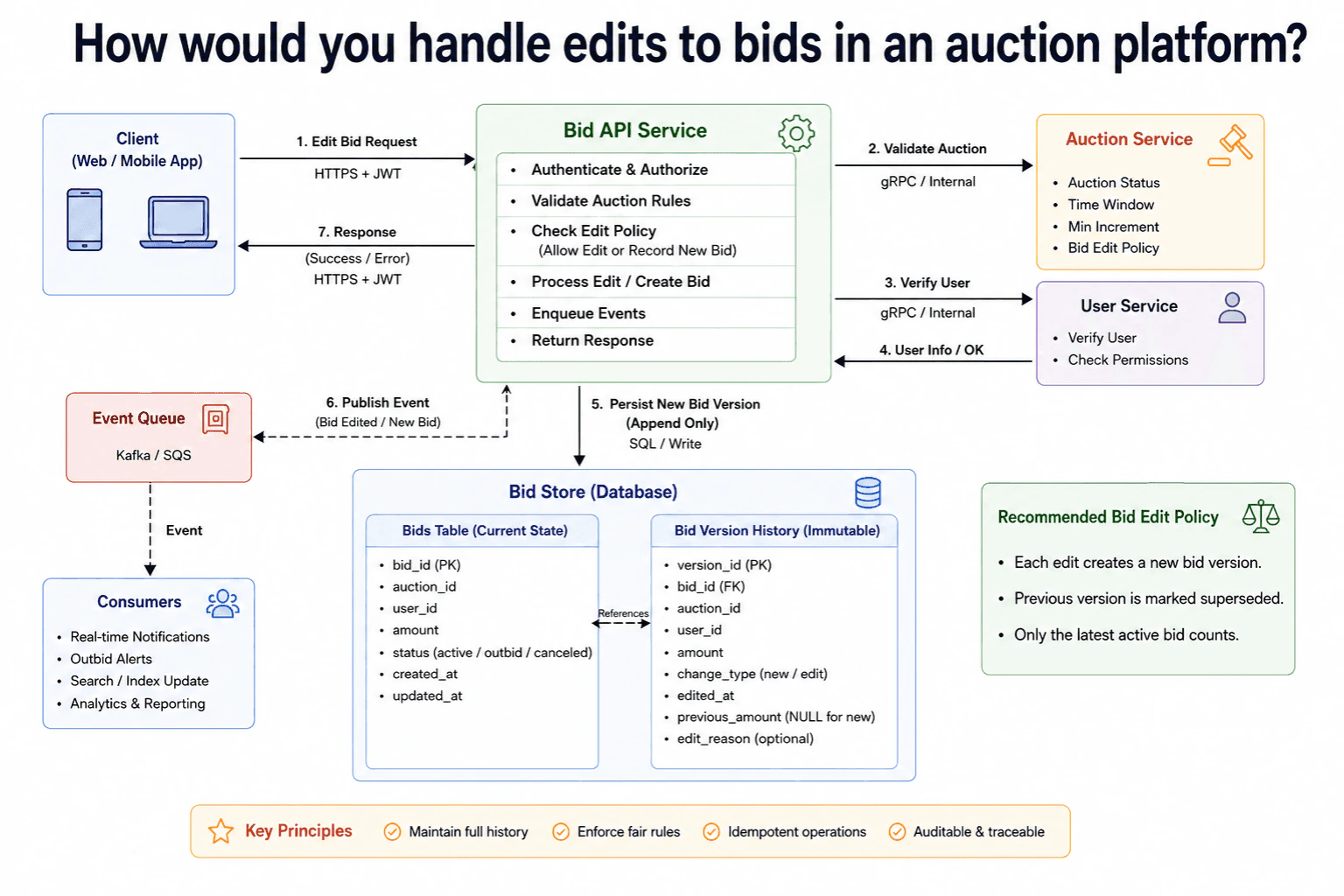
At a high level, I would not edit the old bid in place. The bidder sends an edit request to the Bid API Service over HTTPS with a JWT, and the API checks the auction rules, verifies the user, and saves a new bid version. The previous version is marked superseded, so only the latest active bid counts. The API then publishes an event for notifications and reporting, and returns success or error. The trade-off is more storage and more writes, but much better auditability and fairness.
Detailed Explanation
This question asks how an auction site should handle bid edits without breaking trust. The goal is simple. We want the bidder to change a bid safely, keep the history clear, and still know the current winning bid. The main challenge is deciding whether to overwrite the old bid or save a new one. I will follow the diagram from the client request, through bid checks, user checks, storage, and event publishing, and then back to the response.
Useful Questions to Ask the Interviewer
Can a bidder edit only before the auction ends?
Should every edit create a new bid version?
What should happen if the new amount is lower than the current bid?
Do we need notifications or search updates after the edit?
How to Explain It in an Interview
1. Start with the goal and the edit policy
I would begin by saying that I would not replace bid data in place. The diagram shows a Recommended Bid Edit Policy with three ideas. Each edit creates a new bid version. The old version is marked superseded. Only the latest active bid counts. This is a good fit for auctions because it keeps the trail of changes clear. It also makes disputes easier to review later.
2. Walk through the request path
The request starts with the client, which can be a web or mobile app. It sends an edit bid request to the Bid API Service over HTTPS with a JWT. A JWT is a signed login token that shows who the caller is. The API is the first place that should reject bad requests. It then calls the Auction Service with an internal gRPC request. gRPC is a fast service-to-service call. The Auction Service checks the auction status, time window, minimum increment, and bid edit policy. That step matters because we only want valid bid edits.
3. Verify the user before writing anything
Next, the Bid API Service verifies the user through the User Service with another internal gRPC call. The User Service checks the user and the permissions. In simple words, it answers, Is this bidder allowed to do this? If the auction is closed, the amount is wrong, or the user is not allowed, the flow stops here. The API returns an error and does not write anything. That is important because we should fail fast before changing data.
4. Store the new bid as a new version
If the request is valid, the Bid API Service writes a new bid version to the Bid Store. The diagram shows this as Persist New Bid Version (Append Only). Append only means we add a new record instead of editing the old one. The Bid Store has two parts. The current state table gives the latest bid quickly. The bid version history keeps every edit for audit and traceability. After the new version is written, the previous bid is marked superseded, so it is no longer the active one. This design keeps the winner logic simple, because only the latest active bid counts.
5. Publish the event and return the response
After the write, the API publishes a bid edited event to the Event Queue. The queue is shown as Kafka or SQS. That keeps the main request path fast and lets other systems catch up later. The Consumers then handle real-time notifications, outbid alerts, search or index updates, and analytics or reporting. Finally, the Bid API Service returns success or error to the client through HTTPS and JWT.
6. Explain the trade-off
The main trade-off is that this design writes more data. That costs more storage and more write work. The benefit is a full history, fair rules, and easy auditing. For an auction system, that is usually the safer choice.
Practical Complexity & Trade-offs
This design chooses safety over a tiny storage saving. The benefit is that every bid change stays in history, so audits and disputes are easier. It also makes the current active bid easy to find, because the system keeps a separate current-state record. The downside is more writes and more data, since every edit becomes a new row. The event queue is also useful. It keeps notifications, search updates, and analytics away from the main request path. That makes the API faster and easier to scale, but the consumers may see the change a little later. We accept that delay because the bid edit itself must stay reliable and traceable.
Why Interviewers Ask This
Interviewers ask this to see whether I can design a clear API boundary and keep the request flow safe. They want to know if I understand validation, user checks, write behavior, and event publishing. They also want to see whether I can explain why we keep bid history instead of overwriting data. A strong answer shows good judgment about fairness, auditability, reliability, and the cost of extra writes.
Interviewer may ask next
What if the bidder edits the bid several times very quickly?
I would keep the same append-only design, but I would make sure the Bid Store accepts only one latest active bid for the same auction and bidder. Each edit would still create a new bid version, and the earlier one would stay in history. The affected flow is the write from the Bid API Service to the Bid Store. Correctness stays strong because the current-state table still shows only the newest active bid, and the full history stays intact. Security also stays the same, because the JWT and user checks still happen before any write. The downside is that very fast edits can cause more rejected or overwritten attempts, so the bidder may need to try again. I would still keep the event queue and consumers unchanged, because they should react only after a successful save.
What if the event queue or consumers are slow after the bid is saved?
I would keep the synchronous bid edit path the same and let the queue handle the delay. The affected flow is the event from the Bid API Service into the Event Queue, and then to Consumers. The API should still write the new bid version first, return success after the write, and publish the event for later processing. That keeps the main bid edit reliable, even if notifications or analytics fall behind for a short time. Correctness stays strong because the Bid Store remains the source of truth for the latest active bid. The downside is that users may see delayed alerts, delayed search updates, or delayed reporting updates. I would keep the consumer work idempotent, which means repeated event handling should not create wrong results. That matches the diagram well, because the queue is there to decouple the edit request from downstream work.
2. How would you support a near real-time leaderboard for an auction platform?API DesignHardAmazon
i Question Details
Explain how an auction platform would support a near real-time leaderboard.
Short Interview Answer (30-60 seconds)
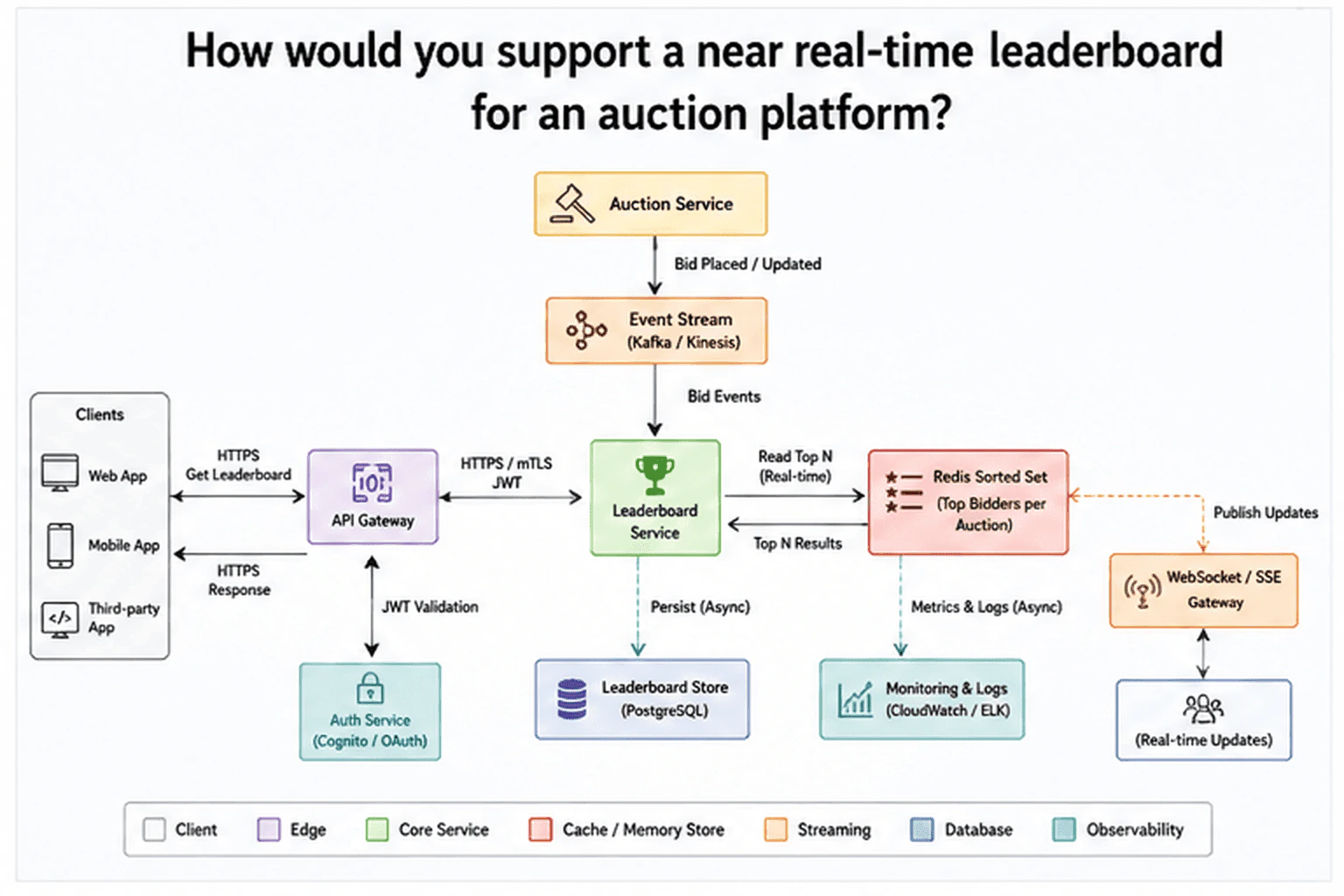
At a high level, I would make the leaderboard fast by reading from Redis and keep the durable record in PostgreSQL. Clients call the API Gateway over HTTPS, the gateway checks the JWT with Auth Service, and then Leaderboard Service reads the Top Bidders per Auction from Redis Sorted Set. Auction Service sends bid changes through Event Stream, and Leaderboard Service updates Redis and writes PostgreSQL asynchronously. The main security choice is JWT validation plus mTLS on the internal call, and the trade-off is speed versus fully synchronous durability.
Detailed Explanation
This question asks how an auction site can show the top bidders almost immediately after bids change. The goal is to keep the leaderboard fast for users and still save each bid safely. I would explain how a leaderboard request reaches the service, how bid events update the ranking, and how live updates reach the browser or app. The hardest part is speed, because the page should not wait for the database on every refresh. I will follow the diagram step by step and keep the explanation simple.
Useful Questions to Ask the Interviewer
How fresh must the leaderboard be?
Is there one leaderboard per auction?
How many bid updates per second do we expect?
Do we need live push updates for every client?
How to Explain It in an Interview
1. Start with the goal and boundary
At a high level, I would keep the public read path simple. Clients use HTTPS to get the leaderboard. The API Gateway sits at the edge and receives requests from the web app, mobile app, and third-party app. Its job is to protect the backend and forward only valid traffic. The gateway also works with Auth Service (Cognito / OAuth) to validate the JWT, which is the login token that proves the caller is signed in. That separates public traffic from internal services.
2. Explain the fast read path
The Leaderboard Service owns the leaderboard logic. After the gateway checks identity, it forwards the call to this service over HTTPS / mTLS with a JWT. mTLS means both services verify each other, so the internal call is encrypted and trusted. The Leaderboard Service reads the Top Bidders per Auction from Redis Sorted Set. Redis is the fast in-memory store. This is why the leaderboard can return top-N results in real time instead of scanning PostgreSQL.
3. Show how bid updates flow in
When a bid is placed or updated, Auction Service publishes a bid event to the Event Stream, such as Kafka or Kinesis. The Leaderboard Service consumes those bid events and updates the Redis sorted set. This keeps the ranking fresh without blocking the user request. The same service then writes the durable data to Leaderboard Store (PostgreSQL) asynchronously. That means PostgreSQL is the safe record, while Redis stays the fast read model.
4. Explain live push updates
The diagram also shows a WebSocket / SSE Gateway. SSE means server-sent events, where the server pushes updates to clients. When the leaderboard changes, the system publishes updates through that gateway to real-time updates clients. That is useful for users watching the auction page. If they are not connected, they can still call the HTTPS leaderboard API again. So the push path improves freshness, but it does not replace the normal read path.
5. Cover security, logging, and failure behavior
If JWT validation fails, the request should not reach the Leaderboard Service. If mTLS fails, the internal call should also fail closed. Monitoring & Logs receives metrics and logs asynchronously, so it helps operations without being part of the user response path. The important trade-off is that Redis gives speed, but PostgreSQL gives durability. The system accepts async persistence because a leaderboard must feel live, even if the durable write lands a little later.
6. Close with the main trade-off
Overall, this design keeps reads fast, updates event-driven, and client experience near real time. I would finish by saying the main idea is to use Redis for quick top-N reads, PostgreSQL for storage, Event Stream for bid changes, and WebSocket / SSE for live delivery.
Practical Complexity & Trade-offs
The benefit of this design is speed. The API Gateway keeps public traffic at the edge, and Leaderboard Service reads the top bidders from Redis Sorted Set instead of scanning PostgreSQL each time. That makes leaderboard reads fast. The Auction Service sends bid changes to Event Stream, so ranking updates can happen without blocking user requests. The downside is that Redis becomes an important hot path. We accept that because the leaderboard must feel near real time. PostgreSQL stays the durable store, but it is written asynchronously, so the system trades a little write delay for faster reads and a simpler user experience. WebSocket / SSE also adds push complexity, but it reduces refresh traffic.
Why Interviewers Ask This
Interviewers ask this to see whether you can design for fresh data, not just data storage. They want to know if you can separate fast reads, event updates, durable storage, and live push delivery. They also check if you understand authentication with JWT, mTLS between services, and async persistence. A strong answer shows that you can explain trade-offs clearly: speed versus consistency, and live updates versus simpler polling. It also shows that you can keep the request path and the event path separate.
Interviewer may ask next
How would you handle a spike in bid traffic during a very active auction?
I would keep the same design and scale the hot parts horizontally. API Gateway, Leaderboard Service, Event Stream consumers, Redis Sorted Set, and the WebSocket / SSE Gateway can all take more instances. The important part is that bid changes already flow through Event Stream, so the system can process them in parallel instead of forcing one slow request path. I would also keep PostgreSQL as the async durable store, so the live ranking path does not wait on disk writes. Correctness stays the same because the event stream still carries the bid changes and the leaderboard still reads from Redis for the latest Top N results. The main downside is more operational work, because scaling consumers and keeping the right event order by auction key needs careful monitoring, and the team must watch for hot auctions that receive much more traffic than the rest.
What would you do if some clients cannot stay connected to WebSocket / SSE?
I would keep the HTTPS leaderboard request as the main fallback for those clients. The WebSocket / SSE Gateway is only for push updates, so if a client disconnects, it can simply fetch the leaderboard again through the normal API path. That keeps correctness in the read API and makes push delivery an improvement, not a dependency. The Leaderboard Service still reads Redis Sorted Set for the latest Top N results, so the client can recover quickly after a reconnect. I would also keep the push gateway separate from the main request path, so a push failure does not break the normal leaderboard response. The downside is that disconnected clients may see updates a little later and may need reconnect logic or refresh logic, but the core answer from the API stays available and the system still behaves in a predictable way.
3. Design a Unix-like CLI to support walking through files and directories and displaying them.System DesignMediumAmazon
i Question Details
Design a Unix-like command-line interface that supports walking through files and directories and displaying them.
Short Interview Answer (30-60 seconds)
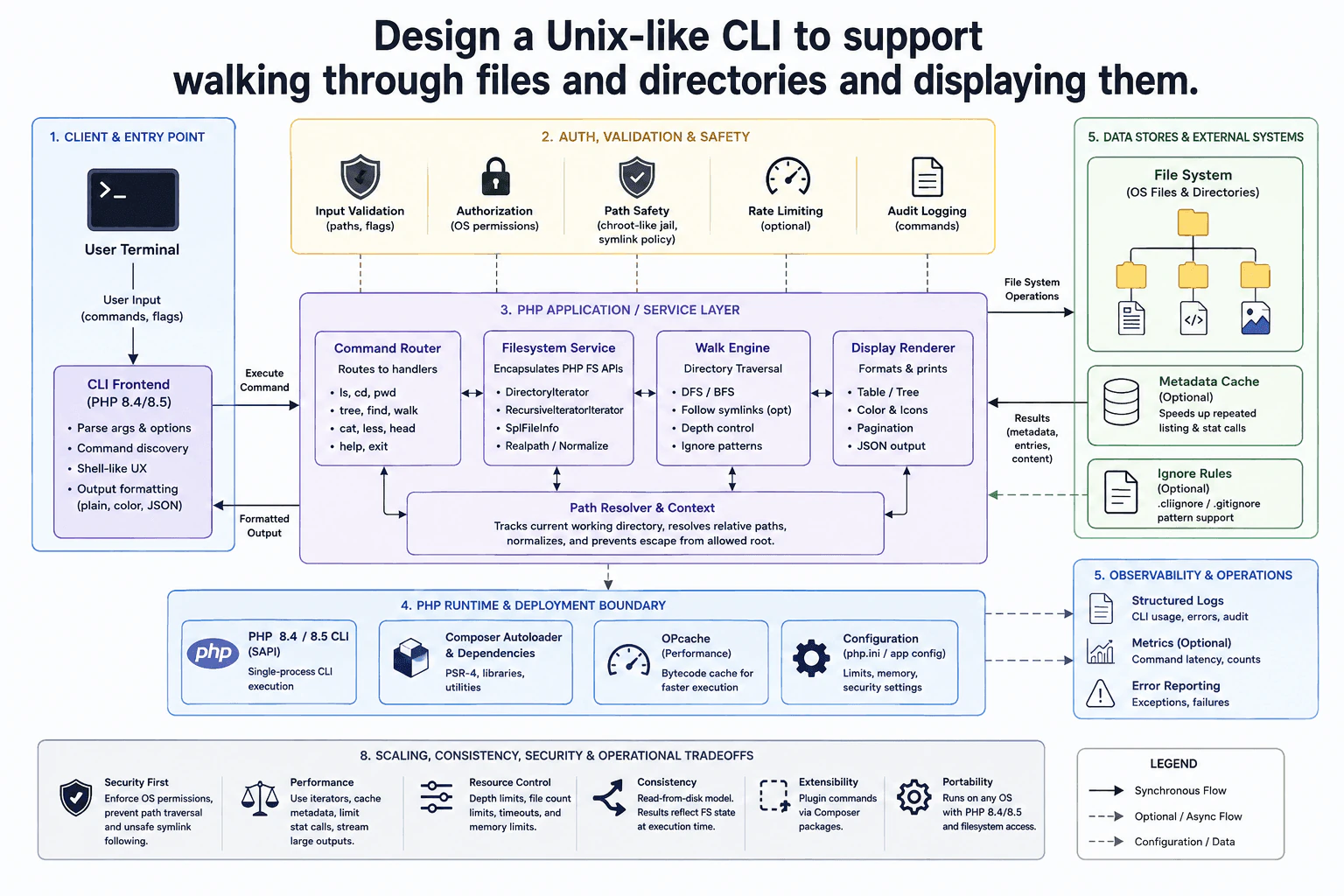
At a high level, this is a terminal tool for walking through files and folders and showing them clearly. The main challenge is to stay safe, respect permissions, and still feel fast. I would explain it in three parts: input and safety checks, the PHP service layer that walks and formats files, and the PHP runtime plus cache and logging. The trade-off is speed versus freshness when repeated file metadata is cached.
Detailed Explanation
The goal is to let a user explore folders from a Unix-like terminal and see files in a clear way. The tool should feel familiar, like ls, tree, pwd, find, cat, less, head, help, and exit. The hard part is that every path must stay safe, and every permission check must be correct. The diagram handles this by separating input checks, the PHP application layer, the filesystem, optional cache and ignore rules, and the runtime boundary.
Useful Questions to Ask the Interviewer
What does the system need to do for the user?
What makes the problem hard?
How will I organize the answer from the diagram?
How to Explain It in an Interview
1. Explain the goal and the main idea
“At a high level, this is a CLI tool for walking through directories and displaying them.” The main goal is simple browsing from the terminal. The tool must show files, folders, and metadata in a readable way. The diagram keeps the design easy by separating user input, safety checks, file walking, output formatting, and runtime details.
2. Explain input and safety first
The first box is the CLI frontend in PHP 8.4 and 8.5. It parses args and options, discovers the command, and gives a shell-like UX. Before any file work, the tool checks input, permissions, path safety, and optional rate limits. The path resolver and context are important here. They track the current working directory, normalize paths, and stop escape from the allowed root.
3. Explain the PHP application and service layer
The command router sends each command to the right handler. The filesystem service wraps PHP file APIs such as DirectoryIterator, RecursiveIteratorIterator, and SplFileInfo. The walk engine does the directory traversal. It can use DFS or BFS, follow symlinks when allowed, control depth, and apply ignore patterns. The display renderer turns the result into table, tree, color, pagination, or JSON output.
4. Explain the file system, cache, and output flow
The main source of truth is the file system itself. That means the OS files and directories are the real data. The optional metadata cache is only a speed layer. It helps repeated listing and stat calls. On a cache hit, the tool can reuse recent metadata. On a miss, it reads the file system first and then can update the cache. The ignore rules box is also optional, and it supports patterns like .clignore and .gitignore.
5. Explain runtime, observability, and trade-offs
The runtime boundary is PHP CLI, with Composer autoloading and OPcache for faster execution. The diagram also shows configuration, single-process CLI execution, and no shared mutable state between runs. Observability comes from structured logs, optional metrics, and error reporting. The main trade-off is clear. Caching makes repeated reads faster, but results may be slightly older. Deep walks give more complete output, but they cost more time and memory. That is why the diagram also calls out security, performance, resource control, consistency, extensibility, and portability.
Engineering Considerations / Design Trade-offs
The benefit is that repeated file listings can be faster because the optional metadata cache can reuse recent data. The downside is that cache results may be a little old. Another benefit is safety. The path resolver, permission checks, and symlink rules help keep the user inside the allowed root. The downside is more code and more checks before each command. I would still choose this design because a file browser must be both quick and safe, not just quick.
Why Interviewers Ask This
Interviewers want to see if you can turn a simple CLI idea into a clean design. They are checking whether you separate input checks, walking logic, formatting, and runtime concerns. They also want to know if you understand safe paths, permissions, caching, and deep directory walks. Most of all, they want clear thinking and a simple explanation.
Interviewer may ask next
What if the folder is very large and the tool cannot load everything into memory?
I would keep the same basic design, but I would make the walk engine stream results as it finds them. That means the tool prints entries in small chunks instead of building one huge list first. The filesystem service still reads the directory, but the display renderer writes output right away. That keeps memory use lower and gives the user faster feedback.
The cache can still help for repeated stat calls, but it should stay optional. For very large folders, I would also keep depth control and ignore patterns, because they reduce extra work. The correctness rule stays the same. The tool must still respect permissions and path safety before it prints anything.
The main downside is that streaming makes sorting and pagination a little harder.
What if symlinks create loops, or the user does not have permission to read part of the tree?
I would keep the same architecture, but I would make the path resolver and safety layer stricter. The path resolver should prevent escape from the allowed root, and the symlink policy should decide whether links are followed at all. If following links is allowed, the walk engine should also track visited paths so it does not loop forever.
For permission errors, the tool should not fail the whole command. It should show a clear error for that branch and keep walking the rest of the tree when possible. The command router and display renderer stay the same. Only the error handling becomes more visible to the user.
The trade-off is that stricter safety can hide some linked paths, but it keeps the CLI correct and predictable.
4. Design a concurrent restaurant waitlist and seating system.System DesignHardAmazon
Short Interview Answer (30-60 seconds)
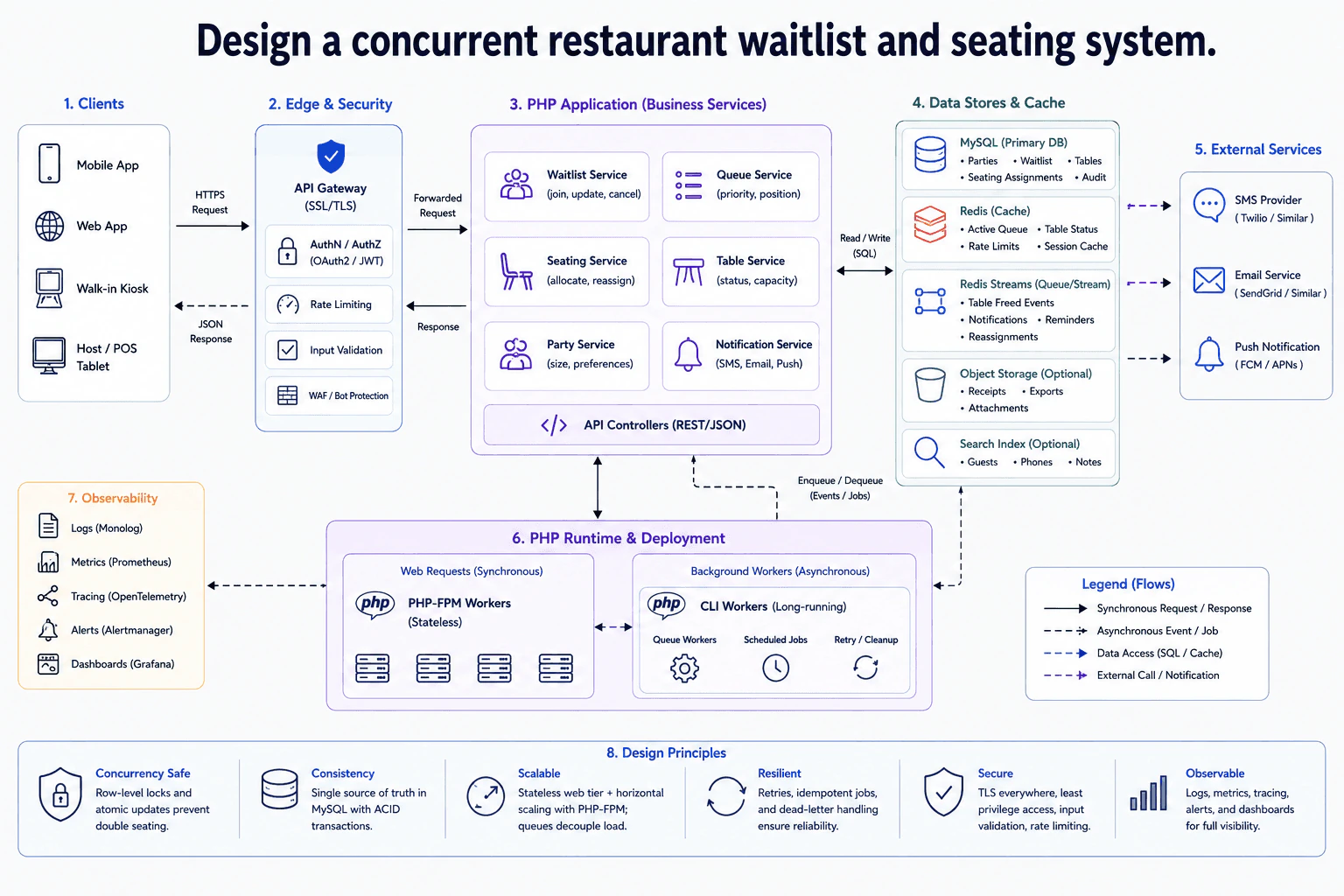
At a high level, this system helps a restaurant manage one fair waitlist and seat guests correctly when tables open. The hard part is that many guests and staff may update the same table at the same time. I would explain the design in three parts: the request path for joining or updating the line, the seating path for assigning tables, and the background path for notifications and cleanup. My main trade-off is keeping the official data correct while using Redis and workers for speed.
Detailed Explanation
The system lets guests join a line, change party details, and get seated when a table opens. The hard part is that many people may act at once, so the same table must never go to two parties. The diagram handles this by keeping the main record in MySQL, using Redis for fast state, and sending slower work to background workers. I would ask the interviewer how big each restaurant can get, whether hosts can move a party by hand, which alerts are required, and how long waitlist history must be kept.
Useful Questions to Ask the Interviewer
How many guests can be on one waitlist during a rush?
Can hosts manually move a party to another table?
Do we need SMS, email, and push, or only one channel?
How long should we keep history and receipts?
How to Explain It in an Interview
1. Explain the goal and the main idea
At a high level, the goal is simple. Keep the waitlist correct and seat the right party at the right time. The main challenge is concurrency. Many guests may join, leave, or get seated together. So the design must stop double seating and keep the official data safe. The diagram splits the system into a fast request path, a seating path, and background work.
2. Explain the join and update path
For the create path, guests use the mobile app, web app, walk-in kiosk, or host POS tablet. The request first goes through the API Gateway with SSL/TLS, auth, rate limiting, input validation, and WAF or bot protection. Then the PHP Application handles the Waitlist Service, Party Service, Queue Service, Table Service, Seating Service, Notification Service, and API Controllers for REST/JSON. The response comes back as JSON through the gateway.
3. Explain where the official data lives
The main database is MySQL. That is the source of truth. It stores parties, the waitlist, tables, seating assignments, and audit history. Redis is only a speed layer. It keeps the active queue, table status, rate limits, session cache, and idempotency keys, which help ignore the same request sent twice. On a cache hit, the service answers faster. If the cache misses, it checks MySQL and then refreshes Redis.
4. Explain seating, runtime, and background work
When a table opens, the Seating Service and Table Service allocate or reassign that table. The Queue Service keeps the party position correct. Some work should not slow the guest response, so the app also uses Redis Streams. That stream carries table-freed events, notifications, reassignments, and reminders. The runtime layer is PHP-FPM for web requests, php.ini plus OPcache on PHP 8.4 or 8.5, and Nginx in front. Long-running PHP CLI workers handle queue work and scheduled jobs. SMS, email, and push services are external, so they run outside the main request path.
5. Explain security, observability, and trade-offs
The design is secure because it uses TLS, auth, rate limits, validation, and bot protection. It is observable because it has structured logs, Prometheus metrics, OpenTelemetry tracing, Alertmanager alerts, and Grafana dashboards. Optional object storage keeps receipts, exports, and attachments. Optional search helps with guests, phones, and notes. The main trade-off is clear. MySQL keeps correctness, but Redis and workers make the system faster and more scalable. The downside is more moving parts and a little delay for background updates.
Engineering Considerations / Design Trade-offs
The benefit is that MySQL keeps the real truth, so seating stays correct. Redis makes hot state faster, so the restaurant can answer common checks quickly. Redis Streams and CLI workers move notifications and cleanup out of the main path, so guests get faster responses. PHP-FPM workers stay stateless, which makes scaling easier. The downside is more moving parts. Also, cache data and background work can be a little behind the main database, so the team must watch them carefully.
Why Interviewers Ask This
Interviewers want to see how you break a hard real-time problem into safe parts. They want to know if you can keep one source of truth, use cache the right way, and separate fast guest actions from slower background work. They also want to hear clear trade-offs, not just a list of tools. This shows judgment, calm thinking, and good system design habits.
Interviewer may ask next
What if the restaurant gets a huge dinner rush and two hosts try to seat the same party at the same time?
I would keep the same design, but I would make the seating step stricter. The change affects the Seating Service, the Table Service, and MySQL. The important part is that the final table assignment must happen in one MySQL transaction, so only one host wins the update. Redis can still show fast state, but it cannot be the final decision maker. That keeps the result correct even when two requests arrive together. The downside is that some seating requests may wait a little longer during peak rushes, because the system must protect correctness first.
What if the SMS provider is slow or down, but guests still need updates?
I would keep the main seating flow the same, and I would push the notification work fully into the background path. The change affects the Notification Service, Redis Streams, and the CLI workers. The guest should still get seated, and the app should still save the official state in MySQL right away. After that, the worker can retry the SMS later, or send email or push if those channels are available. This keeps the system correct because seating does not depend on the notification. The downside is that some guests may receive updates later than usual.
5. Design an auction platform.System DesignHardAmazon
i Question Details
Design an auction platform, focusing on database schemas, scaling, and low-latency APIs with caching.
Short Interview Answer (30-60 seconds)
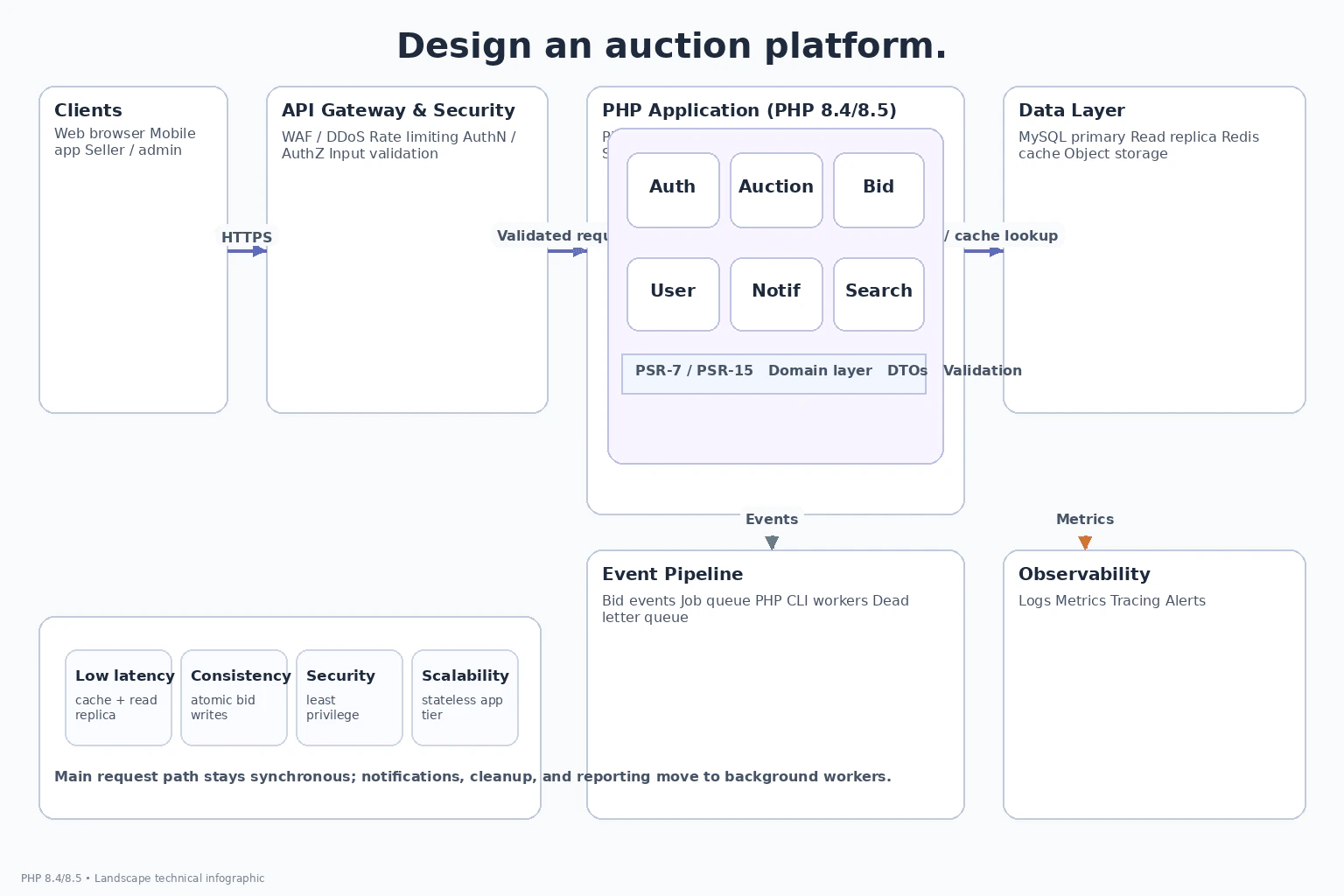
At a high level, this is an auction platform for buyers, sellers, and admins. The main challenge is to keep bid writes correct while keeping reads and lookups fast. I would explain it in three parts: the request path through the PHP app, the data path through MySQL and Redis, and the background path for events and reporting. The diagram keeps the app stateless and sends non-urgent work to PHP CLI workers. The trade-off is faster reads and easier scaling, but more moving parts behind the scenes.
Detailed Explanation
The goal is to let people create auctions, place bids, and look up auction data quickly. The hard part is simple to say: bids must stay correct, but reads must stay very fast. The diagram shows that I should keep the live request path in the PHP app and move notifications, cleanup, and reporting to background workers. It also shows a cache and a read replica to reduce pressure on the main database. I will keep the answer aligned with the attached diagram and the same flow order.
Useful Questions to Ask the Interviewer
Do auction closes need strict timing at the second level?
Do users need instant winner updates, or can some updates arrive a little later?
Should search and reports be fast, or is a small delay acceptable?
How to Explain It in an Interview
1. Explain the goal and the main idea
At a high level, this system is about fast auction reads and correct bid writes. The diagram starts with Clients, then an API Gateway & Security layer, then the PHP Application, then the Data Layer. That is the main shape of the design. The app is written for PHP 8.4/8.5, and it stays stateless so more app instances can be added. Inside the app, the main parts are Auth, Auction, Bid, User, Notif, and Search. The app also uses a domain layer, DTOs, and validation to keep the code clean.
2. Explain the create and write path
For the create path, the request first goes through the API Gateway & Security layer. That layer handles WAF, DDoS protection, rate limiting, AuthN, AuthZ, and input validation. Then the validated request goes into the PHP application. The important point is that the app handles the bid and auction logic in the main request path, so correctness comes first. The diagram also shows PSR-7 and PSR-15 at the edge, which means the HTTP request is handled in a standard PHP way before the domain logic runs.
3. Explain the read and lookup path
For reads, the app can use Redis cache first. That is the fast path. If the cache does not have the data, the app can use the MySQL primary or the read replica in the Data Layer. The diagram also shows object storage in the same layer. The key idea is that the cache is for speed, not truth. MySQL is still the source of truth for bid data. The read replica helps reduce load on the primary, but it may be a little behind.
4. Explain background work
The event path is separate from the live request path. Bid events go into the Event Pipeline. From there, PHP CLI workers process the job queue. The dead letter queue is there for jobs that keep failing. This is where notifications, cleanup, and reporting fit well. They do not need to block the main bid response. That is why the diagram says the main request path stays synchronous, while background work moves out of the user flow.
5. Explain scale, security, and trade-offs
The diagram calls out four trade-offs at the bottom. Low latency comes from cache plus the read replica. Consistency comes from atomic bid writes in the main database. Security comes from least privilege and the gateway checks. Scalability comes from the stateless app tier. The main downside is that this design has more parts to operate. But it gives faster reads and keeps the main database safer under load. That is the balance the diagram is trying to show.
Engineering Considerations / Design Trade-offs
The benefit is that the system stays fast for users. Redis and the read replica reduce work on the main database. The PHP app is stateless, so more app servers can be added when traffic grows. The downside is more moving parts. The event queue, dead letter queue, and background workers all need care. The main database still owns bid correctness, so writes must stay careful. We accept that extra complexity because it gives faster reads and a cleaner split between live requests and background jobs.
Why Interviewers Ask This
The interviewer wants to see if you can split one hard problem into clear flows. They also want to know if you can keep bid writes correct, keep reads fast, and move non-urgent work into the background. This question checks judgment. It shows whether you can explain trade-offs in simple words and still cover security, caching, and scaling.
Interviewer may ask next
How would you handle a bid that arrives at almost the same time as the auction close time?
I would keep the same basic design, but I would make the close-time check happen in the main write path before the bid is saved. The PHP app would still go through Auth, Auction, Bid, and Validation first. The important part is that the main database must decide whether the bid is still allowed. If the auction is already closed, the write should fail right away. If the bid is valid, the app saves it first and then sends any background event. That keeps correctness in one place. The downside is that a few late bids may be rejected, but that is better than showing the wrong winner.
What would you change if search and reporting became much heavier than bids?
I would keep the same architecture, but I would push more work into the Event Pipeline and keep the live request path narrow. The PHP app would still handle the bid write and the user response. After that, PHP CLI workers would process search indexing, notifications, cleanup, and reporting in the background. That protects the main database and keeps the live auction flow fast. Search could read from its own built data if needed, while reports could arrive later. The downside is that search and report views may not update right away, but the auction flow stays responsive.
6. Design a distributed rate limiter.System DesignHardAmazon
i Question Details
Design a distributed rate limiter using a token-bucket approach and explain how concurrency and atomic updates can be handled with Redis Lua scripts.
Short Interview Answer (30-60 seconds)
At a high level, this system keeps one shared request limit for many PHP workers. The hard part is making every worker agree on the same answer at the same time. I would explain it in three parts: the API Gateway checks each request, Redis stores the token bucket, and PHP-FPM serves the allowed traffic. The main trade-off is that Redis stays on the fast path, but that gives one correct limit decision and clear 429 responses with Retry-After.
Detailed Explanation
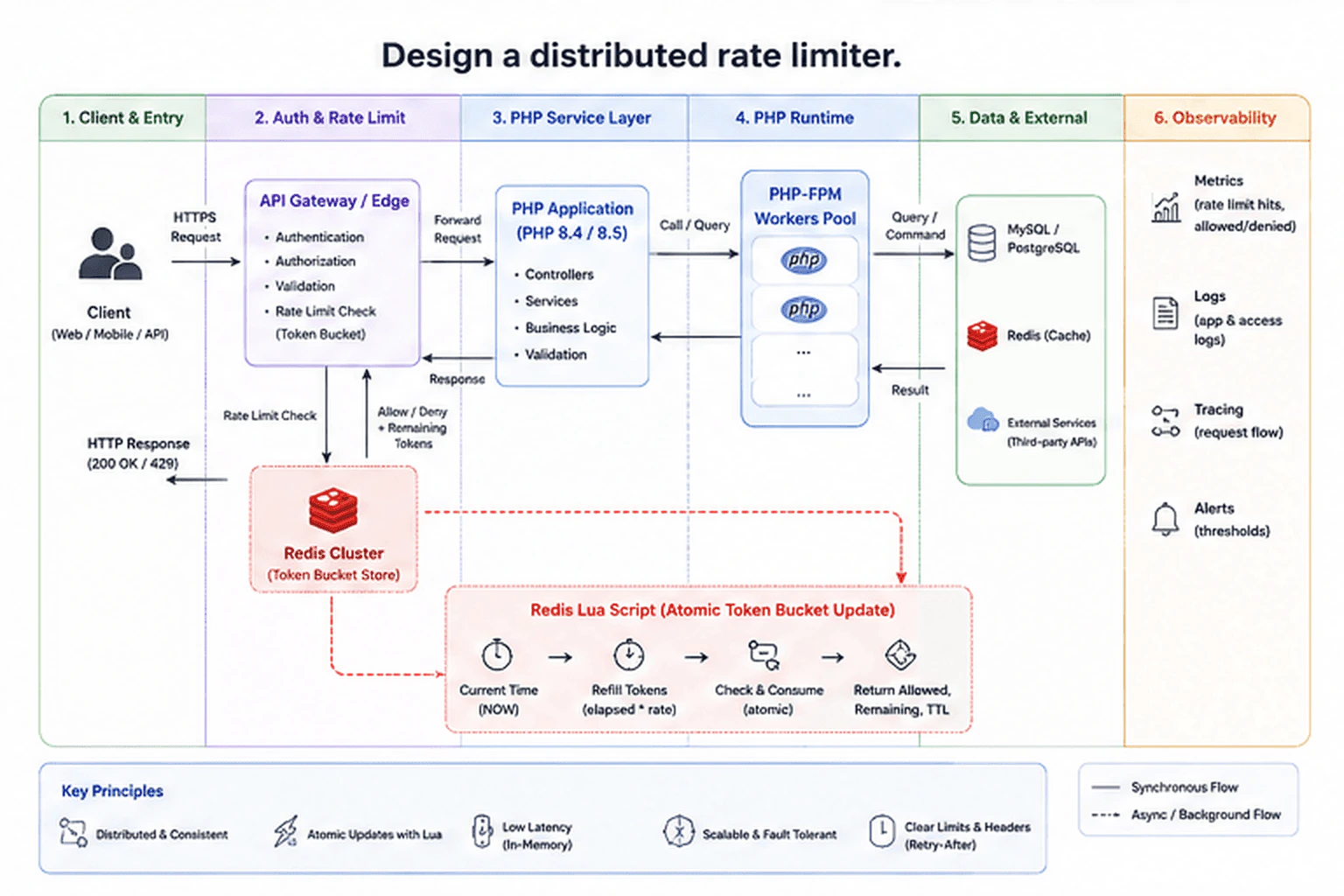
The goal is to stop a client from sending too many requests. The hard part is that many workers can answer at the same time, but they still need one shared decision. This diagram keeps that shared decision in Redis and uses a Lua script to update the token bucket in one step. I would explain the design in three parts: how the gateway checks each request, how Redis counts tokens safely, and how the PHP app still serves normal traffic and reports metrics.
Useful Questions to Ask the Interviewer
Should the limit be per user, API key, IP address, or route?
What should happen when Redis is slow or temporarily unavailable?
Do we need one shared limit or different limits for different endpoints?
How to Explain It in an Interview
1. Explain the goal and the main idea
At a high level, the system must decide quickly whether a request is allowed. The token bucket is the shared counter. Each request spends one token when it is allowed. If the bucket is empty, the gateway returns 429 Too Many Requests. The reason for this design is simple. PHP-FPM workers are separate processes, so they cannot keep one shared counter in memory.
2. Explain the first main flow
For the main request path, the client first sends an HTTPS request to the API Gateway / Edge. The gateway handles authentication, authorization, and validation. Then it performs the rate limit check before it forwards the request. If the request is allowed, the gateway sends it to the PHP Application. The PHP Application runs the business logic, and then the PHP-FPM Workers Pool handles the work inside PHP 8.4 / 8.5. The response then flows back to the gateway and back to the client.
3. Explain the Redis token bucket update
The shared state lives in the Redis Cluster, which is the token bucket store. The Lua script makes the update atomic, which means the check and the change happen as one step. The script gets the current time, refills tokens using elapsed time and the refill rate, checks whether one token can be consumed, and then returns the result. It also returns the remaining tokens and the TTL, which helps with cleanup. This is the key correctness point. Two workers can ask at the same time, but Redis still gives one shared answer.
4. Explain the PHP runtime and data path
The PHP-FPM workers pool is a runtime boundary, not a shared memory space. Each worker can handle one request, but it does not own the rate limit state. That is why Redis is the shared source for the limit decision. The wider application can still use MySQL / PostgreSQL, Redis cache, and external third-party APIs. Those systems are shown as separate dependencies, but they are not the place where the token bucket decision lives. The gateway still sits in front and keeps the fast rejection path simple.
5. Explain observability and trade-offs
The diagram also shows metrics, logs, tracing, and alerts. That matters because rate limiting is an operational feature, not just a code feature. We want to know how many requests are allowed or denied, and we want logs that show access behavior. When the gateway rejects the request, it returns 429 and a Retry-After header so the client knows when to try again. The trade-off is clear. Putting Redis on the fast path gives one consistent answer across workers, but it also makes Redis a very important dependency.
Engineering Considerations / Design Trade-offs
The benefit is that one Redis decision is shared by all PHP-FPM workers. That keeps the limit correct even when many requests hit at the same time. The Lua script is a big win because it updates the bucket in one step. The downside is that every limited request must talk to Redis, so Redis becomes part of the fast path. That adds one more network hop and makes Redis health very important. The PHP app stays simple, but the rate limiter is tied to Redis speed and availability. Metrics, logs, tracing, and alerts help us see the impact quickly.
Why Interviewers Ask This
Interviewers want to see whether you can keep a shared limit correct in a distributed system. They also want to know if you understand why PHP-FPM workers cannot keep that state in memory, and how Lua makes the Redis update atomic. They are checking if you can explain fast paths, trade-offs, and monitoring in simple words.
Interviewer may ask next
What if we need different limits for different endpoints?
I would keep the same API Gateway / Edge, PHP Application, PHP-FPM Workers Pool, and Redis Cluster. The change is that the gateway would choose a different Redis key for each endpoint or request type. The Lua script can stay the same, because it still does one atomic token bucket update. That keeps the correct behavior across all workers. The downside is more rules to manage, because each route may need its own limit, its own refill rate, and its own alerting. The team also has to document which path uses which bucket, so the limits stay easy to understand.
What if the PHP application also needs data from MySQL / PostgreSQL and Redis cache on the same request?
I would keep the same design and keep Redis in the center of the limit check. The PHP Application and PHP-FPM Workers Pool would still handle the normal request work after the gateway allows traffic. The difference is that the workers would keep using MySQL / PostgreSQL, Redis cache, and External Services for the rest of the request, while the token bucket still lives only in the Redis Cluster. That keeps the limit decision shared and correct. The downside is that the allowed path does more work, so the request takes longer after it passes the limit check. It also means we must keep metrics and alerts in place so we can see when Redis or the app path becomes slow.
7. Design a personalized autocomplete system.System DesignHardAmazon
i Question Details
Design a personalized autocomplete system that supports trending top-k suggestions, multilingual suggestions, scalability, and low latency.
Short Interview Answer (30-60 seconds)
At a high level, this is a fast autocomplete system for typed search. The main challenge is to return useful suggestions immediately while also using the user’s language, profile, and live trends. I would break the design into three parts: the request path, the ranking path, and the background update path. Redis handles the common case quickly, and the queue with workers keeps the trending data fresh. The trade-off is a little delay in updates so typing stays very fast.
Detailed Explanation
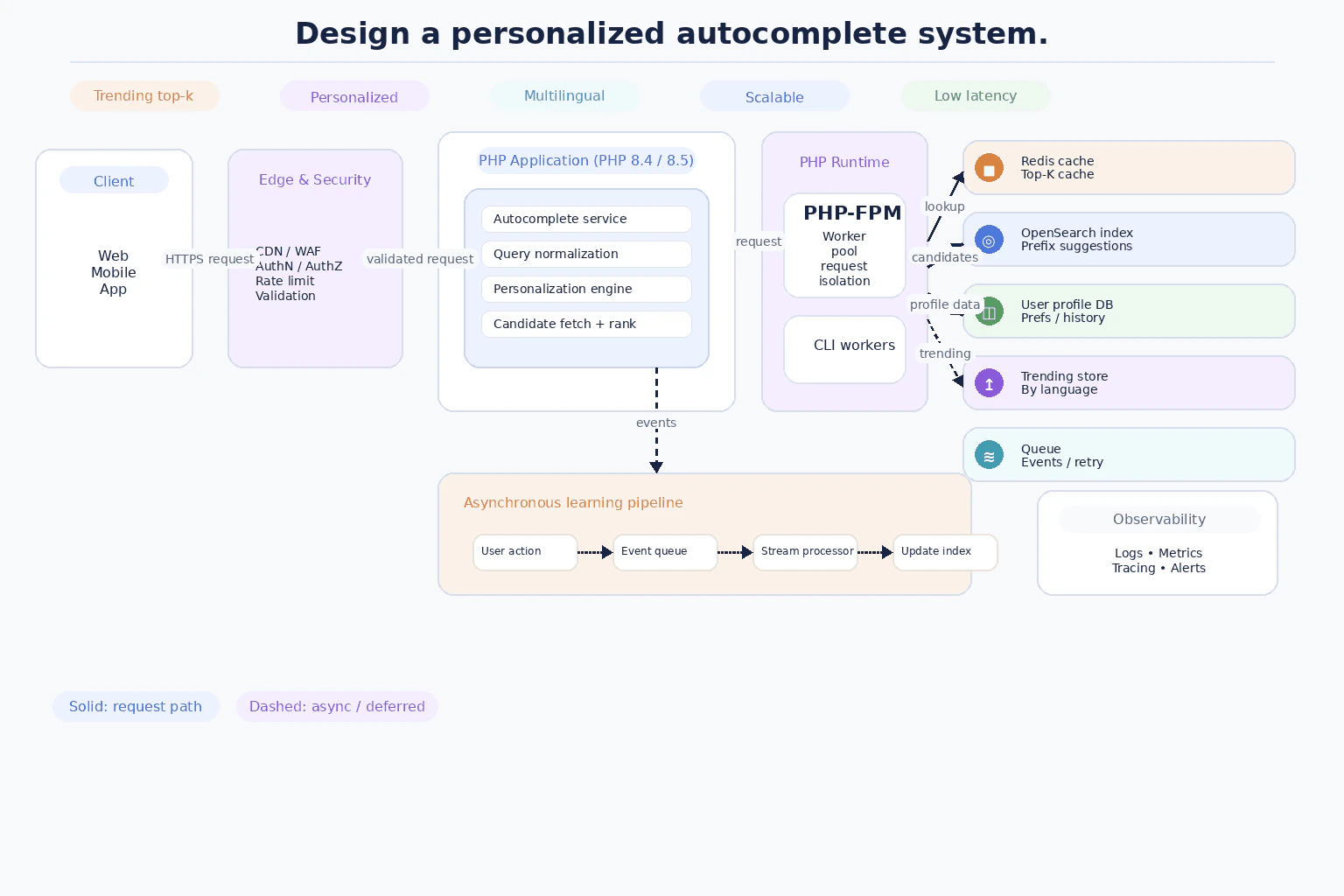
This system helps people find the right suggestion while they type. The goal is simple. Return good suggestions right away. The hard part is that the best result depends on the user, the language, and what is trending now. The diagram keeps the fast request path separate from the background learning path. One path reads data and returns suggestions. The other path records user actions, updates the index later, and keeps trends fresh. That keeps the typing experience quick even when background work takes longer.
Useful Questions to Ask the Interviewer
What freshness do we want for trending suggestions?
Should personalization use click history only, or also saved profile data?
Do we need different behavior for different languages?
How to Explain It in an Interview
1. Explain the goal and the main idea
At a high level, I would say this is a low-latency autocomplete system. The user types a few letters and expects a good suggestion almost at once. The diagram shows that we should make the request path very fast, while still using personal and trending data. It also shows that we should keep learning from user actions in the background, so typing does not slow down.
2. Explain the request path
For the main request, the client sends the query through the Edge & Security layer first. That layer handles CDN or WAF checks, auth, rate limit, and validation. Then the PHP Application layer takes over. It runs on PHP 8.4 or 8.5, and the PHP-FPM worker pool handles each request in an isolated worker process. The app normalizes the query, uses the personalization engine, and asks for likely candidates. This part must stay simple and fast because every keystroke can trigger it.
3. Explain where the suggestions come from
On the fast path, Redis is the cache for top-k suggestions. On a cache hit, the service can answer very quickly. If the cache misses, the app uses the OpenSearch index for prefix suggestions, the User profile DB for prefs and history, and the Trending store by language. Then it fetches candidates and ranks them. This makes Redis a speed layer, while the other stores provide the data used to build the final answer.
4. Explain background learning
The diagram also shows an asynchronous learning pipeline. User actions go into the Events / retry queue. A stream processor reads those events and updates the index later. The CLI workers handle this background work, including retry handling. That means the main typing path does not wait for the learning path. If updates are slow, users still get suggestions from the fast path first.
5. Explain scale, security, and trade-offs
The biggest trade-off is freshness versus speed. Redis and the search index make reads fast, but they may not always show the newest click right away. The background queue and workers add more moving parts, but they protect the user-facing path from slow update work. Retry handling helps when background work fails for a moment. Observability, with logs, metrics, tracing, and alerts, helps us see problems early. If one language gets much more traffic, the trending store by language helps keep the impact local instead of hurting every language.
Engineering Considerations / Design Trade-offs
The benefit is fast typing. Redis can answer common requests very quickly, and OpenSearch helps when the cache misses. The user profile DB and trending store make the list more personal and more useful. The downside is freshness. New clicks and new trends may appear a little later because that work happens in the background. Another downside is more moving parts. We have edge checks, PHP workers, a cache, search storage, profile storage, a trending store, a queue, and retry handling. We accept that because the main goal is low latency.
Why Interviewers Ask This
Interviewers want to see how you split a real product into a fast path and a background path. They also want to know if you choose the right source of truth, use cache correctly, and keep learning work away from the user request. This question checks whether you can balance speed, personalization, multilingual behavior, retry handling, and scaling without making the design too complex.
Interviewer may ask next
What if we need trending suggestions to update almost immediately after every click?
I would keep the same basic design, but I would make the background learning path faster. The client request would still go through the Edge & Security layer, the PHP Application, and the PHP-FPM workers in the same way. The change would be in the Events / retry queue, stream processor, and update index steps. They would run more often, so the Trending store by language gets fresher data sooner. The main benefit is that users see new trends more quickly. The correctness rule stays the same because the fast path still uses the same ranking order. The downside is more load on the queue and workers, plus a little more operational work to keep the pipeline healthy.
What if one language suddenly gets much more traffic than the others?
I would keep the same architecture, but I would pay more attention to the busiest language. The PHP Application would still normalize the query, fetch candidates, and rank them the same way. Redis would still handle the common cache hits, and OpenSearch would still help with prefix suggestions. The main change is that the Trending store and update pipeline may need more tuning for that one language so it does not slow down the others. Correctness stays the same because the same stores still feed the ranking step. The downside is that the hot language can increase storage and tuning work, even though the overall flow does not change.
8. Could you build an inventory service using NoSQL?System DesignHardAmazon
i Question Details
Discuss whether and how an inventory service could be built using NoSQL.
Short Interview Answer (30-60 seconds)
At a high level, this is an inventory service where the main stock data lives in NoSQL. The hard part is keeping stock changes correct while still serving reads quickly and doing background work safely. I would explain it in three parts: the secure entry path, the PHP inventory service with its main data store, and the async and operations paths. Redis, queue workers, and observability support the main flow, but the NoSQL database stays the source of truth. The trade-off is more moving parts for better speed and flexibility.
Detailed Explanation
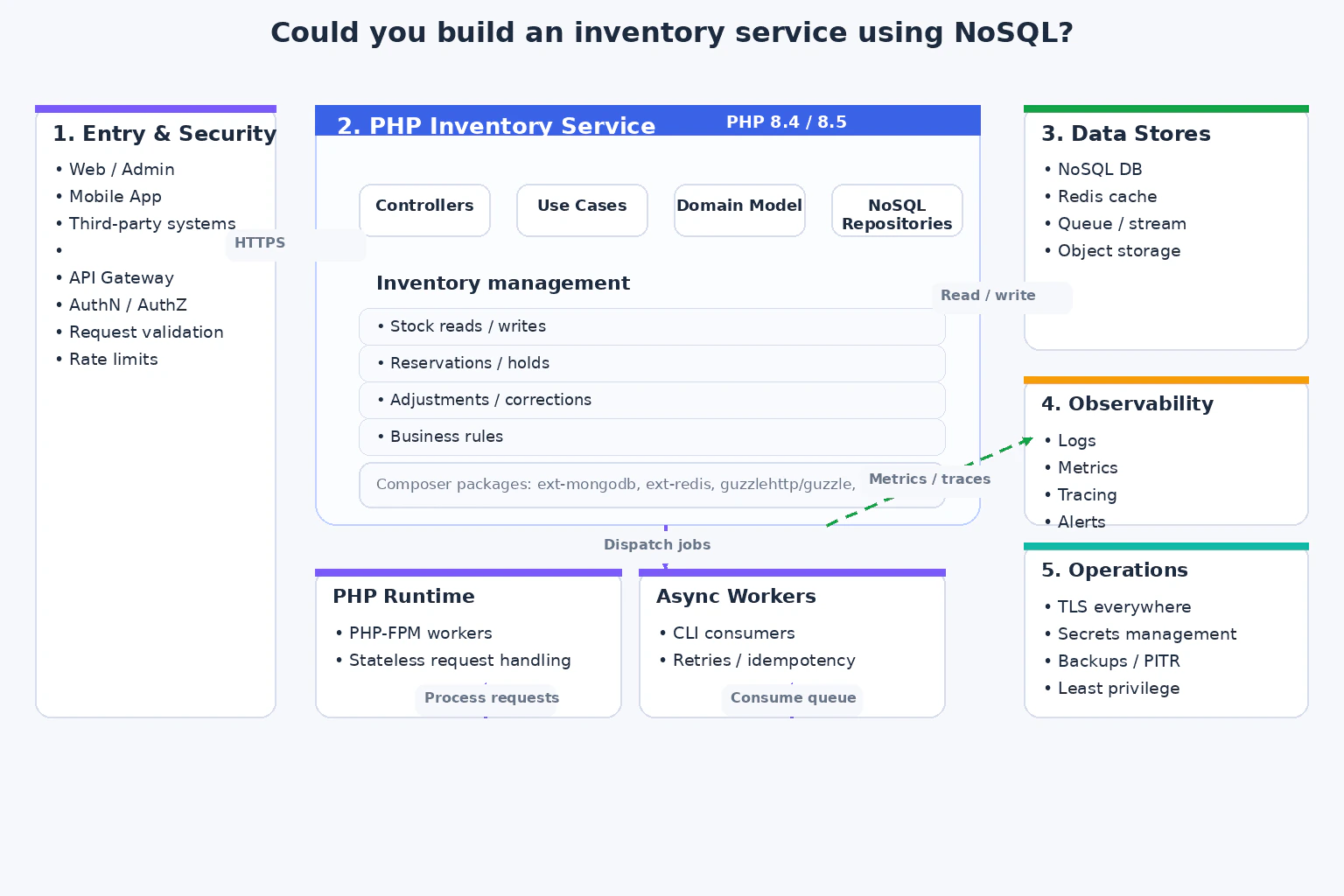
The question asks whether we can build an inventory system with a flexible database instead of a fixed table design. It must keep stock numbers correct, even when many users read, reserve, or change items at the same time. The diagram shows a secure front door, one PHP service for inventory work, a main NoSQL data store, a cache, background workers, and operations tools. I would explain it in that order, because that is how the system is used overall.
Useful Questions to Ask the Interviewer
Does inventory need strict real-time accuracy for every write?
Are reservations and holds part of the core flow?
How to Explain It in an Interview
1. Explain the goal and the main idea
At a high level, this is an inventory service, not just a data store. The main job is to keep stock changes correct. The service also needs to handle reservations, holds, and corrections. The diagram keeps inventory data in NoSQL. It uses Redis as a helper, and it sends non-urgent work to the background.
2. Explain the secure entry path and the PHP service
Requests can come from the web, mobile apps, or third-party systems. They first go through the API Gateway, then AuthN and AuthZ, request validation, and rate limits. After that, the request reaches the PHP Inventory Service. Inside that service, controllers call use cases, the domain model applies business rules, and repositories talk to NoSQL.
The diagram also shows PHP 8.4 and 8.5, PHP-FPM workers, and packages like ext-mongodb, ext-redis, guzzlehttp/guzzle, and monolog/monolog. In simple words, PHP-FPM handles live requests, while Composer adds the libraries the service needs.
3. Explain the main data path
The data store box shows NoSQL DB, Redis cache, queue / stream, and object storage. I would say the NoSQL database is the source of truth for inventory data. That is the place where stock reads, stock writes, reservations, holds, and adjustments are saved.
Redis is there to help with faster access to hot data. If Redis already has the data, the service can answer faster. If not, it goes back to NoSQL. So Redis is a helper, not the final record.
4. Explain background work and the runtime boundary
The diagram separates PHP Runtime from Async Workers. PHP-FPM workers handle the live request, and they stay stateless. CLI consumers handle queue work in the background. The service dispatches jobs, and the workers consume the queue.
This matters because not every task should slow the user request. The background path can handle retries and idempotency. Idempotency means the same request sent again should not double count stock. That is useful when a job is retried after a failure.
5. Explain observability and operations
The diagram also shows logs, metrics, tracing, and alerts. I would mention those as the tools that help the team watch the service and debug problems. The Operations box adds TLS everywhere, secrets management, backups and PITR, and least privilege. That means traffic is encrypted, secrets are protected, data can be restored, and access is limited.
The main trade-off is simple. NoSQL gives flexible data modeling and easier scaling. The downside is more moving parts. We must manage cache, queue work, backups, and access control carefully. That is the cost of keeping the system fast and practical.
Engineering Considerations / Design Trade-offs
The benefit is that the service can keep inventory data flexible and still scale well. NoSQL fits a changing inventory shape, and Redis can speed up hot reads. PHP-FPM keeps live requests separate from queue workers, so background work does not block users. The downside is more moving parts. We have to manage the NoSQL database, the cache, the queue, object storage, logs, metrics, tracing, and alerts. We also need TLS, secrets management, backups and PITR, and least privilege. That extra work is the price for speed and flexibility.
Why Interviewers Ask This
The interviewer wants to see judgment, not memorized buzzwords. They want to know if you can split one system into a secure entry path, a main inventory path, and background work. They also want to see that you understand the source of truth, the role of Redis, why PHP-FPM and CLI workers are different, and how to explain trade-offs in simple words. Clear thinking matters more than naming many tools.
Interviewer may ask next
What if stock reservations must stay correct during a traffic burst?
I would keep the same basic design, but I would make the write path stricter. The request would still enter through the API Gateway and reach the PHP Inventory Service. The service would still validate the request and apply business rules before writing to NoSQL. The important part is that the NoSQL database stays the source of truth for stock changes.
Redis can still help with faster reads, but it should not decide the final stock value. The background workers can still handle follow-up jobs after the main write is saved. I would also rely on retries and idempotency so the same request does not count twice. That keeps the live request focused on correctness first. The downside is that very hot items may move a little slower, because the service must protect the stock count before it optimizes speed.
What if the queue or async workers fall behind?
I would keep the same architecture, because the live request path is still the most important part. The PHP-FPM workers would keep handling the user request, and the PHP Inventory Service would still write the main inventory change to NoSQL first. The queue / stream is only for background work, so a delay there should not block the response.
The CLI consumers can catch up later when the queue becomes healthy again. Observability matters here, because logs, metrics, tracing, and alerts should show the backlog quickly. That lets the team know the background path is late. If needed, object storage can still hold files or exports while the workers recover. The downside is that non-urgent work, such as follow-up processing or file handling, can appear later than usual. The system still works, but the background side becomes slower until the workers recover.
9. What is the most challenging project you have worked on?BehavioralMediumAmazon
i Question Details
Describe the most challenging project you have worked on.
Interview tip:
Use STAR to structure your answer: briefly explain the Situation and Task, make Action the most detailed part, and finish with the Result. For example, describe a realistic project where you protected the most important user need, reduced risk by breaking the work into safer steps, communicated tradeoffs early, and still delivered a reliable result.
Situation
In my last role, the most challenging project I worked on was a legacy PHP application that needed a major change in the order flow. The old code had grown over time, and several parts of the process were tightly connected. A small change in one place could break something else.
Task
My responsibility was to help deliver the change without disrupting live users. We needed to keep the existing flow stable while updating the business logic and making the code easier to support. The main challenge was to balance speed, safety, and clear communication with the team.
Action
I first mapped the full request flow so I could see every place the change would touch. Then I split the work into smaller steps instead of trying to change everything at once. I added a safe path for the new logic, kept the old path available during testing, and wrote focused tests around the most important cases. I also added better logging so we could see where a request failed and why. When I found parts of the code that were too risky to change directly, I pushed for a smaller scope and explained the impact early to my manager and teammates. That helped us avoid hidden problems later. I worked closely with QA, checked edge cases by hand, and made sure we had a rollback plan before release.
Result
The project shipped without breaking the main user flow, and the team felt more confident because the release was controlled instead of rushed. The code was easier to understand after the change, and the logging helped us support the feature faster after launch. I learned that on a difficult project, the best result often comes from protecting the critical path, reducing risk step by step, and communicating clearly before problems grow.
Why Interviewers Ask This
Interviewers ask this to see how you handle pressure, complexity, and uncertainty. A strong answer shows ownership, judgment, communication, and the ability to protect important business goals while still moving the work forward.
Interviewer may ask next
What made that project so difficult?
It was difficult because the code was old, several parts were connected, and the change affected a user flow that could not fail. That meant I had to think about risk, testing, and rollback before writing the final code.
What would you do differently now?
I would push for earlier isolation of the risky parts and stronger automated tests before the main implementation starts. I would also involve QA and product earlier so we can confirm edge cases sooner and avoid late changes.
10. Tell me something that is not in your resume.BehavioralEasyAmazon
i Question Details
Tell me something about yourself that is not included in your resume.
Interview tip:
Use STAR to structure your answer: briefly explain the Situation and Task, make Action the most detailed part, and finish with the Result. For example, describe a real habit, side project, or leadership moment that is not on your resume and show what it reveals about how you work.
Situation
In my last role, one thing people did not see on my resume was that I spent time helping newer developers outside of work. I joined a small study group where people were learning PHP and basic debugging, and many of them felt stuck when code failed without clear errors.
Task
My goal was to help them understand problems faster and explain my thinking in simple words. I also wanted to improve my own communication, because in real projects I often need to help teammates who are not close to the code every day.
Action
I started by listening to the exact problem before giving advice. I would ask them to show the request, the error message, and the last change they made, then I would walk them through the flow step by step. I also showed them how I read logs, check input data, and add small tests so they could learn a repeatable method instead of guessing. Over time I made my explanations shorter and more practical, because I saw that people learned faster when I used plain words and one example at a time.
Result
The group became more confident, and I became much better at explaining technical issues without jargon. That habit also helped me at work, because I now communicate problems and tradeoffs more clearly and I stay calm when something is not obvious at first.
Why Interviewers Ask This
Interviewers ask this to see who you are beyond the resume and to learn how you communicate, what you value, and how you contribute when the work is not directly listed on your experience.
Interviewer may ask next
How does that outside work habit help you on a project?
It helps me slow down, listen first, and explain issues in a clear way. When I work on a project now, I am better at helping teammates understand the problem, the cause, and the next step without making it feel harder than it is.
What did you learn about yourself from it?
I learned that I enjoy helping people understand technical work, and I am patient when I have to explain the same idea in a different way. It also showed me that clear communication is a real skill, not just a nice extra, because it saves time and builds trust.
More questions load as you scroll
Php Developer Resume Examples
Explore the resume examples below to find the one that best matches your target Php Developer role.
Disclaimer: This interview guide is for educational and informational purposes only. It is designed to help readers prepare, but it does not guarantee any interview result, hiring decision, offer, or outcome. Interview questions, hiring criteria, and preferred answers can vary by employer, interviewer, industry, location, and time. All answers, examples, and explanations in this guide are suggested examples for interview preparation, not definitive answers or instructions for professional practice. They are based on research and judgment, are provided without warranties of any kind, and should be adapted to the question, role, and applicable laws and professional requirements. Diagrams are simplified illustrations intended to highlight the main concepts and their relationships; actual situations, systems, and practices may be more complex. Alternative approaches may be equally valid or better suited to a particular question, context, or interviewer. To the fullest extent permitted by applicable law, the contributors and publisher are not liable for decisions made, actions taken, or losses incurred based on this guide.
State Laws and Professional Responsibilities: Laws and requirements governing an occupation vary by state and jurisdiction. You are responsible for checking the current laws, licensing requirements, and scope-of-practice rules that apply to your location and role, and for ensuring that your answers and actions comply with them. Adapt examples in this guide to those requirements. This guide is not legal advice.
Company Notice: This guide is an independent educational resource and is not affiliated with, endorsed by, sponsored by, or approved by the company named in this guide. Company names identify reported interview experiences or the employer context of clearly labeled original practice exercises. Interview practices can change without notice, and inclusion of company-specific content does not mean these questions are official, complete, or guaranteed to be asked. To the fullest extent permitted by law, the author, contributors, and publisher are not responsible for outcomes related to use of this material.
Content Accuracy and Verification: To the fullest extent permitted by applicable law, we do not represent or warrant that interview guides, questions, answers, examples, or diagrams are accurate, complete, current, error-free, or suitable for any particular purpose. You are responsible for independently reviewing and verifying the information before relying on it.