18 NVIDIA Php Developer Interview Questions & Answers

nvidia icon

Questions with Detailed ExplanationsWith Detailed Explanations

(Last Updated: August 28, 2026)

1. Detect whether a linked list contains a cycle.CodingEasyNvidia

Question Details

Given a linked list, determine whether it contains a cycle.

Short Interview Answer (30-60 seconds)

I use Floyd’s cycle detection. I keep two pointers on the linked list. The slow pointer moves one node at a time, and the fast pointer moves two nodes at a time. If the list has a cycle, the fast pointer will eventually meet the slow pointer inside the loop. If the fast pointer reaches null, there is no cycle. I stop as soon as they meet or the end is reached. This runs in O(n) time and O(1) extra space.

Detailed Explanation

See the Code while reading this explanation.

This question asks whether a linked list ever loops back to an earlier node. In the diagram, the list is 1 -> 2 -> 3 -> 4 -> 5, and node 5 points back to node 3. That means the answer is true. I use two pointers. One moves one step. The other moves two steps. If they meet, the list has a cycle. If the fast pointer reaches the end, the list has no cycle. This is a good fit because it checks the list without extra storage.

Useful Questions to Ask the Interviewer
  1. Should I return only true or false, or also the node where the cycle starts?
  2. Can I keep the list unchanged and use constant extra space?
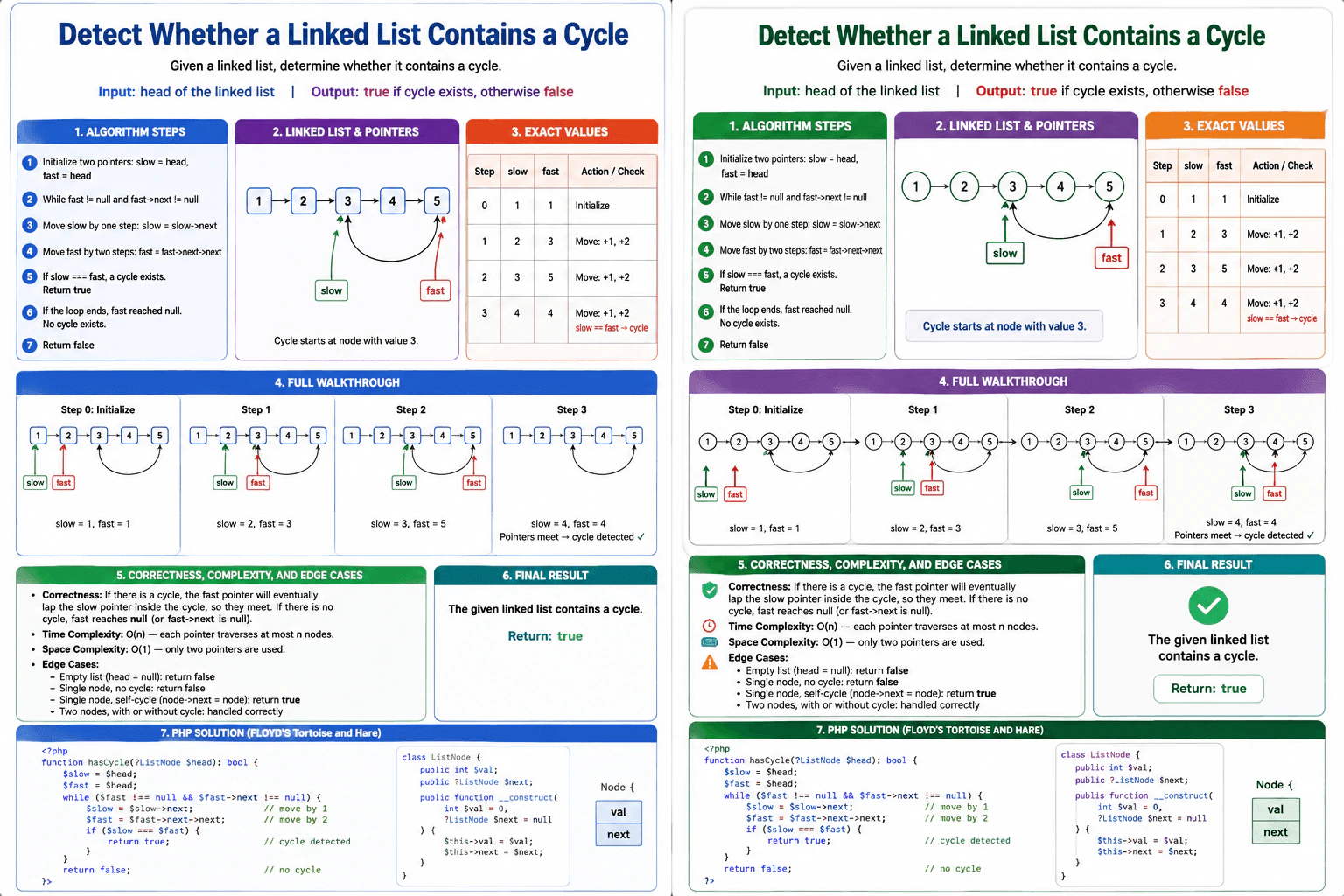
Detect whether a linked list contains a cycle. diagram
How to Explain It in an Interview
1. Understand the input and required output

The input is one linked list head. The output is a boolean. The diagram uses one example list: 1 -> 2 -> 3 -> 4 -> 5, with 5 linking back to 3. The expected result is true because the list contains a cycle.

2. Choose the algorithm and data structure

I use two pointers, slow and fast. slow moves by one node. fast moves by two nodes. The key invariant is that if a cycle exists, fast will eventually lap slow and they will meet inside the loop. This is better than saving visited nodes because it uses constant extra space.

3. Initialize the state

Both slow and fast start at head. That matches step 0 in the diagram. The loop continues only while fast and fast->next are not null. This keeps the code safe when the list has no cycle.

4. Walk through the example

Step 1: slow goes to 2 and fast goes to 3. Step 2: slow goes to 3 and fast goes to 5. Step 3: slow goes to 4 and fast goes to 4. They meet, so the code returns true right away. We do not process any later step.

5. Explain why the result is correct

If there is no cycle, fast eventually reaches null. If there is a cycle, fast keeps moving around the loop and eventually catches slow. That is why meeting means the list contains a cycle.

6. Explain the PHP implementation

The function takes ?ListNode $head. It sets both pointers to head. Inside the loop, slow moves one step and fast moves two steps. If slow === fast, it returns true immediately. If the loop ends, it returns false. The code compares node references, not node values.

7. Explain complexity and edge cases

Time is O(n). Extra space is O(1). Important edge cases are an empty list, one node with no cycle, one node that points to itself, and two nodes with or without a cycle.

Key Insight / Why This Solution Works

The central invariant is simple. slow moves one step and fast moves two steps over the same next pointers. If there is a cycle, fast will lap slow and they will meet. If there is no cycle, fast reaches null first. This is why we do not need a visited set. The diagram’s example shows the meet at the node with value 4 after the cycle at node 3 is entered.

Code
<?php
declare(strict_types=1);

class ListNode
{
    public int $val;
    public ?ListNode $next;

    public function __construct(int $val = 0, ?ListNode $next = null)
    {
        $this->val = $val;
        $this->next = $next;
    }
}

/**
 * Detect whether a linked list contains a cycle.
 */
function hasCycle(?ListNode $head): bool
{
    // Start both pointers at the head node.
    $slow = $head;
    $fast = $head;

    // Move until the fast pointer reaches the end or the two pointers meet.
    while ($fast !== null && $fast->next !== null) {
        // slow moves one step.
        $slow = $slow->next;

        // fast moves two steps.
        $fast = $fast->next->next;

        // If both pointers point to the same node, a cycle exists.
        if ($slow === $fast) {
            return true;
        }
    }

    // No cycle was found.
    return false;
}

// Demo example from the diagram:
// 1 -> 2 -> 3 -> 4 -> 5
//                ^    |
//                |____|
$node1 = new ListNode(1);
$node2 = new ListNode(2);
$node3 = new ListNode(3);
$node4 = new ListNode(4);
$node5 = new ListNode(5);

$node1->next = $node2;
$node2->next = $node3;
$node3->next = $node4;
$node4->next = $node5;
$node5->next = $node3;

var_dump(hasCycle($node1)); // bool(true)
Time & Space Complexity

The list is processed with two pointers. Each loop step does constant work. The loop stops when the fast pointer reaches the end or when slow and fast meet. So the time is O(n). We only store two pointers, so the extra space is O(1).

Where it is used

This pattern is useful whenever a next-pointer chain could loop back to an earlier node. Common examples are linked list interview problems and any pointer chain where a cycle would cause an endless loop.

Why Interviewers Ask This

The interviewer wants to see whether I can recognize Floyd’s cycle detection, use node references correctly, and explain why two speeds prove the cycle. They also want to check safe PHP null handling, early return, constant extra space, and whether I can keep node identity separate from node value.

Common interview mistakes

A common mistake is comparing node values instead of node identity. Another is skipping the null check before moving fast two steps. Another is moving the wrong pointer by the wrong amount. Another is forgetting to return as soon as the pointers meet. Some candidates also add extra storage even though this problem can be solved with two pointers only.

Interview tip

Say the invariant out loud: slow moves one step, fast moves two, and meeting means there is a cycle.
Interviewer may ask next
How would you find the node where the cycle starts?

After slow and fast meet, move one pointer back to head. Then move both pointers one step at a time. The node where they meet again is the start of the cycle. The time is O(n) and the space is O(1).

Can you also find the cycle length?

Yes. After the first meeting, keep one pointer fixed and move the other pointer around the cycle until it comes back to the same node. Count those steps. That gives the cycle length in O(n) time and O(1) space.

2. Round a size up to the next required power-of-two alignment.CodingEasyNvidia

Question Details

Write an operation that accepts size and alignment and returns the next size aligned to alignment. Assume alignment is a power of two; for example, aligning 10 to 8 returns 16.

Short Interview Answer (30-60 seconds)

I would round the size up to the next allowed boundary. I first check that the alignment is a positive power of two, then I compute size % alignment. If the remainder is zero, I return the size right away. Otherwise, I add the missing amount to reach the next multiple. That matches the diagram exactly and runs in O(1) time with O(1) extra space for one input pair.

Detailed Explanation

See the Code while reading this explanation.

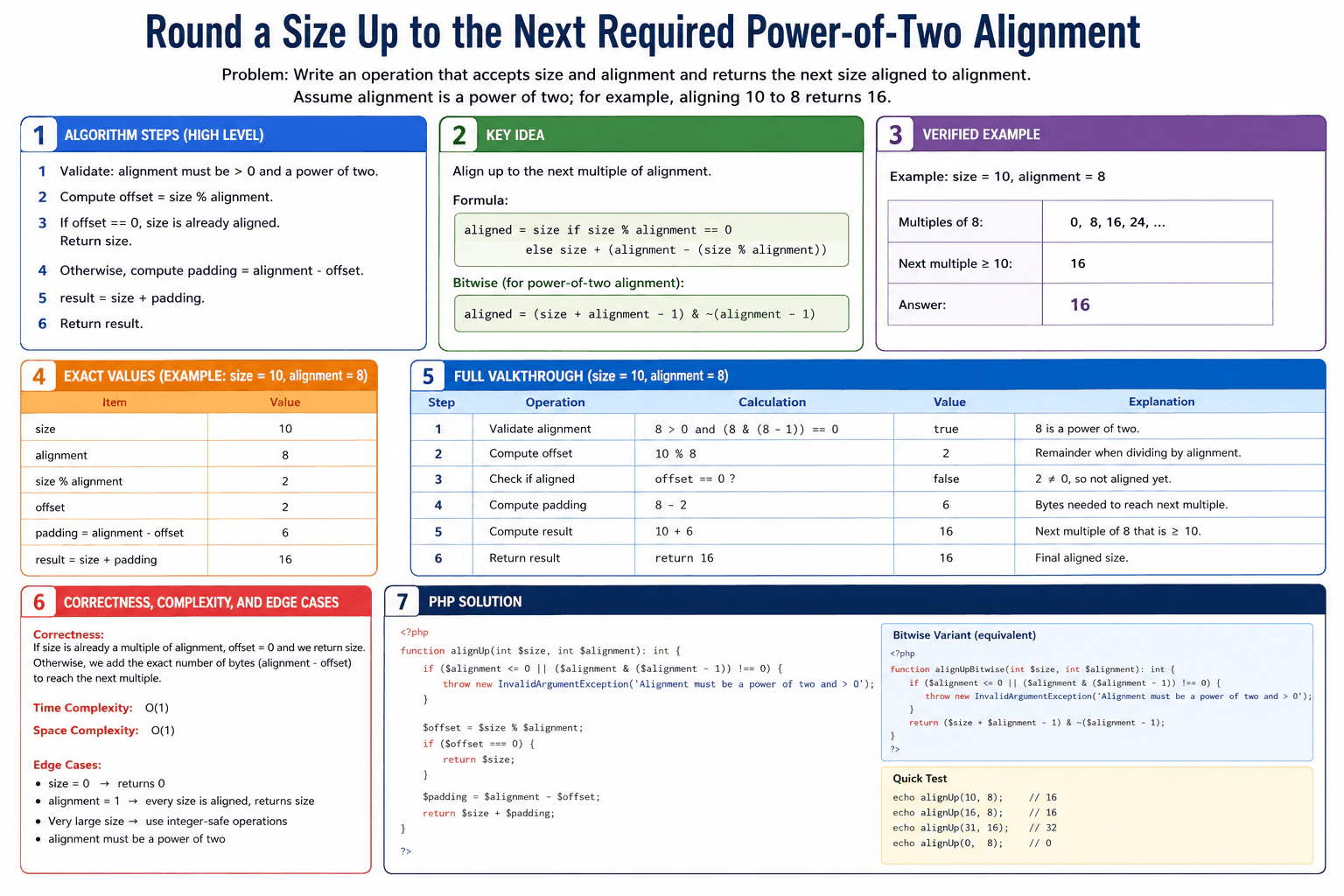
This problem asks us to move a size up to the next allowed boundary. Think of a mark on a ruler. If the size already lands on a mark, we keep it. If not, we add just enough to reach the next mark. In the diagram, 10 with alignment 8 becomes 16. The selected method is simple and fast. It checks the current position, then either returns it or adds the missing amount. This fits the problem because we only need the next valid size, not all possible sizes.

Useful Questions to Ask the Interviewer
  1. Is the alignment always a power of two?
  2. Can size be zero or very large?
  3. Do you want only the aligned size, or also the padding?
Round a size up to the next required power-of-two alignment. diagram
How to Explain It in an Interview
1. Understand the input and output

The input is a size and an alignment. The output is the next size that is aligned. In the example, 10 with alignment 8 becomes 16.

2. Choose the algorithm and state

I use the remainder from size % alignment. The key idea is that the answer is always the smallest multiple of alignment that is greater than or equal to size.

3. Initialize the state

I first check that alignment is valid. It must be greater than 0 and a power of two. Then I compute the remainder, which the diagram calls offset.

4. Walk through the example

For size = 10 and alignment = 8, the remainder is 2. That means 10 is not aligned yet. I then compute padding = 8 - 2 = 6. After that, I add the padding to get 16.

5. Explain why the result is correct

If the remainder is 0, the size is already on a boundary, so I return it. If not, adding alignment - remainder moves the size to the next boundary and nothing larger.

6. Explain the PHP implementation

The PHP code does the same steps as the diagram. It validates the alignment, gets the remainder, returns early if the size is already aligned, and otherwise adds the padding. The diagram also shows an equivalent bitwise version for power-of-two alignment.

7. Explain complexity and edge cases

The work is constant for one input pair, so the time is O(1). The extra memory is also O(1). Important edge cases are size = 0, alignment = 1, very large sizes, and invalid alignment values.

Key Insight / Why This Solution Works

The central invariant is: the result is always the smallest multiple of alignment that is greater than or equal to size. I first validate that alignment is a positive power of two. Then I use the remainder to see whether size is already aligned. If the remainder is zero, I return size. Otherwise, I add exactly the missing amount to reach the next multiple. The bitwise formula in the diagram is equivalent for power-of-two alignment, but the modulo version is easier to explain.

Code
<?php

function alignUp(int $size, int $alignment): int
{
    // Validate the alignment first.
    // It must be a positive power of two.
    if ($alignment <= 0 || ($alignment & ($alignment - 1)) !== 0) {
        throw new InvalidArgumentException('Alignment must be a power of two and > 0');
    }

    // Find how far size is from the current alignment boundary.
    $offset = $size % $alignment;

    // If there is no remainder, the size is already aligned.
    if ($offset === 0) {
        return $size;
    }

    // Add only the bytes needed to reach the next multiple.
    $padding = $alignment - $offset;

    return $size + $padding;
}

// Equivalent power-of-two version shown in the diagram.
function alignUpBitwise(int $size, int $alignment): int
{
    if ($alignment <= 0 || ($alignment & ($alignment - 1)) !== 0) {
        throw new InvalidArgumentException('Alignment must be a power of two and > 0');
    }

    return ($size + $alignment - 1) & ~($alignment - 1);
}

// Example runs from the diagram.
echo alignUp(10, 8) . PHP_EOL;  // 16
echo alignUp(16, 8) . PHP_EOL;  // 16
echo alignUp(31, 16) . PHP_EOL; // 32
echo alignUp(0, 8) . PHP_EOL;   // 0
Time & Space Complexity

The work does not grow with the input size. I do a few arithmetic checks and one remainder calculation, so the time is O(1). I also use only a few variables, so the extra space is O(1). The diagram shows a constant-time solution, and that is why this fits simple alignment problems well.

Where it is used

This pattern is useful when software must round values to storage or memory boundaries. I would use it in allocators, buffer sizing, page alignment, graphics code, and low-level systems work where data must fit a fixed boundary.

Why Interviewers Ask This

The interviewer is checking whether I can reason about boundaries and alignment. They also want to see if I validate the input, use the remainder correctly, and explain why the answer is the next multiple. This question also tests whether I can write clean PHP, handle the power-of-two rule, and give the exact complexity without overclaiming.

Common interview mistakes

A common mistake is to return the padding instead of the aligned size. Another mistake is to forget the early return when the remainder is zero. Some candidates also forget that alignment must be a positive power of two. A fourth mistake is to use the bitwise formula without explaining why it only works for power-of-two alignment. A fifth mistake is to compute the next multiple in a way that can round down instead of up.

Interview tip

Say the invariant first: I return the smallest multiple of alignment that is at least size. Then walk through the remainder and the padding on the example 10 and 8.

Interviewer may ask next
What changes if the alignment is not guaranteed to be a power of two?

I would keep the modulo-based version and remove the bitwise shortcut. The core rule is still to return the smallest multiple of alignment that is at least size. I would still validate that alignment is greater than 0. The time and space complexity stay O(1). The tradeoff is that the bitwise formula is no longer safe.

What changes if you also want to return the padding value?

I would return both values, such as the aligned size and the padding. The main logic does not change. I still compute the remainder first, return the original size when the remainder is zero, and otherwise add the missing amount. The time and space complexity stay O(1).

3. Serialize and deserialize a list of strings.CodingMediumNvidia

Question Details

Write functions that serialize a list of strings and deserialize the representation back into the original list.

Short Interview Answer (30-60 seconds)

I would serialize each string as its length, then a colon, then the string itself, and then a pipe as the item separator. To deserialize, I move left to right, read the length first, copy exactly that many characters, and skip the pipe. This works even with empty strings and special symbols because the length tells me where each item ends. The PHP solution runs in O(total characters) time and O(total characters) auxiliary space.

Detailed Explanation

See the Code while reading this explanation.

This problem asks for a safe way to pack a list of strings into one string and then unpack it back into the same list. We must keep the same order and the exact same values, even when a string is empty or contains a pipe. The length prefix makes that possible because it tells the decoder exactly how many characters to read for each item.

Useful Questions to Ask the Interviewer
  1. Should the returned list keep the same order as the input?
  2. Can the input contain empty strings or special characters like a pipe or colon?
  3. Do you want Unicode text to be handled exactly as shown in the example?
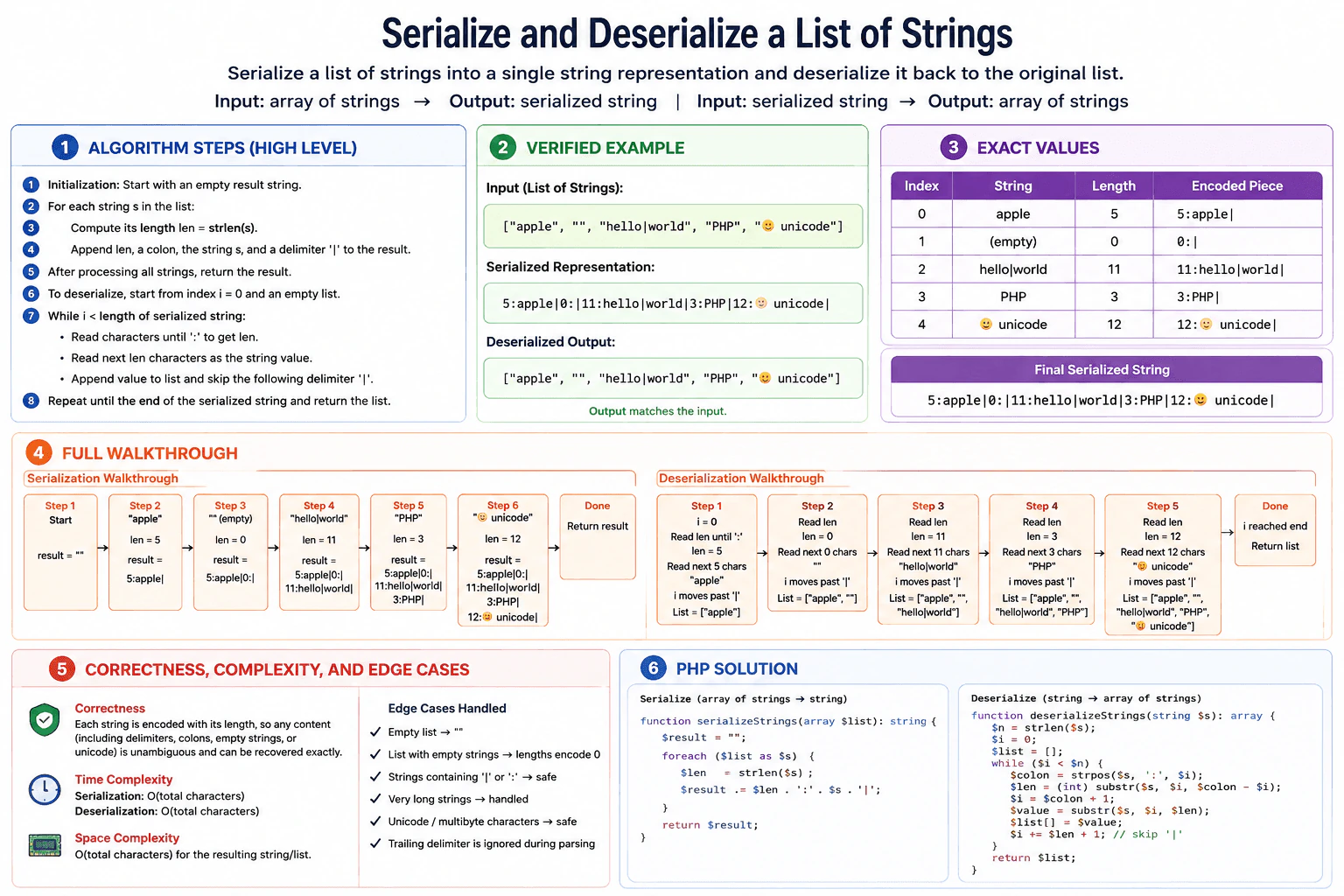
Serialize and deserialize a list of strings. diagram
How to Explain It in an Interview
1. Understand the input and required output

The input is a list of strings. The output for serialization is one string. The output for deserialization is the original list again. We must keep the same order and the exact same string values.

2. Choose the algorithm and data structure

I use a length-prefixed format. Each item is stored as length:number of characters, then a colon, then the string itself, and then a pipe as the separator. The key idea is that the length tells the decoder exactly how many characters belong to the current item.

3. Initialize the state

For serialization, I start with an empty result string. For deserialization, I start with index 0 and an empty list. The index always points to the next unread part of the serialized string.

4. Walk through the example

The diagram uses the list ['apple', '', 'hello|world', 'PHP', '😊 unicode']. The serializer writes 5:apple|, then 0:|, then 11:hello|world|, then 3:PHP|, then 12:😊 unicode|. This gives one long string. The decoder reads 5, then takes apple, then moves past the pipe. It repeats the same steps for the empty string, for hello|world, for PHP, and for 😊 unicode.

5. Explain why the result is correct

The invariant is simple. Every encoded item starts with its own length. That means the decoder does not need to guess where the string ends. It reads the length, copies exactly that many characters, and then moves to the next item. This is why pipes inside the content do not break the format.

6. Explain the PHP implementation

The serializer loops through the input list one string at a time. It uses strlen($s) to get the length, then appends length, a colon, the string, and a pipe. The deserializer keeps an index $i. It finds the next colon with strpos, reads the number before the colon, reads that many characters for the value, stores the value, and then moves the index past the item and the pipe. The code matches the diagram step by step.

7. Explain complexity and edge cases

The time is O(total characters) for both directions. We read each item a small number of times. The extra space is also O(total characters) because we build the result string or the output list. The important edge cases are an empty list, empty strings, strings that contain | or :, very long strings, and Unicode text.

Key Insight / Why This Solution Works

The main idea is to make each item self-describing. The length before the string tells the decoder exactly how many characters belong to that item. The pipe is only a separator between items. Because of that, the content can contain special characters and the decoder still knows where one item ends and the next item begins. The central invariant is that everything before the current index has already been decoded correctly, and the current index always points to the next unread item.

Code
<?php
function serializeStrings(array $list): string
{
    // Start with an empty encoded string.
    $result = '';

    // Process each string in order.
    foreach ($list as $s) {
        // Get the length of the current string.
        $len = strlen($s);

        // Write: length + colon + original string + pipe separator.
        $result .= $len . ':' . $s . '|';
    }

    return $result;
}

function deserializeStrings(string $s): array
{
    // Total number of bytes in the encoded string.
    $n = strlen($s);

    // Current read position in the encoded string.
    $i = 0;

    // This will hold the decoded list of strings.
    $list = [];

    // Read item by item until we reach the end.
    while ($i < $n) {
        // Find the colon that ends the length field.
        $colon = strpos($s, ':', $i);

        // Read the length that appears before the colon.
        $len = (int) substr($s, $i, $colon - $i);

        // Move to the start of the string content.
        $i = $colon + 1;

        // Read exactly $len characters for this string.
        $value = substr($s, $i, $len);

        // Store the decoded string.
        $list[] = $value;

        // Skip over the string and the trailing pipe separator.
        $i += $len + 1; // skip '|'
    }

    return $list;
}

// Example run that matches the diagram.
$input = ["apple", "", "hello|world", "PHP", "😊 unicode"];
$serialized = serializeStrings($input);
$decoded = deserializeStrings($serialized);

echo "Serialized: " . $serialized . PHP_EOL;
echo "Decoded: " . json_encode($decoded, JSON_UNESCAPED_UNICODE) . PHP_EOL;
Time & Space Complexity

The work is proportional to the total size of the input strings. Serialization reads each string once and writes its length, the colon, the string, and the pipe. Deserialization moves from left to right, reads one length, copies exactly that many characters, and then jumps to the next item. So the time is O(total characters). The extra memory is O(total characters) because we build the serialized string or the final list.

Where it is used

This pattern is useful when you need to store or send a list of strings in one field. It works well in cache values, simple file formats, database text columns, message payloads, and logs because the length prefix keeps the data safe even when the text contains separator symbols.

Why Interviewers Ask This

The interviewer is checking whether you can design a reversible format, keep the parsing state correct, and explain why special characters do not break the data. They also want to see that you preserve order, handle empty strings, and write the PHP code with the same logic you described. This question is also a good test of how clearly you explain complexity and edge cases.

Common interview mistakes

A common mistake is to split the encoded text only by the pipe and ignore the length. That breaks as soon as a string contains a pipe. Another mistake is to read the wrong number of characters after the colon. That shifts every later item. A third mistake is to forget to move the index past the pipe after each decoded item. Another one is to use a different length rule when encoding and decoding.

Interview tip

Say the invariant out loud: each item tells the decoder its own length, so the parser never has to guess where the string ends.

Interviewer may ask next
How would you handle streaming input if the full serialized string is not available at once?

I would keep a buffer and parse only when I have the colon, the length, and enough data for the current item. The same length-prefix idea still works. The tradeoff is a little more state in the parser, but the format stays correct.

What changes if the strings may contain binary data or null bytes?

The same length-prefix format still works if I treat the data as raw bytes. I would keep using byte-safe operations so the stored length matches the bytes I read back. The tradeoff is that the parser must stay byte-based instead of character-based.

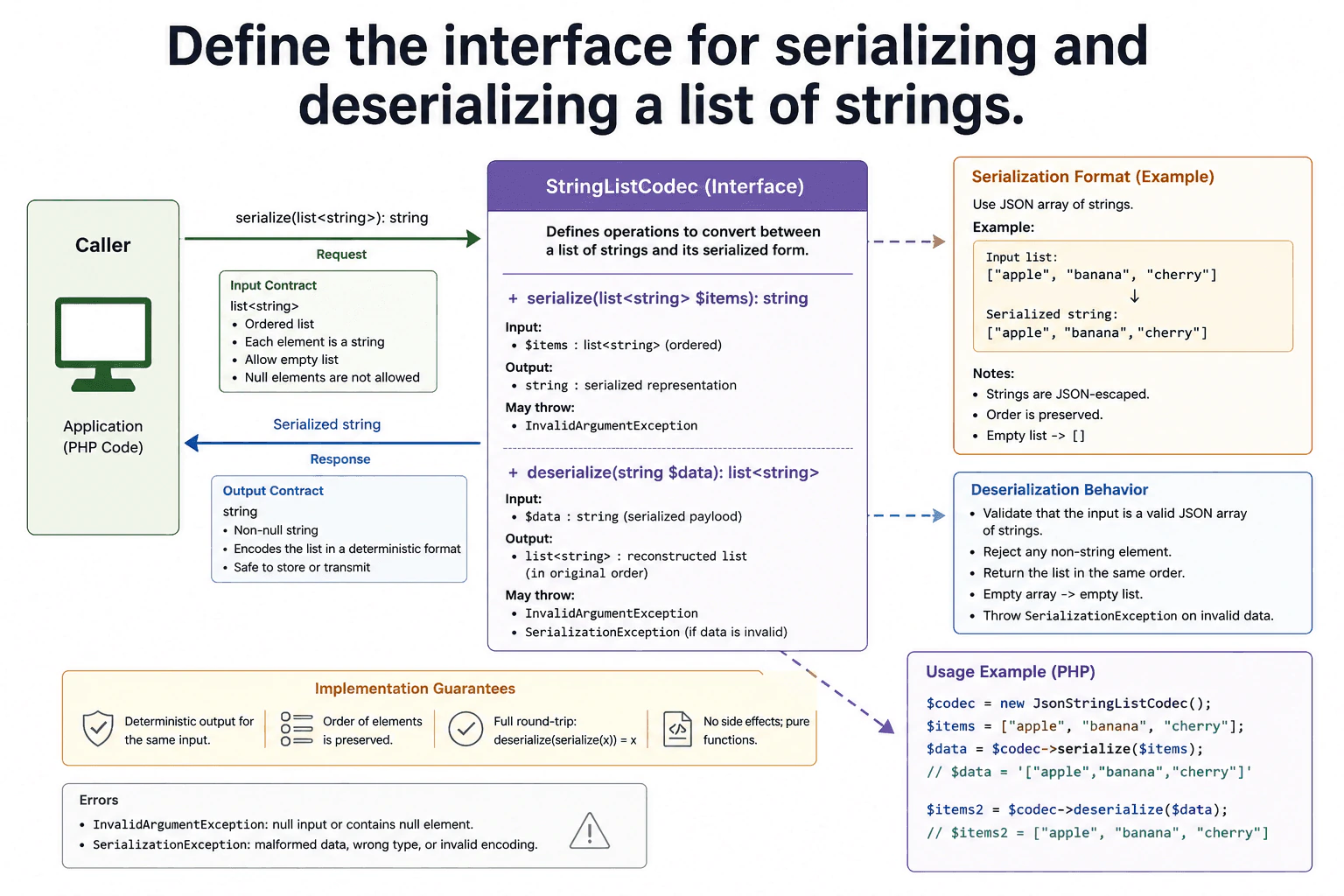
4. Define the interface for serializing and deserializing a list of strings.API DesignMediumNvidia

Question Details

Define callable operations that serialize a list of strings and reconstruct the original list, including the input and output contracts exposed to callers.

Short Interview Answer (30-60 seconds)

At a high level, I would define one small interface that turns an ordered list of strings into one string, and then rebuilds the same list later. The main contract is serialize(list<string> $items): string and deserialize(string $data): list<string>. The diagram uses JSON as the example format, keeps the original order, and allows empty lists. The most important design choice is strict validation with clear exceptions, so bad input is rejected instead of guessed. The trade-off is that the API stays simple and predictable, but it is not forgiving of malformed data.

Detailed Explanation

This question asks for a small API that stores a list of strings in one string, then restores the same list later. The goal is simple round-trip behavior. We want the same items back, in the same order. The main challenge is choosing a clear contract for empty lists, bad input, and non-string values. I will follow the diagram closely. It shows a PHP caller, a StringListCodec interface, JSON as the example format, and clear error types.

Useful Questions to Ask the Interviewer
  • Should the wire format stay JSON, or can it change later?
  • Are empty lists allowed?
  • Should null or non-string values be rejected immediately?
  • Do you want strict exceptions, or a softer return style?
Define the interface for serializing and deserializing a list of strings. diagram
How to Explain It in an Interview
1. Start with the goal and boundary

I would begin by saying the interface is only for one job. It converts an ordered list of strings into a serialized string, and it converts that string back into the original list. The caller is PHP code. The interface name in the diagram is StringListCodec. The two methods are serialize(list<string> $items): string and deserialize(string $data): list<string>. That is a good boundary because the caller does not need to know the storage format.

2. Explain the serialize contract

For serialize, the input is a list of strings. The list is ordered. Empty lists are allowed. Null elements are not allowed. The output is one string. The diagram uses a JSON array of strings as the example format. So ["apple", "banana", "cherry"] becomes a JSON string. Strings are JSON-escaped, which means special characters are written safely. This step should be deterministic. The same input should always produce the same output.

3. Explain the deserialize contract

For deserialize, the input is one serialized string. The method rebuilds the original list in the same order. If the data is valid JSON and every element is a string, it returns list<string>. If the data is an empty array, it returns an empty list. If the data is malformed, has the wrong type, or contains a non-string value, it throws SerializationException. That makes the contract strict and easy to reason about.

4. Separate caller errors from data errors

The diagram also shows InvalidArgumentException for bad caller input. That covers null input or a list that contains null. I would explain that this is different from broken serialized data. InvalidArgumentException means the caller passed a bad value to the API. SerializationException means the stored or received string could not be parsed safely. This split is useful because it tells the caller where the problem started.

5. Call out the guarantees

I would highlight four guarantees from the diagram. First, order is preserved. Second, the output is deterministic. Third, the design is pure, so it has no side effects. Fourth, round-trip behavior is expected: deserialize(serialize(x)) = x. That is the key interview point. It shows the API can safely store and restore the same list without changing its meaning.

6. Show the PHP usage and trade-off

In PHP, the diagram shows a simple implementation class like JsonStringListCodec. The caller creates the codec, serializes the list, stores or sends the string, and later deserializes it back. The main trade-off is that JSON is strict, but that is good here. It keeps the contract clear and avoids ambiguity. The downside is that invalid data is rejected instead of repaired. I would accept that because the API stays predictable and safe.

Why Interviewers Ask This

Interviewers want to see whether I can define a clean contract before writing code. They are checking if I model the input and output correctly, keep serialize and deserialize separate, preserve order, and handle bad data in a clear way. They also want to see good judgment on trade-offs, like why JSON is a safe default and why strict exceptions are better than guessing. In short, they are testing API clarity, correctness, and practical design thinking.

Interviewer may ask next
What if we want to support CSV instead of JSON later without changing callers?

I would keep the same interface and change only the implementation behind StringListCodec. The affected part is the serialization format inside JsonStringListCodec, not the caller-facing contract. The caller would still use serialize(list<string> $items): string and deserialize(string $data): list<string>. That keeps correctness because the methods still return the same kinds of values and still preserve order. It also keeps the error rules the same: bad input still throws InvalidArgumentException or SerializationException. The main downside is that CSV is less safe for this problem because commas, quotes, and empty values can be ambiguous. So I would still prefer JSON for the default implementation, and only swap the formatter if the business requirement truly changes.

How should deserialize behave when the data contains a number, null, or malformed JSON?

I would reject it and throw SerializationException. The affected flow is the deserialize(string $data): list<string> path. That method should only accept a valid JSON array where every element is a string. If the payload is malformed, has the wrong shape, or includes a non-string item, the implementation should fail closed and not guess. That keeps the round-trip contract correct and prevents silent data corruption. The caller still gets a clear error signal and can log, retry, or repair the stored value. The downside is that the API is strict, so it will not try to recover partially valid data. I would accept that trade-off because this interface is meant to be predictable and safe, not forgiving in ways that change the list.

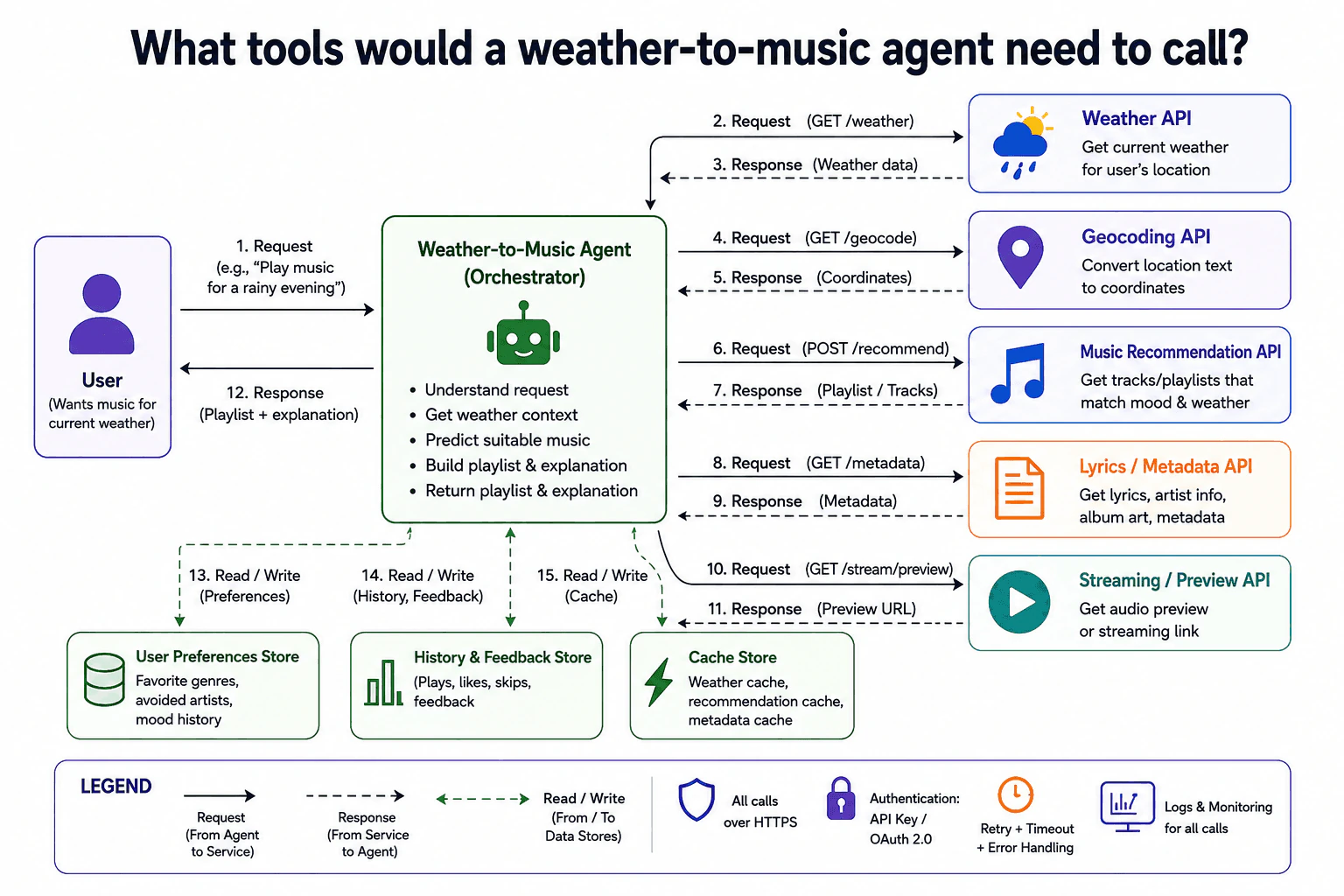
5. What tools would a weather-to-music agent need to call?API DesignMediumNvidia

Question Details

For an agent that predicts suitable music from the weather, define the tool or service calls it needs and explain how those calls support the agent workflow.

Short Interview Answer (30-60 seconds)

At a high level, I would make one Weather-to-Music Agent handle the user request and call the Weather API, Geocoding API, Music Recommendation API, Lyrics / Metadata API, and Streaming / Preview API in order. The agent also reads the User Preferences Store, History & Feedback Store, and Cache Store to personalize the playlist and reduce repeat work. The main security choice is to keep every call over HTTPS with API key or OAuth 2.0. The trade-off is better personalization, but more calls add latency and more failure points.

Detailed Explanation

This question asks how a weather-aware music agent should work. The agent takes one user request and turns it into music that fits the weather. The main goal is to show which services it calls, in what order, and what each service returns. The hard part is keeping the flow simple while still personalizing the answer. I will follow the diagram exactly, from the user request to the final playlist and explanation.

Useful Questions to Ask the Interviewer
  • Should the final answer include only music, or also an explanation and preview link?
  • Do we already know the user location, or do we need geocoding every time?
  • Should we use saved preferences, history, and cache to improve speed?
What tools would a weather-to-music agent need to call? diagram
How to Explain It in an Interview
1. Goal and boundary

At a high level, I would keep one Weather-to-Music Agent in charge. It owns the user experience. It does not guess the music by itself. It gathers weather, location, and user context, then calls the downstream APIs shown in the diagram. That keeps the design easy to understand and easy to change later.

2. User request, weather, and geocoding

The user first sends one request to the agent, like play music for a rainy evening. The agent then calls the Weather API with GET /weather to get the current weather for the user's location. If the location is text, the agent also calls the Geocoding API with GET /geocode to convert that text into coordinates. Each request has one clear sender and one clear receiver. The response goes back only to the agent. If a call is slow or fails, the diagram supports retry, timeout, and error handling.

3. Music recommendation and enrichment

Next, the agent sends POST /recommend to the Music Recommendation API. That service returns tracks or playlists that match the mood and weather. After that, the agent calls the Lyrics / Metadata API with GET /metadata to fetch lyrics, artist info, album art, and other metadata. The diagram also shows a call to the Streaming / Preview API with GET /stream/preview, so the final answer can include a preview URL or stream link. I would explain that these calls enrich the result. They do not replace the main music decision.

4. Preferences, history, and cache

The diagram shows three stores below the agent. The User Preferences Store keeps favorite genres and avoided artists. The History & Feedback Store keeps plays, likes, skips, and feedback. The Cache Store keeps weather, recommendation, and metadata data. The agent reads and writes these stores to make the answer more personal and to avoid repeated work. This is useful because the same user may ask similar questions many times. The downside is stale cache data, so the cache should have a short life.

5. Return path, security, validation, and trade-offs

The final response returns from the agent to the user as a playlist plus explanation. All calls use HTTPS. The diagram also calls out authentication with API key or OAuth 2.0, plus logging and monitoring for all calls. I would say the main security decision is to keep service calls trusted and traceable. The agent should reject bad or unauthenticated requests before they move downstream. The trade-off is simple: more enrichment gives a better answer, but it also adds latency, more failure points, and more operational work.

Practical Complexity & Trade-offs

The main design choice is to keep one agent in charge and let each API do one job. That makes the flow easy to understand. The benefit is clear ownership: weather, geocoding, music, metadata, and preview each stay separate. The downside is that every extra call adds time and can fail. I would accept that cost because the answer becomes more useful and more personal. The stores also help. Preferences and history improve the result, while cache reduces repeat calls. This is safer and faster, but cache can become stale, so it needs a clear expiry rule. HTTPS, authentication, retries, and monitoring add more work, but they reduce risk.

Why Interviewers Ask This

Interviewers want to see if I can break one user request into clean service calls. They also want to know whether I understand request and response order, clear ownership, and simple security. This question checks judgment on HTTPS, authentication, retries, caching, and logging. It also shows whether I can explain the trade-off between a richer music answer and extra latency or failure points. A strong answer proves I can design a practical API flow, not just name services.

Interviewer may ask next
What would you change if the Weather API is slow or temporarily down?

I would keep the same design and add short fallback rules around the Weather API and the Cache Store. If the Weather API is slow, the agent should use the latest cached weather when it is still fresh, then retry once or twice within the timeout limit. The affected flow is the agent's GET /weather request and the final playlist decision. Correctness stays good because the agent still prefers real weather when it is available, and it only falls back when the diagram's retry and cache ideas support it. The main downside is that the user may get slightly stale weather or a less precise song choice. I would still keep the Music Recommendation API, Lyrics / Metadata API, and Streaming / Preview API unchanged, so the response format stays the same.

How would you keep the recommendations personal without storing too much user data?

I would keep the same workflow and make personalization depend only on the User Preferences Store and History & Feedback Store. The affected parts are the reads and writes for favorites, skipped songs, and feedback. The agent can use that data to improve the Music Recommendation API request, but it should not store more than it needs. Correctness and security stay strong because the user context stays inside the agent's own data layer, and all service calls still use HTTPS with authentication. The main downside is that the recommendations may be less personal if the stored history is small or the user has disabled feedback storage. I would not change the weather, geocoding, metadata, or preview calls. The only change is how much user history the agent uses before asking for music, which keeps the design simple and easier to explain.

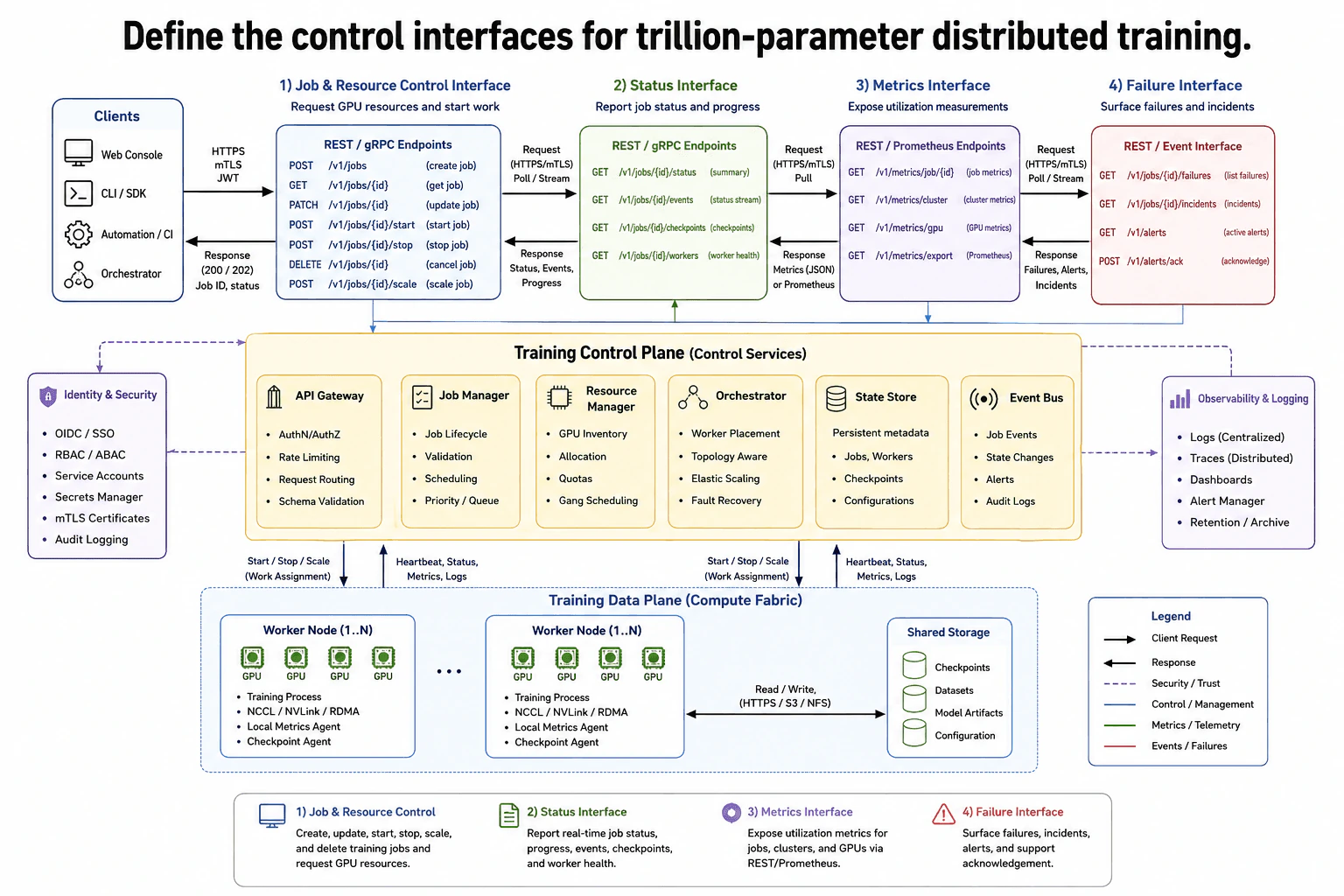
6. Define the control interfaces for trillion-parameter distributed training.API DesignHardNvidia

Question Details

For the reported distributed-training design problem, define how training jobs request GPU resources, start work, report status, expose utilization measurements, and surface failures.

Short Interview Answer (30-60 seconds)

At a high level, this API controls a very large training run and keeps it observable. I would separate job and resource control, status, metrics, and failure APIs behind one training control plane. The main flow is that a client sends HTTPS requests with mTLS and a JWT, the control plane validates the caller, creates or updates the job, and returns a job ID or status. The trade-off is that we keep control centralized for safety and simpler operations, but we add coordination overhead.

Detailed Explanation

This question asks how to control a very large training job that uses many GPUs. We need a simple way to ask for resources, start work, check progress, see GPU use, and report problems. The goal is to keep the system safe, clear, and easy to operate while many worker machines run at the same time. The hard part is that one control API must manage many moving parts without mixing up commands, status, metrics, and failures. I will follow the diagram from job control to status, metrics, and alerts.

Useful Questions to Ask the Interviewer
  • How many training jobs can run at the same time?
  • Should start, stop, and scale return right away or wait for completion?
  • What status, failure, and metrics details should the caller see?
  • Which actions are only for trusted operators or automation?
Define the control interfaces for trillion-parameter distributed training. diagram
How to Explain It in an Interview
1. Start with the goal and boundary

At a high level, I would split this into a control plane and a data plane. The clients in the diagram are the web console, CLI or SDK, automation or CI, and an orchestrator. They send HTTPS requests with mTLS, which means encrypted transport with both sides checked, and a JWT, which is a signed token that carries caller identity and permissions. The control plane owns admission, validation, and orchestration. The workers own the actual training. That separation keeps the API simple and keeps GPU work away from the client path.

2. Show the job and resource control API

I would separate the design into job commands and job state. The Jobs API shows POST /v1/jobs to create a run, GET /v1/jobs/{id} to read it, PATCH /v1/jobs/{id} to update it, POST /v1/jobs/{id}/start to begin work, POST /v1/jobs/{id}/stop to stop it, DELETE /v1/jobs/{id} to cancel it, and POST /v1/jobs/{id}/scale to change size. The Job Manager checks the spec, quota, and policy first. Then the Resource Manager and Orchestrator decide placement and start workers. On success, the API returns 200 or 202 with the job ID and current status. If the request is invalid or not allowed, the control plane rejects it before any worker changes.

3. Show status, metrics, and failure APIs

The request first creates work, and then the read APIs explain what happened. GET /v1/jobs/{id}/status shows overall state and progress. GET /v1/jobs/{id}/events shows status changes. GET /v1/jobs/{id}/checkpoints shows saved checkpoints. GET /v1/jobs/{id}/workers shows worker health. For utilization, GET /v1/metrics/job/{id}, GET /v1/metrics/cluster, GET /v1/metrics/gpu, and GET /v1/metrics/export expose job, cluster, GPU, and Prometheus-style metrics. For problems, GET /v1/jobs/{id}/failures, GET /v1/jobs/{id}/incidents, GET /v1/alerts, and POST /v1/alerts/ack surface crashes, incidents, alerts, and operator acknowledgement. These are read and report paths, not the main control path.

4. Explain the control plane and data plane

The Training Control Plane owns the API Gateway, Job Manager, Resource Manager, Orchestrator, State Store, and Event Bus. It stores job state, worker state, and events. The Training Data Plane owns worker nodes, GPUs, the training process, NCCL or NVLink or RDMA communication, a local metrics agent, and a checkpoint agent. Shared storage holds checkpoints, datasets, model artifacts, and configuration. When the control plane starts, stops, or scales a job, it sends work assignments to the workers. The workers then report heartbeats, status, metrics, and logs back through the control path.

5. Explain security, observability, and trade-offs

The main security decision is to keep identity, authorization, and logging separate. The diagram shows OIDC or SSO, RBAC or ABAC, service accounts, secrets manager, mTLS certificates, and audit logging. OIDC or SSO proves who the caller is. RBAC or ABAC decides what that caller may do. mTLS protects the wire and lets both sides verify each other. Audit logging records the security decision, but it does not own the business response. Observability then uses logs, traces, dashboards, alert manager, and retention or archive. The trade-off is clear: central control gives safety, auditability, and easy status reporting, but it also adds coordination work and more moving parts.

Practical Complexity & Trade-offs

The benefit is that one clear control plane handles create, start, stop, scale, status, metrics, and failures. That makes the system easier to teach and easier to operate. Using mTLS and JWT is safer because traffic is encrypted and every caller has an identity. The downside is extra coordination. The control plane must validate requests, track state, fan out work, and collect reports from many workers. That adds latency and operational complexity. We accept this because large training runs need strong control, clear audit logs, and reliable progress reporting more than a very simple API.

Why Interviewers Ask This

Interviewers want to see whether I can model a large system with clear boundaries. They are checking if I can separate control, status, metrics, and failure paths, and still keep request and response flows correct. They also want to see that I understand security ownership, like mTLS, JWT, and authorization, without mixing those roles together. Finally, they are testing judgment: can I explain trade-offs, reliability, and worker coordination in a simple way.

Interviewer may ask next
What changes if a worker crashes during training?

The main design stays the same, but the failure path becomes more important. The affected flow is the worker node, the local metrics agent, the checkpoint agent, and the failure APIs such as GET /v1/jobs/{id}/failures, GET /v1/jobs/{id}/incidents, and GET /v1/alerts. When a worker fails, the control plane should keep the last known job state, record the incident, and surface the problem through events and alerts. Correctness stays strong because the control plane still owns job state, and the worker does not directly tell clients what to do. Security also stays the same because the same mTLS and JWT checks still gate access. The downside is that recovery can take longer, because the orchestrator may need to reschedule work and reload checkpoints from shared storage.

How would you separate access for human operators and automation?

I would keep the same endpoints, but I would use different identities and policy rules. Human users would come through OIDC or SSO, while automation or CI would use service accounts. The affected flow is the HTTPS request into the API Gateway, where RBAC or ABAC decides whether the caller may create, start, stop, scale, or inspect a job. mTLS still protects the transport, and JWT claims still carry the caller identity and allowed actions. That keeps correctness and security aligned, because the receiving service owns authorization and audit logging records the decision. The downside is more policy work. Teams must manage roles, claims, and service-account access carefully, or operators may get blocked by mistake.

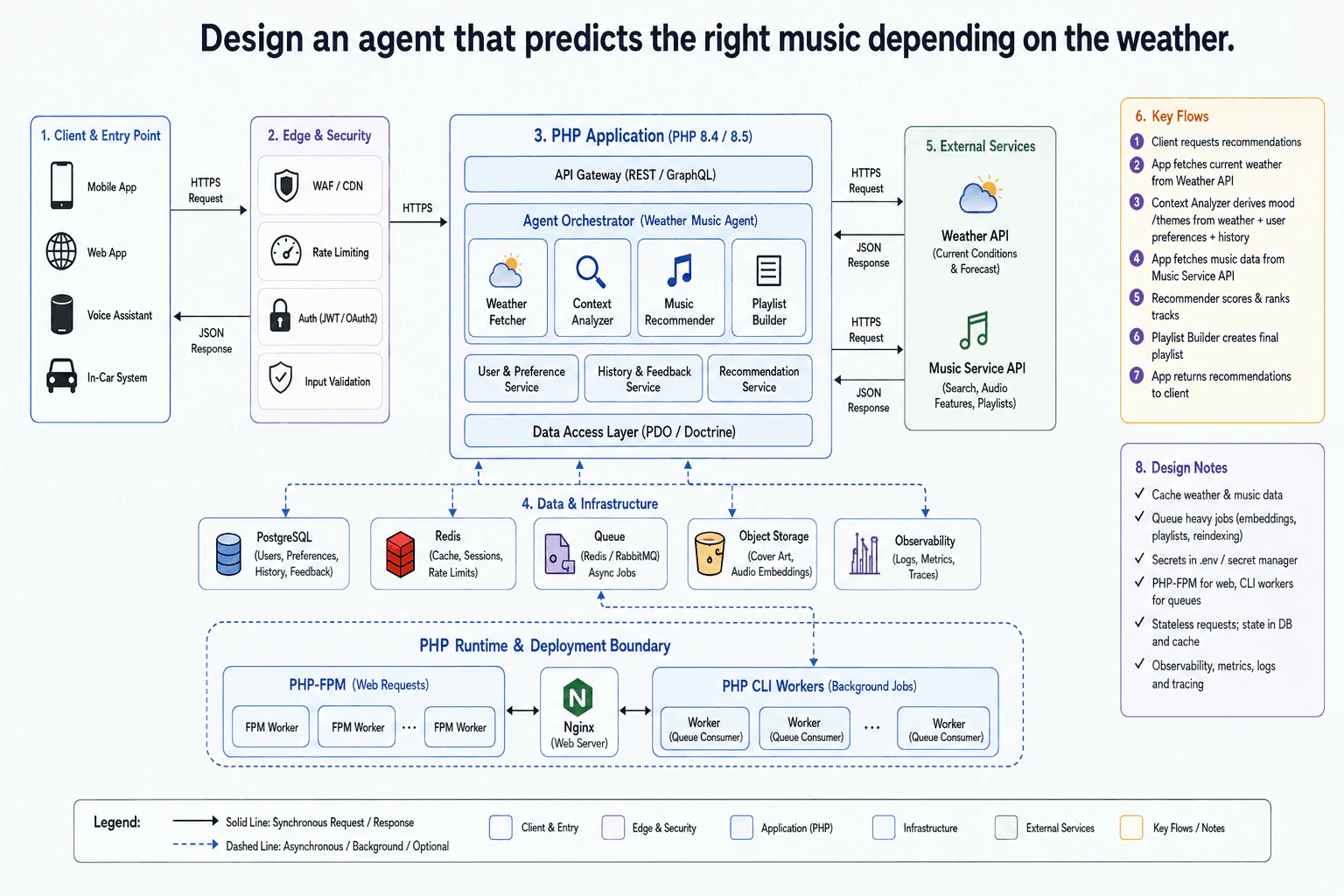
7. Design an agent that predicts the right music depending on the weather.System DesignMediumNvidia

Question Details

Design an agent that uses current weather conditions to select suitable music and explain which external tools or services it must call.

Short Interview Answer (30-60 seconds)

At a high level, this app listens to the weather and then picks music that fits the day. The hard part is that it must use live weather and music data, but still answer fast. I would explain it in three parts: the client and edge checks, the PHP weather-music flow, and the data plus background jobs. The trade-off is that caching makes it faster, but some answers can be a little old.

Detailed Explanation

The goal is to build a helper that looks at the current weather and suggests music that fits that moment. A rainy afternoon, a hot morning, and a calm evening should not lead to the same songs. The hard part is that the helper must check live weather, user taste, and music data before it answers. The diagram solves this by keeping the user request fast, moving heavy work to the background, and saving shared data in the database and cache.

Useful questions to ask:

Useful Questions to Ask the Interviewer
  1. Should the reply be a full playlist or just a few tracks?
  2. How fresh must the weather data be?
  3. Should the system use saved tastes and past feedback?
Design an agent that predicts the right music depending on the weather. diagram
How to Explain It in an Interview
1. Explain the goal and the main idea

At a high level, this is a system that turns weather into music choices. The user sends a request, and the app uses the weather to choose songs that fit the mood. The main challenge is to keep the answer fast while still using fresh outside data.

The diagram keeps one main request path. It also keeps background work separate. That is useful because the user should not wait for every heavy task.

2. Explain the client and edge checks

The request can come from a mobile app, a web app, a voice assistant, or an in-car system. Before the PHP app sees it, the request goes through WAF / CDN, rate limiting, auth with JWT / OAuth2, and input validation.

That edge layer blocks bad traffic and keeps the app clean. It also means the app only handles requests that are ready to process.

3. Explain the PHP application flow

The main app is PHP Application (PHP 8.4 / 8.5). The request enters through API Gateway, which can use REST or GraphQL. Then the Agent Orchestrator, named Weather Music Agent, runs the main logic.

The Weather Fetcher gets the current conditions and forecast from the Weather API. The Context Analyzer combines weather, user preferences, and history. Then the Music Recommender scores tracks from the Music Service API. After that, the Playlist Builder creates the final playlist.

The app also uses the User & Preference Service, History & Feedback Service, and Recommendation Service. The Data Access Layer uses PDO or Doctrine. That keeps storage code away from business logic.

4. Explain data, cache, and runtime

PostgreSQL stores user preferences, history, and feedback. Redis stores cache, sessions, and rate limits. The Queue, using Redis or RabbitMQ, carries async jobs. Object Storage keeps cover art and audio embeddings. Observability holds logs, metrics, and tracing.

PHP-FPM handles web requests. PHP CLI Workers handle background jobs. Nginx sits in front as the web server. This split is important. PHP-FPM stays focused on fast user requests, while CLI workers do the heavier work in the background.

The design notes also show that the app caches weather and music data. That lowers outside calls. The queue handles heavy jobs like embeddings, playlists, and reindexing. The system is also stateless at the request layer, so scaling is easier.

5. Explain scale, failures, and trade-offs

If Weather API or Music Service API is slow, cached data helps the app keep moving. That is the main reason for Redis here. The downside is that cache can be a little old.

The queue helps protect the main request path. It lets the app do heavy work later without slowing the reply. The downside is more moving parts, so we need good logs, metrics, and tracing.

Secrets should stay in env or a secret manager. That keeps API keys and other private values out of code. The main trade-off is clear: faster replies and better scaling, but with some extra complexity and a small chance of stale data.

Engineering Considerations / Design Trade-offs

The benefit is speed. Redis saves weather and music data, so the app does not call outside services every time. The queue helps with heavy work like embeddings, playlist work, and reindexing, so the user request stays quick. The downside is that cached data can be a little old, and queued work happens later. PHP-FPM is good for web requests, and PHP CLI workers are good for background jobs. The downside is more moving parts, so we must watch logs, metrics, and tracing.

Why Interviewers Ask This

The interviewer wants to see whether you can split one problem into a fast request path and slower background work. They also want to know if you can choose the source of truth, use cache safely, and keep the system simple under load. Good answers show judgment about security, stale data, and how to explain trade-offs in plain English.

Interviewer may ask next
What if the Weather API is slow or fails?

I would keep the same basic design, but I would rely more on Redis cache and the last good weather value. The Weather Fetcher would check cache first. If it finds a recent answer, the app can keep going right away. If not, it calls the Weather API.

That keeps the PHP-FPM request short and protects the main path. The background workers can refresh weather data later if needed. The downside is that the music choice may use slightly old weather data for a short time, but the user still gets a fast reply instead of waiting.

What if traffic grows a lot and many users ask at the same time?

I would keep the same architecture, but I would lean more on caching and background jobs. Many users may ask for recommendations at once, and not every request should trigger fresh outside calls. Redis can reuse recent weather data and recent music data, so the app does less repeated work.

PHP-FPM can keep serving web requests, while PHP CLI Workers handle the heavier jobs in the queue. That helps the system stay responsive. The downside is that shared cached results may not be perfectly fresh for every user, so the Recommendation Service still needs to use user preferences and history to make the final choice feel personal.

8. Design a distributed training environment for a trillion-parameter language model.System DesignHardNvidia

Question Details

Design a distributed training environment for a trillion-parameter language model, including parallelism, GPU resource management, utilization benchmarking, and debugging low GPU utilization.

Short Interview Answer (30-60 seconds)

At a high level, this is a distributed training system for one very large language model. The main challenge is that no single machine can hold or train it, so the work must be split across many GPUs and nodes. I would explain it in three parts: how a job is accepted and prepared, how the GPU cluster trains the model, and how we watch, benchmark, and debug low GPU use. The trade-off is more speed, but also more coordination and recovery work.

Detailed Explanation

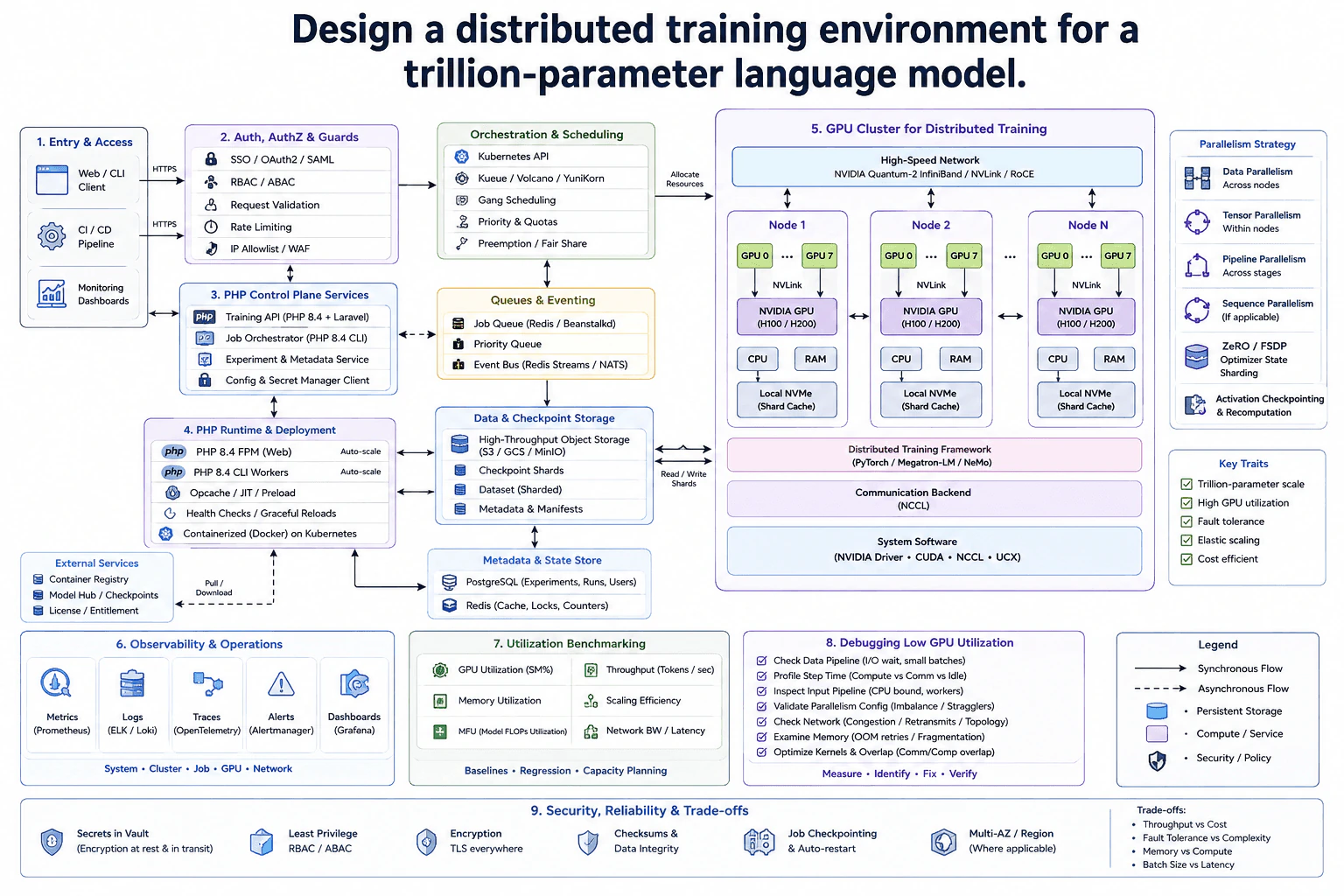
The goal is to train one very large language model on many GPUs. The system must accept jobs, prepare data, manage GPU workers, and save training progress so work is not lost. The hard part is that the model is too big for one machine, so the work must be split across nodes. The diagram shows the access and control layer, the scheduling layer, the GPU cluster, and the monitoring tools. That is the structure I would use in the interview.

Useful Questions to Ask the Interviewer
  1. How many GPUs and nodes should the first version support?
  2. How often should we save checkpoints?
Design a distributed training environment for a trillion-parameter language model. diagram
How to Explain It in an Interview
1. Explain the goal and the main idea

At a high level, I would say this is a control plane around a GPU training cluster. The control plane prepares jobs, data, and state. The GPU cluster does the heavy math. This split matters because training must stay fast, but control and recovery must still be safe.

2. Explain access, safety, and job setup

A request first goes through the entry and access layer. The diagram shows a web or CLI client. After that, AuthN/AuthZ and guards check SSO, RBAC or ABAC, validation, rate limits, and IP allowlists or WAF rules. Then the PHP control plane services handle the job. The Training API, Job Orchestrator, Experiment and Metadata Service, and Config and Secret Manager Client run the control path. The PHP runtime uses FPM for web traffic and CLI workers for background work on Kubernetes. The external services, like the container registry, model hub or checkpoint store, and license or entitlement checks, stay outside the hot training path.

3. Explain data, queues, and state

The orchestrator sends work into the queues and eventing layer. The diagram shows a job queue, a priority queue, and an event bus. Kubernetes API, Kueue, Volcano, or YuniKorn handle placement, quotas, fair share, and gang scheduling. Training data goes through raw sources, preprocessing, sharding and packing, a data loader, and a distributed sampler. The system saves metadata in PostgreSQL and uses Redis for cache, locks, and counters. Checkpoints, shards, datasets, and manifests go to object storage, with local NVMe used as shard cache on each node.

4. Explain the GPU cluster and parallelism

The training cluster is the main compute plane. Each node has GPUs, CPU, RAM, and local NVMe. Nodes connect through a high-speed network like NVIDIA Quantum-2 InfiniBand, NVLink, or RoCE. Inside the cluster, the framework uses PyTorch, Megatron-LM, or NeMo. NCCL handles communication. The diagram also shows tensor parallelism, pipeline parallelism, data parallelism, sequence parallelism, and ZeRO or FSDP. The point is to split the model, activations, and optimizer state so one model can train across many GPUs.

5. Explain monitoring, benchmarking, and debugging

Observability is separate from training. Prometheus collects metrics. ELK or Loki stores logs. OpenTelemetry sends traces. Alertmanager sends alerts. Grafana shows dashboards. For benchmarking, the diagram watches GPU utilization, memory utilization, MFU, throughput in tokens per second, scaling efficiency, and network bandwidth or latency. If GPU use is low, the debugging flow checks the data pipeline, step time, input pipeline, parallelism config, network, memory, and kernel overlap. The idea is simple: measure, identify, fix, and verify.

6. Explain security, reliability, and trade-offs

Security uses secrets in Vault, least privilege with RBAC or ABAC, and TLS everywhere. Reliability uses checksums, data integrity, job checkpointing, and auto-restart. Multi-AZ or multi-region is used where needed. The trade-off is clear. More parallelism and more checkpoints improve safety and speed, but they also add cost, memory pressure, latency sensitivity, and complexity. That is the main balance shown in the diagram.

Engineering Considerations / Design Trade-offs

The benefit is that the work is split across many GPUs, so one model can train at a large scale. The benefit is also that checkpoints, logs, and metrics are separated from the hot training path. That keeps the main training loop faster. The downside is more moving parts. We need queues, schedulers, storage, and a network fabric that all work together. We also pay for more storage and more coordination. Another downside is tuning complexity. Tensor, pipeline, and data parallelism must match the model and the cluster size. That takes careful testing and ongoing tuning. The diagram also shows a balance between memory use, batch size, and latency, so those settings have to be chosen carefully.

Why Interviewers Ask This

Interviewers want to see judgment, not memorization. They want to know if you can split a huge problem into clear flows, choose the right place for state, and keep the fast path simple. They also want to see if you understand parallelism, recovery, monitoring, and debugging. Good answers show that you can balance speed, cost, reliability, and ease of operations.

Interviewer may ask next
What if we need stricter priority and quotas for different teams?

I would keep the same design, but I would make the scheduler stricter. The change is in the orchestration layer, where Kueue, Volcano, or YuniKorn already handle gang scheduling, priority, quotas, and fair share. High-priority jobs would get earlier placement, and some lower-priority jobs would wait or be preempted. That keeps the same control plane and the same GPU cluster.

The main thing that changes is who gets the GPUs first. The data path, checkpointing, observability, and debugging stay the same. Correctness is still protected because the job state stays in PostgreSQL and Redis, and the cluster only starts a job when the scheduler has enough GPUs. The downside is less predictability for low-priority teams, and more scheduling complexity.

What if a GPU node fails in the middle of training?

I would keep the same architecture, but I would rely more on checkpointing and restart. The checkpointing service already writes model checkpoints, shards, and manifests to object storage. If a node dies, the job orchestrator can start the work again from the latest saved point instead of from the beginning.

That keeps the answer consistent with the diagram. The control plane still uses Kubernetes, queues, and metadata in PostgreSQL and Redis. The GPU cluster still uses the same parallelism strategy. The main difference is that checkpoint intervals may need to be shorter for higher safety, and the auto-restart path becomes more important. The downside is extra storage traffic, more write load, and a little less time spent on useful training work.

9. What kinds of problems did you solve on your previous projects?BehavioralMediumNvidia

Question Details

Describe the types of problems you solved on previous projects and clarify your personal contribution.

Interview tip:

Use STAR to structure your answer: briefly explain the Situation and Task, make Action the most detailed part, and finish with the Result. For example, describe a realistic project where you solved customer facing and internal workflow problems, explained what you personally fixed, how you worked with the team, and what changed after your actions.

Situation

In my last role, I worked on a PHP application that handled customer profiles, order updates, and internal support tools. The main problems were slow pages, fragile form flows, and a few integration issues when data moved between the app and external services.

Task

My job was to find the root cause of the issues, fix the most important ones without breaking other parts of the system, and make the code easier for the team to support.

Action

I started by checking logs, request flow, and the code paths behind the slow pages and errors. Then I broke the work into small fixes so I could lower risk. I cleaned up some query logic, added validation at the edge of the request, and moved repeated business rules into shared service classes so the same logic was not copied in several controllers. When I found integration failures, I added clearer error handling and safer retry paths so we could tell what failed and why. I also reviewed the changes with my teammates early, because I wanted feedback before release and I did not want a quick fix to create a larger issue later.

Result

The application became more stable and easier to maintain. The most important user facing issues were reduced, support could understand failures more clearly, and the team had a cleaner code path for future changes. I learned to protect the main user flow first and to keep fixes small and well reviewed when the system is already in production.

Why Interviewers Ask This

Interviewers ask this to see how you think about real work problems, how you prioritize, and whether you can solve issues with good judgment, ownership, and teamwork.

Interviewer may ask next
Why did you focus on the user facing flow first?

I focused on the user facing flow first because that was where the pain was strongest. It affected customers and support the most, so fixing that path gave the biggest value while I kept the rest of the system stable.

What would you do differently now?

I would add more automated tests before merging the refactor and bring QA in earlier for the risky paths. That would give me faster confidence that the cleanup did not change behavior in places that were already working.

10. How would you prioritize limited computing resources across multiple projects?BehavioralHardNvidia

Question Details

In a distributed computing environment with limited resources and multiple projects, explain how you would prioritize the projects and allocate resources fairly and effectively.

Interview tip:

Use STAR to structure your answer: briefly explain the Situation and Task, make Action the most detailed part, and finish with the Result. For example, describe a realistic case where you protected production work first, ranked projects by business impact and urgency, told stakeholders what would move and what would wait, and kept the shared platform stable.

Situation

In my last role, we had several PHP services sharing the same worker pool, cache, and database resources. At the same time, multiple teams were asking for background jobs, report generation, and release work. The system was starting to slow down during busy hours, and teams were not always clear on which work should go first.

Task

My responsibility was to help prioritize the shared computing resources in a fair way, keep the most important user facing work stable, and make sure each project team understood the tradeoffs. I also had to avoid surprises, because one team slowing another team down would have created more conflict.

Action

I started by grouping all requests into clear buckets. First was production critical work, such as payments, login, and urgent bug fixes. Second was customer visible work that affected revenue or key deadlines. Third was internal or batch work that could wait, such as reports, backfills, and non urgent indexing jobs. I then met with the project owners and asked three simple questions for each request. What happens if this waits. Who is blocked. What is the safest smaller version we can run now.

After that, I set limits on the shared workers so one project could not consume everything. For example, I reserved capacity for production tasks and moved heavy background jobs to off peak hours. I also broke large jobs into smaller chunks so they could pause and resume instead of holding resources for too long. When two projects had the same priority, I compared business impact, user impact, and deadline risk, then I made the tradeoff visible to both teams before changing the schedule.

I kept communication simple and direct. I shared the priority order, the reason behind it, and when the lower priority work would be revisited. I also checked the queue and service health every day, so I could adjust quickly if a project became urgent or a service started to fall behind. This helped me protect the platform while still giving each team a fair path to progress.

Result

The shared environment became much more predictable, and production work stayed stable even when several teams were active at once. Projects still moved forward, but they did so with clearer expectations and fewer conflicts. I learned that fair prioritization is not about saying yes to everyone. It is about making the rules clear, protecting the most important user needs, and revisiting the plan often as the situation changes.

Why Interviewers Ask This

Interviewers ask this to see whether I can make calm, fair decisions when resources are tight. They want to know if I can balance business impact, urgency, and team communication without letting one project hurt the rest of the system.

Interviewer may ask next
How did you decide what should wait?

I looked first at user impact and production risk. If a task affected core user flows or a live incident, it stayed at the top. If it was batch work, reporting, or a task with less immediate value, I asked the team to delay it or run it in a smaller slice so it would not block the shared system.

What would you do differently now?

I would make the priority rules even more visible earlier, before the system became crowded. I would also review capacity more often with the teams, so they could plan around known limits instead of reacting after contention had already started.

More questions load as you scroll

Disclaimer: This interview guide is for educational and informational purposes only. It is designed to help readers prepare, but it does not guarantee any interview result, hiring decision, offer, or outcome. Interview questions, hiring criteria, and preferred answers can vary by employer, interviewer, industry, location, and time. The examples and explanations reflect the authors' research and judgment, are provided without warranties of any kind, and should not be treated as the only correct approach. Diagrams are simplified illustrations intended to highlight the main components and their interactions; actual systems and implementations may be more complex. Alternative approaches may be equally valid or better suited to a particular question, context, or interviewer. To the fullest extent permitted by applicable law, the author, contributors, and publisher are not liable for decisions made, actions taken, or losses incurred based on this guide.

Company Notice: This guide is an independent educational resource and is not affiliated with, endorsed by, sponsored by, or approved by the company named in this guide. Company names are used only to identify interview experiences commonly reported by candidates. Interview practices can change without notice, and inclusion of company-specific content does not mean these questions are official, complete, or guaranteed to be asked. To the fullest extent permitted by law, the author, contributors, and publisher are not responsible for outcomes related to use of this material.