This interview guide is for educational and informational purposes only. It is designed to help readers prepare, but it does not guarantee any interview result, hiring decision, offer, or outcome. Interview questions, hiring criteria, and preferred answers can vary by employer, interviewer, industry, location, and time. All answers, examples, and explanations in this guide are suggested examples for interview preparation, not definitive answers or instructions for professional practice. They are based on research and judgment, are provided without warranties of any kind, and should be adapted to the question, role, and applicable laws and professional requirements. Diagrams are simplified illustrations intended to highlight the main concepts and their relationships; actual situations, systems, and practices may be more complex. Alternative approaches may be equally valid or better suited to a particular question, context, or interviewer. To the fullest extent permitted by applicable law, the contributors and publisher are not liable for decisions made, actions taken, or losses incurred based on this guide.
State Laws and Professional Responsibilities
Laws and requirements governing an occupation vary by state and jurisdiction. You are responsible for checking the current laws, licensing requirements, and scope-of-practice rules that apply to your location and role, and for ensuring that your answers and actions comply with them. Adapt examples in this guide to those requirements. This guide is not legal advice.
Identity, Image, and Privacy Notice
To respect individual privacy, some names, profile photographs, avatars, biographical details, and other identifying information displayed in this guide may be replaced with pseudonyms, licensed stock images, illustrative avatars, composite images, or representative descriptions. Unless a person is expressly identified as an actual contributor, a displayed name, image, or profile should not be understood as depicting or identifying a specific candidate, interviewer, employee, or other real individual. These representations are provided for editorial and illustrative purposes only and do not imply endorsement, employment, participation, or affiliation with this guide or any company mentioned in it. Any resemblance to an actual person is coincidental.
Company Notice
This guide is an independent educational resource and is not affiliated with, endorsed by, sponsored by, or approved by the company named in this guide. Company names identify reported interview experiences or the employer context of clearly labeled original practice exercises. Interview practices can change without notice, and inclusion of company-specific content does not mean these questions are official, complete, or guaranteed to be asked. To the fullest extent permitted by law, the author, contributors, and publisher are not responsible for outcomes related to use of this material.
Content Accuracy and Verification
To the fullest extent permitted by applicable law, we do not represent or warrant that interview guides, questions, answers, examples, or diagrams are accurate, complete, current, error-free, or suitable for any particular purpose. You are responsible for independently reviewing and verifying the information before relying on it.
Questions or comments?
Contact us for general questions, or share feedback, technical corrections, and comments with the community.
1. Implement a snake_case to camelCase converter in PHP.CodingEasyGoogle
i Question Details
Define the expected input format, rejected or handled edge cases, and implement a PHP function that converts snake_case text to camelCase.
Short Interview Answer (30-60 seconds)
I would split the snake_case string on underscores, keep the first part unchanged, then lowercase and capitalize each later non-empty part before joining them. That turns user_profile_name into userProfileName. I also return the original string when there are no letters, so cases like ___ stay as they are. The code processes each part once. So the time is O(n), and the extra space is O(n) because explode() stores all parts in an array.
This question asks me to change a snake_case name into camelCase. The input is one string with words separated by underscores. The output is the same text without underscores, with the first word kept lowercase and every later word starting with a capital letter. The idea is simple and easy to explain in PHP. I would ask the interviewer whether empty strings and strings with no letters should stay unchanged, and whether repeated underscores should be ignored.
Useful Questions to Ask the Interviewer
Should an empty string return an empty string?
Should leading, trailing, or repeated underscores be ignored?
Should strings with no letters stay unchanged?
How to Explain It in an Interview
1. Understand the input and required output
The input is one snake_case string. The output is one camelCase string. I do not change the meaning of the text. I only remove underscores and change the letter case around word boundaries.
2. Choose the algorithm and data structure
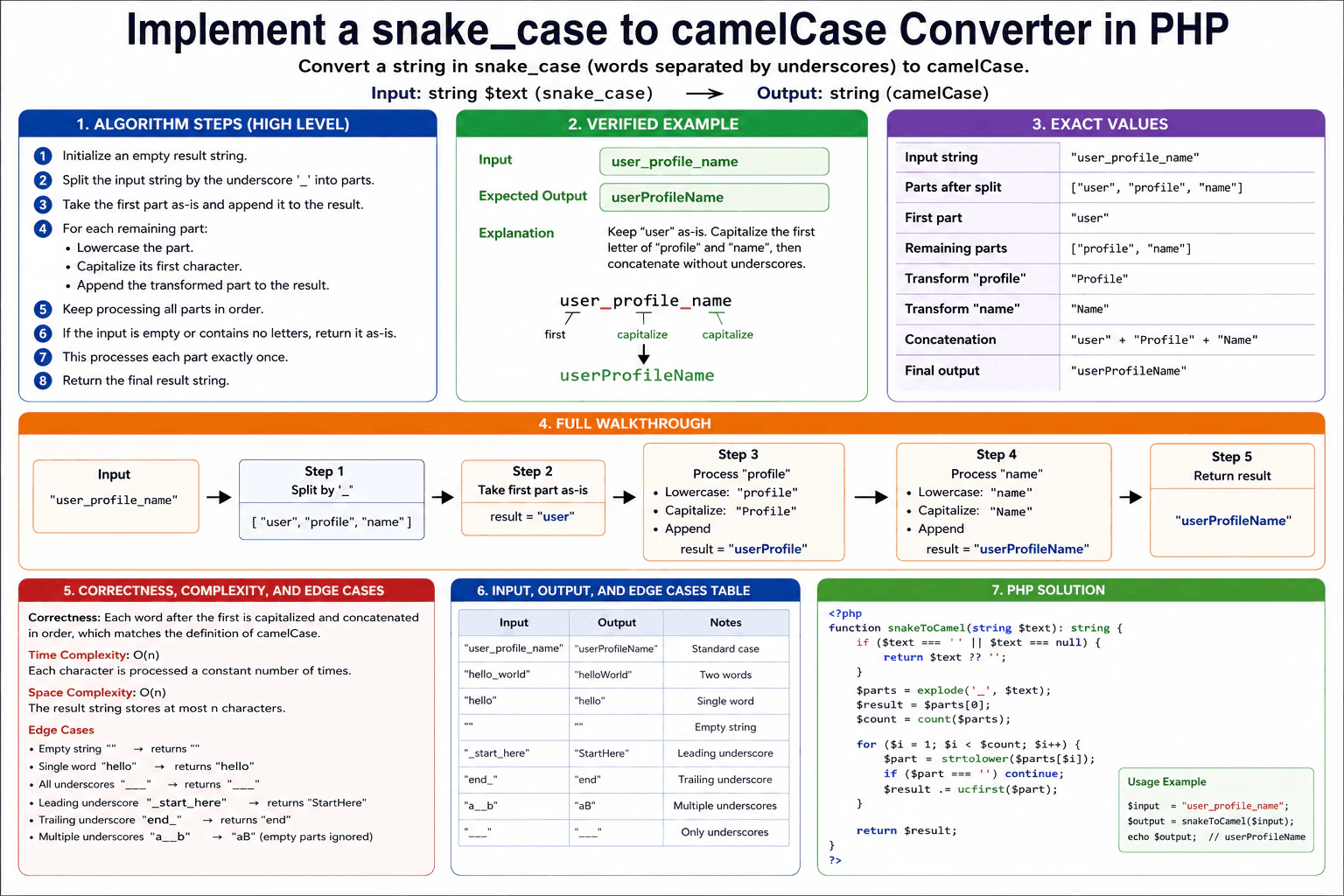
The diagram uses a split-and-join string approach. PHP explode('_', $text) gives me all parts at once. The first part stays as it is. Every later non-empty part is lowercased and then capitalized. The key invariant is simple: after each step, the result already holds the correct camelCase prefix for the parts I have processed.
3. Initialize the state
I start by checking the easy edge cases. Empty input stays empty. If the string has no letters, I return it unchanged. Then I split the string on _. The first piece becomes the base of the answer.
4. Walk through the example
Use the exact example from the diagram: user_profile_name → userProfileName.
Split the string into ["user", "profile", "name"].
Put user into the result first.
Read profile. Lowercase it, then capitalize the first letter. Append Profile.
Read name. Lowercase it, then capitalize the first letter. Append Name.
Return userProfileName.
Empty parts are skipped. That is why _start_here becomes StartHere, end_ becomes end, and a__b becomes aB.
5. Explain why the result is correct
The first chunk stays unchanged, which matches camelCase. Every later chunk becomes a word with a capital first letter. Skipping empty chunks prevents extra characters when there are repeated, leading, or trailing underscores. Because each part is handled in order, the final string is the correct camelCase form for the shown rules.
6. Explain the PHP implementation
The function snakeToCamelCase(string $text): string takes the input string. It handles the empty string first. It also returns strings with no letters unchanged. Then it calls explode('_', $text). The loop starts at the second part. Each part is lowercased. If the part is empty, the code skips it. Otherwise, ucfirst() makes the first letter uppercase, and the code appends it to $result. At the end, the function returns $result.
7. Explain complexity and edge cases
The time is O(n), where n is the length of the string. The code reads the string and processes each part once. The extra space is O(n) because explode() stores the split parts in memory.
Relevant edge cases:
empty string
one word like hello
leading underscore like _start_here
trailing underscore like end_
repeated underscores like a__b
only underscores like ___
numbers and symbols like user_id_2
Key Insight / Why This Solution Works
The key idea is to split the string on underscores, keep the first part as it is, and transform every later non-empty part into title case before appending it. The invariant is that the result always contains the correct camelCase prefix for the parts already processed. Empty pieces are skipped, so repeated, leading, or trailing underscores do not create extra letters. If the string has no letters, the safe fallback is to return it unchanged.
Code
<?phpfunctionsnakeToCamelCase(string$text): string{
// Empty input stays empty.if ($text === '') {
return'';
}
// If there are no letters, keep the string unchanged.if (!preg_match('/[A-Za-z]/', $text)) {
return$text;
}
// Split the input string into parts using the underscore separator.$parts = explode('_', $text);
// Keep the first part unchanged.$result = $parts[0];
$count = count($parts);
// Process each later part once.for ($i = 1; $i < $count; $i++) {
$part = strtolower($parts[$i]);
// Skip empty parts created by repeated, leading, or trailing underscores.if ($part === '') {
continue;
}
// Capitalize the first letter and append it to the result.$result .= ucfirst($part);
}
return$result;
}
// Example run from the diagram.$input = 'user_profile_name';
$output = snakeToCamelCase($input);
echo$output; // userProfileName
Time & Space Complexity
Let n be the length of the input string. The code scans the string a small number of times, so the work is linear in n. That is O(n) time. explode() builds an array of parts, so the extra memory is also O(n). The early check for strings with no letters is still linear and does not change the bound.
Where it is used
This is useful when an API, database column, file name, or request key uses snake_case but your PHP code wants camelCase. It also helps when cleaning imported field names before using them in application code.
Why Interviewers Ask This
The interviewer wants to see whether I can turn a simple string rule into correct PHP. They are checking split logic, loop order, empty-part handling, and whether I keep the first chunk unchanged. They also want a clear complexity explanation and careful edge-case handling. This problem looks small, but it tests precision, consistency, and simple code quality.
Common interview mistakes
A common mistake is to capitalize the first word too, which gives UserProfileName instead of userProfileName. Another mistake is to forget to skip empty parts from repeated, leading, or trailing underscores. Another is to return the split pieces without joining them. Candidates also sometimes lose the original order or forget that strings with no letters should stay unchanged in this version.
Interview tip
Say the processing order out loud: split on _, keep the first part, then lower-case and capitalize each later non-empty part. That keeps the explanation simple and matches the code exactly.
Interviewer may ask next
What changes if repeated, leading, or trailing underscores should be rejected instead of skipped?
I would validate the parts after explode(). If any part is empty, I would stop and return an error instead of building the camelCase result. The main loop stays the same. Time is still O(n), and space is still O(n). The tradeoff is stricter input validation.
What changes if the separator can be any non-letter character instead of only underscore?
I would replace explode('_', $text) with a regex split that treats any non-letter separator as a break. Then I would keep the same rule for the first part and the later parts. The time stays O(n), and the space stays O(n). The tradeoff is that the input rules become more flexible, but also less strict.
2. Find the median of two sorted arrays efficiently.CodingHardGoogle
i Question Details
Given two sorted arrays, find their median efficiently and explain the expected time and space complexity.
Short Interview Answer (30-60 seconds)
I would binary search the smaller array and look for the right partition between the two sorted arrays. At each step I compare the border values on the left and right sides. When the left side is never bigger than the right side, the partition is correct and I can read the median directly. This gives O(log(min(m,n))) time and O(1) extra space.
We have two sorted lists of numbers. We need the middle value after both lists are seen together. We do not want to merge everything first, because that takes more work than needed. Instead, we look for one split point in each list so the left side has the right number of values. When the split is correct, the values on the left are never bigger than the values on the right. Then the median comes from the values around the split.
Useful questions to ask:
Useful Questions to Ask the Interviewer
Are both arrays already sorted in ascending order?
Can one of the arrays be empty?
Do you want the answer as a float when the total length is even?
Is it fine to search the smaller array first?
How to Explain It in an Interview
1. Understand the input and required output
We get two sorted arrays, nums1 and nums2. The goal is to return the median of all values together. We do not need to build a merged array.
2. Choose the algorithm and data structure
We use binary search on the smaller array. The state is only a few indexes and border values. The key invariant is that the left partition must contain half of the total values, or one extra when the total count is odd.
3. Initialize the state
First, we make nums1 the smaller array. Then we set low = 0 and high = m. This gives the full search range for the cut point in nums1.
4. Walk through the example
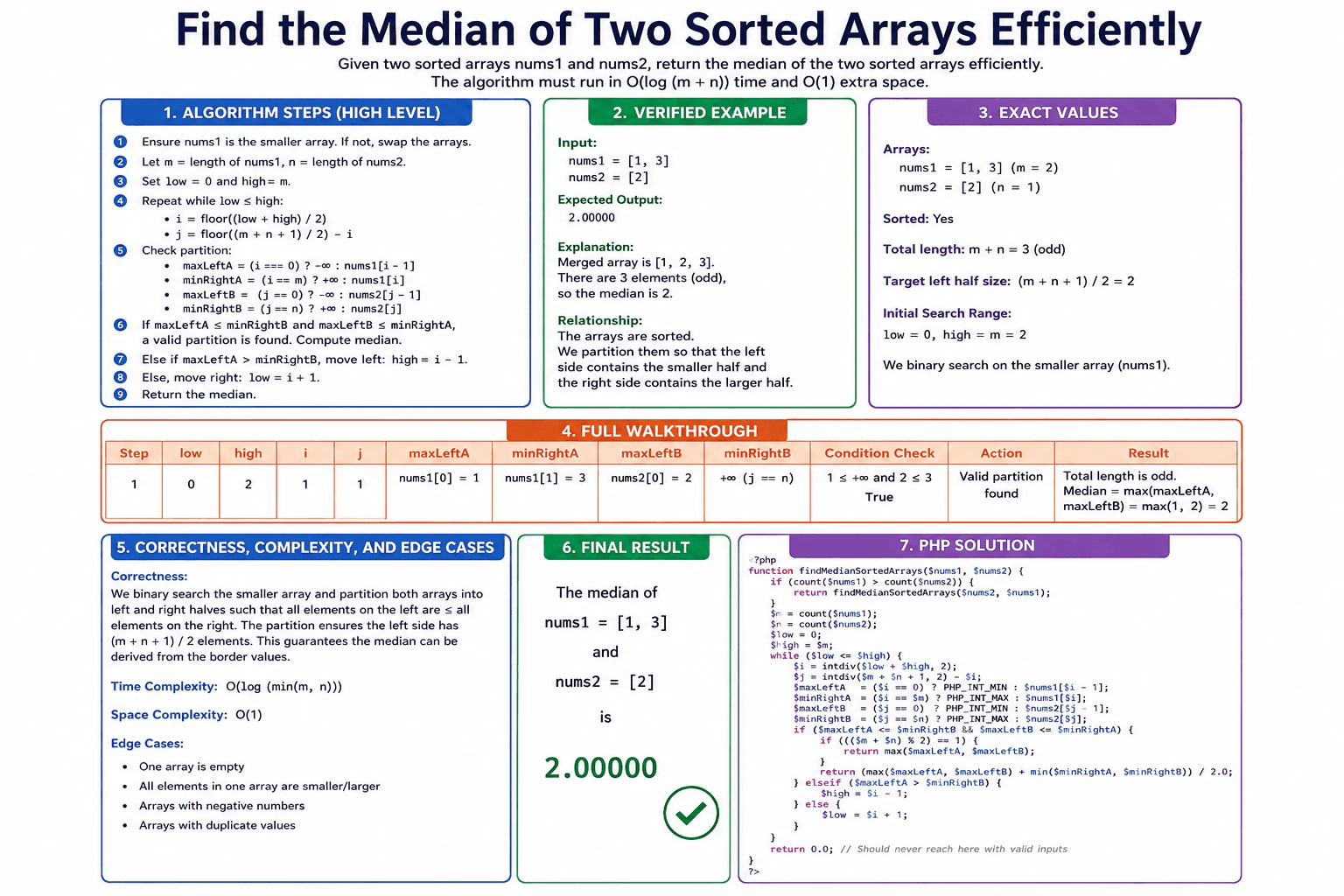
For nums1 = [1, 3] and nums2 = [2], we have m = 2, n = 1, low = 0, high = 2. The first split gives i = 1 and j = 1. The border values are maxLeftA = 1, minRightA = 3, maxLeftB = 2, and minRightB = +infinity. The check is true because 1 <= +infinity and 2 <= 3. So the partition is valid. The total length is odd, so the median is max(1, 2) = 2.
5. Explain why the result is correct
The split is correct only when every value on the left side is less than or equal to every value on the right side. That means the middle value must be on the border of the split. For odd total length, the median is the largest value on the left side. For even total length, it is the average of the two middle border values.
6. Explain the PHP implementation
The code first swaps the arrays if nums1 is larger. That keeps the binary search short. Then it sets low and high for the cut position in nums1. Inside the loop, it computes i and j, reads the four border values, checks the partition, and moves left or right when needed. If the partition is valid, it returns the median right away.
7. Explain complexity and edge cases
The search runs on the smaller array, so the time is O(log(min(m,n))). The code uses only a few variables, so the extra space is O(1). The main edge cases are an empty array, duplicate values, negative values, and one array being much smaller than the other.
Key Insight / Why This Solution Works
The key insight is that the arrays are already sorted, so we only need the correct partition, not a full merge. We search for a cut in the smaller array. The other cut is chosen so the left side always has (m + n + 1) / 2 values. The invariant is simple: when the partition is valid, maxLeftA <= minRightB and maxLeftB <= minRightA. That means every left value is less than or equal to every right value. Then the median is easy to read from the border values.
Code
<?phpfunctionfindMedianSortedArrays(array$nums1, array$nums2): float{
// Make nums1 the smaller array so the binary search stays short.if (count($nums1) > count($nums2)) {
returnfindMedianSortedArrays($nums2, $nums1);
}
$m = count($nums1);
$n = count($nums2);
$low = 0;
$high = $m;
while ($low <= $high) {
// Cut point in the smaller array.$i = intdiv($low + $high, 2);
// Cut point in the other array so the left side has the right size.$j = intdiv($m + $n + 1, 2) - $i;
// Border values around the cut. Use sentinels at the edges.$maxLeftA = ($i == 0) ? PHP_INT_MIN : $nums1[$i - 1];
$minRightA = ($i == $m) ? PHP_INT_MAX : $nums1[$i];
$maxLeftB = ($j == 0) ? PHP_INT_MIN : $nums2[$j - 1];
$minRightB = ($j == $n) ? PHP_INT_MAX : $nums2[$j];
// Check whether every value on the left is <= every value on the right.if ($maxLeftA <= $minRightB && $maxLeftB <= $minRightA) {
// Odd total length: the median is the biggest value on the left.if ((($m + $n) % 2) == 1) {
return (float) max($maxLeftA, $maxLeftB);
}
// Even total length: average the two middle border values.return (max($maxLeftA, $maxLeftB) + min($minRightA, $minRightB)) / 2.0;
} elseif ($maxLeftA > $minRightB) {
// The cut in nums1 is too far right. Move left.$high = $i - 1;
} else {
// The cut in nums1 is too far left. Move right.$low = $i + 1;
}
}
// Defensive fallback; the stated problem guarantees a solution.return0.0;
}
// Example from the diagram:// $result = findMedianSortedArrays([1, 3], [2]);// echo number_format($result, 5, '.', '') . PHP_EOL; // 2.00000?>
Time & Space Complexity
We only search the smaller array, so the loop behaves like binary search. That is why the running time grows like the log of the smaller length. The code does not build a merged list. It keeps only a few numbers and indexes in memory. So the extra memory stays constant. In simple words, this is O(log(min(m,n))) time and O(1) extra space.
Where it is used
This pattern is useful when two sorted data sources already exist and you need the middle value quickly without merging them. It is common in analytics, ranking systems, and any place where sorted numeric data arrives from two places.
Why Interviewers Ask This
The interviewer wants to see if you can turn a sorting-style problem into a partition problem. They are checking whether you can choose the smaller array, keep the cut invariant, and read the median from border values. They also want to hear correct complexity words and see that you can handle edge cases like empty arrays and duplicate values without mixing up indices.
Common interview mistakes
A common mistake is to merge both arrays first. That works, but it is slower than the partition method shown in the diagram. Another mistake is to binary search the bigger array instead of the smaller one. That makes the search longer than needed. A third mistake is mixing up indices and values when reading the border elements. Another easy error is using the wrong border check or the wrong average formula for even length. A final mistake is forgetting the edge sentinels when the cut is at the start or end of an array.
Interview tip
Say the invariant out loud: the left side always has the right size, and every left value must be less than or equal to every right value.
Interviewer may ask next
What changes if one array can be empty?
The same partition logic still works. The sentinel values at the edges handle the empty side, so the median comes from the other array or from the average of its middle values.
What changes if we want the two middle values instead of their average when the total length is even?
The partition logic stays the same. After finding the valid cut, return the two border values instead of averaging them. The time and space complexity do not change.
3. Design an API rate limiter.API DesignHardGoogle
i Question Details
Design an API rate limiter suitable for a distributed production environment.
Short Interview Answer (30-60 seconds)
At a high level, I would protect the backend with a central rate limiter behind the API Gateway. The client sends an HTTPS request to the gateway, which handles authentication, authorization, routing, and request validation. The gateway asks the limiter for a decision. The limiter reads the configured policy and atomically checks and updates the key’s counter in Redis. Allowed requests reach the backend and return normally. Rejected requests return 429 Too Many Requests. The main trade-off is consistent shared enforcement versus added latency and dependence on Redis.
Detailed Explanation
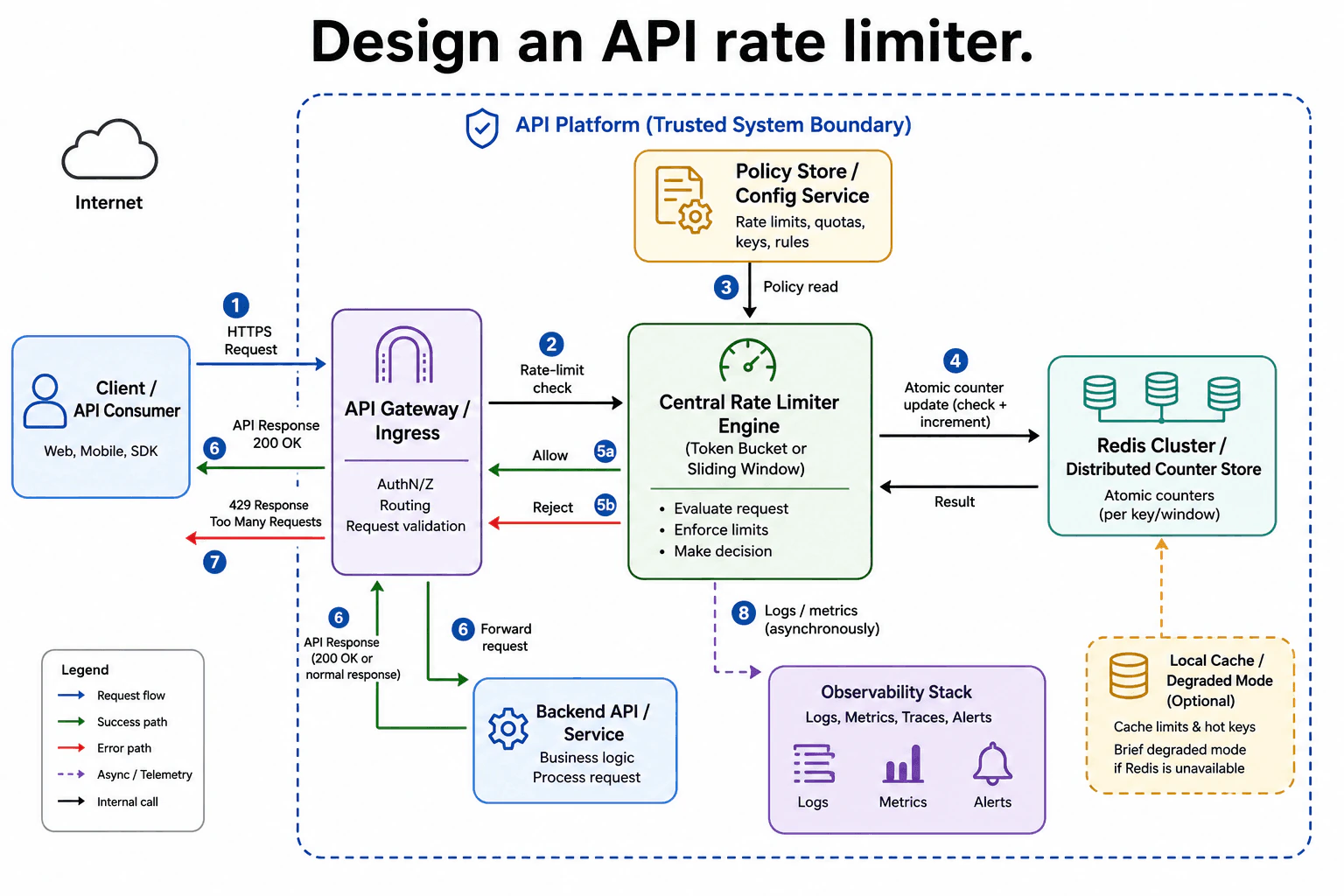
This question asks us to stop a client from sending too many requests. The goal is to protect the backend and control API usage fairly. The difficult part is that requests may reach different servers at the same time. Every request must follow the same rule and update shared usage safely. The diagram solves this with an API Gateway, a Central Rate Limiter Engine, a Policy Store, and a Redis Cluster. I would ask the interviewer:
Useful Questions to Ask the Interviewer
What limit and time window should we enforce?
Are short request bursts acceptable?
Should Redis failure reject traffic or use a brief fallback?
How much extra request latency is acceptable?
How to Explain It in an Interview
1. Define the trusted API boundary
I would begin by separating the external client from the trusted API platform. The client may be a web application, mobile application, or SDK. It sends an HTTPS request to the API Gateway or ingress component.
The gateway owns authentication, authorization, routing, and request validation. It also coordinates the rate-limit check before the backend receives the request.
2. Ask the limiter for a decision
The API Gateway sends an internal rate-limit check to the Central Rate Limiter Engine. The diagram does not show a literal HTTP route or request body. Therefore, I would describe this as an internal service contract instead of inventing an endpoint.
The limiter owns the final decision. It evaluates the request, enforces the configured limit, and returns either allow or reject to the gateway.
3. Read the configured policy
The Central Rate Limiter Engine reads the applicable rule from the Policy Store or Config Service. This store contains rate limits, quotas, keys, and rules.
The policy tells the limiter which limit and time window apply to the key. Keeping policy separate makes rules easier to manage. It also keeps configuration ownership outside the gateway.
4. Check and update shared state
The limiter sends an atomic counter check and update to the Redis Cluster. Atomic means the check and update act as one safe operation. Concurrent requests cannot all read the same old count and pass incorrectly.
Redis stores counters for each key and time window. It returns the result to the limiter. The limiter applies the policy and chooses allow or reject.
The diagram supports either a token bucket or sliding window algorithm. A token bucket permits controlled bursts. A sliding window measures traffic over the most recent period.
5. Follow the allowed path
If the request is under the limit, the limiter returns allow to the API Gateway. The gateway forwards the request to the Backend API or service.
The backend performs its business logic and returns the API response to the gateway. The gateway then sends that response back to the client. The diagram shows a 200 OK or another normal successful response.
The request and response are separate flows. The request travels toward the backend. The response returns from the backend through the gateway to the client.
6. Follow the rejected path
If the request exceeds the limit, the limiter returns reject to the API Gateway. The gateway does not forward the request to the backend.
Instead, the gateway returns 429 Too Many Requests to the client. This protects backend capacity and clearly explains why the request was rejected.
7. Explain observability and degraded mode
The rate limiter sends logs and metrics asynchronously to the Observability Stack. The stack supports logs, metrics, traces, and alerts. This side flow is separate from the synchronous business response.
If Redis is unavailable, the diagram shows an optional local cache or degraded mode. The limiter may briefly use cached information for hot keys. This improves availability, but separate limiter instances may temporarily disagree about counts.
A stricter design can reject requests when reliable shared state is unavailable. This protects the backend, but valid callers may also be rejected. The correct choice depends on whether protection or availability is more important.
Practical Complexity & Trade-offs
The benefit of this design is consistent enforcement. Every gateway asks the same rate-limiting layer, and Redis stores shared counters for all requests. Atomic updates reduce race conditions during heavy traffic. The downside is extra work in the request path. The gateway calls the limiter, and the limiter calls Redis, which adds latency. Redis also becomes an important dependency. A local fallback cache can improve availability, but different limiter instances may temporarily hold different counts. Rejecting traffic during a Redis outage is safer, but it may block valid callers. A token bucket supports controlled bursts. A sliding window gives smoother enforcement but may require more storage or processing. We accept this complexity because predictable limits protect the backend.
Why Interviewers Ask This
Interviewers use this question to test distributed-system judgment rather than memorized algorithms. They want to see clear ownership between the gateway, limiter, policy store, Redis, backend, and observability system. They also evaluate whether the candidate understands atomic updates, shared state, request and response direction, 429 behavior, failure choices, scaling, and latency trade-offs. A strong answer explains normal traffic and degraded behavior without promising perfect consistency or unlimited scale.
Interviewer may ask next
What should happen if the Redis Cluster becomes unavailable?
I would keep the gateway, limiter, policy store, backend, and response paths unchanged. Only the limiter’s distributed-counter path would enter degraded mode. The diagram allows a brief local cache for hot keys. The limiter could temporarily use recently cached information while Redis recovers.
This keeps some valid traffic moving, but correctness becomes weaker. Different limiter instances may hold different local counts. A caller could temporarily receive more requests than the shared policy allows.
For a stricter API, I would fail closed instead. The limiter would return reject because it cannot safely verify the shared counter. The API Gateway would then return 429 Too Many Requests and would not call the backend. This protects the service from uncontrolled traffic.
The main trade-off is availability versus protection. Local fallback improves availability but weakens global consistency. Failing closed preserves protection but may reject valid callers. I would monitor degraded mode through the existing logs, metrics, traces, and alerts.
How would you choose between token bucket and sliding window limiting?
I would keep every component and request flow unchanged. Only the counting logic inside the Central Rate Limiter Engine would change. The Policy Store would still provide the rules, and Redis would still hold the shared counter state.
With a token bucket, tokens are added at a configured rate. Each accepted request consumes a token. Saved tokens allow a controlled burst, while the refill rate controls long-term traffic.
With a sliding window, the limiter measures requests within the most recent time period. This gives smoother enforcement near time boundaries and avoids the sharp boundary behavior of a simple fixed window.
Both algorithms still return allow or reject to the gateway. Rejected requests still produce 429 Too Many Requests, and allowed requests still continue to the backend.
The token bucket is useful when short bursts are acceptable. A sliding window may be fairer, but it can require more storage or more expensive Redis operations. I would choose based on burst tolerance, latency, and required accuracy.
4. Define the API for an inventory management system.API DesignHardGoogle
i Question Details
Define the API operations and contracts needed to read inventory, update stock, and preserve consistency during concurrent changes.
Short Interview Answer (30-60 seconds)
At a high level, I would design the API around safe inventory reads and version-checked stock changes. Client Apps authenticate with the Identity Provider, receive a JWT, and call the Inventory API over HTTPS. Reads use GET /inventory/{sku} or GET /inventory?location=. Updates use PATCH /inventory/{sku}/stock or POST /stock-adjustments. Each write sends the last known version through If-Match. The database updates only when that version still matches. This prevents lost updates, but clients must handle 409 Conflict by reading the latest record and retrying.
Detailed Explanation
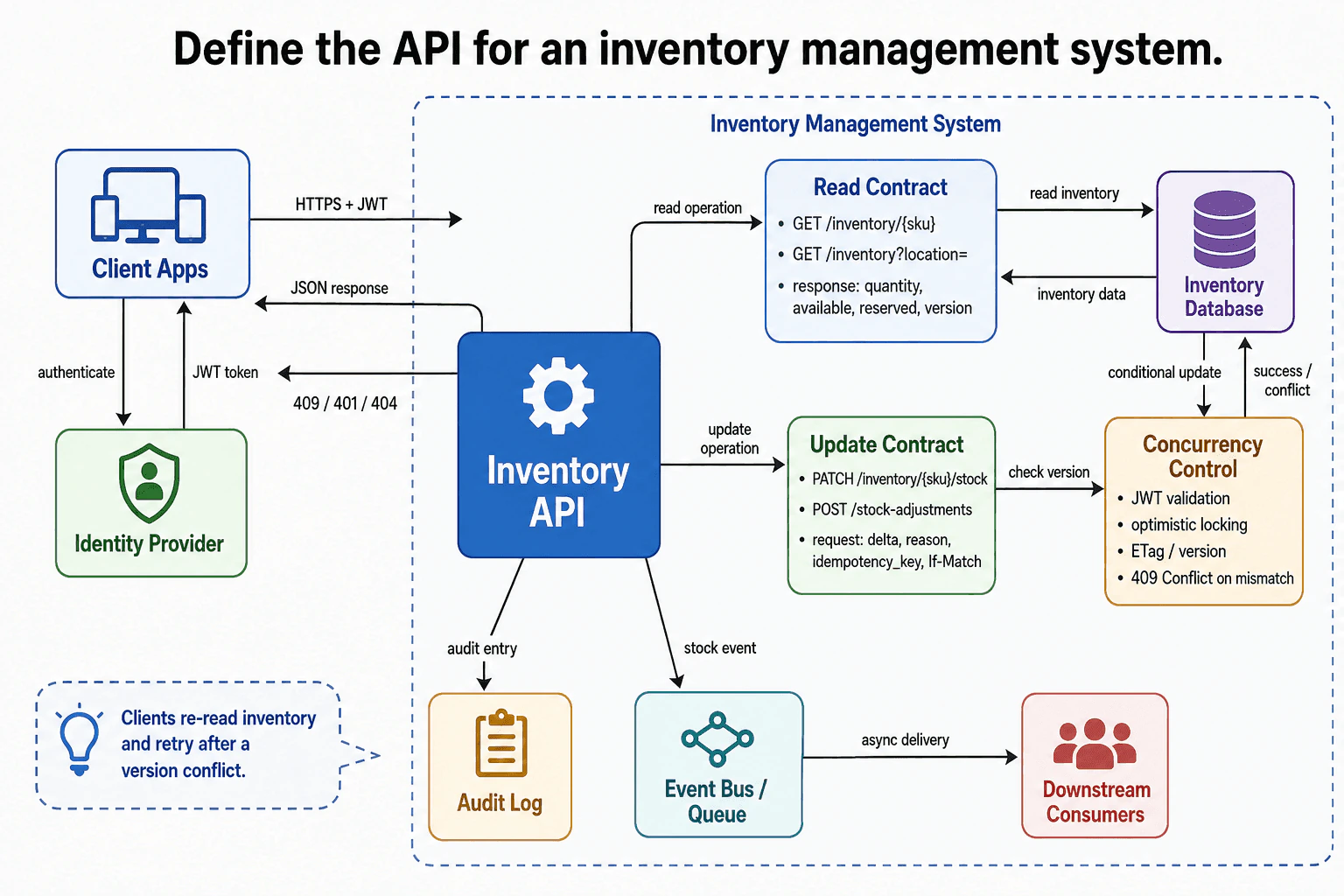
This system lets applications check stock and change it without losing another user's work. The main problem appears when two clients read the same item and then update it at nearly the same time. The design must keep the final stock value correct. It must also identify callers, return clear errors, record accepted adjustments, and notify other systems. I would explain the solution in the same order as the diagram, starting with the client and identity flow, then covering reads, updates, version checks, logging, events, and failures.
Useful Questions to Ask the Interviewer
Is inventory stored separately for each location?
Must every adjustment include a reason?
How often do updates conflict?
Which systems consume stock events?
How to Explain It in an Interview
1. Start with authentication and the API boundary
I would begin with the Client Apps. They first authenticate with the Identity Provider. The Identity Provider returns a JWT token. A JWT is a signed token that identifies the caller. The client then sends an HTTPS request with that JWT to the Inventory API. HTTPS protects the request while it travels over the network. The Inventory Management System boundary contains the Inventory API, read and update contracts, concurrency control, the database, the Audit Log, and the Event Bus or Queue.
2. Define the inventory read contracts
For one product, I would use GET /inventory/{sku}. The sku path value identifies the item. For inventory at a location, I would use GET /inventory?location=. The Inventory API routes the call to the Read Contract. The Read Contract sends a read inventory request to the Inventory Database. The database returns inventory data to the Read Contract. The response contains quantity information, including available stock, reserved stock, and the current version. The Inventory API returns the result to the Client Apps as JSON. If the requested inventory is not found, the API returns 404.
3. Define the stock update contracts
For a direct stock change, I would use PATCH /inventory/{sku}/stock. For a separate adjustment action, I would use POST /stock-adjustments. The request contains a delta, a reason, an idempotency_key, and an If-Match value. The delta states how much the stock changes. The reason explains the business cause. The idempotency key helps the API recognize a repeated write request. If-Match carries the record version that the client last read.
4. Preserve consistency during concurrent changes
The Inventory API routes the write to the Update Contract. The Update Contract sends the version check to Concurrency Control. This component validates the JWT for the protected operation and uses optimistic locking. Optimistic locking means clients may read freely, but every write must prove that the record has not changed. Concurrency Control compares the If-Match value with the current ETag or version. It sends a conditional update to the Inventory Database. If the versions match, the database updates the record and returns success. If they differ, it returns a conflict result.
5. Return failures and retry safely
The visible error responses are 401, 404, and 409. A 401 means authentication is missing or invalid. A 404 means the requested inventory was not found. A 409 means the write used an old version. After a 409, the client reads the inventory again, reviews the latest state, and retries with the new version. The idempotency key prevents a retried adjustment request from being applied twice.
6. Record accepted work and publish events
After an accepted stock operation, the Inventory API sends an audit entry to the Audit Log. The Audit Log records the adjustment, but it does not control the business response. The Inventory API also sends a stock event to the Event Bus or Queue. The queue delivers the event asynchronously to Downstream Consumers. This keeps downstream work outside the synchronous request and response path.
7. Explain the trade-off
The main benefit is protection against lost updates without locking every record during reads. The downside is that clients must understand versions and handle conflicts. When many writers update the same item, some requests may need an extra read and retry. The design accepts that cost because correct inventory is more important than making every write succeed immediately.
Practical Complexity & Trade-offs
The benefit of this design is clear responsibility. The Identity Provider issues the JWT. The Inventory API receives HTTPS requests and routes each operation. The Read Contract handles reads. The Update Contract and Concurrency Control protect writes. The database stores stock values and the current version. The Audit Log records accepted adjustments. The Event Bus or Queue sends stock events to other systems. Version checking is safer than blindly overwriting data because it prevents lost updates. The downside is extra client work. Clients must save the version and handle 409 Conflict. Idempotency keys make retries safer, but the server must remember which write requests were already accepted. Asynchronous events keep the main response simple, but downstream systems receive changes later.
Why Interviewers Ask This
Interviewers use this question to test engineering judgment rather than endpoint memorization. They want to see whether the candidate can separate reads from writes, choose suitable HTTP methods, model request and response directions, and protect shared data during concurrent changes. They also evaluate authentication, idempotency, status codes, audit logging, asynchronous events, and trade-off communication. A strong answer explains both how the design works and why each decision protects inventory correctness.
Interviewer may ask next
How would the design behave when many clients update the same SKU at once?
I would keep the same optimistic locking design, but I would expect more 409 Conflict responses. Every client first reads the record through GET /inventory/{sku} and receives its current version. The client then sends PATCH /inventory/{sku}/stock or POST /stock-adjustments with that version in If-Match. Concurrency Control compares the supplied version with the version stored in the Inventory Database. The first valid conditional update succeeds and changes the record version. Other requests that still carry the old version fail with 409. Those clients must read the latest inventory and decide whether their change is still valid before retrying. The idempotency_key remains important because a network retry must not apply one accepted adjustment twice. The Audit Log and stock event are created only for an accepted stock operation. The main downside is higher latency and more database reads during heavy contention. However, this preserves the correct stock value and avoids silent lost updates.
What should happen if a downstream consumer is temporarily unavailable?
The main inventory request should remain independent from that consumer. The Inventory API still performs the version-checked database update, returns the normal JSON result, records the audit entry, and sends the stock event to the Event Bus or Queue. The unavailable Downstream Consumer does not sit in the synchronous response path, so it should not make the accepted inventory update fail. The queue keeps the event available for later asynchronous delivery according to its delivery behavior. The Inventory API endpoints and concurrency rules do not change. GET /inventory/{sku}, GET /inventory?location=, PATCH /inventory/{sku}/stock, and POST /stock-adjustments continue to use the same contracts. The main benefit is better separation between inventory correctness and downstream processing. The downside is delay. A consumer may act on the stock change later than the API response. The system must therefore accept temporary differences between the database state and what downstream consumers have processed.
5. Define the interfaces between a central HR system and multiple local HR systems.API DesignHardGoogle
i Question Details
Define the integration interfaces for synchronizing data securely between a central HR system and multiple local HR systems.
Short Interview Answer (30-60 seconds)
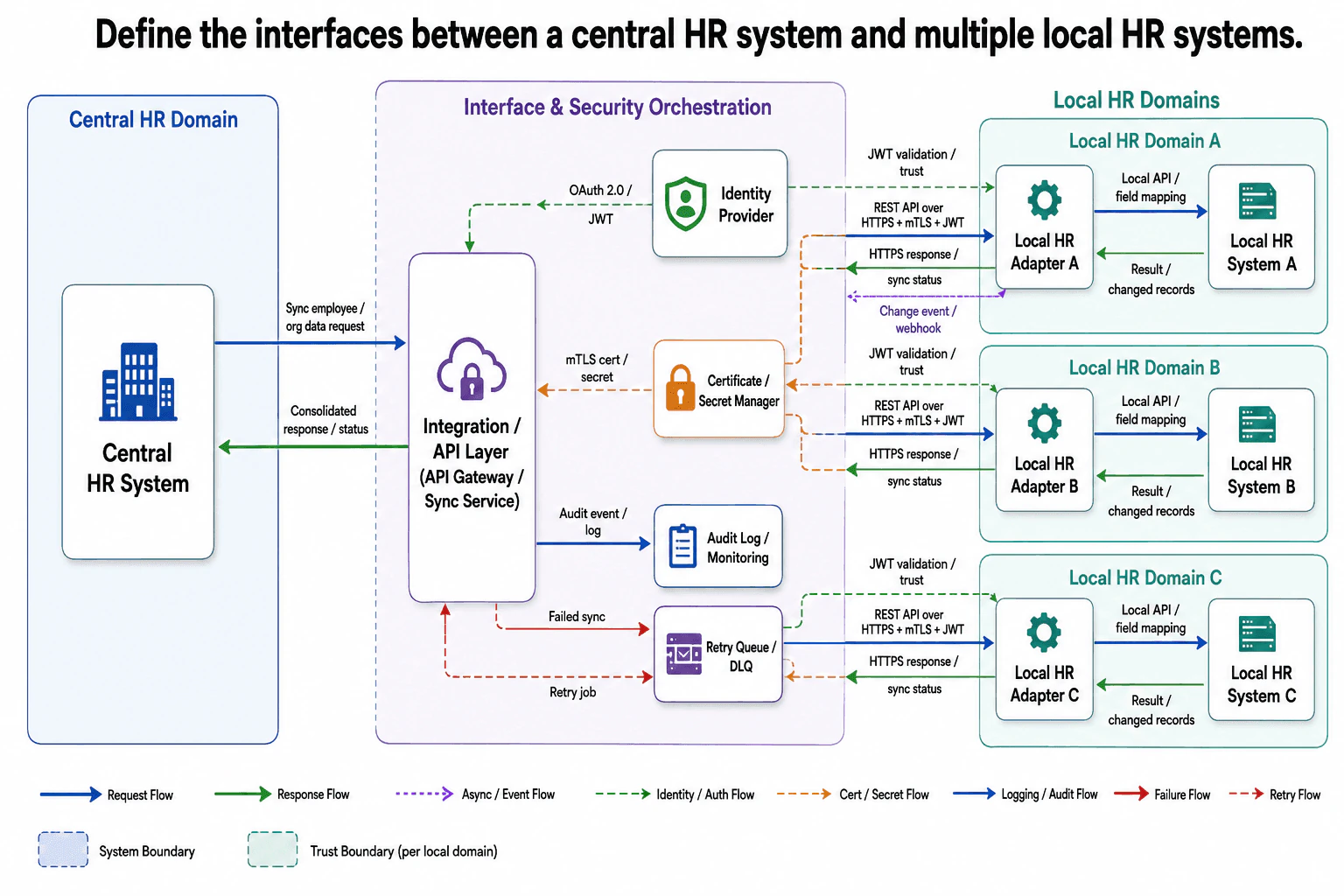
At a high level, I would place an Integration / API Layer between the Central HR System and each local HR domain. The central system sends an employee or organization data request to this layer. The layer calls each Local HR Adapter through REST over HTTPS, mTLS, and JWT. Each adapter maps the shared data to its Local HR System and returns the synchronization status. The Identity Provider, Certificate / Secret Manager, audit logging, webhook flow, and Retry Queue / DLQ support security and reliability. The trade-off is stronger isolation with more components to operate.
Detailed Explanation
The goal is to let one central HR system exchange employee and organization information with several local HR systems. Each local system may use different fields and rules. The central system should not need to understand those differences. The design therefore uses one shared integration layer and one adapter for each local system. It must also protect sensitive HR data, record important activity, accept local change notifications, and handle failed synchronization work. I will explain the components and flows in the same order shown in the diagram.
Useful Questions to Ask the Interviewer
Is the Central HR System the main source of truth?
Which data can local systems change?
How quickly must each synchronization finish?
How should partial failures be reported?
How to Explain It in an Interview
1. Set the system boundaries
I would first separate the Central HR Domain from the local HR domains. The Central HR System owns the main employee and organization synchronization request. The Interface & Security Orchestration area contains the Integration / API Layer and its supporting services. Each local domain contains one Local HR Adapter and one Local HR System. This keeps local formats and local rules outside the central contract.
2. Start the central request
The Central HR System sends a sync employee or organization data request to the Integration / API Layer. This layer acts as the API gateway and synchronization service. It gives the central system one stable integration point. The central system does not call Local HR Systems directly. This reduces coupling and makes the central design easier to maintain.
3. Apply identity and connection security
The Identity Provider supplies the OAuth 2.0 and JWT trust used by the Integration / API Layer. A JWT is a signed token that identifies the calling system. The diagram also shows JWT validation and trust flowing to every Local HR Adapter. The Certificate / Secret Manager supplies the mTLS certificate or secret used by the integration layer. It also supplies client certificates or secrets to the local adapters. mTLS encrypts the connection and lets the communicating systems verify each other. The Certificate / Secret Manager stores or supplies these values; the diagram does not show it issuing certificates.
4. Call each Local HR Adapter
The Integration / API Layer sends a separate REST API request to each Local HR Adapter. The connection uses HTTPS, mTLS, and JWT. Each adapter owns local field mapping. It converts the shared employee or organization data into the format understood by its Local HR System. The adapter then calls the Local HR System through its local API. This adapter pattern keeps vendor-specific names and rules inside each local domain.
5. Return local results to the central system
Each Local HR System returns results or changed records to its Local HR Adapter. The adapter maps that result into the shared integration format. It then returns an HTTPS response and synchronization status to the Integration / API Layer. The integration layer combines the local outcomes. It sends a consolidated response and status back to the Central HR System. The request and response paths remain separate and point in opposite directions.
6. Process local change events
Local HR Adapter A also sends a change event or webhook to the Integration / API Layer. A webhook is an asynchronous notification sent when local data changes. This is separate from the normal synchronous REST request and response path. It allows a local domain to report a change without waiting for the central system to start another request.
7. Record failures and retry work
The Integration / API Layer sends audit events and logs to Audit Log / Monitoring. This system records activity but does not create the business response. When synchronization fails, the integration layer sends failed work to the Retry Queue / DLQ. The diagram also shows a dashed retry-job connection between the queue and integration layer. This represents retry processing for failed work. The main benefit is better recovery. The downside is extra operational complexity and the risk of repeating an update, so retry processing should recognize work that was already completed.
Practical Complexity & Trade-offs
The benefit is that the Central HR System uses one shared interface. Each Local HR Adapter hides the special fields and rules of one Local HR System. This makes local changes easier to contain. HTTPS protects data in transit. mTLS verifies both sides of the connection, while JWT trust identifies the calling system. Using both controls reduces risk, but certificates, tokens, and secrets require careful operation. Audit logging helps teams investigate synchronization problems. The webhook flow improves data freshness because a local system can report changes. The Retry Queue / DLQ keeps failed work for later processing. The downside is more moving parts and possible repeated updates during retries. We accept this complexity because HR data is sensitive and the local systems are different.
Why Interviewers Ask This
Interviewers ask this question to test whether a candidate can define clear integration boundaries and correct request and response flows. They want to see whether local differences are isolated behind adapters. They also evaluate security ownership, including JWT trust, mTLS, and secret handling. A strong answer separates synchronous calls, asynchronous webhooks, audit logging, and retry processing. The interviewer is mainly testing engineering judgment, failure handling, and the ability to explain trade-offs clearly.
Interviewer may ask next
What happens when one Local HR System is temporarily unavailable?
I would keep the same interfaces and use the existing failure path. The Integration / API Layer would send the normal REST request over HTTPS with mTLS and JWT to the affected Local HR Adapter. If the adapter or its Local HR System cannot complete the work, the integration layer would record the failure and send the failed synchronization work to the Retry Queue / DLQ. The other local domains could continue through their normal request and response paths. The consolidated response returned to the Central HR System should show that one local synchronization did not complete. Audit Log / Monitoring would receive the related activity for investigation. Retry processing would later move the failed work through the integration layer again. The same JWT trust and mTLS checks still apply during that attempt. The main downside is temporary inconsistency between the central and local systems. Retry processing may also repeat an update, so the worker should recognize work that has already succeeded.
How are changes that begin inside a local HR domain handled?
I would use the change event or webhook flow shown from Local HR Adapter A to the Integration / API Layer. The Local HR System first returns its changed records to the adapter. The adapter performs local field mapping and creates the shared change notification. It then sends the webhook to the integration layer as a separate asynchronous flow. The normal REST request and HTTPS response interfaces remain unchanged. The adapter still uses its established JWT trust and client certificate or secret. The integration layer records the event through Audit Log / Monitoring and processes it using the shared synchronization rules. If that processing fails, the existing Retry Queue / DLQ can hold the failed work for retry handling. The main benefit is faster propagation of locally initiated changes. The downside is that asynchronous notifications may arrive late or more than once. The processing logic must therefore avoid applying the same change repeatedly while preserving the original component boundaries.
6. Define the query API for a large-scale search autocomplete system.API DesignHardGoogle
i Question Details
Define the request and response contract for a low-latency autocomplete service used by a large-scale search engine.
Short Interview Answer (30-60 seconds)
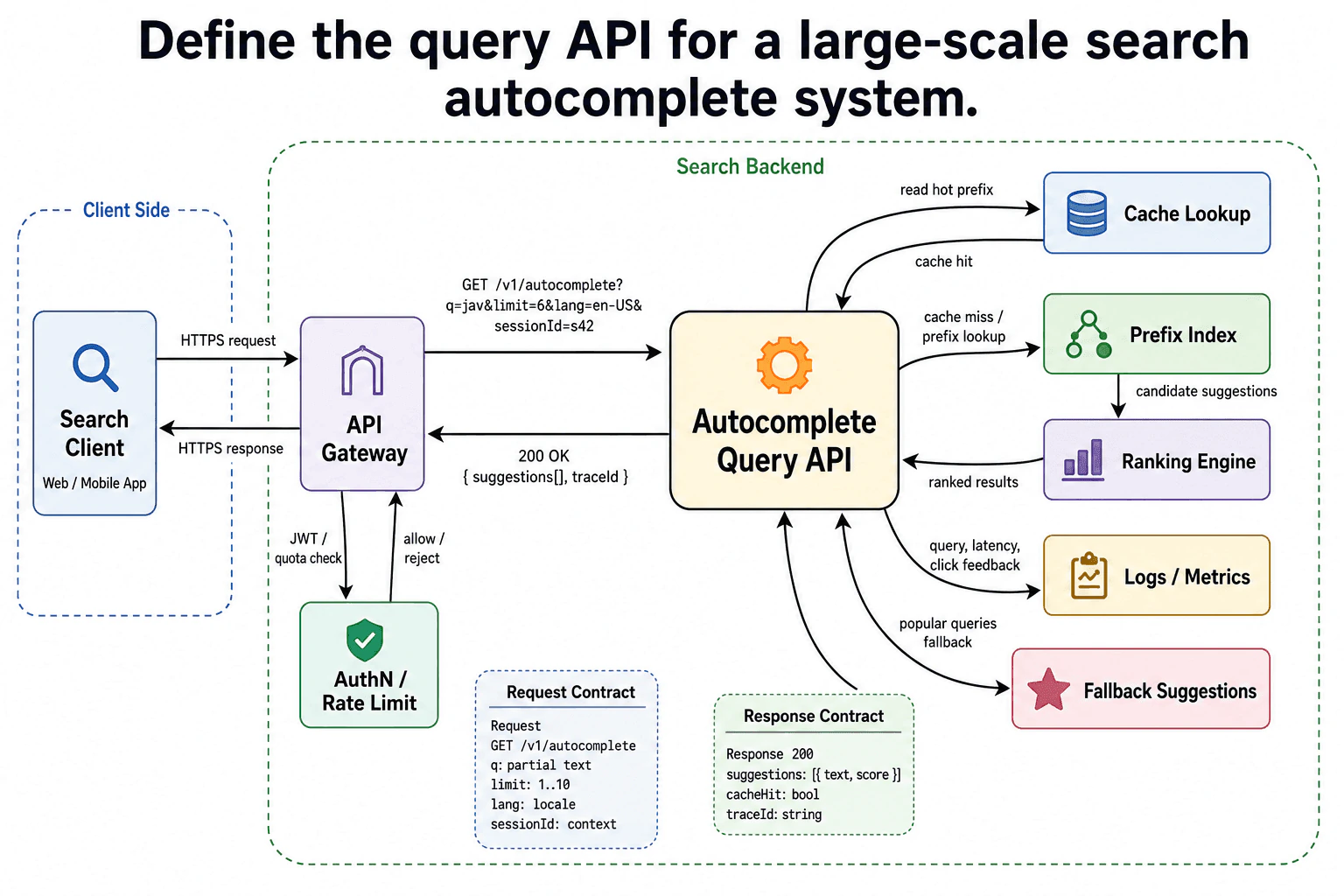
At a high level, I would expose one low-latency endpoint: GET /v1/autocomplete. The Search Client sends partial text, a result limit, a language, and session context through the API Gateway. The gateway uses AuthN / Rate Limit to check the JWT and quota before forwarding the request. The Autocomplete Query API checks the cache first, then uses the Prefix Index and Ranking Engine when needed. It returns scored suggestions, cache status, and a trace ID. The trade-off is faster responses through caching, with some risk of older suggestions.
Detailed Explanation
We are building a service that suggests complete search phrases while someone is typing. It must respond quickly because a new request may arrive after every letter. The service receives partial text, finds useful matches, ranks them, and returns a small list. It must also protect the backend from untrusted or excessive traffic. I would explain the design by following the attached diagram from the Search Client, through the API Gateway and Autocomplete Query API, and then back to the client.
Useful Questions to Ask the Interviewer
What latency target should the API meet?
What is the maximum number of suggestions per request?
Should results depend on language and session context?
How fresh must cached suggestions be?
When should popular fallback suggestions be used?
How to Explain It in an Interview
1. Define the public request contract
I would start with the client-facing endpoint. The Search Client sends an HTTPS request to GET /v1/autocomplete. The q parameter contains the partial text. The limit parameter controls the number of returned suggestions, with the diagram showing a range from 1 to 10. The lang parameter identifies the locale. The sessionId provides request context. One example shown is GET /v1/autocomplete?q=jav&limit=6&lang=en-US&sessionId=s42.
2. Validate the request at the gateway
The HTTPS request first reaches the API Gateway. The gateway sends a JWT / quota check to AuthN / Rate Limit. A JWT is a signed token that identifies the caller. The quota check limits how much traffic the caller may send. AuthN / Rate Limit returns either allow or reject. A rejected request does not reach the search service. An allowed request continues to the Autocomplete Query API.
3. Check Cache Lookup first
The Autocomplete Query API coordinates the search. It first sends read hot prefix to Cache Lookup. The cache stores suggestions for frequently requested prefixes. When the cache contains the prefix, it returns a cache hit result to the query API. This is the fastest path because the service avoids searching the larger index. The response contract includes cacheHit, so the result records whether this path was used.
4. Search the Prefix Index on a cache miss
If the cache does not contain the prefix, the query API sends a cache miss / prefix lookup request to Prefix Index. Prefix Index finds candidate suggestions that begin with the supplied text. It then sends candidate suggestions to Ranking Engine. The index owns fast prefix matching. It does not decide the final order.
5. Rank the candidates
Ranking Engine orders the candidate suggestions by usefulness. It returns ranked results to the Autocomplete Query API. The query API selects the requested top results based on the limit value. Keeping ranking separate from prefix matching makes both responsibilities easier to change and scale independently.
6. Use fallback suggestions and record metrics
Fallback Suggestions provides popular queries as a supporting path when the normal lookup cannot provide useful results. It is not the main request path. The Autocomplete Query API also sends query information, latency, and click feedback to Logs / Metrics. This is a side flow for monitoring and quality analysis. Logs / Metrics does not create or return the business response.
7. Return the response
The Autocomplete Query API sends the result back to the API Gateway. The visible success status is 200 OK. The response contains suggestions, where each item has text and score. It also contains cacheHit and traceId. The trace ID connects the client response with backend logs. The gateway then returns the HTTPS response to the Search Client.
The benefit of this design is low latency for common prefixes. The downside is added operational complexity. The cache, index, ranking system, fallback data, and metrics must all be maintained. Cached results may also be less fresh than index results.
Practical Complexity & Trade-offs
The main performance choice is to check Cache Lookup before Prefix Index. The benefit is a very fast answer for common prefixes. The downside is that cached suggestions may be older than the latest index data. Separating Prefix Index from Ranking Engine lets each part focus on one job and scale independently. However, it creates more components and network calls. The API Gateway protects the backend by using AuthN / Rate Limit for JWT and quota checks. This reduces abuse, but it adds a small amount of latency. Fallback Suggestions improves reliability when the normal path has no useful result, but popular suggestions may be less relevant. Logs, latency data, click feedback, cache status, and trace IDs improve troubleshooting, but they also add storage and operational cost.
Why Interviewers Ask This
Interviewers ask this question to test whether a candidate can define a clear API contract and trace request and response flows correctly. They also evaluate decisions about latency, caching, prefix search, ranking, rate limits, fallback behavior, and observability. A strong answer assigns each responsibility to the correct component and explains practical trade-offs. The goal is not memorizing one architecture. It is showing clear engineering judgment and communication.
Interviewer may ask next
What happens if Cache Lookup becomes unavailable during a traffic spike?
I would keep the same public endpoint and use the existing cache-miss path. The affected connection is between Autocomplete Query API and Cache Lookup. When the cache cannot return a result, the query API continues with Prefix Index. Prefix Index returns candidate suggestions to Ranking Engine, and Ranking Engine returns ranked results to the query API. The successful response keeps the same 200 OK contract with suggestions, cacheHit, and traceId. In this case, cacheHit is false. Logs / Metrics should record the cache failure and the higher latency. AuthN / Rate Limit remains unchanged and continues protecting the backend during the spike. Fallback Suggestions remains available when the normal lookup path cannot provide useful results. The main downside is increased load on Prefix Index and Ranking Engine. Response time will also rise because more requests must use the slower path. The existing quota check becomes especially important because it limits pressure on the degraded backend.
How would you improve language-specific suggestions without changing the overall architecture?
I would keep GET /v1/autocomplete and use the existing lang parameter throughout the current flow. The Search Client already sends the language. The API Gateway and AuthN / Rate Limit behavior would remain unchanged. Autocomplete Query API would include both q and lang when reading Cache Lookup. This keeps cached suggestions for different languages separate. On a cache miss, Prefix Index would search the matching language data. Ranking Engine would rank candidates that belong to that locale. Fallback Suggestions would provide popular queries for the same language. The response contract would remain unchanged, including suggestion text, score, cacheHit, and traceId. Logs / Metrics should record the language so latency and result quality can be reviewed by locale. The benefit is more relevant suggestions. The downside is greater storage and operational work because cache entries, index data, ranking signals, and fallback lists must be maintained for every supported language.
7. Define the retrieval API for ranked and personalized email search.API DesignHardGoogle
i Question Details
Given an email corpus, a query, and a user profile, define an API that returns relevant ranked emails and supports personalization.
Short Interview Answer (30-60 seconds)
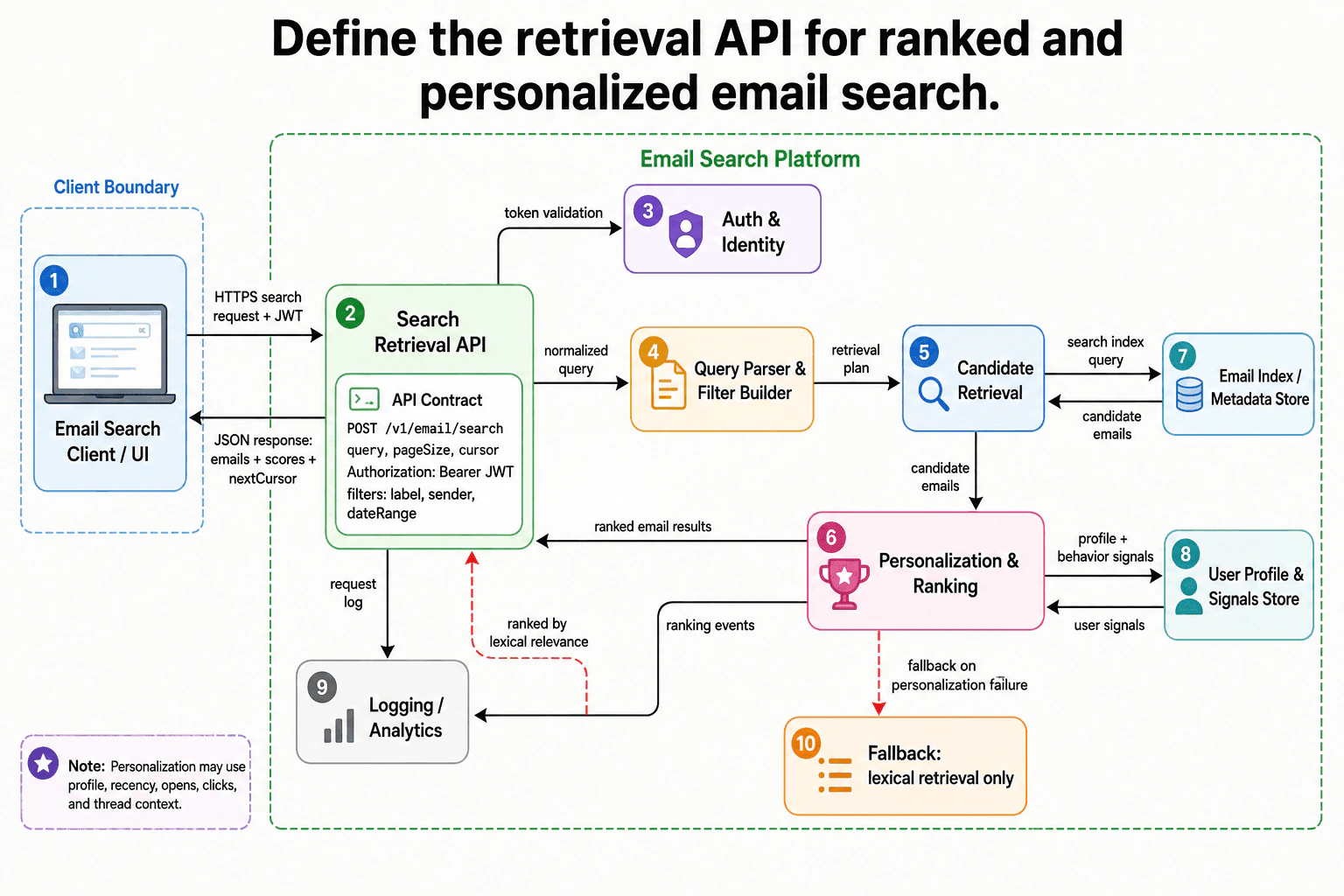
At a high level, I would expose one retrieval endpoint for ranked email search. The client sends an HTTPS request with a bearer JWT to POST /v1/email/search. The Search Retrieval API validates the token, normalizes the query and filters, retrieves matching email candidates, and sends them for personalization and ranking. The ranking step uses profile and behavior signals, then returns ranked emails, scores, and nextCursor. If personalization is unavailable, the system falls back to lexical relevance. This improves availability, but fallback results may be less useful for that user.
Detailed Explanation
We need an API that helps a user find useful emails. The user provides search words and filters. The system finds matching emails and places the best ones first. It may use the user’s profile and recent actions to improve the order. The response must also support more result pages. The main challenge is balancing personal relevance with reliable search. I would follow the diagram from the client request, through identity checking, retrieval, ranking, fallback, and the final response.
Useful Questions to Ask the Interviewer
How large is each user’s email corpus?
Which filters must be supported?
How fresh must behavior signals be?
What latency is acceptable?
Should lexical fallback always return results when personalization fails?
How to Explain It in an Interview
1. Define the client contract and API boundary
I would start with one public endpoint owned by the Search Retrieval API. The Email Search Client / UI sends an HTTPS search request with a JWT to POST /v1/email/search. The request contains query, pageSize, cursor, and filters such as label, sender, and dateRange. The Authorization header carries a bearer JWT. The Search Retrieval API is the main coordinator. It does not store the email corpus or user signals. It calls the components that own those responsibilities.
2. Validate the token
The Search Retrieval API sends the token to Auth & Identity for token validation. This component checks the request’s user identity before the search continues. The diagram does not show a separate authorization policy or permission service, so I would not add one. If token validation does not succeed, the normal retrieval flow should not continue. The exact HTTP error code is not shown, so I would keep the explanation at that level.
3. Normalize the query and build the retrieval plan
After token validation, the Search Retrieval API sends the normalized-query work to the Query Parser & Filter Builder. This component cleans and organizes the search text and filters. It then creates a retrieval plan for Candidate Retrieval. Separating this step keeps query interpretation outside the public API layer. It also lets retrieval receive a consistent plan rather than many different client input forms.
4. Retrieve matching email candidates
The Query Parser & Filter Builder sends the retrieval plan to Candidate Retrieval. Candidate Retrieval sends a search index query to the Email Index / Metadata Store. That store owns the searchable email corpus and its metadata. It returns candidate emails to Candidate Retrieval. This stage finds emails that match the query and filters. It does not perform the final personalized ordering.
5. Personalize and rank the candidates
Candidate Retrieval sends the candidate emails to Personalization & Ranking. This component requests profile and behavior signals from the User Profile & Signals Store. Those signals may include profile information, recency, opens, clicks, and thread context. The store returns user signals to the ranking component. Personalization & Ranking combines search relevance with this user context. It then sends ranked email results back to the Search Retrieval API.
6. Return the response and record supporting events
The Search Retrieval API returns a JSON response to the Email Search Client / UI. The response contains emails, scores, and nextCursor. The cursor lets the client continue to another page without exposing internal index details. The API also sends a request log to Logging / Analytics. Personalization & Ranking sends ranking events there as well. These logging paths support monitoring and analysis. They do not own or delay the business response shown in the main path.
7. Use lexical fallback when personalization fails
If personalization fails, Personalization & Ranking triggers Fallback: lexical retrieval only. This fallback ranks the available candidates using lexical relevance, meaning the relationship between the search words and email content or metadata. It sends results ranked by lexical relevance back to the Search Retrieval API. The API can then complete the normal JSON response. The benefit is continued search availability. The trade-off is that fallback ordering does not use the user’s profile or behavior signals.
Time & Space Complexity
The design separates public API work, candidate retrieval, and final ranking. The benefit is clear ownership. Each part can improve without changing the client contract. The downside is extra service calls, which add latency and operational work. A bearer JWT gives the request a user identity, but the token must be validated before retrieval continues. Cursor pagination keeps each response small and hides internal storage details. Personalization can improve relevance by using profile, recency, opens, clicks, and thread context. However, it depends on the User Profile & Signals Store. The lexical fallback reduces the risk of a complete search failure. Its downside is weaker personalization. Logging helps measure requests and ranking behavior, but it adds storage and monitoring cost. We accept these costs because both result quality and availability matter.
Why Interviewers Ask This
Interviewers use this question to test API boundaries, request and response modeling, and service ownership. They want to see whether the candidate separates query parsing, candidate retrieval, ranking, identity validation, data stores, fallback, and logging. They also evaluate pagination choices, failure handling, and the ability to explain a realistic trade-off. A strong answer follows the full flow clearly without inventing unsupported endpoints, status codes, or infrastructure.
Interviewer may ask next
What happens if Personalization & Ranking or the User Profile & Signals Store is unavailable?
I would keep the same POST /v1/email/search contract and use the fallback shown in the design. The Search Retrieval API would still validate the JWT and send the query through the Query Parser & Filter Builder. Candidate Retrieval would still query the Email Index / Metadata Store and receive matching candidate emails. If Personalization & Ranking cannot obtain or use the profile and behavior signals, it would trigger Fallback: lexical retrieval only. The fallback would rank the candidates using lexical relevance and send those results back to the Search Retrieval API. The API would then return emails, scores, and nextCursor through the existing response path. This maintains correctness because the results still match the user’s query and filters. It also prevents one personalization dependency from making all search unavailable. The main downside is lower ranking quality. The result order may not reflect profile, recency, opens, clicks, or thread context. Logging / Analytics should receive the existing request and ranking-related events so the team can measure fallback usage.
How would you scale this design for a much larger email corpus and higher request volume?
I would keep the public endpoint and response contract unchanged while scaling the components behind the Search Retrieval API. Candidate Retrieval and the Email Index / Metadata Store would need the most capacity because each request performs an index lookup. The index can divide the searchable corpus into partitions, while Candidate Retrieval coordinates the query and combines the candidate set. Personalization & Ranking can run on more service instances because separate search requests can be ranked independently. The User Profile & Signals Store must also support more signal reads with predictable response time. Cursor pagination remains important because it limits response size and avoids returning the complete result set at once. Logging / Analytics should remain a supporting path rather than owning the search response. The lexical fallback should remain available when personalization cannot keep up. The main downside is operational complexity. More partitions and service instances require careful routing, capacity planning, monitoring, and consistent index updates, even though the client sees the same API.
8. Design an autocomplete system for a large-scale search engine.System DesignHardGoogle
Short Interview Answer (30-60 seconds)
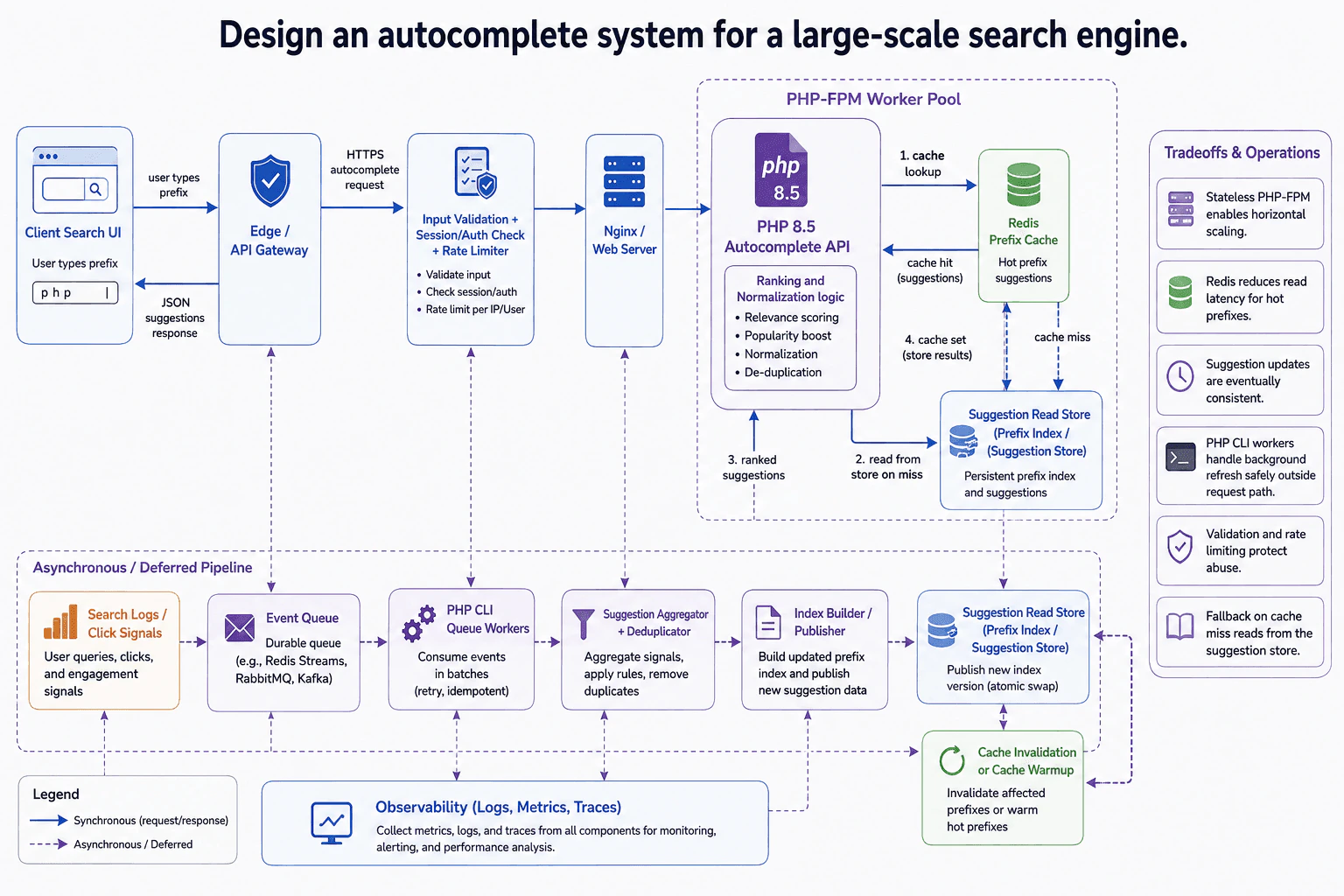
At a high level, this is a read-heavy autocomplete system. The main challenge is returning useful suggestions quickly while new search and click signals keep changing the rankings. I would explain three flows: the normal request path, the cache-miss fallback, and the background update path. PHP-FPM handles stateless requests, Redis serves hot prefixes, and the Suggestion Read Store handles misses. PHP CLI workers rebuild and publish the prefix index later. The trade-off is that suggestion updates appear after a small delay.
Detailed Explanation
The system must suggest useful search terms while a user is still typing. The response must feel immediate, even when many people enter the same popular prefix. At the same time, suggestions should improve as search and click behavior changes. The diagram handles these needs with two connected paths. The first path serves autocomplete requests quickly through PHP-FPM, Redis, and a persistent prefix index. The second path processes search signals in the background and publishes updated suggestion data without slowing the user response.
Useful Questions to Ask the Interviewer
Should ranking use only popularity and relevance?
How quickly must new suggestions become visible?
Is session checking required for every request?
What should happen when Redis is unavailable?
How to Explain It in an Interview
1. Explain the goal and the two paths
I would start by saying autocomplete is mainly a fast-read problem. A user sends a short prefix, such as "php". The system returns a small ranked list of matching suggestions.
The synchronous path must be fast because it directly affects typing. The asynchronous path can run later because updated rankings do not need to appear instantly.
2. Explain how the request enters the system
The user types a prefix in the Client Search UI. The request reaches the Edge or API Gateway over HTTPS.
The next stage validates the input, checks the session or authentication state, and applies rate limits. Validation rejects malformed input. Rate limiting protects the service from abusive request bursts.
Nginx receives the accepted request and sends it to the PHP 8.5 Autocomplete API. The API runs inside the PHP-FPM Worker Pool. These workers are stateless across requests, so more workers can be added horizontally.
3. Explain the cache hit and cache miss paths
The PHP service first sends a cache lookup to the Redis Prefix Cache. Redis stores hot prefix suggestions in memory.
On a cache hit, Redis returns the suggestions to the PHP service. The service sends a JSON suggestions response back through Nginx and the API Gateway to the client.
On a cache miss, the PHP service reads from the Suggestion Read Store. This persistent store contains the Prefix Index and suggestion data. It returns candidate suggestions.
The PHP service applies relevance scoring, popularity boosting, normalization, and de-duplication. It then stores the ranked result in Redis and returns the JSON response.
4. Explain the background update pipeline
Search Logs and Click Signals enter the Asynchronous or Deferred Pipeline. This work stays outside the request path.
The events enter a durable Event Queue. PHP CLI Queue Workers consume them in batches. The workers can retry failed work and avoid applying the same event twice.
The Suggestion Aggregator and Deduplicator combines signals and removes duplicates. The Index Builder or Publisher builds an updated prefix index. It publishes the new index version to the Suggestion Read Store.
The system then invalidates affected Redis prefixes or warms popular prefixes. This lets later requests use newer rankings.
5. Explain operations, failures, and trade-offs
Redis lowers read time for popular prefixes. If Redis misses or is unavailable, the PHP service can read from the Suggestion Read Store instead.
Logs, metrics, and traces are collected from the main components. They help the team detect errors, slow requests, queue problems, and cache issues.
The main trade-off is freshness. Background publishing keeps the request path fast, but changed suggestions may take a short time to appear.
Engineering Considerations / Design Trade-offs
The benefit is fast reads for popular prefixes. Redis keeps common suggestions in memory, so the PHP service often avoids a slower store lookup. The downside is that cached results may stay old until they are replaced or invalidated. Background workers keep indexing work away from user requests. The downside is that new search and click signals appear later. Stateless PHP-FPM workers are easy to add when traffic grows. However, they cannot depend on request-local memory from another worker. The Suggestion Read Store provides a fallback, but cache misses take longer and add more load to that store.
Why Interviewers Ask This
Interviewers ask this question to test how you separate a fast user path from slower background work. They want to see correct cache-hit and cache-miss handling, a clear persistent suggestion store, and safe index publishing. They also check whether you understand PHP-FPM request workers, PHP CLI background workers, validation, rate limiting, observability, and the trade-off between fast responses and slightly delayed updates.
Interviewer may ask next
How would the design change if trending searches had to appear within a few seconds?
I would keep the same architecture, but I would shorten the background update cycle. Search Logs and Click Signals would still enter the Event Queue. PHP CLI Queue Workers would process smaller batches with less waiting time.
The Suggestion Aggregator and Deduplicator would update scores more often. The Index Builder or Publisher would build and publish smaller index versions instead of waiting for a large refresh. After the new Prefix Index is published to the Suggestion Read Store, the system would invalidate affected Redis entries or warm the newly popular prefixes.
Correctness still depends on publishing the new index before refreshing the related cache entries. This prevents Redis from serving results that do not exist in the persistent store.
The main downside is more background work. The queue workers, index builder, suggestion store, and Redis cache receive updates more often. This increases cost and may cause more cache churn during sudden trends.
What should happen if the Redis Prefix Cache becomes unavailable?
I would continue serving autocomplete requests from the Suggestion Read Store. The PHP 8.5 Autocomplete API would attempt the normal Redis lookup first. If Redis fails or times out, the service would use the same cache-miss path and read the Prefix Index directly.
The PHP service would still apply ranking, normalization, and de-duplication before building the JSON response. The result remains correct because Redis is only a speed layer. The persistent Suggestion Read Store keeps the prefix index and suggestion data.
Rate limiting becomes more important during this failure. Without Redis, many more requests may reach the Suggestion Read Store. Logs, metrics, and traces should report Redis errors, longer response times, and increased store traffic.
The main downside is slower responses and heavier load on the Suggestion Read Store. The system can remain available, but it may handle less traffic until Redis recovers.
9. Design an inventory management system.System DesignHardGoogle
i Question Details
Design an inventory management system covering data storage, stock updates, consistency, concurrency, multithreading, and scaling for large-scale usage.
Short Interview Answer (30-60 seconds)
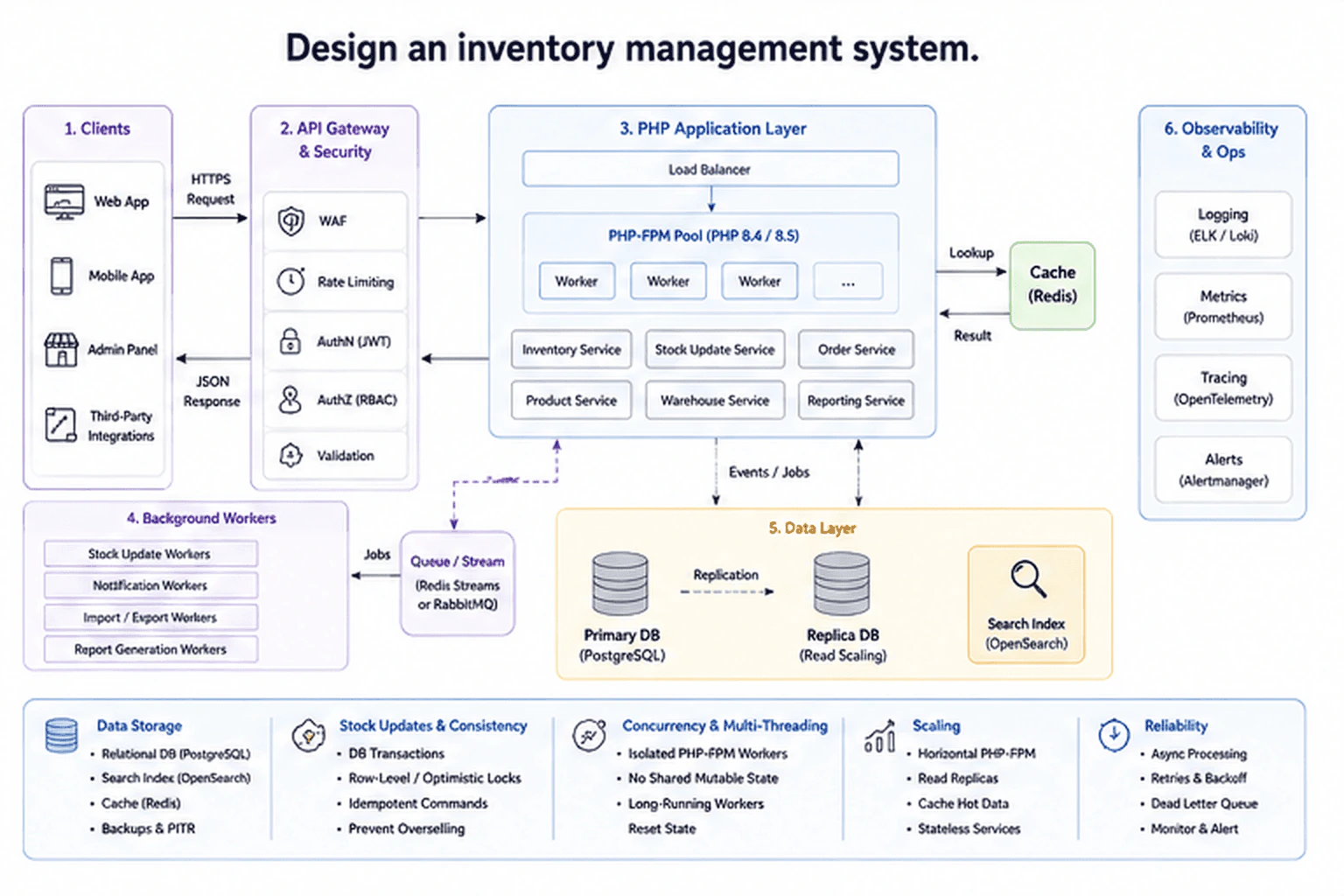
At a high level, this system keeps item counts correct in a busy store system. The main challenge is that stock updates must stay safe, but reads, search, and reports also need to stay fast as usage grows. I would explain it in three parts: the request path through security and the load balancer, the background worker path for jobs and notifications, and the data layer with PostgreSQL, replicas, Redis, and OpenSearch. The main trade-off is speed on reads versus small delays in background work.
Detailed Explanation
The goal is to keep item counts correct in a busy store system. People can check stock, change stock, place orders, upload files, and read reports. The hard part is that many actions can happen at the same time, and the numbers must still stay right. The other challenge is making common reads fast without slowing the main store of data. The diagram solves this by splitting the design into a request path, a background job path, and a data layer with a main database, read copies, cache, and search.
Useful Questions to Ask the Interviewer
How fresh do stock numbers need to be?
Do we expect more reads, more writes, or both?
Should imports, exports, and reports run in the background?
How to Explain It in an Interview
1. Explain the goal and the main idea
I would start by saying this system must keep inventory correct first. That is the main job. The design also needs to stay fast when many users check stock at the same time. So the diagram splits the work into fast request handling and slower background work. That keeps the core stock update path simple and safe.
2. Explain the request path
For normal requests, the flow starts at Web App, Mobile App, Admin Panel, or Third-Party Integrations. The request passes through API Gateway & Security and then the load balancer in the PHP Application Layer. That layer handles WAF, Rate Limiting, AuthN (JWT), AuthZ (RBAC), and Validation. Then PHP-FPM Pool (PHP 8.4 / 8.5) runs the request in worker processes. Services like Inventory Service, Stock Update Service, Order Service, Product Service, Warehouse Service, and Reporting Service decide what to do.
3. Explain reads, cache, and search
For quick reads, the app can check Cache (Redis) first. If the data is there, it returns the result right away. If not, it goes to the data layer. The Primary DB (PostgreSQL) is the main source of truth. The Replica DB helps with read scaling. Search Index (OpenSearch) helps with search and lookup work. This keeps search faster without changing the main stock count.
4. Explain background work
Some tasks should not block the user. That is why the diagram has Background Workers. Stock Update Workers, Notification Workers, Import / Export Workers, and Report Generation Workers all read jobs from Queue / Stream (Redis Streams or RabbitMQ). This is where work like notifications, imports, exports, and reports runs. The app also publishes Events / Jobs to that queue path. If a job fails, the system can retry it later instead of stopping the main request.
5. Explain concurrency, scale, and PHP runtime
The bottom callouts explain safety and scale. DB Transactions, row-level or optimistic locks, and idempotent commands help prevent overselling. Isolated PHP-FPM workers mean each request runs in its own process, so we do not share mutable state. Long-running workers must reset state so old values do not leak into the next job. Scaling comes from horizontal PHP-FPM, read replicas, and cache for hot data. Monitoring and ops use Logging, Metrics, Tracing, and Alerts. The trade-off is that some reads may lag a little, and background jobs may finish later.
6. Explain the main trade-off
The benefit is strong stock safety and faster reads for busy traffic. The downside is more moving parts. We accept that because inventory systems need both correctness and scale.
Engineering Considerations / Design Trade-offs
The benefit is that the main stock count stays in one safe database, while reads can use cache and read copies. That makes common lookups faster. The downside is that the design has more parts to run and watch. Background jobs, queues, and workers add delay between the user action and the final result. We also accept a small risk that some read copies or search data may be a little behind the main database. The trade-off is worth it because inventory systems need both safety and good speed.
Why Interviewers Ask This
Interviewers want to see if you can keep stock correct when many users act at once. They also want to know if you can separate fast requests from background jobs, use the main database as the source of truth, and explain why cache, replicas, and search are only helpers. Clear trade-offs matter too, because real systems need both safety and scale.
Interviewer may ask next
What if stock updates must never oversell, even during a flash sale?
I would keep the same basic design, but I would make the stock update path stricter. The important part is the Primary DB (PostgreSQL), because that is where the real count lives. For each change, the Stock Update Service should use a DB transaction and a row-level lock, or an optimistic lock, on the item row. That means two updates cannot both sell the last unit at the same time. If the count is too low, the request should fail right away. Background workers can still handle notifications and reports after the commit. I would also keep the queue work separate so the user path stays simple. The downside is that very busy items may move more slowly, because correctness is more important than raw speed.
What if search traffic becomes much larger than stock update traffic?
I would keep the same architecture, but I would lean harder on the read side. The Primary DB (PostgreSQL) would still own the real stock changes, but the Replica DB and the Search Index (OpenSearch) would take more of the read work. Cache (Redis) should hold the hottest items, so common lookups return quickly. Background workers can keep the search index up to date after changes. I would also watch the metrics closely so we know when reads are falling behind, and we can add more read capacity. That way, stock updates stay safe while reads scale out. The downside is that search and replica data can lag a little behind the main database, so the system favors speed with a small delay.
10. Design a system that retrieves and ranks relevant emails for a query and user profile.System DesignHardGoogle
i Question Details
Given an email corpus, a query, and a user profile, design a system that retrieves relevant emails, ranks the results, and personalizes them using the user profile.
Short Interview Answer (30-60 seconds)
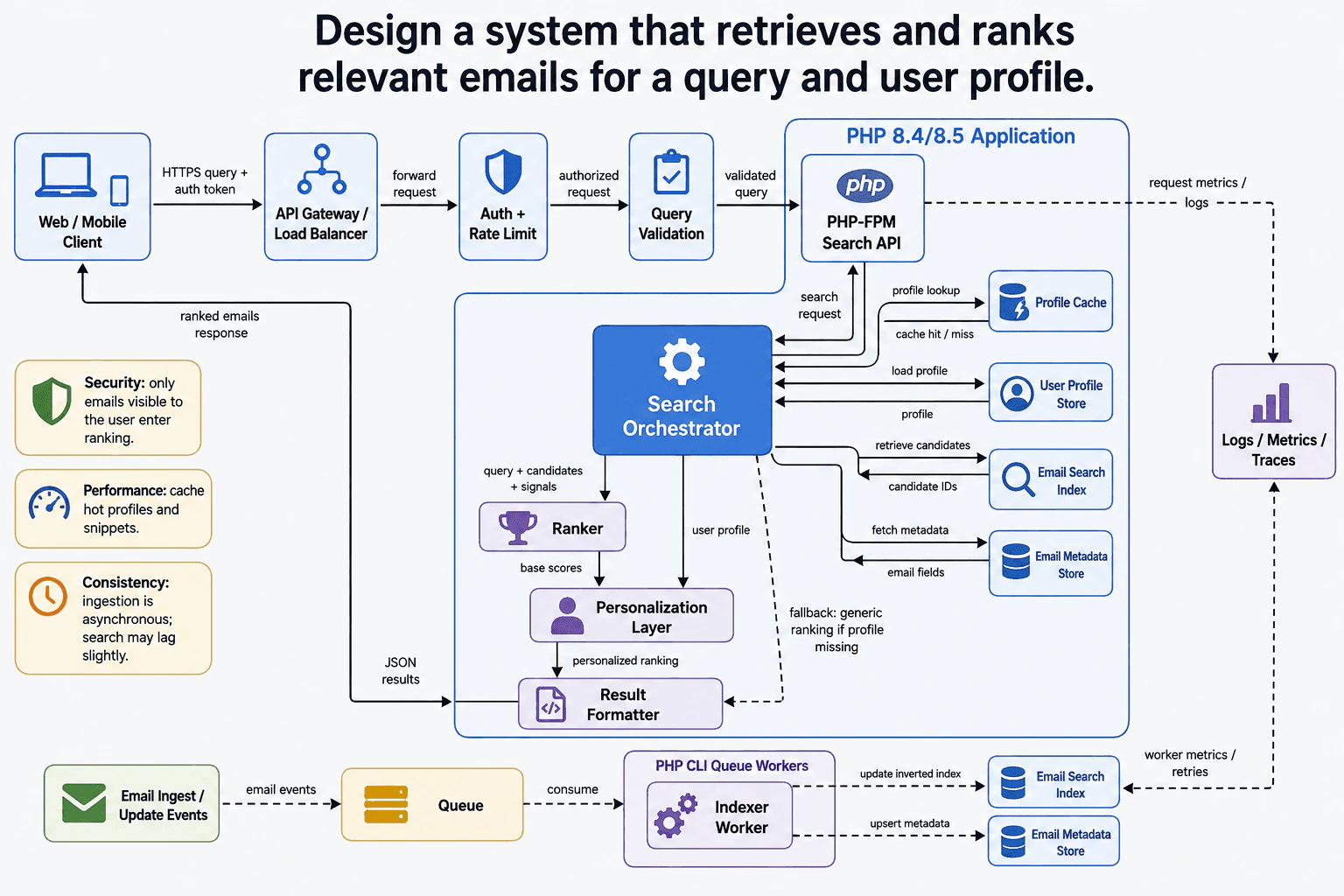
At a high level, this system finds matching emails and ranks the most useful ones for each user. The main challenge is keeping search fast while using profile data to improve the order. I would explain three flows: request handling, retrieval and ranking, and background indexing. The Search Orchestrator loads candidates, metadata, and profile signals before ranking and personalizing the results. If profile data is unavailable, it returns generic rankings. The trade-off is that background indexing is fast, but recent mailbox changes may appear after a small delay.
Detailed Explanation
The system receives a search query and must return the emails that matter most to that user. It must first find emails that match the words. It must then improve their order using the user profile. The difficult part is doing this quickly without blocking the request on every data lookup. The diagram solves this with a protected request path, a central search flow, a ranking and personalization flow, and background workers that keep the search data updated.
Useful Questions to Ask the Interviewer
Which user-profile signals may change the ranking?
How quickly must new or updated emails appear in search?
Should search continue when profile data is unavailable?
Which mailbox access rules must be applied before ranking?
How to Explain It in an Interview
1. Start with the protected request path
I would begin by checking the request before doing expensive search work. The Web / Mobile Client sends an HTTPS query and auth token to the API Gateway / Load Balancer.
The request then passes through Auth + Rate Limit. This confirms access and limits abusive traffic. Query Validation rejects malformed or unsupported queries before they reach the application.
The validated query enters the PHP-FPM Search API inside the PHP 8.4/8.5 Application boundary. PHP-FPM handles each web request in a worker process. It sends the search request to the Search Orchestrator.
2. Retrieve the profile and candidate emails
The Search Orchestrator coordinates the main search flow. It first sends a profile lookup to the Profile Cache.
On a cache hit, the cached profile can reduce latency. On a cache miss, the orchestrator loads the profile from the User Profile Store. The returned profile later becomes an input to personalization.
The orchestrator asks the Email Search Index to retrieve candidate email IDs. It then asks the Email Metadata Store for the related email fields. These fields may include the information needed to display and rank the candidates.
Only emails visible to the user should enter ranking. Mailbox access control must therefore be enforced before ranked results are returned.
3. Rank, personalize, and return the results
Next, the Search Orchestrator sends the query, candidates, and ranking signals to the Ranker. The Ranker produces base scores for the matching emails.
Those scores move to the Personalization Layer. The orchestrator also provides the user profile. This layer changes the order using user-specific signals.
If the profile is missing, the system falls back to generic ranking. Search still returns useful results instead of failing the whole request.
The Result Formatter creates the JSON results. The PHP-FPM Search API then sends the ranked email response back to the Web / Mobile Client.
4. Keep search data updated in the background
Email creation, update, and deletion events enter through Email Ingest / Update Events. These events are placed on the Queue instead of blocking a search request.
The Indexer Worker runs inside PHP CLI Queue Workers. It consumes queued events, updates the inverted index in the Email Search Index, and upserts the related data in the Email Metadata Store.
An inverted index maps search terms to matching emails. It makes text lookup much faster than scanning every email.
5. Explain operations and the main trade-off
Logs / Metrics / Traces collect request logs, latency, errors, worker metrics, and retries. These signals help the team find slow searches and failed indexing work.
Caching hot profiles reduces repeated store reads. Personalizing only the strongest candidates also limits expensive ranking work.
The main trade-off is speed versus freshness. Background indexing keeps the request path fast, but the search index may briefly lag behind mailbox changes.
Engineering Considerations / Design Trade-offs
The benefit is that search requests stay fast. The Email Search Index quickly finds broad candidates. The Profile Cache avoids repeated profile reads. The Ranker and Personalization Layer can focus on the strongest results instead of every email. The downside is that the system has several moving parts. The Queue or Indexer Worker may fall behind, so recent mailbox changes may not appear immediately. If profile data is missing, generic ranking keeps search available, but the order may be less personal. We accept these limits because a fast useful result is better than making every request wait for perfectly fresh data.
Why Interviewers Ask This
Interviewers use this question to test how a candidate breaks a large search problem into clear flows. They want to see whether the candidate can combine text matching with personal ranking, use caching safely, separate user requests from background indexing, protect private mailbox data, and explain fallback behavior. The important skill is making sensible choices about speed, freshness, correctness, and availability.
Interviewer may ask next
How would the design change if new emails must appear in search within a few seconds?
I would keep the same architecture, but I would make the background indexing path faster and easier to measure. Email Ingest / Update Events would still send changes to the Queue. The Indexer Worker would still update the Email Search Index and Email Metadata Store.
The main change would be tighter limits on queue delay. I would track how long the oldest event has waited. I would also measure the time between an email change and its index update.
More PHP CLI Queue Workers could consume events when the queue grows. Worker retries should have limits so one bad event does not block later events. Logs / Metrics / Traces should show queue age, worker errors, and indexing delay.
The PHP-FPM Search API would keep using the same read path. This avoids moving indexing work into user requests.
The downside is higher worker cost and more operational complexity. A short delay can still happen during a large spike or worker failure.
What should happen when the User Profile Store is unavailable during a search?
I would keep search available by using the fallback shown in the diagram. The Search Orchestrator would first check the Profile Cache. If a cached profile exists, it can still send that profile to the Personalization Layer.
If the cache misses and the User Profile Store is unavailable, the orchestrator should continue without profile data. It can retrieve candidate IDs from the Email Search Index, fetch fields from the Email Metadata Store, and send the query, candidates, and other signals to the Ranker.
The system then uses generic ranking instead of personalized ranking. The Result Formatter still creates JSON results, and the PHP-FPM Search API returns them to the client.
Logs / Metrics / Traces should record the store error and fallback rate. This helps the team understand the size of the problem.
The downside is lower ranking quality. The results still match the query, but they may not reflect the user’s normal interests as well.
More questions load as you scroll
Php Developer Resume Examples
Explore the resume examples below to find the one that best matches your target Php Developer role.
Disclaimer: This interview guide is for educational and informational purposes only. It is designed to help readers prepare, but it does not guarantee any interview result, hiring decision, offer, or outcome. Interview questions, hiring criteria, and preferred answers can vary by employer, interviewer, industry, location, and time. All answers, examples, and explanations in this guide are suggested examples for interview preparation, not definitive answers or instructions for professional practice. They are based on research and judgment, are provided without warranties of any kind, and should be adapted to the question, role, and applicable laws and professional requirements. Diagrams are simplified illustrations intended to highlight the main concepts and their relationships; actual situations, systems, and practices may be more complex. Alternative approaches may be equally valid or better suited to a particular question, context, or interviewer. To the fullest extent permitted by applicable law, the contributors and publisher are not liable for decisions made, actions taken, or losses incurred based on this guide.
State Laws and Professional Responsibilities: Laws and requirements governing an occupation vary by state and jurisdiction. You are responsible for checking the current laws, licensing requirements, and scope-of-practice rules that apply to your location and role, and for ensuring that your answers and actions comply with them. Adapt examples in this guide to those requirements. This guide is not legal advice.
Company Notice: This guide is an independent educational resource and is not affiliated with, endorsed by, sponsored by, or approved by the company named in this guide. Company names identify reported interview experiences or the employer context of clearly labeled original practice exercises. Interview practices can change without notice, and inclusion of company-specific content does not mean these questions are official, complete, or guaranteed to be asked. To the fullest extent permitted by law, the author, contributors, and publisher are not responsible for outcomes related to use of this material.
Content Accuracy and Verification: To the fullest extent permitted by applicable law, we do not represent or warrant that interview guides, questions, answers, examples, or diagrams are accurate, complete, current, error-free, or suitable for any particular purpose. You are responsible for independently reviewing and verifying the information before relying on it.