This interview guide is for educational and informational purposes only. It is designed to help readers prepare, but it does not guarantee any interview result, hiring decision, offer, or outcome. Interview questions, hiring criteria, and preferred answers can vary by employer, interviewer, industry, location, and time. All answers, examples, and explanations in this guide are suggested examples for interview preparation, not definitive answers or instructions for professional practice. They are based on research and judgment, are provided without warranties of any kind, and should be adapted to the question, role, and applicable laws and professional requirements. Diagrams are simplified illustrations intended to highlight the main concepts and their relationships; actual situations, systems, and practices may be more complex. Alternative approaches may be equally valid or better suited to a particular question, context, or interviewer. To the fullest extent permitted by applicable law, the contributors and publisher are not liable for decisions made, actions taken, or losses incurred based on this guide.
State Laws and Professional Responsibilities
Laws and requirements governing an occupation vary by state and jurisdiction. You are responsible for checking the current laws, licensing requirements, and scope-of-practice rules that apply to your location and role, and for ensuring that your answers and actions comply with them. Adapt examples in this guide to those requirements. This guide is not legal advice.
Identity, Image, and Privacy Notice
To respect individual privacy, some names, profile photographs, avatars, biographical details, and other identifying information displayed in this guide may be replaced with pseudonyms, licensed stock images, illustrative avatars, composite images, or representative descriptions. Unless a person is expressly identified as an actual contributor, a displayed name, image, or profile should not be understood as depicting or identifying a specific candidate, interviewer, employee, or other real individual. These representations are provided for editorial and illustrative purposes only and do not imply endorsement, employment, participation, or affiliation with this guide or any company mentioned in it. Any resemblance to an actual person is coincidental.
Company Notice
This guide is an independent educational resource and is not affiliated with, endorsed by, sponsored by, or approved by the company named in this guide. Company names identify reported interview experiences or the employer context of clearly labeled original practice exercises. Interview practices can change without notice, and inclusion of company-specific content does not mean these questions are official, complete, or guaranteed to be asked. To the fullest extent permitted by law, the author, contributors, and publisher are not responsible for outcomes related to use of this material.
Content Accuracy and Verification
To the fullest extent permitted by applicable law, we do not represent or warrant that interview guides, questions, answers, examples, or diagrams are accurate, complete, current, error-free, or suitable for any particular purpose. You are responsible for independently reviewing and verifying the information before relying on it.
Questions or comments?
Contact us for general questions, or share feedback, technical corrections, and comments with the community.
11. How would you sort a data set that is too large to fit in one machine's memory using multiple workers?System DesignHardGoogle
i Question Details
If the data set is too large to fit in memory on one machine and you have multiple workers, explain how you would sort it.
Short Interview Answer (30-60 seconds)
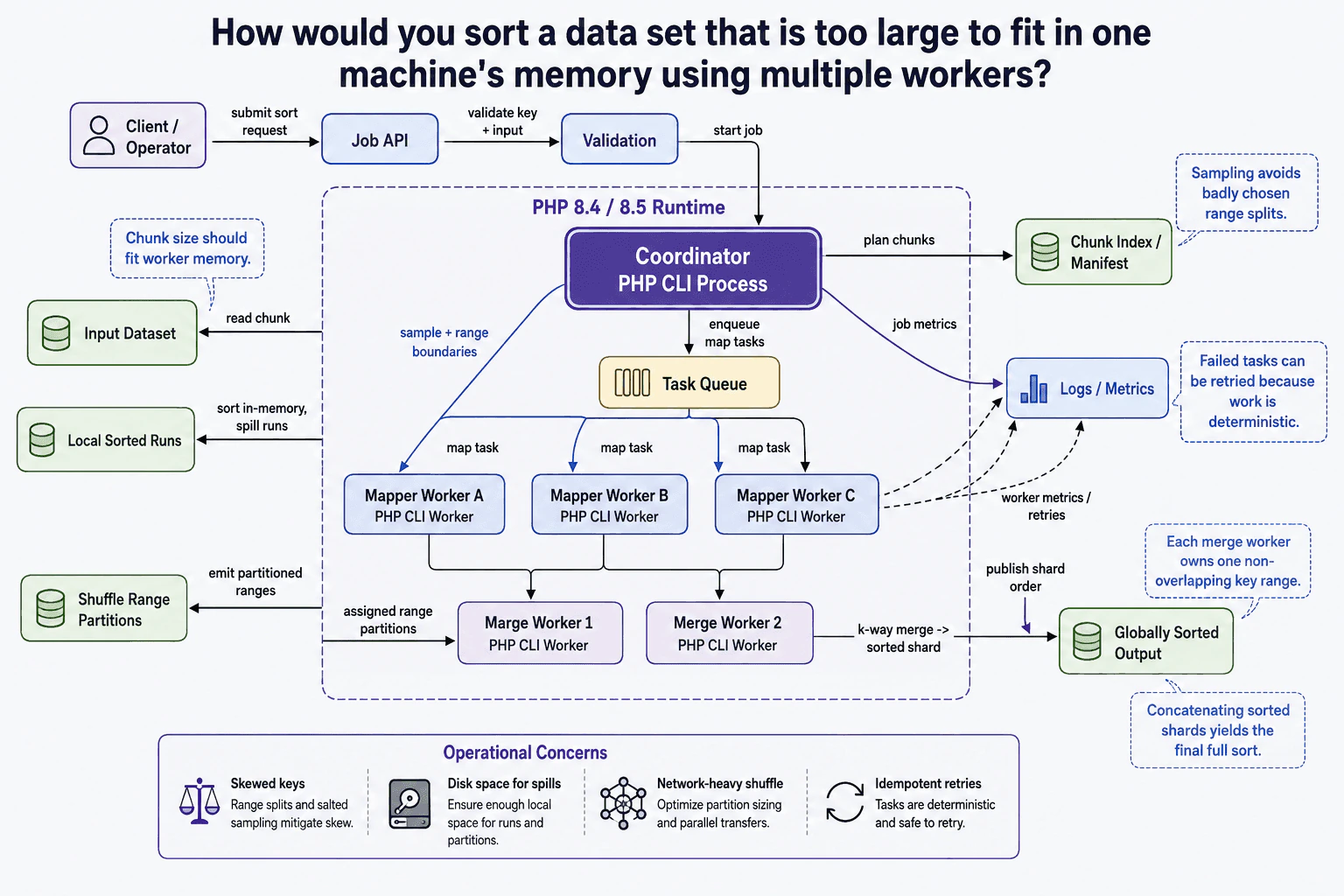
At a high level, I would use a distributed external sort. The main challenge is keeping global order when no worker can hold the full data set. I would explain three flows: plan the chunks, sort and shuffle them, then merge ordered ranges. A PHP CLI Coordinator schedules Mapper Workers and Merge Workers through a Task Queue. The Chunk Index / Manifest tracks the work. The main trade-off is horizontal scale versus heavy disk and network use.
Detailed Explanation
The goal is to sort one data set that is too large for a single machine's memory. Each worker can process only a manageable chunk. Sorting the chunks separately is not enough because the complete result must still have one correct global order. The design solves this in stages. It first plans the chunks. Mapper Workers then create sorted runs and divide records by key range. Merge Workers combine those ranges into final sorted shards. The Coordinator records progress and publishes the correct shard order.
Useful Questions to Ask the Interviewer
Which field or fields define the sort key?
How large is the input data set?
How much memory and local disk does each worker have?
Can records share the same key, and how should ties be ordered?
How quickly must the final sorted output be ready?
How to Explain It in an Interview
1. Explain the main sorting approach
I would begin by saying that this is a distributed external sort. External sort means workers use storage because all records cannot stay in memory.
The work has two main stages. Mapper Workers sort smaller chunks. Merge Workers combine non-overlapping key ranges into the Globally Sorted Output.
2. Accept the request and plan the work
The Client / Operator sends the sort request to the Job API. Validation checks the input and the requested sort key. It then starts the Coordinator PHP CLI Process.
The Coordinator plans the chunks and records that plan in the Chunk Index / Manifest. It creates map tasks and places them in the Task Queue. Each chunk should be small enough to fit within a worker's memory while it is being sorted.
3. Sort chunks and create local runs
The Task Queue assigns map tasks to Mapper Worker A, Mapper Worker B, and Mapper Worker C. Each one is a PHP CLI Worker.
A mapper reads its assigned chunk from the Input Dataset. It sorts records in memory. When the chunk requires temporary storage, it spills ordered files into Local Sorted Runs. A sorted run is simply a file whose records are already ordered.
The Coordinator also samples keys and chooses range boundaries. Good boundaries reduce the chance that one key range receives far more records than the others.
4. Shuffle records and merge each range
The Mapper Workers emit records into Shuffle Range Partitions. This groups records by their final key range rather than by their original chunk.
Merge Worker 1 and Merge Worker 2 receive their assigned range partitions. Each worker owns a non-overlapping key range. It performs a k-way merge, which combines several sorted inputs into one sorted shard.
The Coordinator publishes the shard order. The system concatenates those shards in range order to produce the Globally Sorted Output.
5. Handle progress, failures, and operational concerns
The Coordinator sends job metrics to Logs / Metrics. Workers also send metrics and retry information. The Chunk Index / Manifest lets the system track planned chunks and unfinished work.
If a task fails, another worker can repeat it from the same recorded plan. The work is deterministic, which means the same input and range rules produce the same ordered result.
The main concerns are skewed keys, disk space for spills, and a network-heavy shuffle. More workers improve parallelism, but they also increase data movement and operational work.
Engineering Considerations / Design Trade-offs
The benefit is that several workers can sort chunks at the same time. This lets the design handle data much larger than one machine's memory. The downside is extra disk and network work. Mapper Workers may write many Local Sorted Runs, and Shuffle Range Partitions move records between workers. Uneven keys can also give one Merge Worker much more work. Sampling helps choose better ranges, but it cannot remove every imbalance. Retries are simpler because the Chunk Index / Manifest records the work and tasks are deterministic. We accept these costs to gain horizontal scale and one globally sorted result.
Why Interviewers Ask This
Interviewers ask this question to test whether the candidate can divide a large data problem into clear stages. They want to hear how memory limits are handled, how global order is preserved, and how workers share the work. They also look for practical judgment about disk spills, key skew, network cost, retries, progress tracking, and the final merge.
Interviewer may ask next
What would you change if the sort keys are highly uneven and one Merge Worker receives most of the records?
I would keep the same design, but I would improve the range boundaries chosen by the Coordinator. The affected parts are key sampling, Shuffle Range Partitions, and the Merge Workers.
The Coordinator would use a larger and more representative sample. It could create more, smaller ranges before assigning them to Merge Worker 1 and Merge Worker 2. The Chunk Index / Manifest would record every range and its final position.
The Mapper Workers would still sort their chunks and emit records by range. Each Merge Worker would still own non-overlapping ranges. The Coordinator would publish the correct shard order, so concatenating the shards would preserve global order.
Logs / Metrics would show the size and progress of each range. This would make an overloaded worker easier to detect.
The downside is more planning, more partitions, and more files to manage. A larger sample also adds work before the main sorting stage begins.
How would the design recover when a Mapper Worker or Merge Worker fails during processing?
I would retry only the failed task rather than restart the complete sort job. The Coordinator would use the Chunk Index / Manifest to find the unfinished chunk or assigned range.
When a Mapper Worker fails, another PHP CLI Worker receives that map task from the Task Queue. It reads the same chunk from the Input Dataset, sorts it again, and recreates the required Local Sorted Runs and Shuffle Range Partitions.
When a Merge Worker fails, another worker receives the same assigned range partitions. It repeats the k-way merge and creates the sorted shard for that range. The Coordinator publishes the shard order only after the required work finishes.
Logs / Metrics records failures, retries, and progress. The tasks are deterministic, so repeating the same work keeps the result correct.
The downside is repeated disk, CPU, and network work. A failure near the end of a large task may therefore add noticeable delay.
12. What is your definition of a strong learning and growth plan for an engineer?BehavioralMediumGoogle
i Question Details
Explain how you plan learning goals, choose skills to develop, measure progress, and apply what you learn in engineering work.
Interview tip:
Use STAR to structure your answer: briefly explain the Situation and Task, make Action the most detailed part, and finish with the Result. For example, describe a realistic time when you set learning goals, chose one skill at a time, tracked progress with real work, and used the new learning to improve your engineering decisions.
Situation
In my last role, I worked on a PHP service that handled customer requests, and I kept seeing small issues come back after releases. I wanted to grow in a focused way instead of learning random topics without a clear plan.
Task
My goal was to build a learning plan that would improve my backend skills, help me make better decisions in daily work, and show steady progress over time. I needed a simple way to choose what to learn, measure it, and use it in real tasks.
Action
I started by looking at the problems I touched most often. I saw that I needed stronger testing habits, a better understanding of Laravel service structure, and more skill in performance work. I chose one area at a time so I could stay focused. First, I set a goal to write better unit and integration tests for the code I changed most. I studied the existing code, added tests around one feature at a time, and used each bug fix as a chance to improve coverage. Next, I worked on request performance. I learned more about query loading, caching, and log based debugging, then I tried each idea in a low risk area before using it in bigger changes. I also shared my plan with my manager in one on one meetings so I could make sure I was learning things that helped the team. That mattered because it kept my growth tied to business needs, not just personal curiosity. I tracked progress by checking whether I could explain the topic in simple words, apply it in a pull request, and depend less on others for the same kind of work. When I learned something useful, I wrote a short note for myself and used it in the next task so the learning became part of my normal workflow.
Result
Over time, my work became more reliable and easier to review. I found issues earlier, added tests with less hesitation, and made better choices when a change could affect performance. I also learned that a strong growth plan should be narrow, visible, and tied to real work. That helped me become a stronger engineer and made my learning useful for the team as well.
Why Interviewers Ask This
Interviewers ask this to see whether the engineer can take ownership of growth, choose priorities with good judgment, and turn learning into better work. A strong answer shows self awareness, consistency, and the ability to improve without losing focus on team goals.
Interviewer may ask next
How did you decide what to learn first?
I started with the skills that were closest to my daily work and caused the most friction. Testing came first because it reduced bugs right away, and then I moved to performance because it had a clear effect on user experience and future work.
How did you know your plan was working?
I looked for signs in real work, not just in study time. I knew it was working when I could add tests faster, explain my choices more clearly in reviews, and solve similar problems with less help from others.
13. How do you retain a learning mindset?BehavioralMediumGoogle
i Question Details
What do you do to ensure that you are constantly learning and growing as an engineer?
Interview tip:
Use STAR to structure your answer: briefly explain the Situation and Task, make Action the most detailed part, and finish with the Result. For example, describe a time when you built a simple weekly habit to read release notes, try small PHP changes in a safe branch, share what you learned with the team, and use that routine to keep improving in your day to day engineering work.
Situation
In my last role, I was working on a PHP service that changed often because we kept improving features and fixing performance issues. I noticed that it was easy to stay busy with delivery and slowly fall behind on new framework updates and better coding practices.
Task
My responsibility was to keep my own skills current so I could make better decisions in the codebase and also help the team avoid outdated patterns. I wanted a learning habit that was practical, repeatable, and tied to real work, not just random reading.
Action
I started by setting aside a regular time each week to review the PHP and framework release notes, security updates, and a few trusted engineering articles. When I found something useful, I did not stop at reading it. I tried it in a small branch or a side project first so I could see how it behaved in real code. That helped me understand the tradeoffs instead of just repeating advice. I also wrote short notes for myself and shared the most useful points with the team during code review or team syncs. When I was unsure about a better approach, I asked questions early, paired with teammates, and compared the old way with the new way in the actual code path. This kept learning connected to delivery and helped me improve without risking the main release.
Result
Over time, I became more confident when reviewing code and choosing solutions because I had tested them myself and understood why they worked. The habit also made my learning more consistent. I was not waiting for a formal training session. I was learning from the work, sharing what I found, and turning that into better day to day engineering decisions.
Why Interviewers Ask This
Interviewers ask this to see whether I keep growing without needing constant direction. They want to know if I stay curious, learn from real work, and apply new knowledge in a practical way that improves my judgment and contributions.
Interviewer may ask next
How do you choose what to learn next?
I usually choose based on the work in front of me. I look at recent bugs, upcoming features, code review feedback, and framework changes, then I focus on the topics that will help me solve real problems better in the next project.
What do you do when new learning conflicts with old habits?
I test the new approach on a small safe change first and compare it with the current method. If the new way is clearer, safer, or easier to maintain, I adopt it and explain the reason to the team so the change is practical, not just personal preference.
14. Tell me about a time you had a disagreement with a co-worker.BehavioralMediumGoogle
i Question Details
Describe a disagreement with a co-worker, how you handled it, and the outcome.
Interview tip:
Use STAR to structure your answer: briefly explain the Situation and Task, make Action the most detailed part, and finish with the Result. For example, describe a realistic disagreement about code structure or release priority, how you listened first, shared your reasoning with examples, found common ground, and reached a solution that kept the project moving.
Situation
In my last role, I was working with another PHP developer on a customer checkout change. We disagreed on how to handle a bug that was affecting a small group of users near a release date. My co worker wanted a very fast patch, while I was worried that it would create a second issue in a shared part of the code.
Task
My responsibility was to help us reach a decision quickly without hurting the release. I needed to keep the discussion professional, protect the user experience, and make sure we did not turn a small fix into a larger problem.
Action
I first asked my co worker to walk me through his view so I could understand why he wanted the faster change. I did not push back right away. After that, I explained my concern in simple terms and showed the two places in the flow that could be affected. I suggested that we separate the urgent fix from the larger cleanup. We agreed to keep the change small for the release, add a few focused tests, and create a follow up task for the deeper refactor after we confirmed the fix in staging. I also made sure we documented the decision so the rest of the team understood why we chose that path.
Result
We shipped the release on time and avoided a follow up bug in the shared code path. My co worker and I had a better working relationship after that because we both saw that I was trying to solve the problem, not win the argument. I learned that when there is disagreement, listening first and offering a safer middle path often leads to a better result than trying to prove one side right.
Why Interviewers Ask This
Interviewers ask this to see how you handle conflict, communicate under pressure, and work with others when there is no easy agreement. A strong answer shows calm judgment, respect for teammates, and the ability to protect the project while still moving forward.
Interviewer may ask next
Why did you choose the middle path instead of your first idea?
I chose it because the release risk was more important than proving the long term design choice right away. The middle path let us solve the urgent user problem, keep the code safe, and return to the larger cleanup after we had more time and better test coverage.
What would you do differently now?
I would involve the other developer even earlier and use a quick shared review of the edge cases before the disagreement became stronger. That usually saves time and helps both people feel heard before the final decision is made.
15. If you and a coworker disagree in a meeting about how to solve a problem, how would you handle it?BehavioralMediumGoogle
i Question Details
Explain how you would handle a disagreement with a coworker during a meeting about the solution to a problem.
Interview tip:
Use STAR to structure your answer: briefly explain the Situation and Task, make Action the most detailed part, and finish with the Result. For example, describe a real time when you stayed calm, listened to your coworker’s view, compared the risks and impact of each option, and helped the team agree on a practical fix.
Situation
In my last role, we had a meeting about a production bug in a PHP feature. My coworker wanted a fast workaround inside the controller, while I thought we should fix the shared service first so the same issue would not come back in other places.
Task
My job was to help the team reach a decision without turning the meeting into a personal argument. I needed to keep the focus on the user impact, the release risk, and what we could safely deliver in the time we had.
Action
I first let my coworker explain the reason for the quick workaround, because it was important to understand the urgency behind the idea. Then I shared my concern that a controller only fix would solve one screen but leave the same bug in other flows that used the same service. I kept the discussion on facts by asking what would break if we changed the shared code and what our rollback plan would be. I suggested a middle path. We could ship a small safe fix first, add tests around the shared service, and then schedule the deeper cleanup after the release. I also made sure to use simple language and avoid sounding defensive, because the goal was to solve the problem together. After the meeting, I paired with my coworker to implement the smaller fix and write the tests so both of us were comfortable with the change.
Result
We agreed on a solution that was safe to release and still protected the codebase from the same bug appearing again. The meeting stayed productive, the feature was fixed on time, and I learned that a calm discussion with clear facts usually leads to a better result than pushing only my first idea.
Why Interviewers Ask This
Interviewers ask this to see whether I can handle disagreement with maturity, listen well, and make good decisions under pressure. A strong answer shows I can stay professional, focus on the real problem, and help the team move forward without damaging collaboration.
Interviewer may ask next
What would you do if the coworker still disagreed?
I would ask one more time for the key concern behind their view and compare the two options against risk, time, and user impact. If we still could not agree, I would ask the tech lead or meeting owner to decide so we could move forward quickly.
What would you do differently now?
I would bring data to the meeting earlier, such as logs, test results, or a small reproduction case. That would make the discussion faster and help both sides judge the options from facts instead of opinions.
16. If another team rewrote your code and now it is broken, how would you communicate with them?BehavioralMediumGoogle
i Question Details
Explain how you would communicate and collaborate with another team after they rewrote your code and introduced a failure.
Interview tip:
Use STAR to structure your answer: briefly explain the Situation and Task, make Action the most detailed part, and finish with the Result. For example, describe a realistic case where another team changed your PHP code, you stayed calm, shared the impact with clear examples, worked with them to find the root cause, and agreed on a fix without blame.
Situation
In one previous project, another team took over a PHP service I had worked on and changed part of the request flow. After their update, a few user actions started failing in production. I knew the fastest way to help was to stay calm and talk in a clear and respectful way.
Task
My job was to contact the other team, explain the failure in a simple way, and work with them to find the root cause without making the conversation feel like blame. I also needed to protect the business impact and help us restore the service quickly.
Action
I first collected the facts before I reached out. I noted the exact error, the request path, the time it started, and the smallest steps to reproduce it. Then I contacted their developer and team lead with a short message that focused on the symptom, the user impact, and the evidence. I did not say that they broke my code. I said what changed, what I observed, and where the behavior no longer matched the expected flow. In the call, I listened first and asked questions about their changes. I compared their new code with the old behavior, checked logs and tests together, and pointed to the exact place where the contract between our services had changed. I also suggested a few options, such as restoring the old behavior, adding a safe fallback, or updating both sides together behind a small rollout. I kept the tone neutral the whole time, because I wanted us to solve the issue as one team.
Result
We found the issue quickly and agreed on a small fix that restored the broken flow. The conversation stayed professional, and the other team was open to working with me again because I had brought facts instead of blame. I learned that clear evidence, calm language, and a shared goal make cross team communication much easier when code breaks after a handoff.
Why Interviewers Ask This
Interviewers ask this to see if I can handle conflict, give clear feedback, and work with another team without creating tension. A strong answer shows ownership, calm communication, good judgment, and focus on fixing the problem instead of blaming people.
Interviewer may ask next
How would you keep the conversation from sounding like blame?
I would keep the message focused on facts, impact, and the shared goal of fixing the service. I would describe the exact behavior change, show logs or a simple repro, and use neutral words like observed and expected instead of broken or careless.
What would you do if the other team disagreed with your finding?
I would stay calm and compare the evidence together. I would walk through the request flow, logs, and tests step by step, then agree on one owner from each side to validate the root cause. If needed, I would involve a tech lead, but only after trying to resolve it directly and respectfully.
17. Tell me about a time when you put the user first and led a product.BehavioralMediumGoogle
i Question Details
Describe a time when you put the user first while leading a product or initiative, including your decisions and the result.
Interview tip:
Use STAR to structure your answer: briefly explain the Situation and Task, make Action the most detailed part, and finish with the Result. For example, describe a realistic product decision where you changed the plan based on user pain, cut low value scope, aligned the team on the tradeoffs, and still shipped a reliable result that helped users.
Situation
In my previous role, we were building a self service account settings page in PHP for customers. The first plan had many extra options, but early feedback from support showed that users mainly struggled with the basic flow. They wanted to update one setting quickly without getting lost.
Task
My job was to lead the product work for that release and make sure we solved the real user problem first. I needed to guide the team, protect the most important user flow, and keep the release practical for engineering and support.
Action
I started by reviewing support tickets, watching a few user sessions, and talking with the support team about the most common pain points. I saw that the main issue was not missing features. It was confusion. So I pushed to simplify the page instead of adding more controls. I removed less important options from the first release, grouped related fields into smaller sections, and added clearer labels and validation messages. I also worked with the backend team to make sure the PHP form handling gave direct error messages when something failed, instead of sending users back to a blank state. When a few stakeholders wanted to keep the larger scope, I explained the user impact in simple terms and showed how the simpler flow would reduce mistakes and save time for customers. I kept the team focused on the one path users needed most, and I checked the page with support before launch so we could catch anything confusing early.
Result
We shipped a simpler product that was easier to use on the first try. Support had fewer repeated questions about the same flow, and users could complete the task with less help. The bigger lesson for me was that putting the user first sometimes means saying no to extra scope and leading the team toward the clearest solution, not the biggest one.
Why Interviewers Ask This
Interviewers ask this to see whether I can balance user empathy with ownership and leadership. A strong answer shows that I can find the real user problem, make tradeoffs, communicate clearly, and guide a team toward a product decision that helps users.
Interviewer may ask next
How did you decide what to cut from the first release?
I used support feedback and user session notes to separate must have items from nice to have items. Anything that did not help the main task on the first try was cut from the initial release, so the team could focus on clarity and reliability.
What would you do differently now?
I would involve a few users even earlier and test the simplified flow sooner. That would help me confirm the main pain point before the team spends time on extra ideas that do not improve the user experience.
18. Tell me about a time when you had to deal with ambiguity.BehavioralMediumGoogle
i Question Details
Describe a time when you had to deal with ambiguity, the actions you took, and the outcome.
Interview tip:
Use STAR to structure your answer: briefly explain the Situation and Task, make Action the most detailed part, and finish with the Result. For example, describe a project where the requirements were unclear, how you identified the most important user need, confirmed assumptions with stakeholders, made safe technical decisions, communicated risks, and delivered a useful result.
Situation
In my last role, I was asked to build a PHP endpoint for a new account reporting feature. The request was brief, and several details were unclear. The team had not agreed on which records should be included, how users should filter the results, or what should happen when older data was incomplete.
Task
I was responsible for moving the work forward without making risky assumptions. My goal was to clarify the most important behavior, create a reliable first version, and avoid designing the endpoint in a way that would be difficult to change later.
Action
I first listed every unclear point and separated them into two groups. The first group contained decisions that could affect users or data accuracy. The second group contained technical details that could be changed later with little risk. I then met with the product owner and showed a few concrete examples of possible report results. This made the discussion easier because we were reviewing real cases instead of abstract requirements. We agreed on the main user need and documented the rules that were confirmed. For the remaining questions, I proposed safe default behavior and clearly marked each assumption. I designed the PHP service so the filtering rules were kept separate from the controller and database query code. This allowed us to change a rule without rewriting the whole endpoint. I also added validation for unsupported inputs and tests for the confirmed cases, missing data, and empty results. During development, I shared a sample response early with the frontend developer and product owner. Their feedback exposed one misunderstanding about date filtering, so I corrected it before the feature reached final testing.
Result
We delivered a reliable first version that matched the confirmed user need. The early examples and written assumptions helped the team resolve uncertainty without delaying all progress. The separated design also made later requirement changes easier to apply. I learned that dealing with ambiguity does not mean guessing. It means identifying what must be clarified, making reversible decisions where possible, and communicating assumptions before they become expensive problems.
Why Interviewers Ask This
Interviewers ask this question to understand how a candidate works when requirements are incomplete or changing. A strong answer shows that the candidate can identify important unknowns, communicate clearly, make careful decisions, continue making progress, and adjust when new information appears.
Interviewer may ask next
How did you decide which unclear points needed immediate clarification?
I focused first on questions that could change the user experience, data accuracy, or public API behavior. Those decisions would be costly to reverse later. Smaller implementation details were handled with simple and reversible choices.
What would you do differently in a similar situation now?
I would create the sample request and response even earlier. In this case, the example exposed a misunderstanding about date filtering. Preparing that example at the start would help the team reach agreement faster.
19. What is your definition of success?BehavioralMediumGoogle
i Question Details
Explain your definition of success and how it guides your work and decisions.
Interview tip:
Use STAR to structure your answer: briefly explain the Situation and Task, make Action the most detailed part, and finish with the Result. For example, describe a PHP project where success meant solving the real user problem, delivering reliable code, communicating clearly, supporting the team, and learning from the outcome.
Situation
In my last role, I worked on a PHP application used by an internal operations team. The team requested a new workflow to reduce repeated manual steps. The first proposal included many features, but the users mainly needed a simple and reliable way to complete their daily work.
Task
I was responsible for building the backend changes and helping the team decide what should be included in the first release. My goal was not only to finish the code. I wanted to deliver something useful, stable, understandable, and easy for the team to support.
Action
I began by speaking with the users and asking them to explain their current process. I wrote down the main problem and separated essential needs from optional ideas. I then reviewed the existing PHP code, database structure, validation rules, and error handling so that the new workflow would fit the application safely. I proposed a smaller first release that solved the main user need without adding unnecessary complexity. I explained the tradeoffs to the product owner and shared what could be added later. While developing the feature, I kept the business logic clear, added focused tests, handled invalid input, and asked another developer to review the important changes. I also demonstrated the workflow to the users before release and adjusted confusing parts based on their feedback. These actions reflect my definition of success. Success means creating real value, protecting quality, communicating honestly, and leaving the code and the team in a better position.
Result
The users received a workflow that was easier to understand and dependable in daily use. The smaller scope also made the release easier for the team to review and support. I learned that success is not measured only by how much code I write or how quickly I finish. I consider work successful when it solves the right problem, meets a strong quality standard, supports the people involved, and gives me useful lessons for the next project.
Why Interviewers Ask This
Interviewers ask this question to understand what motivates the candidate and how they judge the quality of their own work. A strong answer shows that success includes user value, sound decisions, reliable delivery, teamwork, ownership, and continued learning rather than only speed or personal recognition.
Interviewer may ask next
Why did you choose a smaller first release?
I chose a smaller first release because the user interviews showed that one workflow was causing most of the difficulty. Solving that need first reduced complexity, made testing easier, and allowed us to deliver useful value without delaying the release for optional features.
How did you evaluate whether the project was successful?
I evaluated it by checking whether users could complete the workflow clearly and reliably, whether the code passed our tests and review, and whether the team could support the change without confusion. I also considered the project successful because the feedback helped us identify sensible improvements for later work.
20. Walk me through your previous internship and what you worked on there.BehavioralMediumGoogle
i Question Details
Describe your previous internship, your work, how it went, what you liked and disliked, and your summer project.
Interview tip:
Use STAR to structure your answer: briefly explain the Situation and Task, make Action the most detailed part, and finish with the Result. For example, describe a realistic internship where you joined an existing PHP team, learned the codebase quickly, owned a small feature from start to finish, handled feedback well, and delivered a summer project that helped the team.
Situation
During my previous internship, I joined a small PHP team that was maintaining a web app with user accounts, reports, and an admin dashboard. The codebase was already live, so the main challenge was to make useful changes without breaking existing users.
Task
My job was to help with bug fixes and small features, and for my summer project I was asked to improve one part of the internal reporting flow. I also needed to learn the team standards, work with code review feedback, and communicate clearly when I found something risky or unclear.
Action
I started by reading the existing PHP controllers, service classes, and database queries so I could understand how data moved through the app. When I picked up tickets, I broke each one into small steps, wrote the change, tested it locally, and checked the related pages so I would not create side effects. For the summer project, I worked on a reporting page that was slow and hard to use. I first talked with my mentor to confirm which parts mattered most to the team, because I did not want to change the whole flow at once. Then I updated the backend logic so the page fetched only the data it needed, cleaned up part of the template code, and added clearer validation for the input filters. I also wrote simple notes in the pull request so reviewers could see what changed and why. When feedback came back, I kept the same goal but adjusted the implementation to fit the existing style of the project. I liked that the team gave me real ownership and trusted me to ask questions early. The hardest part was working inside a live codebase where one small change could affect several pages, so I learned to move carefully and test more than I expected.
Result
The changes were merged and used by the team, and the reporting page became easier to maintain and smoother for the people who used it internally. I left the internship with a better understanding of PHP, teamwork, code reviews, and how to make safe changes in an existing product. The biggest thing I learned was that good communication and careful testing matter just as much as writing the code itself.
Why Interviewers Ask This
Interviewers ask this to see how you learn in a real team, how much ownership you take, and whether you can explain your work clearly. A strong answer shows that you can handle existing code, communicate well, and make steady progress on useful work.
Interviewer may ask next
What did you do when you were unsure about the codebase?
I read the related files first, then I asked my mentor focused questions instead of guessing. That saved time because I could understand the flow before changing anything, and it helped me avoid simple mistakes.
What would you do differently now?
I would spend even more time before coding on understanding the full path of the request and the tests around it. During that internship I learned that a few extra minutes of review can prevent a lot of rework later.
More questions load as you scroll
Disclaimer: This interview guide is for educational and informational purposes only. It is designed to help readers prepare, but it does not guarantee any interview result, hiring decision, offer, or outcome. Interview questions, hiring criteria, and preferred answers can vary by employer, interviewer, industry, location, and time. All answers, examples, and explanations in this guide are suggested examples for interview preparation, not definitive answers or instructions for professional practice. They are based on research and judgment, are provided without warranties of any kind, and should be adapted to the question, role, and applicable laws and professional requirements. Diagrams are simplified illustrations intended to highlight the main concepts and their relationships; actual situations, systems, and practices may be more complex. Alternative approaches may be equally valid or better suited to a particular question, context, or interviewer. To the fullest extent permitted by applicable law, the contributors and publisher are not liable for decisions made, actions taken, or losses incurred based on this guide.
State Laws and Professional Responsibilities: Laws and requirements governing an occupation vary by state and jurisdiction. You are responsible for checking the current laws, licensing requirements, and scope-of-practice rules that apply to your location and role, and for ensuring that your answers and actions comply with them. Adapt examples in this guide to those requirements. This guide is not legal advice.
Company Notice: This guide is an independent educational resource and is not affiliated with, endorsed by, sponsored by, or approved by the company named in this guide. Company names identify reported interview experiences or the employer context of clearly labeled original practice exercises. Interview practices can change without notice, and inclusion of company-specific content does not mean these questions are official, complete, or guaranteed to be asked. To the fullest extent permitted by law, the author, contributors, and publisher are not responsible for outcomes related to use of this material.
Content Accuracy and Verification: To the fullest extent permitted by applicable law, we do not represent or warrant that interview guides, questions, answers, examples, or diagrams are accurate, complete, current, error-free, or suitable for any particular purpose. You are responsible for independently reviewing and verifying the information before relying on it.