This interview guide is for educational and informational purposes only. It is designed to help readers prepare, but it does not guarantee any interview result, hiring decision, offer, or outcome. Interview questions, hiring criteria, and preferred answers can vary by employer, interviewer, industry, location, and time. All answers, examples, and explanations in this guide are suggested examples for interview preparation, not definitive answers or instructions for professional practice. They are based on research and judgment, are provided without warranties of any kind, and should be adapted to the question, role, and applicable laws and professional requirements. Diagrams are simplified illustrations intended to highlight the main concepts and their relationships; actual situations, systems, and practices may be more complex. Alternative approaches may be equally valid or better suited to a particular question, context, or interviewer. To the fullest extent permitted by applicable law, the contributors and publisher are not liable for decisions made, actions taken, or losses incurred based on this guide.
State Laws and Professional Responsibilities
Laws and requirements governing an occupation vary by state and jurisdiction. You are responsible for checking the current laws, licensing requirements, and scope-of-practice rules that apply to your location and role, and for ensuring that your answers and actions comply with them. Adapt examples in this guide to those requirements. This guide is not legal advice.
Identity, Image, and Privacy Notice
To respect individual privacy, some names, profile photographs, avatars, biographical details, and other identifying information displayed in this guide may be replaced with pseudonyms, licensed stock images, illustrative avatars, composite images, or representative descriptions. Unless a person is expressly identified as an actual contributor, a displayed name, image, or profile should not be understood as depicting or identifying a specific candidate, interviewer, employee, or other real individual. These representations are provided for editorial and illustrative purposes only and do not imply endorsement, employment, participation, or affiliation with this guide or any company mentioned in it. Any resemblance to an actual person is coincidental.
Company Notice
This guide is an independent educational resource and is not affiliated with, endorsed by, sponsored by, or approved by the company named in this guide. Company names identify reported interview experiences or the employer context of clearly labeled original practice exercises. Interview practices can change without notice, and inclusion of company-specific content does not mean these questions are official, complete, or guaranteed to be asked. To the fullest extent permitted by law, the author, contributors, and publisher are not responsible for outcomes related to use of this material.
Content Accuracy and Verification
To the fullest extent permitted by applicable law, we do not represent or warrant that interview guides, questions, answers, examples, or diagrams are accurate, complete, current, error-free, or suitable for any particular purpose. You are responsible for independently reviewing and verifying the information before relying on it.
Questions or comments?
Contact us for general questions, or share feedback, technical corrections, and comments with the community.
1. Find the index of the one unpaired integer in a list where every other integer appears twice in consecutive positions.CodingEasyApple
i Question Details
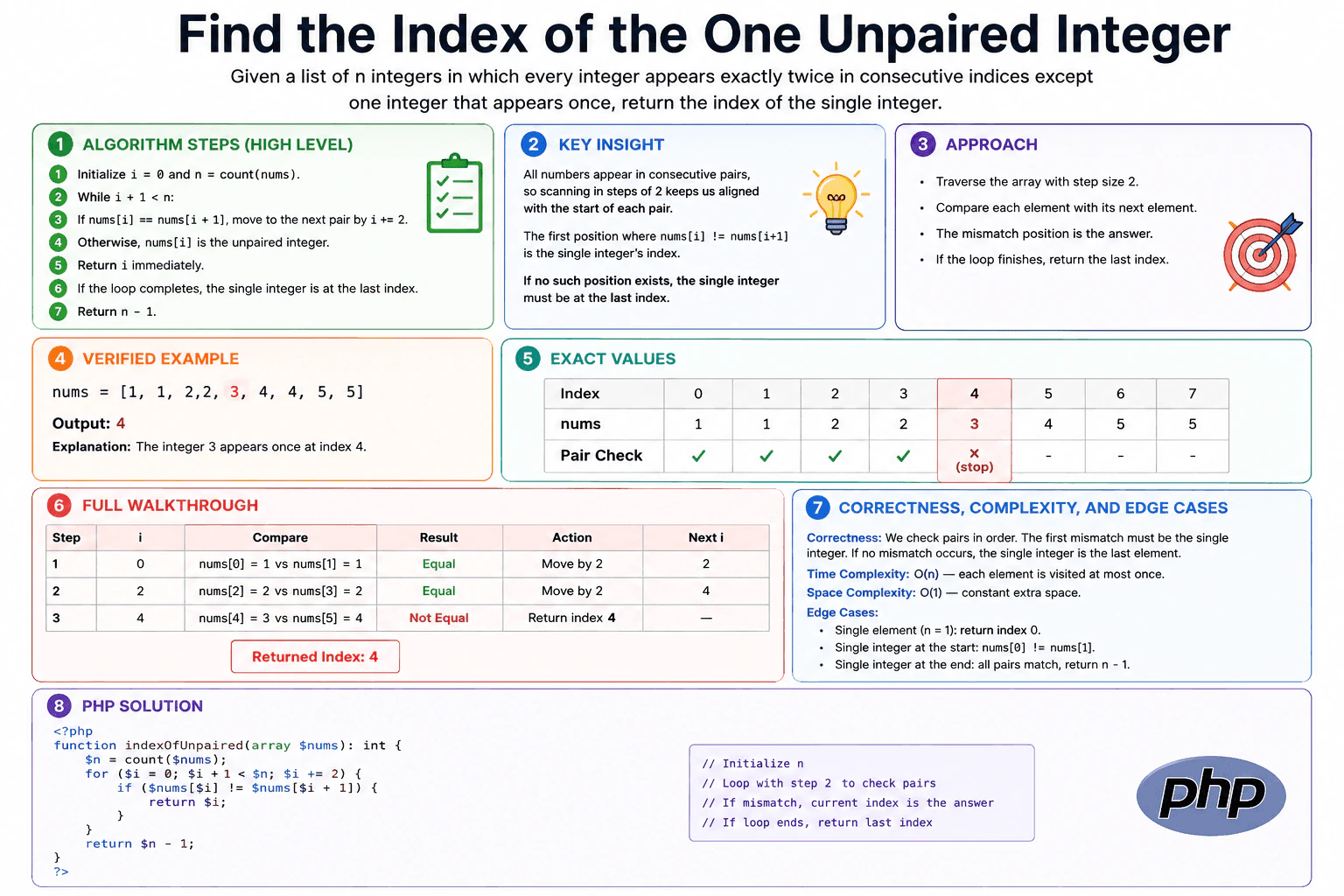
Given a list of n integers in which every integer appears exactly twice in consecutive indices except one integer that appears once, return the index of the single integer.
Short Interview Answer (30-60 seconds)
I would walk through the list two items at a time. Since every number appears as a consecutive pair except one single number, I compare nums[i] with nums[i + 1]. The first mismatch gives me the single number’s index, so I return it right away. If all pairs match, the single number must be at the last index. This uses O(n) time and O(1) extra space.
This problem asks for the position of one number in a list. Every other number is written twice, and each matching pair sits next to each other. We do not need the number itself. We need the index where the pair pattern breaks. The cleanest way is to check the list two items at a time. As soon as two neighbors are different, the first value in that pair is the answer. If no break appears, the single number is at the last position.
Useful questions to ask:
Useful Questions to Ask the Interviewer
Should I return a zero-based index?
Can I assume exactly one number is unpaired?
Is the list always arranged so equal values sit next to each other?
How to Explain It in an Interview
1. Understand the input and required output
The input is one list of integers. The output is the index of the only integer that does not have an equal neighbor right after it. I do not return the value. I return the position. The key promise is that every other number appears twice in consecutive positions.
2. Choose the algorithm and data structure
I use a simple loop that checks the list two items at a time. I compare nums[i] with nums[i + 1]. If they are equal, that pair is complete, so I move to the next pair. If they are different, the first value in that pair is the single integer. No extra data structure is needed.
3. Initialize the state
I start with i = 0. This means I begin at the first pair. The invariant is simple: every pair before i has already matched. That is why I can safely move forward by 2 after each successful check.
1. Start at i = 0. Compare nums[0] = 1 and nums[1] = 1. They match. Move to i = 2. 2. At i = 2, compare nums[2] = 2 and nums[3] = 2. They match again. Move to i = 4. 3. At i = 4, compare nums[4] = 3 and nums[5] = 4. They do not match. The answer is index 4. I stop here.
5. Explain why the result is correct
The list is built from consecutive pairs, except for one single value. So every correct pair keeps the pattern aligned. The first time the pattern breaks, the left item in that broken pair must be the single number. If no break appears, then the single number must be the last item in the list.
6. Explain the PHP implementation
The PHP code counts the list first. Then it loops with $i += 2. That keeps the scan on pair boundaries. Inside the loop, it checks whether $nums[$i] is different from $nums[$i + 1]. If yes, it returns $i right away. If the loop finishes, it returns $n - 1 as a defensive fallback. The problem guarantees a solution, so the fallback is not the expected path.
7. Explain complexity and edge cases
The loop checks each pair at most once, so the time is O(n). The code uses only a few variables, so the extra space is O(1). Important edge cases are a list with one item, a single item at the start of the break, and a single item at the last index.
Key Insight / Why This Solution Works
The key insight is that the input is already grouped into adjacent pairs. That means I do not need counting, sorting, or a hash map. I only need to compare neighbors. The invariant is that every pair before the current index has matched. When nums[i] and nums[i + 1] differ, the pair is broken, so nums[i] is the single value’s position. If no break appears, the single value is at the last index.
Code
<?phpdeclare(strict_types=1);
functionindexOfUnpaired(array$nums): int{
$n = count($nums);
// Start at the first pair and move two positions at a time.for ($i = 0; $i + 1 < $n; $i += 2) {
// If the pair does not match, the first item is the single integer.if ($nums[$i] !== $nums[$i + 1]) {
return$i;
}
}
// Defensive fallback; the stated problem guarantees a solution.return$n - 1;
}
// Example from the diagram.$nums = [1, 1, 2, 2, 3, 4, 4, 5, 5];
echoindexOfUnpaired($nums) . PHP_EOL; // 4
Time & Space Complexity
We process the input at most once, and we move in steps of 2. So the time is O(n). We only keep a few small variables like n and i, so the auxiliary space is O(1). There is no extra map, stack, or queue.
Where it is used
This pattern is useful when data is supposed to come in fixed adjacent pairs and one item breaks the pattern. It can help in ordered logs, paired records, or validation checks where you want to find the first place the sequence stops matching.
Why Interviewers Ask This
Interviewers want to see whether you notice the pair pattern quickly and keep the original index. They also want to know if you can explain why comparing neighbors is enough. This question checks simple loop logic, safe bounds, early return, and clear PHP code. It also shows whether you can state time and space complexity honestly and avoid confusing values with positions.
Common interview mistakes
A common mistake is returning the number itself instead of its index. Another mistake is moving by 1 instead of by 2, which breaks the pair alignment. Some candidates also forget the last-item fallback when every earlier pair matches. Another easy bug is reading past the end of the list by missing the i + 1 boundary check. The last mistake is describing extra work that the code never does.
Interview tip
Say the invariant out loud: every pair before the current index has matched, so the first mismatch must point to the single number.
Interviewer may ask next
What changes if the list does not guarantee exactly one unpaired integer?
Then I would add validation. I would still scan the pairs, but I would also check whether I found a mismatch at all. If no mismatch appears, or if more than one break appears, I would report invalid input. The time stays O(n) and the extra space stays O(1).
What changes if the equal values are not guaranteed to be next to each other?
Then the step-by-2 scan no longer works. I would need a different pass that tracks values and their counts or positions. That keeps the result correct, but it uses O(n) extra space instead of O(1).
2. Return the next English letter cyclically while preserving case and without branching.CodingEasyApple
i Question Details
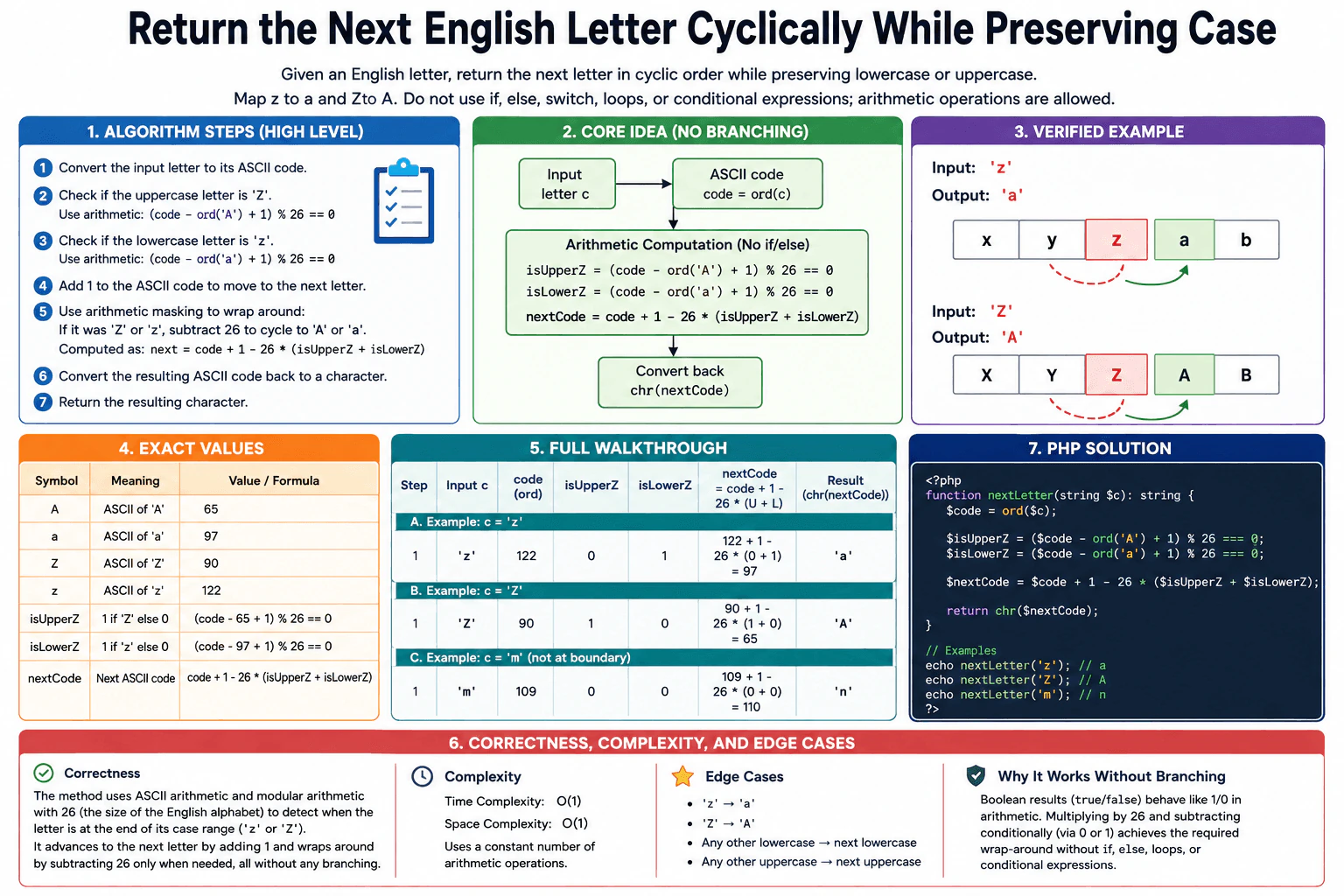
Given an English letter, return the next letter in cyclic order while preserving lowercase or uppercase. Map z to a and Z to A. Do not use if, else, switch, loops, or conditional expressions; arithmetic operations are allowed.
Short Interview Answer (30-60 seconds)
I would convert the letter to its ASCII code, then use arithmetic to detect whether it is the last letter in its case. The same formula always adds 1, and it subtracts 26 only for Z or z, so it wraps to A or a without any branching. I use ord and chr, so the solution stays very small, with O(1) time and O(1) extra space.
This problem asks for one English letter and the next letter after it. The case must stay the same. So lowercase stays lowercase, and uppercase stays uppercase. The special wrap is z to a and Z to A. The diagram solves this with arithmetic only. It turns the character into a number, checks the boundary with simple math, and then converts the number back to a character. That fits the rules well because there is no loop and no if statement in the final code.
Useful Questions to Ask the Interviewer
Do you want the answer to keep the same case?
Should z become a and Z become A?
Is one English letter the only input, with no extra symbols?
How to Explain It in an Interview
1. Understand the input and required output
The input is one English letter. The output is the next letter in cyclic order. The case must not change. So m becomes n, z becomes a, Q becomes R, and Z becomes A.
2. Choose the algorithm and data structure
I do not need a data structure here. I use direct ASCII arithmetic instead. The key idea is to turn the letter into a number, move forward by one, and wrap around when the letter is at the end of its alphabet range. The invariant is simple. After the math, the result is always the next letter in the same case.
3. Initialize the state
First I read the input character as $c. Then I convert it with ord($c) to get $code. After that I compute two boolean flags, $isUpperZ and $isLowerZ. They tell me whether the current letter is the last uppercase letter or the last lowercase letter.
4. Walk through the example
For z, the ASCII code is 122. The lowercase boundary check becomes true, and the uppercase check becomes false. The formula gives 122 + 1 - 26 = 97, and chr(97) is a.
For Z, the ASCII code is 90. The uppercase boundary check becomes true, and the lowercase check becomes false. The formula gives 90 + 1 - 26 = 65, and chr(65) is A.
For m, both boundary checks are false. The formula gives 109 + 1 = 110, and chr(110) is n.
5. Explain why the result is correct
The formula always moves one step forward. If the letter is not at the end of the range, that is enough. If the letter is z or Z, subtracting 26 wraps the code back to the first letter of the same case. That is why the same line works for every English letter.
6. Explain the PHP implementation
The function takes one character. ord($c) converts it to a number. The two comparisons return booleans. In PHP, booleans act like 1 or 0 in arithmetic, so $isUpperZ + $isLowerZ is either 0 or 1. Then the code computes the final ASCII value and returns chr($nextCode).
7. Explain complexity and edge cases
The code does a fixed amount of work. It does not loop. So the time is O(1). It uses only a few variables. So the extra space is O(1). The important edge cases are z, Z, and a middle letter like m. The same formula handles all of them.
Key Insight / Why This Solution Works
The core idea is branchless ASCII arithmetic. I convert the letter to a code, move forward by one, and use a boolean mask to subtract 26 only at the boundary. The invariant is that the formula always produces the next letter in the same case. If the letter is not z or Z, adding 1 is enough. If it is z or Z, the subtract-26 part wraps the code back to a or A.
Code
<?phpfunctionnextLetter(string$c): string{
// Convert the input character to its ASCII code.$code = ord($c);
// Detect the boundary letter for each case.// In PHP, true and false behave like 1 and 0 in arithmetic.$isUpperZ = ($code - ord('A') + 1) % 26 === 0;
$isLowerZ = ($code - ord('a') + 1) % 26 === 0;
// Move forward by one letter.// Subtract 26 only when the input is Z or z.$nextCode = $code + 1 - 26 * ($isUpperZ + $isLowerZ);
// Convert the ASCII code back to a letter.returnchr($nextCode);
}
// ExamplesechonextLetter('z'); // aechonextLetter('Z'); // AechonextLetter('m'); // n?>
Time & Space Complexity
The function always does the same small number of arithmetic steps. So the time is O(1). It only keeps a few variables in memory, so the extra space is O(1). There is no loop, no array, and no extra storage that grows with the input.
Where it is used
This pattern is useful when you need a tiny character transform with strict rules. It shows up in interview questions, text encoders, simple puzzle logic, and cases where you want to avoid branching.
Why Interviewers Ask This
Interviewers want to see whether you can turn a simple character rule into clean arithmetic. They are checking if you know ASCII codes, can avoid branching when asked, and can handle the boundary letters correctly. They also want to see whether you understand boolean arithmetic in PHP and can explain why the same expression works for both lowercase and uppercase. Clear complexity reasoning matters too.
Common interview mistakes
A common mistake is to use if, switch, or a loop, even though the problem forbids branching.
Another mistake is to forget the wraparound case. Then z does not become a, and Z does not become A.
Some people mix up the lowercase and uppercase ranges. That breaks the case-preserving rule.
Another mistake is to forget that PHP booleans can act like 1 and 0 in arithmetic, so the mask logic may look strange at first.
It is also easy to overcomplicate the solution. This problem only needs a few arithmetic steps.
Interview tip
Say the formula out loud: add 1 for every letter, then subtract 26 only at the boundary. That makes the branchless idea easy to follow.
Interviewer may ask next
How would you shift the letter forward by k positions instead of just one?
I would replace the + 1 with + k and keep the same modulo-26 wrap logic. The idea stays the same, and the time and space complexity stay O(1).
What would you change if the input could include non-letter characters?
I would add a separate validation rule for non-letters, because the shown formula assumes one English letter. That extra check would still keep the work constant time, but it would add a new decision outside the branchless core.
3. Remove all adjacent duplicates from a string.CodingEasyApple
i Question Details
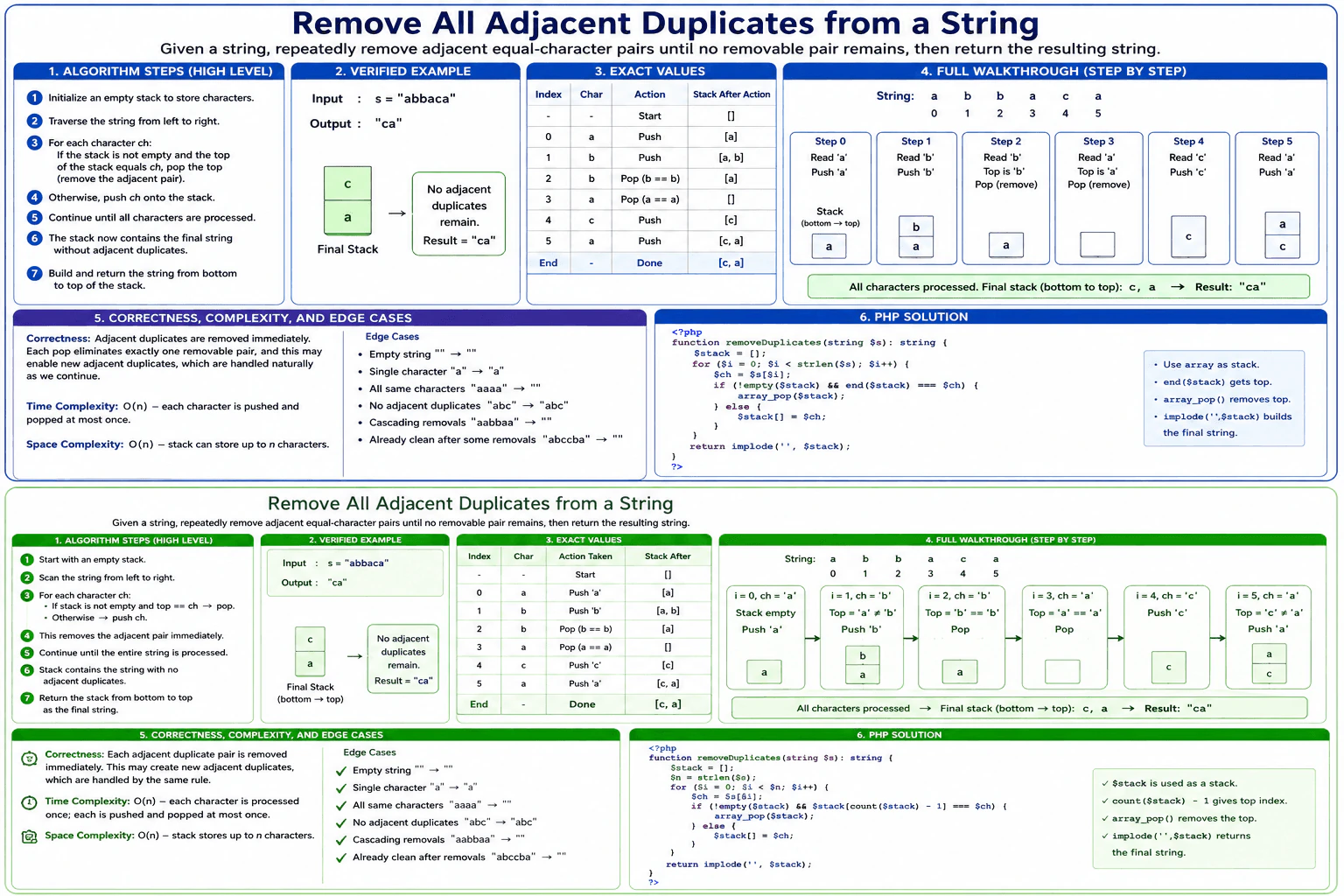
Given a string, repeatedly remove adjacent equal-character pairs until no removable pair remains, then return the resulting string. Explain edge cases and complexity.
Short Interview Answer (30-60 seconds)
I use a stack to remove adjacent duplicates from left to right. For each character, I compare it with the stack top. If they match, I pop the top. If they do not match, I push the character. The stack always holds the cleaned result for the part I have already read, and that also handles chain removals. For abbaca, the result is ca. The time is O(n), and the extra space is O(n).
This problem asks me to clean a string by removing touching equal letters again and again. If two neighbors are the same, both disappear. I keep doing that until no such pair is left, then I return the final string. The example abbaca becomes ca. I use a stack because it remembers the current result while I scan from left to right, and it lets me remove the last kept letter right away when the new letter matches it. That makes chain removals easy to handle.
Useful Questions to Ask the Interviewer
Do we return only the final string?
Should uppercase and lowercase letters be treated as different?
Can the input string be empty?
Is there any special character set or length limit I should assume?
How to Explain It in an Interview
1. Understand the input and required output
The input is one string. The output is the same string after repeated removal of adjacent equal characters. We do not return removed characters or positions. We return the final cleaned string only.
2. Choose the stack
I use a stack. The stack stores the current unfinished result. The top of the stack is the last character we kept. This is the right choice because every new character only needs to compare with that last kept character.
3. Initialize the state
I start with an empty stack. I read the string from left to right. The invariant is simple: after processing each prefix, the stack contains the reduced form of that prefix with no adjacent equal pair left inside it.
4. Walk through the example
For abbaca, I read a and push it. Then I read b and push it because the top is a. Next I read the second b. It matches the top b, so I pop. Then I read a. It matches the top a, so I pop again. Next I read c and push it. Last I read a and push it because the top is c. The final stack is c, a, so the result is ca.
5. Explain why the result is correct
The stack always stores the correct cleaned result for what I have processed so far. When two equal letters meet, I remove them right away. That also handles chain removals, because after a pop, the new top may match the next character. When the scan ends, nothing left in the stack can still be removed.
6. Explain the PHP implementation
The function takes the string as input. It creates an empty array and uses it as a stack. It gets the string length, then loops through each index. For each character, it reads $ch = $s[$i]. Then it checks the top with $stack[count($stack) - 1] when the stack is not empty. If the top matches, it removes it with array_pop($stack). Otherwise it appends the character. At the end, implode('', $stack) builds the final string.
7. Explain complexity and edge cases
The time is O(n) because I read each character once. Each character is pushed at most once and popped at most once. The extra space is O(n) because the stack can grow to the full string length in the worst case. Important edge cases are an empty string, one character, a string with no duplicates, a string where all characters cancel, and chain removals like abbaca.
Key Insight / Why This Solution Works
The key idea is to treat the stack as the current reduced string. For each new character, I only need to compare it with the stack top. If they are the same, I remove the top. If they are different, I add the new character. This works because the stack always represents the final cleaned result for the prefix I have already processed. That invariant is what makes chain removals work naturally. After a pop, the next character is compared with the new top, so repeated pairs keep disappearing until the prefix is stable.
Code
<?phpfunctionremoveDuplicates(string$s): string{
// Use an array as a stack of characters.$stack = [];
// Cache the length so we do not call strlen() on every loop check.$n = strlen($s);
// Read the string from left to right.for ($i = 0; $i < $n; $i++) {
$ch = $s[$i];
// Compare the current character with the top of the stack.if (!empty($stack) && $stack[count($stack) - 1] === $ch) {
// Same character next to the top, so remove the pair.array_pop($stack);
} else {
// Different character, so keep it in the stack.$stack[] = $ch;
}
}
// Join the stack back into the final string.returnimplode('', $stack);
}
// Example from the diagram.$input = 'abbaca';
echoremoveDuplicates($input) . PHP_EOL; // ca
Time & Space Complexity
We process the string from left to right. Each character is handled once. It is either pushed onto the stack or removed later with one pop. So the time is O(n). The stack can hold all characters in the worst case, so the extra space is O(n).
Where it is used
This pattern is useful when one item can cancel the previous item. It shows up in string cleanup, parser-style text processing, and problems like bracket matching. It is also a good fit when you want a simple one-pass solution that keeps only the current unfinished result.
Why Interviewers Ask This
Interviewers want to see if I can spot the stack pattern, keep one clear invariant, and handle repeated cancellations correctly. They also check whether I can explain why the scan is one pass, why chain removals still work, and why the PHP code matches the idea. Good edge-case handling and correct complexity wording matter too.
Common interview mistakes
A common mistake is stopping after removing only one pair. The string can create new pairs after a pop. Another mistake is comparing with the previous character in the original string instead of the current stack top. Some candidates forget that chain removals are part of the same rule, so they leave extra pairs behind. Another mistake is returning the stack too early or forgetting to join the stack at the end. The last common issue is giving the wrong complexity and ignoring that the stack may grow with the input.
Interview tip
Say the stack is the cleaned string so far. Each new letter either extends that string or cancels its last letter.
Interviewer may ask next
What changes if I also need to return how many pairs were removed?
I would add a counter and increase it every time I pop from the stack. Each pop removes one adjacent pair. The stack logic stays the same, so the time is still O(n) and the extra space is still O(n).
Can this work on streaming input?
Yes. I would read one character at a time and keep the same stack rule. I still compare the new character with the stack top, then push or pop. The time stays O(n), and the extra space is O(n) in the worst case.
4. Define the API boundaries for a distributed peer-to-peer web crawler.API DesignHardApple
i Question Details
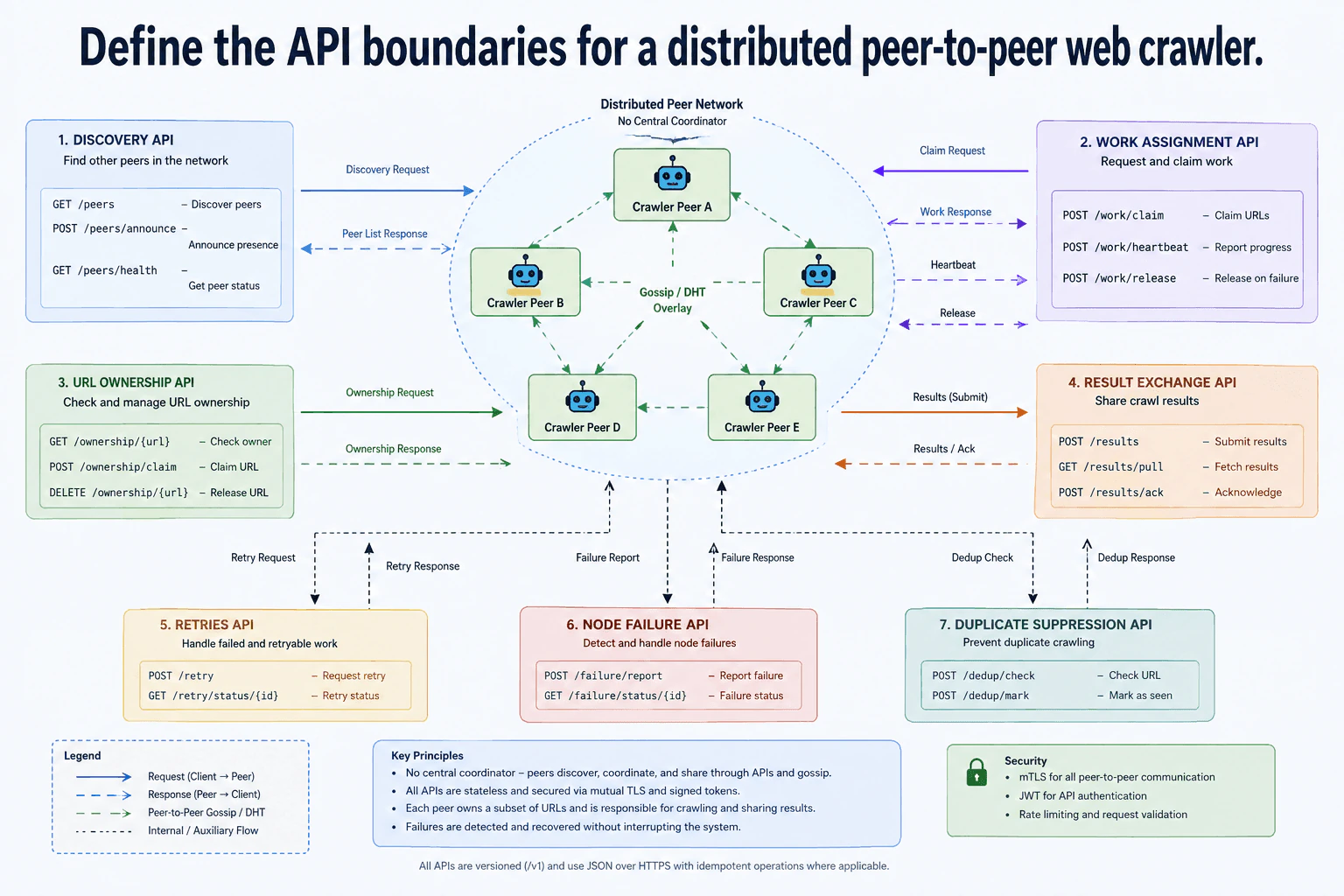
Define interfaces between crawler peers for discovery, work assignment, URL ownership, result exchange, retries, node failure, and duplicate suppression without relying on a central coordinator.
Short Interview Answer (30-60 seconds)
At a high level, I would split this into small peer-to-peer APIs so crawler nodes can find each other, claim URL work, exchange crawl results, and recover from failures without a central coordinator. The main flow is discovery through /peers, then work claim, ownership, results, retry, failure, and duplicate suppression. The main security choice is to protect every peer call with mTLS, JWT, and request validation. The trade-off is that the design is harder to coordinate, but it removes the single point of failure and scales better.
Detailed Explanation
This question asks how crawler peers talk to each other with no central leader. We need a simple way to find peers, ask for work, decide URL ownership, send crawl results, and handle retries, node failures, and duplicate checks. The goal is to keep crawling even when some peers go down. The hardest part is that two peers may see the same URL. I will follow the diagram in the same order it shows the APIs.
Useful questions to ask:
Useful Questions to Ask the Interviewer
Should URL ownership stay local, or move often?
Should result exchange be synchronous, or can it be stored first and acked later?
How to Explain It in an Interview
1. Start with the boundary and the goal
I would begin by saying this is a peer-to-peer crawler with no central coordinator. Each peer is both a client and a server. The diagram shows a distributed peer network with a Gossip / DHT Overlay, so peers discover each other and share state directly. The goal is to find work, own URLs, exchange crawl results, and recover when a node fails. The reason for this boundary is simple. Crawling should keep working even when one peer disappears.
2. Discovery through /peers
The first API group is Discovery API. GET /peers lets a peer ask for other peers in the network. POST /peers/announce lets a peer say, “I am here now.” GET /peers/health checks status. The request goes to the peer that owns discovery, and the response comes back with a peer list or health state. This is needed because the system cannot depend on a central directory. The diagram’s discovery request and peer list response show that flow clearly.
3. Claim work and decide URL ownership
Next, I would talk about Work Assignment API and URL Ownership API. POST /work/claim claims URLs for crawling. POST /work/heartbeat reports progress. POST /work/release gives the work back when a peer fails or stops. The response from a work claim comes back as the work response shown in the diagram. At the URL level, GET /ownership/{url} checks who owns a URL. POST /ownership/claim claims it. DELETE /ownership/{url} releases it. This matters because two peers can see the same URL. Ownership keeps one peer responsible at a time and reduces duplicate work.
4. Share crawl results
After crawling, the peer uses the Result Exchange API. POST /results submits crawl results. GET /results/pull fetches shared results. POST /results/ack confirms receipt. The diagram shows results moving from the crawler peer to the result side, then an ack coming back. I would keep the explanation simple. One peer sends the crawl output. Another peer stores or shares it. The ack tells the sender the data was accepted. This keeps result handling separate from crawl ownership, so crawling can keep moving.
5. Handle retries, node failure, and duplicate suppression
The next part is reliability. POST /retry requests that failed work be tried again. GET /retry/status/{id} shows retry state. POST /failure/report tells the network that a node failed. GET /failure/status/{id} shows the failure state. The duplicate suppression API stops the same URL from being crawled twice. POST /dedup/check asks if a URL was already seen. POST /dedup/mark records that it was seen. I would explain that this is not perfect global locking. The trade-off is simpler scaling and no central leader, but peers must accept some coordination cost.
6. Security, versioning, and trade-offs
The main security decision is to protect every peer call with mTLS and JWT. mTLS means both sides verify each other with certificates. JWT is a signed token that proves the caller is trusted. The diagram also shows rate limiting and request validation. I would mention that every API is versioned under /v1 and uses JSON over HTTPS with idempotent operations where applicable. Idempotent means the same retry does not change the result twice. The benefit is a clear and resilient design. The downside is more API calls and more state to keep consistent across peers.
Practical Complexity & Trade-offs
The benefit of this design is that it has no single leader. That makes the crawler harder to break and easier to scale by adding peers. The downside is that coordination moves into the APIs. We need ownership checks, dedup checks, retries, and failure reporting to keep peers in sync. That is more work than a central queue, but it fits a distributed system better. mTLS and JWT add security, but they also add setup and rotation work. Idempotent requests are important because retries should not create duplicate crawls. Versioning the APIs under /v1 helps later changes without breaking old peers.
Why Interviewers Ask This
Interviewers ask this to see if I can draw clean API boundaries in a distributed system. They want to know if I understand request and response flow, ownership, duplicate suppression, retries, and failure handling. They also check whether I keep authentication, transport security, and authorization separate. A strong answer shows judgment, not memorization. It should explain why the design avoids a central coordinator and what trade-off that choice creates for consistency, coordination cost, and operational simplicity.
Interviewer may ask next
What changes if a peer fails while it still owns work?
The design stays the same, but /work/release and /failure/report become more important. When a peer stops heartbeating, another peer can mark that node failed through POST /failure/report and then check GET /failure/status/{id}. The failed peer’s URLs should be released from ownership with DELETE /ownership/{url}, and the work can be claimed again with POST /work/claim. That keeps correctness because only one live peer should own the work at a time. If the old peer comes back later, it should not assume it still owns the same URLs. It must read ownership again first. Security stays the same because the retry and failure calls still use mTLS, JWT, and request validation. The main downside is that some work may be crawled twice if the failure happened right before a result was sent. That is acceptable here because the system prefers recovery over perfect exactly-once behavior.
How do you stop two peers from crawling the same URL?
I would keep the same API set and use /dedup/check, /dedup/mark, and ownership together. A peer first asks POST /dedup/check before it starts crawling. If the URL is new, it claims ownership with POST /ownership/claim and then crawls it. After that, it calls POST /dedup/mark so other peers know the URL was already seen. The ownership API still helps when two peers discover the same URL at the same time. Only one should win the claim, and the other peer should back off and try another URL. This keeps the design correct without a central lock manager. If the peer later retries the same URL, the check should return the same answer because the call is idempotent. The downside is that duplicate suppression is still best effort, not perfect global locking. That is the trade-off for keeping the system decentralized and scalable.
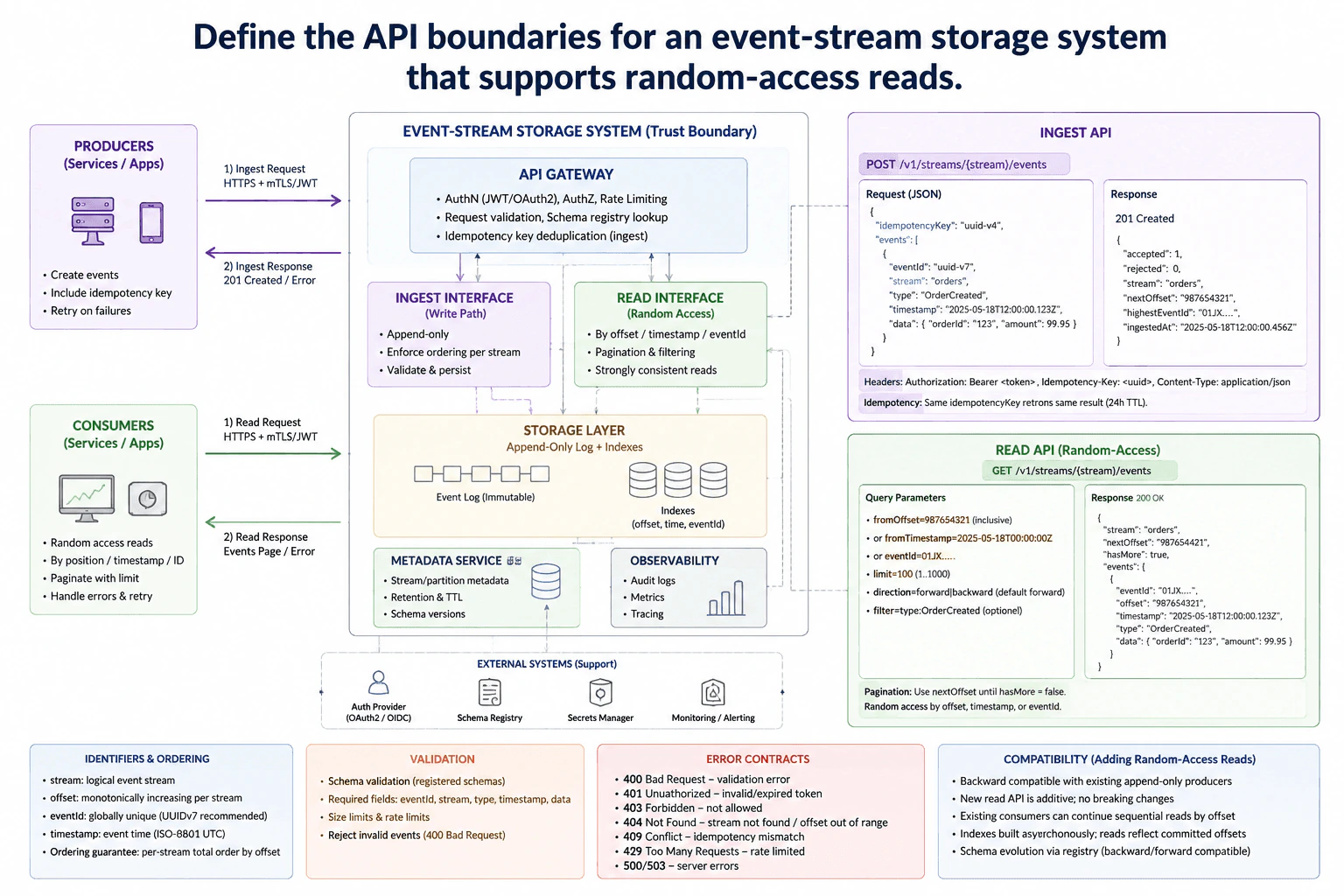
5. Define the API boundaries for an event-stream storage system that supports random-access reads.API DesignHardApple
i Question Details
Specify the ingest and read interfaces for an event-stream system, including request and response contracts, identifiers, ordering, pagination or offsets, validation, errors, idempotency, and compatibility when random-access reads are added.
Short Interview Answer (30-60 seconds)
At a high level, my goal is to keep ingest simple and make reads flexible. Producers append ordered events through POST /v1/streams/{stream}/events, and consumers read pages through GET /v1/streams/{stream}/events using offset, timestamp, or event ID. The gateway handles JWT or OAuth2, authorization, and rate limiting before the request reaches storage. The trade-off is that we keep the write path fast with an append-only log, but random-access reads need extra indexes and careful paging.
Detailed Explanation
This question asks how to split one event system into a write side and a read side. One side saves new events in order. The other side lets a client jump to old events by offset, time, or event ID. The main challenge is to keep the write path simple while adding safe random reads later. I will follow the diagram and explain the gateway, ingest path, read path, storage, validation, errors, and compatibility.
Useful Questions to Ask the Interviewer
Is ordering required only inside one stream, or across all streams?
How long should old events stay available?
Is random access mainly by offset, timestamp, or event ID?
How to Explain It in an Interview
1. Goal and API boundary
I would start by saying the system has one job: store events and make them easy to read later. The public boundary is small and clear. Producers call the ingest API to append events. Consumers call the read API to fetch events later. Inside the boundary, each stream is a logical event stream. Offsets increase monotonically inside each stream. The diagram recommends globally unique event IDs, and UUIDv7 is a good fit. That keeps writes simple and preserves order. The diagram also shows support systems outside the main path. Those include the auth provider, schema registry, secrets manager, and monitoring.
2. Ingest API and write path
The ingest endpoint is POST /v1/streams/{stream}/events. The request uses Authorization: Bearer <token>, Idempotency-Key: <uuid>, and Content-Type: application/json. The body has an idempotencyKey and an events array. Each event has eventId, stream, type, timestamp, and data. I would explain that the gateway first checks JWT or OAuth2, authorization, and rate limits. It also looks up schemas and deduplicates repeated ingest requests. If the request is valid, the ingest interface appends events in order. The response is 201 Created with accepted, rejected, stream, nextOffset, highestEventId, and ingestedAt. If the same idempotency key comes back within 24 hours, the system returns the same result.
3. Read API and random-access path
The read endpoint is GET /v1/streams/{stream}/events. It supports random access by fromOffset, fromTimestamp, and eventId. fromOffset is inclusive. The query also includes limit, direction, and an optional filter. limit ranges from 1 to 1000, and direction is forward or backward. The default direction is forward. The example filter is type:OrderCreated. I would say the read service uses indexes to fetch an ordered page of events. The response is 200 OK with stream, nextOffset, hasMore, and events. This gives clients a safe paging model. Clients keep calling the read API with nextOffset until hasMore is false. That is why the storage layer keeps both the immutable log and the indexes.
4. Validation, errors, and support systems
I would next explain that validation happens early. The gateway and ingest path check registered schemas, required fields, size limits, and rate limits. The diagram lists 400 for bad input, 401 for missing or expired auth, 403 for not allowed, 404 for missing stream or out-of-range offset, 409 for idempotency mismatch, 429 for rate limits, and 500/503 for server problems. I would also mention the support systems. The auth provider issues trusted identity. The schema registry stores approved schema versions. The secrets manager holds secrets. Monitoring and alerting watch logs, metrics, and tracing. Those systems support the API, but they do not own the business response.
5. Compatibility and trade-offs
The main compatibility rule is that the new read API is additive. That means existing append-only producers do not break. Existing consumers can still read sequentially by offset. The diagram also says indexes are built asynchronously, so reads reflect committed offsets. That is a useful trade-off. The benefit is that writes stay fast and predictable. The downside is that random-access reads depend on extra indexing work and more storage. Schema evolution also matters. The schema registry lets the system stay backward and forward compatible. So I would close by saying the design keeps the write path clean, and adds read power without breaking old clients.
Practical Complexity & Trade-offs
The benefit is that the write path stays simple and safe. Producers append events in order, and each stream keeps one clear offset sequence. That makes reads and retries easier to reason about. The downside is that random-access reads need extra indexes by offset, timestamp, and event ID. Those indexes add storage cost and background work. We also accept more gateway logic, because it must check tokens, validate schemas, enforce idempotency, and rate limit traffic. That is safer, but it adds latency and operational work. The design stays practical because the old append-only path remains easy, while the new read path gets more power.
Why Interviewers Ask This
Interviewers want to see whether I can draw a clean API boundary and keep request and response flows correct. They also want to know if I understand ordering, idempotency, random-access reads, validation, and error handling. This question tests whether I can separate the gateway, storage, metadata, and observability roles. It also shows whether I can explain why random access needs indexes instead of changing the append-only write path. A strong answer proves I can make trade-offs clear in simple English.
Interviewer may ask next
What changes if readers must only see committed events during heavy ingest?
Yes, I would keep the same public API, but I would make the read path rely only on committed offsets. The affected flow is the read service and its index lookup, not the ingest contract. The ingest path still appends events in order and returns 201 Created with the next offset. The read API still uses fromOffset, fromTimestamp, eventId, limit, direction, and filter, but it only serves data that has been committed into the log and indexed. That keeps correctness strong, because consumers never see partial writes. Security does not change, because the gateway still validates tokens, schemas, and request limits. The main downside is freshness. During heavy ingest, reads may lag behind the newest events because indexing happens asynchronously. I would accept that trade-off if correctness matters more than instant visibility.
What changes if we add a new schema version or a new event field?
I would keep the same ingest and read endpoints, and I would change the schema rules behind them. The affected components are the gateway, the ingest interface, and the schema registry. New fields would be added with versioned schemas, and old readers would keep working with backward-compatible data. The gateway would still check the registered schema before accepting the event, and the ingest path would still write the event into the append-only log. The read API would not need a new route, because it already returns events from storage by offset or time. This keeps the system stable for clients. The downside is version management. We need careful schema evolution rules, and we may need to keep old versions longer. That adds process work, but it avoids breaking existing producers and consumers.
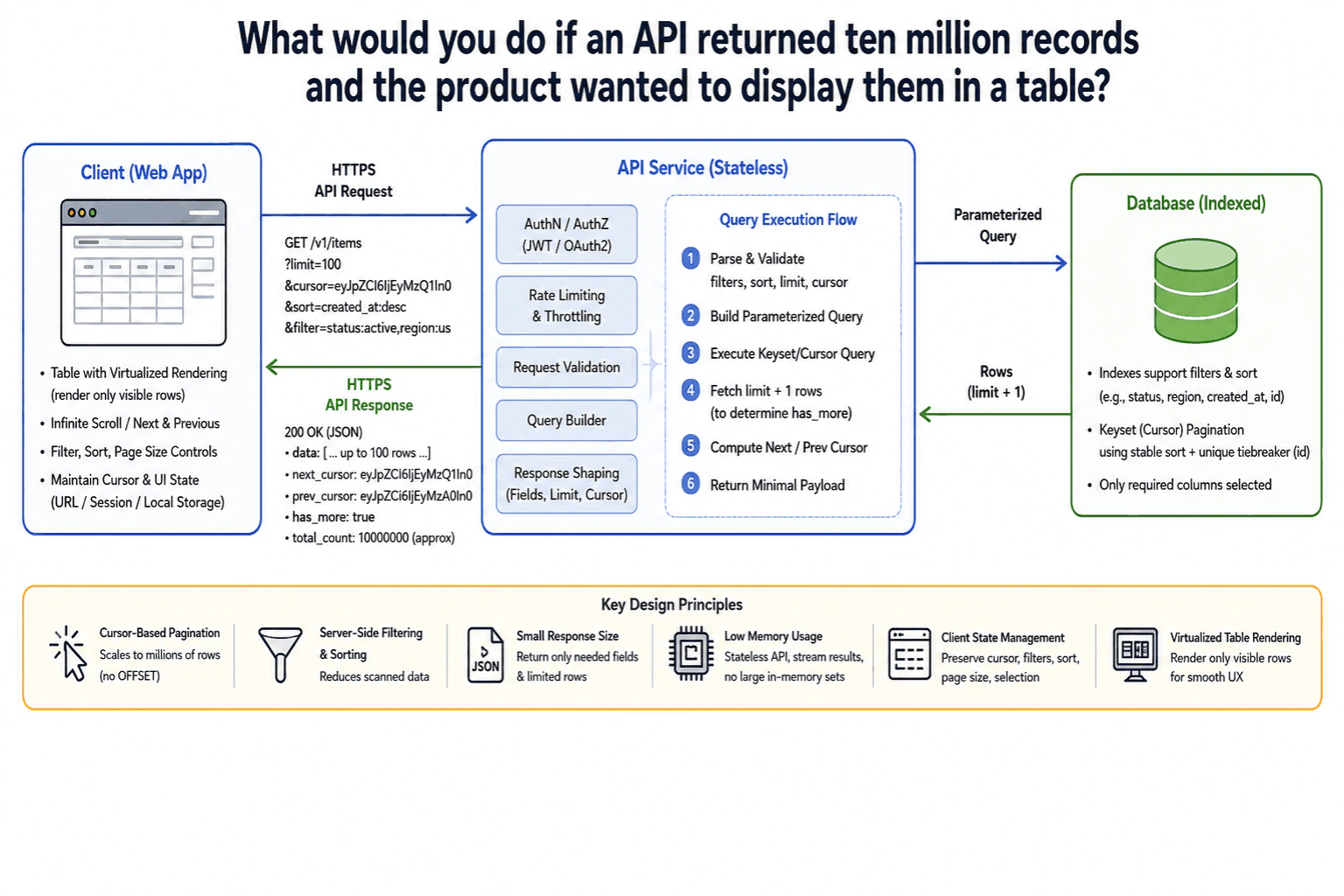
6. What would you do if an API returned ten million records and the product wanted to display them in a table?API DesignHardApple
i Question Details
Redesign the API and client interaction so a table can support a dataset of ten million records. Address cursor-based pagination, server-side filtering and sorting, response size, memory use, client state, and virtualized rendering.
Short Interview Answer (30-60 seconds)
At a high level, I would not try to send ten million rows to the browser. I would keep the API stateless, use cursor-based pagination with server-side filtering and sorting, and return only a small JSON page. The client would keep the cursor and table state in the URL, session, or local storage, and the table would render only visible rows. The main security and reliability checks are JWT or OAuth2 authentication, request validation, and rate limiting. The trade-off is that cursor pagination is fast and stable, but random page jumps are harder.
Detailed Explanation
This asks how to show a huge list in a table without making the page slow. The goal is to keep the screen fast, keep memory low, and still let users search, sort, and move through records. I would follow the diagram by showing only one page at a time, checking each request, and returning only the rows the table needs. Then the page draws only visible rows. The hard part is handling size without loading everything at once.
Useful Questions to Ask the Interviewer
Should users only move next and previous, or can they jump to a page?
Which filters and sort fields are allowed?
Do we need exact counts, or is an approximate count enough?
Where should we store the cursor and table state: URL, session, or local storage?
How to Explain It in an Interview
1. Start with the goal
At a high level, I would keep the table view narrow. The browser asks for a small page, not the whole dataset. That is why the diagram uses virtualized rendering and cursor-based pagination. Virtualized rendering means the browser draws only the visible rows. Cursor pagination means each request asks for the next slice after a known point, not an offset into a huge list.
2. Send a small, controlled request
The client sends GET /v1/items with limit=100, cursor=..., sort=created_at:desc, and filter=status:active,region:us. The client also keeps UI state such as filters, sort order, page size, cursor, and selection in the URL, session, or local storage. That makes refresh and back-button behavior easier. The API stays stateless, so any server can answer the next request.
3. Check identity, limit abuse, and validate input
The request first reaches the API service. The service applies AuthN / AuthZ with JWT or OAuth2, which means it checks who the caller is and whether the caller may use the endpoint. It also applies rate limiting and throttling to protect the service from abuse. Then it validates the request: allowed filter fields, allowed sort fields, cursor shape, and page size. If validation fails, the request is rejected before the database is touched.
4. Build a safe query and use cursor pagination
The service then uses a query builder to create a parameterized query. That keeps the SQL safe and structured. The database should have indexes on the filter and sort fields, such as status, region, created_at, and id. The diagram uses keyset, or cursor, pagination with a stable sort and a unique tiebreaker id. The query fetches limit + 1 rows so the service can tell whether more rows exist. This avoids OFFSET scans, which get slower as the table grows.
5. Return a compact response and keep the UI light
The service shapes the response and returns only the fields the table needs. On success, it returns 200 OK (JSON). The JSON includes data, next_cursor, prev_cursor, has_more, and an approximate total_count. The client uses next_cursor and prev_cursor to move through the list. The browser keeps rendering only visible rows, so the DOM stays small and memory use stays low.
6. Explain the trade-off
The main trade-off is simple. Cursor pagination is fast and stable for very large tables, but it does not make random page jumps easy. I accept that trade-off because the table stays responsive at ten million rows. If the product later needs exact jumps or exact counts, that would be a separate design choice, not the default path.
Practical Complexity & Trade-offs
The benefit is that the API returns only what the table needs, so the browser stays fast. Server-side filtering and sorting reduce the work on the client and reduce data transfer. Cursor pagination is safer and faster than OFFSET for huge tables, but it makes random page jumps harder. That is the trade-off I would accept because the main goal here is scale and responsiveness. The API should stay stateless, and the client should keep the cursor and UI state. This keeps the design simple to scale, but it puts a little more work in the UI.
Why Interviewers Ask This
The interviewer wants to see whether I can design for scale without wasting memory or network. They are checking if I choose the right pagination model, push filtering and sorting to the server, and keep the browser light. They also want to see basic security and reliability thinking, like authentication, validation, and rate limiting. Most of all, they want a clear trade-off discussion, not buzzwords.
Interviewer may ask next
What if the product wants random access to page 500, not just next and previous?
I would keep cursor pagination as the main path, because that is what the diagram supports best. If the product truly needs random page jumps, I would add a separate search or navigation mode instead of changing the main table flow. That new mode would still use the same API checks, the same filtering rules, and the same indexed database fields. I would also keep the response compact and still return only the fields needed for the table. The main downside is that random page access is harder to keep fast and stable at this scale. Cursor pagination gives better performance and better consistency, but it does not map cleanly to page 500 from an arbitrary starting point. So I would treat random jumping as a separate product choice, not the default table behavior.
What happens when the user changes the filter or sort while the table is open?
I would reset the cursor and request the first page again. The new filter or sort changes the result set, so the old cursor is no longer valid for that view. The client should keep the new filters, sort order, and page size in its state, then send them back in the next GET /v1/items request. The API service would validate the new request, build a new parameterized query, and use the same keyset pagination flow. The client would still render only visible rows, so the browser stays light. The downside is that the user loses the old position in the table, but the result stays correct and consistent with the new view. That is the safer choice, because a cursor belongs to one filter and sort combination. It also prevents the table from showing mismatched pages after the user changes the view.
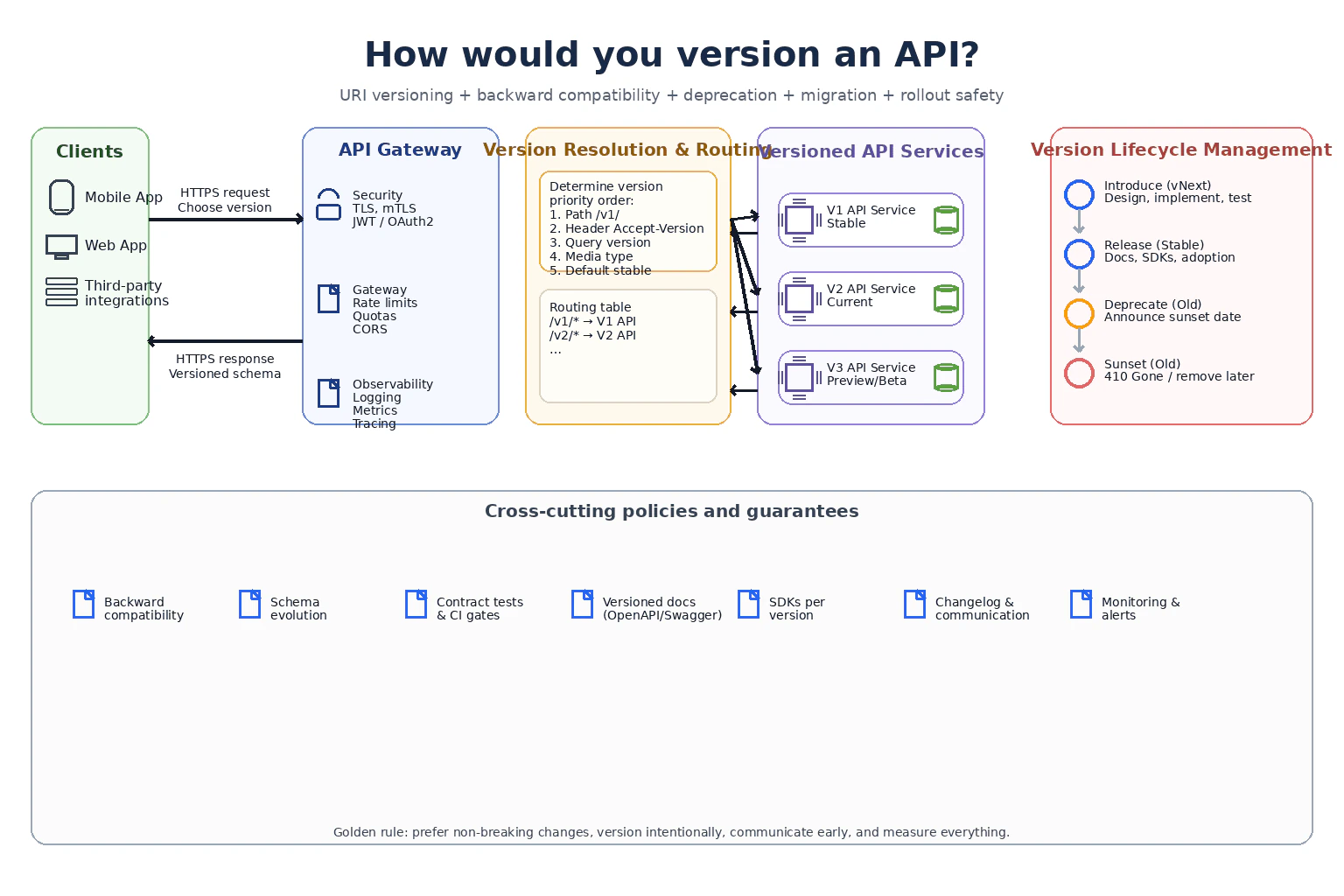
7. How would you version an API?API DesignHardApple
i Question Details
Design an API-versioning approach and handle advanced follow-ups involving backward compatibility, client migration, deprecation, schema evolution, and rollout safety.
Short Interview Answer (30-60 seconds)
At a high level, I would use URI versioning as the main rule, with the API gateway acting as the single entry point. Clients send HTTPS requests with a version hint, such as /v1/, Accept-Version, a query version, or a media type. The gateway checks security, rate limits, and observability, then routes to V1, V2, or V3. The main trade-off is more maintenance, but it protects old clients while new versions roll out safely.
Detailed Explanation
This question is about keeping an API useful while it changes over time. The goal is to let mobile apps, web apps, and third-party integrations keep working while newer versions are added. The main challenge is choosing one clear version rule and retiring old versions without breaking clients. I will explain the design in the same order as the diagram, from clients, to the API gateway, to version resolution, to versioned services, and then to lifecycle control.
Useful Questions to Ask the Interviewer
Should URI versioning be the primary rule, or only one of several accepted rules?
How long should old versions stay available?
Do you want additive changes only, or do you expect breaking changes too?
What deprecation notice and migration help should clients receive?
How to Explain It in an Interview
1. Start with the goal and the API boundary
At a high level, I would keep the API stable for existing clients. The clients in the diagram are mobile apps, web apps, and third-party integrations. They all send HTTPS requests to the API Gateway. That gateway is the first trust boundary. It is the right place to choose the version and protect the system. This keeps version handling in one place instead of pushing it into every service.
2. Explain how version resolution works
The diagram shows URI versioning as the first and clearest signal. It also shows other version hints, like the Accept-Version header, a query version, and a media type. I would explain the priority order exactly as shown: path first, then header, then query, then media type, then the default stable version. The gateway also handles security, rate limits, quotas, CORS, logging, metrics, and tracing. Those are gateway responsibilities, not business logic.
3. Route the request to the correct versioned service
After version resolution, the gateway routes the request to the matching service. The diagram shows V1 API Service as Stable, V2 API Service as Current, and V3 API Service as Preview/Beta. I would say each version owns its own contract. That means V1 can stay stable while V2 and V3 evolve. The routing table makes this concrete, for example /v1/* goes to V1 API and /v2/* goes to V2 API. The gateway routes traffic, but the service owns the business behavior and response shape.
4. Keep the data model backward compatible
The diagram highlights backward compatibility and schema evolution. I would prefer additive changes first. New fields are safer than removed fields. New behavior is safer than changing old behavior in place. Contract tests and CI gates help catch breaking changes before release. Versioned docs, such as OpenAPI or Swagger, help clients understand each version. SDKs per version help teams migrate with less risk. Changelogs and communication matter too, because versioning is also a coordination problem.
5. Manage the version lifecycle clearly
I would treat versioning as a lifecycle. The diagram shows four stages: Introduce vNext, Release Stable, Deprecate Old, and Sunset Old. First, I introduce the new version and test it. Then I release it as stable. After that, I deprecate the old version with a clear notice and migration help. Finally, I sunset the old version and remove it later. The key point is that old clients should not lose service without warning. Monitoring and alerts help track adoption during the change.
The main trade-off is maintenance cost. More versions mean more code, more tests, more docs, and more support work. The benefit is safety. Clients can move at different speeds, and breaking changes do not have to land all at once. I would finish by saying that this design accepts extra work in exchange for lower risk to production clients.
Practical Complexity & Trade-offs
The benefit is that old and new clients can live together. The gateway can read several version signals, but the service only has to handle the version it receives. That makes the system flexible. The downside is more maintenance. Each version needs tests, docs, and support. This is safer, but it also slows down releases a little. Backward compatibility helps a lot because it lets us add new fields and new behavior without breaking old apps. Breaking changes need a new version, which is more work, but we accept that because breaking production clients is much worse.
Why Interviewers Ask This
The interviewer wants to see judgment, not memorized buzzwords. They are checking whether I can keep old clients working while new versions are added safely. They also want to see clear request flow, correct gateway ownership, version selection, backward compatibility, deprecation, and trade-off thinking. A strong answer shows that I can separate routing from business logic and explain how the API changes over time.
Interviewer may ask next
What would you do if V2 needs a breaking change?
I would move that change into V3 or the next version, not force it into V2. The affected flow is the request path from the API Gateway to the versioned service. V1 and V2 should keep their current contracts so existing clients do not break. The gateway can still use the same version rules, and the new version can start as Preview/Beta before it becomes Current or Stable. That keeps correctness simple, because each version owns its own schema and behavior. I would also keep contract tests, versioned docs, and the changelog updated so migration is clear. If the change is large, I would publish the migration steps before release and watch adoption closely. The downside is more work, because we must support two versions for longer. We accept that cost because it is safer than changing a live version in place.
How do you handle a client that sends both a path version and an Accept-Version header?
I would follow the priority order shown in the diagram. The path version wins first, then the Accept-Version header, then the query version, then the media type, and finally the default stable version. That keeps the decision predictable. The affected component is the version resolution logic in the API Gateway. The gateway should resolve the version once, then route the request to the matching service. That protects correctness because clients get one clear rule, and it keeps security and logging in the same place. I would also return the chosen version in logs or response metadata if the system supports that, so support teams can debug requests faster. The downside is that clients must follow the documented priority order, so the docs, SDKs, and changelog need to be very clear.
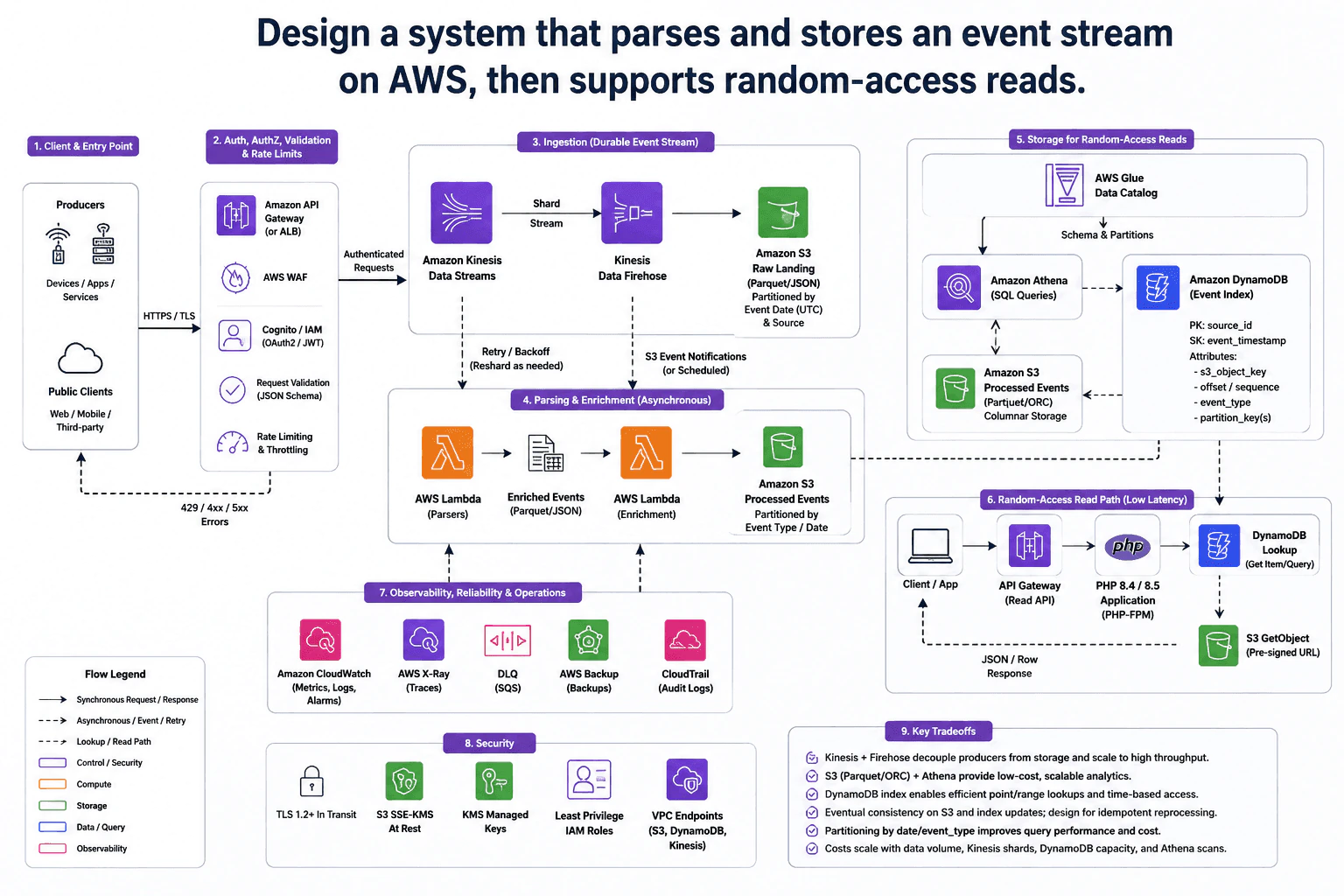
8. Design a system that parses and stores an event stream on AWS, then supports random-access reads.System DesignHardApple
i Question Details
Design an AWS-based system that ingests, parses, and stores an event stream, then modify the design to support efficient random-access reads. Explain API boundaries, data modeling, storage choices, and tradeoffs.
Short Interview Answer (30-60 seconds)
At a high level, this is a system that must capture a steady stream of events, save them safely, and still let us fetch specific events quickly later. The hard part is that ingest and parsing should stay fast, while random reads need a separate lookup path. I would explain it in three parts: ingesting the stream, parsing and storing it in the background, and serving random reads from an index plus S3. The trade-off is more moving parts for faster reads.
Detailed Explanation
The question asks for a cloud system that takes a stream of events, saves them safely, and later finds any single event quickly by key or time. The hard part is that new events must be written fast, but random reads need a separate lookup path so we do not scan everything. I would break this answer into three flows: how events enter the system, how background workers parse and store them, and how the read API finds one event through the index and storage.
Useful Questions to Ask the Interviewer
How fresh do the reads need to be after an event is written?
Do reads usually ask for one event, one source, or a time range?
How long do we keep raw events and processed events?
How to Explain It in an Interview
1. Explain the goal and the main idea
At a high level, I would say this system keeps writes and reads separate. Clients and services send events into AWS, and the system stores them safely first. Background workers then parse and shape the data for later reads. The main idea is that the ingest path should not wait on heavy read work.
2. Explain the ingest path
For the create path, the request starts at Amazon API Gateway, or an ALB if we use that front door. AWS WAF, Cognito or IAM, request validation, and rate limiting sit in front of the stream. Then the request goes into Amazon Kinesis Data Streams. Kinesis gives us a durable, ordered stream. After that, Firehose writes the raw data into Amazon S3. The raw data is partitioned by event date in UTC and source, so later reads and scans are easier.
3. Explain parsing and background storage
Next, AWS Lambda parser workers read from the stream or from S3 event notifications. The diagram also shows retry or backoff when needed. These workers parse, enrich, and normalize the events. Then they write the processed events back to Amazon S3 in a query-friendly format like Parquet or ORC. AWS Glue Data Catalog keeps the schema and partitions clear. Amazon Athena can then run SQL over the processed S3 data when we need wider queries.
4. Explain random-access reads
For the read path, the client calls the read API through API Gateway. The PHP 8.4/8.5 application runs under PHP-FPM. It first looks up the event in Amazon DynamoDB, which is the fast event index. The key fields are source_id and event_timestamp, and the index also stores the S3 object key, offset or sequence, event type, and partition keys. If the app finds the row, it can read the event data from S3 with GetObject, often through a pre-signed URL. CloudFront can sit in front of S3 for hotter read traffic.
5. Explain failures, operations, and trade-offs
If parsing fails, the diagram sends failed messages to an Amazon SQS DLQ. A PHP DLQ processor can inspect them, reprocess them, or archive them into S3. CloudWatch, X-Ray, CloudTrail, SNS, S3 access logs, and IAM cover observability and security. The main trade-off is simple: Kinesis and Firehose decouple ingest from storage and scale well, S3 is cheap for raw and processed data, and DynamoDB gives fast lookups. The downside is more parts to run, and the index and S3 data may not update at exactly the same moment.
Engineering Considerations / Design Trade-offs
The benefit is that the main ingest path stays fast, because parsing and read shaping happen in the background. S3 stores raw and processed event data cheaply, and DynamoDB gives a quick way to find one event without scanning files. Athena is useful for larger SQL queries over the processed objects. CloudFront can help if the same read is requested often. The downside is more moving parts. We must also keep the S3 files, DynamoDB index, and retry flow in sync. Careful partitioning and safe retry logic matter, or the same event may be handled again.
Why Interviewers Ask This
Interviewers want to see if you can split one problem into clear flows. They also want to know if you choose the right main store, the right fast lookup layer, and the right background work. This question checks whether you can explain trade-offs in simple words and keep the write path separate from the read path.
Interviewer may ask next
What if a client must read the event almost immediately after it is written?
I would keep the same basic design, but I would make the write path wait until the DynamoDB event index is written before I return success. That way the read API can find the new event right away. The S3 object would still hold the full event data, and the PHP 8.4/8.5 app would still use DynamoDB first for the fast lookup. I would also keep the same partition keys, so the new row lands in the right place. If the index write is slow, I would retry it once and then send the event to the DLQ, so we do not lose the data. The design stays correct because the index and the stored data are both ready before the client gets a success response. The downside is that writes take a little longer, and a slow index write can slow the whole request a bit.
What if most reads are by source and time range, not by one event?
I would keep the same design, but I would lean more on AWS Glue, Athena, and the processed S3 files for those reads. DynamoDB would still be the fast index for direct lookups, but Athena would be better when the user wants a wider range of rows. That works well because the processed events are already partitioned by event date and source. I would keep the DynamoDB item only as the pointer to the right S3 object and row. If the query is common, I would also let CloudFront cache the S3 object or the API response when that fits the access pattern. The design stays correct because the raw data is still stored in S3, and the index still points to the right object. The downside is that SQL scans can cost more and take longer than a direct lookup, so the user may wait longer for the answer.
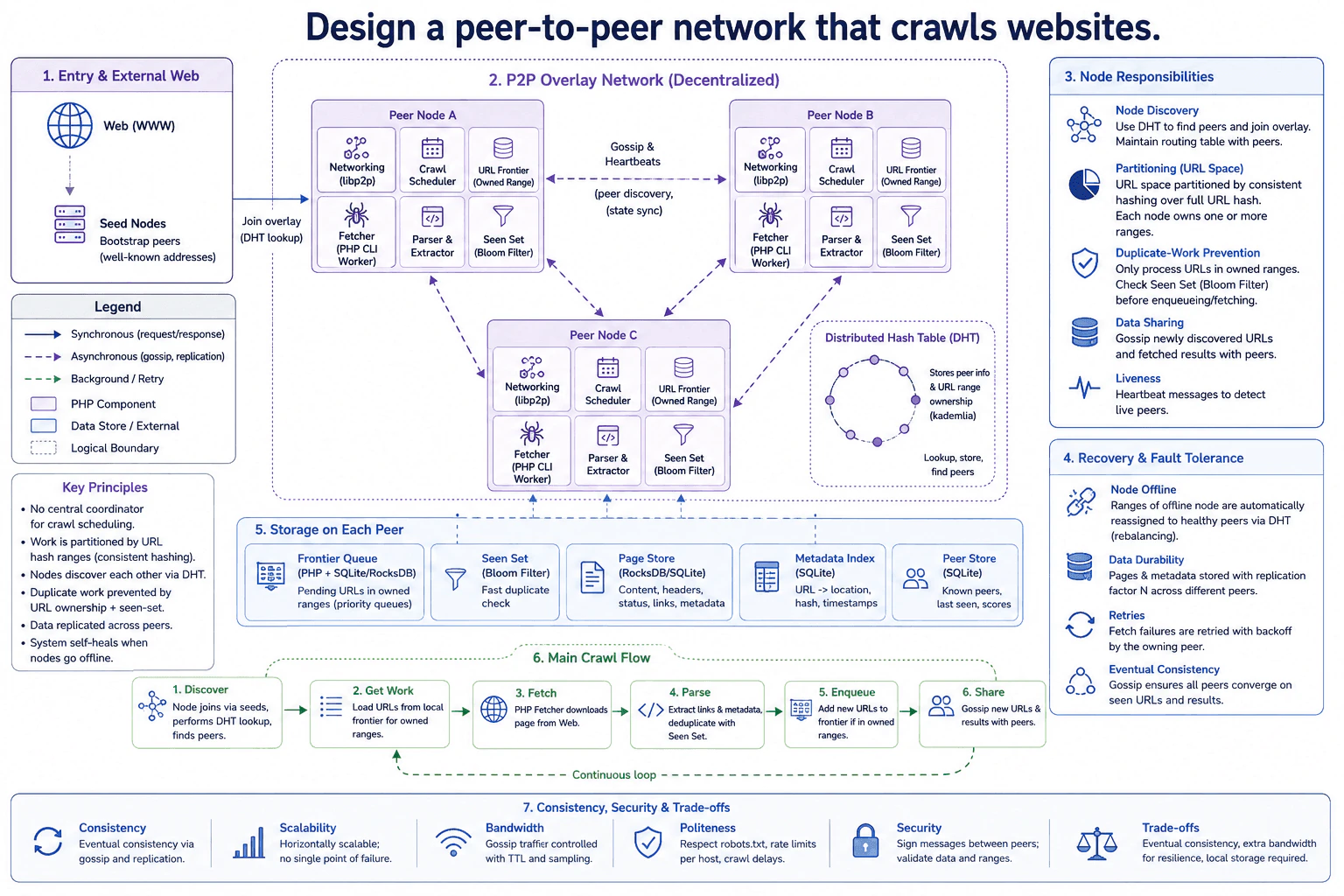
9. Design a peer-to-peer network that crawls websites.System DesignHardApple
i Question Details
Design a distributed, peer-to-peer-first web crawler. Explain node discovery, partitioning the crawl space without a central coordinator, duplicate-work prevention, and recovery when nodes go offline during a crawl.
Short Interview Answer (30-60 seconds)
At a high level, this is a peer-to-peer crawl system with no central boss. Many peers join, split URL ranges, crawl pages, and share what they find. I would explain it in three parts: how a peer joins, how it claims and crawls URLs, and how the network recovers when a node drops out. The main trade-off is more peer coordination, but much better resilience and scale. The answer follows the attached audit prompt and the selected diagram.
Detailed Explanation
The goal is to let many computers crawl websites together. No single machine should own the whole crawl. Each peer must find other peers, split the work, avoid reading the same page twice, and keep going when one peer leaves. The hard part is sharing that work without one central manager. The diagram solves this with seed nodes, a P2P overlay, a DHT, and local crawl state on each peer. I would explain the join step, the crawl step, and the recovery step in a simple, clear way.
Useful Questions to Ask the Interviewer
How many peers should we expect at peak?
Should we crawl only allowed pages, or also follow broader links?
Do we want one crawl run to finish, or keep crawling forever?
How to Explain It in an Interview
1. Explain the goal and the main idea
At a high level, I would say this is a peer-to-peer crawler with no central coordinator. The main goal is to spread crawl work across many nodes while keeping duplicate work low. The diagram does this with seed nodes, a P2P overlay, and a Distributed Hash Table, or DHT. A DHT is a shared lookup map across peers. That lets peers discover each other and agree on who owns each URL range.
2. Explain how a new peer joins
A new peer starts from well-known bootstrap addresses or a local seed list. Then it joins the overlay through Networking (libp2p) with a secure P2P handshake. After that, gossip and heartbeats help it learn about live peers. I would also point out the Peer Store, because it keeps known peers and last-seen data. That helps discovery stay useful even when some nodes disappear.
3. Explain how crawl work is split
For partitioning, the diagram uses URL hash ranges in the DHT keyspace. Each peer owns one or more ranges, so there is no central boss handing out work. The Crawl Scheduler only pulls URLs from ranges it owns. The URL Frontier (Owned Range) keeps pending URLs for each owned range. The Seen Set, shown as a Bloom filter, helps stop repeat work fast.
4. Explain the crawl flow on each peer
The main flow is simple: discover, get work, fetch, parse, enqueue, and share. The Fetcher (PHP CLI Worker) runs inside PHP 8.4 or 8.5. It downloads the page from the web. The Parser & Extractor pull out links and metadata. Then the peer adds new URLs back into the frontier if they belong to its range. It also gossips the new URLs and results to other peers.
5. Explain recovery, storage, and trade-offs
If a peer goes offline, other peers detect it with heartbeats and timeouts. Then the DHT can reassign its expired URL ranges and work claims. The local stores keep the Page Store, Metadata Index, and Frontier Queue safe on each node. I would also mention observability, because logs, metrics, and health checks help spot problems early. The trade-off is clear: no central coordinator gives better resilience, but it adds more peer coordination and some temporary overlap in work. The system stays correct because ownership, seen checks, and claim expiry keep the crawl moving.
Engineering Considerations / Design Trade-offs
The benefit is that the crawl keeps working even when some peers fail. The work is spread across many nodes, so the system can grow as more peers join. The downside is more peer messaging, more local state, and some temporary overlap in work. The seen set, DHT ownership, and claim expiry help keep that overlap small. Local storage on each peer also makes recovery easier, but it means each peer must manage its own data carefully. That is the main trade-off: better resilience and scale, but more coordination and more bookkeeping on every node.
Why Interviewers Ask This
The interviewer wants to see if you can break a hard distributed problem into simple parts. They want to know if you can design peer discovery, work sharing, duplicate prevention, and recovery without a central boss. They also want to hear how you think about trade-offs, like resilience versus extra coordination, and how you explain the design clearly and calmly.
Interviewer may ask next
What if one peer crashes while it still owns many URL ranges?
I would keep the same design, but I would make work claims expire quickly. That way, if a peer disappears, other peers can take those URL ranges again through the DHT. Heartbeats help detect the dead node, and the crawl scheduler can re-claim unfinished work. The page store already saved on the node stays useful for any completed fetches. The seen set still helps stop repeat work when the range is picked up again. I would also keep the frontier queue durable on each peer, so the next owner can reload pending URLs. The downside is that some URLs may be seen twice for a short time, so the seen check and canonical URL checks still matter. That is a good trade-off because the crawl keeps moving instead of waiting for manual repair.
What if many new peers join at the same time and the crawl needs rebalancing?
I would keep the same overlay and the same URL-hash ownership model. New peers would join through seed nodes, then gossip would help them learn the network. The DHT would give them owned ranges, and the crawl scheduler would start pulling from those ranges. The peer store would also help each node remember who is live and who is new. That keeps the load spread out as the cluster grows. I would not move work all at once. I would let ranges shift in small steps so the crawl stays stable. The frontier queue on each peer can refill gradually instead of dumping a huge batch at once. The downside is extra messaging and some short-term movement of work while ownership changes.
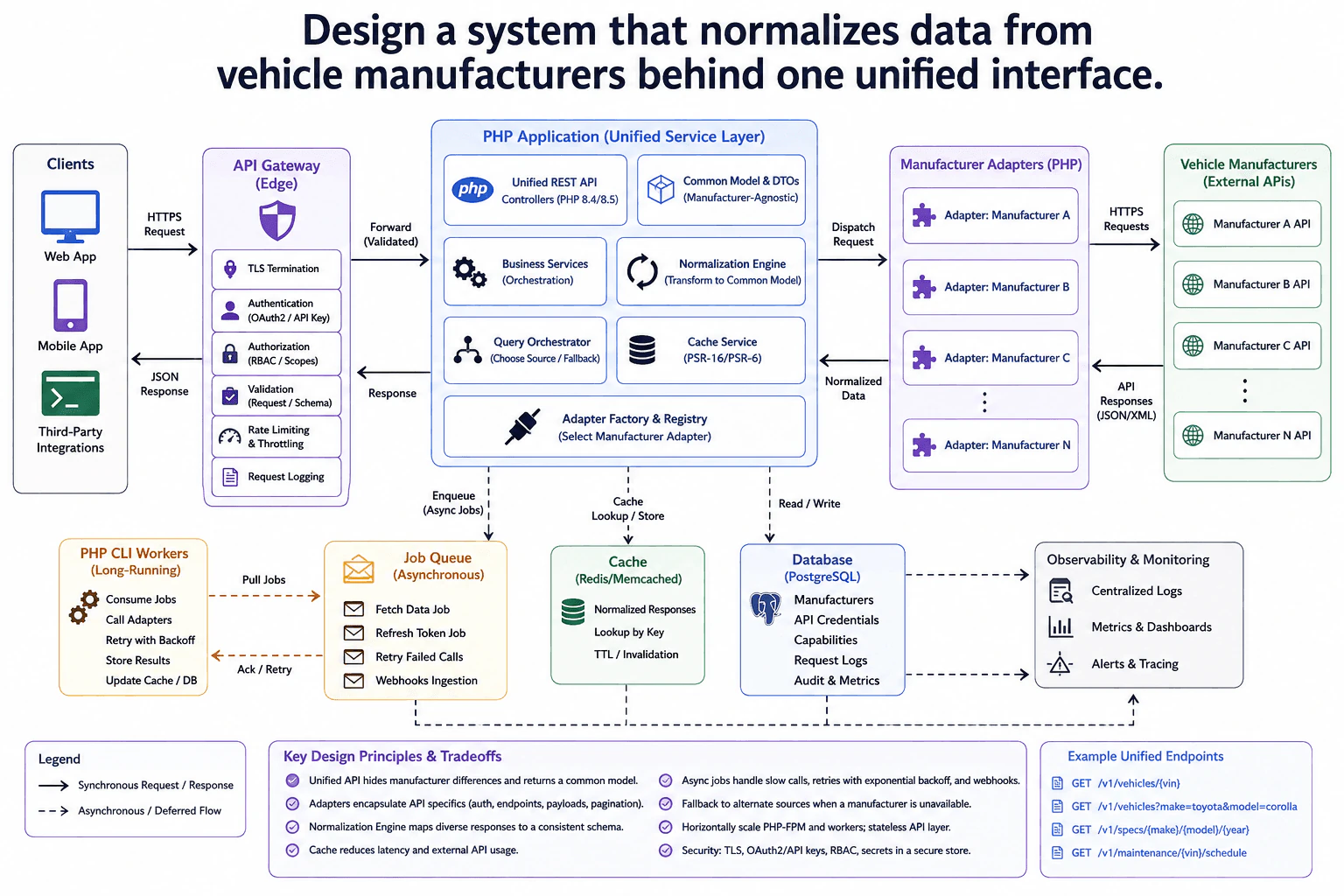
10. Design a system that normalizes data from vehicle manufacturers behind one unified interface.System DesignHardApple
i Question Details
Design a system that retrieves equivalent data from vehicle manufacturers worldwide even though each manufacturer exposes a different API, translates the responses into a common model, and provides a unified interface to clients.
Short Interview Answer (30-60 seconds)
At a high level, this system gives clients one simple way to get vehicle data from many manufacturers. The hard part is that every maker has its own API and its own data shape, so the service must translate those replies into one common model. I would explain the design in three parts: the secure request path, the manufacturer adapter and normalization path, and the background jobs plus cache and database. The trade-off is that the cache and workers add complexity, but they keep the PHP service fast.
Detailed Explanation
The goal is to give clients one simple way to ask for vehicle data from many manufacturers. Each maker may name the same data in a different way and may return it in a different format. Some calls can also be slow or fail. The hard part is hiding all of that behind one clean interface while keeping common reads fast. The diagram solves this by using one edge gateway, one PHP service layer, manufacturer adapters, a shared cache, a database, and background workers for slower refresh and retry work.
Useful Questions to Ask the Interviewer
What data matters most: one vehicle, a list of vehicles, or a full spec sheet?
How fresh does the answer need to be after a maker updates its API?
Do we need to support all manufacturers equally, or only a few first?
How to Explain It in an Interview
1. Explain the goal and the main idea
At a high level, the goal is to hide many vendor APIs behind one unified interface. The client should not care whether data comes from Manufacturer A, B, or N. The PHP service owns the common shape. The adapters own the vendor differences. That is the main idea in the diagram.
2. Explain the secure request path
For the request path, traffic first hits the API Gateway (Edge). It handles TLS termination, authentication with OAuth2 or API keys, authorization with RBAC and scopes, request validation, rate limiting, and request logging. Then the PHP Application (Unified Service Layer) receives the call through Unified REST API Controllers. The Business Services layer keeps orchestration rules in one place. This part is the front door for clients.
3. Explain cache, lookup, and normalization
Inside the PHP layer, the Query Orchestrator decides where to look first and when to fall back. On a cache hit in Cache Service, the system can return normalized data quickly. On a miss, Adapter Factory & Registry picks the right Manufacturer Adapter. That adapter calls the right external API, which may return JSON, XML, or GraphQL data. The Normalization Engine converts that reply into Common Model & DTOs, which are the shared data objects used by all clients. The cache follows PSR-16 and PSR-6, so the cache interface stays standard in PHP.
4. Explain background work
Some work should happen in the background. The Job Queue holds fetch data jobs, refresh token jobs, retry failed calls, and webhooks ingestion. PHP CLI Workers pull those jobs, call adapters, retry failed calls with backoff, and store results. This keeps slow work away from the main request path. The main request stays fast, while the worker path handles refresh and recovery.
5. Explain data, monitoring, and trade-offs
Database (PostgreSQL) is the main store. It keeps manufacturers, API credentials, capabilities, request logs, audit data, and metrics. Observability & Monitoring gives centralized logs, metrics and dashboards, alerts and tracing. The trade-off is simple. Cache makes reads faster, and workers protect the fast path. But they add more moving parts and some cached data may be a little old. We accept that so the system can serve many manufacturers through one interface.
Engineering Considerations / Design Trade-offs
The main benefit is that clients talk to one clean PHP API, and each manufacturer stays behind its own adapter. The cache makes common reads faster, and the queue keeps slow or failed work out of the main request path. The downside is more moving parts. We must keep adapters in sync with many external APIs. The cache can show older data for a short time. Background workers also add retry logic, monitoring, and operational work. We accept that because it protects the fast path and keeps the interface simple.
Why Interviewers Ask This
Interviewers want to see if you can hide many vendor differences behind one clean API. They also want to know if you can choose a main store, use cache the right way, and separate fast requests from background work. This question checks judgment, not memorization. It shows whether you can explain trade-offs in simple words.
Interviewer may ask next
How would you add a new vehicle manufacturer without breaking old clients?
I would keep the same front door and add one more adapter. The new manufacturer would be registered in Adapter Factory & Registry, and its code would translate that maker's API into the same Common Model & DTOs. That means the PHP Application can keep returning the same unified endpoints, so old clients do not need to change. I would also add the new maker's credentials and capability data to Database (PostgreSQL). If the maker changes its fields later, only that adapter and its tests should need updates. The important part is that the shared response shape stays stable while only the vendor-specific code changes. The downside is that every new manufacturer adds more code to maintain and test.
What if the cache is slow or missing for a lot of requests?
I would keep the same architecture, but I would expect more traffic to fall through to the Query Orchestrator and the Manufacturer Adapters. When Cache Service is slow or empty, the PHP layer should fetch from the external API, normalize the data, store the result, and then return it. The database still keeps the main records, so the answer stays correct even if the cache is weak. PHP CLI Workers can also refresh popular data in the background so the next request is faster. I would watch the cache hit rate, error rate, and external API latency in Observability & Monitoring. The downside is that the system becomes slower for a while and sends more calls to the manufacturer APIs until the cache warms up again.
More questions load as you scroll
Php Developer Resume Examples
Explore the resume examples below to find the one that best matches your target Php Developer role.
Disclaimer: This interview guide is for educational and informational purposes only. It is designed to help readers prepare, but it does not guarantee any interview result, hiring decision, offer, or outcome. Interview questions, hiring criteria, and preferred answers can vary by employer, interviewer, industry, location, and time. All answers, examples, and explanations in this guide are suggested examples for interview preparation, not definitive answers or instructions for professional practice. They are based on research and judgment, are provided without warranties of any kind, and should be adapted to the question, role, and applicable laws and professional requirements. Diagrams are simplified illustrations intended to highlight the main concepts and their relationships; actual situations, systems, and practices may be more complex. Alternative approaches may be equally valid or better suited to a particular question, context, or interviewer. To the fullest extent permitted by applicable law, the contributors and publisher are not liable for decisions made, actions taken, or losses incurred based on this guide.
State Laws and Professional Responsibilities: Laws and requirements governing an occupation vary by state and jurisdiction. You are responsible for checking the current laws, licensing requirements, and scope-of-practice rules that apply to your location and role, and for ensuring that your answers and actions comply with them. Adapt examples in this guide to those requirements. This guide is not legal advice.
Company Notice: This guide is an independent educational resource and is not affiliated with, endorsed by, sponsored by, or approved by the company named in this guide. Company names identify reported interview experiences or the employer context of clearly labeled original practice exercises. Interview practices can change without notice, and inclusion of company-specific content does not mean these questions are official, complete, or guaranteed to be asked. To the fullest extent permitted by law, the author, contributors, and publisher are not responsible for outcomes related to use of this material.
Content Accuracy and Verification: To the fullest extent permitted by applicable law, we do not represent or warrant that interview guides, questions, answers, examples, or diagrams are accurate, complete, current, error-free, or suitable for any particular purpose. You are responsible for independently reviewing and verifying the information before relying on it.