This interview guide is for educational and informational purposes only. It is designed to help readers prepare, but it does not guarantee any interview result, hiring decision, offer, or outcome. Interview questions, hiring criteria, and preferred answers can vary by employer, interviewer, industry, location, and time. All answers, examples, and explanations in this guide are suggested examples for interview preparation, not definitive answers or instructions for professional practice. They are based on research and judgment, are provided without warranties of any kind, and should be adapted to the question, role, and applicable laws and professional requirements. Diagrams are simplified illustrations intended to highlight the main concepts and their relationships; actual situations, systems, and practices may be more complex. Alternative approaches may be equally valid or better suited to a particular question, context, or interviewer. To the fullest extent permitted by applicable law, the contributors and publisher are not liable for decisions made, actions taken, or losses incurred based on this guide.
State Laws and Professional Responsibilities
Laws and requirements governing an occupation vary by state and jurisdiction. You are responsible for checking the current laws, licensing requirements, and scope-of-practice rules that apply to your location and role, and for ensuring that your answers and actions comply with them. Adapt examples in this guide to those requirements. This guide is not legal advice.
Identity, Image, and Privacy Notice
To respect individual privacy, some names, profile photographs, avatars, biographical details, and other identifying information displayed in this guide may be replaced with pseudonyms, licensed stock images, illustrative avatars, composite images, or representative descriptions. Unless a person is expressly identified as an actual contributor, a displayed name, image, or profile should not be understood as depicting or identifying a specific candidate, interviewer, employee, or other real individual. These representations are provided for editorial and illustrative purposes only and do not imply endorsement, employment, participation, or affiliation with this guide or any company mentioned in it. Any resemblance to an actual person is coincidental.
Company Notice
This guide is an independent educational resource and is not affiliated with, endorsed by, sponsored by, or approved by the company named in this guide. Company names identify reported interview experiences or the employer context of clearly labeled original practice exercises. Interview practices can change without notice, and inclusion of company-specific content does not mean these questions are official, complete, or guaranteed to be asked. To the fullest extent permitted by law, the author, contributors, and publisher are not responsible for outcomes related to use of this material.
Content Accuracy and Verification
To the fullest extent permitted by applicable law, we do not represent or warrant that interview guides, questions, answers, examples, or diagrams are accurate, complete, current, error-free, or suitable for any particular purpose. You are responsible for independently reviewing and verifying the information before relying on it.
Questions or comments?
Contact us for general questions, or share feedback, technical corrections, and comments with the community.
11. Design a shared-memory producer-consumer protocol on a DRAM page.System DesignHardApple
i Question Details
Design a producer-consumer protocol that communicates through a shared DRAM page. Address synchronization, cache coherence, memory barriers, race conditions, and failure or retry behavior.
Short Interview Answer (30-60 seconds)
At a high level, this is a tiny shared-memory channel between two PHP workers. The hard part is making one page safe when both sides read and write at once, so order and visibility matter. I would explain it in three parts: the shared DRAM page layout, the producer and consumer flows, and the rules for atomics, wakeups, and recovery. The trade-off is a very fast path, but the code must be careful about empty, full, and crash cases.
Detailed Explanation
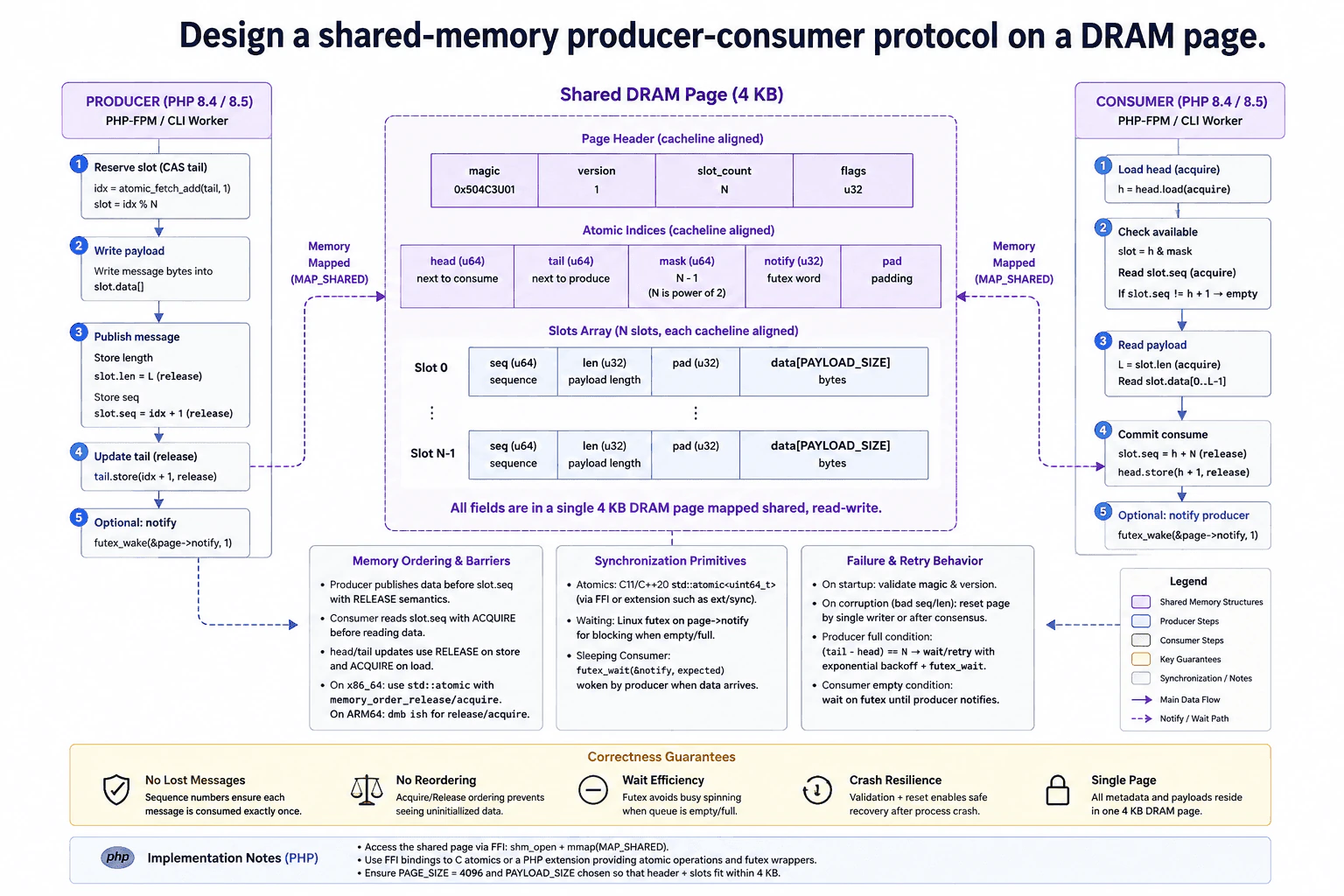
The goal is to let one PHP process put messages into a shared DRAM page, and let another PHP process read them. The hard part is that both sides can touch the same bytes at the same time, so the page needs clear rules for ownership, visibility, and recovery. The diagram solves this with one shared 4 KB page, atomic head and tail counters, per-slot sequence numbers, and futex wakeups. I will explain the page layout first, then the producer flow, then the consumer flow, and finish with ordering and failure handling.
Useful Questions to Ask the Interviewer
Is this single-producer, single-consumer only?
Is it acceptable to lose a message that was written but not fully published?
How to Explain It in an Interview
1. Explain the goal and the main idea
I would start by saying that the goal is a safe handoff through one shared page. The producer writes, and the consumer reads. The tricky part is that both sides can run at the same time, so we need a clear rule for who owns each slot. The diagram keeps that rule small by using head, tail, mask, and sequence numbers.
2. Explain the shared page layout
Next, I would describe the 4 KB DRAM page. It has a page header, atomic indexes, and a slots array. The header holds magic, version, slot count, flags, head, tail, mask, and a notify word for futex waiting. Each slot has a sequence number, a payload length, padding, and the data bytes. Both processes map the same page with MAP_SHARED, so they see the same bytes.
3. Explain the producer flow
For the write path, the producer first reserves a slot with an atomic fetch-add on tail. Then it writes the message bytes into slot.data. After that, it publishes the slot by storing the length and the sequence number with release ordering. That order matters because the consumer must never see a ready slot before the payload is complete. If the page is full, the producer waits or retries, and it can wake the consumer with futex_wake.
4. Explain the consumer flow
For the read path, the consumer loads head with acquire ordering. Then it checks the target slot with head & mask. If slot.seq is not head + 1, the slot is not ready yet, so the consumer treats it as empty and waits. If it is ready, the consumer reads the length and payload with acquire ordering. After that, it marks the slot consumed by setting slot.seq to head + N and advances head with release ordering.
5. Explain ordering, failure, and implementation notes
I would finish with the safety rules. The producer must write data before the publish store. The consumer must read the publish marker before trusting the bytes. That is why the diagram calls out release and acquire semantics. It also mentions x86-64 std::atomic with memory_order_release and memory_order_acquire, plus ARM64 dmb ish. On startup, both sides validate magic and version. If the page looks corrupt, they reset it. In PHP, the implementation note is to use shm_open and mmap through FFI or a PHP extension, plus atomic wrappers and futex wrappers. The trade-off is a very fast path, but the code must be careful about empty, full, and crash cases.
Engineering Considerations / Design Trade-offs
The benefit is speed. Both processes share one small page, so there is no database, queue, or network hop. The producer and consumer can move messages with a very small amount of work. The downside is that the page is limited to 4 KB, so the message size and slot count must be planned carefully. Another downside is that the code must use atomic rules, because a small mistake can create a race. Crash handling is also stricter. If the page looks wrong, the design may reset it or retry instead of pretending the data is safe.
Why Interviewers Ask This
The interviewer wants to see if you can build a safe shared-memory protocol, not just name low-level tools. They are checking whether you understand atomic writes, read ordering, slot ownership, full and empty handling, and crash recovery. They also want to see if you can explain cache coherence and memory barriers in simple words, because that shows real understanding instead of memorized terms.
Interviewer may ask next
What if we need multiple producers instead of one producer?
I would keep the same shared page design, but I would change the write side. The current design is single-producer, so one tail counter is enough. With multiple producers, two writers could pick the same slot unless we add a stronger claim step or a lock around tail. That change affects the producer flow and the slot reservation step. The consumer flow can stay almost the same, because it still reads only ready slots in order. Correctness comes from making each slot have one owner before publish. I would also keep the same release and acquire rules, so the consumer never reads a half-written message. I would test the full and empty paths more carefully, because races become much easier to create. The downside is more contention, so writers may wait more often and the fast path gets less simple.
What if a process crashes after writing data but before publishing the slot?
I would keep the same page format, but I would make startup checks stricter. The important rule is that a slot is trusted only after the final release store says it is ready. If a process crashes after writing some bytes but before publish, the consumer must treat that slot as incomplete. On restart, both sides should validate magic, version, and every slot sequence before doing real work. I would also reject any page that does not match the expected size or slot count. If the page looks wrong, the safe move is to reset it and start fresh. That keeps the protocol simple and avoids reading garbage. The downside is that an in-flight message can be lost after a crash, but the page stays safe and easy to recover. That is the trade-off for fast reads and writes too.
12. Can you tell me about yourself and your experiences?BehavioralEasyApple
i Question Details
Give a focused overview of your background and experiences most relevant to the role, including your responsibilities, strengths, and the progression that led you to apply.
Interview tip:
Use STAR to structure your answer: briefly explain the Situation and Task, make Action the most detailed part, and finish with the Result. For example, describe a clear career path where you grew from supporting existing PHP code to owning backend features, improved how you worked with product and QA, and used that experience to prepare for this role.
Situation
In my last role, I worked on a PHP based web application that had grown over time and needed steady support as well as new feature work. I started by handling smaller fixes, then moved into more responsibility as I learned the codebase and the business rules behind the product.
Task
My goal was to become someone the team could trust with backend work that affected users directly. I needed to keep the existing system stable, deliver features on time, and communicate clearly when I found risks or tradeoffs.
Action
I spent time learning how the application was structured, how requests moved through the backend, and where the main pain points were. I worked on API endpoints, database queries, validation, and bug fixes in PHP, and I paid close attention to clean error handling and readable code so the team could support it later. When requirements were unclear, I asked early questions and broke the work into small steps so product, QA, and I could stay aligned. I also reviewed my own changes carefully before sending them out, because I wanted to reduce rework and avoid breaking related flows. Over time, I took more ownership of features from start to finish, including discussing edge cases, checking how a change would affect other parts of the system, and helping the team choose the simpler solution when that was the safer choice.
Result
That experience helped me grow into a more reliable backend developer. I became more confident in PHP, more careful about quality, and better at working with others across the full delivery process. I am now looking for a role where I can bring that same mix of technical ownership, practical judgment, and clear communication to a stronger product and engineering team.
Why Interviewers Ask This
Interviewers ask this to understand your background, how your experience fits the role, and whether you can explain your growth in a clear and confident way. A strong answer shows self awareness, relevant experience, and a steady progression toward the work they need done.
Interviewer may ask next
What kind of PHP work did you own most often?
I most often owned backend feature work, API changes, bug fixes, and database related updates. I was also involved in checking edge cases and making sure the code was easy for the next person to support.
How did you grow during that role?
I grew by taking on more ownership over time. At first I focused on smaller fixes and learning the system, and later I started handling larger pieces of work, communicating risks earlier, and making stronger decisions about code quality and simplicity.
13. Tell me about yourself and the most complex project you've worked on.BehavioralMediumApple
i Question Details
Give a concise professional introduction, then describe the most complex project you worked on, your ownership, difficult decisions, collaboration, outcome, and lessons.
Interview tip:
Use STAR to structure your answer: briefly explain the Situation and Task, make Action the most detailed part, and finish with the Result. For example, describe a realistic project where you took ownership of a hard PHP system, made careful tradeoffs, kept teammates aligned, protected the most important user need, and delivered a reliable result.
Situation
In my last role, I worked on a PHP based web platform that handled a key business workflow from start to finish. The system had grown over time, so the code was hard to change and small updates could affect other parts of the site. I also needed to work with backend, frontend, and support teams because the flow touched many users.
Task
My responsibility was to lead the most complex part of that project, which was improving the workflow without breaking existing behavior. I needed to understand the old logic, reduce risk, and help the team move in a safer way. I also had to keep the business informed because the change affected a path that users depended on every day.
Action
I first studied the full request flow and mapped the important steps so I could see where failures were most likely. Then I broke the work into smaller parts and moved the most stable logic into separate PHP classes so the code was easier to read and test. I added checks for edge cases, logged the key steps, and wrote tests for the parts that had caused bugs before. When I saw that one design would be faster to build but harder to support later, I chose the simpler design because long term stability mattered more than speed. I also kept the team updated with short progress notes, asked for review on the riskiest changes, and worked closely with support so we could catch problems early. When one part of the flow did not match the existing user behavior, I adjusted the plan instead of forcing a clean but unsafe rewrite.
Result
The project was delivered in a safer and more maintainable way, and the team had a clearer structure for future changes. The workflow became easier to support, and new updates were less risky because the important logic was separated and covered by tests. I learned that on complex PHP projects, good ownership is not only writing code. It is also making careful decisions, protecting the user experience, and keeping everyone aligned while the work is still in progress.
Why Interviewers Ask This
Interviewers ask this to understand how you present yourself, how you handle complex work, and how you think under pressure. A strong answer shows ownership, judgment, communication, and the ability to turn a messy project into a clear result.
Interviewer may ask next
Why did you choose to split the logic into separate classes?
I chose that approach because the original code was too hard to change safely. Splitting the logic made each part smaller, easier to test, and easier for the team to review. It also reduced the chance that one change would break a different part of the flow.
What would you do differently if you had more time?
I would add even more automated tests around the older edge cases and document the new flow more clearly for the team. That would make future changes faster and would help new developers understand why the structure was changed.
14. Walk me through your resume and explain what you would do differently in one of your projects.BehavioralMediumApple
i Question Details
Summarize your resume, select one or two relevant projects, explain your reasoning and contribution, and describe what you would do differently based on what you know now.
Interview tip:
Use STAR to structure your answer: briefly explain the Situation and Task, make Action the most detailed part, and finish with the Result. For example, describe a career path in PHP web development, choose one project where you owned a meaningful feature or improvement, explain why you focused on that work, and clearly state what you would change now to make the project easier to maintain and deliver.
Situation
I started my career in PHP web development by working on small business applications, then moved into larger web products where I handled backend features, API work, database changes, and production support. In my last role, I worked on a customer portal where the team had to keep adding new features while also keeping the code stable and easy to maintain.
Task
On one of my previous projects, my responsibility was to deliver a new order management flow and make sure it fit into the existing PHP codebase without breaking older parts of the application. I also wanted to keep the work clean enough so the next changes would be easier for the team.
Action
I first reviewed the existing flow end to end so I could see where the real user pain was and where the code was too tightly connected. Then I broke the work into smaller pieces. I updated the backend logic in PHP, separated the business rules from the controller layer, and checked the database queries so the page would not do extra work on each request. I also added focused tests around the most important paths so I could change the code with more confidence. During the work, I kept the team informed when I saw that one part of the original plan would make the code harder to support later, and I suggested a simpler approach that still met the business need. If I were doing that project again, I would spend even more time on the design before coding and I would involve the team earlier on the structure of the feature, so we could reduce rework and make the implementation cleaner from the start.
Result
The feature was delivered in a stable way, and the team had a clearer structure for future changes. I also learned that in PHP projects, speed matters, but maintainability matters just as much. Since then, I have been more deliberate about planning the structure first, keeping the logic small, and making sure the code is easy for the next developer to understand.
Why Interviewers Ask This
Interviewers ask this to see how well you can explain your background, choose relevant experience, judge your own work, and show self awareness. A strong answer shows ownership, clear communication, and the ability to reflect on what you would improve next time.
Interviewer may ask next
What would you change in that project now?
I would push for a cleaner design earlier, with a clearer split between controller logic, business rules, and data access. I would also get feedback on the structure before building too much, because that would reduce rework and make the code easier to support later.
How did you decide what to improve first?
I focused first on the part of the flow that affected the user most and the parts of the code that were most likely to break future changes. That let me deliver value quickly while still improving the foundation for the next work.
15. Tell me about a project that you've done recently.BehavioralMediumApple
i Question Details
Describe a recent project, your specific responsibility, major technical decisions, collaboration, difficulties, outcome, and what you learned.
Interview tip:
Use STAR to structure your answer: briefly explain the Situation and Task, make Action the most detailed part, and finish with the Result. For example, describe Describe a recent project, your specific responsibility, major technical decisions, collaboration, difficulties, outcome, and what you learned.
Situation
In my last role, I worked on a customer self service returns project in PHP. The old flow was slow and had too many manual steps, so support teams were handling many requests that should have been automated.
Task
My job was to build the backend part of the new returns flow, make it reliable, and keep it easy for the frontend team to use. I also needed to make sure the system could handle edge cases like duplicate requests, partial returns, and failed notification steps.
Action
I started by breaking the work into small parts. I designed the main API endpoints, then kept the controller thin and moved business rules into separate service classes so the code would stay readable. I used database transactions for the return creation flow so that inventory updates, return status changes, and audit records would stay in sync. I also added idempotency checks so a customer could not create the same return twice if they clicked submit more than once.
For the notification part, I chose queued jobs instead of sending emails inside the request. That made the API faster and reduced the chance that a slow mail service would block the user flow. I worked closely with the frontend developer to agree on the request and response format, and I stayed in touch with QA while they tested unusual cases. When they found issues with partial returns and retry behavior, I added better validation and clearer error messages so users would know what to fix. I also added logs around the risky steps so we could trace problems faster in production.
Result
We delivered the project with a cleaner code structure and a more stable return flow. The support team had less manual work, and the new process was easier to maintain because the important logic was isolated and tested. The biggest thing I learned was to think about failure cases early, not after the main flow is already finished. That helped me write simpler PHP code and build something the whole team could support with confidence.
Why Interviewers Ask This
Interviewers ask this to see how you think about real work, how much ownership you take, and whether you can explain your technical choices in a clear and practical way. A strong answer shows judgment, collaboration, and the ability to learn from a project.
Interviewer may ask next
Why did you choose queued jobs for notifications?
I chose queued jobs because the notification step did not need to block the user request. Sending it in the background kept the API responsive and made the flow more reliable if the mail service was slow or temporarily unavailable.
What would you do differently if you built it again?
I would add even more edge case testing earlier, especially around duplicate submissions and partial returns. I would also involve QA sooner in the API design so we could catch confusing cases before the implementation was already deep in progress.
16. Describe a technical project you worked on and the challenges you faced.BehavioralMediumApple
i Question Details
Describe a technical project, the most important challenges, your actions, how you worked with others, the result, and what you would improve.
Interview tip:
Use STAR to structure your answer: briefly explain the Situation and Task, make Action the most detailed part, and finish with the Result. For example, describe a realistic project where you improved a PHP feature, handled legacy code safely, worked with your team on tradeoffs, and shared what you learned after the release.
Situation
In my last role, I worked on a PHP project that handled an important customer flow in an older codebase. The main challenge was that the code had grown over time, so parts of it were hard to change safely. We also had a tight timeline because the business wanted a better user experience without breaking the current flow.
Task
My responsibility was to improve the feature while keeping it reliable for users. I needed to understand the old logic, find the risky parts, and make changes in a way that the rest of the team could review and test easily. I also had to keep communication clear because the work touched backend logic, validation, and the front end.
Action
I started by reading the existing code and tracing the full request path so I could see where the data changed. I found a few places where the logic was duplicated and where validation happened too late, which made debugging harder. I proposed breaking the work into smaller steps so we could reduce risk. First, I separated the core business rules into smaller methods so the flow was easier to follow. Then I added clearer input checks early in the request so bad data would fail fast instead of causing deeper errors. I also wrote tests around the most important cases before changing the behavior, because I wanted proof that the old flow still worked after my changes. While I was doing this, I kept the team updated with short notes on what I had changed, what still needed review, and where I saw risk. When I found a case that could affect the release, I raised it early and worked with the other developers to decide the safest fix. That helped us avoid a bigger issue later and kept everyone aligned on scope.
Result
We delivered the change without disrupting the existing flow, and the code became easier to understand and maintain. The team had a cleaner structure for future updates, and the testing process was smoother because the important cases were covered. What I would improve is starting the cleanup work even earlier, because I saw how much time we saved once the logic was simplified and the risk was reduced.
Why Interviewers Ask This
Interviewers ask this to see how you handle real work, not just theory. They want to understand your judgment, ownership, problem solving, and how you deal with risk, teamwork, and change in a real PHP project.
Interviewer may ask next
What was the hardest part of that project?
The hardest part was working with the older code safely. The logic was spread across several places, so I had to understand the full flow before changing anything. I focused on small steps, test coverage, and early communication so I could reduce the risk of breaking the feature.
What would you do differently next time?
I would spend more time upfront on simplifying the structure before the deadline pressure starts. That would make the later changes easier and would give the team a cleaner base for future work. I would still keep the same approach of small changes, early tests, and clear updates to the team.
17. Tell me about a time you came up with a technical solution while working on a project.BehavioralMediumApple
i Question Details
Describe the project problem, how you developed the technical solution, alternatives considered, stakeholders involved, implementation, result, and lessons.
Interview tip:
Use STAR to structure your answer: briefly explain the Situation and Task, make Action the most detailed part, and finish with the Result. For example, describe a realistic project problem, the technical options you weighed, who you talked to, how you built and rolled out the solution, and what improved after release.
Situation
In one of my previous projects, we had a PHP based order flow that was slowing down because it did too much work during the user request. The page had to save the order, call an external service, and update several internal tables before it could respond. When traffic grew, users started seeing delays and some requests failed during busy hours.
Task
My job was to find a safer way to finish the order flow without making the user wait for every slow step. I also needed to keep the finance and support teams informed, because they depended on the order status being correct and easy to trace.
Action
I first broke the flow into the parts that had to happen right away and the parts that could wait. Saving the order and returning a clear confirmation had to stay in the request. The external call and follow up updates could move to a background job. I compared three options: increasing the request timeout, retrying the full flow inside PHP, and moving the slow work to a queue worker. I chose the queue approach because it kept the user path fast and made retries safer. I shared the plan with product, QA, and support so they knew what the user would see and how failure cases would be tracked. Then I added an order status field, stored the job payload in the database, and built a worker to process each job after the request finished. I also added idempotency checks so the same order would not be processed twice if the worker retried. During testing, I used logs and manual checks to confirm that a saved order always had one clear final state. After that, we rolled it out behind a feature flag and watched the error cases closely before turning it on for everyone.
Result
The checkout flow became much more stable, and the user no longer waited on the slow external call. Support could see the order state more clearly, and the team had a pattern we reused for other slow tasks later. I learned that the best technical solution is not always the most complex one. It is the one that protects the user experience, keeps the system easy to debug, and fits how the team works.
Why Interviewers Ask This
Interviewers ask this to see how you solve real project problems, weigh tradeoffs, and turn a technical idea into a practical result. A strong answer shows ownership, clear thinking, communication with others, and good judgment under pressure.
Interviewer may ask next
Why did you choose a queue worker over retries inside PHP?
I chose the queue worker because retries inside the request would still keep the user waiting and could make the failure harder to control. With a worker, I could isolate the slow part, add safe retries, and keep the main request simple and fast.
What would you do differently now?
I would add stronger monitoring earlier, especially for job failures and slow external responses. That would help us catch problems sooner and make the rollout safer, even before users reported them.
18. Walk through a past project and explain why you chose a specific eviction policy.BehavioralHardApple
i Question Details
Describe the project, the eviction-policy choices available, why you selected one, how you handled consistency, what metrics you used, and what you would change with hindsight.
Interview tip:
Use STAR to structure your answer: briefly explain the Situation and Task, make Action the most detailed part, and finish with the Result. For example, describe a previous PHP project that used cache or session storage, the eviction choices you considered, why you picked one policy over the others, how you kept the cached data consistent with the source of truth, which cache health metrics you watched, and what you would improve now.
Situation
In one of my previous projects, we had a PHP application that served product and account pages with a cache layer in front of the database. Traffic was growing, and the cache could not hold every item all the time. We had to choose an eviction policy that would protect the most useful data and still keep the system stable.
Task
My responsibility was to help design the cache behavior and make sure the team picked a policy that fit the access pattern. I also needed to reduce slow database reads without serving stale data for too long. The goal was to improve response time while keeping the cache simple enough to operate and reason about.
Action
I first looked at the access pattern. Most users kept returning to the same hot pages, and new content was added constantly. I compared least recently used, least frequently used, and time based expiration. I chose least recently used for the main cache because our traffic was driven more by recent access than by long term frequency. That made it a better fit than least frequently used, which would have kept old but once popular items around for too long. I still used a short time to live on top of that so stale data could not live forever.
To handle consistency, I treated the database as the source of truth and the cache as a fast copy. When data changed, I invalidated the related keys right away and rebuilt them on the next read. For shared data that changed often, I used clear key naming and grouped keys so I could remove related entries together. I also added logging for cache misses, stale reads, and evictions, and I watched cache hit rate, p95 response time, and database load. That helped me see whether the policy was protecting the right data instead of just filling memory.
Result
The cache became much more predictable. The hottest data stayed in memory longer, the database saw fewer repeat reads, and page response times became more stable during busy periods. I learned that the best eviction policy is not the most famous one. It is the one that matches the access pattern, the freshness needs, and the operational cost of the system.
Why Interviewers Ask This
Interviewers ask this to see whether I can make a practical system choice instead of copying a textbook answer. It shows how I think about tradeoffs, data freshness, cache behavior, and the impact of my decision on performance and reliability.
Interviewer may ask next
Why did you choose least recently used over least frequently used?
Least recently used matched our traffic better because the same items were requested again in short bursts. Least frequently used would have kept older items just because they were popular at some point, even when they were no longer useful. I wanted the cache to favor what users were actually touching now.
What would you change if you built it again today?
I would make the invalidation rules more automated and add better per key observability earlier. I would also review whether a mixed policy would work better for different data groups, because not every cache entry has the same access pattern or freshness need.
19. Tell me about a time when you improved a process.BehavioralMediumApple
i Question Details
Describe the original process, the problem or inefficiency, evidence you gathered, the change you introduced, adoption challenges, and measurable result.
Interview tip:
Use STAR to structure your answer: briefly explain the Situation and Task, make Action the most detailed part, and finish with the Result. For example, describe the original process, the problem or inefficiency, evidence you gathered, the change you introduced, adoption challenges, and the result you saw.
Situation
In my last role, our release work for a PHP service was slower than it should have been. Developers, QA, and support were using separate notes, so small details were often missed during handoff. That caused extra questions, delayed approvals, and a few avoidable fixes after release.
Task
I was asked to help improve the process without adding a lot of overhead for the team. My goal was to make the release path clearer, reduce repeated back and forth, and keep the steps simple enough that people would actually use them.
Action
I first looked at a few recent releases and wrote down where the delays came from. I found that most issues were not code problems. They were missing deployment notes, unclear rollback steps, and no single place to confirm QA sign off. Based on that, I proposed one release checklist in the repository so it lived with the code. I kept it short and only asked for the items that truly mattered, such as database changes, feature flags, test notes, and rollback instructions. I also added a small status page in our admin tool so anyone could see whether a build was ready, in QA, or approved for release. Before rolling it out, I met with the other developers, QA, and support to explain why each field mattered and to remove anything that felt unnecessary. I then ran the new flow on one service first, collected feedback, and adjusted the wording so it was easier to follow. After that, I helped the team adopt it across the rest of the releases and answered questions during the first few cycles.
Result
The release process became much smoother and easier to follow. We had fewer handoff mistakes, fewer repeated questions, and less last minute confusion before deployment. The team also started using the checklist on its own because it saved time instead of adding work. I learned that a process change works best when it is simple, based on real evidence, and explained in a way that helps people see the value quickly.
Why Interviewers Ask This
Interviewers ask this to see whether I can notice friction in a work process, use evidence to find the real cause, and improve the flow in a practical way. A strong answer shows ownership, good judgment, and the ability to get other people to adopt a better way of working.
Interviewer may ask next
How did you handle people who did not want the new checklist?
I kept the first version very small and showed the team the specific problems it solved. I also asked for feedback early, removed steps that did not add value, and focused on how the checklist saved time during release, not just how it helped me.
What would you do differently now?
I would automate more of the checklist inside the deployment flow so people do not have to copy the same information by hand. I would still keep the process simple, but I would remove even more manual steps where the system can validate the work for us.
20. Tell me about one bug you encountered and how you would prevent it in the future.BehavioralMediumApple
i Question Details
Describe a significant bug, how it was discovered, the root cause, your role in resolving it, its impact, and the engineering practices you would use to prevent recurrence.
Interview tip:
Use STAR to structure your answer: briefly explain the Situation and Task, make Action the most detailed part, and finish with the Result. For example, describe a realistic bug in a PHP service where stale cached data showed the wrong result, how you traced it to the cache key, how you fixed it, and how you would add tests and monitoring to stop it from coming back.
Situation
In my last role, we had a PHP service that built user invoices and cached some of the response data to keep the page fast. After a release, a few users started seeing the wrong invoice details after changing filters. The page still loaded, but the data was not always fresh.
Task
My job was to find the root cause quickly, fix the bug safely, and make sure we did not repeat it. I also needed to keep the issue clear for the team and avoid changing unrelated parts of the billing flow.
Action
I first reproduced the issue with the same user flow and checked the logs around the affected requests. I found that the cache layer was using only the route name as the cache key, so different filter values could return the same stored response. That meant one user request could reuse data from another request with different parameters. I fixed it by rebuilding the cache key to include the important request inputs, such as the filter values and user context. I also reviewed the invalidation logic so old entries would not survive after invoice updates. After that, I added tests for different filter combinations and changed the code review checklist to require a review of every cache key and invalidation path. I also shared the root cause with the team so we could watch for similar patterns in other endpoints.
Result
The bug stopped happening after the fix, and the invoice page became reliable again. More importantly, the team became more careful with caching in PHP services. What I learned is that fast code is not enough if the cached data is not scoped correctly. Since then, I always check what makes a response unique and I add tests for those cases before I consider a caching change safe.
Why Interviewers Ask This
Interviewers ask this to see how I investigate problems, take ownership, communicate clearly, and learn from mistakes. A strong answer shows that I can find the real cause of a bug, fix it in a careful way, and put preventive steps in place instead of only patching the symptom.
Interviewer may ask next
How would you prevent this bug from happening again?
I would treat the cache key as part of the contract and review it whenever request inputs change. I would also add tests for different input combinations, keep an eye on cache related logs, and make sure code review checks include cache scope and invalidation.
What would you do differently if you found this bug again today?
I would add more tracing earlier so I could compare the request input, cache key, and returned data faster. I would also ask for a quick peer review of the fix before release so we could confirm that the cache logic was correct and complete.
More questions load as you scroll
Disclaimer: This interview guide is for educational and informational purposes only. It is designed to help readers prepare, but it does not guarantee any interview result, hiring decision, offer, or outcome. Interview questions, hiring criteria, and preferred answers can vary by employer, interviewer, industry, location, and time. All answers, examples, and explanations in this guide are suggested examples for interview preparation, not definitive answers or instructions for professional practice. They are based on research and judgment, are provided without warranties of any kind, and should be adapted to the question, role, and applicable laws and professional requirements. Diagrams are simplified illustrations intended to highlight the main concepts and their relationships; actual situations, systems, and practices may be more complex. Alternative approaches may be equally valid or better suited to a particular question, context, or interviewer. To the fullest extent permitted by applicable law, the contributors and publisher are not liable for decisions made, actions taken, or losses incurred based on this guide.
State Laws and Professional Responsibilities: Laws and requirements governing an occupation vary by state and jurisdiction. You are responsible for checking the current laws, licensing requirements, and scope-of-practice rules that apply to your location and role, and for ensuring that your answers and actions comply with them. Adapt examples in this guide to those requirements. This guide is not legal advice.
Company Notice: This guide is an independent educational resource and is not affiliated with, endorsed by, sponsored by, or approved by the company named in this guide. Company names identify reported interview experiences or the employer context of clearly labeled original practice exercises. Interview practices can change without notice, and inclusion of company-specific content does not mean these questions are official, complete, or guaranteed to be asked. To the fullest extent permitted by law, the author, contributors, and publisher are not responsible for outcomes related to use of this material.
Content Accuracy and Verification: To the fullest extent permitted by applicable law, we do not represent or warrant that interview guides, questions, answers, examples, or diagrams are accurate, complete, current, error-free, or suitable for any particular purpose. You are responsible for independently reviewing and verifying the information before relying on it.