This interview guide is for educational and informational purposes only. It is designed to help readers prepare, but it does not guarantee any interview result, hiring decision, offer, or outcome. Interview questions, hiring criteria, and preferred answers can vary by employer, interviewer, industry, location, and time. All answers, examples, and explanations in this guide are suggested examples for interview preparation, not definitive answers or instructions for professional practice. They are based on research and judgment, are provided without warranties of any kind, and should be adapted to the question, role, and applicable laws and professional requirements. Diagrams are simplified illustrations intended to highlight the main concepts and their relationships; actual situations, systems, and practices may be more complex. Alternative approaches may be equally valid or better suited to a particular question, context, or interviewer. To the fullest extent permitted by applicable law, the contributors and publisher are not liable for decisions made, actions taken, or losses incurred based on this guide.
State Laws and Professional Responsibilities
Laws and requirements governing an occupation vary by state and jurisdiction. You are responsible for checking the current laws, licensing requirements, and scope-of-practice rules that apply to your location and role, and for ensuring that your answers and actions comply with them. Adapt examples in this guide to those requirements. This guide is not legal advice.
Identity, Image, and Privacy Notice
To respect individual privacy, some names, profile photographs, avatars, biographical details, and other identifying information displayed in this guide may be replaced with pseudonyms, licensed stock images, illustrative avatars, composite images, or representative descriptions. Unless a person is expressly identified as an actual contributor, a displayed name, image, or profile should not be understood as depicting or identifying a specific candidate, interviewer, employee, or other real individual. These representations are provided for editorial and illustrative purposes only and do not imply endorsement, employment, participation, or affiliation with this guide or any company mentioned in it. Any resemblance to an actual person is coincidental.
Company Notice
This guide is an independent educational resource and is not affiliated with, endorsed by, sponsored by, or approved by the company named in this guide. Company names identify reported interview experiences or the employer context of clearly labeled original practice exercises. Interview practices can change without notice, and inclusion of company-specific content does not mean these questions are official, complete, or guaranteed to be asked. To the fullest extent permitted by law, the author, contributors, and publisher are not responsible for outcomes related to use of this material.
Content Accuracy and Verification
To the fullest extent permitted by applicable law, we do not represent or warrant that interview guides, questions, answers, examples, or diagrams are accurate, complete, current, error-free, or suitable for any particular purpose. You are responsible for independently reviewing and verifying the information before relying on it.
Questions or comments?
Contact us for general questions, or share feedback, technical corrections, and comments with the community.
11. Design a notification system at both high and low levels.System DesignHardMicrosoft
i Question Details
Design a notification system covering high-level services and low-level components. Explain message creation, channel selection, delivery workers, retries, deduplication, user preferences, persistence, scaling, and failure handling.
Short Interview Answer (30-60 seconds)
At a high level, I would separate accepting a notification from delivering it. The main challenge is supporting several channels without delaying the caller or sending duplicates. I would explain three flows: request acceptance, background delivery, and failure handling. The PHP-FPM layer validates the request, builds the message, checks preferences, saves the notification, and queues jobs. PHP CLI workers deliver each channel and retry failures. This adds operational complexity, but it keeps the request fast and lets delivery scale separately.
Detailed Explanation
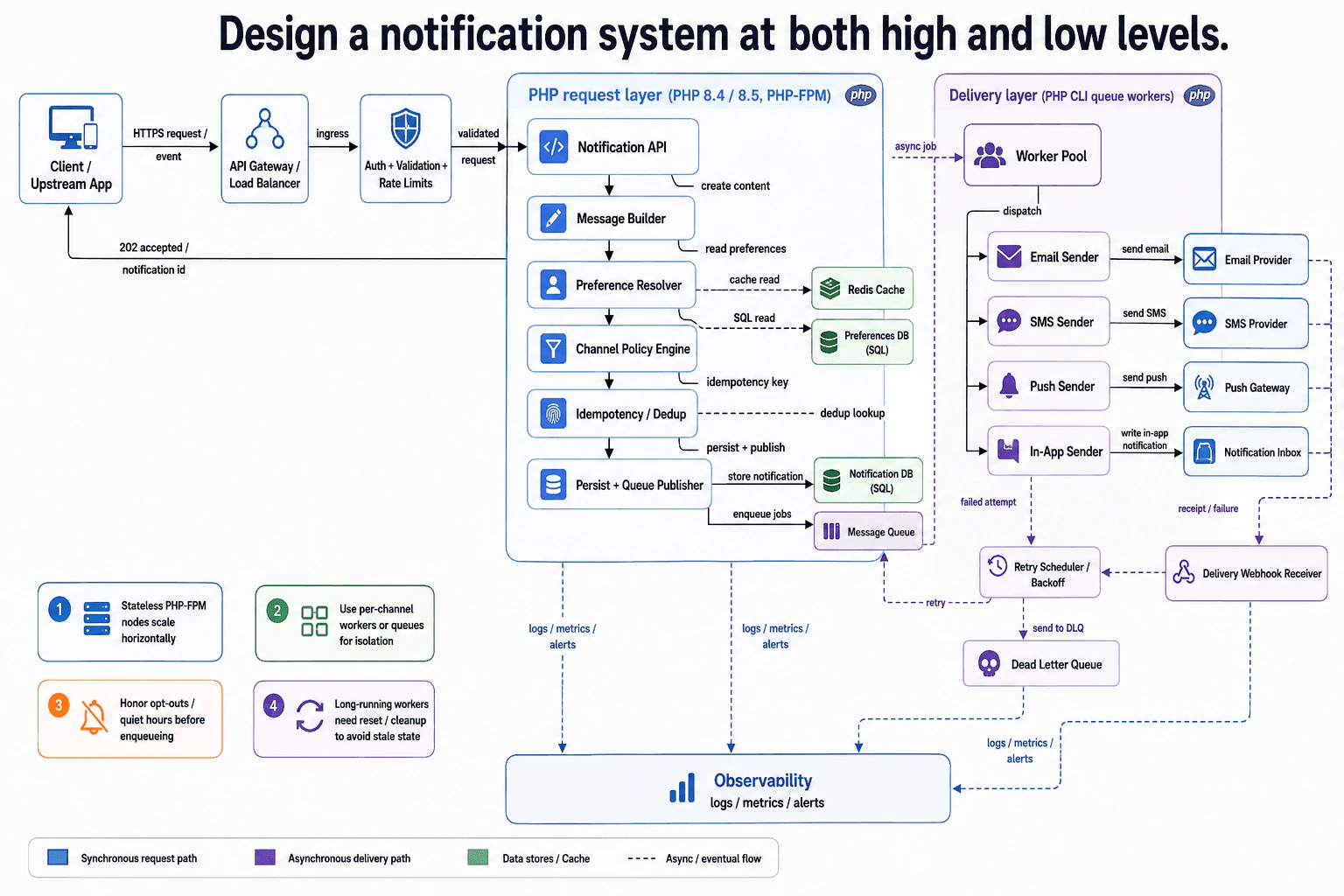
The system must accept a notification and send it through the channels allowed for that user. A user may allow email but disable SMS. An external provider may fail or return its final result later. The system must respond quickly, avoid duplicate sends, save delivery progress, and retry temporary failures. The diagram separates the short PHP-FPM request path from background delivery by PHP CLI workers. It also shows how preferences, notification records, retries, provider callbacks, failed jobs, and monitoring work together.
Useful Questions to Ask the Interviewer
Which delivery channels must the system support?
Must quiet hours and user opt-outs always be enforced?
How many retries are allowed before a job is stopped?
How quickly must delivery status become visible?
How to Explain It in an Interview
1. Explain the goal and the main split
I would start by saying that delivery should not block acceptance. The caller only needs confirmation that the notification was accepted.
The design therefore has two runtime areas. PHP-FPM handles the short request path. Long-running PHP CLI queue workers handle delivery after the response.
2. Explain the request acceptance path
The Client or Upstream App sends an HTTPS request or event. The API Gateway and Load Balancer receive it. Authentication, validation, and rate limits are applied before the validated request reaches the Notification API.
The Notification API sends content work to the Message Builder. The Preference Resolver reads user settings. It can read from Redis Cache and the Preferences DB through an SQL query.
The Channel Policy Engine decides which channels are allowed. This is where the design honors opt-outs and quiet hours. The Idempotency and Dedup component checks Redis Cache for a repeated request.
The Persist + Queue Publisher stores the notification in the Notification DB. It then places delivery jobs in the Message Queue. The Notification API returns a 202 accepted response with the notification ID.
3. Explain the background delivery path
The Message Queue sends an async job to the Worker Pool. Async means the work continues after the caller receives the response.
The Worker Pool dispatches work by channel. The Email Sender calls the Email Provider. The SMS Sender calls the SMS Provider. The Push Sender calls the Push Gateway. The In-App Sender writes the message to the Notification Inbox.
Separate senders or queues improve isolation. A problem with one channel does not need to stop every other channel.
4. Explain status, retries, and failed jobs
The Email Provider, SMS Provider, and Push Gateway send receipts or failures to the Delivery Webhook Receiver. The receiver updates the delivery status in the Notification DB.
A failed worker attempt goes to the Retry Scheduler / Backoff component. Backoff means the system waits before trying again. When another attempt is due, the scheduler places the job back into the Message Queue.
After the retry limit, the job moves to the Dead Letter Queue. This keeps failed work available for inspection instead of losing it.
5. Explain scaling and operations
PHP-FPM nodes are stateless, so more nodes can be added behind the Load Balancer. The queue also lets the Worker Pool scale separately from the request layer.
The request layer, delivery layer, retry flow, and Delivery Webhook Receiver send logs, metrics, and alerts to Observability. Long-running PHP workers need reset and cleanup. Otherwise, memory growth or stale application state can remain inside a worker process.
Engineering Considerations / Design Trade-offs
The benefit is that the caller gets a fast response because delivery runs in the background. The queue also lets the request layer and delivery workers scale separately. Channel-specific workers improve isolation, while saved notification and delivery status help with support and replay. The downside is that the system has more parts to operate. A notification can be accepted before it is actually delivered. Retries may delay the final result. Long-running PHP workers also need cleanup and restarts because memory or old state can remain inside each process.
Why Interviewers Ask This
Interviewers ask this question to see whether you can divide a large system into clear flows. They want to test how you separate a fast request from background work. They also look for good judgment around user preferences, duplicate requests, saved status, retries, failed jobs, scaling, provider callbacks, and monitoring. The goal is to evaluate reasoning and communication, not memorized component names.
Interviewer may ask next
How would you change the design if one notification must be delivered to several million users?
I would keep the same two runtime paths, but I would divide the large notification into many smaller queue jobs. Authentication, validation, and rate limits would still happen before the request reaches the Notification API. The Persist + Queue Publisher would save the notification and publish manageable jobs before the API returns 202 accepted.
The Message Queue would hold work that the Worker Pool can process in parallel. More PHP CLI workers could be added without changing the PHP-FPM request layer. Email, SMS, push, and in-app work would still use their own senders or queues.
The Preference Resolver and Channel Policy Engine must still honor each user’s settings and quiet hours. Idempotency and Dedup must remain in place, so repeated or retried work does not create duplicate sends.
The downside is much more queue traffic, more saved delivery status, and greater monitoring needs. Worker capacity and queue growth become important operational concerns.
What happens if one external delivery provider is unavailable for a long time?
I would keep the request path unchanged because provider failure should not block notification acceptance. The Persist + Queue Publisher would still save the notification and place the delivery job in the Message Queue. The Notification API would still return the notification ID.
The failed channel attempt would go to the Retry Scheduler / Backoff component. The delay should grow between retries, so the system does not call the unavailable provider too quickly. When another attempt is due, the scheduler places the job back into the Message Queue.
If the retry limit is reached, the job moves to the Dead Letter Queue. The Notification DB keeps the delivery status, while Observability shows failures, retries, and queue growth. Other channel workers can continue because the design keeps delivery paths separate.
The downside is delayed delivery. Some jobs may also need manual review or replay after the provider becomes healthy again.
12. How are AI tools helping you in your projects?BehavioralMediumMicrosoft
i Question Details
Describe specific ways you use AI tools in engineering projects, how you validate generated output, protect sensitive data, preserve accountability, and measure whether the tools improve quality or delivery.
Interview tip:
Use STAR to structure your answer: briefly explain the Situation and Task, make Action the most detailed part, and finish with the Result. For example, describe a PHP project where you used AI tools to speed up research, draft tests, or review code while validating every suggestion, protecting sensitive data, keeping ownership of decisions, and checking whether the tools improved quality or delivery.
Situation
During a previous project, my team was improving a PHP application with several older services and limited automated test coverage. I used AI tools to help me understand unfamiliar code, explore possible refactoring options, and prepare test cases more quickly.
Task
My responsibility was to improve the code safely without exposing private data or accepting generated output without review. I also wanted to confirm that the tools were creating real value instead of only making the work feel faster.
Action
I used AI as an assistant, not as the final decision maker. For example, I shared small, simplified code samples with names and business details removed. I never entered credentials, customer information, production logs, or private source code that was not approved for use. I asked the tool to explain complex methods, suggest PHPUnit test cases, identify edge cases, and compare possible designs. I then checked every suggestion against the actual requirements, PHP documentation, framework behavior, and our coding standards. I ran static analysis, unit tests, integration tests, and manual checks before accepting any change. When the tool produced code that looked correct but missed an important validation rule, I rejected it and wrote the correct logic myself. I also kept normal code review in place so another developer could examine the final change. To measure the benefit, I compared whether the tool reduced time spent on repetitive research and test preparation while still producing code that passed the same quality checks. I remained accountable for every line I committed and clearly explained my decisions during review.
Result
The tools helped me move through research and test preparation more efficiently, while the validation process prevented weak or unsafe suggestions from reaching the application. The team received clearer tests and easier to review changes. I learned that AI is most useful when it supports careful engineering judgment rather than replacing it.
Why Interviewers Ask This
Interviewers ask this question to understand whether the candidate can use modern AI tools responsibly. A strong answer shows practical use, careful validation, protection of sensitive information, personal accountability, and a clear way to judge whether the tools improve engineering work.
Interviewer may ask next
How do you decide whether an AI generated code suggestion is safe to use?
I treat it like code from an unknown source. I check it against the requirements, PHP and framework documentation, security rules, and our coding standards. I also run static analysis, automated tests, and manual checks. I only use the suggestion when I can explain how it works and take responsibility for it.
What would you do if an AI tool saved time but reduced code quality?
I would stop using it for that type of task or change how I use it. In this project, quality checks were required whether the code came from me or from an AI tool. Saving time was useful only when the final change remained secure, correct, maintainable, and easy for the team to review.
13. What is one non-technical skill you want to improve?BehavioralMediumMicrosoft
i Question Details
Identify one non-technical skill you want to improve, explain why it matters to your engineering effectiveness, what feedback or evidence revealed the gap, and the concrete actions and measures you are using to improve.
Interview tip:
Use STAR to structure your answer: briefly explain the Situation and Task, make Action the most detailed part, and finish with the Result. For example, describe a time when feedback showed that your technical explanations were too detailed, why clear and concise communication mattered, the steps you took to improve, and how you measured progress through feedback and better team discussions.
Situation
One non technical skill I want to improve is concise communication. During a previous PHP project, I often gave detailed explanations when discussing changes to an API or a database query. My technical points were correct, but a teammate told me that the main decision was sometimes difficult to find because I included too much background information.
Task
I needed to make my communication clearer without removing important context. This mattered because developers, testers, and product team members needed to understand the impact of a change quickly so that they could make decisions and raise concerns.
Action
I started preparing a simple structure before important discussions. I first stated the problem, then explained my recommendation, and finally described the main risk or tradeoff. For example, when proposing a change to a PHP service, I explained the user impact before discussing implementation details. I moved deeper technical information, such as query behavior or framework configuration, into a separate section for people who needed it. I also paused after explaining the main point and asked whether the team wanted more detail. After meetings and code reviews, I asked trusted teammates whether my message was clear and whether I had included too much or too little information. I reviewed their feedback and adjusted my approach for the next discussion.
Result
My explanations became easier to follow, and team discussions became more focused. People asked more specific questions because the main decision and its impact were clear. I learned that strong communication is not about saying less in every situation. It is about giving the right level of detail to the right audience. I am still improving this skill by asking for feedback and checking whether others can clearly repeat the main point of my message.
Why Interviewers Ask This
Interviewers ask this question to evaluate self awareness, openness to feedback, and commitment to professional growth. A strong answer identifies a meaningful development area, explains why it affects engineering effectiveness, and shows a practical process for improving it.
Interviewer may ask next
How do you decide how much technical detail to include?
I consider the audience and the decision they need to make. I begin with the problem, recommendation, and impact. I then add implementation details only when they help the audience evaluate the decision or complete their work.
How do you know your communication is improving?
I look at the quality of the discussion and ask for direct feedback. When teammates understand the main point, ask focused questions, and need fewer repeated explanations, I see that as useful evidence that my communication is becoming clearer.
14. What are the biggest lessons you have learned in life?BehavioralMediumMicrosoft
i Question Details
Share the most important lessons you have learned, explain the experiences that shaped them, and show how they affect your decisions, collaboration, and approach to engineering work.
Interview tip:
Use STAR to structure your answer: briefly explain the Situation and Task, make Action the most detailed part, and finish with the Result. For example, describe a difficult engineering experience that taught you to stay humble, communicate concerns early, ask for help when needed, and make decisions based on evidence rather than assumptions.
Situation
During a previous project, I helped modernize an older PHP application while the team continued adding features. I initially believed that careful coding would be enough to manage the risk. As the work progressed, I learned that technical skill alone does not prevent problems when assumptions are not shared and concerns are not discussed early.
Task
I was responsible for changing a central part of the application without disrupting existing users. I also needed to coordinate with other developers because several features depended on the same PHP services and database tables.
Action
I first reviewed the existing code, automated tests, logs, and database queries instead of assuming that I understood the full behavior. When I found unclear business rules, I asked the team to confirm them before I changed anything. I divided the work into small changes that could be reviewed and tested separately. I explained the risks in simple terms, especially where older code had hidden dependencies. I also asked another developer to challenge my approach because I had learned that asking for another view is a strength, not a weakness. When feedback showed that one part of my design was too complex, I changed it instead of defending it. I kept the team updated when new information affected the plan. This experience reinforced three lessons for me. Stay humble because there is always more context to learn. Communicate early because silence makes small risks larger. Focus on steady progress because reliable small steps are often better than one large and clever change.
Result
The team completed the change without creating major disruption, and the smaller review steps made the work easier to understand and maintain. More importantly, the experience changed how I approach engineering and collaboration. I now test my assumptions, invite feedback, and raise concerns early. These lessons also affect my decisions outside technical work because they help me listen carefully, remain open to correction, and take responsibility for the effect of my choices.
Why Interviewers Ask This
Interviewers ask this question to understand the candidate's self awareness, maturity, and ability to learn from experience. A strong answer shows that the candidate can turn difficult situations into practical principles that improve judgment, teamwork, communication, and engineering decisions.
Interviewer may ask next
Why did you decide to ask another developer to challenge your approach?
I knew that I was working with an older system that had behavior spread across several areas. A second view could reveal assumptions that I had missed. The feedback helped me simplify part of the design, and it reminded me that good collaboration improves the solution rather than reducing individual ownership.
What would you do differently if you faced the same situation now?
I would involve the team earlier, before forming a detailed solution. I would document the known business rules, identify uncertain areas, and agree on small validation steps at the start. That would reduce rework and make the risks visible sooner.
15. How do you handle critical customer issues and high-pressure escalations?BehavioralHardMicrosoft
i Question Details
Use a real example to explain how you assessed urgency and customer impact, coordinated responders, communicated status, made decisions under pressure, restored service, and followed through afterward.
Interview tip:
Use STAR to structure your answer: briefly explain the Situation and Task, make Action the most detailed part, and finish with the Result. For example, describe a critical customer issue where you assessed urgency and business impact, brought the right responders together, shared clear status updates, made careful decisions under pressure, restored service, and completed follow up work to prevent the issue from happening again.
Situation
In my last role, a customer reported that users could sign in to our PHP application, but an important account page was failing for many requests. The issue started during a busy period and affected a core customer workflow. Support escalated it because the customer could not complete normal business tasks and needed frequent updates.
Task
I was responsible for helping lead the technical response. My goals were to confirm the scope, reduce customer impact, coordinate the people needed for recovery, and keep support informed without making guesses. I also needed to make sure that any emergency change was safe and could be reversed.
Action
I first treated the issue as a high priority because it affected an important workflow and was happening repeatedly. I reviewed application logs, recent releases, error reports, and database activity. I found that a recently changed PHP query was taking too long when accounts contained a large amount of data. This caused requests to reach the timeout limit. I reproduced the failure with similar data in a safe environment so we could confirm the cause instead of changing several things at once. I then created a shared response channel and clearly assigned work. I focused on the application and query behavior. Another developer reviewed the database plan, while support collected affected account examples and communicated with the customer. I gave support short updates that explained what we knew, what we were checking, the current customer impact, and when the next update would come. I avoided giving a recovery time until we had tested a fix. Under pressure, I chose a small and reversible change instead of a larger redesign. I added a safer query path for large accounts, confirmed that it returned the same business data, reviewed the change with another developer, and prepared a rollback plan. After testing the slow case and the normal case, we deployed the change carefully and watched error logs, response times, and database activity. Once the failures stopped, I asked support to confirm recovery with the customer. I then documented the timeline, cause, decisions, and remaining risks. I also added a test for large account data and proposed better alerts for slow queries so we could detect a similar issue earlier.
Result
The customer workflow was restored without creating a new service problem. Support had clear information throughout the escalation, and the customer received consistent updates instead of conflicting messages. The follow up test and monitoring improvements reduced the chance of the same issue returning unnoticed. I learned that during a critical escalation, calm communication and a small verified recovery step are just as important as finding the technical cause.
Why Interviewers Ask This
Interviewers ask this question to understand how a candidate behaves when customer impact, technical uncertainty, and time pressure happen together. A strong answer shows that the candidate can assess urgency, investigate carefully, coordinate responders, communicate honest status, make reversible decisions, restore service safely, and take ownership of prevention work after recovery.
Interviewer may ask next
Why did you choose a small query change instead of completing the larger redesign during the incident?
The immediate goal was to restore the customer workflow with the lowest possible risk. A larger redesign would have required more testing and introduced more unknowns. The smaller change addressed the confirmed cause, could be reviewed quickly, and had a clear rollback plan. I kept the broader redesign as follow up work after the service was stable.
What would you improve if you handled a similar escalation again?
I would create the shared response channel and assign communication ownership even earlier. I would also use a prepared incident update format so support could receive the impact, current findings, actions, risks, and next update time in a consistent way. On the technical side, I would make sure slow query alerts include enough account context to help us identify data related patterns sooner.
16. Why are you looking for a change?BehavioralMediumMicrosoft
i Question Details
Explain why you are considering a new role, what you want to learn or contribute next, and how the Microsoft opportunity fits your goals without speaking negatively about your current or previous employer.
Interview tip:
Use STAR to structure your answer: briefly explain the Situation and Task, make Action the most detailed part, and finish with the Result. For example, describe how your current role helped you grow as a PHP Developer, why you are now seeking broader technical challenges, how you discussed your goals professionally, and why the Microsoft opportunity matches what you want to learn and contribute next.
Situation
In my last role, I gained strong experience building and maintaining PHP applications. I worked on backend services, database queries, API integrations, production support, and code reviews. I valued the team and learned a lot, but over time my work became focused mainly on maintaining the same set of features.
Task
I wanted to decide whether I could continue growing in the role or whether I should look for a new opportunity. My goal was not simply to leave. I wanted a position where I could solve larger engineering problems, learn from experienced developers, and contribute to systems used at greater scale.
Action
I first reviewed the kind of work that gave me the most energy. I found that I was most engaged when improving application design, making PHP services more reliable, simplifying complex code, and working with other teams on shared technical decisions. I spoke openly with my manager about taking on more responsibility and asked for opportunities involving architecture, performance, and service integration. I accepted the available work and continued supporting my team fully, but I also recognized that the current roadmap offered limited room in those areas. I then began looking carefully at roles that matched my next step instead of applying broadly. The Microsoft opportunity stood out because it would let me use my PHP and backend experience while learning how larger teams design secure, reliable, and scalable services. I am also interested in the strong engineering culture and the chance to collaborate with people from different technical backgrounds.
Result
This process helped me make a thoughtful and positive decision. I am grateful for what I learned in my previous role, and I am now ready for a new challenge where I can contribute my current skills, take on broader ownership, and continue growing as an engineer.
Why Interviewers Ask This
Interviewers ask this question to understand the candidate's motivation, judgment, and professionalism. A strong answer shows that the candidate is moving toward meaningful growth and contribution, has realistic expectations, and can discuss a previous employer with respect.
Interviewer may ask next
What specific growth are you looking for in your next role?
I want to take greater ownership of backend design, service reliability, performance, and technical decisions. I also want to learn from engineers who work on complex systems and contribute to projects that require collaboration across several teams.
Why do you believe Microsoft is a good fit for that next step?
Microsoft offers the scale, engineering depth, and collaborative environment I am looking for. The role would allow me to apply my PHP and backend experience while developing stronger skills in secure service design, reliability, and working across large technical systems.
17. How have you influenced someone without formal authority?BehavioralHardMicrosoft
i Question Details
Describe a real situation where you needed to influence a decision without being the manager. Explain the stakeholders, evidence, communication approach, resistance, outcome, and what you learned.
Interview tip:
Use STAR to structure your answer: briefly explain the Situation and Task, make Action the most detailed part, and finish with the Result. For example, describe a situation where you used technical evidence, clear communication, and respect for another stakeholder's concerns to influence a decision even though you were not the manager.
Situation
In my last role, our team was preparing to add a new payment provider to a PHP application. A senior product stakeholder wanted us to place the provider logic directly inside the existing checkout controller because it appeared to be the fastest option. I was not the technical lead, but I believed this approach would make the controller difficult to test and would create problems when we added more providers later.
Task
My responsibility was to implement part of the integration and help the team deliver it safely. I needed to explain the technical risk without sounding as though I was blocking progress. I also needed to influence the product stakeholder and the technical lead even though I had no authority over either decision.
Action
I first listened to the product stakeholder's main concern, which was meeting the planned release date. I then reviewed the current controller and prepared a small PHP example that compared the proposed approach with a separate payment service and provider interface. I kept the example focused on the current requirement rather than proposing a large redesign. I showed that the separate service would keep provider specific code away from the checkout flow and allow us to test success, failure, and timeout cases without calling the real provider. I also explained the business impact in simple terms. A tightly connected controller might save a small amount of work now, but later changes could affect the whole checkout process and make production issues harder to isolate. The stakeholder was concerned that my proposal would increase the scope, so I broke the work into essential and optional parts. I suggested creating only the small interface, one provider implementation, and focused tests for the first release. I shared the example before the decision meeting and invited the technical lead to challenge it. During the meeting, I asked questions, addressed the concerns directly, and made it clear that the final decision belonged to the team. This helped the discussion stay collaborative rather than personal.
Result
The team agreed to use the small service based design while postponing broader cleanup. We completed the integration with clear separation between checkout logic and provider logic. The focused tests also made it easier to verify error handling before release. I learned that influencing without authority depends on understanding other people's priorities, using evidence they can evaluate, and offering a practical path instead of only pointing out risks.
Why Interviewers Ask This
Interviewers ask this question to understand whether a candidate can build support for a sound decision through evidence, empathy, and clear communication instead of relying on job title or authority. A strong answer shows professional judgment, respect for stakeholders, practical negotiation, and the ability to move a team toward a better outcome.
Interviewer may ask next
How did you handle the stakeholder's concern that your proposal would delay the release?
I acknowledged that the release date was the main priority and reduced my proposal to the smallest useful design. I separated essential work from optional cleanup and showed a focused PHP example so the team could estimate the change clearly. This made the proposal feel like a practical delivery option rather than a large technical rewrite.
What would you do differently in a similar situation now?
I would involve the product stakeholder slightly earlier and present the business risk before showing the technical design. The technical example was useful, but leading with the effect on checkout reliability and future provider changes would make the reason for the proposal clear even faster.
18. What is your favorite Microsoft product, and why?BehavioralEasyMicrosoft
i Question Details
Name a Microsoft product you value and explain which user problem it solves well, what product or engineering choices stand out, and one thoughtful improvement you would consider.
Interview tip:
Use STAR to structure your answer: briefly explain the Situation and Task, make Action the most detailed part, and finish with the Result. For example, describe how you used a Microsoft product to solve a real development problem, which product choices helped you work effectively, why you value the product, and one practical improvement you would suggest.
Situation
My favorite Microsoft product is Visual Studio Code. In my last role, I used it while maintaining a PHP application with several modules, external services, and a local development environment. The team needed an editor that was fast, flexible, and easy to configure for different developers.
Task
My responsibility was to make my own development process reliable and help the team use a consistent setup for writing, reviewing, and debugging PHP code. I also wanted to reduce small environment differences that made code quality checks harder to repeat.
Action
I chose Visual Studio Code because it solves the main problem of giving developers a lightweight editor that can still support a complete workflow. I configured PHP language support, debugging, formatting, static analysis, and Git tools. Static analysis checks code for likely errors without running it. I added shared workspace settings so the team could use the same formatting and validation rules. I also documented the required extensions instead of asking everyone to install a large collection of optional tools. What stands out to me is the product design. The core editor stays simple, while extensions let each team add only the features it needs. The command palette also makes many actions easy to find without filling the screen with menus. One improvement I would consider is clearer built in guidance for extension trust and compatibility. New developers can find several extensions that appear to solve the same problem, so better recommendations based on the project language and existing workspace settings could make setup safer and easier.
Result
Visual Studio Code gave me one place to write code, inspect Git changes, run checks, and debug requests. The shared setup also made our development process more consistent and reduced confusion during code reviews. I learned that a strong developer product should offer useful defaults while still allowing teams to adapt it to their own workflow.
Why Interviewers Ask This
Interviewers ask this question to understand whether the candidate can evaluate a product from both a user and engineering point of view. A strong answer shows product awareness, technical judgment, clear reasoning, and the ability to suggest a practical improvement without ignoring the product's existing strengths.
Interviewer may ask next
Why did you choose Visual Studio Code instead of a larger development environment?
I chose it because the team needed a fast and flexible editor that worked across different machines. Its extension model let us add PHP debugging, analysis, formatting, and Git support without forcing every developer to use features they did not need.
How would your suggested extension guidance improve the developer experience?
It would help new developers choose trusted and compatible tools more quickly. I would base the guidance on the project language, workspace settings, extension maintenance, and possible overlap with tools that are already installed.
19. Why Microsoft?BehavioralMediumMicrosoft
i Question Details
Explain why you want to work at Microsoft and connect your motivation to the role, team, products, engineering culture, growth mindset, and the contribution you hope to make.
Interview tip:
Use STAR to structure your answer: briefly explain the Situation and Task, make Action the most detailed part, and finish with the Result. For example, describe how your experience building reliable PHP applications shaped your interest in Microsoft, how you studied the role, team, products, and engineering culture, and how your skills and growth goals could help you contribute.
Situation
In my last role, I worked on PHP applications that supported important business processes. That experience showed me that good software is not only about writing code. It also depends on reliable cloud services, secure development practices, useful tools, and teams that keep learning.
Task
As I planned my next career step, I wanted to find a company where I could use my PHP and backend development experience while growing into a stronger software engineer. I was looking for a role where the products have real impact, engineers solve problems at scale, and learning is part of the culture.
Action
I studied Microsoft beyond its well known products. I looked at how its teams build cloud platforms, developer tools, business applications, and services used by many types of organizations. I was especially interested in the engineering culture around collaboration, customer focus, security, accessibility, and growth mindset. Those values match how I like to work. On previous PHP projects, I focused on clear code, stable APIs, careful database design, testing, monitoring, and open communication with other teams. I also learned new tools when a project required them instead of limiting myself to one technology. I believe that approach would help me contribute to a Microsoft team. I could bring practical PHP and backend experience, while learning the team’s systems, standards, and product goals. I would also look for ways to improve reliability, simplify development, and create better experiences for users and other engineers.
Result
That research made Microsoft a strong choice for me because the opportunity connects my current skills with the engineer I want to become. I would be able to contribute as a PHP Developer, learn from experienced teams, work on meaningful products, and keep improving through feedback and new challenges.
Why Interviewers Ask This
Interviewers ask this question to understand whether the candidate has a clear and genuine reason for choosing Microsoft. They want to see knowledge of the role and company, alignment with the engineering culture, realistic growth goals, and a clear view of how the candidate can contribute.
Interviewer may ask next
Which part of Microsoft’s engineering culture interests you most?
The growth mindset interests me most. In my previous work, I improved by asking for feedback, reviewing mistakes, and learning tools required by the project. I want to work in a culture where learning is expected and where engineers help each other improve.
How would your PHP experience help a Microsoft team?
My PHP experience would help me contribute to backend services, APIs, integrations, database driven applications, and existing web systems. I also bring habits that apply across technologies, including clear design, automated testing, secure coding, monitoring, documentation, and close collaboration with other engineers.
20. What three qualities are necessary to work at Microsoft?BehavioralMediumMicrosoft
i Question Details
Identify three qualities you believe are important for success at Microsoft, explain why each matters, and support each one with a brief example from your experience.
Interview tip:
Use STAR to structure your answer: briefly explain the Situation and Task, make Action the most detailed part, and finish with the Result. For example, describe a PHP project where you showed a growth mindset, took ownership of a difficult problem, and collaborated openly with others to deliver a reliable solution.
Situation
In my last role, our team was preparing a PHP application for an important release. During final testing, we found that a payment workflow sometimes created duplicate requests when a user refreshed the page. The issue involved application logic, database behavior, and communication between several team members.
Task
I was responsible for finding the cause and helping the team deliver a safe fix. I also needed to keep the release discussion clear because the issue affected both developers and business stakeholders. This experience showed me that three important qualities for working at Microsoft are a growth mindset, ownership, and strong collaboration.
Action
First, I used a growth mindset by treating the failure as something to understand instead of hiding it or blaming the existing code. I reproduced the issue locally, reviewed the request flow, and studied how repeated HTTP requests were handled. I learned that the application did not have a reliable way to recognize that the same payment request had already been processed. Second, I showed ownership by taking responsibility for the problem from investigation through validation. I added an idempotency key, which is a unique value used to identify a request, and stored it with the payment record. Before creating a new payment, the PHP service checked whether that key had already been used. I also added a database constraint as a second layer of protection. Third, I collaborated closely with the team. I explained the cause in simple language, asked another developer to review the design, worked with the tester to create repeat request scenarios, and informed the product owner about the risk and the proposed fix. I made sure my contribution was clear, but I also used feedback from the team to improve the solution.
Result
The updated workflow prevented duplicate processing during our tests, and the team was able to release the feature with greater confidence. The experience taught me that strong technical work depends on being willing to learn, taking responsibility for the full outcome, and working openly with others. I believe those three qualities are especially important at Microsoft because complex products require continuous learning, dependable ownership, and collaboration across different roles.
Why Interviewers Ask This
Interviewers ask this question to understand whether the candidate recognizes the behaviors needed to succeed in a large and collaborative technology company. A strong answer connects qualities such as learning, ownership, and teamwork to real actions instead of only listing positive words.
Interviewer may ask next
Why did you choose an idempotency key instead of only blocking duplicate requests in the user interface?
I chose an idempotency key because the server must protect the operation even when the user interface cannot. A request can be repeated because of a refresh, a network retry, or another client. The server side check made the solution more reliable, and the database constraint added another layer of protection.
What would you do differently if you faced the same situation again?
I would discuss duplicate request handling during the initial design and add repeat request tests before final testing. I would also document the idempotency approach so other developers could apply the same pattern to similar workflows.
More questions load as you scroll
Disclaimer: This interview guide is for educational and informational purposes only. It is designed to help readers prepare, but it does not guarantee any interview result, hiring decision, offer, or outcome. Interview questions, hiring criteria, and preferred answers can vary by employer, interviewer, industry, location, and time. All answers, examples, and explanations in this guide are suggested examples for interview preparation, not definitive answers or instructions for professional practice. They are based on research and judgment, are provided without warranties of any kind, and should be adapted to the question, role, and applicable laws and professional requirements. Diagrams are simplified illustrations intended to highlight the main concepts and their relationships; actual situations, systems, and practices may be more complex. Alternative approaches may be equally valid or better suited to a particular question, context, or interviewer. To the fullest extent permitted by applicable law, the contributors and publisher are not liable for decisions made, actions taken, or losses incurred based on this guide.
State Laws and Professional Responsibilities: Laws and requirements governing an occupation vary by state and jurisdiction. You are responsible for checking the current laws, licensing requirements, and scope-of-practice rules that apply to your location and role, and for ensuring that your answers and actions comply with them. Adapt examples in this guide to those requirements. This guide is not legal advice.
Company Notice: This guide is an independent educational resource and is not affiliated with, endorsed by, sponsored by, or approved by the company named in this guide. Company names identify reported interview experiences or the employer context of clearly labeled original practice exercises. Interview practices can change without notice, and inclusion of company-specific content does not mean these questions are official, complete, or guaranteed to be asked. To the fullest extent permitted by law, the author, contributors, and publisher are not responsible for outcomes related to use of this material.
Content Accuracy and Verification: To the fullest extent permitted by applicable law, we do not represent or warrant that interview guides, questions, answers, examples, or diagrams are accurate, complete, current, error-free, or suitable for any particular purpose. You are responsible for independently reviewing and verifying the information before relying on it.