This interview guide is for educational and informational purposes only. It is designed to help readers prepare, but it does not guarantee any interview result, hiring decision, offer, or outcome. Interview questions, hiring criteria, and preferred answers can vary by employer, interviewer, industry, location, and time. All answers, examples, and explanations in this guide are suggested examples for interview preparation, not definitive answers or instructions for professional practice. They are based on research and judgment, are provided without warranties of any kind, and should be adapted to the question, role, and applicable laws and professional requirements. Diagrams are simplified illustrations intended to highlight the main concepts and their relationships; actual situations, systems, and practices may be more complex. Alternative approaches may be equally valid or better suited to a particular question, context, or interviewer. To the fullest extent permitted by applicable law, the contributors and publisher are not liable for decisions made, actions taken, or losses incurred based on this guide.
State Laws and Professional Responsibilities
Laws and requirements governing an occupation vary by state and jurisdiction. You are responsible for checking the current laws, licensing requirements, and scope-of-practice rules that apply to your location and role, and for ensuring that your answers and actions comply with them. Adapt examples in this guide to those requirements. This guide is not legal advice.
Identity, Image, and Privacy Notice
To respect individual privacy, some names, profile photographs, avatars, biographical details, and other identifying information displayed in this guide may be replaced with pseudonyms, licensed stock images, illustrative avatars, composite images, or representative descriptions. Unless a person is expressly identified as an actual contributor, a displayed name, image, or profile should not be understood as depicting or identifying a specific candidate, interviewer, employee, or other real individual. These representations are provided for editorial and illustrative purposes only and do not imply endorsement, employment, participation, or affiliation with this guide or any company mentioned in it. Any resemblance to an actual person is coincidental.
Company Notice
This guide is an independent educational resource and is not affiliated with, endorsed by, sponsored by, or approved by the company named in this guide. Company names identify reported interview experiences or the employer context of clearly labeled original practice exercises. Interview practices can change without notice, and inclusion of company-specific content does not mean these questions are official, complete, or guaranteed to be asked. To the fullest extent permitted by law, the author, contributors, and publisher are not responsible for outcomes related to use of this material.
Content Accuracy and Verification
To the fullest extent permitted by applicable law, we do not represent or warrant that interview guides, questions, answers, examples, or diagrams are accurate, complete, current, error-free, or suitable for any particular purpose. You are responsible for independently reviewing and verifying the information before relying on it.
Questions or comments?
Contact us for general questions, or share feedback, technical corrections, and comments with the community.
31. Design homepage viewport rendering with deduplication.System DesignMediumNetflix
i Question Details
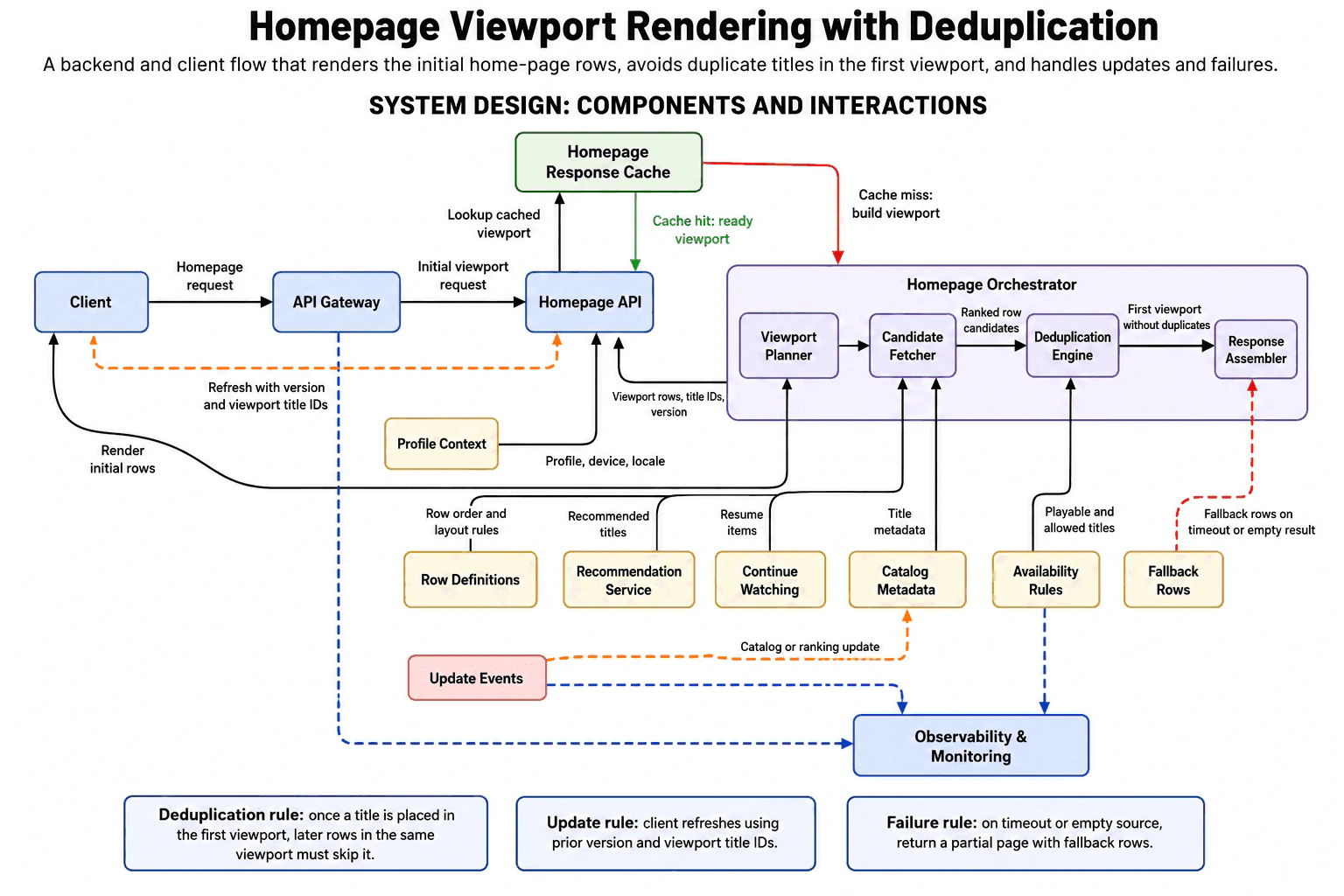
Design the backend and client interaction for rendering the initial rows of a streaming-service home page while preventing duplicate titles in the first viewport and handling updates and failures.
Short Interview Answer (30-60 seconds)
At a high level, this system builds the first homepage viewport without repeating titles. The main challenge is combining several content sources while keeping the first screen fast and useful. I would explain three flows: the initial request, viewport building, and update or failure handling. The Homepage API checks the Homepage Response Cache first. On a miss, the Homepage Orchestrator plans rows, fetches candidates, removes duplicates, and assembles the result. The downside is extra coordination, but users get faster and more varied homepages.
Detailed Explanation
The goal is to render the first homepage rows quickly and without repeated titles. The hard part is that several sources may return the same movie or show. The design solves this with a cache-first request path, one ordered viewport-building flow, and separate paths for updates, fallback content, and monitoring.
Useful Questions to Ask the Interviewer
Which user flows and system capabilities are required for the first version?
What traffic, data volume, latency, and availability targets should I design for?
Which consistency, security, geographic, and cost constraints matter most?
How to Explain It in an Interview
1. Explain the goal and the request path
I would begin by saying that the first screen must feel fast and varied. A title shown in one visible row should not appear again in another visible row.
The Client sends a homepage request to the API Gateway. The gateway forwards the initial viewport request to the Homepage API.
The Homepage API also receives Profile Context. This includes the profile, device, and locale used for the request.
2. Explain the cache hit and cache miss paths
The Homepage API first looks up a ready viewport in the Homepage Response Cache. A cache is a fast place that keeps a result prepared earlier.
On a cache hit, the cache returns the ready viewport to the Homepage API. The API can then render the initial rows for the Client.
On a cache miss, the request moves to the Viewport Planner inside the Homepage Orchestrator. The system must build a new viewport.
3. Explain how the viewport is built
The Viewport Planner decides the row order and layout. It uses Row Definitions to understand which rows should appear.
The Candidate Fetcher then gathers possible titles. Recommendation Service provides recommended titles. Continue Watching provides resume items. Catalog Metadata provides information about each title.
The Candidate Fetcher sends ranked row candidates to the Deduplication Engine. This component removes titles already placed in an earlier visible row.
Availability Rules also feed the Deduplication Engine. These rules remove titles that are not playable or allowed.
The Response Assembler receives the first viewport without duplicates. It returns the viewport rows, title IDs, and version to the Homepage API.
The API then sends the initial rows back to the Client.
4. Explain refreshes and content updates
The Client can refresh using the earlier version and viewport title IDs. These values help the system avoid repeating titles already shown.
Update Events carry catalog or ranking changes to Catalog Metadata. This keeps the title information used by the Candidate Fetcher current.
The refresh path is separate from the first homepage request. This keeps the normal user path easier to understand and manage.
5. Explain failures and monitoring
If a source times out or returns no useful result, Fallback Rows feed the Response Assembler. The system can return a partial page instead of failing the whole homepage.
Observability & Monitoring receives operational signals from the API Gateway, Homepage API, Update Events, and Availability Rules. This helps the team find request failures, update problems, and rule-related issues.
The main trade-off is extra coordination between components. The benefit is a fast cached path, fewer duplicate titles, and a usable page during partial failures.
Engineering Considerations / Design Trade-offs
The benefit is that a cache hit returns a ready viewport quickly. The Deduplication Engine also gives the user more variety on the first screen. The downside is that several components must work in the correct order. A cache miss takes longer because the system must plan rows, fetch titles, check metadata and availability, remove duplicates, and assemble the response. Fallback Rows keep the page usable during failures, but the result may be less personal. Update Events keep catalog information fresh, but they add another path to operate and monitor.
Why Interviewers Ask This
Interviewers use this problem to test how you split one user request into clear steps. They want to see whether you understand cache hits and misses, combining several content sources, removing duplicates, and handling partial failures. They also check whether you can explain update paths, monitoring, and trade-offs without making the design unnecessarily complex.
Interviewer may ask next
How would the design change if the client loads more homepage rows while the user scrolls?
I would keep the same architecture and reuse the existing refresh information. The Client would send the current version and the title IDs already shown.
The Homepage API would pass this information into the viewport-building flow. The Viewport Planner would plan the next rows instead of rebuilding the first screen.
Recommendation Service and Continue Watching could still return titles already visible on the page. The Deduplication Engine would compare those candidates with the title IDs sent by the Client. It would skip any title already shown.
Catalog Metadata and Availability Rules would still provide title details and playback checks. The Response Assembler would then return only the next usable rows.
This keeps the deduplication rule correct across multiple viewport requests. The main downside is that later requests carry more title IDs. Cache reuse may also be lower because different users have seen different title sets.
What should happen when Recommendation Service times out during viewport building?
I would allow the request to continue with the sources that still work. The Candidate Fetcher could use Continue Watching items and any other candidates already returned.
Catalog Metadata would still describe those titles. Availability Rules would still remove titles that cannot be played. The Deduplication Engine would continue removing repeated titles.
If the remaining candidates are not enough, Fallback Rows would feed the Response Assembler. The Homepage API could then return a partial but usable homepage instead of an error.
Observability & Monitoring should record the timeout and fallback use. This helps the team see whether Recommendation Service is failing often.
The design stays correct because fallback titles still pass through the normal assembly path. The main downside is weaker personalization. Users may see more general content until Recommendation Service recovers.
32. Design an ad pacing system.System DesignHardNetflix
i Question Details
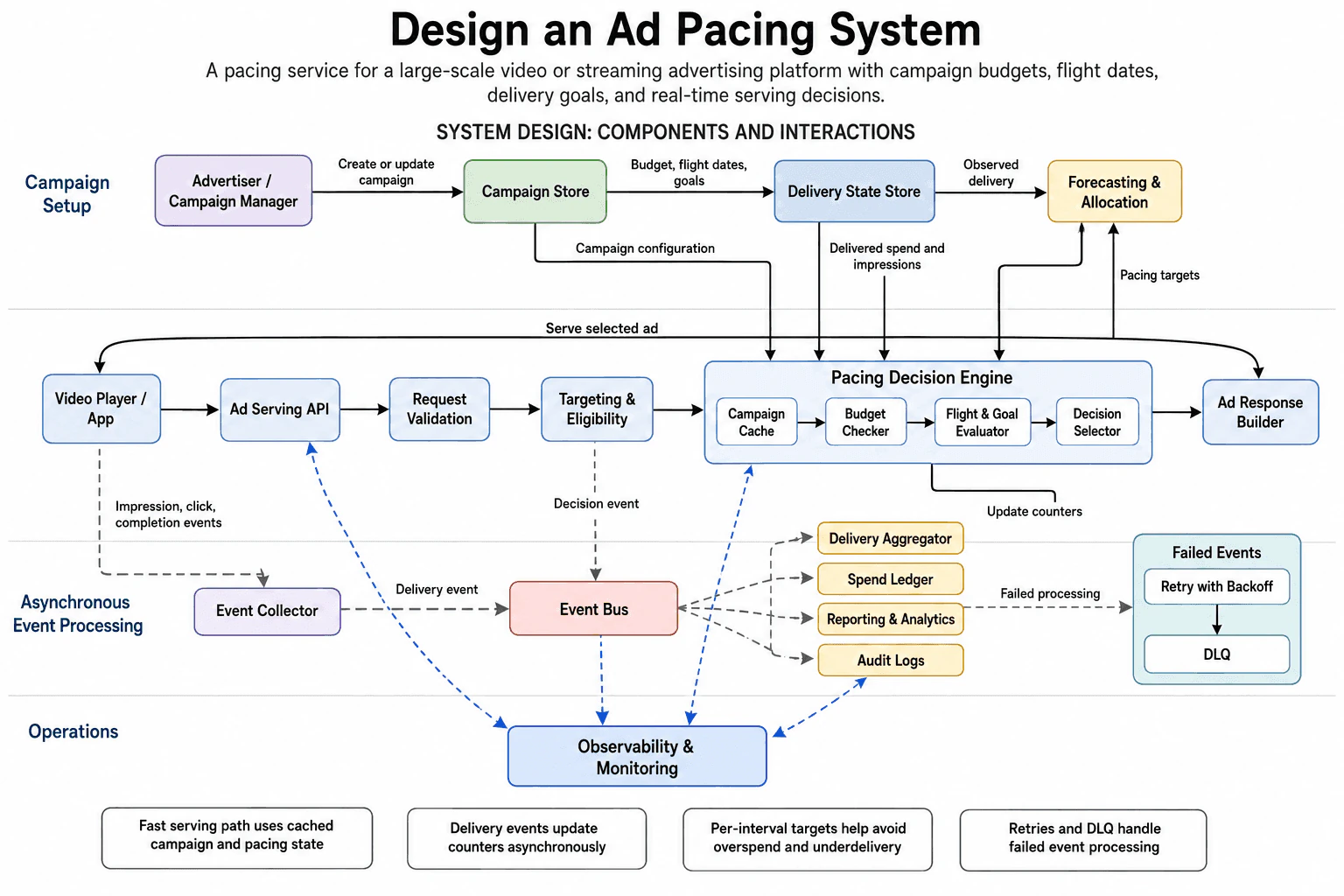
Design an advertising pacing system for a large-scale video or streaming advertising platform with campaign budgets, flight dates, delivery goals, and real-time serving decisions.
Short Interview Answer (30-60 seconds)
At a high level, this system controls how quickly each ad campaign spends its budget. The main challenge is making a fast serving decision while delivery counts keep changing. I would explain it in three flows: campaign setup, real-time ad serving, and background event processing. The Pacing Decision Engine uses cached campaign data, current delivery state, and pacing targets. Events later update spend, reports, and audit records. The trade-off is that background delivery counters may be slightly behind.
Detailed Explanation
The goal is to deliver each campaign across its flight dates without spending too quickly or too slowly. The difficult part is that every ad request needs a fast decision, while spend and impression counts change continuously. The diagram handles this with four connected areas: campaign setup, real-time serving, background event processing, and operations.
Useful Questions to Ask the Interviewer
Which user flows and system capabilities are required for the first version?
What traffic, data volume, latency, and availability targets should I design for?
Which consistency, security, geographic, and cost constraints matter most?
How to Explain It in an Interview
1. Explain the goal and pacing idea
I would start by saying that pacing controls how quickly a campaign spends. A campaign has a budget, flight dates, and delivery goals. If it serves too often, it may finish its budget early. If it serves too slowly, it may miss its delivery goal.
The fast path chooses an ad for the current request. Background work records what happened and updates later decisions.
2. Explain campaign setup and planning
The Advertiser / Campaign Manager creates or updates a campaign. The Campaign Store keeps the campaign configuration. This configuration contains the campaign budget, flight dates, and goals.
The Delivery State Store keeps observed delivery information. This includes delivered spend and impression counts. Forecasting & Allocation combines campaign configuration with observed delivery. It then creates pacing targets for the next serving period.
These targets tell the serving system how aggressively the campaign should compete for upcoming requests.
3. Explain the real-time serving path
For each opportunity, the Video Player / App calls the Ad Serving API. Request Validation checks that the request is usable. Targeting & Eligibility removes campaigns that should not serve for that request.
The remaining choices enter the Pacing Decision Engine. Campaign Cache provides campaign data quickly. Budget Checker makes sure a campaign still has usable budget. Flight & Goal Evaluator checks flight dates, delivery goals, and pacing targets. Decision Selector chooses the final campaign.
Ad Response Builder creates the response. The selected ad then returns to the Video Player / App. This path stays short because the player cannot wait for reporting or analytics work.
4. Explain background event processing
The player sends impression, click, and completion events to Event Collector. Event Collector sends delivery events to the Event Bus. The Pacing Decision Engine also sends decision events to the Event Bus.
The Event Bus distributes work to Delivery Aggregator, Spend Ledger, Reporting & Analytics, and Audit Logs. Delivery Aggregator combines delivery events and updates the counters used by the Delivery State Store. Spend Ledger records spend-related activity. Reporting & Analytics prepares campaign reports. Audit Logs keep a history of important actions.
This work runs in the background, so it does not delay ad serving.
5. Explain failures, monitoring, and trade-offs
If event processing fails, the work enters Failed Events. Retry with Backoff waits before trying again. The wait grows after repeated failures. Events that still fail move to the DLQ, which stores failed work for later review.
Observability & Monitoring watches the Ad Serving API, Pacing Decision Engine, Event Bus, and Delivery Aggregator. It helps the team find slow requests, incorrect decisions, and delayed processing.
The main benefit is fast serving with flexible background processing. The downside is that delivery state may be slightly behind the newest event. Forecasting and pacing targets reduce this risk, but they cannot remove it completely.
Engineering Considerations / Design Trade-offs
The benefit is that the serving path stays fast. Campaign Cache avoids slower campaign lookups, and pacing targets are prepared before the request arrives. Background events also keep reporting work away from the player. The downside is that the Delivery State Store may not include the newest impression yet. This can cause small overdelivery or underdelivery. Forecasting & Allocation reduces that risk by adjusting future pacing targets. Retries make event processing more reliable, but they add delay. The DLQ keeps failed events available, but the team must inspect and replay them later.
Why Interviewers Ask This
Interviewers ask this question to test how you separate a fast decision path from slower background work. They want to see how you manage changing budgets, delayed delivery data, retries, and monitoring. A strong answer also explains why pacing uses both current delivery state and future targets, while clearly describing the trade-off between speed and perfectly current counters.
Interviewer may ask next
How would the design change if a campaign must never spend more than its budget?
I would keep the same architecture, but I would make Budget Checker more conservative. It would stop selecting a campaign before the recorded spend reaches the exact budget. The extra gap would protect against impressions that have happened but have not reached the Delivery State Store yet.
Forecasting & Allocation would also lower pacing targets as the campaign approaches its limit. Flight & Goal Evaluator would use those lower targets when deciding whether the campaign should still compete. The real-time path would remain the same, from the Ad Serving API through the Pacing Decision Engine and Ad Response Builder.
Delivery events would still flow through Event Collector and the Event Bus. Delivery Aggregator would continue updating delivery counters. This keeps the system correct without adding a new service.
The downside is underdelivery. The campaign may stop a little early because the design keeps a safety margin for delayed events.
What happens if the Event Bus or Delivery Aggregator is unavailable for several minutes?
The real-time serving path can continue for a short time using the latest Campaign Cache, Delivery State Store, and pacing targets. However, those delivery counts will become less current while background events wait.
Failed processing should enter the Failed Events path. Retry with Backoff waits before trying again, so the system does not repeatedly overload the failing component. Events that still cannot be processed move to the DLQ. After recovery, the team can review and replay them.
Observability & Monitoring should show delayed events, growing failures, and missing counter updates. Audit Logs help confirm what was processed before and after recovery. Spend Ledger and Reporting & Analytics will also be delayed until the events continue flowing.
The main downside is weaker pacing accuracy during the outage. The longer the delay lasts, the greater the risk of temporary overdelivery or underdelivery.
33. Design an ads audience targeting system.System DesignHardNetflix
i Question Details
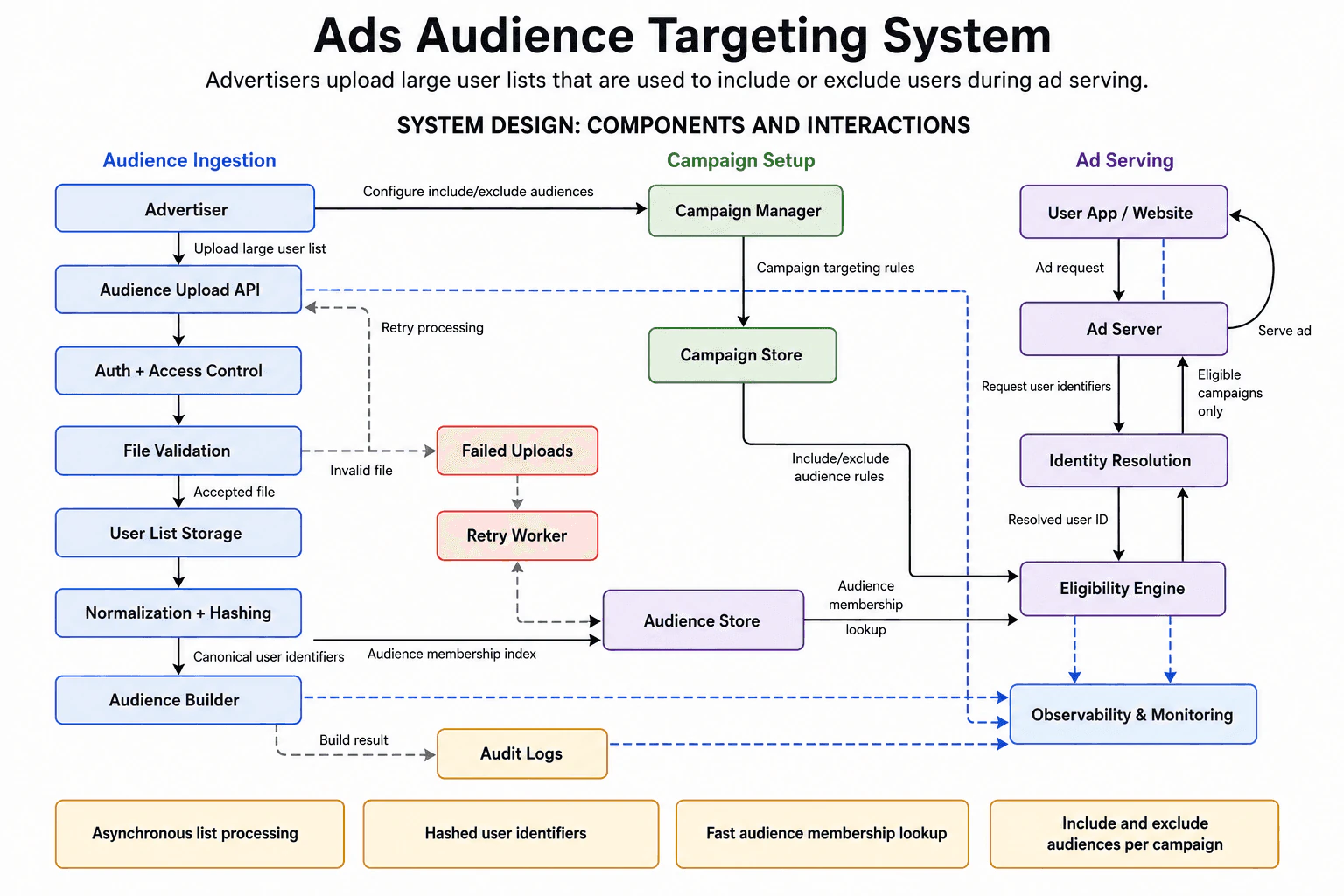
Design a system that allows advertisers to upload large user lists and then target or exclude those users when serving ads.
Short Interview Answer (30-60 seconds)
At a high level, this system lets advertisers upload user lists and use them for ad targeting. The main challenge is separating slow list processing from the fast ad-serving path. I would explain it in three flows: audience ingestion, campaign setup, and real-time eligibility checks. The system validates, normalizes, hashes, and builds audience membership data. During ad serving, the Eligibility Engine combines that data with campaign rules. The trade-off is that new audience changes may take time to become available.
Detailed Explanation
The system must let advertisers upload large user lists and use them to include or exclude users from campaigns. The difficult part is that building an audience may take time, while ad serving must remain fast. The diagram handles this by separating audience ingestion, campaign setup, real-time ad serving, and supporting work such as retries, audit logs, and monitoring.
Useful Questions to Ask the Interviewer
Which user flows and system capabilities are required for the first version?
What traffic, data volume, latency, and availability targets should I design for?
Which consistency, security, geographic, and cost constraints matter most?
How to Explain It in an Interview
1. Explain the goal and the main idea
I would begin by separating slow preparation work from fast serving work. Large files need validation, storage, normalization, hashing, and audience building.
That work happens before the audience is used for an ad request. The serving path only performs identity resolution, audience lookup, and campaign-rule checks.
2. Explain the audience ingestion path
The Advertiser uploads a large user list through Audience Upload API. Auth + Access Control checks whether the advertiser may perform that action.
File Validation checks the uploaded file. An accepted file moves into User List Storage. An invalid file moves to Failed Uploads.
Retry Worker can send failed work back toward Audience Upload API for retry processing. This keeps temporary upload problems outside the ad-serving path.
Normalization + Hashing converts each user identifier into one common form. Hashing hides the original value while still allowing matching.
Audience Builder creates the audience membership index. It writes that result into Audience Store. Audience Builder also sends the build result to Audit Logs.
3. Explain campaign setup
The Advertiser configures include or exclude audiences through Campaign Manager. Campaign Manager saves the campaign targeting rules in Campaign Store.
Audience Store and Campaign Store have different jobs. Audience Store answers whether a user belongs to an audience. Campaign Store holds the rules that say how each campaign uses that audience.
4. Explain the ad-serving path
A User App or Website sends an ad request to Ad Server. Ad Server asks Identity Resolution for the resolved user ID.
Eligibility Engine uses that user ID for an audience membership lookup in Audience Store. It also reads include or exclude audience rules from Campaign Store.
The engine returns only eligible campaigns to Ad Server. Ad Server then serves an ad back to the User App or Website.
The slow upload steps do not run during this request. This keeps the serving path small and easier to make fast.
5. Explain retries, logs, and monitoring
Failed Uploads and Retry Worker handle problems from the ingestion path. Audit Logs record the Audience Builder result.
Observability & Monitoring receives operational signals from important ingestion and serving components. This helps the team find upload failures, slow audience builds, and eligibility problems.
The main benefit is fast membership checking during ad serving. The downside is delay between uploading a list and using the finished audience.
Engineering Considerations / Design Trade-offs
The benefit is that slow file processing does not delay an ad request. Audience Builder prepares the membership index before serving starts. This makes the lookup inside Eligibility Engine much faster. Hashing also reduces exposure of the original user identifiers. The downside is delay. A new list may not affect campaigns until validation, storage, normalization, hashing, and audience building finish. Retry Worker helps recover failed uploads, but it adds more moving parts. Keeping Audience Store and Campaign Store separate makes their jobs clear, but Eligibility Engine must combine both results correctly.
Why Interviewers Ask This
Interviewers want to see whether the candidate can separate slow background work from a fast request path. They also test understanding of identity matching, audience membership, campaign rules, retries, and monitoring. A strong answer explains the data flow clearly and shows good judgment about correctness and speed. The interviewer is judging design choices and trade-offs, not memorized service names.
Interviewer may ask next
What happens when an uploaded audience file is invalid or processing fails?
The file should leave the normal ingestion path and move to Failed Uploads. This happens after File Validation detects that the file cannot be accepted.
Retry Worker then handles retry processing. It sends the work back toward Audience Upload API instead of changing Audience Store directly. This matters because invalid or incomplete data must not become audience membership data.
User List Storage, Normalization + Hashing, and Audience Builder should run only after the file is accepted. Audit Logs should record the final build result when Audience Builder completes its work.
Observability & Monitoring should show repeated failures so the team can investigate them. The main downside is delay. A campaign cannot use the new audience until the upload succeeds and Audience Store receives the finished membership index.
What should happen if Audience Store is unavailable during an ad request?
Eligibility Engine cannot safely complete the audience membership lookup without Audience Store. It may still have the resolved user ID and campaign rules, but it is missing the membership result.
For an include rule, the engine should not assume that the user belongs to the audience. For an exclude rule, it should not silently assume that targeting is safe. The service should follow a clear conservative policy that avoids using unknown membership as a valid match.
Ad Server and Eligibility Engine should report the problem through Observability & Monitoring. This lets the team detect the failure quickly while keeping the rest of the request flow visible.
The main downside is lower ad delivery during the outage. This protects targeting correctness, but fewer campaigns may be considered eligible until Audience Store is available again.
34. Design a file backup system.System DesignHardNetflix
i Question Details
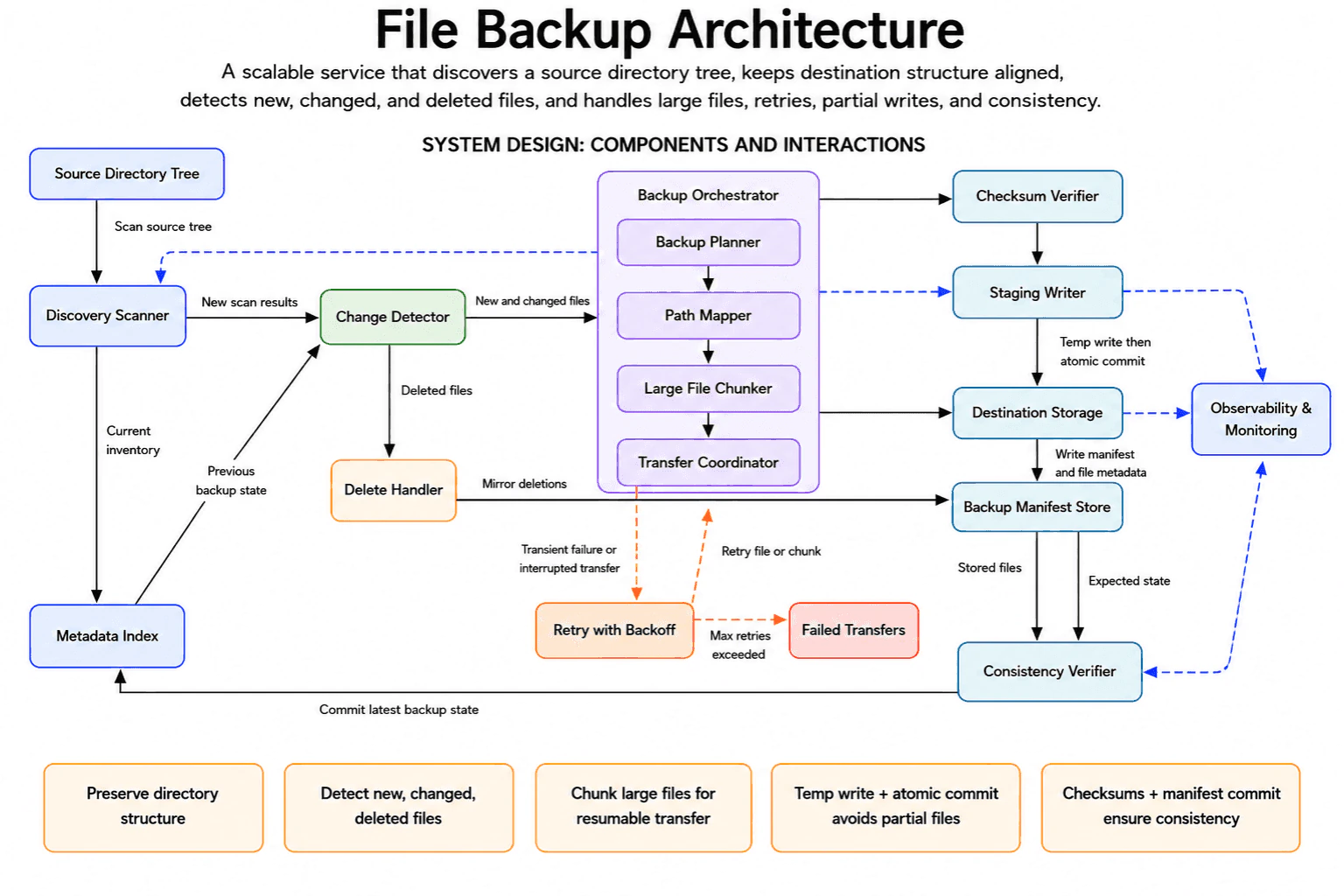
Design a scalable file backup system that discovers a source directory tree, preserves its structure at the destination, detects new, changed, and deleted files, and handles large files, retries, partial writes, and consistency.
Short Interview Answer (30-60 seconds)
At a high level, this system copies a source directory tree into backup storage while keeping its structure. The main challenge is finding only new, changed, and deleted files, then handling interrupted transfers safely. I would explain three flows: discovery and change detection, planned file transfer, and consistency checking. Large files are split into chunks, temporary failures use retries, and staging prevents partial files. The trade-off is extra metadata and verification work for safer backups.
Detailed Explanation
The goal is to back up a source directory tree without losing its folder structure. The system must detect file changes and avoid unsafe partial writes. It must also recover when a large file transfer stops halfway. The diagram organizes the solution into discovery, transfer, safe storage, retry, and verification flows.
Useful Questions to Ask the Interviewer
Which user flows and system capabilities are required for the first version?
What traffic, data volume, latency, and availability targets should I design for?
Which consistency, security, geographic, and cost constraints matter most?
How to Explain It in an Interview
1. Explain discovery and change detection
I would start with the Discovery Scanner. It scans the Source Directory Tree and creates the current inventory.
The Metadata Index holds the previous backup state. The Change Detector compares that state with the new scan results. This finds new files, changed files, and deleted files.
New and changed files move into the Backup Orchestrator. Deleted files move to the Delete Handler.
2. Explain planning and path preservation
Inside the Backup Orchestrator, the Backup Planner decides which files need work. The Path Mapper keeps the source directory structure at the destination.
The Large File Chunker divides large files into smaller pieces. This lets the system retry one file or chunk instead of restarting everything.
The Transfer Coordinator manages the transfer process. It sends completed transfer work toward checksum checking and destination writing.
3. Explain safe file writing
The Checksum Verifier checks that transferred data was not changed or damaged. A checksum is a small value calculated from file data.
The Staging Writer writes the data into a temporary location first. It then performs an atomic commit, which makes the final file visible only after the complete write succeeds.
The committed file goes to Destination Storage. This prevents an interrupted write from replacing a good file with an incomplete one.
Destination Storage then writes the manifest and file metadata into the Backup Manifest Store. The manifest records what the backup process produced and expects.
4. Explain deletions and retry handling
The Delete Handler receives deleted-file information from the Change Detector. It sends the mirror-deletion update into the Backup Manifest Store.
If a file or chunk transfer fails temporarily, the Transfer Coordinator sends it to Retry with Backoff. Backoff means the system waits before trying again.
A retry returns to the transfer flow. When the maximum retries are exceeded, the work moves to Failed Transfers. This keeps failures visible for later action.
5. Explain consistency and monitoring
The Backup Manifest Store sends the recorded stored-file view and expected state to the Consistency Verifier. The verifier checks whether the recorded backup state is internally consistent.
After that check, it commits the latest backup state into the Metadata Index. The next scan can compare against this updated state.
Observability & Monitoring receives signals from the scanning, writing, storage, and consistency paths. This helps operators find slow transfers, failed writes, and mismatched backup state.
The benefit is safer and resumable backups. The downside is more metadata, staging space, checksum work, and verification time.
Engineering Considerations / Design Trade-offs
The benefit is that the system copies only files that changed. Chunking makes large files easier to retry. Staging and atomic commit protect Destination Storage from incomplete files. The manifest and consistency checks also make backup problems easier to find. The downside is extra work. The system must scan directories, store metadata, calculate checksums, track retries, and verify the final state. It also needs temporary staging space. We accept this added complexity because a backup system must prefer correct and complete files over the fastest possible copy.
Why Interviewers Ask This
Interviewers ask this question to test how you divide a storage problem into clear flows. They want to see how you detect changes, preserve paths, handle large files, retry failures, and avoid partial writes. They also want to know whether you can explain consistency and trade-offs clearly without claiming perfect recovery or unlimited scale.
Interviewer may ask next
How would the design handle very large files when network failures happen often?
I would keep the same design and rely more on the Large File Chunker. It would divide each large file into smaller chunks before transfer.
The Transfer Coordinator would track which file or chunk needs another attempt. When the network fails, Retry with Backoff would wait and retry only the failed work. A successful retry would return to the transfer flow.
The Checksum Verifier would check transferred data before the Staging Writer commits it. The final file would appear in Destination Storage only after the complete staged write succeeds.
The Backup Manifest Store would still record the manifest and file metadata. The Consistency Verifier would check the recorded stored-file view and expected state before updating the Metadata Index.
The main downside is more tracking data. The system must remember chunk progress, retry state, and the final completed file state.
What happens when a transfer keeps failing after every retry?
The transfer should move to Failed Transfers after the retry limit is reached. It should not loop forever or silently disappear.
The Transfer Coordinator first sends the failed file or chunk to Retry with Backoff. Each retry waits before trying again. This avoids sending repeated work too quickly during a temporary failure.
When the maximum retries are exceeded, the failure moves to Failed Transfers. Observability & Monitoring should make this problem visible to operators.
The latest backup state should not be committed as complete until the Consistency Verifier finishes its check. The Metadata Index therefore continues to represent the last verified backup state.
The main downside is that the new backup may remain incomplete until someone fixes or retries the failed transfer. This is safer than marking missing data as successfully backed up.
35. Tell me about a complex project you led. What made it complex, and how did you handle it?BehavioralHardNetflix
Interview tip:
Use STAR to structure your answer: briefly explain the Situation and Task, make Action the most detailed part, and finish with the Result. For example, describe a complex Python project with several systems and teams, explain your responsibility, show how you reduced uncertainty, made technical decisions, coordinated the work, handled risks, and delivered a reliable result.
Situation
In my last role, I led a project to replace a slow manual data process with a Python service. The service had to collect data from several internal systems, validate it, apply business rules, and make the results available to other teams. The project was complex because the source systems used different data formats, some records arrived late, and several teams depended on the final output.
Task
I was responsible for the technical plan and the delivery of the service. My goal was to create a reliable system without interrupting the existing process. I also needed to keep the scope clear, coordinate the work across teams, and make sure failures could be found and corrected quickly.
Action
I started by meeting each team that produced or used the data. I wrote down the input rules, expected outputs, common failure cases, and ownership for each dependency. This helped us find conflicting assumptions before we started coding. I then divided the project into small parts. These included data collection, validation, business rule processing, storage, and reporting. I defined a clear interface between each part so the team could work in parallel without creating tight connections between components. For the Python service, I used separate modules for each responsibility and added automated tests around the most important business rules. I also designed the processing to be safe to repeat. This meant that running the same input again would not create duplicate results. That decision mattered because late data and temporary connection failures were expected. I added structured logs and clear error categories so we could tell whether a failure came from bad input, a source system, or our own code. I created a simple project board with priorities, owners, risks, and decision dates. During regular reviews, I explained technical issues in plain language and raised risks early. When one source team could not provide its new interface on time, I avoided delaying the whole project. I created a temporary adapter for its existing format and kept the rest of the design unchanged. I also ran the new service beside the manual process for a period of time. We compared the outputs, investigated differences, and only changed over after the teams agreed that the results were dependable.
Result
The team delivered a stable Python service that replaced the manual process without disrupting the teams that depended on it. The new design made failures easier to understand, reduced repeated manual work, and gave the team a clear way to add new data sources later. I learned that leading a complex project is not only about choosing the right technology. It is also about reducing uncertainty, making ownership clear, communicating risks early, and creating a delivery plan that can adjust when dependencies change.
Why Interviewers Ask This
Interviewers ask this question to evaluate whether a candidate can lead work that has technical, organizational, and delivery challenges at the same time. A strong answer shows that the candidate can break a large problem into manageable parts, make sound decisions, coordinate people, manage risks, communicate clearly, and take responsibility for the final outcome.
Interviewer may ask next
Why did you run the new service beside the manual process before changing over?
I wanted to reduce the risk of replacing a process that several teams depended on. Running both processes let us compare real outputs, find hidden data differences, and correct problems without affecting users. It also gave the other teams evidence that the new service was reliable before they approved the change.
What would you do differently if you led a similar project again?
I would involve the teams that own the source data even earlier and ask them to provide sample failure cases at the start. We discovered some unusual records during the comparison period that could have been included in our first test set. Earlier examples would help us improve validation sooner and reduce work near the final changeover.
36. Tell me about a time you had to give constructive feedback to a teammate or cross-functional partner.BehavioralHardNetflix
i Question Details
Explain what was not going well, how you delivered the feedback, and what outcome followed.
Interview tip:
Use STAR to structure your answer: briefly explain the Situation and Task, make Action the most detailed part, and finish with the Result. For example, describe a project where a teammate's approach was creating quality or delivery problems, how you prepared specific examples, shared the feedback respectfully, listened to their view, agreed on practical changes, and improved the working relationship and project outcome.
Situation
In my last role, I worked with a teammate who was building a Python service that processed data from an external API. The code worked in normal cases, but several pull requests had limited error handling and very large functions. This made the service harder to test and increased the risk of failures when the external API returned incomplete data. I noticed that review comments were starting to repeat, but the underlying issue was not changing.
Task
I needed to help improve the code without making the teammate feel blamed or challenged. My goal was to give clear feedback, understand why they had chosen that approach, and agree on a better way to structure the service before the next release.
Action
I first collected a few specific examples from the code instead of giving broad feedback such as saying the design was poor. I checked that each example had a real effect on testing, error handling, or future maintenance. I then asked for a private conversation because I did not want to raise a sensitive concern in a public review thread. I started by explaining the shared goal, which was to make the service reliable and easy for the whole team to support. I described what I had observed and focused on the code rather than the person. For example, I showed how one large function handled API calls, validation, transformation, and database writes in the same place. I explained that separating those responsibilities would make failures easier to locate and tests easier to write. I also asked how they saw the problem. They explained that they were under time pressure and had optimized for completing the first working version. I acknowledged that the decision was reasonable for the earlier deadline. We then worked together on a practical improvement plan. We split the large function into smaller units, added clear handling for missing API fields, and created tests for the main failure cases. I offered to pair on the first refactor so the feedback felt supportive rather than like extra work being assigned to them. In later reviews, I also recognized the improvements so the conversation was not only about problems.
Result
The teammate responded well because the feedback was specific, private, and connected to a shared goal. The service became easier to test and support, and later pull requests needed fewer repeated comments. Our working relationship also improved because we could discuss technical concerns more openly. I learned that constructive feedback works best when I bring evidence, listen before judging, and help create a realistic next step.
Why Interviewers Ask This
Interviewers ask this question to evaluate whether a candidate can address performance or quality concerns without damaging trust. A strong answer shows emotional awareness, clear communication, respect, practical judgment, and the ability to turn feedback into better collaboration and results.
Interviewer may ask next
How did you handle the possibility that your teammate might disagree with the feedback?
I avoided presenting my view as the only correct answer. I used specific code examples, explained the impact, and asked them to describe their reasoning. When they explained the deadline pressure, I recognized that context and adjusted the plan so we improved the design in manageable steps instead of demanding a complete rewrite.
What would you do differently in a similar situation now?
I would raise the pattern earlier, before the same comments appeared across several pull requests. I would also agree on simple design expectations at the start of the work, such as separating API access, validation, and database logic. That could prevent the issue and make later feedback easier.
37. Tell me about a time you received critical feedback. How did you apply it afterward?BehavioralHardNetflix
i Question Details
Explain how you responded and what you changed afterward.
Interview tip:
Use STAR to structure your answer: briefly explain the Situation and Task, make Action the most detailed part, and finish with the Result. For example, describe a time when a reviewer gave direct feedback about the structure or quality of your Python code, how you listened and asked for examples, what changes you made to your code and working habits, and how the feedback improved later work.
Situation
In my last role, I submitted a Python service update for review. The code worked and passed its tests, but a senior developer said it was difficult to understand and maintain. Some functions handled validation, business logic, and database access in the same place. The feedback was direct because similar patterns had appeared in my earlier changes.
Task
I was responsible for improving the update before release. I also needed to understand the larger concern and make sure I did not repeat the same design problem in future work.
Action
I first avoided defending the code and asked the reviewer to walk me through the sections that caused the most concern. I wrote down the specific issues and repeated them in my own words to confirm that I understood. I then separated validation, business logic, and database operations into smaller functions with clear responsibilities. I improved the function names, added type hints where they made the inputs clearer, and rewrote several tests so each test checked one behavior. I sent the revised structure to the reviewer before completing every detail because I wanted to confirm that I was moving in the right direction. After the change was approved, I created a personal review checklist. Before opening later reviews, I checked function size, responsibility, naming, error handling, and test clarity. I also started asking for early design feedback when a change touched several parts of a service.
Result
The revised code was easier for the team to review, test, and extend. My later changes required fewer structural corrections because I was applying the feedback before submitting them. I learned that critical feedback is most useful when I turn it into specific actions and a repeatable working habit.
Why Interviewers Ask This
Interviewers ask this question to understand whether a candidate can receive difficult feedback without becoming defensive, identify the real issue, and make lasting improvements. A strong answer shows self awareness, professional communication, ownership, and the ability to turn feedback into better future work.
Interviewer may ask next
How did you make sure you understood the feedback correctly?
I asked the reviewer to point to specific parts of the code and explain why they would be difficult to maintain. I then summarized the concerns in my own words and shared a revised structure early. That gave the reviewer a chance to correct my understanding before I completed the full change.
What would you do differently if you faced the same situation now?
I would ask for design feedback before writing the full implementation when a change combines validation, business logic, and data access. I would also use my review checklist from the start. This would help me find structural problems earlier and reduce the amount of rework needed during review.
38. Describe a time you navigated significant ambiguity. How did you move forward?BehavioralHardNetflix
Interview tip:
Use STAR to structure your answer: briefly explain the Situation and Task, make Action the most detailed part, and finish with the Result. For example, describe a project with unclear requirements where you identified the most important unknowns, gathered input from stakeholders, tested assumptions with a small Python prototype, communicated risks, and created a clear path forward.
Situation
In my last role, I worked on a Python service that collected data from several internal systems and prepared it for reporting. The request was urgent, but the expected output was not clear. Different stakeholders described the data rules in different ways, and there was no complete specification.
Task
I was responsible for moving the work forward without building the wrong solution. I needed to understand the real business need, reduce the main technical risks, and give the team a clear plan that could be adjusted as we learned more.
Action
I started by listing what we knew, what we were assuming, and what still needed a decision. This helped separate real requirements from guesses. I then met with the main stakeholders and used a few concrete data examples to ask how each case should be handled. I wrote their answers in a simple decision table so everyone could see where the rules agreed and where they conflicted. For the most uncertain area, I built a small Python prototype that read sample records, applied the proposed rules, and produced an example output. I chose a prototype because it was faster and safer than building the full service around an untested assumption. I shared the results with the stakeholders and explained the tradeoffs in plain language. After they agreed on the core behavior, I divided the work into a stable first version and later improvements. I also added clear validation, logging, and configuration so rule changes would not require a large rewrite. Throughout the work, I kept the team informed about confirmed decisions, open questions, and risks.
Result
We reached agreement on the important rules and delivered a reliable first version without waiting for every minor detail to be resolved. The service was easier to adjust when new requirements appeared because the uncertain rules were separated from the main processing logic. I learned that ambiguity becomes manageable when I make assumptions visible, test the riskiest idea early, and create regular decision points with the people involved.
Why Interviewers Ask This
Interviewers ask this question to understand how a candidate works when requirements, ownership, or outcomes are unclear. A strong answer shows structured thinking, practical judgment, clear communication, ownership, and the ability to make progress without making careless assumptions.
Interviewer may ask next
Why did you build a prototype before the full service?
The main risk was not the Python implementation. It was whether we understood the data rules correctly. The prototype gave stakeholders something concrete to review and allowed us to correct wrong assumptions before they became part of the full design.
What would you do differently in a similar situation now?
I would create the decision table even earlier and assign an owner and review date to every open question. That would make unresolved items more visible and reduce the chance that a temporary assumption is treated as a final decision.
39. Tell me about a time you influenced a product decision. What was your role, and what changed as a result?BehavioralHardNetflix
Interview tip:
Use STAR to structure your answer: briefly explain the Situation and Task, make Action the most detailed part, and finish with the Result. For example, describe a product decision where you used user feedback and technical evidence, explained the tradeoffs to product partners, recommended a better approach, handled concerns, and helped the team improve the final product.
Situation
In my last role, our team was building a feature that let users export reports from a web application. The original product plan allowed users to request very large reports and wait on the page while the Python service created the file. During an early review, I saw that large requests could take a long time, use too much application memory, and create a poor user experience.
Task
I was responsible for the Python service that collected the data and generated the export file. My goal was to support the planned feature, but I also wanted to help the product team choose an experience that would remain reliable as report sizes grew.
Action
I first created a small test using realistic report sizes. I showed that small exports completed quickly, but large exports kept a web process busy for too long and could slow down other requests. I then spoke with the product manager and designer. I explained the issue in user terms instead of only discussing server limits. A user might click the button again because the page appeared stuck, which could create duplicate work and more delay. I proposed that small reports could still download immediately, while larger reports should run as background jobs. A background job means the server completes the work separately instead of making the user wait on the same page. I suggested showing clear progress and notifying the user when the file was ready. The product manager was concerned that this would add steps to the first release. To reduce that concern, I worked with the team to define a simple first version. We reused our existing task queue, added a basic export status, and kept the same download flow for small files. I documented the options, risks, and expected user impact so the final decision was clear. My role was not to make the product decision alone. I provided the technical evidence, connected it to the user experience, and helped the product manager and designer compare the choices.
Result
The team changed the product plan and used the mixed approach. Small exports stayed fast and simple, while large exports no longer blocked the web request. The feature was more reliable, and users received clearer feedback about what was happening. I learned that influencing a product decision is not about rejecting an idea. It is about explaining the risk clearly, understanding product concerns, and offering a practical option that protects both the user experience and the delivery goal.
Why Interviewers Ask This
Interviewers ask this question to understand whether a candidate can contribute beyond writing code. They want to see how the candidate uses evidence, communicates technical tradeoffs, respects product ownership, handles concerns, and helps a team make a better decision. A strong answer shows influence through clear reasoning and collaboration rather than authority.
Interviewer may ask next
How did you handle the product manager's concern about adding more work?
I acknowledged that the concern was valid because the team had a delivery target. Instead of pushing for a complex solution, I reduced the proposal to a simple first version that reused our existing task queue. I also kept immediate downloads for small reports. This showed that I understood the product goal and was trying to reduce risk without creating unnecessary scope.
What would you do differently in a similar situation now?
I would involve the product manager and designer earlier, before the first product plan was nearly complete. I would also prepare a simple user flow together with the technical test. The test explained the system risk well, but a visual user flow would make the experience change easier to understand and help the team reach a decision sooner.
40. Why do you want to work at Netflix?BehavioralMediumNetflix
Interview tip:
Use STAR to structure your answer: briefly explain the Situation and Task, make Action the most detailed part, and finish with the Result. For example, describe a previous Python project that showed you how reliable software can improve the user experience, the responsibilities you owned, the technical and product decisions you made with your team, and how that experience shaped your interest in solving similar problems at Netflix.
Situation
In my last role, I worked on a Python service that processed user activity and provided data to a customer facing application. The service was important because slow or incorrect data could directly affect what users saw in the product.
Task
I was responsible for improving the reliability of the service while keeping the code simple enough for the team to maintain. I also needed to work closely with product and engineering partners so that our technical choices supported the user experience.
Action
I first studied the full data flow and identified where delays and failures could affect users. I added clear validation at the service boundary so bad input was rejected early. I improved logging so the team could understand why a request failed instead of only seeing that it failed. I also separated the main processing logic into smaller Python modules, which made testing and future changes easier. Before making larger changes, I spoke with the product partner to understand which user actions mattered most. This helped me focus on the parts of the service that had the greatest product impact. I shared my design with the team, asked for feedback, and adjusted it when another engineer identified an operational risk. That experience showed me that strong engineering is not only about writing correct code. It is also about understanding users, making careful tradeoffs, and helping the team operate the system with confidence. Those are the reasons I am interested in Netflix. I want to work on products used by a wide audience, solve meaningful reliability and data problems with Python, and learn from engineers who connect technical decisions with the viewing experience.
Result
The service became easier to understand, test, and support. The team could identify problems more quickly, and later changes were safer to make. I learned that I do my best work when technical depth, product impact, and collaboration are all important. That is the type of environment I am looking for at Netflix.
Why Interviewers Ask This
Interviewers ask this question to understand whether the candidate has a thoughtful reason for choosing Netflix and whether the role matches the candidate's skills, interests, and working style. A strong answer connects past experience with the work the candidate hopes to do and shows genuine interest beyond compensation or company recognition.
Interviewer may ask next
Which part of your previous project best connects with the work you hope to do at Netflix?
The strongest connection was learning how a backend Python service could directly affect the user experience. I enjoyed tracing technical problems back to their product impact and then choosing improvements that helped both users and the engineering team. I hope to continue doing that kind of work at Netflix.
What did you learn about the type of engineering environment where you perform best?
I learned that I perform best when engineers understand the product goal, take ownership of reliable delivery, and openly review important decisions. In that project, feedback from product and engineering partners helped me build a better solution than I would have created alone. I want an environment where that level of judgment and collaboration is expected.
More questions load as you scroll
Disclaimer: This interview guide is for educational and informational purposes only. It is designed to help readers prepare, but it does not guarantee any interview result, hiring decision, offer, or outcome. Interview questions, hiring criteria, and preferred answers can vary by employer, interviewer, industry, location, and time. All answers, examples, and explanations in this guide are suggested examples for interview preparation, not definitive answers or instructions for professional practice. They are based on research and judgment, are provided without warranties of any kind, and should be adapted to the question, role, and applicable laws and professional requirements. Diagrams are simplified illustrations intended to highlight the main concepts and their relationships; actual situations, systems, and practices may be more complex. Alternative approaches may be equally valid or better suited to a particular question, context, or interviewer. To the fullest extent permitted by applicable law, the contributors and publisher are not liable for decisions made, actions taken, or losses incurred based on this guide.
State Laws and Professional Responsibilities: Laws and requirements governing an occupation vary by state and jurisdiction. You are responsible for checking the current laws, licensing requirements, and scope-of-practice rules that apply to your location and role, and for ensuring that your answers and actions comply with them. Adapt examples in this guide to those requirements. This guide is not legal advice.
Company Notice: This guide is an independent educational resource and is not affiliated with, endorsed by, sponsored by, or approved by the company named in this guide. Company names identify reported interview experiences or the employer context of clearly labeled original practice exercises. Interview practices can change without notice, and inclusion of company-specific content does not mean these questions are official, complete, or guaranteed to be asked. To the fullest extent permitted by law, the author, contributors, and publisher are not responsible for outcomes related to use of this material.
Content Accuracy and Verification: To the fullest extent permitted by applicable law, we do not represent or warrant that interview guides, questions, answers, examples, or diagrams are accurate, complete, current, error-free, or suitable for any particular purpose. You are responsible for independently reviewing and verifying the information before relying on it.