This interview guide is for educational and informational purposes only. It is designed to help readers prepare, but it does not guarantee any interview result, hiring decision, offer, or outcome. Interview questions, hiring criteria, and preferred answers can vary by employer, interviewer, industry, location, and time. All answers, examples, and explanations in this guide are suggested examples for interview preparation, not definitive answers or instructions for professional practice. They are based on research and judgment, are provided without warranties of any kind, and should be adapted to the question, role, and applicable laws and professional requirements. Diagrams are simplified illustrations intended to highlight the main concepts and their relationships; actual situations, systems, and practices may be more complex. Alternative approaches may be equally valid or better suited to a particular question, context, or interviewer. To the fullest extent permitted by applicable law, the contributors and publisher are not liable for decisions made, actions taken, or losses incurred based on this guide.
State Laws and Professional Responsibilities
Laws and requirements governing an occupation vary by state and jurisdiction. You are responsible for checking the current laws, licensing requirements, and scope-of-practice rules that apply to your location and role, and for ensuring that your answers and actions comply with them. Adapt examples in this guide to those requirements. This guide is not legal advice.
Identity, Image, and Privacy Notice
To respect individual privacy, some names, profile photographs, avatars, biographical details, and other identifying information displayed in this guide may be replaced with pseudonyms, licensed stock images, illustrative avatars, composite images, or representative descriptions. Unless a person is expressly identified as an actual contributor, a displayed name, image, or profile should not be understood as depicting or identifying a specific candidate, interviewer, employee, or other real individual. These representations are provided for editorial and illustrative purposes only and do not imply endorsement, employment, participation, or affiliation with this guide or any company mentioned in it. Any resemblance to an actual person is coincidental.
Company Notice
This guide is an independent educational resource and is not affiliated with, endorsed by, sponsored by, or approved by the company named in this guide. Company names identify reported interview experiences or the employer context of clearly labeled original practice exercises. Interview practices can change without notice, and inclusion of company-specific content does not mean these questions are official, complete, or guaranteed to be asked. To the fullest extent permitted by law, the author, contributors, and publisher are not responsible for outcomes related to use of this material.
Content Accuracy and Verification
To the fullest extent permitted by applicable law, we do not represent or warrant that interview guides, questions, answers, examples, or diagrams are accurate, complete, current, error-free, or suitable for any particular purpose. You are responsible for independently reviewing and verifying the information before relying on it.
Questions or comments?
Contact us for general questions, or share feedback, technical corrections, and comments with the community.
1. Explain the Python Data Structures Used for a Streaming TaskLanguage SpecificEasyMeta
i Question Details
For a stream of incoming records, choose Python data structures that support incremental processing and explain their operations and memory behavior.
Short Interview Answer (30-60 seconds)
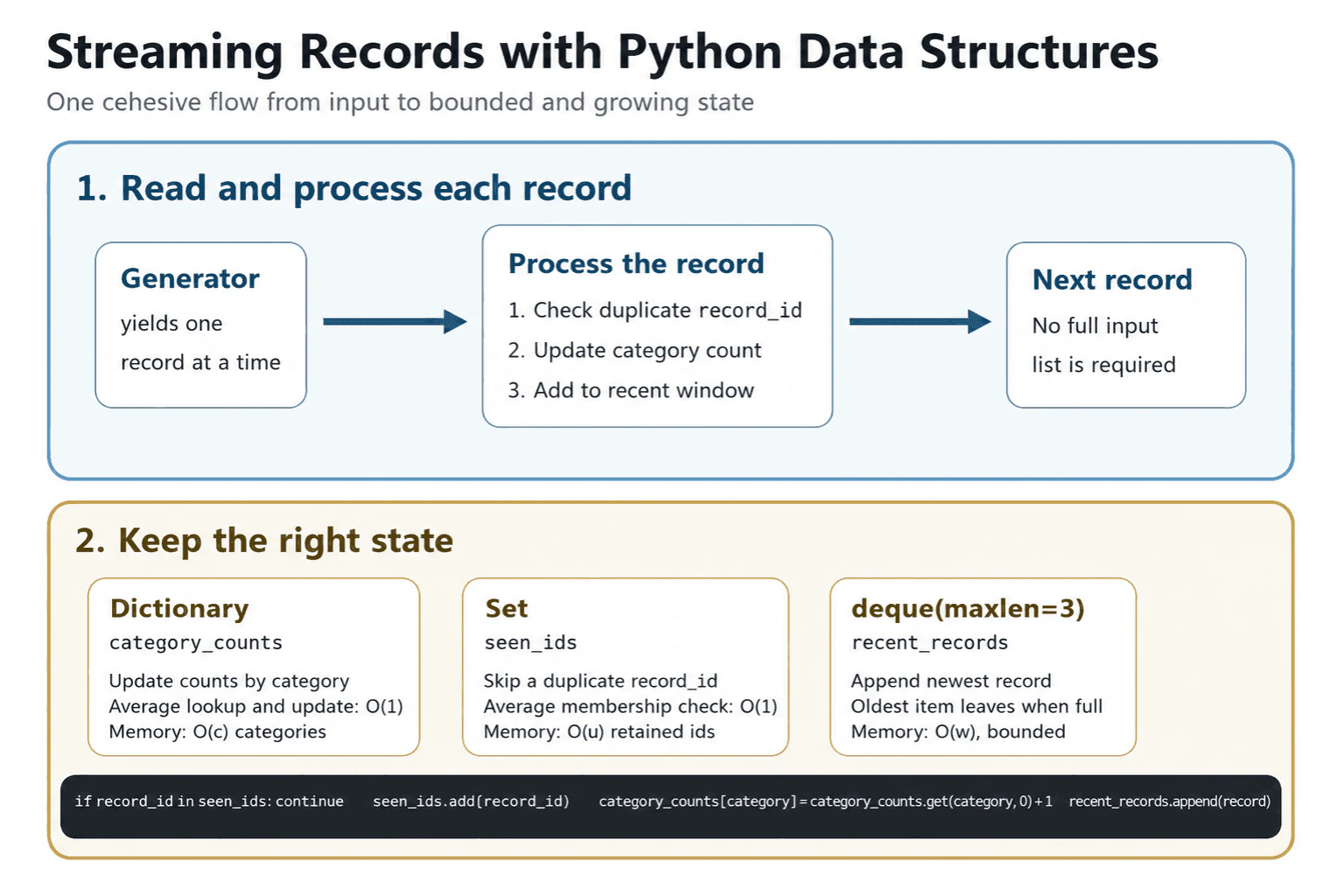
I would consume the stream through an iterator or generator, keep running counts in a dictionary, use a set for duplicate checks, and store the recent window in a deque with a fixed maximum length. This processes records one at a time instead of loading the full stream. The deque stays bounded, but the dictionary and set can still grow as new categories and record identifiers arrive.
I would process each record as it arrives instead of first building a list. An iterator or generator supplies one record at a time, so the consumer does not need to retain the complete input. This saves memory only when the upstream source also produces records incrementally.
Useful Questions to Ask the Interviewer
Should I focus on Python language behavior, or also explain the runtime and standard library?
Which Python version and execution environment should I assume?
Would you like a small code example together with production tradeoffs and edge cases?
I would use a dictionary for running counts by category. Dictionary lookup and update are usually constant time. I would use a set for duplicate identifiers because membership checks are also usually constant time. These are average costs, not strict guarantees. An unusual hash collision pattern can make an operation slower.
For a recent record window, I would use collections.deque with maxlen. Appending is constant time. When the deque is full, appending a new record automatically removes the oldest record. Its memory is bounded by the chosen window size.
The dictionary grows with the number of distinct categories. The set grows with the number of retained identifiers. For an endless stream, I would add expiry rules, periodic cleanup, or external state storage. I would also define how to handle malformed records, missing keys, and identifiers that arrive again after their expiry period.
Example
The example reads records from a generator. Each record contains a record identifier and a category. The seen_ids set skips an identifier that was already accepted. The category_counts dictionary stores the running count for each category. The recent_records deque has maxlen set to three, so it stores only the three most recent accepted records. Four unique records are accepted and one repeated identifier is skipped. The final counts are payment two, search one, and order one. The final recent window contains record identifiers two, three, and four. Processing n records takes O(n) expected time. The dictionary uses O(c) memory for c categories. The set uses O(u) memory for u retained unique identifiers. The deque and the final list copy use O(w) memory for window size w, which is three in this example.
Code
from collections import deque
from collections.abc import Iterable, Iterator
from typing import TypedDict
classRecord(TypedDict):
record_id: int
category: strdefincoming_records() -> Iterator[Record]:
# Yield one record at a time instead of building a complete input list.yield {"record_id": 1, "category": "payment"}
yield {"record_id": 2, "category": "search"}
yield {"record_id": 3, "category": "payment"}
yield {"record_id": 2, "category": "search"}
yield {"record_id": 4, "category": "order"}
defprocess_stream(
records: Iterable[Record],
) -> tuple[dict[str, int], list[Record]]:
# Keep identifiers that have already been accepted.# This set can grow unless the application removes old identifiers.
seen_ids: set[int] = set()
# Keep a running count for each category.# This dictionary grows when new categories appear.
category_counts: dict[str, int] = {}
# Keep only the three most recent accepted records.# The deque automatically removes the oldest record when it is full.
recent_records: deque[Record] = deque(maxlen=3)
# Consume the input incrementally.for record in records:
record_id = record["record_id"]
# Skip an identifier that has already been accepted.if record_id in seen_ids:
continue# Retain the identifier for later duplicate checks.
seen_ids.add(record_id)
# Update the running count for this category.
category = record["category"]
category_counts[category] = category_counts.get(category, 0) + 1# Add the accepted record to the bounded recent window.
recent_records.append(record)
# Create a small list copy so the result is simple to print and inspect.return category_counts, list(recent_records)
defmain() -> None:
counts, recent = process_stream(incoming_records())
print("Counts:", counts)
print("Recent records:", recent)
if __name__ == "__main__":
main()
Where it is used
This pattern is used in log consumers, message queue workers, transaction monitoring, request metrics, sensor processing, and event pipelines. The iterator supplies records incrementally. The dictionary stores totals by category. The set prevents a retained identifier from being processed twice. The bounded deque keeps a recent window for local analysis. In a long running service, identifier expiry and inactive category cleanup are needed when the retained state must not grow forever.
Why Interviewers Ask This
Interviewers ask this question to check whether a candidate can match each streaming operation to the right Python data structure. They evaluate knowledge of iterators, generators, dictionaries, sets, and deque behavior. They also want to see whether the candidate understands average lookup cost, bounded and unbounded state, allocation behavior, and the risk of memory growth in a long running process.
Common interview mistakes
A common mistake is converting the incoming stream to a list, which stores every record before processing begins. Another mistake is using a list for duplicate checks. List membership scans elements and takes linear time, while set membership is usually constant time. Some candidates assume that maxlen bounds the memory of the whole process, but it bounds only the deque. The dictionary and set may still grow. It is also incorrect to say that dictionary and set operations are always constant time. Their expected behavior is constant time, but worst case operations can be linear. Another mistake is removing the first element of a list for every new record, because Python must shift the remaining references.
Interview tip
Start with the operation, then name the structure. Use an iterator for incremental input, a dictionary for keyed state, a set for membership checks, and a bounded deque for the recent window. State clearly which structures have bounded memory and which structures require cleanup.
Interviewer may ask next
What happens when the deque reaches its maximum length?
Appending a new item automatically removes the oldest item when the deque is already at maxlen. In this example, the deque always keeps only the three most recent accepted records. This gives the recent window O(w) bounded memory for window size w. The tradeoff is that an evicted record is no longer available from the deque, although another object may still hold a reference to it.
How would you control memory growth in the set and dictionary?
I would remove identifiers and inactive category state according to an explicit retention rule, or move durable state to an external store. The set currently retains every accepted identifier, so its memory grows with the number of unique identifiers. The dictionary grows with the number of distinct categories. Expiry reduces memory, but an identifier that returns after expiry may be accepted again. External storage supports larger state, but it adds network cost, failure handling, and consistency decisions.
2. Count Employees at Each Open Office in PythonLanguage SpecificEasyMeta
i Question Details
Given Python dictionaries representing offices and a set of closed office IDs, return a dictionary mapping each open office ID to its employee count.
Short Interview Answer (30-60 seconds)
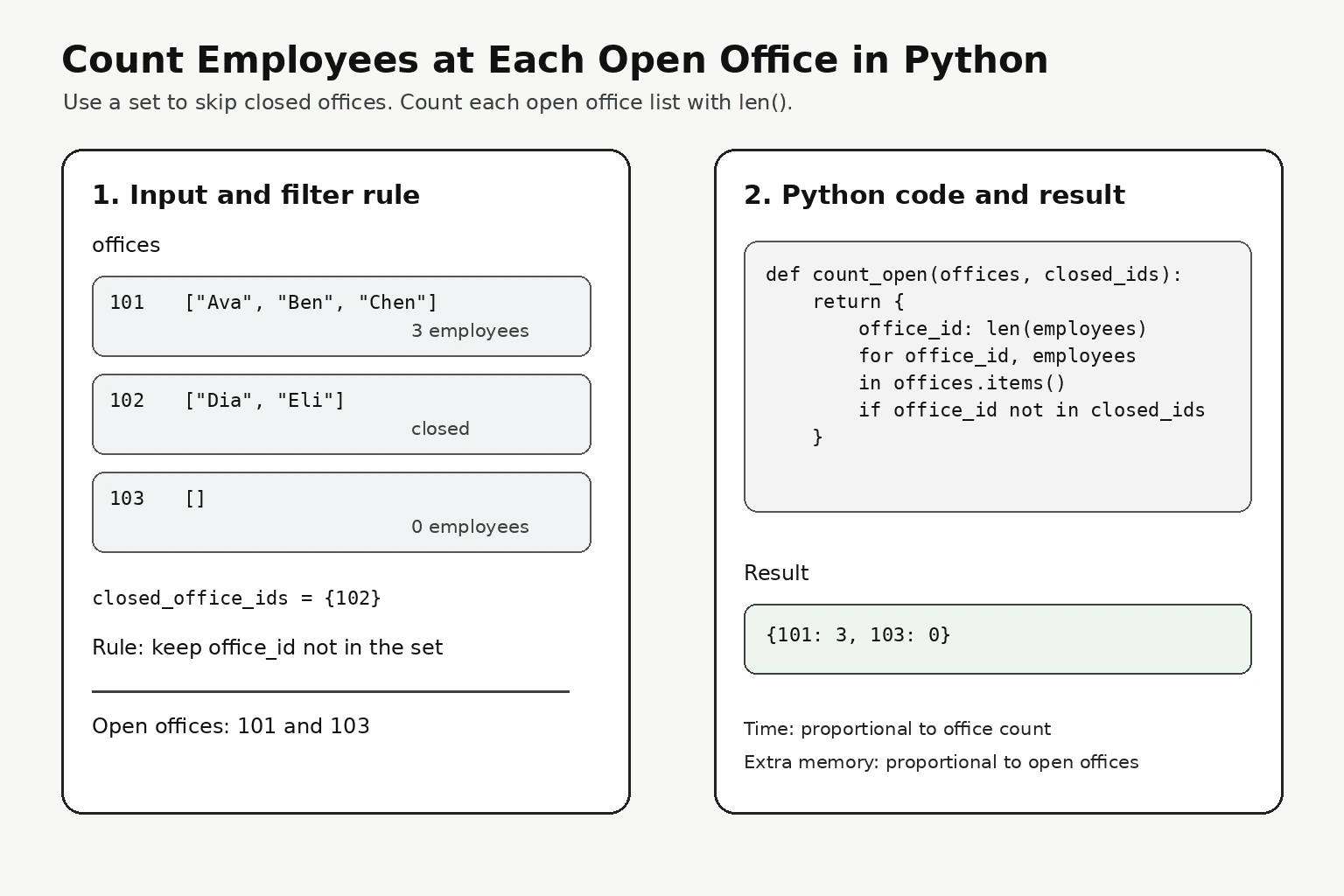
I would iterate through the offices dictionary and create a new dictionary for offices whose IDs are not in the closed office set. For each open office, I would use len on its employee list. Using a set makes each closed office check take average constant time.
The practical solution is to create a new dictionary that contains only open offices. The code iterates through offices.items(), which gives each office ID and its employee list. It checks whether the office ID is absent from closed_office_ids. If the office is open, len(employees) gives the number of employees in that list. An open office with an empty list is included with a count of zero. A closed office is not included at all. The solution assumes every office value is a list of employees and every office ID is hashable. Integer office IDs satisfy that requirement. Python sets use hashing, so membership checks take average constant time. The function visits each office once, so its average running time is proportional to the number of offices. It creates a new result dictionary, so extra memory is proportional to the number of open offices. The original offices dictionary and its employee lists are not copied or changed. In production, invalid values such as None should be rejected or normalized before calling this function because len(None) raises TypeError.
Useful Questions to Ask the Interviewer
Should I focus on Python language behavior, or also explain the runtime and standard library?
Which Python version and execution environment should I assume?
Would you like a small code example together with production tradeoffs and edge cases?
Example
The function reads each office ID and employee list from the offices dictionary. It excludes office IDs found in the closed office set. For every remaining office, it stores len(employees) in a new dictionary. In the example, office 102 is closed, office 101 has three employees, and office 103 has an empty employee list. The returned result is {101: 3, 103: 0}. The input dictionary and employee lists are not modified.
Code
defcount_employees_at_open_offices(
offices: dict[int, list[str]], closed_office_ids: set[int]
) -> dict[int, int]:
# Build a new dictionary that contains only open offices.# len returns the number of names in each employee list.return {
office_id: len(employees)
for office_id, employees in offices.items()
if office_id notin closed_office_ids
}
# Each office ID maps to a list of employee names.
offices = {101: ["Ava", "Ben", "Chen"], 102: ["Dia", "Eli"], 103: []}
# Office 102 is closed and must be excluded.
closed_office_ids = {102}
# Count employees only at open offices.
result = count_employees_at_open_offices(offices, closed_office_ids)
# Expected output: {101: 3, 103: 0}print(result)
Where it is used
This pattern is useful when building office staffing summaries, workforce dashboards, scheduling services, location based reports, and API responses. It filters inactive locations and returns a small dictionary that can be serialized as JSON after any required key conversion.
Why Interviewers Ask This
Interviewers ask this question to check whether a candidate can combine Python dictionaries, sets, iteration, membership tests, and len in a small correct function. It also tests whether the candidate can define input assumptions, preserve the original data, handle empty employee lists, and explain time and memory costs.
Common interview mistakes
Common mistakes include returning closed offices with a count of zero instead of excluding them, using the number of office IDs instead of the length of each employee list, using a list for closed office membership when a set is available, changing the original dictionary during iteration, and passing None or another value that does not support len.
Interview tip
State the filtering rule first. Then explain that the set provides average constant time membership checks, len counts each employee list, open offices with empty lists return zero, and the function creates a new dictionary without changing the input.
Interviewer may ask next
What happens if an open office has an empty employee list?
It is included with a count of zero. len on an empty list returns zero, and the office passes the open office check. This matters because an open office with no employees is different from a closed office, which is excluded.
What are the time and memory costs of this solution?
The average running time is proportional to the number of offices because the function visits each office once and set membership is average constant time. Extra memory is proportional to the number of open offices because the function creates one result entry for each open office. It does not copy the employee lists, so the result stores only office IDs and integer counts.
3. Validate Open and Close Log Entries in PythonLanguage SpecificEasyMeta
i Question Details
Given tuples of OPEN or CLOSE and resource IDs, use Python data structures to reject close-before-open, duplicate opens, and resources left open.
Short Interview Answer (30-60 seconds)
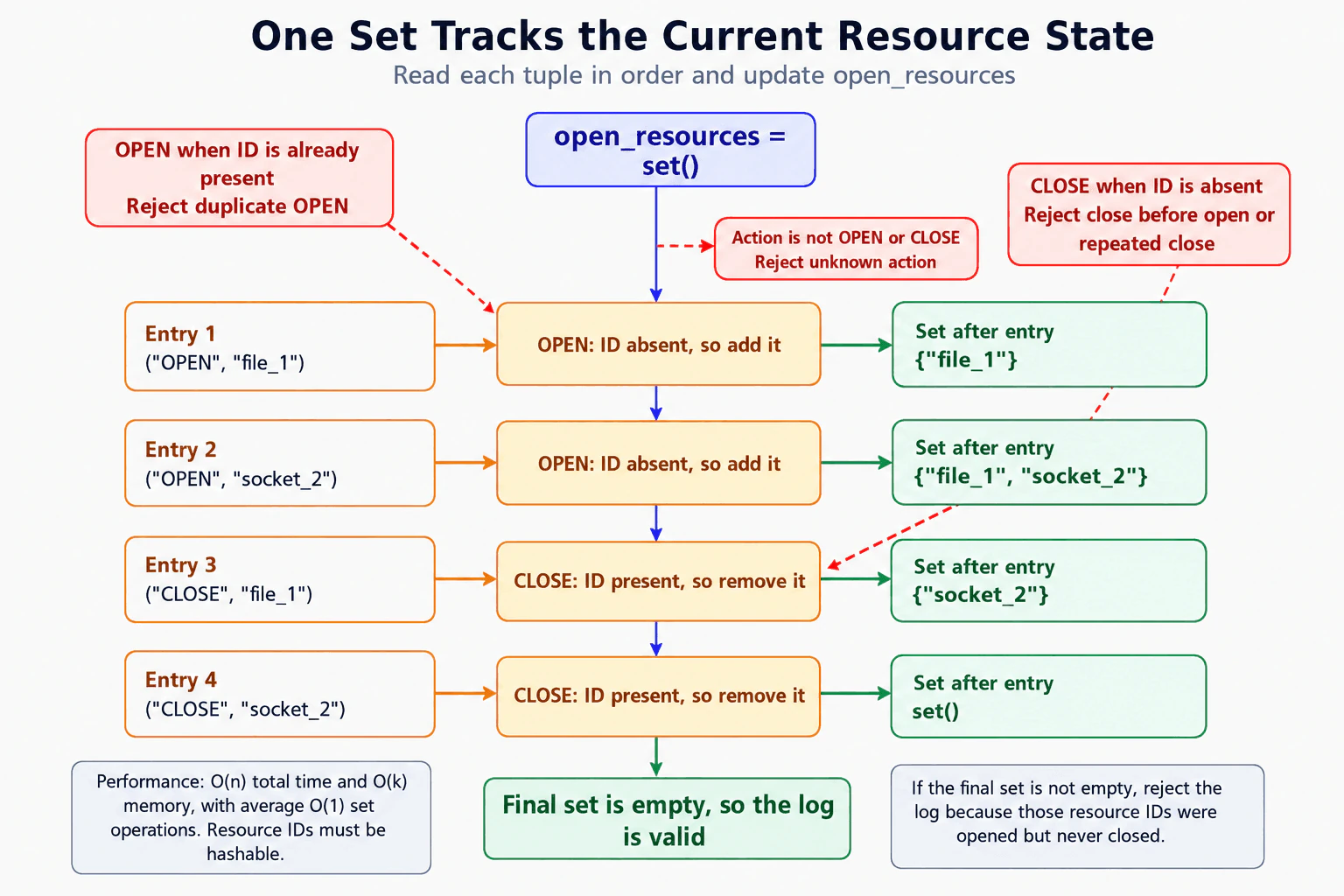
I would scan the entries once and keep the currently open resource IDs in a Python set. For OPEN, I reject the entry if the ID is already present. For CLOSE, I reject it if the ID is absent. After processing every entry, the set must be empty, or some resources were left open. This directly detects close before open, duplicate opens, repeated closes, and unfinished resources.
Use a Python set to store the resource IDs that are currently open. Process the tuples from first to last because event order matters. For an OPEN entry, reject the log if the resource ID is already in the set. That means the same resource was opened twice without a matching close. Otherwise, add the ID. For a CLOSE entry, reject the log if the ID is not in the set. That means the resource was closed before it was opened, or it was closed more than once. Otherwise, remove the ID. Reject any action other than OPEN or CLOSE. After the scan, the set must be empty. Any remaining IDs represent resources that were opened but never closed. Python sets are appropriate because membership, insertion, and removal take constant time on average. The complete scan takes linear time. Memory grows with the largest number of resources open at the same time. Resource IDs must be hashable so Python can store them in a set. In production, returning the entry position, resource ID, and failure reason makes invalid logs easier to investigate.
Useful Questions to Ask the Interviewer
Should I focus on Python language behavior, or also explain the runtime and standard library?
Which Python version and execution environment should I assume?
Would you like a small code example together with production tradeoffs and edge cases?
Example
The function keeps one set named open_resources. It reads each tuple in order. OPEN adds a resource ID only when that ID is not already open. CLOSE removes a resource ID only when that ID is currently open. An unsupported action is rejected because it does not match the required log format. After all entries are processed, any IDs still in the set are reported as resources left open. The function returns a boolean and a clear message so the caller can identify the exact validation failure.
Code
from collections.abc import Hashable, Iterable
defvalidate_resource_log(
entries: Iterable[tuple[str, Hashable]],
) -> tuple[bool, str]:
"""Validate ordered OPEN and CLOSE entries for resource IDs."""# Keep only resource IDs that are currently open.
open_resources: set[Hashable] = set()
# Read entries in order because event order affects validity.for position, entry inenumerate(entries):
# The question defines each entry as a tuple with two values.ifnotisinstance(entry, tuple) orlen(entry) != 2:
return (
False,
f"Invalid entry at position {position}: expected a tuple with two values",
)
action, resource_id = entry
# A set requires every stored resource ID to be hashable.ifnotisinstance(resource_id, Hashable):
return (
False,
f"Unhashable resource ID at position {position}: {resource_id!r}",
)
if action == "OPEN":
# An ID already in the set has been opened twice.if resource_id in open_resources:
return (
False,
f"Duplicate OPEN for resource {resource_id!r} at position {position}",
)
# Mark the resource as currently open.
open_resources.add(resource_id)
elif action == "CLOSE":
# A missing ID means there is no active matching OPEN.if resource_id notin open_resources:
return (
False,
f"CLOSE without matching OPEN for resource {resource_id!r} at position {position}",
)
# Remove the ID because its lifecycle is now complete.
open_resources.remove(resource_id)
else:
# Reject actions outside the required OPEN and CLOSE format.returnFalse, f"Unknown action {action!r} at position {position}"# Any remaining IDs were opened but never closed.if open_resources:
remaining = sorted(repr(resource_id) for resource_id in open_resources)
returnFalse, f"Resources left open: {', '.join(remaining)}"returnTrue, "Log is valid"if __name__ == "__main__":
valid_entries = [
("OPEN", "file_1"),
("OPEN", "socket_2"),
("CLOSE", "file_1"),
("CLOSE", "socket_2"),
]
duplicate_open_entries = [
("OPEN", "file_1"),
("OPEN", "file_1"),
]
close_before_open_entries = [
("CLOSE", "file_1"),
]
left_open_entries = [
("OPEN", "file_1"),
]
print(validate_resource_log(valid_entries))
print(validate_resource_log(duplicate_open_entries))
print(validate_resource_log(close_before_open_entries))
print(validate_resource_log(left_open_entries))
Where it is used
This pattern is used to validate file handle logs, database connection events, session start and end records, lock acquisition and release events, transaction boundaries, and other resource lifecycle logs. It is useful when every resource must be opened before it is closed and no resource may remain open after processing.
Why Interviewers Ask This
Interviewers ask this question to test whether a candidate can choose a suitable Python data structure for tracking changing state. It evaluates set membership knowledge, ordered event processing, duplicate detection, input validation, complexity analysis, and the ability to explain why equal event counts alone do not prove that a log is valid.
Common interview mistakes
A common mistake is using a list, which makes membership checks slower as the number of open resources grows. Another mistake is checking only whether the total OPEN and CLOSE counts are equal. Equal counts do not prove that events are ordered correctly or matched by resource ID. Candidates may also forget that a second CLOSE is invalid after the first CLOSE removes the ID. Another mistake is returning success without checking whether the set is empty at the end. Resource IDs must also be hashable because Python set elements require a hash value.
Interview tip
State the three required checks first. Explain that one set represents the resources currently open. Then show that OPEN adds, CLOSE removes, and the final empty set check finds unfinished resources. Finish by stating linear total time, average constant time set operations, and memory based on the maximum number of resources open at once.
Interviewer may ask next
What happens if the same resource is closed twice?
The second CLOSE is rejected. The first CLOSE removes the resource ID from the set. When the second CLOSE is processed, the ID is absent, so there is no active matching OPEN. This matters because the same check detects both close before open and repeated close events.
How would you process a very large log without loading it all into memory?
I would pass an iterator or generator to the same single scan validator. Entries can then be read one at a time, so the complete log does not need to be stored in memory. The set of currently open resource IDs must still remain in memory. The tradeoff is that memory depends on the maximum number of resources open at once, not on the total number of log entries.
4. Find the Most Common Comment Across Shop Locations in PythonLanguage SpecificEasyMeta
i Question Details
Given comments grouped by shop, ignore duplicates within the same shop and return any comment appearing in the most distinct shops.
Short Interview Answer (30-60 seconds)
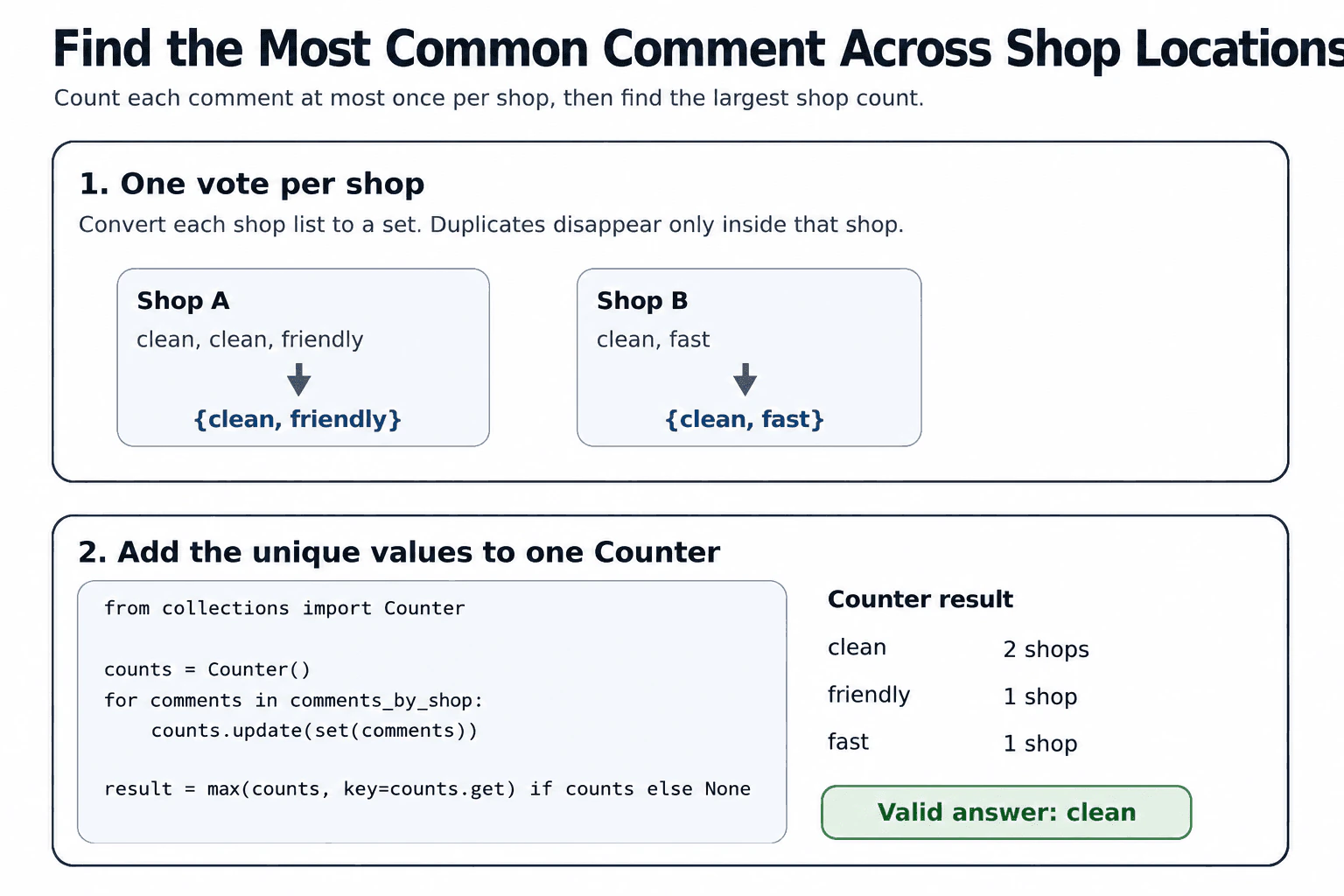
I would convert each shop's comments to a set and update one Counter with those unique comments. This gives each comment at most one count per shop. I would then return any comment with the highest count. If no shop contains a comment, I would return None.
Use a set for each shop, then count those unique values with collections.Counter. A set removes repeated comments inside one shop. This matters because the goal is to count distinct shops, not total comment entries.
Useful Questions to Ask the Interviewer
Should I focus on Python language behavior, or also explain the runtime and standard library?
Which Python version and execution environment should I assume?
Would you like a small code example together with production tradeoffs and edge cases?
For example, Shop A contains clean, clean, and friendly. Shop B contains clean and fast. Shop A contributes one count for clean and one for friendly. Shop B contributes one count for clean and one for fast. The final counts are clean two, friendly one, and fast one, so the function returns clean.
Python sets and Counter use hashing for membership and counting. The comments must therefore be hashable. Strings are hashable and work well here. If no comments exist, there is no valid result, so the function returns None. If several comments share the highest count, returning any one of them satisfies the question.
The code examines every input comment once on average. Its average time cost is O(n), where n is the total number of comment entries. Its extra memory cost is O(u), where u is the total number of distinct comments.
Example
The function creates one Counter for all shops. For each shop, set(comments) creates a temporary set that contains each comment once. Counter.update then adds one count for every unique comment from that shop. After all shops are processed, max with shop_counts.get returns a comment whose count is highest. The function returns None when the Counter is empty. In the example, clean appears in Shop A and Shop B, so the result is clean.
Code
from collections import Counter
from typing import Iterable, Optionaldefmost_common_comment(
comments_by_shop: Iterable[Iterable[str]],
) -> Optional[str]:
"""Return any comment that appears in the most distinct shops."""# Count how many different shops contain each comment.
shop_counts: Counter[str] = Counter()
# Process one shop at a time.for comments in comments_by_shop:
# Remove repeated comments within this shop.
unique_comments = set(comments)
# Add one count for each unique comment from this shop.
shop_counts.update(unique_comments)
# No comment can win when every shop is empty.ifnot shop_counts:
returnNone# Return any comment with the largest shop count.returnmax(shop_counts, key=shop_counts.get)
if __name__ == "__main__":
shops = [
["clean", "clean", "friendly"],
["clean", "fast"],
]
result = most_common_comment(shops)
print(result) # clean
Where it is used
This pattern is useful when each source should contribute at most one vote for each value. Examples include finding the complaint reported by the most branches, the feature requested by the most customer accounts, or the error code seen on the most servers. Each shop or source can be processed separately, so the full input does not need to be stored in memory at once.
Why Interviewers Ask This
Interviewers ask this question to test whether a candidate can choose Python data structures that match an exact counting rule. The candidate must recognize that repeated comments inside one shop count once, while the same comment in another shop adds another count. It also tests knowledge of sets, Counter, hashable values, empty input, tie behavior, and the cost of temporary collections.
Common interview mistakes
A common mistake is updating the Counter with each original shop list. That makes duplicate comments inside one shop count several times. Another mistake is creating one set from all shops, because that removes the information about how many distinct shops contained each comment. Candidates may also forget to define the result for empty input. Another mistake is promising a specific winner during a tie even though the question allows any tied comment.
Interview tip
State the counting rule first: one count per comment per shop. Then explain that a set enforces the rule inside each shop and a Counter combines the counts across shops. Mention empty input, ties, hashable comments, average O(n) time, and O(u) extra memory.
Interviewer may ask next
What happens when two comments appear in the same maximum number of shops?
Either tied comment may be returned. The exact behavior is that max selects one key whose Counter value is highest. This matters because the original question allows any comment with the maximum shop count. The code does not guarantee which tied value wins because each shop is converted to a set, and set iteration order should not be used as a business rule. If production requirements need deterministic tie handling, the final selection rule must explicitly define it.
How does this approach behave when the input is very large?
It processes every comment once on average, so the average time cost remains O(n). The main tradeoff is memory for the global Counter and the temporary set for the current shop. Processing shops from an iterator avoids storing every shop at once. However, the Counter must still keep one entry for every distinct comment seen across all shops, so memory remains O(u).
5. Implement a Timed Python Function and Explain Its Edge CasesLanguage SpecificEasyMeta
i Question Details
Implement a small Python function in a few minutes, state clarifying questions, enumerate edge cases, and outline tests and complexity.
Short Interview Answer (30-60 seconds)
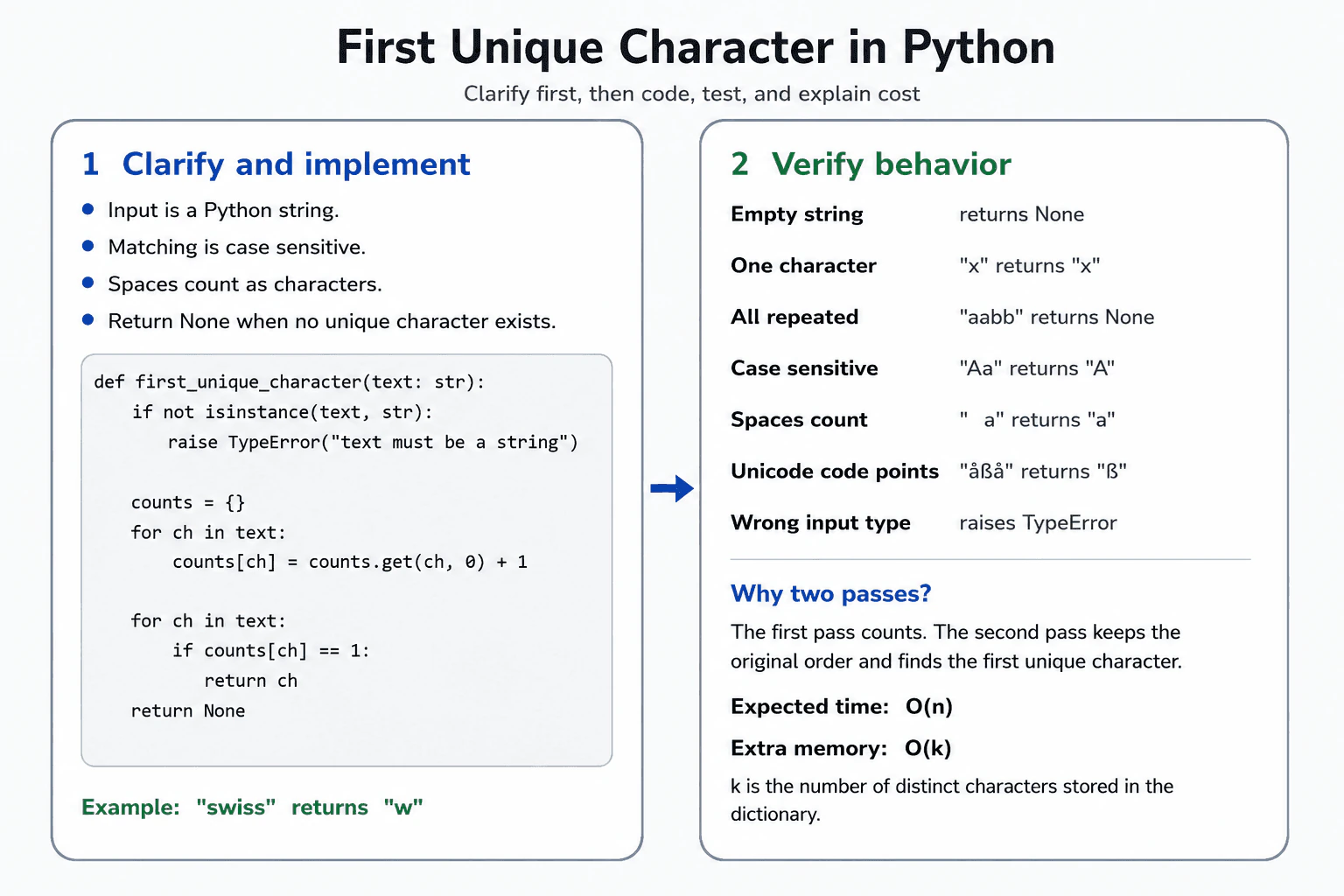
I would first confirm the input type, expected result, case rules, treatment of spaces, and behavior when no answer exists. I will assume the function must return the first character that appears exactly once in a string. I would count characters with a dictionary, then scan the original string again to preserve order. The function returns None when the string is empty or every character is repeated, and it raises TypeError for a non string input.
I will assume the function receives a Python string and returns the first character that appears exactly once. Before coding, I would ask whether matching is case sensitive, whether spaces count, what to return when no unique character exists, and how invalid input should be handled. In this implementation, matching is case sensitive, every string character counts, no result returns None, and a non string value raises TypeError.
Useful Questions to Ask the Interviewer
Should I focus on Python language behavior, or also explain the runtime and standard library?
Which Python version and execution environment should I assume?
Would you like a small code example together with production tradeoffs and edge cases?
The first loop counts each character in a dictionary. The second loop reads the original string in order and returns the first character whose count is one. Two loops are needed because the result depends on both frequency and original position.
An empty string returns None. A one character string returns that character. The string aabb returns None. Spaces, newline characters, and Unicode code points are treated like other characters. Python strings contain Unicode code points, so a visible symbol made from multiple code points may be processed as multiple characters.
The expected time cost is O n because the function scans the string twice. Extra memory is O k, where k is the number of distinct characters. Production code should document these rules and test invalid, empty, repeated, case sensitive, whitespace, and Unicode input.
Example
The function first checks that the input is a string. It then stores the frequency of each character in a dictionary. A second loop scans the original string so the original order is preserved. The first character with a count of one is returned. If the string is empty or every character is repeated, the function returns None. The expected time cost is O n because there are two full scans. The extra memory cost is O k, where k is the number of distinct characters stored in the dictionary.
Code
deffirst_unique_character(text: str) -> str | None:
"""Return the first character that appears exactly once."""# Enforce the documented input contract.ifnotisinstance(text, str):
raise TypeError("text must be a string")
# Count how many times each character appears.
counts: dict[str, int] = {}
for character in text:
counts[character] = counts.get(character, 0) + 1# Scan the original string to preserve character order.for character in text:
if counts[character] == 1:
return character
# No unique character exists.returnNoneif __name__ == "__main__":
# Normal case. The first unique character is w.assert first_unique_character("swiss") == "w"# Every character is repeated.assert first_unique_character("aabb") isNone# Empty input has no unique character.assert first_unique_character("") isNone# A single character is unique.assert first_unique_character("x") == "x"# Matching is case sensitive.assert first_unique_character("Aa") == "A"# Spaces count as characters. The first unique character is a.assert first_unique_character(" a") == "a"# Unicode code points are supported as dictionary keys.assert first_unique_character("åßå") == "ß"# Invalid input raises TypeError.try:
first_unique_character(123)
except TypeError:
passelse:
raise AssertionError("Expected TypeError for non string input")
print("All tests passed")
Where it is used
This pattern is useful in text validation, log analysis, identifier inspection, data cleaning, and ordered frequency checks. The same two pass method can be adapted to a list when every list element is hashable and the required result is the first value that occurs once.
Why Interviewers Ask This
Interviewers ask this question to test whether a candidate can clarify an incomplete requirement, choose suitable Python data structures, write correct code under time pressure, identify boundary cases, design useful tests, and explain time and memory costs from the actual implementation.
Common interview mistakes
Common mistakes include returning any unique character instead of the first one, calling text.count inside a loop and repeatedly scanning the full string, using a set and losing the required order, ignoring empty input, changing letter case without permission, removing spaces without permission, returning different no result values in different cases, and claiming constant memory even though the dictionary can store one entry for every distinct character.
Interview tip
State the assumptions before writing code. Then explain why one pass counts frequencies and the second pass preserves order. Finish with boundary cases, expected O n time, O k extra memory, and a few focused tests.
Interviewer may ask next
How does the function handle a visible Unicode symbol made from multiple code points?
It processes each Unicode code point separately because Python iterates through a string by code point, not by user perceived character. This matters for symbols that combine multiple code points, such as some accented text or emoji sequences. Supporting complete user perceived characters would require Unicode grapheme segmentation, which adds complexity and usually needs a dedicated Unicode aware library.
Could the function use less extra memory for a restricted character set?
Yes. If the input is guaranteed to contain only a small fixed character set, a fixed size count array can replace the dictionary. This change gives predictable memory use and may reduce allocation overhead. The tradeoff is that it depends on a strict input contract and does not support general Unicode strings as naturally as the dictionary solution.
6. Implement Maximum Non-Adjacent Sum in PythonLanguage SpecificMediumMeta
i Question Details
Given non-negative scores, implement a Python function returning the maximum total obtainable without choosing adjacent elements.
Short Interview Answer (30-60 seconds)
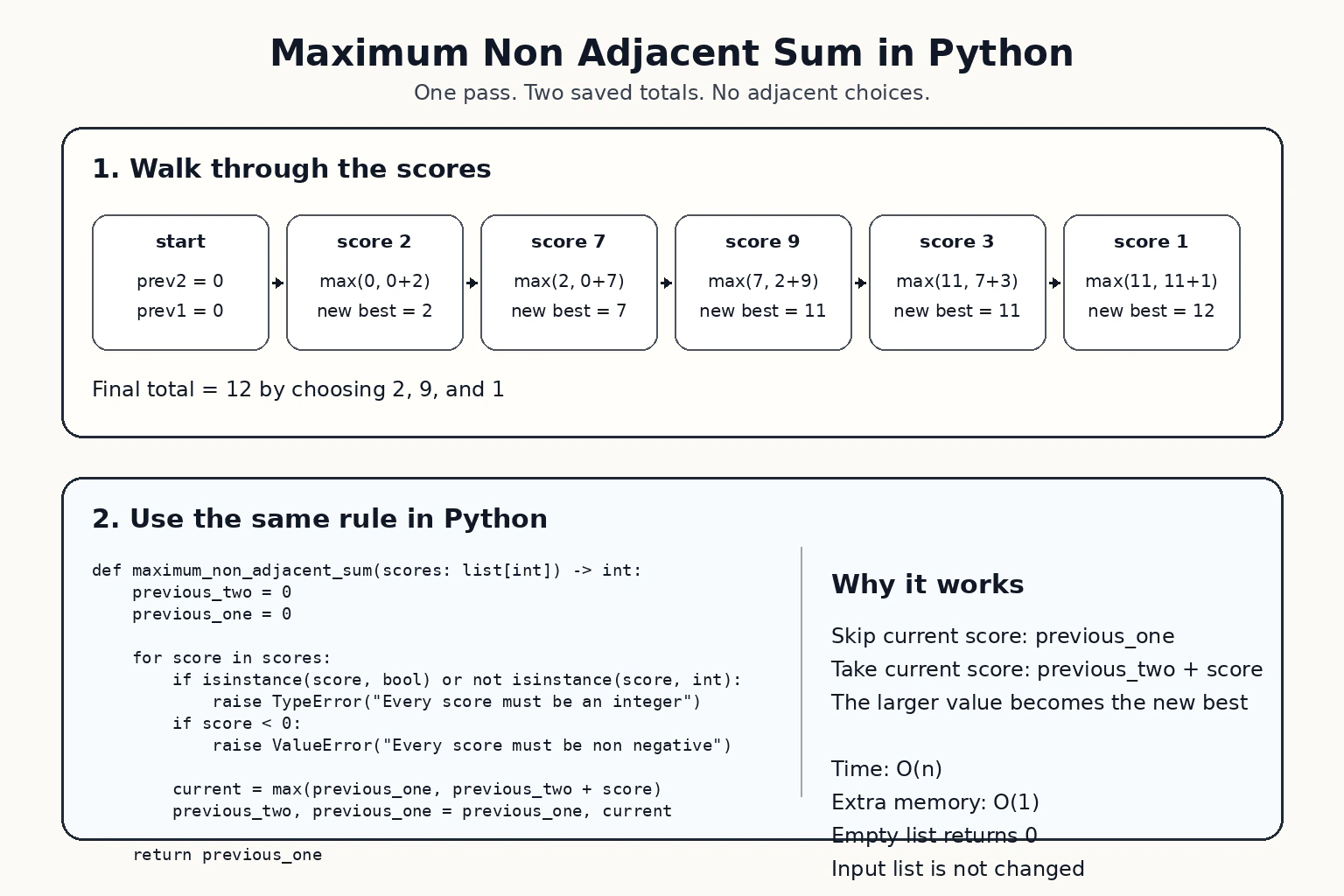
I would scan the scores once and keep two running totals. For each score, I either skip it and keep the current best total, or select it and add it to the best total from before the adjacent position. I keep the larger result. This takes linear time, uses constant auxiliary memory, and does not modify the input list.
The practical solution uses dynamic programming with two variables. Dynamic programming means reusing results from smaller parts of the problem. Let previous_two store the best total before the previous position. Let previous_one store the best total through the previous position.
Useful Questions to Ask the Interviewer
Should I focus on Python language behavior, or also explain the runtime and standard library?
Which Python version and execution environment should I assume?
Would you like a small code example together with production tradeoffs and edge cases?
For each score, there are two valid choices. We can skip it, so the total remains previous_one. Or we can select it and add it to previous_two, because selecting the previous score would break the adjacency rule. The larger value becomes the new best total.
For [2, 7, 9, 3, 1], the function returns 12 by selecting 2, 9, and 1. An empty list returns 0. A list with one score returns that score. The input must contain non negative integers, so the implementation rejects negative values, Boolean values, and other types.
The loop reads every score once. It does not copy or modify the list. It uses constant auxiliary memory because it stores only two running totals. Python integers can grow as totals increase, so very large integers require additional processing time and storage even though the number of stored totals remains constant.
Example
The function keeps two earlier results. previous_two is the best total available before the previous position. previous_one is the best total through the previous position. For each score, the function compares skipping the score with selecting it and adding it to previous_two. It then moves the saved totals forward. For [2, 7, 9, 3, 1], it returns 12. The function performs one loop over the list, takes linear time, uses constant auxiliary memory, and leaves the input unchanged.
Code
defmaximum_non_adjacent_sum(scores: list[int]) -> int:
"""Return the largest total formed without selecting adjacent scores."""# This is the best total before the previous position.
previous_two = 0# This is the best total through the previous position.
previous_one = 0# Read every score once without copying or changing the list.for score in scores:
# Boolean is a subclass of int in Python, so reject it explicitly.ifisinstance(score, bool) ornotisinstance(score, int):
raise TypeError("Every score must be an integer")
# The question states that all scores are non negative.if score < 0:
raise ValueError("Every score must be non negative")
# Either skip this score or select it with a valid earlier total.
current = max(previous_one, previous_two + score)
# Move both saved results forward for the next position.
previous_two = previous_one
previous_one = current
# An empty list returns zero because both totals start at zero.return previous_one
if __name__ == "__main__":
example_scores = [2, 7, 9, 3, 1]
result = maximum_non_adjacent_sum(example_scores)
print(result) # 12
Where it is used
This pattern is useful when valuable choices conflict with immediately neighboring choices. Examples include selecting promotions that cannot run in consecutive time slots, choosing maintenance periods that require a gap, or maximizing rewards when adjacent actions cannot both be accepted. In production code, the input contract should clearly state that scores must be non negative integers and that selecting no elements is allowed for an empty input.
Why Interviewers Ask This
Interviewers ask this question to test whether a candidate can express a dynamic programming recurrence in clear Python code. It evaluates list iteration, variable update order, edge case handling, input validation, and the ability to reduce memory use when only two earlier results are needed.
Common interview mistakes
A common mistake is selecting large scores without checking whether their positions are adjacent. Another mistake is changing previous_two before calculating the current result, which removes a value still needed for the decision. Some candidates create a full result list even though only two earlier totals are required. Other mistakes include returning the largest single score, failing to handle an empty list, modifying the input, or silently accepting values that violate the non negative integer contract.
Interview tip
Start by stating the two choices for each score. Either skip it or select it with the best total from before the adjacent position. Then define both running variables, walk through [2, 7, 9, 3, 1], and finish by stating linear time and constant auxiliary memory.
Interviewer may ask next
What changes if negative scores are allowed?
The same recurrence works when selecting no elements is allowed, because the totals start at zero and negative scores can be skipped. An input containing only negative values would return zero. If at least one score must be selected, the initialization and empty input behavior must change so the result can be the largest negative score. This distinction matters because zero would otherwise represent an invalid empty selection.
How would you return the selected positions as well as the total?
The implementation must store decision information for each position so it can reconstruct the selected positions after computing the maximum total. One common method stores the best total at every position and then walks backward to determine whether each score was selected. The running time remains linear, but auxiliary memory increases from constant space to linear space because the earlier decisions must be retained.
7. Implement a Sparse Vector in PythonLanguage SpecificMediumMeta
i Question Details
Represent a sparse vector using Python containers and compute a dot product efficiently without iterating through all zero positions.
Short Interview Answer (30-60 seconds)
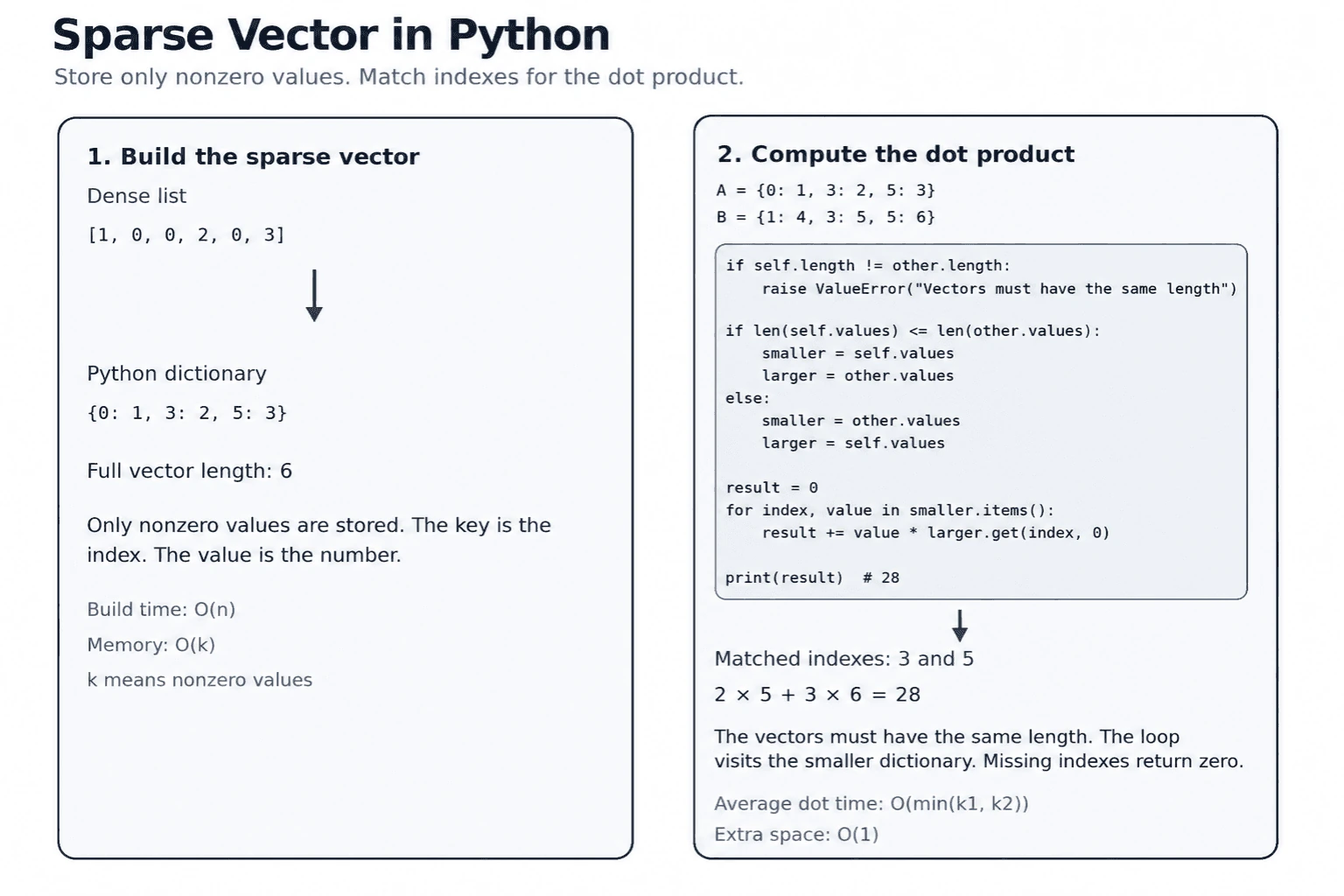
I would store only nonzero values in a Python dictionary, with each index as the key. For the dot product, I would iterate through the dictionary with fewer stored entries and look up the same indexes in the other dictionary. This avoids scanning every zero position, so the dot product depends on the smaller number of nonzero entries rather than the full vector length.
I would represent each sparse vector with a dictionary that maps an index to its nonzero value. Zero values are not stored. The object also keeps the full vector length so it can reject a dot product between vectors with different dimensions.
Useful Questions to Ask the Interviewer
Should I focus on Python language behavior, or also explain the runtime and standard library?
Which Python version and execution environment should I assume?
Would you like a small code example together with production tradeoffs and edge cases?
To compute the dot product, I choose the dictionary with fewer entries. For each stored index and value, I call get on the other dictionary. If that index is absent, get returns zero, so the position contributes nothing. Otherwise, I multiply the two values and add the product to the result.
Python dictionaries provide average constant time lookup. Therefore, the dot product takes average O(min(k1, k2)) time, where k1 and k2 are the numbers of stored entries. It uses O(1) additional space. Building a vector from a dense list still takes O(n) time because every input value must be inspected, and the dictionary uses O(k) memory.
This design is useful when most positions are zero. For dense vectors, a list can have lower overhead and better sequential access. Production code should validate dimensions and choose numeric types that provide the required precision.
Example
The SparseVector class stores the full vector length and a dictionary containing only nonzero values. The dot method first verifies that both vectors have the same length. It then iterates through the dictionary with fewer entries and uses get to find the value at the same index in the other dictionary. A missing index contributes zero. Creating one vector from a dense list takes O(n) time and O(k) memory, where n is the full length and k is the number of nonzero values. The dot product takes average O(min(k1, k2)) time and O(1) additional space.
Code
from typing importList, Union
Number = Union[int, float]
classSparseVector:
def__init__(self, values: List[Number]) -> None:
# Store the full dimension for dot product validation.self.length = len(values)
# Keep only positions with nonzero values.self.values = {index: value for index, value inenumerate(values) if value != 0}
defdot(self, other: "SparseVector") -> Number:
# A dot product requires vectors with equal dimensions.ifself.length != other.length:
raise ValueError("Vectors must have the same length")
# Iterate through fewer stored entries to reduce dictionary lookups.iflen(self.values) <= len(other.values):
smaller = self.values
larger = other.values
else:
smaller = other.values
larger = self.values
result: Number = 0# An absent index represents zero and adds nothing to the result.for index, value in smaller.items():
result += value * larger.get(index, 0)
return result
# Example sparse vectors.
vector_a = SparseVector([1, 0, 0, 2, 0, 3])
vector_b = SparseVector([0, 4, 0, 5, 0, 6])
# The result is 1 times 0 plus 2 times 5 plus 3 times 6, which is 28.print(vector_a.dot(vector_b))
Where it is used
This representation is useful for document term counts, recommendation features, search ranking data, machine learning feature vectors, and user preference data where the possible dimension is large but each item contains only a small number of nonzero values.
Why Interviewers Ask This
Interviewers ask this question to test whether a candidate can choose an efficient Python container for sparse data. It evaluates dictionary usage, average lookup cost, iteration strategy, dimension validation, and the distinction between the full vector length and the number of stored nonzero values. It also tests whether the candidate can avoid scanning positions that cannot affect the result.
Common interview mistakes
Common mistakes include storing zero values in the dictionary, scanning the full vector length during every dot product, iterating through the larger dictionary without reason, and using direct dictionary indexing for positions that may be absent. Another mistake is failing to compare vector lengths, which can allow an invalid dot product to return a misleading result. Candidates should also avoid claiming worst case constant lookup because dictionary lookup is constant time only on average.
Interview tip
Start with the dictionary representation. Explain that missing indexes mean zero. Then describe why iterating through the smaller dictionary reduces work. Finish with dimension validation, construction cost, dot product cost, and memory cost.
Interviewer may ask next
What should happen if the two sparse vectors have different lengths?
The dot method should raise a ValueError before performing any multiplication. A dot product requires equal dimensions because every logical position in one vector must correspond to a position in the other vector. Ignoring the mismatch could return a number for an operation that is not valid.
When would a regular Python list be better than this dictionary representation?
A regular list is usually better when most positions are nonzero. In that case, the dictionary stores almost every index and adds hashing and object overhead without skipping much work. A list also provides compact sequential access. The dictionary representation is better when the vector is sparse enough that omitting zero positions saves meaningful memory and computation.
8. Implement a Sorted Iterator over K Python ListsLanguage SpecificMediumMeta
i Question Details
Create a Python iterator or class over k sorted lists with has-next and next behavior, preserving sorted output and bounded memory.
Short Interview Answer (30-60 seconds)
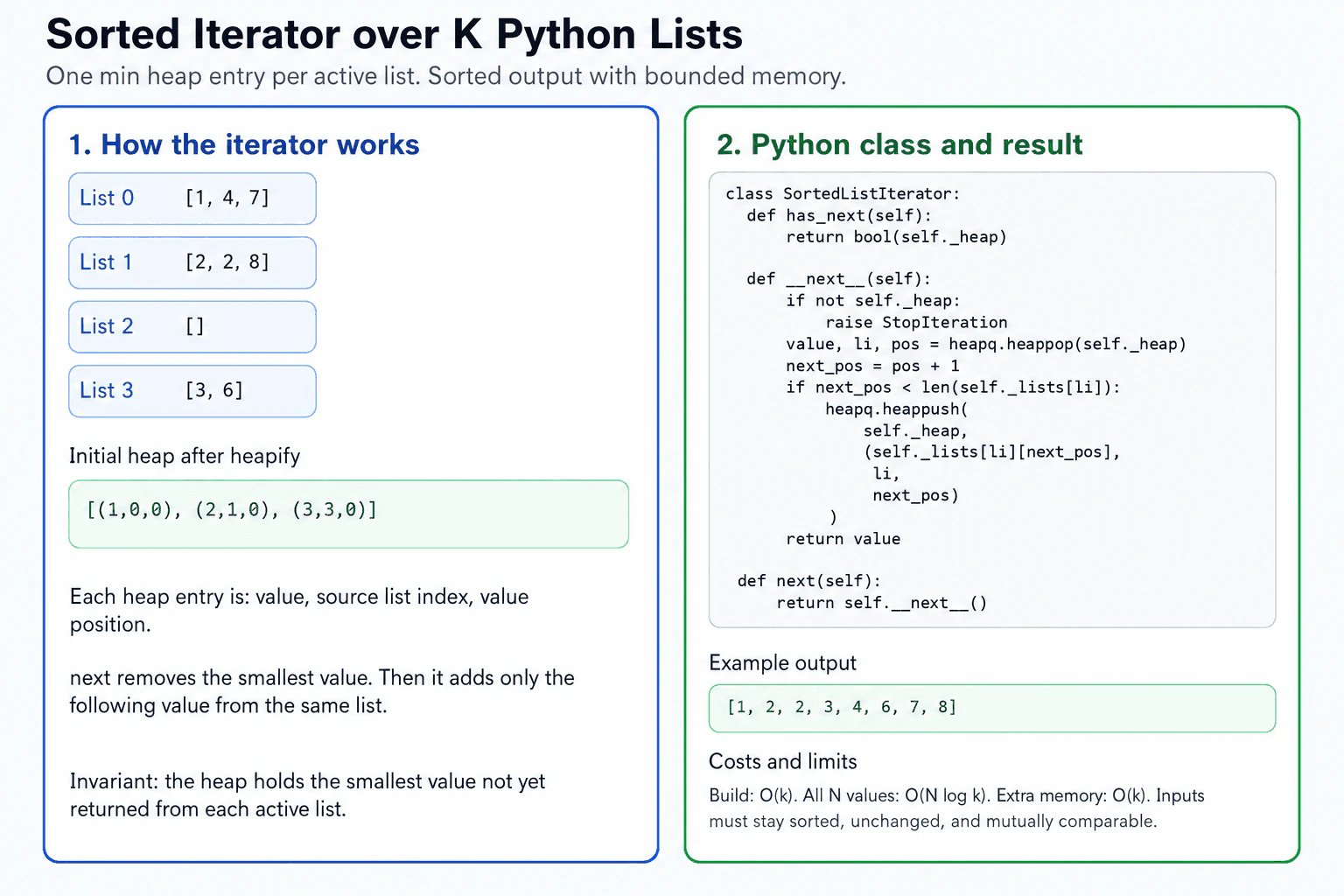
I would keep one current value from each nonempty list in a min heap. Each call to next removes the smallest value, returns it, and adds the following value from the same source list. This produces sorted output lazily and uses O of k extra memory instead of storing all N values.
I would use a min heap from Python's heapq module. I assume every input list is sorted in ascending order and all stored values can be compared with each other. During initialization, I add the first value from every nonempty list and call heapify. Each heap entry stores the value, its source list index, and its position in that list.
Useful Questions to Ask the Interviewer
Should I focus on Python language behavior, or also explain the runtime and standard library?
Which Python version and execution environment should I assume?
Would you like a small code example together with production tradeoffs and edge cases?
When the iterator removes the smallest entry, that value is the next result. It then adds the following value from the same source list, when one exists. Therefore, the heap keeps at most one pending value from each list.
The class implements __iter__ and __next__, so Python's next function and for loops work normally. It also provides the requested has_next and next methods. After all values are consumed, __next__ and next raise StopIteration.
Empty lists are skipped and duplicate values are preserved. Initialization takes O of k time with heapify. Returning all N values takes O of N log k time. Extra memory is O of k because the class stores only heap entries and references to the original lists. The source lists should not be modified during iteration because changes could break ordering or indexed access.
Example
The class keeps references to the original sorted lists and stores at most one pending value from each nonempty list in a min heap. Every heap entry contains the value, the source list index, and the position inside that list. The source index also gives Python a stable integer comparison when equal values occur. Initialization collects the first entries and uses heapify. The __next__ method removes the smallest entry, adds the following value from the same list when available, and returns the removed value. The next method delegates to __next__, so both methods use the same exhaustion behavior. For the lists [1, 4, 7], [2, 2, 8], [], and [3, 6], the output is [1, 2, 2, 3, 4, 6, 7, 8].
Code
import heapq
from collections.abc import Iterator, Sequencefrom typing importAnyclassSortedListIterator(Iterator[Any]):
"""Iterate over several ascending sorted lists in sorted order."""def__init__(self, lists: Sequence[Sequence[Any]]) -> None:
# Keep references to the source lists instead of copying their values.self._lists = lists
# Each entry stores the value, source list index, and value position.self._heap: list[tuple[Any, int, int]] = []
# Collect the first value from every nonempty source list.for list_index, values inenumerate(self._lists):
if values:
self._heap.append((values[0], list_index, 0))
# Build the initial heap in linear time for the collected entries.
heapq.heapify(self._heap)
defhas_next(self) -> bool:
# A heap entry means that another value is available.returnbool(self._heap)
def__iter__(self) -> "SortedListIterator":
# A Python iterator returns itself from __iter__.returnselfdef__next__(self) -> Any:
# Python iterators raise StopIteration after exhaustion.ifnotself._heap:
raise StopIteration
# Remove the smallest pending value.
value, list_index, value_index = heapq.heappop(self._heap)
# Add the next value from the same source list when it exists.
next_index = value_index + 1
source_list = self._lists[list_index]
if next_index < len(source_list):
heapq.heappush(
self._heap,
(source_list[next_index], list_index, next_index),
)
return value
defnext(self) -> Any:
# Provide the requested explicit next method.returnself.__next__()
if __name__ == "__main__":
sorted_lists = [
[1, 4, 7],
[2, 2, 8],
[],
[3, 6],
]
iterator = SortedListIterator(sorted_lists)
result = []
while iterator.has_next():
result.append(iterator.next())
print(result)
assert result == [1, 2, 2, 3, 4, 6, 7, 8]
# The standard Python next function uses the same iterator behavior.try:
next(iterator)
except StopIteration:
print("Iterator is exhausted")
Where it is used
This iterator pattern is useful for merging sorted database result pages, timestamp ordered log lists, search result partitions, and ordered records produced by several workers. It is useful when the application should process or return one value at a time instead of creating one large merged list. The inputs must remain sorted and unchanged while iteration is active.
Why Interviewers Ask This
Interviewers ask this question to test whether the candidate understands Python iterators, StopIteration, tuple ordering, and the heapq module. It also tests whether the candidate can merge sorted inputs lazily, preserve duplicate values, handle empty lists, and explain time and memory costs without copying every input value.
Common interview mistakes
A common mistake is inserting every input value into the heap, which uses O of N extra memory instead of O of k. Another mistake is joining and sorting all lists, which creates a full merged result and is not lazy. Candidates may forget empty lists, duplicate values, or StopIteration. They may also store only the value and lose the source position needed to advance the correct list. The implementation also fails to guarantee sorted output when an input list is unsorted, when values are not mutually comparable, or when a source list is modified during iteration.
Interview tip
Explain the heap invariant first: it contains the smallest value not yet returned from each active list. Then show that after removing one entry, only the next value from that same list is added. Finish with O of N log k total time, O of k extra memory, duplicate preservation, and StopIteration after exhaustion.
Interviewer may ask next
What happens with empty lists, duplicate values, incomparable values, and an exhausted iterator?
Empty lists are skipped, duplicate values are returned, incomparable values can cause TypeError, and an exhausted iterator raises StopIteration. Duplicate values remain separate because each heap entry also stores its source list index and position. These behaviors matter because the iterator must preserve every input item while still following Python's normal iterator protocol.
How would the implementation change if each source were an iterator instead of a list?
The heap strategy would stay the same, but the class would store source iterators instead of list indexes and positions. Initialization would read one item from each source with Python's next function. After removing an entry, it would read one more item from that same source and add it to the heap. This supports streams and removes the need for indexed access, but every source must still yield sorted and mutually comparable values. Reading may also perform blocking work or raise source specific exceptions, so production code must define how those failures are handled.
9. Implement an LRU Cache with Python Data StructuresLanguage SpecificMediumMeta
i Question Details
Use Python mappings and linked ordering or an equivalent structure to implement O(1) average get and put operations.
Short Interview Answer (30-60 seconds)
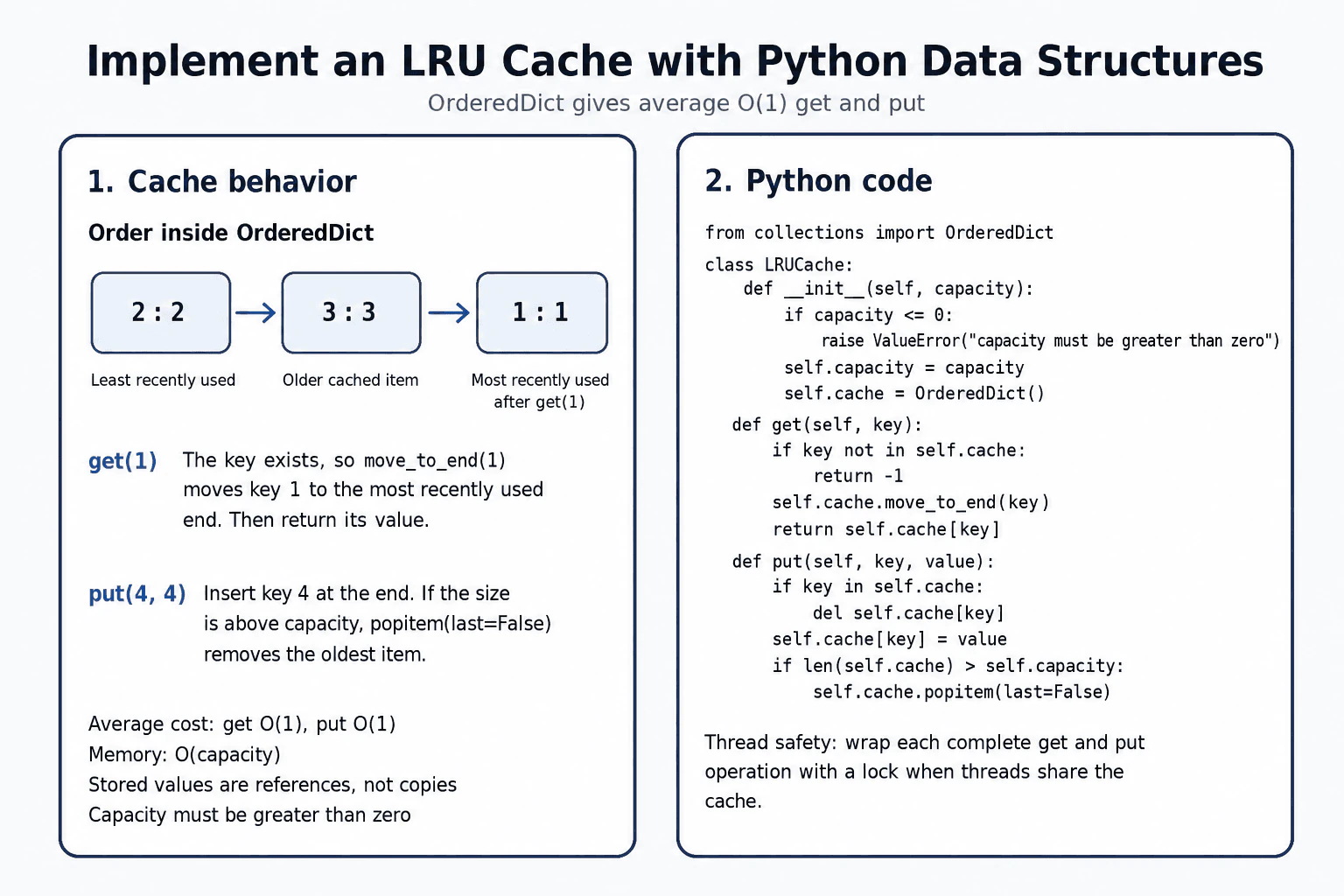
I would use collections.OrderedDict. It provides average constant time key lookup and keeps entries in a defined order. A successful get moves the key to the most recently used end. A put updates or inserts the key, then removes the least recently used entry when capacity is exceeded. I would reject a nonpositive capacity and add a lock if several threads share the cache.
The practical Python solution is collections.OrderedDict. It combines a mapping with maintained key order. In this implementation, the first entry is the least recently used item, and the last entry is the most recently used item.
Useful Questions to Ask the Interviewer
Should I focus on Python language behavior, or also explain the runtime and standard library?
Which Python version and execution environment should I assume?
Would you like a small code example together with production tradeoffs and edge cases?
For get, the code checks whether the key exists. A missing key returns negative one. This answer assumes negative one is reserved as the missing value. A found key is moved to the end with move_to_end, then its value is returned. For put, an existing key is deleted and inserted again with its new value. This makes it the most recently used entry. If the cache grows beyond capacity, popitem with last set to false removes the oldest entry.
Lookup, insertion, deletion, movement, and eviction take average constant time. Memory use is proportional to capacity because each cached item requires mapping storage and ordering metadata. Stored objects are not copied. The cache keeps references to them.
This design is suitable for a bounded cache inside one Python process. It is not safe for compound concurrent operations without synchronization. A positive capacity is required, and cached values should not use negative one when callers must distinguish a hit from a miss.
Example
The implementation uses OrderedDict for both key lookup and usage order. The oldest entry stays at the beginning, and the newest entry stays at the end. get returns negative one for a missing key. A successful get moves the key to the end. put deletes an existing key before inserting its new value so that the key becomes most recently used. When the number of entries exceeds capacity, popitem with last set to false removes the least recently used entry. The constructor rejects capacities less than one.
Code
from collections import OrderedDict
classLRUCache:
def__init__(self, capacity: int) -> None:
# The cache must be able to retain at least one item.if capacity <= 0:
raise ValueError("capacity must be greater than zero")
# Store the maximum number of items allowed.self.capacity = capacity
# The first item is least recently used.# The last item is most recently used.self.cache: OrderedDict[int, int] = OrderedDict()
defget(self, key: int) -> int:
# This implementation reserves negative one for a missing key.if key notinself.cache:
return -1# Mark the key as most recently used.self.cache.move_to_end(key)
# Return the cached value.returnself.cache[key]
defput(self, key: int, value: int) -> None:
# Remove an existing entry before reinserting it.# Reinsertion places it at the most recently used end.if key inself.cache:
delself.cache[key]
# Add the new or updated value.self.cache[key] = value
# Remove the least recently used item when capacity is exceeded.iflen(self.cache) > self.capacity:
self.cache.popitem(last=False)
if __name__ == "__main__":
lru = LRUCache(2)
lru.put(1, 1)
lru.put(2, 2)
print(lru.get(1))
lru.put(3, 3)
print(lru.get(2))
lru.put(4, 4)
print(lru.get(1))
print(lru.get(3))
print(lru.get(4))
Where it is used
This pattern is used for bounded in process caches that store database lookup results, parsed configuration, compiled templates, recent API metadata, or other values that are expensive to recreate. It works well when one Python process owns the cache and losing cached data is acceptable. It is not a replacement for a shared cache when several processes or machines must read the same entries.
Why Interviewers Ask This
Interviewers ask this question to test whether a candidate can combine fast key lookup with access ordering. It checks knowledge of Python mappings, mutable state, eviction rules, edge cases, operation costs, and practical use of the standard library. It also shows whether the candidate can choose a suitable built in structure instead of writing unnecessary linked list pointer code.
Common interview mistakes
Common mistakes include using a normal dictionary without explicitly maintaining access order, evicting the newest entry instead of the oldest entry, forgetting that a successful get must refresh recency, and allowing the cache to grow beyond capacity. Another mistake is checking the returned value to decide whether a key exists. This fails when negative one can be stored as a valid value. Candidates may also claim guaranteed constant time instead of average constant time, or assume that several cache steps are automatically safe when threads run them concurrently.
Interview tip
Start with the two requirements: fast key lookup and fast access ordering. Explain that OrderedDict provides both. Then walk through one successful get, one update, and one eviction. Finish with average constant time operations, memory proportional to capacity, the reserved missing value, and the need for synchronization during shared access.
Interviewer may ask next
What should happen when the cache capacity is zero?
The constructor should reject a zero capacity. This implementation raises ValueError because a zero capacity cache cannot retain any item. Rejecting it gives the class a clear contract and avoids inserting an item only to evict it immediately.
How would you make this cache safe for multiple threads?
I would protect every complete get and put operation with threading.Lock. This matters because membership checks, order changes, insertion, and eviction are separate steps that must behave as one logical operation. The main tradeoff is contention because only one thread can execute a protected cache operation at a time.
10. Implement Weighted Random Selection Without bisect_rightLanguage SpecificMediumMeta
i Question Details
Given names mapped to weights, implement weighted random selection in Python and write the binary-search step without using bisect_right.
Short Interview Answer (30-60 seconds)
I would build cumulative weights once, generate a random integer from zero up to but not including the total weight, and manually find the first cumulative weight greater than that target. This reproduces the behavior needed instead of bisect_right. Preparation takes linear time, while each selection takes logarithmic time.
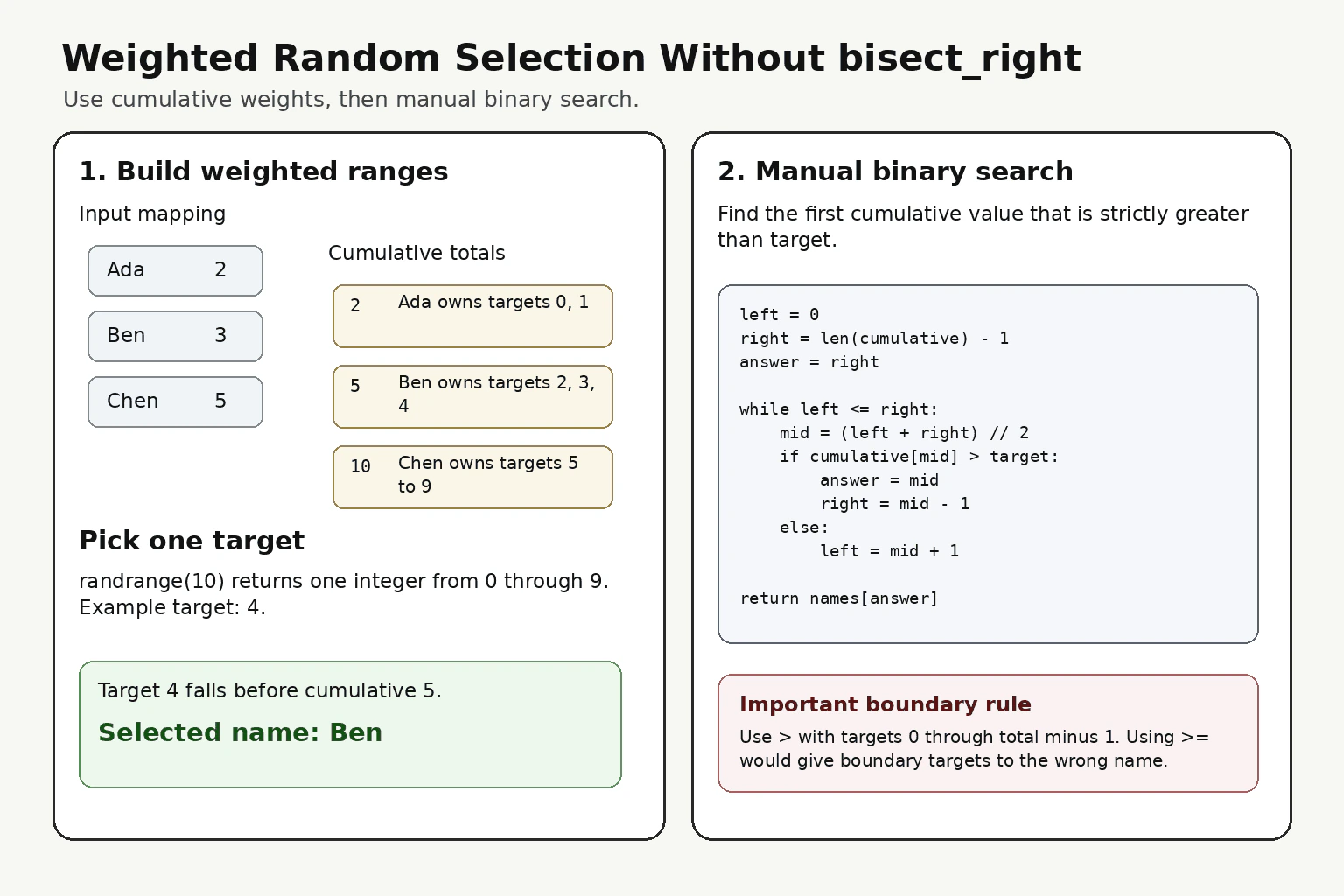
The practical solution is to turn the mapping into cumulative weights and search them manually. Suppose Ada has weight 2, Ben has weight 3, and Chen has weight 5. The cumulative values are 2, 5, and 10. I generate a random integer from 0 through 9. Targets 0 and 1 select Ada. Targets 2 through 4 select Ben. Targets 5 through 9 select Chen.
Useful Questions to Ask the Interviewer
Should I focus on Python language behavior, or also explain the runtime and standard library?
Which Python version and execution environment should I assume?
Would you like a small code example together with production tradeoffs and edge cases?
The binary search finds the first cumulative value strictly greater than the target. When the middle value is greater, I save that position and continue searching left. Otherwise, I search right. This is the same boundary behavior that bisect_right would provide for this cumulative list and target.
The code requires a nonempty mapping with positive integer weights. It rejects Boolean values because bool is a subclass of int in Python. Zero and negative weights are rejected because cumulative values must increase strictly.
Building the selector takes linear time and linear memory. Each later selection takes logarithmic time and constant extra memory. If weights change, the cumulative list must be rebuilt before another correct selection.
Example
The code reads the mapping in its iteration order and stores the names and running weight totals in matching lists. For weights 2, 3, and 5, the cumulative list becomes 2, 5, and 10. It then generates a target with randrange using the total weight, so the possible targets are 0 through 9. The manual binary search returns the first cumulative value that is strictly greater than the target. That index identifies the selected name. The cumulative data is prepared once, so repeated selections only need random target generation and logarithmic binary search.
Code
import random
from collections.abc import Mapping
classWeightedSelector:
"""Select a name using positive integer weights."""def__init__(self, weights_by_name: Mapping[str, int]) -> None:
# The selector needs at least one name and weight.ifnot weights_by_name:
raise ValueError("weights_by_name must not be empty")
# Store names and cumulative weights in matching positions.self._names: list[str] = []
self._cumulative_weights: list[int] = []
running_total = 0for name, weight in weights_by_name.items():
# Require a clear string name for each selectable item.ifnotisinstance(name, str) ornot name:
raise TypeError("each name must be a nonempty string")
# bool is a subclass of int, so reject it explicitly.ifisinstance(weight, bool) ornotisinstance(weight, int):
raise TypeError("each weight must be a positive integer")
# Positive weights keep cumulative values strictly increasing.if weight <= 0:
raise ValueError("each weight must be greater than zero")
running_total += weight
self._names.append(name)
self._cumulative_weights.append(running_total)
self._total_weight = running_total
defchoose(self, rng: random.Random | None = None) -> str:
# A supplied generator makes tests repeatable.
generator = rng if rng isnotNoneelse random
# Generate a target from zero up to but not including the total.
target = generator.randrange(self._total_weight)
# Find the first cumulative weight strictly greater than target.
left = 0
right = len(self._cumulative_weights) - 1
answer_index = right
while left <= right:
middle = (left + right) // 2ifself._cumulative_weights[middle] > target:
answer_index = middle
right = middle - 1else:
left = middle + 1returnself._names[answer_index]
defmain() -> None:
weights_by_name = {
"Ada": 2,
"Ben": 3,
"Chen": 5,
}
selector = WeightedSelector(weights_by_name)
# Use a seed only to make this demonstration repeatable.
rng = random.Random(7)
selections = [selector.choose(rng) for _ inrange(10)]
print(selections)
if __name__ == "__main__":
main()
Where it is used
This pattern is useful for feature rollout, load distribution, game rewards, test data generation, recommendation sampling, and choosing actions with different probabilities. It works best when the weight mapping stays unchanged while the application performs many selections.
Why Interviewers Ask This
Interviewers ask this question to test whether a candidate can use Python mappings, cumulative weights, random number generation, and binary search correctly. It also tests whether the candidate understands boundary rules, input validation, repeated selection cost, and the reason cumulative values must remain strictly increasing.
Common interview mistakes
A common mistake is using greater than or equal to with a target generated from zero through total minus one. That gives the wrong ranges at cumulative boundaries. Another mistake is generating a target that can equal the total weight, which creates an invalid position. Candidates may also rebuild cumulative weights for every selection, accept zero or negative weights, forget that Boolean values pass an int check, or stop at the first valid middle position without continuing left to find the earliest cumulative value greater than the target.
Interview tip
Explain the target ranges first. Then state the exact binary search rule: find the first cumulative weight strictly greater than the target. Finish by separating the linear preparation cost from the logarithmic cost of each selection.
Interviewer may ask next
Why must the search use greater than instead of greater than or equal to?
It must use greater than because the target comes from zero up to but not including the total weight. With cumulative values 2, 5, and 10, target 2 belongs to the second name, not the first. Searching for the first cumulative value greater than 2 returns 5 and therefore the correct second index. Using greater than or equal to would give the first name one extra target and would distort the probabilities.
What changes if the weights are updated frequently?
The cumulative weights must be rebuilt after every update before selection remains correct. Rebuilding takes linear time, so this list based solution is best when selections are frequent and updates are rare. A tree based structure can support faster updates and selections when both happen often, but it needs more code, more memory, and more careful maintenance.
More questions load as you scroll
Python Developer Resume Examples
Explore the resume examples below to find the one that best matches your target Python Developer role.
Disclaimer: This interview guide is for educational and informational purposes only. It is designed to help readers prepare, but it does not guarantee any interview result, hiring decision, offer, or outcome. Interview questions, hiring criteria, and preferred answers can vary by employer, interviewer, industry, location, and time. All answers, examples, and explanations in this guide are suggested examples for interview preparation, not definitive answers or instructions for professional practice. They are based on research and judgment, are provided without warranties of any kind, and should be adapted to the question, role, and applicable laws and professional requirements. Diagrams are simplified illustrations intended to highlight the main concepts and their relationships; actual situations, systems, and practices may be more complex. Alternative approaches may be equally valid or better suited to a particular question, context, or interviewer. To the fullest extent permitted by applicable law, the contributors and publisher are not liable for decisions made, actions taken, or losses incurred based on this guide.
State Laws and Professional Responsibilities: Laws and requirements governing an occupation vary by state and jurisdiction. You are responsible for checking the current laws, licensing requirements, and scope-of-practice rules that apply to your location and role, and for ensuring that your answers and actions comply with them. Adapt examples in this guide to those requirements. This guide is not legal advice.
Company Notice: This guide is an independent educational resource and is not affiliated with, endorsed by, sponsored by, or approved by the company named in this guide. Company names identify reported interview experiences or the employer context of clearly labeled original practice exercises. Interview practices can change without notice, and inclusion of company-specific content does not mean these questions are official, complete, or guaranteed to be asked. To the fullest extent permitted by law, the author, contributors, and publisher are not responsible for outcomes related to use of this material.
Content Accuracy and Verification: To the fullest extent permitted by applicable law, we do not represent or warrant that interview guides, questions, answers, examples, or diagrams are accurate, complete, current, error-free, or suitable for any particular purpose. You are responsible for independently reviewing and verifying the information before relying on it.