This interview guide is for educational and informational purposes only. It is designed to help readers prepare, but it does not guarantee any interview result, hiring decision, offer, or outcome. Interview questions, hiring criteria, and preferred answers can vary by employer, interviewer, industry, location, and time. All answers, examples, and explanations in this guide are suggested examples for interview preparation, not definitive answers or instructions for professional practice. They are based on research and judgment, are provided without warranties of any kind, and should be adapted to the question, role, and applicable laws and professional requirements. Diagrams are simplified illustrations intended to highlight the main concepts and their relationships; actual situations, systems, and practices may be more complex. Alternative approaches may be equally valid or better suited to a particular question, context, or interviewer. To the fullest extent permitted by applicable law, the contributors and publisher are not liable for decisions made, actions taken, or losses incurred based on this guide.
State Laws and Professional Responsibilities
Laws and requirements governing an occupation vary by state and jurisdiction. You are responsible for checking the current laws, licensing requirements, and scope-of-practice rules that apply to your location and role, and for ensuring that your answers and actions comply with them. Adapt examples in this guide to those requirements. This guide is not legal advice.
Identity, Image, and Privacy Notice
To respect individual privacy, some names, profile photographs, avatars, biographical details, and other identifying information displayed in this guide may be replaced with pseudonyms, licensed stock images, illustrative avatars, composite images, or representative descriptions. Unless a person is expressly identified as an actual contributor, a displayed name, image, or profile should not be understood as depicting or identifying a specific candidate, interviewer, employee, or other real individual. These representations are provided for editorial and illustrative purposes only and do not imply endorsement, employment, participation, or affiliation with this guide or any company mentioned in it. Any resemblance to an actual person is coincidental.
Company Notice
This guide is an independent educational resource and is not affiliated with, endorsed by, sponsored by, or approved by the company named in this guide. Company names identify reported interview experiences or the employer context of clearly labeled original practice exercises. Interview practices can change without notice, and inclusion of company-specific content does not mean these questions are official, complete, or guaranteed to be asked. To the fullest extent permitted by law, the author, contributors, and publisher are not responsible for outcomes related to use of this material.
Content Accuracy and Verification
To the fullest extent permitted by applicable law, we do not represent or warrant that interview guides, questions, answers, examples, or diagrams are accurate, complete, current, error-free, or suitable for any particular purpose. You are responsible for independently reviewing and verifying the information before relying on it.
Questions or comments?
Contact us for general questions, or share feedback, technical corrections, and comments with the community.
1. What synchronization strategy would you use for a Python in-memory key-value store?Language SpecificMediumNetflix
i Question Details
Compare a single global lock, per-key locks, lock striping, and language-provided concurrent structures for a single-process multithreaded store.
Short Interview Answer (30-60 seconds)
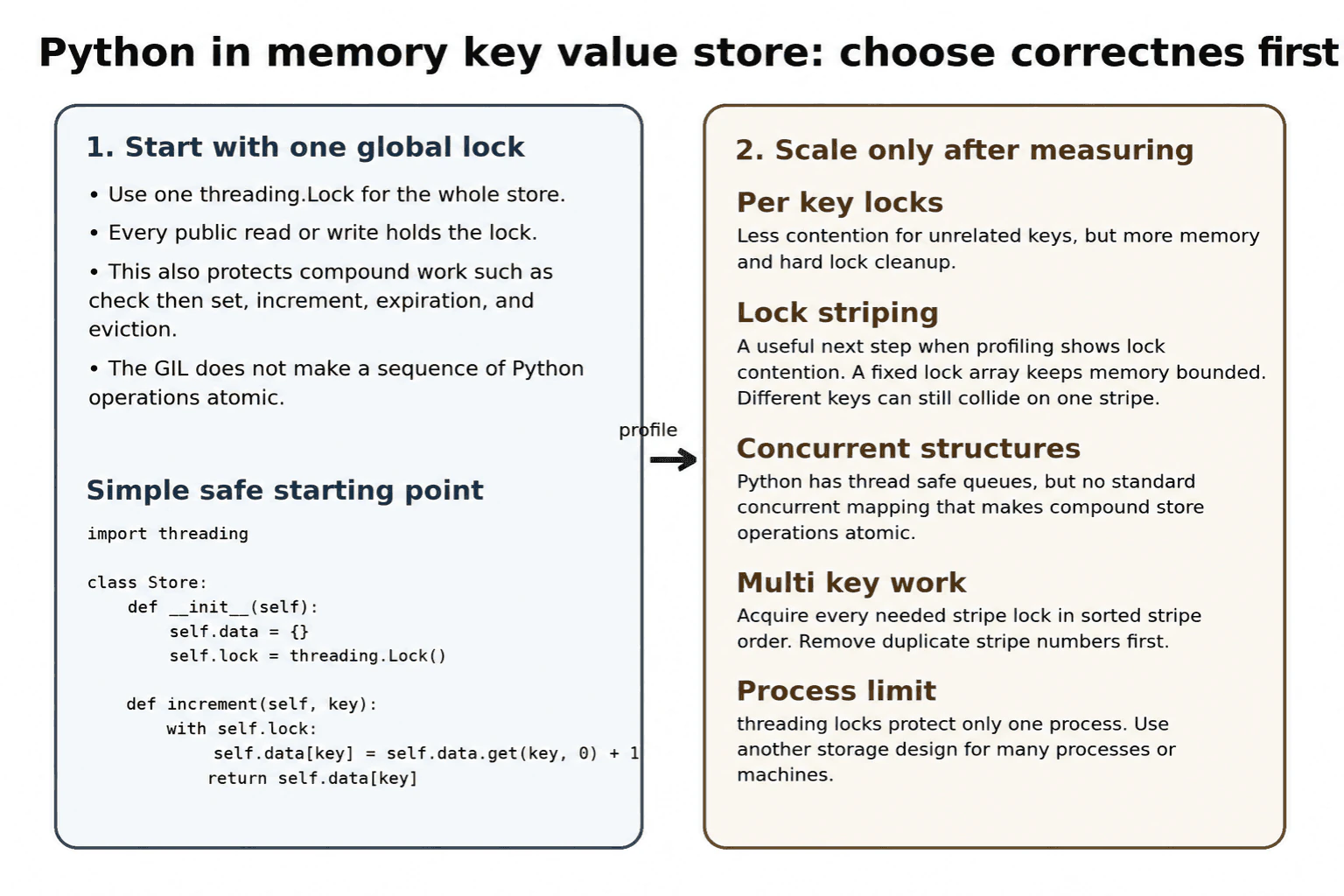
I would start with one global threading.Lock because it gives the store a simple and correct synchronization rule. Every operation that reads or changes shared state would use that lock, especially compound operations such as check then set or increment. If profiling later shows serious lock contention, I would move to lock striping, where each key maps to one lock from a fixed lock array. I would not rely on the GIL or a normal dict as a complete thread safety guarantee.
Detailed Explanation
I would first protect the whole store with one threading.Lock. This is the simplest design to reason about and test. Every public operation must hold the lock while it reads or changes the dictionary and related metadata. This matters for compound actions such as check then set, increment, compare then update, expiration, and eviction. The GIL does not make a sequence of Python operations atomic.
Useful Questions to Ask the Interviewer
Should I focus on Python language behavior, or also explain the runtime and standard library?
Which Python version and execution environment should I assume?
Would you like a small code example together with production tradeoffs and edge cases?
A global lock has low memory cost, but unrelated keys still wait for each other. Per key locks reduce that contention, but they require safe lock creation and cleanup. They can also consume large amounts of memory when the key count grows.
If measurements show real contention, I would use lock striping. The store owns a fixed array of locks, and each key maps to one stripe. This bounds memory while allowing many unrelated keys to proceed at the same time. Stripe collisions still cause waiting.
Python has thread safe queues, but the standard library does not provide a general concurrent mapping that makes compound store operations atomic. Multi key operations must acquire all required stripe locks in a fixed order. For sharing across processes or machines, I would choose a different storage design.
Where it is used
This strategy is useful for a single process service that keeps temporary shared state in memory. Examples include local caches, request counters, rate limit state, session metadata, feature data, and test implementations. A global lock is a good default when operations are short and contention is low. Lock striping is useful when many threads frequently access different keys and measurements show that the global lock is a bottleneck. Thread locks do not coordinate separate processes or separate machines.
Why Interviewers Ask This
Interviewers ask this question to test whether a candidate understands Python thread synchronization and the difference between a safe individual operation and a safe sequence of operations. They also evaluate whether the candidate can balance correctness, contention, memory use, deadlock risk, and implementation complexity when choosing between a global lock, per key locks, lock striping, and standard library options.
Common interview mistakes
Common mistakes include assuming the GIL makes a whole store operation atomic, protecting writes while leaving compound reads unprotected, and treating a normal dict as a complete concurrent data structure. Another mistake is creating one lock per key without a safe lifecycle policy. Removing a per key lock while another thread still uses it can break synchronization. Candidates also forget to protect expiration or eviction metadata with the same lock as the value. Acquiring several locks in inconsistent orders can cause deadlock. Choosing lock striping without measuring contention can add complexity without a useful performance gain.
Interview tip
Give the decision first. Start with one global lock for correctness, then explain that lock striping is a measured optimization. Compare the choices using contention, memory use, cleanup complexity, and deadlock risk. Clearly state that the GIL does not make compound store operations atomic.
Interviewer may ask next
How would you make an operation that updates two keys safe with lock striping?
I would acquire every stripe lock needed by the two keys before reading or changing either value. I would remove duplicate stripe indexes because both keys may map to the same stripe, then acquire the remaining locks in sorted index order. The fixed order prevents two threads from acquiring the same locks in opposite orders and waiting forever. This makes the multi key operation atomic within the store, but it temporarily blocks more stripes and can reduce concurrency.
When would per key locks be better than lock striping?
Per key locks can be better when profiling shows that stripe collisions between unrelated hot keys cause unacceptable contention and the number of active keys is controlled. Each key then has its own lock, so unrelated keys do not block each other. The tradeoff is higher memory use and more complex lock lifecycle management. Lock creation, lookup, reference handling, and cleanup must all be synchronized so two threads never use different locks for the same key.
2. How should expired entries be compacted from a Python TTL cache?Language SpecificMediumNetflix
i Question Details
Compare lazy deletion during reads, periodic cleanup, expiration heaps, timing wheels, and background workers, including synchronization and memory tradeoffs.
Short Interview Answer (30-60 seconds)
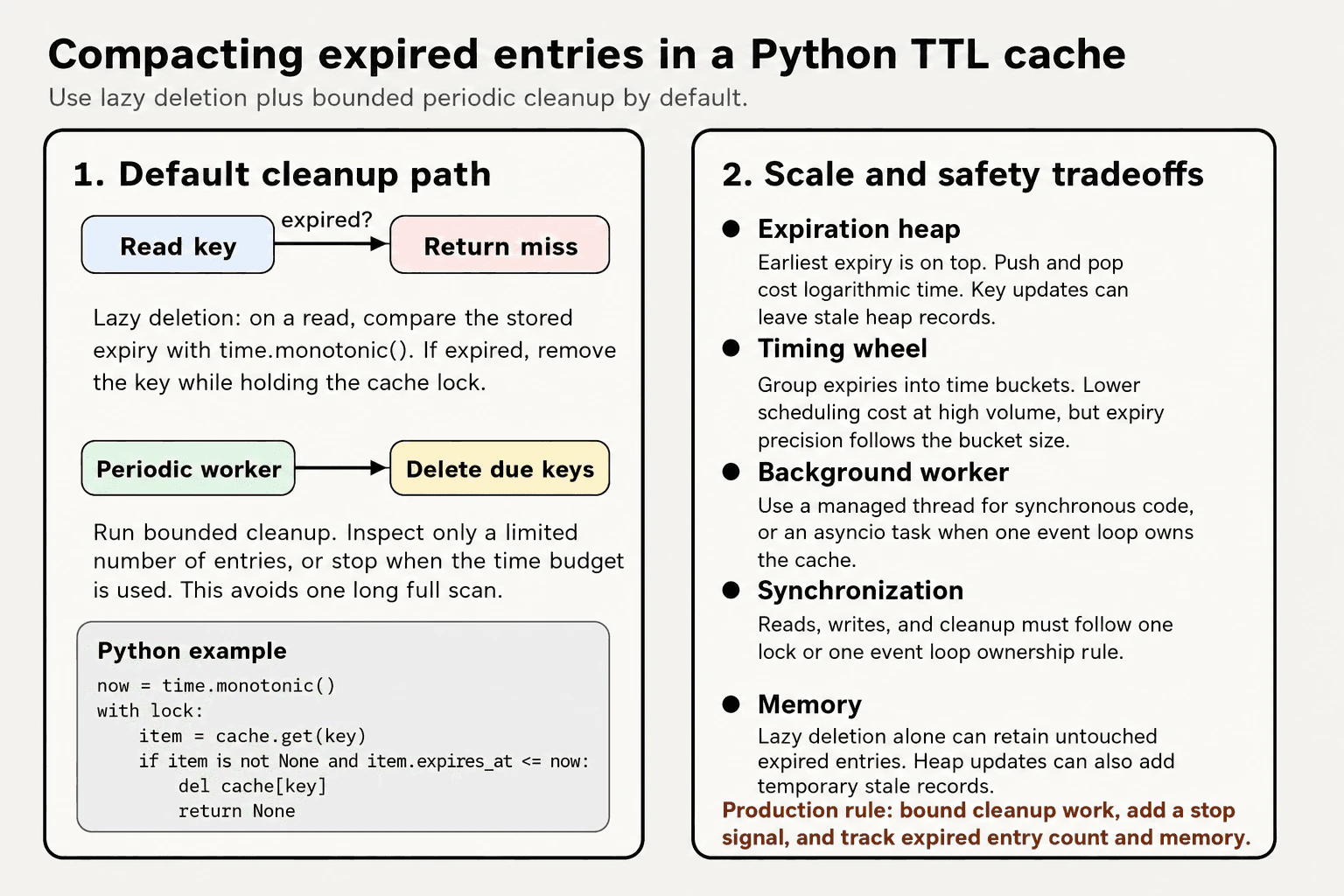
I would normally combine lazy deletion with bounded periodic cleanup. A read checks the expiry time and removes an expired entry, while periodic cleanup removes expired entries that are never read again. For a large cache, I would consider an expiration heap or a timing wheel to avoid repeatedly scanning the full dictionary. Reads, writes, and cleanup must follow one synchronization policy, such as one shared lock or one asyncio event loop owner.
Detailed Explanation
The practical default is lazy deletion plus bounded periodic cleanup. Each entry stores a value and an expiry time from time.monotonic. A read treats the entry as missing when the expiry has passed and removes it while holding the cache lock. Lazy deletion is efficient for active keys, but expired keys that are never accessed can remain in memory.
Useful Questions to Ask the Interviewer
Should I focus on Python language behavior, or also explain the runtime and standard library?
Which Python version and execution environment should I assume?
Would you like a small code example together with production tradeoffs and edge cases?
Periodic cleanup solves that problem. It should inspect only a limited number of entries or run within a time budget, so one cleanup pass does not create a long pause. A full dictionary scan costs time proportional to the number of stored entries.
For larger caches, an expiration heap keeps the earliest expiry at the top. Insertion and removal cost logarithmic time. Updating a key can leave stale heap records, so cleanup must compare each heap record with the current dictionary entry before deleting anything.
A timing wheel groups expiries into time buckets. It can reduce scheduling cost at high volume, but expiry precision is limited by the bucket interval. A background thread suits synchronous code. An asyncio task suits a cache owned by one event loop. Every design needs controlled shutdown, memory limits, and cleanup metrics.
Where it is used
This design is used in local response caches, authentication token caches, rate limit state, service discovery data, and temporary lookup results. Small caches often use lazy deletion with occasional bounded scans. Larger caches with many expiry events may use an expiration heap. Very high volume systems with acceptable coarse expiry precision may use a timing wheel. Synchronous services may run cleanup in a managed worker thread, while asyncio services may run cleanup in a scheduled task.
Why Interviewers Ask This
Interviewers ask this to test whether a candidate can combine Python data structures, time handling, synchronization, memory control, and production cleanup policy. They want to see whether the candidate understands that logical expiration and physical removal are separate concerns, and whether the cleanup design matches the cache size and workload.
Common interview mistakes
Common mistakes include using only lazy deletion, which allows untouched expired entries to consume memory, and scanning the entire dictionary too often, which can create latency spikes. Another mistake is using time.time for elapsed lifetime when clock changes can affect expiration decisions. Developers may also assume the GIL makes a multi step check and delete sequence safe. It does not provide the required cache level atomicity. Heap implementations often forget to reject stale expiry records after a key is updated. Background cleanup also needs a stop mechanism, bounded work, error handling, and metrics.
Interview tip
Start with lazy deletion plus bounded periodic cleanup as the default. Then compare a full scan, an expiration heap, and a timing wheel using cleanup cost, memory retention, expiry precision, synchronization, and implementation complexity.
Interviewer may ask next
What happens when a key is updated before its old heap expiry is processed?
The old heap record becomes stale and must not remove the newer value. Cleanup should compare the key and expiry stored in the heap record with the current expiry stored in the dictionary. It deletes the dictionary entry only when those expiry values still match and the entry is expired. This check matters because heapq does not support efficient removal of an arbitrary old record. The tradeoff is temporary extra heap memory, so a production cache may rebuild the heap when stale records become excessive.
When should a timing wheel be chosen instead of an expiration heap?
A timing wheel should be chosen when the cache processes a very large number of expiry events and exact expiry precision is not required. Entries are placed into buckets that represent time intervals, and cleanup processes the bucket that becomes due. This can reduce per entry scheduling cost compared with logarithmic heap operations. The tradeoff is that entries may remain until their bucket is processed, bucket boundaries reduce precision, and a bucket containing many entries can create a cleanup burst.
3. How would you implement a thread-safe key-value store in Python using a normal dict?Language SpecificMediumNetflix
i Question Details
Describe or sketch put, get, and delete using Python synchronization primitives so each operation appears atomic under multiple threads.
Short Interview Answer (30-60 seconds)
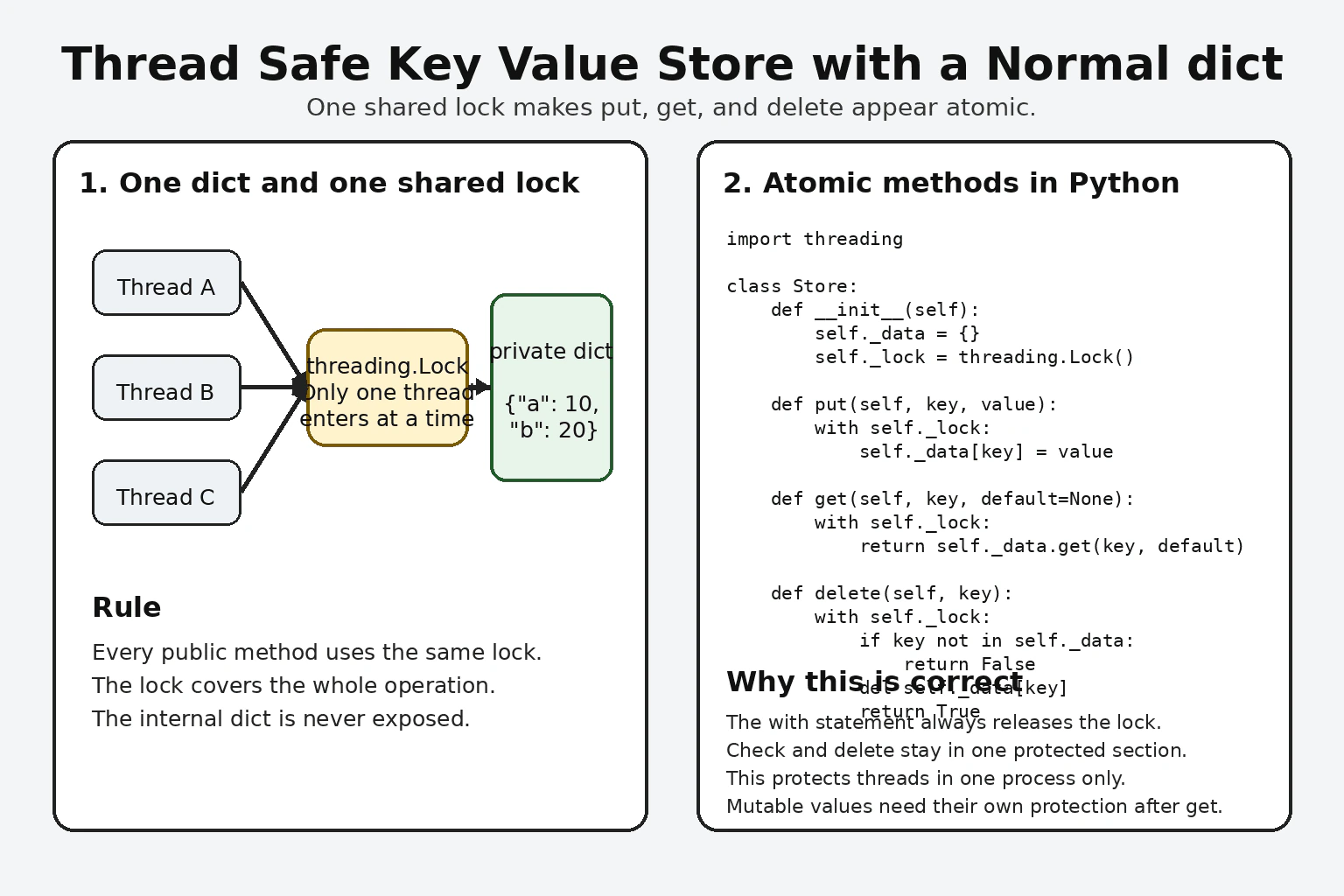
I would keep the dict private and protect every put, get, and delete operation with the same threading.Lock. Each method would acquire the lock with a with statement, complete the entire dict operation, and release the lock automatically. This makes each public method appear atomic to other threads using the store. I would not depend on the global interpreter lock because it does not provide a clear application level guarantee for a sequence of dict actions.
I would place the normal dict inside a class and create one threading.Lock for the store. Every public method must use that same lock. Put acquires the lock and stores the value. Get acquires the lock and returns the value or a supplied default. Delete acquires the lock, checks for the key, removes it, and returns whether removal happened.
Useful Questions to Ask the Interviewer
Should I focus on Python language behavior, or also explain the runtime and standard library?
Which Python version and execution environment should I assume?
Would you like a small code example together with production tradeoffs and edge cases?
The with statement releases the lock even if a dict operation raises an exception. While one thread holds the lock, other threads calling these methods wait. This makes each complete method call appear atomic to callers that use the class correctly.
I would not rely on the global interpreter lock. Runtime details may make some individual dict actions safe from memory corruption, but a sequence such as check then delete can still race without application synchronization.
Average dict lookup, insertion, and deletion are constant time. Lock waiting can increase latency under contention. The store uses linear memory for its entries and constant extra synchronization memory. It is suitable for a small store shared by threads in one process. It does not synchronize separate processes or servers. Returned mutable values also need their own protection if threads modify them.
Example
The class owns one private dict and one private threading.Lock. Put, get, and delete all acquire the same lock. Put stores a value. Get returns the stored value or the caller supplied default. Delete performs both the key check and the removal while holding the lock, then returns True when the key existed or False when it did not. Keeping the complete operation inside one protected block prevents another thread from changing the dict between related steps. The code protects the dict structure, but it does not automatically protect later mutation of a mutable object returned by get.
Code
import threading
from collections.abc import Hashable
from typing importAnyclassThreadSafeKeyValueStore:
def__init__(self) -> None:
# Keep the normal dict private so callers cannot bypass the lock.self._data: dict[Hashable, Any] = {}
# Every public operation uses this same lock.self._lock = threading.Lock()
defput(self, key: Hashable, value: Any) -> None:
# Hold the lock for the complete write operation.withself._lock:
self._data[key] = value
defget(self, key: Hashable, default: Any = None) -> Any:
# Hold the lock while reading from the shared dict.withself._lock:
returnself._data.get(key, default)
defdelete(self, key: Hashable) -> bool:
# Keep both the key check and deletion inside one locked block.withself._lock:
if key notinself._data:
returnFalsedelself._data[key]
returnTruedefmain() -> None:
store = ThreadSafeKeyValueStore()
store.put("profile", {"name": "Maya"})
print(store.get("profile"))
print(store.delete("profile"))
print(store.get("profile", "missing"))
print(store.delete("profile"))
if __name__ == "__main__":
main()
Where it is used
This pattern is useful for small in process caches, shared configuration values, test doubles, worker coordination data, and temporary state used by several threads. It works best when protected operations are short and contention is moderate. A database, process safe service, or external shared store is usually better when data must be durable, shared across processes, shared across machines, or accessed under heavy contention.
Why Interviewers Ask This
Interviewers ask this question to check whether the candidate understands shared mutable state, threading.Lock, context managers, and atomic application operations. It also tests whether the candidate knows that the global interpreter lock is not a replacement for an explicit synchronization design around a shared dict.
Common interview mistakes
A common mistake is assuming that the global interpreter lock makes every dict workflow thread safe. Another mistake is using a different lock in each method, because those locks would not coordinate access to the same dict. Developers may also place the key check outside the protected block and lock only the deletion, which creates a race between the two actions. Exposing the internal dict is unsafe because callers could modify it without using the lock. Holding the lock during slow file access, network access, callbacks, or other unrelated work creates unnecessary contention. Another mistake is calling a public locked method from inside another block that already holds this non reentrant lock, because the same thread can then block itself.
Interview tip
Start with the design: one private dict and one shared lock around every complete public operation. Explain that check and delete must use one locked block. Then mention contention, mutable returned values, and the fact that this design protects threads in one process only.
Interviewer may ask next
What happens if get returns a mutable value?
The dict lookup is protected, but later mutation of the returned object is not protected. Get returns the same object reference that is stored in the dict. After the method releases the lock, several threads could modify that object at the same time. This matters because atomic access to the dict does not make the stored objects deeply thread safe. Returning a copy can reduce shared mutation for suitable value types, but copying adds processing time, memory allocation, and type specific behavior.
How would this design behave under heavy read traffic?
Every read and write would still use one exclusive lock, so heavy read traffic could create contention. Only one put, get, or delete method can execute inside the protected section at a time. This keeps the behavior simple and correct, but waiting can increase latency. Partitioning keys across several locked dicts could improve concurrency, but it adds memory use and complexity, and operations involving several partitions become harder to keep atomic.
4. How would you represent a versioned key-value store in Python?Language SpecificMediumNetflix
i Question Details
Explain Python data structures suitable for storing multiple timestamped values per key and efficiently retrieving the latest value at or before a requested timestamp.
Short Interview Answer (30-60 seconds)
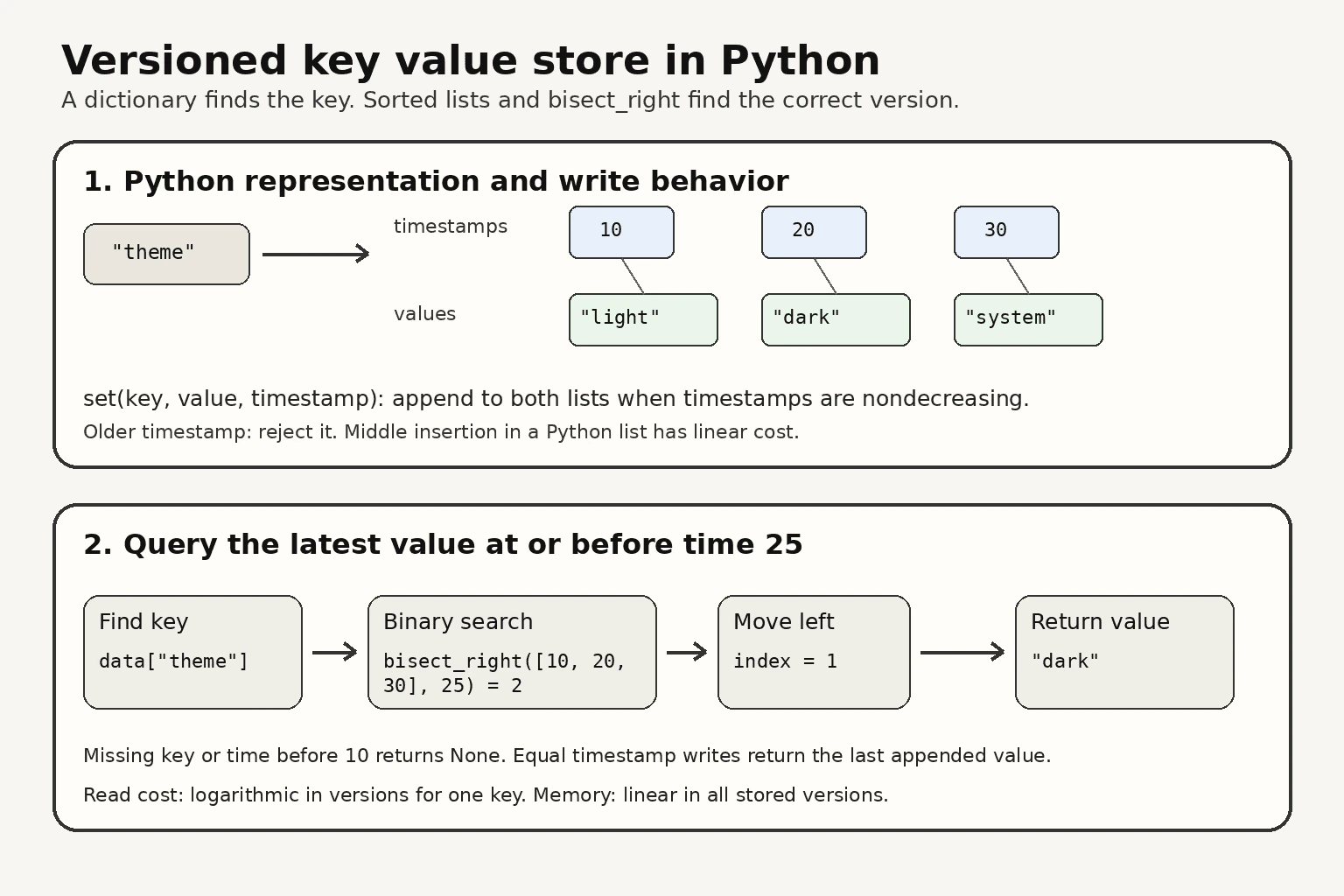
I would use a dictionary that maps each key to two parallel lists. One list stores sorted timestamps and the other stores the matching values. When timestamps arrive in order, a write appends to both lists. A read uses bisect_right on the timestamp list and returns the value at the previous position. This gives constant average key lookup, constant amortized append, and logarithmic search for a key.
I would map each key to two Python lists. The first list stores timestamps in sorted order. The second list stores the matching values at the same indexes. For example, the key theme could have timestamps 10, 20, and 30 with values light, dark, and system.
Useful Questions to Ask the Interviewer
Should I focus on Python language behavior, or also explain the runtime and standard library?
Which Python version and execution environment should I assume?
Would you like a small code example together with production tradeoffs and edge cases?
When writes for one key arrive in nondecreasing timestamp order, set can append to both lists. Python list append has constant amortized cost. To read a value, get uses bisect_right from the standard library. It finds the position after the last timestamp that is less than or equal to the requested timestamp. Moving one position left gives the correct value. If the position is zero, no value existed at that time.
The dictionary gives constant average lookup by key. Binary search gives logarithmic lookup among the versions for that key. Memory grows with every stored timestamp and value. The main limitation is unordered input. Inserting an older timestamp into the middle of a Python list takes linear time because later elements must move. In production, I would define duplicate timestamp behavior, validate ordering, and add retention rules if history can grow without a limit.
Example
The VersionedKeyValueStore keeps a dictionary from each string key to a VersionHistory object. Each history contains a timestamp list and a value list. The lists always have the same length, and matching indexes describe one version. The set method rejects a timestamp that is older than the latest timestamp for that key. It then appends the timestamp and value. Equal timestamps are allowed, so a later write at the same timestamp becomes the value returned for that timestamp. The get method uses bisect_right on the timestamp list. The returned position is after every timestamp that is less than or equal to the requested time. The value at the previous index is therefore the newest valid version. The method returns None when the key does not exist or when the requested timestamp is earlier than the first version. An ordered write has constant amortized time. A read takes logarithmic time in the number of versions for that key. Memory use is linear in the total number of stored versions.
Code
from bisect import bisect_right
from dataclasses import dataclass, field
from typing importAny@dataclassclassVersionHistory:
# Matching indexes in these two lists describe one stored version.
timestamps: list[int] = field(default_factory=list)
values: list[Any] = field(default_factory=list)
classVersionedKeyValueStore:
def__init__(self) -> None:
# Map each key to its ordered version history.self._data: dict[str, VersionHistory] = {}
defset(self, key: str, value: Any, timestamp: int) -> None:
# Create an empty history when the key is first stored.
history = self._data.setdefault(key, VersionHistory())
# This implementation requires timestamps for one key to arrive# in nondecreasing order. Equal timestamps are allowed.if history.timestamps and timestamp < history.timestamps[-1]:
raise ValueError("Timestamps for each key must be nondecreasing")
# Append the timestamp and value at matching indexes.
history.timestamps.append(timestamp)
history.values.append(value)
defget(self, key: str, timestamp: int) -> Any | None:
# Return None when the key has never been stored.
history = self._data.get(key)
if history isNone:
returnNone# Find the position after the last timestamp that is less than# or equal to the requested timestamp.
index = bisect_right(history.timestamps, timestamp)
# No version existed at or before the requested timestamp.if index == 0:
returnNone# Matching indexes keep the timestamp and value connected.return history.values[index - 1]
if __name__ == "__main__":
store = VersionedKeyValueStore()
store.set("theme", "light", 10)
store.set("theme", "dark", 20)
store.set("theme", "system", 30)
print(store.get("theme", 5))
print(store.get("theme", 20))
print(store.get("theme", 25))
print(store.get("theme", 40))
Where it is used
This structure is useful for configuration history, feature flag history, document revisions, cache snapshots, price history, and systems that must answer which value was active at a particular time. It works best when writes for each key arrive in order and historical reads are frequent. It is less suitable when late writes are common or when the complete history is too large to keep in process memory.
Why Interviewers Ask This
Interviewers ask this question to check whether a candidate can combine Python dictionaries, lists, type hints, and the bisect module into a practical design. They also evaluate whether the candidate understands sorted data, binary search, Python list behavior, duplicate timestamps, missing values, memory growth, and the cost of receiving writes out of order.
Common interview mistakes
A common mistake is scanning every version from the beginning, which makes each read linear instead of logarithmic. Another mistake is storing timestamps in an ordinary dictionary without maintaining an ordered sequence, because finding the nearest earlier timestamp then requires extra work. Candidates may also forget the case where the requested time is earlier than the first version. Other mistakes include letting the timestamp and value lists become different lengths, accepting unordered writes without accounting for linear insertion cost, leaving duplicate timestamp behavior undefined, and assuming that Python dictionary insertion order can replace timestamp search.
Interview tip
State the data structure first: a dictionary from each key to sorted timestamps and matching values. Then explain ordered append, bisect_right, the earlier than first timestamp case, duplicate timestamp behavior, and the cost of unordered insertion. Use one small example throughout the explanation.
Interviewer may ask next
What happens when two values are written for the same key at the same timestamp?
The current implementation keeps both versions and returns the value written last at that timestamp. Equal timestamps are appended in write order. bisect_right moves past every matching timestamp, so the previous index points to the most recently appended value. This behavior matters because duplicate timestamp rules must be explicit. A production system could instead replace the earlier value or reject the second write, but the set method and tests would need to enforce that different rule consistently.
How would the design change if timestamps can arrive out of order?
The timestamp list must remain sorted, so the write path would use binary search to find the correct insertion index and then insert into both the timestamp and value lists at that index. Finding the index takes logarithmic time, but each Python list insertion takes linear time because later elements must move. This matters when a key has many versions or receives frequent late events. The main tradeoff is preserving logarithmic reads while accepting slower writes, or using a different in memory structure or an external database when unordered writes are common.
5. How would you parse raw dependency strings in Python?Language SpecificMediumNetflix
i Question Details
Parse inputs such as 'install A after B', 'C->A', and 'B before D' into a directed graph while handling malformed text and duplicate edges.
Short Interview Answer (30-60 seconds)
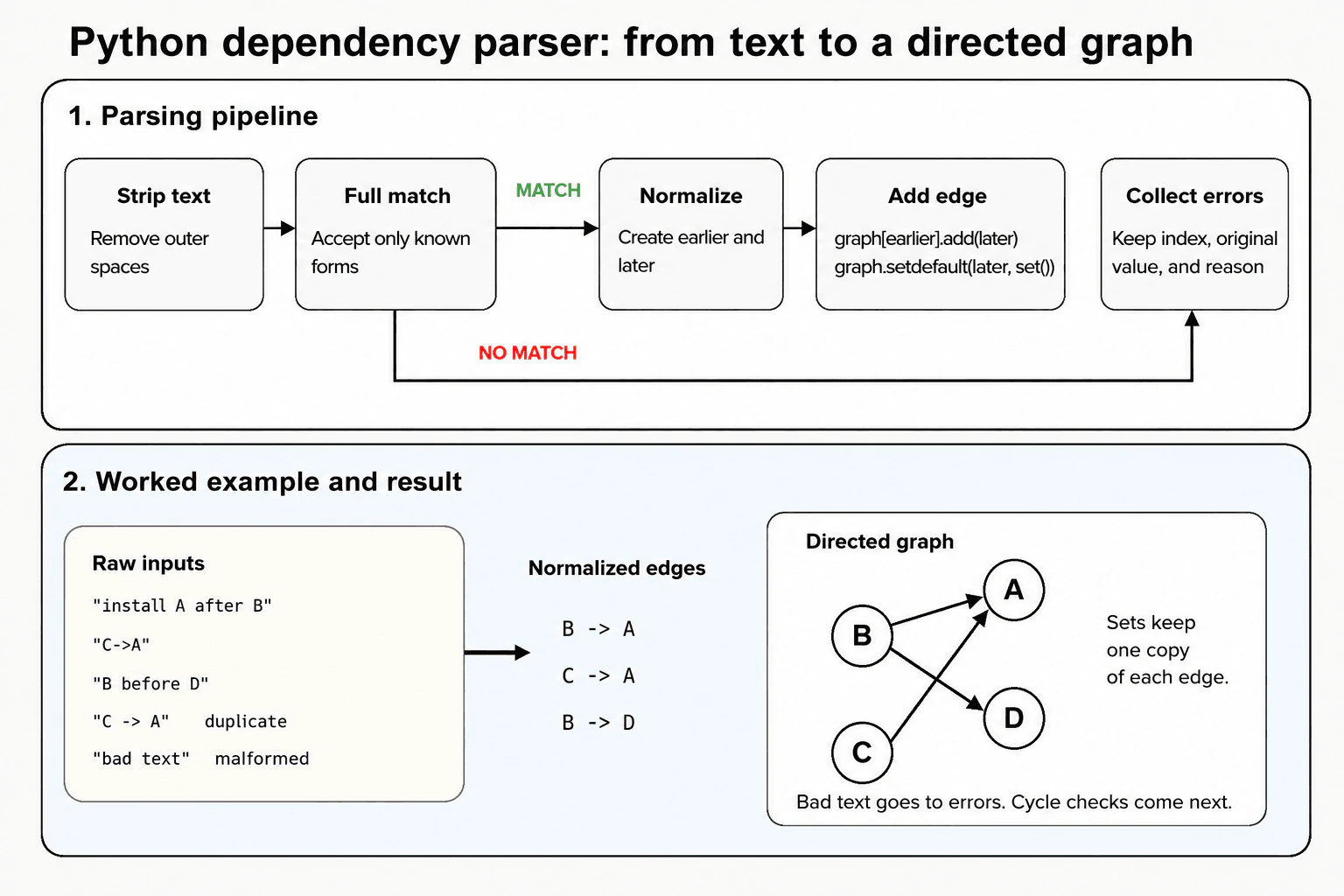
I would define one edge rule first: X to Y means X must happen before Y. Then I would strip each string, match it against the supported formats with full regular expression matching, convert every match into that same direction, and store destinations in a set. The examples produce B to A, C to A, and B to D. Sets remove duplicate edges, while invalid values are returned as structured errors instead of being guessed or silently ignored.
I would first define one graph rule: an edge from X to Y means X must happen before Y. This removes ambiguity when different text forms describe the same dependency.
Useful Questions to Ask the Interviewer
Should I focus on Python language behavior, or also explain the runtime and standard library?
Which Python version and execution environment should I assume?
Would you like a small code example together with production tradeoffs and edge cases?
Each value is checked to confirm that it is a string, stripped of surrounding spaces, and matched against one of three supported patterns. Full matching is important because it rejects extra unknown text instead of accepting only part of a line. For install A after B, the edge is B to A. For C to A, the edge is C to A. For B before D, the edge is B to D.
The graph uses a dictionary whose values are sets. A set stores each destination once, so repeated dependency strings do not create duplicate edges. Destination nodes are also added with empty sets so every known node appears in the graph.
Malformed values are collected with their position, original value, and reason. The parser does not guess their meaning. Production code can then reject the whole request or continue with valid entries according to an explicit policy. Cycle detection, including self dependencies, should run as a separate validation step after parsing.
Example
The code defines three compiled regular expression patterns for the supported formats. Every successful match produces two named values called earlier and later. The graph stores an edge from earlier to later, which always means that earlier must run first. A dictionary maps each node to a set of destination nodes, so repeated inputs create only one edge. The destination is also added as a key even when it has no outgoing edges. Empty strings, values that are not strings, and unsupported formats are collected in an error list. For the sample input, the graph contains B to A, B to D, and C to A. The repeated C to A input appears only once.
Code
import re
from collections import defaultdict
from collections.abc import Iterable
from typing importAny# A node name starts with a letter or underscore.# It may then contain letters, digits, underscores, or dots.
NAME = r"[A-Za-z_][A-Za-z0-9_.]*"# Each expression is checked with fullmatch, so the whole input must follow# one supported grammar.
AFTER_PATTERN = re.compile(
rf"install\s+(?P<later>{NAME})\s+after\s+(?P<earlier>{NAME})",
re.IGNORECASE,
)
ARROW_PATTERN = re.compile(rf"(?P<earlier>{NAME})\s*->\s*(?P<later>{NAME})")
BEFORE_PATTERN = re.compile(
rf"(?P<earlier>{NAME})\s+before\s+(?P<later>{NAME})",
re.IGNORECASE,
)
PATTERNS = (AFTER_PATTERN, ARROW_PATTERN, BEFORE_PATTERN)
defparse_dependencies(
raw_dependencies: Iterable[Any],
) -> tuple[dict[str, set[str]], list[dict[str, Any]]]:
"""Parse supported dependency strings into a directed graph."""# Each set stores unique outgoing edges for one source node.
graph: defaultdict[str, set[str]] = defaultdict(set)
errors: list[dict[str, Any]] = []
for index, raw_value inenumerate(raw_dependencies):
# Reject values that are not strings.ifnotisinstance(raw_value, str):
errors.append(
{
"index": index,
"value": raw_value,
"reason": "Expected a string",
}
)
continue
text = raw_value.strip()
# Reject empty text after surrounding whitespace is removed.ifnot text:
errors.append(
{
"index": index,
"value": raw_value,
"reason": "Input is empty",
}
)
continuematch = None# Try each supported grammar and require the whole string to match.for pattern in PATTERNS:
match = pattern.fullmatch(text)
ifmatchisnotNone:
break# Do not guess the meaning of unsupported text.ifmatchisNone:
errors.append(
{
"index": index,
"value": raw_value,
"reason": "Unsupported dependency format",
}
)
continue
earlier = match.group("earlier")
later = match.group("later")
# earlier to later means earlier must happen first.
graph[earlier].add(later)
# Keep destination only nodes in the graph with no outgoing edges.
graph.setdefault(later, set())
returndict(graph), errors
if __name__ == "__main__":
sample = [
"install A after B",
"C->A",
"B before D",
"C -> A",
"broken dependency text",
" ",
None,
]
dependency_graph, parse_errors = parse_dependencies(sample)
# Sort only for stable and readable output.
printable_graph = {
node: sorted(destinations) for node, destinations insorted(dependency_graph.items())
}
print("Graph:", printable_graph)
print("Errors:", parse_errors)
Where it is used
This approach is useful when reading deployment order rules, workflow configuration, migration dependencies, package metadata, job scheduling rules, or administrator supplied configuration. In production, the accepted grammar should be documented, malformed values should be logged safely, node naming rules should be consistent, and the completed graph should be checked for cycles before any work is scheduled.
Why Interviewers Ask This
Interviewers ask this question to test whether a candidate can convert several text formats into one reliable data model. It checks Python string handling, regular expressions, dictionaries, sets, validation, error reporting, and correct graph direction. It also tests whether the candidate defines clear input rules instead of silently guessing what malformed text means.
Common interview mistakes
Common mistakes are reversing the meaning of after, storing destinations in a list and keeping duplicate edges, using partial matching, forgetting nodes that have no outgoing edges, and silently dropping malformed values. Another mistake is assuming that successful parsing proves the dependency graph is valid. Parsing builds the graph, while cycle detection and self dependency checks are separate validation steps.
Interview tip
State the edge direction before discussing code. Translate each sample into that direction, explain why sets remove duplicate edges, and show how malformed values are reported. Finish by saying that cycle detection happens after parsing.
Interviewer may ask next
What should happen if the input contains A before A?
The parser should produce the edge A to A because the text follows a supported format, but the later graph validation step should reject it as a self dependency. That edge is a cycle of length one, so executing the graph would be impossible. Keeping parsing and graph validation separate makes both responsibilities clear, but production code must run validation before scheduling work.
Would you still use regular expressions if many more dependency formats were added?
No, I would replace the small pattern list once the grammar became complex or ambiguous. The exact change would be to introduce a tokenizer and a structured parser while preserving the same graph and error result. Regular expressions are simple and practical for these three forms. A structured parser requires more code and memory, but it gives clearer grammar rules, more precise error locations, and safer future extensions.
6. How would you write production-quality Python for string-array transformations?Language SpecificMediumNetflix
i Question Details
Discuss input validation, Unicode and empty-input behavior, readable abstractions, deterministic output, testing, and time and space complexity.
Short Interview Answer (30-60 seconds)
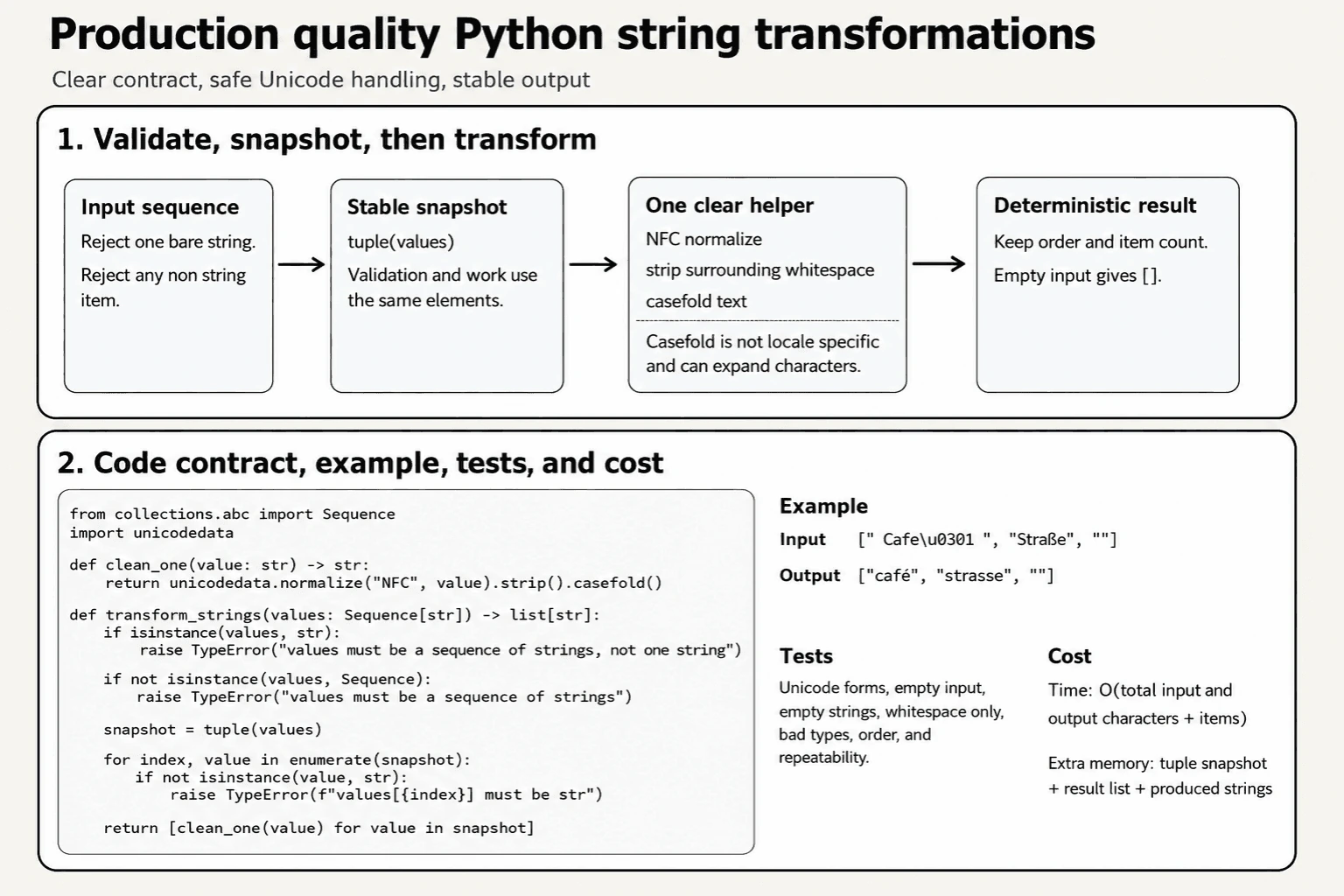
I would define the contract first, take a stable snapshot of the input sequence, validate every element, and apply one small pure function to each string. In this example, I normalize Unicode with NFC, remove surrounding whitespace, and use casefold for consistent case matching. I preserve element order and count, return an empty list for empty input, and raise clear errors for invalid values. The work is proportional to the input and output text, and new memory is required because Python strings are immutable.
I would begin with an explicit contract. The function accepts a sequence of strings, preserves element order and count, and returns a new list. It rejects a bare string because Python would otherwise treat it as a sequence of characters. It copies the sequence into a tuple so validation and transformation use the same snapshot.
Useful Questions to Ask the Interviewer
Should I focus on Python language behavior, or also explain the runtime and standard library?
Which Python version and execution environment should I assume?
Would you like a small code example together with production tradeoffs and edge cases?
Each value is passed to one small helper. The helper applies Unicode NFC normalization, strip, and casefold. NFC gives canonically equivalent text a consistent representation. Strip removes surrounding Unicode whitespace. Casefold provides stronger Unicode case matching than lower. It is not locale specific, and some characters can expand. For example, the German sharp s becomes ss.
Empty input returns an empty list. Empty strings remain in their original positions. The function does not mutate the caller's sequence or strings. Python strings are immutable, so normalization, trimming, and case conversion can create new string objects.
I would test ordinary text, composed and decomposed Unicode, whitespace only values, empty input, invalid containers, invalid elements, preserved order, and repeated calls. Time is O of the total input and output characters plus the number of elements. Extra memory is O of the snapshot, result references, and output characters.
Example
The code defines one public function and one small pure helper. The public function rejects a bare string and any value that is not a sequence. It copies the sequence into a tuple, then validates every element before producing any transformed result. The helper applies NFC normalization, removes surrounding whitespace, and applies casefold. The list comprehension preserves order and produces exactly one output for each input element. For the example input, the output is ["café", "strasse", ""]. Empty input returns an empty list. Time is O of the total input and output characters plus the number of elements. Extra memory is O of the tuple snapshot, result references, and produced string data.
Code
from collections.abc importSequenceimport unicodedata
def_normalize_value(value: str) -> str:
"""Return one string in the agreed canonical form."""# Normalize canonically equivalent Unicode text to NFC form.
normalized = unicodedata.normalize("NFC", value)
# Remove surrounding Unicode whitespace.
trimmed = normalized.strip()
# Produce a Unicode aware case matching form.return trimmed.casefold()
deftransform_strings(values: Sequence[str]) -> list[str]:
"""Validate and transform a sequence of strings in stable order."""# A bare string is a sequence, but processing it would transform characters.ifisinstance(values, str):
raise TypeError("values must be a sequence of strings, not one string")
# Type hints are not enforced automatically at runtime.ifnotisinstance(values, Sequence):
raise TypeError("values must be a sequence of strings")
# Take one snapshot so validation and transformation use the same elements.
snapshot = tuple(values)
# Validate every element before creating any result values.for index, value inenumerate(snapshot):
ifnotisinstance(value, str):
raise TypeError(f"values[{index}] must be str")
# Return a new list while preserving element order and count.return [_normalize_value(value) for value in snapshot]
if __name__ == "__main__":
sample = [" Cafe\u0301 ", "Straße", ""]
result = transform_strings(sample)
print(result)
assert result == ["café", "strasse", ""]
assert transform_strings([]) == []
assert transform_strings([" "]) == [""]
try:
transform_strings("abc")
except TypeError as error:
assertstr(error) == "values must be a sequence of strings, not one string"else:
raise AssertionError("A bare string must be rejected")
try:
transform_strings(["valid", 7])
except TypeError as error:
assertstr(error) == "values[1] must be str"else:
raise AssertionError("A non string element must be rejected")
Where it is used
This pattern is useful when preparing search terms, comparison keys, cache keys, user names, tags, imported records, and values sent to another service. The exact operations must follow the business contract. Original display text should usually be stored separately because trimming and casefold can change what the user entered.
Why Interviewers Ask This
Interviewers ask this question to test whether a candidate can turn a simple string operation into a precise and reliable Python contract. They evaluate runtime validation, Unicode knowledge, stable ordering, readable abstractions, test design, allocation awareness, and accurate time and memory analysis.
Common interview mistakes
Common mistakes include accepting a bare string and processing one character at a time, trusting type hints as runtime validation, using lower when Unicode case matching is required, deleting empty results without documenting that element positions will change, converting the values to a set and losing order, mutating the caller's list, and claiming constant memory even though new containers and strings are created. Another mistake is overwriting original display text with a comparison form.
Interview tip
State the contract first. Then explain validation, the exact Unicode operations, preserved order and count, empty input behavior, tests, and complexity. Mention that Python strings are immutable and that casefold is useful for matching keys but may not be suitable for displayed text.
Interviewer may ask next
What happens to empty values and characters that expand during casefold?
Empty values remain in the output and keep their original positions. A whitespace only string becomes an empty string after strip. Casefold can increase the number of characters, such as changing the German sharp s to ss. This matters because character length may change even though the number and order of list elements remain unchanged.
How would you reduce memory use for a very large input stream?
I would change the contract to accept an iterable and return an iterator that yields one validated and transformed string at a time. This removes the full tuple snapshot and result list, so working memory can stay small apart from the current value. The tradeoff is that validation errors occur during iteration, partial output may already have been consumed, and the result cannot be indexed or reused unless the caller stores it.
7. How would you implement a fixed-capacity weighted cache in Python?Language SpecificMediumNetflix
i Question Details
Design get and put operations for a cache with a total weight limit and explain the Python data structures used for lookup and eviction.
Short Interview Answer (30-60 seconds)
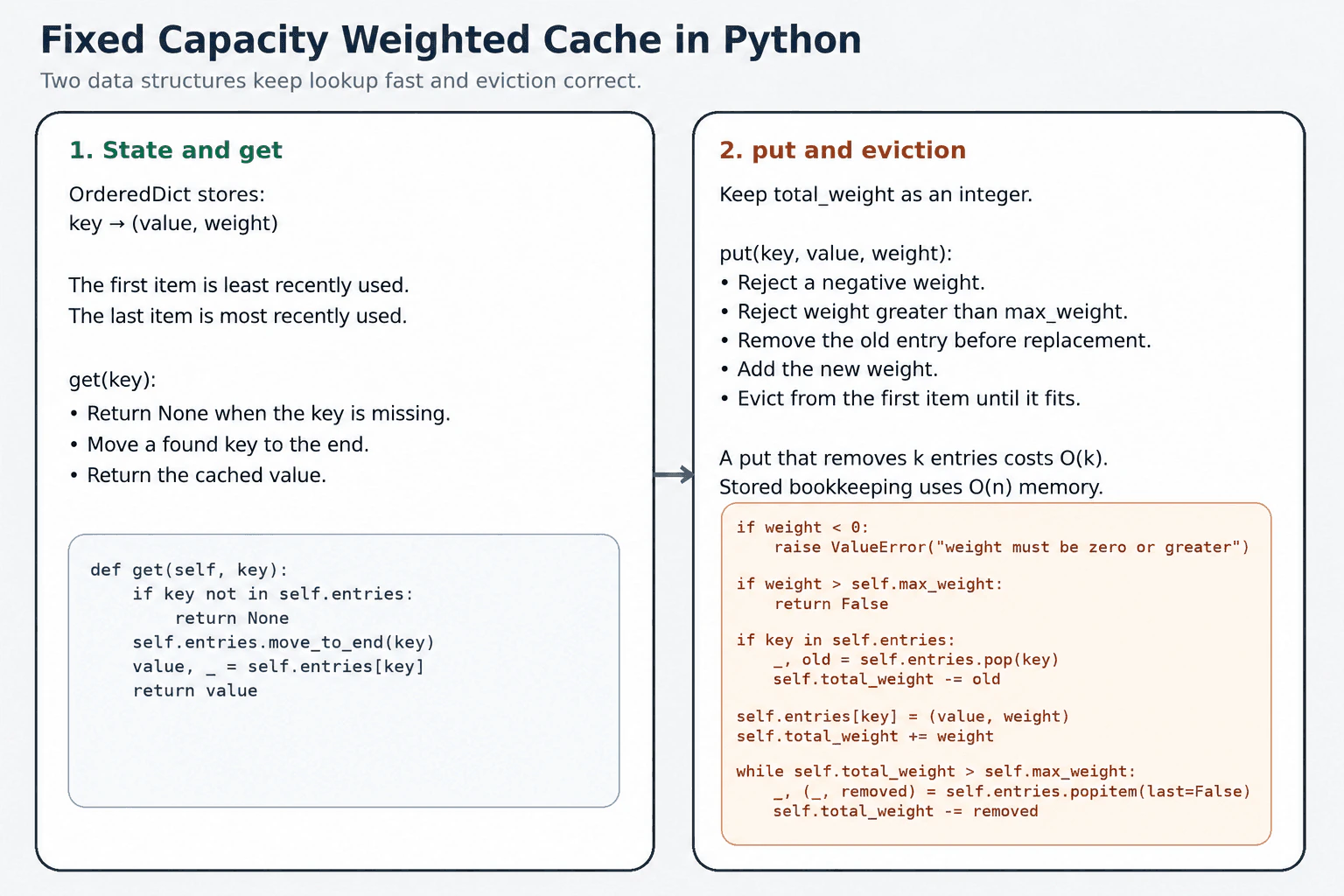
I would use collections.OrderedDict for key lookup and least recently used ordering, plus an integer that tracks the total stored weight. A successful get moves the key to the most recently used end. A put validates the weight, replaces any old entry, updates the total, and removes least recently used entries until the cache fits. Lookup and order updates are constant time on average. One put may remove several entries, so its immediate cost depends on the number of evictions.
I would store each key in an OrderedDict with its value and weight, and keep a separate total_weight integer. The first item is the least recently used entry, and the last item is the most recently used entry.
Useful Questions to Ask the Interviewer
Should I focus on Python language behavior, or also explain the runtime and standard library?
Which Python version and execution environment should I assume?
Would you like a small code example together with production tradeoffs and edge cases?
A successful get moves the key to the end with move_to_end. A missing key returns None. A put rejects a negative weight and rejects an item that is heavier than the full limit. It then removes any old version of the key, subtracts its old weight, inserts the replacement, and adds the new weight. If the total becomes too large, popitem with last set to False removes old entries until the cache fits.
Lookup, insertion, deletion, and moving an existing key are constant time on average. A put that evicts k entries takes O(k) time. The cache uses O(n) bookkeeping memory for n entries and also keeps references to all cached keys and values.
Mutable values can grow after insertion, so stored weights may become stale. Zero weight entries can grow without affecting the limit. Shared access needs a lock because get and put both change cache state.
Example
The implementation uses one OrderedDict named entries. Each key maps to a tuple containing the value and its recorded weight. The current total is stored in total_weight. A successful get moves its key to the end, which marks it as most recently used. A put first validates the supplied weight. An item heavier than max_weight is rejected before existing state is changed. When a key is updated, the old entry is removed and its old weight is subtracted before the replacement is inserted. If the cache becomes too heavy, popitem with last equal to False repeatedly removes entries from the least recently used end. The method returns None for a missing key and returns True or False from put to show whether the item was accepted. Because None can also be a cached value, callers that need to distinguish a miss from a stored None value should use a separate membership method or a unique sentinel. The recorded weight does not update automatically when a mutable value changes.
Code
from collections import OrderedDict
from typing importGeneric, Optional, TypeVar
K = TypeVar("K")
V = TypeVar("V")
classWeightedLRUCache(Generic[K, V]):
"""A least recently used cache limited by total entry weight."""def__init__(self, max_weight: int) -> None:
# The total weight limit must be zero or greater.if max_weight < 0:
raise ValueError("max_weight must be zero or greater")
self.max_weight = max_weight
self.total_weight = 0# Each key maps to a tuple containing the value and its weight.# The first item is least recently used.# The last item is most recently used.self.entries: OrderedDict[K, tuple[V, int]] = OrderedDict()
defget(self, key: K) -> Optional[V]:
"""Return the value and mark the key as most recently used."""if key notinself.entries:
returnNone# Move the accessed key to the most recently used end.self.entries.move_to_end(key)
value, _ = self.entries[key]
return value
defput(self, key: K, value: V, weight: int) -> bool:
"""Store an entry and evict old entries until the weight fits."""if weight < 0:
raise ValueError("weight must be zero or greater")
# Reject an entry that can never fit in the cache.# This check happens before an existing value is changed.if weight > self.max_weight:
returnFalse# Remove the old version before adding the replacement.if key inself.entries:
_, old_weight = self.entries.pop(key)
self.total_weight -= old_weight
# Add the new entry at the most recently used end.self.entries[key] = (value, weight)
self.total_weight += weight
# Remove least recently used entries until the limit is met.whileself.total_weight > self.max_weight:
_, (_, removed_weight) = self.entries.popitem(last=False)
self.total_weight -= removed_weight
returnTruedef__contains__(self, key: K) -> bool:
"""Return whether the key is present without changing recency."""return key inself.entries
def__len__(self) -> int:
"""Return the number of cached entries."""returnlen(self.entries)
if __name__ == "__main__":
cache = WeightedLRUCache[str, str](max_weight=10)
cache.put("a", "alpha", 4)
cache.put("b", "beta", 3)
cache.put("c", "gamma", 3)
# Accessing a makes it the most recently used entry.print(cache.get("a"))
# Adding d raises the total weight to 15.# The cache removes b and c, which are the oldest entries.
cache.put("d", "delta", 5)
print(cache.get("b"))
print(cache.get("c"))
print(cache.get("a"))
print(cache.get("d"))
print(cache.total_weight)
Where it is used
A weighted cache is useful when cached objects have very different sizes or costs. Examples include decoded images, serialized responses, compiled templates, database query results, and machine learning objects. A simple item count treats a small object and a large object as equal, while a weight limit gives better control over retained memory or another limited resource.
Why Interviewers Ask This
Interviewers ask this question to test whether the candidate can combine Python mapping behavior with an ordered eviction policy. They are evaluating accurate weight accounting, average constant time lookup, safe replacement of existing keys, handling of oversized entries, and awareness of memory retention, mutable values, concurrency, and production limits.
Common interview mistakes
Common mistakes include evicting by item count instead of total weight, forgetting to subtract the old weight when replacing a key, and failing to update recency after get. Another mistake is removing an existing value before checking whether its replacement is too heavy to fit. Some implementations scan a normal dictionary to find an eviction target, which makes eviction slow. It is also wrong to assume recorded weight changes automatically when a mutable value grows. Allowing unlimited zero weight entries can cause real memory growth even though total_weight stays within the limit. A missing key and a cached None value are also indistinguishable when get returns None unless the caller checks membership separately.
Interview tip
State the eviction rule first. Then explain the two pieces of state: an OrderedDict for lookup and recency, and an integer for total weight. Walk through a key replacement and a put that evicts several entries. Finish with the O(k) eviction cost, O(n) bookkeeping memory, retained object memory, stale weight risk, zero weight limitation, and thread safety requirement.
Interviewer may ask next
What happens when one entry is heavier than the entire cache limit?
The put operation rejects that entry and returns False before changing the cache. The entry can never fit, even after every other item is removed. Checking this first matters when the same key already exists because the valid old value should not be lost after an invalid replacement attempt. Raising an exception would also be a valid contract, but the chosen behavior must be documented and consistent.
How would you make this weighted cache safe for concurrent threads?
I would protect get, put, membership checks that must be coordinated with later changes, and other state changing methods with a threading.RLock. The lock must cover the OrderedDict operation and total_weight update as one critical section because those pieces of state must remain consistent. This adds synchronization cost and can reduce parallel throughput, but it prevents races caused by interleaved accesses, replacements, and evictions. Under heavy contention, partitioning can improve throughput, but each partition then has its own weight budget and eviction order.
8. How would you write and run unit tests during a Python live-coding interview without a debugger?Language SpecificMediumNetflix
i Question Details
Explain how to structure small tests, isolate edge cases, use assertions and targeted print output, and avoid hiding failures.
Short Interview Answer (30-60 seconds)
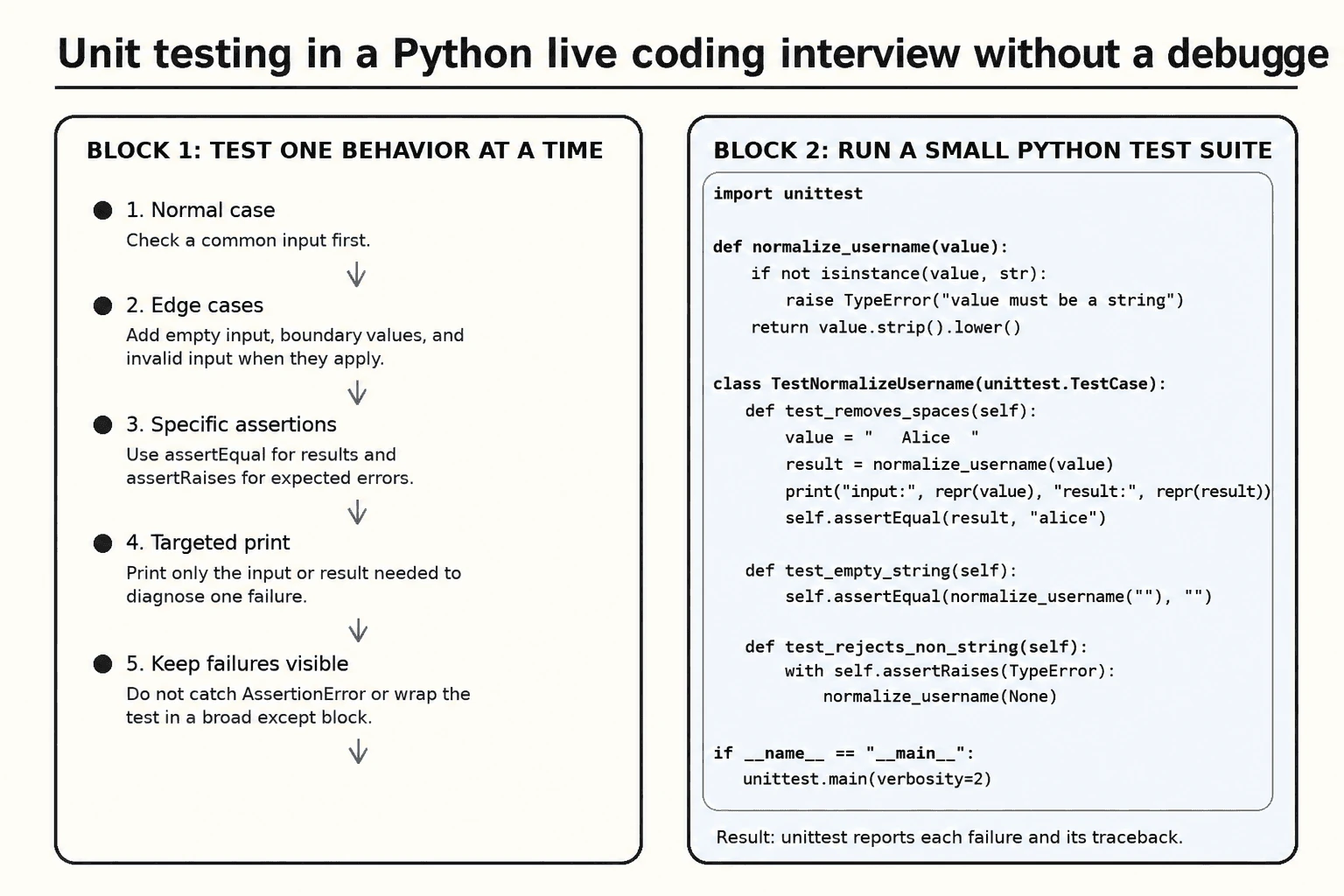
I would write a few small tests that each check one behavior, then run them after every meaningful code change. I would start with a normal case, then test boundary, empty, and invalid inputs when they apply. I would use specific assertions such as assertEqual and assertRaises. When a failure is unclear, I would add one temporary print for the relevant input and result, but I would keep the assertion so the test still fails visibly.
I would create small tests before changing too much code. Each test should verify one clear behavior. I would begin with a normal input, then add empty input, boundary values, and invalid input when they apply. Python includes the unittest module, which provides test cases and assertions such as assertEqual, assertTrue, and assertRaises. When an assertion fails, the test runner marks the test as failed and shows the test name, failure details, and traceback. This gives useful evidence even without a debugger.
Useful Questions to Ask the Interviewer
Should I focus on Python language behavior, or also explain the runtime and standard library?
Which Python version and execution environment should I assume?
Would you like a small code example together with production tradeoffs and edge cases?
I would run the tests after each meaningful change with unittest.main. I would use descriptive test names so the failing behavior is easy to identify. When the cause is still unclear, I would add one temporary print near the relevant value. The print should show only the input, intermediate value, or result needed for diagnosis. It must not replace the assertion.
I would not catch AssertionError or place a broad except block around a test. That can hide a real failure and make incorrect code appear successful. In production, I would keep tests deterministic, remove temporary prints, and run the same suite in automated checks.
Example
The example tests a function that normalizes a username. Each test method checks one behavior. The first test checks normal text. The second checks surrounding spaces. The third checks the empty string case. The fourth verifies that a value that is not a string raises TypeError. One temporary print shows the input and result for focused diagnosis, while assertEqual still decides whether the test passes. unittest.main runs the tests and reports failures with tracebacks. No exception handler catches assertion failures, so an incorrect result remains visible. The function processes the input text and creates normalized string values, but this cost belongs to the function being tested rather than to the testing technique itself.
Code
import unittest
defnormalize_username(value):
# Reject values that are not strings.ifnotisinstance(value, str):
raise TypeError("value must be a string")
# Remove surrounding spaces and convert letters to lowercase.return value.strip().lower()
classTestNormalizeUsername(unittest.TestCase):
# Check the normal input case.deftest_converts_letters_to_lowercase(self):
self.assertEqual(normalize_username("Alice"), "alice")
# Check that surrounding spaces are removed.deftest_removes_surrounding_spaces(self):
value = " Alice "
result = normalize_username(value)
# Add this focused print only while diagnosing a failure.print("input:", repr(value), "result:", repr(result))
# Keep the assertion so an incorrect result still fails visibly.self.assertEqual(result, "alice")
# Check the empty string case.deftest_empty_string(self):
self.assertEqual(normalize_username(""), "")
# Check invalid input behavior.deftest_rejects_value_that_is_not_a_string(self):
withself.assertRaises(TypeError):
normalize_username(None)
if __name__ == "__main__":
# Run all discovered tests and show each test result.
unittest.main(verbosity=2)
Where it is used
This approach is used when testing utility functions, validation logic, data transformations, API helpers, and bug fixes. Small focused tests are also useful in continuous integration because a failure points to one behavior instead of reporting a vague problem across several operations.
Why Interviewers Ask This
Interviewers ask this question to see whether a candidate can verify Python code in a disciplined way under time pressure. They evaluate test structure, assertion choice, edge case reasoning, failure diagnosis, and whether the candidate keeps failures visible instead of masking them with exception handling.
Common interview mistakes
Common mistakes include putting several behaviors in one test, checking only the normal case, using vague assertions, and giving tests unclear names. Another mistake is printing values without asserting the expected result. Candidates may also catch AssertionError or use a broad except block, which can hide failures. Temporary prints should be focused and removed after the cause is understood. Tests should also avoid dependence on random values, shared mutable state, network access, or execution order unless those dependencies are controlled.
Interview tip
Explain the test order before writing code. State the expected behavior, add one small test, run it, and use the failure message as evidence. Mention that prints help diagnosis, but assertions decide success or failure.
Interviewer may ask next
What happens if a test catches AssertionError and does not raise it again?
The test can appear to pass even though an assertion failed. Catching AssertionError removes the failure signal unless the exception is raised again or the test explicitly calls self.fail. This matters because the test runner relies on an uncaught assertion failure to mark the test as failed. The safe choice is to let assertion failures reach the runner.
When would you choose pytest instead of unittest in production?
I would choose pytest when the project already uses it or when concise assertions, fixtures, and parameterized tests make the suite easier to maintain. The testing strategy stays the same: use small tests, cover edge cases, keep failures visible, and use focused diagnostic output. The tradeoff is that pytest adds an external dependency, while unittest is part of the Python standard library and is usually available during a live coding interview.
9. Explain concurrency and reliability tradeoffs in Python services.Language SpecificHardNetflix
i Question Details
Discuss thread safety, synchronization, retries, duplicate work, idempotency, failure recovery, and how Python execution models affect the implementation.
Short Interview Answer (30-60 seconds)
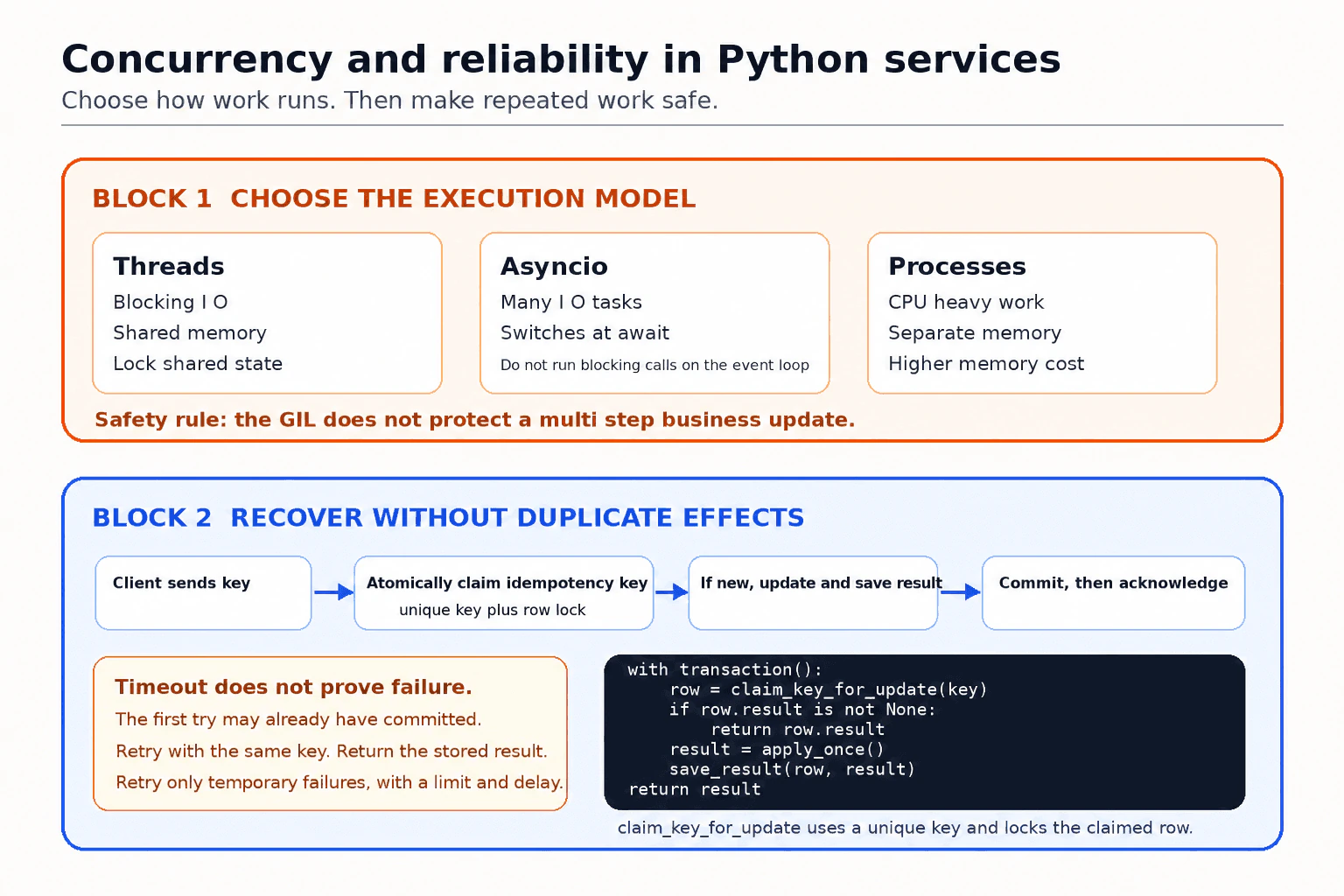
I choose the Python execution model from the workload, but I design correctness separately. Threads are useful for blocking input and output work. Asyncio is useful for many cooperative network tasks. Processes are usually the safer default for CPU intensive Python work when true parallel execution is needed. In a normal CPython build, the GIL limits Python bytecode execution, but it does not make compound updates thread safe. Free threaded CPython builds can run threads in parallel, which makes explicit synchronization even more important. For reliability, I use timeouts, limited retries, idempotency keys, transactions, durable queues, and restart safe workers because a timeout or crash can cause the same operation to run more than once.
Detailed Explanation
The practical rule is to choose concurrency for throughput and design reliability for repeated execution. Threads share memory and work well with blocking input and output libraries. In a normal CPython build, the GIL usually allows one thread to execute Python bytecode at a time, but a compound read, change, and write operation can still interleave. Shared mutable state therefore needs a Lock, Queue, transaction, or ownership rule. Free threaded CPython builds can execute Python threads in parallel, so code must not depend on the GIL for safety.
Useful Questions to Ask the Interviewer
Should I focus on Python language behavior, or also explain the runtime and standard library?
Which Python version and execution environment should I assume?
Would you like a small code example together with production tradeoffs and edge cases?
Asyncio runs tasks cooperatively on an event loop. It works well when tasks await nonblocking operations. A slow blocking call can stop progress for other tasks on that loop. Processes provide separate memory and can use multiple CPU cores, but they add memory use, process startup, and data transfer costs.
Reliability requires assuming that work may run again. A timeout does not prove that the first attempt failed. I retry only temporary failures, apply a limit and delay, and use an idempotency key for state changes. The service stores the key and result durably in the same transaction as the business update. Durable queues, acknowledgements after commit, and restart safe workers allow recovery without creating duplicate effects.
Where it is used
These choices are used in web APIs, background job systems, media processing, data pipelines, notification services, and clients that call remote services. Threads often support blocking database or network libraries. Asyncio often supports many concurrent sockets or service calls. Processes often handle CPU intensive parsing, encoding, compression, or computation. Idempotency and durable recovery are important for payments, account updates, job queues, and any operation where a client or worker may repeat a request after a timeout or crash.
Why Interviewers Ask This
Interviewers ask this question to test whether a candidate can connect Python execution behavior with reliable service design. They are evaluating knowledge of threads, asyncio, processes, shared state, synchronization, retries, duplicate execution, idempotency, and crash recovery. They also want practical judgment about choosing an execution model and protecting data when failures happen at uncertain times.
Common interview mistakes
Common mistakes include treating the GIL as a lock for application state, depending on behavior that changes in a free threaded build, and protecting only one step of a multi step invariant. Other mistakes include using a normal in memory dictionary as durable duplicate protection, using a threading lock between separate processes, calling blocking code directly on an asyncio event loop, and sharing an asyncio lock across threads. Reliability mistakes include retrying permanent errors, retrying without a limit, assuming a timeout means no work completed, acknowledging a queue message before data commits, and storing the idempotency record separately from the business update. These errors can cause races, blocked event loops, lost work, or duplicate effects.
Interview tip
Start with the workload choice, then separate concurrency from correctness. Compare threads, asyncio, and processes in a few sentences. State that the GIL is not an application synchronization mechanism and mention free threaded CPython. Finish with one concrete failure case: a request times out after the server commits, the client retries, and an idempotency key plus one transaction prevents a duplicate update.
Interviewer may ask next
Does an asyncio service need synchronization if its tasks normally run on one thread?
Yes. Asyncio tasks can interleave whenever code awaits, so a multi step update can still observe stale state or violate an invariant. The exact behavior is cooperative task switching rather than operating system thread switching. Protect the full critical section with an asyncio Lock, avoid awaiting while an invariant is partly updated, or give one task ownership of the mutable state. This matters because single thread execution does not make a sequence of operations automatically atomic. The tradeoff is added coordination and possible waiting between tasks.
When should a service use processes instead of threads for Python work?
Use processes when the work is CPU intensive and must use multiple cores reliably across standard CPython deployments. Separate processes bypass one process GIL and isolate memory, but values sent between them usually need serialization. This matters because serialization, process startup, extra memory, and result transfer can cost more than the computation for small tasks. Threads are often cheaper for blocking input and output, while a free threaded CPython build may also provide parallel threads when its dependencies support that mode. The main tradeoff is stronger CPU parallelism and isolation in exchange for higher memory and communication cost.
10. How would you test Python code for race conditions?Language SpecificHardNetflix
i Question Details
Discuss unit tests, concurrent stress tests, reproducible scheduling techniques, logging, assertions, and tools that help validate a thread-safe Python implementation.
Short Interview Answer (30-60 seconds)
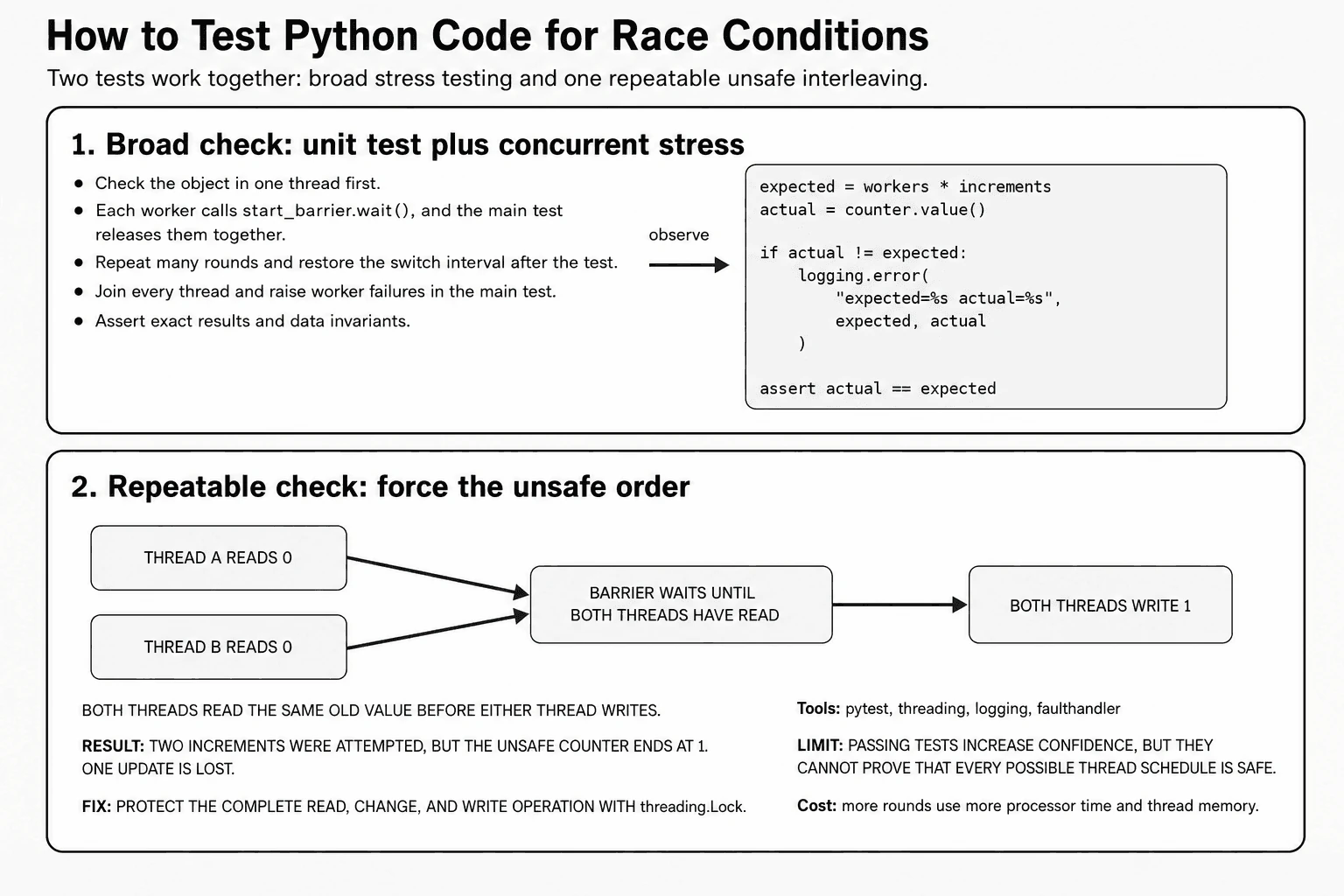
I would combine normal unit tests, repeated concurrent stress tests, and controlled scheduling tests. I would start workers together with a Barrier, use Events, Barriers, or test hooks to force risky execution orders, capture worker exceptions, log useful context, and assert exact results and invariants. The Python interpreter lock does not make a complete read, change, and write sequence automatically thread safe. Passing tests increase confidence, but they cannot prove that every possible schedule is safe.
I would test race conditions in three layers. First, I would write normal unit tests for the shared object in one thread. This confirms its rules before concurrency makes failures harder to diagnose.
Useful Questions to Ask the Interviewer
Should I focus on Python language behavior, or also explain the runtime and standard library?
Which Python version and execution environment should I assume?
Would you like a small code example together with production tradeoffs and edge cases?
Next, I would run many threads against the same object. A Barrier can release the workers together. Repeating the test and temporarily reducing the thread switch interval creates more chances for operations to overlap. Every worker exception must be collected and reported in the main test thread.
I would assert exact results and important invariants. For a counter, the final value must equal the number of completed increments. For a collection, its keys, size, and related totals must remain consistent.
For known risky orders, I would use Events, Barriers, or test hooks to pause execution at a specific point. This makes an unsafe interleaving reproducible instead of depending on luck. Logging should include the round, thread name, operation, and observed state. Pytest can organize the tests, while logging and faulthandler can help diagnose hangs or failures. Stress tests use more processor time and memory for threads, and they cannot explore every schedule. I would run fast checks on each change and larger repeated tests in continuous integration.
Example
The code uses one safe counter and one deliberately unsafe counter. The safe counter protects its complete update with threading.Lock. Its basic test checks normal behavior. Its stress test creates eight workers, releases them together with a Barrier, and makes each worker perform twenty thousand increments. Worker exceptions are captured and raised in the main thread. The thread switch interval is temporarily reduced and then restored. After every round, the final value must equal the exact expected value.
The controlled test uses the unsafe counter with a test hook. Two threads read the same value and then wait at a Barrier before either writes. Both threads therefore write the same next value, so one update is lost. The assertion confirms the reproducible failure. This example covers unit tests, concurrent stress, controlled scheduling, logging, exception handling, and invariant checks. It increases confidence in the safe implementation but does not claim to explore every possible schedule.
Code
import logging
import sys
import threading
from collections.abc importCallable# Include the thread name in each diagnostic message.
logging.basicConfig(
level=logging.INFO,
format="%(asctime)s %(threadName)s %(levelname)s %(message)s",
)
classThreadSafeCounter:
"""A counter whose complete update is protected by one lock."""def__init__(self) -> None:
self._value = 0self._lock = threading.Lock()
defincrement(self) -> None:
# Protect the complete read, change, and write operation.withself._lock:
self._value += 1defvalue(self) -> int:
# Read under the same lock to obtain a consistent value.withself._lock:
returnself._value
classHookedUnsafeCounter:
"""An unsafe counter with a hook used only by the controlled test."""def__init__(self, after_read: Callable[[], None]) -> None:
self.value = 0self._after_read = after_read
defincrement(self) -> None:
# Read the shared value without synchronization.
old_value = self.value
# Let the test pause both threads after they read the same value.self._after_read()
# Write without synchronization, which can lose an update.self.value = old_value + 1deftest_basic_behavior() -> None:
"""Check normal behavior before testing concurrency."""
counter = ThreadSafeCounter()
counter.increment()
counter.increment()
assert counter.value() == 2defrun_concurrent_round(
worker_count: int = 8,
increments_per_worker: int = 20_000,
) -> None:
"""Start workers together and verify the exact final value."""
counter = ThreadSafeCounter()
start_barrier = threading.Barrier(worker_count + 1)
worker_errors: list[BaseException] = []
error_lock = threading.Lock()
defworker() -> None:
try:
# Wait until every worker has been created.
start_barrier.wait()
# Update the same shared counter many times.for _ inrange(increments_per_worker):
counter.increment()
except BaseException as error:
# Save the failure so the main thread can report it.with error_lock:
worker_errors.append(error)
threads = [
threading.Thread(target=worker, name=f"worker_{index}") for index inrange(worker_count)
]
for thread in threads:
thread.start()
# Release all workers after they reach the starting barrier.
start_barrier.wait()
for thread in threads:
thread.join()
if worker_errors:
raise RuntimeError("A worker thread failed") from worker_errors[0]
expected = worker_count * increments_per_worker
actual = counter.value()
if actual != expected:
logging.error(
"Counter mismatch. expected=%s actual=%s",
expected,
actual,
)
# The exact final value is the main invariant for this counter.assert actual == expected
deftest_concurrent_stress(rounds: int = 10) -> None:
"""Repeat the safe counter test under frequent thread switching."""
original_interval = sys.getswitchinterval()
try:
# Encourage more scheduling changes during the stress test.
sys.setswitchinterval(0.000001)
for round_number inrange(1, rounds + 1):
logging.info("Starting stress round %s", round_number)
run_concurrent_round()
finally:
# Restore the process setting even if an assertion fails.
sys.setswitchinterval(original_interval)
deftest_reproducible_lost_update() -> None:
"""Force two unsafe increments to read before either one writes."""
after_read_barrier = threading.Barrier(2)
worker_errors: list[BaseException] = []
error_lock = threading.Lock()
defpause_after_read() -> None:
# Both workers must finish their read before either can write.
after_read_barrier.wait()
counter = HookedUnsafeCounter(after_read=pause_after_read)
defworker() -> None:
try:
counter.increment()
except BaseException as error:
with error_lock:
worker_errors.append(error)
threads = [
threading.Thread(target=worker, name="forced_first"),
threading.Thread(target=worker, name="forced_second"),
]
for thread in threads:
thread.start()
for thread in threads:
thread.join()
if worker_errors:
raise RuntimeError("A controlled worker failed") from worker_errors[0]
# Two increments were attempted, but both wrote the value one.assert counter.value == 1if __name__ == "__main__":
test_basic_behavior()
test_concurrent_stress()
test_reproducible_lost_update()
print("All race condition tests passed.")
Where it is used
This approach is useful for shared caches, counters, connection pools, job queues, rate limit state, session stores, in memory indexes, and background worker coordination. It is especially important when several threads update the same object or when Python code calls input and output operations or native libraries that may allow another thread to run.
Why Interviewers Ask This
Interviewers want to see whether the candidate understands how shared Python state can become incorrect when threads interleave operations. They also evaluate whether the candidate can design repeatable tests, define meaningful invariants, expose worker failures, diagnose concurrency problems, and avoid treating one successful run as proof of thread safety.
Common interview mistakes
Common mistakes include running only one concurrent test, checking only that no exception occurred, and using random sleep calls as the main scheduling method. Another mistake is assuming that the Python interpreter lock makes every shared operation atomic. Developers may also check only the final result while ignoring other broken invariants, forget to join threads, lose exceptions raised inside workers, change the global thread switch interval without restoring it, or create controlled tests that do not actually force the intended execution order. A passing stress test is evidence, not proof that no race exists.
Interview tip
Explain the strategy in layers. Start with unit tests, then synchronized stress tests, then controlled schedules, logging, worker exception handling, and invariant checks. State clearly that Python thread scheduling is not fully deterministic and that repeated passing tests cannot prove the absence of every race.
Interviewer may ask next
Does the Python interpreter lock prevent race conditions in this counter?
No. The Python interpreter lock does not protect the complete logical read, change, and write operation as one guaranteed critical section. Code should not depend on incidental interpreter behavior. The explicit threading.Lock protects the complete counter update. This matters because an implementation that appears safe in a simple run may fail under another schedule or runtime configuration.
How would you balance race condition coverage against test execution cost?
I would use two test levels. A small number of fast stress rounds and controlled Barrier or Event based tests would run on each change. A larger suite with more workers, operations, and repetitions would run in continuous integration or on a schedule. More repetitions increase the chance of exposing rare interleavings, but they also use more processor time, create more thread memory overhead, and extend the test run. Controlled tests should cover known risky schedules so the project does not depend only on expensive stress testing.
More questions load as you scroll
Python Developer Resume Examples
Explore the resume examples below to find the one that best matches your target Python Developer role.
Disclaimer: This interview guide is for educational and informational purposes only. It is designed to help readers prepare, but it does not guarantee any interview result, hiring decision, offer, or outcome. Interview questions, hiring criteria, and preferred answers can vary by employer, interviewer, industry, location, and time. All answers, examples, and explanations in this guide are suggested examples for interview preparation, not definitive answers or instructions for professional practice. They are based on research and judgment, are provided without warranties of any kind, and should be adapted to the question, role, and applicable laws and professional requirements. Diagrams are simplified illustrations intended to highlight the main concepts and their relationships; actual situations, systems, and practices may be more complex. Alternative approaches may be equally valid or better suited to a particular question, context, or interviewer. To the fullest extent permitted by applicable law, the contributors and publisher are not liable for decisions made, actions taken, or losses incurred based on this guide.
State Laws and Professional Responsibilities: Laws and requirements governing an occupation vary by state and jurisdiction. You are responsible for checking the current laws, licensing requirements, and scope-of-practice rules that apply to your location and role, and for ensuring that your answers and actions comply with them. Adapt examples in this guide to those requirements. This guide is not legal advice.
Company Notice: This guide is an independent educational resource and is not affiliated with, endorsed by, sponsored by, or approved by the company named in this guide. Company names identify reported interview experiences or the employer context of clearly labeled original practice exercises. Interview practices can change without notice, and inclusion of company-specific content does not mean these questions are official, complete, or guaranteed to be asked. To the fullest extent permitted by law, the author, contributors, and publisher are not responsible for outcomes related to use of this material.
Content Accuracy and Verification: To the fullest extent permitted by applicable law, we do not represent or warrant that interview guides, questions, answers, examples, or diagrams are accurate, complete, current, error-free, or suitable for any particular purpose. You are responsible for independently reviewing and verifying the information before relying on it.