This interview guide is for educational and informational purposes only. It is designed to help readers prepare, but it does not guarantee any interview result, hiring decision, offer, or outcome. Interview questions, hiring criteria, and preferred answers can vary by employer, interviewer, industry, location, and time. All answers, examples, and explanations in this guide are suggested examples for interview preparation, not definitive answers or instructions for professional practice. They are based on research and judgment, are provided without warranties of any kind, and should be adapted to the question, role, and applicable laws and professional requirements. Diagrams are simplified illustrations intended to highlight the main concepts and their relationships; actual situations, systems, and practices may be more complex. Alternative approaches may be equally valid or better suited to a particular question, context, or interviewer. To the fullest extent permitted by applicable law, the contributors and publisher are not liable for decisions made, actions taken, or losses incurred based on this guide.
State Laws and Professional Responsibilities
Laws and requirements governing an occupation vary by state and jurisdiction. You are responsible for checking the current laws, licensing requirements, and scope-of-practice rules that apply to your location and role, and for ensuring that your answers and actions comply with them. Adapt examples in this guide to those requirements. This guide is not legal advice.
Identity, Image, and Privacy Notice
To respect individual privacy, some names, profile photographs, avatars, biographical details, and other identifying information displayed in this guide may be replaced with pseudonyms, licensed stock images, illustrative avatars, composite images, or representative descriptions. Unless a person is expressly identified as an actual contributor, a displayed name, image, or profile should not be understood as depicting or identifying a specific candidate, interviewer, employee, or other real individual. These representations are provided for editorial and illustrative purposes only and do not imply endorsement, employment, participation, or affiliation with this guide or any company mentioned in it. Any resemblance to an actual person is coincidental.
Company Notice
This guide is an independent educational resource and is not affiliated with, endorsed by, sponsored by, or approved by the company named in this guide. Company names identify reported interview experiences or the employer context of clearly labeled original practice exercises. Interview practices can change without notice, and inclusion of company-specific content does not mean these questions are official, complete, or guaranteed to be asked. To the fullest extent permitted by law, the author, contributors, and publisher are not responsible for outcomes related to use of this material.
Content Accuracy and Verification
To the fullest extent permitted by applicable law, we do not represent or warrant that interview guides, questions, answers, examples, or diagrams are accurate, complete, current, error-free, or suitable for any particular purpose. You are responsible for independently reviewing and verifying the information before relying on it.
Questions or comments?
Contact us for general questions, or share feedback, technical corrections, and comments with the community.
1. How would you use Python to find the median of a very large dataset without loading everything into memory?Language SpecificMediumApple
i Question Details
Explain Python implementation choices for processing data too large to fit in memory. Discuss streaming, chunking, external storage or partitioning assumptions, memory limits, validation, and complexity tradeoffs.
Short Interview Answer (30-60 seconds)
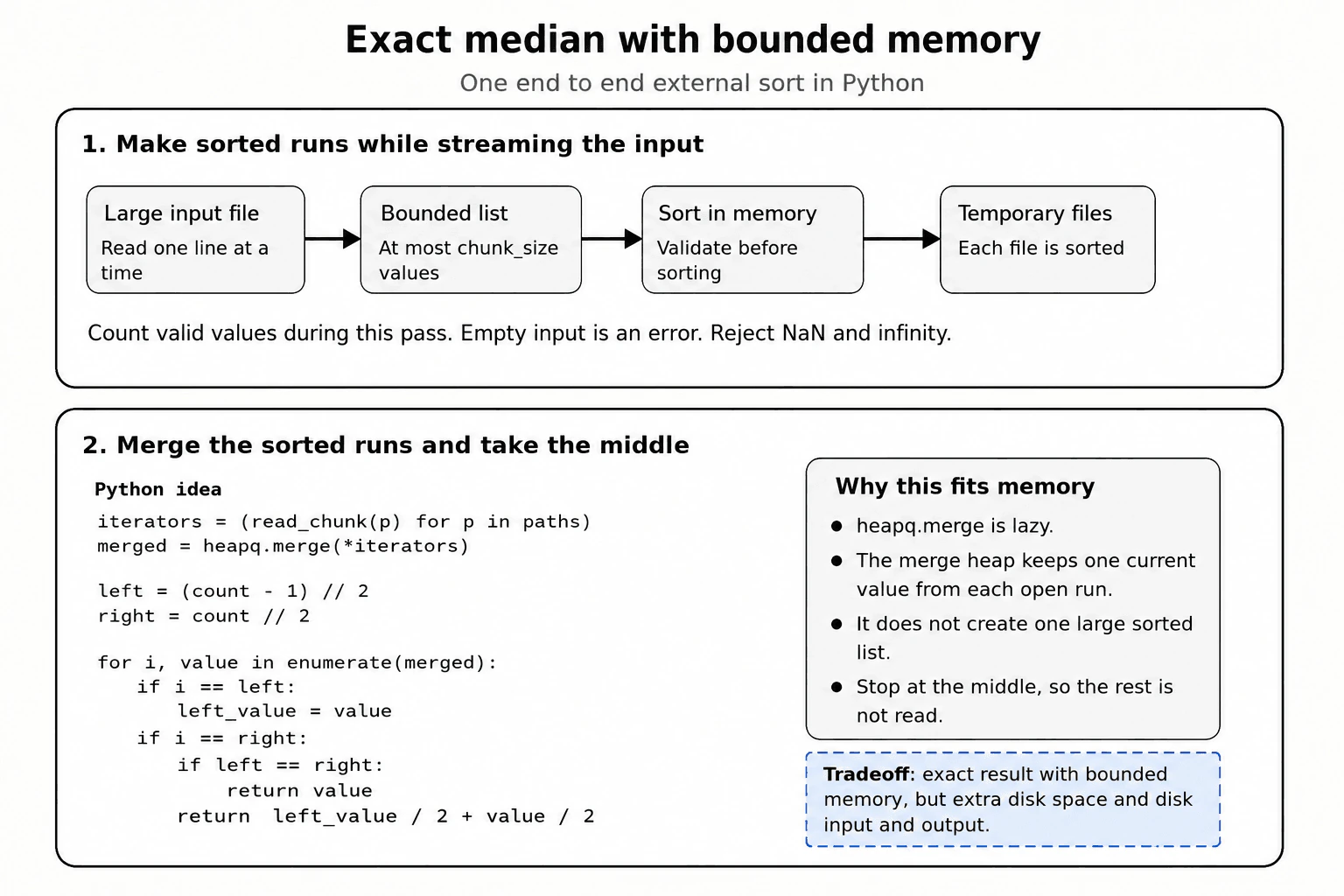
I would use an external sort. I would read a bounded chunk of values, sort that chunk in memory, and write it to a temporary file. After processing the full input and counting the values, I would lazily merge the sorted files with heapq.merge and stop at the middle position. This returns the exact median of the parsed values while keeping memory bounded. The tradeoff is temporary disk space and extra disk input and output.
I would use external sorting because an exact median requires ordered values, while the full dataset does not fit in memory. A Python generator can read values one at a time, but it cannot identify the exact middle value for arbitrary unsorted input by itself.
Useful Questions to Ask the Interviewer
Should I focus on Python language behavior, or also explain the runtime and standard library?
Which Python version and execution environment should I assume?
Would you like a small code example together with production tradeoffs and edge cases?
First, I read a fixed number of values into a list. I validate them, sort the list, and write the sorted values to a temporary file. I repeat this while counting every valid value. The chunk size is chosen from the memory limit.
Next, I create an iterator for each sorted file and pass the iterators to heapq.merge. The merge is lazy. Python keeps only the next candidate from each iterator instead of creating one large sorted list. I stop after reaching the required middle index. For an even count, I average the two middle values.
If there are n values and chunks contain at most m values, chunk sorting costs about n log m time. Merging costs about n log k time, where k is the number of chunk files. Memory is about m values plus the merge heap. The method also needs temporary disk space near the size of the parsed data.
Example
The function assumes the input contains one finite numeric value per nonblank line. It parses each value as a Python float, so the returned result is the exact median of those parsed float values. A different numeric type such as Decimal should be used when the original decimal precision must be preserved. The function stores at most chunk_size values in its main list. It sorts each chunk and writes it to a file inside TemporaryDirectory. It counts all values during the same pass. It then creates lazy iterators for the sorted files and combines them with heapq.merge. For an odd count, it returns the single middle value. For an even count, it averages the two middle values. Empty input, invalid text, NaN, and infinity raise ValueError. TemporaryDirectory removes the temporary files when processing finishes or an exception occurs. This direct merge opens every chunk iterator during merging, so a production version must use multiple merge passes when the chunk count could exceed the operating system file limit.
Code
import heapq
import math
import os
import tempfile
def_write_sorted_chunk(values, directory, index):
# Sort only the current bounded chunk in memory.
values.sort()
# Store the sorted values in a temporary text file.
path = os.path.join(directory, f"chunk_{index}.txt")
withopen(path, "w", encoding="utf-8") as output_file:
for value in values:
output_file.write(f"{value!r}\n")
return path
def_read_sorted_chunk(path):
# Yield one value at a time from one sorted temporary file.withopen(path, "r", encoding="utf-8") as input_file:
for line in input_file:
yieldfloat(line)
defmedian_from_large_file(path, chunk_size=100000):
# A positive chunk size is required for bounded processing.if chunk_size <= 0:
raise ValueError("chunk_size must be greater than zero")
total_count = 0
chunk_paths = []
# All temporary chunk files are removed when this block ends.with tempfile.TemporaryDirectory() as temporary_directory:
current_chunk = []
chunk_index = 0# Read the source file without loading the full dataset.withopen(path, "r", encoding="utf-8") as source_file:
for line_number, line inenumerate(source_file, start=1):
text = line.strip()
# Ignore blank lines.ifnot text:
continuetry:
value = float(text)
except ValueError as error:
raise ValueError(f"Invalid number on line {line_number}: {text!r}") from error
# Reject values that do not have the required finite ordering.ifnot math.isfinite(value):
raise ValueError(f"Non finite number on line {line_number}: {text!r}")
current_chunk.append(value)
total_count += 1# Sort and store the chunk when it reaches the chosen limit.iflen(current_chunk) == chunk_size:
chunk_paths.append(
_write_sorted_chunk(
current_chunk,
temporary_directory,
chunk_index,
)
)
current_chunk = []
chunk_index += 1# Store the last partial chunk.if current_chunk:
chunk_paths.append(
_write_sorted_chunk(
current_chunk,
temporary_directory,
chunk_index,
)
)
if total_count == 0:
raise ValueError("Cannot find the median of an empty dataset")
# Create lazy iterators over the sorted temporary files.
sorted_iterators = (_read_sorted_chunk(chunk_path) for chunk_path in chunk_paths)
# Produce values in global sorted order without one full sorted list.
merged_values = heapq.merge(*sorted_iterators)
left_index = (total_count - 1) // 2
right_index = total_count // 2
left_value = None# Stop as soon as the right middle value is reached.for index, value inenumerate(merged_values):
if index == left_index:
left_value = value
if index == right_index:
if left_index == right_index:
return value
# Divide first to reduce overflow risk for large finite floats.return left_value / 2.0 + value / 2.0raise RuntimeError("Median positions were not reached")
if __name__ == "__main__":
# This example has six values, so the median is the average of 3 and 5.
example_path = "numbers.txt"withopen(example_path, "w", encoding="utf-8") as example_file:
example_file.write("9\n1\n5\n3\n7\n2\n")
print(median_from_large_file(example_path, chunk_size=2))
os.remove(example_path)
Where it is used
This approach is useful for large log exports, sensor readings, transaction files, analytics data, and batch jobs where the source is larger than available memory. It is appropriate when the exact median is required and temporary disk storage is available. For a database source, an indexed database query or database percentile function may be better because the database can perform the ordering close to the stored data.
Why Interviewers Ask This
Interviewers ask this question to test whether the candidate understands that sequential reading alone cannot find an exact median for arbitrary unsorted values. They also want to see sound Python iterator use, bounded memory processing, validation, temporary storage management, and clear judgment about exact and approximate results.
Common interview mistakes
A common mistake is passing a generator to a median function and assuming memory will stay bounded. The function still needs access to all values or an ordered representation. Another mistake is keeping every sorted chunk as a Python list, which removes the memory benefit. It is also incorrect to claim that an exact median of arbitrary unsorted values can always be found in one pass with constant memory and no external storage. Other mistakes include forgetting the even count case, silently accepting NaN, ignoring float precision, choosing a chunk size without measuring memory use, running out of temporary disk space, opening more files than the operating system allows, and failing to clean up temporary files after an error.
Interview tip
Start with the decision to use external sorting for an exact result. Explain the two phases: bounded chunk sorting and lazy merging. State that a generator controls how values are read but does not solve exact median selection by itself. Then mention time cost, memory cost, temporary disk use, numeric precision, validation, file limits, and when an approximate method would be acceptable.
Interviewer may ask next
What would you change if the number of chunk files exceeds the operating system file limit?
I would use multiple merge passes. I would merge a limited group of sorted chunk files into a larger sorted file, close the input files, and repeat until the remaining file count is safe. The ordering and final median remain exact for the parsed values. The main tradeoff is additional disk reading, disk writing, and processing time.
Would you still use external sorting if an approximate median were acceptable?
No, I would usually choose a streaming quantile estimator when a controlled approximation is acceptable. The exact behavior change is that the result becomes an estimate instead of the true middle value. This can greatly reduce temporary disk use and may require only one pass with bounded memory. The tradeoff is approximation error, so the allowed error and confidence requirements must be defined before using it.
2. How would you debug a Python loop-condition bug?Language SpecificEasyApple
i Question Details
Given a Python loop that does not stop or skips expected work, explain how you would inspect the condition, loop variable updates, boundary cases, logging or prints, and tests that prove the fix.
Short Interview Answer (30-60 seconds)
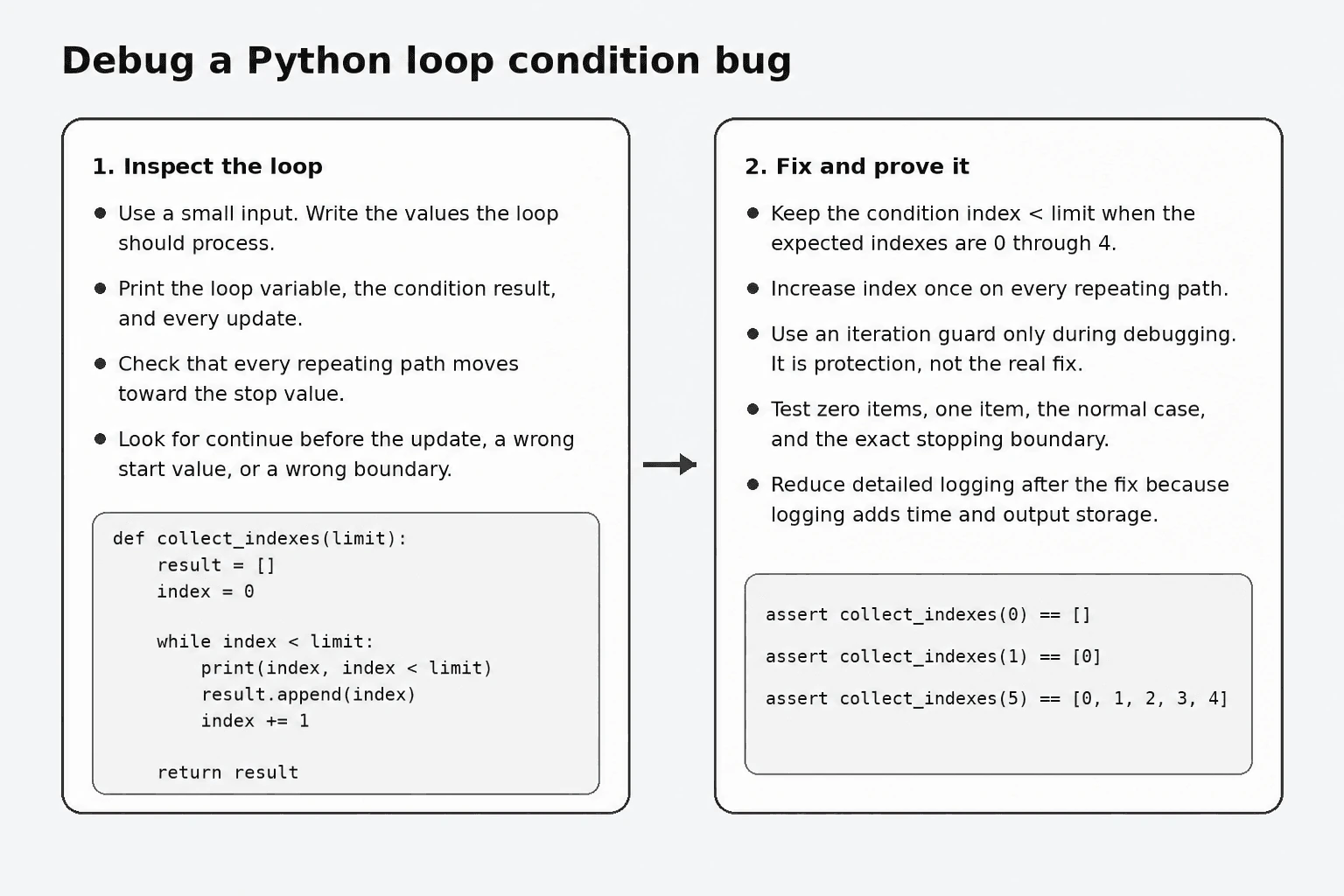
I would first reproduce the bug with the smallest useful input and define the exact values the loop should process. Then I would trace the condition, the loop variable, and every update on each iteration. I would confirm that the condition can become false, check whether continue skips an update, verify the boundary values, make the smallest correct fix, and add tests for empty input, one item, normal input, and the exact stopping point.
I would begin by reproducing the bug with a small input and writing down the expected processed values. Then I would print or log the loop variable, the condition result, and every value changed inside the loop. Python checks a while condition before each iteration. If the condition stays true, or the loop variable does not move toward the stopping value, the loop does not stop.
Useful Questions to Ask the Interviewer
Should I focus on Python language behavior, or also explain the runtime and standard library?
Which Python version and execution environment should I assume?
Would you like a small code example together with production tradeoffs and edge cases?
For example, if the loop should process indexes zero through four, the condition should be index < limit, with limit equal to five. The index must increase once on every repeating path. I would check whether continue runs before that update. If work is skipped, I would inspect the starting value, the comparison operator, and any continue or break statement.
During debugging, I may add an iteration guard so a broken loop fails clearly instead of running forever. The guard is protection, not the actual fix. After correcting the logic, I would test zero items, one item, the normal case, and the final boundary. Detailed logging adds time and output storage cost, so production logging should be limited or sampled after the fix is proven.
Example
The example collects the integers from zero through four when limit is five. Python checks index < limit before every iteration. The current index is recorded, then index increases by one, so the loop state always moves toward termination. The iteration guard raises an error if a future code change prevents normal progress. The assertions prove the zero item case, one item case, normal case, and exact stopping boundary. The loop performs one append for each processed index, so its running time and returned list memory both grow in direct proportion to limit.
Code
defcollect_indexes(limit: int) -> list[int]:
# Reject input outside the supported range.if limit < 0:
raise ValueError("limit must be zero or greater")
# Store each index processed by the loop.
result = []
# Start at the first expected index.
index = 0# Count iterations so a future loop bug fails clearly.
iterations = 0
maximum_iterations = limit + 1# Python checks this condition before every iteration.while index < limit:
# Show the values needed to inspect the loop condition.print(f"index={index}, limit={limit}, condition={index < limit}")
# Perform the expected work for this index.
result.append(index)
# Move the loop variable toward the stopping value.
index += 1# Record completed iterations after progress is made.
iterations += 1# Stop clearly if a future change breaks normal termination.if iterations > maximum_iterations:
raise RuntimeError("loop exceeded the expected iteration count")
return result
# Test zero items.assert collect_indexes(0) == []
# Test one item.assert collect_indexes(1) == [0]
# Test the normal case and exact stopping boundary.assert collect_indexes(5) == [0, 1, 2, 3, 4]
print("All tests passed")
Where it is used
This debugging method is useful for retry loops, service polling, pagination, queue consumers, file processing, and index based data processing. These loops often depend on a counter, status value, page token, or external result changing correctly before execution can stop.
Why Interviewers Ask This
Interviewers ask this question to check whether the candidate understands how Python evaluates loop conditions and how loop state changes during execution. They also want to see a disciplined debugging process that checks termination, boundary values, skipped updates, and tests instead of applying an unsupported change.
Common interview mistakes
Common mistakes include checking only the condition and not the variable update, changing < to <= without defining the expected boundary, updating the wrong variable, using the wrong starting value, and placing the update after a continue statement. Other mistakes include using break to hide the real logic error, adding prints without inspecting the condition result, and testing only a normal input while missing zero items, one item, or the final stopping value.
Interview tip
Explain the process in a fixed order. Define the expected values, trace the condition and state changes, prove that every repeating path makes progress, check the boundaries, apply the smallest fix, and verify it with focused tests.
Interviewer may ask next
What happens if continue runs before the loop variable is updated?
The loop variable is not updated on that iteration. In a while loop, Python returns directly to the condition when continue runs. If the same condition remains true and execution keeps taking that path, the loop can run forever. This matters because the loop has no guaranteed progress. The fix is to update the required state before continue or restructure the loop so every repeating path moves toward termination.
When would you replace this while loop with a for loop?
I would replace it with a for loop when the work is based on a known range or iterable. For example, for index in range(limit) advances through zero to limit minus one without a manual counter update. This removes one common source of termination bugs. A while loop is still appropriate when stopping depends on changing state, such as a retry result or queue status. The tradeoff is that a for loop is safer for fixed iteration, while a while loop gives more control for state based termination.
3. How would you generate test inputs during a Python CoderPad interview?Language SpecificEasyApple
i Question Details
Explain how you would create small, edge-case-focused test inputs while coding in Python, including normal cases, empty input, boundary values, malformed input, and how you would use the tests to catch mistakes.
Short Interview Answer (30-60 seconds)
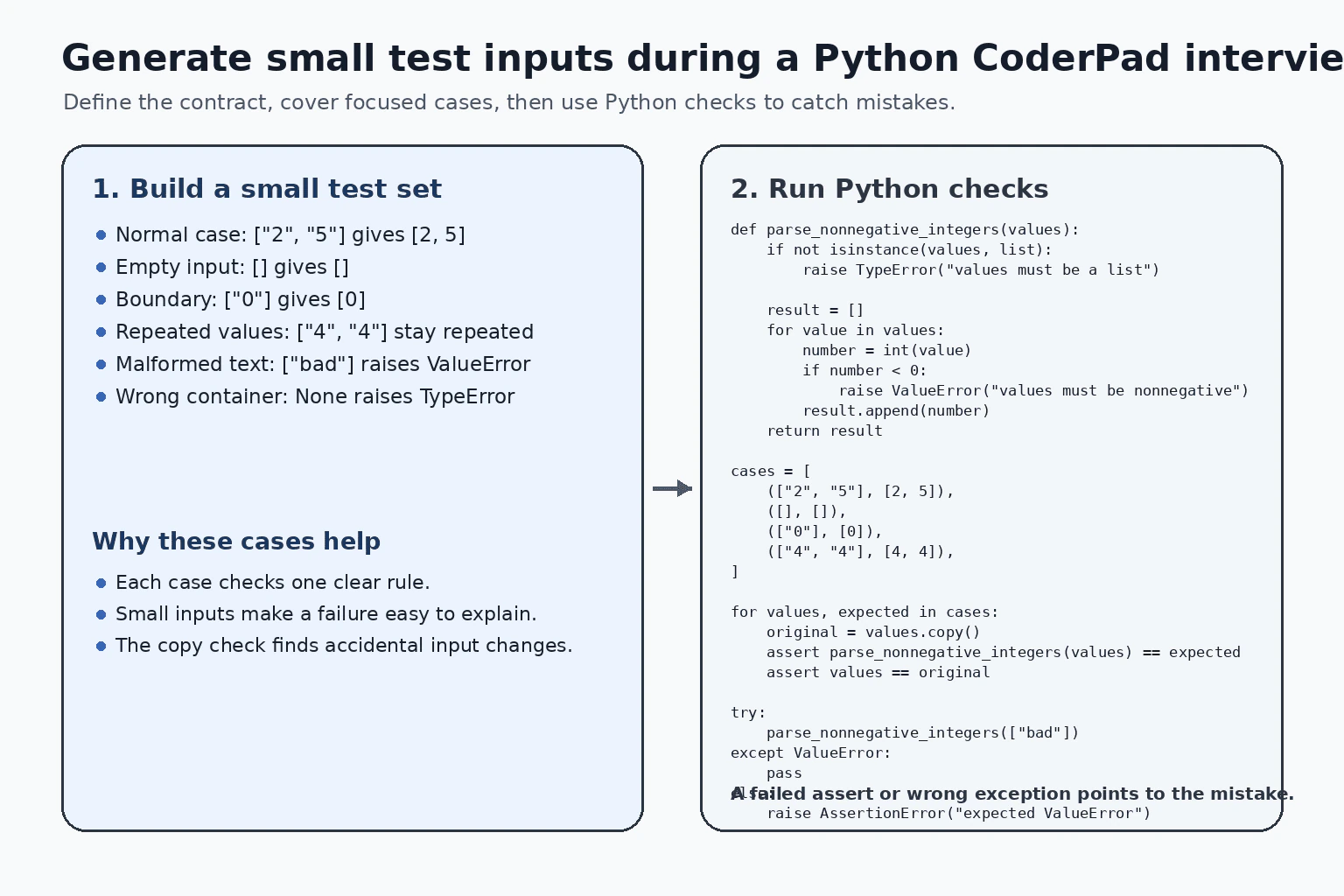
I would first define the input contract and expected behavior. Then I would create a small set of focused cases: one normal case, empty input, boundary values, values just outside the boundary, repeated values when relevant, and malformed input. In Python, I would use assert for expected results and try with except when an exception is expected. I would keep each case small so a failure clearly shows which assumption or line of code is wrong.
I would begin by stating what inputs are valid and what the function should return or raise. Then I would create one small normal case that proves the main path. I would add empty input, the smallest valid value, the largest practical valid value, and values just outside the allowed range. I would also test repeated values, unexpected types, and malformed text when those cases apply.
Useful Questions to Ask the Interviewer
Should I focus on Python language behavior, or also explain the runtime and standard library?
Which Python version and execution environment should I assume?
Would you like a small code example together with production tradeoffs and edge cases?
In CoderPad, plain assert statements are usually enough. An assertion compares the actual result with the expected result. Python raises AssertionError when they differ. If invalid input should raise ValueError, I would call the function inside try and except, then fail the test when no exception is raised. I would catch only the expected exception type so another defect is not hidden.
Small tests help expose wrong comparisons, missed empty checks, accidental input mutation, and incorrect exception handling. For a function that reads n items, the work is usually proportional to n. If it creates a new result list, it also uses memory proportional to n. I would test correctness first, then add one larger case only when speed or memory is relevant.
Example
The example function converts a list of numeric strings into a new list of nonnegative integers. The test table covers a normal case, empty input, zero as the lower boundary, repeated values, and a large valid value. Separate tests verify malformed text, a negative value, and a wrong container type. Valid cases use assert. Invalid cases verify the exact exception type. The tests also confirm that the original input list is not changed. For n input strings, the function takes O(n) time and allocates O(n) additional memory for the result list.
Code
defparse_nonnegative_integers(values):
# Reject a wrong container type with a clear error.ifnotisinstance(values, list):
raise TypeError("values must be a list")
# Build a new list so the caller's input is not changed.
result = []
# Convert each string and reject negative numbers.for value in values:
number = int(value)
if number < 0:
raise ValueError("values must be nonnegative")
result.append(number)
return result
# Each tuple contains an input and its expected output.
valid_cases = [
(["2", "5", "9"], [2, 5, 9]),
([], []),
(["0"], [0]),
(["4", "4"], [4, 4]),
(["1000000"], [1000000]),
]
# Run the valid cases and verify that input data is not mutated.for values, expected in valid_cases:
original = values.copy()
actual = parse_nonnegative_integers(values)
assert actual == expected
assert values == original
# Verify malformed text and a negative value.
value_error_cases = [
["abc"],
["7", "bad"],
["-1"],
]
for values in value_error_cases:
try:
parse_nonnegative_integers(values)
except ValueError:
passelse:
raise AssertionError("expected ValueError")
# Verify that a wrong container type raises TypeError.try:
parse_nonnegative_integers(None)
except TypeError:
passelse:
raise AssertionError("expected TypeError")
print("All focused tests passed")
Where it is used
This method is used when developing Python parsers, validators, data transformation functions, API request handlers, command line tools, and file processing code. The focused CoderPad cases can later become automated tests in unittest or pytest. In production, teams normally run these tests on every code change and keep each discovered defect as a regression test.
Why Interviewers Ask This
Interviewers ask this to see whether a candidate can turn requirements into small Python examples, predict results, define invalid input behavior, and find defects without relying on a full testing framework. They are also evaluating whether the candidate understands assertions, exceptions, input mutation, boundary analysis, and practical debugging.
Common interview mistakes
Common mistakes include testing only the normal path, using one large example that hides the exact failure, forgetting empty input, and testing a boundary without checking values around it. Candidates may also accept malformed data accidentally, catch every exception with a broad except clause, or fail to define what should happen for None or another wrong type. Another common mistake is changing the caller's list when mutation is not part of the function contract.
Interview tip
State the input contract first. Then name the test groups and write the smallest useful example for each group. Say the expected result before running the code. When a test fails, explain which assumption was wrong and keep that case as a regression test.
Interviewer may ask next
Why should you catch only the expected exception type in an invalid input test?
You should catch only the expected exception type because a broad except clause can hide an unrelated programming defect. In this example, malformed numeric text and negative values should produce ValueError, while a wrong container type should produce TypeError. Checking the exact behavior matters because it verifies the function contract. The tradeoff is that the test code is slightly longer, but failures become clearer and safer to debug.
When would you add generated test data instead of using only fixed examples?
I would add generated data after fixed examples already cover the main behavior and known boundaries. Generated inputs can explore many combinations and reveal cases that were not considered manually. This matters for parsers, validation rules, and data transformations with many possible inputs. The main tradeoff is reproducibility, so I would use a fixed random seed or record the failing input, then save every discovered defect as a small fixed regression test.
4. How would you handle nulls, duplicates, and time-zone inconsistencies in Python data manipulation code?Language SpecificEasyApple
i Question Details
Explain how production Python data code should treat missing values, duplicate records, time-zone conversion, deterministic output, and validation before downstream processing.
Short Interview Answer (30-60 seconds)
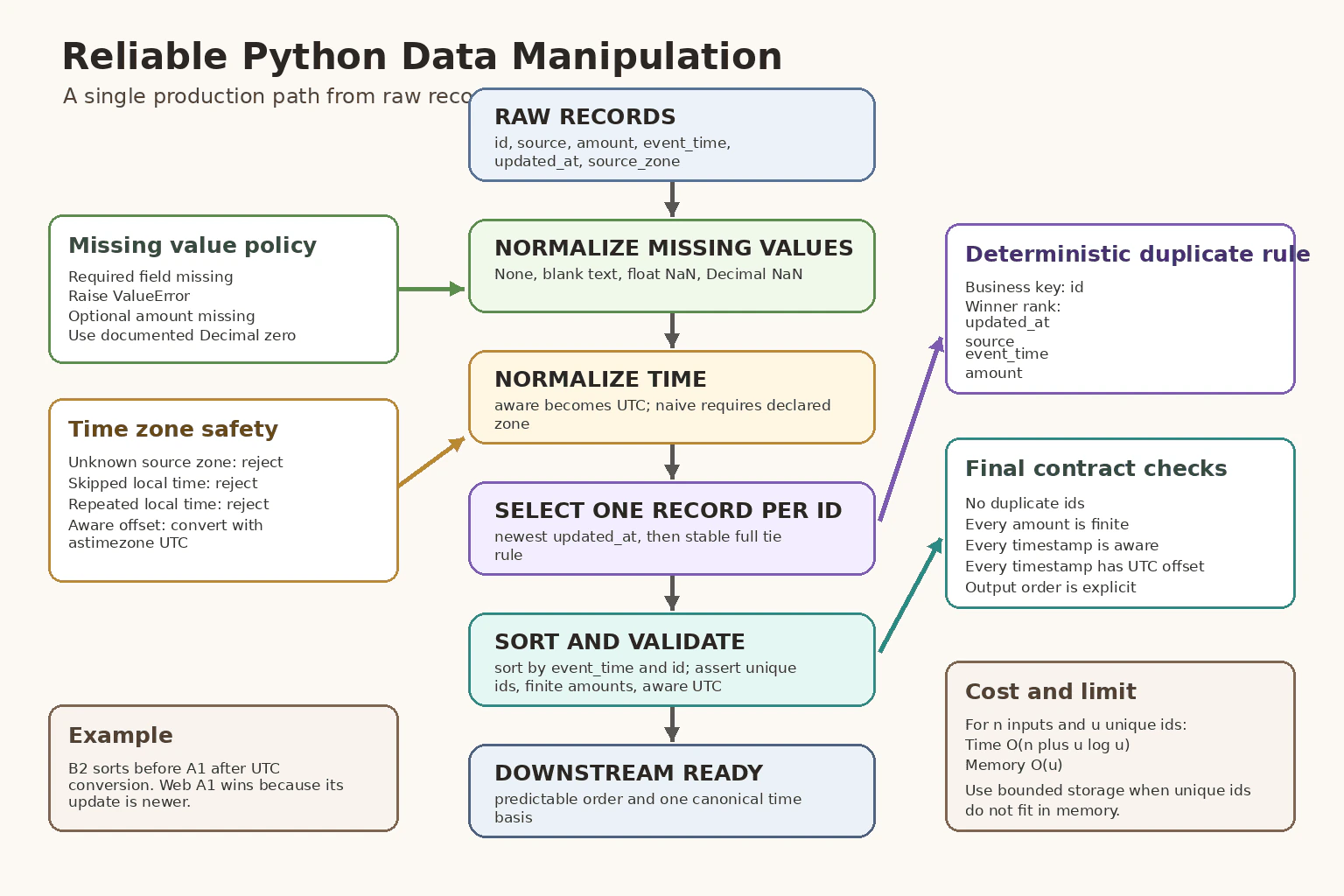
I would define explicit data rules before processing. I would reject missing required values, use documented defaults only for optional values, convert every timestamp to an aware UTC datetime, remove duplicates with a stable business key and a complete tie rule, sort the result, and validate it before downstream use. I would reject a naive timestamp when its source zone is unknown or when the local time is ambiguous or invalid.
I would use one predictable cleaning pipeline. First, I would normalize missing forms such as None, blank text, and numeric NaN. Required fields such as id and event time should raise a clear error. Optional fields may receive a documented default only when that default preserves the business meaning.
Useful Questions to Ask the Interviewer
Should I focus on Python language behavior, or also explain the runtime and standard library?
Which Python version and execution environment should I assume?
Would you like a small code example together with production tradeoffs and edge cases?
Next, I would normalize time. Python datetime objects may be naive, with no zone information, or aware, with a valid offset. An aware value can be converted to UTC with astimezone. A naive value needs a declared source zone. I would reject it when the zone is missing, unknown, ambiguous during a repeated clock hour, or invalid during a skipped clock hour.
For duplicates, I would group by a business key such as id. I would keep the newest update and apply a complete stable tie rule so input order cannot change the result. Then I would sort by explicit fields and validate uniqueness, required values, and UTC awareness.
For n input records and u unique ids, dictionary selection costs O(n), sorting costs O(u log u), and retained memory costs O(u). This is suitable when unique records fit in memory.
Example
The code uses the Python standard library. It treats id, source, event_time, and updated_at as required. It treats amount as optional and changes a missing amount to Decimal zero. Missing detection covers None, blank strings, floating point NaN, and Decimal NaN. Aware timestamps are converted to UTC. Naive timestamps require a valid source_zone. The code uses UTC round trips to reject ambiguous and invalid daylight saving time values instead of guessing. Records are grouped by id. The greatest tuple of updated_at, source, event_time, and amount wins, which creates a complete deterministic tie rule for every cleaned field. The final records are sorted by event_time and id. Validation confirms unique ids, finite amounts, and aware UTC timestamps. In the example, B2 appears before A1 because its UTC event time is earlier, and the web version of A1 wins because it has the newest update time.
Code
from __future__ import annotations
import math
from datetime import datetime, timezone
from decimal import Decimal, InvalidOperation
from typing importAnyfrom zoneinfo import ZoneInfo, ZoneInfoNotFoundError
defis_missing(value: Any) -> bool:
# Recognize common missing forms used by Python data inputs.if value isNone:
returnTrueifisinstance(value, str):
return value.strip() == ""ifisinstance(value, float):
return math.isnan(value)
ifisinstance(value, Decimal):
return value.is_nan()
returnFalsedefrequire_text(value: Any, field_name: str) -> str:
# Reject missing required text instead of silently inventing a value.if is_missing(value):
raise ValueError(f"{field_name} is required")
text = str(value).strip()
if text == "":
raise ValueError(f"{field_name} is required")
return text
deflocalize_naive_datetime(
value: datetime,
zone: ZoneInfo,
field_name: str,
) -> datetime:
# Test both fold values because a clock hour can repeat.
valid_utc_values: list[datetime] = []
for fold in (0, 1):
candidate = value.replace(tzinfo=zone, fold=fold)
candidate_utc = candidate.astimezone(timezone.utc)
round_trip = candidate_utc.astimezone(zone)
# A valid local time must survive conversion to UTC and back.if round_trip.replace(tzinfo=None) == value and round_trip.fold == fold:
valid_utc_values.append(candidate_utc)
# Remove duplicate UTC values that represent the same real instant.
unique_values = sorted(set(valid_utc_values))
ifnot unique_values:
raise ValueError(f"{field_name} is an invalid local time in {zone.key}")
iflen(unique_values) > 1:
raise ValueError(f"{field_name} is an ambiguous local time in {zone.key}")
return unique_values[0]
defparse_datetime(
value: Any,
source_zone: Any,
field_name: str,
) -> datetime:
# Accept a datetime object or an ISO formatted string.ifisinstance(value, datetime):
parsed = value
elifisinstance(value, str) and value.strip():
text = value.strip()
# Convert the common Z suffix into the offset form accepted here.if text.endswith("Z"):
text = text[:-1] + "+00:00"try:
parsed = datetime.fromisoformat(text)
except ValueError as error:
raise ValueError(f"{field_name} is not a valid ISO datetime") from error
else:
raise ValueError(f"{field_name} is required")
# A naive datetime needs an explicit zone from the source contract.if parsed.tzinfo isNoneor parsed.utcoffset() isNone:
zone_name = require_text(source_zone, "source_zone")
try:
zone = ZoneInfo(zone_name)
except ZoneInfoNotFoundError as error:
raise ValueError(f"Unknown source_zone: {zone_name}") from error
return localize_naive_datetime(parsed, zone, field_name)
# Convert every aware timestamp to the canonical UTC zone.return parsed.astimezone(timezone.utc)
defparse_amount(value: Any) -> Decimal:
# Amount is optional, so missing input receives a documented default.if is_missing(value):
return Decimal("0")
try:
amount = Decimal(str(value))
except InvalidOperation as error:
raise ValueError("amount must be numeric") from error
ifnot amount.is_finite():
raise ValueError("amount must be finite")
return amount
defclean_records(
records: list[dict[str, Any]],
) -> list[dict[str, Any]]:
# Retain one deterministic winner for each business id.
selected: dict[str, dict[str, Any]] = {}
for raw in records:
record_id = require_text(raw.get("id"), "id")
source = require_text(raw.get("source"), "source")
source_zone = raw.get("source_zone")
cleaned = {
"id": record_id,
"source": source,
"amount": parse_amount(raw.get("amount")),
"event_time": parse_datetime(
raw.get("event_time"),
source_zone,
"event_time",
),
"updated_at": parse_datetime(
raw.get("updated_at"),
source_zone,
"updated_at",
),
}
current = selected.get(record_id)
# Compare every cleaned value except id to create a total tie rule.
cleaned_rank = (
cleaned["updated_at"],
cleaned["source"],
cleaned["event_time"],
cleaned["amount"],
)
if current isNone:
selected[record_id] = cleaned
else:
current_rank = (
current["updated_at"],
current["source"],
current["event_time"],
current["amount"],
)
if cleaned_rank > current_rank:
selected[record_id] = cleaned
# Explicit sorting makes output independent of arrival order.
result = sorted(
selected.values(),
key=lambda item: (item["event_time"], item["id"]),
)
# Validate the contract before returning data downstream.
ids = [item["id"] for item in result]
iflen(ids) != len(set(ids)):
raise ValueError("Duplicate ids remain after cleaning")
for item in result:
ifnot item["amount"].is_finite():
raise ValueError("amount must be finite")
for field_name in ("event_time", "updated_at"):
value = item[field_name]
if value.tzinfo isNoneor value.utcoffset() isNone:
raise ValueError(f"{field_name} must be an aware datetime")
if value.utcoffset() != timezone.utc.utcoffset(value):
raise ValueError(f"{field_name} must be converted to UTC")
return result
defmain() -> None:
# Two records share id A1. The newest update must win.
records = [
{
"id": "A1",
"source": "store",
"source_zone": "America/Los_Angeles",
"amount": None,
"event_time": "2026-07-29T09:00:00",
"updated_at": "2026-07-29T09:05:00",
},
{
"id": "A1",
"source": "web",
"source_zone": "UTC",
"amount": "25.50",
"event_time": "2026-07-29T16:00:00+00:00",
"updated_at": "2026-07-29T16:10:00+00:00",
},
{
"id": "B2",
"source": "mobile",
"source_zone": "Asia/Kolkata",
"amount": "10",
"event_time": "2026-07-29T20:30:00",
"updated_at": "2026-07-29T20:35:00",
},
]
for record in clean_records(records):
print(
record["id"],
record["source"],
record["amount"],
record["event_time"].isoformat(),
record["updated_at"].isoformat(),
)
if __name__ == "__main__":
main()
Where it is used
This pattern is used in Python import jobs, application programming interface ingestion, event processing, reporting pipelines, database synchronization, billing feeds, and analytics preparation. It is important when several systems use different missing value formats, retry the same record, send local timestamps, or deliver records in different orders.
Why Interviewers Ask This
Interviewers ask this question to test whether a candidate can turn unreliable input into safe and predictable Python data. They are evaluating rules for missing values, duplicate identity, naive and aware datetime objects, daylight saving time cases, deterministic selection, validation, performance, and memory use before downstream processing.
Common interview mistakes
Common mistakes include treating every false value as missing, replacing required values with defaults, ignoring NaN, comparing naive and aware datetime objects, attaching UTC to local clock text without conversion, guessing an unknown source zone, ignoring repeated or skipped daylight saving time values, removing duplicates without a business key, using an incomplete tie rule, relying on arrival order, and skipping validation before downstream processing.
Interview tip
State the data contract first. Then explain missing value rules, UTC normalization, daylight saving time validation, deterministic duplicate selection, explicit sorting, and final validation. Mention the O(n plus u log u) time cost and O(u) retained memory cost.
Interviewer may ask next
What happens when a naive timestamp falls inside a daylight saving time change?
It must be checked before conversion. A repeated clock hour can represent two real instants, while a skipped clock hour represents no real instant. The code tests both fold values and performs a UTC round trip. It rejects ambiguous or invalid local times instead of guessing. This matters because a guessed instant can change ordering, duplicate selection, billing, or reporting results.
How would you handle duplicates when the unique records do not fit in memory?
I would keep the same business key and deterministic winner rule but move the grouping work to bounded storage. I could sort records externally, process sorted chunks, use a database with an indexed id, or use a stateful stream processor. The dictionary approach uses O(u) memory for u unique ids. The alternative reduces process memory but adds input and output work, operational complexity, and storage coordination.
5. Explain Python lists, dictionaries, and concurrency in a production program.Language SpecificMediumApple
i Question Details
Explain how you would use Python lists and dictionaries in production code and how concurrency affects shared data. Discuss thread safety, queues, locks, events, multiprocessing, and when each choice is appropriate.
Short Interview Answer (30-60 seconds)
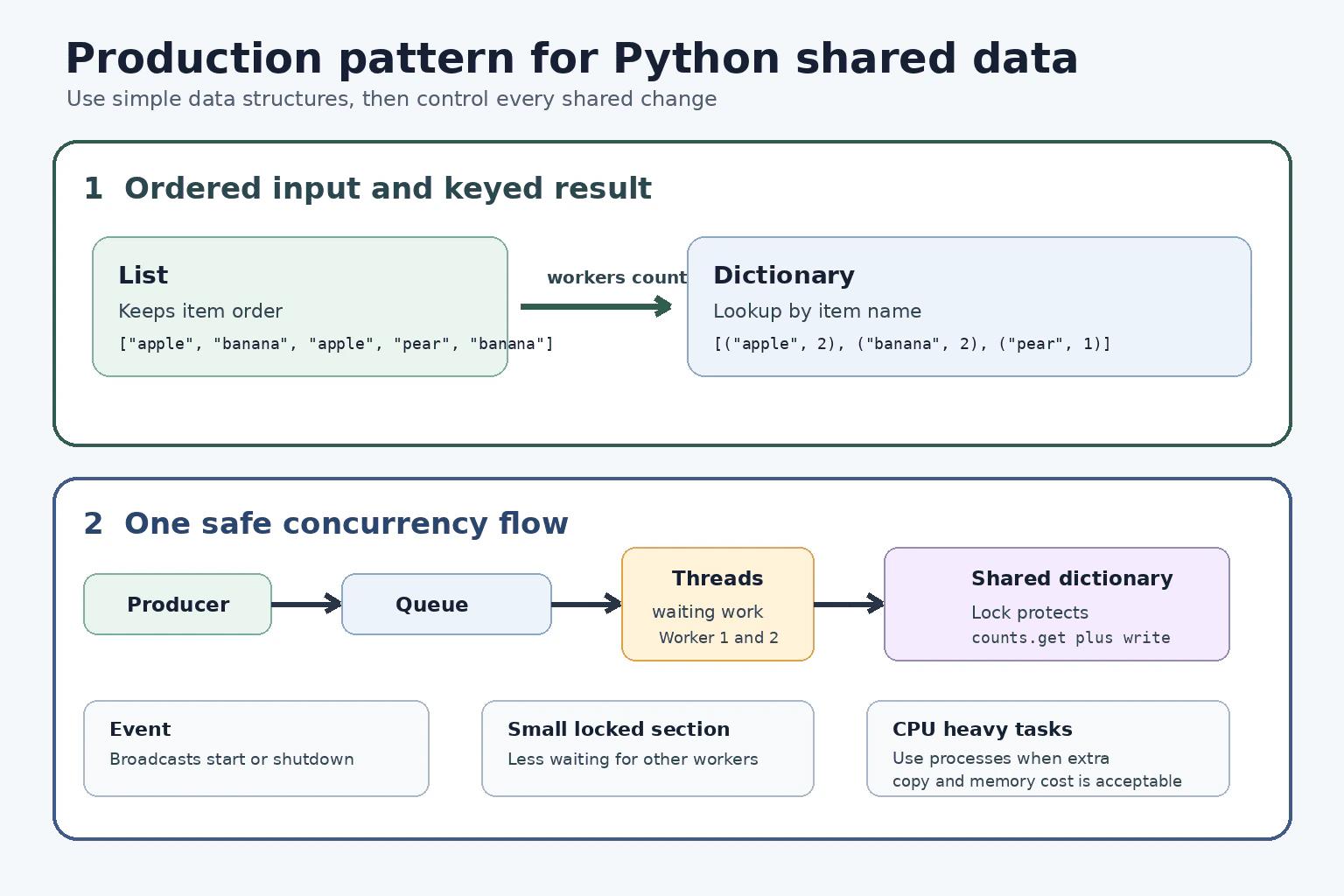
I use a list when order matters and a dictionary when I need lookup by key. When threads share either mutable object, I protect complete logical updates instead of relying on the Python runtime. I prefer a queue to transfer work, a lock for a small shared update, and an event for a shared signal. Threads usually fit input and output work. Processes usually fit CPU heavy Python work when the communication and memory costs are acceptable.
In production, I use a list for an ordered batch and a dictionary for lookup by a unique key. A list preserves insertion order. A dictionary also preserves insertion order and usually provides constant time key lookup, insertion, and update. Both structures are mutable, so shared changes need a clear owner or synchronization. I do not rely on the global interpreter lock for correctness. A read, calculate, and write sequence contains several steps, so another thread can change the data between them. This also keeps the design correct on Python builds that allow threads to execute Python code in parallel. I prefer a queue when producers send independent tasks to consumers. I use a lock when workers must update one shared dictionary. I keep the locked section small because other workers must wait. I use an event to broadcast a state change, such as start or shutdown. Threads are useful when tasks spend time waiting for files, networks, or databases. Processes are useful for CPU heavy Python work, but process startup, serialization, communication, and separate memory increase cost. Large lists and dictionaries also consume memory for stored references and dictionary table capacity.
Useful Questions to Ask the Interviewer
Should I focus on Python language behavior, or also explain the runtime and standard library?
Which Python version and execution environment should I assume?
Would you like a small code example together with production tradeoffs and edge cases?
Example
The program stores five item names in an ordered list. A thread safe queue gives each item to one worker. An event releases both workers after setup is complete. The workers share one dictionary, so a lock protects the complete read and update operation. The main thread waits until every item is processed. It then places one stop value in the queue for each worker and joins the threads. Sorting the dictionary items before printing makes the displayed result deterministic. The program prints apple with two, banana with two, and pear with one.
Code
from queue import Queue
from threading import Event, Lock, Thread
# This list keeps the input items in their original order.
items = ["apple", "banana", "apple", "pear", "banana"]
# Worker threads share this dictionary.
counts: dict[str, int] = {}
# The queue safely transfers tasks between threads.
tasks: Queue[str | None] = Queue()
# The lock protects the complete dictionary update.
counts_lock = Lock()
# The event releases all workers after setup is complete.
start_event = Event()
defworker() -> None:
# Every worker waits for the same start signal.
start_event.wait()
whileTrue:
item = tasks.get()
try:
# One stop value ends one worker.if item isNone:
return# Protect the read and write as one logical operation.with counts_lock:
counts[item] = counts.get(item, 0) + 1finally:
# Mark every received queue item as complete.
tasks.task_done()
# Create two workers for this example.
workers = [Thread(target=worker) for _ inrange(2)]
# Start the threads. They wait at the event.for thread in workers:
thread.start()
# Add all real tasks before releasing the workers.for item in items:
tasks.put(item)
# Broadcast the start signal to both workers.
start_event.set()
# Wait until all real tasks are processed.
tasks.join()
# Add one stop value for each worker.for _ in workers:
tasks.put(None)
# Wait until the stop values are received.
tasks.join()
# Wait for both threads to exit cleanly.for thread in workers:
thread.join()
# Sort the output so its displayed order is deterministic.print(sorted(counts.items()))
Where it is used
Lists are used for ordered database results, request batches, and response items. Dictionaries are used for caches, counters, configuration, and lookup by identifier. Queues are used in producer and consumer pipelines. Locks protect short shared updates. Events broadcast start, stop, or readiness signals. Threads fit network, database, and file work. Processes fit independent CPU heavy calculations when the extra memory and communication cost is justified.
Why Interviewers Ask This
Interviewers ask this question to check whether a candidate can choose suitable Python data structures and manage shared mutable data safely. They evaluate knowledge of runtime behavior, worker coordination, input and output concurrency, CPU work, failure handling, performance cost, and memory cost.
Common interview mistakes
Common mistakes include assuming the global interpreter lock makes a complete shared update safe, using a normal list as a worker queue, reading and writing a dictionary without one shared lock, holding a lock during slow input and output work, forgetting task_done, calling task_done too many times, sending too few stop values, modifying a collection while iterating over it, and using processes without considering serialization and duplicated memory.
Interview tip
Start with the data choice, then explain ownership. Say that lists keep ordered items, dictionaries provide key lookup, queues transfer work, locks protect small shared updates, events broadcast state, threads fit waiting work, and processes fit CPU work. Mention that correctness must not depend on the global interpreter lock.
Interviewer may ask next
Does the global interpreter lock make the dictionary update safe?
No. It does not make the complete read, calculate, and write operation safe. The expression contains multiple logical steps, so another thread can update the same key between those steps. The shared lock matters because it protects the whole operation. The tradeoff is that only one worker can enter that protected section at a time.
When should this program use multiprocessing instead of threads?
It should use multiprocessing when each independent task performs substantial CPU heavy Python work and measurements show that process parallelism helps. Each process has separate memory, so this shared dictionary cannot be used in the same way. Inputs and results must cross a process communication boundary, which adds startup, serialization, memory, and communication cost.
6. How would you decide between Python threads and multiprocessing for an Apple service?Language SpecificMediumApple
i Question Details
Compare using threads and multiprocessing in Python for service work. Explain I/O-bound versus CPU-bound work, shared state, communication cost, startup cost, error handling, and operational tradeoffs.
Short Interview Answer (30-60 seconds)
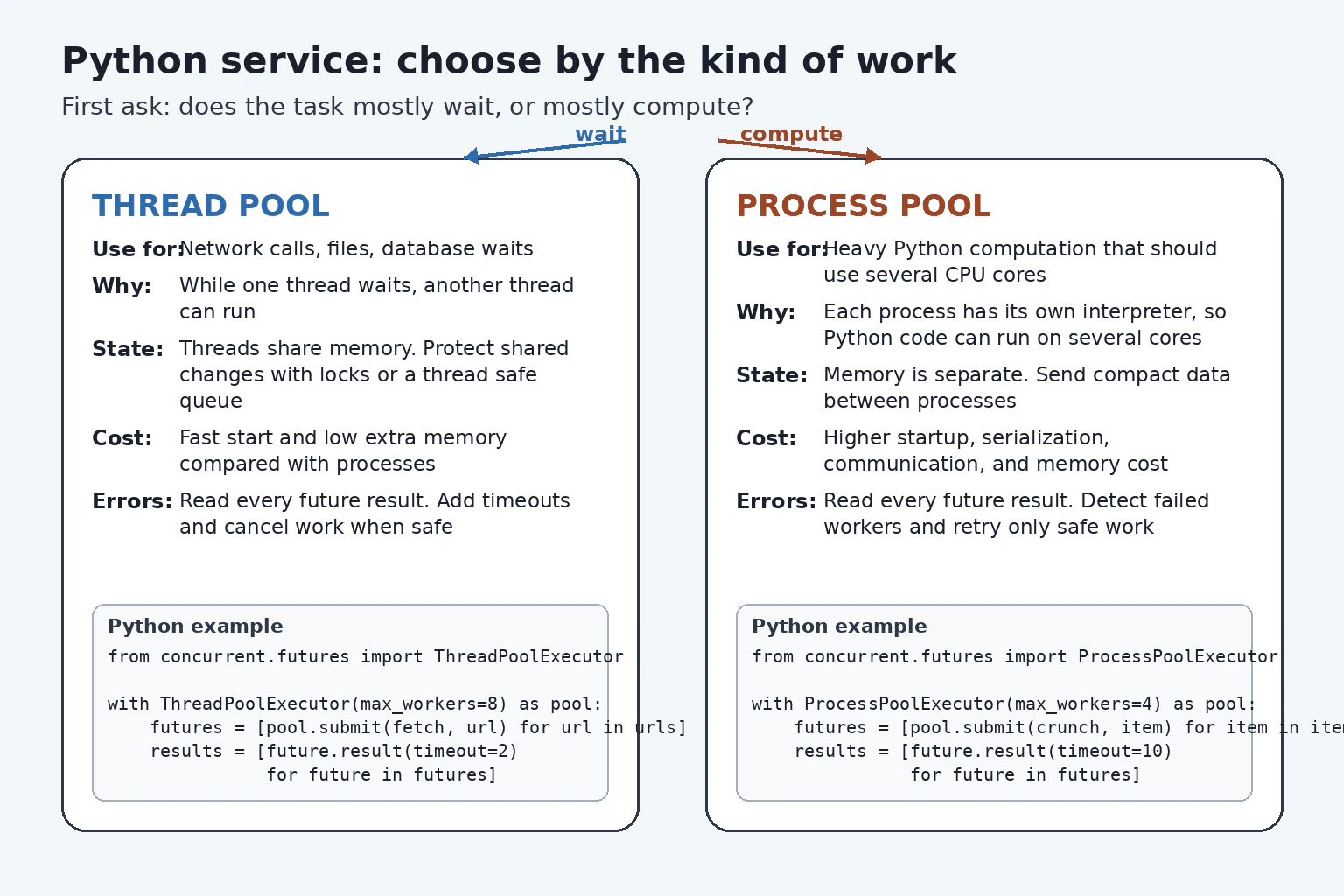
I would normally choose threads for work that mostly waits for network, file, or database input. I would choose multiprocessing for heavy Python computation that must use several CPU cores. Threads start quickly and share memory, but shared mutable state needs locks or queues. Processes have separate interpreters and memory, so they add startup, serialization, communication, and memory cost. I would benchmark the real workload and keep the worker count bounded.
Detailed Explanation
I would first measure whether the service work mainly waits or computes. Threads are usually a good fit for blocking network calls, file access, and database work. When one thread waits, another can run. Threads start quickly and share objects in one process, but shared mutable state can cause races and may require locks or thread safe queues.
Useful Questions to Ask the Interviewer
Should I focus on Python language behavior, or also explain the runtime and standard library?
Which Python version and execution environment should I assume?
Would you like a small code example together with production tradeoffs and edge cases?
Multiprocessing is usually a better fit for heavy Python computation. In a normal Global Interpreter Lock enabled CPython build, only one thread at a time executes Python bytecode. Each process has its own interpreter, so several processes can execute Python code on several CPU cores.
Processes have higher startup and memory costs. Arguments and results usually must be serialized and sent through a queue, pipe, or process pool connection. Large objects and many small tasks can make this cost larger than the useful work. Processes normally isolate memory and crashes better, but a failed worker can still lose work or break a pool.
In production, I would use bounded pools, timeouts, cancellation rules, clear error reporting, graceful shutdown, back pressure, and monitoring for latency, queue depth, CPU use, and memory use.
Where it is used
Threads are useful when a service calls several internal APIs, waits for database responses, reads files, or uses blocking client libraries. Multiprocessing is useful for image processing, compression, parsing, data transformation, and other CPU intensive Python work. A service may use threads for request related waiting and send expensive computation to a bounded process pool.
Why Interviewers Ask This
Interviewers ask this to test whether the candidate can connect Python runtime behavior to a practical service design. They want to see knowledge of the Global Interpreter Lock, memory sharing, process isolation, communication cost, worker failures, and production operations.
Common interview mistakes
Common mistakes include assuming Python threads always execute CPU intensive Python code in parallel, ignoring that some native extensions can release the Global Interpreter Lock, using multiprocessing for tiny tasks where startup and communication cost dominate, sending very large objects between processes, changing shared thread state without synchronization, creating unlimited workers, ignoring exceptions returned by futures, and assuming every operating system starts child processes in the same way.
Interview tip
Start with the workload type. Say threads for waiting and multiprocessing for heavy Python computation. Then explain the Global Interpreter Lock, shared state, process isolation, serialization cost, startup cost, memory use, error handling, and the need to measure the real service.
Interviewer may ask next
Can Python threads ever execute CPU work in parallel?
Yes, they can in specific cases. In a normal Global Interpreter Lock enabled CPython build, threads do not usually execute CPU intensive Python bytecode in parallel. However, native extensions may release the Global Interpreter Lock while doing work, and a free threaded Python build changes this behavior. This matters because the correct choice depends on the actual runtime and library behavior. The tradeoff is that relying on parallel thread execution without measurement can make performance unpredictable.
When can multiprocessing perform worse than threads?
Multiprocessing can perform worse when tasks are small, workers start frequently, or large arguments and results must be serialized and transferred. Separate processes also require more memory because each process has its own interpreter and heap. This matters because coordination cost can exceed the saved computation time. A long lived bounded process pool, compact messages, sensible task sizes, and measurement can reduce the cost, but threads may still be better for work dominated by waiting.
7. How would you implement a robust TCP socket message reader in Python?Language SpecificMediumApple
i Question Details
Explain how Python code should read complete messages from a TCP socket when messages may be length-prefixed or newline-delimited. Cover partial reads, buffering, connection close behavior, malformed data, and error handling.
Short Interview Answer (30-60 seconds)
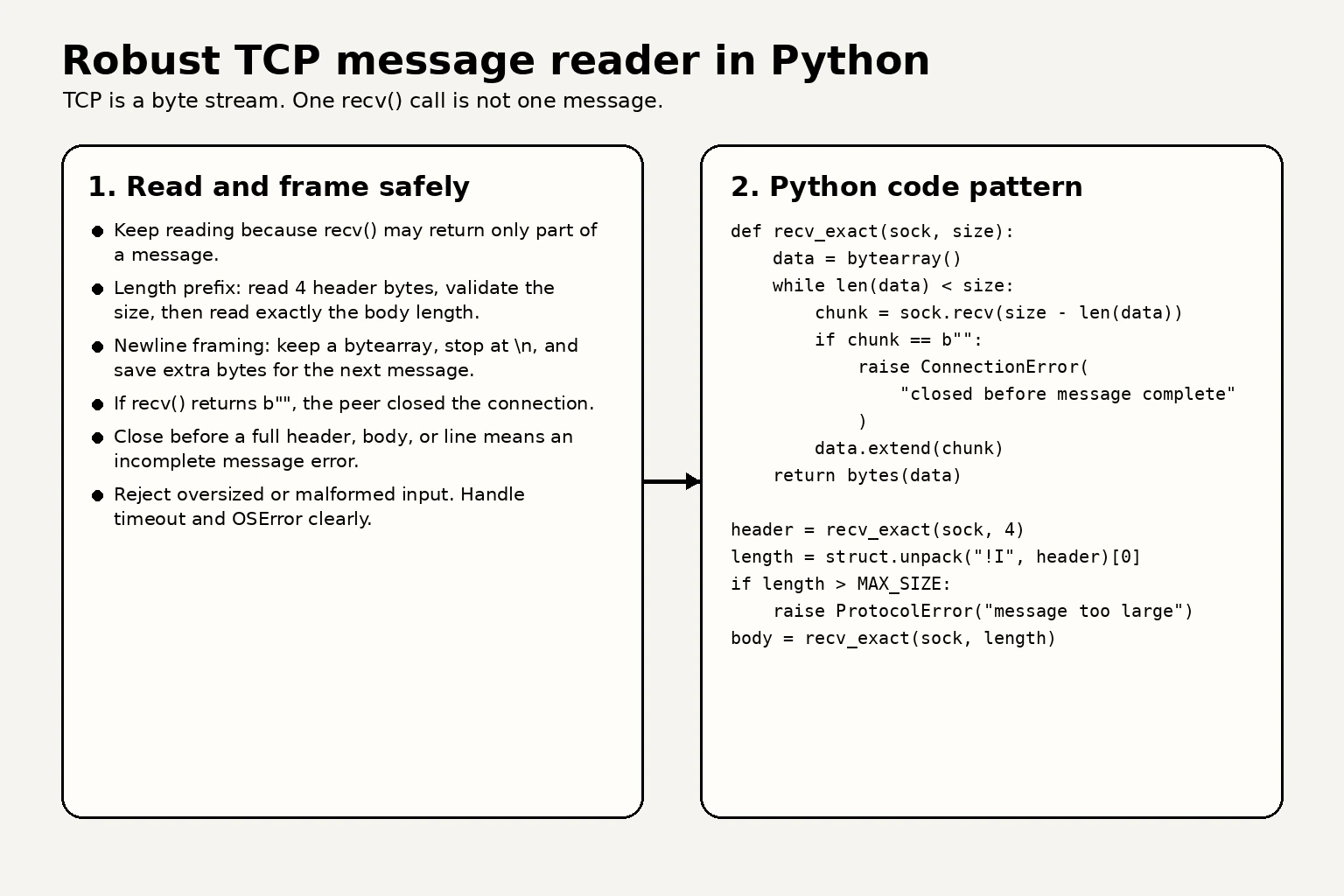
I would define one framing rule, keep a buffer when needed, and never assume that one recv call returns one complete message. For a length prefixed protocol, I would read the complete fixed size header, validate the declared length, and then read exactly that many body bytes. For a newline delimited protocol, I would keep reading until the buffer contains a newline and preserve any extra bytes for the next message. If recv returns b"", the peer has closed the connection, so a close before a complete message is an error.
I would first choose one framing rule because TCP only provides an ordered stream of bytes. It does not preserve message boundaries. One recv call may return part of a message, one message, or several messages together.
Useful Questions to Ask the Interviewer
Should I focus on Python language behavior, or also explain the runtime and standard library?
Which Python version and execution environment should I assume?
Would you like a small code example together with production tradeoffs and edge cases?
For a length prefixed protocol, I read exactly four header bytes, decode the unsigned body length in network byte order, reject a length above the configured limit, and then read exactly that many body bytes. For a newline delimited protocol, I keep a bytearray between calls, search for a newline, return one complete message, and leave later bytes in the buffer.
In Python, recv returns b"" when the peer closes the connection. If that happens during a header, body, or unfinished line, I raise a connection error instead of returning partial data. I handle socket.timeout and OSError separately so the caller knows why the read failed.
Buffering uses memory proportional to the current message size, so every reader needs a maximum size. In production, I would also set timeouts, validate text encoding after framing, log protocol violations, and close connections that send malformed or oversized messages.
Example
The code implements both framing styles with the same safety rules. recv_exact repeatedly calls recv until it has the requested number of bytes. It raises an error if the peer closes early. read_length_prefixed_message reads a four byte unsigned length in network byte order, rejects a body that exceeds the configured limit, and then reads the complete body. NewlineMessageReader keeps a bytearray across calls, returns one message without its newline, and preserves extra bytes for the next call. A message requires time proportional to the number of bytes read. Memory use is proportional to the buffered message data, with a small extra receive chunk. Converting a completed bytearray slice to bytes creates a copy, and removing consumed bytes from the front of the bytearray may move the remaining bytes.
Code
import socket
import struct
classProtocolError(Exception):
"""Raised when received bytes break the message protocol."""defrecv_exact(sock: socket.socket, size: int) -> bytes:
"""Read exactly size bytes or raise if the connection closes early."""if size < 0:
raise ValueError("size must not be negative")
data = bytearray()
whilelen(data) < size:
try:
chunk = sock.recv(size - len(data))
except socket.timeout as exc:
raise TimeoutError("timed out while reading from the socket") from exc
except OSError as exc:
raise ConnectionError("socket read failed") from exc
if chunk == b"":
raise ConnectionError("connection closed before the message was complete")
data.extend(chunk)
returnbytes(data)
defread_length_prefixed_message(
sock: socket.socket,
max_message_size: int = 1_048_576,
) -> bytes:
"""Read one message with a four byte unsigned network order length."""if max_message_size < 0:
raise ValueError("max_message_size must not be negative")
header = recv_exact(sock, 4)
message_size = struct.unpack("!I", header)[0]
if message_size > max_message_size:
raise ProtocolError("declared message size exceeds the allowed limit")
return recv_exact(sock, message_size)
classNewlineMessageReader:
"""Read newline delimited messages while preserving extra bytes."""def__init__(self, max_message_size: int = 1_048_576) -> None:
if max_message_size < 0:
raise ValueError("max_message_size must not be negative")
self.max_message_size = max_message_size
self.buffer = bytearray()
defread_message(self, sock: socket.socket) -> bytes:
"""Return one message without the trailing newline."""whileTrue:
newline_index = self.buffer.find(b"\n")
if newline_index != -1:
if newline_index > self.max_message_size:
raise ProtocolError("line exceeds the allowed limit")
message = bytes(self.buffer[:newline_index])
delself.buffer[: newline_index + 1]
return message
iflen(self.buffer) > self.max_message_size:
raise ProtocolError("line exceeds the allowed limit")
try:
chunk = sock.recv(4096)
except socket.timeout as exc:
raise TimeoutError("timed out while reading from the socket") from exc
except OSError as exc:
raise ConnectionError("socket read failed") from exc
if chunk == b"":
ifself.buffer:
raise ConnectionError("connection closed before the newline arrived")
raise EOFError("connection closed")
self.buffer.extend(chunk)
defmain() -> None:
# Demonstrate a length prefixed message.
sender, receiver = socket.socketpair()
try:
payload = b"hello"
sender.sendall(struct.pack("!I", len(payload)) + payload)
print(read_length_prefixed_message(receiver))
finally:
sender.close()
receiver.close()
# Demonstrate two newline delimited messages received together.
sender, receiver = socket.socketpair()
try:
sender.sendall(b"first\nsecond\n")
reader = NewlineMessageReader()
print(reader.read_message(receiver))
print(reader.read_message(receiver))
finally:
sender.close()
receiver.close()
if __name__ == "__main__":
main()
Where it is used
This pattern is used in Python chat servers, internal service protocols, game servers, device gateways, log collectors, and custom TCP clients. Length prefixes work well for binary messages and content that may contain any byte value. Newline framing works well for text commands, JSON Lines, and other line based protocols.
Why Interviewers Ask This
Interviewers ask this to check whether a candidate understands that TCP is a byte stream and does not preserve application message boundaries. They also evaluate correct use of socket recv, persistent buffering, framing rules, connection close detection, input limits, malformed data handling, and exception design. A strong answer shows both Python runtime knowledge and practical production judgment.
Common interview mistakes
Common mistakes are assuming one recv call returns one complete message, treating a short recv result as the end of a message, discarding bytes that belong to the next message, ignoring b"" from recv, accepting an unlimited declared length, decoding text before the complete byte message has arrived, using a new line buffer for every call, and hiding all failures behind one broad exception.
Interview tip
Start by saying that TCP is a byte stream and therefore needs explicit message framing. Then explain partial reads, persistent buffering, the meaning of b"", maximum size checks, and preservation of extra bytes. This gives the interviewer a clear and production focused answer.
Interviewer may ask next
What should happen if the peer closes after sending only part of a message?
The reader should raise a connection error for an incomplete message. In Python, recv returns b"" when the peer has closed the connection. If the required header, body, or newline has not arrived, returning partial data would hide a protocol failure and could cause the application to process corrupted input.
When would you choose length prefixed framing instead of newline delimited framing?
I would choose length prefixed framing when messages are binary, may contain newline bytes, or need a known body size before parsing. It adds a fixed header and requires strict length validation, but it can represent any byte content. Newline framing is simpler for text records, but embedded newlines require escaping or a different content rule.
8. How would you write Python edge-case handling for a data transformation pipeline?Language SpecificMediumApple
i Question Details
Explain how Python transformation code should validate input types, handle missing fields, preserve deterministic ordering, report bad records, avoid silent data loss, and include tests for edge cases.
Short Interview Answer (30-60 seconds)
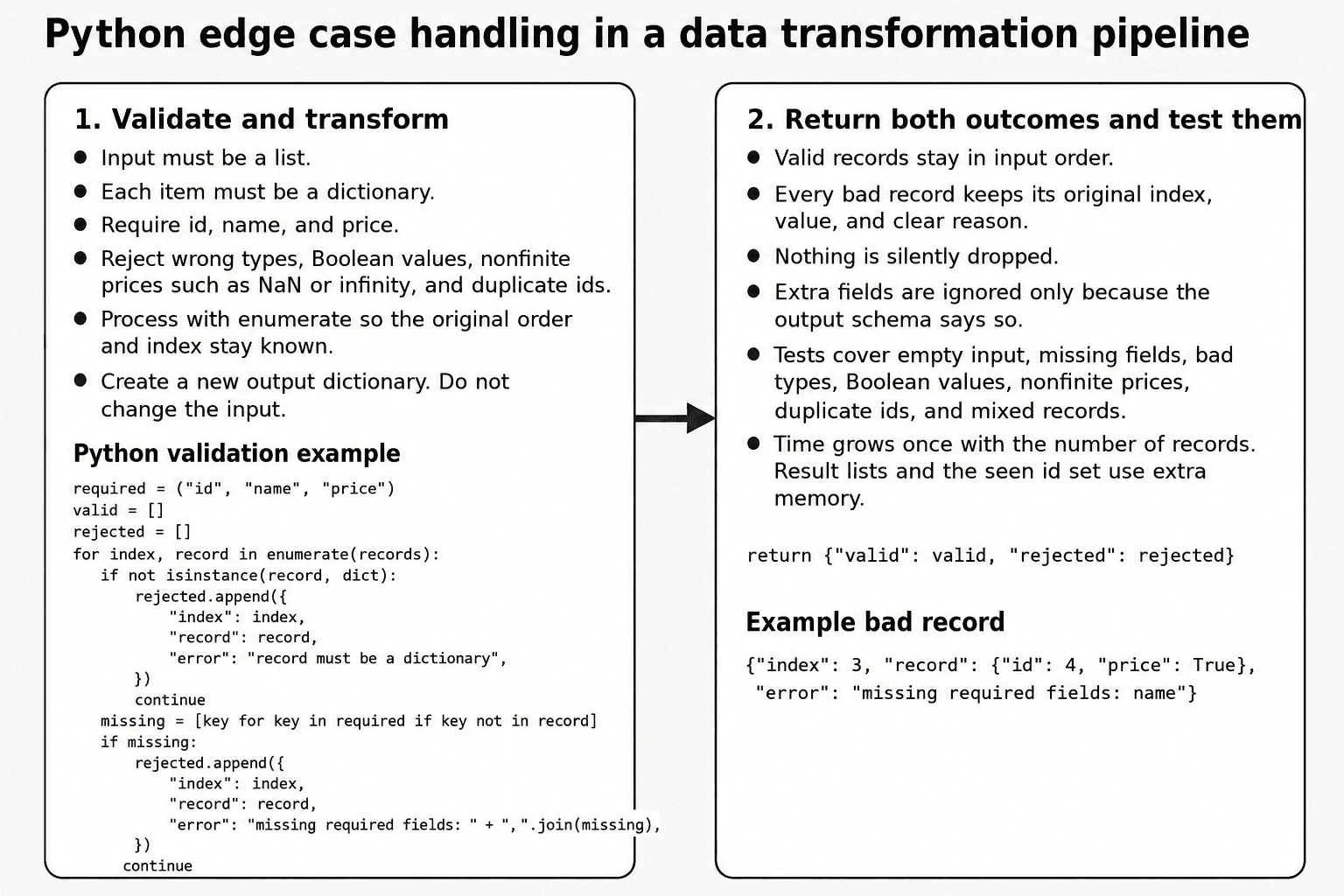
I would define a clear input contract, validate every record before transforming it, and return valid and rejected records separately. I would process the input list from left to right so output order stays deterministic, require every expected field, reject incorrect Python types explicitly, and include the original index and reason for every rejected record. I would also create new output dictionaries instead of changing the input and test missing fields, Boolean values, duplicate ids, nonfinite numbers, empty input, and mixed valid and invalid records.
I would start with an explicit validation contract. The outer input must be a list, and each item must be a dictionary containing id, name, and price. The code processes items from left to right, so Python list ordering keeps valid results and errors deterministic.
Useful Questions to Ask the Interviewer
Should I focus on Python language behavior, or also explain the runtime and standard library?
Which Python version and execution environment should I assume?
Would you like a small code example together with production tradeoffs and edge cases?
Each id must be an integer but not a Boolean. Each name must be a nonempty string. Each price must be an integer or float, must not be a Boolean, and must be finite. This rejects values such as True, NaN, and infinity that can otherwise pass basic numeric checks. Duplicate ids among accepted records are also rejected.
The function creates new dictionaries instead of changing the original records. It records every invalid item with its original index, value, and exact reason, so no record disappears silently. Unexpected extra fields are ignored by an explicit rule.
This design fits imports, event processing, and extract transform load jobs. Its running time grows once with the number of records. The result lists and duplicate id set use additional memory. For very large inputs, records can be processed in batches while keeping the same validation rules, order, and error details.
Example
The function requires the outer value to be a list. It then visits each item in its original order and keeps the index returned by enumerate. A record must be a dictionary and must contain id, name, and price. The id must be an integer that is not a Boolean. The name must be a nonempty string. The price must be an integer or float that is not a Boolean and must be finite. Duplicate ids among valid records are rejected. Every invalid item is added to the rejected list with its original index, original value, and exact reason. Valid values are copied into new normalized dictionaries, so the input is not changed. The included assertions cover valid input, missing fields, wrong container types, Boolean values, nonfinite prices, duplicate ids, extra fields, empty input, and mixed valid and invalid records.
Code
import math
from typing importAnydeftransform_records(records: list[object]) -> dict[str, list[dict[str, Any]]]:
# Validate the outer container before processing any records.ifnotisinstance(records, list):
raise TypeError("records must be a list")
valid_records: list[dict[str, Any]] = []
rejected_records: list[dict[str, Any]] = []
seen_ids: set[int] = set()
# Enumerate preserves input order and gives each record its original index.for index, raw_record inenumerate(records):
error: str | None = None# Every record must be a dictionary.ifnotisinstance(raw_record, dict):
error = "record must be a dictionary"else:
# Report missing fields before checking their values.
missing_fields = [field for field in ("id", "name", "price") if field notin raw_record]
if missing_fields:
error = "missing required fields: " + ", ".join(missing_fields)
else:
record_id = raw_record["id"]
name = raw_record["name"]
price = raw_record["price"]
# Boolean is a subclass of integer, so reject it explicitly.ifnotisinstance(record_id, int) orisinstance(record_id, bool):
error = "id must be an integer"elif record_id in seen_ids:
error = "id must be unique"elifnotisinstance(name, str) ornot name.strip():
error = "name must be a nonempty string"elifnotisinstance(price, (int, float)) orisinstance(price, bool):
error = "price must be a number"elifnot math.isfinite(price):
error = "price must be finite"# Record every failure instead of silently dropping the input.if error isnotNone:
rejected_records.append(
{
"index": index,
"record": raw_record,
"error": error,
}
)
continue# The checks above guarantee that these fields have valid values.
record_id = raw_record["id"]
name = raw_record["name"]
price = raw_record["price"]
seen_ids.add(record_id)
# Create a normalized copy so the original dictionary is not changed.
valid_records.append(
{
"id": record_id,
"name": name.strip(),
"price": float(price),
}
)
return {
"valid": valid_records,
"rejected": rejected_records,
}
if __name__ == "__main__":
sample_records: list[object] = [
{"id": 2, "name": " Keyboard ", "price": 99},
{"id": 1, "name": "Mouse"},
{"id": 3, "name": "Cable", "price": True},
{"id": 4, "name": "Adapter", "price": float("nan")},
{"id": 2, "name": "Monitor", "price": 299.0},
{"id": 5, "name": "Stand", "price": 49.5, "source": "store"},
"not a dictionary",
]
result = transform_records(sample_records)
# Valid records keep their relative input order.assert [record["id"] for record in result["valid"]] == [2, 5]
# Values are normalized into new dictionaries.assert result["valid"][0] == {
"id": 2,
"name": "Keyboard",
"price": 99.0,
}
# Extra fields are ignored by the explicit output schema.assert result["valid"][1] == {
"id": 5,
"name": "Stand",
"price": 49.5,
}
# Every bad record is reported with its original position.assert [record["index"] for record in result["rejected"]] == [1, 2, 3, 4, 6]
assert result["rejected"][0]["error"] == "missing required fields: price"assert result["rejected"][1]["error"] == "price must be a number"assert result["rejected"][2]["error"] == "price must be finite"assert result["rejected"][3]["error"] == "id must be unique"assert result["rejected"][4]["error"] == "record must be a dictionary"# Empty input produces two empty result lists.assert transform_records([]) == {"valid": [], "rejected": []}
# Invalid outer input fails immediately.try:
transform_records({"id": 1}) # type: ignore[arg-type]except TypeError as exc:
assertstr(exc) == "records must be a list"else:
raise AssertionError("Expected TypeError")
print(result)
Where it is used
This pattern is used in file imports, API request cleanup, message processing, analytics preparation, and extract transform load jobs. It is useful when valid records should continue through the pipeline while invalid records must remain available for inspection, correction, reporting, or retry.
Why Interviewers Ask This
Interviewers ask this to check whether a candidate can turn unreliable input into predictable Python behavior. They are evaluating type validation, dictionary handling, ordering guarantees, error reporting, input mutation awareness, test coverage, and judgment about whether bad records should stop the pipeline or be reported separately.
Common interview mistakes
Common mistakes include checking only whether a field can be converted, using get without distinguishing a missing field from a field whose value is None, and accepting Boolean values because bool inherits from int. Other mistakes include allowing NaN or infinity into numeric output, catching every exception and continuing without an error record, changing input dictionaries in place, using an unordered container for results, rejecting records without their original index, and testing only successful input. Silently ignoring extra fields without documenting that rule can also hide schema mistakes.
Interview tip
Explain the contract first. Then walk through required fields, exact Python type checks, deterministic list order, copied output records, and structured rejection details. Mention that Boolean values need special handling because bool inherits from int, and finish with the edge cases covered by tests.
Interviewer may ask next
Why must Boolean values and nonfinite numbers be checked explicitly?
They must be checked explicitly because Python treats bool as a subclass of int, while float can represent NaN and infinity. Without these checks, True could be accepted as an id or price, and a nonfinite price could enter later calculations. Rejecting these values keeps the transformation contract precise. The tradeoff is stricter input handling, so a caller that intentionally supports those values would need a different documented rule.
How would you reduce memory use for millions of records?
I would process the records in bounded batches and write or consume each batch before reading the next one. The validation behavior, original index, deterministic order, and structured errors would remain the same. This reduces memory used by the valid and rejected result lists. The duplicate id set can still grow with the number of unique ids, so a very large pipeline may need an external store or a partitioning rule. The tradeoff is more operational complexity and possible partial progress if processing stops.
9. How would you implement reliable message framing in Python when TCP reads split messages across packets?Language SpecificHardApple
i Question Details
Explain the Python buffering logic, state tracking, byte parsing, timeout behavior, malformed frame handling, backpressure, and tests needed when socket reads do not align with application messages.
Short Interview Answer (30-60 seconds)
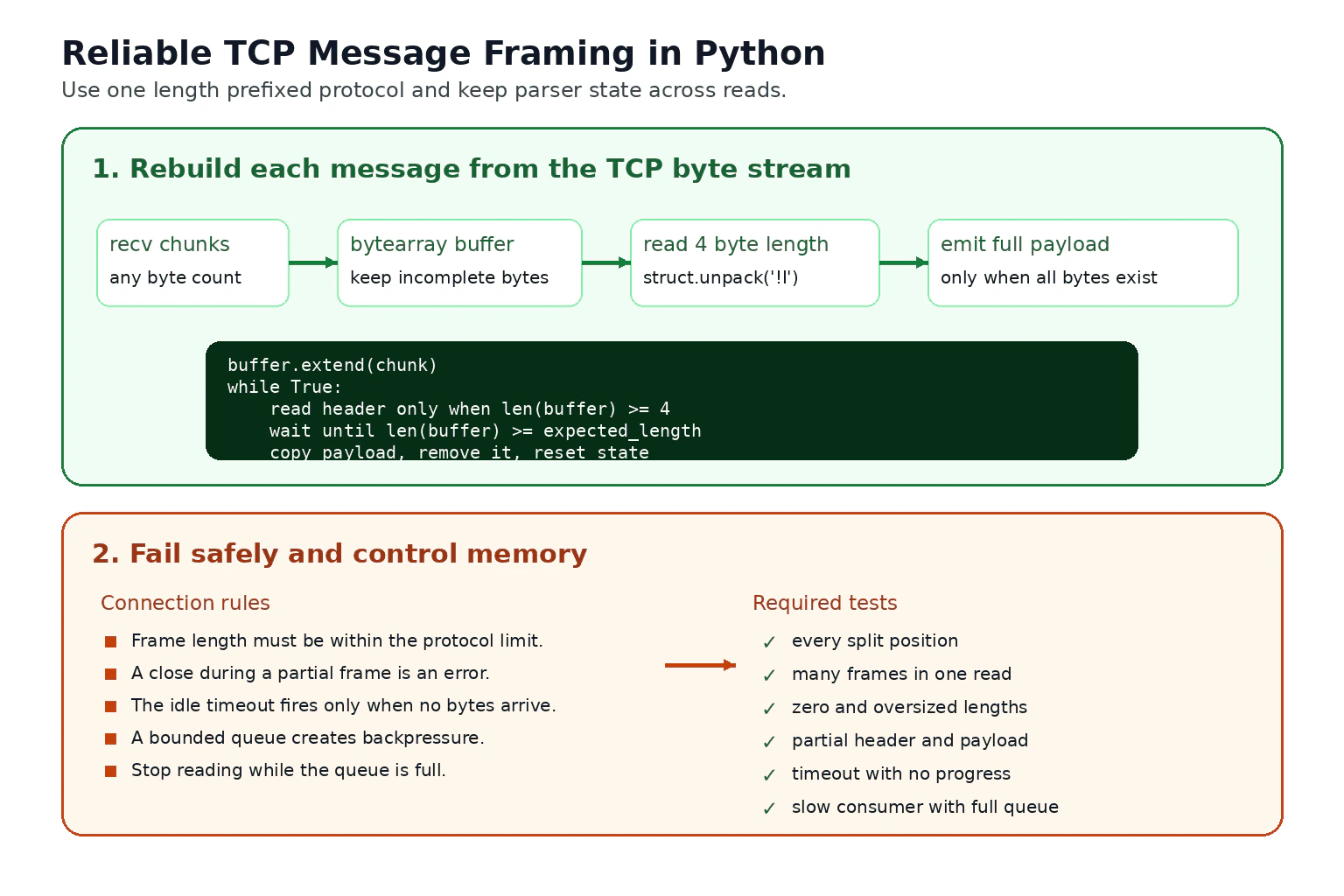
I would prefix every payload with a four byte unsigned length and keep a bytearray across socket reads. Each read is appended to the buffer. I parse the header only when all four bytes are present, then wait until the complete declared payload is available. I also limit frame and buffer sizes, reject malformed or truncated frames, use an idle timeout, and stop reading when downstream processing has no capacity.
I would use a four byte unsigned length prefix followed by the payload. TCP provides an ordered stream of bytes, not application messages. One recv call may contain part of a frame, one frame, or several frames.
Useful Questions to Ask the Interviewer
Should I focus on Python language behavior, or also explain the runtime and standard library?
Which Python version and execution environment should I assume?
Would you like a small code example together with production tradeoffs and edge cases?
The Python parser therefore keeps a bytearray and an expected payload length across calls. It appends each received chunk. When at least four bytes are available, it reads the length with struct.unpack using network byte order. It removes a payload only after all declared bytes have arrived. Any incomplete bytes stay in the buffer for the next read.
I would reject zero length frames when the protocol does not allow them and reject lengths above a fixed maximum. A closed connection with unfinished bytes is a truncated frame error. A timeout should measure a lack of incoming progress, not require a complete frame to arrive in one read.
Memory must be bounded. The frame size, receive buffer, and processing queue should all have limits. When the processing queue is full, reading should pause until capacity returns. Tests should split frames at every byte position, combine frames in one read, and cover invalid lengths, truncation, timeouts, and slow consumers.
Example
The code uses a four byte unsigned length in network byte order. FrameParser stores unread bytes in a bytearray and stores the current payload length in expected_length. The feed method accepts any socket chunk and returns every complete payload currently available. It preserves incomplete data for the next call. It rejects empty frames, oversized frames, and excessive buffered data. The finish method detects a connection that closes during a partial header or payload. The receive loop applies an idle timeout and treats an empty recv result as end of stream. The tests cover every split position, several frames in one read, an invalid length, a truncated frame, and real socket reads with small receive sizes.
Code
import socket
import struct
from collections.abc import Iterator
HEADER_SIZE = 4
MAX_FRAME_SIZE = 1024 * 1024
MAX_BUFFER_SIZE = MAX_FRAME_SIZE + 64 * 1024classFrameError(Exception):
"""Raised when received bytes do not form a valid frame."""classFrameParser:
"""Incrementally parses four byte length prefixed frames."""def__init__(
self,
max_frame_size: int = MAX_FRAME_SIZE,
max_buffer_size: int = MAX_BUFFER_SIZE,
) -> None:
if max_frame_size < 1:
raise ValueError("max_frame_size must be positive")
if max_buffer_size < max_frame_size:
raise ValueError("max_buffer_size must allow one complete payload")
self.max_frame_size = max_frame_size
self.max_buffer_size = max_buffer_size
self.buffer = bytearray()
self.expected_length: int | None = Nonedeffeed(self, data: bytes) -> list[bytes]:
"""Adds received bytes and returns all complete payloads."""ifnot data:
return []
self.buffer.extend(data)
messages: list[bytes] = []
whileTrue:
# Read the header only when all four header bytes are present.ifself.expected_length isNone:
iflen(self.buffer) < HEADER_SIZE:
breakself.expected_length = struct.unpack("!I", self.buffer[:HEADER_SIZE])[0]
delself.buffer[:HEADER_SIZE]
ifself.expected_length == 0:
raise FrameError("empty frames are not allowed")
ifself.expected_length > self.max_frame_size:
raise FrameError("frame is larger than the allowed limit")
# Keep an incomplete payload for the next socket read.iflen(self.buffer) < self.expected_length:
break# bytes creates an independent immutable payload for the caller.
payload = bytes(self.buffer[: self.expected_length])
delself.buffer[: self.expected_length]
messages.append(payload)
self.expected_length = None# Check the remaining unread data after complete frames were removed.iflen(self.buffer) > self.max_buffer_size:
raise FrameError("receive buffer limit exceeded")
return messages
deffinish(self) -> None:
"""Checks parser state when the peer closes its sending side."""ifself.expected_length isnotNoneorself.buffer:
raise FrameError("connection ended during an incomplete frame")
defencode_frame(
payload: bytes,
max_frame_size: int = MAX_FRAME_SIZE,
) -> bytes:
"""Builds one four byte length prefixed frame."""ifnot payload:
raise ValueError("payload must not be empty")
iflen(payload) > max_frame_size:
raise ValueError("payload is larger than the allowed limit")
return struct.pack("!I", len(payload)) + payload
defreceive_frames(
sock: socket.socket,
idle_timeout: float = 5.0,
read_size: int = 4096,
) -> Iterator[bytes]:
"""Yields complete frames until the peer closes the connection."""if idle_timeout <= 0:
raise ValueError("idle_timeout must be positive")
if read_size <= 0:
raise ValueError("read_size must be positive")
parser = FrameParser()
sock.settimeout(idle_timeout)
whileTrue:
try:
chunk = sock.recv(read_size)
except socket.timeout as exc:
raise TimeoutError("no bytes arrived before the idle timeout") from exc
ifnot chunk:
parser.finish()
returnfor message in parser.feed(chunk):
yield message
defrun_tests() -> None:
# Test every possible split position in one encoded frame.
frame = encode_frame(b"apple")
for split_at inrange(1, len(frame)):
parser = FrameParser()
assert parser.feed(frame[:split_at]) == []
assert parser.feed(frame[split_at:]) == [b"apple"]
parser.finish()
# Test several frames arriving in one read.
parser = FrameParser()
combined = encode_frame(b"one") + encode_frame(b"two")
assert parser.feed(combined) == [b"one", b"two"]
parser.finish()
# Test a declared length above the allowed maximum.
parser = FrameParser(max_frame_size=8, max_buffer_size=16)
try:
parser.feed(struct.pack("!I", 9))
raise AssertionError("oversized frame was accepted")
except FrameError:
pass# Test a connection ending during an incomplete payload.
parser = FrameParser()
assert parser.feed(struct.pack("!I", 5) + b"ab") == []
try:
parser.finish()
raise AssertionError("truncated frame was accepted")
except FrameError:
pass# Test real socket reads that are smaller than one frame.
sender, receiver = socket.socketpair()
try:
encoded = encode_frame(b"network")
sender.sendall(encoded)
sender.shutdown(socket.SHUT_WR)
received = list(
receive_frames(
receiver,
idle_timeout=1.0,
read_size=3,
)
)
assert received == [b"network"]
finally:
sender.close()
receiver.close()
print("All tests passed")
if __name__ == "__main__":
run_tests()
Where it is used
This pattern is used in Python TCP services, internal service protocols, database clients, device connections, game servers, and workers that exchange binary messages over long lived connections. It is needed whenever the application must recover message boundaries from a TCP byte stream.
Why Interviewers Ask This
Interviewers ask this question to check whether the candidate understands that TCP is a byte stream and does not preserve application message boundaries. They also evaluate Python byte parsing, persistent parser state, timeout decisions, input validation, bounded memory use, backpressure, error handling, and realistic network testing.
Common interview mistakes
Common mistakes include assuming one recv call equals one message, discarding incomplete bytes, parsing a header before all four bytes arrive, and returning only one frame when a read contains several. Other mistakes are decoding text before the full payload is available, trusting any declared length, allowing buffers or work queues to grow without limits, treating a timeout as a valid end of message, accepting unfinished data when the peer closes, and continuing to read while downstream processing is already full.
Interview tip
Start by stating that TCP does not preserve message boundaries. Then explain the four byte length prefix, persistent bytearray, expected length state, validation limits, idle timeout, truncated frame handling, and paused reads for backpressure. Finish with the main split, combined, malformed, timeout, and slow consumer tests.
Interviewer may ask next
What should happen if the peer closes after sending only part of a frame?
Treat it as a truncated frame error. An empty recv result means the peer has closed its sending side. If the parser still has part of a header, an expected payload length, or unread payload bytes, finish raises FrameError. This matters because returning partial data would pass a corrupted message to the application.
How would you apply backpressure when processing is slower than receiving?
Stop reading when a bounded processing queue is full and resume only after a consumer frees capacity. In asyncio, the receive coroutine can await queue.put, and a protocol using transports can also call pause_reading when stricter control is needed. In selector based code, the server can temporarily remove read interest for that socket. This bounds application memory, but it increases waiting time and may cause the peer or the application deadline to time out.
10. How would you implement read-heavy TTL behavior in a Python key-value component?Language SpecificHardApple
i Question Details
Explain Python data structures and control flow for a key-value component with time-based expiry under read-heavy workloads. Cover clock handling, stale reads, cleanup strategy, concurrency, memory growth, and tests.
Short Interview Answer (30-60 seconds)
I would store each value with an expiry time in a Python dictionary and check that time before returning every read. I would use time.monotonic for expiry calculations so system clock changes do not extend or shorten an item by mistake. An expired item is deleted and never returned. I would also run small bounded cleanup passes after a fixed number of operations so expired keys that are never read do not remain in memory forever.
I would use a dictionary that maps each key to a value and an expiry time. On set, I calculate the expiry with time.monotonic plus the TTL. A monotonic clock only moves forward during the process lifetime, so a system clock correction does not make an item expire early or late.
Useful Questions to Ask the Interviewer
Should I focus on Python language behavior, or also explain the runtime and standard library?
Which Python version and execution environment should I assume?
Would you like a small code example together with production tradeoffs and edge cases?
On get, I acquire a lock, find the entry, and compare its expiry with the current monotonic time. If the current time is equal to or greater than the expiry, I delete the entry and return the default value. This prevents stale reads. Dictionary lookup, update, and deletion are constant time on average.
Read cleanup alone is not enough because an expired key that is never read can remain in memory. I would run bounded incremental cleanup after a fixed number of operations. Each pass examines only a limited number of keys, which keeps lock pauses small.
The lock protects compound actions such as checking and deleting. The Global Interpreter Lock does not make that full sequence atomic. This design is process local. Monotonic expiry values should not be persisted across restarts. Tests should inject a fake clock and cover expiry boundaries, replacement, missing keys, cleanup limits, concurrency, and memory growth.
Example
The implementation stores entries in a Python dictionary as value and expiry time pairs. It accepts a clock function so tests can move time without sleeping. Set, get, delete, size, and cleanup use the same reentrant lock. A get checks expiry before returning a value, so stale data is never returned. Expired entries are deleted immediately when read.
The component also starts a bounded cleanup pass after a configured number of operations. Each pass examines only a limited number of keys. This limits the time spent holding the lock during one operation. A saved key snapshot and cursor let later passes continue the scan. Keys added after a snapshot is created are checked during a later snapshot. Deleted keys in the snapshot are skipped safely.
Cleanup is incremental, not a background thread. Therefore no cleanup happens while the component is idle. Memory can also grow if new entries arrive faster than cleanup can inspect them. The cleanup frequency and limit must match the workload. The size method performs one bounded cleanup pass, so it reports stored entries and may still include expired entries that the pass has not examined.
Code
from __future__ import annotations
import threading
import time
from collections.abc importCallablefrom typing importGeneric, TypeVar
K = TypeVar("K")
V = TypeVar("V")
classTTLStore(Generic[K, V]):
def__init__(
self,
clock: Callable[[], float] = time.monotonic,
cleanup_every: int = 100,
cleanup_limit: int = 20,
) -> None:
# Cleanup settings must allow the scan to make progress.if cleanup_every < 1:
raise ValueError("cleanup_every must be at least 1")
if cleanup_limit < 1:
raise ValueError("cleanup_limit must be at least 1")
# Each dictionary entry contains the value and its expiry time.self._data: dict[K, tuple[V, float]] = {}
# A monotonic clock is used by default.# Tests can provide a fake clock instead.self._clock = clock
# The lock protects complete read, check, and delete sequences.self._lock = threading.RLock()
# Cleanup runs after a fixed number of public operations.self._cleanup_every = cleanup_every
self._cleanup_limit = cleanup_limit
self._operations = 0# Cleanup uses a key snapshot and continues from this position.self._cleanup_keys: list[K] = []
self._cleanup_index = 0defset(self, key: K, value: V, ttl_seconds: float) -> None:
# A negative TTL is rejected because it is usually a caller error.if ttl_seconds < 0:
raise ValueError("ttl_seconds cannot be negative")
withself._lock:
# Use the same clock for writes, reads, and cleanup.
expires_at = self._clock() + ttl_seconds
self._data[key] = (value, expires_at)
self._record_operation_locked()
defget(self, key: K, default: V | None = None) -> V | None:
withself._lock:
entry = self._data.get(key)
if entry isNone:
self._record_operation_locked()
return default
value, expires_at = entry
# The entry is expired at the exact expiry boundary.ifself._clock() >= expires_at:
delself._data[key]
self._record_operation_locked()
return default
self._record_operation_locked()
return value
defdelete(self, key: K) -> bool:
withself._lock:
existed = key inself._data
self._data.pop(key, None)
self._record_operation_locked()
return existed
defsize(self) -> int:
withself._lock:
# This is a bounded cleanup, not a complete expiry scan.self._cleanup_locked()
returnlen(self._data)
def_record_operation_locked(self) -> None:
# The caller already holds the lock.self._operations += 1ifself._operations >= self._cleanup_every:
self._operations = 0self._cleanup_locked()
def_cleanup_locked(self) -> None:
# Create a new snapshot after the previous one is fully examined.ifself._cleanup_index >= len(self._cleanup_keys):
self._cleanup_keys = list(self._data.keys())
self._cleanup_index = 0
now = self._clock()
checked = 0# Examine only a limited number of keys during this pass.whileself._cleanup_index < len(self._cleanup_keys) and checked < self._cleanup_limit:
key = self._cleanup_keys[self._cleanup_index]
self._cleanup_index += 1
checked += 1# The key may have been deleted after the snapshot was created.
entry = self._data.get(key)
if entry isnotNoneand now >= entry[1]:
delself._data[key]
classFakeClock:
def__init__(self) -> None:
self.now = 0.0def__call__(self) -> float:
returnself.now
defadvance(self, seconds: float) -> None:
if seconds < 0:
raise ValueError("seconds cannot be negative")
self.now += seconds
if __name__ == "__main__":
# Use a fake clock to demonstrate expiry without real waiting.
clock = FakeClock()
store: TTLStore[str, str] = TTLStore(
clock=clock,
cleanup_every=3,
cleanup_limit=2,
)
store.set("token", "active", ttl_seconds=5)
print(store.get("token"))
# The exact expiry time counts as expired.
clock.advance(5)
print(store.get("token", "missing"))
print(store.size())
Where it is used
This design is useful for local response caches, session metadata, temporary authorization results, rate limit state, configuration snapshots, and other process local data that becomes invalid after a known time. It works best when one Python process owns the component and small cleanup delays are acceptable. A shared cache such as Redis is more suitable when several processes or machines must see the same values or when expiry must continue while the Python process is stopped.
Why Interviewers Ask This
Interviewers ask this to test whether the candidate can combine Python dictionaries, clock functions, locking, and cleanup control flow into a safe component. They also want to see whether the candidate understands stale reads, expiry boundaries, memory growth, concurrency, and the cost of doing cleanup during frequent reads.
Common interview mistakes
Common mistakes include using time.time for duration checks, returning a value before checking expiry, scanning every key during each read, and relying only on cleanup during reads. Another mistake is assuming the Global Interpreter Lock protects a check followed by a delete. Developers may also use real sleep calls in tests, persist monotonic expiry values across process restarts, accept negative TTL values without a clear rule, or assume bounded cleanup can prevent all memory growth regardless of workload.
Interview tip
Start with the read rule: check expiry before returning any value. Then explain why time.monotonic is the correct process local clock, why a lock protects the full check and delete sequence, and why bounded incremental cleanup is needed for expired keys that are never read. Finish with average dictionary cost, cleanup limits, memory growth, and fake clock tests.
Interviewer may ask next
What should happen when the current time exactly equals the expiry time?
The entry should be treated as expired when the current monotonic time is equal to or greater than its expiry time. This exact boundary rule prevents an item from being returned for one extra read. The code uses the same comparison in get and cleanup, so both paths behave consistently.
Can bounded cleanup guarantee that memory never grows?
No. Bounded cleanup limits work during each pass, but it cannot guarantee fixed memory use when entries are added faster than cleanup examines them or when the component becomes idle. Increasing the cleanup frequency or cleanup limit removes expired entries sooner but increases lock time and request work. A dedicated cleanup thread or an external cache may be better when strict memory control is required.
More questions load as you scroll
Python Developer Resume Examples
Explore the resume examples below to find the one that best matches your target Python Developer role.
Disclaimer: This interview guide is for educational and informational purposes only. It is designed to help readers prepare, but it does not guarantee any interview result, hiring decision, offer, or outcome. Interview questions, hiring criteria, and preferred answers can vary by employer, interviewer, industry, location, and time. All answers, examples, and explanations in this guide are suggested examples for interview preparation, not definitive answers or instructions for professional practice. They are based on research and judgment, are provided without warranties of any kind, and should be adapted to the question, role, and applicable laws and professional requirements. Diagrams are simplified illustrations intended to highlight the main concepts and their relationships; actual situations, systems, and practices may be more complex. Alternative approaches may be equally valid or better suited to a particular question, context, or interviewer. To the fullest extent permitted by applicable law, the contributors and publisher are not liable for decisions made, actions taken, or losses incurred based on this guide.
State Laws and Professional Responsibilities: Laws and requirements governing an occupation vary by state and jurisdiction. You are responsible for checking the current laws, licensing requirements, and scope-of-practice rules that apply to your location and role, and for ensuring that your answers and actions comply with them. Adapt examples in this guide to those requirements. This guide is not legal advice.
Company Notice: This guide is an independent educational resource and is not affiliated with, endorsed by, sponsored by, or approved by the company named in this guide. Company names identify reported interview experiences or the employer context of clearly labeled original practice exercises. Interview practices can change without notice, and inclusion of company-specific content does not mean these questions are official, complete, or guaranteed to be asked. To the fullest extent permitted by law, the author, contributors, and publisher are not responsible for outcomes related to use of this material.
Content Accuracy and Verification: To the fullest extent permitted by applicable law, we do not represent or warrant that interview guides, questions, answers, examples, or diagrams are accurate, complete, current, error-free, or suitable for any particular purpose. You are responsible for independently reviewing and verifying the information before relying on it.