This interview guide is for educational and informational purposes only. It is designed to help readers prepare, but it does not guarantee any interview result, hiring decision, offer, or outcome. Interview questions, hiring criteria, and preferred answers can vary by employer, interviewer, industry, location, and time. All answers, examples, and explanations in this guide are suggested examples for interview preparation, not definitive answers or instructions for professional practice. They are based on research and judgment, are provided without warranties of any kind, and should be adapted to the question, role, and applicable laws and professional requirements. Diagrams are simplified illustrations intended to highlight the main concepts and their relationships; actual situations, systems, and practices may be more complex. Alternative approaches may be equally valid or better suited to a particular question, context, or interviewer. To the fullest extent permitted by applicable law, the contributors and publisher are not liable for decisions made, actions taken, or losses incurred based on this guide.
State Laws and Professional Responsibilities
Laws and requirements governing an occupation vary by state and jurisdiction. You are responsible for checking the current laws, licensing requirements, and scope-of-practice rules that apply to your location and role, and for ensuring that your answers and actions comply with them. Adapt examples in this guide to those requirements. This guide is not legal advice.
Identity, Image, and Privacy Notice
To respect individual privacy, some names, profile photographs, avatars, biographical details, and other identifying information displayed in this guide may be replaced with pseudonyms, licensed stock images, illustrative avatars, composite images, or representative descriptions. Unless a person is expressly identified as an actual contributor, a displayed name, image, or profile should not be understood as depicting or identifying a specific candidate, interviewer, employee, or other real individual. These representations are provided for editorial and illustrative purposes only and do not imply endorsement, employment, participation, or affiliation with this guide or any company mentioned in it. Any resemblance to an actual person is coincidental.
Company Notice
This guide is an independent educational resource and is not affiliated with, endorsed by, sponsored by, or approved by the company named in this guide. Company names identify reported interview experiences or the employer context of clearly labeled original practice exercises. Interview practices can change without notice, and inclusion of company-specific content does not mean these questions are official, complete, or guaranteed to be asked. To the fullest extent permitted by law, the author, contributors, and publisher are not responsible for outcomes related to use of this material.
Content Accuracy and Verification
To the fullest extent permitted by applicable law, we do not represent or warrant that interview guides, questions, answers, examples, or diagrams are accurate, complete, current, error-free, or suitable for any particular purpose. You are responsible for independently reviewing and verifying the information before relying on it.
Questions or comments?
Contact us for general questions, or share feedback, technical corrections, and comments with the community.
1. How would you diagnose a memory leak in a long-running Python service?Language SpecificHardNvidia
i Question Details
Explain distinguishing true leaks from caches, tracking allocation growth, object retention, reference cycles, native-extension memory, workload reproduction, and regression validation.
Short Interview Answer (30-60 seconds)
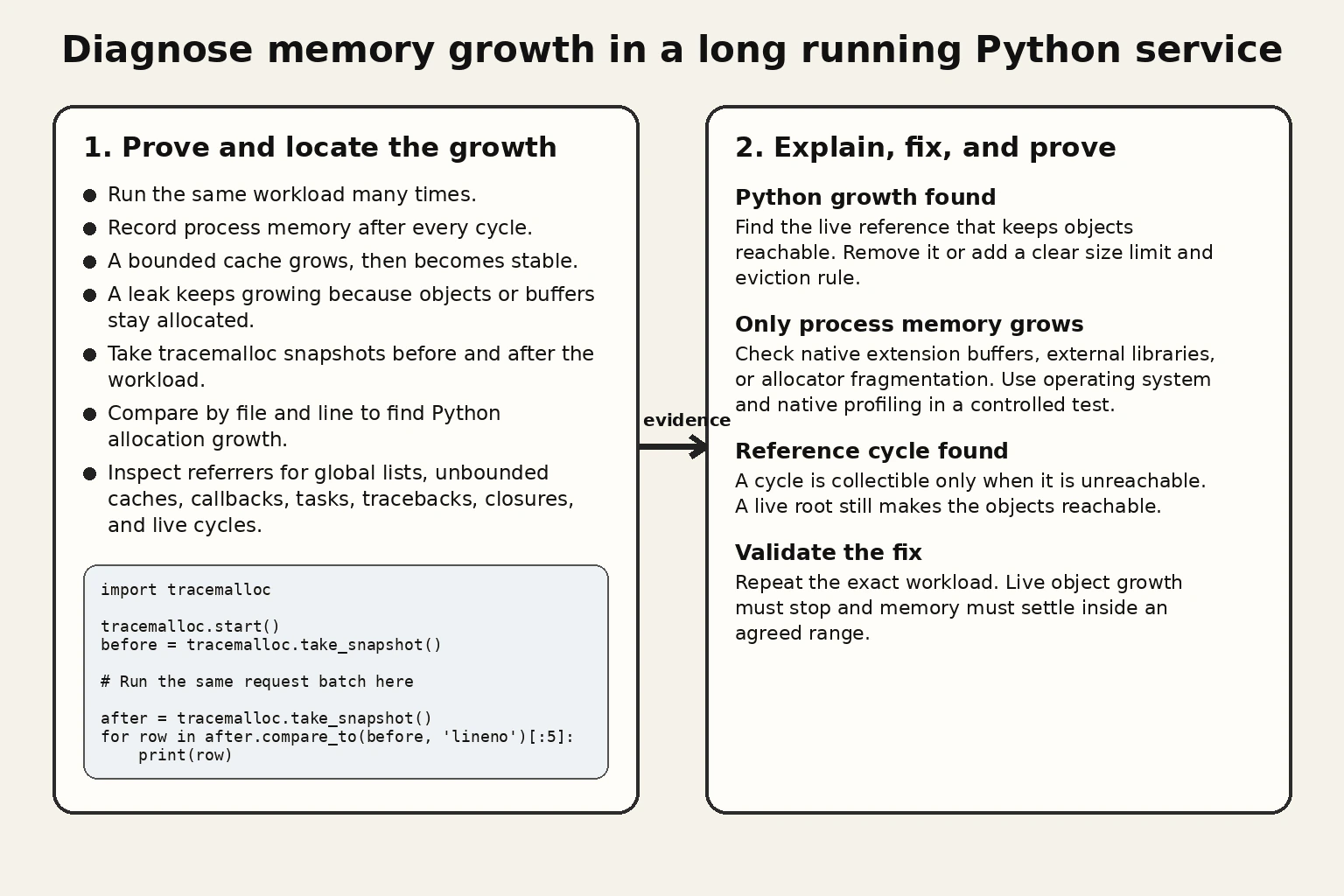
I would first prove that memory keeps growing under a repeatable workload instead of assuming every increase is a leak. I would compare process memory with tracemalloc snapshots, find the allocation sites and object types that continue growing, and inspect what still references those objects. I would check global collections, unbounded caches, callbacks, unfinished tasks, tracebacks, and reference cycles. If process memory grows but Python allocation data stays stable, I would investigate native extensions or allocator behavior. After the fix, I would repeat the same workload and confirm that memory reaches a stable level.
Detailed Explanation
I would first run a repeatable workload and measure memory after each cycle. A cache may grow at first and then reach a limit. A leak keeps growing because objects or native buffers remain allocated.
Useful Questions to Ask the Interviewer
Should I focus on Python language behavior, or also explain the runtime and standard library?
Which Python version and execution environment should I assume?
Would you like a small code example together with production tradeoffs and edge cases?
I would track process memory and Python allocations separately. tracemalloc can compare snapshots and show which Python allocation locations keep growing. I would group results by file and line, then inspect the object types and the references that keep them alive. Common causes include global lists, dictionaries without limits, caches without eviction, registered callbacks, unfinished asyncio tasks, saved exception tracebacks, and closures.
Python mainly releases an object when its reference count reaches zero. The cyclic garbage collector can remove many unreachable reference cycles. It cannot collect objects that are still reachable from a live root, even when a cycle exists.
If process memory grows but tracemalloc does not show similar growth, I would investigate native extensions, external buffers, or allocator fragmentation. I would use operating system metrics and native profiling in a controlled test.
After fixing the retention path, I would repeat the same workload for many cycles. The fix is valid when live object growth stops and memory settles within an agreed range.
Where it is used
This investigation is used in web APIs, background workers, asyncio services, data processing systems, database clients, image processing services, and machine learning inference services that remain alive for hours or days. It is especially important when container memory rises after each request, workers restart after reaching a memory limit, or latency becomes worse as the process grows.
Why Interviewers Ask This
Interviewers ask this to test whether a candidate understands Python memory behavior, can distinguish normal cache growth from object retention, can investigate both Python and native allocations, and can validate a production fix with repeatable evidence.
Common interview mistakes
Common mistakes include treating every increase in process memory as a leak, testing only one request, assuming that calling gc.collect fixes the cause, and using tracemalloc as proof that no native memory growth exists. Other mistakes include ignoring unbounded caches, global collections, callbacks, unfinished tasks, and saved tracebacks. Developers may also inspect a reference cycle without checking whether a live root still reaches it. Another mistake is expecting process memory to fall immediately after objects are freed. Python and the system allocator may keep released memory available for reuse, so resident memory alone cannot prove that live objects are still leaking.
Interview tip
Present the diagnosis in a clear order. First prove continued growth with a repeatable workload. Then compare process memory with Python allocation snapshots. Next identify the retained objects and the references keeping them alive. If Python allocations do not explain the growth, check native memory and allocator behavior. Finish by explaining how the same workload proves that the fix makes memory stabilize.
Interviewer may ask next
Can process memory remain high after Python objects are freed?
Yes. Python may free objects for reuse without immediately returning all memory to the operating system. Its allocator and the system allocator can retain arenas or fragmented regions inside the process. This matters because high resident memory does not always mean that live Python objects are leaking. I would compare repeated workload cycles, live object counts, tracemalloc snapshots, and process memory. Retaining memory can make later allocations faster, but it makes resident memory less reliable as the only diagnostic signal.
What would you do if tracemalloc stays stable while process memory keeps growing?
I would investigate allocations that tracemalloc does not fully explain, especially buffers created by native extensions or external libraries. I would reproduce the growth with the suspected feature enabled and disabled, review library specific memory metrics, and use operating system or native allocation profiling in a controlled environment. This matters because some C or C plus plus code allocates memory outside the Python allocation paths visible to ordinary tracemalloc reports. Native profiling adds setup cost and can slow the service, so I would first narrow the workload and suspected dependency.
2. How do you parse text safely in Python?Language SpecificEasyNvidia
i Question Details
Explain string handling, splitting or regular expressions, validation, Unicode, malformed records, exceptions, and tests for a production parser.
Short Interview Answer (30-60 seconds)
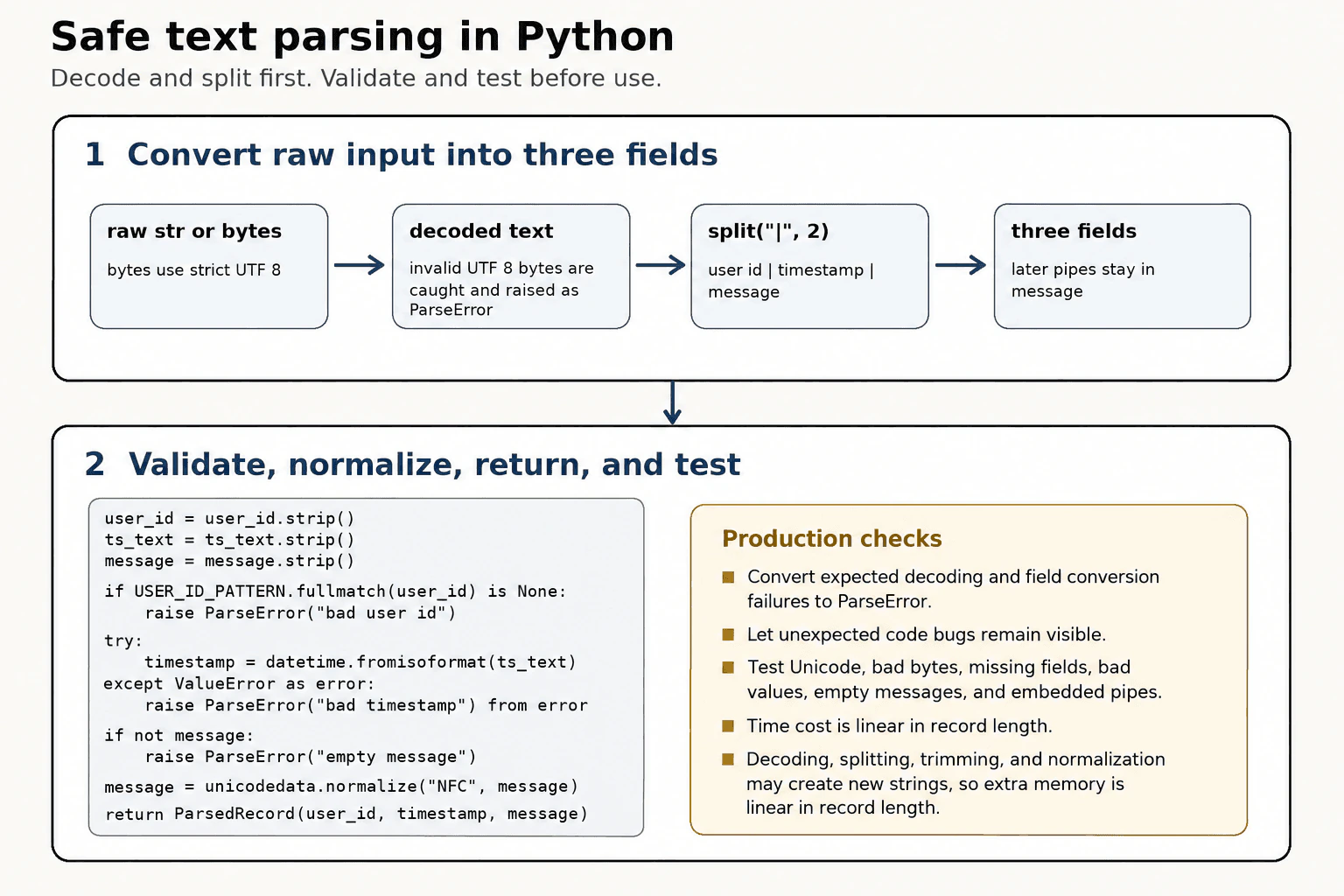
I parse text safely by defining the exact format, decoding bytes with strict UTF 8 handling, splitting with a limit, validating every field, and raising a clear custom exception for malformed records. I normalize Unicode only when the application needs equivalent text forms to compare consistently. I also test missing fields, invalid values, embedded delimiters, bad byte sequences, empty input, and boundary cases.
I first define the accepted record format. In this example, each record contains a user identifier, an ISO timestamp, and a message separated by pipe characters. If the input is bytes, I decode it as UTF 8 with strict error handling. Python then raises UnicodeDecodeError for invalid byte sequences instead of silently changing the data.
Useful Questions to Ask the Interviewer
Should I focus on Python language behavior, or also explain the runtime and standard library?
Which Python version and execution environment should I assume?
Would you like a small code example together with production tradeoffs and edge cases?
I call split with a maximum of two splits. This preserves any later pipe characters inside the message. I verify that three fields were produced, trim only the fields whose surrounding spaces are not meaningful, and validate each value before creating the result. A compiled regular expression checks the small identifier rule. datetime.fromisoformat validates and converts the timestamp.
I normalize the message with unicodedata.normalize using NFC so common equivalent Unicode forms have one representation. This does not make the value safe for HTML, SQL, or shell commands. Those destinations need their own escaping or parameter handling.
The parser raises ParseError for expected input failures while allowing unexpected programming errors to remain visible. Its time cost is linear in the record length. Splitting and normalization create new strings, so memory use is also linear in the record length.
Example
The parser accepts either text or bytes. Bytes are decoded with strict UTF 8 rules. The record is split at most twice, so the message may contain additional pipe characters. The user identifier must contain only ASCII letters, digits, or underscores. The timestamp must be accepted by datetime.fromisoformat. The message must not be empty after surrounding spaces are removed, and it is normalized to Unicode NFC form. Expected input problems become ParseError with a clear reason. Unexpected programming errors are not hidden. The included checks cover valid input, Unicode text, an embedded delimiter, missing fields, invalid identifiers, invalid timestamps, empty messages, unsupported input types, and invalid UTF 8 bytes.
Code
import re
import unicodedata
from dataclasses import dataclass
from datetime import datetime
from typing importUnionclassParseError(ValueError):
"""Raised when an input record does not match the required format."""@dataclass(frozen=True)classParsedRecord:
"""Store one validated record."""
user_id: str
timestamp: datetime
message: str# Compile the expression once because the parser may process many records.
USER_ID_PATTERN = re.compile(r"^[A-Za-z0-9_]+$")
defparse_record(raw: Union[str, bytes]) -> ParsedRecord:
"""Parse one record with the format user_id|timestamp|message."""# Decode bytes strictly so damaged UTF 8 input is rejected.ifisinstance(raw, bytes):
try:
text = raw.decode("utf-8", errors="strict")
except UnicodeDecodeError as error:
raise ParseError("The record is not valid UTF 8 text") from error
elifisinstance(raw, str):
text = raw
else:
raise ParseError("The record must be text or bytes")
# Split only twice so the message may contain pipe characters.
parts = text.split("|", 2)
iflen(parts) != 3:
raise ParseError("The record must contain exactly three fields")
# Ignore surrounding spaces for fields where spaces are not meaningful.
user_id = parts[0].strip()
timestamp_text = parts[1].strip()
message = parts[2].strip()
# Validate the identifier before using it.if USER_ID_PATTERN.fullmatch(user_id) isNone:
raise ParseError("The user identifier contains invalid characters")
# Parse and validate the timestamp value.try:
timestamp = datetime.fromisoformat(timestamp_text)
except ValueError as error:
raise ParseError("The timestamp is not valid ISO format text") from error
# Reject an empty message.ifnot message:
raise ParseError("The message must not be empty")
# Normalize common equivalent Unicode forms to NFC.
normalized_message = unicodedata.normalize("NFC", message)
return ParsedRecord(
user_id=user_id,
timestamp=timestamp,
message=normalized_message,
)
defexpect_parse_error(raw: object) -> None:
"""Confirm that malformed input raises ParseError."""try:
parse_record(raw) # type: ignore[arg-type]except ParseError:
returnraise AssertionError("Expected ParseError")
if __name__ == "__main__":
# Test a valid Unicode record.
record = parse_record("user_7|2026-07-28T14:30:00|Cafe\u0301 ready")
assert record.user_id == "user_7"assert record.timestamp == datetime(2026, 7, 28, 14, 30)
assert record.message == "Caf\u00e9 ready"# Test that an additional pipe remains inside the message.
record_with_pipe = parse_record("user_8|2026-07-28T15:00:00|left|right")
assert record_with_pipe.message == "left|right"# Test malformed records and unsupported input.
expect_parse_error("missing fields")
expect_parse_error("bad id!|2026-07-28T15:00:00|hello")
expect_parse_error("user_9|not a timestamp|hello")
expect_parse_error("user_9|2026-07-28T15:00:00| ")
expect_parse_error(b"user_9|2026-07-28T15:00:00|\xff")
expect_parse_error(123)
print("All parser tests passed")
Where it is used
This pattern is used when reading log records, message queue payloads, imported files, network responses, and simple integration feeds. It is useful when a service must accept valid records while rejecting, logging, counting, or quarantining malformed ones. For CSV or JSON input, production code should use the csv or json module because those formats have quoting, escaping, nesting, and syntax rules that manual splitting does not handle correctly.
Why Interviewers Ask This
Interviewers ask this question to check whether a candidate can turn untrusted text into reliable Python data. They want to see correct decoding, controlled splitting, field validation, Unicode handling, useful exceptions, and tests for malformed input. They also evaluate whether the candidate separates parsing from later security controls instead of assuming that parsed text is automatically safe.
Common interview mistakes
Common mistakes include calling split without a limit when the final field may contain the delimiter, accepting the wrong number of fields, and catching Exception so broadly that programming bugs are hidden. Other mistakes include decoding bytes with replacement characters without recording data loss, using a regular expression as the only validation step, trimming spaces that are meaningful to the format, assuming Unicode normalization is always required, and treating parsed text as safe for SQL, HTML, or shell commands. Another mistake is returning partly valid data after a required field has failed validation.
Interview tip
Explain the parser as a clear sequence: decode, split, validate, normalize, convert, and report errors. Mention one malformed record and show exactly how the parser rejects it. Also explain that parsing checks structure and values, while each output destination still needs its own security controls.
Interviewer may ask next
What happens if the message contains a pipe character?
The message keeps the pipe character because split is called with a maximum of two splits. Python separates the user identifier and timestamp, then leaves the rest of the text as the message. This matters because an unlimited split would create extra fields and could reject or misread a valid record. The limitation is that this format allows unescaped pipe characters only in the final field.
When should you use the csv or json module instead of manual splitting?
Use the csv or json module when the input follows one of those formats. The csv module handles quoting, delimiters, and embedded line breaks. The json module handles escaped strings, numbers, arrays, objects, and syntax errors. These parsers may do more work than a simple split, but they correctly implement the full format and reduce the risk of malformed records being interpreted incorrectly in production.
3. How do you write clear Python under interview time constraints?Language SpecificEasyNvidia
i Question Details
Explain how you clarify requirements, choose data structures, structure functions, name variables, validate edge cases, and state complexity while coding live.
Short Interview Answer (30-60 seconds)
I first confirm the input, output, constraints, and important edge cases. Then I choose the simplest Python data structure that supports the required operations efficiently. I write one focused function, use clear names, test a normal case and edge cases aloud, and state the expected time and space cost. I also make assumptions explicit instead of hiding them in the code.
I start by confirming the input type, expected output, size limits, duplicate handling, ordering rules, and behavior when no answer exists. This prevents me from solving the wrong problem. I then choose a Python data structure based on the operations I need. For example, a set is useful when I need fast membership checks.
Useful Questions to Ask the Interviewer
Should I focus on Python language behavior, or also explain the runtime and standard library?
Which Python version and execution environment should I assume?
Would you like a small code example together with production tradeoffs and edge cases?
I keep the solution small and direct. I usually write one main function and add a helper only when it removes repeated or confusing logic. Names such as seen, value, and required_value explain purpose better than unclear single letters.
While coding, I explain important decisions instead of reading every line aloud. I test an empty input, a normal case, duplicate values, and a case with no result. I avoid broad exception handling unless the requirements call for it because it can hide programming errors.
Finally, I walk through one example and state complexity. In the example below, each value is processed once. Set lookup and insertion are expected O of 1 operations, so expected time is O of n. In unusual heavy collision cases, they can be slower. The set can store up to n values, so extra space is O of n.
Example
The function finds the first pair discovered in input order whose sum equals the target. It uses a set named seen to store values that were already processed. For each value, it calculates the required partner. If that partner is in seen, the function returns the pair. Otherwise, it stores the current value and continues. It returns None when no pair exists. The input is typed as a list of integers, but Python type hints are not enforced automatically at runtime. The code assumes callers follow that contract.
Code
from typing importOptionaldeffind_pair_with_sum(values: list[int], target: int) -> Optional[tuple[int, int]]:
"""Return the first discovered pair whose sum equals target.
Return None when no valid pair exists.
"""# Store values that have already been processed.# Set lookup and insertion are expected constant time operations.
seen: set[int] = set()
# Process each input value once.for value in values:
# Calculate the value needed to reach the target.
required_value = target - value
# A previously seen value completes the pair.if required_value in seen:
return required_value, value
# Store the current value for later checks.
seen.add(value)
# Make the no result behavior explicit.returnNonedefmain() -> None:
# Normal case with one valid pair.
numbers = [4, 7, 1, 9]
print(find_pair_with_sum(numbers, 10))
# Duplicate values can form a pair when both appear in the input.print(find_pair_with_sum([5, 5], 10))
# Empty input has no valid pair.print(find_pair_with_sum([], 10))
# No matching pair returns None.print(find_pair_with_sum([1, 2, 3], 20))
if __name__ == "__main__":
main()
Where it is used
These habits are useful in live coding interviews, code reviews, debugging sessions, and production development. They help when writing request validation, service logic, data processing functions, and utility functions. Clear assumptions, focused functions, descriptive names, and explicit edge behavior also make Python code easier to test, review, and maintain.
Why Interviewers Ask This
Interviewers ask this question to see whether a candidate can turn an unclear requirement into correct, readable, and efficient Python. They evaluate requirement clarification, data structure choices, function design, naming, edge case handling, complexity analysis, and the ability to explain decisions while coding.
Common interview mistakes
Common mistakes include coding before confirming requirements, choosing a data structure without explaining why it fits, using unclear names, putting unrelated logic into one large function, ignoring empty input or duplicate values, and claiming constant extra space when the set can grow with the input. Another mistake is saying set operations are always constant time. Their expected cost is O of 1, but unusual collision behavior can make an operation slower. Adding unnecessary abstraction or broad exception handling can also make a short solution harder to verify.
Interview tip
State your assumptions and plan before typing. Explain why the chosen Python data structure fits the required operations. Write the simplest correct function, test important cases aloud, and finish with precise expected time and space complexity.
Interviewer may ask next
How does the solution handle duplicate values such as two fives for a target of ten?
It handles them correctly when both fives appear in the input. The first five is added to seen. When the second five is processed, its required value is five, which is already present, so the function returns the pair. Checking before adding the current value matters because it prevents a single element from being matched with itself.
When would you use sorting and two indexes instead of a set?
I would consider sorting when mutation is acceptable or when ordered processing is useful for another requirement. Sorting changes the time cost to O of n log n, followed by an O of n scan. Python list sorting can also use temporary memory, and copying the input to preserve its order requires O of n additional space. The set solution keeps the original order unchanged and has expected O of n time, but it also uses O of n extra space.
4. Which Python features make it suitable for your work?Language SpecificEasyNvidia
i Question Details
Discuss specific Python language and ecosystem characteristics you have used, along with their productivity, maintainability, and performance tradeoffs.
Short Interview Answer (30-60 seconds)
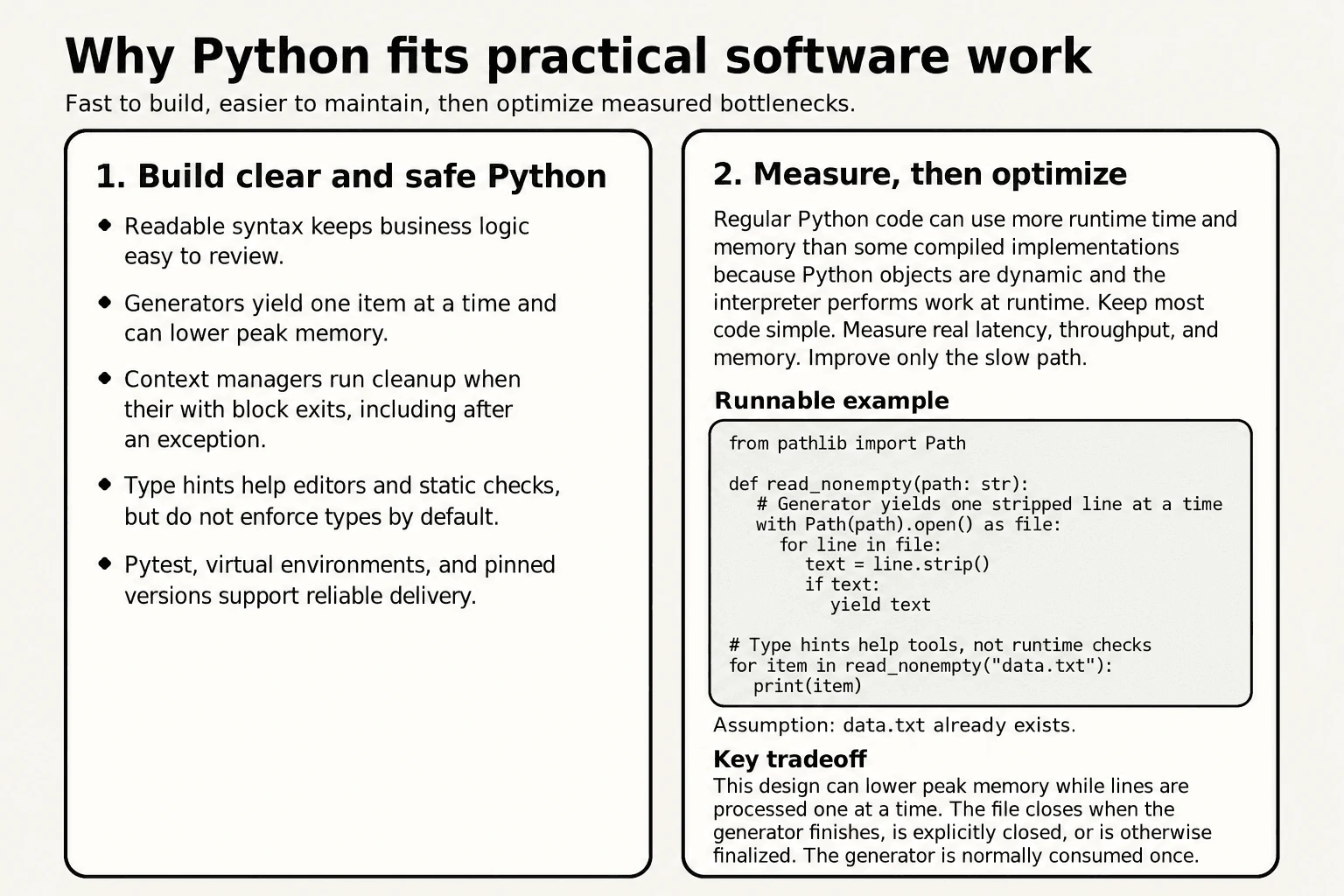
Python suits my work because it lets me build clear and reliable software quickly. Its readable syntax, standard library, generators, context managers, type hints, testing tools, and mature package ecosystem improve productivity and maintainability. The main tradeoff is that regular Python can use more runtime time and memory than compiled alternatives, so I measure bottlenecks and optimize only the parts that need it.
Detailed Explanation
Python is suitable for my work because it lets me build clear software quickly while keeping the code easy to test and maintain. Its readable syntax reduces unnecessary code, and the standard library covers files, data formats, networking, logging, concurrency, and testing. Generators produce one value at a time, so they can lower peak memory use when data does not need to be stored all at once. They may add iteration overhead and can be consumed only once unless created again. Context managers run cleanup logic when a block ends, including when an exception occurs, which helps release files, locks, and connections safely. Type hints improve editor support, documentation, and static checking, but Python does not normally enforce them at runtime. Pytest, virtual environments, pinned dependencies, and mature packages support reliable testing and repeatable deployment. The main tradeoff is performance. Dynamic objects and interpreter work can make regular Python slower and more memory heavy than compiled alternatives. I would keep most business logic in clear Python, measure real bottlenecks, and then improve only the slow path with a better algorithm, batching, caching, NumPy, compiled extensions, or another service when the added complexity is justified.
Useful Questions to Ask the Interviewer
Should I focus on Python language behavior, or also explain the runtime and standard library?
Which Python version and execution environment should I assume?
Would you like a small code example together with production tradeoffs and edge cases?
Where it is used
These features are useful in web APIs, automation tools, data pipelines, command line applications, test systems, and machine learning services. Generators are useful for large files, database result streams, and event streams because they avoid storing every item at once. Context managers help release files, locks, sockets, and database connections. Type hints help teams understand interfaces and catch some mistakes before runtime. Pytest supports regression testing. Virtual environments isolate project packages, while pinned dependency files help make builds and deployments repeatable.
Why Interviewers Ask This
Interviewers ask this question to check whether a candidate can connect Python features to practical engineering needs. They are evaluating knowledge of runtime behavior, maintainability, testing, dependency management, memory use, performance limits, and the judgment to choose the right tool instead of only saying that Python is easy to learn.
Common interview mistakes
A common mistake is listing many Python features without explaining how they help. Another mistake is claiming that type hints enforce types at runtime. They mainly support documentation, editors, and static checking unless explicit runtime validation is added. It is also wrong to say that generators are always faster. Their main benefit is lazy evaluation and lower peak memory use, while each iteration can still have overhead. Context managers do not make every resource safe automatically because their cleanup method must be implemented correctly. Virtual environments isolate installed packages, but they do not pin exact versions by themselves. Production dependencies still need version control, security review, tests, and monitoring.
Interview tip
Choose a small set of features and connect each one to a real engineering need. Explain how it works, where it helps, and one limitation. Finish by showing that you measure performance and memory use instead of making broad claims about Python being fast or slow.
Interviewer may ask next
What limitations should you consider when using a generator?
A generator produces values lazily and is normally consumed only once. This matters because a second loop over the same exhausted generator returns no values unless the generator is created again. It can lower peak memory use when values are processed one at a time, but it does not help when every result must later be stored in a list. It may also add per item iteration overhead, so it should be chosen for streaming behavior and memory control rather than assumed speed.
When would you move work out of regular Python code?
I would move work only when measurements show that interpreter overhead, object allocation, or single process execution cannot meet the required latency, throughput, or memory limit. I would first improve the algorithm and remove unnecessary work. I could then use batching, NumPy, a compiled extension, multiprocessing, or another service depending on the bottleneck. The tradeoff is more code, harder debugging, added deployment work, and greater operational complexity.
5. How do Python processes and threads differ?Language SpecificMediumNvidia
i Question Details
Compare memory isolation, scheduling, communication, startup cost, failure isolation, and appropriate use for CPU-bound and I/O-bound work.
Short Interview Answer (30-60 seconds)
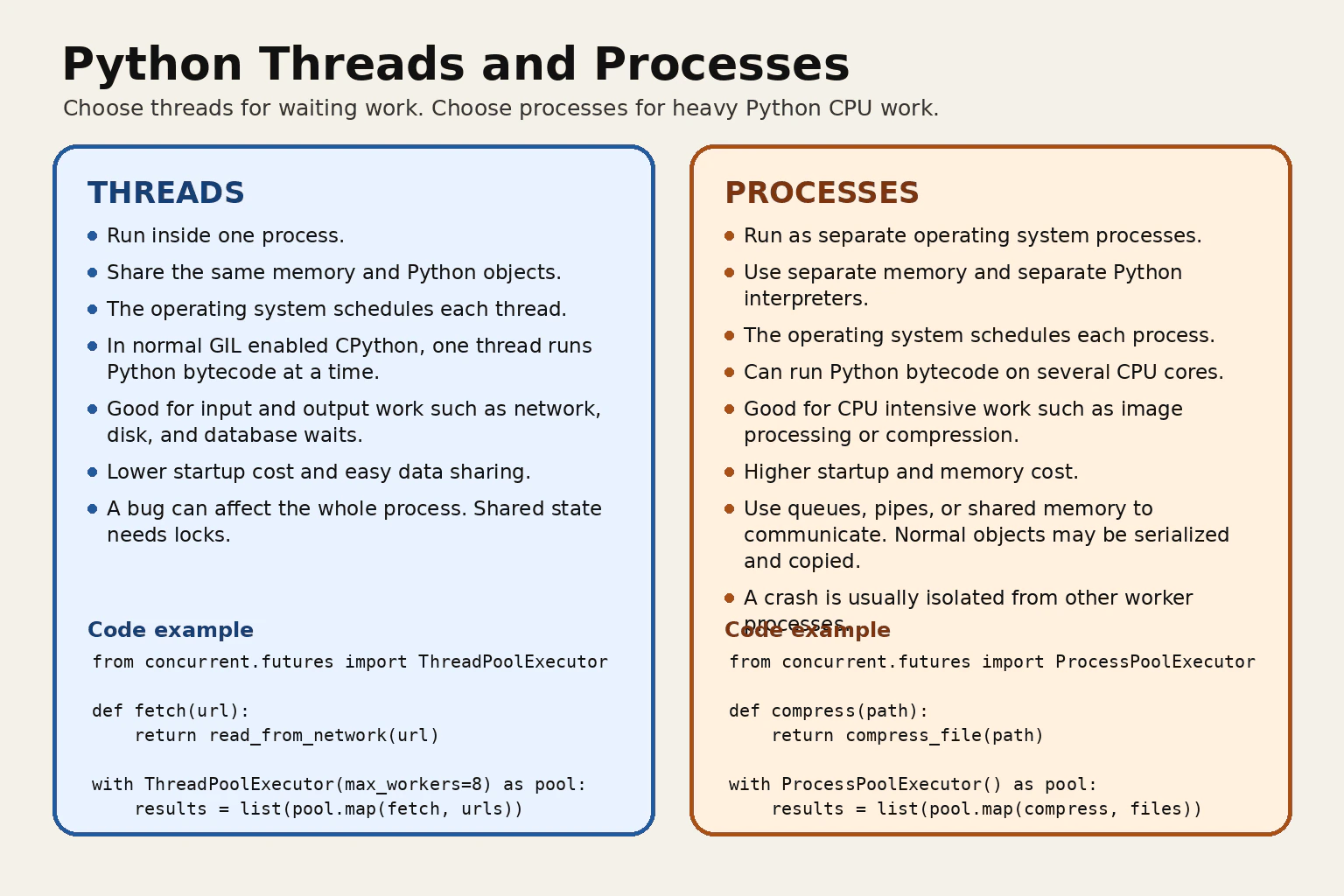
I usually use threads for input and output bound work and processes for CPU bound Python work. Threads run inside one process and share memory, so they start more cheaply and communicate easily, but shared state needs synchronization. Processes have separate memory and separate Python interpreters, so they cost more to start and exchange data, but they can use multiple CPU cores and provide stronger failure isolation.
Detailed Explanation
The practical choice is usually threads for waiting work and processes for heavy CPU work. Threads run inside one process and share its memory and resources. Sharing data is simple, but concurrent updates to mutable objects can cause race conditions. Locks can protect shared state, although they add complexity and waiting.
Useful Questions to Ask the Interviewer
Should I focus on Python language behavior, or also explain the runtime and standard library?
Which Python version and execution environment should I assume?
Would you like a small code example together with production tradeoffs and edge cases?
Processes have separate memory spaces and separate Python interpreters. Normal Python objects are not directly shared. Queues and pipes usually serialize and copy data between processes. Shared memory can reduce copying for large buffers, but synchronization is still required.
The operating system schedules both threads and processes. In standard Global Interpreter Lock enabled CPython, only one thread normally executes Python bytecode at a time within a process. Threads still work well for network, disk, and database waits because blocking operations can release the lock. Processes can execute Python bytecode on multiple CPU cores.
Processes usually start more slowly and use more memory, but the exact cost depends on the operating system and process start method. They also isolate crashes and memory corruption more strongly. In production, use bounded worker counts, timeouts, clean shutdown handling, and measurements from the real workload.
Where it is used
Threads are useful for network clients, web requests, database calls, file access, and other work that spends much of its time waiting. Processes are useful for image processing, data transformation, simulations, compression, and other CPU intensive Python work. A production service may also use several worker processes for isolation and multiple threads inside each worker for input and output concurrency.
Why Interviewers Ask This
Interviewers ask this to check whether the candidate understands Python concurrency, the Global Interpreter Lock in standard CPython, shared memory risks, process communication costs, operating system scheduling, and how to choose the correct model for CPU bound and input and output bound work.
Common interview mistakes
A common mistake is saying that Python threads provide no concurrency. They can overlap while waiting, and native extensions may release the Global Interpreter Lock. Another mistake is assuming shared thread memory is automatically safe. Mutable shared objects can still have race conditions. Candidates also forget that process queues and pipes often serialize and copy data. Shared memory can reduce copying, but it does not remove synchronization needs. Creating too many threads or processes can increase scheduling, memory, and communication costs. Processes can also be slower for small tasks because startup and transfer costs may exceed the useful work.
Interview tip
Start with the decision: threads for input and output bound work and processes for CPU bound Python work. Then compare memory sharing, communication cost, startup cost, the Global Interpreter Lock, scheduling, and failure isolation. State that the conclusion assumes standard Global Interpreter Lock enabled CPython.
Interviewer may ask next
Can Python threads ever run CPU work in parallel?
Yes, when the CPU work runs in native code that releases the Global Interpreter Lock. Standard Python bytecode inside one Global Interpreter Lock enabled CPython process normally does not run in parallel across threads. This matters because libraries such as numerical extensions may behave differently from pure Python code. The tradeoff is that thread safety and actual lock release behavior depend on the native library.
When can processes be slower than threads?
Processes can be slower when tasks are small or when large amounts of data must be transferred between workers. Process startup, serialization, copying, and result transfer add overhead. This matters because the overhead may be larger than the CPU work itself. The tradeoff is that processes provide multiple core execution and stronger isolation, while threads usually have lower startup and communication costs.
6. How would you implement asynchronous I/O in Python?Language SpecificMediumNvidia
i Question Details
Explain coroutines, tasks, awaiting, event-loop scheduling, cancellation, timeouts, backpressure, and how to keep blocking work off the event loop.
Short Interview Answer (30-60 seconds)
I would use asyncio for operations that spend most of their time waiting for network, database, or subprocess I/O. I would write coroutines with async def, await nonblocking operations, and create tasks only when independent work should run concurrently. I would apply timeouts, preserve cancellation, limit concurrency with a semaphore or bounded queue, and move blocking functions to asyncio.to_thread so they do not stop the event loop.
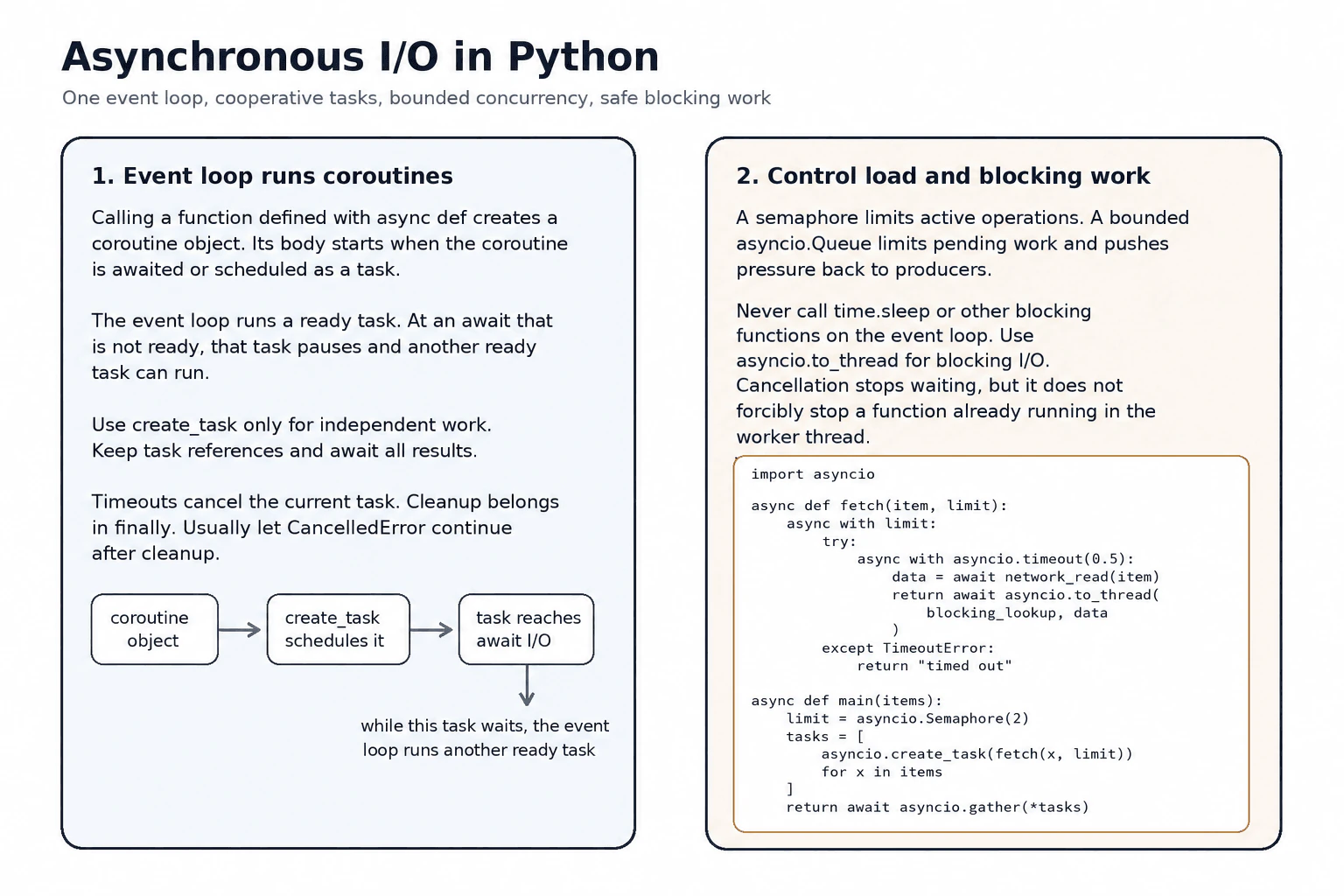
I would implement asynchronous I/O with asyncio and async functions. Calling an async function creates a coroutine object. Its body starts when the coroutine is awaited or scheduled as a task. The event loop runs ready tasks and lets another task run when the current coroutine reaches an await whose result is not ready. This is cooperative scheduling, so long synchronous work can delay every task.
Useful Questions to Ask the Interviewer
Should I focus on Python language behavior, or also explain the runtime and standard library?
Which Python version and execution environment should I assume?
Would you like a small code example together with production tradeoffs and edge cases?
I would use asyncio.create_task when independent operations should make progress together, keep each task reference, and await every result. I would use asyncio.timeout to place a time limit around an operation. When the limit expires, it cancels the current task and raises TimeoutError outside the timeout context.
Cancellation is normal control flow. Cleanup belongs in finally blocks, and CancelledError should usually be raised again after cleanup. To control overload, I would use a semaphore to limit active operations or a bounded queue to limit waiting work. This also limits task and request memory growth.
Blocking functions must not run directly on the event loop. I would use asyncio.to_thread for blocking I/O. Cancellation stops waiting for that call, but it does not forcibly stop the worker thread. For substantial CPU bound work, I would use processes or a separate worker service.
Example
The example runs four simulated I/O operations concurrently. A semaphore allows only two operations to enter the active section at one time. This protects the downstream resource, although all four task objects still exist in memory. Each active operation has a timeout. The third operation exceeds the limit and returns a timeout result. A blocking lookup runs with asyncio.to_thread, so its sleep occurs in a worker thread rather than on the event loop. All task references are stored and awaited with asyncio.gather. If the parent task is cancelled, unfinished child tasks are cancelled and awaited so their cleanup can finish. Cancellation of asyncio.to_thread stops the coroutine from waiting, but it does not forcibly terminate a blocking function that is already running in the thread.
Code
import asyncio
import time
# This function blocks its calling thread.defblocking_lookup(value: int) -> str:
time.sleep(0.2)
returnf"blocking result for {value}"asyncdeffetch_item(
item_id: int,
delay: float,
limit: asyncio.Semaphore,
) -> str:
# The semaphore limits active operations to two at a time.asyncwith limit:
try:
# The time limit covers the simulated I/O and blocking lookup.asyncwith asyncio.timeout(0.5):
print(f"starting item {item_id}")
# asyncio.sleep represents a nonblocking I/O wait.await asyncio.sleep(delay)
# Run the blocking function in a worker thread.
blocking_result = await asyncio.to_thread(
blocking_lookup,
item_id,
)
returnf"item {item_id}: {blocking_result}"except TimeoutError:
returnf"item {item_id}: timed out"finally:
# This cleanup runs after success, failure, timeout, or cancellation.print(f"finished cleanup for item {item_id}")
asyncdefmain() -> None:
# At most two operations may use the protected resource at once.
limit = asyncio.Semaphore(2)
work = [
(1, 0.1),
(2, 0.2),
(3, 0.7),
(4, 0.1),
]
# Store every task so its lifecycle and result remain observable.
tasks = [asyncio.create_task(fetch_item(item_id, delay, limit)) for item_id, delay in work]
try:
# Wait for every task and return results in input order.
results = await asyncio.gather(*tasks)
for result in results:
print(result)
except asyncio.CancelledError:
# Ask every unfinished child task to stop.for task in tasks:
task.cancel()
# Wait for child cleanup and collect cancellation exceptions.await asyncio.gather(*tasks, return_exceptions=True)
# Preserve cancellation for the caller.raiseif __name__ == "__main__":
asyncio.run(main())
Where it is used
This approach is used in network clients, asynchronous web servers, database clients, message consumers, service integrations, subprocess management, and programs that maintain many connections. A semaphore is useful when an external service or connection pool supports only limited concurrent operations. A bounded queue is useful when producers can create work faster than consumers can process it. asyncio.to_thread is useful when an existing library exposes a blocking interface and cannot be replaced with an asynchronous client.
Why Interviewers Ask This
Interviewers ask this question to check whether the candidate understands asyncio beyond async and await syntax. They want to evaluate knowledge of coroutine execution, task scheduling, cooperative cancellation, timeout handling, concurrency limits, overload control, and the effect of blocking work on the event loop. They also want to see whether the candidate can build reliable production code instead of creating an unlimited number of tasks.
Common interview mistakes
Common mistakes include calling an async function without awaiting or scheduling its coroutine, creating tasks and losing their references, using time.sleep inside a coroutine, starting unlimited tasks, and swallowing CancelledError. Another mistake is assuming async code makes CPU bound work faster. Blocking library calls placed directly inside async functions stop the event loop and delay unrelated tasks. A semaphore limits active operations but does not limit how many task objects are created, so a bounded queue or limited task creation is needed when the incoming workload itself is unbounded. Developers must also remember that cancelling asyncio.to_thread does not forcibly stop the function already running in its worker thread.
Interview tip
Start by saying that asyncio is best for waiting based concurrency. Then explain the path from coroutine creation to task scheduling and event loop execution. Mention that switching happens at await points, so blocking code can freeze all tasks. Finish with cancellation, timeouts, backpressure, and the difference between thread offloading for blocking I/O and process based execution for substantial CPU work.
Interviewer may ask next
What happens if a coroutine catches CancelledError and does not raise it again?
The task can suppress the cancellation and may continue running or appear to finish normally. Python delivers task cancellation by raising CancelledError at an await point. A coroutine may catch it to release resources, but it should usually raise it again after cleanup. Suppressing it can interfere with timeouts, parent task cancellation, structured cleanup, and application shutdown because the caller may expect the task to have stopped.
When would you use a bounded queue instead of only a semaphore for backpressure?
I would use a bounded queue when producers can create work faster than consumers can process it. A semaphore limits the number of active operations, but code can still create a very large number of tasks that wait for the semaphore and consume memory. With a bounded asyncio.Queue, await queue.put waits when the queue is full, so pressure reaches the producer and pending work stays within a chosen limit. The tradeoff is more worker and shutdown logic, including queue sizing, task_done calls, join handling, error handling, and cancellation.
7. How would you manage Python dependencies for a production service?Language SpecificMediumNvidia
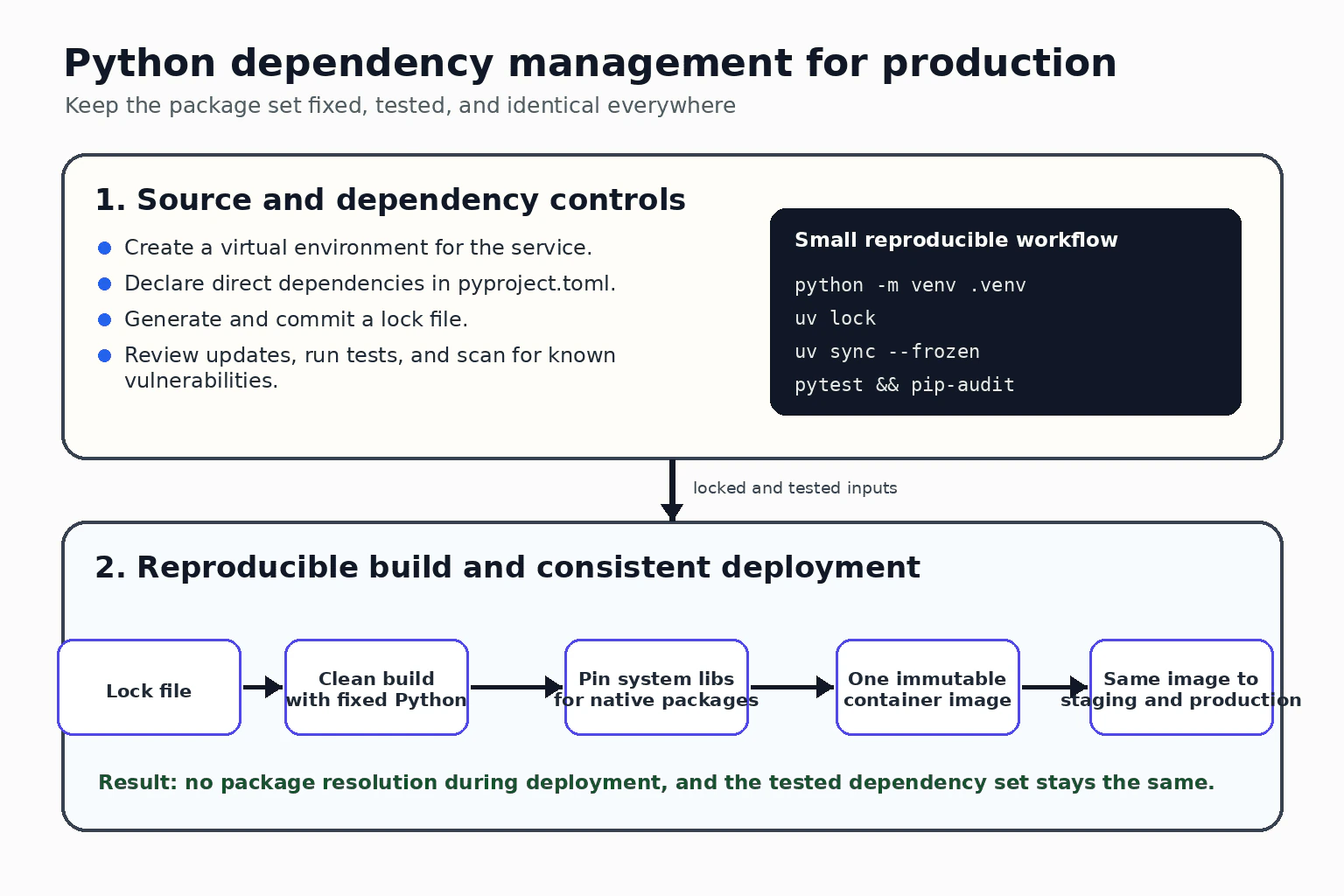
I would isolate the service, declare direct dependencies in pyproject.toml, and commit a tool generated lock file that records the resolved dependency set. Every build would use the same Python version and install from that lock file in a clean environment. I would test and scan dependency updates before release, control native system libraries in the image, and promote the same immutable image through staging and production.
Detailed Explanation
I would make dependency installation repeatable from development through production. Direct Python dependencies belong in pyproject.toml. A dependency tool resolves those packages and their transitive dependencies, then writes the selected versions and available integrity information to a lock file. The lock file should be committed and used during clean builds.
Useful Questions to Ask the Interviewer
Should I focus on Python language behavior, or also explain the runtime and standard library?
Which Python version and execution environment should I assume?
Would you like a small code example together with production tradeoffs and edge cases?
A virtual environment isolates Python packages from the system interpreter and other projects. This matters because Python imports modules from the active environment and module search path. For deployment, I would also use a container or another controlled image that fixes the Python version, operating system libraries, and build tools.
Updates should happen through reviewed changes. I would update a small dependency set, regenerate the lock file with the chosen tool, inspect the resolved changes, run unit and integration tests, scan for known vulnerabilities, and deploy gradually.
Native extensions need special care because compatibility depends on the Python version, operating system, processor, and linked libraries. I would prefer compatible trusted wheels, pin required system packages, and build artifacts in a controlled environment. I would build the image once and promote that same tested image to every deployment environment.
Where it is used
This process is used for web services, application programming interfaces, background workers, scheduled jobs, data services, and command line tools. It is especially important when several Python applications share infrastructure, when packages contain native extensions, or when development, continuous integration, staging, and production must run the same tested dependency set.
Why Interviewers Ask This
Interviewers ask this question to test whether a candidate can keep a Python service stable, secure, and repeatable across machines. They want to see knowledge of environment isolation, package resolution, transitive dependencies, native extensions, controlled upgrades, vulnerability handling, and consistent deployment.
Common interview mistakes
Common mistakes include installing packages into the system Python, using broad version ranges without a committed lock file, editing a generated lock file by hand, and resolving dependencies again during deployment. Other mistakes include ignoring transitive dependencies, upgrading many packages in one change, skipping vulnerability review, assuming the lock file controls operating system libraries, and building separate images for staging and production. Pinning every version manually in the project file is also poor practice because it mixes direct dependency intent with the complete resolved graph.
Interview tip
Explain the controls in order. Start with isolated environments and declared direct dependencies. Then describe the lock file, clean builds, controlled updates, security scanning, native dependencies, and promotion of one immutable image. State clearly that reproducibility requires control of Python and system libraries as well as Python package versions.
Interviewer may ask next
What would you do if a locked package has no compatible wheel for the production platform?
I would prevent the production host from compiling it unexpectedly. I would check the supported Python version, processor, operating system, and required system libraries. Then I would build the package in a controlled build image or select a compatible package version and regenerate the lock file. This matters because native compilation can vary across machines. The tradeoff is more build maintenance in exchange for tested and repeatable artifacts.
How would you update a dependency with a critical security vulnerability?
I would update the affected dependency through an urgent reviewed change, regenerate the lock file, inspect every resolved change, run focused and full tests, rebuild the immutable image, and deploy it gradually. I would also check whether the vulnerable behavior is reachable in the service. This matters because the update must reduce exposure without creating an uncontrolled production failure. I would avoid changing unrelated dependencies unless the resolver requires those changes.
8. How would you test a Python parser with many malformed inputs?Language SpecificMediumNvidia
i Question Details
Explain unit tests, parameterization, property-based testing, fuzzing, fixtures, boundary cases, Unicode cases, and regression tests.
Short Interview Answer (30-60 seconds)
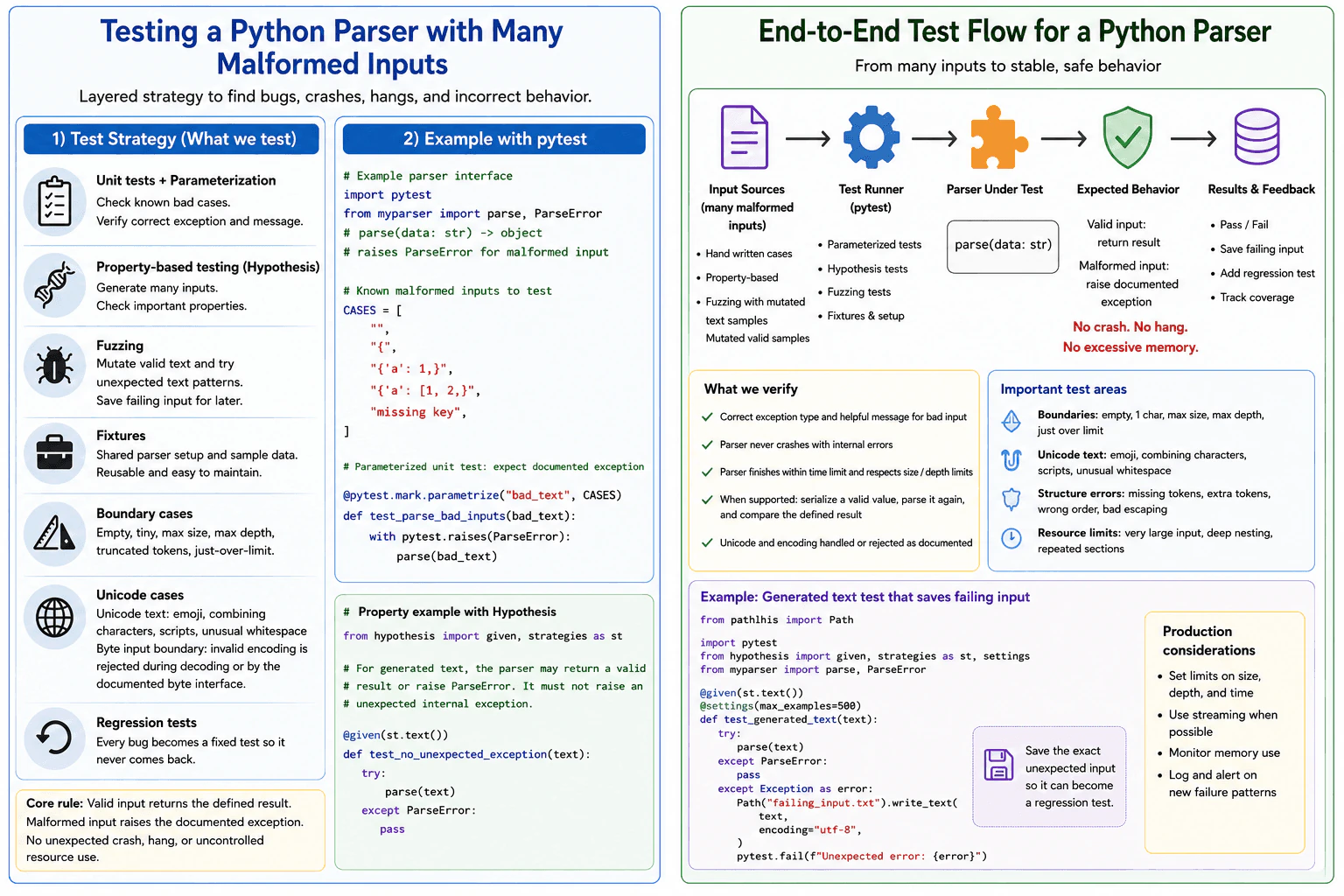
I would combine focused unit tests, pytest parameterization, property based tests, and fuzzing. For each malformed input, I would verify that the parser raises the documented exception, does not return a partial result unless that behavior is intentional, and does not hang or expose an unexpected internal exception. I would also test boundaries, Unicode text, invalid encoded bytes, reusable fixtures, and a regression case for every bug found.
Detailed Explanation
I would test the parser in layers. First, I would write unit tests for known failures such as missing delimiters, invalid tokens, extra input, incorrect escaping, and truncated structures. Pytest parameterization lets one test run many named inputs while checking the expected exception type and useful error details.
Useful Questions to Ask the Interviewer
Should I focus on Python language behavior, or also explain the runtime and standard library?
Which Python version and execution environment should I assume?
Would you like a small code example together with production tradeoffs and edge cases?
Next, I would use property based testing with Hypothesis. It can generate text, bytes, nested values, and structured malformed cases. Useful properties are that parsing always ends within a chosen limit, raises only documented exceptions for rejected input, and gives the same result for valid input after a supported serialize and parse round trip.
I would also run fuzzing against raw bytes and mutated valid samples. Every failure must save the exact input so it can become a deterministic regression test.
Fixtures would provide shared parser settings, valid seed documents, and common malformed samples. Boundary tests would cover empty input, one character input, maximum size, excessive nesting, incomplete final tokens, and values just above limits. Unicode tests would cover emoji, combining characters, unusual whitespace, surrogate handling where relevant, and decoding errors. Production tests should also verify size, depth, time, and memory limits.
Where it is used
This testing approach is used for configuration parsers, source code parsers, query languages, file import tools, network protocol decoders, API request validation, log readers, and custom data formats. It is most important when input comes from users, uploaded files, external services, or untrusted network clients.
Why Interviewers Ask This
Interviewers ask this question to see whether a candidate can test Python error handling beyond a few normal examples. They are evaluating knowledge of pytest, exception contracts, parameterized tests, generated data, Unicode handling, reusable fixtures, and regression protection. They also want to see whether the candidate can find crashes, hangs, excessive resource use, and cases where invalid input is accepted.
Common interview mistakes
Common mistakes include testing only valid input, checking only that any exception occurs, and ignoring the documented public exception type. Another mistake is asserting an exact internal error message even when the message is not part of the public API. Developers may forget empty input, trailing input, incomplete tokens, excessive nesting, huge values, Unicode normalization, decoding errors, or repeated malformed sections. Fuzz failures are also wasted when the exact failing input is not saved. A parser may reject bad input correctly but still be unsafe if it hangs, performs excessive backtracking, or consumes too much memory.
Interview tip
Explain the strategy in layers. Start with deterministic unit and parameterized tests. Then add property based testing and fuzzing. Finish with fixtures, boundaries, Unicode, resource limits, and regression cases. State the main contract clearly: malformed input must fail predictably, expose only documented behavior, and finish within controlled limits.
Interviewer may ask next
How would you test deeply nested malformed input?
I would test input at the supported depth limit and just above it. The allowed case should parse correctly, while the rejected case should raise the documented parser exception. The parser should not expose RecursionError unexpectedly, hang, or consume uncontrolled memory. This matters because recursive descent parsers can use one Python stack frame for each nesting level. An iterative design can reduce stack risk, but it requires more explicit parser state.
When would you use fuzzing instead of property based testing?
I would use fuzzing when I want broad exploration of raw bytes, corrupted files, and unusual token combinations without describing the full input structure. I would use property based testing when I can define useful generators and properties, such as valid round trips or documented rejection behavior. Property based tools often shrink a failure into a smaller example, which helps debugging. Fuzzing may explore a wider low level space, but it needs a saved corpus, reproducible seeds, and controlled CPU and memory use. In production work, I would usually use both and convert every useful failure into a regression test.
9. How do you choose between asyncio, threads, and processes in Python?Language SpecificHardNvidia
i Question Details
Compare concurrency models for I/O-bound and CPU-bound workloads, including the GIL, blocking libraries, serialization cost, shared state, cancellation, and operational complexity.
Short Interview Answer (30-60 seconds)
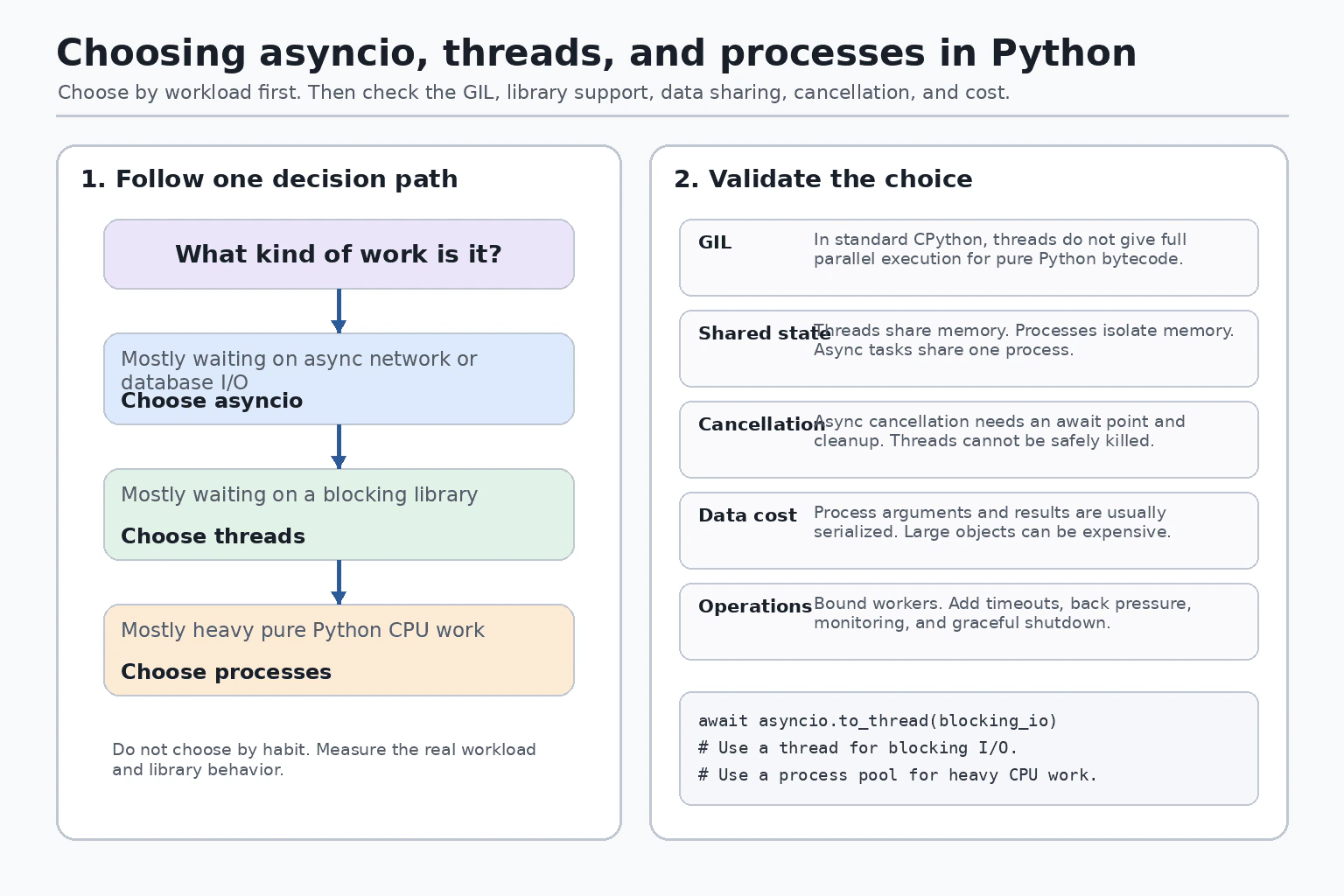
I choose asyncio for many concurrent input and output operations when the libraries provide async APIs. I choose threads when I must call blocking input and output libraries without blocking the main flow. I choose processes for heavy pure Python CPU work because separate processes have separate interpreters and can use multiple CPU cores. I also compare cancellation behavior, shared state, serialization cost, memory use, worker limits, and operational complexity before making the final choice.
Detailed Explanation
Start by classifying the workload. Use asyncio when one process must manage many network operations and the libraries can yield control with await. Asyncio tasks are lightweight, but scheduling is cooperative. A task must reach an await point before another task can run. A blocking call inside the event loop can delay every other task.
Useful Questions to Ask the Interviewer
Should I focus on Python language behavior, or also explain the runtime and standard library?
Which Python version and execution environment should I assume?
Would you like a small code example together with production tradeoffs and edge cases?
Use threads for blocking input and output libraries, such as synchronous database or HTTP clients. Threads share the same process memory, so passing objects is simple. However, shared mutable state can cause race conditions and may require locks. In a standard CPython build, the GIL usually prevents multiple threads from executing Python bytecode at the same time. Threads therefore help waiting work more than pure Python CPU work.
Use processes for CPU intensive Python work. Each process has its own interpreter and memory space, so workers can execute on separate CPU cores. The costs are process startup, higher memory use, and serialization when data crosses process boundaries. Large objects can make communication expensive.
In production, also consider timeouts, cancellation, back pressure, worker limits, graceful shutdown, monitoring, failure isolation, and whether every required library supports the selected model.
Where it is used
Asyncio is commonly used in services that manage many sockets, API calls, message queues, or database requests through async libraries. Threads are useful when a service must call synchronous input and output libraries while keeping an event loop or main thread responsive. Processes are useful for image processing, compression, parsing, simulation, data transformation, and other CPU intensive Python work. A production application may combine these models, such as asyncio for request handling, threads for blocking adapters, and processes for selected CPU tasks.
Why Interviewers Ask This
Interviewers ask this question to check whether a candidate can match a Python concurrency model to the real workload. They are evaluating knowledge of the GIL, blocking calls, cooperative scheduling, process isolation, serialization cost, shared state, cancellation behavior, memory use, and production complexity.
Common interview mistakes
Common mistakes include using threads for pure Python CPU work and expecting normal CPython builds to provide full parallel execution, calling a blocking function directly inside an asyncio event loop, creating an unbounded number of tasks or workers, sharing mutable thread state without synchronization, sending large objects repeatedly between processes, assuming cancellation immediately stops running code, and choosing asyncio before confirming that required libraries provide async APIs.
Interview tip
Classify the workload first. Then explain library support, the GIL, shared state, and process serialization. Finish with cancellation, memory use, worker limits, and production operations.
Interviewer may ask next
What happens when an asyncio task calls a blocking function?
The event loop stops running other tasks until the blocking function returns. This happens because asyncio uses cooperative scheduling and the task does not give control back to the loop. For blocking input and output, the call can be moved to a bounded thread executor or replaced with an async library. For heavy CPU work, a process is usually a better boundary. The tradeoff is added scheduling, resource management, and shutdown complexity.
When can processes be slower than one Python process?
Processes can be slower when each task is small or when large arguments and results must cross process boundaries. Python normally serializes transferred objects, and the operating system must schedule separate workers with separate memory. Process startup, communication, copying, and higher memory use can cost more than the parallel CPU time saves. Processes work best when each task performs enough CPU work to justify those costs.
10. How would you optimize Python code used in GPU inference pipelines?Language SpecificHardNvidia
i Question Details
Explain how to measure Python overhead around GPU work, reduce synchronization and copies, batch inputs, overlap CPU and GPU work, manage memory, and validate correctness.
Short Interview Answer (30-60 seconds)
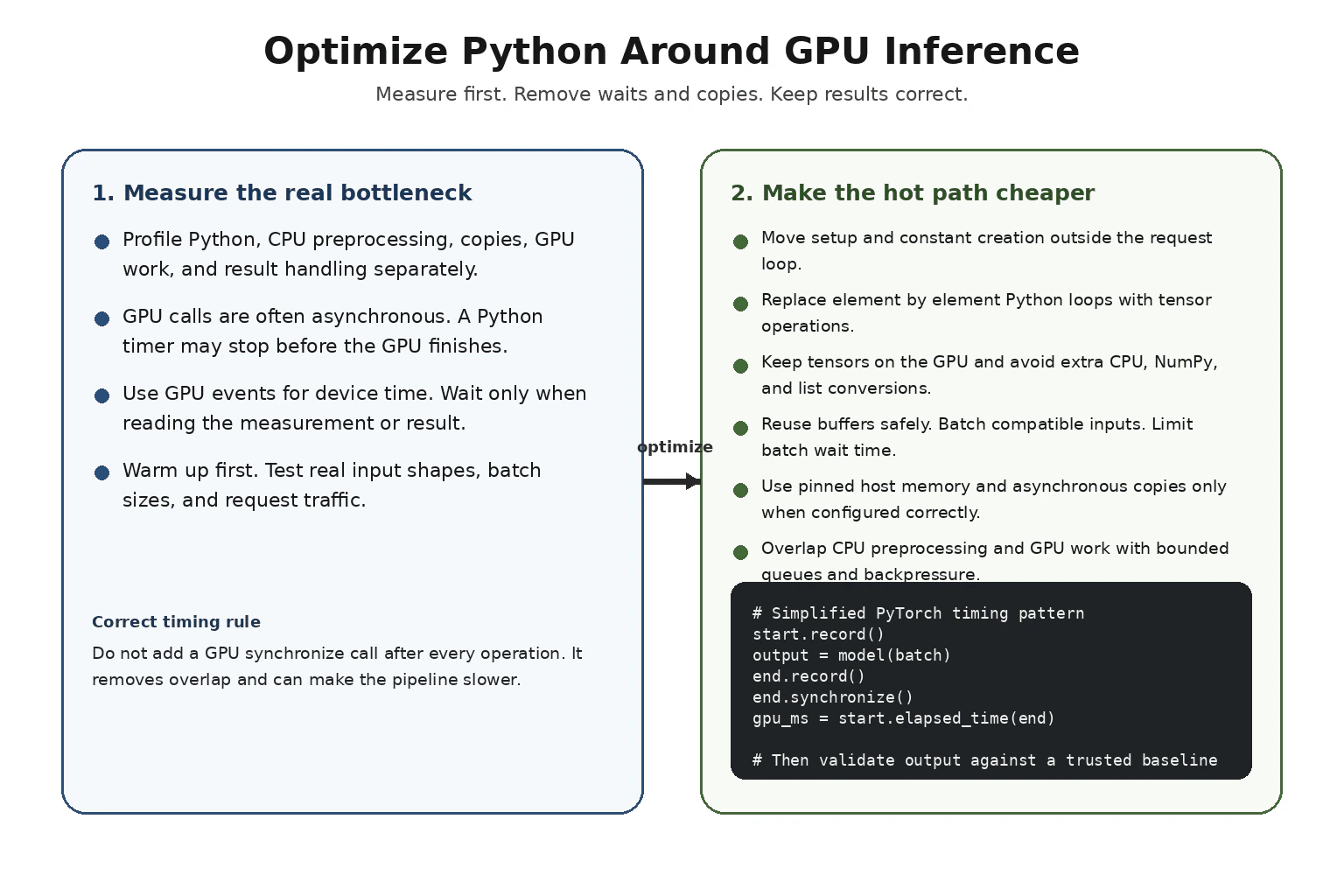
I would profile the complete inference path before changing it. I would measure Python work, CPU preprocessing, host to device copies, GPU execution, synchronization, and result handling separately. Then I would remove unnecessary waits and copies, replace Python loops with tensor operations, reuse buffers, batch compatible requests, and overlap CPU preparation with GPU work. I would validate every change against trusted outputs and realistic latency, throughput, and memory limits.
Detailed Explanation
I would optimize the measured bottleneck, not guess. GPU operations are often asynchronous, so a Python timer may measure only command submission. For accurate device time, I would use GPU events and wait before reading the result. I would use synchronization only at measurement or correctness boundaries because frequent waits prevent useful overlap.
Useful Questions to Ask the Interviewer
Should I focus on Python language behavior, or also explain the runtime and standard library?
Which Python version and execution environment should I assume?
Would you like a small code example together with production tradeoffs and edge cases?
Next, I would reduce Python work in the request loop. I would move model setup and constant creation outside the loop, replace element by element Python code with tensor operations, keep tensors on the GPU between stages, and avoid unnecessary conversions through lists, NumPy arrays, or CPU tensors.
I would reuse safely sized buffers when possible, but only after earlier work has finished using them. For transfers, pinned host memory can support asynchronous copies when the framework, device, stream, and copy options are configured correctly.
I would batch compatible requests to improve GPU utilization, while limiting batch size and wait time to protect latency. CPU preprocessing can overlap GPU work through bounded queues. Threads help when native libraries release the Python interpreter lock. Processes are safer for heavy pure Python CPU work but add communication and copying costs.
Finally, I would warm up the pipeline, test realistic shapes, monitor peak memory and tail latency, apply backpressure, and compare outputs with suitable numeric tolerances.
Where it is used
This approach is used in Python inference services for computer vision, speech, recommendation, and language models. It is useful when preprocessing, tensor conversion, memory transfer, request batching, or Python scheduling limits performance more than the model itself. It also applies to offline inference jobs where larger batches and deeper overlap may improve throughput, provided memory use remains controlled.
Why Interviewers Ask This
Interviewers ask this to test whether the candidate can separate Python overhead from GPU execution time and improve the full inference path instead of optimizing only model kernels. They also want to see sound judgment about asynchronous execution, data movement, batching, memory reuse, concurrency, measurement, and correctness in production.
Common interview mistakes
Common mistakes include timing asynchronous GPU calls without waiting before reading the measurement, synchronizing after every operation, and assuming low kernel time means low request latency. Other mistakes include copying tensors back to the CPU between GPU stages, converting tensors through Python lists, creating new constants and buffers for every request, reusing a buffer before earlier GPU work has finished, and expecting asynchronous transfer from ordinary pageable host memory. Candidates also often choose the largest possible batch without measuring queue delay, tail latency, or peak memory. In production, unbounded queues, missing backpressure, skipped warm up, unrealistic test shapes, and output checks that require exact floating point equality can hide serious problems.
Interview tip
Explain the optimization in pipeline order. Start with correct measurement, then cover synchronization, Python overhead, copies, batching, overlap, memory reuse, and correctness. State the condition or limitation for each optimization instead of claiming that it always improves performance.
Interviewer may ask next
Why can GPU event timing still require synchronization before the result is read?
The event records are placed into the GPU work stream, so Python can reach the elapsed time query before the GPU has completed them. The program must wait for the ending event or otherwise ensure completion before reading a valid result. This matters because reading too early can produce an unavailable or misleading measurement. The tradeoff is that synchronization pauses the host, so it should be used around profiling boundaries rather than after every operation.
When should Python threads or processes be used for CPU preprocessing?
Threads are useful when preprocessing spends most of its time in native code that releases the Python interpreter lock, such as many NumPy or image library operations. Processes are more suitable for heavy pure Python CPU work because separate interpreters can run in parallel. This change matters because blocked preprocessing can leave the GPU idle. The tradeoff is that processes add startup, serialization, communication, and possible memory copy costs, so both choices should be tested with bounded queues and realistic inputs.
More questions load as you scroll
Python Developer Resume Examples
Explore the resume examples below to find the one that best matches your target Python Developer role.
Disclaimer: This interview guide is for educational and informational purposes only. It is designed to help readers prepare, but it does not guarantee any interview result, hiring decision, offer, or outcome. Interview questions, hiring criteria, and preferred answers can vary by employer, interviewer, industry, location, and time. All answers, examples, and explanations in this guide are suggested examples for interview preparation, not definitive answers or instructions for professional practice. They are based on research and judgment, are provided without warranties of any kind, and should be adapted to the question, role, and applicable laws and professional requirements. Diagrams are simplified illustrations intended to highlight the main concepts and their relationships; actual situations, systems, and practices may be more complex. Alternative approaches may be equally valid or better suited to a particular question, context, or interviewer. To the fullest extent permitted by applicable law, the contributors and publisher are not liable for decisions made, actions taken, or losses incurred based on this guide.
State Laws and Professional Responsibilities: Laws and requirements governing an occupation vary by state and jurisdiction. You are responsible for checking the current laws, licensing requirements, and scope-of-practice rules that apply to your location and role, and for ensuring that your answers and actions comply with them. Adapt examples in this guide to those requirements. This guide is not legal advice.
Company Notice: This guide is an independent educational resource and is not affiliated with, endorsed by, sponsored by, or approved by the company named in this guide. Company names identify reported interview experiences or the employer context of clearly labeled original practice exercises. Interview practices can change without notice, and inclusion of company-specific content does not mean these questions are official, complete, or guaranteed to be asked. To the fullest extent permitted by law, the author, contributors, and publisher are not responsible for outcomes related to use of this material.
Content Accuracy and Verification: To the fullest extent permitted by applicable law, we do not represent or warrant that interview guides, questions, answers, examples, or diagrams are accurate, complete, current, error-free, or suitable for any particular purpose. You are responsible for independently reviewing and verifying the information before relying on it.