NVIDIA Python Developer Interview Questions & Answers

nvidia icon

Questions with Detailed ExplanationsWith Detailed Explanations

(Last Updated: August 28, 2026)

31. Design an AI-agent platform with benchmarks and guardrails.System DesignHardNvidia

Question Details

Design a platform where teams build and run AI agents. Explain agent execution, tool permissions, state, evaluation benchmarks, guardrails, observability, versioning, rollback, cost controls, and isolation between users and workloads.

Short Interview Answer (30-60 seconds)

At a high level, this platform lets teams build and run AI agents safely. The main challenge is controlling tool use, state, cost, and safety during every run. I would explain it in three parts: the control plane, the execution plane, and the operations layer. Requests pass through identity and rate checks. Agents plan actions, call approved tools, save state, and use model serving. Benchmarks measure quality, while guardrails, rollback, monitoring, and isolation reduce risk. The downside is greater platform complexity.

Detailed Explanation

The goal is to give many teams one platform for building and running AI agents. The difficult part is that an agent can call tools, read data, save state, spend money, and produce unsafe output. The design separates agent setup from live execution. It also adds evaluation, guardrails, monitoring, version control, cost limits, and isolation around every workload.

Useful Questions to Ask the Interviewer
  1. Which user flows and system capabilities are required for the first version?
  2. What traffic, data volume, latency, and availability targets should I design for?
  3. Which consistency, security, geographic, and cost constraints matter most?
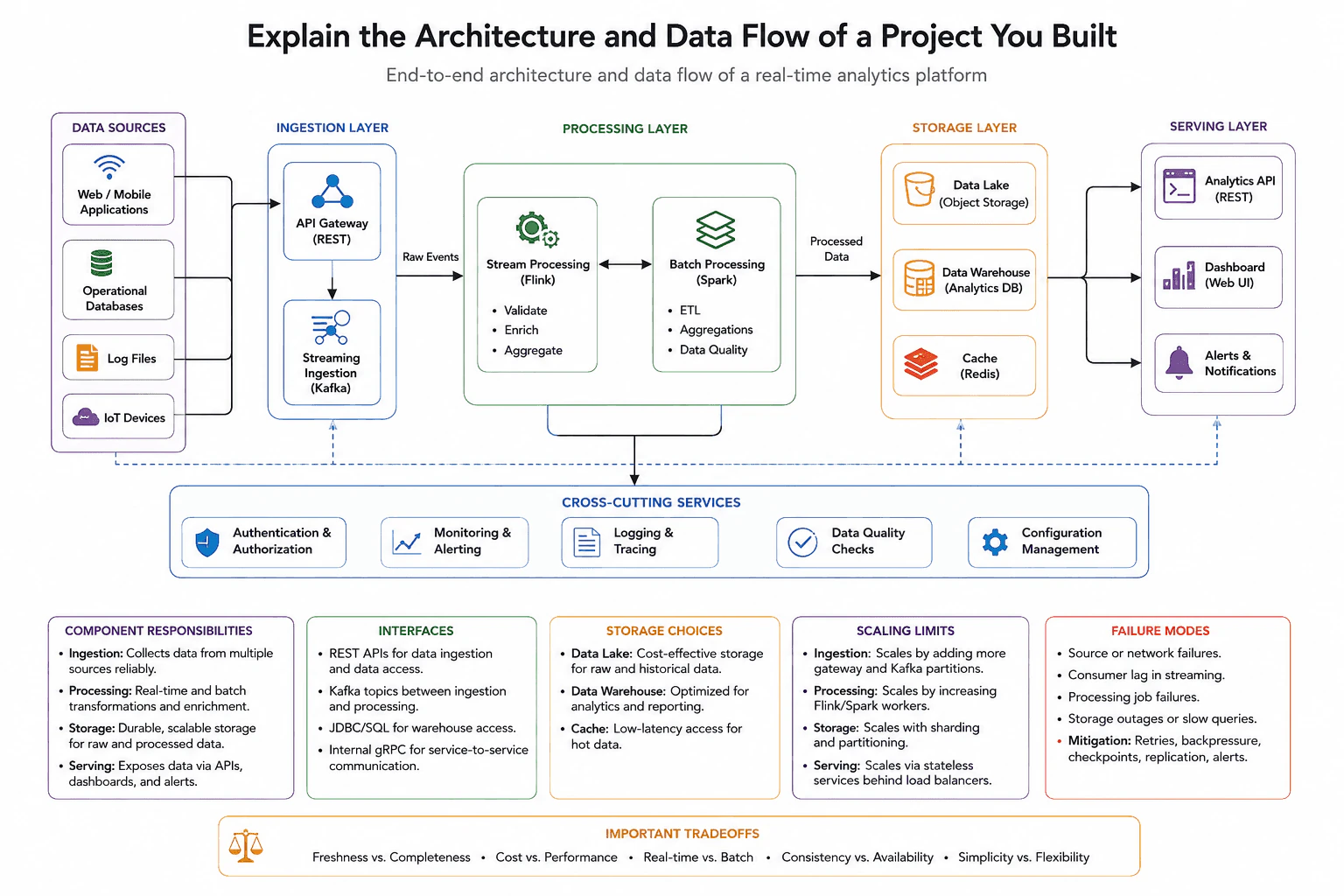
Design an AI-agent platform with benchmarks and guardrails. diagram
How to Explain It in an Interview
1. Start with the Platform Control Plane

I would begin with how teams define and govern an agent. Developers, data scientists, product managers, and auditors use the Web Console, CLI, REST or GraphQL API, or Webhooks and Events.

The Agent Builder defines agents, tools, and prompts. The Agent Registry stores versions, metadata, and ownership. Permissions and RBAC control roles, policies, and scopes. RBAC means role-based access control. The Secrets Manager protects API keys, credentials, and tokens. The Config and Policy Manager stores runtime settings and rules.

This control plane prepares the approved configuration used during execution.

2. Explain the request and execution path

For a live run, the request enters through Request Ingress. The API Gateway accepts it. AuthN and AuthZ check identity and permission. Rate Limiting controls how much work a user can send. The Request Router sends the request into the Agent Runtime.

The Planner chooses the next step. The Action Executor performs that step as a worker. The Tool Gateway checks whether the requested tool is allowed. It then reaches the Tooling Layer, which includes Search, Code Executor, Data Access, File or Storage, and External APIs.

Model Serving provides the language and embedding models used by the agent. Cache can reuse responses, embeddings, and intermediate results when suitable.

3. Explain state and background processing

The State Manager keeps short-term memory, session state, and checkpoints. A checkpoint is a saved point that helps resume or inspect a run. The State Store keeps conversations, memory, and checkpoints.

The Artifact Store keeps prompts, datasets, outputs, and models. The Vector Store keeps embeddings and the retrieval index. These stores support agent reasoning and later evaluation.

The Message and Event Bus handles async events, schedules, retries, and timeouts. Async means the work can continue without blocking the main request. Retries help with temporary failures. Timeouts stop work that runs too long.

4. Explain benchmarks and guardrails

Evaluation and Benchmarks measures whether an agent is ready to release. The Benchmark Suite uses standard datasets and tasks. The Automated Evaluator scores quality, correctness, and safety. Human Review adds labels and feedback. Scoreboards and Reports show trends and leaderboards.

Guardrails and Safety protect each run. Input Guardrails check for PII, jailbreaks, and toxic text. Output Guardrails check hallucinations and policy rules. Tool Permissions allow or deny actions by policy. Runtime Policies set limits, timeouts, and budgets.

5. Explain operations, rollback, cost, and isolation

Observability and Monitoring provides Logs and Traces, Metrics and Alerts, Audit Logs, and Dashboards. These show latency, errors, usage, access, changes, health, cost, and quality.

Versioning tracks agents, prompts, tools, and policies. Rollback returns the platform to an earlier safe version when a release fails. Cost Controls use budgets, quotas, and rate limits. Usage Tracking shows cost by team and agent.

Isolation separates workloads by tenant, project, and environment. The main trade-off is stronger safety and control in exchange for more services, checks, and operational work.

Engineering Considerations / Design Trade-offs

The benefit is strong control over agent behavior. Teams can see who changed an agent, which tools it used, how much it cost, and whether it passed safety checks. Benchmarks make versions easier to compare. Rollback reduces release risk. Isolation also prevents one tenant or project from affecting another. The downside is more moving parts. Each run may pass through identity checks, rate limits, tool rules, safety checks, logging, and budget rules. These checks can add delay and operational work. We accept this because agents can reach real tools and sensitive data, so safety matters more than a very simple platform.

Why Interviewers Ask This

Interviewers ask this question to test how you control a powerful system, not only how you call an LLM. They want to see whether you can separate setup from execution, protect tools and data, save state, measure quality, handle failures, control cost, support rollback, and isolate users. They also want clear trade-offs. A strong answer shows practical judgment about safety, ownership, and daily operations.

Interviewer may ask next
How would you change this design if one customer required complete isolation from every other customer?

I would keep the same main design, but strengthen the Isolation controls around that customer. Request Ingress would attach the tenant identity to every request. Permissions and RBAC would verify that identity before the Agent Runtime starts.

The customer would have separate project and environment boundaries for execution, tools, state, and data. The State Store, Artifact Store, Vector Store, Cache, and audit records would all be separated by tenant. The Tool Gateway would apply tenant-specific tool rules. Network controls around the workload would block access to another tenant's tools or data.

Usage Tracking and Cost Controls would also measure only that customer's workloads. Logs and Audit Logs would keep the same tenant boundary.

Correctness comes from checking tenant identity at every important boundary, not only during login. The main downside is higher cost and more operational work because separate workloads and data stores are harder to manage.

What happens if a new agent version produces unsafe or low-quality results after release?

I would stop the release and use Rollback to return to the last safe version. The main affected areas are the Agent Registry, Evaluation and Benchmarks, Guardrails and Safety, Observability and Monitoring, and the lifecycle controls.

Before release, the Benchmark Suite and Automated Evaluator compare the new version with earlier results. Human Review can check cases that are difficult to score automatically. After release, Output Guardrails, Logs and Traces, Metrics and Alerts, Audit Logs, and Dashboards help detect unsafe behavior or falling quality.

If safety alerts rise or benchmark results fall, the platform changes the active agent, prompt, tool, or policy version back to the earlier version stored in the Agent Registry. The team can then inspect traces, state checkpoints, and audit records before trying another release.

The main downside is that rollback also removes useful new behavior until the team fixes and tests the update.

32. Tell me about yourself.BehavioralMediumNvidia

Question Details

Give a concise professional introduction focused on your Python and systems experience, recent impact, and fit for the NVIDIA role.

Interview tip:

Use STAR to structure your answer: briefly explain the Situation and Task, make Action the most detailed part, and finish with the Result. For example, describe how your Python and systems experience developed, the responsibility you took in a recent project, the technical and communication choices you made, the impact you created, and why that experience fits the NVIDIA role.

Situation

I am a Python Developer with experience building backend services, data processing tools, and systems that need to stay reliable under changing workloads. In my last role, I worked on a Python service that processed large volumes of technical data and supported other teams that depended on accurate and timely results.

Task

My responsibility was to improve the service so it was easier to maintain, more reliable during busy periods, and clearer for the engineers who operated it. I also needed to make changes without disrupting the teams already using the system.

Action

I first studied the full data flow and spoke with the users and engineers who supported the service. This helped me separate the main problem from smaller symptoms. I found that slow processing, limited visibility, and tightly connected code made failures harder to diagnose. I reorganized the Python code into smaller modules with clear responsibilities. I added validation at important boundaries so bad input could be rejected early. I improved logging so each request could be traced through the system, and I added tests for normal cases, failure cases, and recovery behavior. I also reviewed the deployment plan with the team and introduced the changes in small steps. This reduced risk and gave us a clear way to stop or reverse a release if a problem appeared. Throughout the work, I explained the tradeoffs in simple terms and asked for feedback from the people who would maintain the service after delivery.

Result

The service became more stable, easier to troubleshoot, and safer to change. The team could understand failures faster and release updates with more confidence. I learned that strong Python development is not only about writing correct code. It also requires understanding the full system, communicating clearly, and designing for the engineers who will operate it. That mix of Python, systems thinking, and practical ownership is why I am interested in the NVIDIA role.

Why Interviewers Ask This

Interviewers ask this question to understand how the candidate presents their professional story, chooses relevant experience, explains recent impact, and connects their background to the role. A strong answer shows clear communication, self awareness, technical focus, and a credible reason for joining NVIDIA.

Interviewer may ask next
Why did you focus on reliability and maintainability in that project?

I focused on them because the service supported several teams, so a small failure could create delays for many people. Reliable behavior protected users, while maintainable code helped the team diagnose problems and make future changes safely.

What part of that experience is most relevant to NVIDIA?

The most relevant part is my ability to combine Python development with systems thinking. I look beyond one function or service, understand how data and failures move through the system, and make changes that improve performance, reliability, and operational clarity.

33. Why should we hire you for this role?BehavioralHardNvidia

Question Details

Connect your demonstrated technical strengths, project impact, learning ability, and collaboration style to the role's requirements without relying on generic claims.

Interview tip:

Use STAR to structure your answer: briefly explain the Situation and Task, make Action the most detailed part, and finish with the Result. For example, describe a Python project where you solved a difficult technical problem, learned an unfamiliar area quickly, improved reliability, worked closely with other engineers, and delivered a result that shows how your strengths match the role.

Situation

In my last role, I worked on a Python service that processed large batches of technical data. The service had become difficult to maintain. Some jobs failed without clear error details, and new data formats required frequent code changes.

Task

I was responsible for making the service more reliable and easier to extend while keeping existing workflows stable. I also needed to learn parts of the data processing system that were new to me and coordinate changes with the engineers who depended on its output.

Action

I first traced the complete data flow and reproduced the common failures with small test inputs. This helped me understand the real causes instead of changing code based on guesses. I separated validation, processing, and storage into clear Python modules so each part had one responsibility. I added type hints, which show the expected kind of data, and focused tests around parsing, error handling, and boundary cases, which are unusual or limit conditions. I also replaced vague error messages with structured logs that showed which stage failed and why. When I found an unfamiliar performance issue, I studied the relevant Python profiling tools, tested the slow path, and reviewed my findings with a more experienced engineer. I then changed the processing logic to avoid repeated work and unnecessary memory use. Before releasing the changes, I shared the design with the team, asked users of the service about compatibility risks, and introduced the update in small steps. I documented the new flow so another developer could support it without depending on me.

Result

The service became more stable, failures were easier to diagnose, and adding new data formats required smaller and safer changes. The team could maintain the system with less uncertainty. I also learned that strong Python development is not only about writing correct code. It requires understanding the full system, learning quickly, explaining decisions clearly, and helping the team own the result. Those are the strengths I would bring to this role.

Why Interviewers Ask This

Interviewers ask this question to see whether the candidate can connect real evidence to the needs of the role. A strong answer shows technical ability, practical judgment, learning speed, ownership, collaboration, and a clear understanding of how those strengths would help the team.

Interviewer may ask next
Which part of this project best shows your learning ability?

The performance issue best shows it. I had limited experience with the profiling tools, so I learned how to use them, measured the slow path, checked my conclusions with an experienced engineer, and applied a change based on evidence rather than guessing.

What would you do differently on a similar project now?

I would involve the engineers who consume the service output earlier. Their feedback helped me identify compatibility risks, so I would include them during the first design review instead of waiting until the implementation was partly complete.

34. Explain a successful project you completed.BehavioralMediumNvidia

Question Details

Describe the objective, your role, important technical decisions, obstacles, collaboration, and measurable result.

Interview tip:

Use STAR to structure your answer: briefly explain the Situation and Task, make Action the most detailed part, and finish with the Result. For example, describe a Python project where you clarified the objective, owned key technical decisions, solved delivery obstacles, worked closely with other teams, and produced a reliable improvement for users.

Situation

In my last role, our operations team relied on a slow manual process to collect data from several internal services and prepare a daily report. The process took significant effort, produced inconsistent results, and sometimes delayed important decisions.

Task

I was responsible for building a Python service that automated the workflow. My goal was to collect the data reliably, validate it, create the report, and make failures easy to identify. I owned the backend design and implementation, while working with operations, platform engineers, and another developer.

Action

I first met with the operations team to understand each manual step and identify which data fields were essential. This helped us avoid automating unnecessary work. I then designed the service as a set of small Python modules for data collection, validation, transformation, and report creation. I chose this structure because each part could be tested and changed without affecting the entire workflow. I added clear data validation rules so incomplete or invalid records were rejected before they reached the report. For calls to internal services, I added timeouts, limited retries, and detailed error messages. This prevented the job from waiting forever when another service was unavailable. I also made the process safe to run again by checking whether a report had already been created before writing new data. I wrote unit tests for the transformation rules and integration tests for the service connections. During testing, we found that one source returned data in different formats depending on the record type. I worked with the source team to confirm the expected formats, then added a normalization step that converted them into one consistent structure. I shared progress regularly with the operations team, demonstrated early versions, and used their feedback to improve the report layout and error messages. Before release, I documented how the service worked, how to restart a failed run, and how to investigate common errors.

Result

The automated service replaced the repeated manual workflow and produced reports in a consistent format. The operations team received the information earlier and spent less time correcting data issues. The modular design also made later changes easier because we could update one part without rewriting the full service. I learned that a successful project depends not only on clean code, but also on understanding the real user process, handling failures carefully, and involving users throughout development.

Why Interviewers Ask This

Interviewers ask this question to understand how a candidate defines success, takes ownership, makes technical decisions, handles obstacles, and works with others. A strong answer shows that the candidate can connect engineering work to a useful outcome and explain their personal contribution clearly.

Interviewer may ask next
Why did you divide the service into separate modules?

I separated data collection, validation, transformation, and report creation so each responsibility was clear. This made testing easier, reduced the risk of changes, and allowed us to update one part without affecting the full workflow.

What would you do differently on a similar project?

I would involve the source system teams earlier and create sample data contracts before implementation. That would help identify format differences sooner and reduce changes during integration testing.

35. What were your exact contributions to the projects on your resume?BehavioralMediumNvidia

Question Details

Choose a major project and clearly separate your personal decisions, implementation, debugging, and measurable impact from the broader team's work.

Interview tip:

Use STAR to structure your answer: briefly explain the Situation and Task, make Action the most detailed part, and finish with the Result. For example, describe a major Python project, clearly separate your work from the team effort, explain the design choices you owned, describe what you implemented and debugged, and show how your contribution improved the final system.

Situation

In my last role, I worked on a Python service that processed large files submitted by users. The service validated each file, transformed the data, and sent the results to another internal system. The broader team owned the product requirements, infrastructure, testing process, and deployment pipeline. My main area was the Python processing service.

Task

I was responsible for designing and implementing the core processing flow. I also needed to investigate failures that happened with large or malformed files. My goal was to make the service easier to maintain, more reliable, and clearer to debug without changing the behavior expected by other systems.

Action

I first reviewed the existing code and traced each step from file upload to final output. I found that validation, transformation, error handling, and database updates were mixed inside one large function. I decided to separate these responsibilities into small Python modules because each part could then be tested and changed independently. I created clear data models for validated input and wrote separate functions for parsing, validation, transformation, and result storage. I added structured logging, which means each log entry included useful fields such as the processing stage and request identifier. This helped us connect related events without reading long text messages. I also added specific exception handling so expected data errors were reported differently from unexpected system failures. During testing, I reproduced a memory problem with large files and found that the code loaded the entire file into memory. I replaced that logic with chunk based processing so the service handled smaller sections at a time. I wrote unit tests for the modules I changed and integration tests for the full processing flow. I worked with another developer who owned the receiving system to confirm that my output format remained compatible. The team reviewed my design and helped with deployment, but I personally owned the code structure, implementation, debugging, tests, and technical documentation for this service.

Result

The service became more stable when processing large files, and failures were easier for the team to understand and correct. Future changes were also safer because each processing step had focused tests. I learned that clearly explaining what I personally owned is important, but it is equally important to recognize where teammates contributed to the final result.

Why Interviewers Ask This

Interviewers ask this question to confirm that the candidate understands the work listed on the resume and can separate personal ownership from team effort. A strong answer shows technical depth, honesty, clear communication, practical decision making, and the ability to explain how individual contributions affected a shared project.

Interviewer may ask next
Why did you separate the processing flow into smaller modules?

I separated it because the original function handled too many responsibilities. Smaller modules made each step easier to understand, test, debug, and change without creating unexpected effects in other parts of the service.

What would you improve if you worked on this service again?

I would add memory and processing time measurements earlier in development. That would help identify large file problems before they appeared during later testing and would make performance decisions more evidence based.

36. What technical skills do you want to learn next?BehavioralEasyNvidia

Question Details

Name the technical skills you want to develop next, why they matter for the role, and the concrete steps you are taking to learn them.

Interview tip:

Use STAR to structure your answer: briefly explain the Situation and Task, make Action the most detailed part, and finish with the Result. For example, describe how you identified the next technical skills to develop, connected them to the Python Developer role, created a practical learning plan, applied the skills in a small project, asked for feedback, and measured your progress.

Situation

In my last role, I worked mainly on Python services that processed data and called external APIs. That experience showed me that my next areas of growth should be asynchronous Python and GPU computing. Asynchronous Python helps a service handle several waiting tasks efficiently. GPU computing uses many processing cores together for work such as data analysis and machine learning.

Task

My goal is to build a deeper understanding of both areas and learn when each one is useful. I want to design Python applications that use resources well, remain easy to maintain, and can support demanding workloads. These skills are also relevant to a Python Developer role at NVIDIA because many products involve high performance systems, large data workloads, and accelerated computing.

Action

I created a practical learning plan instead of only reading documentation. First, I am studying asyncio, task scheduling, timeouts, cancellation, and safe error handling. I am building a small service that makes several external requests at the same time so I can compare a normal sequential approach with an asynchronous approach. I am also adding tests for failures, slow responses, and cancelled tasks because correct behavior matters more than speed alone. Next, I am learning the basics of GPU computing with Python. I am studying how work moves between the CPU and GPU, why memory transfer can become a bottleneck, and which types of calculations benefit from parallel processing. I am practicing with small array operations before moving to larger examples. After each exercise, I review the code, record what I learned, and ask experienced developers for feedback on design and readability. I chose this approach because building, testing, and explaining a working example helps me understand the limits of a tool, not just its syntax.

Result

This process has already improved how I evaluate performance problems. I now think more carefully about whether a workload is waiting on input and output, using the CPU heavily, or suitable for parallel processing. I have also learned to choose a technology only after understanding the workload and measuring the current behavior. My next step is to combine these skills in a small data processing application and continue improving it through testing, profiling, and feedback.

Why Interviewers Ask This

Interviewers ask this question to understand whether a candidate takes ownership of continued learning and chooses skills with a clear purpose. A strong answer shows self awareness, knowledge of the role, a realistic learning plan, practical application, and the judgment to connect new technology to real engineering problems.

Interviewer may ask next
Why did you choose asynchronous Python and GPU computing instead of other skills?

I chose them because they address two different performance needs I have seen in Python work. Asynchronous Python is useful when a service spends time waiting for APIs, files, or databases. GPU computing is useful when a workload contains large calculations that can run in parallel. Learning both helps me select an approach based on the actual bottleneck.

How will you know that you have learned these skills well enough?

I will look for evidence that I can explain when each approach should be used, build a reliable example, test failure cases, profile the application, and explain the tradeoffs clearly. I will also ask another developer to review my design and confirm that the code is correct, readable, and not using complexity without a real benefit.

37. Describe a conflict with a cross-functional teammate about delivery.BehavioralHardNvidia

Question Details

Describe the disagreement, the delivery impact, how you listened and presented evidence, how the decision was made, and what changed afterward.

Interview tip:

Use STAR to structure your answer: briefly explain the Situation and Task, make Action the most detailed part, and finish with the Result. For example, describe a disagreement about delivery scope, the risk to the release, how you listened to the teammate, presented technical evidence, reached a shared decision, and improved collaboration afterward.

Situation

In my last role, I was building a Python service for a planned release. A product teammate wanted to include an additional reporting feature before launch. I believed adding it at that stage would delay testing and create a risk for the main workflow. The disagreement became tense because both of us were trying to protect the delivery, but we had different views of what mattered most.

Task

I was responsible for delivering a reliable service on time while making sure the product need was understood. I needed to resolve the conflict without ignoring the teammate's concern or allowing the discussion to become personal.

Action

I first asked the product teammate to explain why the reporting feature was important and what user problem it solved. I listened without interrupting and learned that a stakeholder needed better visibility after launch. I then explained my concern using evidence from the current work. I showed which Python modules still required integration tests, which external service calls needed failure testing, and how the new reporting logic would add another data path that had not been reviewed. I made it clear that I was not rejecting the feature itself. I was concerned about adding untested scope to the current release. I proposed two options. We could delay the full release and include the feature, or we could release the stable core workflow and schedule the reporting feature as the next task. I also offered a small temporary solution by adding structured logs that could provide basic visibility until the full report was ready. We reviewed the delivery goal, technical risks, and stakeholder need together. We then brought the options to the engineering lead, who agreed that protecting the core release was the better choice. I documented the decision, updated the task plan, and worked with the product teammate to define clear acceptance criteria for the reporting feature.

Result

We delivered the core service without adding last minute risk, and the temporary logs gave the stakeholder useful visibility. The reporting feature was completed in the next planned release with proper testing. My relationship with the product teammate also improved because the final decision considered both the user need and the engineering risk. I learned that conflict is easier to resolve when I listen first, separate the person from the problem, and use clear evidence to compare options.

Why Interviewers Ask This

Interviewers ask this question to evaluate how a candidate handles disagreement, delivery pressure, and competing priorities across teams. A strong answer shows active listening, evidence based communication, practical judgment, shared decision making, and respect for both product and engineering concerns.

Interviewer may ask next
How did you handle the teammate's resistance to reducing the release scope?

I acknowledged that the reporting need was valid and asked questions until I understood its purpose. I then focused the discussion on delivery risk rather than personal opinions. Offering a temporary visibility solution also showed that I was trying to meet the underlying need instead of simply saying no.

What would you do differently in a similar situation?

I would review optional scope with product and engineering earlier in the delivery cycle. That would give us more time to estimate testing work, agree on priorities, and avoid making an important scope decision close to release.

38. How do you prioritize tasks?BehavioralMediumNvidia

Question Details

Describe a real situation with competing engineering priorities. Explain the criteria you used, what you deferred, how you communicated tradeoffs, and the outcome.

Interview tip:

Use STAR to structure your answer: briefly explain the Situation and Task, make Action the most detailed part, and finish with the Result. For example, describe a project with competing engineering tasks, the criteria you used to rank them, what you deferred, how you explained the tradeoffs, and how your choices helped the team deliver the most important work.

Situation

In my last role, I was working on a Python service that processed customer requests. During the same release, we had a production error affecting some requests, a planned performance improvement, and several smaller feature requests from internal teams.

Task

I was responsible for deciding the order of my work and helping the team protect the release. I needed to address the urgent issue without ignoring important planned work or making promises that we could not keep.

Action

I first collected the facts instead of treating every request as equally urgent. I checked which users were affected, whether data could be lost, whether a temporary workaround existed, and which tasks blocked other team members. The production error could cause requests to fail, so I gave it the highest priority. I reproduced the issue, reviewed the service logs, and found that an external call was timing out without proper retry handling. I created a small and focused fix with a limited retry and clear error logging. I also added tests for the failure case before asking a teammate to review the change. Next, I discussed the remaining work with the product owner and the engineering lead. I explained that the performance improvement was valuable but did not affect correctness, while the smaller features could safely move to the next release. I shared the reason for the order, the likely effect of each delay, and the work that would still be completed. I then updated the task board so the whole team could see what was active, what was deferred, and why. After the production fix was released and observed, I returned to the performance work because it had the next highest user impact.

Result

The production issue was resolved without expanding the change beyond what was needed. The team understood why some work moved to the next release, and there was no confusion about ownership or expectations. We still completed the most important planned improvement after the service was stable. I learned that good prioritization requires clear criteria, early communication, and the discipline to defer useful work when more important risks need attention.

Why Interviewers Ask This

Interviewers ask this question to understand how a candidate makes decisions when time and engineering capacity are limited. A strong answer shows that the candidate considers user impact, risk, dependencies, urgency, and effort, while communicating tradeoffs clearly and taking ownership of the final decision.

Interviewer may ask next
Why did you defer the feature requests instead of dividing your time between all tasks?

I deferred them because splitting my attention would have slowed the production fix and increased the chance of mistakes. The feature requests had no immediate effect on service correctness, so completing the urgent fix first was the safer choice.

What would you do differently in a similar situation now?

I would define the priority criteria with the team before a busy release begins. Having agreed rules for user impact, data risk, dependencies, and urgency would make decisions faster and reduce debate when several requests arrive at once.

39. Tell me about a production bug you owned end to end.BehavioralMediumNvidia

Question Details

Explain detection, impact assessment, investigation, root cause, mitigation, permanent fix, validation, communication, and prevention work.

Interview tip:

Use STAR to structure your answer: briefly explain the Situation and Task, make Action the most detailed part, and finish with the Result. For example, describe a production bug you detected, how you assessed the user impact, investigated the root cause, reduced the immediate risk, delivered a permanent fix, validated the recovery, communicated with others, and added prevention work.

Situation

In my last role, I supported a Python service that processed customer requests through a background job queue. One morning, our monitoring showed a growing number of failed jobs. Some requests were being retried many times, which delayed later work in the queue. The service was still running, but users were seeing slow or incomplete results.

Task

I took ownership of the incident from detection through prevention. My first goals were to understand the impact, stop the queue from getting worse, restore normal processing safely, and keep the support and engineering teams informed. I also needed to find the real cause and make sure the same failure could not silently return.

Action

I first checked the error logs, queue depth, retry count, and recent deployments. This helped me separate the symptoms from the cause. I found that the failures started after a change to an external API response. A field that had always contained a value could now be null. Our Python code passed that value into a parsing function, which raised an exception. The retry system treated the exception as temporary, so the same bad jobs kept returning to the queue. I then assessed the impact by identifying which job type was failing and which requests were still processing normally. I shared a clear update with the incident channel and the support team. I explained what was affected, what was not affected, and what I was doing next. I avoided giving an early recovery time because I had not yet confirmed the safest mitigation. For the immediate mitigation, I paused retries for the affected job type instead of stopping the whole worker system. This protected healthy traffic and prevented the queue from growing with repeated failures. I then wrote a small recovery script that identified the affected jobs and moved them into a separate holding queue. I tested the script against a copy of production data before using it. For the permanent fix, I updated the parser to handle a null value explicitly. When the field was optional, the code used a safe default. When the field was required for processing, the job was marked as invalid with a clear reason instead of being retried. I also changed the retry logic so that data validation errors were not treated as temporary system errors. I added unit tests for null, missing, and malformed values. I also added an integration test using the new external response shape. After review from another engineer, we deployed the fix gradually. I watched error rates, queue depth, processing time, and the holding queue during the rollout. Once the service was stable, I replayed the valid held jobs in small groups and confirmed that completed results matched the source data. After recovery, I documented the timeline, root cause, mitigation, and permanent changes. I added an alert for unusual retry growth and proposed contract tests for external API responses. These tests check whether important response fields change before the change reaches production.

Result

Normal processing returned without stopping healthy workloads, and the affected valid requests were completed safely. Invalid requests were recorded clearly instead of repeating forever. The incident also improved our retry rules, external API testing, monitoring, and recovery process. I learned that owning a production bug means more than writing a code fix. It also means controlling the impact, communicating facts clearly, validating recovery, and improving the system after the incident.

Why Interviewers Ask This

Interviewers ask this question to evaluate ownership, technical judgment, incident response, communication, and learning. A strong answer shows that the candidate can assess impact, reduce risk, investigate carefully, fix the root cause, validate the recovery, and improve the system instead of only patching the immediate error.

Interviewer may ask next
Why did you pause only the affected retries instead of stopping all workers?

Most job types were still healthy, so stopping every worker would have increased the impact. Pausing only the affected retries protected normal traffic while giving me a controlled way to isolate and recover the failed jobs.

What would you do differently if a similar incident happened now?

I would use the same isolation and validation approach, but I would identify the error category earlier and disable retries for permanent data errors sooner. I would also confirm the external response contract immediately because that became the main cause in this incident.

40. Why do you want to work at NVIDIA?BehavioralMediumNvidia

Question Details

Explain why NVIDIA's products, engineering problems, and role responsibilities align with your experience and the work you want to do next.

Interview tip:

Use STAR to structure your answer: briefly explain the Situation and Task, make Action the most detailed part, and finish with the Result. For example, describe a Python project where you improved a data or machine learning workflow, solved performance and reliability problems, worked closely with engineers, and learned that you want to build large scale computing systems like those developed at NVIDIA.

Situation

In my last role, I worked on a Python service that prepared large data sets for machine learning jobs. The service had become difficult to scale. Processing was slow, failures were hard to diagnose, and engineers often had to restart jobs manually.

Task

I was responsible for making the workflow faster, more reliable, and easier for other engineers to use. I also needed to understand where Python was the right tool and where the system needed better use of parallel computing and specialized hardware.

Action

I first measured each stage instead of guessing where the problem was. I added timing, memory, and error tracking so I could see which operations were using the most resources. I found that repeated data conversion and single process execution were major causes of delay. I reorganized the Python code into smaller processing stages, reduced unnecessary copies, and added controlled parallel work for independent tasks. I also added checkpoints so a failed job could continue from the last completed stage instead of starting again. I worked with the machine learning engineers to understand how the data was consumed and with the platform team to make resource limits and failure messages clear. This project made me interested in the connection between Python software, high performance computing, and accelerated hardware. That is a major reason I want to work at NVIDIA. NVIDIA builds products and platforms that help developers solve demanding AI and computing problems. The Python Developer role also matches the work I want to do next because it combines practical software engineering, performance analysis, developer experience, and collaboration with specialists across the system.

Result

The workflow became more stable, easier to investigate, and more efficient for the engineering team. Failed jobs could recover without repeating all completed work, and developers had clearer information when something went wrong. I learned that I enjoy improving systems where software design and computing performance meet. I now want to apply that experience to larger and more complex engineering problems at NVIDIA.

Why Interviewers Ask This

Interviewers ask this question to understand whether the candidate has a clear and informed reason for choosing NVIDIA. A strong answer connects the company’s computing products and engineering challenges with the candidate’s real experience, future goals, and understanding of the Python Developer role. It also shows that the candidate is motivated by the work itself rather than only by the company name.

Interviewer may ask next
Which part of NVIDIA’s work interests you most?

I am most interested in the software that connects Python developers with accelerated computing systems. My previous project showed me how much performance depends on data movement, parallel work, reliability, and clear developer tools. I want to deepen that experience while helping engineers use complex computing platforms effectively.

What would you bring to this Python Developer role?

I would bring a practical approach to performance and reliability. I measure problems before changing code, separate large workflows into clear stages, design useful recovery paths, and communicate closely with the engineers who use the system. I would also bring curiosity about the full computing stack and a willingness to learn from hardware, platform, and machine learning specialists.

More questions load as you scroll

Disclaimer: This interview guide is for educational and informational purposes only. It is designed to help readers prepare, but it does not guarantee any interview result, hiring decision, offer, or outcome. Interview questions, hiring criteria, and preferred answers can vary by employer, interviewer, industry, location, and time. The examples and explanations reflect the authors' research and judgment, are provided without warranties of any kind, and should not be treated as the only correct approach. Diagrams are simplified illustrations intended to highlight the main components and their interactions; actual systems and implementations may be more complex. Alternative approaches may be equally valid or better suited to a particular question, context, or interviewer. To the fullest extent permitted by applicable law, the author, contributors, and publisher are not liable for decisions made, actions taken, or losses incurred based on this guide.

Company Notice: This guide is an independent educational resource and is not affiliated with, endorsed by, sponsored by, or approved by the company named in this guide. Company names are used only to identify interview experiences commonly reported by candidates. Interview practices can change without notice, and inclusion of company-specific content does not mean these questions are official, complete, or guaranteed to be asked. To the fullest extent permitted by law, the author, contributors, and publisher are not responsible for outcomes related to use of this material.