11. How would you safely expose Python code to concurrent Kubernetes callbacks?
Explain shared-state protection, idempotent reconciliation, duplicate and out-of-order events, locking, work queues, retries, process models, and observability.
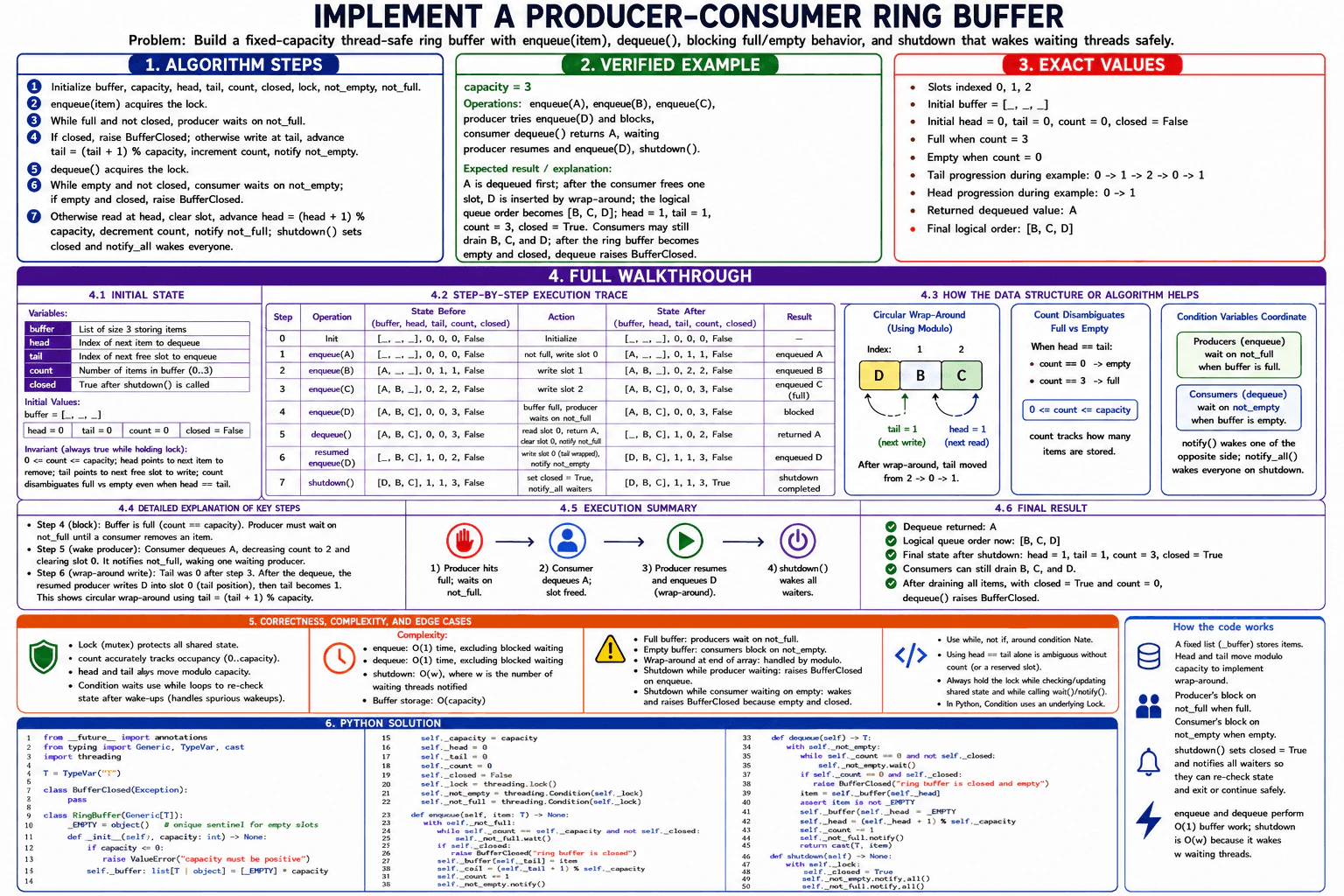
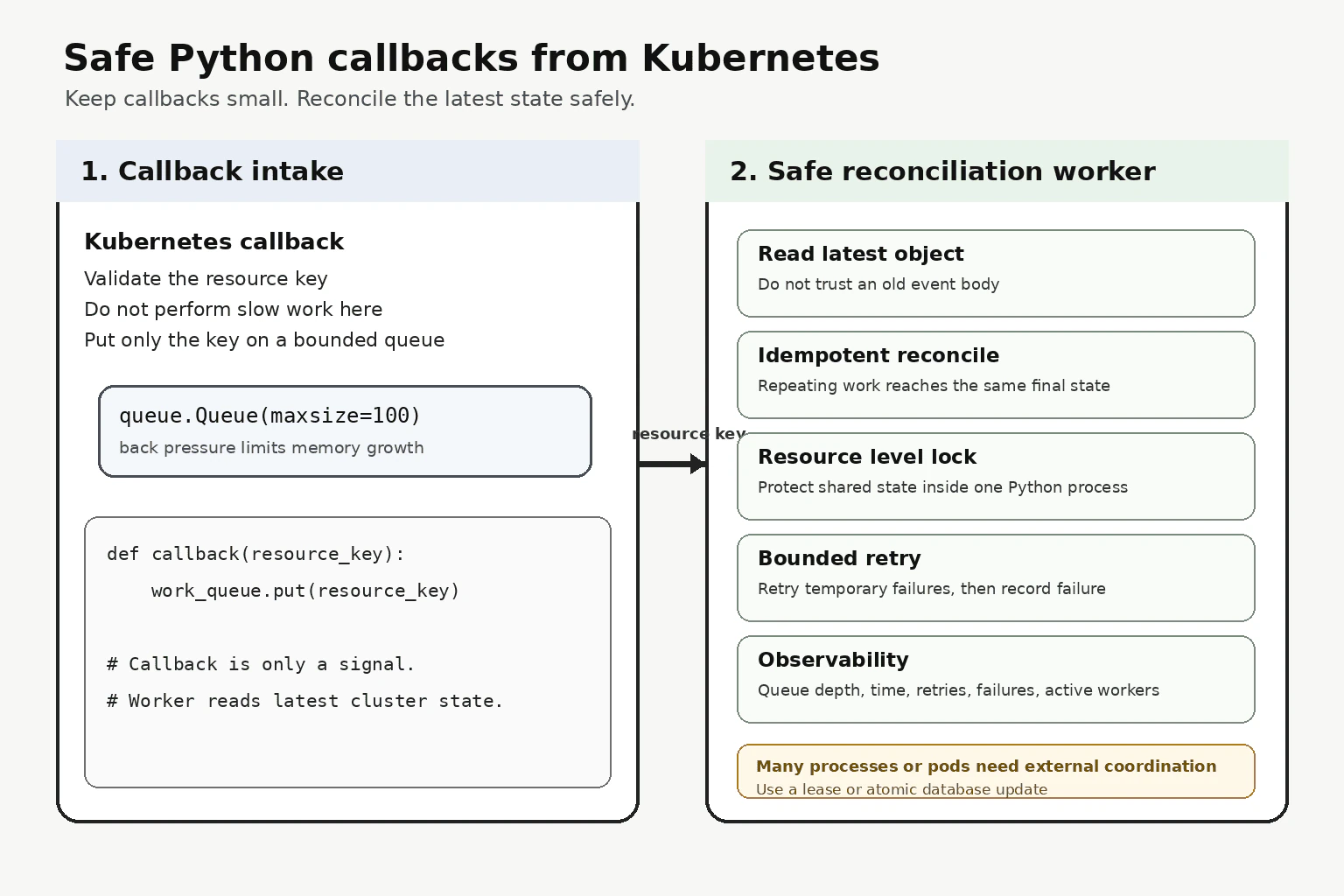
I would keep each callback small and place only the resource key on a bounded thread safe work queue. A worker would then read the latest Kubernetes object and run an idempotent reconciliation, so duplicate or out of order callbacks cannot apply stale commands. I would use a resource level lock for shared state inside one process, bounded retries for temporary failures, and durable external coordination when several processes or pod replicas can handle the same resource.
I would treat every callback as a signal that a resource may need reconciliation, not as a command that must be applied once. The callback validates the resource key and places it on a bounded work queue. A worker reads the latest object from the Kubernetes API and calculates the desired result. The reconciliation is idempotent, so repeating it reaches the same final state.
- Should I focus on Python language behavior, or also explain the runtime and standard library?
- Which Python version and execution environment should I assume?
- Would you like a small code example together with production tradeoffs and edge cases?
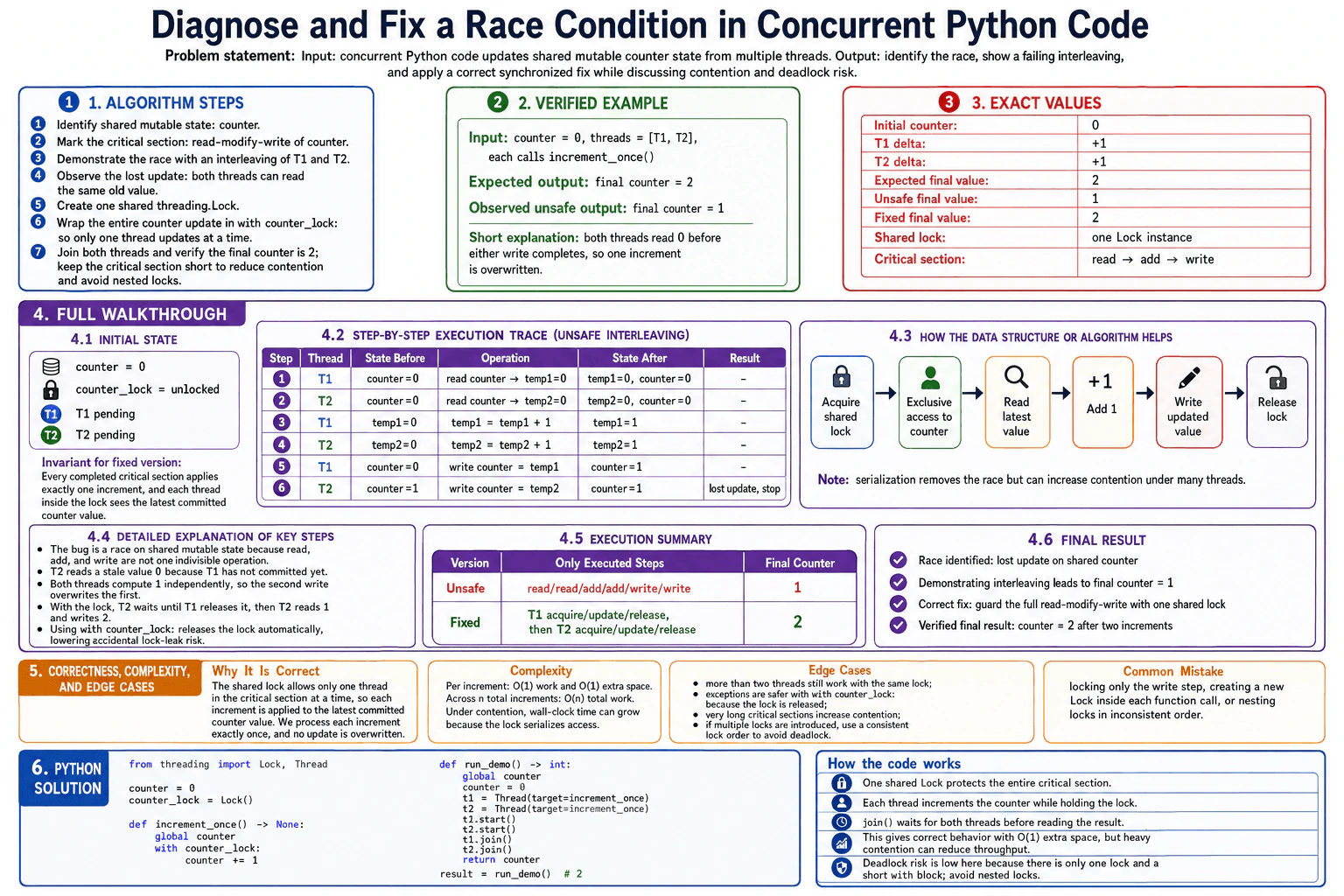
This design handles duplicate and out of order events because the worker uses current cluster state instead of trusting an old event body. Kubernetes resourceVersion values are opaque strings, so Python code should not compare them as integers. A resource level threading lock can prevent overlapping work inside one process. The GIL does not make a group of dictionary reads, writes, and network calls atomic.
A bounded queue provides back pressure and limits memory growth. Temporary errors receive bounded retries with increasing delay and random variation. Permanent errors are recorded without endless retries.
Threads suit blocking Kubernetes clients. Asyncio suits a fully asynchronous call path. Separate processes and pod replicas do not share Python locks or memory, so they require leases, atomic database updates, or another durable coordination method. Production metrics should include queue depth, reconciliation time, retry count, failures, and active workers.
This pattern is used in Python Kubernetes operators, custom controllers, automation services, webhook consumers, and services that react to resource changes. It is especially useful when several callbacks may mention the same resource, callbacks may be repeated, or reconciliation includes slow network calls. The bounded queue limits memory use, while resource level locking allows unrelated resources to be processed concurrently.
Interviewers ask this question to test whether the candidate understands Python concurrency, shared mutable state, idempotent control loops, and Kubernetes event behavior. They also want to see whether the candidate can choose safe coordination for threads, asynchronous tasks, processes, and multiple pod replicas while keeping retries and observability practical.
Common mistakes include performing slow reconciliation inside the callback, treating every event as a command, and assuming each callback is delivered exactly once. Other mistakes include relying on the GIL for compound shared state changes, using one global lock for every resource, comparing Kubernetes resourceVersion values as integers, using an unbounded queue, retrying permanent errors forever, and holding a lock while waiting longer than necessary. A serious production mistake is using an in memory lock while several processes or pod replicas can reconcile the same resource.
Start with the callback, bounded queue, and idempotent reconciliation flow. Explain that workers read the latest Kubernetes state, so duplicate and out of order callbacks are safe. Then separate thread safety inside one process from coordination across processes and pod replicas. Finish with bounded retries, back pressure, and observability.