This interview guide is for educational and informational purposes only. It is designed to help readers prepare, but it does not guarantee any interview result, hiring decision, offer, or outcome. Interview questions, hiring criteria, and preferred answers can vary by employer, interviewer, industry, location, and time. All answers, examples, and explanations in this guide are suggested examples for interview preparation, not definitive answers or instructions for professional practice. They are based on research and judgment, are provided without warranties of any kind, and should be adapted to the question, role, and applicable laws and professional requirements. Diagrams are simplified illustrations intended to highlight the main concepts and their relationships; actual situations, systems, and practices may be more complex. Alternative approaches may be equally valid or better suited to a particular question, context, or interviewer. To the fullest extent permitted by applicable law, the contributors and publisher are not liable for decisions made, actions taken, or losses incurred based on this guide.
State Laws and Professional Responsibilities
Laws and requirements governing an occupation vary by state and jurisdiction. You are responsible for checking the current laws, licensing requirements, and scope-of-practice rules that apply to your location and role, and for ensuring that your answers and actions comply with them. Adapt examples in this guide to those requirements. This guide is not legal advice.
Identity, Image, and Privacy Notice
To respect individual privacy, some names, profile photographs, avatars, biographical details, and other identifying information displayed in this guide may be replaced with pseudonyms, licensed stock images, illustrative avatars, composite images, or representative descriptions. Unless a person is expressly identified as an actual contributor, a displayed name, image, or profile should not be understood as depicting or identifying a specific candidate, interviewer, employee, or other real individual. These representations are provided for editorial and illustrative purposes only and do not imply endorsement, employment, participation, or affiliation with this guide or any company mentioned in it. Any resemblance to an actual person is coincidental.
Company Notice
This guide is an independent educational resource and is not affiliated with, endorsed by, sponsored by, or approved by the company named in this guide. Company names identify reported interview experiences or the employer context of clearly labeled original practice exercises. Interview practices can change without notice, and inclusion of company-specific content does not mean these questions are official, complete, or guaranteed to be asked. To the fullest extent permitted by law, the author, contributors, and publisher are not responsible for outcomes related to use of this material.
Content Accuracy and Verification
To the fullest extent permitted by applicable law, we do not represent or warrant that interview guides, questions, answers, examples, or diagrams are accurate, complete, current, error-free, or suitable for any particular purpose. You are responsible for independently reviewing and verifying the information before relying on it.
Questions or comments?
Contact us for general questions, or share feedback, technical corrections, and comments with the community.
51. What is a deadlock, and how can you prevent it?Language SpecificMedium
i Question Details
Explain deadlock, how it happens, and practical techniques to prevent it.
Short Interview Answer (30-60 seconds)
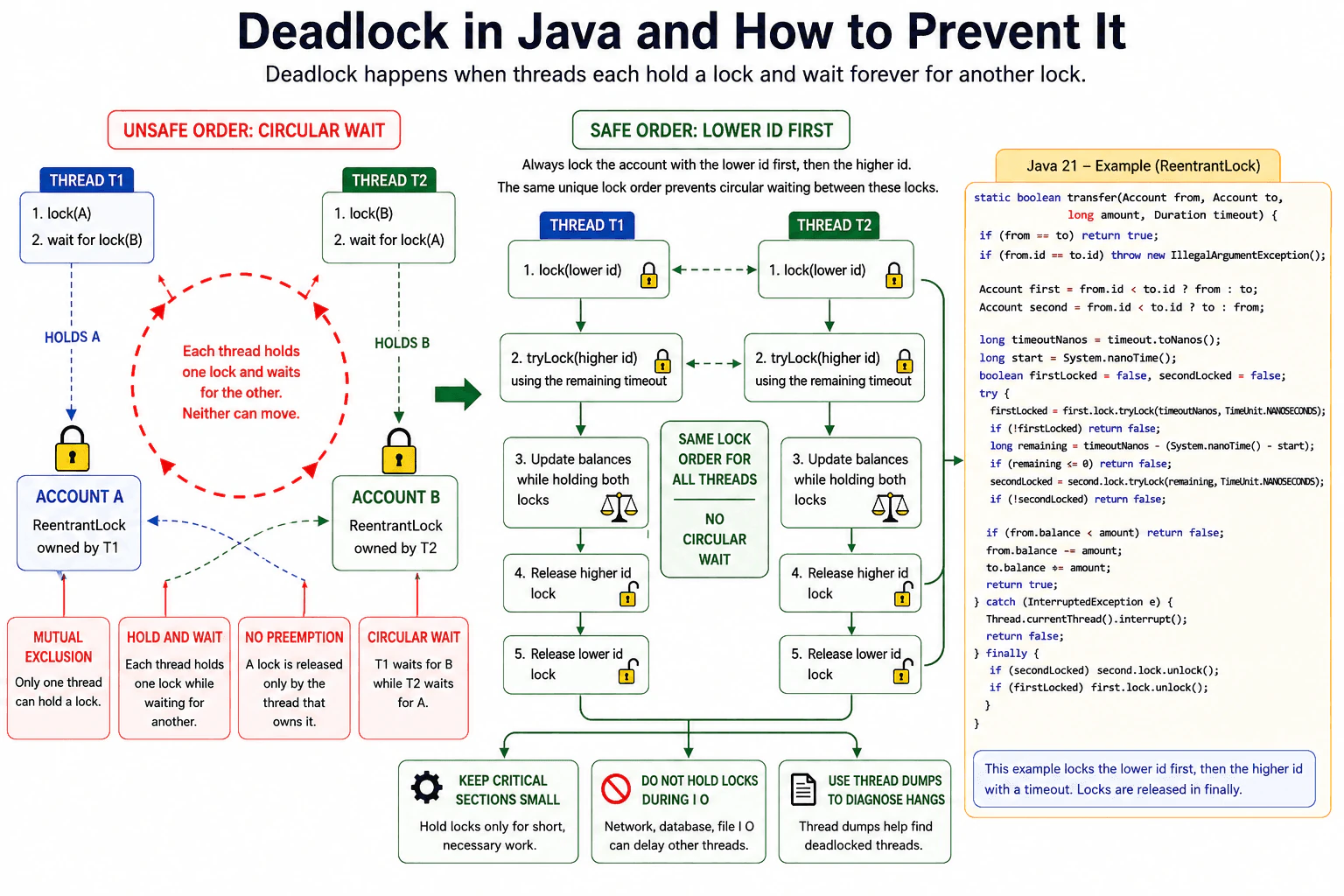
The main prevention rule is to make every thread acquire shared locks in the same stable order. A deadlock happens when two or more threads each hold a lock and wait forever for another lock in the same cycle. I also keep critical sections small, avoid unnecessary nested locks, release locks in finally blocks, and use timed tryLock calls when an operation must not wait forever.
A deadlock happens when several workers block one another and none of them can continue. Each worker is holding something that another worker needs. At the same time, each worker is waiting for something held by someone else. Nobody can move first, so the work never finishes. In an application, this can leave requests waiting, reduce the amount of work the service can handle, and eventually make the service appear unavailable even though the process is still running.
Useful Questions to Ask the Interviewer
Can the operation require more than one shared lock?
Is there a unique and stable order that every caller can follow?
Should the operation wait forever, wait for a limited time, or fail quickly?
How to Explain It in an Interview
In Java, a deadlock often appears when threads acquire multiple locks in different orders. For example, thread one locks account A and waits for account B. At the same time, thread two locks account B and waits for account A. Each thread owns one lock and waits for the other, so neither can continue.
The main prevention technique is consistent lock ordering. Give every protected object a unique and stable value, such as an account identifier. Every thread must acquire the object with the smaller identifier first and the object with the larger identifier second. This removes the circular waiting pattern. The identifiers must be unique for different objects. Otherwise, the code needs another safe rule for equal values.
Critical sections should also be small. Do not perform network calls, database calls, file access, long calculations, or user callbacks while holding a lock. Avoid nested locks when one lock, immutable data, message passing, or a concurrent collection can solve the problem more safely.
The synchronized keyword waits until the monitor is available and does not support timed acquisition. ReentrantLock provides tryLock methods that can wait for a limited time. A timeout limits waiting, but it does not correct an unsafe lock order. Every acquired ReentrantLock must be released in a finally block.
Lock operations add coordination cost and can reduce throughput when many threads compete for the same state. The example uses constant extra memory. In production, thread dumps and ThreadMXBean can help identify deadlocked platform threads. Virtual threads can also enter logical deadlocks, so more threads do not replace correct lock design.
Code
import java.time.Duration;
import java.util.Objects;
import java.util.concurrent.TimeUnit;
import java.util.concurrent.locks.ReentrantLock;
publicclassMain {
staticfinalclassAccount {
privatefinallong id;
privatelong balance;
privatefinalReentrantLocklock=newReentrantLock();
Account(long id, long balance) {
if (balance < 0) {
thrownewIllegalArgumentException("balance must not be negative");
}
this.id = id;
this.balance = balance;
}
}
staticbooleantransfer(Account from, Account to, long amount, Duration timeout) {
Objects.requireNonNull(from, "from");
Objects.requireNonNull(to, "to");
Objects.requireNonNull(timeout, "timeout");
if (from == to) {
returntrue;
}
if (from.id == to.id) {
thrownewIllegalArgumentException("different accounts must have different ids");
}
if (amount < 0) {
thrownewIllegalArgumentException("amount must not be negative");
}
if (timeout.isNegative() || timeout.isZero()) {
thrownewIllegalArgumentException("timeout must be positive");
}
Accountfirst= from.id < to.id ? from : to;
Accountsecond= from.id < to.id ? to : from;
longtimeoutNanos= timeout.toNanos();
longstart= System.nanoTime();
booleanfirstLocked=false;
booleansecondLocked=false;
try {
firstLocked = first.lock.tryLock(timeoutNanos, TimeUnit.NANOSECONDS);
if (!firstLocked) {
returnfalse;
}
longelapsed= System.nanoTime() - start;
longremaining= timeoutNanos - elapsed;
if (remaining <= 0) {
returnfalse;
}
secondLocked = second.lock.tryLock(remaining, TimeUnit.NANOSECONDS);
if (!secondLocked) {
returnfalse;
}
if (from.balance < amount) {
returnfalse;
}
from.balance -= amount;
to.balance += amount;
returntrue;
} catch (InterruptedException exception) {
Thread.currentThread().interrupt();
returnfalse;
} finally {
if (secondLocked) {
second.lock.unlock();
}
if (firstLocked) {
first.lock.unlock();
}
}
}
publicstaticvoidmain(String[] args) {
AccountaccountA=newAccount(1, 1_000);
AccountaccountB=newAccount(2, 500);
booleancompleted= transfer(accountA, accountB, 200, Duration.ofSeconds(1));
System.out.println("completed = " + completed);
System.out.println("accountA = " + accountA.balance);
System.out.println("accountB = " + accountB.balance);
}
}
Why Interviewers Ask This
Interviewers ask this question to check whether a candidate understands Java lock ownership, waiting threads, unsafe locking patterns, and production diagnosis. They also want to see whether the candidate can prevent circular waiting with consistent lock ordering, reduce risk with small critical sections, use timed lock attempts correctly, and explain the limits of each technique.
Common interview mistakes
Common mistakes include acquiring the same locks in different orders, using identifiers that are not unique, holding locks during slow external work, adding more threads and assuming the problem will disappear, forgetting to unlock in a finally block, ignoring interruption, and treating a timeout as proof that the locking design is safe. Another mistake is synchronizing on publicly accessible or replaceable objects such as string literals, boxed values, or mutable lock references.
Interview tip
Start with a simple circular waiting example. Then state the main rule: every thread must acquire shared locks in one unique and stable order. Mention small critical sections, finally based lock release, timed tryLock calls, and thread dump diagnosis. Make clear that a timeout limits waiting but does not replace a safe locking design.
Interviewer may ask next
What happens if two different accounts have the same identifier in the lock ordering design?
The ordering rule becomes unsafe because different callers can choose different first locks when the identifiers are equal. That can recreate circular waiting. The code therefore rejects different accounts with equal identifiers. A production design must guarantee unique identifiers or use a separate tie rule that every caller follows consistently.
When should you use tryLock instead of synchronized?
Use tryLock when the operation needs timed acquisition, interruption support, or a controlled failure path when a lock is unavailable. ReentrantLock provides these controls but requires explicit unlock calls in finally blocks and adds more implementation responsibility. synchronized is simpler and releases its monitor automatically when the block exits, so it is often preferable when timed acquisition is not required.
52. What are the tradeoffs between synchronized, ReentrantLock, and ReadWriteLock?Language SpecificHard
i Question Details
Compare these locking options in fairness, interruptibility, read/write behavior, and practical performance.
Short Interview Answer (30-60 seconds)
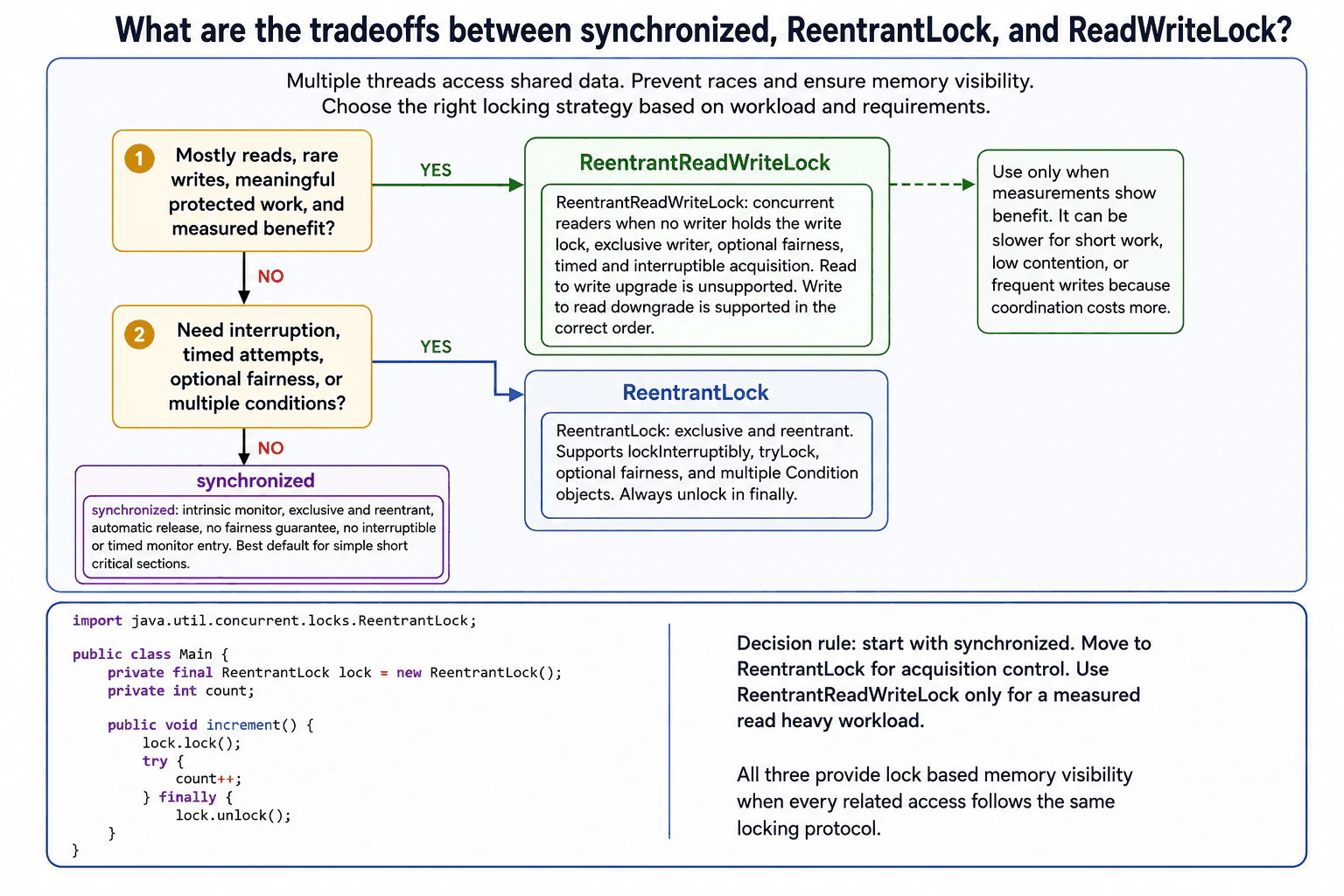
I would normally start with synchronized because it is simple, reentrant, releases its monitor automatically, and is usually suitable for short exclusive critical sections. I would choose ReentrantLock when I need interruptible acquisition, timed attempts, optional fairness, multiple conditions, or more flexible lock placement. I would consider ReentrantReadWriteLock only for a measured read heavy workload where protected reads are long enough to benefit from running together. It adds memory, bookkeeping, and misuse risk, so it can be slower when writes are frequent or critical sections are small.
Detailed Explanation
These choices stop several threads from changing shared information in an unsafe way. The simplest choice lets one thread use the protected work at a time and releases access automatically. A more flexible choice gives the program greater control over how a waiting thread enters or gives up. The third choice can let several readers work together while still allowing only one writer. The correct option depends on how often reading and writing happen, how long the protected work takes, and whether cancellation, waiting limits, or fair ordering are required.
Useful Questions to Ask the Interviewer
Is the workload mostly reads, mostly writes, or balanced?
Must a waiting thread support interruption or a time limit?
Is approximate arrival order important enough to accept lower throughput?
Has contention been measured under a realistic production load?
How to Explain It in an Interview
synchronized uses an intrinsic monitor belonging to an object or class. It is reentrant, so the owning thread can enter code guarded by the same monitor again. A thread waiting only to enter synchronized code cannot use a timed attempt and cannot cancel that monitor acquisition through interruption. This is different from Object.wait, which is interruptible. The JVM releases the monitor automatically when the block or method exits, including abrupt exit caused by an exception. docs.oracle.com
ReentrantLock also provides reentrant exclusive access. It supports lockInterruptibly for interruptible acquisition and tryLock for immediate or timed attempts. It can use a fair policy that generally favors the longest waiting thread, but the API does not promise perfect scheduling fairness. Fair mode usually reduces throughput. The untimed tryLock call may still acquire a fair lock even when other threads are waiting. The programmer must call unlock in a finally block. ReentrantLock can also create multiple Condition objects, while an intrinsic monitor has one wait set. docs.oracle.com
ReadWriteLock is an interface. ReentrantReadWriteLock is its standard reentrant implementation. Its read lock can be held by multiple readers when no writer owns the write lock. Its write lock is exclusive. This can improve throughput when reads greatly outnumber writes, protected reads perform meaningful work, and contention is high. It can be worse for short operations, frequent writes, or low contention because it performs more ownership and queue bookkeeping.
ReentrantReadWriteLock supports interruptible and timed acquisition through its lock objects and offers optional fairness. It does not support directly upgrading a held read lock to the write lock. Write to read downgrading is supported with the correct acquisition order. docs.oracle.com
All three choices provide the required lock based memory visibility when every access follows the same locking protocol. ReentrantLock and ReentrantReadWriteLock also require explicit lock objects and internal coordination state. Exact memory and performance costs depend on the JVM, contention pattern, critical section size, fairness setting, and hardware, so production measurements should decide whether added complexity is justified.
Why Interviewers Ask This
Interviewers ask this question to test whether the candidate understands Java lock behavior and can choose a suitable lock for a real workload. It evaluates knowledge of exclusive access, shared reading, fairness, interruption, timed acquisition, memory visibility, safe release, contention, and production measurement. It also tests whether the candidate prefers the simplest correct option instead of assuming that a more configurable lock must be faster.
Common interview mistakes
Common mistakes include claiming that ReentrantLock is always faster than synchronized, treating fairness as a strict execution order guarantee, and assuming that the untimed tryLock method obeys a fair lock queue. Another mistake is forgetting to release an explicit lock in a finally block. Developers may also hold locks during slow input, output, database, or network operations, which increases contention. With ReentrantReadWriteLock, common errors include using it for tiny reads, ignoring frequent writes, attempting read to write upgrading, and failing to protect every related access with the correct lock. It is also wrong to say that interruption can cancel a thread that is merely blocked while entering synchronized code. Object.wait is interruptible, but monitor entry is not.
Interview tip
Begin with the decision rule. Say synchronized is the default for simple exclusive access, ReentrantLock is for extra acquisition control, and ReentrantReadWriteLock is for measured read heavy contention. Then compare automatic release, fairness, interruption, timed attempts, shared readers, memory overhead, and misuse risk. State that performance depends on the workload and must be measured.
Interviewer may ask next
Can interruption stop a thread that is waiting to enter a synchronized block?
No, interruption does not cancel a thread that is blocked only while trying to acquire an intrinsic monitor for synchronized code. Its interrupt status can be set, but it remains blocked until it acquires the monitor. This differs from Object.wait, which throws InterruptedException while waiting, and from ReentrantLock.lockInterruptibly, which supports interruptible lock acquisition. This matters during cancellation and shutdown because synchronized monitor entry provides less control over a waiting thread.
When can a fair ReentrantLock or ReentrantReadWriteLock reduce performance?
A fair lock can reduce throughput because it generally favors queued threads and gives the runtime less freedom to let a recently running thread acquire the available lock. ReentrantReadWriteLock can also reduce performance when reads are short, writes are frequent, or contention is low because shared read ownership and separate lock queues add coordination work. Fairness also does not guarantee operating system scheduling order, and the untimed tryLock method can bypass the fairness policy. These tradeoffs matter because more lock features and more theoretical concurrency do not automatically produce better latency or throughput.
53. What is CompletableFuture, and when should you use it?Language SpecificHard
i Question Details
Explain CompletableFuture, asynchronous composition, and when it is a better fit than blocking calls.
Short Interview Answer (30-60 seconds)
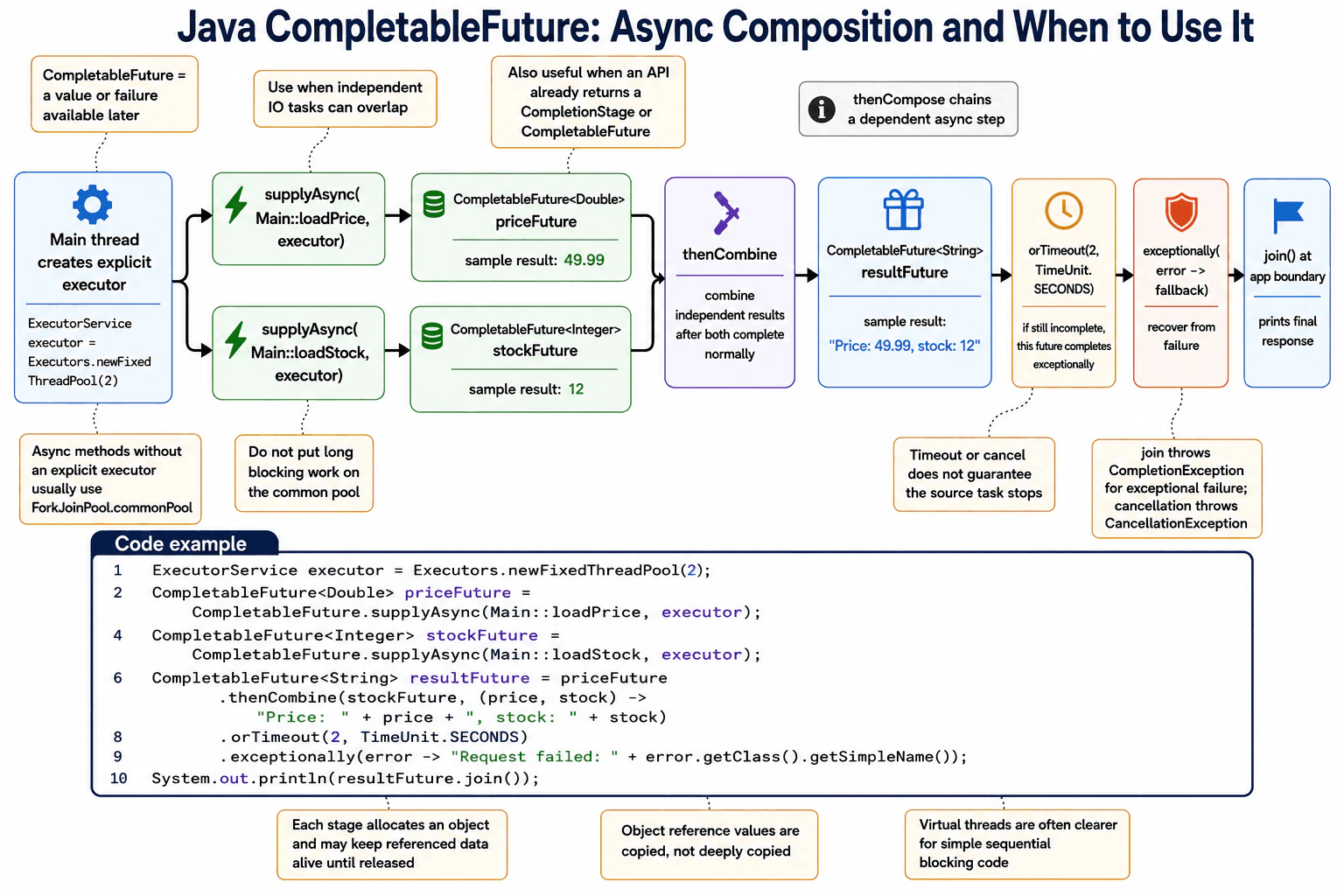
CompletableFuture is a JDK class that represents a result or failure that may become available later. I use it when independent operations can run at the same time or when later work must be composed from an asynchronous result. It is a good fit for asynchronous APIs and result pipelines. I avoid it when simple sequential blocking code, often using virtual threads, would be easier to read and maintain.
Use CompletableFuture when work can start now and its result can be processed later. It is especially useful when two or more independent operations can run at the same time, such as loading a price and stock count from separate services. Their results can then be combined into one response. This can reduce total waiting time when resources are available, but it adds more stages, objects, failure paths, and executor decisions. Simple blocking code may be clearer when the steps are naturally sequential.
Useful Questions to Ask the Interviewer
Are the operations independent or does one need the result of another?
Does the existing API already return CompletableFuture or CompletionStage?
Is the work mainly waiting for input and output or performing CPU heavy calculations?
Which executor, timeout, and failure policy should be used?
How to Explain It in an Interview
CompletableFuture is a class in java.util.concurrent that implements Future and CompletionStage. It can hold a value or an exception that will be supplied later. supplyAsync starts work that returns a value. runAsync starts work that returns no value.
thenApply transforms a completed value. thenCompose starts a dependent asynchronous operation and flattens its returned stage. thenCombine joins two independent stages after both complete normally. Methods with an Async suffix schedule the continuation through an executor. Async methods without an explicit executor normally use ForkJoinPool.commonPool. Non Async continuations may run in the thread that completes the earlier stage or in another thread that helps complete it, so slow continuation code should not rely on a particular thread. docs.oracle.com
Use an explicit executor when isolation or workload control matters. Do not place long blocking operations on the shared common pool without careful capacity planning. CPU heavy work also needs an executor sized for available processors.
join and get both wait. join reports failure through CompletionException. get uses checked exceptions and can be interrupted. exceptionally can recover from failure. handle can map either success or failure. whenComplete is mainly for observing the outcome.
orTimeout completes the selected future exceptionally after the limit. It does not guarantee that the underlying operation stops. CompletableFuture cancellation also does not use mayInterruptIfRunning to interrupt the executing task. Production code must arrange cancellation with the real client, task, or resource when stopping the work is required. docs.oracle.com
Each stage allocates an object and may retain functions, results, exceptions, and referenced application data until those references can be released. Values are passed between stages as Java values. Object reference values are copied, but objects are not deeply copied.
Interviewers ask this question to check whether a candidate understands asynchronous composition, dependent and independent tasks, executor selection, exception propagation, timeouts, cancellation, and blocking boundaries. They also want to see whether the candidate can choose between CompletableFuture, ordinary blocking code, and virtual threads based on clarity, workload type, and production needs.
Common interview mistakes
Common mistakes include calling join or get immediately after starting each operation, which removes useful overlap, and using thenApply for a function that returns another future, which creates a nested future instead of a flat chain. Other mistakes include running long blocking work on ForkJoinPool.commonPool, assuming every continuation runs on the original executor, omitting timeouts, swallowing the original exception, believing orTimeout stops the source task, assuming cancel interrupts the running operation, creating unlimited concurrent work, and forgetting to shut down an owned executor.
Interview tip
Begin with the decision. Explain that CompletableFuture is useful for composing results that arrive later, especially when independent operations can overlap or an API is already asynchronous. Then distinguish thenCompose from thenCombine. Finish with executor choice, blocking boundaries, exception handling, timeout behavior, cancellation limits, and when virtual threads provide simpler code.
Interviewer may ask next
Does orTimeout cancel the underlying asynchronous operations?
No. orTimeout completes the selected CompletableFuture exceptionally with TimeoutException if it is still incomplete when the limit expires, but it does not guarantee that the supplier, network request, or other source operation stops. This matters because timed out work may continue using threads, connections, CPU time, or remote capacity. A production design should also configure timeouts and cancellation in the underlying client or task and should release results that are no longer needed.
When are virtual threads a better choice than CompletableFuture?
Virtual threads are often a better choice when the workflow uses blocking input and output calls and reads naturally as sequential code. They allow ordinary return values, try catch blocks, stack traces, and interruption handling, which can improve clarity. CompletableFuture remains a better fit when an API already produces asynchronous stages or when results must be composed as a pipeline. Neither option makes CPU heavy work faster, removes the need for concurrency limits, or provides durable task processing. openjdk.org
54. What is false sharing, and why can it hurt concurrency performance?Language SpecificHard
i Question Details
Explain false sharing, cache-line effects, and how it can affect highly concurrent Java code.
Short Interview Answer (30-60 seconds)
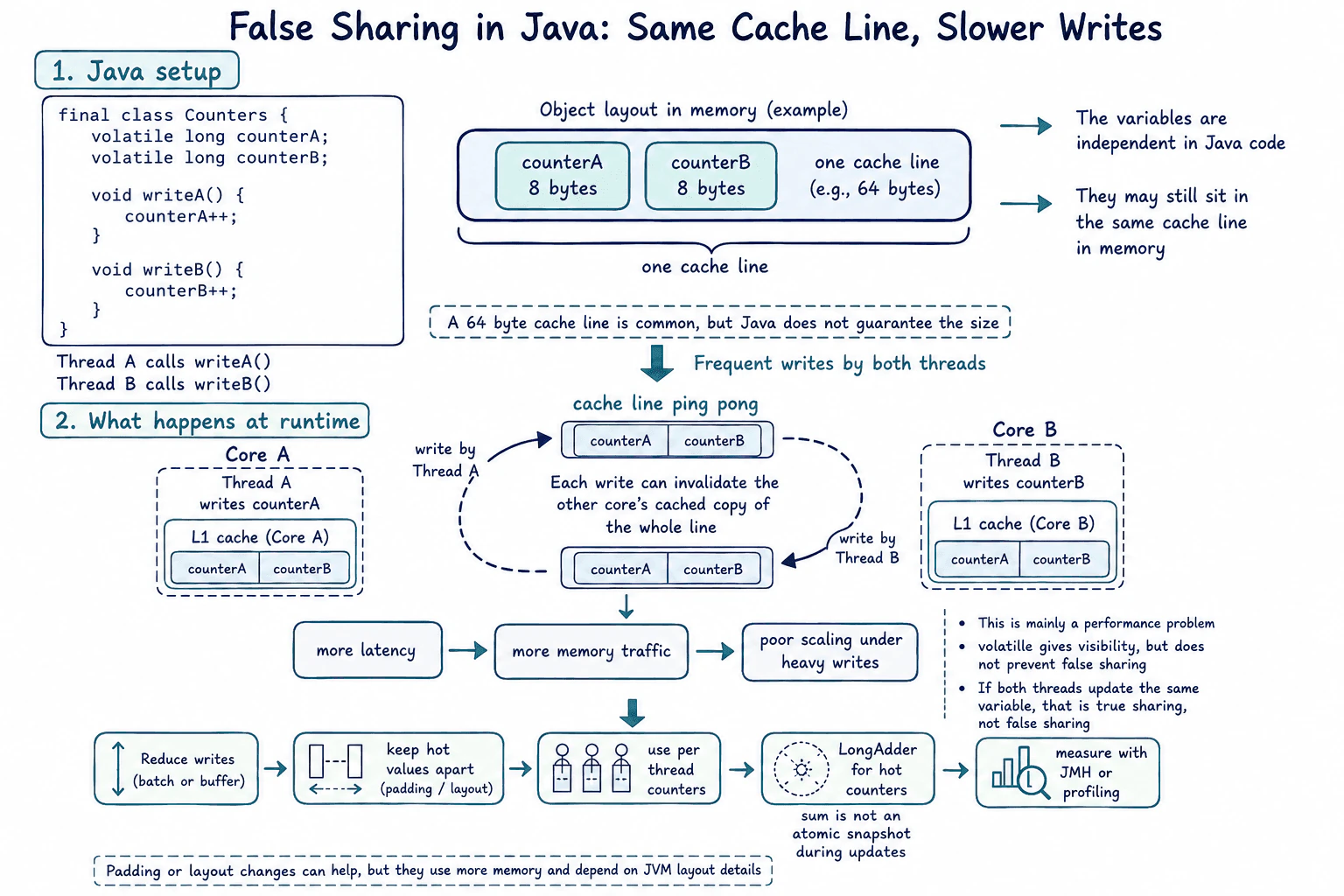
False sharing happens when different threads update independent variables that occupy the same processor cache line. The variables do not logically share data, but each write can invalidate the other core's cached copy of the whole line. The line then moves repeatedly between cores, which increases latency and memory traffic. In Java, I would confirm the problem with a realistic benchmark or profiler, then reduce shared line writes by separating hot state, aggregating locally, or using LongAdder when its weaker snapshot behavior is acceptable.
Detailed Explanation
False sharing is a slowdown that happens when two workers change different values stored very close together in memory. The values are independent, but the computer moves and protects memory in fixed groups. A change to one value can therefore force another worker to fetch the whole group again. This repeated movement wastes time and can make adding more workers reduce performance instead of improving it. The problem is most likely when several workers write very often and the values are placed next to each other.
Useful Questions to Ask the Interviewer
Are different threads updating the values at a high rate?
Is the slowdown visible in a benchmark or production profile?
Can the data layout or counter design be changed?
How to Explain It in an Interview
Processors normally load and track memory in cache lines. A cache line is a fixed block of nearby bytes. A size of 64 bytes is common on widely used processors, but Java does not guarantee any particular cache line size.
Suppose thread A repeatedly updates counterA while thread B repeatedly updates counterB. The counters are independent in Java code. However, if both counters occupy the same cache line, each core may need exclusive ownership of that entire line before writing. Cache coherence then invalidates or transfers copies held by other cores. Ownership can move back and forth even though the threads never update the same Java variable. This repeated movement is often called cache line ping pong.
False sharing usually harms performance rather than correctness. It does not by itself create a Java Memory Model data race. A program still needs synchronization, volatile fields, atomic classes, or another safe design when those mechanisms are required for visibility and atomicity. Declaring fields volatile does not separate them into different cache lines and therefore does not remove false sharing.
The problem commonly appears with neighboring object fields, array elements, worker statistics, queue indexes, and counters. Read only values do not cause false sharing because the damaging behavior requires writes. Two threads updating the same value is true sharing, not false sharing.
Useful mitigations include reducing write frequency, keeping per thread or per worker state and combining it later, separating frequently written values, or using LongAdder for a heavily contended statistical counter. LongAdder spreads updates across internal cells. Its sum method does not provide one atomic snapshot while updates continue, so it is not suitable when every read must return one exact current value.
Padding or separating values can reduce contention, but it increases memory use and may reduce useful cache density. Manual padding is also fragile because Java does not define final object field layout. JVM specific layout controls may help in specialized systems, but production changes should be based on realistic JMH measurements and profiling rather than assumptions.
Why Interviewers Ask This
Interviewers ask this question to check whether the candidate understands that Java concurrency performance depends on processor cache behavior as well as locks and synchronization. A strong answer shows knowledge of cache lines, cache coherence, object layout limits, contention measurement, and the tradeoffs of techniques such as local aggregation, padding, and LongAdder.
Common interview mistakes
Common mistakes include assuming that different Java fields cannot interfere, confusing false sharing with a Java Memory Model correctness error, and treating two threads updating the same variable as false sharing. Other mistakes are adding volatile or locks and expecting them to separate cache lines, replacing AtomicLong with LongAdder when exact atomic reads are required, trusting source field order as a layout guarantee, and using padding without measuring its memory and cache costs. A weak benchmark can also create misleading results through dead code removal, warmup effects, thread scheduling, or unequal workloads.
Interview tip
Begin with the practical conclusion that independent variables can still compete because processors manage memory by cache line. Then explain line ownership moving between cores, distinguish false sharing from true sharing and correctness problems, and finish with measurement, memory tradeoffs, and suitable mitigations.
Interviewer may ask next
Does declaring both counters volatile prevent false sharing?
No. Volatile provides Java Memory Model visibility and ordering for each field, but it does not force the fields into separate cache lines. If different cores frequently write volatile fields that occupy the same line, cache coherence can still transfer that line between the cores. Volatile may be necessary for correctness, while data placement and write frequency must be handled separately for performance.
When should LongAdder be preferred over AtomicLong for a counter?
LongAdder is usually preferred when many threads frequently update a statistical counter and readers can accept a sum that is not one atomic snapshot during concurrent updates. It reduces contention by distributing writes across internal cells. AtomicLong is better when every update and read must operate on one exact atomic value. The main tradeoff is that LongAdder uses more memory and provides weaker snapshot semantics in exchange for better throughput under heavy contention.
55. How does ForkJoinPool work?Language SpecificHard
i Question Details
Explain work-stealing, task splitting, and when ForkJoinPool is appropriate.
Short Interview Answer (30-60 seconds)
ForkJoinPool is mainly appropriate for CPU bound work that can be split into many mostly independent tasks. A large task divides itself into smaller tasks, and worker threads process them from local queues. When a worker becomes idle, it steals available work from another worker. This balances uneven workloads with less contention than one central queue. It works well for recursive calculations and related parallel operations, but long blocking calls can reduce its effective parallelism.
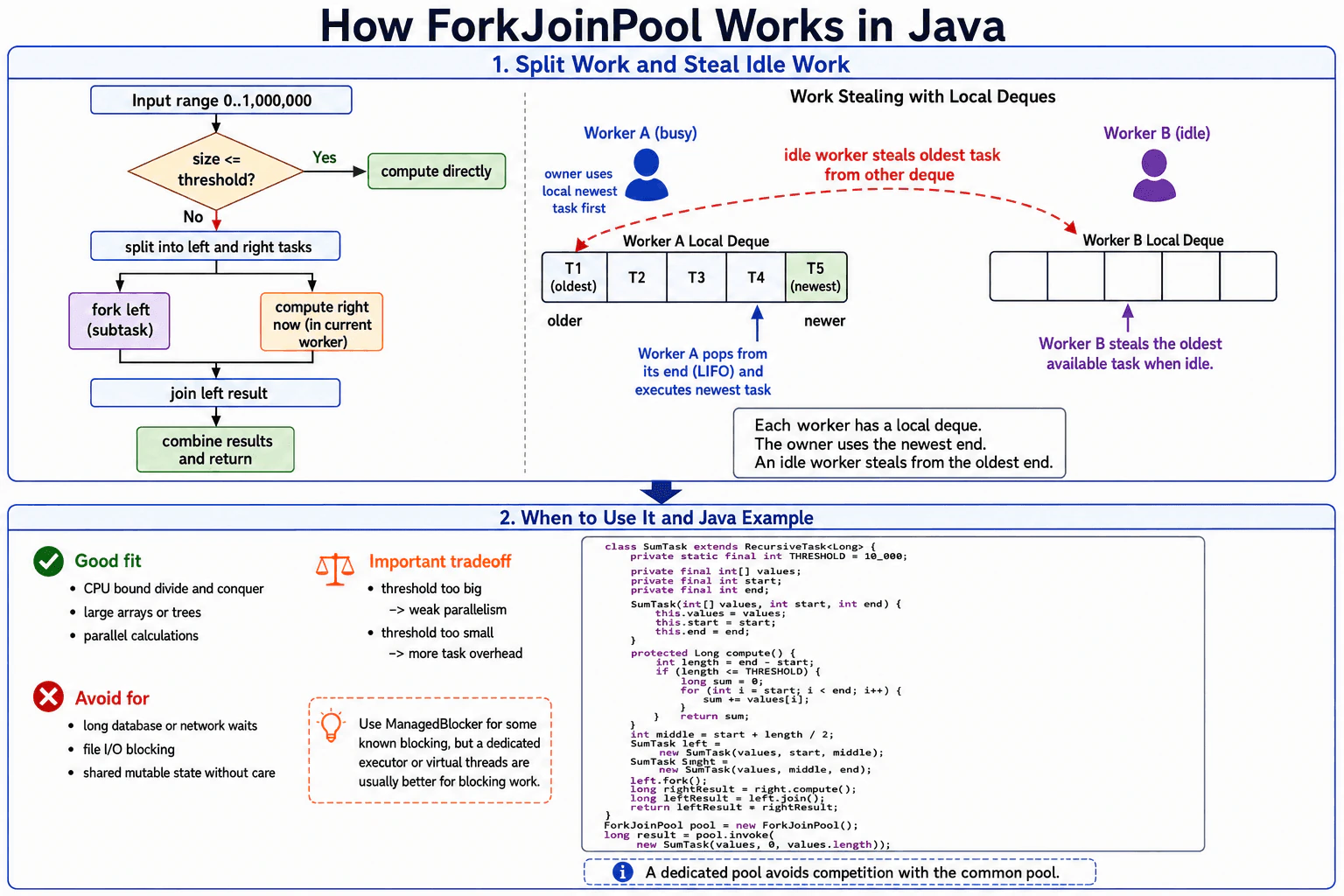
ForkJoinPool helps a program finish a large calculation by breaking it into smaller pieces that can be handled at the same time. Each available worker handles a piece. When one worker finishes early, it takes an available piece from a worker that still has several pieces. This reduces idle time and spreads uneven work across the available processing units. It works best when each piece can be completed mostly on its own and spends its time calculating instead of waiting. Before choosing it, I would ask:
Useful Questions to Ask the Interviewer
Is the work mainly calculation or waiting?
Can the input be divided into independent ranges?
How much work should each smallest task contain?
How to Explain It in an Interview
ForkJoinPool is an ExecutorService designed mainly for ForkJoinTask instances. A task commonly extends RecursiveTask when it returns a result or RecursiveAction when it returns no result.
A worker places newly forked tasks into its own work queue. With the normal scheduling mode, the worker usually takes recently added local tasks first. An idle worker can steal an older available task from another worker's queue. Taking work from opposite ends reduces competition between the owner and thieves while helping distribute uneven workloads.
A divide and conquer task first checks a threshold. If its input is small enough, it computes the result directly. Otherwise, it splits the input into smaller ranges. A common pattern is to fork one subtask, compute the other in the current worker, and then join the forked result. Join waits when necessary and returns the completed result.
The threshold is important. Large tasks may leave processors idle. Very small tasks create more task objects, queue operations, joins, and scheduling work than the calculation justifies.
ForkJoinPool is best suited to CPU bound work with enough independent computation, such as array reduction, tree processing, recursive search, and some parallel stream operations. It is usually a poor fit for long database, network, file, lock, or other blocking waits. The pool can compensate for some known blocking through managedBlock and ManagedBlocker, but it cannot guarantee compensation for unmanaged blocking. A dedicated executor or virtual threads are usually clearer for blocking workloads.
Tasks that share mutable data still require normal thread safety. Production code should also consider whether using the common pool could compete with parallel streams, CompletableFuture operations, or unrelated application work.
Interviewers ask this question to test whether a candidate understands Java parallel execution, recursive task splitting, work stealing, blocking risks, task sizing, shared pool effects, and the judgment required to choose ForkJoinPool for suitable production workloads.
Common interview mistakes
Common mistakes include using ForkJoinPool for long blocking operations, creating tasks with too little work, assuming more tasks always improve speed, and modifying shared mutable data without proper synchronization. Another mistake is forking both subtasks and immediately joining them when the current worker could compute one subtask directly. Developers may also assume that every task receives its own thread or that work stealing guarantees fairness. A further production mistake is using the common pool without considering competition from parallel streams, CompletableFuture operations, or other library code.
Interview tip
Start by saying that ForkJoinPool is mainly for CPU bound work that can be divided. Then explain task splitting, worker local queues, work stealing, fork, direct computation, and join. Finish with the threshold tradeoff, task allocation cost, blocking limitation, and possible competition in the common pool.
Interviewer may ask next
What happens when a ForkJoinPool task performs a long blocking operation?
A long blocking operation can reduce effective parallelism because the blocked worker cannot execute or steal other tasks. This matters because ForkJoinPool is designed mainly for computation tasks that frequently complete, split, or join. The pool can try to compensate when blocking is reported through managedBlock and ManagedBlocker, but it does not guarantee compensation for unmanaged input, output, locks, or other waits. For large numbers of blocking operations, a dedicated executor or virtual threads are usually a better choice.
How should the splitting threshold be chosen for a ForkJoinPool task?
The threshold should make each smallest task large enough to justify task creation and scheduling, while still creating enough independent work to keep available processors busy. A threshold that is too high can produce weak parallelism and poor load balance. A threshold that is too low creates excessive task objects, queue operations, joins, and memory pressure. The correct value depends on input size, calculation cost, processor count, memory access, and runtime competition, so it should be measured with representative production workloads.
56. How do thread pools work, and how do you size one?Language SpecificHard
i Question Details
Explain how thread pools schedule work and how you would choose pool size based on workload characteristics.
Short Interview Answer (30-60 seconds)
I first classify the work as processor bound or waiting bound. A Java thread pool accepts tasks and uses a limited group of worker threads to execute them. For processor bound work, I start near the number of available processors. For waiting bound work, I may use more threads and estimate the size as processor count times target processor use times one plus waiting time divided by processing time. I then confirm the result with load tests and configure a bounded queue, a rejection policy, metrics, interruption handling, and graceful shutdown.
The practical goal is to choose enough workers to keep useful work moving without allowing too much work to pile up. Too few workers make requests wait. Too many can waste memory, increase switching overhead, and overload a database or remote service. The right number depends on whether each job spends most of its time calculating or waiting for something else. It also depends on traffic, response time goals, queue limits, and the capacity of systems called by the application. The starting number must be tested with realistic measurements.
Useful Questions to Ask the Interviewer
Is the work mainly calculation or waiting?
What request rate and response time must the service support?
How much time does one task spend waiting and processing?
What queue limit and overload behavior are acceptable?
What limits exist in databases, remote services, and connection pools?
How to Explain It in an Interview
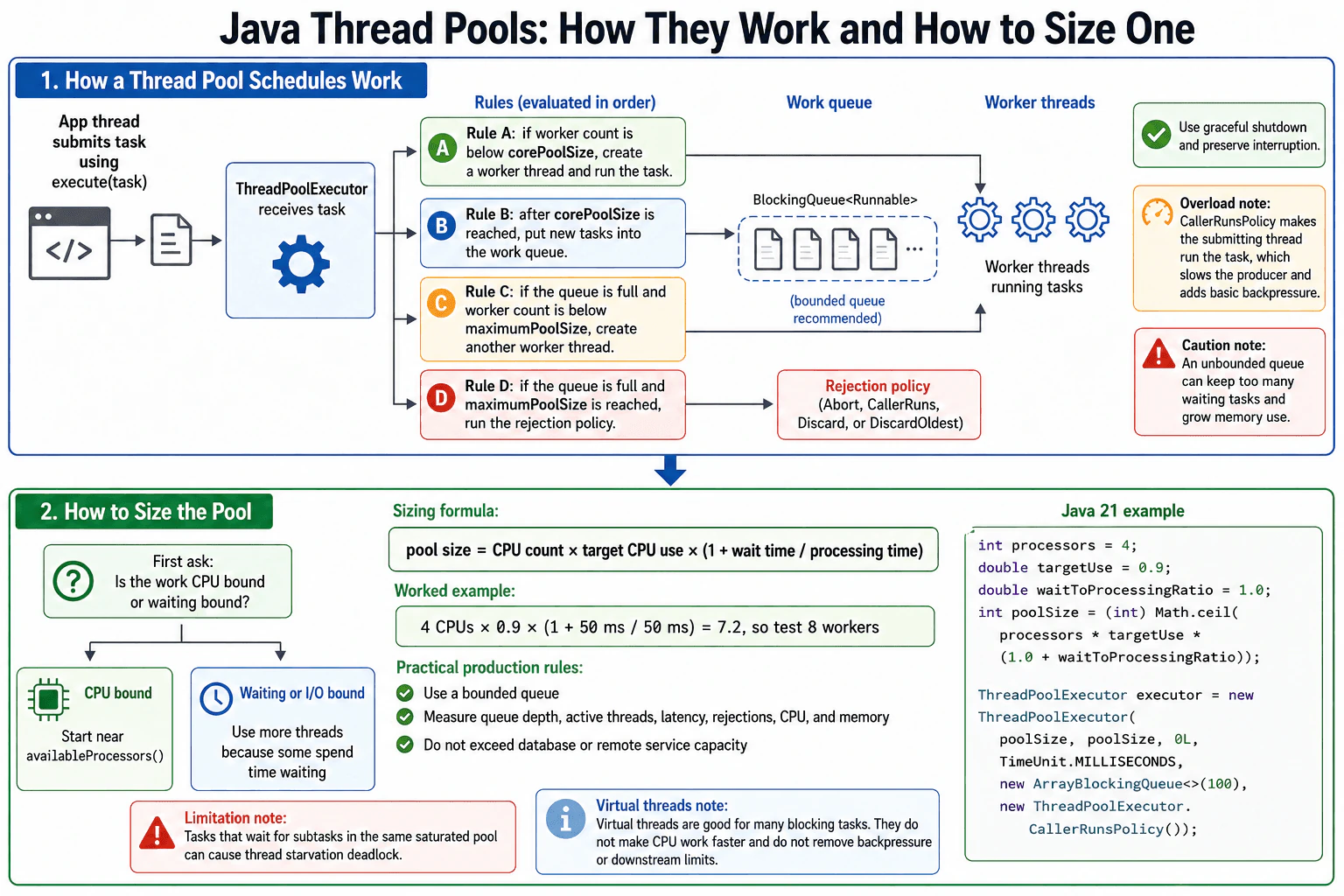
In Java, an ExecutorService separates task submission from execution. A ThreadPoolExecutor owns worker threads and usually a queue. When execute receives a task, it creates a worker while the worker count is below corePoolSize, even if an existing worker is idle. After the core size is reached, it offers the task to the queue. If the queue refuses the task, it tries to create another worker up to maximumPoolSize. If that also fails, the rejection policy runs.
For processor bound work, start near the number returned by Runtime.getRuntime().availableProcessors(). More active platform threads usually add context switching without increasing calculation throughput. For waiting bound work, a useful estimate is:
pool size equals processor count times target processor use times one plus waiting time divided by processing time.
With four processors, target use of 0.9, and equal waiting and processing times, the estimate is 7.2, so I would test eight workers. This is only a starting point. Container processor limits, task variation, garbage collection, and downstream capacity can change the result.
Pool size, queue capacity, and rejection policy must be chosen together. A bounded queue limits retained tasks and memory growth. CallerRunsPolicy makes the submitting thread run a rejected task, which can slow producers and provide basic backpressure. Executors.newFixedThreadPool uses an unbounded LinkedBlockingQueue, so queued tasks can accumulate until memory is exhausted.
In production, measure active workers, queue depth, queue wait time, task time, rejection count, processor use, memory, and downstream saturation. Preserve interruption and use graceful shutdown. Avoid tasks that wait for subtasks submitted to the same saturated pool because this can cause thread starvation deadlock.
Virtual threads are normally created per task for blocking work instead of being pooled as scarce workers. They do not speed up processor bound work or remove backpressure. In Java 21, synchronized code and native calls could pin a carrier. From JDK 24, synchronized code no longer causes nearly all such pinning, but native and other remaining cases still need care.
Interviewers ask this question to check whether the candidate understands Java executors, worker creation, task queues, rejection, interruption, and shutdown. It also tests whether the candidate can separate processor bound work from waiting bound work, estimate a reasonable starting size from measurements, and design the pool together with queue capacity, overload handling, memory limits, and downstream capacity.
Common interview mistakes
Common mistakes include choosing a large number without measuring the workload, assuming more threads always improve throughput, and using one pool for unrelated slow and fast tasks. Another mistake is using Executors.newFixedThreadPool without noticing its unbounded queue. Waiting tasks retain their objects and referenced data, so a growing queue can increase latency and eventually exhaust memory. Developers also incorrectly expect maximumPoolSize to enlarge a pool that uses an unbounded queue. Other mistakes include ignoring rejection, swallowing InterruptedException, creating a new pool for every request, failing to shut down an executor, and allowing more concurrent tasks than a database or remote service can handle. Tasks that submit subtasks to the same saturated pool and wait for them can also cause thread starvation deadlock. Virtual threads must not be treated as permission for unlimited access to scarce resources.
Interview tip
Start by separating processor bound work from waiting bound work. Explain the ThreadPoolExecutor order of core workers, queueing, additional workers, and rejection. Present the sizing formula as a measured starting point rather than a guarantee. Finish with bounded queues, load testing, memory use, downstream limits, interruption, metrics, and graceful shutdown.
Interviewer may ask next
What happens when a ThreadPoolExecutor reaches its maximum worker count and its queue is also full?
The configured RejectedExecutionHandler runs. With CallerRunsPolicy, the thread that submitted the task executes it when the executor is still running. If the executor is shut down, that policy does not run the task. This behavior matters because making the producer perform work can slow further submissions and provide basic backpressure. The tradeoff is that the submitting thread may be a request thread or event processing thread, so its normal work becomes slower. AbortPolicy instead throws RejectedExecutionException, which is useful when the caller should fail fast and handle overload explicitly.
Would you use the same pool sizing rule for virtual threads?
No. Virtual threads are normally created per task, so the traditional platform thread pool formula is not the main concurrency control. This matters because a blocked virtual thread usually releases its carrier, allowing many waiting tasks without keeping one platform thread for every task. Virtual threads still do not make processor bound work faster or remove resource limits. In Java 21, synchronized code and native calls could pin carriers. JDK 24 changed synchronized behavior through JEP 491, although native and other remaining pinning cases still require care. The main tradeoff is that high task concurrency becomes cheaper, but databases, connection pools, memory, rate limits, and remote services must still be protected with explicit limits such as semaphores, bounded queues, or rate controls.
57. How do you detect and prevent race conditions?Language SpecificHard
i Question Details
Explain how race conditions appear in Java code and how you would detect, reproduce, and prevent them.
Short Interview Answer (30-60 seconds)
I first reduce or remove shared mutable state. When threads must share changing state, I define the invariant and protect the complete operation with one consistent mechanism, such as synchronized, Lock, an atomic class, or an atomic operation from a concurrent collection. I detect races through code review, invariant checks, repeated stress tests, and focused tools such as jcstress. Volatile can provide visibility and ordering, but it does not make a compound update such as count++ atomic.
A race condition happens when two or more workers use the same changeable information and the final result depends on which worker runs first. The failure may appear only once in many runs, so normal testing can miss it. I first find information that several workers can read or change. I then define the rule that must always remain true. Next, I run many workers together and check that rule repeatedly. To prevent the problem, I avoid sharing the information when possible or control the whole change as one protected action.
Useful Questions to Ask the Interviewer
Which state is shared between threads?
Which invariant must always remain true?
Must several fields change together?
Is temporary blocking acceptable?
How to Explain It in an Interview
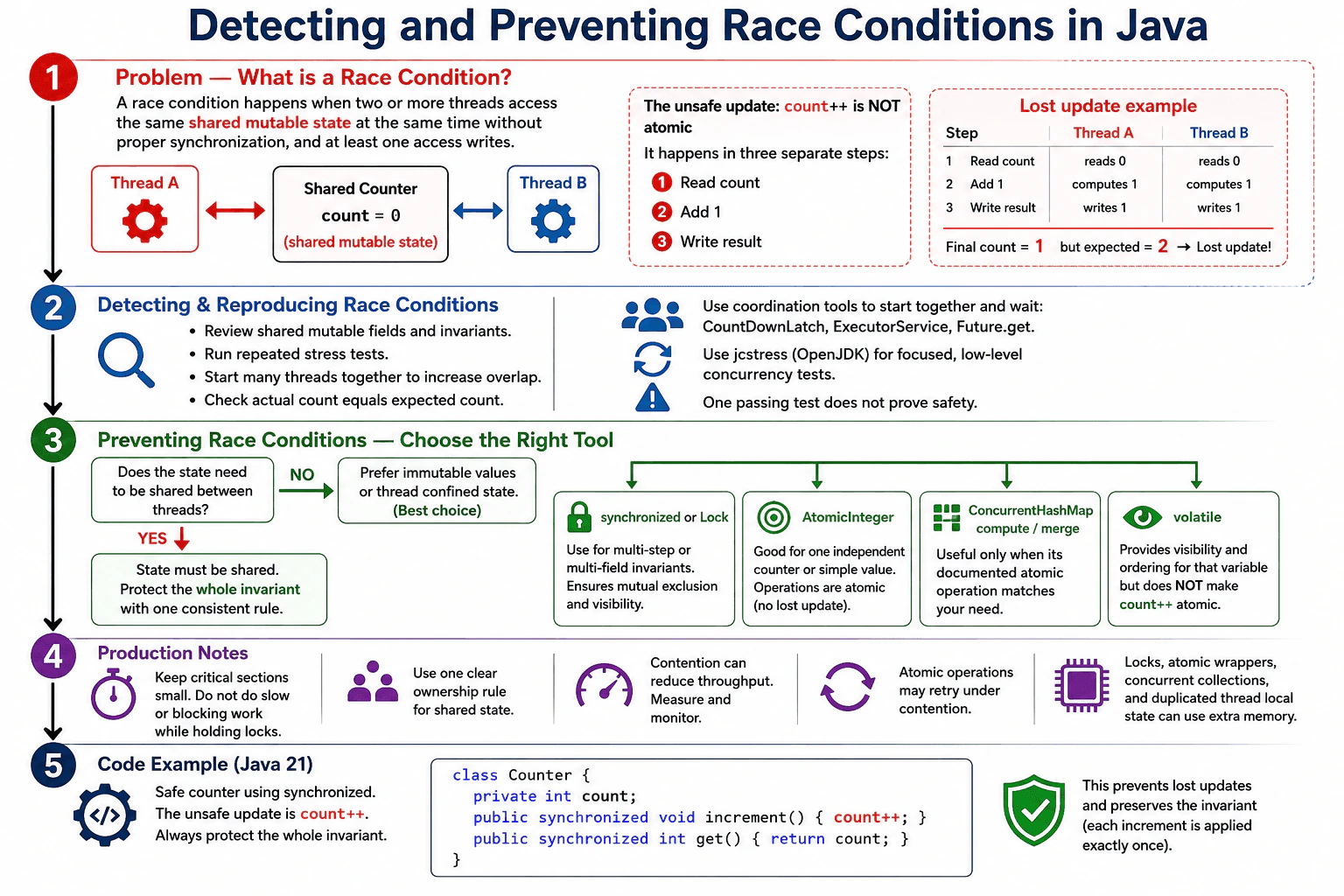
A simple Java example is count++. It looks like one statement, but it reads the current value, adds one, and writes the result. Two threads can read the same old value and both write the same new value. One increment is then lost.
Detection starts with code review. Look for mutable instance fields, static fields, caches, collections, counters, check then act logic, and objects published to several threads. Verify that every access follows one documented synchronization rule. Then create a stress test that starts many threads together, repeats the operation, and checks an invariant such as actual count equals expected count. Repeat the test many times. The experimental jcstress tool is useful for small focused concurrency tests across many executions. A successful test increases confidence but cannot prove that every possible schedule is safe.
Prevention depends on the complete invariant. Prefer immutable values, local variables, or thread confined objects because they remove shared writes. Use synchronized or Lock when several reads and writes must happen as one operation. Unlocking a monitor or Lock establishes the required visibility for a later successful lock on the same synchronization object. Use AtomicInteger for one independent atomic counter operation. Use ConcurrentHashMap methods such as compute or merge when their documented atomic operation matches the requirement.
Volatile is not enough for count++. It provides visibility and ordering for the volatile variable, but the combined read, calculation, and write can still overlap. Individually thread safe calls can also form an unsafe sequence, such as checking a key and then inserting it in separate calls.
Synchronization can reduce throughput when threads compete for the same lock. Atomic updates can retry under contention. Locks, atomic wrapper objects, concurrent collections, and duplicated thread local state can also use additional memory. Keep protected sections small, avoid unnecessary sharing, measure realistic contention, and use one clear ownership rule.
Interviewers ask this question to check whether a candidate understands shared mutable state, atomicity, visibility, ordering, safe publication, and Java Memory Model rules. They also evaluate whether the candidate can choose correctly among immutability, thread confinement, synchronization, locks, atomic classes, and concurrent collections. Production judgment matters because timing dependent failures may disappear during debugging, and a passing unit test does not prove that concurrent code is safe.
Common interview mistakes
Common mistakes include assuming that one Java statement is one atomic action, using volatile for a compound update, synchronizing writes but not reads, and protecting the same state with different locks. Other mistakes include publishing a mutable object before construction or configuration is complete, returning mutable internal state without protection, and combining individually thread safe calls into an unsafe check then act sequence. Developers may also assume that ConcurrentHashMap makes every multi call workflow atomic, or that several AtomicInteger fields preserve one shared invariant. Thread.sleep is not a reliable way to coordinate or prove reproduction. A test that passes once does not prove thread safety.
Interview tip
Start with the practical rule that shared mutable state needs one clear ownership or synchronization policy. Use count++ to show the read, calculation, and write steps. Explain detection with invariants, repeated stress tests, and focused concurrency testing. Then match the prevention tool to the operation: immutability or confinement first, atomic classes for one independent value, concurrent collection methods for supported atomic map operations, and one lock for a multi step or multi field invariant.
Interviewer may ask next
Would declaring the counter volatile make count++ thread safe?
No. Volatile makes writes visible to later reads and adds Java Memory Model ordering guarantees, but count++ is still a compound read, calculation, and write. Two threads can read the same value and lose one update. This matters because the value can be visible while the update remains non atomic. Use AtomicInteger.incrementAndGet or protect the complete increment with synchronization.
When would you choose AtomicInteger instead of synchronized?
I would choose AtomicInteger when one independent integer needs an atomic operation such as incrementAndGet, getAndAdd, or compareAndSet. It avoids a monitor and can perform well when contention is not extreme, although failed compare and set attempts may retry under contention. I would choose synchronized or Lock when several fields or several steps must satisfy one invariant. The main tradeoff is that AtomicInteger is simple for one value, but several separate atomic calls do not make the whole workflow atomic.
58. How do you design a thread-safe Java class?Language SpecificHard
i Question Details
Explain the design principles and synchronization strategies used to make a class safe for concurrent access.
Short Interview Answer (30-60 seconds)
I first identify all mutable state and the rules that must always remain true. Then I protect every access to related state with one clear synchronization policy, usually a private lock. I keep fields private, avoid exposing mutable internal objects, and publish the completed instance safely. Atomic classes are useful for one independent value, while concurrent collections are useful when their atomic operations match the requirement. The main rule is that every compound operation must be atomic and its completed changes must be visible to other threads.
A safe class must keep giving correct results when several tasks use the same object at the same time. I first find every value that can change and every rule connecting those values. I then make sure a complete change happens without another task seeing or creating a half finished result. I also prevent callers from changing hidden data through returned objects. Finally, I make sure each task can see completed changes instead of an older value.
Useful Questions to Ask the Interviewer
Which fields can change after construction?
Which fields must be read or changed together?
Will one instance be shared by many threads?
Are reads much more common than writes?
Can returned objects expose internal mutable state?
How to Explain It in an Interview
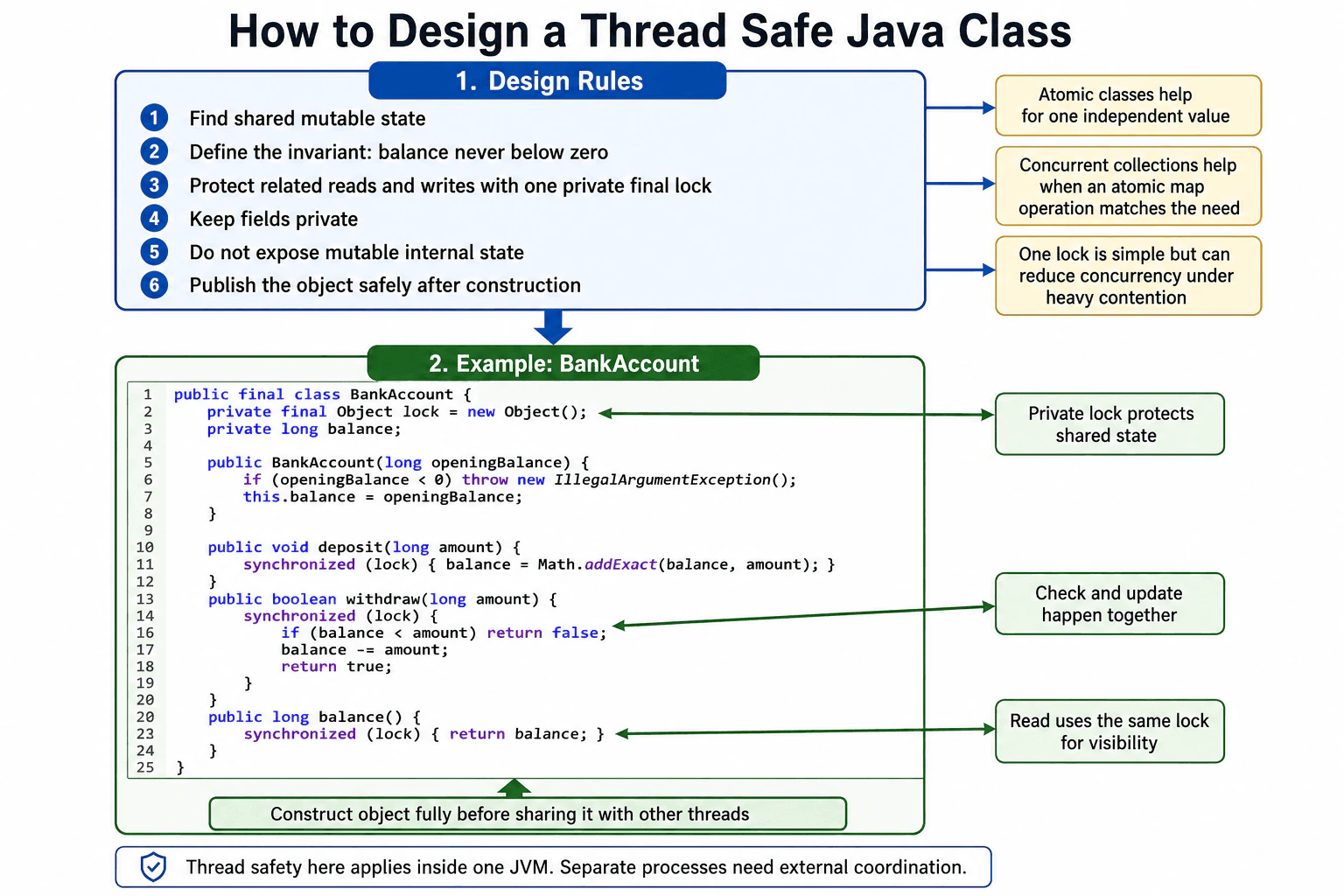
Start by defining the class invariant. An invariant is a rule that must always remain true. For example, an account balance must never become negative. Identify every field involved in that rule and protect every related read and write with the same synchronization policy.
A simple design uses synchronized blocks with one private lock object. Entering and leaving the same monitor provides mutual exclusion and visibility under the Java Memory Model. Only one thread can execute the protected section at a time. A thread that later acquires the same monitor can observe changes completed before the previous thread released it.
Keep the lock private and final. This prevents outside code from acquiring it and interfering with the class. Keep mutable fields private. Do not return mutable internal collections or objects. Return an immutable value, an unmodifiable copy, or a defensive copy.
Use final fields where possible because fewer mutable values make reasoning easier. Publish the completed object safely. Thread start, static initialization, synchronization, a volatile reference, and concurrent collections can provide safe publication when used correctly.
AtomicInteger and similar classes work well for one independent value. They do not automatically protect a rule involving several fields or several steps. ConcurrentHashMap is useful when one of its atomic operations matches the required update. A separate check followed by an update may still be unsafe.
Correctness comes first. One lock is easy to reason about but can limit parallel work when many threads contend for it. Each instance in this example also stores one extra lock object. Normal calls do not create a new object. Keep protected sections small, avoid slow input and output or unknown callbacks while holding the lock, document which state the lock protects, and measure contention before choosing a more complex design.
Interviewers ask this question to check whether the candidate understands shared mutable state, class invariants, atomic operations, visibility, safe publication, locking, and concurrent collections. They also want to see whether the candidate can choose a simple synchronization policy, prevent mutable state from escaping, and balance correctness, maintainability, memory use, and performance.
Common interview mistakes
Common mistakes include protecting writes but not reads, using different locks for fields that belong to one invariant, and using volatile for a compound check and update. Another mistake is assuming an atomic field makes the whole class safe when several values or steps must remain consistent. Returning a mutable internal object lets callers bypass the synchronization policy. Other problems include locking on public objects, calling slow or unknown code while holding a lock, publishing this from a constructor, using a non thread safe collection without protection, and assuming one JVM lock coordinates separate processes or service replicas.
Interview tip
Explain the invariant first. Then name the shared mutable fields and the single policy that protects them. State how the policy provides atomicity and visibility. Finish with safe publication, prevention of mutable state leaks, and the tradeoff between a simple lock and greater concurrency.
Interviewer may ask next
Would making the balance field volatile make deposit and withdraw thread safe?
No. Volatile would provide visibility for individual reads and writes, but deposit and withdraw are compound operations. Deposit reads the current balance, calculates another value, and writes it back. Two threads could read the same old balance and lose one update. Withdraw combines a balance check with a change, so another thread must not act between those steps. Synchronizing the full operation on the same lock provides both atomicity and visibility.
When should you replace one private lock with another concurrency mechanism?
Replace it only when measurement shows meaningful contention and another mechanism can preserve the same invariant clearly. One independent counter may use an atomic class. A shared map may use an atomic ConcurrentHashMap operation such as compute. A class with many reads and rare writes may use a read and write lock, but that adds memory, rules, and failure modes and may not improve performance. The alternative must still protect every compound operation, prevent state leaks, and provide the required visibility.
59. What is class loading in Java?Language SpecificMedium
i Question Details
Explain the Java class loading process and the role of the bootstrap, platform, and application class loaders.
Short Interview Answer (30-60 seconds)
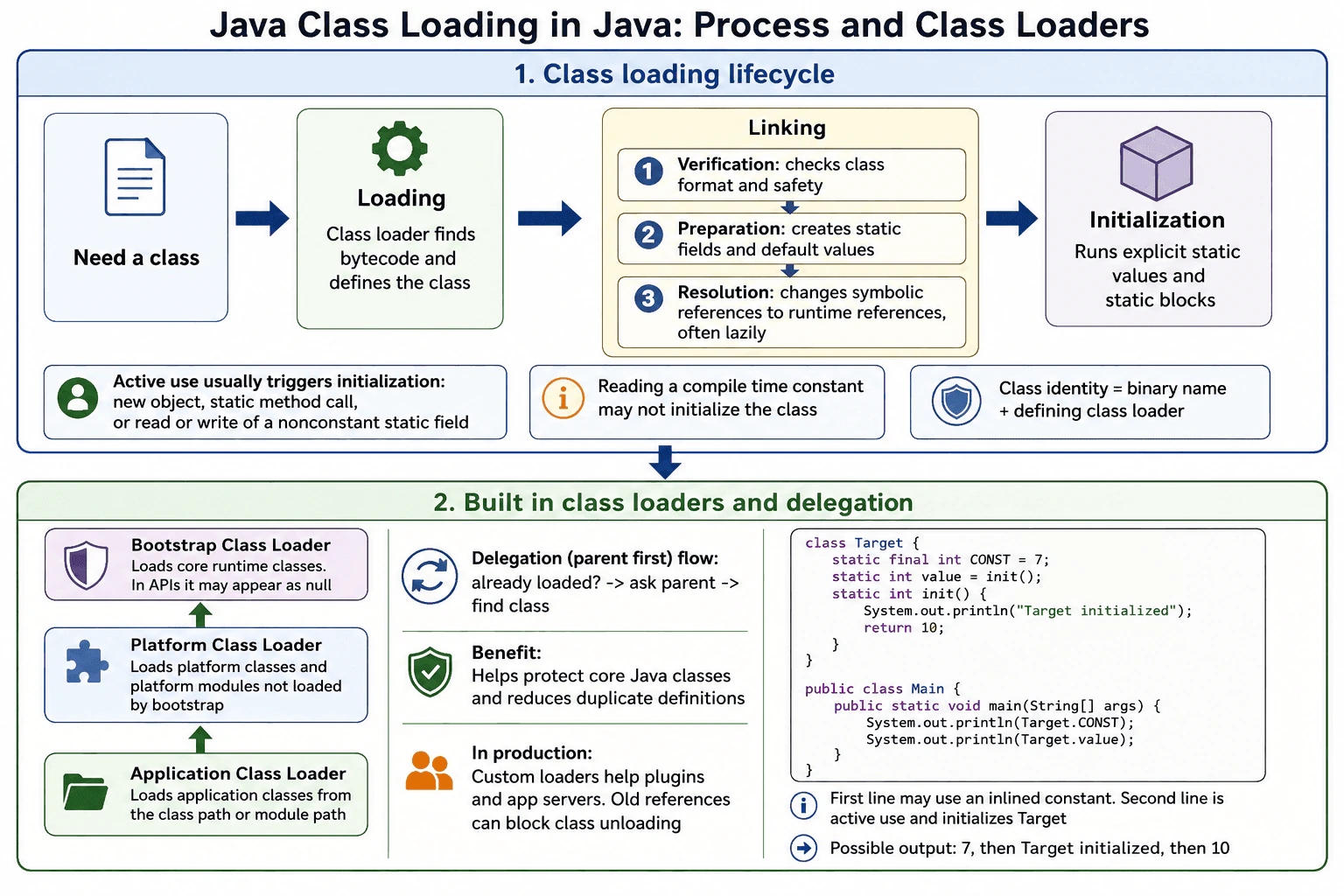
Class loading is the process the JVM uses to find class bytecode and create a runtime class representation. The class is then linked through verification, preparation, and optional resolution, and it is initialized when Java first actively uses it. The bootstrap loader handles core runtime classes, the platform loader handles platform classes, and the application loader normally handles application classes. Java uses delegation to protect core classes and reduce duplicate definitions.
Detailed Explanation
Java does not need to bring every class into a running program at startup. It can bring a class in when the program needs it. The JVM finds the class data, checks that it is valid, prepares its shared values, and runs its starting setup when required. Different loaders handle core Java code, platform code, and application code. This keeps trusted runtime classes separate from application libraries and supports controlled loading of extra code. It also explains many startup, dependency, and memory problems in real applications.
Useful Questions to Ask the Interviewer
Should I include custom class loaders and plugin isolation?
Should I explain linking and initialization as separate steps?
Should I discuss class path and module path behavior?
How to Explain It in an Interview
Class loading is the JVM process that finds binary class data and creates the runtime representation of a class or interface.
The complete lifecycle has three main stages: loading, linking, and initialization. During loading, a class loader obtains the binary data and defines the class. Linking includes verification, preparation, and resolution. Verification checks that the binary form follows JVM rules. Preparation creates static fields and gives them default values. Resolution changes symbolic references, such as class and method names, into runtime references. The JVM may delay some resolution until a reference is used.
Initialization applies explicit static field values and runs static initialization blocks in source order. It normally happens on first active use, such as creating an object, calling a static method, or reading or writing a static field that is not a constant variable. Reading a compile time constant may not initialize the class because the value can be copied into the calling class.
The bootstrap loader loads core runtime classes. It is supplied by the JVM and may appear as null through ClassLoader APIs. The platform loader loads platform classes that are not loaded by the bootstrap loader. The application loader, also called the system class loader, normally loads application classes from the class path or module path.
The default loading method checks whether the class is already loaded, delegates to a parent loader, and then tries to find the class itself. Class identity includes both the binary name and the defining loader. Therefore, classes with the same name can still be incompatible when different loaders define them.
Why Interviewers Ask This
Interviewers ask this question to check whether a candidate understands how the JVM finds, validates, prepares, and initializes classes. It also tests knowledge of loader delegation, class identity, initialization timing, dependency isolation, startup behavior, and production failures caused by missing or conflicting classes.
Common interview mistakes
A common mistake is saying that every class is loaded and initialized when the JVM starts. Classes can be loaded as needed, and loading does not automatically mean initialization. Another mistake is treating loading, linking, and initialization as one operation. Candidates also sometimes say that resolution must finish immediately, although the JVM may resolve references lazily. It is incorrect to assume that equal class names always mean equal runtime types because the defining loader is also part of class identity. Another mistake is describing the bootstrap loader as a normal Java ClassLoader object. Candidates may also confuse ClassNotFoundException with NoClassDefFoundError. ClassNotFoundException commonly comes from an explicit loading request that cannot find a class. NoClassDefFoundError means the JVM could not make an expected class definition available, which can also happen after an earlier initialization failure.
Interview tip
Explain the lifecycle in order: loading, linking, and initialization. Then describe the bootstrap, platform, and application loaders. Finish with delegation and the rule that class identity includes the defining loader. This gives both the basic answer and the production reason the behavior matters.
Interviewer may ask next
Can two class loaders define classes with the same binary name, and can objects of those classes be used as the same type?
Yes, two class loaders can define classes with the same binary name, but the JVM treats them as different runtime types when their defining loaders differ. An object created from one definition cannot normally be cast to the other definition. This matters in plugin systems and application servers because shared interfaces should usually be defined by a common loader. Otherwise, code can throw ClassCastException even though both displayed class names are identical.
What are the main performance and memory tradeoffs of dynamic class loading in production?
Dynamic class loading adds work when a class is first needed because the JVM must locate, read, verify, link, and possibly initialize it. This can increase startup time or first use latency, although the exact cost depends on the JVM, storage, class count, and initialization code. Loaded classes also require runtime metadata and static state, with exact storage details depending on the JVM implementation. A custom loader and its classes can remain reachable when application code, threads, caches, or framework objects still reference them. This can prevent unloading and retain memory after a plugin or application reload.
60. Explain the class loader hierarchy and parent delegation model.Language SpecificHard
i Question Details
Explain how Java class loaders are organized and why parent delegation matters for safety and consistency.
Short Interview Answer (30-60 seconds)
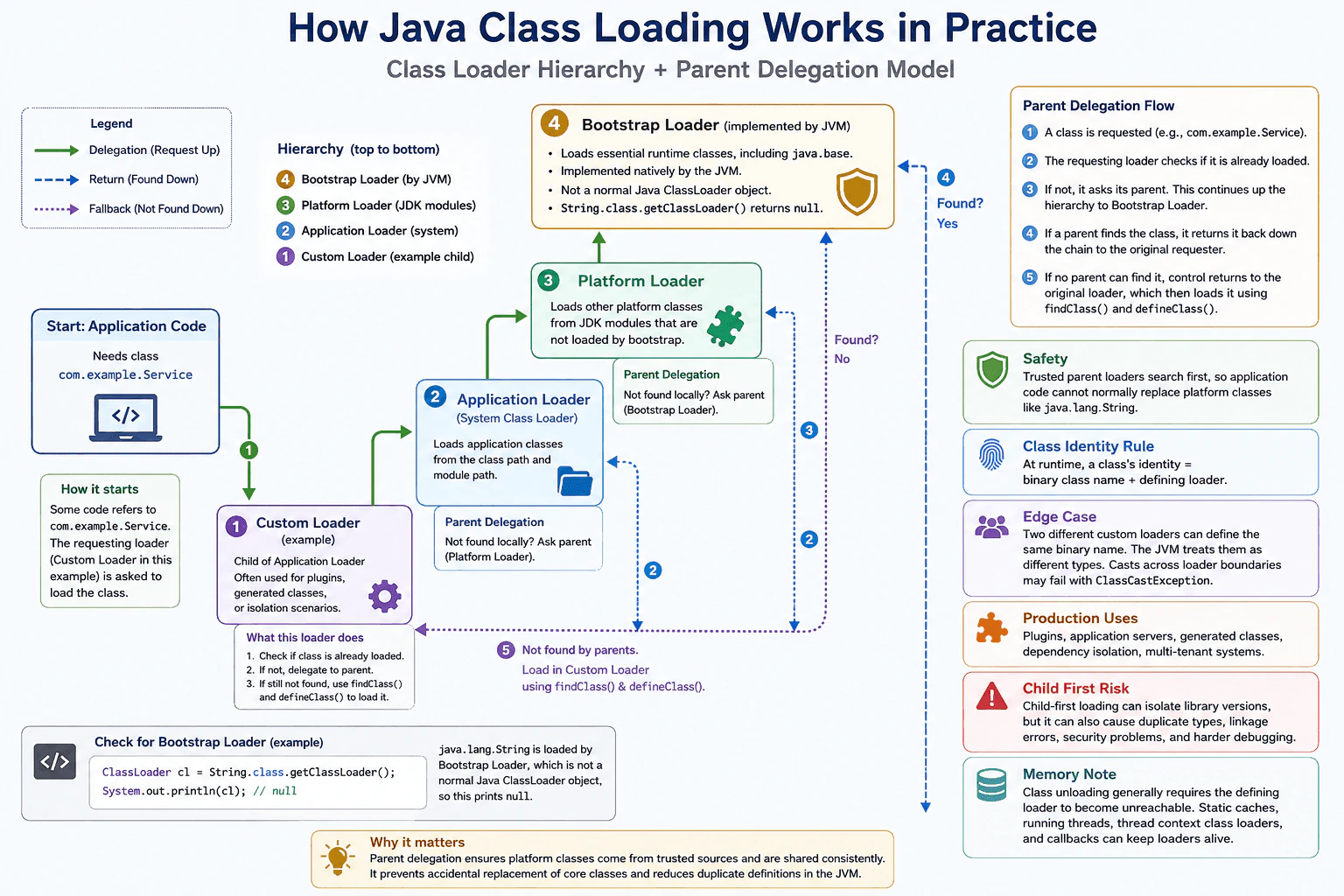
Java normally uses parent first class loading. The bootstrap loader loads essential Java runtime classes. The platform loader loads other platform classes. The application loader loads normal application classes. A loader usually checks whether the class is already loaded, asks its parent, and only then tries to find the class itself. This protects core Java classes and keeps shared types consistent. An important detail is that a class is identified by both its binary name and the loader that defined it.
Detailed Explanation
Java needs a safe and consistent way to find the code used to create objects and run a program. It uses a chain of loaders. A loader normally asks a more trusted loader to search first. This prevents application code from replacing important Java classes with different files that use the same names. It also helps different parts of a program agree on what each class means. Custom systems can change parts of this behavior for isolation, but they must do so carefully.
Useful Questions to Ask the Interviewer
Should I explain only the standard loaders in a normal Java application?
Should I also cover custom loaders used by plugins and application servers?
Should I explain class identity, unloading, and common production failures?
How to Explain It in an Interview
The practical rule is parent first delegation. The default ClassLoader loadClass method first checks whether the requested class was already loaded. It then asks the parent loader to load the class. If there is no Java parent loader, the request is passed to the bootstrap loading mechanism. Only when the parent side cannot find the class does the current loader call its own findClass logic.
The bootstrap loader is the root. It is implemented by the JVM and loads essential runtime classes, including classes from the java.base module. It is not represented by a normal ClassLoader object, so Class.getClassLoader can return null for a class defined by the bootstrap loader.
The platform loader is below the bootstrap loader. It loads Java platform classes that are not defined by the bootstrap loader. The application loader, also called the system class loader in a typical launch, is below the platform loader. It loads application classes from the configured class path and module path.
Delegation matters for safety and consistency. An application cannot normally replace java.lang.String with its own definition because the trusted bootstrap mechanism finds the platform class first. Delegation also reduces accidental duplicate definitions of shared classes.
A runtime class is identified by its binary name and its defining loader. Two custom loaders can therefore define classes with the same name, but the JVM treats them as different types. Passing objects across those loader boundaries can cause ClassCastException even when the printed names look identical.
Custom loaders are useful for plugins, application servers, generated classes, and dependency isolation. Some systems use child first lookup for selected classes. That can isolate library versions, but it can also create duplicate types, linkage errors, security problems, and difficult debugging.
Class unloading is tied to the defining loader. Classes can generally become eligible for unloading only when their loader and all reachable classes, objects, and related metadata are no longer reachable. Static caches, running threads, thread context class loaders, callbacks, and library registries can keep an old loader alive and cause a class loader leak.
Why Interviewers Ask This
Interviewers ask this question to check whether the candidate understands how the JVM locates and defines classes, why trusted platform classes are loaded before application classes, and how defining loaders affect type identity. It also tests production judgment about custom loaders, plugin isolation, dependency conflicts, class loading failures, and class loader leaks.
Common interview mistakes
A common mistake is saying that every loader searches its own files before asking its parent. The default ClassLoader behavior normally delegates first. Another mistake is treating the bootstrap loader as a normal Java ClassLoader object instead of a JVM provided loading mechanism that appears as null through some APIs. Candidates also forget that type identity includes the defining loader, not only the class name. Other mistakes include assuming every custom loader must follow parent first delegation, using child first lookup for shared interfaces, confusing ClassNotFoundException with NoClassDefFoundError, and retaining old loaders through threads, static caches, callbacks, or thread context class loaders.
Interview tip
Start with the parent first rule. Then name the bootstrap, platform, and application loaders in order. Explain that delegation protects trusted platform classes and keeps shared type definitions consistent. Finish with the key production detail that the binary class name and defining loader together determine runtime type identity.
Interviewer may ask next
Can two class loaders define classes with the same binary name, and are those classes compatible?
Yes, two different defining loaders can define classes with the same binary name, but the JVM treats them as different runtime types. The exact behavior is that runtime type identity contains both the binary name and the defining loader. This matters because an object created from one definition cannot normally be cast to the other definition, even when both class files contain equivalent code. The main tradeoff is that loader isolation supports separate dependency versions, but shared interfaces and object exchange must use types visible from a common parent loader.
Why might a plugin system use child first loading instead of normal parent delegation?
A plugin system may use child first loading so a plugin can load its own dependency version before using a version visible from its parent. The exact change is that the plugin loader searches selected local classes before delegating those names. This matters for dependency isolation, but it increases the risk of duplicate types, linkage failures, unsafe replacement of shared classes, and class loader leaks. Core Java classes and shared application contracts should normally remain controlled by trusted parent loaders.
More questions load as you scroll
Disclaimer: This interview guide is for educational and informational purposes only. It is designed to help readers prepare, but it does not guarantee any interview result, hiring decision, offer, or outcome. Interview questions, hiring criteria, and preferred answers can vary by employer, interviewer, industry, location, and time. All answers, examples, and explanations in this guide are suggested examples for interview preparation, not definitive answers or instructions for professional practice. They are based on research and judgment, are provided without warranties of any kind, and should be adapted to the question, role, and applicable laws and professional requirements. Diagrams are simplified illustrations intended to highlight the main concepts and their relationships; actual situations, systems, and practices may be more complex. Alternative approaches may be equally valid or better suited to a particular question, context, or interviewer. To the fullest extent permitted by applicable law, the contributors and publisher are not liable for decisions made, actions taken, or losses incurred based on this guide.
State Laws and Professional Responsibilities: Laws and requirements governing an occupation vary by state and jurisdiction. You are responsible for checking the current laws, licensing requirements, and scope-of-practice rules that apply to your location and role, and for ensuring that your answers and actions comply with them. Adapt examples in this guide to those requirements. This guide is not legal advice.
Content Accuracy and Verification: To the fullest extent permitted by applicable law, we do not represent or warrant that interview guides, questions, answers, examples, or diagrams are accurate, complete, current, error-free, or suitable for any particular purpose. You are responsible for independently reviewing and verifying the information before relying on it.