This interview guide is for educational and informational purposes only. It is designed to help readers prepare, but it does not guarantee any interview result, hiring decision, offer, or outcome. Interview questions, hiring criteria, and preferred answers can vary by employer, interviewer, industry, location, and time. All answers, examples, and explanations in this guide are suggested examples for interview preparation, not definitive answers or instructions for professional practice. They are based on research and judgment, are provided without warranties of any kind, and should be adapted to the question, role, and applicable laws and professional requirements. Diagrams are simplified illustrations intended to highlight the main concepts and their relationships; actual situations, systems, and practices may be more complex. Alternative approaches may be equally valid or better suited to a particular question, context, or interviewer. To the fullest extent permitted by applicable law, the contributors and publisher are not liable for decisions made, actions taken, or losses incurred based on this guide.
State Laws and Professional Responsibilities
Laws and requirements governing an occupation vary by state and jurisdiction. You are responsible for checking the current laws, licensing requirements, and scope-of-practice rules that apply to your location and role, and for ensuring that your answers and actions comply with them. Adapt examples in this guide to those requirements. This guide is not legal advice.
Identity, Image, and Privacy Notice
To respect individual privacy, some names, profile photographs, avatars, biographical details, and other identifying information displayed in this guide may be replaced with pseudonyms, licensed stock images, illustrative avatars, composite images, or representative descriptions. Unless a person is expressly identified as an actual contributor, a displayed name, image, or profile should not be understood as depicting or identifying a specific candidate, interviewer, employee, or other real individual. These representations are provided for editorial and illustrative purposes only and do not imply endorsement, employment, participation, or affiliation with this guide or any company mentioned in it. Any resemblance to an actual person is coincidental.
Company Notice
This guide is an independent educational resource and is not affiliated with, endorsed by, sponsored by, or approved by the company named in this guide. Company names identify reported interview experiences or the employer context of clearly labeled original practice exercises. Interview practices can change without notice, and inclusion of company-specific content does not mean these questions are official, complete, or guaranteed to be asked. To the fullest extent permitted by law, the author, contributors, and publisher are not responsible for outcomes related to use of this material.
Content Accuracy and Verification
To the fullest extent permitted by applicable law, we do not represent or warrant that interview guides, questions, answers, examples, or diagrams are accurate, complete, current, error-free, or suitable for any particular purpose. You are responsible for independently reviewing and verifying the information before relying on it.
Questions or comments?
Contact us for general questions, or share feedback, technical corrections, and comments with the community.
41. What are generics in Java, and why are they useful?Language SpecificMedium
i Question Details
Explain generics, type safety, and how generics improve reusable code.
Short Interview Answer (30-60 seconds)
Generics let me write a class, interface, or method that works with different reference types while the compiler checks the chosen type. For example, List<String> accepts strings and returns strings, so I do not need an unsafe cast. Generics make code reusable, make APIs clearer, and catch many type errors before the program runs. Java implements most generic typing through erasure, so parameterized types usually do not remain distinct runtime types.
Generics let one piece of Java code work safely with different kinds of objects. The caller chooses what kind of object the code should hold, return, or process. The compiler then checks that the code uses that kind consistently. This prevents many mistakes before the program starts. It also removes many manual conversions when values are read from collections. Generics are useful when the same behavior should work for customers, orders, messages, or other object types without copying the implementation for every type.
Useful Questions to Ask the Interviewer
Should I explain generic classes, generic methods, or both?
Should I cover bounds and wildcards?
Should I explain type erasure and runtime limitations?
How to Explain It in an Interview
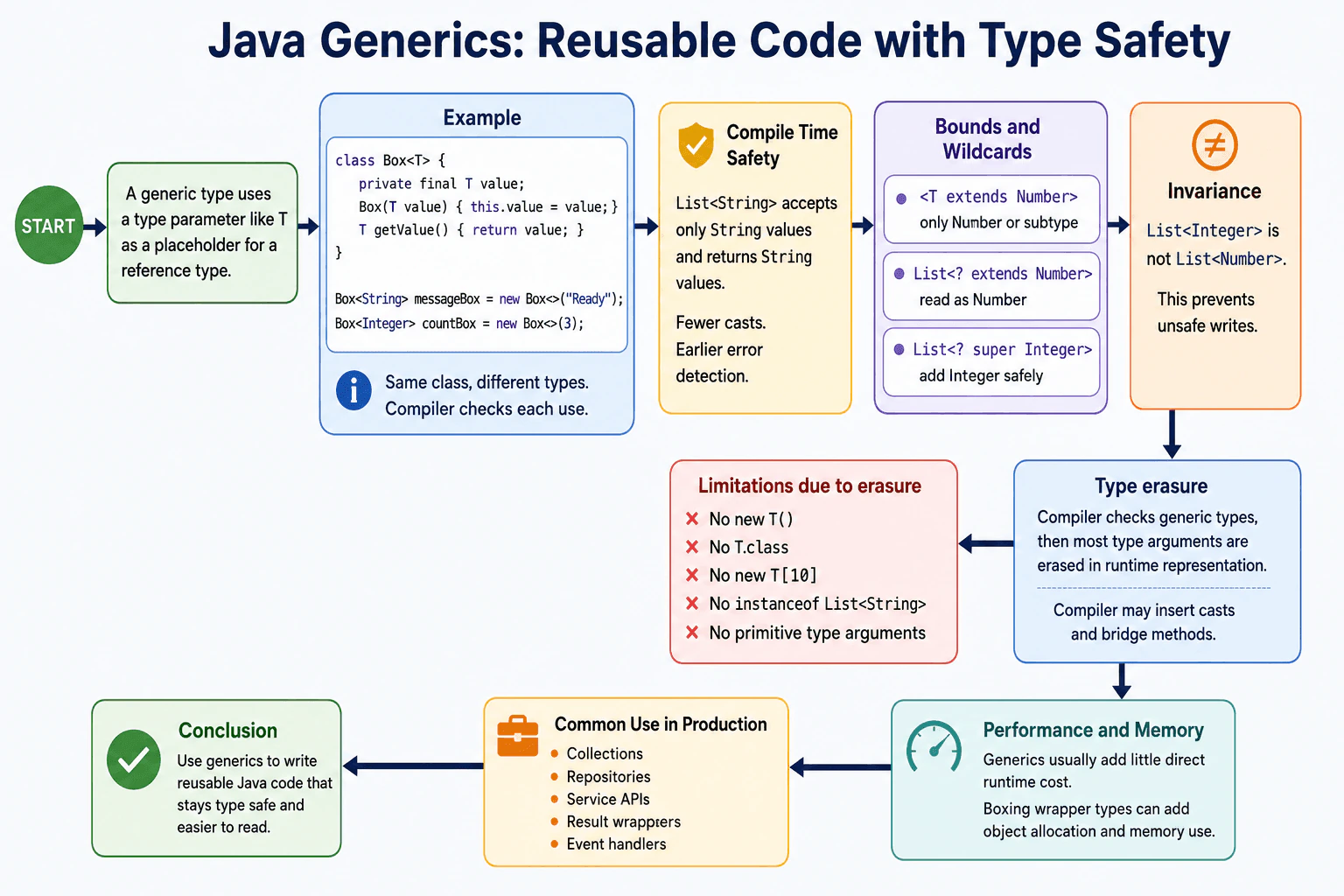
A generic declaration uses a type parameter as a placeholder for a reference type. For example, Box<T> declares T as the type stored by the box. Box<String> stores and returns a String. Box<Integer> uses the same class with Integer. The compiler checks each use, so the code remains reusable without losing type safety.
Generics are checked mainly during compilation. The compiler rejects adding an Integer to a List<String>. It also knows that reading from that list returns a String, so an explicit cast is unnecessary.
A bound restricts which types are accepted. The declaration <T extends Number> accepts Number and its subtypes. Wildcards make method parameters more flexible. List<? extends Number> is useful when a method reads values as Number. List<? super Integer> is useful when a method adds Integer values. List<?> represents a list whose exact element type is unknown.
Java generic types are invariant. List<Integer> is not a subtype of List<Number>, even though Integer is a subtype of Number. Allowing that assignment would make unsafe writes possible.
Java implements generics mainly with type erasure. The compiler verifies type arguments and then erases most of them from the generated runtime representation. It can insert casts and create bridge methods when needed to preserve type behavior. Because of erasure, code cannot use new T(), T.class, new T[10], or instanceof List<String>. Primitive types cannot be type arguments, so wrapper types such as Integer are required.
Generics themselves normally add little runtime or memory cost because objects do not usually store separate metadata for each type argument. Inserted casts and bridge methods have negligible cost in ordinary code. Using wrapper types for primitive values can cause boxing, object allocation, and additional memory use. In production, generics are common in collections, repositories, result wrappers, event handlers, and reusable service APIs.
Interviewers ask this question to check whether a candidate understands compile time type safety and reusable Java APIs. They also want to see whether the candidate can explain type parameters, bounds, wildcards, invariance, and type erasure. A strong answer shows practical judgment about preventing unsafe casts, designing flexible method signatures, and recognizing which generic type information is unavailable at runtime.
Common interview mistakes
A common mistake is assuming that List<Integer> can be assigned to List<Number>. Generic types are invariant, so that assignment is not allowed. Another mistake is using raw types such as List instead of List<String>. Raw types remove useful compiler checks and can lead to ClassCastException at runtime. Candidates also assume that List<? extends Number> safely accepts Number values. The exact element type is unknown, so adding any non null value is not type safe. Other mistakes include expecting all generic type arguments to be available at runtime, trying to use primitive type arguments, creating new T(), creating arrays of T, or testing instanceof with a parameterized type.
Interview tip
Start with the practical benefit. Say that generics provide reusable code with compile time type safety and fewer casts. Give a simple List<String> or Box<T> example. Then explain invariance, bounds, wildcards, and type erasure as the main rules and limitations. Connect each rule to how it prevents unsafe reads or writes.
Interviewer may ask next
Why can Java not create new T() or test whether an object is an instance of List<String>?
Java cannot perform those operations because most generic type arguments are erased from the runtime representation. The compiler knows T and List<String> while checking the source, but the runtime usually sees the erased class, such as Object or List. It therefore lacks enough concrete type information to choose a constructor for T or distinguish List<String> from List<Integer>. This matters when code requires runtime type information. A common solution is to pass a Class<T>, a constructor function, a factory, or another explicit type token. The tradeoff is a more complex API and added responsibility for the caller.
When should a method use ? extends T and when should it use ? super T?
Use ? extends T when the method mainly reads values as T. Use ? super T when the method needs to add T values. For example, List<? extends Number> can refer to List<Integer> or List<Double>, so values can be read as Number, but adding a Number is unsafe because the exact element type is unknown. List<? super Integer> can safely accept Integer values, but values read from it are only guaranteed to be Object. This tradeoff makes APIs more flexible while preserving type safety.
42. What is a lambda expression in Java?Language SpecificMedium
i Question Details
Explain lambda expressions, functional interfaces, and why lambdas make code shorter.
Short Interview Answer (30-60 seconds)
A lambda expression is a concise way to provide the behavior required by a functional interface. I write parameters, an arrow, and a body instead of declaring a separate class. Java uses the target functional interface to infer the parameter and return types. Lambdas are useful for callbacks, collection operations, event handling, and task submission, but I keep them small and avoid depending on their object identity or allocation behavior.
A lambda expression lets a Java program pass a small action to another method without declaring a separate named class. It is useful when code needs one clear action, such as comparing names, processing every item, testing a value, or running a task. The shorter form removes repeated class setup and keeps simple behavior near the place where it is used. To use it correctly, we must know what information the action receives, what result it returns, and which interface describes that action.
Useful Questions to Ask the Interviewer
Which functional interface should the lambda implement?
Does the lambda need to capture any value from the surrounding method?
Would a method reference or named method make the behavior clearer?
How to Explain It in an Interview
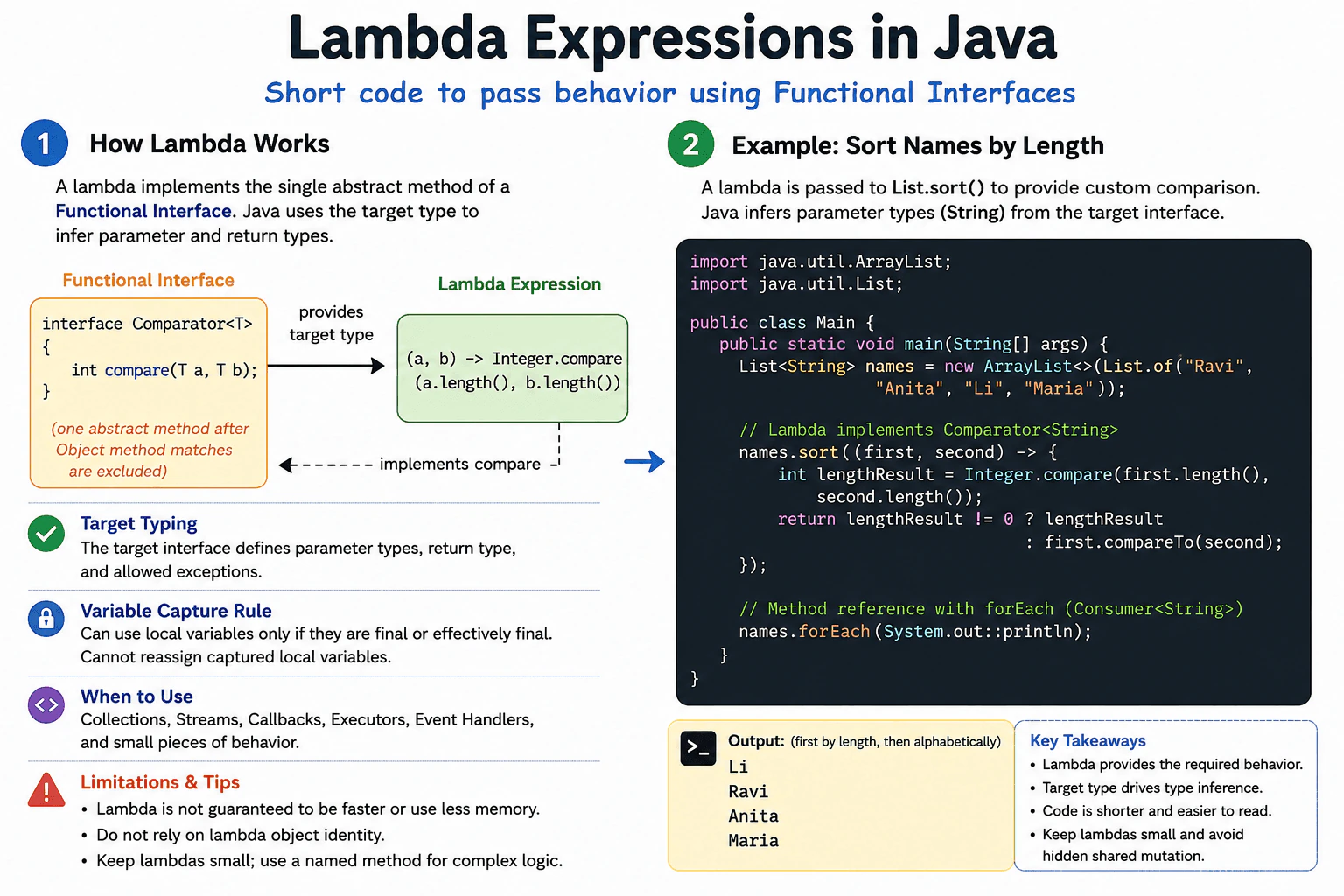
A lambda expression provides an implementation of the single abstract method of a functional interface. A functional interface has one abstract method after methods matching public methods of Object are excluded. It may also contain default, static, or private methods. Common examples are Runnable, Comparator, Predicate, Function, and Consumer.
The main syntax is (parameters) -> expression or (parameters) -> { statements; }. For example, name -> name.length() receives a name and returns its length. A lambda needs a target type. The target functional interface tells Java the expected parameter types, return type, and allowed checked exceptions. Java can often infer the parameter types from that context.
A lambda may capture a local variable from its surrounding method only when that variable is final or effectively final. Effectively final means the variable is assigned once and is not reassigned. The captured value is the value available when the lambda is created. A lambda may access fields and may change a captured mutable object's contents, but shared mutation can reduce clarity and create thread safety problems.
Lambdas are commonly used with collection methods, streams, callbacks, executors, and event handlers. A method reference such as System.out::println can be clearer when the lambda only calls an existing method.
Lambdas should remain small and focused. Complex conditions, many side effects, or extensive exception handling usually belong in a named method. Code must not rely on lambda object identity because Java does not guarantee whether a lambda instance is reused or newly created. Runtime allocation and optimization are implementation details, so performance and memory use should be measured when they matter.
Interviewers ask this question to check whether a candidate understands how Java represents small units of behavior. They also evaluate knowledge of functional interfaces, target typing, variable capture, method references, runtime allocation limits, and the judgment needed to keep lambda based code readable in production.
Common interview mistakes
Common mistakes include assuming any interface can be used as a lambda target, forgetting that the target must be a functional interface, and writing parameter or return types that do not match its abstract method. Candidates may also try to reassign a captured local variable, confuse changing an object's contents with reassigning the local reference, or assume a lambda is identical to an anonymous class in every detail. Other mistakes include depending on lambda object identity, hiding important side effects, ignoring checked exception rules, and using large lambdas that are difficult to read or test.
Interview tip
Begin by saying that a lambda supplies the single abstract method of a functional interface. Show the parameter, arrow, and body syntax. Then mention target type inference, effectively final local variable capture, one practical use, and the rule that complex behavior should usually move into a named method.
Interviewer may ask next
Can a Java lambda modify a local variable declared outside the lambda?
No, a lambda cannot reassign a captured local variable. The local variable must be final or effectively final, meaning it is assigned once and not reassigned. Java captures its value when the lambda is created. The lambda may change the contents of a captured mutable object, but that is different from reassigning the local reference. This matters because hidden shared mutation can make behavior harder to understand and can cause thread safety problems when the lambda runs concurrently.
Are lambda expressions always faster or more memory efficient than anonymous classes?
No, a lambda is not guaranteed to be faster or to allocate less memory. Java normally links lambda behavior through the invokedynamic instruction, and the runtime may reuse an instance, create an instance, inline the call, or apply other optimizations. Capturing lambdas may require an object that stores captured values, while a stateless lambda may be reusable, but neither behavior should be assumed by application code. Lambdas mainly reduce source code ceremony. Performance and memory use should be measured in the real workload when they are important.
43. What is the Stream API in Java 8?Language SpecificMedium
i Question Details
Explain the Stream API, its pipeline model, and how it is used to process collections.
Short Interview Answer (30-60 seconds)
The Stream API is a JDK feature introduced in Java 8 for processing sequences of values through a pipeline. A stream reads elements from a source, applies lazy intermediate operations such as filter and map, and begins processing when a terminal operation such as collect, count, or reduce runs. A stream does not store data, and this kind of pipeline does not change the source collection unless the code performs explicit side effects. I use streams when they make data processing clear and avoid them when a loop expresses complex control flow more clearly.
The Stream API gives Java 8 a clear way to process values from a collection without writing every loop by hand. A developer describes the steps, such as keeping some items, changing them, sorting them, and collecting the result. Java passes the values through those steps when a final result is requested. The stream does not hold its own permanent data, and the original collection is not changed by this example. This approach is useful when the processing steps are simple and easy to read.
Useful Questions to Ask the Interviewer
Must the result preserve the source encounter order?
Can the source contain null values?
Is the source held in memory or backed by a resource that must be closed?
Is parallel processing being considered, and has it been measured?
How to Explain It in an Interview
A stream is a sequence of elements for processing. It is not a collection and does not store elements. It reads them from a source such as a List, an array, or a file.
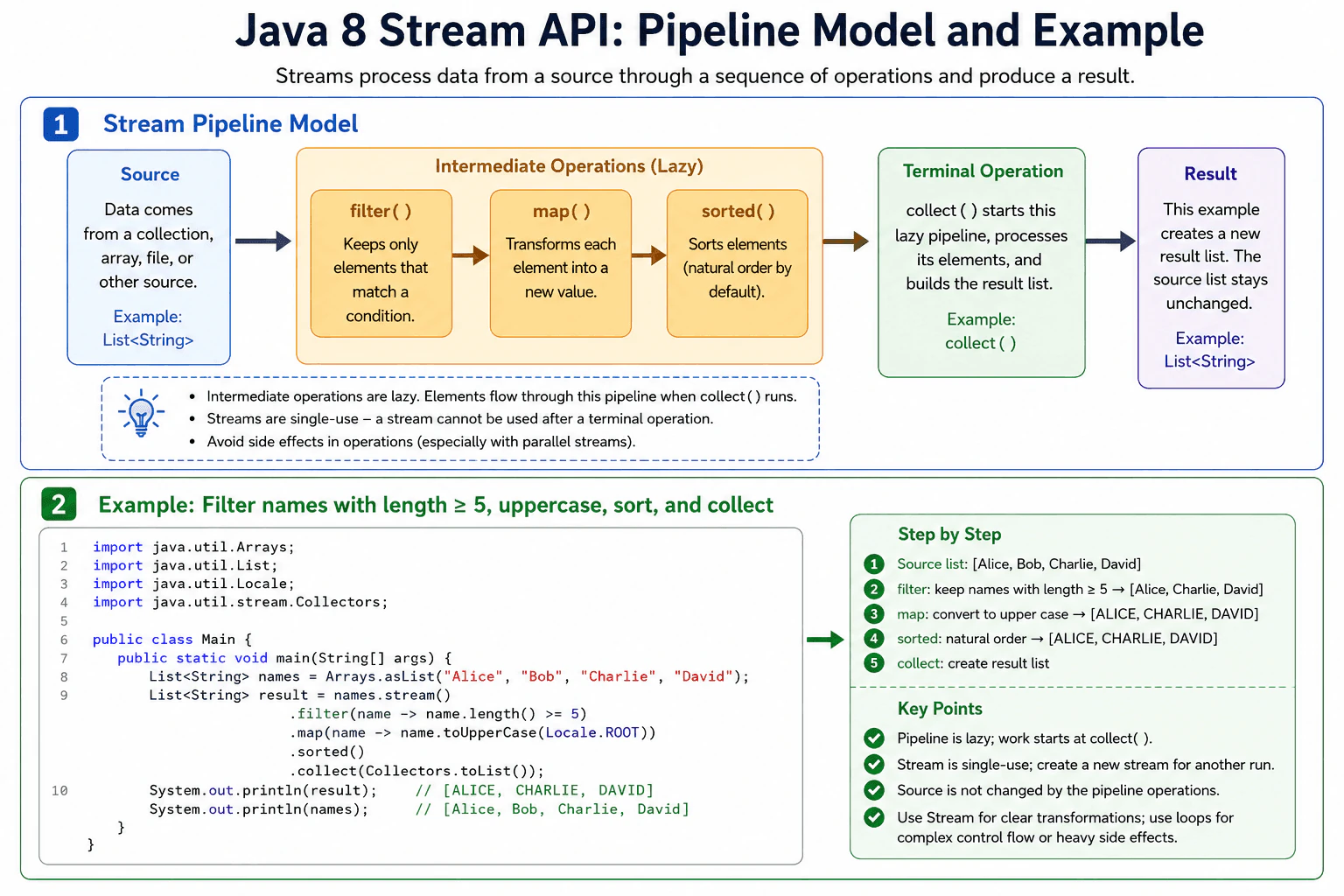
A stream pipeline contains a source, zero or more intermediate operations, and a terminal operation. Intermediate operations such as filter, map, distinct, and sorted return another stream. They are lazy, which means they normally do no element processing until a terminal operation starts the pipeline. Terminal operations include collect, count, reduce, and forEach.
In the example, filter keeps names with at least five characters. map creates uppercase strings. sorted places them in natural order. collect starts the pipeline and creates the result list. The output is [ALICE, CHARLIE, DAVID], and the source list remains unchanged.
A stream is single use. After a terminal operation, it must not be used again. Stream operations should also avoid modifying shared mutable data. Such side effects make pipelines difficult to understand and can become unsafe during parallel execution.
Streams work well for filtering, transformation, grouping, sorting, and aggregation. A loop is often clearer for complex state changes, checked exception handling, or control flow that needs break or continue. Parallel streams are not automatically faster because task splitting, coordination, ordering, and result combination add overhead.
Interviewers ask this question to check whether a candidate understands declarative collection processing in Java. They want the candidate to explain stream sources, lazy intermediate operations, terminal operations, encounter order, single use behavior, side effects, and the difference between a stream and a collection. They also evaluate whether the candidate can choose between streams and loops and can discuss performance and production tradeoffs.
Common interview mistakes
Common mistakes include treating a stream as stored data, assuming intermediate operations run immediately, trying to reuse a stream after a terminal operation, and expecting the source collection to change automatically. Other mistakes include putting shared mutable side effects inside map, filter, or forEach, assuming parallelStream always improves performance, ignoring encounter order, and forgetting to close a resource backed stream. Developers should also not assume that Collectors.toList returns a specific list implementation or guarantees mutability.
Interview tip
Explain the pipeline in this order: source, lazy intermediate operations, terminal operation, and result. State that a stream does not store elements, is single use, and should normally avoid shared mutable side effects. Then mention one situation where a loop is clearer and explain why parallel execution must be measured instead of assumed to be faster.
Interviewer may ask next
What happens if the same stream is used after a terminal operation?
The stream must not be reused. A terminal operation consumes the pipeline, and another operation on that stream object normally throws IllegalStateException. This matters because a stream represents one traversal rather than reusable stored data. A new stream must be created from the original source when another traversal is required.
When should a parallel stream be used instead of a sequential stream?
A parallel stream should be used only when measurement shows a real benefit for a sufficiently large, easily divided, CPU bound workload. Parallel streams normally use the common ForkJoinPool, and task splitting, scheduling, ordering, and combining results add overhead. They can perform worse for small inputs, blocking work, expensive coordination, or pipelines with shared mutable state. A sequential stream is the safer default for most application code.
44. What is Optional used for?Language SpecificMedium
i Question Details
Explain Optional and how it can reduce null-related bugs without being overused.
Short Interview Answer (30-60 seconds)
Optional is used mainly as a method return type when a result may be present or absent. It makes the missing case visible in the API instead of returning an unexpected null. I normally handle it with methods such as map, orElse, orElseGet, orElseThrow, and ifPresent. I avoid calling get unless presence has already been proved, and I do not use Optional for every nullable value.
Optional is a Java container that tells the caller that a result may exist or may be missing. It helps a method communicate that absence clearly instead of quietly returning null. The caller must then decide what to do, such as use another value, run different work, or report an error. This can reduce bugs caused by forgotten null checks. Optional is most useful when no result is a normal outcome. It should not replace every value that might be missing, because that can make code harder to read.
Useful Questions to Ask the Interviewer
Is a missing result expected, or should it be treated as an error?
Would an empty collection communicate the result better than Optional?
Does creating the fallback value require expensive work or cause side effects?
How to Explain It in an Interview
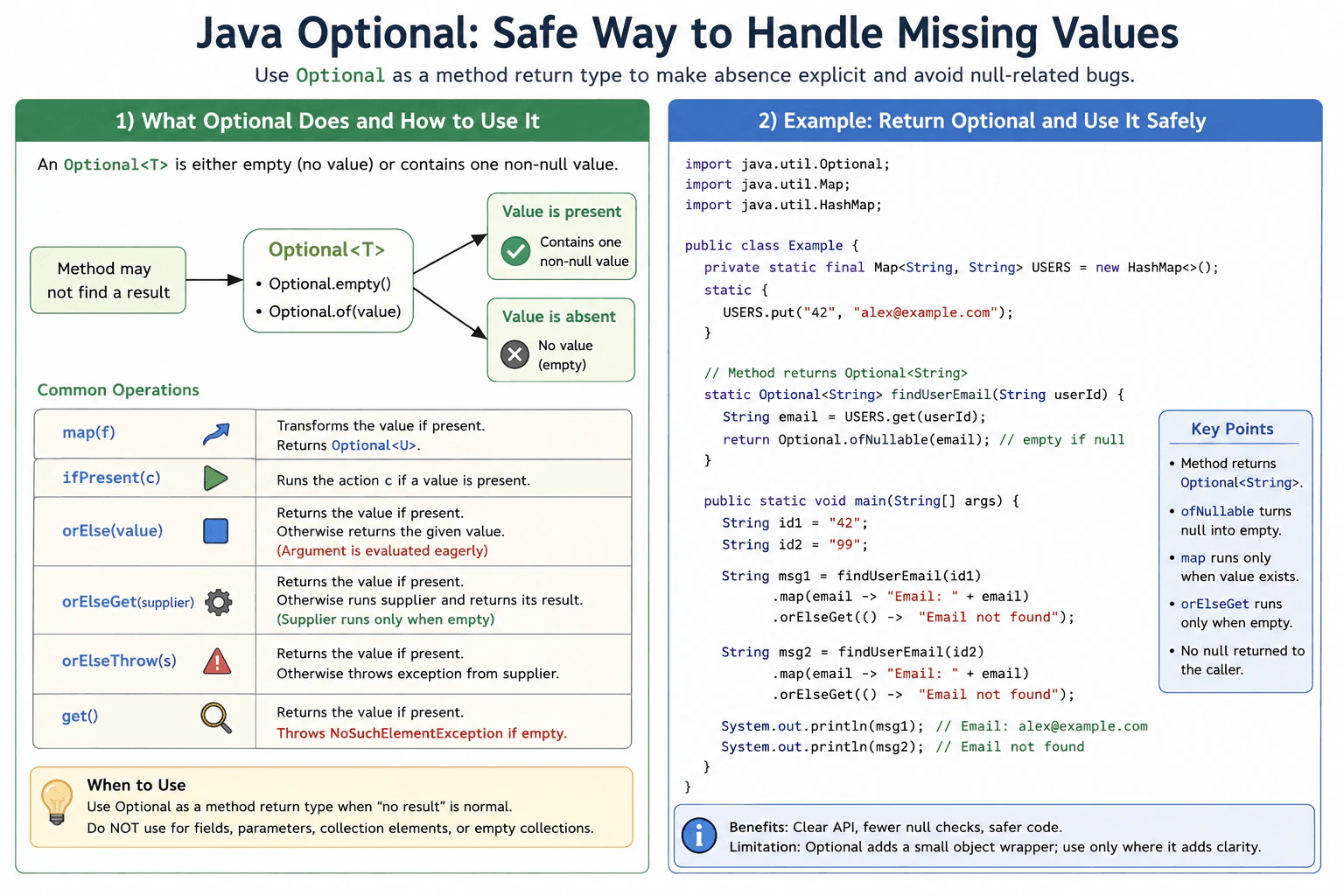
Optional<T> is a final JDK class that represents either an empty result or one non null value of type T. It is mainly intended for method return types when a method may legitimately have no result. For example, findUserEmail can return Optional<String> when an unknown user has no email result.
Use Optional.of when the supplied value must not be null. It throws NullPointerException when given null. Use Optional.ofNullable when the value may be null. It returns an empty Optional for null. Use Optional.empty to represent absence directly.
The caller can use map to transform a present value, ifPresent to perform an action, orElse to provide an already available fallback, orElseGet to create a fallback only when the Optional is empty, and orElseThrow when absence should become an exception. The fallback expression passed to orElse is evaluated before orElse runs, even when a value is present. The supplier passed to orElseGet runs only when the Optional is empty.
Calling get on an empty Optional throws NoSuchElementException. Safer operations usually make the empty case clearer. Optional should not normally wrap a collection merely to represent no elements, because an empty collection already communicates that state. It is also usually unnecessary for method parameters, object fields, or collection elements unless an API has a specific reason.
A present Optional commonly requires a wrapper object, although the JVM may remove some allocations through optimization. Code must not depend on Optional object identity, compare Optional instances with reference equality, or use them as synchronization locks because Optional is a value based class.
Interviewers ask this question to check whether a candidate understands how Java represents an expected missing result. They also evaluate whether the candidate can choose safe Optional operations, explain eager and lazy fallback behavior, and avoid using Optional where a simpler type communicates the result more clearly.
Common interview mistakes
Common mistakes include returning null from a method declared to return Optional, calling Optional.of with a value that may be null, and calling get without proving that a value is present. Another mistake is using orElse for expensive fallback work and assuming that the work runs only when the Optional is empty. Developers may also use Optional for fields, parameters, collection elements, or empty collections without a clear API benefit. Code should not compare Optional objects with reference equality or rely on Optional.empty returning the same object instance.
Interview tip
Start by saying that Optional makes an expected missing return value explicit. Then explain present and empty states, show one safe handling method, mention that orElse evaluates its fallback eagerly while orElseGet evaluates its supplier only when needed, and finish by explaining that Optional should not replace every nullable value.
Interviewer may ask next
What happens when get is called on an empty Optional?
It throws NoSuchElementException. This behavior matters because get does not safely handle absence. The caller should normally use operations such as orElse, orElseGet, orElseThrow, map, or ifPresent, or prove that a value is present before calling get. The tradeoff is that get is concise, but it can hide unsafe assumptions about the empty case.
What is the difference between orElse and orElseGet?
orElse receives a fallback value whose expression is evaluated before the method runs, even when the Optional contains a value. orElseGet receives a supplier that runs only when the Optional is empty. This matters when fallback creation is expensive or has side effects. Use orElse for a simple value that already exists, and use orElseGet when fallback work should be delayed.
45. What is serialization and deserialization?Language SpecificMedium
i Question Details
Explain how objects are converted to bytes and restored back in Java.
Short Interview Answer (30-60 seconds)
Serialization converts a Java object and the reachable serializable objects it refers to into bytes. Deserialization reads those bytes and rebuilds the object graph. Java provides ObjectOutputStream and ObjectInputStream for this when the classes implement Serializable. I would use native Java serialization only for trusted and controlled Java data. I would not use it for untrusted input, public APIs, or long term shared data because of security and compatibility risks.
Serialization means turning the saved information inside an object into bytes. The bytes can be written to a file, stored for a short time, or sent somewhere else. Deserialization performs the reverse action. It reads the bytes and rebuilds the saved objects and their connections. In Java, only supported objects can be saved this way. The process needs care because changing a class may make older saved information incompatible. Reading data from an unsafe source can also cause harmful code to run during restoration.
Useful Questions to Ask the Interviewer
Can an outside user provide the serialized data?
Must old saved data work after future class changes?
Is native Java serialization required, or can we use another data format?
How to Explain It in an Interview
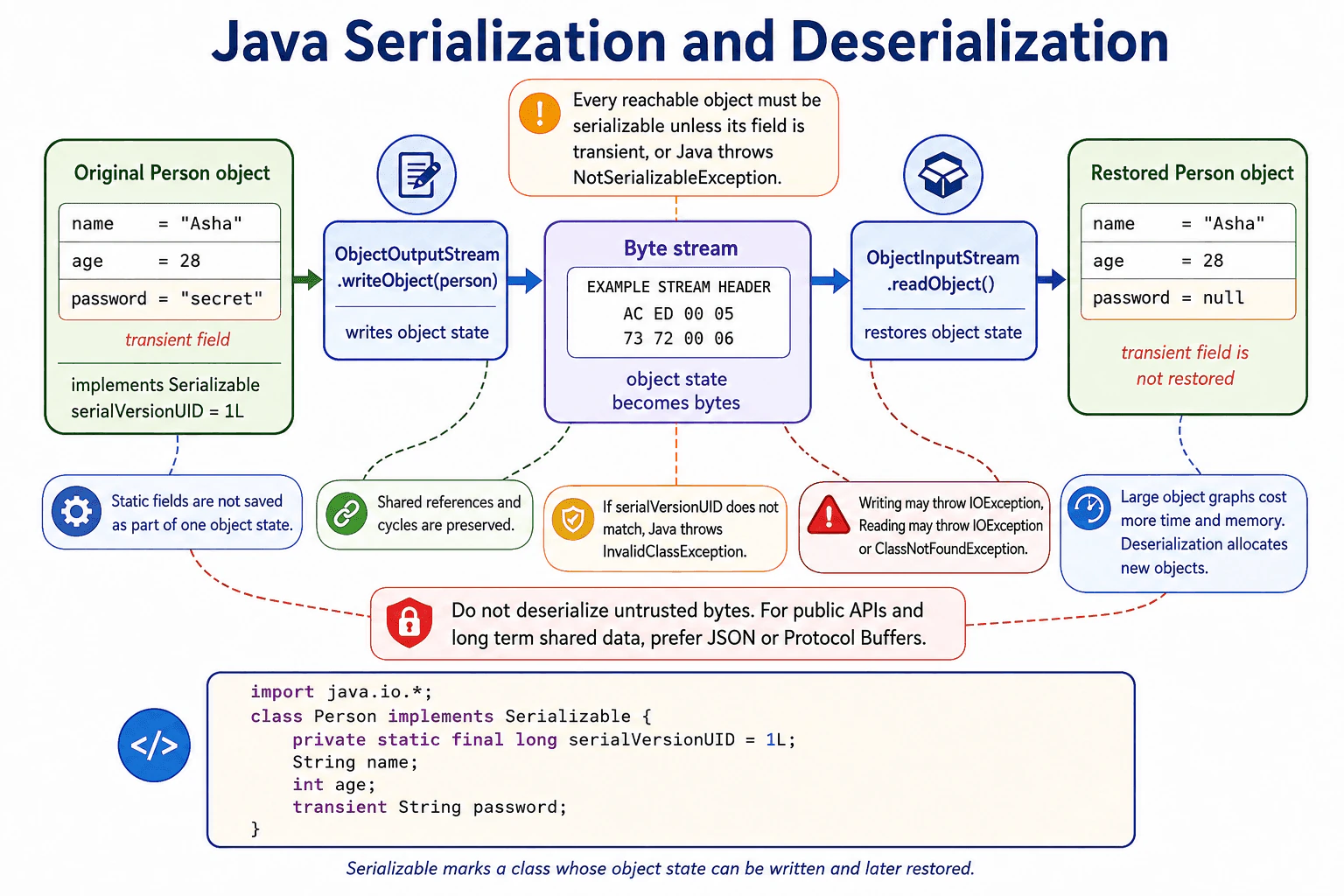
Native Java serialization uses the Serializable marker interface. It has no methods. It tells ObjectOutputStream that objects of the class may be written. The stream saves instance field values and follows references to reachable objects. Every reachable object must also be serializable unless its field is marked transient. Static fields belong to the class rather than one object, so they are not saved as part of the object state.
The stream tracks objects it has already visited. This preserves shared references and allows cyclic object graphs to be written without endlessly following the same references.
Deserialization uses ObjectInputStream. It reads class information and field values, allocates objects, restores their state, and reconnects references. Constructors of serializable classes are not normally called during this process. The no argument constructor of the first nonserializable superclass is called. Restoration hooks such as readObject and readResolve may also run.
A serializable class should declare an explicit serialVersionUID. During deserialization, Java compares the saved value with the value in the current class. A mismatch causes InvalidClassException. Keeping the same value does not make every class change compatible. Changes to field types, inheritance, or custom restoration logic can still fail or restore incomplete state.
Use try with resources to close streams. Writing can throw IOException. Reading can throw IOException or ClassNotFoundException. Work and memory use grow with the number of objects visited and the number of bytes processed. Serialization keeps tracking information for visited objects. Deserialization allocates the restored objects, arrays, strings, and supporting data, so a large or hostile stream can consume significant memory.
Never deserialize untrusted bytes with unrestricted ObjectInputStream. When native serialization cannot be avoided, use trusted sources, strict class controls, ObjectInputFilter limits, size limits, and tests for old data. For public APIs, queues, databases, and long term storage, explicit formats such as JSON, Avro, or Protocol Buffers are usually easier to validate, version, and share.
Interviewers ask this question to check whether a candidate understands how Java saves and restores object state. They also evaluate knowledge of object graphs, serialVersionUID, transient fields, class compatibility, resource handling, security risks, and the judgment needed to choose a safer data format for production systems.
Common interview mistakes
Common mistakes include implementing Serializable only on the root class while a reachable object is not serializable, assuming transient fields keep their original values, relying on an automatically generated serialVersionUID, and changing a class without testing older serialized data. Developers may also expect serializable class constructors to run during restoration, assume serialization encrypts data, forget to close streams, cast the restored object to the wrong type, or expect static fields to be restored. The most serious mistake is deserializing untrusted bytes without strict filtering and limits.
Interview tip
Begin with the conversion in both directions. Then explain Serializable, ObjectOutputStream, ObjectInputStream, and the reachable object graph. Mention transient and static fields, serialVersionUID, constructor behavior, compatibility limits, memory allocation, and the danger of untrusted deserialization. Finish by explaining when an explicit data format is a better production choice.
Interviewer may ask next
What happens if an object references a field whose value is not serializable?
Serialization fails with NotSerializableException when ObjectOutputStream reaches that nonserializable object in the reachable graph. Implementing Serializable on only the root class is not enough. Every reachable value that must be saved must also support serialization. Marking the field transient prevents that value from being written, but the restored field receives its default value. The tradeoff is that the skipped state must be recreated or accepted as lost.
Why are JSON or Protocol Buffers often preferred over native Java serialization in production?
They are often preferred because they represent explicit data rather than the internal structure of Java objects. This makes validation, versioning, inspection, and communication with other languages easier. Native Java serialization tightly couples saved bytes to Java classes and can execute restoration hooks during deserialization. It may still be convenient for trusted and short lived Java only data. The tradeoff is that explicit formats require mapping code, schemas, or generated classes.
46. How do you implement custom serialization safely?Language SpecificHard
i Question Details
Explain custom serialization, versioning concerns, and how to avoid breaking compatibility or security.
Short Interview Answer (30-60 seconds)
I use Java native serialization only for trusted data and only when compatibility with that format is required. I declare an explicit serialVersionUID, store only necessary state, validate every restored value in readObject, and reject invalid state with InvalidObjectException. I also apply a strict ObjectInputFilter before reading. For public or untrusted data, I prefer an explicit format such as JSON or Protocol Buffers.
This question asks how to save an object in a controlled form and rebuild it later without accepting bad data or breaking older saved data. The class may change after the data is written. A field may be added, removed, or given a new meaning. The saved input may also be damaged or harmful. A safe design must decide what information is stored, how older information is read, what values are allowed, and which sources are trusted.
Useful Questions to Ask the Interviewer
Must data written by older application versions still be readable?
Can the input come from users, files, messages, or another service?
Which fields are secrets, temporary values, or values that can be calculated again?
How to Explain It in an Interview
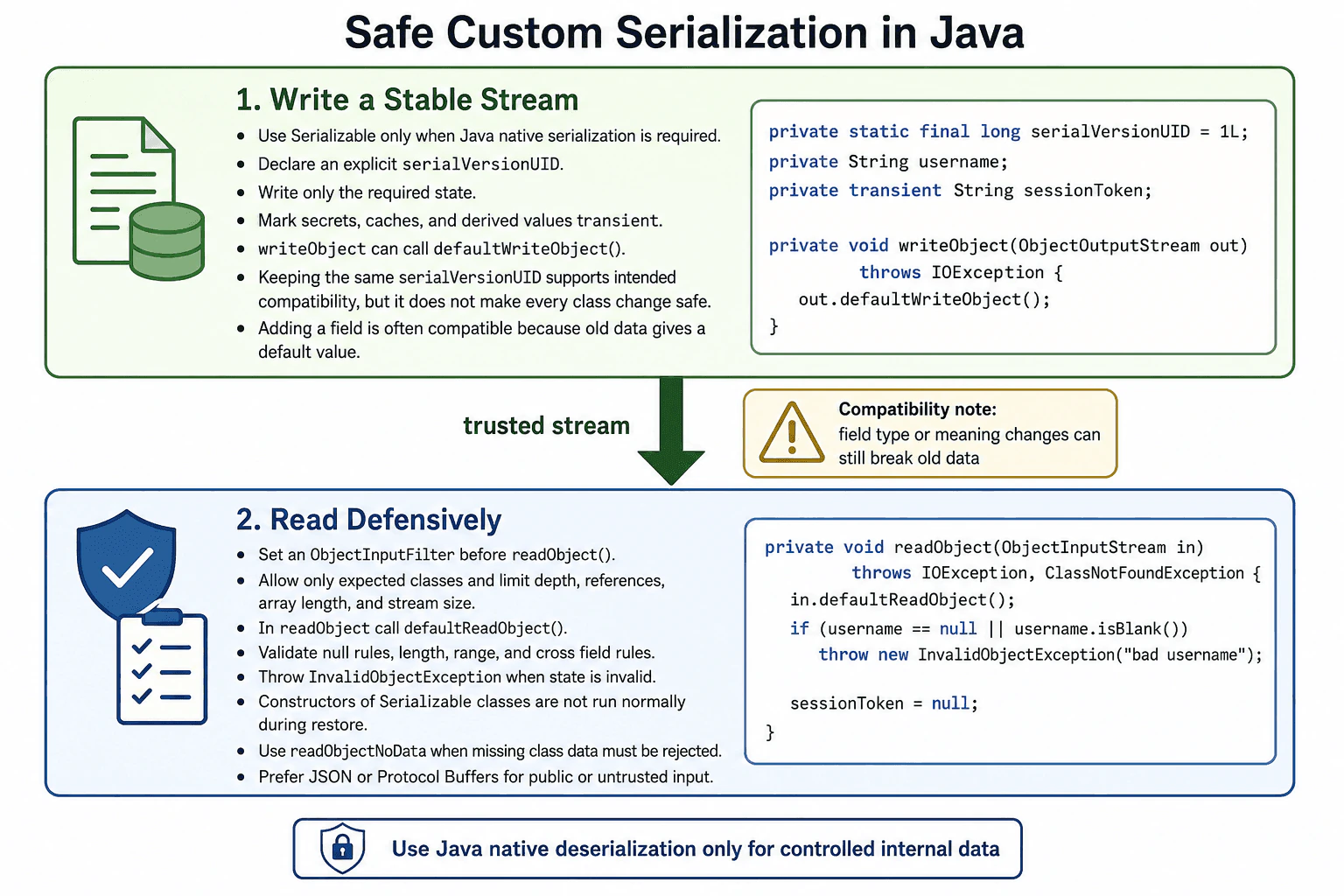
Java native serialization writes an object graph through ObjectOutputStream and restores it through ObjectInputStream. A participating class implements Serializable. Custom private writeObject and readObject methods let the class control this process.
Declare an explicit serialVersionUID. Java compares it with the value in the stream. A different value causes InvalidClassException. The same value is necessary for intended compatibility, but it does not make every class change safe. Adding a field is often compatible because old streams provide its default value. Changing a field type, changing the class hierarchy, or changing the meaning of stored data can still break behavior. When several stream versions must be supported, readObject can use GetField and explicit defaults.
Store only required state. Mark tokens, passwords, open resources, caches, and derived values as transient. In readObject, treat restored values as untrusted. Check null rules, size limits, ranges, and relationships between fields. Throw InvalidObjectException before the object is returned if any invariant fails. Constructors of Serializable classes are not run normally during restoration. The constructor of the first superclass that is not Serializable is run, so constructor validation alone is not enough.
Set a strict ObjectInputFilter before readObject. Limit classes, graph depth, reference count, array length, and stream size. This is defense in depth, not permission to read hostile data. Native deserialization can invoke class specific restoration behavior and build large graphs. Work and temporary memory generally grow with the number and size of restored objects. Shared references and cycles are preserved through stream handles, but very deep or very large graphs can still exhaust resources.
Use this approach for controlled internal compatibility or legacy data. Prefer an explicit external format for public interfaces and untrusted input.
Interviewers ask this to test whether a candidate understands Java object serialization, stream compatibility, object invariants, deserialization risks, and the production judgment needed to handle stored data without creating security or maintenance problems.
Common interview mistakes
Common mistakes are relying on an automatically calculated serialVersionUID, assuming the same serialVersionUID makes every class change compatible, writing secrets or live resources, trusting constructor validation, failing to validate cross field rules in readObject, allowing broad classes through ObjectInputFilter, and treating the filter as enough protection for hostile input.
Interview tip
Begin with the safety decision. Say that Java native deserialization is only for controlled data. Then explain serialVersionUID, minimal stored state, validation in readObject, strict filtering, compatibility tests, and when an explicit external format is the better choice.
Interviewer may ask next
Are constructors called normally when a Serializable object is restored?
No. Constructors of Serializable classes are not called in the normal way during restoration. Java initializes their fields from the stream, while the no argument constructor of the first superclass that is not Serializable is called. This matters because constructor checks do not protect the restored object, so readObject must validate every invariant and reject invalid state.
When is a serialization proxy safer than custom readObject and writeObject methods?
A serialization proxy is safer when a class has strong invariants, final fields, or a stored form that should not match its internal layout. writeReplace stores a small proxy, and readResolve rebuilds the real object through a validating constructor or factory. The tradeoff is extra code and another compatibility type, but it avoids partially restored objects and reduces dependence on private field layout.
47. What is multithreading in Java?Language SpecificEasy
i Question Details
Define a thread and multithreading in Java. Explain shared process memory, independent execution paths, creating work with Runnable or Callable, using executors instead of manually creating many threads, and the basic risks of race conditions, visibility problems, deadlocks, and unsafe shared mutable state.
Short Interview Answer (30-60 seconds)
Multithreading in Java means using multiple threads inside one Java process so different tasks can make progress independently. A thread is one path of execution. Threads in the same JVM can share heap objects, so shared mutable data needs careful coordination. I normally submit Runnable or Callable tasks to an executor instead of manually creating many platform threads. This makes execution management easier, but I still need to handle race conditions, visibility problems, deadlocks, interruption, and safe access to shared state.
Detailed Explanation
Multithreading lets one Java application make progress on more than one task at the same time. Each task can follow its own execution path while still belonging to the same running application. This is useful when a program must serve many requests, wait for outside work, or perform background jobs. The important point is that these tasks can use some of the same data. If two tasks change that data without proper control, the result can be wrong or unpredictable. Java provides standard tools to create, manage, and coordinate this work safely.
Useful Questions to Ask the Interviewer
Would you like me to focus on platform threads or also mention virtual threads?
Should I explain synchronization and shared state problems in more detail?
How to Explain It in an Interview
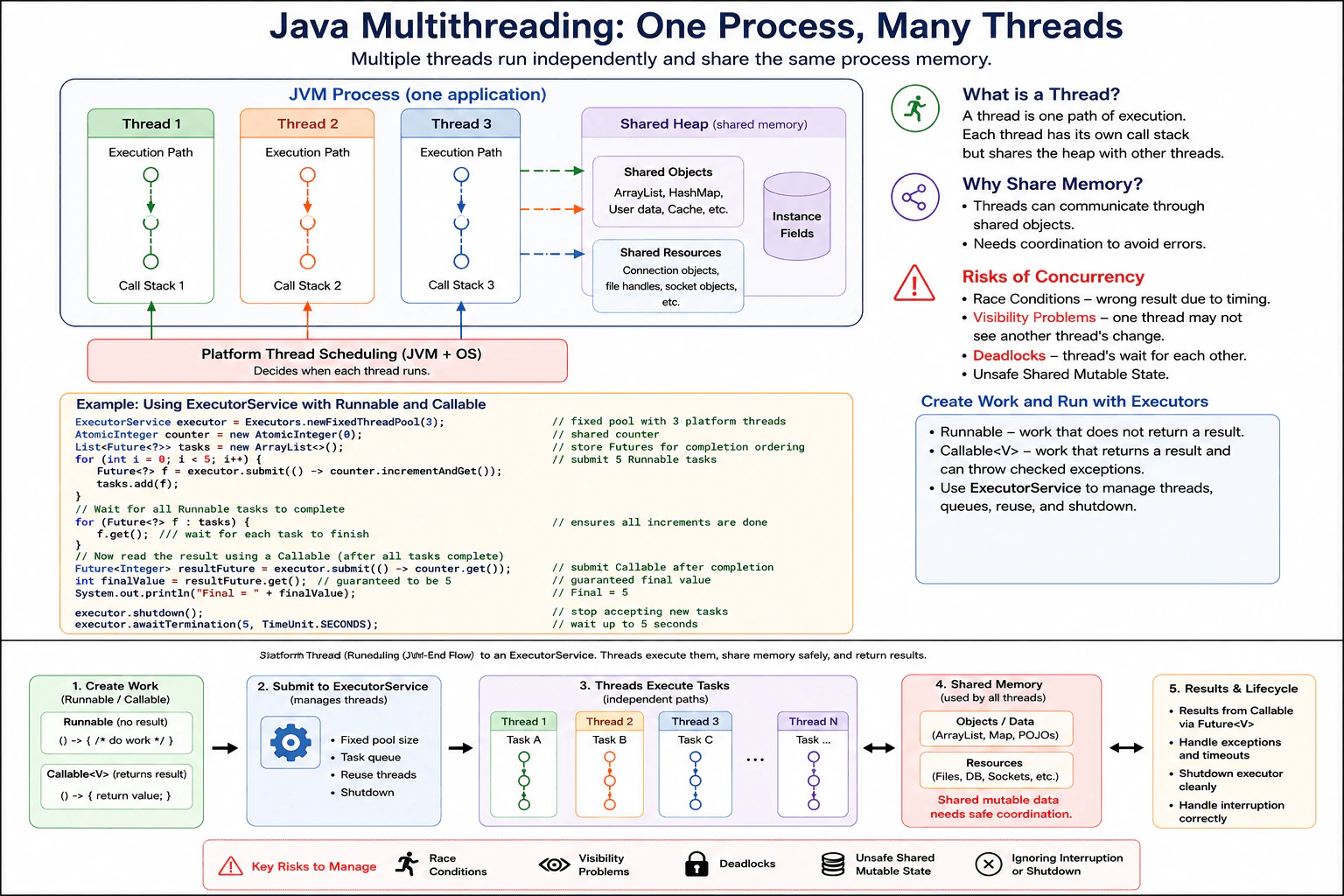
A thread is one path of execution inside a Java process. A Java application can have many threads. Each thread has its own execution state, such as its call stack, while threads in the same JVM can share objects stored on the heap.
This shared heap is useful because threads can work with the same application state, but it also creates risk. If two threads read and change the same mutable object without proper coordination, their operations can interfere. This can cause a race condition, where the result depends on timing.
There can also be a visibility problem. One thread may change a value, but another thread is not automatically guaranteed to observe that change correctly unless the program establishes the required Java Memory Model relationship. Java provides tools such as synchronized, volatile, locks, atomic classes, and concurrent collections for different coordination needs.
Runnable represents work that does not return a result. Callable can return a result and can throw checked exceptions. In production code, it is usually better to submit tasks to an ExecutorService instead of repeatedly creating platform threads yourself. An executor separates task submission from thread management and can control thread creation, reuse, queues, and shutdown.
Modern Java also supports virtual threads. They are useful when an application has many tasks that spend much of their time waiting, such as network or database operations. They can make high concurrency blocking code practical, but they do not make CPU intensive work faster and they do not remove the need to limit access to scarce resources.
Another important risk is deadlock, where threads wait indefinitely for resources held by each other. Good designs reduce shared mutable state, choose the correct coordination tool, limit concurrency where resources require it, handle interruption correctly, and shut executors down cleanly.
Why Interviewers Ask This
Interviewers ask this to check whether a candidate understands how Java can run multiple tasks concurrently, how threads inside one JVM can share application data, and why shared mutable data can become unsafe. They also want to see whether the candidate knows practical Java tools such as Runnable, Callable, and executors, and can recognize common concurrency problems such as race conditions, visibility problems, and deadlocks.
Common interview mistakes
A common mistake is thinking that every thread has completely separate application memory. Threads have their own execution state, but threads in the same JVM can share heap objects. Another mistake is assuming that concurrent code is automatically safe because each thread follows its own path. Shared mutable data can still cause race conditions and visibility problems. Developers also sometimes create a new platform thread for every task instead of using an executor or another suitable concurrency model. Other mistakes include ignoring interruption, forgetting to shut down executors, holding locks for too long, acquiring multiple locks in inconsistent orders, assuming volatile makes a compound operation atomic, and assuming virtual threads make CPU intensive work faster.
Interview tip
Start by defining a thread as one execution path and multithreading as multiple threads making progress inside one Java process. Then explain the most important practical fact: threads in the same JVM can share heap objects. Connect that fact to race conditions and visibility. Finish by saying that Runnable or Callable represent work and that executors are normally preferred for managing task execution.
Interviewer may ask next
If two Java threads change the same object at the same time, what can go wrong?
They can produce a race condition if the shared mutable state is accessed without the required coordination. The exact result can depend on the timing and ordering of operations. There can also be a visibility problem where one thread is not guaranteed to observe another thread's change correctly. This matters because code that appears correct in a simple test can fail under real concurrency. Depending on the state and operation, Java tools such as synchronized, volatile, locks, atomic classes, or concurrent collections can establish the required behavior. The main tradeoff is that coordination adds complexity and can reduce concurrency, so shared mutable state should be kept as small as practical.
Why would you use an executor instead of creating a new thread for every task?
An executor separates task submission from thread management. With an ExecutorService, the application submits Runnable or Callable tasks while the executor controls how those tasks are executed. A fixed thread pool can limit and reuse platform threads, which prevents uncontrolled platform thread creation under load. Modern Java can also use virtual threads for large numbers of blocking tasks, but resource limits still matter. An executor does not remove race conditions or make shared state safe. The main tradeoff is choosing an execution strategy and concurrency level that match the workload and the resources the application depends on.
48. What are transient and volatile variables?Language SpecificMedium
i Question Details
Explain transient and volatile, including persistence, visibility, and concurrency implications.
Short Interview Answer (30-60 seconds)
The practical difference is that transient affects standard Java object serialization, while volatile affects visibility and ordering between threads. A transient instance field is normally excluded when an object is serialized, so it has its default value after deserialization unless custom logic restores it. A volatile field makes writes visible to subsequent reads of that field and creates memory ordering guarantees. It does not make compound operations such as count plus plus atomic.
Detailed Explanation
These words solve two separate problems. One controls whether a value is included when Java saves an object using its built in object saving mechanism. The other controls how workers running at the same time see changes to a shared value. The first can leave a field out of the saved object data. The second helps one worker see a value written by another worker. Neither word provides the behavior of the other, and each has limits that matter in real applications.
Useful Questions to Ask the Interviewer
Is the application using standard Java object serialization or another storage format?
Will several threads read or update the field?
Is the shared operation a simple read or write, or does it contain several steps?
How to Explain It in an Interview
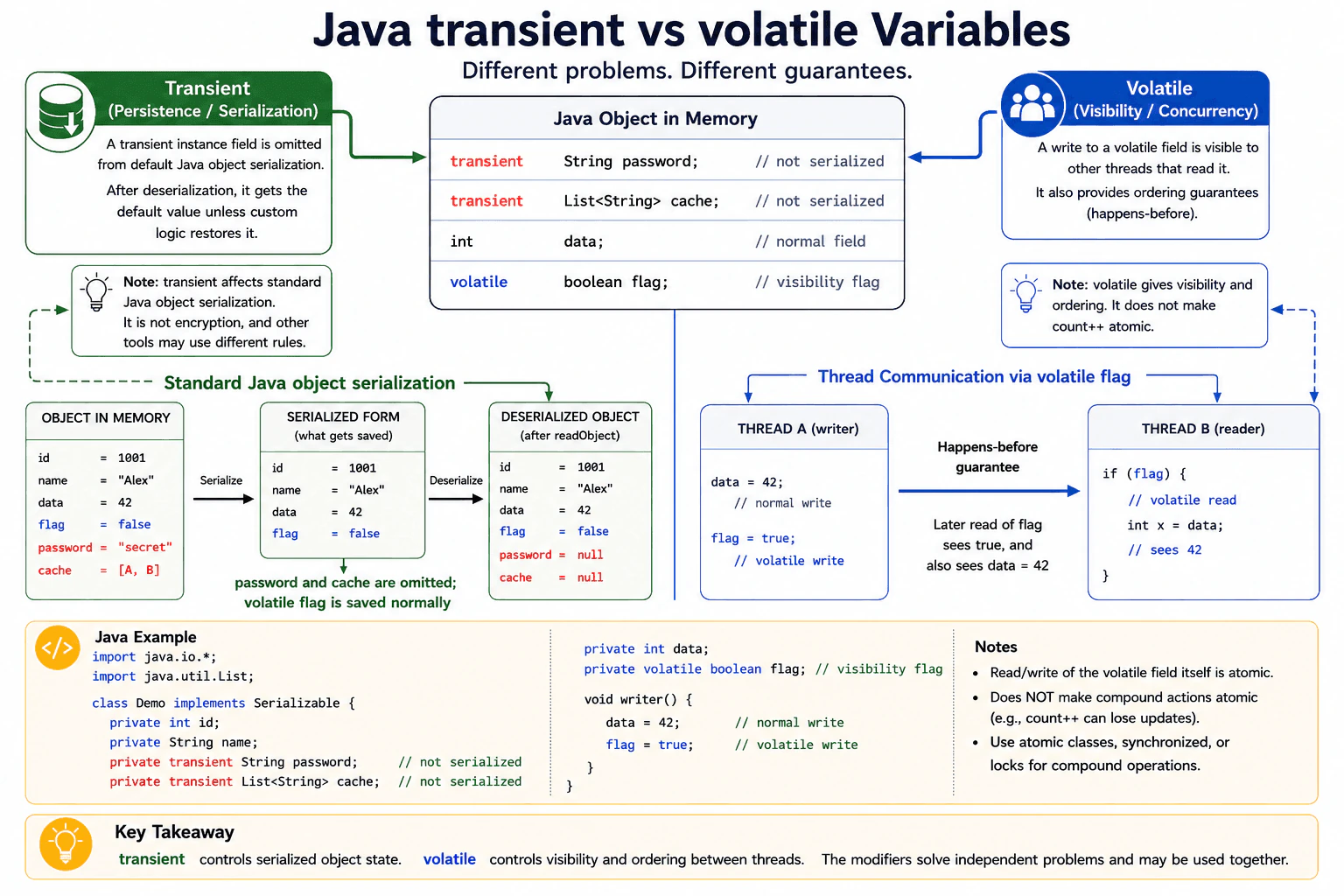
A transient field is declared with the transient modifier. During default Java object serialization, a transient instance field is not included in the serialized state. When the object is deserialized, that field receives its Java default value, such as null, zero, or false, unless custom deserialization logic restores another value.
Transient is useful for temporary caches, calculated values, environment specific objects, or values that should not be part of the standard serialized form. Static fields are already excluded because they belong to the class rather than an individual object, so marking a static field transient has no useful serialization effect.
Transient is not encryption, secure deletion, or a universal persistence rule. JSON libraries, database mappers, and frameworks may apply their own rules and may still include the field unless configured otherwise.
A volatile field is used for shared state between threads. A write to a volatile field is visible to subsequent reads of that field. It also creates ordering guarantees under the Java Memory Model. Actions performed before the volatile write become visible to a thread after it performs the corresponding volatile read.
A read or write of the volatile field itself is atomic. However, a compound operation such as count plus plus is not atomic because it performs a read, calculation, and write. Multiple threads can still lose updates. Use synchronization, a lock, or an atomic class when several steps must act as one operation.
A volatile reference only protects access to the reference value. It does not automatically make the referenced object or array elements thread safe. A field can be both transient and volatile because the modifiers solve independent problems. Neither modifier creates an additional object allocation or changes the field type. Volatile access may cost more than ordinary access because it limits some optimizations and requires memory coordination.
Why Interviewers Ask This
Interviewers ask this question to check whether a candidate can separate object persistence from communication between threads. It tests knowledge of Java field modifiers, standard object serialization, the Java Memory Model, visibility, ordering, atomicity, and safe production use. It also shows whether the candidate understands that transient does not provide thread safety and volatile does not make compound operations atomic.
Common interview mistakes
A common mistake is saying that transient prevents every serializer, framework, or database tool from storing a field. Its defined effect applies to standard Java object serialization, while other tools use their own rules. Another mistake is treating transient as encryption or secure deletion. It provides neither. Candidates also assume that volatile makes count plus plus safe. Volatile provides visibility and ordering, but it does not make a compound operation atomic. Another error is assuming that a volatile object or array reference makes the referenced object or its elements thread safe. It only gives volatile behavior to the reference field itself.
Interview tip
Start by separating the two concerns. Say that transient affects standard Java object serialization and volatile affects visibility and ordering between threads. Then state one important limitation for each. Transient does not control every persistence tool, and volatile does not make compound operations atomic.
Interviewer may ask next
What value does a transient field have after an object is deserialized?
It normally has its Java default value after standard deserialization. A reference becomes null, a numeric primitive becomes zero, a char becomes the zero character, and a boolean becomes false. The field was excluded from the serialized state, so no saved value is restored. Custom readObject logic can assign another value. For a class that implements Serializable, its field initializers and constructor do not restore the transient field during normal deserialization, although the constructor of the first nonserializable superclass is invoked.
When should volatile be replaced with an atomic class, synchronization, or a lock?
Stronger coordination is required when an update contains several dependent steps or several values must remain consistent together. For example, count plus plus is a read, calculation, and write, so a volatile counter can still lose updates. An atomic class is suitable for supported single value atomic operations. Synchronization or a lock is suitable when several fields or actions must form one indivisible operation. The tradeoff is stronger correctness with additional coordination cost and possible contention.
49. What is the difference between synchronized method and synchronized block?Language SpecificMedium
i Question Details
Compare synchronized methods and synchronized blocks, including scope and contention.
Short Interview Answer (30-60 seconds)
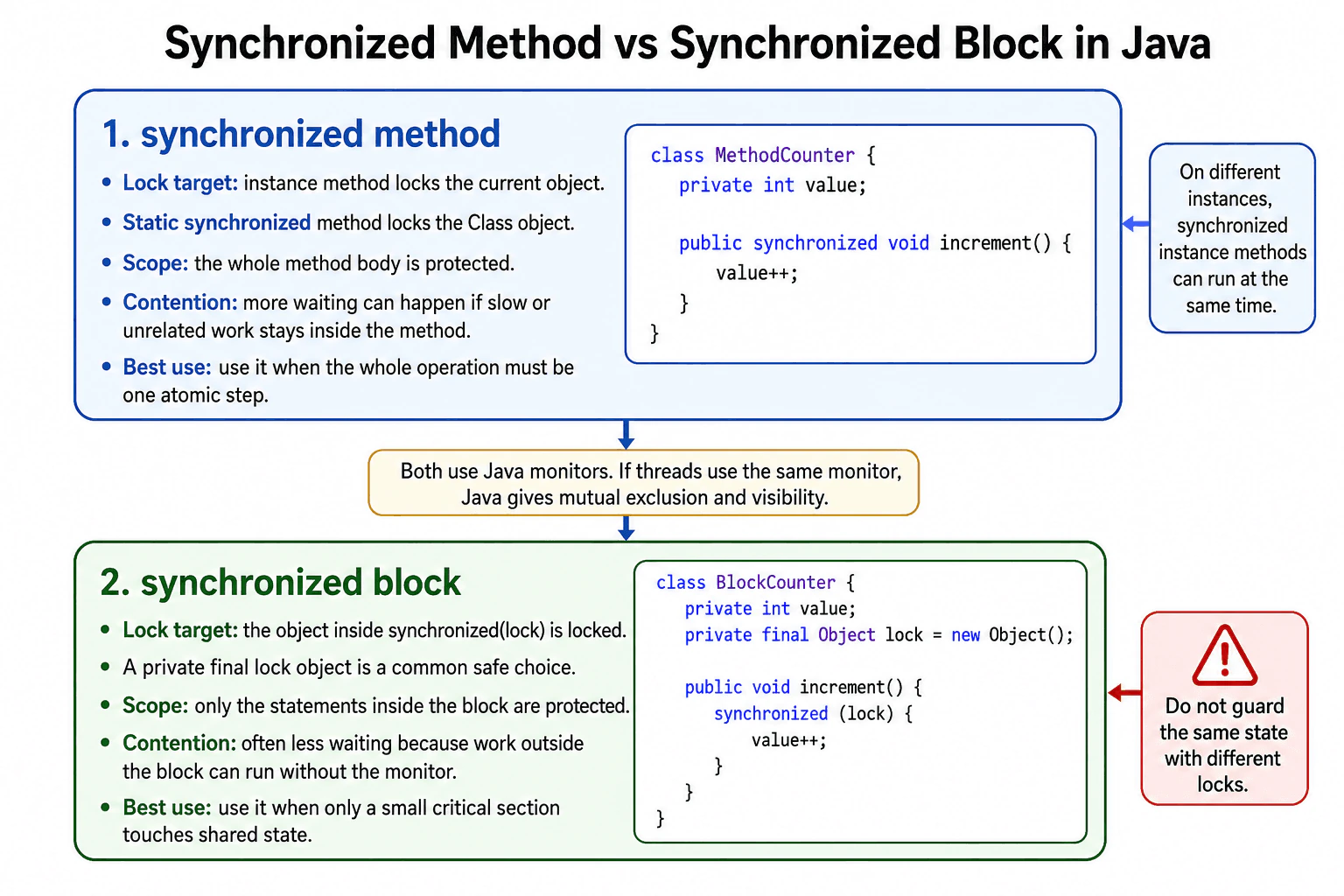
A synchronized method locks for the entire method, while a synchronized block locks only the selected statements. An instance synchronized method locks the current object. A static synchronized method locks the Class object. A synchronized block lets me choose both the protected section and the lock object. I use a method when the whole operation needs one lock, and a block when a smaller critical section is safe and can reduce contention.
Both forms prevent several workers from entering protected work at the same time when they use the same guard object. The main difference is how much work is protected and which object controls entry. Protecting a whole operation is simple and harder to misuse. Protecting only the sensitive part may let other work continue sooner, but the boundary must be chosen carefully. The decision matters when several requests or background tasks update the same information.
Useful Questions to Ask the Interviewer
Is the shared state stored in each instance or shared by the whole class?
Must the complete operation happen as one indivisible action?
Can slow calculations or external calls safely remain outside the protected section?
How to Explain It in an Interview
A synchronized instance method acquires the monitor of the current object before entering the method body and releases it when the method exits, including when an exception is thrown. Its locking effect is the same as placing the complete body inside synchronized (this). Calls on the same instance contend for the same monitor. Calls on different instances use different monitors and may run at the same time.
A static synchronized method acquires the monitor of the Class object that declares the method. It protects class level state only when every related access uses that same Class monitor.
A synchronized block acquires the monitor of the object named in its expression. It can protect only the statements that must be atomic, and it can use a private final lock object instead of this. The expression must produce a nonnull reference. Replacing the lock reference or using different locks for the same state breaks the protection.
Both forms provide the same monitor based mutual exclusion and Java Memory Model visibility guarantees when threads release and later acquire the same monitor. A smaller block can reduce waiting, but only when code moved outside the block does not depend on the protected state or split one required atomic operation.
The language does not guarantee fairness, so a waiting thread is not guaranteed to acquire the monitor next. A private lock adds one lock object per containing instance, while a synchronized method needs no separate application lock object. On Java 21, synchronized code can pin a virtual thread to its carrier in important cases. Starting with JDK 24, JEP 491 removes nearly all pinning caused by synchronized methods and blocks, although native code and remaining pinning cases still require care.
Interviewers ask this question to check whether the candidate understands Java monitor locking, can identify which object is locked, and can choose a safe locking scope. They also evaluate whether the candidate can reduce contention without breaking atomicity, memory visibility, or thread safety in production code.
Common interview mistakes
A common mistake is saying that synchronized methods and synchronized blocks use different locking mechanisms. Both use Java monitors. Another mistake is claiming that every synchronized method locks the whole class. An instance method locks the current object, while a static method locks the declaring Class object. Other errors include protecting writes but not reads, using different lock objects for the same state, locking on a mutable reference, locking on a public object that outside code can also use, or shrinking a block so much that one required atomic operation becomes several separate operations. Holding a monitor during slow input, output, network, or database work can also create unnecessary contention.
Interview tip
Explain three points in order: which object is locked, how much code is protected, and when the smaller scope is still correct. State that both forms have the same monitor and visibility guarantees when they use the same monitor.
Interviewer may ask next
Can two threads execute the same synchronized instance method at the same time on different objects?
Yes. A synchronized instance method locks the current object, so calls on two different instances acquire different monitors and may run at the same time. They block each other only when they acquire the same monitor. This matters because instance synchronization does not protect mutable state shared across all instances unless every access also uses one common lock.
Is a synchronized block always faster or better than a synchronized method?
No. Both forms use monitor locking, and neither form is automatically faster. A block can reduce contention when independent work safely remains outside the critical section. The tradeoff is greater implementation risk because every related read and write must use the same lock, and the smaller boundary must still preserve the required atomic operation. A whole synchronized method is often safer when the complete method represents one protected state transition.
50. What is wait/notify/notifyAll used for?Language SpecificMedium
i Question Details
Explain how wait, notify, and notifyAll coordinate threads that share a monitor.
Short Interview Answer (30-60 seconds)
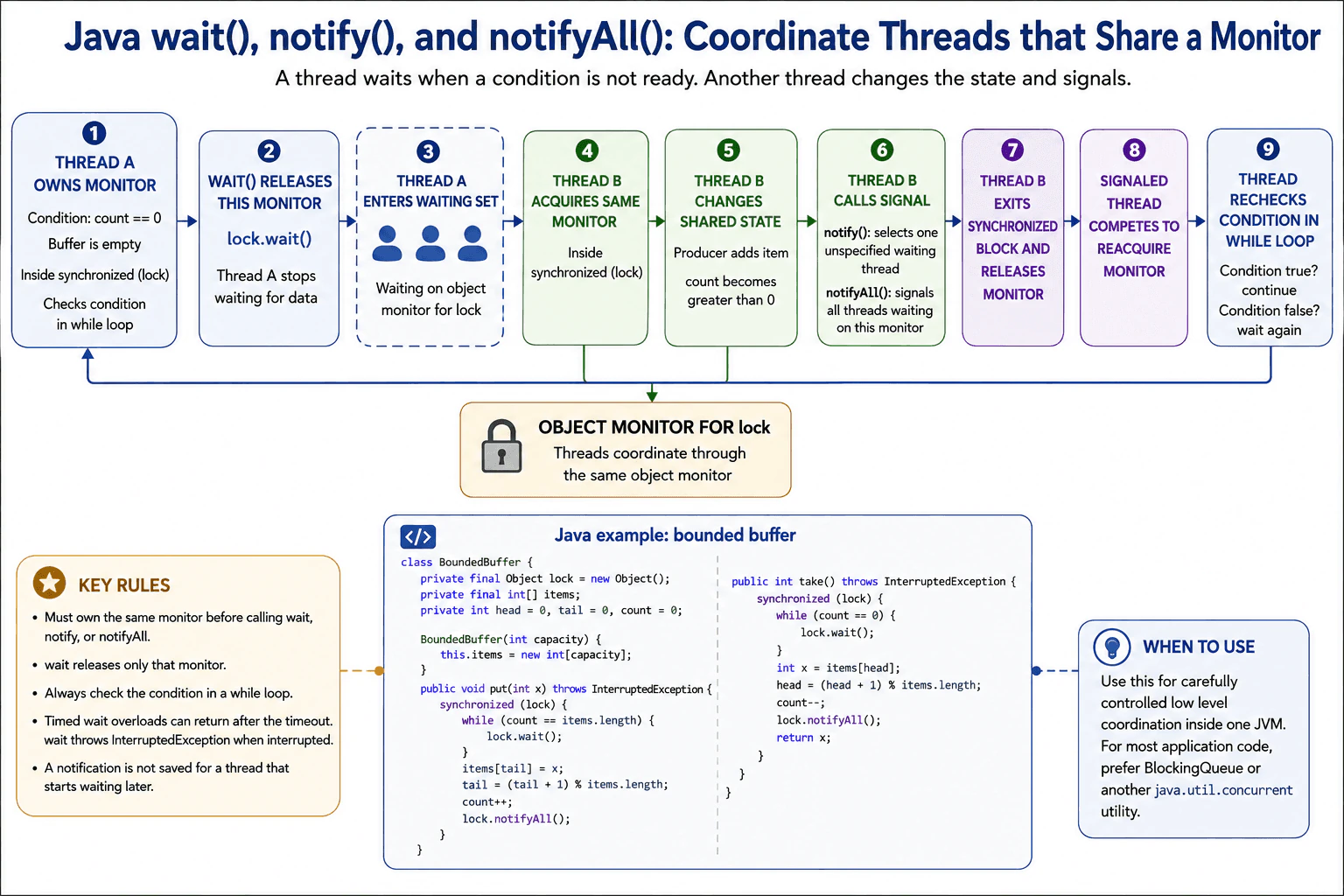
wait, notify, and notifyAll coordinate threads that use the same object monitor. A thread calls wait when a shared condition is not ready. wait releases that monitor and pauses the thread. Another thread changes the shared state while holding the same monitor and calls notify or notifyAll. notify selects one waiting thread, while notifyAll gives every waiting thread a chance to continue. I always test the condition in a while loop because waking does not guarantee that the condition is true.
Detailed Explanation
These methods help several workers take turns when they depend on the same shared information. One worker may need to stop because the information is not ready. It can wait and allow another worker to update that information. After another worker makes the required change, it can signal that work may continue. One signal chooses one waiting worker. The other signal gives every waiting worker a chance to check whether it can continue. This is useful when progress depends on a shared condition.
Useful Questions to Ask the Interviewer
Can different conditions use the same shared object?
Should one waiting thread continue, or should every waiting thread check again?
Should waiting have a time limit?
How to Explain It in an Interview
wait, notify, and notifyAll are final methods inherited from Object. They coordinate threads through the monitor associated with an object. A thread must own that object monitor before calling any of these methods, normally by entering a synchronized method or synchronized block that uses the same object. Otherwise, Java throws IllegalMonitorStateException.
A thread calls wait when a required condition is false. wait places the thread in the waiting set for that monitor and releases only that object monitor. This allows another thread to acquire the monitor and change the shared state. The waiting thread keeps any other locks that it already owns, which can create deadlock risks if the locking design is poor.
notify selects one unspecified thread from that monitor's waiting set. notifyAll signals every thread in that waiting set. A signaled thread does not run immediately. It must first reacquire the same monitor. Threads that were signaled by notifyAll compete for the monitor and continue one at a time.
The shared condition must be checked in a while loop. A thread may wake without a useful notification. Another thread may also change or consume the shared state before the awakened thread reacquires the monitor. A notification is not stored for a thread that starts waiting later.
wait can also use a timeout. It throws InterruptedException if the waiting thread is interrupted. Code should normally restore the interrupt status or propagate the exception according to the method contract.
The state check, state change, wait call, and signal must use the same monitor. Releasing and later reacquiring that monitor also provides the memory visibility needed for the waiting thread to see synchronized state changes. For most production code, BlockingQueue, CountDownLatch, Semaphore, or Lock with Condition is clearer and safer.
Why Interviewers Ask This
Interviewers ask this question to check whether a candidate understands Java monitor based thread coordination. They want to see whether the candidate knows the monitor ownership rules, the difference between waiting and sleeping, the need to test a condition in a loop, interruption behavior, memory visibility, and the practical difference between notify and notifyAll. It also tests whether the candidate can choose safer higher level concurrency tools for production code.
Common interview mistakes
Common mistakes include calling wait, notify, or notifyAll without owning the target object's monitor, which causes IllegalMonitorStateException. Another mistake is synchronizing on one object but calling wait or notify on another. Using if instead of while is unsafe because a thread may wake when its condition is still false. Developers also confuse wait with Thread.sleep. wait releases the target object monitor, while Thread.sleep does not release any monitor. Another mistake is assuming notify selects the oldest or most suitable waiter. Java gives no such guarantee. Calling notify before a thread starts waiting does not save the notification. Ignoring InterruptedException can also prevent cancellation and clean shutdown. Holding unrelated locks while waiting may cause deadlock because wait releases only the monitor on which it is called.
Interview tip
Explain the protocol in order. The thread owns the monitor, checks a shared condition in a while loop, calls wait and releases that monitor, then another thread changes the shared state and signals while holding the same monitor. Mention that notify selects one unspecified waiter, notifyAll signals all waiters, and every awakened thread must reacquire the monitor and check the condition again. Also mention interruption and higher level concurrency utilities.
Interviewer may ask next
Can a thread continue immediately after notify is called?
No. notify only selects one unspecified thread from the waiting set for that monitor. The selected thread cannot return from wait until the notifying thread releases the monitor and the selected thread acquires it again. Even then, it must check the shared condition again because another thread may have changed the state first, the notification may relate to a different condition, or the wakeup may not indicate that useful work is available.
When should notifyAll be preferred over notify?
notifyAll should usually be preferred when different conditions share one monitor or when it is difficult to prove that any selected waiter can make progress. It signals every waiter so each thread can reacquire the monitor in turn and test its own condition. The tradeoff is more wakeups, scheduling work, and monitor competition. notify may reduce this work, but it is safe only when waking one unspecified waiter is guaranteed to preserve progress.
More questions load as you scroll
Disclaimer: This interview guide is for educational and informational purposes only. It is designed to help readers prepare, but it does not guarantee any interview result, hiring decision, offer, or outcome. Interview questions, hiring criteria, and preferred answers can vary by employer, interviewer, industry, location, and time. All answers, examples, and explanations in this guide are suggested examples for interview preparation, not definitive answers or instructions for professional practice. They are based on research and judgment, are provided without warranties of any kind, and should be adapted to the question, role, and applicable laws and professional requirements. Diagrams are simplified illustrations intended to highlight the main concepts and their relationships; actual situations, systems, and practices may be more complex. Alternative approaches may be equally valid or better suited to a particular question, context, or interviewer. To the fullest extent permitted by applicable law, the contributors and publisher are not liable for decisions made, actions taken, or losses incurred based on this guide.
State Laws and Professional Responsibilities: Laws and requirements governing an occupation vary by state and jurisdiction. You are responsible for checking the current laws, licensing requirements, and scope-of-practice rules that apply to your location and role, and for ensuring that your answers and actions comply with them. Adapt examples in this guide to those requirements. This guide is not legal advice.
Content Accuracy and Verification: To the fullest extent permitted by applicable law, we do not represent or warrant that interview guides, questions, answers, examples, or diagrams are accurate, complete, current, error-free, or suitable for any particular purpose. You are responsible for independently reviewing and verifying the information before relying on it.