This interview guide is for educational and informational purposes only. It is designed to help readers prepare, but it does not guarantee any interview result, hiring decision, offer, or outcome. Interview questions, hiring criteria, and preferred answers can vary by employer, interviewer, industry, location, and time. All answers, examples, and explanations in this guide are suggested examples for interview preparation, not definitive answers or instructions for professional practice. They are based on research and judgment, are provided without warranties of any kind, and should be adapted to the question, role, and applicable laws and professional requirements. Diagrams are simplified illustrations intended to highlight the main concepts and their relationships; actual situations, systems, and practices may be more complex. Alternative approaches may be equally valid or better suited to a particular question, context, or interviewer. To the fullest extent permitted by applicable law, the contributors and publisher are not liable for decisions made, actions taken, or losses incurred based on this guide.
State Laws and Professional Responsibilities
Laws and requirements governing an occupation vary by state and jurisdiction. You are responsible for checking the current laws, licensing requirements, and scope-of-practice rules that apply to your location and role, and for ensuring that your answers and actions comply with them. Adapt examples in this guide to those requirements. This guide is not legal advice.
Identity, Image, and Privacy Notice
To respect individual privacy, some names, profile photographs, avatars, biographical details, and other identifying information displayed in this guide may be replaced with pseudonyms, licensed stock images, illustrative avatars, composite images, or representative descriptions. Unless a person is expressly identified as an actual contributor, a displayed name, image, or profile should not be understood as depicting or identifying a specific candidate, interviewer, employee, or other real individual. These representations are provided for editorial and illustrative purposes only and do not imply endorsement, employment, participation, or affiliation with this guide or any company mentioned in it. Any resemblance to an actual person is coincidental.
Company Notice
This guide is an independent educational resource and is not affiliated with, endorsed by, sponsored by, or approved by the company named in this guide. Company names identify reported interview experiences or the employer context of clearly labeled original practice exercises. Interview practices can change without notice, and inclusion of company-specific content does not mean these questions are official, complete, or guaranteed to be asked. To the fullest extent permitted by law, the author, contributors, and publisher are not responsible for outcomes related to use of this material.
Content Accuracy and Verification
To the fullest extent permitted by applicable law, we do not represent or warrant that interview guides, questions, answers, examples, or diagrams are accurate, complete, current, error-free, or suitable for any particular purpose. You are responsible for independently reviewing and verifying the information before relying on it.
Questions or comments?
Contact us for general questions, or share feedback, technical corrections, and comments with the community.
31. Design a Snake and Food game.System DesignMediumMicrosoft
i Question Details
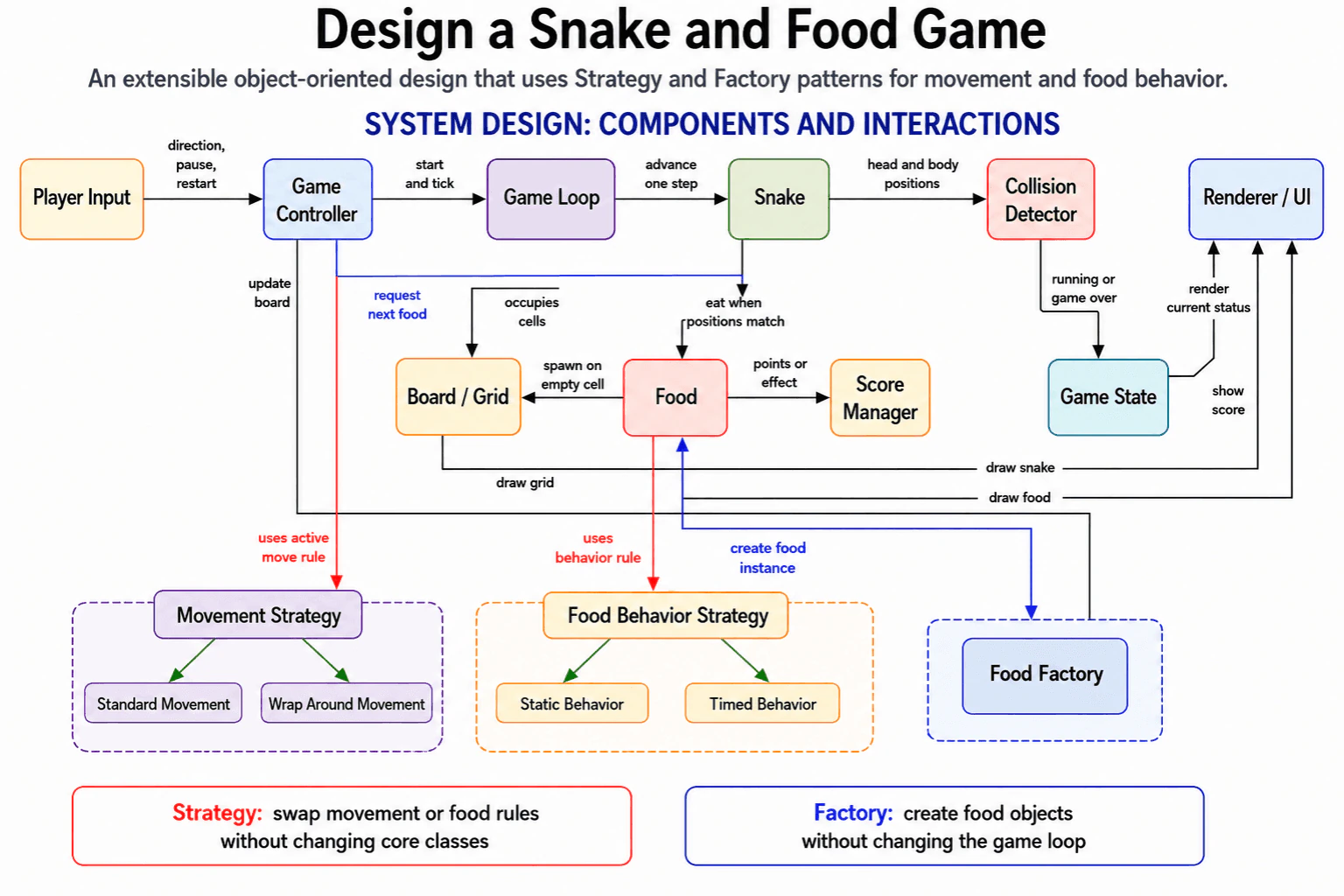
Design the game with extensible object-oriented components, and explain how Strategy and Factory patterns can support different movement or food behaviors.
Short Interview Answer (30-60 seconds)
At a high level, this game moves a snake, places food, updates the score, and ends after a collision. The main challenge is adding new movement and food rules without changing the core game flow. I would explain three parts: the game tick, food creation and scoring, and rendering. The Game Controller runs the flow, Strategy objects provide replaceable rules, and the Food Factory creates food. The downside is more classes, but future changes become safer.
Detailed Explanation
The goal is to build a Snake and Food game that stays easy to extend. Each game tick must move the snake, check collisions, update food and score, and refresh the screen. The main design problem is avoiding one large class that contains every rule. The diagram separates the normal game flow from movement rules, food behavior rules, and food creation.
Useful Questions to Ask the Interviewer
Which user flows and system capabilities are required for the first version?
What traffic, data volume, latency, and availability targets should I design for?
Which consistency, security, geographic, and cost constraints matter most?
How to Explain It in an Interview
1. Explain the main game flow
I would start with one normal game tick. Player Input sends a direction, pause, or restart command to the Game Controller.
The Game Controller starts the Game Loop. The Game Loop advances the Snake by one step. The Snake then provides its head and body positions to the Collision Detector.
The Collision Detector decides whether the game is still running or is over. It sends that result to Game State. The Renderer / UI reads the current status from Game State.
2. Explain the board and food interaction
The Game Controller updates the Board / Grid. The Snake occupies cells on that board.
Food is placed on an empty cell. When the Snake and Food positions match, the Snake eats the Food.
The Food sends its points or effect to the Score Manager. This keeps scoring work outside the Snake class.
3. Explain food creation with the Factory pattern
The Game Controller requests the next food from the Food Factory. A factory is an object that creates other objects.
The Food Factory creates the selected Food instance. It then provides that instance to the game.
This keeps creation rules outside the Game Loop. Adding another food type does not require rewriting the loop.
4. Explain replaceable behavior with Strategy
The Game Controller uses the active Movement Strategy. A strategy is a separate object that contains one replaceable rule.
The diagram shows Standard Movement and Wrap Around Movement. The controller can switch between them without changing its main flow.
Food also uses an active Food Behavior Strategy. The diagram shows Static Behavior and Timed Behavior. The Food class can use either rule without containing both implementations.
5. Explain rendering and the main trade-off
The Renderer / UI draws the grid, snake, and food. It also shows the score and the current game status.
This design gives each class a clear job. The Game Loop controls timing. The Collision Detector decides the result. Strategy objects hold changing rules. The Food Factory handles creation.
The benefit is easier extension and testing. The downside is more classes and connections. That extra structure is useful when the game will gain more rules later.
Engineering Considerations / Design Trade-offs
The benefit is that changing one rule does not require changing the whole game. Movement rules stay inside Movement Strategy classes. Food rules stay inside Food Behavior Strategy classes. The Food Factory handles food creation. This makes each part easier to test and replace. The downside is that the design contains more small classes and arrows. A very small game could use simpler direct code. However, direct code becomes harder to manage as new rules are added. We accept the extra structure because it keeps the core Game Loop and Game Controller stable.
Why Interviewers Ask This
Interviewers use this question to test object-oriented design judgment. They want to see whether the candidate can separate input, timing, movement, collision checks, scoring, rendering, and object creation. They also want to know whether the candidate understands Strategy and Factory as practical tools. The key skill is explaining how the design supports change without turning the game into one large class.
Interviewer may ask next
How would you add several food types with different points and timed effects?
I would keep the same design and extend the Food Factory and Food Behavior Strategy. The Game Controller would still request the next food from the Food Factory. The factory would choose which Food instance to create.
Each Food instance would carry its own points or effect. When the Snake eats it, the Food would send that value to the Score Manager. A normal food could use Static Behavior. A temporary bonus food could use Timed Behavior.
The Game Loop would not change. It would still advance the Snake and continue the normal flow. Correctness stays clear because the factory creates the object, while the strategy controls its behavior.
The downside is that the factory may gain too many selection rules. I would keep those rules small and test each food type separately.
How would you let the player switch between Standard Movement and Wrap Around Movement during the game?
I would keep both implementations behind Movement Strategy. The Game Controller would store which strategy is currently active. A player command could ask the controller to switch that active rule.
On the next game tick, the Game Loop would still advance the Snake in the same way. The controller would use the newly selected Movement Strategy to apply the movement rule. The Snake, Collision Detector, Board / Grid, and Renderer / UI would keep their current jobs.
This stays correct because only one movement rule is active for each step. The controller owns the choice, while each strategy owns its rule.
The downside is that switching rules during play may surprise the player. The UI should clearly show the current movement mode, and tests should cover switching near board edges.
32. Design the messaging infrastructure for Microsoft Teams.System DesignHardMicrosoft
i Question Details
Design the messaging path for Microsoft Teams, including persistent connections, a group chat with more than 10,000 members, message-history partitioning, ordering, and the tradeoffs between sequence numbers and timestamps. Compare WebSockets with long polling and explain scaling and failure handling.
Short Interview Answer (30-60 seconds)
At a high level, this system must deliver chat messages quickly and keep each conversation in the right order. The main challenge is sending one message to more than 10,000 members while keeping history safe. I would explain three flows: client connections, ordered message storage, and large-group fanout. WebSockets provide the main connection path, while long polling is the fallback. Sequence numbers control ordering, and the Durable Write Log supports retry and replay. The trade-off is more system complexity for better speed and recovery.
Detailed Explanation
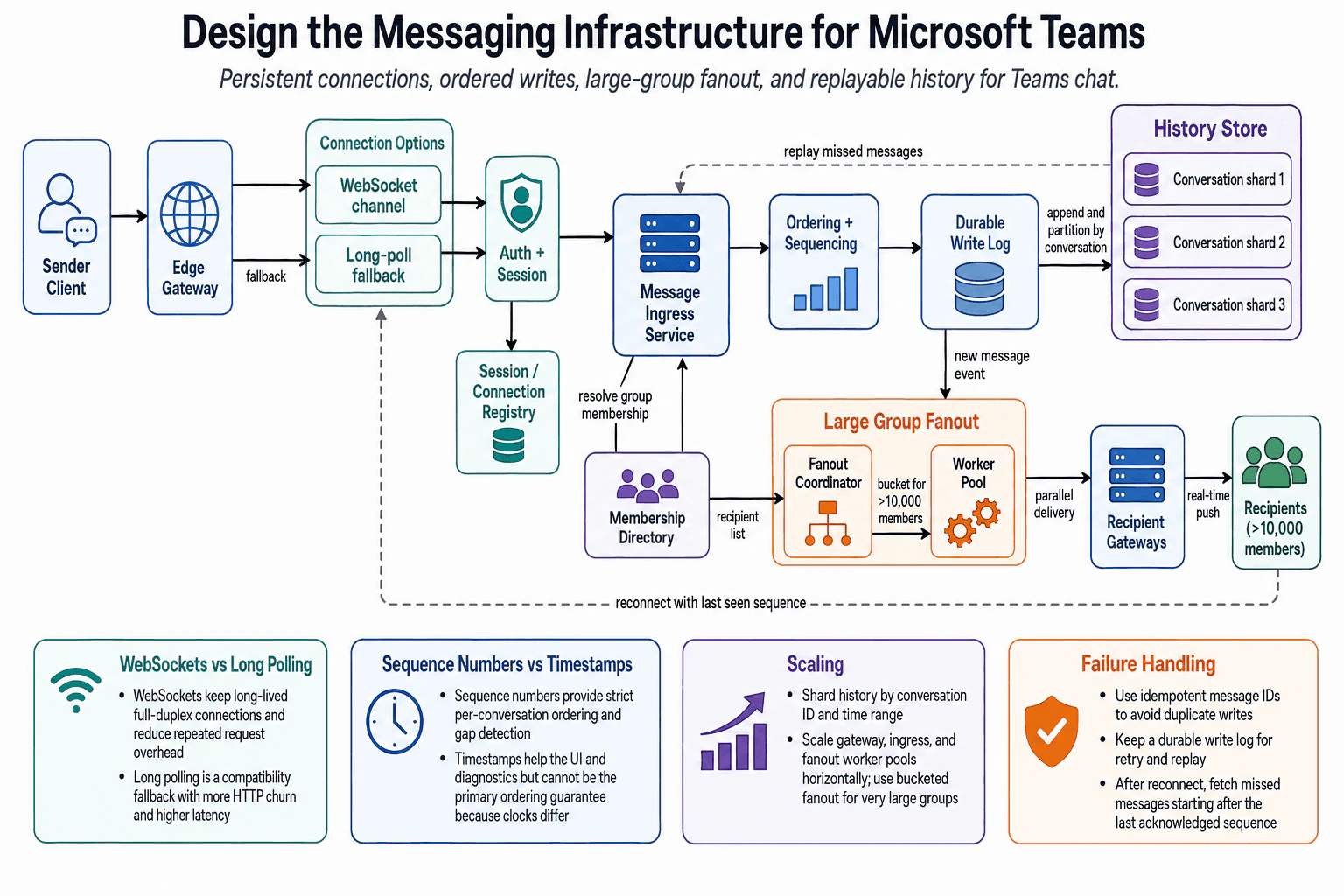
The goal is to move chat messages quickly, preserve their order, and replay anything a client misses. The difficult part is large-group delivery. One message may need to reach more than 10,000 members. The diagram handles this by separating connection management, ordered message storage, and large-group fanout.
Useful Questions to Ask the Interviewer
Which user flows and system capabilities are required for the first version?
What traffic, data volume, latency, and availability targets should I design for?
Which consistency, security, geographic, and cost constraints matter most?
How to Explain It in an Interview
1. Explain how clients stay connected
I would start with the connection path. The Sender Client first reaches the Edge Gateway.
The preferred connection is the WebSocket channel. A WebSocket keeps one two-way connection open. This reduces repeated request work and usually gives lower delay.
The Long-poll fallback is used when WebSockets are not available. Long polling keeps making HTTP requests while waiting for new data. It works on more networks, but creates more request traffic and higher delay.
Both paths reach Auth + Session. This service checks the user session. It also updates the Session / Connection Registry, which records where the active client connection lives.
2. Explain message intake and ordering
After session checking, the message reaches the Message Ingress Service. This service accepts the new chat message and resolves the group through the Membership Directory.
The message then moves to Ordering + Sequencing. This step assigns a sequence number inside that conversation. For example, one chat may receive message 101, then 102, then 103.
Sequence numbers give strict order and reveal missing gaps. Timestamps are still useful for display and debugging. However, timestamps should not control order because machine clocks can differ.
3. Explain durable storage and history
The ordered message is written to the Durable Write Log. Durable means the record remains available even when a service stops. The log supports retry and replay.
The message is then appended to the History Store. History is partitioned by conversation. The diagram shows Conversation shard 1, Conversation shard 2, and Conversation shard 3.
A shard is one smaller part of the stored data. Splitting history across shards lets the storage layer grow across more machines. It also avoids placing every conversation on one machine.
4. Explain large-group fanout
The Durable Write Log sends a new message event to Large Group Fanout. Fanout means copying one message toward many recipients.
The Membership Directory sends the recipient list to the Fanout Coordinator. The coordinator divides a group larger than 10,000 members into smaller buckets. The Worker Pool processes those buckets in parallel.
Recipient Gateways then push the message to connected recipients. This path runs separately from the main write path. The sender does not wait for all 10,000 deliveries to finish.
5. Explain reconnects, failures, and trade-offs
When recipients disconnect, they reconnect through the connection path with their last seen sequence number. The Message Ingress Service can replay missed messages from the History Store.
The Durable Write Log keeps delivery work safe for retry. Idempotent message IDs prevent duplicate writes. Idempotent means the same message can be retried without creating another stored copy.
The benefit is fast messaging, strict order, and reliable recovery. The downside is extra work for open connections, sequencing, sharded history, and large fanout worker pools.
Engineering Considerations / Design Trade-offs
The benefit is that WebSockets provide fast two-way messaging with less repeated request work. The downside is that the system must keep many connections open. Long polling is a useful fallback, but it creates more HTTP traffic and higher delay. Sequence numbers provide clear ordering and gap detection. Timestamps are easier for display, but clocks may disagree. Sharding lets message history grow across several machines, but storage becomes harder to manage. Bucketed fanout keeps the sender fast for groups above 10,000 members. The downside is that different recipients may receive the same message at slightly different times.
Why Interviewers Ask This
Interviewers use this question to test how you divide a large real-time system into clear flows. They want to see whether you understand persistent connections, message ordering, durable storage, sharding, and large-group delivery. They also check whether you can recover missed messages and explain practical trade-offs between WebSockets, long polling, sequence numbers, timestamps, and background fanout.
Interviewer may ask next
How would the design change if a group grew from 10,000 members to one million members?
I would keep the same main architecture, but expand the Large Group Fanout path. The Membership Directory would divide the recipient list into many more buckets. The Fanout Coordinator would spread those buckets across a much larger Worker Pool.
Recipient Gateways would also run on more machines. Each worker would send only to gateways that hold active recipients from its assigned bucket. This reduces repeated work across the gateway layer.
The Durable Write Log would still store the message before fanout begins. The History Store would still partition data by conversation. These two parts keep recovery correct even when delivery takes longer.
Ordering would still use the same per-conversation sequence number. Idempotent message IDs would keep retries from creating duplicate stored messages.
The main downside is cost and delivery spread. One million users may not receive the message at exactly the same moment, even though every recipient can still recover the correct ordered history.
What happens if a Recipient Gateway fails while a message is being delivered?
The stored message remains safe because the Recipient Gateway is not the history store. The Durable Write Log and History Store already contain the message before live delivery finishes.
A disconnected recipient reconnects through the available connection path. The client sends its last seen sequence number. The system uses that number to find which messages were missed.
The replay path returns those missing messages from the History Store to the Message Ingress Service. The client can then receive them through its new connection. The Durable Write Log also supports retry when fanout work did not finish.
Idempotent message IDs protect the write side during retries. The same delivery may be attempted again without creating another stored message.
The main downside is a short delay. Some users may pause while reconnecting and replaying missed messages, but their conversation history remains ordered and complete.
33. Design a distributed unique-ID generation system.System DesignHardMicrosoft
i Question Details
Design a system that produces globally unique identifiers at massive throughput while preserving useful time ordering. Explain the ID format, coordination strategy, clock problems, and behavior during node or region failures.
Short Interview Answer (30-60 seconds)
At a high level, this system gives many services unique IDs very quickly. The main challenge is avoiding duplicates while keeping useful time order across regions. I would explain it in three parts: request routing, local ID generation, and failure handling. A global router sends each request to a healthy region. Each node builds an ID from timestamp, region, worker, and sequence fields. Worker leases keep node identities separate. The trade-off is extra coordination and careful clock handling.
Detailed Explanation
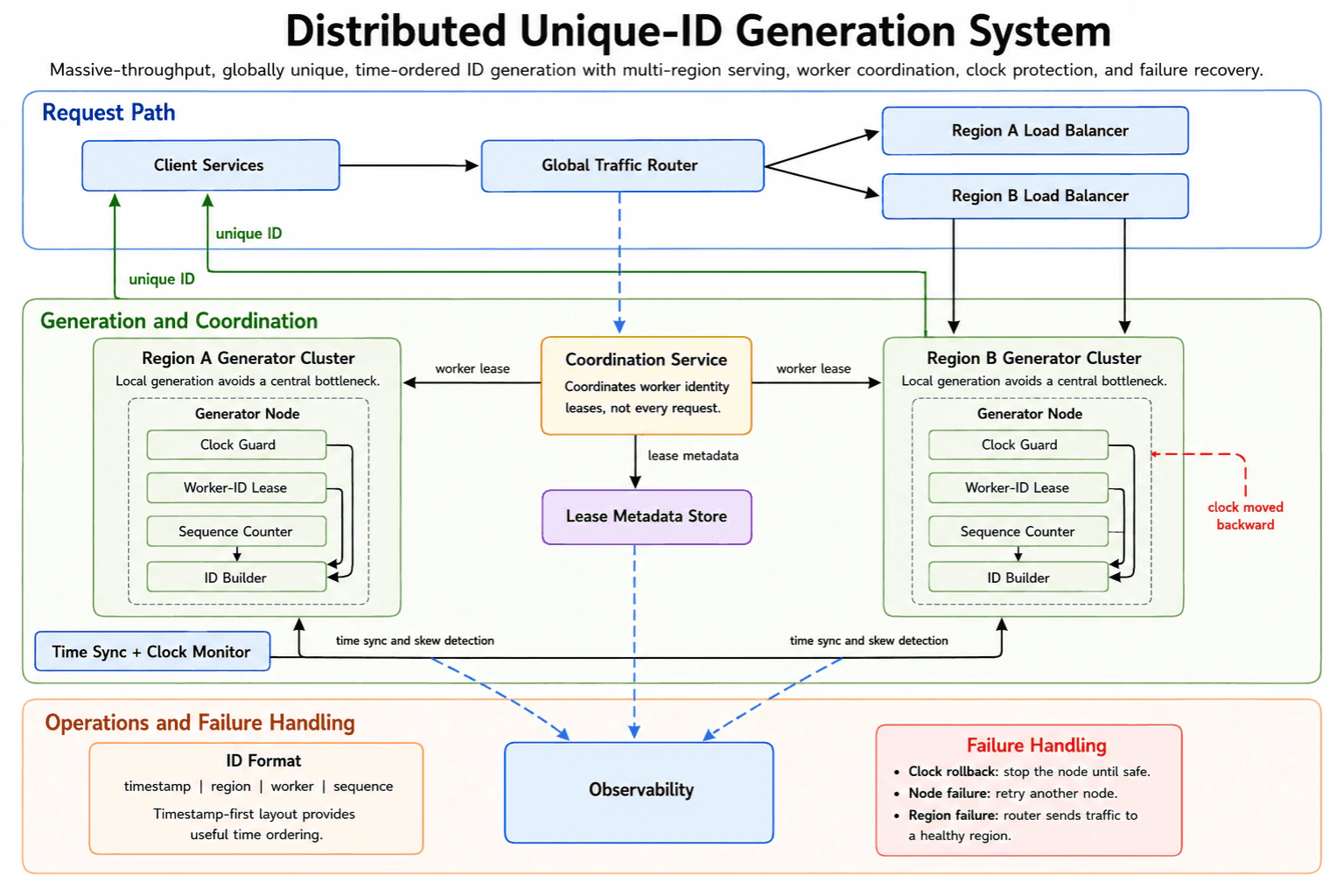
The system must create globally unique IDs at very high speed. The difficult part is letting many nodes generate IDs at the same time. Their clocks may differ, nodes may fail, and whole regions may become unavailable. The diagram handles this with regional generation, leased worker identities, clock protection, and regional routing.
Useful Questions to Ask the Interviewer
Which user flows and system capabilities are required for the first version?
What traffic, data volume, latency, and availability targets should I design for?
Which consistency, security, geographic, and cost constraints matter most?
How to Explain It in an Interview
1. Explain the ID format
I would begin with the ID structure. Each ID contains four fields: timestamp, region, worker, and sequence.
The timestamp comes first. This gives useful time ordering because newer IDs usually sort after older IDs. The region field separates IDs created in different regions. The worker field identifies the generator node. The sequence field separates several IDs created by one worker during the same timestamp.
These fields work together to prevent duplicates. This depends on each active node holding a different Worker-ID Lease.
2. Explain the request path
Client Services send an ID request to the Global Traffic Router. The router chooses Region A or Region B based on region health.
The selected Regional Load Balancer sends the request to its ID Generator Cluster. A Generator Node creates the ID locally. The generated unique ID then returns to Client Services.
Local generation keeps the main request path fast. It also avoids one central generator becoming a bottleneck.
3. Explain how a Generator Node builds an ID
Inside each Generator Node, the Clock Guard first checks that time is safe. The Worker-ID Lease provides the node's assigned worker value.
The Sequence Counter increases when the node creates several IDs during the same timestamp. The ID Builder combines the timestamp, region, worker, and sequence fields.
The Coordination Service is not called for every ID. Therefore, normal ID creation remains inside the selected region.
4. Explain worker coordination and clock safety
The Coordination Service assigns worker leases to both regional clusters. It reads and writes lease metadata in the Lease Metadata Store.
This lease process prevents two active nodes from using the same worker value. Nodes renew their leases periodically rather than during every request.
The Time Sync + Clock Monitor checks time and clock differences in both regions. A clock difference is called clock skew. If a clock moves backward, the Clock Guard stops that node until time becomes safe again.
5. Explain monitoring and failures
Observability receives health information from the routing, lease, and regional generation parts. This helps operators find unhealthy nodes, lease problems, and clock issues.
If a Generator Node fails, the request is retried on another node. If one region fails, the Global Traffic Router sends new traffic to the healthy region. If a clock rolls back, the affected node stops instead of creating unsafe IDs.
The main benefit is massive local generation without one central request bottleneck. The downside is added lease and clock management. A region failure also places more traffic on the surviving region.
Engineering Considerations / Design Trade-offs
The benefit is that both regions create IDs locally. This keeps requests fast and avoids one central generator. The timestamp field also gives useful time order. The downside is that worker leases must remain correct. Two nodes using the same worker value could create duplicate IDs. Clocks are another risk. A node must stop if its clock moves backward. Regional routing keeps the service available during one region failure, but the healthy region must then handle more traffic. We accept this extra complexity because it supports very high traffic and safe ID generation.
Why Interviewers Ask This
Interviewers ask this question to test practical system-design judgment. They want to see whether you can divide uniqueness across timestamp, region, worker, and sequence fields. They also check whether you understand worker coordination, clock problems, node failures, and regional failures. A strong candidate explains both the fast local path and the safety rules needed around it.
Interviewer may ask next
What should happen if a generator node's clock moves backward for a long time?
I would stop that Generator Node from creating IDs. The Clock Guard already handles this case in the diagram. It should fence the node, which means blocking it from serving ID requests until its time is safe again.
The Regional Load Balancer should send new requests to other healthy nodes in the same ID Generator Cluster. Those nodes can continue creating IDs with their own Worker-ID Leases and Sequence Counters.
The Time Sync + Clock Monitor should keep checking the affected node. Observability should report the rollback and show how long the node remains blocked. The node can return only after its clock reaches a safe value.
This keeps uniqueness and useful time ordering correct. The main downside is reduced capacity. If many nodes have the same clock problem, the region may handle less traffic until their clocks recover.
What happens if the Coordination Service becomes unavailable?
Existing Generator Nodes can continue while their Worker-ID Leases remain valid. Normal ID creation does not call the Coordination Service on every request, so the fast path can keep working for a limited time.
New nodes must not begin generating IDs without a valid worker lease. Existing nodes must also stop when their leases expire. This prevents two nodes from using the same worker value.
The Lease Metadata Store still contains lease information, but the Coordination Service manages assignment and renewal. Observability should report the failure and show which leases are close to expiry.
This approach keeps correctness more important than capacity. The main downside is that the system cannot safely add workers or renew expired leases. Available generation capacity will slowly fall until the Coordination Service recovers.
34. Design product-description content moderation at marketplace scale.System DesignHardMicrosoft
i Question Details
Design a system that detects and handles inappropriate text in seller-uploaded product descriptions across billions of listings. Cover policy categories and severity, multilingual and adversarial text, low-latency upload decisions, asynchronous review, appeals, auditability, monitoring, rescans, and model or policy changes.
Short Interview Answer (30-60 seconds)
At a high level, this system checks seller descriptions before publishing them. The main challenge is making fast upload decisions across billions of listings while still handling many languages, hidden text tricks, and serious policy violations. I would explain three flows: upload-time moderation, human review and appeals, and background rescans. Clear descriptions reach the Listing Store. Uncertain cases receive human review. The trade-off is that stronger safety checks improve quality, but some sellers must wait longer.
Detailed Explanation
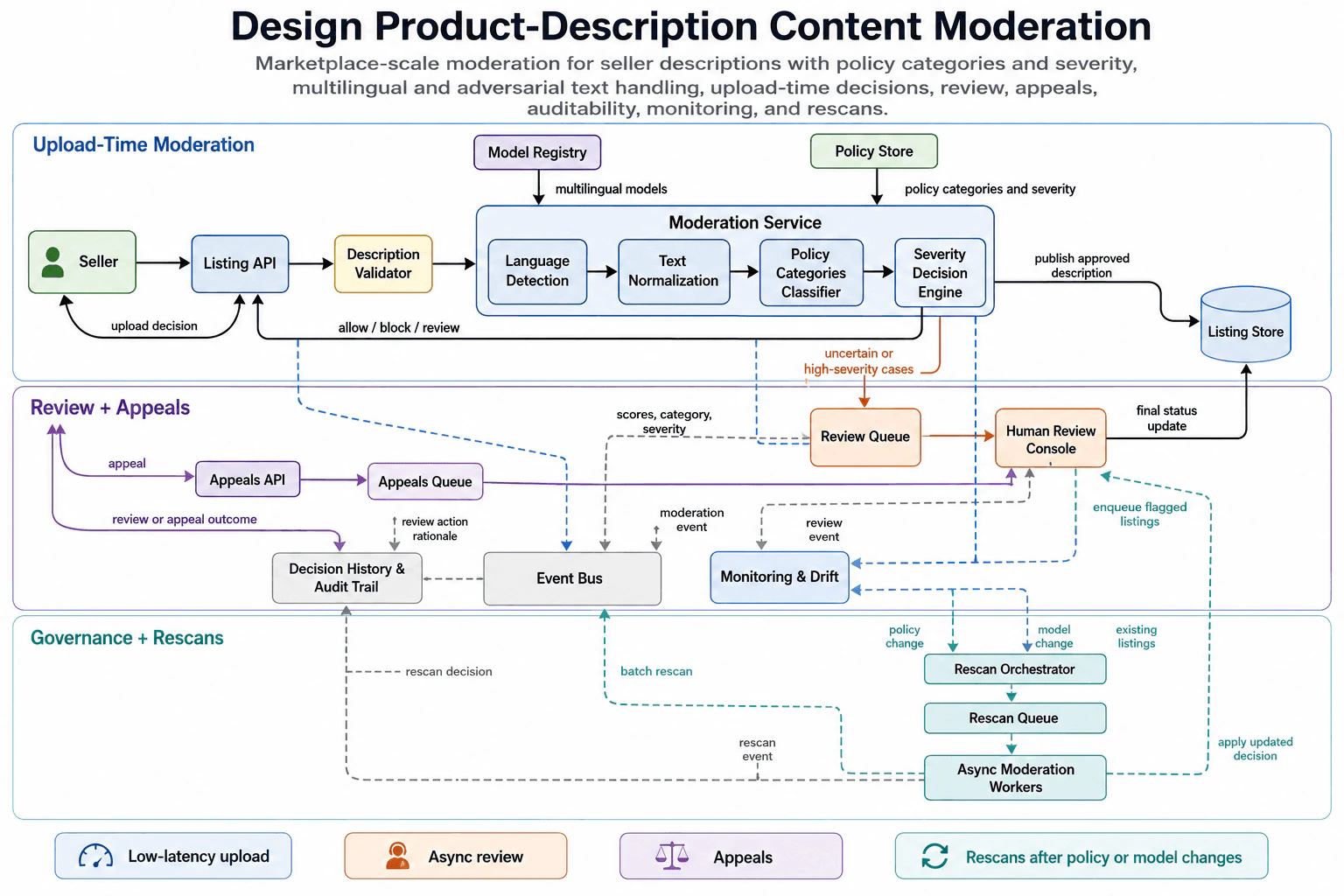
The goal is to detect inappropriate seller text before it reaches the marketplace. The hard part is keeping uploads fast while handling many languages, unusual spelling, hidden text tricks, and changing policies. The diagram solves this with three connected paths: upload-time moderation, review and appeals, and background rescans.
Useful Questions to Ask the Interviewer
Which user flows and system capabilities are required for the first version?
What traffic, data volume, latency, and availability targets should I design for?
Which consistency, security, geographic, and cost constraints matter most?
How to Explain It in an Interview
1. Explain the fast upload path
I would start with the path used for every new description. The Seller sends text to the Listing API. The Description Validator checks that the submitted description is usable.
The request then enters the Moderation Service. Language Detection identifies the language. Text Normalization makes different spellings and text forms easier to compare. It can also reduce simple adversarial tricks, which are attempts to hide harmful words.
The Policy Categories Classifier finds the policy areas that may apply. The Severity Decision Engine then returns allow, block, or review. The Listing API sends that upload decision back to the Seller.
When the description is approved, the moderation path publishes it to the Listing Store. This keeps clear cases on a short path.
2. Explain policies, models, and decisions
The Policy Store provides policy categories and severity guidance. The Model Registry provides the multilingual models used by moderation.
Keeping these inputs separate makes changes easier to manage. A policy update can change what is allowed. A model update can improve language understanding without changing the whole upload flow.
The Severity Decision Engine separates clear cases from uncertain cases. Uncertain or high-severity cases move to the Review Queue instead of being published automatically.
3. Explain human review and appeals
The Review Queue sends difficult cases to the Human Review Console. A reviewer can inspect the description and make the final decision.
The console sends the final status update to the Listing Store. This gives serious or unclear cases a human check before the marketplace uses the result.
A Seller can challenge a decision through the Appeals API. The appeal waits in the Appeals Queue and then reaches the Human Review Console. The final review or appeal outcome returns to the Seller.
4. Explain audit records, events, and monitoring
Decision History & Audit Trail records moderation scores, category, and severity. It also records the reviewer action and rationale. A rationale is the reason behind the decision.
The Severity Decision Engine sends a moderation event to the Event Bus. Human review sends a review event. Async Moderation Workers send a rescan event.
Monitoring & Drift receives signals from the Listing API, Moderation Service, Human Review Console, and Async Moderation Workers. Drift means model results change over time. This view helps the team find unusual decisions, slow processing, or growing work queues.
5. Explain rescans and trade-offs
A policy change, model change, or existing listing can trigger the Rescan Orchestrator. It sends work to the Rescan Queue. Async Moderation Workers then process listings in the background.
The workers run batch rescans through the Moderation Service. They apply updated decisions to the Listing Store. Flagged listings are sent to the Human Review Console. Rescan decisions also enter the audit and event paths.
The benefit is fast uploads with deeper checks in the background. The downside is that reviews and large rescans may finish later.
Engineering Considerations / Design Trade-offs
The benefit is a short path for clear upload decisions. Difficult cases move to human review instead of slowing every seller. The Review Queue, Appeals Queue, and Rescan Queue also hold work when it cannot finish immediately. The downside is delay. A seller may wait for a reviewer, and old listings may wait for a rescan. Audit records and events make decisions easier to inspect, but they create more background work. Policy and model changes can improve safety, but they may trigger many rescans. We accept these costs because the system needs both fast uploads and careful moderation.
Why Interviewers Ask This
Interviewers use this question to test how you divide one large safety problem into clear flows. They want to see how you balance quick automatic decisions with human judgment. They also check whether you understand appeals, audit records, monitoring, and policy changes. A strong answer explains how old listings are checked again without slowing normal uploads.
Interviewer may ask next
How would the design handle a major policy change that requires rescanning billions of existing listings?
I would keep the same design and use the background rescan path more heavily. The policy change would reach the Rescan Orchestrator from the Policy Store. The orchestrator would organize existing listings from the Listing Store and place the work in the Rescan Queue.
Async Moderation Workers would take listings in batches. Each batch would pass through the same Moderation Service used for new uploads. This keeps new descriptions and old descriptions under the same policy logic.
Clear updated decisions would be applied to the Listing Store. Flagged listings would be sent to the Human Review Console. Each rescan decision would also reach Decision History & Audit Trail and the Event Bus.
Monitoring & Drift would show progress and unusual result changes. The main downside is time. Billions of listings cannot be checked at once, so some listings may keep their earlier status until their batch finishes.
What would change if every high-severity description required human approval before publishing?
I would change the Severity Decision Engine so every high-severity result enters the Review Queue. Those descriptions would not be published automatically to the Listing Store.
The Human Review Console would become the final approval point for these cases. A reviewer would inspect the description and send the final status update to the Listing Store. The Seller would receive the review outcome through the existing response path.
Decision History & Audit Trail would keep the severity result, reviewer action, and reviewer rationale. The Event Bus would still receive separate moderation and review events. Monitoring & Drift would watch the larger review workload and longer waiting times.
This change keeps high-risk decisions under human control. It also preserves the current architecture and its audit path. The main downside is slower publishing. The Review Queue may grow quickly, and more human reviewers may be needed.
35. Design over-the-air delivery of car software updates.System DesignHardMicrosoft
i Question Details
A large car software update is split into packages for delivery. Design the system so vehicles can download and apply the update reliably when packages may be lost, duplicated, delayed, or received out of order.
Short Interview Answer (30-60 seconds)
At a high level, the system must receive every update package before changing the car software. The main challenge is unreliable delivery because packages can be lost, repeated, delayed, or received out of order. I would divide the design into release creation, reliable downloading, and safe activation. A manifest defines the expected package set. The vehicle retries only missing packages, removes duplicates, verifies integrity, and installs through staging. The trade-off is more vehicle-side storage and recovery logic.
Detailed Explanation
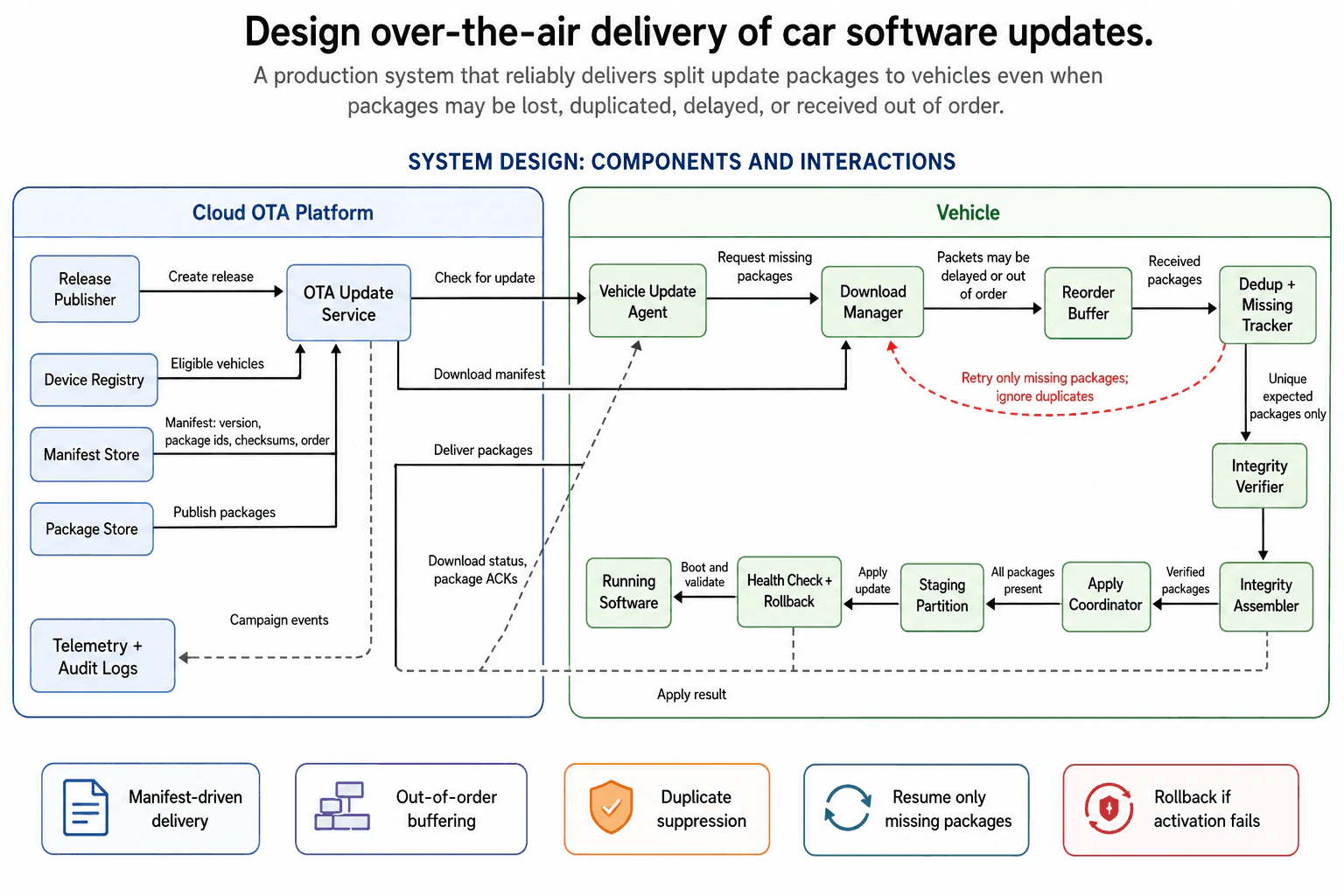
The system must deliver a large update without leaving the vehicle unusable. This is difficult because the network may lose, repeat, delay, or reorder packages. The diagram solves this in three parts. The Cloud OTA Platform prepares and offers the release. The vehicle downloads and verifies every required package. It then activates the update through staging, health checking, and rollback.
Useful Questions to Ask the Interviewer
Which user flows and system capabilities are required for the first version?
What traffic, data volume, latency, and availability targets should I design for?
Which consistency, security, geographic, and cost constraints matter most?
How to Explain It in an Interview
1. Prepare the release and define completeness
I would start with how the Cloud OTA Platform prepares an update. The Release Publisher creates a release through the OTA Update Service.
The OTA Update Service works with the Manifest Store and Package Store. The Package Store holds the split update packages. The Manifest Store holds the version, package identifiers, checksums, and expected order.
The manifest defines when the download is complete. The vehicle does not rely on package arrival order. It checks received identifiers against the expected package set.
The Device Registry provides the eligible vehicles. This lets the OTA Update Service offer the release only to the intended vehicles.
2. Check for an update and request packages
For the delivery path, the Vehicle Update Agent checks the OTA Update Service. It receives the update manifest and starts the download process.
The Download Manager asks for the missing packages. The Package Store delivers those packages. Some packages may arrive late or in the wrong order.
The Reorder Buffer holds these arrivals until they can be handled correctly. This keeps network arrival order separate from update package order.
3. Track progress and handle unreliable delivery
The Dedup + Missing Tracker records which package identifiers have arrived. It ignores duplicate packages because the same package may be delivered more than once.
It also finds gaps in the expected package set. The red retry path sends only missing package identifiers back to the Download Manager. Completed packages are not downloaded again.
This supports the diagram’s resume behavior. After a connection break, the vehicle continues with missing packages instead of restarting everything.
The Vehicle Update Agent reports download status and package ACKs. An ACK is a message confirming that a package was received.
4. Verify and assemble the full update
Each unique expected package moves to the Integrity Verifier. It checks the package checksum. A checksum is a small value used to detect damaged data.
Verified packages move to the Integrity Assembler. The Apply Coordinator waits until all packages are present. This prevents a partial update from being applied.
5. Activate safely and report the result
The Apply Coordinator applies the update to the Staging Partition. Staging is a separate area used before the new software becomes active.
The Health Check + Rollback step boots and validates the staged update. If validation succeeds, it becomes the Running Software. If activation fails, rollback keeps or restores the working software.
The apply result returns to the OTA Update Service. Campaign events, download status, package ACKs, and update results are recorded in Telemetry + Audit Logs.
The main trade-off is extra state, storage, and recovery logic inside the vehicle. That added complexity is useful because it avoids partial installs and repeated downloads.
Engineering Considerations / Design Trade-offs
The benefit is reliable delivery over an unreliable network. The manifest gives the vehicle a clear list of required packages. The missing tracker saves progress and retries only unfinished work. This reduces repeated downloads. The reorder buffer and duplicate checks add more memory and logic inside the vehicle. Integrity checks add processing before installation. Staging and rollback also need extra storage because the working software must remain safe during activation. We accept these costs because a broken car update is much worse than a slower update. The design chooses safety and recovery over the simplest download process.
Why Interviewers Ask This
Interviewers use this question to test how you handle unreliable delivery and safe software changes. They want to see whether you separate release creation, downloading, verification, and activation. They also expect clear handling of missing, repeated, delayed, and out-of-order packages. A strong answer explains why the manifest, saved progress, integrity checks, staging, health validation, and rollback are needed.
Interviewer may ask next
What changes if a vehicle loses connectivity for several days during the download?
I would keep the same design and rely on the saved package progress. The Dedup + Missing Tracker already knows which package identifiers arrived before the connection stopped.
When connectivity returns, the Vehicle Update Agent checks the update again. The Download Manager requests only the packages still missing from the expected manifest set. Packages already received are not downloaded again. Repeated deliveries are still ignored.
Every new package still passes through the Reorder Buffer and Integrity Verifier. The Apply Coordinator still waits until the complete verified set is present. This keeps the update correct even after a long interruption.
The vehicle reports updated download status and package ACKs when the connection returns. The main downside is local storage. The vehicle must keep partial packages and tracking state for a longer time. It also needs cleanup rules after the update finishes or is cancelled.
How should the system behave when every package arrives, but the new software fails its health check?
The vehicle should not download the whole update again. Package delivery already succeeded, and the Integrity Verifier confirmed the package data.
The Apply Coordinator has placed the update in the Staging Partition. The Health Check + Rollback step then boots and validates that staged software. When the check fails, the new software must not become the Running Software.
Rollback keeps or restores the previous working software. The vehicle sends the failed apply result to the OTA Update Service. The result is also recorded in Telemetry + Audit Logs with the related campaign events.
This keeps the vehicle usable even when the release contains a bad update. The main downside is extra storage and activation time. The vehicle must preserve a working version while testing the staged version. The rollback path also needs careful testing because it is the final safety step.
36. Externally sort a 500 GB CSV by one column using a machine with 16 GB of RAM.System DesignMediumMicrosoft
i Question Details
Design an external merge-sort solution for a CSV much larger than available memory. Explain chunking, sorting runs, k-way merging, disk I/O, and the important CSV-handling and failure-recovery considerations.
Short Interview Answer (30-60 seconds)
At a high level, the goal is to sort a 500 GB CSV using only 16 GB of RAM. The main challenge is that the whole file cannot fit in memory. I would explain the design in two phases: create sorted runs, then merge them. The system reads complete CSV rows, sorts memory-sized chunks, and writes each run to disk. A K-Way Merge Engine combines those runs into one output CSV. The trade-off is extra disk work and temporary storage.
Detailed Explanation
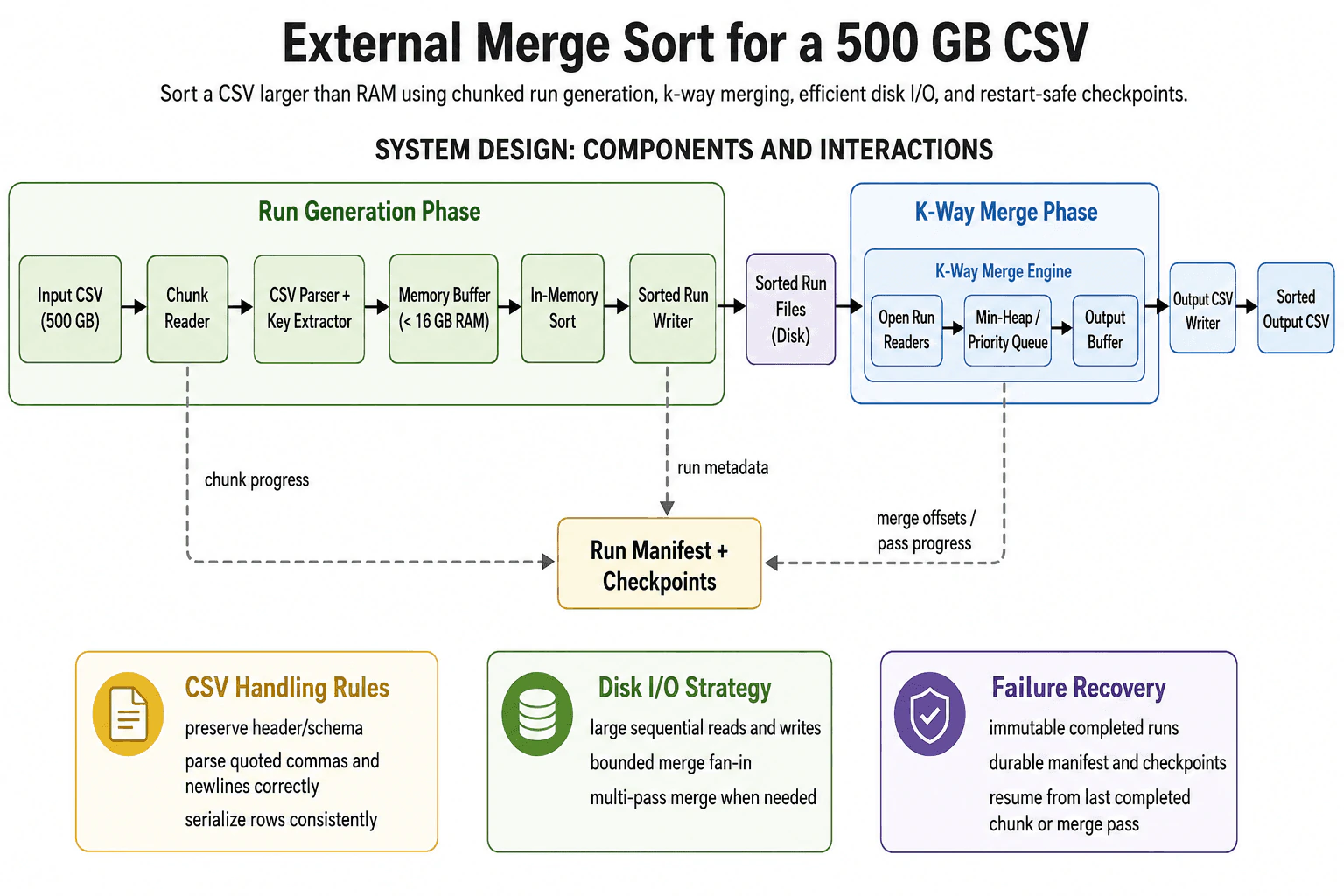
The goal is to sort a 500 GB CSV by one column. The machine has only 16 GB of RAM, so the complete file cannot be loaded at once. The design solves this with two phases. The Run Generation Phase creates smaller sorted files on disk. The K-Way Merge Phase combines those files into one Sorted Output CSV. The Run Manifest + Checkpoints records completed work and supports safe recovery.
Useful Questions to Ask the Interviewer
Which user flows and system capabilities are required for the first version?
What traffic, data volume, latency, and availability targets should I design for?
Which consistency, security, geographic, and cost constraints matter most?
How to Explain It in an Interview
1. Explain the main idea
I would start by calling this an external merge sort. External means the algorithm uses disk because memory is limited. The Memory Buffer must remain below 16 GB. I would also leave memory for parsing, sorting, and output buffers.
The first phase creates Sorted Run Files. Each run contains rows already ordered by the selected column. The second phase merges those runs without loading them completely into memory.
2. Create the sorted runs
The Input CSV first enters the Chunk Reader. It reads a limited amount of data for each pass. It must not treat an arbitrary byte boundary as a row boundary.
The CSV Parser + Key Extractor builds complete CSV rows. It correctly handles quoted commas and quoted newlines. It also extracts the selected column used as the sort key.
Complete rows enter the Memory Buffer. The In-Memory Sort orders them by that key. The Sorted Run Writer then serializes every full row and writes one Sorted Run File to disk.
This process repeats until the complete 500 GB input is processed. The header and schema stay consistent. The header should appear once in the final output, not once per run.
3. Merge the sorted run files
The K-Way Merge Engine opens a bounded number of run files. Bounded fan-in means it limits how many runs are open together. This protects memory and file handles.
The Open Run Readers provide the next row from every active run. The Min-Heap / Priority Queue stores those current rows. A min-heap keeps the smallest sort key at the top.
The engine removes the smallest row and sends it to the Output Buffer. It then reads the next row from the same run. This continues until every active run is empty.
The Output CSV Writer writes buffered rows sequentially. It produces the final Sorted Output CSV. If all runs cannot be opened together, the system performs several merge passes.
4. Use disk efficiently
The design favors large sequential reads and writes. Sequential access is faster than many small random disk operations. The Memory Buffer and Output Buffer reduce the number of disk calls.
Temporary Sorted Run Files require extra disk space. A multi-pass merge also reads and writes some data more than once. The benefit is predictable memory use.
5. Recover from failures
The Run Manifest + Checkpoints records chunk progress and run metadata. It also records completed merge passes and their progress information. Completed run files stay unchanged and can be reused.
After a failure, the system resumes from the last completed chunk or merge pass. It should discard any incomplete output from the failed step before restarting that step. This avoids mixing partial data with confirmed output.
The main trade-off is simple. The design uses more disk work and temporary storage. In return, it safely sorts a file much larger than RAM.
Engineering Considerations / Design Trade-offs
The benefit is predictable memory use. The system never needs to hold the full 500 GB file in RAM. Creating each run sorts only one memory-sized chunk. During merging, the min-heap chooses the next row efficiently. The downside is extra disk work. Temporary run files need storage, and every merge pass reads and writes data again. A small merge fan-in may require more passes. Checkpoints also add a little writing. We accept these costs because they make the job restart-safe and allow the sort to finish within the 16 GB memory limit.
Why Interviewers Ask This
Interviewers ask this to test whether you can solve a large-data problem under a hard memory limit. They want to see clear thinking about chunking, CSV parsing, sorting runs, k-way merging, and disk access. They also check whether you notice failure recovery, temporary storage, and the trade-off between merge fan-in and extra merge passes.
Interviewer may ask next
What would you change if the machine could open only a small number of run files at once?
I would keep the same design and reduce the merge fan-in. Fan-in means the number of Sorted Run Files opened during one merge. The Open Run Readers would open only the allowed number of files.
The Min-Heap / Priority Queue would still choose the smallest current row. Each group of runs would be merged into a larger sorted run. The system would then repeat the process through several merge passes.
The Run Manifest + Checkpoints would record every completed pass and its output files. If a failure occurs, the next attempt can reuse those completed files. Correctness stays the same because every pass merges already sorted inputs in key order.
The main downside is extra disk work. More passes require additional reads, writes, time, and temporary storage.
How would the design recover if the process crashes during a merge pass?
I would restart from the last confirmed checkpoint. The Run Manifest + Checkpoints records merge offsets or pass progress. It also identifies the completed Sorted Run Files used by that pass.
Completed runs remain unchanged, so the system can safely open them again. Any incomplete output created by the failed merge should be removed or ignored. The K-Way Merge Engine then restarts the unfinished merge step and produces a clean output file.
After the pass finishes, the system records the new run metadata before moving forward. This prevents a partial file from being treated as completed work. It also avoids rebuilding runs from earlier completed chunks.
The main downside is that some work from the failed merge step may be repeated. More frequent checkpoints reduce repeated work, but they add extra disk writes.
37. What motivates you in your work?BehavioralMediumMicrosoft
Interview tip:
Use STAR to structure your answer: briefly explain the Situation and Task, make Action the most detailed part, and finish with the Result. For example, describe a project where solving a real user problem motivated you to understand the cause, improve the Python solution, work closely with the team, and deliver a reliable result.
Situation
In my last role, an internal team depended on a Python service to process data and prepare daily reports. The service often failed when the input contained unexpected values. People had to restart jobs and check the output by hand. I was motivated because the problem affected real users and gave me a clear chance to make their work easier.
Task
I was responsible for finding the cause and making the service more reliable. My goal was not only to stop the immediate failures. I also wanted to make future problems easier to detect and fix.
Action
I first spoke with the users to understand when the failures happened and which reports were most important. This helped me focus on the real impact instead of guessing from the code alone. I then reviewed the application logs and reproduced the issue with sample input. I found that the service assumed several fields would always contain valid values. I added clear validation before processing so bad input could be handled safely. I also improved the error messages so users could understand what went wrong without reading Python stack traces. I wrote automated tests for normal input, missing values, and invalid formats because tests would protect the fix during future changes. I shared my findings with the team, explained why the failures occurred, and asked another developer to review the changes. What motivated me throughout the work was seeing a direct link between careful engineering and a better daily experience for the users.
Result
The service became more stable, and users no longer needed to repeat the same manual recovery steps for those input problems. The team also had clearer tests and error messages for future support. I learned that I am most motivated when I can solve a useful problem, understand its root cause, and leave the system easier to maintain than I found it.
Why Interviewers Ask This
Interviewers ask this question to understand what gives a candidate energy, how that motivation affects daily work, and whether it fits the role. A strong answer shows that the candidate is driven by meaningful results, steady learning, quality work, and helping users or teammates rather than only external rewards.
Interviewer may ask next
How did you stay motivated while investigating the repeated failures?
I stayed motivated by keeping the user impact visible. Each failure created extra manual work, so every step toward the root cause had a clear purpose. I also divided the investigation into small goals, such as reproducing the issue, confirming the bad assumption, and testing the fix.
What would you do differently on a similar project now?
I would add input validation and clearer monitoring earlier in the service design. I would also speak with the users sooner because their examples helped me identify the most important failure cases and avoid spending time on less useful changes.
38. How are AI tools helping you in your projects?BehavioralMediumMicrosoft
Interview tip:
Use STAR to structure your answer: briefly explain the Situation and Task, make Action the most detailed part, and finish with the Result. For example, describe a realistic Python project where you used AI tools to understand unfamiliar code, create an initial solution, improve tests, review risks, verify every suggestion, communicate limits clearly, and deliver a more reliable result.
Situation
During a previous project, my team was improving a Python service that processed incoming data and stored validated records. The code had grown over time, and some parts were difficult to understand. We also had limited test coverage, so even a small change could create an unexpected issue.
Task
I was responsible for adding a new validation rule without breaking the existing data flow. I also wanted to improve the surrounding tests and make the code easier for the team to maintain. I decided to use AI tools as an assistant, but I remained responsible for every technical decision and every line that entered the codebase.
Action
I first used an AI coding tool to summarize the relevant modules and trace how data moved through the service. I compared that explanation with the actual Python code instead of assuming it was correct. This helped me find the main validation path and the places where errors were handled. I then asked the tool to suggest a few implementation options. I reviewed each option for readability, performance, and compatibility with our existing patterns. I rejected one suggestion because it changed shared behavior that was outside the task. I chose a smaller change that kept the new rule isolated. Next, I used the tool to create an initial set of unit test ideas, including valid input, missing fields, incorrect types, and unexpected values. I wrote and adjusted the final tests myself because the generated examples did not fully match our data model. I also checked the solution with static analysis, local tests, and a manual review of edge cases. During the team review, I explained where AI had helped, which suggestions I had rejected, and how I had verified the final code. This made the process clear and allowed the team to review the reasoning, not only the final result.
Result
The new validation rule was added without changing the existing behavior. The related code became easier to understand, and the added tests gave the team more confidence when making later changes. The main lesson for me was that AI tools are most useful when they speed up exploration and provide ideas, while the developer still verifies the facts, protects the system design, and owns the final decision.
Why Interviewers Ask This
Interviewers ask this question to understand whether the candidate uses AI tools with good technical judgment. A strong answer shows that the candidate can gain speed without trusting generated output blindly, protect code quality and sensitive information, verify suggestions, and remain accountable for the final result.
Interviewer may ask next
How did you verify that the AI suggestions were correct?
I compared each suggestion with the existing code, data model, and project conventions. I then ran unit tests, static analysis, and manual edge case checks. I also reviewed the final change line by line before asking the team to review it.
What would you avoid sharing with an AI tool?
I would avoid sharing secrets, credentials, private customer data, internal access details, or any source code that company policy does not allow me to share. I would use approved tools and remove sensitive context before asking for help.
39. How would you improve a Microsoft product you use regularly?BehavioralMediumMicrosoft
Interview tip:
Use STAR to structure your answer: briefly explain the Situation and Task, make Action the most detailed part, and finish with the Result. For example, describe a recurring problem you noticed while using a Microsoft product, how you confirmed the user need, how you designed and tested a practical improvement, how you handled privacy and usability concerns, and how you would evaluate whether the change helped users.
Situation
I use Microsoft Teams regularly for technical discussions. In my last role, developers often shared Python code in chat while investigating production issues. Long code samples were difficult to read, indentation could be unclear, and important explanations became separated from the exact lines they described.
Task
I wanted to improve the code sharing experience without turning Teams into a full development environment. My goal was to help developers review small code samples quickly while keeping the normal chat experience simple for other users.
Action
I would add a structured code review option to the existing code block feature. A user could select Python as the language, see clear syntax highlighting, and attach a comment to a specific line. I would first interview developers, testers, and support engineers to confirm that line based comments solve a common problem rather than only my own problem. I would also review anonymized usage patterns, with proper privacy controls, to understand how often people share code and how large those samples are. Next, I would build a small prototype and test it with users who frequently discuss code in Teams. I would keep the feature optional so regular conversations remain unchanged. I would set limits on code size because large files should still be reviewed in a source control tool. I would also make sure pasted secrets are detected and that users receive a warning before sending sensitive values such as access tokens. Finally, I would work with design, security, accessibility, and engineering teams to refine the experience. I would measure whether users can understand and respond to code discussions more easily, while checking that the feature does not add confusion or slow down chat.
Result
This approach would make short technical discussions clearer and reduce the need to copy every small example into another tool. It would also preserve Teams as a communication product rather than trying to replace a code review platform. The main lesson I have learned from similar improvement work is to begin with a real user problem, test the smallest useful change, and include security and accessibility from the start.
Why Interviewers Ask This
Interviewers ask this question to evaluate product thinking, customer focus, technical judgment, and the ability to turn an observation into a practical improvement. A strong answer shows that the candidate can identify a real user problem, validate assumptions, consider tradeoffs, collaborate with different teams, and define how success should be evaluated.
Interviewer may ask next
Why would you add this feature to Teams instead of directing users to a code review tool?
I would only support short code discussions that already happen naturally in chat. Full reviews, approval rules, and large changes should remain in a source control tool. The purpose is to make quick conversations clearer, not to duplicate an existing development platform.
What would you do if users found the feature confusing?
I would review where users became confused, simplify the entry point, and test the revised flow with both technical and nontechnical users. Because the feature is optional, I could also reduce its visibility until the experience was clear and useful.
40. How do you handle technical debt when there is a deadline?BehavioralMediumMicrosoft
Interview tip:
Use STAR to structure your answer: briefly explain the Situation and Task, make Action the most detailed part, and finish with the Result. For example, describe a project with a fixed deadline where you identified technical debt, separated urgent risks from work that could wait, communicated the tradeoffs, documented the remaining debt, and created a clear plan to address it after delivery.
Situation
In my last role, my team had a fixed deadline for a Python service update. While reviewing the code, I found duplicated validation logic, weak test coverage, and a database access function that was difficult to maintain. Rewriting everything before the release would have placed the deadline at risk.
Task
I was responsible for delivering my part of the update without creating avoidable production problems. I also needed to make sure that any technical debt we accepted was visible, understood, and planned instead of being forgotten after the release.
Action
I first separated the issues by risk. I treated anything related to data correctness, security, or likely production failure as required work before release. I moved lower risk cleanup, such as removing duplication and improving internal structure, into a documented follow up plan. I explained this choice to the team and showed how each item could affect the release. For the database function, I made a small and safe change that added clear error handling and tests without attempting a full redesign. For the duplicated validation logic, I kept the existing structure for the deadline but added tests around the most important cases so future refactoring would be safer. I created work items for the remaining debt with context, affected files, expected improvements, and clear completion criteria. I also asked the team to review the priorities so the decision was shared and visible. After the release plan was agreed, I reserved time in the next development cycle to address the highest priority debt first.
Result
We delivered the update on time without ignoring the most serious risks. The release remained stable, and the team had a clear record of what we had postponed and why. We later improved the validation structure and database code with the support of the tests added before release. I learned that technical debt is sometimes a reasonable tradeoff, but it must be deliberate, limited, documented, and followed by a real plan.
Why Interviewers Ask This
Interviewers ask this question to evaluate how a candidate balances delivery speed with software quality. A strong answer shows practical judgment, risk based prioritization, clear communication, ownership of deferred work, and the discipline to prevent temporary compromises from becoming permanent problems.
Interviewer may ask next
How did you decide which technical debt had to be fixed before the deadline?
I focused on the possible impact of each issue. Problems that could cause incorrect data, security concerns, or production failures had to be addressed before release. Cleanup that mainly affected readability or future maintenance could wait if it was documented and planned.
What would you do if the team did not have time to address the remaining debt after release?
I would bring the items back into planning with clear evidence of their impact, such as slower changes, repeated defects, or difficult testing. I would suggest handling the highest risk item in small steps instead of waiting for a large rewrite, and I would keep the tradeoff visible to the team and product owner.
More questions load as you scroll
Disclaimer: This interview guide is for educational and informational purposes only. It is designed to help readers prepare, but it does not guarantee any interview result, hiring decision, offer, or outcome. Interview questions, hiring criteria, and preferred answers can vary by employer, interviewer, industry, location, and time. All answers, examples, and explanations in this guide are suggested examples for interview preparation, not definitive answers or instructions for professional practice. They are based on research and judgment, are provided without warranties of any kind, and should be adapted to the question, role, and applicable laws and professional requirements. Diagrams are simplified illustrations intended to highlight the main concepts and their relationships; actual situations, systems, and practices may be more complex. Alternative approaches may be equally valid or better suited to a particular question, context, or interviewer. To the fullest extent permitted by applicable law, the contributors and publisher are not liable for decisions made, actions taken, or losses incurred based on this guide.
State Laws and Professional Responsibilities: Laws and requirements governing an occupation vary by state and jurisdiction. You are responsible for checking the current laws, licensing requirements, and scope-of-practice rules that apply to your location and role, and for ensuring that your answers and actions comply with them. Adapt examples in this guide to those requirements. This guide is not legal advice.
Company Notice: This guide is an independent educational resource and is not affiliated with, endorsed by, sponsored by, or approved by the company named in this guide. Company names identify reported interview experiences or the employer context of clearly labeled original practice exercises. Interview practices can change without notice, and inclusion of company-specific content does not mean these questions are official, complete, or guaranteed to be asked. To the fullest extent permitted by law, the author, contributors, and publisher are not responsible for outcomes related to use of this material.
Content Accuracy and Verification: To the fullest extent permitted by applicable law, we do not represent or warrant that interview guides, questions, answers, examples, or diagrams are accurate, complete, current, error-free, or suitable for any particular purpose. You are responsible for independently reviewing and verifying the information before relying on it.