This interview guide is for educational and informational purposes only. It is designed to help readers prepare, but it does not guarantee any interview result, hiring decision, offer, or outcome. Interview questions, hiring criteria, and preferred answers can vary by employer, interviewer, industry, location, and time. All answers, examples, and explanations in this guide are suggested examples for interview preparation, not definitive answers or instructions for professional practice. They are based on research and judgment, are provided without warranties of any kind, and should be adapted to the question, role, and applicable laws and professional requirements. Diagrams are simplified illustrations intended to highlight the main concepts and their relationships; actual situations, systems, and practices may be more complex. Alternative approaches may be equally valid or better suited to a particular question, context, or interviewer. To the fullest extent permitted by applicable law, the contributors and publisher are not liable for decisions made, actions taken, or losses incurred based on this guide.
State Laws and Professional Responsibilities
Laws and requirements governing an occupation vary by state and jurisdiction. You are responsible for checking the current laws, licensing requirements, and scope-of-practice rules that apply to your location and role, and for ensuring that your answers and actions comply with them. Adapt examples in this guide to those requirements. This guide is not legal advice.
Identity, Image, and Privacy Notice
To respect individual privacy, some names, profile photographs, avatars, biographical details, and other identifying information displayed in this guide may be replaced with pseudonyms, licensed stock images, illustrative avatars, composite images, or representative descriptions. Unless a person is expressly identified as an actual contributor, a displayed name, image, or profile should not be understood as depicting or identifying a specific candidate, interviewer, employee, or other real individual. These representations are provided for editorial and illustrative purposes only and do not imply endorsement, employment, participation, or affiliation with this guide or any company mentioned in it. Any resemblance to an actual person is coincidental.
Company Notice
This guide is an independent educational resource and is not affiliated with, endorsed by, sponsored by, or approved by the company named in this guide. Company names identify reported interview experiences or the employer context of clearly labeled original practice exercises. Interview practices can change without notice, and inclusion of company-specific content does not mean these questions are official, complete, or guaranteed to be asked. To the fullest extent permitted by law, the author, contributors, and publisher are not responsible for outcomes related to use of this material.
Content Accuracy and Verification
To the fullest extent permitted by applicable law, we do not represent or warrant that interview guides, questions, answers, examples, or diagrams are accurate, complete, current, error-free, or suitable for any particular purpose. You are responsible for independently reviewing and verifying the information before relying on it.
Questions or comments?
Contact us for general questions, or share feedback, technical corrections, and comments with the community.
Explain how zip combines iterables element by element, when iteration stops, how strict mode changes mismatch handling, and how zipped pairs can be unpacked.
Short Interview Answer (30-60 seconds)
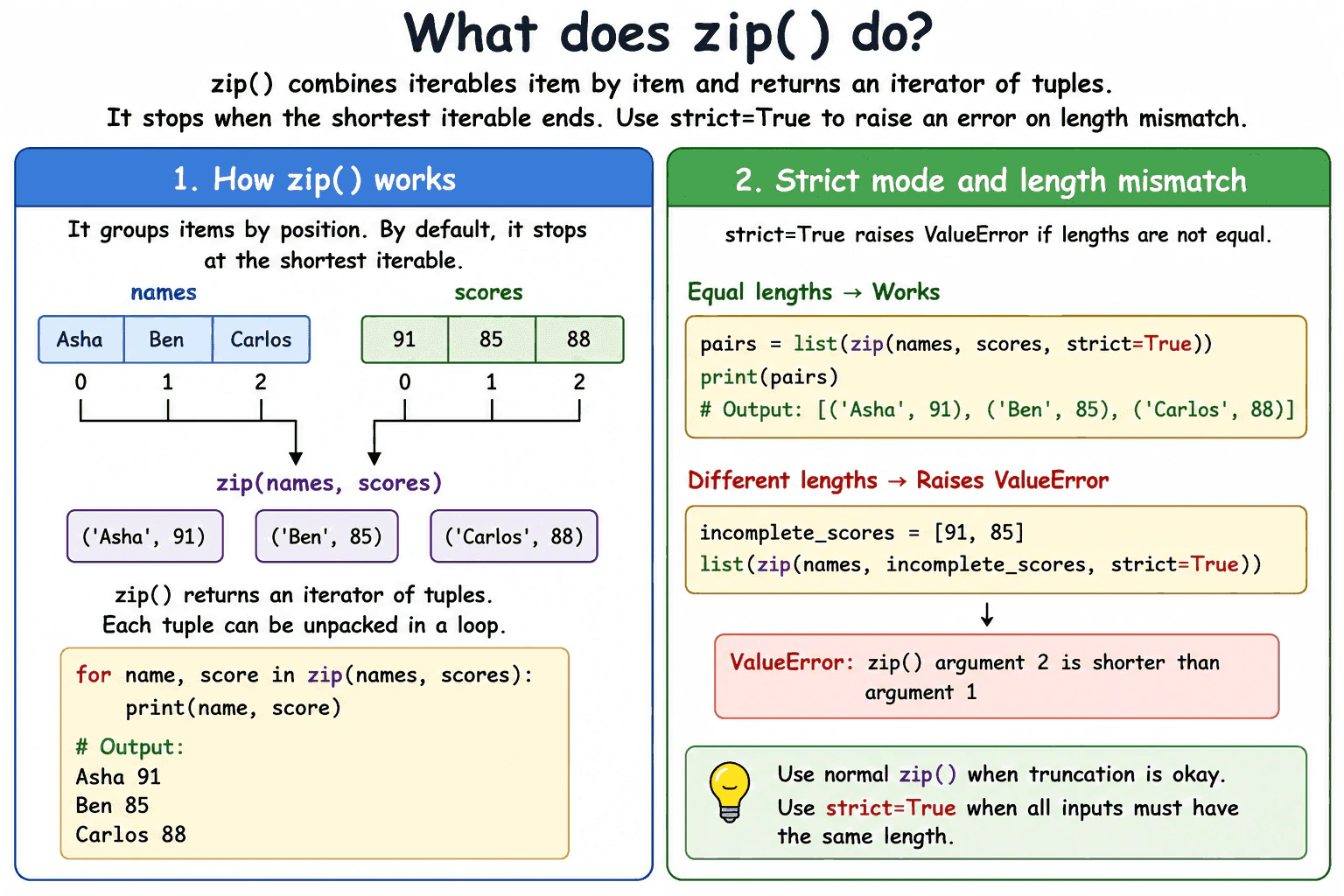
zip() combines two or more iterables one position at a time and returns an iterator of tuples. By default, it stops when the shortest iterable ends. I use strict=True when every iterable must contain the same number of values. The values in each tuple can be unpacked directly inside a loop.
Use zip() when values from different iterables belong together by position. For example, it can combine a list of names with a list of scores. The first name is paired with the first score, the second name with the second score, and so on.
Useful Questions to Ask the Interviewer
Should I focus on Python language behavior, or also explain the runtime and standard library?
Which Python version and execution environment should I assume?
Would you like a small code example together with production tradeoffs and edge cases?
zip() returns an iterator. It creates each tuple only when iteration requests it. It does not build a complete list of results in advance. This keeps its additional memory use small, although the input iterables still remain in memory if they are stored collections.
By default, zip() stops when the shortest iterable ends. Any remaining values in longer iterables are not included. This is useful when truncation is intentional, but it can silently hide missing data.
Use strict=True when all inputs must have equal lengths. Python then raises ValueError when one iterable ends before the others. This behavior is useful when mismatched data should be rejected instead of ignored.
Each generated tuple can be unpacked directly, such as for name, score in zip(names, scores). A zip object is normally consumed as it is iterated. Convert it to a list only when the complete result must be stored, indexed, or reused.
Example
The example combines names and scores by position. The first loop uses strict=True because each name must have exactly one score. Each generated tuple is unpacked into name and score. The next statement creates a dictionary from the same matching values. The final example shows that strict=True raises ValueError when one input ends before the other.
Code
names = ["Asha", "Ben", "Carlos"]
scores = [91, 85, 88]
# Combine matching values and require equal input lengthsfor name, score inzip(names, scores, strict=True):
# Unpack each tuple into a name and its matching scoreprint(f"{name}: {score}")
# Build a dictionary from the same matching values
score_by_name = dict(zip(names, scores, strict=True))
print(score_by_name)
incomplete_scores = [91, 85]
try:
# Force complete iteration so the length mismatch is detected herelist(zip(names, incomplete_scores, strict=True))
except ValueError as error:
print(f"Length mismatch: {error}")
Where it is used
zip() is used when looping through related columns, combining identifiers with values, creating dictionaries from keys and values, comparing corresponding items, and processing matching configuration settings. strict=True is useful in production when unequal input lengths indicate missing, incomplete, or incorrectly prepared data.
Why Interviewers Ask This
Interviewers ask this question to check whether a candidate understands Python iteration, lazy evaluation, tuple unpacking, input length mismatches, and when silent truncation can create incorrect results.
Common interview mistakes
A common mistake is assuming zip() keeps all values from the longest iterable. Normal zip() stops at the shortest iterable and leaves remaining values unused. Another mistake is forgetting that zip() returns an iterator, so it is usually consumed after one complete pass. Developers may also use normal zip() when unequal lengths should be treated as invalid data. Another mistake is expecting strict=True to raise an error when the zip object is created. The mismatch is detected only when iteration reaches the point where one input ends before another. Unpacking into the wrong number of variables also raises an error.
Interview tip
Start by saying that zip() combines iterables by position. Then explain that it returns an iterator, normal zip() stops at the shortest input, strict=True raises ValueError during iteration for unequal lengths, and each tuple can be unpacked directly.
Interviewer may ask next
When does strict=True raise ValueError for inputs with different lengths?
It raises ValueError during iteration when Python discovers that one iterable has ended while another still has a value. Creating the zip object alone does not fully check the lengths because zip() is lazy. This matters when code expects the error immediately, so the iterator must be consumed before the mismatch is guaranteed to be detected.
What is the tradeoff between keeping a zip object and converting it to a list?
Keeping the zip object processes values lazily and uses only a small amount of additional memory for the iterator and current items. Converting it to a list stores every generated tuple, which uses memory in proportion to the number of pairs. A list is useful when the result must be indexed or reused, while the iterator is better for a single pass through large or generated inputs.
32. What do map() and filter() return in Python 3?Language SpecificEasy
i Question Details
Explain the lazy objects returned by map and filter, how their functions are applied, and when comprehensions may be clearer.
Short Interview Answer (30-60 seconds)
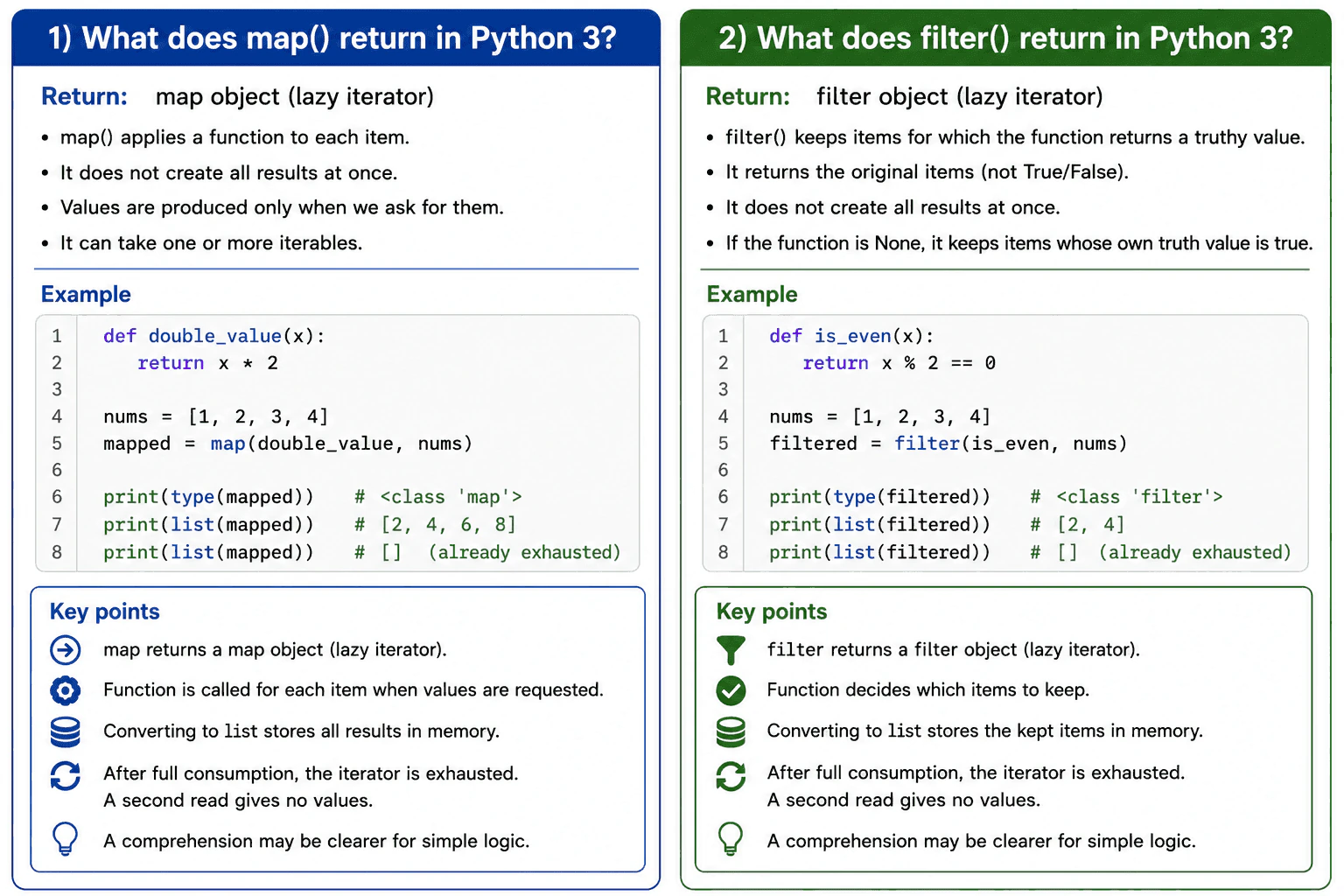
In Python 3, map() returns a map object, and filter() returns a filter object. Both objects are lazy iterators, so they produce values only when code requests them. map() transforms items by applying a function, while filter() keeps items whose test returns a true value. I convert the result to a list only when I need all values stored or need to read them more than once.
In Python 3, map() returns a map object, and filter() returns a filter object. Both are lazy iterators. Python does not calculate and store every result when these objects are created. It requests input values and calls the supplied function only as the result is consumed.
Useful Questions to Ask the Interviewer
Should I focus on Python language behavior, or also explain the runtime and standard library?
Which Python version and execution environment should I assume?
Would you like a small code example together with production tradeoffs and edge cases?
map() applies a function to each input item. It can accept more than one iterable and stops when the shortest iterable ends. For the numbers [1, 2, 3, 4], a doubling function produces 2, 4, 6, and 8.
filter() tests each item and returns the original item when the test is true. With an even number test, the same input produces 2 and 4. When the function is None, filter() keeps items whose own truth value is true.
Lazy evaluation supports processing one value at a time. If all n input items are consumed, the work is proportional to n. The iterator itself uses small extra memory, but converting it to a list stores all results and uses memory proportional to the result size.
These iterators are normally consumed once. Use comprehensions when they express simple logic more clearly.
Example
The example uses the numbers [1, 2, 3, 4] throughout. map() creates a lazy map object that doubles each number when the object is consumed. filter() creates a lazy filter object that keeps only even numbers. The program prints the exact object types before requesting the values. Converting each object to a list consumes it and produces [2, 4, 6, 8] for map() and [2, 4] for filter(). A second conversion of the same map object produces an empty list because that iterator has already been exhausted.
Code
defdouble_value(number):
# Return the transformed value used by map()return number * 2defis_even(number):
# Return True when filter() should keep the numberreturn number % 2 == 0# Use the same input for both examples
numbers = [1, 2, 3, 4]
# Create lazy iterator objects
mapped_values = map(double_value, numbers)
filtered_values = filter(is_even, numbers)
# Show the exact types returned in Python 3print(type(mapped_values))
print(type(filtered_values))
# Request and store every generated valueprint(list(mapped_values))
print(list(filtered_values))
# The map iterator is now exhaustedprint(list(mapped_values))
Where it is used
map() is useful when a processing pipeline applies the same named conversion to each record. filter() is useful when a pipeline passes only valid or relevant records to the next step. Their lazy behavior is valuable when inputs are large or arrive as a stream because the program can process one item at a time. A list comprehension is often clearer when the result must be stored immediately. A generator expression can provide similar lazy behavior when comprehension syntax is easier to understand.
Why Interviewers Ask This
Interviewers ask this question to check whether a candidate understands Python iterators and lazy evaluation. They also want to see whether the candidate knows when results are calculated, how iterator consumption affects later use, and when a comprehension may make the code easier to read.
Common interview mistakes
A common mistake is expecting map() and filter() to return lists in Python 3. Another mistake is expecting the function to run immediately when the iterator object is created. Printing the object itself does not display all generated values. A developer may also consume an iterator once and incorrectly expect it to return the same values again. Converting a large iterator to a list removes the main memory advantage of lazy processing. It is also incorrect to say that filter() returns the test results because it returns the original input items whose tests are true.
Interview tip
Begin by naming the exact return types. Then explain that both are lazy iterators and are normally consumed once. Clearly state that map() transforms values while filter() selects original values. Mention list conversion and comprehensions only after explaining the core runtime behavior.
Interviewer may ask next
What happens if the same map or filter object is consumed twice?
The second consumption normally produces no values because map and filter objects are iterators that become exhausted as values are requested. This matters when later code needs repeated access. The program can create a new iterator or store the first result in a list, but storing a list uses memory for every result.
When is a comprehension clearer than map() or filter()?
A comprehension is usually clearer when a simple transformation or condition can be read directly in one expression. A list comprehension creates all results immediately, while a generator expression remains lazy. map() is often clear with an existing named function, and filter() can be clear with a named test. The main tradeoff is readability together with whether the program needs stored results or one value at a time.
33. What do any() and all() do?Language SpecificEasy
i Question Details
Explain their Boolean aggregation behavior, short-circuiting, and the results for empty iterables.
Short Interview Answer (30-60 seconds)
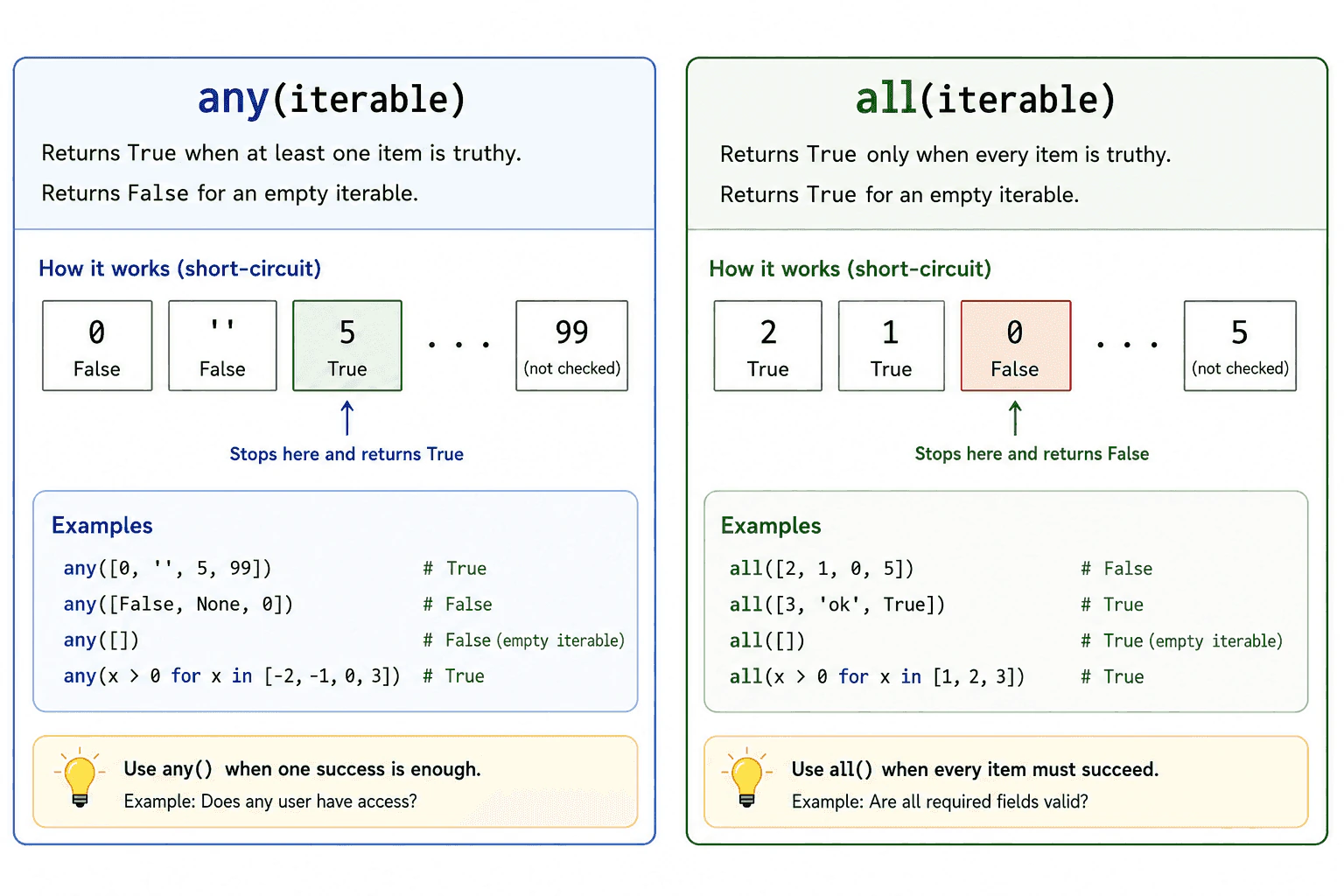
any() returns True when at least one item is truthy. all() returns True only when every item is truthy. Both stop as soon as the result is known. For an empty iterable, any() returns False and all() returns True.
Detailed Explanation
Use any() when one truthy result is enough. Use all() when every result must be truthy. Each function accepts an iterable and applies normal Python truth testing to its items. Values such as False, None, zero, an empty string, and an empty collection are falsy. Other objects are usually truthy unless their type defines different truth behavior.
Useful Questions to Ask the Interviewer
Should I focus on Python language behavior, or also explain the runtime and standard library?
Which Python version and execution environment should I assume?
Would you like a small code example together with production tradeoffs and edge cases?
any() returns True as soon as it reads one truthy item. It returns False if every item is falsy or the iterable is empty. all() returns False as soon as it reads one falsy item. It returns True if every item is truthy. It also returns True for an empty iterable because no falsy item breaks the condition.
This early stopping is called short circuit evaluation. If the result is found after k items, the time cost is proportional to k. In the worst case, every item is checked. The functions use constant extra memory while iterating, not counting the iterable itself. With an infinite iterable, a call may never finish if no decisive item appears. Truth testing can also raise an exception if an object defines faulty truth behavior. Use these functions for clear condition checks, but not when you need the matching item, the failing item, or a count.
Where it is used
any() is useful when checking whether at least one permission is granted, one search result matches, one feature flag is enabled, or one health check succeeds. all() is useful when confirming that every required field is valid, every dependency check succeeds, or every value meets a rule. They work well with generator expressions because values can be produced one at a time and evaluation can stop early. In production code, handle empty input separately when the business rule requires at least one item.
Why Interviewers Ask This
Interviewers ask this question to check whether a candidate understands truth testing, Boolean aggregation, short circuit evaluation, empty iterable behavior, and the effect of lazy iteration. It also tests whether the candidate can choose the correct function for validation and production condition checks.
Common interview mistakes
A common mistake is reversing the meanings of any() and all(). Another mistake is thinking they accept only literal True and False values, even though they apply Python truth testing to every item. Developers may incorrectly expect all() on an empty iterable to return False. Another mistake is creating a complete list before the call when a generator expression could reduce memory use and avoid unnecessary work. It is also incorrect to use these functions when the program must return the exact item that passed or failed.
Interview tip
Begin with the direct rule. Say that any() needs one truthy item, while all() needs every item to be truthy. Then mention short circuit evaluation and the empty iterable results. These details show that you understand both the visible result and the runtime behavior.
Interviewer may ask next
Why does all() return True for an empty iterable?
It returns True because the empty iterable contains no falsy item that violates the requirement. all() checks whether every observed item is truthy, and there is no counterexample. This matters in validation code because all() alone does not prove that at least one item exists. When at least one item is required, the program must check for that condition separately.
Why can a generator expression be better than a list with any() or all()?
A generator expression can produce one value at a time, so any() or all() can stop before evaluating every possible value. This can reduce extra memory use and unnecessary computation. The tradeoff is that a generator is consumed as it is read, and the call may never finish for an infinite generator when no decisive value appears.
34. What is PEP 8?Language SpecificEasy
i Question Details
Explain the purpose of Python's style guide and discuss its guidance on indentation, naming, imports, whitespace, and line length.
Short Interview Answer (30-60 seconds)
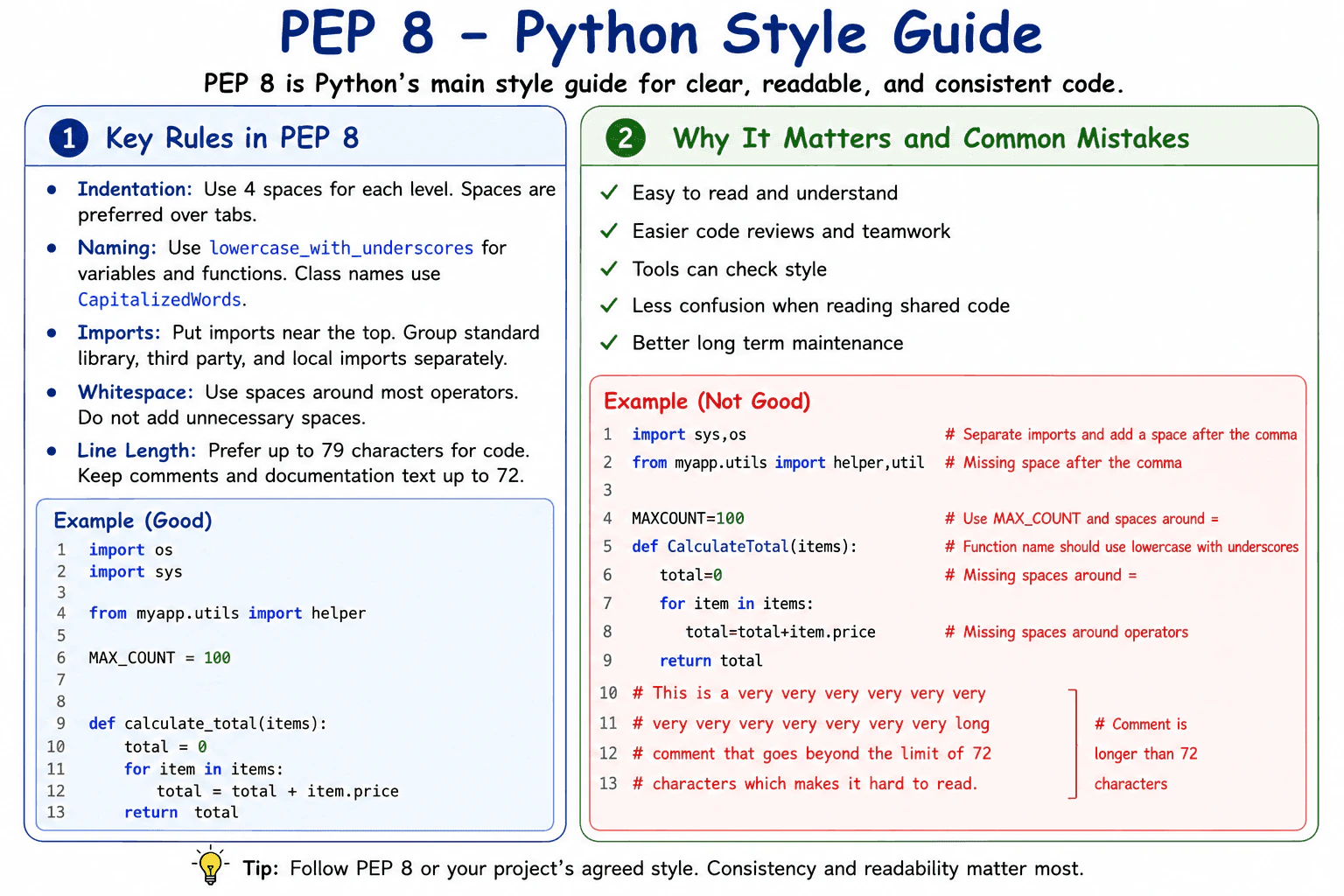
PEP 8 is the main style guide for Python code. It recommends four spaces for each indentation level, clear naming conventions, organized imports, consistent whitespace, and a maximum line length of 79 characters. Most of its guidance improves readability and does not change runtime behavior. Indentation is the important exception because Python uses indentation to define code blocks. In a real project, I follow the established project style when it differs from PEP 8.
Detailed Explanation
PEP 8 is the main style guide for Python code. Its practical goal is to make code easier to read, review, and maintain. Most of its rules are conventions, not requirements enforced by the Python interpreter.
Useful Questions to Ask the Interviewer
Should I focus on Python language behavior, or also explain the runtime and standard library?
Which Python version and execution environment should I assume?
Would you like a small code example together with production tradeoffs and edge cases?
PEP 8 recommends four spaces for each indentation level. Spaces are preferred over tabs. This matters because Python uses indentation to define code blocks, so inconsistent indentation can change program structure or cause an error.
Function and variable names normally use lowercase words separated by underscores. Class names normally use capitalized words. Constants normally use uppercase words separated by underscores.
Imports usually appear near the top of the file. They should normally be written on separate lines and grouped as standard library imports, third party imports, and local application imports.
PEP 8 also recommends avoiding unnecessary whitespace, while placing spaces around most binary operators. It limits code lines to 79 characters and comments or documentation text to 72 characters. A team may agree on a code limit up to 99 characters. Project consistency takes priority when a documented local convention differs. Following PEP 8 has no inherent runtime or memory cost, although formatters and linters use development and build resources when they run.
Where it is used
PEP 8 is used when teams write application code, libraries, command line tools, tests, and automation scripts. It guides code reviews and helps developers understand unfamiliar files more quickly. Projects often use editor settings, formatters, linters, and continuous integration checks to apply selected conventions consistently. These tools operate during development or validation and do not normally add work or memory use to the running application.
Why Interviewers Ask This
Interviewers ask this question to check whether a candidate understands Python coding conventions and can write code that is readable, consistent, and easy for a team to maintain. It also tests whether the candidate can separate style recommendations from syntax rules that affect how Python interprets a program.
Common interview mistakes
A common mistake is saying that Python requires every PEP 8 rule. Most rules are recommendations for readability. Another mistake is treating indentation as only visual style. Python uses indentation to form code blocks, and mixing tabs with spaces for indentation can raise a TabError when the meaning is inconsistent. Other mistakes include putting several unrelated imports on one line, failing to separate import groups, using unclear names, adding spaces inside brackets, adding spaces around keyword argument equals signs, and enforcing the 79 character limit even when a documented project convention uses another limit. Developers should not change stable code only to satisfy style rules when the change adds risk or reduces clarity.
Interview tip
Begin by defining PEP 8 as Python's main style guide. Cover four spaces for indentation, naming, import grouping, whitespace, and line length. Then explain that most rules improve readability rather than runtime behavior, while indentation can affect syntax and program structure. Mention that an established project convention takes priority within that project.
Interviewer may ask next
Does Python reject code that does not follow PEP 8?
No, Python does not reject code merely because it breaks most PEP 8 conventions. A long line, an unusual variable name, or poorly grouped imports can still run. Indentation is different because Python uses it to define blocks. Invalid indentation can raise an IndentationError, and inconsistent use of tabs and spaces can raise a TabError. This distinction matters because style problems mainly affect maintainability, while indentation problems can affect correctness.
Should a production team always enforce the 79 character limit?
No, a production team may adopt a documented wider limit. PEP 8 permits teams that agree on the choice to increase the code line limit up to 99 characters, while comments and documentation text should remain limited to 72 characters. A wider limit can reduce unnecessary wrapping, but longer lines can be harder to review beside another file. The important production decision is to choose one rule and enforce it consistently with project tooling.
35. What is the Python standard library?Language SpecificEasy
i Question Details
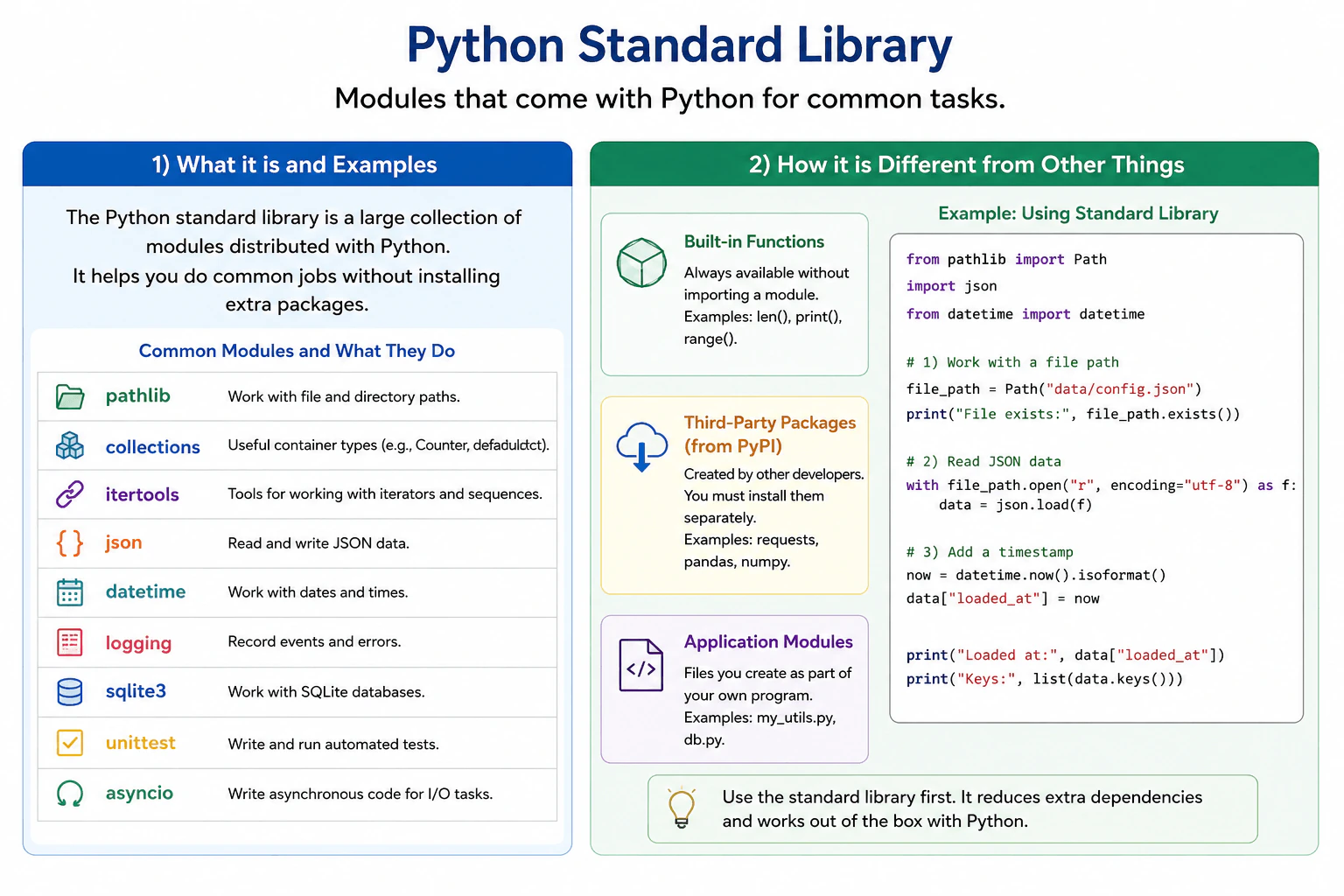
Define the Python standard library as the modules distributed with Python for common tasks. Give concrete examples such as pathlib, collections, itertools, json, datetime, logging, sqlite3, unittest, and asyncio. Distinguish the standard library from built-in functions, third-party packages installed from PyPI, and application modules.
Short Interview Answer (30-60 seconds)
The Python standard library is the collection of modules distributed with Python for common programming tasks. For example, pathlib works with file paths, json reads and writes JSON data, datetime handles dates and times, logging records application events, and unittest supports testing. These modules are different from built in functions such as len, third party packages installed from PyPI, and modules that belong to my own application. In practice, I first check whether the standard library already provides a suitable tool before adding another dependency.
Detailed Explanation
The Python standard library is a large set of ready made tools distributed with Python. It helps programmers do common jobs without first installing another package. These tools can work with files, dates, stored data, tests, logs, databases, repeated values, and tasks that spend time waiting. This matters because a programmer can often solve a normal problem using tools that are already available in a Python installation. It can also keep an application simpler because fewer extra packages may be needed.
Useful Questions to Ask the Interviewer
Would you like examples of common standard library modules?
Should I also explain how it differs from built in functions and packages installed from PyPI?
How to Explain It in an Interview
The standard library contains modules distributed with Python for common work. A program imports the module it needs. For example, pathlib helps manage file paths, collections provides useful container types, itertools helps work with iterators, json handles JSON data, datetime works with dates and times, logging records events, sqlite3 provides access to SQLite databases, unittest supports tests, and asyncio supports asynchronous programming.
It is important to separate this idea from three other things. Built in functions such as len and print are available without importing a normal module. Third party packages are separate projects that are commonly installed from PyPI. Application modules are files created as part of your own program.
Using the standard library can reduce external dependencies and simplify deployment. However, being in the standard library does not make a module the best choice for every problem. A third party package may provide features or an interface that better matches the requirement. In production, compare the requirements first and choose the simplest dependable option.
Where it is used
The standard library is used throughout production Python applications. pathlib is useful for file and directory paths. json is common when reading configuration data or exchanging JSON data. datetime is used for dates and times. logging records application events and errors. sqlite3 can support applications that use SQLite. unittest supports automated tests. collections and itertools help process and organize data. asyncio is useful when a program needs to manage many tasks that spend time waiting, such as network operations. Teams often check the standard library first because using an existing module can avoid an unnecessary external dependency.
Why Interviewers Ask This
Interviewers ask this to check whether a candidate understands what Python already provides before adding external packages. They also want to see whether the candidate can distinguish modules distributed with Python from built in functions, third party packages installed from PyPI, and modules written inside an application. This shows practical judgment about dependencies, portability, maintenance, and choosing an appropriate tool for common programming tasks.
Common interview mistakes
A common mistake is saying that every module available through import belongs to the standard library. That is not true because imported modules can also come from third party packages or the application itself. Another mistake is treating built in functions such as len or print as standard library modules. They are directly available in Python and do not require importing a normal module. Candidates may also assume that a standard library module is always better than a third party package. The correct choice depends on the required features, simplicity, maintenance needs, and production environment.
Interview tip
Start with one clear sentence: the standard library is the collection of modules distributed with Python for common tasks. Then name a few examples such as pathlib, json, datetime, and logging. Finish by clearly separating standard library modules from built in functions, packages installed from PyPI, and modules written inside the application.
Interviewer may ask next
If I can import a module successfully, does that mean it belongs to the Python standard library?
No. A successful import only means Python found a module through its import system. The module might come from the standard library, a third party package, or the application itself. For example, json is part of the standard library, while many packages installed from PyPI are not. This distinction matters because third party packages usually create an additional dependency that must be installed and maintained.
When should you use a third party package instead of a standard library module?
Use a third party package when it provides important features, a clearer interface, or better support for the actual requirement than the available standard library option. The main tradeoff is that the extra package becomes another dependency that must be installed, updated, reviewed, and supported in production. I normally check the standard library first, then choose an external package when its benefits justify that added dependency.
36. What is a Python virtual environment?Language SpecificEasy
i Question Details
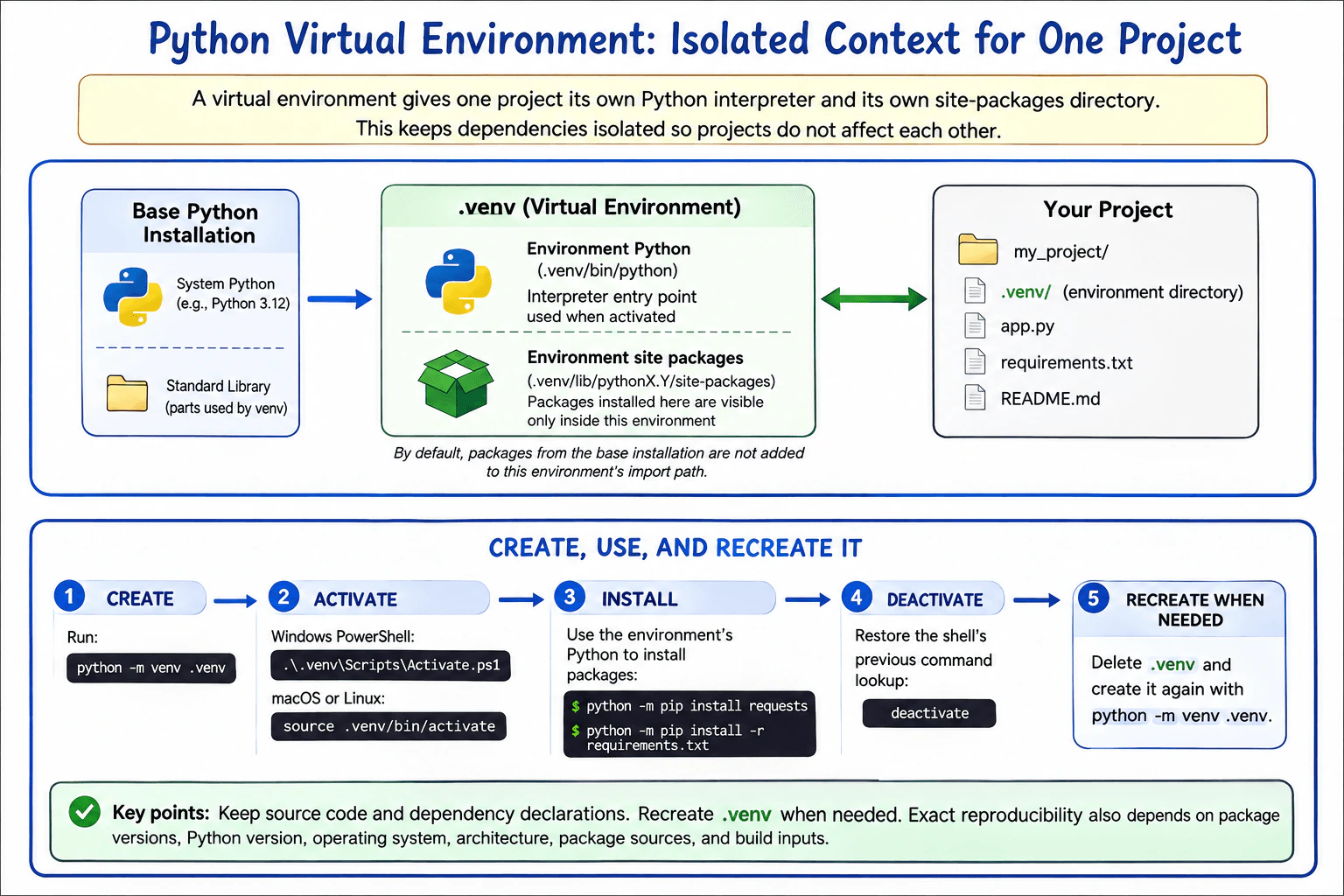
Define a virtual environment as an isolated Python installation context for one project. Explain its interpreter and site-packages relationship, creating one with python -m venv, activation, installing dependencies through that environment, deactivation, reproducibility limits, and why source code and dependency declarations should be kept while the environment directory itself is normally recreated.
Short Interview Answer (30-60 seconds)
A Python virtual environment gives one project an isolated Python context with its own package installation location. I normally create it with python -m venv .venv, activate it, and install that project's dependencies through its Python or pip command. This prevents packages for one project from interfering with another project. I keep the source code and dependency declarations, but I normally recreate the environment directory when needed.
Detailed Explanation
A virtual environment gives one Python project its own place for the extra packages that project needs. This helps stop one project's packages from changing another project's setup. For example, two projects can use different versions of the same package. Each project can keep its own installed version. The environment folder is normally temporary and can be created again. The important things to keep are the source files and dependency declarations that describe what packages the project needs. This makes project setup easier to repeat on another machine or during an automated build.
Useful Questions to Ask the Interviewer
Would you like me to explain the commands for creating and using the environment?
Should I also explain how dependency declarations help recreate it?
How to Explain It in an Interview
A virtual environment is an isolated Python context for one project. I can create one with python -m venv .venv. The environment has its own Python entry point and its own site packages directory. It still uses parts of the base Python installation, such as the standard library, so it is not a completely independent Python installation.
By default, packages from the base installation are not added to the environment's import path. After activation, the shell changes its command lookup so python and related commands normally use the environment. I then install dependencies through that environment so they go into its site packages directory.
Deactivation restores the shell's previous command lookup. Activation is optional because I can run the environment's Python executable directly.
I normally recreate the environment instead of committing it. Exact reproducibility also depends on package versions, Python version, operating system, architecture, package sources, and build inputs.
Where it is used
Virtual environments are commonly used for local development, automated tests, continuous integration, deployment preparation, and Python services on shared machines. They are useful when several projects need different package versions. Teams usually create a fresh environment from dependency declarations during setup or automated builds instead of copying an existing environment directory.
Why Interviewers Ask This
Interviewers ask this to check whether a candidate understands how Python projects keep dependencies isolated. They also want to see whether the candidate understands the relationship between a virtual environment, its Python interpreter, its package installation directory, dependency declarations, and normal development or production workflows.
Common interview mistakes
A common mistake is thinking a virtual environment is a completely independent Python installation. It still depends on the base Python installation that created it for parts such as the standard library. Another mistake is using the wrong pip command and installing packages into a different environment or the system installation. Developers may also commit the whole environment directory instead of keeping dependency declarations. Another mistake is assuming a simple dependency list guarantees an identical environment on every Python version, operating system, and machine architecture.
Interview tip
Start with isolation. Say that one project gets its own package installation location. Then explain creation, activation, package installation, deactivation, and why the environment directory is normally recreated instead of stored with the source code.
Interviewer may ask next
Do I have to activate a virtual environment before using it?
No. Activation is only a convenience for the current shell. It changes command lookup so python and related commands normally resolve to the environment. You can instead run the environment's Python executable directly. This matters in scripts, automation, and production because they can select the exact interpreter without depending on shell activation.
Does a virtual environment make a Python project fully reproducible?
No. A virtual environment provides dependency isolation, but the environment directory itself does not guarantee an identical rebuild. Reproducibility can also depend on exact package versions, the Python version, operating system, machine architecture, package sources, and build inputs. In production, the usual tradeoff is to recreate environments from controlled dependency declarations instead of copying an existing environment directory.
37. What are pip and PyPI?Language SpecificEasy
i Question Details
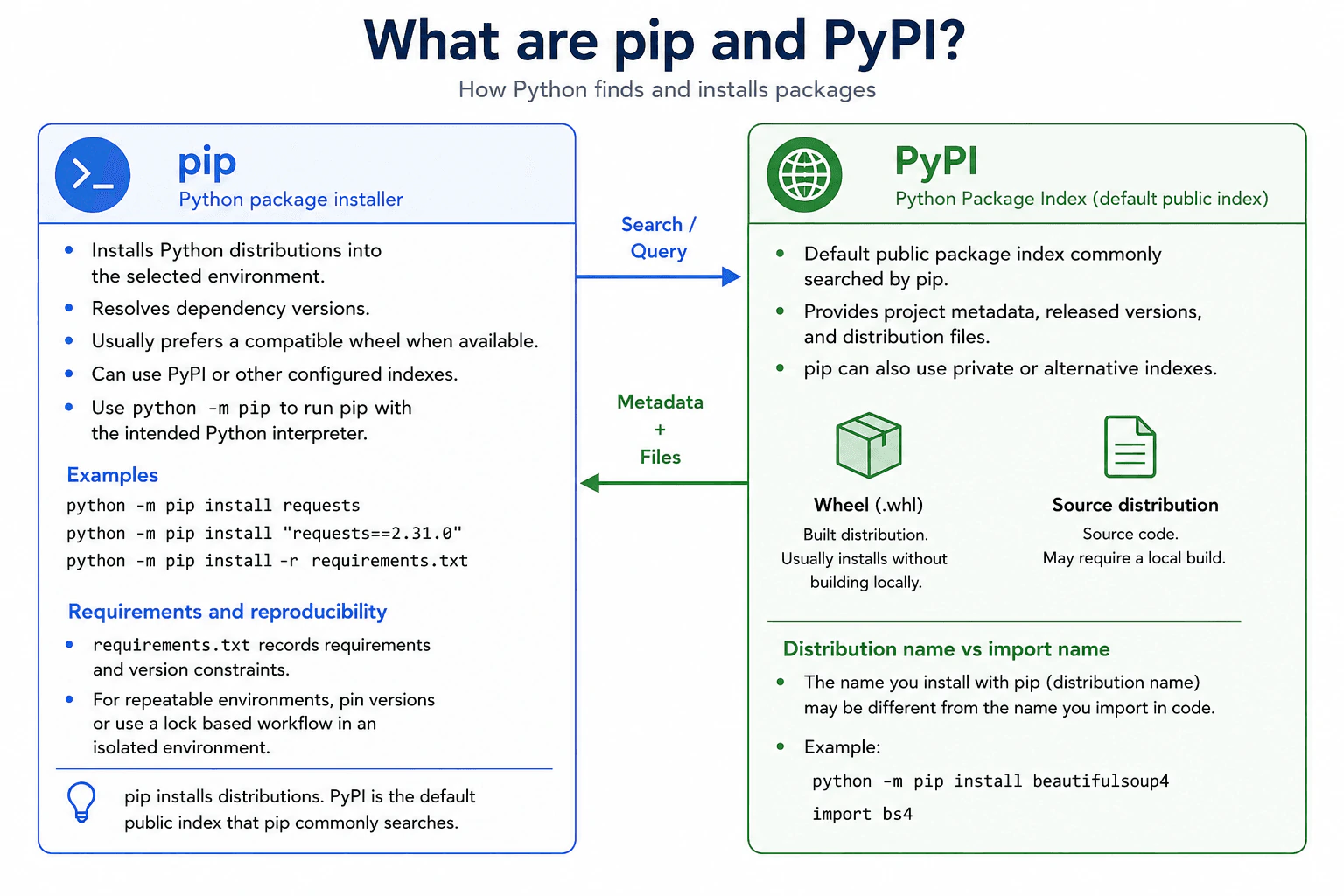
Define pip as a Python package installer and PyPI as the default public index from which pip commonly discovers distributions. Explain python -m pip, project names and versions, wheels and source distributions, dependency resolution, requirements files, lock or environment reproducibility concerns, private indexes, and why an import package is not always named exactly like its distribution package.
Short Interview Answer (30-60 seconds)
pip is the common tool for installing Python distributions, while PyPI is the main public package index that pip searches by default. I usually run python -m pip so pip runs with the Python interpreter I intend to use. In real projects, I also control dependency versions because an installation can change over time if versions are not constrained or locked.
Detailed Explanation
pip is a tool that helps you add reusable software to a Python environment. PyPI is the main public place where many Python projects publish that software. A project can request one exact release or allow a range of acceptable releases. The installer may also need to install other software required by that project. Teams record dependency choices so development, testing, and production environments can stay consistent. Some companies use a private package source for internal software. The name used to install a project can also be different from the name used inside Python code.
Useful Questions to Ask the Interviewer
Should I also explain dependency reproducibility and private package sources?
Do you want an example of how a distribution name can differ from an import package name?
How to Explain It in an Interview
pip is Python's common package installer. PyPI is the default public package index that pip commonly searches for project metadata and distribution files. pip can also install from other configured indexes, local files, or supported source locations.
I prefer python -m pip because it runs pip with the selected Python interpreter. This reduces the chance of accidentally using pip from another Python environment.
When installing a project, pip resolves version requirements for that project and its dependencies. It selects versions that satisfy the available constraints. If a compatible wheel is available, pip normally uses it. A wheel is a built distribution that usually installs without building the project locally. Otherwise pip may use a source distribution, which can require a local build and build tools.
A requirements file records dependency requirements, but broad version ranges do not guarantee an identical environment later. Production teams often pin versions or use a lock based workflow with isolated environments. pip can also use private indexes for internal distributions. Finally, a distribution name used with pip does not have to match the package or module name used with import.
Where it is used
pip and PyPI are used when creating development environments, installing application dependencies, preparing test environments, building deployment images, and distributing reusable Python projects. Production teams often install from controlled dependency requirements or lock data. Organizations may also use private indexes for internal libraries or approved packages.
Why Interviewers Ask This
Interviewers ask this to check whether a Python developer understands how project dependencies are discovered, installed, versioned, and reproduced. They also want to see whether the candidate understands distribution names, import package names, public and private package sources, dependency resolution, and safe dependency practices for production environments.
Common interview mistakes
Common mistakes include treating pip and PyPI as the same thing, running a pip command that belongs to a different Python environment, assuming a requirements file automatically guarantees an identical environment, and ignoring transitive dependency versions. Another mistake is assuming the distribution name passed to pip must exactly match the package or module name used with import. Developers may also forget that pip can use private or alternative indexes instead of only PyPI.
Interview tip
Start by saying that pip installs Python distributions and PyPI is the public index that pip searches by default. Then briefly explain python -m pip, dependency resolution, wheels, source distributions, reproducibility, private indexes, and the difference between distribution names and import package names.
Interviewer may ask next
Why can the name passed to pip be different from the name used in an import statement?
They can differ because a distribution name identifies the installable project, while an import package or module name identifies Python code provided by that distribution. One distribution can provide one or more import packages with different names. This matters because developers should check the project's documentation instead of assuming the installation name is always the correct import name.
Is a requirements file enough to guarantee the same dependency environment in production?
Not always. A requirements file with broad version ranges can allow pip to select different valid versions at different times, including different transitive dependencies. For stronger reproducibility, teams can pin versions or use a lock based workflow and install inside an isolated environment. The tradeoff is that tighter version control improves repeatability but requires deliberate dependency updates for fixes and newer releases.
38. What is a module in Python?Language SpecificEasy
i Question Details
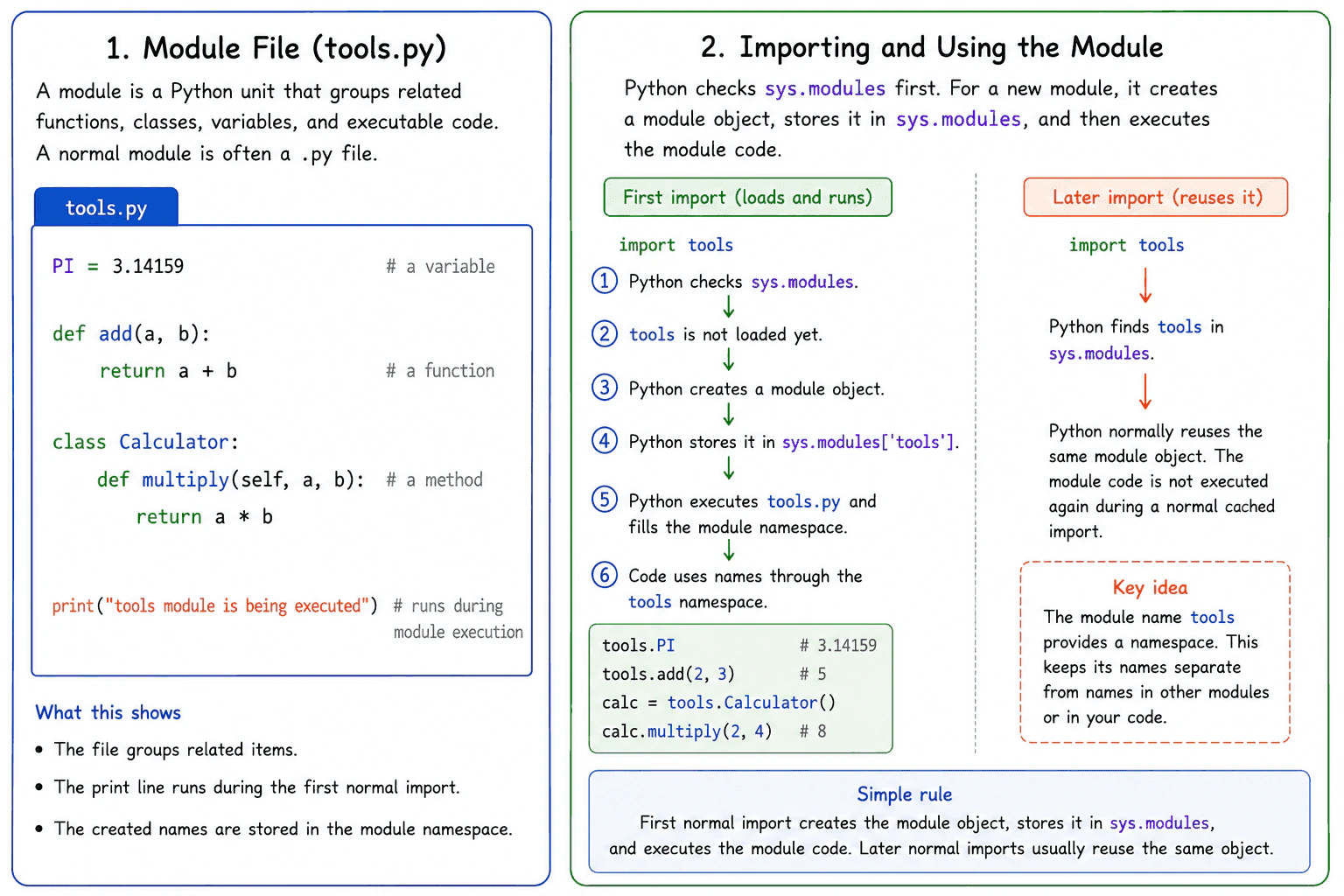
Explain how a module organizes executable definitions, how import creates or reuses a module object, and how module names provide namespaces.
Short Interview Answer (30-60 seconds)
A module is a Python unit that groups related names such as functions, classes, and variables. A module is often a .py file, but it can also be provided by Python itself or by an extension. On the first normal import, Python creates a module object, stores it in sys.modules, and executes the module code to fill its namespace. Later imports normally reuse that same object. The module name provides a separate namespace, so code can use names such as math.sqrt without mixing them with unrelated names.
Detailed Explanation
A module is a unit that organizes related Python definitions and executable statements. A normal module is often stored in a .py file, although modules can also come from built in or extension loaders.
Useful Questions to Ask the Interviewer
Should I focus on Python language behavior, or also explain the runtime and standard library?
Which Python version and execution environment should I assume?
Would you like a small code example together with production tradeoffs and edge cases?
When Python processes an import, it first checks sys.modules. This mapping stores module names and their loaded module objects. If the module is already there, Python normally reuses that object. If it is not there, the import system finds the module, creates a module object, places it in sys.modules, and executes the module code. Functions, classes, variables, and imported names created during execution become entries in the module namespace.
A namespace maps names to objects. Accessing tools.parse means finding parse inside the tools module namespace. This keeps names from different modules separate.
The first import can include file lookup, loading, possible compilation, and code execution. Later imports are usually much cheaper because they reuse the cached object. A loaded module normally remains reachable through sys.modules, so the module object and objects referenced by its namespace continue using memory. Production modules should therefore keep import work small, avoid unexpected side effects, and handle circular imports carefully.
Where it is used
Modules are used to divide an application into clear areas such as configuration, database access, validation, business rules, logging, and shared utilities. They allow several files to reuse the same functions and classes through imports. Module namespaces also make ownership clear because code can use names such as payments.validate or users.create. In production, module level constants and lightweight object setup are common. Slow network requests, database queries, process creation, and other expensive actions should usually not run during import because they delay application startup and make testing less predictable.
Why Interviewers Ask This
Interviewers ask this question to check whether a candidate understands how Python organizes code, executes imports, manages module objects, and separates names. It also tests whether the candidate can recognize import side effects, circular import problems, and the production cost of work performed during import.
Common interview mistakes
A common mistake is thinking that import copies the module source into the importing file. Python normally creates or reuses a module object and binds a name to that object. Another mistake is expecting the module code to run every time an import statement is reached. Normal imports usually reuse the object in sys.modules. Developers may also confuse a module namespace with the local namespace of a function. Using from module import name binds that object directly in the current namespace, which can hide its origin and cause name conflicts. Circular imports can expose a module before all of its names exist. Large side effects during import can also slow startup, complicate tests, and make failures depend on import order.
Interview tip
Begin with the practical definition: a module groups related Python code and provides its own namespace. Then describe the import sequence in order: check sys.modules, create the module object when needed, execute its code, and reuse the object on later imports. Finish with one production concern such as circular imports or expensive import side effects.
Interviewer may ask next
What happens when two Python modules import each other?
Python can return a partly initialized module. The import system normally places a new module object in sys.modules before executing all of its code. If that module imports a second module which imports the first module again, Python finds the existing object in sys.modules even though some names may not exist yet. Accessing one of those missing names can raise an ImportError or an AttributeError. This matters because the result can depend on import order. A common correction is to move shared definitions into a third module or delay a specific import until the code needs it.
What are the performance and memory tradeoffs of module caching?
Module caching makes later imports faster because Python normally reuses the existing module object instead of finding, loading, and executing the module again. It also gives all importers access to the same module namespace. The tradeoff is that the module object and the objects referenced by its namespace normally stay reachable through sys.modules and continue using memory. Source changes are also not loaded automatically into a running process. importlib.reload can execute the module again, but existing references outside the module may still point to older objects, so restarting the process is usually safer in production.
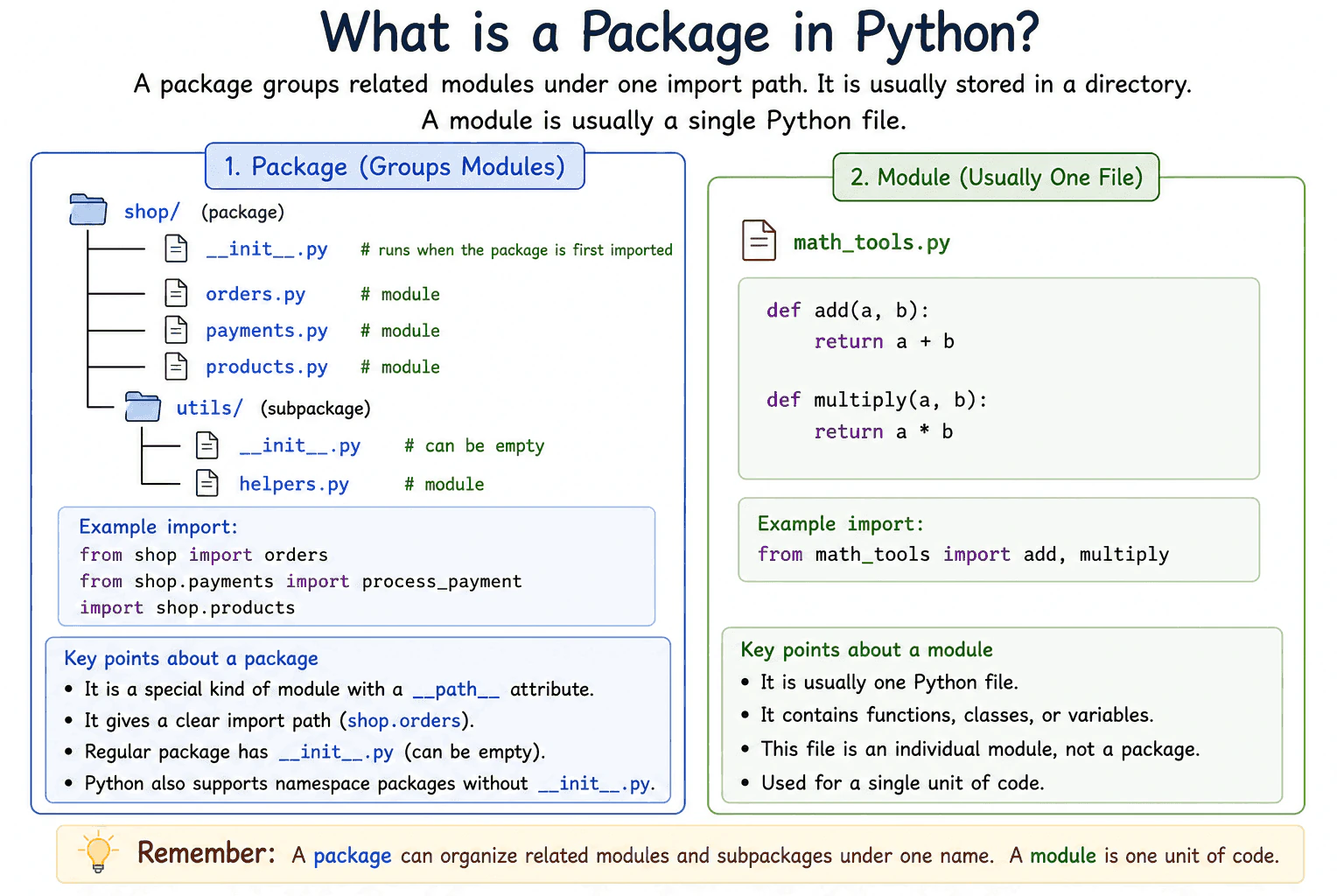
39. What is a package in Python?Language SpecificEasy
i Question Details
Explain how packages organize related modules, the role of package directories and __init__.py, and how packages differ from individual modules.
Short Interview Answer (30-60 seconds)
A package is a special kind of Python module that can contain related modules and smaller packages. In a typical project, it is represented by a directory. A regular package normally has an __init__.py file, which Python executes when it first imports the package. Python also supports namespace packages without that file. A module usually represents one unit of code, while a package provides a naming hierarchy for organizing several units.
Detailed Explanation
A package groups related Python modules under one import path. For example, a shop package may contain orders.py, payments.py, and products.py. Each file is normally an individual module. The shop package gives them names such as shop.orders and shop.payments.
Useful Questions to Ask the Interviewer
Should I focus on Python language behavior, or also explain the runtime and standard library?
Which Python version and execution environment should I assume?
Would you like a small code example together with production tradeoffs and edge cases?
Technically, a package is a special kind of module with a __path__ attribute. This path tells Python where it can search for the package's submodules.
A regular package is typically a directory containing __init__.py. Python executes this file when the package is first imported. It may be empty, perform small initialization tasks, or expose selected names from other modules. Heavy work should be avoided there because it increases import time, keeps more objects in memory, and may create unwanted side effects.
Python also supports namespace packages without __init__.py. One namespace package can combine portions found in different import locations. This is useful for some large libraries, but it adds complexity.
Importing a package does not automatically import every module inside it. Loading all modules would increase startup work and memory use. Packages should therefore expose only the modules and names that users need.
Where it is used
Packages are used to divide production applications into clear areas such as authentication, payments, database access, API handling, and tests. Libraries use packages to provide stable import paths and group related public features. Smaller packages also help teams test, reuse, replace, and maintain parts of an application without placing all code in one large module.
Why Interviewers Ask This
Interviewers ask this question to check whether the candidate understands how Python organizes code and resolves imports. They also want to know whether the candidate can distinguish a package from an individual module, explain the role of __init__.py, and make sensible decisions about package structure in a production application.
Common interview mistakes
A common mistake is saying that a package is only a directory. A package is a module that Python recognizes as able to contain submodules, and it has a __path__ attribute. Another mistake is saying that every package must have __init__.py. Regular packages normally have this file, but namespace packages do not. Developers may also assume that importing a package automatically imports every module inside it. Python normally loads only the package and the modules requested by the import statements. Other mistakes include placing slow database or network work in __init__.py, exposing too many internal names, and creating circular imports between package modules.
Interview tip
Begin with the main difference. Explain that a package organizes related modules and is itself a special module that can contain submodules. Then describe regular packages, __init__.py, and namespace packages. Finish by noting that importing a package does not automatically import every module inside it.
Interviewer may ask next
Can a Python package work without an __init__.py file?
Yes. A namespace package works without an __init__.py file. Python creates it from matching package portions found in one or more import locations. This matters when one logical package must be spread across several directories or installed distributions. The tradeoff is greater import and packaging complexity, so a regular package is usually simpler when this feature is not required.
Should __init__.py import every module in the package?
No. __init__.py should import only the modules or names that the package intentionally exposes. Importing every module increases import time, creates additional module objects and related memory use, and may trigger unwanted side effects or circular imports. Selective imports provide a clearer public interface while avoiding unnecessary startup work.
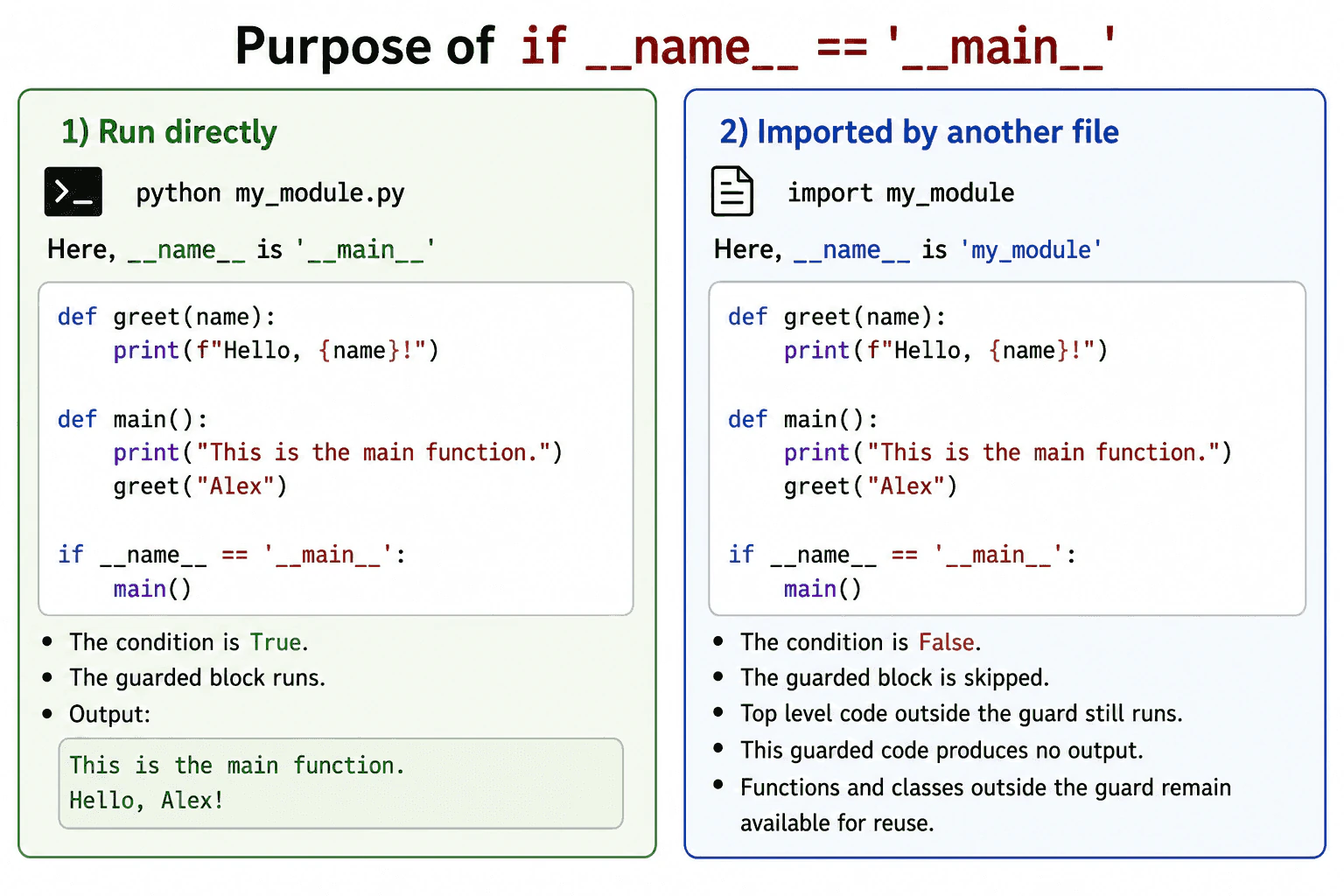
40. What is the purpose of if __name__ == '__main__'?Language SpecificEasy
i Question Details
Explain how __name__ differs when a file is run directly versus imported and how the guard separates script entry-point behavior from reusable definitions.
Short Interview Answer (30-60 seconds)
The main guard makes a block run only when that module is executed as the program entry point. In that case, Python sets __name__ to '__main__'. When another module imports it normally, __name__ contains the module's import name, so the guarded block is skipped. This lets the file provide reusable functions and classes without starting the program during import.
Detailed Explanation
Use the main guard to separate reusable definitions from code that starts a program. Python gives every module a special variable named __name__. When a module is executed as the program entry point, Python sets __name__ to '__main__'. This includes running a file directly and running a module with python m. The condition is then true, so the guarded block runs.
Useful Questions to Ask the Interviewer
Should I focus on Python language behavior, or also explain the runtime and standard library?
Which Python version and execution environment should I assume?
Would you like a small code example together with production tradeoffs and edge cases?
When the module is imported normally, __name__ contains its import name, which can be a fully qualified package name. The condition is false, so the guarded block is skipped. Functions, classes, constants, and other statements outside the block are still executed or created during import.
This matters because Python executes top level module code when it loads a module. Without the guard, command line parsing, file access, network calls, or application startup could happen just because another module imported the file.
The guard usually calls a main function or runs a small demonstration. It does not stop code outside the block from running, create a separate scope, or prevent later execution through reload tools. Its runtime cost is one small comparison, and its extra memory cost is constant and negligible.
Where it is used
It is used in command line tools, utility scripts, application entry modules, local demonstrations, and modules that are also imported by tests or other application code. A common production pattern is to define reusable functions and classes outside the guard, place startup logic in a main function, and call main inside the guard.
Why Interviewers Ask This
Interviewers ask this question to check whether a candidate understands how Python executes modules. It also tests whether the candidate can separate reusable definitions from code that should run only when a module is used as the program entry point.
Common interview mistakes
A common mistake is believing that the guard prevents the entire module from running during import. Python still executes top level statements outside the guard when it loads the module. Another mistake is placing reusable functions or classes inside the guard, which makes them unavailable after a normal import. Developers may also misspell __name__ or '__main__'. The guard does not create a new scope, and it should protect entry point behavior rather than ordinary reusable definitions.
Interview tip
Start by comparing the two values of __name__. Then explain that the guard keeps entry point behavior from running during a normal import. Also mention that top level code outside the guard still executes.
Interviewer may ask next
What happens to top level code outside the main guard when the module is imported more than once?
It normally runs only when Python first loads that module in the current interpreter because Python stores loaded modules in sys.modules. Later normal imports usually reuse the stored module. Explicit reload tools can execute the top level code again, which matters when that code has side effects.
Should reusable functions be placed inside the main guard?
No. Reusable functions and classes should normally stay outside the guard so importing modules and tests can access them. The guard should contain or call only entry point behavior. This improves reuse and testing without adding meaningful performance or memory cost.
More questions load as you scroll
Disclaimer: This interview guide is for educational and informational purposes only. It is designed to help readers prepare, but it does not guarantee any interview result, hiring decision, offer, or outcome. Interview questions, hiring criteria, and preferred answers can vary by employer, interviewer, industry, location, and time. All answers, examples, and explanations in this guide are suggested examples for interview preparation, not definitive answers or instructions for professional practice. They are based on research and judgment, are provided without warranties of any kind, and should be adapted to the question, role, and applicable laws and professional requirements. Diagrams are simplified illustrations intended to highlight the main concepts and their relationships; actual situations, systems, and practices may be more complex. Alternative approaches may be equally valid or better suited to a particular question, context, or interviewer. To the fullest extent permitted by applicable law, the contributors and publisher are not liable for decisions made, actions taken, or losses incurred based on this guide.
State Laws and Professional Responsibilities: Laws and requirements governing an occupation vary by state and jurisdiction. You are responsible for checking the current laws, licensing requirements, and scope-of-practice rules that apply to your location and role, and for ensuring that your answers and actions comply with them. Adapt examples in this guide to those requirements. This guide is not legal advice.
Content Accuracy and Verification: To the fullest extent permitted by applicable law, we do not represent or warrant that interview guides, questions, answers, examples, or diagrams are accurate, complete, current, error-free, or suitable for any particular purpose. You are responsible for independently reviewing and verifying the information before relying on it.