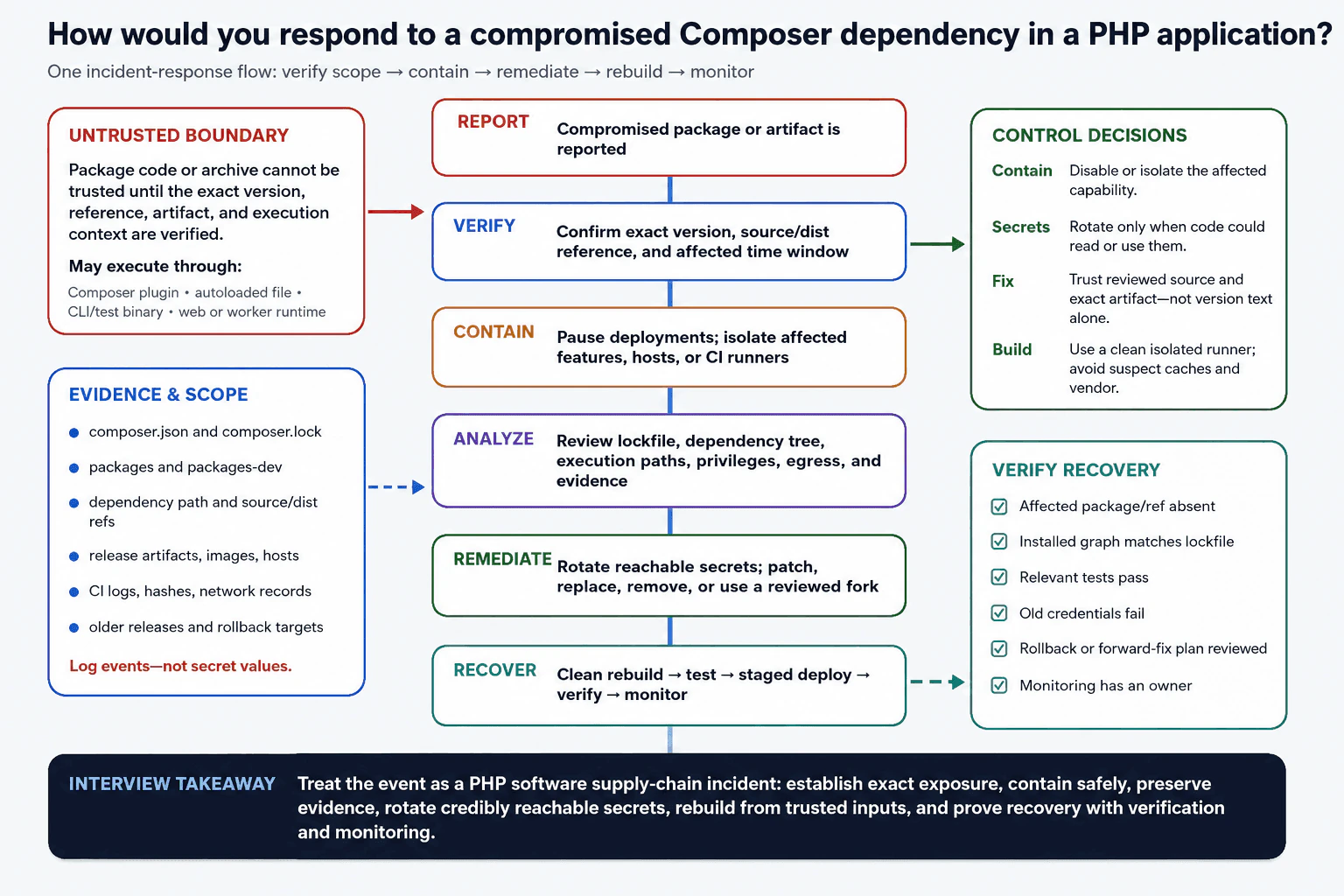
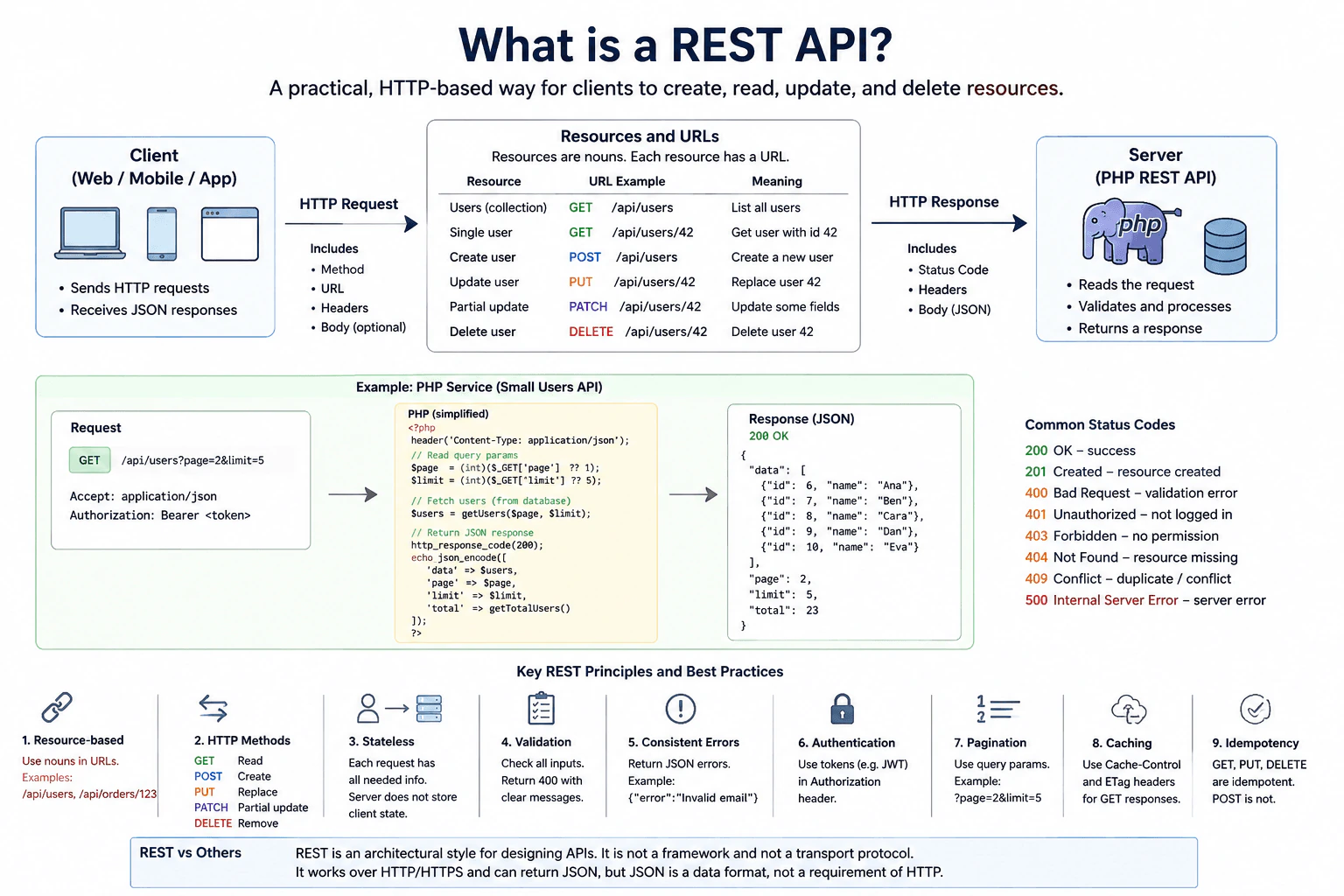
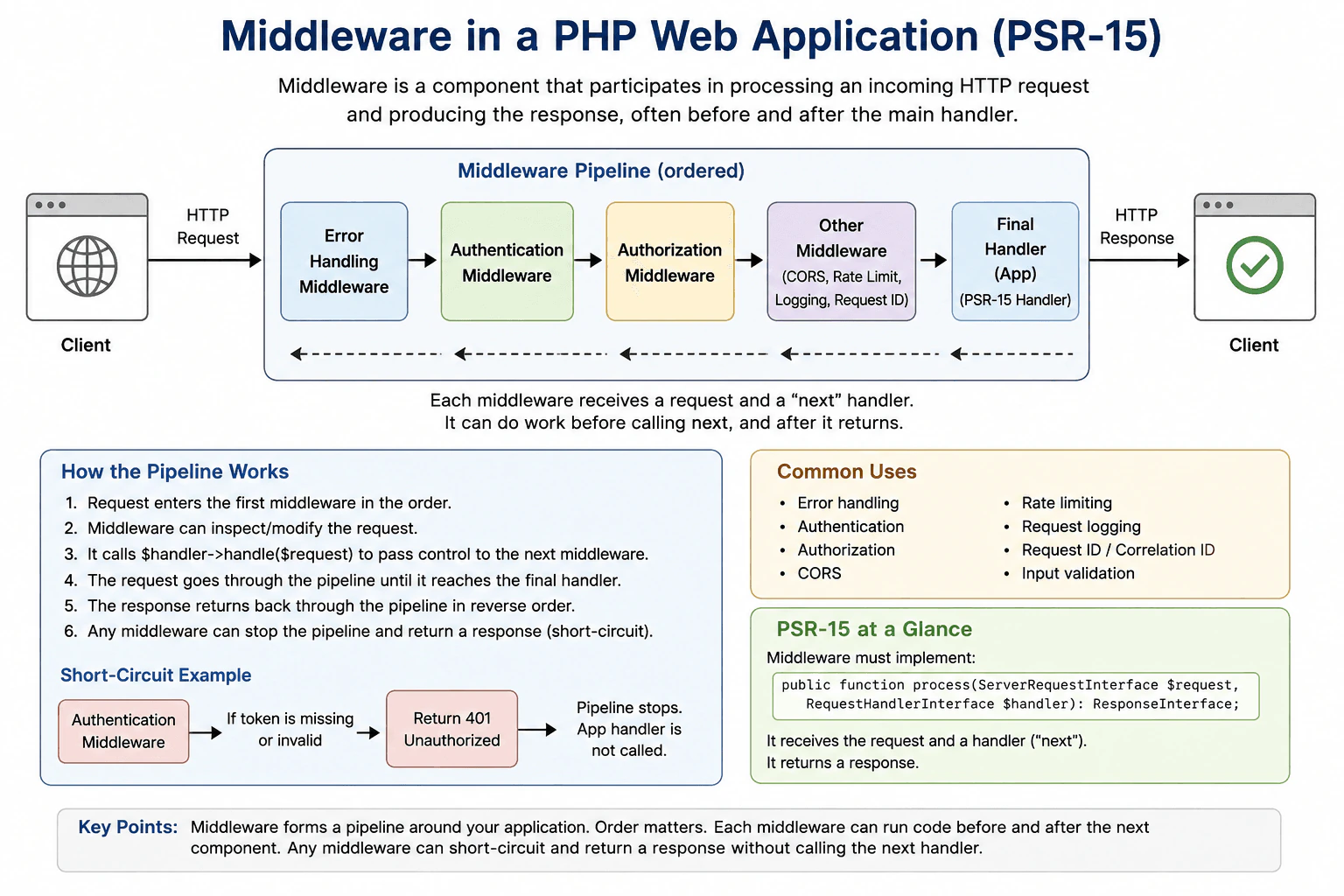
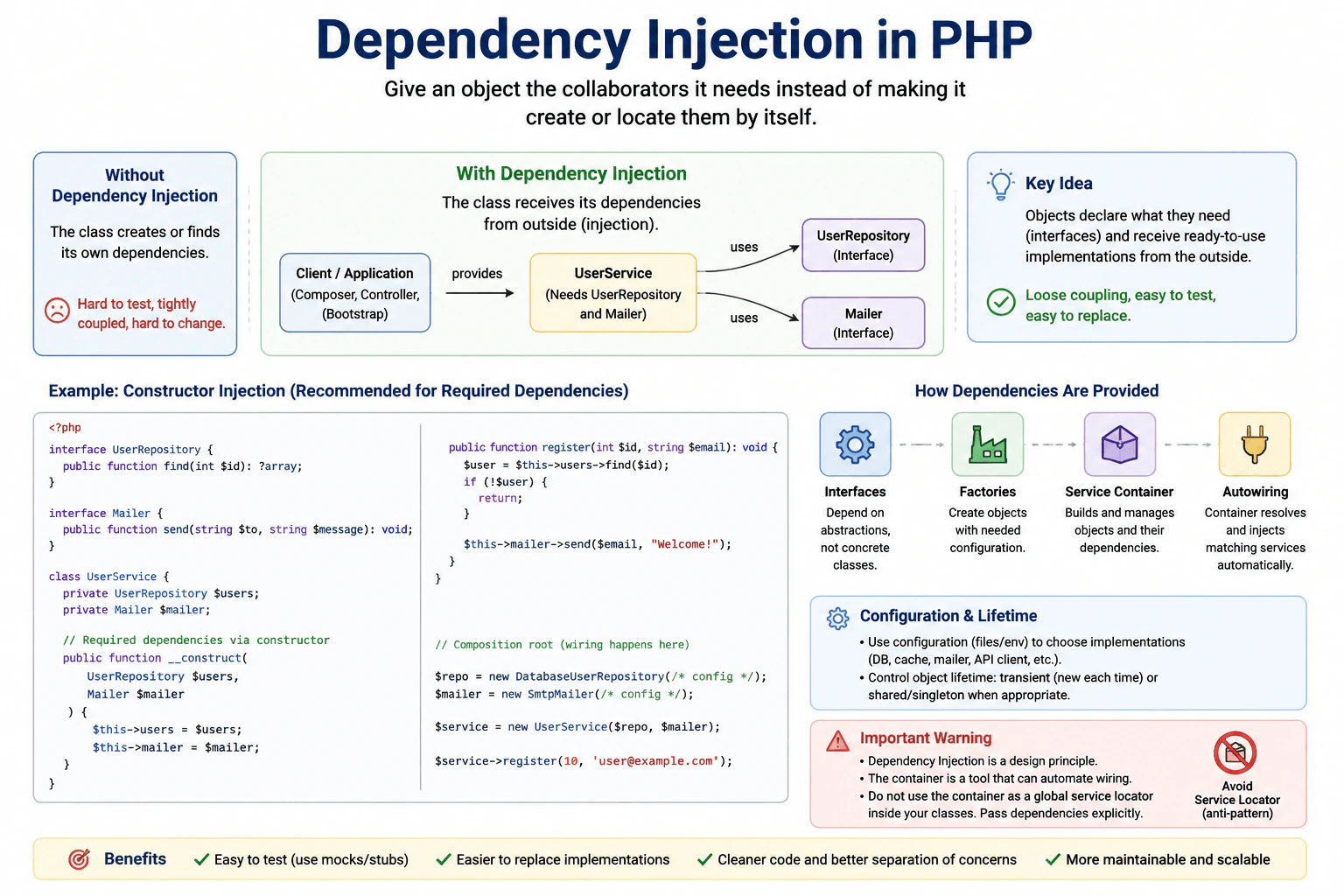
227 Php Developer Interview Questions & Answers

116 top • 13 Amazon • 21 Google • 10 Netflix • 7 Meta • 18 NVIDIA • 21 Apple • 21 Microsoft

Php Developer icon

Questions with Detailed ExplanationsWith Detailed Explanations

(Last Updated: August 28, 2026)

91. Describe a time you disagreed with a code-review comment.BehavioralMedium

Question Details

Explain the technical disagreement, evidence you gathered, how you discussed it respectfully, the final decision, and the effect on the code or team.

Interview tip:

Use STAR to structure your answer: briefly explain the Situation and Task, make Action the most detailed part, and finish with the Result. For example, describe a code review where you disagreed with a suggested implementation, gathered technical evidence, discussed the concern respectfully, agreed on a final approach, and improved either the code or the team review process.

Situation

In my last role, I submitted a PHP change that moved repeated validation logic into a dedicated service class. During review, a teammate suggested placing the logic directly inside the controller because the change was small and would require fewer files.

Task

I needed to respond professionally, protect the maintainability of the code, and help the team reach a decision without turning the review into a personal argument.

Action

I first checked whether my concern was based on evidence or only personal preference. I reviewed similar controllers in the codebase and found that duplicated validation had already caused inconsistent error handling in several places. I also wrote a small comparison showing how the controller would look with the validation inline and how the service could be reused by another existing endpoint. I replied in the review with this evidence and explained that my concern was separation of responsibilities. The controller should manage the request and response, while the service should contain reusable business rules. I also acknowledged that the reviewer was right about avoiding unnecessary abstraction. I suggested a short discussion so we could compare both options. During that discussion, I listened to the concern about adding complexity and proposed keeping the service small, using a clear name, and avoiding extra interfaces or patterns that the feature did not need. We agreed that the shared validation justified the service, but we simplified my original implementation before merging it.

Result

The final code kept the controller easier to read and gave both endpoints one consistent validation path. The discussion also improved our review process because we became more careful about explaining whether a comment was based on a standard, a defect, or a personal preference. I learned that disagreement in a code review is most useful when I bring evidence, stay open to simplification, and focus on the code rather than defending my first solution.

Why Interviewers Ask This

Interviewers ask this question to evaluate how a candidate handles technical conflict, receives feedback, supports an opinion with evidence, and works toward a shared decision. A strong answer shows respect, sound judgment, flexibility, and a focus on code quality rather than personal ownership.

Interviewer may ask next
Why did you not simply accept the review comment?

I did not reject it immediately. I first checked the codebase and compared both approaches. The evidence showed that the validation was already needed in more than one place, so placing it in the controller would likely create duplication and inconsistent behavior.

What would you do differently in a similar review now?

I would explain the reason for the service in the pull request description before reviewers ask about it. I would also include the reuse case and mention that I intentionally kept the design small. That would give reviewers more context and could reduce unnecessary back and forth.

92. How do you explain a complex PHP issue to a non-technical stakeholder?BehavioralEasy

Question Details

Use a real example and explain how you adapted the language, clarified impact and options, checked understanding, and reached a decision.

Interview tip:

Use STAR to structure your answer: briefly explain the Situation and Task, make Action the most detailed part, and finish with the Result. For example, describe a real PHP issue, how you translated the technical cause into simple business language, explained the impact and available options, checked the stakeholder's understanding, and helped them make a clear decision.

Situation

In my last role, a PHP application sometimes created duplicate customer orders when a payment request took too long. The technical cause involved repeated requests, database timing, and missing protection against processing the same request twice. A non technical stakeholder needed to understand the issue because it was affecting customer trust and support work.

Task

I was responsible for explaining the problem clearly, presenting practical options, and helping the stakeholder decide whether we should apply a quick fix or make a more complete change. I also needed to avoid unnecessary technical detail while still being honest about the risk.

Action

I first removed technical terms from my explanation. Instead of discussing request retries and database transactions, I said that the system could receive the same payment instruction more than once and did not always recognize that it had already handled it. I used a simple example of a customer pressing a payment button once but the system hearing the instruction twice. I then explained the impact in business terms. Customers could see duplicate orders, the support team could receive more complaints, and staff might need to correct records manually. I presented two options. The first option was a smaller change that would reduce the immediate risk but would not protect every payment path. The second option was to add a unique request key and stronger database checks so the application could safely ignore repeated instructions. I explained that the second option required more development and testing but provided better long term protection. I paused after each part and asked the stakeholder to explain the issue and options back in their own words. This showed me which parts were still unclear. I answered their questions, confirmed the priority with the product team, and recommended the more complete solution because the issue involved payments and customer confidence.

Result

The stakeholder understood both the technical risk and the business tradeoff. We agreed to implement the stronger protection and communicate the change to the support team. The issue was resolved without hiding the complexity or overwhelming the stakeholder. I learned that a good explanation should connect the technical cause to customer impact, present clear choices, and confirm understanding before a decision is made.

Why Interviewers Ask This

Interviewers ask this question to evaluate whether a PHP Developer can translate technical problems into clear business language. A strong answer shows communication skill, sound judgment, awareness of stakeholder needs, and the ability to explain impact and options without using unnecessary jargon.

Interviewer may ask next
Why did you recommend the more complete solution instead of the quicker fix?

I recommended it because the issue affected payment processing and customer trust. The quicker fix reduced some risk, but it did not protect every path. The complete solution gave the application a reliable way to recognize repeated requests and prevent duplicate processing.

How did you confirm that the stakeholder understood your explanation?

I paused after explaining the cause, impact, and options. I asked the stakeholder to describe the issue and tradeoffs in their own words. Their response showed which points were clear and which points needed a simpler explanation before we made the decision.

93. Tell me about a failure that changed how you develop PHP applications.BehavioralHard

Question Details

Describe the failure, your responsibility, impact, recovery, what you learned, and the concrete practices you changed afterward.

Interview tip:

Use STAR to structure your answer: briefly explain the Situation and Task, make Action the most detailed part, and finish with the Result. For example, describe a PHP release that failed because an important production condition was not tested, explain your responsibility for the impact and recovery, show how you communicated with the team, and describe the testing, review, deployment, and monitoring practices you changed afterward.

Situation

In my last role, I worked on a PHP application that processed customer orders. I changed part of the checkout logic to reduce duplicate submissions. The change worked in my local environment and passed the tests that existed at the time. After deployment, some valid orders were rejected because production used a different session storage setup. I had tested the business logic, but I had not tested the full request flow in an environment that matched production.

Task

I was responsible for the PHP change, so I took ownership of the failure. My immediate goal was to restore checkout safely, understand why my checks had missed the issue, and prevent the same type of mistake from happening again.

Action

I first told the team clearly what I knew and what I did not yet know. I did not blame the infrastructure or the existing test suite. I asked for the release to be paused while I reviewed logs, request data, session behavior, and the code path that rejected the orders. I found that my duplicate submission check depended on session data being available in a specific order. That assumption was true locally but not always true with the shared session storage used in production. I prepared a small rollback so the team could restore the previous behavior without adding another risky change. After service was stable, I reproduced the failure in a staging environment configured like production. I then changed the logic so it did not depend on session timing alone. I used a server side request token and stored its status in the database, which gave the application a consistent source of truth. I added integration tests for repeated requests, missing session data, delayed session updates, and database failures. I also added structured logging around the checkout decision so similar problems would be easier to diagnose. During the review, I explained the incorrect assumption I had made and asked another developer to challenge the new design and test cases. Finally, I proposed a release checklist that required production like configuration testing, a rollback plan, log review, and monitoring for important user flows.

Result

The rollback restored normal checkout behavior, and the revised solution was released after the team tested the complete flow. The failure changed how I develop PHP applications because I stopped treating passing local tests as proof that a change was safe. I now identify environment assumptions early, test important request flows against production like services, prepare rollback steps before release, and add monitoring for the behavior that matters to users. I also learned that ownership means communicating quickly, recovering safely, and improving the development process rather than only correcting the line of code that failed.

Why Interviewers Ask This

Interviewers ask this question to understand whether a candidate can take responsibility for a meaningful failure, recover calmly, find the real cause, and turn the lesson into better engineering practices. A strong answer shows honesty, practical judgment, technical learning, clear communication, and evidence that the candidate changed how future PHP changes are tested and released.

Interviewer may ask next
Why did you choose to roll back instead of fixing the issue directly in production?

I chose the rollback because it was the fastest low risk way to restore a critical user flow. At that point, I understood the symptom but had not fully proven the cause. A direct production fix could have introduced another failure. After service was stable, I reproduced the issue, tested the revised design, and released it through the normal review process.

What would you do differently before a similar PHP release now?

I would document every assumption about sessions, storage, queues, caching, and database behavior before implementation. I would test the complete request flow in a production like environment, include failure cases in the integration tests, review the rollback steps with the team, and confirm that logs and monitoring can show whether the release is behaving correctly.

94. Tell me about a production incident you handled in a PHP application.BehavioralMedium

Question Details

Describe the incident, your role, immediate containment, diagnosis, communication, recovery, root cause, and prevention work.

Interview tip:

Use STAR to structure your answer: briefly explain the Situation and Task, make Action the most detailed part, and finish with the Result. For example, describe a production incident in a PHP application, your responsibility during the response, how you contained the impact, diagnosed the cause, communicated with others, restored service, and prevented the issue from happening again.

Situation

In my last role, a PHP application started returning errors during a busy period. Customers could open the site, but some requests that saved data were failing or taking too long. Our monitoring showed that the PHP processes were waiting for database connections, and the error rate was continuing to rise.

Task

I was responsible for helping stabilize the application, identifying the cause, and keeping the support and operations teams informed. My first priority was to reduce customer impact without making risky changes during the incident. After recovery, I also needed to help find the root cause and prevent the same failure from happening again.

Action

I first reviewed the application logs, PHP FPM status, database activity, and recent deployment history. I confirmed that the web servers were healthy, but many PHP requests were holding database connections for too long. To contain the issue, I worked with the operations engineer to temporarily reduce traffic to the affected feature and restart only the unhealthy PHP workers. This released blocked connections while keeping the rest of the application available. I shared clear updates with support and the incident lead, including what users were experiencing, what we had confirmed, and what action we were taking next. I then traced the slow requests to a recently changed background job. The job selected a large set of records, processed them inside one database transaction, and called an external service before completing the transaction. When the external service became slow, each job kept its transaction and database connection open. I paused that job, verified that database activity returned to normal, and watched the application logs to confirm that requests were recovering. After the immediate incident, I changed the job so it processed smaller groups of records and completed each database transaction before calling the external service. I also added a request timeout, safer retry limits, and clearer logging. The team reviewed the change, tested failure cases in a staging environment, and released it through our normal deployment process. We then added alerts for long running transactions and unusual growth in waiting database connections.

Result

The application returned to normal operation after we paused the affected job and released the blocked connections. The permanent change removed the long database transaction from the external service call, so a slow dependency could no longer consume connections in the same way. I learned that incident handling requires both technical focus and clear communication. I also learned to check how background work uses shared resources, because a job that is not visible to users can still affect the whole application.

Why Interviewers Ask This

Interviewers ask this question to understand how a candidate behaves when a live PHP application is failing. They want evidence of calm judgment, safe containment, structured diagnosis, clear communication, personal ownership, and prevention work after service is restored. A strong answer shows that the candidate can protect users while investigating the technical cause instead of making rushed changes.

Interviewer may ask next
Why did you pause the background job instead of deploying a code change immediately?

I paused the job because the evidence showed that it was holding database connections and increasing the impact. Pausing it was a small and reversible action that reduced pressure quickly. A rushed code deployment during an active incident would have added more risk before we fully understood the cause.

What would you do differently during a similar incident now?

I would check long running database transactions and background jobs earlier because they were central to this incident. I would also assign one person to maintain the incident timeline from the start, so technical decisions, user impact, and recovery steps are recorded clearly while the team works.

95. Describe a difficult tradeoff you made between delivery speed and code quality.BehavioralMedium

Question Details

Explain the constraints, risks, options, decision, safeguards, technical debt recorded, and later follow-up.

Interview tip:

Use STAR to structure your answer: briefly explain the Situation and Task, make Action the most detailed part, and finish with the Result. For example, describe a PHP project with a fixed release date, the quality risks you identified, the options you considered, the scope decision you made, the safeguards you added, the technical debt you recorded, and how you completed the remaining improvements after release.

Situation

In my last role, our team needed to release an important update to a PHP application before a fixed business deadline. The update changed how customer requests were validated and processed. The existing code in that area was difficult to maintain, and a full cleanup would have delayed the release.

Task

I was responsible for implementing the backend changes while protecting the most important quality areas. I needed to help the team deliver on time without hiding risks or leaving the application in an unsafe state.

Action

I first reviewed the affected request flow and separated critical quality needs from improvements that could wait. I treated input validation, authorization, database consistency, error handling, and automated tests as required because problems in those areas could cause incorrect data or security issues. I then discussed three options with the team. We could fully redesign the module and miss the deadline, make a very fast patch with limited protection, or make a focused change inside the existing structure and schedule the larger cleanup later. I recommended the focused change. I explained the risks and the parts of the design that would remain imperfect. I kept the new business logic in a small service class instead of adding more logic to the controller. I reused the existing database transaction so partial updates could not be saved. I added validation for the new fields and tests for the main success path, invalid input, permission failure, and database rollback. I also added logging around the new processing step so we could investigate unexpected failures after release. For the work we postponed, I created clear technical debt items that described the duplicated logic, the needed refactoring, the affected files, and the risk of leaving it unchanged. I reviewed the decision with the product owner and another developer so the tradeoff was visible and agreed upon rather than being an individual shortcut.

Result

We released the required update by the deadline with the main reliability and security protections in place. The release was stable, and the recorded technical debt gave the team a clear follow up plan. In a later development cycle, I helped move the remaining duplicated logic into shared services and expanded the tests. I learned that delivery speed and code quality should not be treated as complete opposites. The better approach is to protect the highest risk areas, reduce scope carefully, communicate what is being postponed, and make sure temporary decisions have clear owners and follow up work.

Why Interviewers Ask This

Interviewers ask this question to understand how a candidate makes decisions when time and engineering quality are in conflict. A strong answer shows that the candidate can identify serious risks, avoid careless shortcuts, communicate tradeoffs clearly, add practical safeguards, record technical debt, and take responsibility for completing postponed improvements.

Interviewer may ask next
How did you decide which quality improvements could wait until after the release?

I judged each item by its possible effect on security, data accuracy, system stability, and future change cost. I did not postpone validation, authorization, transaction safety, or tests for the main failure cases. I postponed the wider restructuring because the existing design could support the focused change safely for a limited time, and I recorded exactly what still needed to be improved.

What would you do differently in a similar situation now?

I would raise the design risk earlier during planning and reserve explicit time for follow up work before the release decision is finalized. I would also define the acceptance conditions for the temporary solution in writing, including the required tests, logging, technical debt owner, and target development cycle for the cleanup.

96. Describe a time you found a security issue before release.BehavioralMedium

Question Details

Explain how you found it, how you assessed severity, coordinated a fix, verified remediation, and improved prevention.

Interview tip:

Use STAR to structure your answer: briefly explain the Situation and Task, make Action the most detailed part, and finish with the Result. For example, describe a realistic PHP project where you found a security weakness before release, assessed its possible impact, explained the risk clearly, worked with the team to fix it, verified the solution, and improved the development process to prevent similar issues.

Situation

In my last role, I was reviewing a new PHP feature before it was released. The feature allowed authenticated users to download documents from their accounts. While testing different request values, I noticed that changing a document identifier in the URL could return a file that belonged to another user.

Task

I was responsible for confirming whether this was a real security issue, understanding its severity, stopping it from reaching production, and helping the team deliver a safe fix without creating unnecessary delay.

Action

I first reproduced the issue with separate test accounts so I could confirm that it was not caused by test data or an incorrect permission setup. I traced the PHP request flow from the controller to the service and database query. I found that the code checked whether the user was logged in, but it did not confirm that the requested document belonged to that user. I treated the issue as serious because an authenticated user could access private files by changing an identifier. I documented the steps, the affected endpoint, the possible impact, and a simple example using test data. I then spoke with the developer who owned the feature and the technical lead. I focused on the risk and the evidence instead of blaming anyone. We agreed to block the release of that endpoint until the fix was verified. I updated the query so it selected the document using both the document identifier and the current user identifier. I also added an authorization check in the service layer so the protection did not depend only on the controller. After the change, I added automated tests for valid access, access to another user's document, missing documents, and direct requests with modified identifiers. I manually repeated the original test and reviewed similar download endpoints to make sure the same pattern was not present elsewhere. Finally, I suggested adding authorization checks to our review checklist and adding security test cases whenever a feature accessed records by an identifier.

Result

The issue was fixed before release, and the team released the feature only after the access checks and tests passed. The review of similar endpoints did not find another exposed path, but it helped the team understand the risk more clearly. I learned that authentication alone is not enough. A system must also verify that each user is allowed to access the exact resource they requested. The new review checklist and test pattern made that check more consistent in later work.

Why Interviewers Ask This

Interviewers ask this question to evaluate security awareness, technical judgment, ownership, and communication. A strong answer shows that the candidate can recognize a real risk, assess its impact, work calmly with others, verify the fix, and improve the process instead of treating the issue as a one time mistake.

Interviewer may ask next
How did you decide that the issue was serious enough to delay the release?

I based the decision on the possible impact and how easily the issue could be used. Any authenticated user could change an identifier and access another user's private document. Because the weakness affected confidentiality and required little effort to exploit, I recommended blocking that endpoint until the authorization check was fixed and verified.

What would you do differently if you found a similar issue now?

I would follow the same basic steps, but I would involve the security owner earlier and use a standard severity assessment so the decision is recorded consistently. I would also review related endpoints at the start of the investigation and add a reusable authorization test helper for resources owned by users.

97. Tell me about a time you had to work with an unfamiliar legacy PHP codebase.BehavioralMedium

Question Details

Describe how you built a mental model, reduced risk, added tests or observability, made the change, and left the codebase safer.

Interview tip:

Use STAR to structure your answer: briefly explain the Situation and Task, make Action the most detailed part, and finish with the Result. For example, describe how you learned the structure of an unfamiliar legacy PHP application, identified the risks around the requested change, added tests and logging, worked with the team to confirm assumptions, delivered the change safely, and improved the code for future developers.

Situation

In my last role, I was asked to update a business rule in an older PHP application that I had not worked with before. The application used a custom framework, had limited documentation, and mixed database queries, business logic, and HTML in the same files. The requested change affected an important workflow, so a small mistake could have caused incorrect data or broken existing behavior.

Task

I was responsible for understanding the existing flow, making the requested change, and reducing the chance of regression. I also needed to explain the risk to the team because the code had few automated tests and the original developers were no longer available.

Action

I started by reproducing the current behavior in a local environment before changing any code. I followed one request from the entry file through the controllers, helper functions, database queries, and templates. I wrote down the main execution path and the data changes at each step. This gave me a simple mental model of how the feature worked. I then searched for every place that called the same functions or updated the same database fields so I could identify hidden dependencies. When I found unclear behavior, I compared the code with application logs, database records, and examples from the support team instead of guessing. I shared my findings with another developer and confirmed which behavior was intentional. Before editing the main logic, I added focused tests around the existing business rules. Some parts were difficult to test because they depended directly on global state and the database, so I first added small wrapper functions around those dependencies. This allowed me to test the decision logic without rewriting the whole application. I also added clear log messages around the changed workflow so we could see which branch was used and why. I kept the production change small. I separated the new rule into a named function, reused the existing data access code, and avoided unrelated cleanup. I reviewed the database transaction boundaries to make sure partial updates could not be saved. After the change passed the tests, I tested normal cases, invalid input, repeated requests, and older records. I asked the team to review both the behavior and my assumptions before release. I also documented the request flow, the business rule, and the new tests so the next developer would have a safer starting point.

Result

The change was released without disrupting the existing workflow, and the added tests and logs made the behavior easier to verify. The codebase was also safer because the business rule was isolated, important dependencies were documented, and future changes could be checked against automated tests. I learned that with legacy code, the safest approach is to build evidence before making assumptions, keep the change focused, and improve the surrounding safety tools as part of the work.

Why Interviewers Ask This

Interviewers ask this question to evaluate how a developer handles uncertainty, risk, and incomplete information. A strong answer shows that the candidate can understand unfamiliar code methodically, protect existing behavior, communicate assumptions, use tests and observability, and improve a legacy system without attempting an unsafe rewrite.

Interviewer may ask next
Why did you avoid refactoring the entire workflow while making the change?

I wanted to reduce the number of variables in the release. A large refactor would have changed many behaviors at once, and the application did not have enough tests to prove that everything still worked. I made the smallest safe change, added tests around the important rule, and documented larger cleanup opportunities for later work.

What would you do differently if you worked on the same codebase again?

I would create the request flow document and basic characterization tests earlier. Characterization tests record what legacy code currently does, even when the design is not ideal. They would help the team detect unexpected behavior changes sooner and make later improvements with more confidence.

98. Describe a time a technical decision you made did not work as expected.BehavioralMedium

Question Details

Explain the original reasoning, warning signs, impact, how you corrected course, and what changed in your decision process.

Interview tip:

Use STAR to structure your answer: briefly explain the Situation and Task, make Action the most detailed part, and finish with the Result. For example, describe a technical choice that seemed reasonable at first, the warning signs that showed it was failing, the impact on users or the team, how you communicated the issue, corrected the design, and improved your decision process.

Situation

In my last role, I worked on a PHP application that displayed account settings and other data that users expected to see immediately after making a change. To reduce database load, I decided to cache this data in local files on each application server. I chose this approach because it was simple, required no new service, and worked well during our initial testing.

Task

I was responsible for improving response times without making the data unreliable. After the application was deployed across several servers, some users began seeing old values after updating their settings. I needed to find the cause, reduce the user impact, and correct the design without creating more instability.

Action

I first reviewed the request flow and reproduced the issue by sending requests through different application servers. This showed that each server had its own cache file, so one server could return old data even after another server had cleared its copy. The first warning signs had been occasional test failures and inconsistent results between environments, but I had treated them as setup issues instead of questioning the design. I took ownership of that mistake and explained the cause and impact to the team. As an immediate safety measure, I disabled caching for the affected settings data so users would receive current values from the database. I then compared several options with the team. We agreed to use a shared cache because every application server needed to read and clear the same data. I updated the PHP service to use the shared cache, added clear rules whenever settings changed, and included a safe fallback to the database when the cache was unavailable. I also added tests that sent related requests through different server instances. During review, I documented why local file caching was not suitable for shared user data. I changed my decision process as well. Before choosing an approach because it is simple, I now check how it behaves under the real deployment model, what happens when data changes, how failures are handled, and how we can observe incorrect behavior.

Result

The stale data problem stopped after the shared cache design was released, and users consistently received their latest settings. The team also gained clearer tests and documentation for cache behavior. I learned that a solution can work in a single server test and still fail in production. Since then, I have validated technical decisions against the full system environment and raised warning signs earlier instead of explaining them away.

Why Interviewers Ask This

Interviewers ask this question to evaluate ownership, technical judgment, adaptability, and the ability to learn from a poor decision. A strong answer shows that the candidate can recognize warning signs, communicate impact honestly, correct the problem carefully, and improve how future decisions are made.

Interviewer may ask next
Why did you choose local file caching in the first place?

I chose it because the application already supported local files, the setup was simple, and the early tests showed faster responses. My mistake was evaluating it mainly in a single server environment. I did not give enough weight to cache consistency across several application servers.

What would you do differently before making a similar decision now?

I would first map where the data is read, where it can change, and which server instances must see the same value. I would test the design in an environment that matches production, define how the cache is cleared, plan for cache failure, and add monitoring before release.

99. Tell me about a time you balanced several urgent defects or requests.BehavioralMedium

Question Details

Explain how you assessed severity and business impact, communicated priorities, delegated or sequenced work, and what happened.

Interview tip:

Use STAR to structure your answer: briefly explain the Situation and Task, make Action the most detailed part, and finish with the Result. For example, describe a realistic situation where several defects arrived at the same time, how you assessed severity and business impact, communicated the priority order, divided or sequenced the work, kept stakeholders informed, and restored the most important functions safely.

Situation

In my last role, our PHP application had several urgent issues reported within a short period. One defect prevented some users from completing payments, another caused incorrect information to appear on an internal report, and a third request involved a slow administration page. Different stakeholders considered their issue the highest priority.

Task

I was responsible for assessing the defects, helping the team decide the correct order of work, and resolving the most serious problems without creating additional risk. I also needed to communicate clearly so that each stakeholder understood what we were doing and why.

Action

I first reproduced each issue and collected enough information to understand its scope. I reviewed application logs, recent code changes, affected user flows, and whether a safe temporary workaround existed. I classified the payment defect as the highest priority because it blocked a core customer action and affected revenue. I placed the reporting defect second because users could still complete their work, but the incorrect data could lead to poor decisions. I placed the slow administration page third because it was inconvenient but did not stop users from completing essential tasks. I explained this order to the product owner and support team using business impact and user impact rather than only technical language. I then divided the work based on team experience. I took ownership of the payment issue because I knew the related PHP service and database transaction flow. Another developer investigated the reporting query, while we scheduled the performance request after the critical fixes were stable. For the payment defect, I traced the request through the controller, service, and database layer. I found that a recent validation change rejected a valid request state. I prepared a small focused correction, added tests for the failed case, reviewed the database transaction behavior, and asked another developer to review the change before release. During the work, I sent regular updates with what we knew, what remained uncertain, and when the next decision would be made. After deployment, I checked logs and completed a controlled test of the payment flow before confirming that the issue was resolved.

Result

The payment flow was restored safely, the reporting defect was corrected next, and the performance request was completed after the urgent work was stable. Stakeholders understood the priority decisions because they were based on clear business impact. I learned that balancing urgent work is not about responding to the loudest request. It requires evidence, clear sequencing, focused ownership, and regular communication.

Why Interviewers Ask This

Interviewers ask this question to understand how a candidate makes decisions under pressure when several problems compete for attention. A strong answer shows that the candidate can assess severity and business impact, communicate tradeoffs, coordinate work, protect quality, and remain accountable for the outcome.

Interviewer may ask next
How did you handle stakeholders who disagreed with your priority order?

I acknowledged the impact of each request and explained the priority order using user impact, business risk, available workarounds, and the risk of delaying each issue. I also gave stakeholders clear updates and a planned sequence for the remaining work, which helped them understand that their requests were not being ignored.

What would you do differently in a similar situation now?

I would create a shared incident summary earlier so that support, product, and engineering could see the same facts, owners, priorities, and status. This would reduce repeated questions and help the team make faster decisions while the defects are being investigated.

100. Tell me about the most difficult PHP production problem you have diagnosed.BehavioralHard

Question Details

Describe why it was difficult, the evidence and hypotheses, experiments or tools used, collaboration, final root cause, fix, and prevention.

Interview tip:

Use STAR to structure your answer: briefly explain the Situation and Task, make Action the most detailed part, and finish with the Result. For example, describe a difficult PHP production issue where the symptoms were inconsistent, explain the evidence and hypotheses you examined, the tools and experiments you used, how you worked with other teams, the root cause you found, and the steps you took to fix the issue and prevent it from returning.

Situation

In my last role, a PHP application started showing random slow requests and occasional gateway errors during busy periods. The issue was difficult because most requests completed normally, the application logs showed no clear exception, and the database appeared healthy. Restarting the PHP workers reduced the problem for a short time, but it always returned.

Task

I was responsible for finding the root cause without creating more risk for customers. My goal was to collect reliable evidence, separate symptoms from causes, coordinate with the infrastructure and database teams, and deliver a safe fix that addressed the real problem instead of repeatedly restarting services.

Action

I first created a timeline using application logs, web server logs, PHP worker status, database activity, and infrastructure monitoring. I compared healthy periods with slow periods and found that memory use inside a small group of PHP workers kept growing. I formed several hypotheses, including a slow database query, blocked external requests, excessive session locking, and a memory leak in application code. I tested each idea separately because changing several things at once would make the result unclear. Database query logs did not show matching delays. Request tracing showed that the slow requests often passed through the same document processing path. I reproduced that path in a staging environment with production like data and ran it repeatedly while tracking memory use. The memory increased after each run and was not fully released. I then reviewed the related PHP code and found that a long running service stored large document objects in a static cache. The cache was intended to avoid repeated parsing, but it had no size limit and remained alive for the lifetime of each worker. I confirmed the cause by temporarily disabling that cache in staging. Memory remained stable and the slowdown disappeared. I shared the evidence with the team, explained why the cache was the root cause, and asked another developer to review the proposed change. We replaced the unbounded cache with a small request scoped cache, added explicit cleanup after document processing, and deployed the change gradually while watching error rates, response times, and worker memory. I also added monitoring for abnormal worker memory growth and documented a diagnostic process for similar issues.

Result

After the change, worker memory stayed stable and the random slow requests and gateway errors stopped. The team no longer needed service restarts as a temporary recovery step. I learned that production debugging works best when I build a timeline, test one hypothesis at a time, and use controlled experiments to prove the root cause before changing the system.

Why Interviewers Ask This

Interviewers ask this question to evaluate how a candidate handles uncertainty, investigates complex production failures, uses evidence instead of guesses, communicates across teams, and balances fast recovery with long term reliability. A strong answer shows structured diagnosis, technical judgment, ownership, safe decision making, and prevention.

Interviewer may ask next
Why did you test each hypothesis separately instead of applying several possible fixes at once?

I needed to know which condition actually caused the problem. If I changed the database settings, cache behavior, and worker configuration together, the symptoms might disappear without proving the root cause. Testing one hypothesis at a time gave me clear evidence and reduced the risk of introducing unrelated changes.

What would you do differently if you faced a similar problem now?

I would add memory tracking and tracing around long running PHP workers earlier in the investigation. The existing monitoring focused mainly on request time and error counts, so the gradual memory growth was easy to miss. I would also review process lifetime and shared state whenever a problem temporarily improves after worker restarts.

More questions load as you scroll

Disclaimer: This interview guide is for educational and informational purposes only. It is designed to help readers prepare, but it does not guarantee any interview result, hiring decision, offer, or outcome. Interview questions, hiring criteria, and preferred answers can vary by employer, interviewer, industry, location, and time. The examples and explanations reflect the authors' research and judgment, are provided without warranties of any kind, and should not be treated as the only correct approach. Diagrams are simplified illustrations intended to highlight the main components and their interactions; actual systems and implementations may be more complex. Alternative approaches may be equally valid or better suited to a particular question, context, or interviewer. To the fullest extent permitted by applicable law, the author, contributors, and publisher are not liable for decisions made, actions taken, or losses incurred based on this guide.