61. How should a PHP application handle database schema migrations?
Explain version-controlled migration files, forward and rollback behavior, deployment ordering, backward-compatible changes, data migrations, locking, and recovery from partial failure.
I use ordered, version-controlled migrations run once by the deployment pipeline, not by web requests. I record completed versions, lock the runner, use expand-and-contract changes for compatibility, batch large data updates, and recover with safe retries, corrective migrations, or a tested restore plan.
This question asks how a PHP team should safely change the way stored information is organized while the application continues to serve users. Each change must be saved, reviewed, applied in the correct order, and recorded so it is not repeated. The answer should also explain how an older and a newer application release can both keep working during an update, how existing information is moved safely, how two update jobs are prevented from running together, and how the team recovers when only part of a change finishes.
Useful clarifying questions:
- Which database system and migration tool are being used?
- Must the deployment avoid application downtime?
- Can old and new PHP versions run at the same time during deployment?
- How large are the affected tables and data sets?
- Which schema operations can the database execute transactionally?
- What backup, restore, and deployment rollback procedures are available?
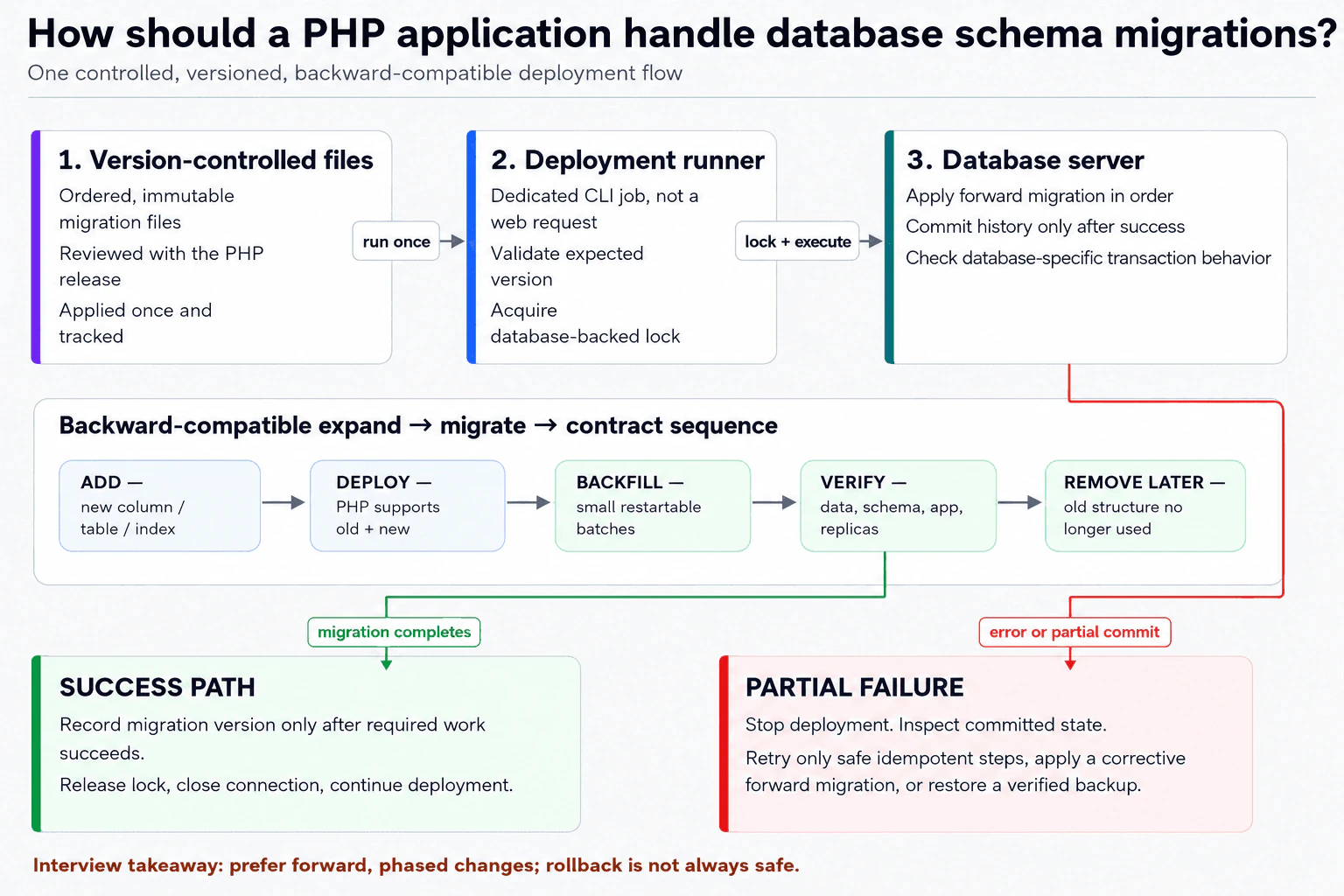
I treat migrations as production code. Each database change belongs in an ordered, immutable, version-controlled migration file. It should be reviewed with the PHP code that depends on it, tested against a production-like copy of the previous schema, and executed through a dedicated deployment or command-line process.
I would not run migrations automatically from a normal PHP web request or from every application instance during startup. That can create duplicate execution, long request times, lock contention, and unpredictable failures. One controlled deployment job should run the migrations before or during the application rollout according to the compatibility plan.
The migration tool should maintain a history table containing a unique migration identifier and the fact that it completed. Before applying a migration, the runner reads this history and validates the expected current version. It records completion only after the required work has succeeded. Applied migration files should not later be edited because different environments may already have executed the original contents. A correction should be a new migration.
The normal strategy is to move forward. A rollback function can be useful for a simple, reversible change, such as removing a newly added unused object. However, rollback is unsafe when a migration drops columns, deletes rows, changes values irreversibly, or has already been used by a newer PHP release. For these cases, I prefer a corrective forward migration or restoration from a verified backup rather than claiming that every change can be reversed.
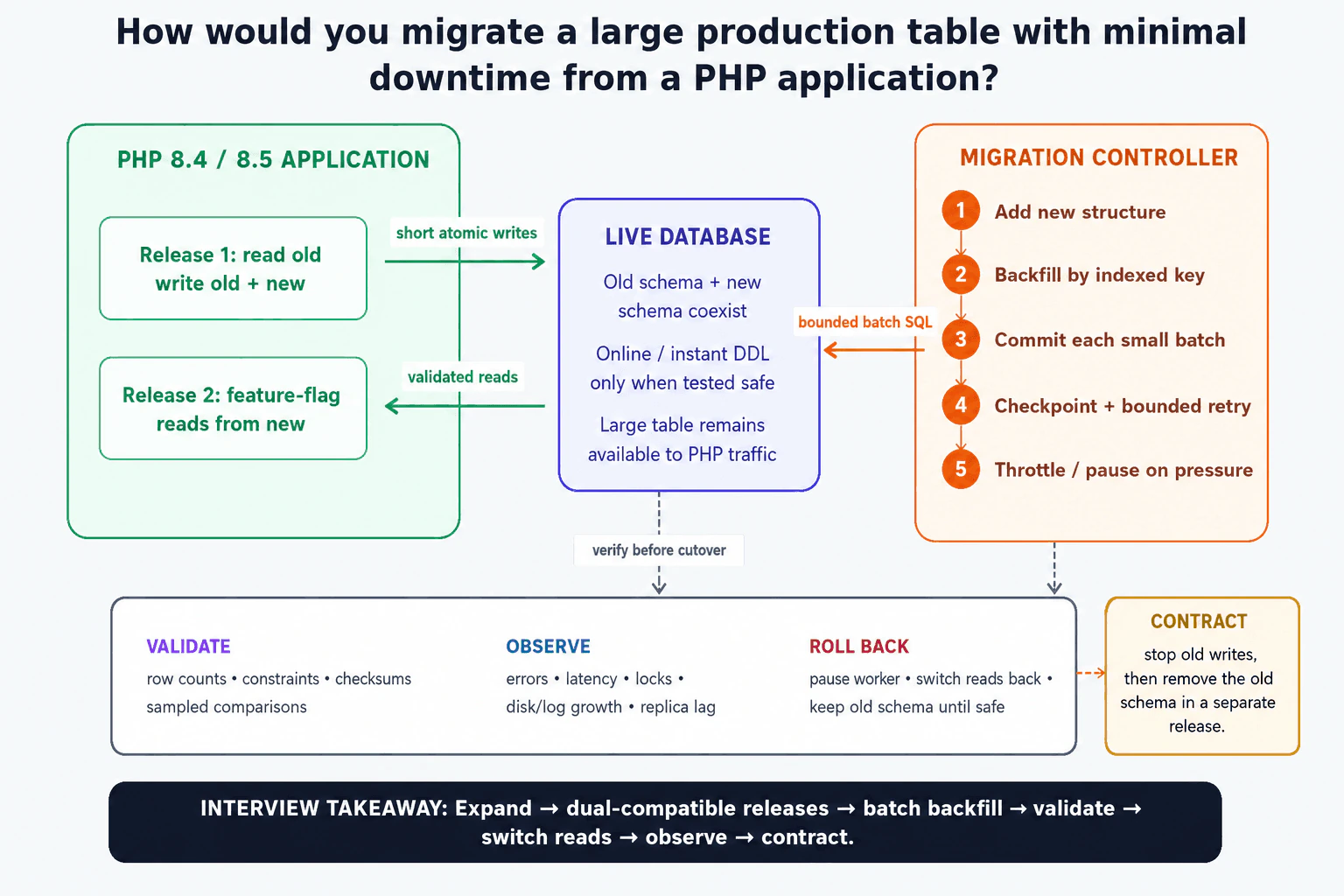
Deployment ordering matters because the schema and PHP code may not change at the same instant. For zero-downtime or rolling deployments, I use an expand-and-contract sequence:
- Add the new table, column, index, or other structure without removing the old one.
- Deploy PHP code that remains compatible with the old and new database states.
- When necessary, temporarily write to both representations or read from the new representation with a controlled fallback.
- Backfill existing rows in restartable batches.
- Verify completeness and switch all reads and writes to the new structure.
- Confirm that no deployed PHP version still depends on the old structure.
- Remove the old structure in a later release.
For example, directly renaming a column can break older PHP workers that still query its original name. A safer process is to add the replacement column, deploy compatible PHP code, copy the existing values, switch application access, verify the result, and remove the old column only after every running version has stopped using it.
Schema migrations and data migrations should usually be separated when the data operation is large. A schema migration changes database objects such as tables, columns, constraints, or indexes. A data migration changes existing rows. Combining a long backfill with a deployment-critical schema change can extend locks, increase database load, enlarge transaction or replication logs, delay replicas, and make recovery harder.
A large data migration should process a limited number of rows per batch using a stable key, such as a primary key, to mark progress. Each batch should be safe to retry. The job should commit between batches when appropriate, pause or reduce its rate if database load becomes unsafe, and verify the result with checks such as remaining-row counts, invalid-value counts, or application-specific invariants. It should not load the entire table into PHP memory.
Transaction behavior must be checked for the selected database and operation. Some databases support transactional schema changes for many statements. Other databases implicitly commit certain schema statements or cannot roll them back. Therefore, calling beginTransaction() in a PHP migration runner does not by itself guarantee that an entire schema migration is atomic. The migration design and recovery plan must match the actual database behavior.
When a migration is fully transactional, the schema or data changes and the migration-history record should be committed together where the tool and database permit it. When operations are not transactional, the migration should use small, explicit, observable steps. Each step should either be idempotent or check the current database state before continuing. Idempotent means safely repeating the step reaches the same correct result instead of creating duplicates or corruption.
Only one migration runner should operate on the same database at a time. I would use the migration tool's database-backed locking feature, a database advisory lock, or a dedicated lock row with safe atomic acquisition. A lock stored only in one PHP process or on one application server is insufficient when several servers or deployment jobs exist. The lock should have a bounded wait policy, clear failure reporting, and release behavior when the migration connection ends or the runner exits.
The migration runner should use a dedicated database connection with migration-specific credentials. Those credentials should have only the permissions required for the approved migration process. The runner should fail on database errors, log the migration identifier and failed step without exposing secrets, release its lock, close the connection, and return a nonzero command-line status so the deployment pipeline stops.
Before deployment, I would test both a clean installation and an upgrade from the exact previous production version. I would also estimate table size, expected lock behavior, index build cost, replication impact, available disk space, backup readiness, and whether the PHP release can operate in every intermediate state.
If a migration fails after some operations have succeeded, I would stop the remaining deployment and inspect the actual database state. I would not blindly rerun the complete file, blindly execute a rollback, or manually mark the history record as complete. Recovery depends on what committed:
- Retry the failed step when it is safe and idempotent.
- Apply a new corrective forward migration when the partial state needs repair.
- Restore from a tested backup or snapshot when destructive damage cannot be repaired safely.
After recovery, I would verify the schema, constraints, indexes, affected data, migration history, application health, and replica health before resuming deployment. The central principle is that every migration must have a defined forward path, compatibility window, concurrency policy, verification method, and recovery plan.
- Define the target schema and identify every PHP version that may run during deployment.
- Create a new ordered migration file and never modify an already-applied migration.
- Separate quick schema changes from long-running data backfills.
- Design destructive or incompatible changes with expand-and-contract phases.
- Test a clean installation and an upgrade from the exact previous production schema.
- Check database-specific transaction, locking, index-build, and rollback behavior.
- Prepare backups, verification queries, observability, and a recovery decision before deployment.
- Run the migration once through a dedicated command-line or deployment job.
- Acquire a database-backed lock and validate the current migration history.
- Apply each change in order and record completion only after its required work succeeds.
- Run large data changes in bounded, restartable, rate-controlled batches.
- Verify schema objects, constraints, indexes, affected data, application compatibility, and replica health.
- Release the lock, close the migration connection, and allow the deployment to continue only after success.
- Remove obsolete structures in a later deployment after no running PHP version uses them.
- On partial failure, stop, inspect committed state, and choose a safe retry, corrective migration, or tested restore.
The cost depends on the database, table size, operation, and available online-change features. A small metadata change may finish quickly, while adding an index, validating a constraint, changing a column type, or rebuilding a table may read or rewrite many rows and use substantial temporary disk space. A data backfill normally takes work proportional to the number of rows it examines or changes. Small batches keep PHP memory use bounded because only one batch is held at a time, but they add repeated query and commit overhead. Temporary old-and-new structures require extra storage, code, monitoring, and cleanup. Long transactions can retain locks and old row versions, grow logs, delay replicas, and make rollback expensive, so production migrations should be measured and rate-controlled.
Interviewers want to know whether the candidate can change a production database without breaking running PHP application versions or losing data. The question evaluates migration versioning, deployment ordering, backward compatibility, schema and data migration design, concurrency control, transaction limitations, operational risk, and recovery judgment. It also tests whether the candidate understands that a database deployment and an application deployment may complete at different times.
Common mistakes include running untracked SQL manually in production; executing migrations from normal web requests; allowing every PHP instance to migrate during startup; editing a migration after it has been applied; assuming a PHP transaction makes every schema statement reversible; recording migration completion before all required steps succeed; deploying PHP code before its required schema exists; dropping or renaming objects while older PHP versions still use them; combining a long backfill with a deployment-critical schema change; processing an entire table in PHP memory; using offset pagination for a changing backfill instead of stable key-based progress; holding one very large transaction unnecessarily; ignoring table locks, disk usage, replicas, and transaction-log growth; relying on a process-local lock in a multi-server deployment; blindly retrying a partially committed migration; treating every rollback method as safe; manually changing the migration-history table without repairing the database; and removing the old structure before compatibility and data verification are complete.
Present the answer in this order: version-controlled migrations, one controlled runner, migration history, expand-and-contract deployment, separate batched data migrations, database-specific transaction limits, database-backed locking, and partial-failure recovery. State clearly that rollback is not always safe and every intermediate schema must support the PHP versions that can still be running.