227 Php Developer Interview Questions & Answers

116 top • 13 Amazon • 21 Google • 10 Netflix • 7 Meta • 18 NVIDIA • 21 Apple • 21 Microsoft

Php Developer icon

Questions with Detailed ExplanationsWith Detailed Explanations

(Last Updated: August 28, 2026)

41. Write a PHP function to determine whether a string is a palindrome.CodingEasy

Question Details

Ignore letter case and define how spaces and punctuation are handled. Return a boolean and explain edge cases and time and space complexity.

Short Interview Answer (30-60 seconds)

I would first remove spaces, punctuation, and other non-alphanumeric ASCII characters, then convert the remaining text to lowercase. I would use two pointers, with one at the start and one at the end. I compare each mirrored pair. If any pair differs, I return false immediately. If the pointers meet or cross, every required pair matched, so I return true. Normalization and comparison take O(n) time. The normalized copy uses O(n) auxiliary space.

Detailed Explanation

See the Code while reading this explanation.

The function receives a string and returns either true or false. Letter case must not affect the result. Spaces and punctuation must also be ignored. I first create a cleaned lowercase string that contains only ASCII letters and digits. I then compare characters from the two ends and move toward the center. This method fits the problem because a palindrome has equal characters in every mirrored position. It can also stop as soon as one mismatched pair proves that the string is not a palindrome.

Useful Questions to Ask the Interviewer
  1. Should digits remain in the normalized string?
  2. Should an empty normalized string be treated as a palindrome?
  3. Is ASCII-only handling acceptable, or must the function support full Unicode text?
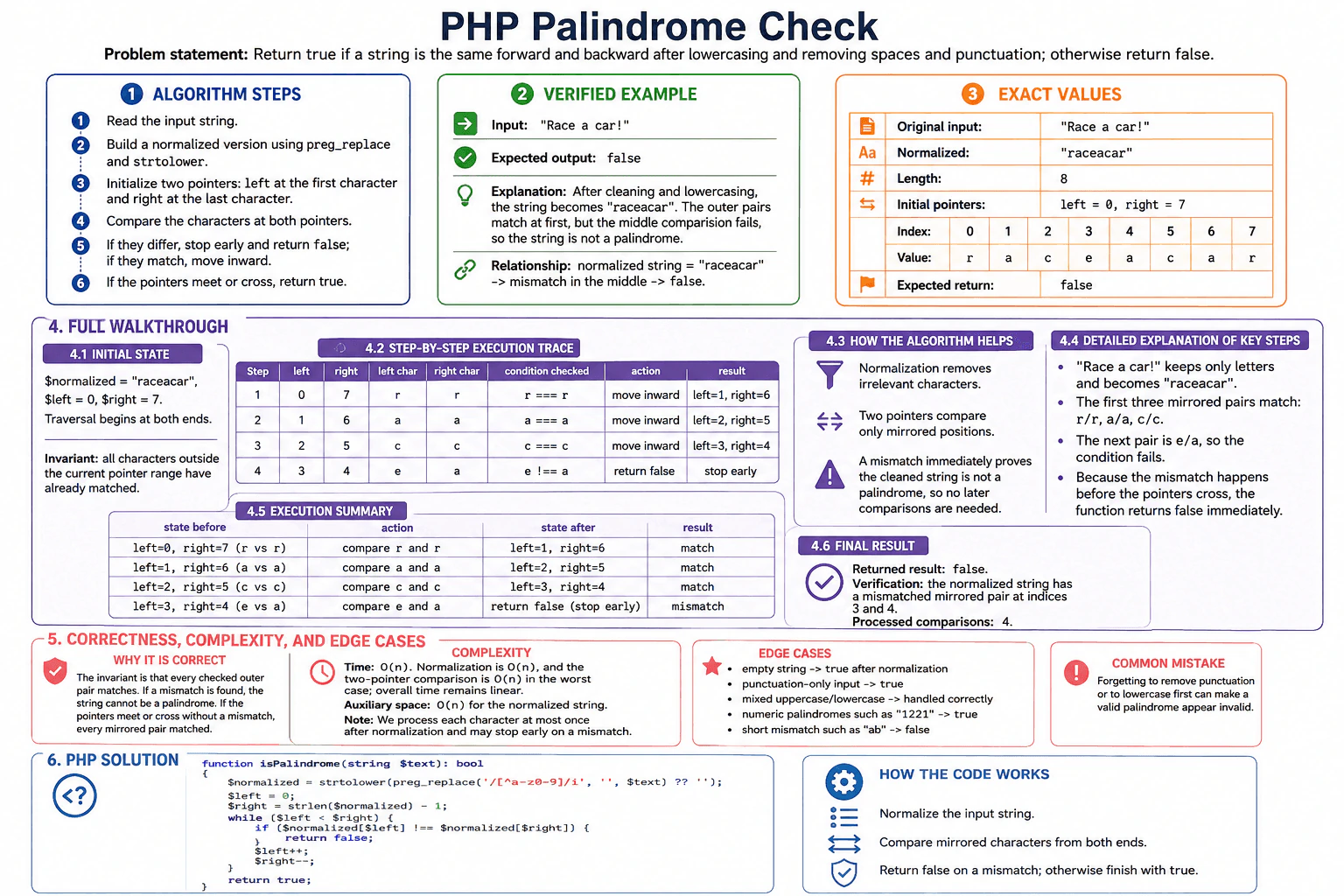
Write a PHP function to determine whether a string is a palindrome. diagram
How to Explain It in an Interview
1. Understand the input and output

The input is one string. The function returns a boolean. It returns true when the normalized string reads the same from left to right and right to left. It returns false when any mirrored character pair differs.

The shown solution ignores spaces and punctuation by removing every character except ASCII letters and digits. It ignores letter case by converting the cleaned string to lowercase.

2. Choose the two-pointer method

I use two pointers. The left pointer starts at the first character. The right pointer starts at the last character. They compare mirrored positions and move inward after every match.

The central invariant is that every character pair outside the current pointer range has already matched. A mismatch immediately proves that the string is not a palindrome.

3. Initialize the example

The example input is "Race a car!".

After removing spaces and punctuation and converting the text to lowercase, the normalized string is "raceacar".

Its length is 8. The left pointer starts at index 0. The right pointer starts at index 7.

The indexed characters are: 0:r, 1:a, 2:c, 3:e, 4:a, 5:c, 6:a, 7:r.

4. Walk through the executed comparisons

Step 1 starts with left = 0 and right = 7. The characters are r and r. The condition r === r is true, so left becomes 1 and right becomes 6.

Step 2 compares indices 1 and 6. The characters are a and a. They match, so left becomes 2 and right becomes 5.

Step 3 compares indices 2 and 5. The characters are c and c. They match, so left becomes 3 and right becomes 4.

Step 4 compares indices 3 and 4. The characters are e and a. The condition e !== a is true, so the function returns false immediately. Processing stops at this point.

5. Explain why the result is correct

The first three mirrored pairs match. The fourth pair does not match. A palindrome requires every mirrored pair to match. Therefore, the normalized string "raceacar" is not a palindrome, and false is the correct result.

If no mismatch were found and the pointers met or crossed, the invariant would show that every mirrored pair had matched. The function could then safely return true.

6. Explain the PHP implementation

preg_replace removes every character except ASCII letters and digits. The null-coalescing operator provides an empty string if preg_replace returns null. strtolower converts the cleaned result to lowercase.

The variables $left and $right store the current pointer positions. The while loop continues while $left is less than $right. A mismatched pair returns false immediately. A matching pair moves both pointers toward the center. If the loop finishes, the function returns true.

7. Explain complexity and edge cases

Normalization takes O(n) time. The two-pointer scan takes O(n) time in the worst case. The total time remains O(n). The normalized string requires O(n) auxiliary space.

An empty string returns true after normalization. A string containing only punctuation also returns true because its normalized form is empty. Mixed case is handled by strtolower. A numeric palindrome such as "1221" returns true. A short mismatch such as "ab" returns false. The shown implementation is ASCII-focused and does not provide complete Unicode handling.

Key Insight / Why This Solution Works

The key insight is that a palindrome must have equal characters in mirrored positions. The solution first normalizes the input by removing every character except ASCII letters and digits, then converting the result to lowercase. It places one pointer at each end of the normalized string. Matching characters allow both pointers to move inward. A mismatch returns false immediately. The invariant is that every pair outside the current pointer range has already matched. If the pointers meet or cross without a mismatch, all mirrored pairs match, so the function returns true.

Code
<?php

/**
 * Return true when the normalized string is a palindrome.
 *
 * Rules used by this solution:
 * - Ignore ASCII letter case.
 * - Remove spaces, punctuation, and other non-alphanumeric ASCII characters.
 * - Keep ASCII digits.
 */
function isPalindrome(string $text): bool
{
    // Step 1: Remove every character except ASCII letters and digits.
    // Step 2: Convert the cleaned string to lowercase.
    $normalized = strtolower(
        preg_replace('/[^a-z0-9]/i', '', $text) ?? ''
    );

    // Step 3: Place one pointer at each end of the normalized string.
    $left = 0;
    $right = strlen($normalized) - 1;

    // Step 4: Compare mirrored characters until the pointers meet or cross.
    while ($left < $right) {
        // Step 5: A mismatch proves that the string is not a palindrome.
        if ($normalized[$left] !== $normalized[$right]) {
            return false;
        }

        // Step 6: The pair matched, so move both pointers inward.
        $left++;
        $right--;
    }

    // Every required mirrored pair matched.
    return true;
}

// Example from the approved diagram.
$input = "Race a car!";
$result = isPalindrome($input);

var_dump($result); // bool(false)
Time & Space Complexity

Let n be the length of the original input string. Normalizing the input takes O(n) time because the characters must be examined. The two-pointer loop also takes O(n) time in the worst case, although it may stop early after a mismatch. Because these two operations happen one after another, the total time complexity is O(n). The function stores a normalized copy whose size can grow with the input, so the auxiliary space complexity is O(n).

Where it is used

This normalization and two-pointer pattern is useful when software must compare text while ignoring formatting differences. Examples include simplified phrase validation, normalized identifier checks, text-cleaning utilities, and interview problems that compare values from opposite ends of a sequence. The same two-pointer idea also appears in sorted-array searches and shrinking-range problems.

Why Interviewers Ask This

This problem tests whether a candidate can clarify text-processing rules, recognize the two-pointer pattern, and maintain a simple correctness invariant. It also checks early-return reasoning, pointer movement, PHP string handling, and accurate complexity analysis. The interviewer may also look for awareness of edge cases such as empty input, punctuation-only input, mixed case, digits, and the difference between ASCII-focused processing and full Unicode support.

Common interview mistakes

A common mistake is comparing the original string without first removing spaces and punctuation. Another is forgetting to convert the text to lowercase. Candidates may move only one pointer after a match, use an incorrect loop condition, or continue processing after a mismatch instead of returning false immediately. It is also incorrect to claim O(1) auxiliary space because this implementation creates a normalized copy. Finally, the regular expression and strtolower are ASCII-focused, so the code should not be described as fully Unicode-safe.

Interview tip

Before coding, state the normalization rule and the invariant: every pair outside the current pointer range has already matched. Then trace the exact pairs r/r, a/a, c/c, and e/a. This makes the early false return easy to explain and proves that the code matches the example.
Interviewer may ask next
How would you support full Unicode text instead of only ASCII letters and digits?

The two-pointer idea would remain the same, but normalization and indexing would change. I would use a Unicode-aware regular expression with Unicode letter and number classes, convert case with mb_strtolower, and split the normalized string into Unicode characters before indexing it. Correctness is preserved because the algorithm still compares mirrored characters after normalization. The time complexity remains O(n), and the auxiliary space remains O(n). The tradeoff is additional code and reliance on Unicode-aware PHP functions.

Can this be implemented with O(1) auxiliary space?

For ASCII input, the function can scan the original string directly with left and right pointers. Each pointer skips non-alphanumeric characters, and the selected characters are compared after case normalization. This avoids building a cleaned copy. The invariant remains that all valid mirrored characters outside the current range have matched. The time complexity stays O(n), and the auxiliary space becomes O(1). The tradeoff is more complicated pointer and character-validation logic.

42. Group an array of words into anagrams in PHP.CodingMedium

Question Details

Return groups containing words with the same character counts. Define case handling, output ordering expectations, and analyze the cost of your grouping key.

Short Interview Answer (30-60 seconds)

I would use a PHP associative array to group the words. For each word, I convert it to lowercase, sort its characters, and use that sorted string as the key. Words with the same key are anagrams, so I append each original word to the matching group. Processing from left to right preserves word order and first-seen group order. The expected time is O(n × k log k). The returned groups use O(n × k) storage, with O(k) temporary working space per word.

Detailed Explanation

See the Code while reading this explanation.

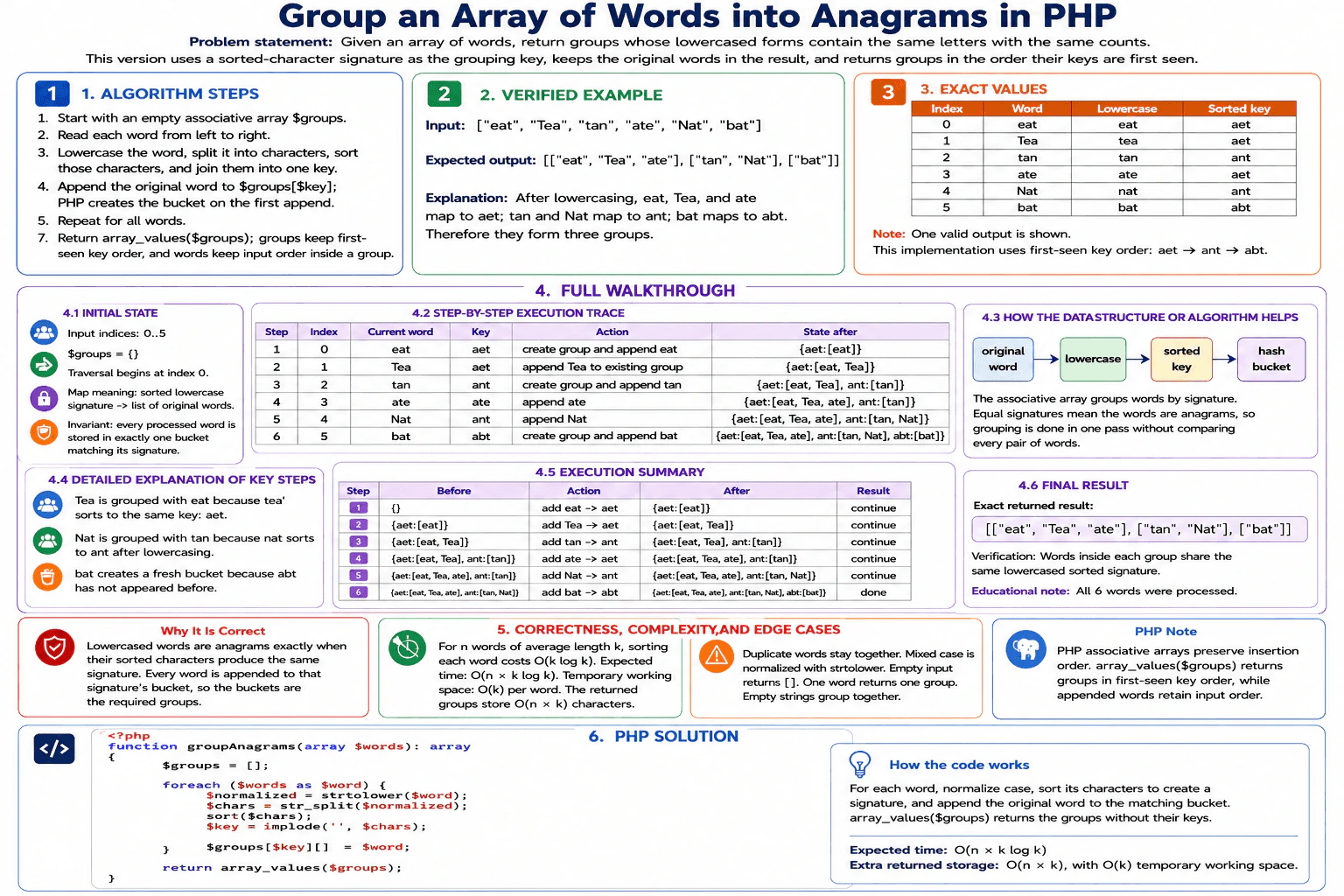
The input is an array of words. The goal is to place words with the same letters and letter counts into the same group. Uppercase and lowercase letters are treated as equal, but each original word is kept unchanged in the result. The main idea is to create the same identifying value for every pair of anagrams. We convert each word to lowercase and sort its characters. A PHP associative array then stores all original words that produce the same sorted value.

Useful Questions to Ask the Interviewer
  1. Should uppercase and lowercase letters be treated as equal?
  2. Must the groups appear in a specific order?
  3. Must words keep their input order inside each group?
  4. Can the input contain duplicate words or empty strings?
  5. Should the solution support only ordinary byte-based strings or full Unicode text?
Group an array of words into anagrams in PHP. diagram
How to Explain It in an Interview
1. Understand the input and required output

The input is an array of strings. The output is an array of groups. Each group contains words that have the same characters with the same counts after case is ignored.

For the example input: ["eat", "Tea", "tan", "ate", "Nat", "bat"]

One valid output is: [["eat", "Tea", "ate"], ["tan", "Nat"], ["bat"]]

This implementation processes words from left to right. PHP associative arrays preserve insertion order, so the groups appear in first-seen key order. Appending words also preserves their input order inside each group.

2. Choose the algorithm and data structure

For each word, create a grouping key:

  1. Convert the word to lowercase.
  2. Split it into characters.
  3. Sort the characters.
  4. Join them into one string.

For example, "Tea" becomes "tea", and sorting gives "aet". The words "eat" and "ate" also produce "aet".

The associative array stores: sorted lowercase signature → list of original words

The central invariant is that every processed word is stored in exactly one bucket whose key matches that word's sorted lowercase signature.

3. Initialize the state

Start with an empty associative array named $groups.

$groups = []

Traversal begins at index 0. No word has been processed yet, so the empty state is correct.

4. Walk through the example

Step 1 processes index 0, word "eat". Its lowercase form is "eat". Its sorted key is "aet". Appending the original word creates the first bucket. State after: {aet:[eat]}

Step 2 processes index 1, word "Tea". Its lowercase form is "tea". Its sorted key is "aet". Append the original word to the existing group. State after: {aet:[eat, Tea]}

Step 3 processes index 2, word "tan". Its sorted lowercase key is "ant". Appending it creates a new bucket. State after: {aet:[eat, Tea], ant:[tan]}

Step 4 processes index 3, word "ate". Its key is "aet". Append it to the first group. State after: {aet:[eat, Tea, ate], ant:[tan]}

Step 5 processes index 4, word "Nat". Its lowercase form is "nat". Its key is "ant". Append it to the second group. State after: {aet:[eat, Tea, ate], ant:[tan, Nat]}

Step 6 processes index 5, word "bat". Its key is "abt". Appending it creates a new bucket. State after: {aet:[eat, Tea, ate], ant:[tan, Nat], abt:[bat]}

All six words have now been processed. Calling array_values($groups) removes the internal signature keys and returns only the grouped arrays.

5. Explain why the result is correct

Two words are anagrams after case is ignored exactly when their lowercase characters produce the same sorted string. Every original word is placed in the bucket for that string. Therefore, words in the same bucket are anagrams, and words with different character counts receive different keys.

6. Explain the PHP implementation

The function creates an empty $groups array. It loops through every original word. It normalizes case with strtolower, creates a character array with str_split, sorts those characters, and joins them into a key. The statement $groups[$key][] = $word appends the original word to the correct bucket. PHP creates that bucket on the first append. Finally, array_values($groups) returns the groups without exposing the internal signature keys.

7. Explain complexity and edge cases

Let n be the number of words and k be their average length. Sorting one word costs O(k log k). Across all words, the expected time is O(n × k log k). PHP associative-array access is O(1) on average. The returned groups and stored keys use O(n × k) storage. Processing one word also needs O(k) temporary working space.

Duplicate words stay together. Mixed case is normalized. Empty input returns an empty array. One word returns one group. Empty strings share the same empty signature.

Key Insight / Why This Solution Works

The key insight is that anagrams become identical after case normalization and character sorting. For example, "eat", "Tea", and "ate" all produce the key "aet". The PHP associative array uses each sorted lowercase signature as a key and stores the matching original words as its value. The invariant is that every processed word appears in exactly one bucket matching its signature. This avoids comparing every word with every other word. Instead, each word is transformed once and placed directly into the correct group.

Code
<?php

/**
 * Group words that contain the same letters with the same counts.
 * Case is ignored when building the grouping key.
 * Original words and input order are preserved in each group.
 *
 * @param string[] $words
 * @return array<int, array<int, string>>
 */
function groupAnagrams(array $words): array
{
    // Key: sorted lowercase signature.
    // Value: original words that have that signature.
    $groups = [];

    // Process the words from left to right.
    foreach ($words as $word) {
        // Ignore case while deciding which group the word belongs to.
        $normalized = strtolower($word);

        // Split the normalized word into individual characters.
        $chars = str_split($normalized);

        // Sort the characters so all anagrams produce the same key.
        sort($chars);

        // Join the sorted characters into one grouping key.
        $key = implode('', $chars);

        // Append the original word.
        // PHP creates the bucket automatically on the first append.
        $groups[$key][] = $word;
    }

    // Remove the internal signature keys and return only the groups.
    return array_values($groups);
}

// Example from the diagram.
$words = ["eat", "Tea", "tan", "ate", "Nat", "bat"];
$result = groupAnagrams($words);

print_r($result);

/*
Expected output:
Array
(
    [0] => Array
        (
            [0] => eat
            [1] => Tea
            [2] => ate
        )

    [1] => Array
        (
            [0] => tan
            [1] => Nat
        )

    [2] => Array
        (
            [0] => bat
        )
)
*/
Time & Space Complexity

Let n be the number of words and k be the average number of characters in each word. Lowercasing, splitting, and joining one word take O(k) time. Sorting its characters takes O(k log k), which is the largest cost. Across all words, the expected time is O(n × k log k). PHP associative-array lookup and insertion are O(1) on average, not guaranteed in the worst case. The returned groups and stored signature keys use O(n × k) storage. Processing one word also needs O(k) temporary working space.

Where it is used

This pattern is useful when software must group values that are equivalent after normalization. Examples include grouping anagrams in word games, organizing dictionary entries, detecting rearranged identifiers, and collecting records that share the same normalized text signature. The broader pattern is to create a canonical key, meaning one standard representation, and use that key to group equivalent values.

Why Interviewers Ask This

This problem checks whether the candidate can convert equivalent values into one canonical key and use an associative array for grouping. It also tests case handling, duplicate handling, preservation of order, and correct PHP array syntax. The interviewer wants to see whether the candidate includes the cost of sorting each word instead of claiming simple linear time. The problem also tests whether the candidate can explain why equal signatures are both necessary and sufficient for two words to be anagrams.

Common interview mistakes

A common mistake is sorting the original word and returning the sorted text instead of preserving the original word. Another mistake is forgetting to normalize case, which would separate "Tea" from "eat". Some candidates use only the word length as the key, but equal lengths do not prove that words are anagrams. Another mistake is comparing every pair of words, which does unnecessary work. Candidates may also claim O(n) time while ignoring the O(k log k) sorting cost. For non-ASCII text, strtolower and str_split may not provide correct Unicode behavior.

Interview tip

Define the associative array before writing code: "The key is the sorted lowercase word, and the value is the list of original words." Then trace the repeated key "aet" to show why the grouping works and why the original capitalization and input order are preserved.

Interviewer may ask next
How would you handle full Unicode words instead of ordinary byte-based strings?

I would use Unicode-aware case conversion and character splitting, such as mb_strtolower with an explicit encoding and a Unicode-safe way to obtain characters. I would then sort those characters and build the same signature. The invariant stays the same because equal normalized character sequences still share one key. If a word has k Unicode characters, sorting costs O(k log k). The groups and keys use O(n × k) storage. The tradeoff is more complex code and larger constant costs.

Can the grouping key be built without sorting every word?

Yes. If the allowed alphabet is fixed and small, I can count how many times each character appears and serialize those counts as the key. Equal count keys still mean the words are anagrams. For an alphabet of fixed size a, building one key takes O(k + a), so the total expected time is O(n × (k + a)). The stored keys use O(n × a) space in addition to the returned words. The tradeoff is that the method depends on a clearly defined alphabet.

43. Find the first non-repeating character in a string using PHP.CodingMedium

Question Details

Return the character and its position, or a no-result value. Define whether matching is case-sensitive and discuss byte versus Unicode handling.

Short Interview Answer (30-60 seconds)

I would use a two-pass frequency-map solution. First, I split the UTF-8 string into Unicode characters and count how many times each character appears. Then I scan the characters again from left to right. The first character with a count of 1 is the answer, so I return that character and its zero-based character index. Matching is case-sensitive. PHP associative-array operations are O(1) on average, so the expected time is O(n). The frequency map uses O(k) space.

Detailed Explanation

See the Code while reading this explanation.

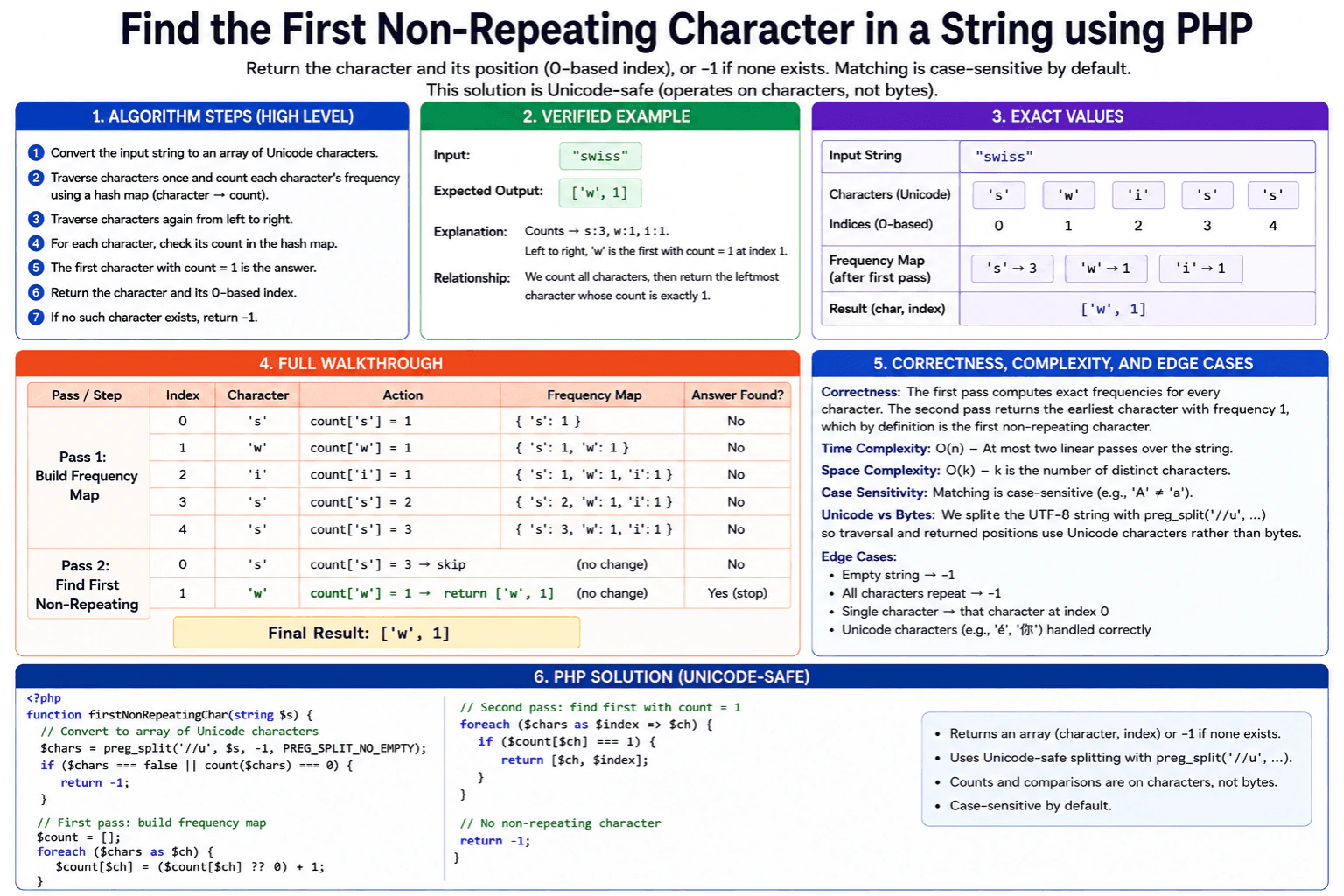
The input is one string. We need to find the first character that appears only once. We return that character and its zero-based position. If every character repeats, we return -1. Matching is case-sensitive, so "A" and "a" are different characters. The position should count Unicode characters rather than UTF-8 bytes. The diagram uses the input "swiss". It first counts every character. It then checks the characters again from left to right. The first character with a count of 1 is "w" at index 1.

Useful Questions to Ask the Interviewer
  1. Should matching be case-sensitive?
  2. Should the returned position be a byte offset or a Unicode character index?
  3. What no-result value should I return if every character repeats?
  4. May I use extra memory for a frequency map?
Find the first non-repeating character in a string using PHP. diagram
How to Explain It in an Interview
1. Understand the input and required output

The function receives one string. It returns an array containing the first non-repeating character and its zero-based Unicode character index. It returns -1 when no such character exists. For the input "swiss", the required result is ["w", 1].

2. Choose the algorithm and data structure

I use two passes and a frequency map. The map stores each character as a key and its total number of occurrences as the value. Counting every character first is necessary because a character that appears unique near the start may appear again later.

The central invariant is that after the first pass, the map contains the exact total frequency of every character. During the second pass, the first character with frequency 1 is therefore the first non-repeating character.

3. Initialize the state

The code uses preg_split('//u', ...) to split the UTF-8 string into Unicode characters. For "swiss", this creates ["s", "w", "i", "s", "s"]. It then creates an empty associative array named $count.

4. Walk through the example

The example input is "swiss".

First pass:

  • At index 0, the character is "s". Its count becomes 1. The map is {"s": 1}.
  • At index 1, the character is "w". Its count becomes 1. The map is {"s": 1, "w": 1}.
  • At index 2, the character is "i". Its count becomes 1. The map is {"s": 1, "w": 1, "i": 1}.
  • At index 3, the character is "s". Its count becomes 2.
  • At index 4, the character is "s". Its count becomes 3.

The completed frequency map is {"s": 3, "w": 1, "i": 1}.

Second pass:

  • At index 0, the character is "s". Its count is 3, so the algorithm skips it.
  • At index 1, the character is "w". Its count is 1, so the algorithm returns ["w", 1] and stops.

The characters after index 1 are not processed during the second pass because the result has already been found.

5. Explain why the result is correct

The first pass records the exact total count of every character. The second pass preserves the original left-to-right order. Therefore, the first character whose count is 1 is exactly the leftmost non-repeating character. In "swiss", "w" is the first such character, and its zero-based character index is 1.

6. Explain the PHP implementation

The function accepts a string. It splits the string into Unicode characters with preg_split('//u', ...). The first foreach loop builds the frequency map. The second foreach loop checks the characters in their original order. When it finds a character whose count is exactly 1, it immediately returns [$character, $index]. If no character has a count of 1, the function returns -1.

7. Explain complexity and edge cases

The algorithm performs at most two linear passes over the characters. PHP associative-array lookup and insertion are O(1) on average, so the expected running time is O(n). The frequency map stores up to k distinct characters, so the map uses O(k) space. Because this PHP implementation also creates a character array with preg_split, its total auxiliary space is O(n). Important edge cases include an empty string, one character, all characters repeating, uppercase and lowercase letters, and multibyte Unicode characters.

Key Insight / Why This Solution Works

The key insight is to separate frequency counting from answer selection. Returning a character during the first pass would be unsafe because the same character might appear again later. The first pass builds a frequency map in which each key is a Unicode character and each value is its total count. The second pass checks the characters in their original order. The invariant is that the map contains the exact total frequency of every character before the second pass begins. Therefore, the first character with a count of 1 is the required result.

Code
<?php

declare(strict_types=1);

/**
 * Find the first non-repeating Unicode character.
 *
 * Matching is case-sensitive.
 * The returned index is a zero-based Unicode character index,
 * not a UTF-8 byte offset.
 *
 * @return array{0: string, 1: int}|int
 */
function firstNonRepeatingChar(string $s): array|int
{
    // Convert the UTF-8 string into an array of Unicode characters.
    $chars = preg_split('//u', $s, -1, PREG_SPLIT_NO_EMPTY);

    // Return the agreed no-result value for an empty or invalid input.
    if ($chars === false || count($chars) === 0) {
        return -1;
    }

    // First pass: build character => total frequency.
    $count = [];

    foreach ($chars as $character) {
        $count[$character] = ($count[$character] ?? 0) + 1;
    }

    // Second pass: keep the original order and stop at the first count of 1.
    foreach ($chars as $index => $character) {
        if ($count[$character] === 1) {
            return [$character, $index];
        }
    }

    // Every character repeats.
    return -1;
}

// Verified example from the diagram.
$input = 'swiss';
$result = firstNonRepeatingChar($input);

var_export($result);
// Output: array (0 => 'w', 1 => 1)
Time & Space Complexity

Let n be the number of Unicode characters in the string, and let k be the number of distinct characters. Splitting and scanning the characters takes O(n) time. PHP associative-array lookup and insertion are O(1) on average, so the full algorithm runs in O(n) expected time. The frequency map uses O(k) space. The shown PHP implementation also stores all split characters in an array, so its total auxiliary space is O(n). The algorithm may stop early during the second pass after finding the answer.

Where it is used

This frequency-map pattern is useful when software must find the earliest item that occurs only once. Examples include finding the first unique symbol in text, detecting an unmatched event code in an ordered log, validating identifiers, and analyzing data where both total frequency and original position matter.

Why Interviewers Ask This

This question tests whether a candidate recognizes the frequency-counting pattern and preserves the original character order. It checks correct use of PHP associative arrays, early return, duplicate handling, and accurate complexity analysis. The Unicode requirement also tests whether the candidate understands the difference between byte positions and character positions. The interviewer can also evaluate how clearly the candidate defines case sensitivity, output format, and no-result behavior.

Common interview mistakes

One mistake is returning a character during the first pass before knowing whether it appears again. Another is using strlen or direct byte indexing and then calling the result a Unicode character index. Candidates may also forget that matching is case-sensitive, return only the character without its position, use a different no-result value, or continue scanning after finding the answer. Another common error is claiming guaranteed O(n) time instead of O(n) expected time when the solution depends on average O(1) PHP associative-array operations.

Interview tip

Before coding, state exactly what the map stores: character to total count. Then explain that the second pass keeps the original order, so the first character with count 1 must be the required answer.

Interviewer may ask next
How would the solution change if matching should be case-insensitive?

Normalize the string before splitting and counting, such as with mb_strtolower($s, 'UTF-8'). Then run the same two-pass frequency-map algorithm on the normalized characters. The expected time remains O(n), and the total auxiliary space remains O(n). The main tradeoff is that returning the original character requires keeping a connection between each normalized character and its original form.

How would you process an input that is too large to keep fully in memory?

The algorithm still needs complete frequency information before it can safely choose the first unique character. One approach is to make a first streaming pass that counts characters while recording characters and positions in temporary storage. A second pass over that storage returns the first character with count 1. The expected time is O(n), the in-memory map uses O(k) space, and the tradeoff is extra storage and I/O.

44. Find the minimum window substring in PHP.CodingHard

Question Details

Given strings s and t, return the smallest substring of s containing all characters of t with multiplicity, or an empty string. Explain the sliding-window invariants and complexity.

Short Interview Answer (30-60 seconds)

I would use a sliding window with two PHP associative arrays. The need map stores how many times each character from t is required. I expand the window with the right pointer and update its counts. When every required count is satisfied, I move the left pointer forward and record smaller valid windows. The invariant is that formed equals required only when the window contains all characters of t with multiplicity. The expected time is O(|s| + |t|), with O(k) auxiliary space.

Detailed Explanation

See the Code while reading this explanation.

We are given a source string s and a target string t. We must return the shortest continuous part of s that contains every character from t. If t contains a character more than once, the returned part must also contain it that many times. If no valid part exists, we return an empty string. A sliding window fits because we can expand until the range is valid, then shrink it without recounting every possible substring.

Useful Questions to Ask the Interviewer
  1. Are character comparisons case-sensitive?
  2. Must repeated characters in t be matched with the same multiplicity?
  3. Should I return an empty string when no valid window exists?
  4. Can I treat the strings as byte-based strings, as this PHP implementation does?
Find the minimum window substring in PHP. diagram
How to Explain It in an Interview
1. Understand the input and required output

The input contains two strings, s and t. We return a substring of s. A substring uses consecutive characters. It is not a subsequence.

For the example: s = "ADOBECODEBANC" t = "ABC"

The expected output is "BANC". It contains A, B, and C, and no shorter valid substring exists.

2. Choose the sliding window and frequency maps

The solution uses a sliding window with left and right boundaries.

The need map stores the required frequency of each character in t. For t = "ABC", it stores A => 1, B => 1, and C => 1.

The window map stores character frequencies inside the current range s[left..right]. The variable required is the number of distinct characters in need. Here, required is 3. The variable formed counts how many required characters currently have enough copies in the window.

The central invariant is: formed equals required exactly when the current window contains every character of t with the required multiplicity.

3. Initialize the state

The window map starts empty. left starts at 0. right starts at 0 when the loop begins. formed starts at 0. bestStart starts at 0. bestLength starts at PHP_INT_MAX, which means that no valid window has been recorded yet.

4. Walk through the example

At right = 0, the character is A. The window count becomes (A:1, B:0, C:0), so formed becomes 1.

At right = 1 and right = 2, the characters D and O are added. They are not required, so formed stays 1.

At right = 3, B reaches its required count. The counts are (1,1,0), so formed becomes 2.

At right = 4, E is added. formed stays 2.

At right = 5, C reaches its required count. The window [0..5] is "ADOBEC". Its required counts are (1,1,1), so formed becomes 3. The window is valid. Its length is 6, so bestStart becomes 0 and bestLength becomes 6.

The algorithm now shrinks from the left. Removing A at index 0 changes the required counts to (0,1,1). formed falls from 3 to 2, and left becomes 1. The window is no longer valid.

The right pointer continues through O, D, E, and B. At right = 9, the required counts are (0,2,1), but A is still missing, so formed remains 2.

At right = 10, A is added. The window [1..10] is "DOBECODEBA". Its required counts are (1,2,1), so formed becomes 3.

The algorithm shrinks again. It removes D at index 1 and O at index 2. These characters are not required. It then removes the extra B at index 3, leaving one required B. Removing E at index 4 gives the valid window [5..10], "CODEBA", with length 6. This ties the current best, so it is not recorded because the code updates only for a strictly smaller window. Removing C at index 5 changes the required counts to (1,1,0), so formed becomes 2 and left becomes 6.

At right = 11, N is added. formed remains 2.

At right = 12, C is added. The window [6..12] is "ODEBANC". Its required counts are (1,1,1), so formed becomes 3.

The algorithm removes O at index 6. The remaining window "DEBANC" has length 6, so it does not replace the best. It removes D at index 7. The window [8..12] is "EBANC" with length 5, so the best becomes start 8 and length 5. It removes E at index 8. The window [9..12] is "BANC" with length 4, so the best becomes start 9 and length 4. Finally, removing B at index 9 changes the required counts to (1,0,1). formed becomes 2, so shrinking stops.

The final answer is substr(s, 9, 4), which returns "BANC".

5. Explain why the result is correct

For every right boundary, the inner loop moves left while the window remains valid. Before each removal, the code records the current valid window when it is smaller than the best one found so far. This means it finds the smallest valid window for each right boundary. Because every right boundary is considered, the smallest recorded candidate is the global minimum window.

6. Explain the PHP implementation

The function first handles empty input and the case where t is longer than s. It builds the need map from t. It then expands right through s and updates the window map.

formed increases only when a required character count becomes exactly equal to its required count. While formed equals required, the code records the current window before removing s[left]. After removal, formed decreases only when a required count falls below its target. The function finally returns the recorded substring or an empty string if no valid window was found.

7. Explain complexity and edge cases

Building need takes O(|t|) time. The right pointer moves forward at most |s| times. The left pointer also moves forward at most |s| times. PHP associative-array lookup and update are O(1) on average, so the total expected time is O(|s| + |t|).

The maps use O(k) auxiliary space, where k is the number of distinct characters stored. For an unbounded character set, the general worst-case extra space can grow to O(|s| + |t|).

Relevant edge cases include an empty s, an empty t, t being longer than s, repeated characters in t, and no valid window in s.

Key Insight / Why This Solution Works

The key insight is that the answer must be a continuous range, so a sliding window can reuse previous work. The need map stores each required character and its required count. The window map stores counts inside s[left..right]. The variable formed tells us how many required characters currently meet their target counts. The invariant is that formed equals required only when the current window contains all characters of t with multiplicity. When the window becomes valid, repeatedly moving left removes unnecessary leading characters and finds the smallest valid window for that right boundary. This avoids recounting every possible substring.

Code
<?php

/**
 * Return the smallest substring of $s that contains every character of $t
 * with the required multiplicity.
 */
function minWindow(string $s, string $t): string
{
    // Step 1: Reject inputs that cannot produce a valid window.
    if ($t === '' || $s === '' || strlen($t) > strlen($s)) {
        return '';
    }

    // Step 2: Count the required characters from t.
    $need = [];
    foreach (str_split($t) as $char) {
        $need[$char] = ($need[$char] ?? 0) + 1;
    }

    // Step 3: Initialize the sliding-window state.
    $window = [];
    $required = count($need);
    $formed = 0;
    $left = 0;
    $bestStart = 0;
    $bestLength = PHP_INT_MAX;
    $length = strlen($s);

    // Step 4: Expand the right boundary through s.
    for ($right = 0; $right < $length; $right++) {
        $char = $s[$right];
        $window[$char] = ($window[$char] ?? 0) + 1;

        // A required character has just reached its target count.
        if (
            isset($need[$char]) &&
            $window[$char] === $need[$char]
        ) {
            $formed++;
        }

        // Step 5: Shrink while the current window remains valid.
        while ($formed === $required) {
            $currentLength = $right - $left + 1;

            // Record the valid window before removing its left character.
            if ($currentLength < $bestLength) {
                $bestLength = $currentLength;
                $bestStart = $left;
            }

            $leftChar = $s[$left];
            $window[$leftChar]--;

            // The window becomes invalid only when a required count is too low.
            if (
                isset($need[$leftChar]) &&
                $window[$leftChar] < $need[$leftChar]
            ) {
                $formed--;
            }

            $left++;
        }
    }

    // Step 6: Return the smallest valid window or an empty string.
    return $bestLength === PHP_INT_MAX
        ? ''
        : substr($s, $bestStart, $bestLength);
}

// Verified example from the diagram.
echo minWindow('ADOBECODEBANC', 'ABC') . PHP_EOL;
// Output: BANC
Time & Space Complexity

Building the frequency map for t takes O(|t|) time. The right pointer moves forward at most |s| times. The left pointer also moves forward at most |s| times. PHP associative-array lookups and updates are O(1) on average, so the total expected time is O(|s| + |t|). The need and window maps use O(k) auxiliary space, where k is the number of distinct characters stored. With an unbounded character set, the general worst-case extra space can be O(|s| + |t|).

Where it is used

This pattern is useful when software must find a smallest or largest continuous range that satisfies a rule. Examples include finding the shortest text section containing required keywords, detecting a valid range in a stream of events, locating a segment containing required symbols, and processing continuous data without scanning every possible range from the beginning.

Why Interviewers Ask This

This problem tests whether a candidate recognizes the sliding-window pattern and can maintain a precise invariant while two boundaries move. It also checks frequency counting, repeated-character handling, correct update order, and the difference between a substring and a subsequence. For PHP developers, it evaluates associative-array usage, string indexing assumptions, complete edge-case handling, executable PHP code, and accurate expected-time complexity analysis.

Common interview mistakes

A common mistake is treating the answer as a subsequence instead of a continuous substring. Another is using a set instead of frequency counts, which fails when t contains repeated characters. Candidates may increase formed every time a required character appears instead of only when its count first reaches the target. They may decrease formed before a count falls below its target. Another mistake is removing s[left] before recording the current valid window. It is also incorrect to replace the best window on an equal length when the code uses a strictly smaller comparison. Finally, PHP associative-array operations should be described as average O(1), not guaranteed O(1).

Interview tip

State the invariant before writing code: formed equals required exactly when the current window contains every target character with the required multiplicity. Then emphasize that the code records the valid window before removing s[left]. That makes the shrinking logic and update order easy to justify.

Interviewer may ask next
What changes if t contains repeated characters, such as "AABC"?

The algorithm stays the same. The need map stores A => 2, B => 1, and C => 1. formed increases for A only when the window count of A reaches 2. While shrinking, formed decreases when the count of A falls below 2. The expected time remains O(|s| + |t|), and the auxiliary space remains O(k).

What changes if s is received as a stream instead of one complete string?

The sliding-window idea still works, but the program must retain the characters currently inside the active window so it knows which character leaves when left advances. A queue or indexed buffer can store that range. The best window seen so far can be updated as data arrives, but the final global answer is known only when the stream ends. Expected processing time remains linear, while memory depends on the largest active window.

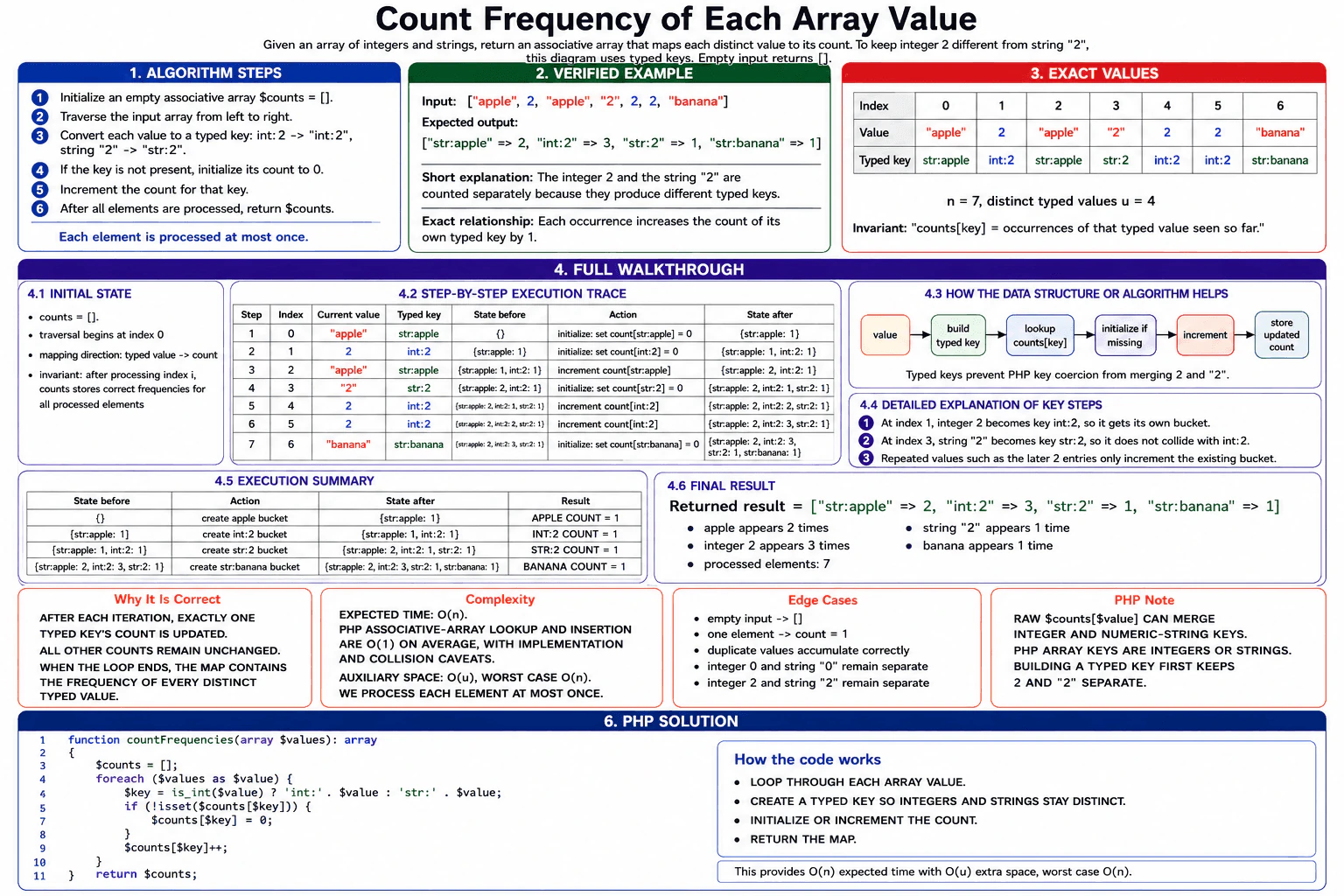
45. Write a PHP function to count the frequency of each value in an array.CodingEasy

Question Details

Return an associative array mapping each value to its count. Define handling for strings versus integers, empty input, and complexity.

Short Interview Answer (30-60 seconds)

I would use a PHP associative array as a frequency map. I process the input from left to right. For each item, I build a typed key such as "int:2" or "str:2" so integer 2 and string "2" stay separate. If the key is missing, I initialize its count to zero, then increment it. Each item updates exactly one typed key. The solution uses O(n) expected time and O(u) auxiliary space, where u is the number of distinct typed values.

Detailed Explanation

See the Code while reading this explanation.

The function receives an array of integers and strings. It must return how many times each value appears. Values with different PHP types must remain separate. For example, integer 2 and string "2" need different counts. I solve this by creating a type-aware name for every value and storing its count in an associative array. I then read the input from left to right and update one count for each item. This avoids scanning the whole array again for every value.

Useful Questions to Ask the Interviewer
  1. Should integer 2 and string "2" be counted separately?
  2. Should an empty input return an empty array?
  3. Will the input contain only integers and strings?
  4. Does the returned key order need to match first appearance order?
Write a PHP function to count the frequency of each value in an array. diagram
How to Explain It in an Interview
1. Understand the input and required output

The input is one PHP array containing integers and strings. The output is an associative array. Each output key represents one typed input value, and each output value is its frequency.

For the input ["apple", 2, "apple", "2", 2, 2, "banana"], the result is ["str:apple" => 2, "int:2" => 3, "str:2" => 1, "str:banana" => 1].

The typed prefixes are important. They keep integer 2 separate from string "2".

2. Choose the algorithm and data structure

I use a PHP associative array named $counts as a frequency map. The mapping direction is typed value to count.

Using a raw input value as a PHP array key can merge an integer with a numeric string. To prevent this, I create a typed key before performing the lookup. Integer 2 becomes int:2. String "2" becomes str:2.

The central invariant is: after processing index i, $counts contains the correct frequency of every typed value from index 0 through index i.

3. Initialize the state

The algorithm starts with $counts = []. No values have been processed, so an empty map is correct.

Traversal begins at index 0. For each value, the code builds a typed key. If that key does not exist, its count starts at zero. The code then increments the count.

4. Walk through the example

At index 0, the value is string "apple". Its typed key is str:apple. The map is empty, so the code creates the key and increments it. The state becomes {str:apple: 1}.

At index 1, the value is integer 2. Its typed key is int:2. The key is missing, so its count becomes 1. The state becomes {str:apple: 1, int:2: 1}.

At index 2, the value is string "apple" again. The key str:apple already exists. Its count increases from 1 to 2. The state becomes {str:apple: 2, int:2: 1}.

At index 3, the value is string "2". Its typed key is str:2. This does not collide with int:2. The code creates str:2 with count 1. The state becomes {str:apple: 2, int:2: 1, str:2: 1}.

At index 4, the value is integer 2. The key int:2 already exists, so its count increases from 1 to 2.

At index 5, the value is integer 2 again. The same key increases from 2 to 3.

At index 6, the value is string "banana". Its key is str:banana. The code creates it with count 1.

After all seven elements are processed, the function returns ["str:apple" => 2, "int:2" => 3, "str:2" => 1, "str:banana" => 1].

5. Explain why the result is correct

Each iteration updates exactly one typed key. All other counts remain unchanged. A first occurrence creates a count of 1. A repeated occurrence increments the existing count.

Because every input element is processed once, the final map contains the exact frequency of every distinct typed value.

6. Explain the PHP implementation

The function accepts an array and returns an array. It starts with an empty $counts map. A foreach loop reads each value from left to right.

The is_int($value) check selects the prefix. Integers use int:. Strings use str:. The code uses isset($counts[$key]) to check whether the typed key already exists. A missing key is initialized to zero. The code increments the count and returns the completed map after the loop.

7. Explain complexity and edge cases

Let n be the number of input elements. The algorithm processes each element once. PHP associative-array lookup and insertion take O(1) time on average, so the total expected time is O(n).

Let u be the number of distinct typed values. The map stores one entry for each distinct typed value, so the auxiliary space is O(u). In the worst case, every item is distinct, making the space O(n).

An empty input returns []. One item produces a count of 1. Duplicate values increase the existing count. Integer 0 and string "0" remain separate. Integer 2 and string "2" also remain separate.

Key Insight / Why This Solution Works

The key insight is to use a frequency map while avoiding PHP array-key coercion. The map stores typed key to count. Before every lookup, the algorithm adds a type prefix to the current value. Integer 2 becomes int:2, and string "2" becomes str:2. This gives each typed value its own bucket. The invariant is that after each iteration, the map contains the correct frequencies for all elements processed so far. A first occurrence creates a bucket, and every later occurrence increments that same bucket.

Code
<?php

declare(strict_types=1);

/**
 * Count the frequency of each integer or string value.
 * Integer and string values remain separate through typed keys.
 *
 * @param array<int, int|string> $values
 * @return array<string, int>
 */
function countFrequencies(array $values): array
{
    // Store each typed value and its current frequency.
    $counts = [];

    // Process every value from left to right.
    foreach ($values as $value) {
        // Build a typed key so integer 2 and string "2" stay separate.
        $key = is_int($value)
            ? 'int:' . $value
            : 'str:' . $value;

        // A value that has not appeared yet starts at zero.
        if (!isset($counts[$key])) {
            $counts[$key] = 0;
        }

        // Count the current occurrence.
        $counts[$key]++;
    }

    // Return the completed frequency map.
    return $counts;
}

// Example from the approved diagram.
$values = ['apple', 2, 'apple', '2', 2, 2, 'banana'];
$result = countFrequencies($values);

print_r($result);

/*
Expected output:
Array
(
    [str:apple] => 2
    [int:2] => 3
    [str:2] => 1
    [str:banana] => 1
)
*/
Time & Space Complexity

Let n be the number of input elements. The loop processes each element once. A PHP associative-array lookup or insertion takes O(1) time on average, with implementation and collision caveats. Therefore, the total expected time is O(n). Let u be the number of distinct typed values. The map stores one entry for each of them, so the auxiliary space is O(u). If every input item is distinct, u equals n, and the worst-case auxiliary space is O(n).

Where it is used

This frequency-map pattern is useful for counting repeated values in logs, survey answers, inventory records, tags, status codes, and grouped data. The typed-key variation is useful in PHP when values that look similar must remain separate because their types are different, such as integer 2 and string "2".

Why Interviewers Ask This

The interviewer is testing whether the candidate recognizes a frequency-counting problem and chooses an associative array. The question also checks duplicate handling, empty input, and clear complexity analysis. The PHP-specific challenge is noticing that raw array keys may not preserve the difference between an integer and a numeric string. A strong answer shows correct type handling, valid PHP syntax, a clear loop invariant, and accurate expected-time wording.

Common interview mistakes

A common mistake is using $counts[$value] directly. PHP can convert a numeric-string key into an integer key, which may merge integer 2 with string "2". Another mistake is incrementing a missing key without initializing it first. Candidates may also forget that duplicate values must update the existing bucket. A slower solution may scan the full array once for every distinct value, producing O(n²) time. Another mistake is claiming guaranteed O(n) time instead of O(n) expected time for hash-based associative-array operations.

Interview tip

Explain the typed-key rule before writing the loop. Say that integer 2 becomes int:2 and string "2" becomes str:2. This immediately shows that you understand the main PHP-specific risk in the problem.

Interviewer may ask next
How would the solution change if the input could also contain booleans, floats, or null?

I would extend the typed-key builder so every supported PHP type has an unambiguous prefix and representation. For example, true could become bool:true, null could become null, and a float could use a stable serialized representation. The counting loop would remain the same. Correctness is preserved because every supported typed value still maps to one unique key. The expected time remains O(n), and the auxiliary space remains O(u). The main tradeoff is that float normalization requires extra care.

How would you process the values if they arrived as a stream?

I would keep the same $counts map in memory and update it whenever a value arrives. The typed-key creation and increment logic would not change. After processing k streamed values, the map would contain the correct counts for those k values. Processing n values still takes O(n) expected time, and the map uses O(u) space. The tradeoff is that exact counting still requires memory for every distinct typed value.

46. Write a PHP function to remove duplicate values from an array while preserving first-occurrence order.CodingEasy

Question Details

Return the deduplicated array, define whether strict type comparison is required, and explain time and space complexity.

Short Interview Answer (30-60 seconds)

I would scan the array from left to right and keep the first occurrence of each typed value. For every value, I would use serialize() to create a key that includes both its type and value. I would store that key in a PHP associative array used as a set. If the key is new, I append the original value to the result. Otherwise, I skip it. This preserves order, keeps 1 separate from "1", uses O(n) expected time, and requires O(n) auxiliary space.

Detailed Explanation

See the Code while reading this explanation.

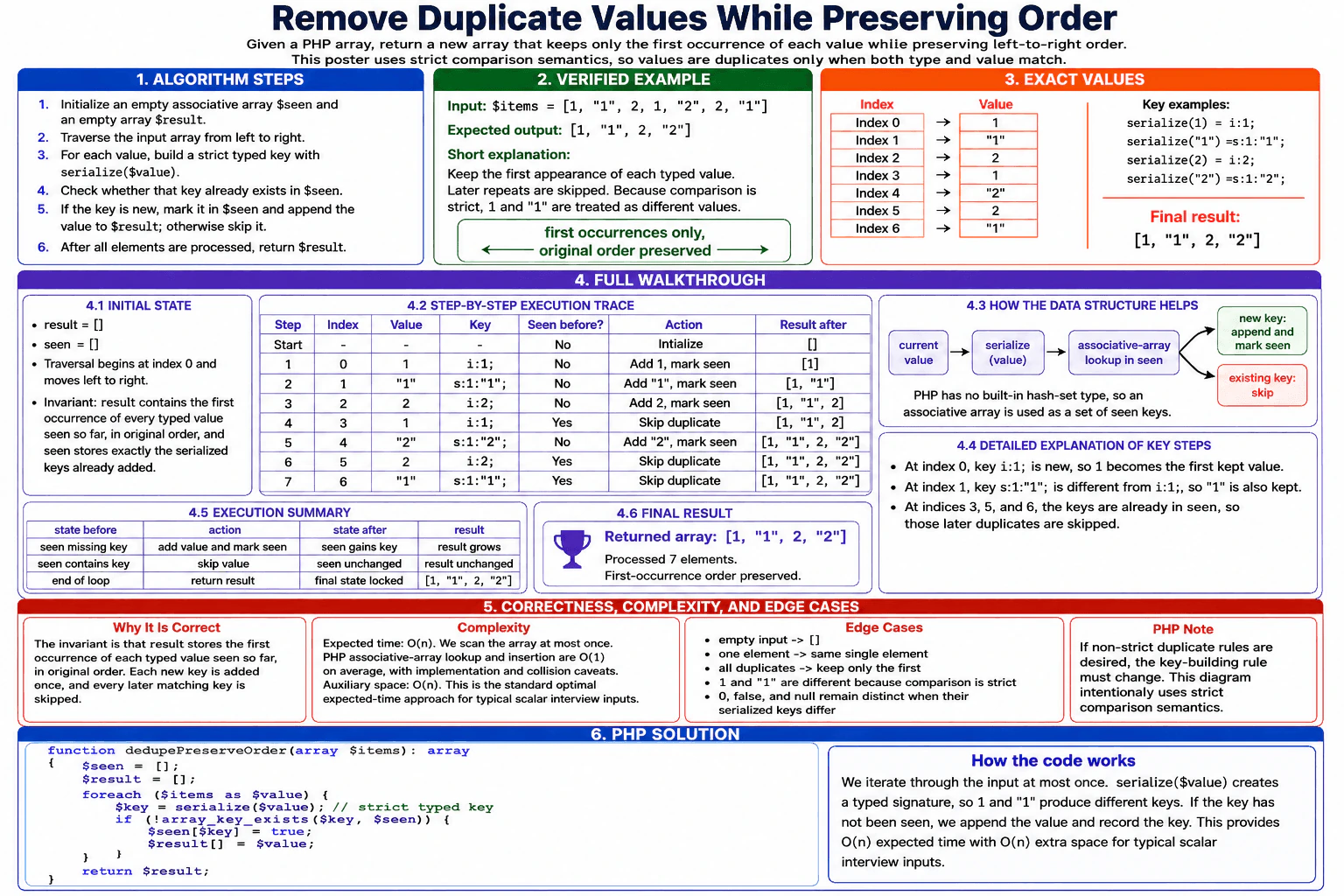
The task is to return a new array with repeated values removed. We must keep the first appearance of each value and preserve the original left-to-right order. Strict comparison is required in the illustrated solution. Therefore, the integer 1 and the string "1" are different values. We process each input value in order. We remember every typed value already accepted and append only values that have not appeared before.

Useful Questions to Ask the Interviewer
  1. Should duplicate checking compare both the PHP type and the value?
  2. Should the original array remain unchanged?
  3. Should the returned array have new sequential numeric indices?
  4. Can the input contain mixed scalar types such as integers, strings, booleans, and null?
Write a PHP function to remove duplicate values from an array while preserving first-occurrence order. diagram
How to Explain It in an Interview
1. Understand the input and required output

The input is a PHP array. The output is a new array containing the first occurrence of every distinct typed value. The output contains values, not original indices. The values must remain in their original left-to-right order.

The example input is: $items = [1, "1", 2, 1, "2", 2, "1"]

The expected output is: [1, "1", 2, "2"]

The integer 1 and the string "1" are both kept because their types are different. The same rule applies to integer 2 and string "2".

2. Choose the algorithm and data structure

We traverse the input once from left to right. We use a PHP associative array named $seen as a set of keys already accepted.

PHP does not provide a separate built-in hash-set type. An associative array can act like a set by storing each generated key as an array key.

For every value, serialize($value) creates a typed representation. For example:

  • serialize(1) produces i:1;
  • serialize("1") produces s:1:"1";
  • serialize(2) produces i:2;
  • serialize("2") produces s:1:"2";

These keys let the algorithm distinguish values that look similar but have different PHP types.

The invariant is: after processing any prefix of the input, $result contains the first occurrence of each typed value seen in that prefix, in original order. The $seen array contains exactly the serialized keys of those accepted values.

3. Initialize the state

We create two empty arrays: $result = [] $seen = []

$result stores the accepted values. $seen stores their serialized typed keys. Traversal starts at index 0 and moves to the right.

4. Walk through the example

At index 0, the value is 1. Its key is i:1;. The key is not in $seen. We store the key and append 1. The result becomes [1].

At index 1, the value is "1". Its key is s:1:"1";. This key is different from i:1;, so we store it and append "1". The result becomes [1, "1"].

At index 2, the value is 2. Its key is i:2;. It is new, so we store it and append 2. The result becomes [1, "1", 2].

At index 3, the value is 1. Its key i:1; already exists. We skip the value. The result stays [1, "1", 2].

At index 4, the value is "2". Its key is s:1:"2";. It is different from i:2;, so we store it and append "2". The result becomes [1, "1", 2, "2"].

At index 5, the value is 2. Its key i:2; already exists. We skip it.

At index 6, the value is "1". Its key s:1:"1"; already exists. We skip it.

After all seven elements are processed, the returned result is [1, "1", 2, "2"].

5. Explain why the result is correct

A value is appended only when its serialized key has not appeared before. Therefore, the first occurrence of each typed value is kept. Every later value with the same type and value produces the same key and is skipped.

Because values are processed from left to right and accepted values are appended immediately, their original order is preserved.

6. Explain the PHP implementation

The function creates empty $seen and $result arrays. The foreach loop processes every input value in order. serialize($value) creates the typed key. array_key_exists($key, $seen) checks whether that key was already accepted.

When the key is missing, the code stores true at $seen[$key] and appends the original value to $result. When the key already exists, the code performs no update. After the loop finishes, the function returns $result.

7. Explain complexity and edge cases

Let n be the number of input elements. Each element is processed once. PHP associative-array lookup and insertion are O(1) on average, so the total expected time is O(n). This is an expected bound because it depends on average hash-table behavior.

The auxiliary space is O(n). In the worst case, every input value is distinct, so $seen stores n serialized keys. The returned array can also contain n values.

Relevant edge cases are an empty array, one element, all duplicate values, mixed values such as 1 and "1", and typed values such as 0, false, and null.

Key Insight / Why This Solution Works

The main idea is to convert every input value into a key that preserves both its PHP type and value. serialize($value) provides that typed key. The algorithm scans from left to right and uses an associative array as a set of keys already accepted. If a key is missing, the original value is appended to the result and the key is stored. If the key exists, the value is skipped. The invariant is that $result contains the first occurrence of every typed value processed so far, in original order, and $seen contains exactly the keys of those values. This avoids repeatedly searching the result array, which could lead to O(n²) time.

Code
<?php

declare(strict_types=1);

/**
 * Remove duplicate values while preserving first-occurrence order.
 * Values are treated as duplicates only when both type and value match.
 *
 * @param array $items
 * @return array
 */
function dedupePreserveOrder(array $items): array
{
    // Store the serialized typed keys already accepted.
    $seen = [];

    // Store the first occurrence of each typed value.
    $result = [];

    // Process values from left to right.
    foreach ($items as $value) {
        // Create a key that includes both the PHP type and value.
        // For example, 1 and "1" produce different keys.
        $key = serialize($value);

        // Append the value only when this typed key is new.
        if (!array_key_exists($key, $seen)) {
            // Mark this typed value as seen.
            $seen[$key] = true;

            // Preserve first-occurrence order by appending now.
            $result[] = $value;
        }
    }

    // Return the deduplicated array with sequential numeric indices.
    return $result;
}

// Example from the diagram.
$items = [1, "1", 2, 1, "2", 2, "1"];
$result = dedupePreserveOrder($items);

// var_export shows the difference between integers and strings.
var_export($result);

// Output:
// array (
//   0 => 1,
//   1 => '1',
//   2 => 2,
//   3 => '2',
// )
Time & Space Complexity

Let n be the number of input values. We process each value once. For each value, the code creates a serialized key, checks $seen, and may insert the key. PHP associative-array lookup and insertion are O(1) on average. Therefore, the total expected time is O(n). It is an expected bound, not a guaranteed worst-case hash-table bound. The auxiliary space is O(n) because $seen may store one key for every distinct typed value. The returned result may also contain up to n values.

Where it is used

This pattern is useful when software must remove repeated values without changing their original order. Examples include cleaning imported data, removing repeated identifiers from ordered input, keeping the first occurrence of user selections, and normalizing mixed-type PHP data when type differences must be preserved.

Why Interviewers Ask This

The interviewer is testing whether you can remove duplicates while preserving order, choose a suitable PHP data structure, and define equality clearly. The problem also checks whether you understand PHP array-key conversion and why a typed key is useful. They want to see correct duplicate handling, a clear invariant, readable PHP code, relevant edge cases, and an accurate explanation of expected time and auxiliary space.

Common interview mistakes

One mistake is using loose comparison, which may incorrectly treat 1 and "1" as duplicates. Another is using the raw value directly as a PHP array key, because PHP can convert numeric-looking string keys. Repeatedly calling in_array() on the growing result can make the solution O(n²). Sorting the input would also lose the required first-occurrence order. Candidates may also claim guaranteed O(n) time instead of O(n) expected time based on average associative-array operations.

Interview tip

Before writing the loop, show that serialize(1) and serialize("1") produce different keys. Then state the invariant: $result stores first occurrences in order, and $seen stores the typed keys already accepted.

Interviewer may ask next
What would change if strict type comparison were not required?

The left-to-right traversal and first-occurrence rule would remain the same, but the key-building rule would change. Instead of serialize(), the code would need a clearly defined normalization that intentionally maps values considered equal to the same key. Correctness would depend on that normalization matching the required equality rules. The expected time would remain O(n), and the auxiliary space would remain O(n). The main tradeoff is that PHP loose comparison has many coercion cases, so the equality rule must be specified carefully.

How would this work if values arrived as a stream?

I would keep the same $seen associative array between incoming values. For each value, I would create its serialized key, check whether the key exists, and emit the value only when it is new. This preserves first-occurrence order because values are handled in arrival order. Processing m streamed values takes O(m) expected time. The space is O(k), where k is the number of distinct typed values seen. The tradeoff is that memory can keep growing for a long stream with many unique values.

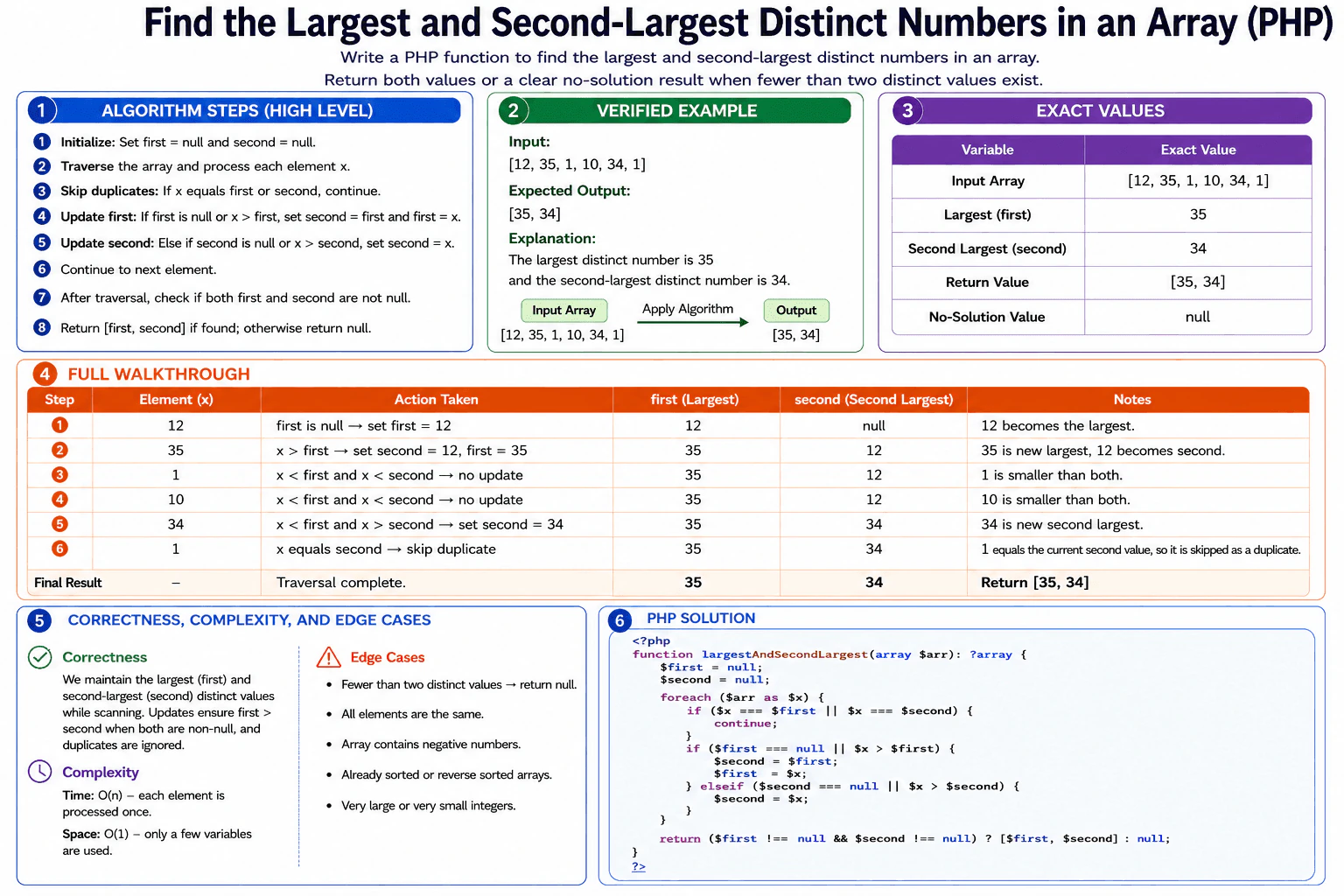
47. Write a PHP function to find the largest and second-largest distinct numbers in an array.CodingEasy

Question Details

Return both values or a clear no-solution result when fewer than two distinct values exist. Do not sort unless justified, and explain complexity.

Short Interview Answer (30-60 seconds)

I would keep two variables, first and second, for the largest and second-largest distinct values. I start both as null and scan the array once. I skip a value if it already equals first or second. If it is larger than first, I move the old first into second. Otherwise, I update second when needed. At the end, I return both values, or null if two distinct values do not exist. The time is O(n), and the auxiliary space is O(1).

Detailed Explanation

See the Code while reading this explanation.

The input is an array of numbers. We need to return its two greatest distinct values in the order [largest, second-largest]. For example, [12, 35, 1, 10, 34, 1] should return [35, 34]. The repeated value 1 must not count as a new distinct value. We can solve this without sorting by keeping the best two distinct values while reading the array from left to right.

Useful Questions to Ask the Interviewer
  1. Should I return the values rather than their indices?
  2. Should I return null when fewer than two distinct values exist?
  3. Can the array contain negative numbers and duplicate values?
Write a PHP function to find the largest and second-largest distinct numbers in an array. diagram
How to Explain It in an Interview
1. Understand the input and required output

The function receives one array of numbers. It returns an array containing the largest distinct value and the second-largest distinct value. The returned order is [largest, second-largest]. If fewer than two distinct values exist, the function returns null.

2. Choose the algorithm and state

I use one pass through the array. I keep two variables named first and second. first stores the largest distinct value found so far. second stores the second-largest distinct value found so far. Both variables start as null because no values have been processed.

The invariant is that first is the largest distinct value seen so far. When second is not null, second is the largest distinct value smaller than first. Therefore, when both values exist, first is greater than second.

3. Process each value

For every value x, I first check whether x already equals first or second. If it does, I skip it because the answer requires distinct values.

If first is null or x is greater than first, the old first becomes second, and x becomes the new first.

Otherwise, if second is null or x is greater than second, x becomes the new second.

4. Walk through the example

Start with first = null and second = null.

For 12, first is null, so first becomes 12. The state is first = 12 and second = null.

For 35, 35 is greater than first. Move 12 into second, then set first to 35. The state is first = 35 and second = 12.

For 1, it is smaller than both stored values, so nothing changes.

For 10, it is also smaller than both stored values, so nothing changes.

For 34, it is smaller than first but greater than second. Set second to 34. The state is first = 35 and second = 34.

For the final 1, it equals the current second value, so the duplicate check skips it. The state remains first = 35 and second = 34.

The final result is [35, 34].

5. Explain why the result is correct

The algorithm updates first whenever it finds a new largest value. The previous first then moves into second. If a value is not larger than first, it can still replace second when it is larger than the current second. Values equal to first or second are skipped, so the two stored values remain distinct. After the full scan, first and second are the two largest distinct values if both exist.

6. Explain the PHP implementation

The PHP function uses nullable variables for first and second. A foreach loop processes every input value. The duplicate check appears before the update conditions. The first update branch handles a new maximum. The second branch handles a new second-largest value. After the loop, the function returns [first, second] when both values exist. Otherwise, it returns null.

7. Explain complexity and edge cases

The loop processes each array element once, so the time complexity is O(n). The algorithm uses only two tracking variables, so the auxiliary space complexity is O(1).

Important edge cases include an empty array, one element, all values being the same, duplicate values, negative numbers, and arrays that are already sorted or reverse sorted.

Key Insight / Why This Solution Works

The key idea is to keep the two best distinct values while scanning the array. first stores the largest value found so far. second stores the largest value that is still smaller than first. Before updating either variable, the algorithm skips a value that already equals first or second. This prevents duplicate values from filling both positions. When a new maximum appears, the old maximum moves into second. Otherwise, the current value may replace second. This avoids sorting and uses constant extra memory.

Code
<?php

declare(strict_types=1);

/**
 * Return the largest and second-largest distinct values.
 * Return null when fewer than two distinct values exist.
 *
 * @param int[] $arr
 * @return int[]|null
 */
function largestAndSecondLargest(array $arr): ?array
{
    // Step 1: No values have been processed yet.
    $first = null;
    $second = null;

    // Step 2: Process each array value once.
    foreach ($arr as $x) {
        // Step 3: Skip a value already stored in either position.
        if ($x === $first || $x === $second) {
            continue;
        }

        // Step 4: A new largest value pushes the old largest into second.
        if ($first === null || $x > $first) {
            $second = $first;
            $first = $x;
            continue;
        }

        // Step 5: Update second when x is below first but above second.
        if ($second === null || $x > $second) {
            $second = $x;
        }
    }

    // Step 6: Return null when two distinct values were not found.
    if ($first === null || $second === null) {
        return null;
    }

    // Step 7: Return the largest and second-largest distinct values.
    return [$first, $second];
}

// Example from the approved diagram.
$numbers = [12, 35, 1, 10, 34, 1];
$result = largestAndSecondLargest($numbers);

var_export($result);
// Output: array (0 => 35, 1 => 34)
Time & Space Complexity

The time complexity is O(n), where n is the number of elements in the array. The loop processes each element once and performs only a constant number of comparisons and assignments. The auxiliary space complexity is O(1). Auxiliary space means extra memory used by the algorithm. Only first and second are stored, so the extra memory does not grow with the input size.

Where it is used

This pattern is useful when software must track the top two distinct measurements without sorting all values. Examples include finding the two highest scores, the two largest transaction amounts, the two greatest sensor readings, or the top two distinct values in a stream.

Why Interviewers Ask This

This question checks whether a candidate can avoid unnecessary sorting and maintain correct state during one pass. It tests duplicate handling, nullable initialization, update order, invariant reasoning, and edge cases. For PHP developers, it also shows whether the candidate can write clear type-aware code and explain why the solution takes O(n) time and O(1) auxiliary space.

Common interview mistakes

A common mistake is sorting the full array even though one pass is enough. Another mistake is allowing the same value to become both first and second. Some candidates update first without moving the old first into second. Others perform the update checks before handling duplicates. It is also easy to forget the null result for empty arrays, one-element arrays, or arrays where every value is the same. Finally, the space complexity should be O(1), not O(n).

Interview tip

State the invariant before coding: first is the largest distinct value seen so far, and second is the largest distinct value smaller than first. Then place the duplicate check before both update branches.

Interviewer may ask next
How would the solution change if the input arrived as a stream instead of a complete array?

The algorithm would stay the same. I would process each incoming value immediately and keep only first and second. I would apply the same duplicate check and update rules. Processing n values would still take O(n) time, and the auxiliary space would remain O(1). The tradeoff is that earlier values cannot be revisited, but this algorithm does not need to revisit them.

What happens if the array contains fewer than two distinct values?

The function returns null. For an empty array, a one-element array, or an array where every value is the same, second remains null. The final check detects this no-solution case. The time complexity remains O(n), and the auxiliary space remains O(1).

48. Merge overlapping intervals in PHP.CodingMedium

Question Details

Given an array of [start, end] intervals, merge every overlap and return non-overlapping intervals ordered by start. Cover empty input, touching endpoints, invalid intervals, and complexity.

Short Interview Answer (30-60 seconds)

I would validate the intervals, sort them by start value and then by end value, and keep a merged result array. I seed it with the first sorted interval. For each remaining interval, I compare its start with the end of the last merged interval. If they overlap or touch, I extend that end. Otherwise, I append the interval. Sorting takes O(n log n) time, the scan takes O(n), and the merged output can use O(n) space.

Detailed Explanation

See the Code while reading this explanation.

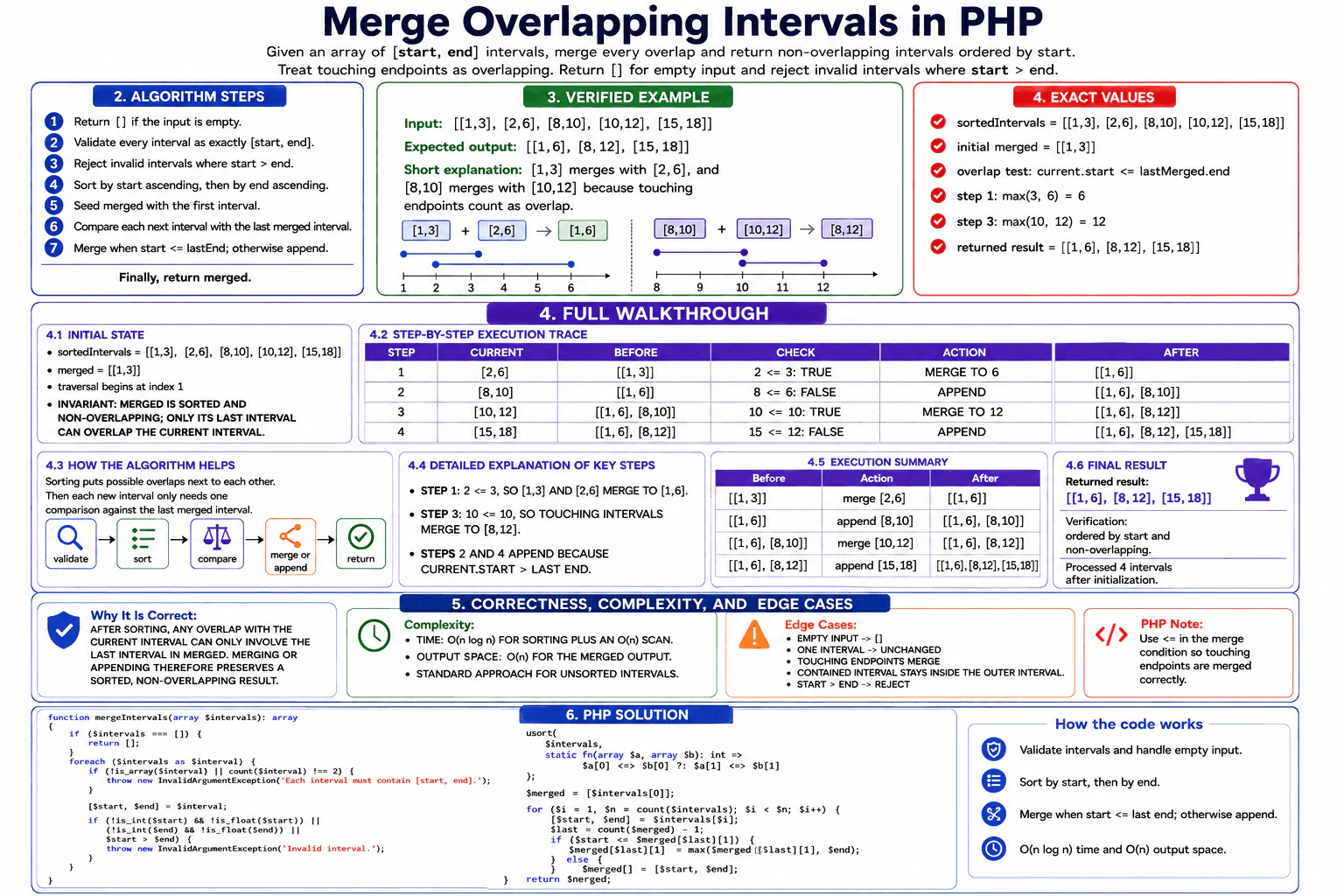
The input is an array of [start, end] intervals. We must combine every pair that overlaps or touches. The returned intervals must be ordered by start and must not overlap. Empty input returns an empty array. An interval is invalid if it does not contain exactly two numeric endpoints or if its start is greater than its end. Sorting is a good fit because intervals that could overlap become neighbors.

Useful Questions to Ask the Interviewer
  1. Should touching intervals such as [4,5] and [5,7] merge? Here, yes.
  2. Should invalid intervals cause an exception? Here, yes.
  3. Can endpoints be integers or decimal numbers? This implementation accepts both.
  4. Must the result remain ordered by start? Yes.
Merge overlapping intervals in PHP. diagram
How to Explain It in an Interview
1. Understand the input and output

The input is an array of [start, end] intervals. The output is a new array of intervals ordered by start. The output must contain no overlaps. Touching endpoints count as overlap. Empty input returns []. Any interval with start greater than end is rejected.

2. Sort the intervals

Sort by start in ascending order. When two intervals have the same start, sort by end in ascending order. This places intervals that may overlap next to each other.

The main invariant is: the merged array is always sorted and non-overlapping, and only its last interval can overlap the current interval.

3. Initialize the state

For the example, the sorted intervals are [[1,3], [2,6], [8,10], [10,12], [15,18]]. Start with merged = [[1,3]]. Traversal begins at index 1 because the first interval is already stored.

4. Walk through the example

Step 1 uses [2,6]. Before the step, merged is [[1,3]]. Check 2 <= 3. This is true, so the intervals overlap. Set the last end to max(3,6) = 6. After the step, merged is [[1,6]].

Step 2 uses [8,10]. Before the step, merged is [[1,6]]. Check 8 <= 6. This is false, so append [8,10]. After the step, merged is [[1,6], [8,10]].

Step 3 uses [10,12]. Before the step, merged is [[1,6], [8,10]]. Check 10 <= 10. This is true. The intervals touch, so they merge. Set the last end to max(10,12) = 12. After the step, merged is [[1,6], [8,12]].

Step 4 uses [15,18]. Before the step, merged is [[1,6], [8,12]]. Check 15 <= 12. This is false, so append [15,18]. The final result is [[1,6], [8,12], [15,18]].

5. Explain why it is correct

After sorting, any interval that overlaps the current interval must be next to it. Because merged is already sorted and non-overlapping, the current interval can overlap only the last merged interval. Merging or appending preserves the invariant after every step.

6. Explain the PHP implementation

The function handles empty input first. It validates every interval. It sorts by start and then by end. It places the first sorted interval in $merged. The loop compares every later interval with the last merged interval. It either extends the last end value or appends a new interval. Finally, it returns $merged.

7. Explain complexity and edge cases

Sorting takes O(n log n) time. The merge scan takes O(n) time. The merged output can contain n intervals, so output space is O(n). Important cases are empty input, one interval, touching endpoints, contained intervals, and invalid intervals.

Key Insight / Why This Solution Works

The key insight is that sorting turns a global overlap problem into a local comparison problem. Sort by start value and use end value as the tie-breaker. Then compare each interval only with the last interval in the merged result. The invariant is that merged remains ordered by start and contains no overlap. When current.start <= lastMerged.end, the intervals overlap or touch, so update the last end to max(lastMerged.end, current.end). Otherwise, append the current interval because it cannot overlap any earlier merged interval.

Code
<?php

declare(strict_types=1);

/**
 * Merge overlapping or touching intervals.
 *
 * @param array<int, array{0:int|float, 1:int|float}> $intervals
 * @return array<int, array{0:int|float, 1:int|float}>
 */
function mergeIntervals(array $intervals): array
{
    // Step 1: Return an empty result for empty input.
    if ($intervals === []) {
        return [];
    }

    // Step 2: Validate every [start, end] interval.
    foreach ($intervals as $interval) {
        if (!is_array($interval) || count($interval) !== 2) {
            throw new InvalidArgumentException(
                'Each interval must contain exactly [start, end].'
            );
        }

        [$start, $end] = $interval;

        if (
            (!is_int($start) && !is_float($start)) ||
            (!is_int($end) && !is_float($end)) ||
            $start > $end
        ) {
            throw new InvalidArgumentException('Invalid interval.');
        }
    }

    // Step 3: Sort by start, then by end.
    usort(
        $intervals,
        static fn(array $a, array $b): int =>
            $a[0] <=> $b[0] ?: $a[1] <=> $b[1]
    );

    // Step 4: Seed the result with the first sorted interval.
    $merged = [$intervals[0]];
    $count = count($intervals);

    // Step 5: Merge or append each remaining interval.
    for ($i = 1; $i < $count; $i++) {
        [$start, $end] = $intervals[$i];
        $last = count($merged) - 1;

        // Touching endpoints count as overlap.
        if ($start <= $merged[$last][1]) {
            $merged[$last][1] = max($merged[$last][1], $end);
        } else {
            $merged[] = [$start, $end];
        }
    }

    // Step 6: Return sorted, non-overlapping intervals.
    return $merged;
}

// Example from the approved diagram.
$input = [[1, 3], [2, 6], [8, 10], [10, 12], [15, 18]];
$result = mergeIntervals($input);

print_r($result);

// Expected result:
// [[1, 6], [8, 12], [15, 18]]
Time & Space Complexity

Let n be the number of intervals. Sorting takes O(n log n) time. The loop then processes each remaining interval once, which takes O(n) time. Therefore, the total time is O(n log n). The returned merged array may contain all n intervals when none overlap, so the output space is O(n). The sorting operation may also require implementation-dependent working memory.

Where it is used

This pattern is useful for calendar bookings, employee schedules, reservation windows, maintenance periods, network ranges, timeline events, and any application that needs to combine overlapping start-and-end ranges.

Why Interviewers Ask This

This problem tests whether a candidate recognizes the sorting-and-interval pattern. It checks whether the candidate chooses the correct sorting keys, maintains a useful invariant, applies the correct overlap condition, and updates the merged state safely. It also tests PHP array handling, validation of malformed input, treatment of touching endpoints, handling of contained intervals, and accurate complexity analysis that includes the sorting cost.

Common interview mistakes

A common mistake is merging without sorting first. Another is comparing the current interval with every earlier interval instead of only the last merged interval. Using current.start < lastEnd is also wrong here because touching endpoints must merge. Candidates may replace the last end with the current end instead of using max, which breaks contained intervals such as [1,10] and [2,4]. Other mistakes are ignoring empty input, accepting start greater than end, or forgetting the O(n log n) sorting cost.

Interview tip

State the invariant before writing the loop: the merged result is sorted and non-overlapping, and only its last interval can overlap the next sorted interval.

Interviewer may ask next
Can the algorithm reduce extra working space by modifying the sorted array in place?

Yes. After sorting, use a write index and store each merged interval back into the same array. The overlap condition and invariant remain unchanged. The time complexity stays O(n log n) because sorting still dominates. Extra working space can be reduced, apart from the sorting implementation and the returned slice. The tradeoff is that the input data is modified.

What changes if touching endpoints must remain separate?

Change the overlap condition from current.start <= lastMerged.end to current.start < lastMerged.end. Then [8,10] and [10,12] remain separate because 10 is not less than 10. The sorting and merge structure stay the same. Time remains O(n log n), and the output can still use O(n) space.

49. Implement an LRU cache in PHP.CodingMedium

Question Details

Support get and put operations with fixed capacity and expected O(1) average time. Define eviction order, update behavior, capacity edge cases, and the data structures used.

Short Interview Answer (30-60 seconds)

I would combine a PHP associative array with a doubly linked list. The array maps each cache key to its node, so I can find entries in O(1) average time. The list stores usage order. The node after the dummy head is most recently used, while the node before the dummy tail is least recently used. Every successful get or put moves its node to the front. If capacity is exceeded, I remove tail->prev. Each operation takes expected O(1) time and the cache uses O(capacity) extra space.

Detailed Explanation

See the Code while reading this explanation.

The cache can hold only a fixed number of key-value pairs. get(key) returns the saved value or -1 when the key is missing. put(key, value) adds a new pair or updates an existing pair. Every successful read or write makes that key the most recently used item. When the cache becomes too large, it removes the item that has not been used for the longest time.

Useful Questions to Ask the Interviewer
  1. Should get return -1 when the key is missing?
  2. Does updating an existing key make it most recently used?
  3. What should happen when capacity is 0 or negative?
  4. Are keys and values integers?
  5. Is expected O(1) average time acceptable for PHP associative-array operations?
Implement an LRU cache in PHP. diagram
How to Explain It in an Interview
1. Understand the required behavior

The cache has a fixed capacity and supports get(key) and put(key, value).

get returns the stored value when the key exists. It returns -1 when the key does not exist.

put adds a new key or updates the value of an existing key. A successful get, an update, or an insertion makes that key the most recently used item.

For the example, the capacity is 2 and the operations are: [put(1,10), put(2,20), get(1), put(3,30), get(2), put(4,40), get(1), get(3), get(4)]

The output is: [null, null, 10, null, -1, null, -1, 30, 40]

2. Choose the data structures

I use a PHP associative array and a doubly linked list.

The associative array maps each cache key to its linked-list node. This gives O(1) average key lookup.

The doubly linked list stores entries from most recently used to least recently used. The node after the dummy head is the most recently used real node. The node before the dummy tail is the least recently used real node.

Each node stores key, value, prev, and next. The key is stored in the node so an evicted node can also be removed from the map.

The central invariant is that the map always points to the current node for every cached key, and the linked list is always ordered from most recently used to least recently used.

3. Initialize the cache

Start with an empty map.

Create a dummy head and dummy tail. Connect head->next to tail and tail->prev to head.

The dummy nodes are not real cache entries. They remove special cases when inserting at the front or removing the last real node.

The initial list is: HEAD <-> TAIL

4. Walk through the example

Step 1: put(1,10) Create node 1:10, store key 1 in the map, and insert the node after head. State: [] -> [1:10]

Step 2: put(2,20) Create node 2:20 and insert it after head. State: [1:10] -> [2:20, 1:10]

Step 3: get(1) Key 1 exists. Remove its node from its current position and insert it after head. Return 10. State: [2:20, 1:10] -> [1:10, 2:20]

Step 4: put(3,30) Create node 3:30 and insert it after head. The cache temporarily has three entries, so evict tail->prev. That node contains key 2. State: [1:10, 2:20] -> [3:30, 1:10]

Step 5: get(2) Key 2 was evicted, so it is not in the map. Return -1. State remains [3:30, 1:10].

Step 6: put(4,40) Create node 4:40 and insert it after head. Capacity is exceeded, so evict tail->prev. That node contains key 1. State: [3:30, 1:10] -> [4:40, 3:30]

Step 7: get(1) Key 1 was evicted, so return -1. State remains [4:40, 3:30].

Step 8: get(3) Key 3 exists. Move its node to the front and return 30. State: [4:40, 3:30] -> [3:30, 4:40]

Step 9: get(4) Key 4 exists. Move its node to the front and return 40. State: [3:30, 4:40] -> [4:40, 3:30]

The values returned by the get operations are [10, -1, -1, 30, 40]. The complete operation output is [null, null, 10, null, -1, null, -1, 30, 40]. The final cache order is [4:40, 3:30].

5. Explain why the solution is correct

The map always points to each key's current node. Every successful get, update, and insertion moves that node to the front. Therefore, the list always stays ordered from most recently used to least recently used.

Because tail->prev is always the least recently used real node, removing it always follows the required eviction rule.

6. Explain the PHP implementation

The Node class stores the key, value, previous node, and next node.

The LRUCache class stores the capacity, the associative array, and the dummy head and tail nodes.

get checks the map. On a miss, it returns -1. On a hit, it removes the node from its current position, inserts it after head, and returns its value.

put returns immediately for non-positive capacity. For an existing key, it changes the value and moves the node to the front. For a new key, it creates a node, stores it in the map, and inserts it at the front. If the cache then exceeds capacity, it removes tail->prev from both the list and the map.

7. Explain complexity and edge cases

PHP associative-array lookup and insertion are O(1) on average. Removing or inserting a known linked-list node is O(1). Therefore, each get and put operation takes expected O(1) average time.

The map and linked list hold at most capacity real entries, so auxiliary space is O(capacity).

Important edge cases are capacity 0, updating an existing key, missing keys, repeated successful gets, and repeated evictions.

Key Insight / Why This Solution Works

A map alone gives fast key lookup but does not directly maintain least-recently-used order. A linked list maintains order, but finding a node by key would take O(n). The solution combines both structures. The PHP associative array stores key to node reference. The doubly linked list stores nodes from most recently used to least recently used. The invariant is that every cached key has exactly one current node in both structures, head->next is the most recently used real node, and tail->prev is the least recently used real node. Because the map gives direct node access, each node can be moved or removed in constant time.

Code
<?php

declare(strict_types=1);

class Node
{
    public int $key;
    public int $value;
    public ?Node $prev = null;
    public ?Node $next = null;

    public function __construct(int $key = 0, int $value = 0)
    {
        $this->key = $key;
        $this->value = $value;
    }
}

class LRUCache
{
    private int $capacity;

    /** @var array<int, Node> Maps each cache key to its list node. */
    private array $map = [];

    private Node $head;
    private Node $tail;

    public function __construct(int $capacity)
    {
        $this->capacity = $capacity;

        // Dummy nodes remove special cases at both ends of the list.
        $this->head = new Node();
        $this->tail = new Node();
        $this->head->next = $this->tail;
        $this->tail->prev = $this->head;
    }

    public function get(int $key): int
    {
        // Return -1 when the key is not stored.
        if (!isset($this->map[$key])) {
            return -1;
        }

        // A successful read makes this node most recently used.
        $node = $this->map[$key];
        $this->removeNode($node);
        $this->insertAfterHead($node);

        return $node->value;
    }

    public function put(int $key, int $value): void
    {
        // A non-positive-capacity cache stores nothing.
        if ($this->capacity <= 0) {
            return;
        }

        // Update an existing node and move it to the MRU position.
        if (isset($this->map[$key])) {
            $node = $this->map[$key];
            $node->value = $value;
            $this->removeNode($node);
            $this->insertAfterHead($node);
            return;
        }

        // Insert a new node at the MRU position.
        $node = new Node($key, $value);
        $this->map[$key] = $node;
        $this->insertAfterHead($node);

        // Remove the LRU node when capacity is exceeded.
        if (count($this->map) > $this->capacity) {
            $lru = $this->tail->prev;

            if ($lru !== null && $lru !== $this->head) {
                $this->removeNode($lru);
                unset($this->map[$lru->key]);
            }
        }
    }

    private function removeNode(Node $node): void
    {
        // Save both neighbors before reconnecting the list.
        $prev = $node->prev;
        $next = $node->next;

        if ($prev !== null) {
            $prev->next = $next;
        }

        if ($next !== null) {
            $next->prev = $prev;
        }
    }

    private function insertAfterHead(Node $node): void
    {
        // This is the old most recently used node, or tail when empty.
        $first = $this->head->next;

        // Place the node directly after the dummy head.
        $node->prev = $this->head;
        $node->next = $first;
        $this->head->next = $node;

        if ($first !== null) {
            $first->prev = $node;
        }
    }
}

// Run the exact example shown in the diagram.
$cache = new LRUCache(2);
$output = [];

$cache->put(1, 10);
$output[] = null;

$cache->put(2, 20);
$output[] = null;

$output[] = $cache->get(1);

$cache->put(3, 30);
$output[] = null;

$output[] = $cache->get(2);

$cache->put(4, 40);
$output[] = null;

$output[] = $cache->get(1);
$output[] = $cache->get(3);
$output[] = $cache->get(4);

// Output: [null,null,10,null,-1,null,-1,30,40]
echo json_encode($output, JSON_THROW_ON_ERROR) . PHP_EOL;
Time & Space Complexity

Each get performs one associative-array lookup and a constant number of linked-list pointer updates. Each put performs an associative-array lookup or insertion and a constant number of pointer updates. PHP associative-array lookup and insertion are O(1) on average, not guaranteed in the worst case. Removing or inserting a known linked-list node is O(1). Therefore, get and put each take expected O(1) average time. The cache stores at most capacity real nodes and capacity map entries, so auxiliary space is O(capacity).

Where it is used

This pattern is useful for bounded caches that should keep recently accessed data and remove older unused data. Common examples include database query caches, API response caches, image caches, browser resource caches, session caches, and in-memory application caches.

Why Interviewers Ask This

This problem tests whether the candidate can combine two data structures to meet several requirements at once. The interviewer is checking whether the candidate recognizes that a map provides fast key lookup while a doubly linked list provides fast recency updates and eviction. It also tests pointer manipulation, update behavior, capacity handling, missing-key behavior, correct PHP associative-array use, edge-case reasoning, and accurate expected-time and space analysis.

Common interview mistakes

Using only an associative array is a mistake because it does not directly maintain least-recently-used order. Using only a linked list makes lookup O(n). Another mistake is forgetting to move a node to the front after a successful get or after updating an existing key. Candidates may evict the wrong node instead of tail->prev. They may remove an evicted node from the list but forget to remove its key from the map. They may also create a second node when updating an existing key or claim guaranteed O(1) time instead of expected O(1) average time for PHP associative arrays.

Interview tip

State the invariant before coding: the map points from every cached key to its current node, head->next is the most recently used real node, and tail->prev is the least recently used real node. Then explain how every get and put preserves that invariant.

Interviewer may ask next
How would the design change if the cache had to support concurrent requests?

The map and linked list must be changed as one atomic operation. I would protect each complete get and put operation with a lock, including node movement and eviction. This keeps the map and list consistent because another request cannot observe a partially completed update. The data-structure work remains expected O(1) per operation, auxiliary space remains O(capacity), and the main tradeoff is lock contention under heavy concurrency.

How would the design change if each entry also had an expiration time?

Each node would store an expiration time. get would check that time before returning the value and would remove an expired node from both structures. put would set or refresh the expiration time. If expired items must be removed even when they are not accessed, an additional min heap or timer structure can track the next expiration. Heap updates would take O(log capacity), while ordinary recency movement would remain O(1). The tradeoff is extra memory and more complex synchronization.

50. What is system design?NEWSystem DesignEasy

Question Details

Define system design as deciding how application components, data stores, interfaces, and infrastructure work together to satisfy clear requirements. Explain the beginner interview sequence: clarify scope and users, identify functional and non-functional requirements, estimate scale, define APIs and data, draw a simple architecture, and then discuss bottlenecks, failures, security, observability, and tradeoffs.

Short Interview Answer (30-60 seconds)

At a high level, system design means deciding how all parts of an application work together. The main challenge is meeting user needs while keeping the system fast, reliable, secure, and easy to change. I would explain it in three parts: understand the requirements and scale, define the APIs and data, then draw and review the architecture. In this example, users reach PHP application servers through a Load Balancer, with Redis, MySQL, File Storage, and a CDN supporting the application. The trade-off is balancing simplicity, performance, cost, and availability.

Detailed Explanation

System design means deciding how the parts of an application should work together. We first need to understand what users need and how much traffic the system may receive. Then we decide how requests, data, files, and responses should move through the application. The diagram uses a simple blog application to make these ideas concrete. Users reach PHP application servers through a Load Balancer. Cache (Redis), Database (MySQL), File Storage, and a CDN support those servers. Finally, we review bottlenecks, failures, security, observability, and trade-offs.

Useful Questions to Ask the Interviewer
  1. What does the product need to do?
  2. Who are the main users?
  3. What is included or excluded from the scope?
  4. How many users and requests should we expect?
  5. How quickly will the stored data grow?
  6. Which qualities matter most, such as speed, availability, or security?
What is system design? diagram
How to Explain It in an Interview
1. Clarify scope and identify requirements

I would start by making sure we are solving the right problem. I would ask what the product does, who uses it, and what is in scope. Then I would separate functional and non-functional requirements. Functional requirements describe features and use cases. Non-functional requirements describe qualities such as speed, availability, and security. These choices guide the rest of the design.

2. Estimate scale

Next, I would estimate how large the system may become. The diagram suggests checking daily or monthly users, requests per second, data growth, and storage needs. These numbers help us choose a design that fits the expected load. They also help us find where performance problems may appear as traffic grows.

3. Define APIs and data

Then I would define the key APIs and their inputs. I would also decide the data model and validation rules. In this blog example, Database (MySQL) stores persistent data such as users, posts, and comments. Persistent means the data stays saved after a request finishes. Cache (Redis) stores session data and frequently read data so the application can access that information quickly.

4. Draw the simple architecture

For the main request path, Users connect through the Internet to the Load Balancer. The Load Balancer sends requests to the Application Servers (PHP). These servers handle requests, run business logic, and generate responses. They work with Cache (Redis) and Database (MySQL) for application data. File Storage holds images, uploads, and files. The CDN handles static assets such as CSS, JavaScript, and images.

5. Review and discuss design considerations

Finally, I would review the design and look for problems. Bottlenecks include database overload, slow queries, too few servers, and network limits. Failures include server crashes, a database outage, or a data center outage, so a recovery plan matters. Security includes authentication, authorization, input validation, HTTPS, and protecting data. Observability means using logging, metrics, alerts, and tracing to understand system health. The main trade-offs are consistency versus availability, performance versus cost, simplicity versus features, and short-term versus long-term choices.

Engineering Considerations / Design Trade-offs

The benefit is that each part has a clear job. Multiple Application Servers (PHP) can handle requests behind the Load Balancer. Cache (Redis) can make common data faster to access, while the CDN can handle static assets. The downside is that more parts create more things to operate and monitor. Better performance can also cost more. Adding features can make the system harder to understand. We therefore balance consistency against availability, performance against cost, simplicity against features, and short-term needs against long-term needs. There is no perfect design. The best choice depends on the requirements and expected scale.

Why Interviewers Ask This

Interviewers ask this question to see how you turn a broad problem into clear design steps. They want to know whether you clarify requirements before choosing technology, estimate scale, define APIs and data, and draw a sensible architecture. They also want to see whether you notice bottlenecks, failures, security needs, observability needs, and trade-offs. The goal is to test your judgment and communication, not whether you memorized one architecture.

Interviewer may ask next
What would you change if traffic grew until the PHP application servers could no longer handle all requests?

I would keep the same basic architecture and add more Application Servers (PHP) behind the existing Load Balancer. The Load Balancer already sits between the Internet and the application servers, so it can spread requests across more servers.

I would first confirm that the application servers are really the bottleneck. Metrics, logging, alerts, and tracing can show where requests are becoming slow. If Database (MySQL) is overloaded instead, adding application servers alone will not fix the real problem.

I would continue using Cache (Redis) for session data and frequently read data. The CDN can also keep handling static assets such as CSS, JavaScript, and images. These parts reduce work that would otherwise reach the PHP servers.

The benefit is that we can handle more application traffic without replacing the basic design. The downside is higher cost and more operational work. Another component, such as MySQL, Redis, or the network, may become the next bottleneck.

How would you handle a MySQL database outage in this design?

I would keep the same design and focus on detecting the outage quickly and following the recovery plan. Database (MySQL) stores persistent data such as users, posts, and comments. If it becomes unavailable, operations that depend on that data may fail.

Observability is important during this failure. Metrics and alerts should show that database requests are failing or becoming slow. Logging and tracing can help the team understand which application requests are affected. The Application Servers (PHP) should not report a successful database operation when the database write actually failed.

Cache (Redis) may still hold session data or frequently read data, but I would not treat it as a replacement for MySQL. The diagram gives MySQL the persistent-data role. The CDN can continue handling static assets that do not need a database request.

The main goal is safe recovery. The downside is that some application features may remain unavailable until Database (MySQL) is restored.

More questions load as you scroll

Disclaimer: This interview guide is for educational and informational purposes only. It is designed to help readers prepare, but it does not guarantee any interview result, hiring decision, offer, or outcome. Interview questions, hiring criteria, and preferred answers can vary by employer, interviewer, industry, location, and time. The examples and explanations reflect the authors' research and judgment, are provided without warranties of any kind, and should not be treated as the only correct approach. Diagrams are simplified illustrations intended to highlight the main components and their interactions; actual systems and implementations may be more complex. Alternative approaches may be equally valid or better suited to a particular question, context, or interviewer. To the fullest extent permitted by applicable law, the author, contributors, and publisher are not liable for decisions made, actions taken, or losses incurred based on this guide.