This interview guide is for educational and informational purposes only. It is designed to help readers prepare, but it does not guarantee any interview result, hiring decision, offer, or outcome. Interview questions, hiring criteria, and preferred answers can vary by employer, interviewer, industry, location, and time. All answers, examples, and explanations in this guide are suggested examples for interview preparation, not definitive answers or instructions for professional practice. They are based on research and judgment, are provided without warranties of any kind, and should be adapted to the question, role, and applicable laws and professional requirements. Diagrams are simplified illustrations intended to highlight the main concepts and their relationships; actual situations, systems, and practices may be more complex. Alternative approaches may be equally valid or better suited to a particular question, context, or interviewer. To the fullest extent permitted by applicable law, the contributors and publisher are not liable for decisions made, actions taken, or losses incurred based on this guide.
State Laws and Professional Responsibilities
Laws and requirements governing an occupation vary by state and jurisdiction. You are responsible for checking the current laws, licensing requirements, and scope-of-practice rules that apply to your location and role, and for ensuring that your answers and actions comply with them. Adapt examples in this guide to those requirements. This guide is not legal advice.
Identity, Image, and Privacy Notice
To respect individual privacy, some names, profile photographs, avatars, biographical details, and other identifying information displayed in this guide may be replaced with pseudonyms, licensed stock images, illustrative avatars, composite images, or representative descriptions. Unless a person is expressly identified as an actual contributor, a displayed name, image, or profile should not be understood as depicting or identifying a specific candidate, interviewer, employee, or other real individual. These representations are provided for editorial and illustrative purposes only and do not imply endorsement, employment, participation, or affiliation with this guide or any company mentioned in it. Any resemblance to an actual person is coincidental.
Company Notice
This guide is an independent educational resource and is not affiliated with, endorsed by, sponsored by, or approved by the company named in this guide. Company names identify reported interview experiences or the employer context of clearly labeled original practice exercises. Interview practices can change without notice, and inclusion of company-specific content does not mean these questions are official, complete, or guaranteed to be asked. To the fullest extent permitted by law, the author, contributors, and publisher are not responsible for outcomes related to use of this material.
Content Accuracy and Verification
To the fullest extent permitted by applicable law, we do not represent or warrant that interview guides, questions, answers, examples, or diagrams are accurate, complete, current, error-free, or suitable for any particular purpose. You are responsible for independently reviewing and verifying the information before relying on it.
Questions or comments?
Contact us for general questions, or share feedback, technical corrections, and comments with the community.
91. What is evaluation-driven development for AI applications?Evaluation And TestingEasy
i Question Details
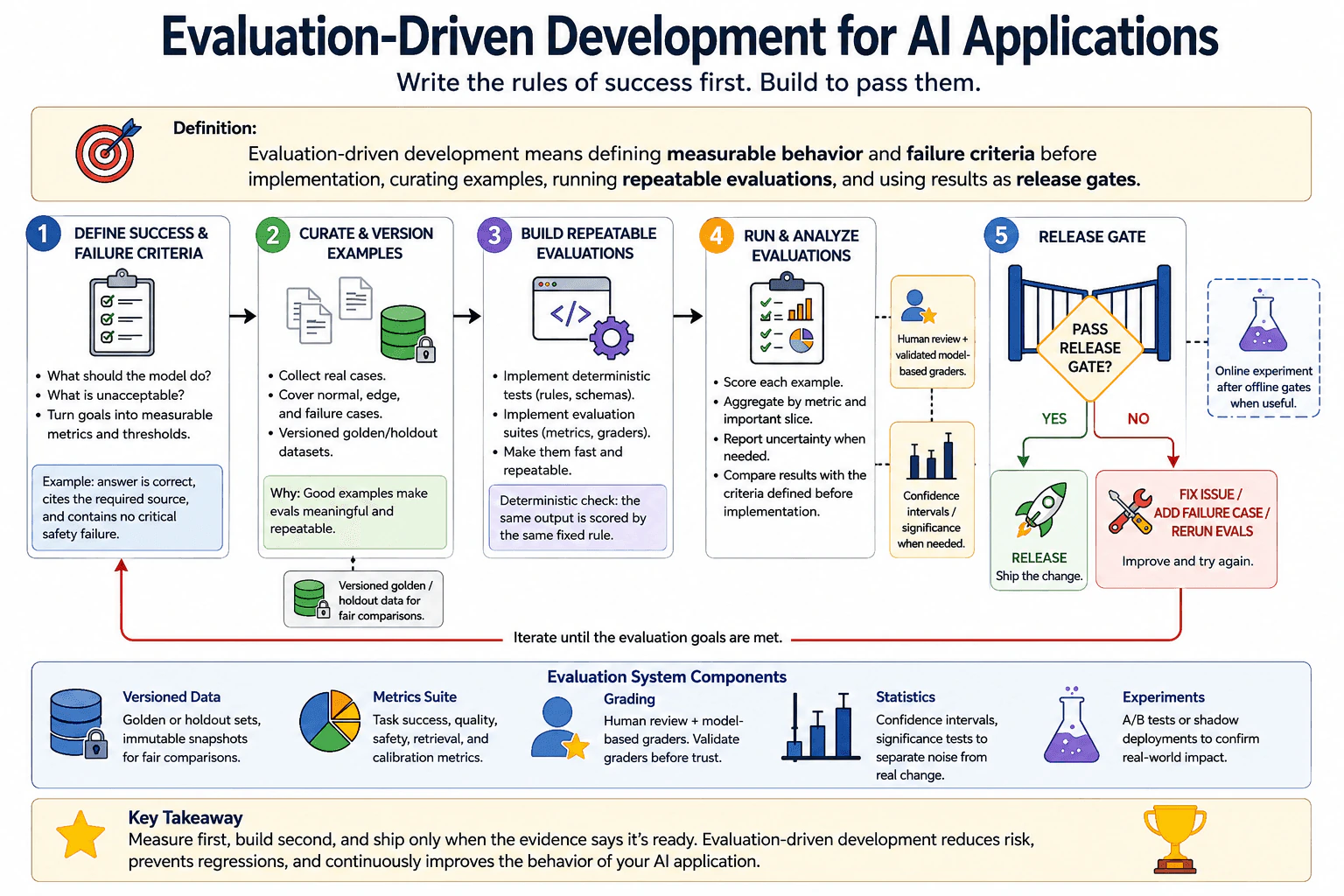
Ground the definition in writing measurable behavior and failure criteria before implementation, curating examples, running repeatable evals, and using results as release gates.
Short Interview Answer (30-60 seconds)
I would define measurable success and failure criteria before building the AI application. Then I would curate and version representative examples, including normal, edge, and failure cases. I would build repeatable evaluations and run them whenever an important change is made. I would score each example, review important slices, and compare the results with the criteria defined earlier. A release gate blocks changes that regress or violate critical requirements. Failed cases feed back into development, so evaluation continuously guides what gets built and what is allowed to ship.
Detailed Explanation
Evaluation driven development means deciding what good and bad behavior look like before building the application. For example, I might require an answer to be correct, use the required source, and avoid a critical safety failure. I then collect examples that represent normal cases, difficult cases, and known failures. Every important change is checked against those examples. The results tell the team whether the change is ready to ship or whether it needs more work. This keeps release decisions based on measured evidence instead of guesses.
Useful Questions to Ask the Interviewer
Which user behaviors are most important for this application?
Which failures should block a release?
Do we already have representative examples or historical failure cases?
Which results need human review instead of an automatic score?
How to Explain It in an Interview
I would describe evaluation driven development as a feedback loop that starts before implementation.
First, I define measurable success and failure criteria. The criteria describe visible behavior that matters to users or the business. For example, an answer may need to be correct, cite the required source, and contain no critical safety failure. The exact targets should come from product requirements. I would not invent arbitrary percentages just to make the evaluation look precise.
Second, I curate and version representative examples. I include normal cases, edge cases, known failures, and safety sensitive cases when they matter. A versioned golden or holdout data set gives the team a stable reference for comparing changes fairly over time. When a real failure appears, I can add it as a new evaluation example so future versions are checked against it.
Third, I build repeatable evaluations. Some checks can use deterministic rules. A deterministic check means the same recorded output is scored by the same fixed rule. Examples include schema checks or exact required fields. Other qualities need judgment because model outputs can vary. Those evaluations may use task metrics, human review, or model based graders. A model based grader should be validated against trusted human judgments before the team relies on it.
Fourth, I run and analyze the evaluations whenever an important change is made. I score each example, aggregate the results by useful metric and important slice, report uncertainty when needed, and compare the results with the criteria defined before implementation. A slice is a meaningful group of examples, such as a language, domain, or request type. Looking only at one overall average can hide a serious failure in a smaller group.
When results can vary, confidence intervals can show how uncertain an estimated metric is. Statistical significance can help when deciding whether an observed difference is likely to represent a meaningful change rather than normal sampling noise. These tools are useful when the decision depends on variation and sample size. They are not required for every simple deterministic check.
Fifth, I use the results as a release gate. If the candidate meets the required criteria and has no blocking regression, it can move toward release. If it fails, the team fixes the issue, adds the failure case to the evaluation data when useful, and runs the evaluations again. This creates the same feedback loop shown in the diagram: define the rules, curate examples, build evaluations, run and analyze them, then pass or fail the release gate.
The offline evaluation boundary contains the candidate AI application, the versioned evaluation data, the scoring rules, the graders, and the analysis used for the release decision. Real users and uncontrolled production traffic are outside this offline boundary. After the offline gate passes, an online experiment can be useful when the team still needs evidence about real user impact.
The main tradeoff is cost versus confidence. More examples, human review, slice analysis, grader validation, and statistical checks take more time and maintenance. They can also catch failures that a small automatic suite would miss. The goal is not to measure everything. The goal is to measure the behaviors and failures that matter enough to guide development and release decisions.
The core takeaway is simple. Measure first. Build against the criteria. Ship only when the evidence passes the gate.
Technical Approach
Define measurable success behavior and blocking failure criteria before implementation.
Curate representative normal, edge, failure, and safety sensitive examples when relevant.
Version the golden or holdout data so changes can be compared fairly.
Build repeatable evaluations using fixed rules for deterministic properties and suitable evaluators for qualities that need judgment.
Validate model based graders against trusted human judgments before relying on them.
Run the evaluations whenever an important application change is made.
Score each example and aggregate results by useful metrics and important slices.
Report uncertainty when variation or sample size makes it useful.
Compare the results with the criteria defined before implementation.
Pass the release gate only when required criteria are satisfied and blocking regressions are absent.
If the gate fails, fix the issue, add the failure case when useful, and rerun the evaluations.
After the offline gate passes, use an online experiment when real user impact still needs to be measured.
Practical Insights
Traditional algorithm complexity is not the main concern for this approach. The practical cost grows with the number of evaluation examples, the cost of running the AI application, and the cost of each evaluator. Human review is usually slower and more expensive than fixed automatic checks. Model based grading can handle more examples, but it needs validation and ongoing checks. Larger evaluation suites also increase CI time. Teams often keep a useful core suite for frequent runs and use broader or more expensive evaluations when the risk justifies the additional cost.
Why Interviewers Ask This
Interviewers ask this to see whether I treat evaluation as part of development rather than as a final check. They want to know whether I can define measurable success and failure criteria, create representative examples, run evaluations in a repeatable way, detect regressions, and make release decisions from evidence. They are also checking whether I understand that AI results can vary, so some evaluations need human review, validated model based graders, useful slices, and uncertainty measures instead of only simple pass or fail checks.
Common interview mistakes
Common mistakes include defining success only after implementation, using a few convenient examples instead of representative cases, changing evaluation data without versioning it, and judging only one overall average. Another mistake is ignoring important slices where a smaller group performs badly. Teams can also create false confidence by trusting a model based grader before validating it against human judgment, using arbitrary thresholds, ignoring uncertainty when it matters, or treating one passing evaluation as proof that production behavior will be perfect. A release gate reduces risk, but it does not guarantee that every real world case will succeed.
Interview tip
Explain the loop in order. Define measurable success and failure criteria first. Curate and version examples. Build repeatable evaluations. Run and analyze them. Then use the results as a release gate. Give one concrete behavior example and explain that failed cases feed back into the evaluation data and development process. This shows that evaluation guides development instead of only checking the finished application.
Interviewer may ask next
What would you do if the overall evaluation passes but one important user slice performs badly?
I would fail the release gate if that slice represents a blocking requirement. The evaluation boundary remains the candidate AI application and the controlled offline evaluation suite, but I would inspect the results for that specific slice instead of trusting only the overall aggregate. I would add or strengthen representative examples for the weak slice, find the cause, make the change, and rerun the same evaluation. This matters because a strong overall result can hide a serious regression for a smaller group. The tradeoff is more evaluation data and analysis work in exchange for a safer release decision.
When would you add an online experiment after the offline evaluation passes?
I would add an online experiment when the offline evaluation cannot fully measure the real user outcome that matters. The offline release gate remains the first boundary and should still block known quality or safety regressions. After that gate passes, the online experiment measures behavior with controlled real traffic. This matters because offline examples can estimate quality but may not predict every production effect. The tradeoff is that online experiments give stronger evidence about real use, but they require more operational care, monitoring, traffic, and time.
92. How do you evaluate LLM outputs? What metrics do you use?Evaluation And TestingEasy
i Question Details
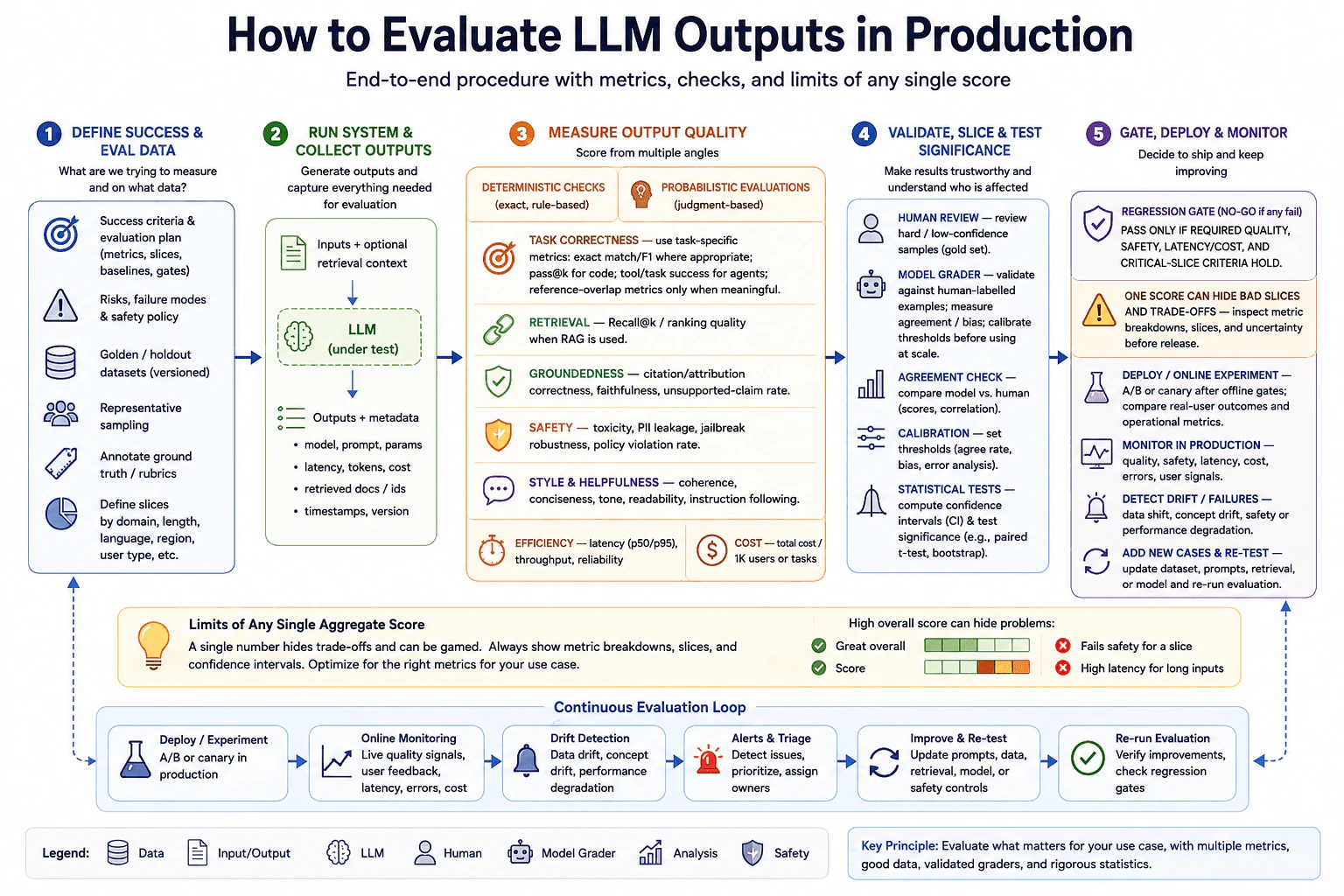
Turn task-specific correctness, groundedness, safety, style, latency, cost, slice analysis, and the limits of any single aggregate score into a production-ready procedure with measurable checks.
Short Interview Answer (30-60 seconds)
I evaluate an LLM with several metrics because one score cannot describe everything that matters. I start with a versioned golden or holdout data set and define success criteria and important slices. I run the system and collect outputs, retrieval context, latency, token use, and cost. Then I measure task correctness, retrieval quality when RAG is used, groundedness, safety, style, and efficiency. I use deterministic checks where an exact rule exists and probabilistic evaluation for judgment based qualities. I validate model graders against human labels, report sample size and confidence intervals, inspect weak slices, and use regression gates before deployment. After release, I keep monitoring quality, safety, latency, cost, and drift, then add new failures back into the evaluation set.
Detailed Explanation
Evaluating an LLM means checking whether its answers are useful for the real job and safe enough to release. I first decide what success looks like and collect examples that represent normal, difficult, and risky cases. I then run the system on those examples and measure different parts of quality instead of relying on one score. I also check important groups of examples separately so a strong average does not hide a weak group. Before release, I compare results with the current baseline. After release, I keep watching real usage and add new failures to future evaluations.
Useful Questions to Ask the Interviewer
What task is the model expected to complete?
Which failures are most important to prevent?
Do we use retrieval, tools, or both?
Which user groups or data slices matter most?
What production signals are available after release?
How to Explain It in an Interview
I would begin by defining the system under test and the success criteria. The boundary is the complete LLM application behavior that produces the output we care about. The evaluation data, reference answers, rubrics, and human labels are inputs to the evaluation process rather than claims about production behavior.
First, I create or maintain a versioned golden or holdout data set. It should contain representative examples, difficult cases, safety cases, and important slices such as domain, input length, language, region, or user type when those slices matter. Versioning is important because I need to know exactly which data was used for a result.
Next, I run the system with controlled settings and collect the information needed for evaluation. I capture the model output, prompt and model version, optional retrieved documents, latency, token use, cost, timestamps, and other useful metadata. This makes later failures easier to reproduce and explain.
Then I measure output quality from several angles. For task correctness, I use metrics that match the task. Exact match or F1 can work when there is a clear expected answer. Pass at k can be useful for code generation. Tool or task success can be useful for an agent. Reference overlap metrics should be used only when overlap really represents quality.
For a RAG system, I separate retrieval quality from answer groundedness. Retrieval metrics such as Recall at k or ranking quality tell me whether useful evidence was retrieved. Groundedness checks whether the generated claims are supported by that evidence. Useful groundedness signals include citation correctness, faithfulness, and unsupported claim rate.
I also measure safety, such as harmful content, private information leakage, jailbreak robustness, or policy violations when those risks apply. Style and helpfulness can include coherence, conciseness, tone, readability, and instruction following. Efficiency includes latency, throughput, reliability, and cost.
I separate deterministic checks from probabilistic evaluations. A deterministic check has a clear rule, such as exact match, a schema check, a rule check, or an executable test. A probabilistic evaluation needs judgment, such as helpfulness, groundedness, or some safety judgments. Those judgments can come from humans or a model grader.
I do not trust a model grader automatically. I validate it against human labelled examples. I compare agreement, inspect disagreement examples, look for systematic bias, and calibrate thresholds before using the grader at scale. Human review is especially useful for difficult samples, low confidence cases, and important failures.
I then analyze results by slice instead of looking only at the overall average. For each important metric or slice, I report the sample size and a confidence interval when appropriate. A confidence interval shows the uncertainty around an estimate. I can also use statistical tests, such as paired tests or bootstrap methods, to decide whether an observed change is likely to be real instead of random sample variation.
The release gate should use several required criteria. Quality, safety, latency, cost, and critical slices may all matter. A strong average must not hide a serious safety failure or a weak user segment. This is why I avoid making the final decision from one aggregate score.
If the offline evaluation passes, I can use a controlled online experiment such as an A/B test or canary release. Offline evaluation remains the first gate. The online experiment then measures real user outcomes and operational behavior.
After deployment, evaluation continues. I monitor quality signals, safety events, latency, cost, errors, user feedback, and drift. When new failures appear, I add representative cases to the evaluation data, update the prompt, retrieval system, model, data, or safety controls as needed, and rerun the same evaluation. This creates a repeatable feedback loop instead of treating evaluation as a one time test.
Technical Approach
Define the exact task, success criteria, risks, baseline, and important slices.
Build or update a versioned golden or holdout data set with representative examples and human labels or rubrics where needed.
Run the LLM system with controlled settings and collect outputs, optional retrieval context, model metadata, latency, token use, cost, and timestamps.
Apply deterministic checks where a clear rule exists.
Measure task specific correctness, retrieval quality when RAG is used, groundedness, safety, style, helpfulness, latency, throughput, reliability, and cost as appropriate.
Use human review and validated model graders for qualities that require judgment.
Compare graders with human labelled examples, inspect agreement and bias, and calibrate thresholds before trusting them at scale.
Report metrics by important slices with sample size and confidence intervals when appropriate.
Use statistical tests when deciding whether a change is a real improvement or regression.
Apply regression gates across the required quality, safety, latency, cost, and critical slice criteria.
After offline gates pass, use a controlled online experiment when appropriate.
Monitor production, collect new failures, add them to the evaluation data, and rerun the evaluation after each meaningful change.
Practical Insights
Traditional algorithmic time complexity is not the main concern here. The practical cost grows mostly with the number of evaluation examples, the number of model calls, the number of graders, and any human review. Larger data sets give stronger evidence but cost more time and money. Model graders reduce manual work but need validation. Human review gives valuable judgment but is slower and more expensive. Slice analysis also needs enough samples in each important slice. In CI, I would normally run a smaller stable regression set frequently and run broader or more expensive evaluations at appropriate release points.
Why Interviewers Ask This
Interviewers ask this to see whether I can turn a vague idea of model quality into measurable production checks. They want to know whether I choose metrics that match the task, use reliable evaluation data, inspect important user slices, validate human and model graders, and understand statistical uncertainty. They also want to see whether I can make a safe release decision instead of trusting one overall score.
Common interview mistakes
A common mistake is choosing one convenient score and treating it as total quality. Another is using metrics that do not match the real task. Teams may mix retrieval quality with groundedness even though they measure different things. They may trust a model grader without checking it against humans. They may report an average without looking at weak slices, sample size, or uncertainty. Other mistakes include changing the evaluation data without versioning it, tuning directly on the holdout set, using too few safety examples, ignoring latency and cost, or assuming an offline pass guarantees good production behavior.
Interview tip
Explain the process as a release decision, not as a list of metrics. Start with the task and evaluation data, then describe the measurements, grader validation, slice analysis, regression gate, and production feedback loop. Emphasize that the right metric depends on the task and that one aggregate score can hide important failures.
Interviewer may ask next
What would you do if a model grader disagrees with human reviewers?
I would not use that grader as a trusted release signal until the disagreement is understood. The boundary being checked is the model grader against a human labelled evaluation set. I would measure agreement, inspect disagreement examples, look for systematic bias, and refine the rubric or grader setup if needed. I would then validate it again before using it at scale. The tradeoff is that human review costs more, but trusting a poorly calibrated grader can create misleading evaluation results.
How would you scale this evaluation process when the full evaluation set becomes too expensive to run on every change?
I would keep the same evaluation strategy but change how often different parts run. The boundary that changes is the CI execution plan, not the meaning of the metrics. I would run a small, stable regression set on frequent changes and run broader slice coverage, human review, and expensive model grading at suitable release stages. I would still require critical safety and quality checks where necessary. The tradeoff is faster feedback and lower cost versus less coverage on each individual CI run.
93. Explain BLEU, ROUGE, and BERTScore. When would you use each?Evaluation And TestingEasy
i Question Details
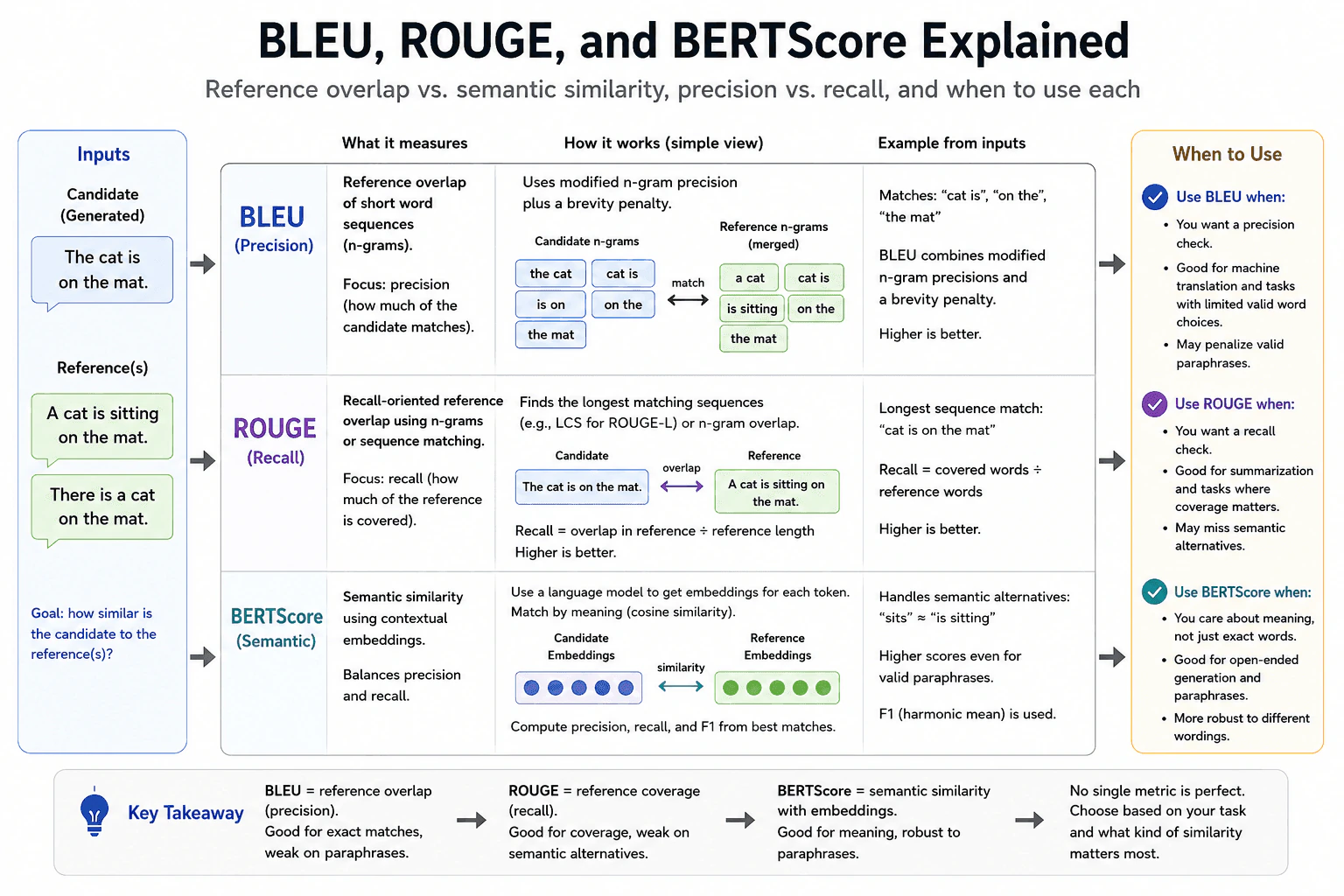
The response should make reference overlap, semantic alternatives, precision or recall emphasis, BERTScore embeddings, task suitability, and failure on valid paraphrases explicit.
Short Interview Answer (30-60 seconds)
I choose the metric based on what kind of similarity matters. BLEU is useful when wording overlap and precision matter. It uses modified n gram precision plus a brevity penalty, so it is common for machine translation but can penalize valid paraphrases. ROUGE is useful when reference coverage and recall matter, which is common in summarization. BERTScore is useful when meaning matters more than exact wording. It compares contextual embeddings and can handle synonyms and paraphrases better. The main tradeoff is that semantic similarity still does not prove factual correctness.
Detailed Explanation
I would first decide what kind of similarity matters for the task. Some tasks need generated text to stay close to reference wording. Other tasks care more about covering the important reference ideas or expressing the same meaning with different words. BLEU, ROUGE, and BERTScore measure these goals differently. BLEU focuses on wording overlap. ROUGE focuses mainly on reference coverage. BERTScore focuses on similarity in meaning. None of them alone proves that an answer is factually correct, safe, useful, or successful for the real task.
Useful Questions to Ask the Interviewer
Is exact wording important, or are valid paraphrases expected?
Do we care more about precision or about covering the reference content?
Is the task machine translation, summarization, or open ended generation?
Will this metric be used alone or together with human review or task specific checks?
How to Explain It in an Interview
BLEU compares generated text with one or more reference texts by looking at matching groups of words. Its main emphasis is precision. Precision asks how much of the wording produced by the model also appears in the reference. BLEU uses modified n gram precision across several n gram sizes and also applies a brevity penalty. The brevity penalty matters because an extremely short answer should not receive an unfairly strong score simply because the few words it contains match the reference. BLEU is a good fit when exact wording matters, especially for machine translation. Its weakness is that a correct paraphrase can receive a lower score because the surface words are different.
ROUGE also compares generated text with a reference, but its common emphasis is recall. Recall asks how much of the reference content appears in the generated text. Different ROUGE variants measure overlap in different ways. ROUGE 1 and ROUGE 2 use n gram overlap, while ROUGE L uses a longest common subsequence idea to measure sequence overlap. This makes ROUGE useful for summarization because missing an important reference idea can be more serious than adding a few extra words. Its weakness is that it still depends mainly on surface overlap, so a valid semantic alternative can receive a weaker score.
BERTScore focuses on semantic similarity, which means similarity in meaning. It uses contextual embeddings. An embedding is a numeric representation of a token, and contextual means that the representation depends on the surrounding words. BERTScore compares generated tokens with reference tokens using similarity between those embeddings. It derives precision, recall, and an F1 value from the best token matches. This lets it recognize that phrases such as "sits" and "is sitting" can express similar meaning even when the exact words differ. BERTScore is therefore useful for open ended generation and other tasks where synonyms and paraphrases are expected.
The evaluation boundary is the generated text compared with one or more reference texts. These metrics measure different kinds of similarity inside that boundary. They do not directly test factual correctness, safety, usefulness, or full task success. BERTScore can give a strong semantic similarity score to an answer that sounds related but contains a wrong fact. BLEU and ROUGE can also reward copied wording even when the response is poor in another important way.
In practice, I would use BLEU when wording precision matters, ROUGE when reference coverage and recall matter, and BERTScore when meaning and valid paraphrases matter. For important production evaluation, I would usually combine the chosen automatic metric with task specific checks and human review when the risk or product requirement justifies it.
Technical Approach
Define what the evaluation should reward.
Use BLEU when matching wording and precision are the main goal.
Use ROUGE when covering reference content and recall are the main goal.
Use BERTScore when similarity in meaning matters more than exact wording.
Check the known failure mode. BLEU and ROUGE can penalize valid paraphrases, while BERTScore can reward semantically similar text that is still factually wrong.
Match the metric to the real task instead of treating any one metric as universally best.
Practical Insights
Traditional algorithmic complexity is not the main decision here. BLEU and ROUGE are usually cheaper because they mainly compare words, n grams, or sequences. BERTScore costs more because it must run a pretrained language model to create contextual embeddings before comparing tokens. On a large evaluation set, that increases runtime and compute use. There is also maintenance cost in choosing good references and checking whether the metric still reflects the real product goal.
Why Interviewers Ask This
Interviewers ask this to see whether I can choose a text generation metric based on what the task actually values. They want to know whether I understand exact reference overlap, reference coverage, and similarity in meaning. They also want me to recognize that a strong automatic score does not always mean the generated answer is correct or useful, especially when valid answers can use different wording.
Common interview mistakes
A common mistake is treating BLEU, ROUGE, and BERTScore as interchangeable. They emphasize different kinds of similarity. Another mistake is saying BLEU is only a simple percentage of matching words. BLEU combines modified n gram precision across multiple n gram sizes and applies a brevity penalty. It is also wrong to describe all ROUGE variants as longest sequence matching because different variants use different overlap methods. Another mistake is assuming BERTScore proves correctness. It measures semantic similarity through contextual embeddings, so a factually wrong answer can still look semantically similar. A final mistake is using one narrow reference set and then treating low overlap as proof that every alternative wording is bad.
Interview tip
Start with the decision rule. Say BLEU for wording overlap and precision, ROUGE for reference coverage and recall, and BERTScore for meaning and paraphrases. Then give one practical use case and one limitation for each. Finish by explaining that no single similarity metric proves overall answer quality.
Interviewer may ask next
What happens if the generated answer is a valid paraphrase but shares very few words with the reference?
BLEU and ROUGE can give that answer a weaker score because their evaluation boundary depends mainly on surface overlap with the reference. BERTScore is usually better for this case because contextual embeddings can recognize similar meaning across different wording. This matters when valid paraphrases are common. The tradeoff is that stronger semantic similarity still does not prove factual correctness, so I would not treat BERTScore alone as a complete quality check.
How would you choose between these metrics for a large production evaluation pipeline?
I would keep the evaluation boundary focused on generated text compared with reference text and choose the metric that matches the product goal. I would use BLEU when wording precision matters, ROUGE when reference coverage matters, and BERTScore when semantic alternatives matter. At larger scale, BLEU and ROUGE are usually cheaper to compute, while BERTScore needs contextual embedding computation with a pretrained language model and therefore costs more. The main tradeoff is compute cost versus how well the metric captures the type of similarity the product actually needs.
94. What is LLM-as-a-judge evaluation, and what are its limitations?Evaluation And TestingEasy
i Question Details
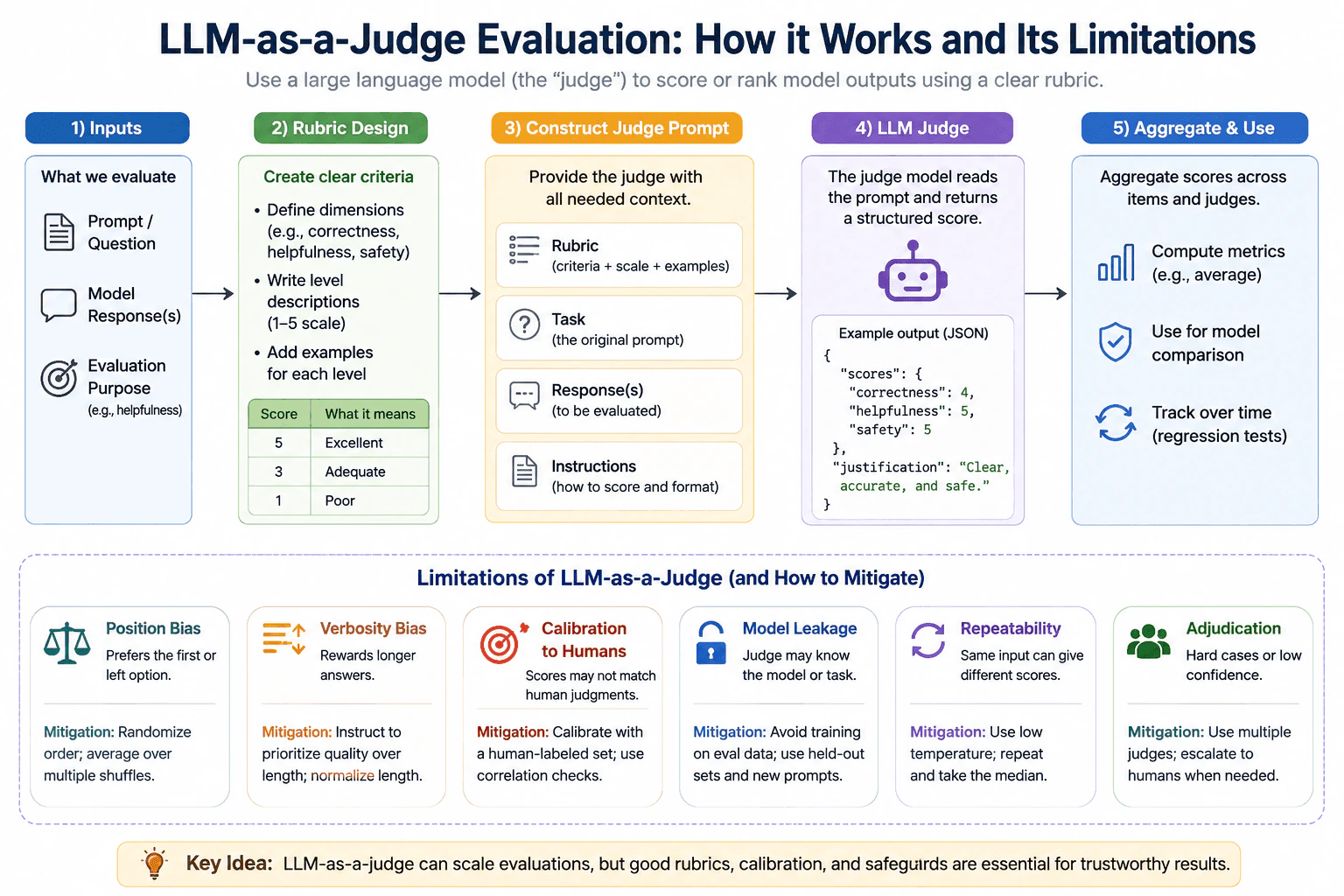
A complete explanation should cover rubric design, structured scoring, position and verbosity bias, calibration to humans, model leakage, repeatability, and adjudication.
Short Interview Answer (30-60 seconds)
I would use an LLM as a judge to score or rank model responses with a clear rubric and structured output. This can make evaluation much faster at scale, but I would not trust the judge alone. I would calibrate it against human reviewers, test for position bias and verbosity bias, reduce model leakage, check repeatability, and send difficult or disputed cases to adjudication.
Detailed Explanation
An LLM can act like a reviewer. We give it a question, one or more answers, and clear rules that describe what a good answer should contain. It returns scores and a short reason. This is useful when people cannot review every answer by hand. But the reviewer can still make mistakes. It may prefer the first answer, reward a longer answer, change its score on another run, or disagree with people. Because of this, we still need clear rules, repeated checks, and human review for difficult cases.
Useful Questions to Ask the Interviewer
Are we scoring one response at a time or comparing two responses?
Do we already have human reviewed examples for calibration?
Which qualities matter most, such as correctness, helpfulness, or safety?
How to Explain It in an Interview
I would explain the evaluation as a clear flow.
First, define the inputs. The judge receives the original prompt or question, the model response or responses, and the purpose of the evaluation. This matters because the judge needs the same task context that the original model had.
Second, design the rubric. A rubric is a clear scoring guide. It defines the qualities we care about, such as correctness, helpfulness, and safety. It also explains what each score means. For example, on a one to five scale, five can mean excellent, three can mean adequate, and one can mean poor. Examples for each level make the rubric easier to apply consistently.
Third, construct the judge prompt. I would give the judge the rubric, the original task, the response or responses being evaluated, and exact instructions for how to score them. The instructions should also define the required output format.
Fourth, the LLM judge reads that information and returns structured scores. For example, it may return separate values for correctness, helpfulness, and safety, plus a short justification. A structured format such as JSON is useful because the application can validate it, aggregate it, compare results across models, and track changes over time.
Fifth, aggregate and use the results. For a larger evaluation set, I would combine scores across many items and, when appropriate, across more than one judge run. These results can support model comparison and regression testing. I would not treat one judge score as final truth.
The first important limitation is position bias. In a comparison, the judge may prefer the first or left response because of where it appears. I would reduce this by changing the response order across runs and combining the results.
The second limitation is verbosity bias. The judge may reward a longer response even when the extra words do not add quality. I would make the rubric focus on correctness and usefulness rather than length. I would also test the judge with examples that vary in length.
The third limitation is calibration to humans. Calibration means checking whether the judge agrees closely enough with trusted human reviewers. I would create a human reviewed evaluation set, compare judge scores with those human judgments, inspect disagreements, and adjust the rubric or judge instructions when needed. I would repeat this check over time because judge behavior or evaluation needs can change.
The fourth limitation is model leakage. The judge may already know something about the model, task, or evaluation examples. Evaluation data may also have appeared in training. That can make results look better than they really are. I would avoid exposing model identity when it is not needed, use held out evaluation sets, avoid training on evaluation data, and refresh prompts and examples over time.
The fifth limitation is repeatability. The same input can receive different scores on different runs because model output is probabilistic. I would use stable settings where possible and repeat important judgments. For repeated runs, I can combine the results with a simple statistic such as the median. Large disagreement between runs is also useful evidence that the case is uncertain.
The final limitation is adjudication. Adjudication means sending difficult or disputed cases to another reviewer. That reviewer may be another judge, several judges, or a human. I would use adjudication when repeated judgments disagree or when the case has high impact. This gives better control over cases where one model score is not reliable enough.
The main tradeoff is scale versus trust. LLM judges can evaluate many responses quickly, but they can contain bias, randomness, and blind spots. Human review is slower and more expensive, but it is important for calibration and difficult cases. A strong evaluation process combines clear rubrics, structured scoring, repeated checks, human calibration, and adjudication.
Technical Approach
Define the evaluation purpose and the inputs to be judged.
Write a clear rubric with scoring criteria, score meanings, and examples.
Build the judge prompt with the rubric, original task, responses, and output instructions.
Ask the LLM judge to return structured scores and a short justification.
Validate the returned structure before using the result.
Aggregate scores across evaluation items and repeated judge runs when useful.
Compare judge results with trusted human judgments for calibration.
Test for position bias and verbosity bias.
Reduce model leakage with held out evaluation data and limited model identity information.
Check repeatability by running important judgments more than once.
Send difficult or disputed cases to adjudication.
Track the results over time for model comparison and regression testing.
Practical Insights
Traditional algorithmic complexity is not the main concern. The practical cost comes from model calls, the number of evaluation examples, repeated judge runs, human calibration, and adjudication. More examples give broader coverage but take more time and money. Repeating judgments can make results more stable, but it also increases cost. Human reviewed examples require extra effort, but they are important because they show whether the judge matches the quality standard we actually want. In CI, a smaller stable evaluation set can run often, while a larger evaluation can run less often.
Why Interviewers Ask This
Interviewers ask this to see whether I understand how to use a model as an evaluator without treating its score as perfect truth. They want to know whether I can design a clear rubric, collect structured scores, compare the judge with human reviewers, find common biases, handle unstable results, and decide when a difficult case needs human review.
Common interview mistakes
A common mistake is using a vague rubric, which makes scoring inconsistent. Another mistake is trusting one judge score without comparing it with human judgments. Teams may forget position bias and always place one response first. They may also reward long answers by accident when the rubric does not separate quality from length. Another mistake is using evaluation examples that may have leaked into training data. It is also risky to assume the same input will always receive the same score. Finally, teams may skip adjudication and treat every judge result as final even when repeated runs or reviewers disagree.
Interview tip
Explain the flow in order: define the inputs, design the rubric, construct the judge prompt, collect structured scores, aggregate the results, calibrate against humans, test known biases, check repeatability, and use adjudication for difficult cases. Make it clear that LLM judging helps with scale, but the judge itself must also be evaluated.
Interviewer may ask next
What would you do if the same response gets different judge scores across repeated runs?
I would treat the LLM judge as a probabilistic evaluator inside the evaluation boundary. I would keep the prompt, response, rubric, and judge instructions fixed, then repeat the judgment and measure how much the scores vary. For important cases, I would aggregate repeated scores, for example with the median. If disagreement remains large, I would send the case to adjudication. This matters because repeatability is part of validating the judge itself, not just the model being evaluated.
How would you keep LLM as a judge evaluation practical when it has to run on a large regression set in CI?
I would keep the evaluation boundary the same but change how often and how much of the evaluation set runs. A smaller stable set can run frequently in CI, while a larger set can run less often. I would reserve repeated judge calls and human adjudication for important or disputed cases instead of applying them to every item. The tradeoff is coverage versus runtime and cost. This keeps the same rubric and calibration strategy while making the evaluation practical at scale.
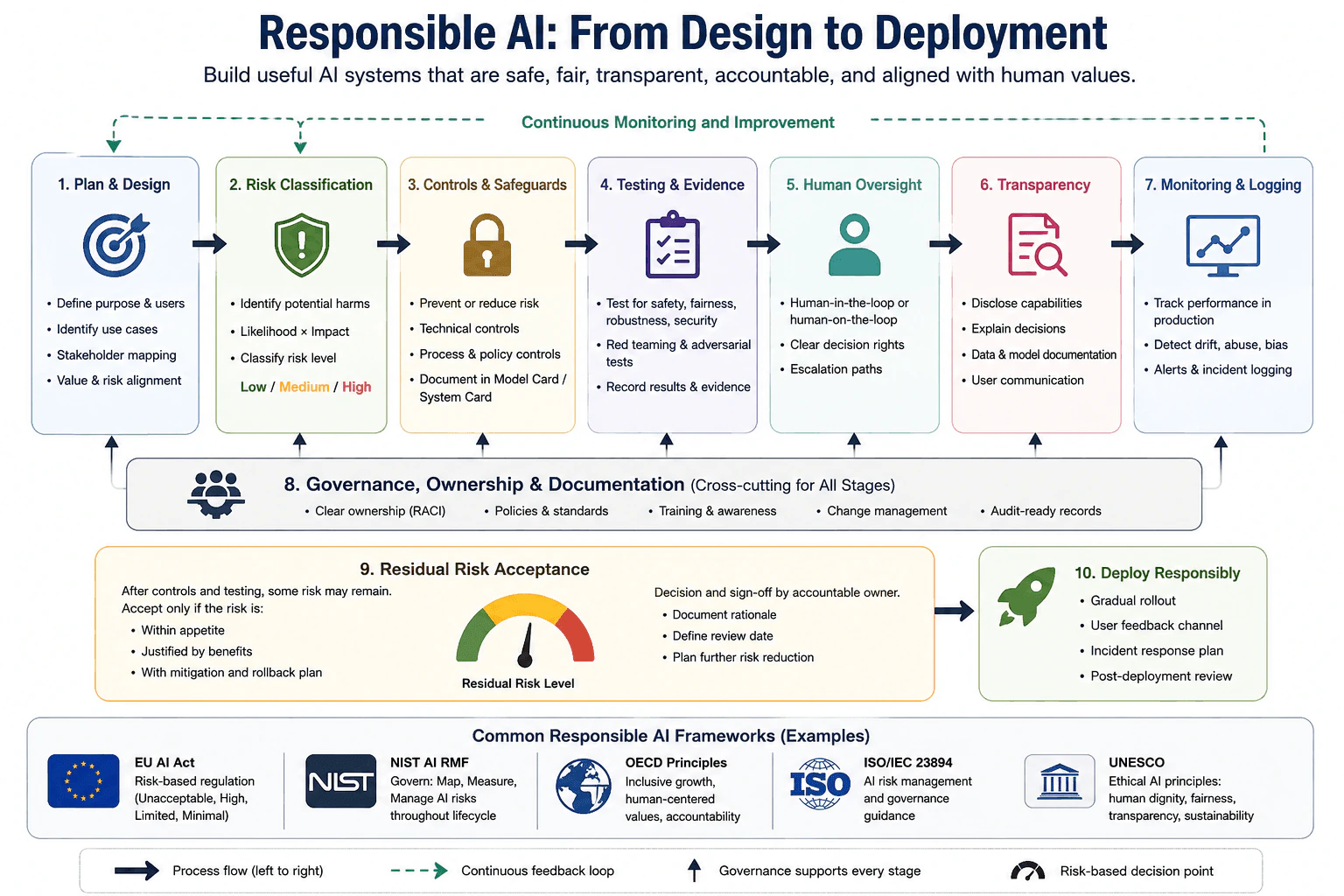
95. What is responsible AI, and what frameworks exist for implementing it?Ai Safety Ethics And Responsible AiMedium
i Question Details
Require a mechanism-level account of risk classification, ownership, documented controls, testing evidence, human oversight, transparency, monitoring, and residual-risk acceptance.
Short Interview Answer (30-60 seconds)
Responsible AI is a risk-based way to build and run AI with clear ownership, controls, testing evidence, human oversight, transparency, monitoring, and residual-risk decisions. Common references include NIST AI RMF, ISO/IEC 23894, OECD principles, UNESCO guidance, and the EU AI Act.
Detailed Explanation
Responsible AI means making AI useful while also reducing harm to people and organizations. It is not one safety check at the end. It is a process used from early design through deployment and ongoing monitoring. Teams first decide what the system should do and who may be affected. They then classify risk, assign responsible owners, add safeguards, test those safeguards, keep evidence, provide human oversight, explain important limits, monitor the system after release, and decide what to do with any risk that still remains.
Useful Questions to Ask the Interviewer
Should I explain responsible AI as a full lifecycle from design through production monitoring and residual-risk acceptance?
Should I compare the main frameworks, or focus mainly on how an engineering team implements them?
Should I cover both technical controls and human governance decisions?
How to Explain It in an Interview
Start with the practical idea: responsible AI is a risk-driven engineering and governance process. The goal is not to claim perfect safety or perfect compliance. The goal is to identify meaningful risks, reduce them with controls, verify those controls with evidence, assign clear ownership, and make an explicit decision about any risk that remains.
Plan and design. Define the purpose, users, use cases, assumptions, system boundaries, affected people, and important risks. This gives the team a clear target for what responsible use means.
Classify risk. Identify possible harms and misuse paths. Consider likelihood and impact, then assign a risk level such as low, medium, or high. Depending on the use case, relevant risks may include safety, privacy, security, fairness, accessibility, abuse, or harmful content.
Add controls and safeguards. Controls should prevent or reduce specific risks. Model mitigations may constrain model behavior. Application controls can validate inputs and outputs, apply authorization, enforce policy, or block unsafe actions. Operational controls include monitoring, alerts, incident procedures, and rollback. Human governance includes approval, escalation, and accountability. Important controls should be documented in system or model documentation.
Test and collect evidence. Run tests for relevant qualities such as safety, fairness, robustness, privacy, or security. Use red-team or adversarial testing when misuse matters. Record test plans, results, metrics, logs, and known gaps. Evidence should show whether a control meets its acceptance criteria instead of relying on a claim that the system is safe.
Provide human oversight. Higher-risk decisions may require a human in the loop, or a human who can review, override, escalate, or stop the system. Define decision rights and escalation paths. Reviewers also need enough information and training to make sound decisions.
Provide transparency. Explain important capabilities and limits. Disclose AI use when required. Maintain data and model documentation, release notes, limitations, and user guidance. Transparency should help users make informed choices without exposing sensitive security information.
Monitor and log production behavior. Track relevant performance, drift, abuse, bias, safety incidents, and user feedback. Use alerts and incident logs. Log only what is needed for investigation and avoid storing sensitive content when it is unnecessary. Use incident response, escalation, mitigation, and rollback so the application can fail safely.
Apply governance, ownership, and documentation across every stage. Assign clear accountable owners. Maintain policies, standards, training, change-management records, and audit-ready evidence. Responsibility should not disappear when the model moves from development to production.
Decide on residual risk. Residual risk means risk left after controls and testing. An accountable owner or review body should decide whether to accept it, add more mitigation, defer deployment, or stop the use case. Record the rationale, review date, further risk-reduction plan, and rollback or mitigation plan.
Deploy responsibly. Use measures such as gradual rollout, user feedback channels, an incident-response plan, and post-deployment review. Deployment is a controlled decision, not the end of the safety process.
Continuously monitor and improve. Production data, incidents, user feedback, model changes, and changes in the use case can reveal new risks. Feed that information back into planning, risk classification, controls, testing, and governance.
Several well-known references help teams organize this work. The NIST AI Risk Management Framework uses four core functions: Govern, Map, Measure, and Manage. ISO/IEC 23894 gives guidance for AI risk management and governance. The OECD AI Principles describe ideas such as inclusive growth, human-centered values, transparency, robustness, security, and accountability. UNESCO provides ethical AI principles involving human dignity, fairness, transparency, and sustainability. The EU AI Act is different because it is a law rather than only a voluntary framework. It uses a risk-based regulatory approach, including categories such as unacceptable, high, limited, and minimal risk for systems that fall within its scope.
The main tradeoff is that stronger controls, testing, review, documentation, and monitoring require more time and operational effort. Some controls can also add latency or user friction. But weak controls can leave serious harms undiscovered. The practical approach is proportional governance: higher-risk systems need stronger evidence, tighter oversight, and more formal approval than lower-risk systems.
Key Insight / Why This Solution Works
Define the purpose, users, use cases, boundaries, assumptions, and affected people.
Identify harms, misuse paths, sensitive data, and failure cases.
Rate likelihood and impact, then assign a risk level.
Assign accountable owners for the product, model, data, risk, controls, and review decisions.
Add model mitigations, application controls, operational controls, and human governance for specific risks.
Define acceptance criteria and collect testing evidence for each important control.
Add human review, override, escalation, and safe-failure paths where risk requires them.
Document capabilities, limits, policies, decisions, and user-facing information.
Monitor production performance, drift, abuse, bias, incidents, and feedback while minimizing sensitive logging.
Have an accountable owner accept, mitigate, defer, or stop residual risk.
Deploy responsibly with gradual rollout, feedback, incident response, and post-deployment review.
Feed monitoring results back into the lifecycle for continuous improvement.
Why Interviewers Ask This
The interviewer wants to know whether the candidate can turn responsible-AI principles into a real engineering and governance process. A strong answer connects risk classification to clear ownership, documented controls, testing evidence, human oversight, transparency, monitoring, incident response, residual-risk acceptance, and responsible deployment. It should also show that frameworks, standards, principles, and laws have different roles.
Common interview mistakes
Common mistakes are treating responsible AI as only a list of principles, claiming a system is safe without testing evidence, leaving risk ownership vague, and failing to separate model mitigations from application controls, operational controls, and human governance. Other mistakes include forgetting human escalation, logging sensitive content unnecessarily, monitoring only model quality while ignoring abuse or incidents, failing to document residual-risk acceptance, and treating deployment approval as permanent. It is also a mistake to present NIST AI RMF, ISO/IEC 23894, OECD principles, UNESCO guidance, and the EU AI Act as the same type of framework because they serve different governance, standards, principles, and legal roles.
Interview tip
Present the answer as one lifecycle: plan, classify risk, add safeguards, test and collect evidence, provide human oversight, explain important limits, monitor production, apply governance across all stages, accept or reduce residual risk, deploy responsibly, and continuously improve. Then name a few major frameworks and explain what role each one plays.
Interviewer may ask next
How would you prove that a responsible AI control is actually working?
Start with a specific risk and the control meant to reduce it. Define a clear acceptance criterion, then collect evidence through tests, red-team cases, logs, review records, or production monitoring. For example, if an application policy should block a prohibited action, test normal and adversarial requests, record the results, review failures, and keep the evidence with the control owner. A control should not be considered effective only because it exists in documentation.
What should a team do when some AI risk remains after all planned controls?
Treat it as residual risk. Summarize what can still go wrong, its likely impact, the controls already applied, the testing evidence, and any remaining gaps. An accountable owner or review body should then accept the risk, require more mitigation, defer deployment, or stop the use case. Record the rationale, review date, monitoring plan, further mitigation actions, and rollback or incident-response path. Acceptance is a governed decision, not a claim that the remaining risk has disappeared.
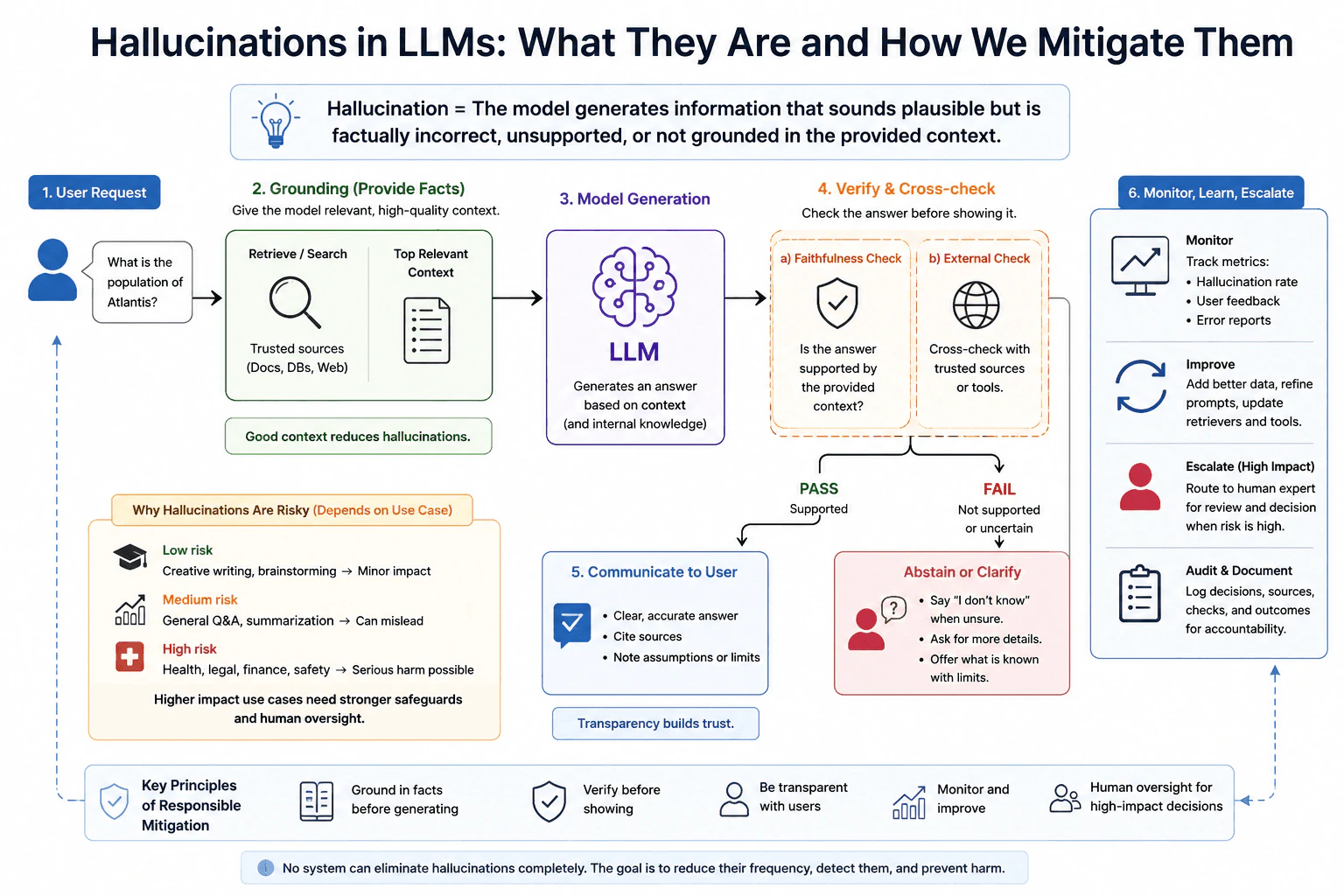
96. What are hallucinations in LLMs, and how do you mitigate them?Ai Safety Ethics And Responsible AiEasy
i Question Details
Expected depth includes risk by use case, grounding or abstention, verification, user communication, monitoring, and escalation for high-impact errors.
Short Interview Answer (30-60 seconds)
Hallucinations are plausible-sounding but false or unsupported LLM outputs. I reduce them with trusted grounding, verification, clear uncertainty, and abstention when support is weak. I monitor failures and escalate high-impact health, legal, finance, or safety cases to human experts.
Detailed Explanation
This question asks how to handle a system that can give an answer that sounds confident even when the answer is wrong or unsupported. The main idea is to match protection to possible harm. A wrong answer in brainstorming may have little impact, while a wrong health, legal, finance, or safety answer can cause serious harm. The system should use reliable information, check important answers, admit when it is unsure, explain limits to the user, watch for repeated failures, and involve a qualified person when the possible harm is high.
Useful Questions to Ask the Interviewer
What use cases will the model support, and how harmful could a wrong answer be in each one?
Do we have trusted documents, databases, or other sources that can be used to support answers?
Which high-impact decisions require human review before the answer can be acted on?
How to Explain It in an Interview
A hallucination is information generated by an LLM that sounds plausible but is factually wrong, unsupported, or not grounded in the provided context. The important point is that fluent language is not proof of truth.
I would start with risk. For creative writing or brainstorming, an incorrect factual detail may have low impact. General question answering or summarization may have medium impact because an unsupported answer can mislead a user. Health, legal, finance, and safety use cases can have high impact, so they need stronger safeguards and human oversight.
The first control is grounding. Grounding means giving the model relevant information from trusted sources before it answers. For example, the application can retrieve useful passages from approved documents, databases, or suitable external sources and place the most relevant context in the model request. This reduces the need for the model to rely only on what it learned during training. Good context reduces hallucinations, but it does not guarantee correctness because retrieval can miss information and the model can still misunderstand the context.
Next, I verify the generated answer. I use a faithfulness check to ask whether the claims are actually supported by the supplied context. For important claims, I can also cross-check against trusted external sources or tools. These checks should be independent enough to catch errors instead of simply repeating the same unsupported claim.
The verification result creates an important decision point. If the answer is supported, the application can show it to the user. It should cite the supporting sources when appropriate and state important assumptions or limits. If the answer is not supported or the evidence is uncertain, the safe path is to abstain or clarify. The system can say that it does not know, ask for more information, or provide only the part that is supported. It should not invent an answer merely to remain helpful.
User communication is also a safety control. I would avoid presenting uncertain output as certain fact. I would show useful sources, explain important limits, and use simple language so the user understands how much confidence to place in the result. Transparency helps the user make a better decision, especially when the answer may affect another action.
In production, I would monitor the system for recurring failures. Useful evidence can include hallucination or factuality measurements, user feedback, and error reports. I would review these signals to find new failure patterns and improve data quality, prompts, retrieval, or supporting tools. Logs should record decisions, source references, checks, and outcomes needed for investigation without copying unnecessary sensitive user content.
For high-impact cases, automation alone is not enough. If an uncertain answer could seriously affect health, legal rights, money, or safety, I would route it to an appropriate human expert for review and decision. I would also have an incident path for serious failures so the team can investigate, contain the problem, document what happened, and update the controls.
The tradeoff is that stronger grounding, verification, and human review add latency, cost, and operational work. Abstention can also reduce how many questions the system answers. I would accept those costs when the possible harm is high. The goal is not to promise that hallucinations disappear. No system can eliminate them completely. The responsible goal is to reduce their frequency, detect unsupported answers, communicate uncertainty, contain failures, and prevent serious harm.
Risk and Control
Classify the use case by the harm a wrong answer could cause.
Retrieve relevant information from trusted sources and give the model the best available context.
Generate the answer using that context.
Check whether the answer is supported by the supplied context.
Cross-check important claims with trusted sources or tools when the risk justifies it.
If the checks pass, show the answer with useful sources, assumptions, and limits.
If support is weak or uncertain, abstain, say that the system does not know, or ask for clarification.
Monitor hallucination or factuality measurements, user feedback, and error reports in production.
Improve data, prompts, retrieval, or tools when repeated failure patterns appear.
Route high-impact uncertain cases to qualified human review and keep audit evidence for investigation.
Practical Insights
Grounding adds data and retrieval work before generation. Verification adds extra checks, so it can increase response time and compute or service cost. External checks may also depend on the speed and availability of other sources or tools. Human review has the highest operational cost and can make responses slower, so it is most useful for high-impact cases. Monitoring requires logs, feedback handling, reports, and regular review. The system also needs maintenance because trusted data, retrieval methods, prompts, validation rules, and failure patterns change over time.
Why Interviewers Ask This
The interviewer wants to know whether I understand that a fluent model answer is not automatically a correct answer. They also want to see whether I can design practical controls around the model. A strong answer should connect the level of protection to the possible harm, use trusted information and verification, support safe abstention when evidence is weak, communicate uncertainty to users, monitor failures in production, and use human oversight for high-impact decisions.
Common interview mistakes
A common mistake is treating confident wording as evidence that an answer is correct. Another is assuming retrieval alone removes hallucinations. Retrieved information can be incomplete, irrelevant, or misunderstood, so important answers still need verification. It is also a mistake to force the model to answer when evidence is weak instead of allowing abstention or clarification. Other mistakes are hiding uncertainty from users, applying the same controls to low-risk and high-risk use cases, logging unnecessary sensitive content, monitoring only system uptime instead of answer quality, and letting high-impact uncertain answers bypass human review. Finally, never claim that one safeguard or one model can eliminate hallucinations completely.
Interview tip
Explain the flow in order: user request, risk level, grounding, model generation, verification, communicate or abstain, then monitor, improve, audit, and escalate. Give one low-risk and one high-risk example. End with the limitation: these controls reduce and contain hallucinations, but they do not guarantee perfect factual accuracy.
Interviewer may ask next
Why is retrieval or grounding not enough by itself to prevent hallucinations?
Grounding gives the model better evidence, but it is not a guarantee. Retrieval can return missing, stale, irrelevant, or conflicting information. The model can also misread correct context or add unsupported claims. I therefore combine grounding with a faithfulness check that asks whether the answer is supported by the retrieved context. For important claims, I may also cross-check trusted sources or tools. If the evidence is still weak, the safe result is to abstain or ask for clarification.
How would you change the design for a high-impact use case such as health, legal, finance, or safety?
I would use stricter controls because the cost of a wrong answer is higher. I would limit grounding to trusted sources, verify important claims, make unsupported answers fail safely through abstention or clarification, and tell the user about important limits. I would monitor failures and keep useful audit evidence without storing unnecessary sensitive content. Most importantly, an uncertain high-impact answer should be routed to an appropriate human expert for review and decision. These controls reduce residual risk, but they still do not guarantee perfect accuracy.
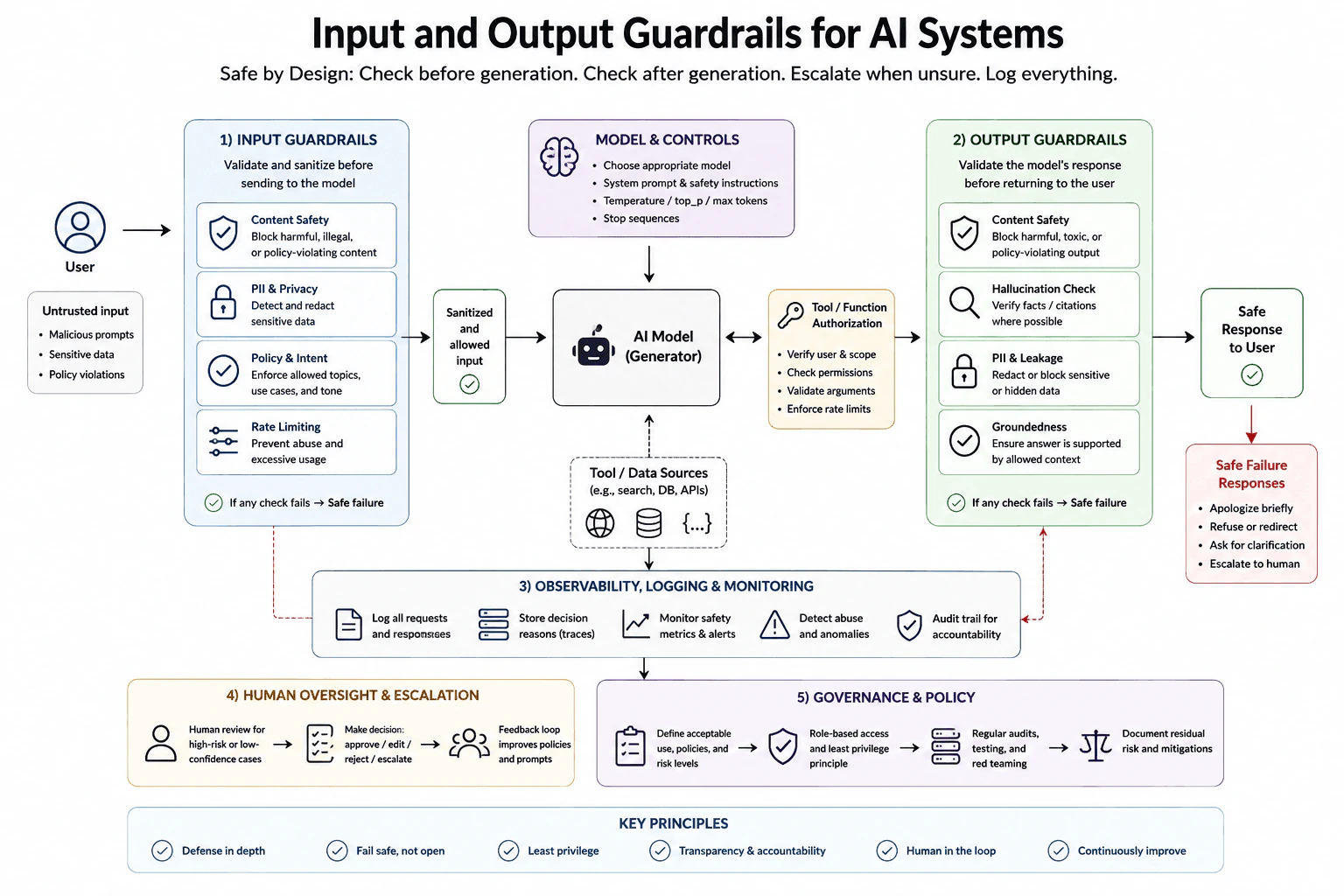
97. How do you implement input and output guardrails for AI systems?Ai Safety Ethics And Responsible AiEasy
i Question Details
Translate the answer into concrete engineering decisions about policy checks before and after generation, model and deterministic controls, tool authorization, human escalation, logging, and safe failure.
Short Interview Answer (30-60 seconds)
I use defense in depth: validate input before the model, apply model and deterministic controls, authorize tool calls, validate output afterward, fail safely on rejected cases, log decisions with sensitive data minimized, and send high-risk or uncertain cases to human review.
Detailed Explanation
This question asks how to stop unsafe requests before they reach the AI and how to stop unsafe answers before they reach the user. A good design checks both sides of the AI instead of trusting one safety step. It also controls any outside action the AI wants to take, such as using a search tool or business function. The system should keep records for review, avoid exposing private information, and send risky or unclear cases to a person. When a check fails, it should stop safely instead of continuing.
Useful Questions to Ask the Interviewer
What kinds of harmful or disallowed content must the system block?
Can the model use search, databases, APIs, internal documents, or other tools?
What sensitive data can appear in user input or model output?
Which cases must go to human review?
What information may be stored in logs, and what must be redacted?
How to Explain It in an Interview
I would build guardrails as several layers around the model. The main flow is: untrusted input -> input guardrails -> allowed input -> model and tool controls -> output guardrails -> safe response. Any failed safety check takes a safe-failure path. High-risk or low-confidence cases can be escalated to a human.
First, I treat every user request as untrusted input. Before generation, I run input guardrails for content safety, privacy, allowed use, and abuse protection. Content checks block harmful, illegal, or policy-violating requests. Privacy checks detect and redact sensitive data. Policy and intent checks enforce allowed topics, use cases, and tone. Rate limits reduce abuse and excessive usage.
Second, I separate model controls from deterministic application controls. Model controls guide generation with an appropriate model, system safety instructions, generation settings such as temperature or maximum output length, and stop conditions when useful. Deterministic controls are normal application rules whose result does not depend on free-form model judgment. Examples include allowlists, schema validation, argument checks, rate limits, redaction rules, and explicit permission checks. These controls are important because the model must not be the only safety boundary.
Third, I protect every tool or function call with authorization. Authorization means checking whether this user is allowed to perform this exact action. I verify the user and requested scope, check permissions, validate tool arguments, and enforce rate limits before the action runs. Search, databases, APIs, and internal documents stay behind this application-controlled boundary. The model may request an action, but it cannot grant itself permission.
Fourth, I validate the model response before returning it to the user. Output guardrails run content-safety checks, detect sensitive-data leakage, and apply grounding or fact checks where the application has reliable evidence. Grounding means checking that an answer is supported by the allowed context or data sources. If a required output check fails, the unsafe result is not returned as the normal answer.
For safe failure, I fail closed rather than continue with an unverified result. The application can refuse or redirect, ask for clarification, return a brief safe response, or escalate to a human. Human review is especially useful for high-risk or low-confidence cases. A reviewer can approve, edit, reject, or escalate the case.
I also add observability, logging, and monitoring across the flow. I record requests and responses only in a privacy-safe form, along with decisions, reasons, traces, safety metrics, alerts, abuse signals, and audit events. Sensitive values should be removed, redacted, or minimized before storage. These records support debugging, incident response, control verification, and accountability.
Finally, I add governance around the system. The team defines acceptable uses, safety policies, and risk levels. Access follows least privilege, which means each user or service receives only the permissions it needs. The team performs regular audits, testing, and red-team exercises, documents residual risk, and uses monitoring and human-review findings to improve policies and prompts.
The main tradeoff is that stronger guardrails add latency, operating cost, and false positives. A safe request may sometimes be blocked or sent for review. I would tune thresholds using evaluation evidence, but I would keep critical authorization, privacy, and safe-failure controls outside the model. No single guardrail gives perfect safety, so the design relies on defense in depth.
Key Insight / Why This Solution Works
Treat the incoming request as untrusted.
Run input content-safety, privacy, policy-and-intent, and rate-limit checks.
If a required check fails, take the safe-failure path or escalate.
Send only allowed input to the model with defined model controls.
Before any tool or function call, verify user and scope, check permissions, validate arguments, and enforce limits.
Generate a candidate response.
Run output content-safety, leakage, grounding, and fact checks where supported.
Return the response only when required checks pass.
Otherwise refuse, redirect, ask for clarification, or escalate to a human.
Review incidents and residual risk, then update policies, prompts, tests, and permissions.
Why Interviewers Ask This
This question tests whether you can turn AI safety policy into concrete engineering controls. The interviewer wants to see that you separate checks before generation from checks after generation, distinguish model controls from application controls, protect tool access with authorization, handle unsafe or uncertain cases safely, log useful evidence without exposing sensitive data, and include human oversight and governance.
Common interview mistakes
Common mistakes are relying only on the system prompt, checking input but not output, using model judgment where a deterministic rule should exist, allowing the model to call tools without server-side authorization, trusting model-generated tool arguments, logging raw sensitive data, returning an unsafe result after a failed check, and treating every uncertain case as either automatically allowed or automatically blocked. Another mistake is claiming that one filter makes the system completely safe.
Interview tip
Explain the flow in order: untrusted input, input guardrails, model and deterministic controls, tool authorization, output guardrails, safe response or safe failure, logging and monitoring, then human oversight and governance. Emphasize defense in depth, least privilege, privacy-safe logging, and fail-safe behavior.
Interviewer may ask next
How would you handle a case where the model wants to call a sensitive tool?
Keep authorization outside the model. The application should verify the user and requested scope, check permission for the exact action, validate every argument, and enforce rate limits before execution. The model can request a tool call, but it cannot approve its own access. If authorization fails or the case is high risk or unclear, do not run the tool; return a safe response or send it to human review.
How do you balance strong guardrails with latency and false positives?
Use a risk-based design. Cheap deterministic checks can run on every request, while expensive grounding, fact, or review steps can be reserved for higher-risk cases. Measure blocked safe requests, unsafe misses, latency, and escalation rates. Tune thresholds with evaluation evidence, but do not remove critical authorization, privacy, or safe-failure controls just to reduce latency.
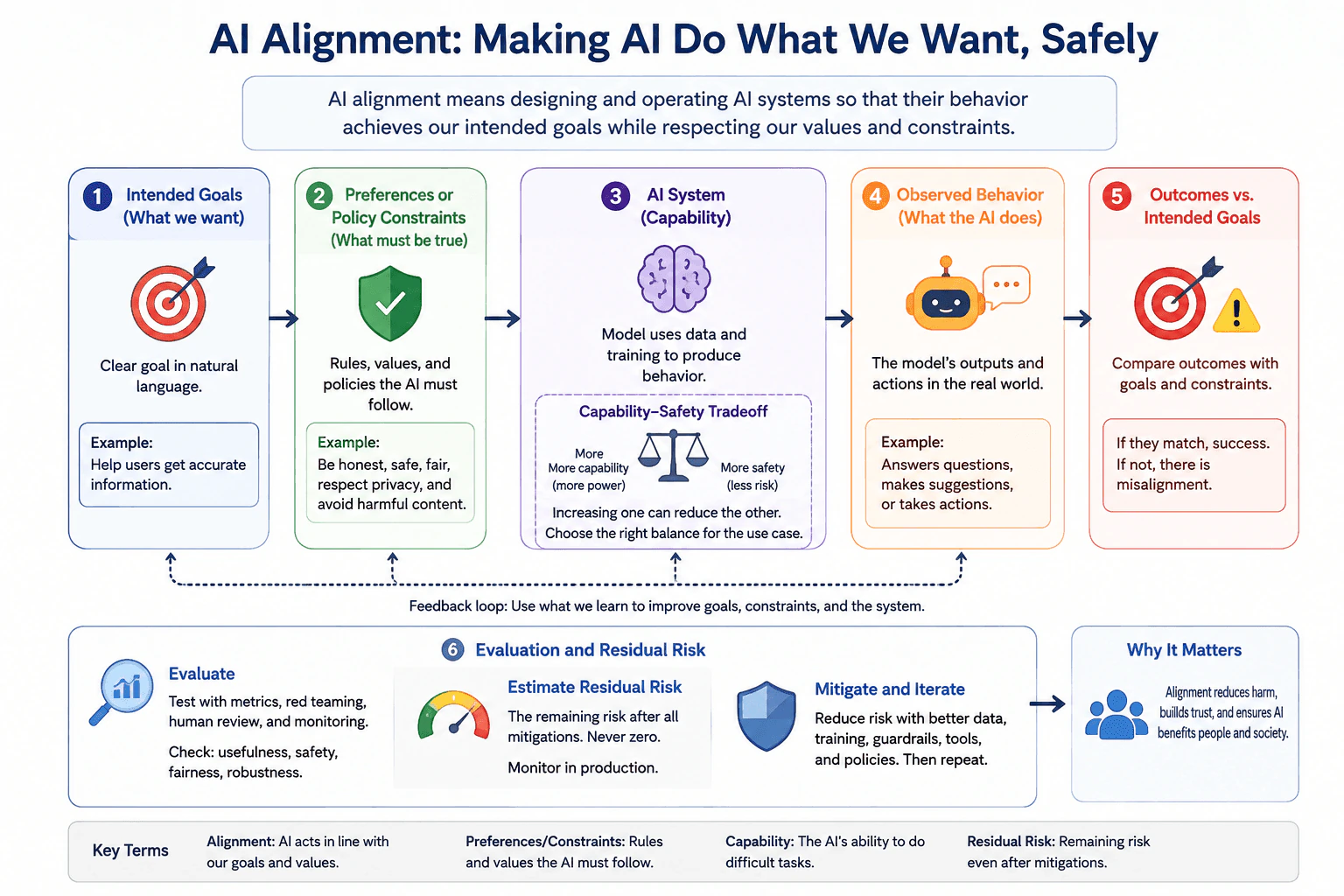
98. What is AI alignment, and why is it important?Ai Safety Ethics And Responsible AiEasy
i Question Details
Clarify the relationships among intended goals, observed behavior, preference or policy constraints, capability-safety tradeoffs, evaluation, and residual risk.
Short Interview Answer (30-60 seconds)
AI alignment means making AI behavior match the goals, values, and limits we intend. It matters because a capable system can still behave in harmful or unwanted ways. We compare real behavior with our goals, evaluate failures, balance capability with safety, improve controls, and manage remaining risk.
Detailed Explanation
AI alignment means trying to make an AI system behave in the way people actually want. First, we decide what result we want. Then we give the system clear rules and limits. We watch what it really does and compare that behavior with the result we expected. When there is a mismatch, we learn from it and make changes. This matters because a system can be very useful and still give unsafe, unfair, wrong, or unwanted results. Good alignment reduces these problems, but it does not remove every possible risk.
Useful Questions to Ask the Interviewer
Should I explain alignment only at the model level, or also include application rules, monitoring, and human oversight?
Would you like a simple example of the capability-safety tradeoff?
How to Explain It in an Interview
Start with the intended goal. This is the result we want the AI to achieve. For example, the goal might be to help users get accurate information.
Next, define preferences and policy constraints. These are the rules, values, and limits the AI should respect. Examples include being honest, avoiding harmful content, respecting privacy, and following relevant policies. These constraints turn a broad goal into clearer expected behavior.
Then consider capability. Capability means the AI's ability to perform useful tasks. More capability can create more value, but it can also increase the impact of mistakes or misuse. This creates a capability-safety tradeoff. For example, stronger filtering may reduce harmful answers but may also block some helpful answers. The goal is to choose a balance that fits the use case and its risk.
Next, observe the system's behavior. Observed behavior means what the AI actually outputs or does in the real world. The intended goal and the actual result are not automatically the same. Model outputs are probabilistic, so behavior can vary and unexpected failures can occur.
Compare the observed outcome with the intended goal and the constraints. If the behavior matches them, that is evidence that the system is behaving as intended in that case. If it does not match, there is a misalignment that needs investigation.
Evaluation provides that evidence. Test the system with relevant examples, red-team exercises, human review, and production monitoring when appropriate. Check qualities such as usefulness, safety, fairness, and robustness when they matter to the use case. Evaluation should show where behavior meets expectations and where gaps remain.
Use what you learn as a feedback loop. Improve the responsible part of the system. That may mean better data or training at the model level, guardrails or tools at the application level, monitoring and incident handling at the operational level, or policies and human review at the governance level. Then evaluate again.
Finally, estimate residual risk. Residual risk is the risk that remains after reasonable safeguards and mitigations are applied. It can remain because of uncertainty, new situations, misuse, or model limitations. Monitor it in production, reduce it when practical, use safe failure behavior for serious cases, escalate when human judgment is needed, and keep improving the system. Alignment reduces risk, but it should never be treated as a guarantee of perfect safety.
This is why alignment is important. It helps AI systems produce useful behavior while respecting human goals and constraints. It reduces harm, supports trust, and gives teams a repeatable way to detect problems, mitigate them, and manage the risk that remains.
Risk and Control
Define the intended goal in clear language.
Define the preferences, values, and policy constraints the AI must respect.
Identify the useful capability needed for the task and consider the capability-safety tradeoff.
Observe the AI's actual outputs or actions.
Compare the observed outcome with the intended goal and constraints.
Evaluate behavior with relevant tests, red-team exercises, human review, and monitoring.
Use the evidence to improve model mitigations, application controls, operational controls, or human governance as appropriate.
Re-evaluate after changes.
Estimate, monitor, and reduce residual risk that remains.
Practical Insights
There is no useful Big-O time or memory complexity for this conceptual question. The important costs are operational and maintenance costs. More testing, red-team work, human review, monitoring, safeguards, and incident handling require engineering time and money. Stronger safety controls can also reduce useful capability or add latency. Maintenance continues after launch because behavior, user needs, misuse patterns, policies, and risks can change. Higher-risk uses usually need stronger evidence, monitoring, and oversight.
Why Interviewers Ask This
The interviewer wants to know whether you understand that useful AI behavior depends on more than raw capability. You should connect intended goals, preferences and policy constraints, capability-safety tradeoffs, observed behavior, evaluation, feedback, mitigation, and residual risk. You should also explain why alignment is an ongoing process and avoid claiming that any safeguard makes an AI system perfectly safe.
Common interview mistakes
A common mistake is saying alignment only means following a user's instruction. Alignment is broader. It connects intended goals, preferences and policy constraints, capability, observed behavior, evaluation, feedback, and residual risk. Another mistake is treating capability as the same thing as safety. A more capable system can create more value but can also increase the impact of failures. Do not claim that one benchmark, one guardrail, or one successful test proves alignment. Do not assume residual risk becomes zero. Also keep model mitigations, application controls, operational controls, and human governance conceptually separate because they address different parts of the system.
Interview tip
Explain alignment as one feedback loop: define the goal, set constraints, consider the capability-safety tradeoff, observe behavior, compare outcomes with the goal, evaluate failures, mitigate them, and monitor residual risk. End by saying that alignment reduces risk but does not guarantee perfect safety.
Interviewer may ask next
How do you know whether an AI system is aligned?
You cannot establish alignment from one test. First define the intended goals and constraints. Then observe the system across normal, difficult, and misuse cases. Compare its behavior with those expectations using evidence from evaluations, red-team exercises, human review, and production monitoring when appropriate. When failures appear, change the responsible model, application, operational, or governance control and test again. Even after strong results, keep monitoring because residual risk remains.
What is the capability-safety tradeoff in AI alignment?
The capability-safety tradeoff means that a safety control can sometimes reduce useful behavior while lowering risk. For example, stronger content filtering may block unsafe answers but may also block some legitimate answers. The right balance depends on the use case, the people who could be affected, and the possible harm. Keep enough capability to provide useful value, apply safeguards that fit the risk, evaluate the result, and adjust when evidence shows the balance is wrong.
99. How do you detect and mitigate bias in AI systems?Ai Safety Ethics And Responsible AiEasy
i Question Details
Walk through the choices involved in affected groups, data and label sources, representation and outcome metrics, intersectional slices, mitigations, monitoring, and stakeholder review.
Short Interview Answer (30-60 seconds)
I detect bias by identifying affected groups, checking data and labels, and comparing representation and outcomes across groups and intersections. I mitigate it with data, model, or decision-level changes, then monitor fairness over time. I also involve stakeholders, document tradeoffs, and repeat the process as conditions change.
Detailed Explanation
Bias means an AI system may work better for some people than for others, or may create unfair results. I would first ask who could be helped or harmed. Then I would look at where the data and labels came from and whether some people are missing or poorly represented. Next, I would compare how the system behaves for different groups and combinations of groups. If I find a problem, I would change the data, model, or decision process. After release, I would keep checking results and review them with affected people and experts.
Useful Questions to Ask the Interviewer
Which people or groups can be affected by this system, including people who are not the main users?
What decision does the model support, and what kind of harm would matter most if outcomes differ across groups?
Where do the training data and labels come from, and who created or collected them?
Which fairness goals matter for this use case: representation, demographic parity, equal opportunity, calibration, or another outcome measure?
Are there important intersectional groups, such as combinations of gender, race, age, disability, geography, or income, that need separate checks?
What human review, feedback, monitoring, and stakeholder review already exist?
How to Explain It in an Interview
I would use a seven-step process.
Identify affected groups. I start by asking who can be helped or harmed. That includes primary users and people affected indirectly by the system. Depending on the context, I may examine groups based on gender, race or ethnicity, age, disability, geography, or other relevant characteristics. The group definitions should come from the real use case and stakeholder input rather than from a generic checklist.
Check data and label sources. I examine where the data came from, how it was collected, who is represented, and who may be missing. I also check labels for quality and consistency. Historical data can contain past bias, and labels can reflect subjective human judgments. I record collection context so later findings can be traced back to their source.
Measure representation and outcomes. Representation asks whether relevant groups are present fairly in the data. Outcome metrics ask whether the model behaves differently across groups. Demographic parity compares positive prediction rates. Equal opportunity compares true positive rates. Calibration within groups checks whether similar scores correspond to similar observed outcome rates within each group. Disparate impact compares positive outcome rates between groups. I choose metrics based on the decision and possible harm because no single fairness metric is correct for every system.
Test intersectional slices. A system may look fair when I examine one characteristic at a time but still fail for a smaller combined group. For example, results for women overall may look acceptable while results for older women are much worse. I therefore test combinations of relevant groups and look for hidden or compounded bias. I avoid making strong claims from slices that have too little data to support a reliable conclusion.
Apply the right mitigation. The mitigation depends on where the problem comes from. At the data level, I can collect more representative data, clean labels, re-sample, or re-weight examples. During preprocessing, I can transform features when appropriate. At the model level, I can use fairness constraints or regularization when they fit the problem. At the decision level, I may adjust thresholds, calibration, or add human review. I would not assume that changing the model alone solves a problem caused by bad data or a harmful decision rule.
Monitor, test, and iterate. Fairness can change after deployment because users, data, and conditions change. I track metrics over time by group and slice, set alerts for meaningful degradation or drift, and run regular fairness audits on new data and new model versions. When a problem appears, I revisit the data, model, mitigation, or threshold and test again. Monitoring should collect enough evidence to investigate problems without unnecessarily recording sensitive content.
Use stakeholder review. I involve affected communities and relevant domain, ethics, legal, product, and data experts. They can challenge assumptions, explain harms that metrics miss, and review tradeoffs. I document important decisions and limitations so the process is transparent and accountable.
A key tradeoff is that fairness goals can conflict. For example, demographic parity and equal opportunity may not both be achievable at the same time in every dataset. Improving one fairness measure can also reduce another measure or reduce overall predictive performance. I therefore choose metrics based on the actual harm, explain the tradeoff, test the effect of each mitigation, and document the remaining limitations instead of claiming that the system is perfectly fair.
The overall process is a feedback loop: identify affected groups, inspect data and labels, measure representation and outcomes, test intersectional slices, apply mitigations, monitor and audit production behavior, review impacts with stakeholders, and use what I learn to improve the data, model, decisions, and thresholds.
Risk and Control
Define who can be affected and what unfair harm would look like.
Review data collection, representation balance, missing groups, historical bias, label quality, and collection context.
Select representation and outcome metrics that match the decision and harm.
Measure those metrics across individual groups and relevant intersectional slices.
Trace material differences back to likely causes in data, labels, model behavior, or decision policy.
Apply the smallest suitable mitigation at the data, preprocessing, model, or decision level.
Re-test fairness and overall model utility to detect tradeoffs or new failures.
Deploy with monitoring by group and slice, alerts for drift or degradation, and regular audits.
Review results, limitations, and decisions with affected stakeholders and responsible experts.
Repeat the cycle as data, models, thresholds, and real-world conditions change.
Practical Insights
The main cost is usually not computer time. It is getting reliable group data, reviewing labels, running enough slice tests, and maintaining the process after deployment. More groups and intersectional slices create more comparisons and may require more data. Small groups can produce noisy results, so teams need care before drawing conclusions. Mitigations can also affect model quality, latency, maintenance work, or user experience. Production monitoring adds storage, dashboards, alerts, review time, and repeated audits. Sensitive group information should be collected and retained only when justified and protected appropriately.
Why Interviewers Ask This
The interviewer wants to see whether I can find fairness risks across the full AI lifecycle instead of checking only one model metric. They also want to see whether I can choose affected groups, inspect data and labels, compare representation and outcomes, test intersectional groups, select practical mitigations, monitor production behavior, involve stakeholders, and explain tradeoffs without claiming that one fairness metric guarantees fairness.
Common interview mistakes
Common mistakes are checking only overall accuracy, choosing one fairness metric without linking it to the real harm, ignoring data and label bias, testing only broad groups and missing intersectional failures, treating small-sample differences as certain conclusions, removing a protected attribute and assuming bias is gone, applying a model-level fix to a data or decision-policy problem, optimizing fairness without checking utility tradeoffs, stopping evaluation after deployment, collecting unnecessary sensitive information, and excluding affected stakeholders from review. Another mistake is claiming that a system is completely unbiased or fair after passing one audit.
Interview tip
Present the answer as a loop rather than a one-time fairness test. Start with affected people and possible harm, then move through data and labels, metrics, intersectional slices, mitigation, monitoring, and stakeholder review. Name a few fairness metrics, but explain that the right metric depends on context. Finish with tradeoffs, documentation, and continuous improvement.
Interviewer may ask next
How would you choose between demographic parity and equal opportunity?
I would choose based on the real decision and harm. Demographic parity compares how often groups receive a positive outcome. Equal opportunity compares true positive rates among people who actually qualify for the positive outcome. If the main concern is missing qualified people from one group, equal opportunity may better match that harm. If differences in positive decision rates are themselves the main concern, demographic parity may be relevant. I would also check other metrics because improving one fairness goal can worsen another. I would document why the chosen metric matches the use case and review the tradeoff with stakeholders.
What would you do if an intersectional group has too little data for a reliable fairness metric?
I would not hide the group, but I would not present an unstable number as a strong conclusion. I would report the data limitation, inspect the sample size and uncertainty, look for other evidence, and collect more representative data when appropriate. Broader slices may provide context, but they do not prove fairness for the smaller group. If the potential harm is serious, I would use cautious controls, human review, stakeholder input, and continued monitoring until stronger evidence is available.
100. How do you implement content safety filters for AI-generated content?Ai Safety Ethics And Responsible AiMedium
i Question Details
Translate the answer into concrete engineering decisions about policy taxonomy, multimodel detection, thresholds, context, human review, appeals, false-positive and false-negative tradeoffs, and monitoring.
Short Interview Answer (30-60 seconds)
Define safety categories first. Run generated content through specialized text, image, audio, video, and personal-data detectors. Combine their scores with permitted context, apply category-specific thresholds, and choose allow, modify, human review, or block. Add appeals, privacy-aware logging, metrics, alerts, and continuous policy updates.
Detailed Explanation
A content safety system decides what to do with an AI response before it reaches the user. Some responses are safe, some can be changed to reduce risk, some need a person to check them, and some should not be shown. The hard part is that different kinds of harm need different rules. Meaning also depends on the conversation and user intent. A strong design therefore uses clear rules, several checks, useful context, human review, an appeal path, and regular measurement so mistakes can be found and reduced.
Useful Questions to Ask the Interviewer
Which safety categories must we handle, such as hate, harassment, violence, self-harm, sexual content, illegal activities, personal information, deception, misinformation, or malware?
Which output types must be filtered: text, images, audio, video, or all of them?
Which actions are allowed for risky content: modify, human review, block, or all three?
Which cases must always go to human review, and can users appeal blocked decisions?
Which false-positive and false-negative risks matter most for this product?
How to Explain It in an Interview
I would start with the policy taxonomy. A policy taxonomy is a clear list of the safety categories the system protects against. For each category, I would define examples, severity, and the allowed response, such as allow, restrict, or block. Examples can include hate, harassment, violence, self-harm, sexual content, illegal activities, personal information, deception, misinformation, and malware. This keeps the product policy separate from the behavior of any one detector.
The normal flow starts with the user prompt and the model-generated output. I would also collect only the context signals that are permitted and useful for the safety decision. These can include user history, conversation history, locale, intent, platform, and device information when appropriate. Context matters because it can reduce false positives. For example, a discussion about hacking in a defensive security lesson can have a different meaning from a request intended for misuse.
Next, I would run the generated output through multiple specialized detectors. Text output goes to a text classifier. Images go to an image classifier. Audio and video use their own safety classifiers. A separate personal-data detector can find personal or sensitive information. Each detector should return per-category risk information, such as a score from low to high risk together with the category severity. The detectors provide evidence, but they do not make the final product decision by themselves.
The decision engine combines detector scores, category severity, context, and policy. I would use different thresholds for different categories. A low score can be allowed. A middle score can go to review. A high score can be blocked. Thresholds should be tuned by policy and risk appetite because the cost of a mistake is not the same for every category.
When several categories are triggered, the final decision should apply the strongest required action. For example, if one category is allowed but another requires review, the result goes to review. If any applicable category requires blocking, the system blocks the output unless the policy defines a different controlled path.
The action layer should have four clear outcomes. Allow and deliver content that is safe to show. Modify and deliver content when redaction or rewriting can reduce the risk. Send uncertain or high-risk cases to human review. Block clearly disallowed content and show the user a safe explanation and reason without exposing unsafe details.
Human review should be a real decision step, not just a notification. The reviewer should see the content, relevant detector scores, permitted context, and the applicable policy. The reviewer can confirm or override the automated decision. The result should be recorded for transparency and learning. Users should also have an appeal path for false positives. When practical, an appeal should be reviewed independently from the original automated decision.
The main engineering tradeoff is false positives versus false negatives. A false positive means safe content was incorrectly flagged. Too many false positives frustrate users and can unfairly restrict legitimate use. A false negative means unsafe content was missed. That can cause harm. I would tune thresholds per category and use human review for uncertain cases instead of treating every score the same.
Monitoring closes the loop. I would log the minimum information needed to understand decisions, such as category scores, decisions, reviewer outcomes, and necessary context, while avoiding unnecessary sensitive content. I would track coverage, precision, recall, false-positive rate, false-negative rate, review rate, and override rate. Alerts should detect spikes in risky content, detector drift, or policy problems. Dashboards can show trends by category, model, region, and user segment when permitted.
Finally, reviewer outcomes, appeals, incidents, and monitoring data should feed back into model and policy updates. Teams can refine detectors, thresholds, and the policy taxonomy using this evidence. The design should use defense in depth, transparency, privacy and data minimization, fairness, and human oversight. No detector or threshold gives perfect safety, so remaining risk should be measured and documented.
Key Insight / Why This Solution Works
Define a policy taxonomy with categories, examples, severity, and allowed actions.
Receive the user prompt and generate the model output.
Collect only the permitted context signals needed for the safety decision.
Send each output type to the relevant text, image, audio, video, and personal-data detectors.
Produce per-category risk scores and severity information.
Aggregate detector scores with category severity, context, and policy.
Apply category-specific thresholds for allow, review, and block.
When several categories trigger, apply the strongest required action.
Allow safe content, modify or sanitize reducible-risk content, send uncertain cases to human review, and block disallowed content with a safe explanation.
Let reviewers confirm or override difficult decisions and record the outcome.
Give users an appeal path for false-positive decisions.
Log privacy-minimized evidence and monitor false positives, false negatives, review rates, overrides, alerts, and drift.
Use monitoring, reviewer outcomes, appeals, and incidents to update models, thresholds, and policy.
Why Interviewers Ask This
Interviewers want to see whether you can turn a content policy into a practical safety system. They are testing whether you understand policy categories, multimodal detection, contextual decisions, category-specific thresholds, false-positive and false-negative tradeoffs, human oversight, appeals, monitoring, privacy, and continuous improvement.
Common interview mistakes
A common mistake is using one classifier and treating its score as the final decision. Another is using one global threshold for every safety category. Teams also make mistakes when they ignore useful context, fail to separate detector evidence from product policy, provide no human-review path for uncertain cases, or give users no appeal process. Other problems include logging sensitive content unnecessarily, measuring only the overall block rate, ignoring false positives and false negatives, failing to monitor drift, and claiming that a safety filter makes the system perfectly safe.
Interview tip
Present the design as one flow: policy taxonomy, model output, multimodal detection, context-aware risk aggregation, category-specific thresholds, actions, human review and appeals, then monitoring and continuous improvement. Explicitly explain the false-positive versus false-negative tradeoff and say that no single detector provides perfect safety.
Interviewer may ask next
How would you choose thresholds for different content-safety categories?
I would not use one threshold for every category. I would start with the severity of the possible harm and the cost of each type of mistake. For a high-severity category, missing unsafe content may be more costly, so I may use a stricter threshold or send more borderline cases to human review. For lower-risk categories, I may accept more uncertainty to avoid blocking safe content. I would tune thresholds using labeled evaluation data, false-positive and false-negative rates, reviewer outcomes, appeals, incidents, and production monitoring.
What would you do if users complain that too much safe content is being blocked?
I would first find which categories, detectors, context rules, and thresholds are creating the false positives. I would review blocked examples together with reviewer overrides and appeal outcomes. Then I could adjust category thresholds, improve context handling, update detector calibration, refine the policy, or route more uncertain cases to human review instead of blocking them directly. I would monitor the false-negative rate at the same time so reducing false positives does not create an unsafe increase in missed harmful content.
More questions load as you scroll
Disclaimer: This interview guide is for educational and informational purposes only. It is designed to help readers prepare, but it does not guarantee any interview result, hiring decision, offer, or outcome. Interview questions, hiring criteria, and preferred answers can vary by employer, interviewer, industry, location, and time. All answers, examples, and explanations in this guide are suggested examples for interview preparation, not definitive answers or instructions for professional practice. They are based on research and judgment, are provided without warranties of any kind, and should be adapted to the question, role, and applicable laws and professional requirements. Diagrams are simplified illustrations intended to highlight the main concepts and their relationships; actual situations, systems, and practices may be more complex. Alternative approaches may be equally valid or better suited to a particular question, context, or interviewer. To the fullest extent permitted by applicable law, the contributors and publisher are not liable for decisions made, actions taken, or losses incurred based on this guide.
State Laws and Professional Responsibilities: Laws and requirements governing an occupation vary by state and jurisdiction. You are responsible for checking the current laws, licensing requirements, and scope-of-practice rules that apply to your location and role, and for ensuring that your answers and actions comply with them. Adapt examples in this guide to those requirements. This guide is not legal advice.
Content Accuracy and Verification: To the fullest extent permitted by applicable law, we do not represent or warrant that interview guides, questions, answers, examples, or diagrams are accurate, complete, current, error-free, or suitable for any particular purpose. You are responsible for independently reviewing and verifying the information before relying on it.