This interview guide is for educational and informational purposes only. It is designed to help readers prepare, but it does not guarantee any interview result, hiring decision, offer, or outcome. Interview questions, hiring criteria, and preferred answers can vary by employer, interviewer, industry, location, and time. All answers, examples, and explanations in this guide are suggested examples for interview preparation, not definitive answers or instructions for professional practice. They are based on research and judgment, are provided without warranties of any kind, and should be adapted to the question, role, and applicable laws and professional requirements. Diagrams are simplified illustrations intended to highlight the main concepts and their relationships; actual situations, systems, and practices may be more complex. Alternative approaches may be equally valid or better suited to a particular question, context, or interviewer. To the fullest extent permitted by applicable law, the contributors and publisher are not liable for decisions made, actions taken, or losses incurred based on this guide.
State Laws and Professional Responsibilities
Laws and requirements governing an occupation vary by state and jurisdiction. You are responsible for checking the current laws, licensing requirements, and scope-of-practice rules that apply to your location and role, and for ensuring that your answers and actions comply with them. Adapt examples in this guide to those requirements. This guide is not legal advice.
Identity, Image, and Privacy Notice
To respect individual privacy, some names, profile photographs, avatars, biographical details, and other identifying information displayed in this guide may be replaced with pseudonyms, licensed stock images, illustrative avatars, composite images, or representative descriptions. Unless a person is expressly identified as an actual contributor, a displayed name, image, or profile should not be understood as depicting or identifying a specific candidate, interviewer, employee, or other real individual. These representations are provided for editorial and illustrative purposes only and do not imply endorsement, employment, participation, or affiliation with this guide or any company mentioned in it. Any resemblance to an actual person is coincidental.
Company Notice
This guide is an independent educational resource and is not affiliated with, endorsed by, sponsored by, or approved by the company named in this guide. Company names identify reported interview experiences or the employer context of clearly labeled original practice exercises. Interview practices can change without notice, and inclusion of company-specific content does not mean these questions are official, complete, or guaranteed to be asked. To the fullest extent permitted by law, the author, contributors, and publisher are not responsible for outcomes related to use of this material.
Content Accuracy and Verification
To the fullest extent permitted by applicable law, we do not represent or warrant that interview guides, questions, answers, examples, or diagrams are accurate, complete, current, error-free, or suitable for any particular purpose. You are responsible for independently reviewing and verifying the information before relying on it.
Questions or comments?
Contact us for general questions, or share feedback, technical corrections, and comments with the community.
51. What is agent orchestration, and how do you implement it?Ai Agents And Agentic SystemsMedium
i Question Details
Frame the concept using workflow graph, task ownership, message contracts, dependencies, retries, shared state, and centralized versus decentralized control.
Short Interview Answer (30-60 seconds)
At a high level, agent orchestration is the control layer that turns one goal into coordinated work across several agents and tools. The main challenge is keeping task order, shared state, retries, permissions, and stopping rules correct while agents produce results. I would explain it in three flows: build the workflow, dispatch owned tasks through clear message contracts, and recover or stop safely. Centralized control is easier to govern and debug, while decentralized coordination spreads decisions but adds coordination complexity.
Detailed Explanation
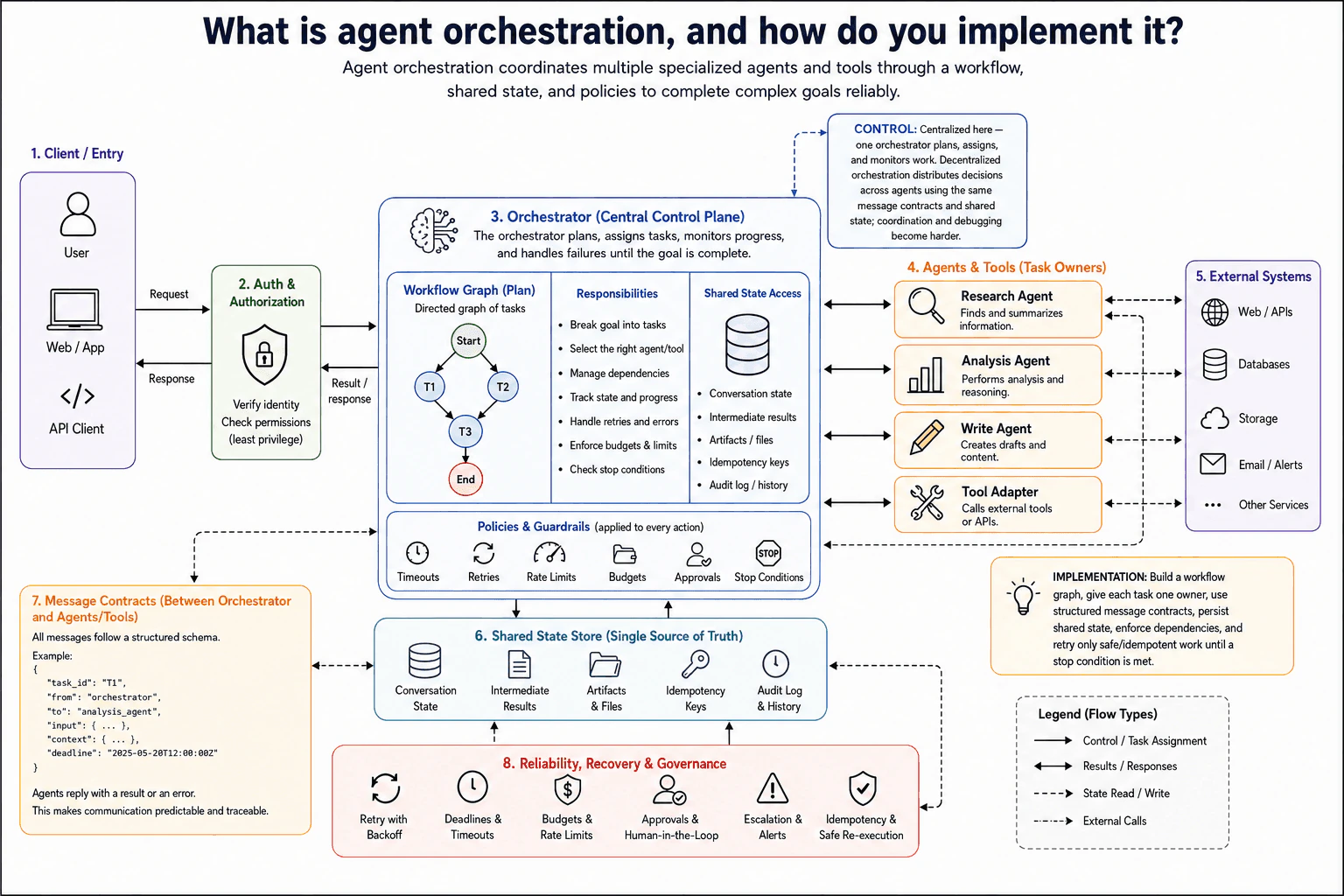
The goal is to take one user request and coordinate several agents and tools until the work is complete. The difficult part is keeping every task in the right order while results move between agents. The system must also keep permissions, shared information, retries, budgets, approvals, and stopping rules under control. The diagram organizes this around one central Orchestrator. It uses a workflow graph to plan work, clear message contracts to pass tasks, a Shared State Store to keep common information, and reliability controls to recover safely from failures.
Useful Questions to Ask the Interviewer
Which tasks may call external systems or create side effects?
Which failures should be retried, and which should stop or escalate?
Should one central Orchestrator control the workflow, or may agents coordinate directly?
How to Explain It in an Interview
1. Start with the request and permission checks
The user sends a goal through the Client / Entry point. Authentication and authorization check identity and permissions before the work reaches the Orchestrator. The diagram also applies least privilege, which means each caller receives only the permissions needed for its task. This matters because an agent decision alone must not grant access to a protected action.
2. Turn the goal into a workflow graph
The Orchestrator is the central control plane. It breaks the goal into tasks, selects the right agent or tool, tracks progress, handles failures, enforces budgets, and checks stop conditions. The Workflow Graph shows the task order. Its edges represent dependencies, meaning one task may need another task to finish before it can run.
Each task has one clear owner. The diagram shows a Research Agent, Analysis Agent, Write Agent, and Tool Adapter. Clear ownership makes inputs, outputs, and success conditions easier to track.
3. Send work through message contracts
The Orchestrator communicates with agents and tools using structured message contracts. A message contains fields such as a task identifier, sender, receiver, input, context, and deadline. The task owner returns either a result or an error.
This contract makes communication predictable. It also makes failures easier to trace because the system knows which task produced each result.
4. Keep shared state in one place
The Shared State Store is the single source of truth shown in the diagram. It keeps conversation state, intermediate results, artifacts, idempotency keys, and audit history. An idempotency key helps recognize repeated work so a safe retry does not create the same side effect twice.
The Orchestrator reads and updates this state as tasks finish. Later tasks can then use earlier results, and recovery can continue from known state.
5. Handle tools, retries, and stopping safely
Agents may use external systems such as web APIs, databases, storage, email, and other services. The Tool Adapter places those calls behind a clear tool contract.
Policies and guardrails apply across the workflow. They include timeouts, retries, rate limits, budgets, approvals, and stop conditions. Temporary failures can retry with backoff. Backoff means waiting longer between repeated attempts. Unsafe or repeated failures should stop, alert, or escalate instead of retrying forever.
The diagram uses centralized control because one Orchestrator makes the main decisions. The benefit is stronger control and simpler debugging. Decentralized coordination can spread decisions across agents, but it makes coordination and debugging harder.
Why Interviewers Ask This
Interviewers ask this question to see whether you can turn a broad goal into controlled, reliable execution. They want to hear how you divide work, assign clear ownership, pass structured messages, manage shared state, respect dependencies, and recover from failures. They also want to see whether you understand permissions, safe retries, stopping rules, and the trade-off between one central controller and more distributed agent coordination.
Interviewer may ask next
How would you change this design if some tool calls can create costly or irreversible side effects?
I would keep the same architecture, but I would make the policy checks around the Tool Adapter stricter for side-effecting actions. The Orchestrator would still plan and assign the task, but a risky action would need explicit authorization before execution.
For actions such as sending a message or changing stored data, I would require an approval when the risk justifies it. I would also use an idempotency key. This key lets the system recognize the same action request again and avoid creating the same side effect twice. Retries would happen only when the operation is known to be safe to repeat.
The Shared State Store would record the approval, action request, result, and audit history. If the tool returns an uncertain result, the Orchestrator should not retry blindly. It should stop, inspect the stored state, or escalate.
The main downside is extra latency and more workflow steps. That cost is reasonable when a mistake could affect users or external systems.
When would you choose decentralized agent coordination instead of one central Orchestrator?
I would choose decentralized coordination when agents need more local independence and the workflow can accept harder coordination. I would still keep the same basic ideas from the diagram. Agents need clear task ownership, message contracts, shared state, dependencies, permissions, and stop conditions.
The main change is where decisions happen. Instead of one Orchestrator making most decisions, agents can send tasks or results directly to each other. The Shared State Store can still give them a common view of progress and intermediate results.
Correctness becomes harder because several agents may make decisions at the same time. I would keep strict authorization, deadlines, idempotency keys, and audit history so repeated or conflicting actions are easier to control.
The benefit is less dependence on one central decision maker. The downside is harder debugging, more coordination logic, and weaker global visibility. I would prefer centralized control unless the problem clearly needs distributed decision making.
52. How do you build a customer support agent with escalation logic?Ai Agents And Agentic SystemsMedium
i Question Details
Turn intent routing, retrieval, approved tools, customer state, escalation thresholds, human handoff, and conversation audit trail into a production-ready procedure with measurable checks.
Short Interview Answer (30-60 seconds)
At a high level, I would build this as a controlled support workflow that can answer simple requests and safely hand difficult cases to a person. The main challenge is letting the agent use useful tools without allowing unsafe actions. I would explain three flows: understand and retrieve, authorize and act, then respond or escalate. Customer state and policies guide each decision. The trade-off is stronger safety and control, but with extra checks and more operational complexity.
Detailed Explanation
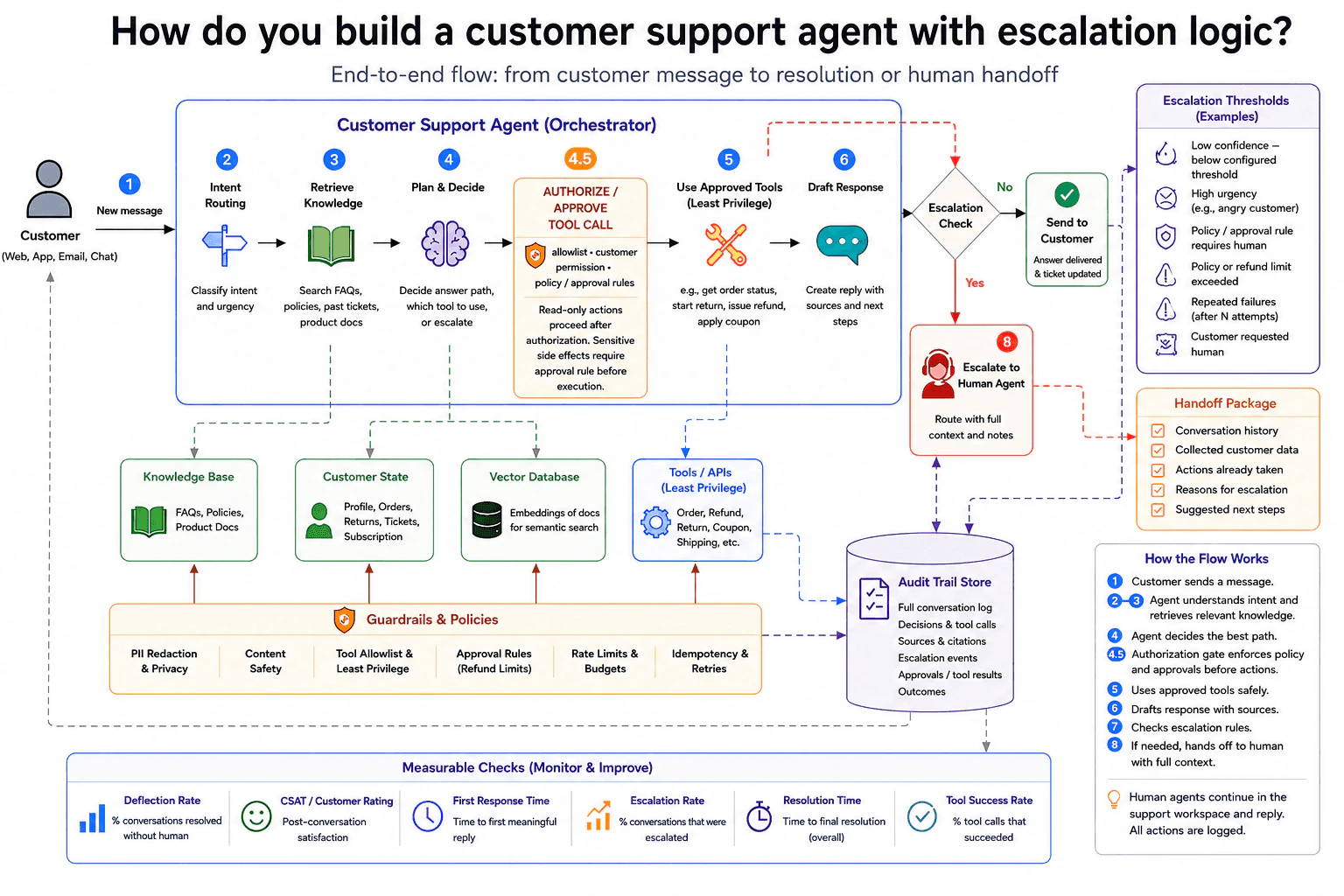
The goal is to help a customer quickly while keeping important actions safe. A customer may ask about an order, refund, return, billing issue, or account problem. Some requests can be handled automatically. Other cases need a human because confidence is low, policy requires approval, a tool keeps failing, or the customer asks for a person. The design separates understanding the request, using approved tools, checking escalation rules, and recording what happened. This keeps automation useful while making sensitive actions controlled and reviewable.
Useful Questions to Ask the Interviewer
Which actions can the agent complete without human approval?
Which customer or policy conditions must always trigger escalation?
What information must be included in the human handoff?
Which support metrics matter most for success?
How to Explain It in an Interview
1. Start with the customer request and intent
I would start with the customer message. The Intent Routing step classifies what the customer wants and how urgent it is.
The agent can recognize cases such as billing, returns, account help, or order questions. Correct routing matters because later steps depend on understanding the request.
2. Retrieve useful knowledge and customer state
Next, the agent retrieves the information needed to answer. Retrieve Knowledge searches FAQs, policies, past tickets, and product documents.
Customer State provides facts such as profile, orders, returns, tickets, and subscription details. The Vector Database supports semantic search. This means finding useful documents by meaning instead of exact words.
3. Plan the action and authorize tool use
Plan & Decide chooses the next action. It can answer, choose a tool, or send the case toward escalation.
Before a real tool runs, the AUTHORIZE / APPROVE TOOL CALL gate checks the allowlist, customer permission, and policy or approval rules. An allowlist is the approved set of tools. Read-only actions can proceed after authorization. Sensitive side effects, such as refunds, require the configured approval rule before execution.
Use Approved Tools follows least privilege. This means each tool gets only the access it needs. Guardrails & Policies also cover privacy, content safety, the tool allowlist, refund approval rules, rate limits, budgets, retries, and idempotency. Idempotency means a repeated request should not accidentally repeat the same side effect.
4. Draft the answer and check escalation
After approved tool use, the agent drafts a response with sources and next steps. The Escalation Check then applies configured rules to decide whether a human is required.
Examples include low confidence, high urgency, a policy or approval rule, refund limits, repeated failures, or a customer request for human help. A request that already requires human handling can also reach the Escalation Check before a sensitive tool action runs.
If escalation is not needed, the response goes to Send to Customer. If escalation is needed, the case goes to Escalate to Human Agent with full context and notes.
5. Keep a complete handoff and audit trail
The Handoff Package includes conversation history, collected customer data, actions already taken, reasons for escalation, and suggested next steps. This prevents the human agent from starting over.
The Audit Trail Store records the full conversation, decisions and tool calls, sources and citations, escalation events, approvals and tool results, and outcomes. Tool activity and human handoff activity are both recorded there.
Finally, I would watch the Measurable Checks shown in the design: deflection rate, CSAT or customer rating, first response time, escalation rate, resolution time, and tool success rate. These checks show whether automation is useful without hiding safety or reliability problems.
Practical Complexity & Trade-offs
The benefit is strong control over risky actions. The agent can decide what it wants to do, but the authorization gate still checks permissions and policy before a tool runs. Human escalation also protects cases that are uncertain, sensitive, or repeatedly failing. The downside is more logic to build and maintain. Policies, approval rules, customer state, tool permissions, retries, and audit records must stay correct. Extra checks may also add some delay. We accept that cost because refunds, account changes, and other side effects should not depend only on an AI decision.
Why Interviewers Ask This
Interviewers want to see whether you can turn an AI agent into a safe production workflow. They look for clear separation between agent decisions and real tool execution. They also want good judgment about permissions, customer state, escalation rules, human handoff, retries, audit records, and measurable results. The key skill is balancing useful automation with control, safety, and a good customer experience.
Interviewer may ask next
What would you change if every refund required human approval before the refund tool could run?
I would keep the same design, but make the refund rule stricter inside the AUTHORIZE / APPROVE TOOL CALL gate. The agent could still understand the request, retrieve policy information, read Customer State, and prepare a recommended refund action. It would not execute the refund action by itself.
When the planned action is a refund, the policy rule would send the request to the Escalation Check before the sensitive action runs. The case would then go to Escalate to Human Agent. The Handoff Package would include the conversation history, customer data, actions already taken, the escalation reason, and suggested next steps.
The Audit Trail Store would record the planned tool call, approval requirement, escalation event, and final outcome. This makes the decision easy to review later.
The downside is slower resolution for simple refunds. More conversations will also reach human agents. The benefit is that the system cannot issue a refund without the required human approval.
How would you handle repeated tool failures without letting the agent retry forever?
I would use the existing Guardrails & Policies controls to limit retries and then escalate repeated failures. A retry is another attempt after a tool fails. The system should allow only the configured number of attempts instead of letting the agent keep trying forever.
Each tool call and result would be written to the Audit Trail Store. If failures continue, the repeated-failure condition shown in Escalation Thresholds would trigger the Escalation Check. The case would then move to Escalate to Human Agent.
The Handoff Package would include the customer request, actions already taken, failure results, the reason for escalation, and suggested next steps. This gives the human agent enough context to continue without repeating failed work.
The downside is that some temporary problems may reach a human even though another retry might succeed. The benefit is bounded behavior. The agent cannot keep consuming time and budget through an endless retry loop.
53. Your AI agent is stuck in an infinite loop. How do you detect and break the cycle?Ai Agents And Agentic SystemsHard
i Question Details
Separate immediate containment, durable remediation, and proof of recovery while addressing repeated-state detection, maximum steps, progress signals, budget exhaustion, circuit breakers, and safe termination.
Short Interview Answer (30-60 seconds)
At a high level, I would treat the agent as a bounded loop that must either make progress or stop. The main challenge is telling a useful multi-step task from a cycle that repeats forever. I would explain three parts: detect repetition or no progress, contain the run immediately, then fix the cause and retest. Deterministic limits such as maximum steps and budgets make stopping reliable. The trade-off is that limits set too low can stop a valid long-running task.
Detailed Explanation
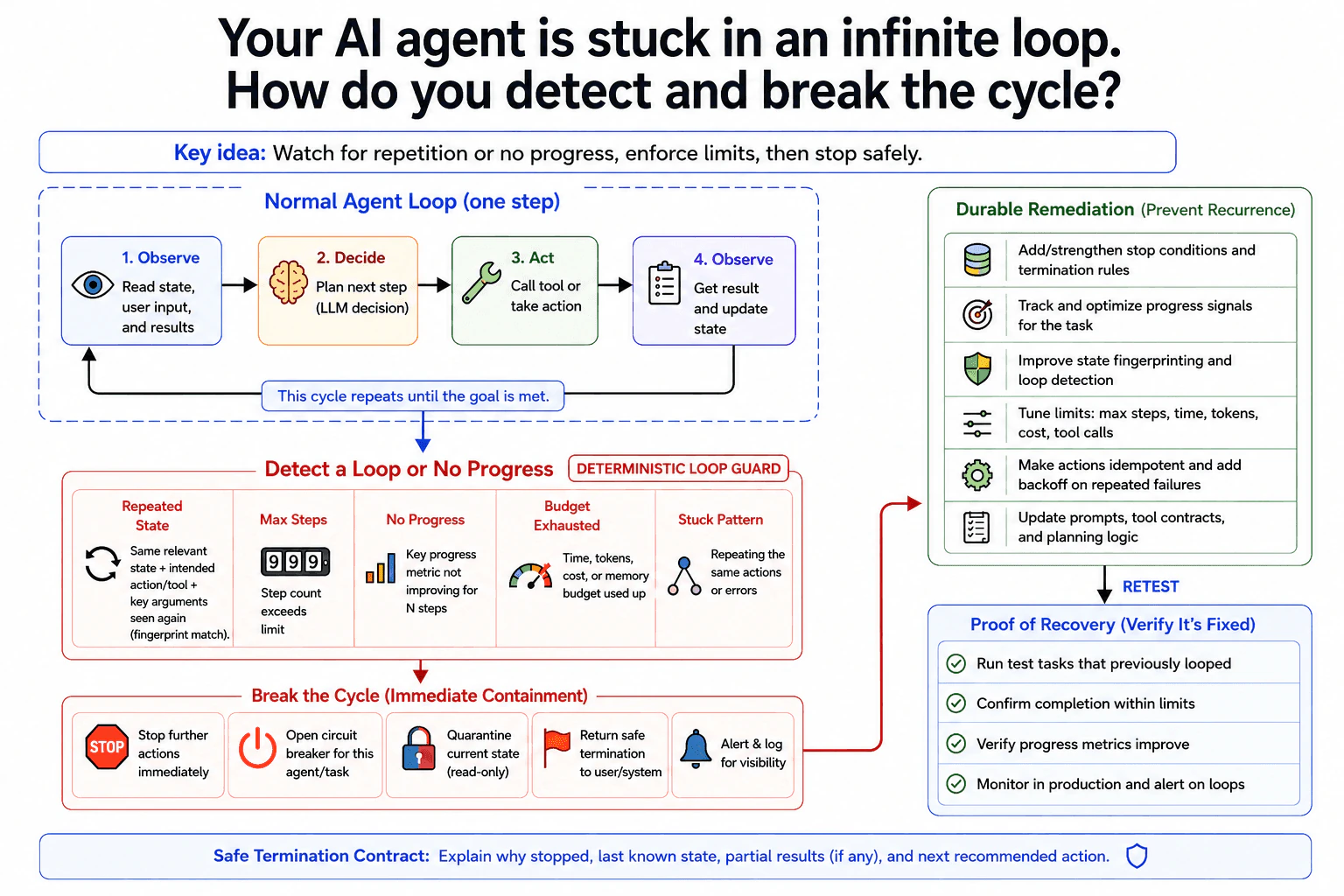
The goal is to stop an AI agent from repeating the same work forever while still allowing useful multi-step tasks to finish. The difficult part is knowing when repetition means real progress and when it means the agent is stuck. The diagram solves this by watching each loop with fixed rules outside the model. It then separates the response into immediate containment, a durable fix, and proof that the fix works. The system should stop safely, keep useful state, explain what happened, and avoid repeating the same failure later.
Useful Questions to Ask the Interviewer
What should count as meaningful progress for this agent?
Which limits matter most: steps, time, tokens, cost, or tool calls?
Should the agent return a partial result when it stops?
Are any tools risky enough to need a circuit breaker?
How to Explain It in an Interview
1. Start with the normal agent loop
I would first show what healthy behavior looks like. The agent observes the current state, decides the next step, acts through a tool, and observes the result. This Observe → Decide → Act → Observe cycle can repeat many times. Repetition alone is not always bad. The important question is whether the task is making useful progress.
2. Detect a loop with a deterministic loop guard
The model should not decide whether it is looping. A deterministic loop guard means normal application code with fixed rules checks every step. It looks for the same relevant state, intended action or tool, and key arguments appearing again. It also checks maximum steps, missing progress, exhausted budgets, and repeating actions or errors. These checks make stopping predictable even if the model keeps proposing another action.
3. Break the cycle immediately
Once the guard decides the run is stuck, containment comes first. The system stops further actions so the loop cannot continue. It can open a circuit breaker, which temporarily blocks the failing agent or task path. The current state can be kept read-only for investigation. The system may return a safe partial result. It should also alert and log what happened.
The safe termination contract explains why execution stopped. It also includes the last known state, any partial result, and the next recommended action.
4. Apply durable remediation
After containment, I would fix the reason the loop happened. The diagram shows stronger stop conditions, better progress signals, improved state fingerprinting, and tuned limits for steps, time, tokens, cost, and tool calls. Repeated actions that have side effects should be made idempotent, which means repeating the same action does not create duplicate damage. Prompts, tool contracts, and planning logic may also need changes.
5. Retest and prove recovery
The final step is to retest the tasks that previously looped. The run should now complete within its limits. Progress metrics should improve instead of staying flat. Production monitoring should keep watching for new loops and raise alerts when they appear. This proves the system recovered instead of only stopping one bad run.
Practical Complexity & Trade-offs
The benefit is that fixed checks can stop a loop even when the model keeps asking for more steps. Maximum steps and budgets also protect time and cost. The downside is that limits can be too strict. A valid task may need many steps and could stop early. Repeated-state checks can also be tricky because two states may look similar while the task is still moving forward. Circuit breakers protect a failing path, but they can temporarily block useful work. We accept these trade-offs because the agent should fail safely instead of running forever or repeating harmful actions.
Why Interviewers Ask This
Interviewers want to see whether you can control an agent instead of trusting the model to control itself. They are testing how you detect repeated behavior, define progress, use hard limits, and stop execution safely. They also want to see whether you separate immediate containment from the deeper fix and whether you can prove that the system recovered.
Interviewer may ask next
What would you change if some valid tasks can require hundreds of agent steps?
I would keep the same design, but I would make the limits depend on the task instead of using one fixed maximum for every run. The deterministic loop guard would still check repeated states, stalled progress, time, tokens, cost, and tool calls. A long task could receive a larger step budget when the system has a good reason to expect more work.
I would not remove the maximum-step rule. Instead, I would combine it with progress signals. A run may continue past a normal soft limit if it is still producing useful new state. A hard upper limit would still stop the run eventually.
The immediate containment path stays the same when the hard limit or another loop signal fires. The durable remediation and retest steps also stay the same. The downside is more configuration. Poor settings can still stop useful work too early or allow a bad run to continue longer.
How would you handle a tool that keeps returning the same temporary error?
I would detect the repeated error as a stuck pattern and contain that path before the agent keeps retrying forever. The deterministic loop guard already watches for repeating actions and errors. When the same failure keeps appearing, the system can stop further actions and open the circuit breaker for that agent or task path.
The circuit breaker temporarily blocks more calls. This prevents the agent from wasting steps, tokens, time, or money on the same failure. The system should keep the current state read-only for investigation, log the failure, and return a safe termination message or partial result when useful.
For the durable fix, I would review the tool contract, retry behavior, planning logic, and any action that can create side effects. Repeated actions should be idempotent, meaning the same request does not create duplicate damage. The downside is that the breaker may temporarily block work after the dependency has already recovered.
54. Your AI agent gets conflicting answers from different tools. How does it reconcile them?Ai Agents And Agentic SystemsHard
i Question Details
The candidate should connect symptoms, controls, and recovery across tool trust levels, timestamps, schema validation, corroboration, conflict policies, and presenting unresolved uncertainty, with explicit success evidence.
Short Interview Answer (30-60 seconds)
At a high level, the agent should treat tool answers as evidence, not guaranteed truth. The hard part is deciding what to trust when valid tools disagree. I would handle this in three stages: validate each result, compare the evidence, and apply a fixed conflict policy. The policy uses freshness, trust, corroboration, and tie-breakers. If the evidence is still unclear, the agent should show uncertainty instead of guessing. The downside is more checks and more policy logic.
Detailed Explanation
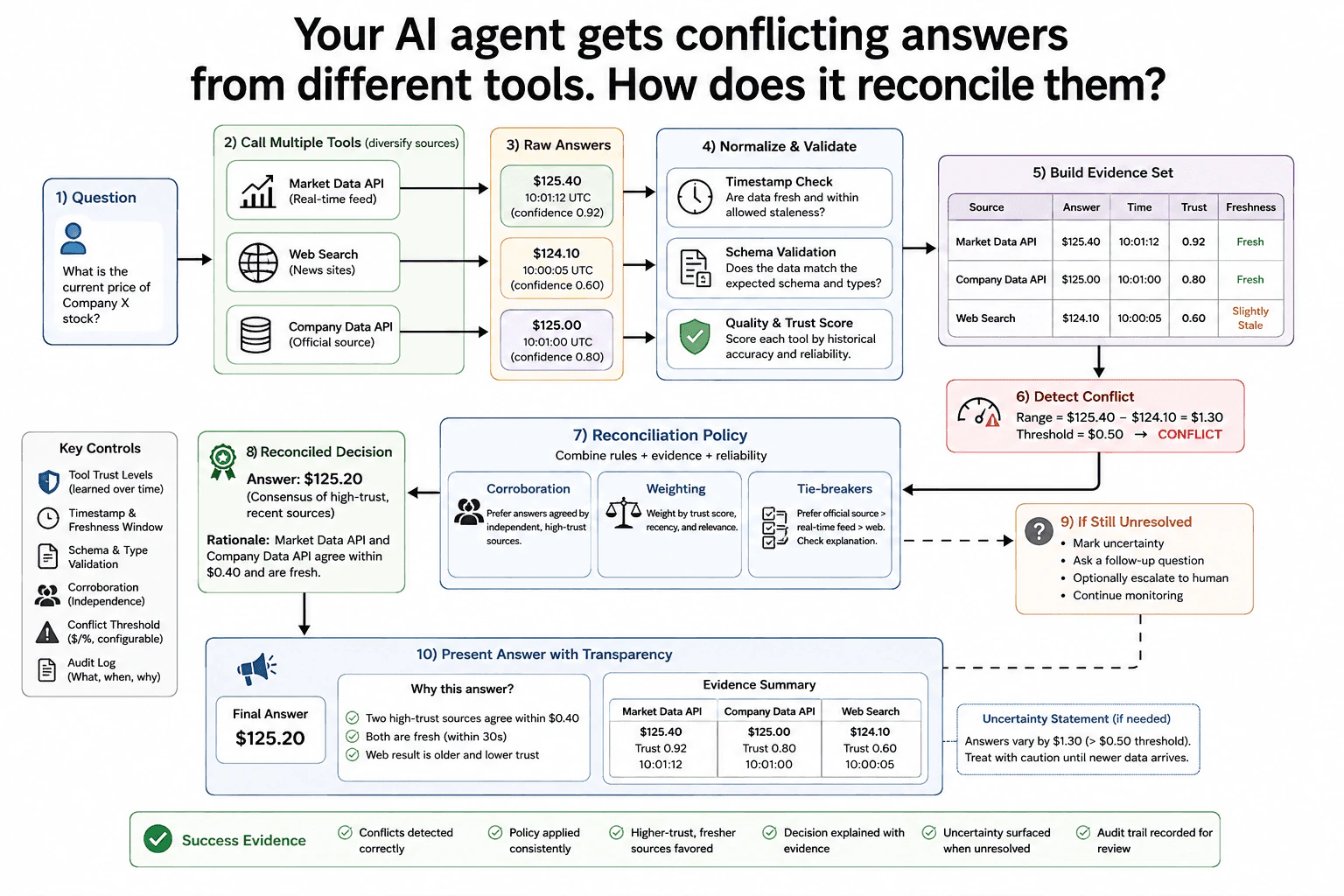
The agent may ask several tools the same question and get different answers. It needs a safe way to decide which result has the strongest support. The problem is difficult because an answer can be valid but old, fresh but less trusted, or different from other sources. The diagram handles this as one clear flow. It gathers several answers, checks them, builds an evidence set, detects a conflict, applies a reconciliation policy, and then either returns a supported result or clearly shows uncertainty.
Useful Questions to Ask the Interviewer
How large can the difference be before we call it a conflict?
Which tools should have higher trust for this type of question?
How fresh must an answer be before we accept it?
When should an unresolved conflict go to a human?
How to Explain It in an Interview
1. Gather answers from several tools
I would start by asking several independent tools for the same fact. In the diagram, these are Market Data API, Web Search, and Company Data API.
The Market Data API returns $125.40. Web Search returns $124.10. Company Data API returns $125.00. Each result also carries timing and confidence information that can help with later checks.
Using several sources matters because one tool can be stale or wrong. The agent should not trust one answer only because it arrived first.
2. Normalize and validate each answer
Next, I would make every result easy to compare. The Timestamp Check asks whether the data is fresh and inside the allowed freshness window.
Schema Validation checks whether each result has the expected fields and data types. A schema simply means the expected shape of the data.
The Quality & Trust Score represents historical accuracy and reliability. The Key Controls also keep tool trust levels, freshness rules, schema checks, and conflict thresholds explicit.
3. Build the evidence set and detect the conflict
The valid results move into Build Evidence Set. This keeps the source, answer, time, trust, and freshness together.
The system then compares the answers. In the diagram, the range is $125.40 minus $124.10, which equals $1.30. The configured conflict threshold is $0.50. Because $1.30 is larger, Detect Conflict marks the results as conflicting.
This rule is deterministic, which means normal application logic applies the same configured rule each time.
4. Apply the Reconciliation Policy
The Reconciliation Policy uses three ideas. Corroboration checks whether independent sources agree. Weighting gives more importance to trust, recency, and relevance. Tie-breakers can prefer an official source over another source, or a real-time feed over web data when that policy fits the question.
Here, Market Data API and Company Data API differ by only $0.40. Both are fresh and have stronger trust than Web Search. The diagram therefore produces a Reconciled Decision of $125.20 as the consensus of those higher-trust, recent sources.
5. Present the answer with transparency
The response should not show only $125.20. Present Answer with Transparency also explains why that value was selected and shows an Evidence Summary.
If the policy still cannot resolve the disagreement, the If Still Unresolved path marks uncertainty. It may ask a follow-up question, optionally escalate to a human, or continue monitoring. The Audit Log records what happened, when it happened, and why.
Success means conflicts are detected correctly, the policy is applied consistently, stronger and fresher evidence is favored, the decision is explained, unresolved uncertainty is surfaced, and the audit trail is available for review.
Practical Complexity & Trade-offs
The benefit is that the agent does not trust one tool blindly. Freshness checks help avoid old information. Trust scores help prefer sources with a stronger history. Corroboration adds support when independent sources agree. The downside is more work. The system must call several tools, keep evidence, compare answers, and maintain conflict rules. Trust scores can also become outdated, so they need review over time. A strict threshold may create warnings for small differences. We accept this extra complexity because a clear uncertain answer is safer than a confident answer built on weak evidence.
Why Interviewers Ask This
Interviewers want to see how you handle uncertainty in an agent system. They are testing whether you understand that tool output is evidence, not guaranteed truth. A strong answer connects validation, timestamps, source trust, corroboration, deterministic conflict rules, and clear uncertainty. They also want to see whether the decision can be explained and reviewed later through the evidence and Audit Log.
Interviewer may ask next
What would you do if the two highest-trust sources still disagree by more than the conflict threshold?
I would keep the same flow, but I would not force a confident numeric answer. The evidence set would still store each source, value, time, trust score, and freshness result. Detect Conflict would mark the disagreement because it is larger than the configured threshold.
Next, the Reconciliation Policy would apply its tie-breakers. It could prefer an official source over another source, or a real-time feed over web data when that rule is configured for this question. The reason for that choice should be shown with the result.
If those rules still do not give enough support, the workflow moves to If Still Unresolved. The agent marks uncertainty, asks a follow-up question, optionally escalates to a human, or continues monitoring for newer data. Present Answer with Transparency should show the disagreement instead of hiding it.
The downside is that the agent may give fewer direct answers. That is acceptable because avoiding false confidence is more important than always returning one number.
How would you handle a tool that used to be reliable but starts returning bad results?
I would keep the same Quality & Trust Score step, but I would let the source's trust level change over time. The diagram's Key Controls already say that tool trust levels are learned over time.
The Audit Log records what happened, when it happened, and why. When later evidence shows which answer was correct, those results can be used to review the source's historical reliability. A tool that repeatedly gives wrong or stale answers should receive less weight in future decisions.
I would keep trust and freshness as separate signals. A trusted tool can still return old data. A newer source can be fresh but have a weaker reliability history. Keeping those signals separate makes the policy easier to understand and explain.
The downside is that trust maintenance adds work. Bad feedback can also change a score unfairly, so score changes should be reviewed rather than accepted blindly.
55. What is fine-tuning?Fine Tuning And Model AdaptationEasy
i Question Details
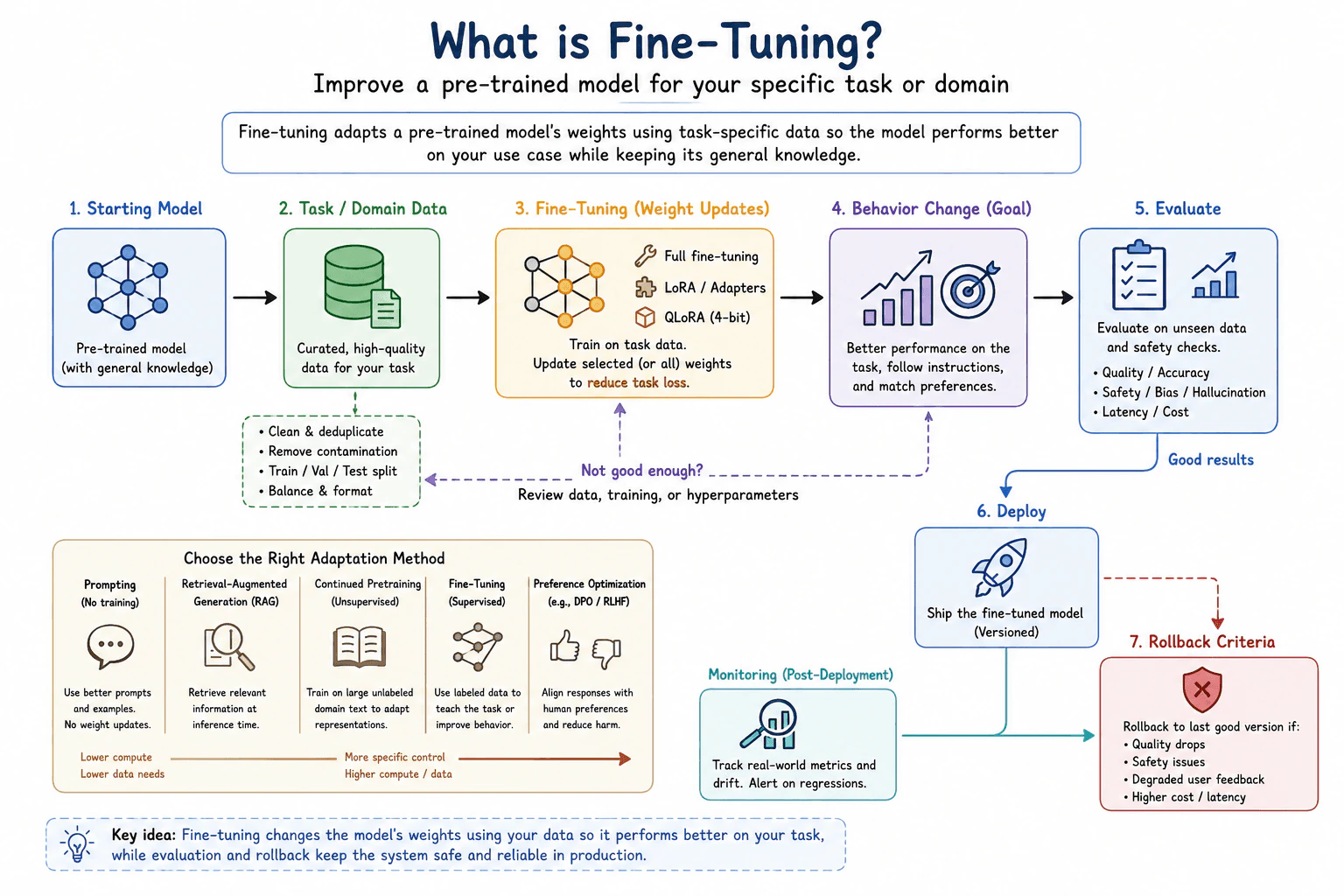
Frame the concept using the starting model, task or domain data, weight updates, intended behavior change, evaluation, and deployment rollback criteria.
Short Interview Answer (30-60 seconds)
Fine tuning starts with a pretrained model and trains it on carefully prepared task or domain data so some or all model weights change. The goal is better behavior for the target use case. I would evaluate the adapted model on unseen data before deployment, save a known good version, monitor production results, and roll back if quality, safety, latency, cost, or user feedback becomes unacceptable.
Detailed Explanation
Fine tuning means taking a model that already knows many general patterns and teaching it to behave better for a particular job. For example, a support model can learn from good support examples so its replies better match the required task and tone. The team prepares clean data, keeps separate data for checking results, trains the model, and measures whether the new behavior is actually better. The new model should be tested before release. It should also be versioned and monitored so the team can return to a known good version if important results become worse.
Useful Questions to Ask the Interviewer
What behavior should the adapted model improve?
What quality and safety checks define success?
What result should trigger a rollback?
How to Explain It in an Interview
Start with a pretrained model. It already has general knowledge from earlier training.
Prepare high quality task or domain data. Clean duplicates, remove contamination, balance the examples when needed, and separate training, validation, and test data.
During fine tuning, the model processes the training examples and computes a loss. Loss tells us how far its output is from the desired result. Backpropagation uses that loss to update weights. Full fine tuning can update all weights. LoRA and QLoRA are parameter efficient methods that train a smaller set of parameters, which can reduce training memory and cost.
The goal is better task behavior, such as stronger instruction following or a desired response style. Evaluate this behavior on unseen data and relevant safety checks. Also measure latency and cost when they matter.
If the result is not good enough, revise the data, training settings, or adaptation method and evaluate again. Watch for catastrophic forgetting, where the adapted model loses useful behavior that the starting model had.
After the model passes the agreed checks, deploy a versioned model and monitor real world behavior. Keep a known good checkpoint or model version. Roll back when agreed criteria show unacceptable quality loss, safety problems, worse user feedback, or harmful latency or cost changes.
Technical Approach
Use prompting when clearer instructions or examples can solve the problem without training.
Use retrieval when the main need is current or private information at inference time.
Use continued pretraining when the model needs broader exposure to large amounts of domain text rather than labeled task behavior.
Use supervised fine tuning when labeled examples should change task behavior or instruction following.
Consider LoRA or QLoRA when parameter efficient adaptation can provide the needed behavior with lower training resource use than full fine tuning.
Use preference optimization when the goal is to make responses better match ranked or preferred outputs.
Evaluate the chosen method on unseen data before deployment.
Why Interviewers Ask This
Interviewers ask this to check whether I understand how a general model can be adapted for a specific task or domain. They want to see if I know that training changes model weights, that good data and evaluation are essential, and that production deployment needs monitoring, versioning, checkpoints, and clear rollback criteria.
Common interview mistakes
Common mistakes include using poor or contaminated training data, allowing examples to leak between training and validation data, evaluating only on training examples, and assuming more training always gives better results. Another mistake is using fine tuning when retrieval would better solve a need for fresh information. Teams can also forget to compare the adapted model with the starting model, miss catastrophic forgetting, deploy without saved checkpoints, or define no clear rollback criteria.
Interview tip
Explain the idea as one simple flow: start with a pretrained model, prepare task data, update weights, evaluate the intended behavior on unseen data, deploy a versioned model, monitor it, and roll back if agreed criteria fail. Also explain that prompting, retrieval, continued pretraining, parameter efficient tuning, or preference optimization can be better choices for different goals.
Interviewer may ask next
What can happen if the fine tuned model improves the target task but becomes worse at other useful behavior?
That can be catastrophic forgetting. The adaptation improves the target behavior but damages useful capabilities that the starting model had. It matters because a model can pass a narrow task evaluation while becoming worse for real users. I would compare the adapted model with the starting model across both target evaluations and important general behavior, use suitable data and training controls, consider parameter efficient adaptation, and keep checkpoints so a harmful version can be rejected or rolled back.
When would you choose retrieval or LoRA instead of full fine tuning?
I would choose retrieval when the main problem is giving the model current or private information at inference time because retrieval adds that information without changing model weights. I would consider LoRA when the behavior itself should change but updating every model weight would require too much training memory or cost. Full fine tuning provides broader weight updates, but it normally requires more compute, memory, storage, evaluation effort, and careful checking for regressions.
56. How do you prepare a dataset for fine-tuning an LLM?Fine Tuning And Model AdaptationEasy
i Question Details
Expected coverage includes lawful collection, deduplication, contamination checks, formatting, train-validation-test separation, quality review, and sensitive-data handling.
Short Interview Answer (30-60 seconds)
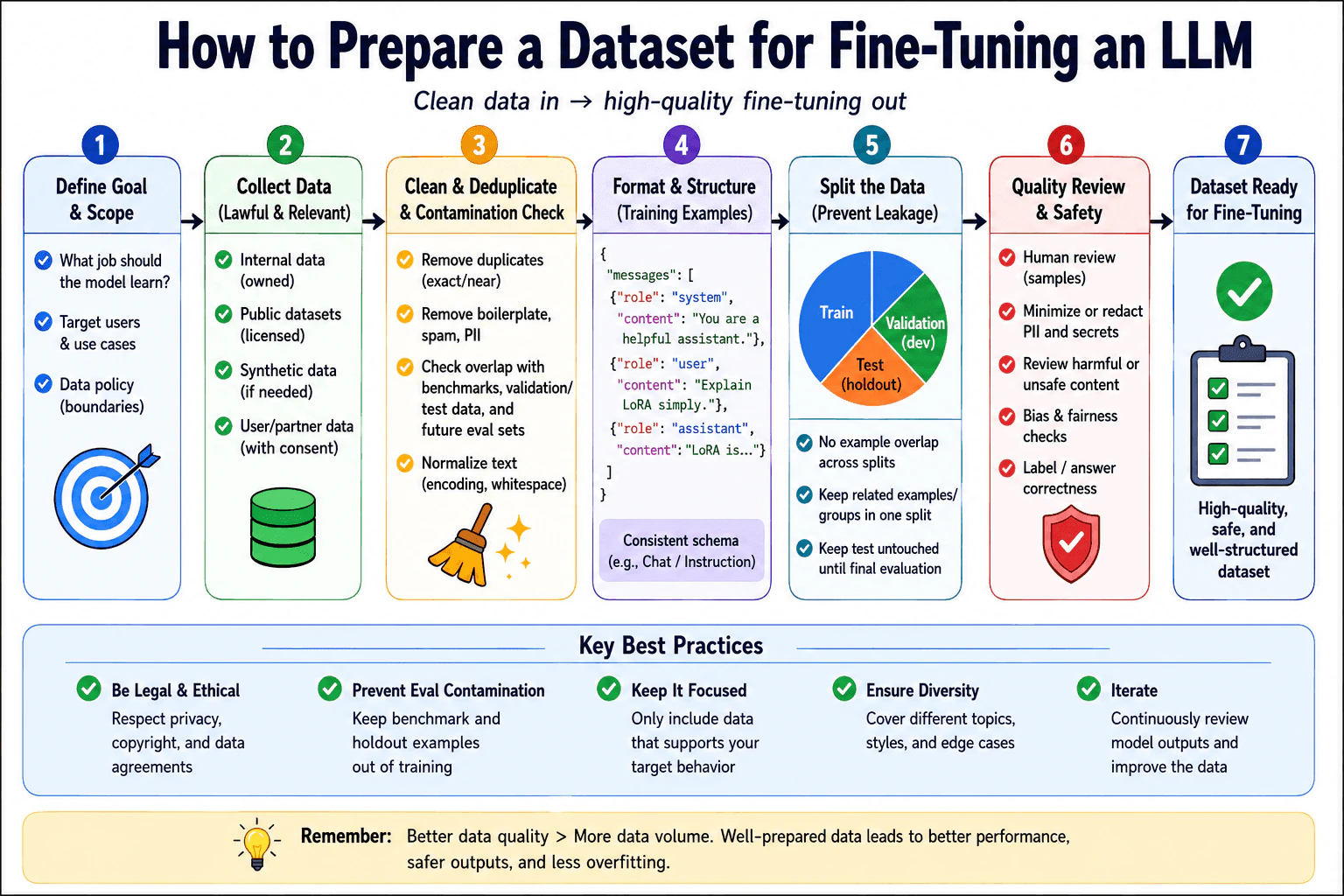
I would first define what behavior the model should learn. Then I would collect only lawful and relevant data, remove duplicates and unwanted content, check for overlap with benchmarks and evaluation data, and convert the examples into one consistent training format. Next, I would create separate train, validation, and test sets without leakage. Finally, I would review correctness, safety, diversity, and sensitive information before declaring the dataset ready for fine tuning.
Detailed Explanation
Preparing a fine tuning dataset means building a trustworthy set of examples that teaches the model the behavior you want. First, decide what the model should learn and who will use it. Then collect only information that you are allowed to use. Remove repeated, irrelevant, unsafe, or private content. Keep benchmark and final evaluation examples out of training. Put every example into one consistent structure. Separate the data into training, checking, and final testing groups without overlap. Review the examples for correctness, safety, and usefulness before training. Good focused data is usually more useful than simply collecting more data.
Useful Questions to Ask the Interviewer
What behavior should the model learn from this dataset?
Which data sources are approved for training?
Do we already have benchmark, validation, or test data that must remain separate?
How to Explain It in an Interview
I would prepare the dataset as a clear sequence of checks.
First, I define the goal and scope. I decide what job the model should learn, who the target users are, and what data boundaries apply. This prevents unrelated examples from entering the dataset.
Second, I collect lawful and relevant data. Sources can include owned internal data, licensed public datasets, approved partner data with consent, or synthetic data when it is useful. I would still check privacy rules, licenses, and data agreements.
Third, I clean and deduplicate the data. I remove exact duplicates and near duplicate examples. I also remove boilerplate, spam, and content that does not help the target behavior. I normalize text when needed so examples are consistent.
I also check for evaluation contamination. This means checking whether training data overlaps with benchmarks, validation data, test data, or future evaluation sets. Those examples should stay out of training because leakage can make evaluation results look better than the model really is.
Next, I format every example using the structure expected by the training system. For instruction style data, this can be a consistent message structure with system, user, and assistant content.
Then I create separate train, validation, and test sets. I do not assume one universal split ratio. I prevent example overlap across splits, keep related examples or groups in one split when needed, and keep the test set untouched until final evaluation.
Finally, I review the dataset for factual correctness, relevance, completeness, diversity, harmful or unsafe content, label quality, personal information, and secrets. I remove or redact sensitive information when it is not needed. The main tradeoff is quality versus volume. A smaller focused dataset can be better than a larger noisy dataset.
Why Interviewers Ask This
Interviewers ask this to see whether you understand that fine tuning starts with careful dataset design. They want to know whether you can define the target behavior, collect data lawfully, remove duplicate and poor quality examples, prevent evaluation contamination, use a consistent training format, create safe train, validation, and test splits, review quality, and handle sensitive information correctly.
Common interview mistakes
Common mistakes include collecting data before defining the target behavior, assuming that more data is always better, leaving duplicate or near duplicate examples in the dataset, allowing benchmark or holdout examples into training, using inconsistent training formats, and letting related examples leak across data splits. Another mistake is ignoring privacy until the end instead of removing or redacting personal information and secrets during preparation. Teams can also forget to review labels and answers for correctness, safety, relevance, and diversity.
Interview tip
Explain the flow in order from goal to final dataset readiness. Emphasize lawful data collection, deduplication, evaluation contamination checks, consistent formatting, leakage safe splits, quality review, and sensitive data handling. Also mention that there is no universal split ratio and that focused high quality data is more important than unnecessary volume.
Interviewer may ask next
What would you do if similar examples appear in both the training and test sets?
I would treat that as an evaluation leakage risk and rebuild the affected splits. Exact duplicates and near duplicate examples should not appear across training and test data. Related examples or groups should also stay in one split when separating them would leak information. This matters because the test set should measure performance on unseen examples. If training contains very similar test content, the final evaluation can look stronger than the real behavior.
Would you prefer a very large noisy dataset or a smaller high quality dataset for fine tuning?
I would usually prefer the smaller high quality dataset when it covers the target behavior well. Noisy examples can teach incorrect answers, unwanted styles, unsafe behavior, or irrelevant patterns. More data can improve coverage, but volume does not compensate for weak labels, duplicate examples, contamination, or poor relevance. The practical tradeoff is coverage versus quality, so I would add more data only when it improves useful coverage without lowering dataset quality.
57. What is instruction tuning, and why is it important for chat models?Fine Tuning And Model AdaptationEasy
i Question Details
Explain how the listed elements interact: instruction-response examples, task diversity, formatting consistency, generalization, and difference from continued pretraining.
Short Interview Answer (30-60 seconds)
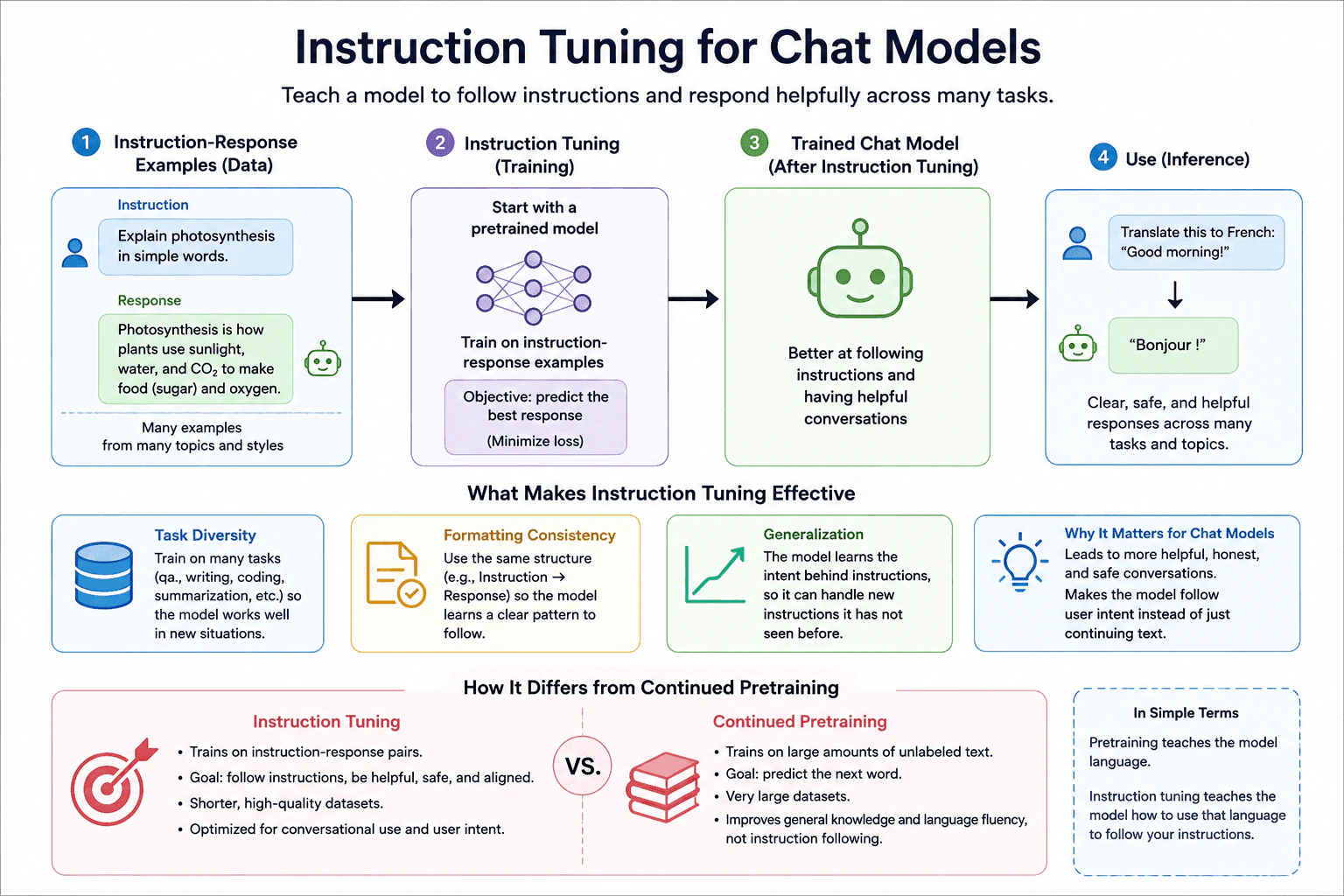
Instruction tuning takes a pretrained model and trains it on examples that pair a user instruction with a good response. This helps the model follow user intent, produce useful answers, and respect requested formats across many tasks. Diverse tasks support generalization to new instructions, while consistent example structure gives the model a clearer pattern to learn. Continued pretraining is different because it mainly learns from more raw text to improve language knowledge rather than directly teaching instruction following.
Detailed Explanation
Instruction tuning teaches an existing language model how to respond when a person asks it to do something. For example, the training data can show a request such as explaining photosynthesis in simple words, followed by a good answer. Many examples can cover translation, coding, question answering, and summarization. Keeping the examples in a clear and consistent structure helps the model learn the expected pattern. The goal is not only to know language, but also to use that knowledge in a way that follows the user request.
Useful Questions to Ask the Interviewer
Should I focus on instruction and response examples used for supervised training?
Should I also compare instruction tuning with continued pretraining?
How to Explain It in an Interview
Start with a pretrained model. It already learned broad language patterns and knowledge from large amounts of text. Instruction tuning adds another training stage using curated examples where each instruction is paired with a desired response.
A simple example is the instruction "Translate Good morning to French" with the response "Bonjour!" During training, the model is optimized to predict the desired response. The training loss measures how far its prediction is from that target. Updating the model to reduce this loss makes responses like the target more likely for similar instructions.
Task diversity matters because a chat model must handle many kinds of requests. Training on explanation, translation, coding, summarization, and other tasks gives the model more chances to learn behavior that transfers to new instructions. This transfer is called generalization. It means the model can often respond reasonably to an instruction it did not see exactly during training.
Formatting consistency also matters. If examples clearly separate the instruction from the response and use a stable structure, the model gets a cleaner signal about what part describes the task and what part is the desired answer.
Instruction tuning is different from continued pretraining. Continued pretraining usually learns from more raw text with next token prediction. Its main purpose is to extend language patterns, fluency, or domain knowledge. Instruction tuning instead uses direct examples of desired assistant behavior.
In production, use instruction tuning when a base model already has useful knowledge but does not reliably follow the desired interaction style or task format. Poor, narrow, or conflicting examples can weaken behavior. Instruction tuning also does not guarantee correct or safe answers, so evaluation is still required before deployment.
Why Interviewers Ask This
Interviewers ask this to check whether a candidate understands how a pretrained model can be adapted to follow user instructions. They also want to see whether the candidate can explain why example quality, task variety, consistent response structure, generalization, and the difference from continued pretraining matter for chat behavior.
Common interview mistakes
A common mistake is saying instruction tuning gives the model all of its knowledge. Most broad language knowledge comes from pretraining. Another mistake is treating instruction tuning and continued pretraining as the same process. They use different kinds of data and serve different goals. Candidates also sometimes ignore task diversity and formatting consistency. Narrow or inconsistent examples can weaken generalization. Finally, instruction tuning should not be described as a guarantee of correct, safe, or perfectly aligned answers. The resulting model still needs evaluation.
Interview tip
Explain the flow in order. Start with a pretrained model, show one instruction and response example, explain why many diverse and consistently formatted examples matter, then describe generalization. Finish by contrasting instruction tuning with continued pretraining. This makes the difference between learning language and learning how to follow user requests easy to understand.
Interviewer may ask next
What happens if the instruction tuning data contains only a small number of very similar tasks?
The model may improve on those narrow tasks but generalize poorly to different instructions. Task diversity matters because it exposes the model to different user intents, response patterns, and requested formats. If the examples are too similar, the model gets a weaker signal about how instruction following should transfer to new situations. The tradeoff is that adding more varied tasks can improve coverage, but the extra examples still need to be accurate and consistently structured.
When would you choose continued pretraining instead of instruction tuning?
Choose continued pretraining when the main goal is to improve language patterns, fluency, or domain knowledge from additional raw text. Choose instruction tuning when the model already has useful knowledge but needs better behavior when following user requests. A production system can use continued pretraining first for domain knowledge and instruction tuning later for assistant behavior. The tradeoff is that the two stages solve different problems and require different kinds of training data.
58. What is the difference between SFT (Supervised Fine-Tuning) and alignment training?Fine Tuning And Model AdaptationEasy
i Question Details
Contrast the choices by examining labeled demonstrations, behavior imitation, alignment objectives, preference signals, and distinct evaluation targets.
Short Interview Answer (30-60 seconds)
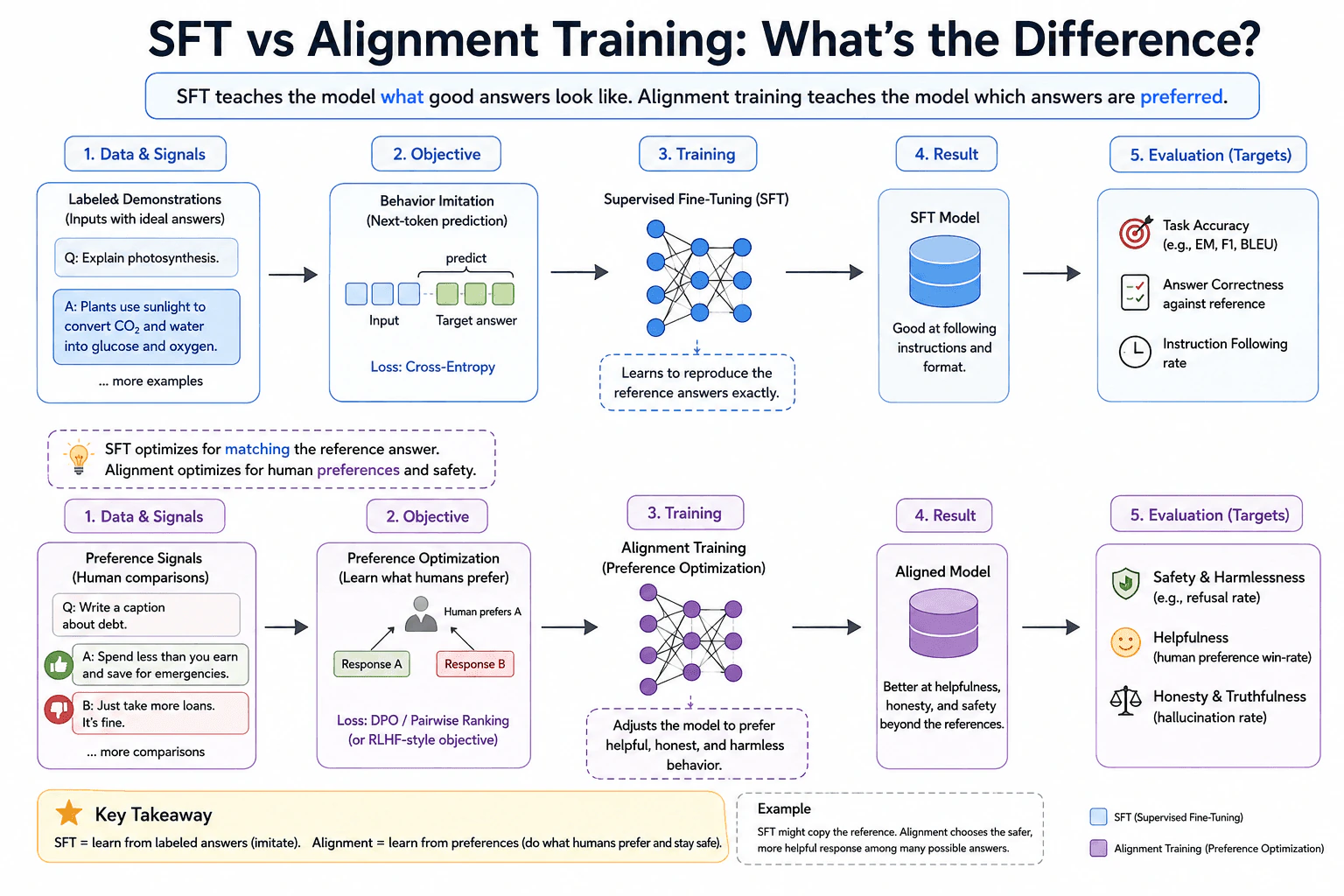
SFT mainly teaches the model to imitate good labeled answers. It usually trains on prompt and response demonstrations with next token prediction and cross entropy loss. Alignment training uses preference signals or related feedback to steer which responses the model should prefer. Methods such as DPO or RLHF can optimize for behavior such as helpfulness, safety, and honesty. In practice, SFT is strong for instruction following and format, while alignment training is used to steer preferred behavior.
Detailed Explanation
SFT and alignment training solve related but different problems. SFT learns from labeled examples that show a prompt and a good answer. It mainly teaches the model to imitate the demonstrated task, style, format, and response pattern. Alignment training uses preference signals that compare possible answers and indicate which behavior people prefer. Its goal is to steer the model toward responses that are more helpful, safe, honest, or otherwise desired. Because the goals differ, the training objectives and evaluation targets also differ. In practice, teams often use both stages together.
Useful Questions to Ask the Interviewer
Should I focus on preference optimization methods such as DPO and RLHF?
Should I compare the evaluation targets for SFT and alignment training?
How to Explain It in an Interview
Start with the data. SFT uses labeled demonstrations. For example, the training set can contain a prompt such as explain photosynthesis paired with a good reference answer. The model predicts the next token and cross entropy loss moves its output distribution toward the demonstrated target tokens. This is behavior imitation. The model learns patterns for the task, style, structure, and instruction format shown in the examples.
Alignment training uses preference signals. A dataset can show two possible responses and record which one a human prefers. DPO can train directly from these pairwise preferences. RLHF is another family of methods that uses human feedback to steer model behavior. The goal is not simply to copy one reference answer. It is to increase the probability of responses that better match the chosen preference objective.
The evaluation targets are also different. For SFT, teams can measure task accuracy, answer correctness against references, exact match, F1, BLEU when appropriate, and instruction following. For alignment, teams can measure helpfulness through human preference win rate, safety and harmlessness through behavior tests such as refusal rate on harmful requests, and honesty or truthfulness through grounded evaluations that may include hallucination rate.
The stages are complementary. SFT often teaches useful task behavior first. Alignment training can then steer that behavior toward preferred responses. Neither stage guarantees good behavior on every input. Results depend on the training data, preference labels, objective, and evaluation coverage.
Why Interviewers Ask This
Interviewers ask this to check whether a candidate can separate two related model adaptation goals. They want to know whether the candidate understands labeled demonstrations, behavior imitation, preference signals, alignment objectives, and the different evaluation targets used for each stage. They also want practical judgment about when SFT is enough and when preference based alignment is useful.
Common interview mistakes
A common mistake is saying that SFT and alignment training are identical because both can update model parameters. Their supervision signals and objectives are different. Another mistake is saying that SFT only teaches factual accuracy. It can also teach style, format, and instruction behavior from demonstrations. A third mistake is treating alignment training as only RLHF. DPO is also a preference optimization method. Candidates should also avoid saying that alignment guarantees safety, honesty, or truthfulness. It only steers behavior according to the available signals, objective, and evaluation coverage.
Interview tip
Start with the core contrast. Say that SFT imitates labeled answers, while alignment training learns which responses or behaviors are preferred. Then compare the data, objective, and evaluation target. End by saying that the stages are often complementary.
Interviewer may ask next
Can an SFT model already show aligned behavior without separate preference training?
Yes. An SFT model can already appear helpful, safe, or polite when those behaviors are strongly represented in its demonstrations. The exact behavior is still learned through imitation of labeled targets. Separate preference training matters when the team wants to compare acceptable responses and directly steer which one the model should prefer. This gives a clearer preference signal, but it also depends on the quality of the comparison data.
Why might a team use DPO after SFT instead of stopping after SFT?
A team may use DPO after SFT because SFT teaches the model to imitate good reference responses, while DPO directly learns from preferred and less preferred response pairs. This matters when several answers are plausible but some better match the desired behavior. The main trade off is that preference training needs reliable comparison data and careful evaluation. Weak or biased preference labels can steer the model toward the wrong behavior.
59. What is RLHF (Reinforcement Learning from Human Feedback), and how is it used to align LLMs?Fine Tuning And Model AdaptationEasy
i Question Details
A complete explanation should cover supervised starting point, preference collection, reward or preference objective, policy optimization, and safety or capability evaluation.
Short Interview Answer (30-60 seconds)
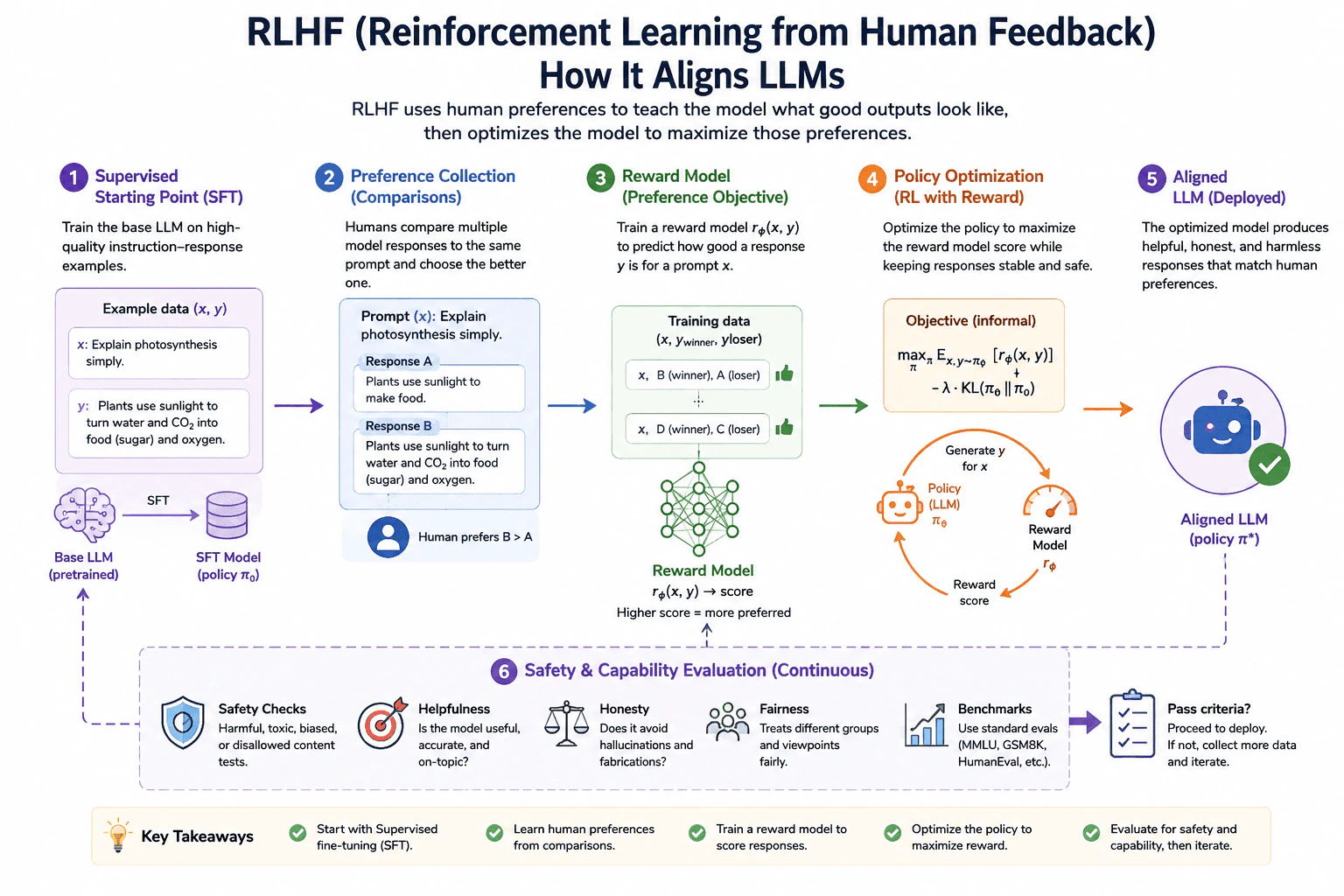
RLHF aligns an LLM by turning human preferences into a training signal. I would first create a useful starting policy with supervised fine tuning. Then people compare responses to the same prompt and choose the better response. A reward model learns to score responses from those choices. The policy is then optimized to receive higher reward while staying reasonably close to the starting policy. Finally, I would evaluate safety, helpfulness, honesty, fairness, and capability before deployment and continue testing after deployment.
Detailed Explanation
The main idea is simple. First, the model learns from good example answers. Next, people compare several answers to the same request and choose which answer they prefer. Those choices teach a separate scoring model what a better answer looks like. The language model is then adjusted so it produces more answers that receive good scores. After that, the team tests whether the model is useful, truthful, fair, and safe. If important problems appear, the team collects more preference data, updates the training process, and tests again before relying on the new version.
Useful Questions to Ask the Interviewer
Should I explain the classic reward model and reinforcement learning flow?
Should I include how safety and capability evaluation feeds back into another training cycle?
How to Explain It in an Interview
RLHF means Reinforcement Learning from Human Feedback. It is a model adaptation process that uses human preferences to guide an LLM toward desired behavior.
The first step is supervised fine tuning, or SFT. A pretrained base LLM is trained on high quality instruction and response examples. This creates the starting policy, shown in the diagram as the SFT model with policy pi zero.
Next comes preference collection. For the same prompt, the model produces multiple responses. Human reviewers compare them and choose the response they prefer. In the diagram example, response B is preferred over response A. These comparisons become preference training data.
The next step is reward model training. The reward model takes a prompt and response and predicts a score. A higher score should represent a response that humans are more likely to prefer.
Then policy optimization begins. The current LLM generates a response. The reward model scores that response. The policy is updated to increase expected reward. The objective can also include a KL penalty. This penalty discourages the updated policy from moving too far from the reference policy and helps keep training stable.
The result is an aligned LLM whose behavior better matches the learned human preferences. Alignment is not finished at deployment. The model must still be evaluated for safety, helpfulness, honesty, fairness, and capability. If the model fails important checks, the team can collect more data, retrain the reward model, continue policy optimization, and evaluate again.
Why Interviewers Ask This
Interviewers ask this to check whether a candidate understands how human preferences can guide model adaptation. They want to see if the candidate can explain the complete flow from supervised fine tuning through preference collection, reward model training, policy optimization, and safety and capability evaluation. They also want to know whether the candidate understands the limits of the learned reward signal and the need for continued evaluation.
Common interview mistakes
A common mistake is saying that human reviewers directly edit every final model response. In RLHF, their comparisons become training data. Another mistake is treating the reward model as the final language model. The reward model only scores candidate responses. A third mistake is saying that maximizing reward guarantees alignment. The reward model is only an approximation of human preferences, so the policy can learn behavior that receives a high score without being truly desirable. Independent evaluation and careful policy constraints are therefore important. It is also incorrect to treat one successful evaluation run as proof that the model will be safe and correct for every input.
Interview tip
Explain RLHF as one clear flow: supervised fine tuning, human preference comparisons, reward model training, policy optimization, aligned model, then safety and capability evaluation. Define the reward model and policy in simple words. Mention the KL penalty as a way to limit excessive policy drift, and make clear that evaluation continues after training.
Interviewer may ask next
What can go wrong if the reward model does not represent human preferences well?
The policy can learn to maximize the wrong signal. If the reward model gives high scores to behavior that people do not actually want, policy optimization can reinforce that behavior. This matters because the policy is trained against the learned reward rather than direct human judgment for every response. The team can address this by collecting better preference data, retraining the reward model, limiting excessive policy changes, and using independent safety and capability evaluation to detect failures.
Why keep the optimized policy close to the reference policy instead of maximizing reward without a constraint?
Keeping the policy reasonably close to the reference policy helps reduce unstable or extreme changes. A KL penalty can discourage updates that move the new policy too far from the supervised starting policy. This matters because an imperfect reward model can otherwise encourage responses that score well but are not truly better. The tradeoff is that a stronger constraint can improve stability while also limiting how much the policy adapts toward the learned preferences.
60. What are the key hyperparameters for fine-tuning (learning rate, epochs, batch size, LoRA rank)?Fine Tuning And Model AdaptationMedium
i Question Details
Explain how the listed elements interact: learning rate, epochs, effective batch size, warmup, regularization, LoRA rank, checkpointing, and signs of under- or overfitting.
Short Interview Answer (30-60 seconds)
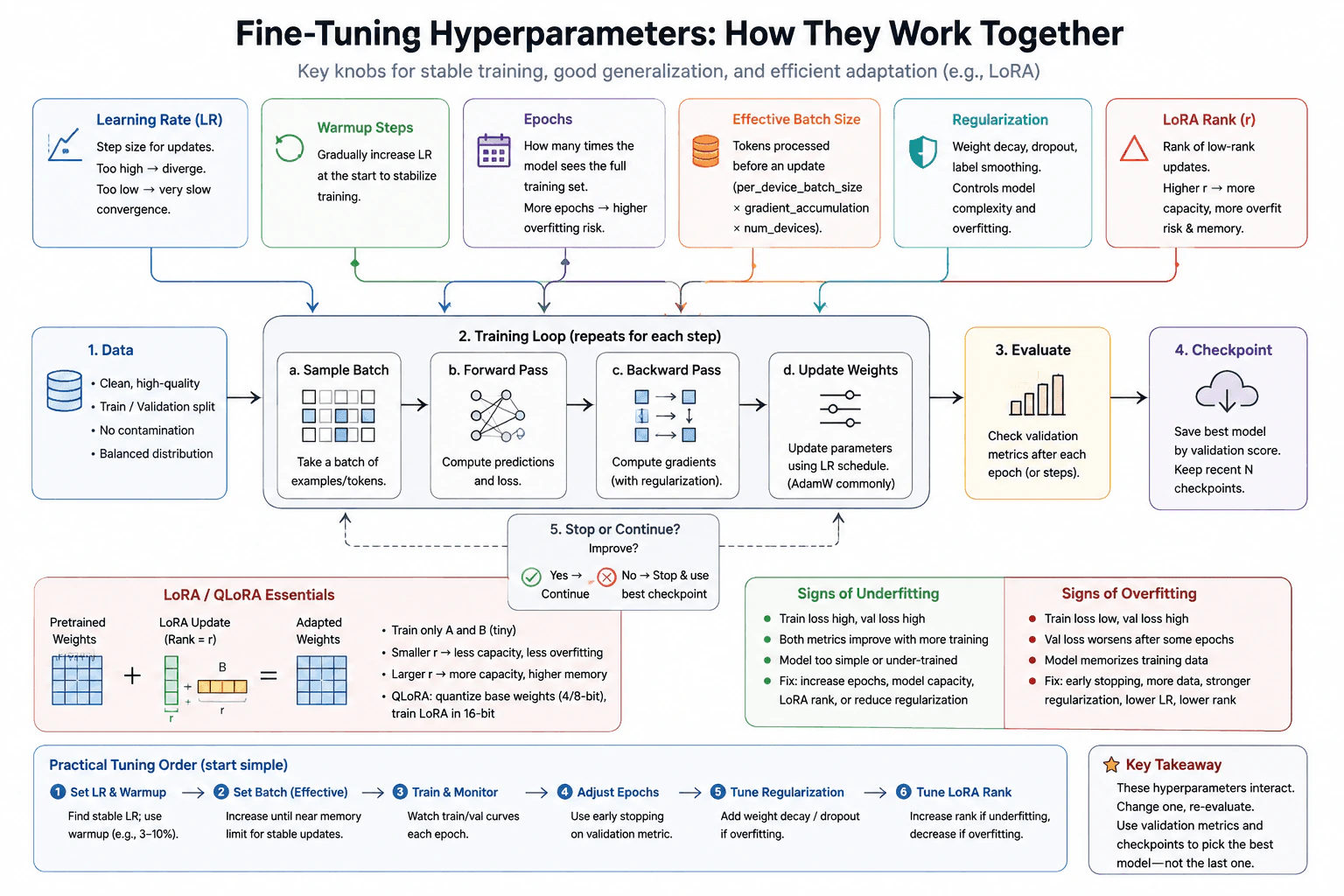
I would tune learning rate and warmup first because they control how safely the model updates. Then I would choose a practical effective batch size and train while watching training and validation results. I would adjust epochs, regularization, and LoRA rank based on those results. More epochs and a larger LoRA rank can add fitting capacity, but they can also increase overfitting risk. I would save checkpoints during training and select the best one using validation results rather than automatically using the last checkpoint.
Detailed Explanation
Fine tuning starts with a pretrained model and a clean set of examples for the new task. Part of the data is used for learning and a separate part is kept for checking progress. During learning, the model sees a group of examples, makes predictions, measures its mistakes, and changes itself a little. Several settings control how large those changes are, how much data contributes to each change, and how long learning continues. The goal is to learn the task without becoming too focused on the examples already seen.
Useful Questions to Ask the Interviewer
Are we changing all model weights or using LoRA adapters?
Which validation result should determine the best checkpoint?
What memory limits affect the batch size or LoRA rank?
How to Explain It in an Interview
I would begin with the learning rate. It controls the size of each parameter update. If it is too high, loss can become unstable or diverge. If it is too low, convergence can be very slow. Warmup starts with a smaller learning rate and gradually raises it during early steps. A later learning rate decay is commonly used after warmup.
The effective batch size is the amount of data contributing to one optimizer update. A common relationship is per device batch size × gradient accumulation steps × number of data parallel devices. A larger effective batch usually gives a more stable gradient estimate, but it needs more memory or more accumulation steps. It can also change the useful learning rate, so I consider batch size and learning rate together.
Each training step samples a batch, runs a forward pass to compute predictions and loss, runs a backward pass to compute gradients, and then applies an optimizer update using the learning rate schedule. AdamW is a common optimizer for this step. Regularization such as weight decay, dropout, or label smoothing can reduce overfitting when appropriate.
Epochs control how many times the model sees the full training set. Too few can cause underfitting. Too many can increase overfitting risk. I evaluate validation results after suitable steps or epochs and use early stopping when validation performance stops improving.
With LoRA, the pretrained weights stay frozen while small matrices A and B learn a low rank update. Rank r controls adapter capacity. A smaller rank uses less memory and has less capacity. A larger rank adds capacity and memory cost and can increase overfitting risk. QLoRA reduces base model memory further by keeping the frozen base weights quantized while training the LoRA adapters at a suitable higher precision.
Underfitting often shows high training loss and high validation loss, with both still improving as training continues. I may train longer, increase LoRA rank or model capacity, or reduce excessive regularization. Overfitting often shows low training loss while validation loss is high or becomes worse. I may stop earlier, use more data, strengthen regularization, lower the learning rate, or reduce LoRA rank.
I save recent checkpoints and the checkpoint with the best validation result. If a later change makes validation results worse, I can return to a previous good checkpoint. I change one major setting at a time and reevaluate so I can tell which change helped.
Why Interviewers Ask This
Interviewers ask this to see whether I understand how the main training controls interact. They want evidence that I can balance training stability, model capacity, memory use, and performance on unseen data. They also want to know whether I can recognize underfitting and overfitting from training and validation results, save useful checkpoints, and choose the best checkpoint instead of assuming the final checkpoint is best.
Common interview mistakes
A common mistake is changing learning rate, batch size, epochs, regularization, and LoRA rank at the same time. That makes it difficult to know which change caused the result. Another mistake is looking only at training loss. Low training loss does not prove that the model performs well on unseen data. It is also wrong to assume that more epochs or a larger LoRA rank is always better. Both can increase overfitting risk. Another mistake is ignoring the effect of effective batch size on update behavior. A final mistake is saving only the last checkpoint instead of also keeping the checkpoint with the best validation result.
Interview tip
Explain these settings as one connected training system. Start with learning rate and warmup, then effective batch size, then epochs, regularization, and LoRA rank. Describe the real training flow from batch sampling through prediction, loss, gradients, and the optimizer update. Finish with training versus validation behavior, checkpoint selection, and how those signals tell you whether to stop or change a setting.
Interviewer may ask next
What would you change if training loss keeps falling but validation loss starts rising?
That pattern indicates overfitting. I would first consider stopping earlier and selecting the best earlier checkpoint. I could also strengthen regularization, lower the learning rate, use more suitable training data, or reduce LoRA rank if the adapter has more capacity than the task needs. The important signal is that better fitting of the training data is no longer improving validation behavior.
How should effective batch size affect the learning rate during fine tuning?
A larger effective batch usually gives a gradient estimate based on more examples before each optimizer update, so the update can be less noisy. Some training setups can therefore use a larger learning rate when effective batch size increases, but I would not scale it blindly. I would use that relationship only as a starting point, keep warmup, and verify training stability and validation results because the useful learning rate depends on the model, optimizer, data, and adaptation method.
More questions load as you scroll
Disclaimer: This interview guide is for educational and informational purposes only. It is designed to help readers prepare, but it does not guarantee any interview result, hiring decision, offer, or outcome. Interview questions, hiring criteria, and preferred answers can vary by employer, interviewer, industry, location, and time. All answers, examples, and explanations in this guide are suggested examples for interview preparation, not definitive answers or instructions for professional practice. They are based on research and judgment, are provided without warranties of any kind, and should be adapted to the question, role, and applicable laws and professional requirements. Diagrams are simplified illustrations intended to highlight the main concepts and their relationships; actual situations, systems, and practices may be more complex. Alternative approaches may be equally valid or better suited to a particular question, context, or interviewer. To the fullest extent permitted by applicable law, the contributors and publisher are not liable for decisions made, actions taken, or losses incurred based on this guide.
State Laws and Professional Responsibilities: Laws and requirements governing an occupation vary by state and jurisdiction. You are responsible for checking the current laws, licensing requirements, and scope-of-practice rules that apply to your location and role, and for ensuring that your answers and actions comply with them. Adapt examples in this guide to those requirements. This guide is not legal advice.
Content Accuracy and Verification: To the fullest extent permitted by applicable law, we do not represent or warrant that interview guides, questions, answers, examples, or diagrams are accurate, complete, current, error-free, or suitable for any particular purpose. You are responsible for independently reviewing and verifying the information before relying on it.