This interview guide is for educational and informational purposes only. It is designed to help readers prepare, but it does not guarantee any interview result, hiring decision, offer, or outcome. Interview questions, hiring criteria, and preferred answers can vary by employer, interviewer, industry, location, and time. All answers, examples, and explanations in this guide are suggested examples for interview preparation, not definitive answers or instructions for professional practice. They are based on research and judgment, are provided without warranties of any kind, and should be adapted to the question, role, and applicable laws and professional requirements. Diagrams are simplified illustrations intended to highlight the main concepts and their relationships; actual situations, systems, and practices may be more complex. Alternative approaches may be equally valid or better suited to a particular question, context, or interviewer. To the fullest extent permitted by applicable law, the contributors and publisher are not liable for decisions made, actions taken, or losses incurred based on this guide.
State Laws and Professional Responsibilities
Laws and requirements governing an occupation vary by state and jurisdiction. You are responsible for checking the current laws, licensing requirements, and scope-of-practice rules that apply to your location and role, and for ensuring that your answers and actions comply with them. Adapt examples in this guide to those requirements. This guide is not legal advice.
Identity, Image, and Privacy Notice
To respect individual privacy, some names, profile photographs, avatars, biographical details, and other identifying information displayed in this guide may be replaced with pseudonyms, licensed stock images, illustrative avatars, composite images, or representative descriptions. Unless a person is expressly identified as an actual contributor, a displayed name, image, or profile should not be understood as depicting or identifying a specific candidate, interviewer, employee, or other real individual. These representations are provided for editorial and illustrative purposes only and do not imply endorsement, employment, participation, or affiliation with this guide or any company mentioned in it. Any resemblance to an actual person is coincidental.
Company Notice
This guide is an independent educational resource and is not affiliated with, endorsed by, sponsored by, or approved by the company named in this guide. Company names identify reported interview experiences or the employer context of clearly labeled original practice exercises. Interview practices can change without notice, and inclusion of company-specific content does not mean these questions are official, complete, or guaranteed to be asked. To the fullest extent permitted by law, the author, contributors, and publisher are not responsible for outcomes related to use of this material.
Content Accuracy and Verification
To the fullest extent permitted by applicable law, we do not represent or warrant that interview guides, questions, answers, examples, or diagrams are accurate, complete, current, error-free, or suitable for any particular purpose. You are responsible for independently reviewing and verifying the information before relying on it.
Questions or comments?
Contact us for general questions, or share feedback, technical corrections, and comments with the community.
101. Your AI model passes bias checks by gender and race separately, but fails for intersectional groups. How do you handle it?Ai Safety Ethics And Responsible AiHard
i Question Details
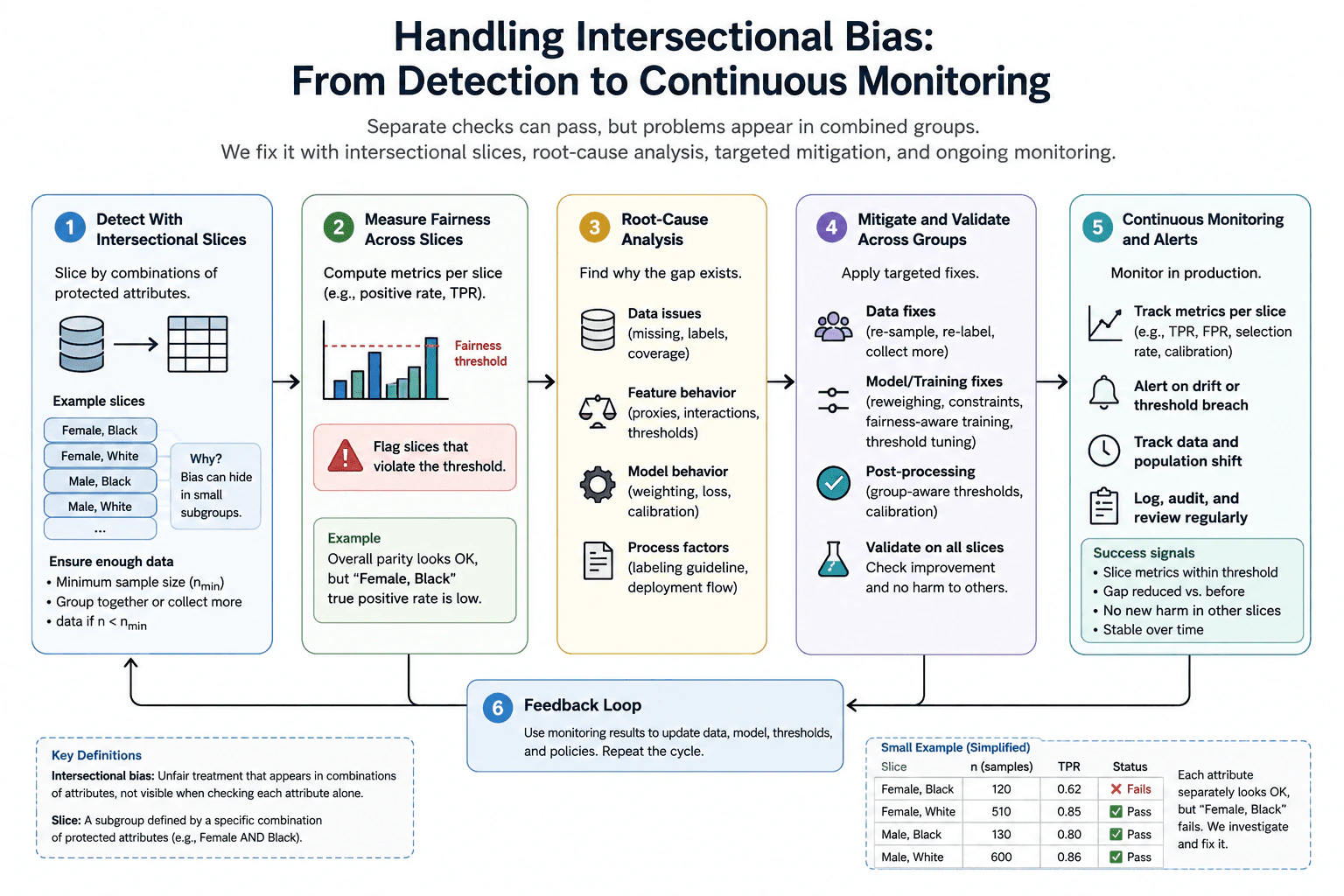
Assess the incident through combined protected-group slices, adequate sample sizes, root-cause analysis, mitigation effects across groups, and continuous monitoring, including the signals used to confirm the corrective action.
Short Interview Answer (30-60 seconds)
I would treat it as a fairness incident. I would measure combined protected-group slices with enough data, find the root cause, apply a targeted mitigation, validate every slice for improvement and new harm, and continuously monitor the same fairness signals in production.
Detailed Explanation
Passing separate checks for gender and race does not prove that every person is treated fairly. A problem can appear only when those traits are considered together. For example, results for women as a whole may look acceptable, and results for Black people as a whole may also look acceptable, while Black women still receive worse outcomes. I would examine these combined groups, make sure each group has enough examples, find the cause of any gap, correct it, check that other groups are not harmed, and keep watching the system after release.
Useful Questions to Ask the Interviewer
Which protected attributes and combined groups are in scope for this system?
Which outcome matters most for fairness here, such as selection rate, true positive rate, false positive rate, or calibration?
What fairness threshold or comparison rule has been approved for this use case?
What should we do when an intersectional slice has too few samples for a reliable result?
Are there legal, policy, or product limits on group-aware changes such as different decision thresholds?
How to Explain It in an Interview
I would start by treating the failed intersectional check as a real fairness incident. Passing gender-only and race-only checks does not cancel a failure that appears when the attributes are combined. Broad averages can hide a problem in a smaller subgroup.
First, I would create intersectional slices. A slice is a subgroup defined by a combination of protected attributes. For example, I might compare Female and Black, Female and White, Male and Black, and Male and White groups when those attributes are relevant and permitted for fairness evaluation. The exact slices should follow the system's risk, policy, and legal scope.
Next, I would check whether each slice has enough data. A very small group can produce a noisy or unstable fairness result. I would define a minimum evidence rule before drawing conclusions. If a slice does not have enough examples, I would collect more representative data where appropriate, report the uncertainty, or use another approved analysis method. I would not silently combine away an important subgroup simply to make the result look better.
Then I would measure the relevant fairness signals for every slice. These can include positive or selection rate, true positive rate, false positive rate, and calibration. True positive rate means how often the model correctly identifies positive cases that really are positive. False positive rate means how often it incorrectly marks negative cases as positive. Calibration checks whether predicted confidence matches real outcomes. I would choose the measures that represent the real harm in the application rather than using every possible metric.
I would compare each slice using the same metric definitions and approved fairness thresholds. A slice that crosses the accepted threshold becomes a clear investigation target. The important point is to evaluate the combined group directly instead of assuming that good aggregate results protect every subgroup.
After detecting the gap, I would perform root-cause analysis. I would start with data issues such as missing coverage, under-representation, poor labels, or incorrect labels. I would inspect feature behavior, including proxy features. A proxy feature is a feature that indirectly carries information about a protected attribute. I would also examine model behavior such as weighting, loss behavior, feature interactions, calibration, or decision thresholds. Finally, I would inspect process factors such as sampling rules, labeling guidance, and deployment logic.
The mitigation should match the cause. For data problems, possible fixes include collecting more representative examples, correcting labels, re-sampling, or re-weighting examples. For model or training problems, I might change weighting, use an appropriate fairness constraint, review problematic proxy features, or use fairness-aware training. Post-processing changes, such as a group-aware threshold or calibration change, may also be considered when they are lawful, policy-approved, operationally appropriate, and supported by the use case.
I would then validate the mitigation across all relevant slices. I would re-run the same fairness measures, not just the metric for the group that originally failed. I want to see that the affected gap is reduced while no other important slice suffers unacceptable new harm. I would also check normal model performance because a fairness mitigation can change accuracy, recall, calibration, or other product outcomes.
I would not define success as one improved number. The stronger success signals are that slice-level measures meet the approved threshold, the identified gap is reduced, no important group becomes unacceptably worse, normal performance stays within its accepted limits, and the improvement remains stable over time.
After deployment, I would continuously monitor these signals by slice. I would watch for fairness threshold breaches, changes in true positive rate or false positive rate where relevant, calibration changes, selection-rate changes, data drift, and population shift. Population shift means that the mix or behavior of users changes over time. I would log enough information to support auditing while avoiding unnecessary storage of sensitive content.
If monitoring finds a new breach or regression, the system should enter the incident process instead of ignoring it. The team should investigate the cause, review the affected groups, and choose an approved response such as correcting data, recalibrating, retraining, changing thresholds, rolling back a change, or escalating to a human risk owner when needed.
Finally, I would keep a feedback loop. Monitoring results should feed back into the data, model, thresholds, policies, and evaluation process. This turns fairness testing from a one-time launch check into a repeated engineering and governance process.
Risk and Control
Build the relevant combined protected-group slices instead of testing each protected attribute only by itself.
Check sample adequacy for every slice before trusting its fairness result.
Choose fairness measures that represent the real harm, such as selection rate, true positive rate, false positive rate, or calibration.
Measure each slice using the same definitions and approved fairness thresholds.
Flag slices that violate the threshold or show a meaningful gap.
Investigate root causes in data coverage, labels, proxy features, feature interactions, model weighting, loss behavior, calibration, thresholds, sampling, labeling guidance, and deployment logic.
Apply a targeted mitigation that matches the cause, such as better data, re-sampling, re-weighting, feature review, fairness-aware training, constraints, or an approved post-processing change.
Re-measure all relevant slices after the mitigation.
Accept the correction only when the affected gap improves, no important slice has unacceptable new harm, and normal model performance remains within accepted limits.
Monitor slice-level fairness, threshold breaches, data drift, and population shift in production.
Log, audit, and review important fairness changes and residual risk.
Feed monitoring results back into data, model, threshold, policy, and evaluation updates, then repeat the cycle.
Practical Insights
The largest cost is usually data and ongoing operations. When protected attributes are combined, the number of possible slices grows, while each slice may contain fewer examples. That makes reliable measurement harder. Collecting representative data, reviewing labels, retraining, validating every group, and monitoring production all require time and people. The system also needs alerting, audit records, ownership, and regular review. The tradeoff is worthwhile for high-impact systems because aggregate metrics can otherwise hide harm to smaller groups.
Why Interviewers Ask This
The interviewer wants to see whether you understand that broad averages can hide harm to smaller combined groups. They are testing whether you can define meaningful intersectional slices, handle weak sample sizes, choose the right fairness measures, find the cause of the disparity, select a mitigation that matches that cause, check effects on every relevant group, and define evidence that shows whether the correction keeps working after deployment.
Common interview mistakes
A common mistake is declaring the system fair because gender-only and race-only checks pass. Another is testing intersectional slices without checking whether they have enough data. Teams may also use a fairness metric that does not match the real harm, or apply a generic mitigation before finding the root cause. Another mistake is validating only the group that originally failed and missing new harm to another group. Group-aware thresholds can also create legal or policy problems if used without review. Finally, treating fairness as a one-time offline test misses regressions caused by new data, population changes, model updates, and deployment changes.
Interview tip
Explain the flow in six simple steps: slice, measure, diagnose, mitigate, validate, monitor. Call out sample size before trusting a slice metric. Finish with clear success signals: the gap is reduced, all relevant slices stay within approved limits, no new unacceptable harm appears, and the improvement remains stable over time.
Interviewer may ask next
What would you do if the failing intersectional group has very few samples?
I would treat the result as uncertain instead of treating the group as safe or unfair based on weak evidence. I would report the sample limitation, examine uncertainty around the fairness measure, and collect more representative data when appropriate. I would not hide the group by merging it into a larger category only to make the metric stable. For a high-risk decision, I would document the remaining uncertainty and use the approved human review or risk-escalation process until stronger evidence is available.
How do you confirm that the fairness mitigation really worked?
I would re-measure the same fairness signals on all relevant intersectional slices. The affected gap should move into the approved range, but that alone is not enough. No important slice should become unacceptably worse, and normal model performance should remain within its accepted limits. After deployment, I would keep monitoring the same slice-level signals, fairness threshold breaches, data drift, and population shift. Stable improvement over time with no unacceptable new harm is much stronger evidence than one better offline score.
102. How would you design an AI incident response plan?Ai Safety Ethics And Responsible AiHard
i Question Details
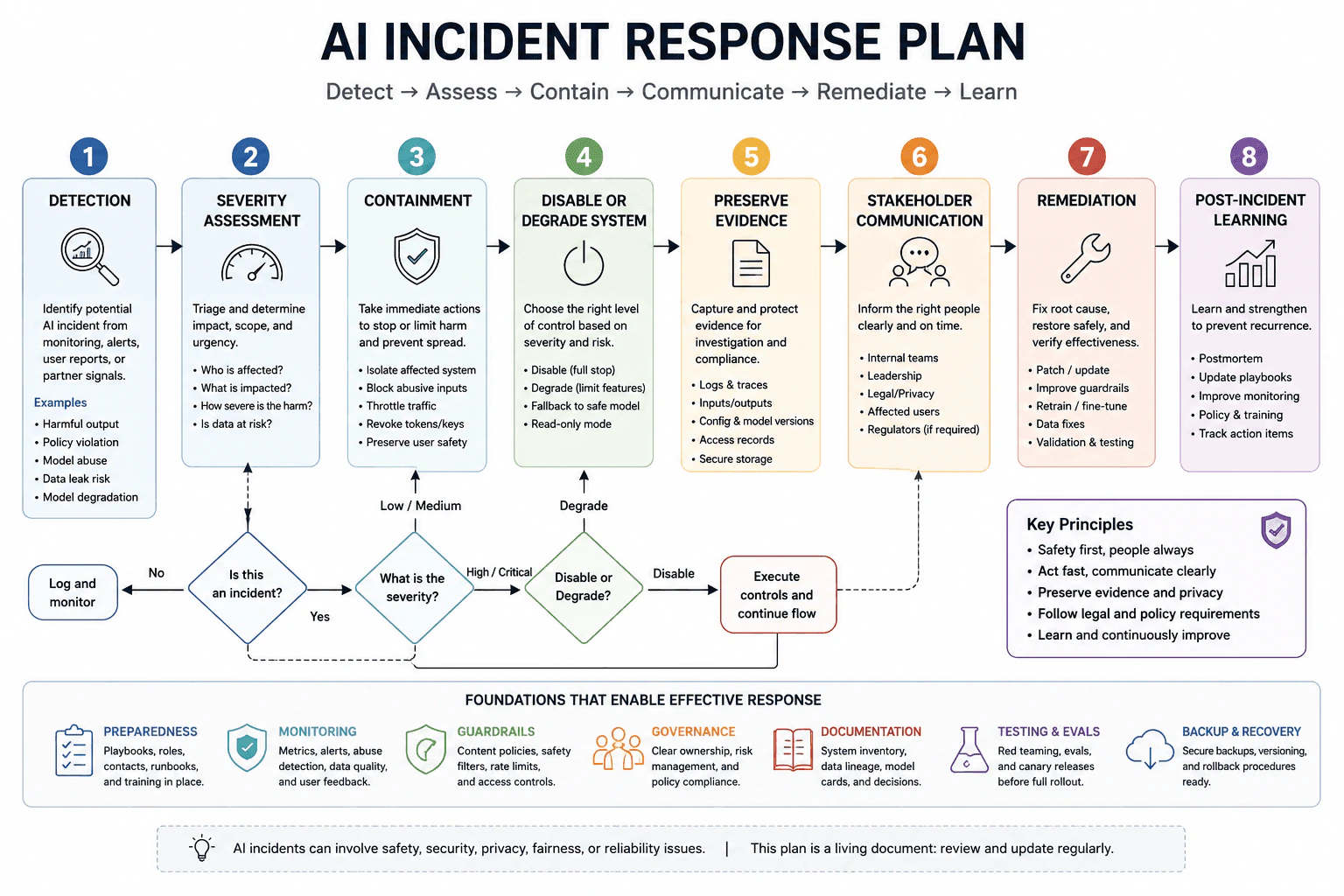
Focus on the practical sequence and decision gates for detection, severity, containment, disabling or degrading the system, preservation of evidence, stakeholder communication, remediation, and post-incident learning.
Short Interview Answer (30-60 seconds)
I would design a risk-based flow: detect, assess severity, contain, disable or degrade when needed, preserve evidence, communicate, remediate, verify recovery, and learn. Each step needs clear ownership, safe failure behavior, privacy-aware evidence handling, monitoring, and tested rollback or recovery procedures.
Detailed Explanation
An AI incident response plan explains what the team should do when an AI system may be causing harm or behaving in an unsafe way. The goal is to notice the problem quickly, understand how serious it is, stop more harm, keep useful records, tell the right people, repair the cause, and safely return the system to normal. The plan must also explain who makes important decisions and what happens when the risk is uncertain. After the incident, the team should learn from what happened and strengthen the system so the same problem is less likely to happen again.
Useful Questions to Ask the Interviewer
What kinds of AI incidents are in scope, such as harmful output, policy violations, model abuse, data leak risk, or model degradation?
Who is allowed to disable, degrade, or restore the AI system?
What severity levels does the organization use, and what actions are required at each level?
What evidence may be retained, and how should sensitive information be protected?
Which internal teams, affected users, or regulators may need to be informed?
How to Explain It in an Interview
I would design the plan as a clear sequence with decision gates.
First, detect a possible AI incident. Detection can come from monitoring, alerts, user reports, or partner signals. Useful examples are harmful output, a policy violation, model abuse, a possible data leak, or unexpected model degradation. The first decision gate asks, "Is this an incident?" If the answer is no, I would log the event and keep monitoring. If the answer is yes, I would move to severity assessment.
Second, assess severity. I would ask who is affected, what is impacted, how severe the harm is, and whether data is at risk. Severity should drive the response. A lower-severity incident may need containment and close monitoring. A high or critical incident may require stronger controls, including disabling or degrading the system.
Third, contain the incident. The immediate goal is to stop or limit further harm before spending too much time on root-cause analysis. Depending on the incident, I may isolate the affected system, block abusive inputs, throttle traffic, revoke exposed tokens or keys, or apply another control needed to preserve user safety.
Fourth, make an explicit disable-or-degrade decision. Disable means a full stop when continued operation creates unacceptable risk. Degrade means keeping only a reduced and safer mode. Examples from the plan include limiting features, switching to a safe fallback model, or using read-only mode. This decision should be based on severity and risk, not only on service availability.
Fifth, preserve evidence. I would capture the information needed to understand what happened without collecting unnecessary sensitive data. Useful evidence includes logs and traces, relevant inputs and outputs, configuration and model versions, and access records. I would store this evidence securely so investigators can use it later without losing or casually changing it.
Sixth, communicate with the right stakeholders. Internal teams and leadership need timely facts. Legal and privacy teams may need to review data or notification duties. Affected users may need clear guidance. Regulators should be informed when required. Communication should explain what is known, what action was taken, what is still uncertain, and what happens next.
Seventh, remediate the root cause. The exact fix depends on what failed. Possible actions include a patch or update, stronger guardrails, retraining or fine-tuning when that is the correct model-level fix, data corrections, and validation and testing. I would keep model changes separate from application and operational controls because one control does not automatically solve every class of risk.
Before returning to normal operation, I would verify that the remediation works. Testing and evaluations should cover the failure that caused the incident. For risky changes, I would use a controlled rollout such as a canary release, where only a small amount of traffic receives the change first. Backups, versioning, and rollback procedures should already be ready so the team can recover if the new version causes another problem.
Finally, I would perform post-incident learning. I would write a postmortem, update playbooks, improve monitoring, update policy and training, and track action items to completion. The plan should be treated as a living document and reviewed regularly.
I would also prepare the foundations before an incident occurs. That includes playbooks, responder roles, contacts, runbooks, training, monitoring for metrics and alerts, content policies, safety filters, rate limits, access controls, clear governance and ownership, system and model documentation, red-team exercises, evaluations, canary releases, backups, versioning, and rollback procedures.
The main tradeoff is safety versus availability. A full shutdown gives the strongest containment but can interrupt an important service. Degradation keeps some service available, but it is acceptable only when the remaining mode is safe enough for the current risk. Another tradeoff is investigation value versus privacy. More evidence can help find the cause, but unnecessary sensitive data creates more risk, so evidence collection should be limited and protected.
Risk and Control
Detect a possible incident from monitoring, alerts, user reports, or partner signals.
Decide whether it is an AI incident. If not, log it and continue monitoring.
Assess severity by asking who is affected, what is impacted, how serious the harm is, and whether data is at risk.
Contain the incident immediately. Isolate affected systems, block abusive inputs, throttle traffic, revoke tokens or keys, and apply controls needed to preserve user safety.
Decide whether to disable or degrade the system. Disable for unacceptable ongoing risk. Degrade only when a safer reduced mode is available, such as limited features, a safe fallback model, or read-only mode.
Preserve evidence such as logs and traces, relevant inputs and outputs, configuration and model versions, and access records. Store it securely.
Communicate with internal teams, leadership, legal or privacy teams, affected users, and regulators when required.
Remediate the root cause with the correct control, such as a patch or update, stronger guardrails, a justified model change, data fixes, and validation and testing.
Restore service carefully. Use evaluations, controlled rollout, monitoring, backups, versioning, and rollback procedures.
Run a postmortem. Update playbooks, monitoring, policy, training, and action items so the organization learns from the incident.
Practical Insights
The main cost is operational, not algorithmic. The organization needs monitoring, alerts, secure logs, trained responders, clear ownership, evidence storage, testing, backups, versioning, and rollback procedures. Keeping a safe fallback mode also adds engineering and maintenance work. More monitoring and evidence can increase storage and review cost. Human review can slow some decisions, but it is important for serious incidents. The plan must also be updated as models, controls, risks, and operating conditions change.
Why Interviewers Ask This
This question tests whether the candidate can turn AI safety principles into a practical operating process. The interviewer wants to see whether the candidate can detect harmful behavior, judge severity, stop further harm, make a disable-versus-degrade decision, preserve useful evidence, communicate clearly, repair the cause, restore service safely, and strengthen controls after the incident.
Common interview mistakes
A common mistake is treating incident response as only a debugging exercise. The team must also consider user harm, privacy, security, policy, communication, and governance. Another mistake is investigating for too long while harmful behavior continues instead of containing it first. Teams can also fail by having no clear owner for the disable-or-degrade decision, losing evidence during emergency changes, logging unnecessary sensitive information, restoring the system without validation, or assuming one model fix solves every application or operational weakness. Skipping the postmortem and leaving action items without owners also makes repeat incidents more likely.
Interview tip
Walk through the plan in order and emphasize the decision gates. Say: detect, confirm the incident, assess severity, contain, decide whether to disable or degrade, preserve evidence, communicate, remediate, restore safely, and learn. Mention the safety-versus-availability tradeoff and explain that monitoring, guardrails, governance, documentation, testing, backups, and rollback procedures must exist before the incident.
Interviewer may ask next
How would you decide whether to disable the AI system completely or only degrade it?
I would base the decision on severity and ongoing risk. If continued operation could cause unacceptable harm, I would disable the affected capability or system. If a tested reduced mode is safe enough, I would degrade instead. Examples include limiting features, switching to a safe fallback model, or using read-only mode. The important point is that availability does not override safety. The response owner should document the decision, monitor the reduced mode, and keep rollback or shutdown available.
What evidence would you preserve during an AI incident?
I would preserve the information needed to reconstruct what happened, including logs and traces, relevant inputs and outputs, configuration and model versions, and access records. I would place that evidence in secure storage and limit access to authorized responders. I would avoid collecting unnecessary secrets or personal data. Evidence should remain available for the investigation while the team records important response actions and decisions.
103. What are Multimodal AI models, and how do they process different types of data?Multimodal AiEasy
i Question Details
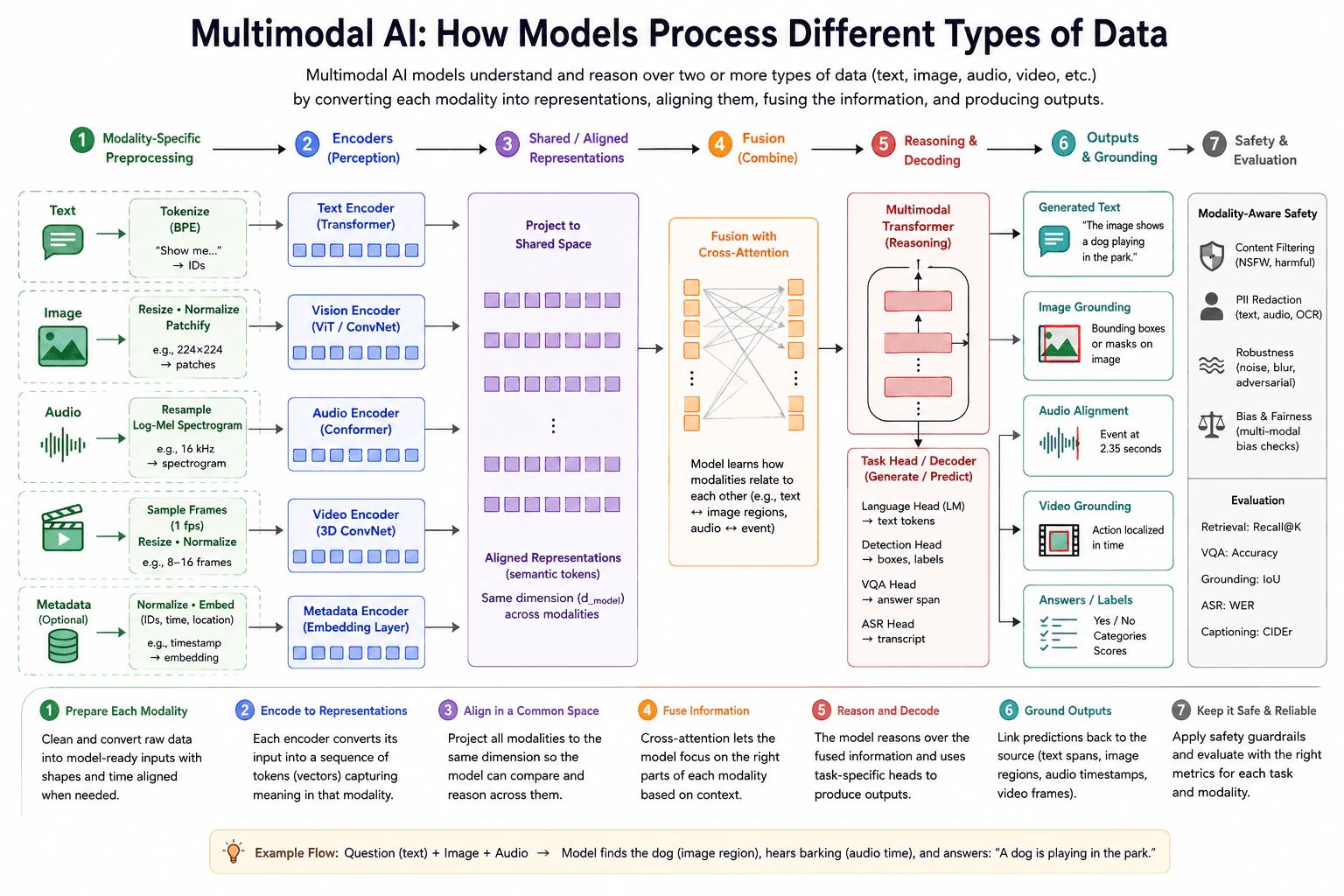
Frame the concept using modality-specific preprocessing, encoders, shared or aligned representations, fusion, decoding, grounding, and modality-aware safety.
Short Interview Answer (30-60 seconds)
Multimodal AI models work with two or more types of data, such as text, images, audio, and video. Each type is prepared and encoded in a way that fits that modality. The resulting representations are aligned into a compatible shared space and then combined, often with cross attention. The model reasons over the combined information and uses a decoder or task head to produce text, image regions, timestamps, labels, scores, or other results. In production, I would also consider grounding, modality aware safety, and evaluation that matches each task.
Detailed Explanation
A multimodal AI model can work with several kinds of information together. For example, a user might provide a written question, a picture, and an audio clip. The system first prepares each kind of input in the right form. It then turns each input into an internal representation that can be compared with the others. The system combines the useful information, uses it to understand the request, and produces a result. It can also connect that result back to evidence in the picture, sound, or video.
Useful Questions to Ask the Interviewer
Which input types and output tasks should the system support?
Does the system need grounded outputs such as image regions, audio timestamps, or video locations?
How to Explain It in an Interview
The easiest way to explain multimodal processing is to follow the data from input to output. First, each modality gets its own preprocessing. Text can be tokenized. Images can be resized, normalized, and divided into patches. Audio can be resampled and converted into a log Mel spectrogram. Video can be sampled into frames over time. Optional metadata can be normalized and embedded.
Next, a suitable encoder converts each modality into representations. A text encoder captures information from text. A vision encoder captures information from images. Audio, video, and metadata encoders do the same for their own inputs.
The system then projects these representations into a shared or aligned space. This gives the model compatible representations that it can compare and combine. A fusion method such as cross attention lets one modality focus on useful parts of another. For example, words in a question can focus on an image region or an audio event.
After fusion, a multimodal reasoning model works over the combined information. A task head or decoder then produces the required output. It may generate text, predict labels or scores, return image boxes, identify an audio event at a timestamp, or localize an action in video.
Grounding links a prediction back to source evidence, such as text spans, image regions, audio timestamps, or video frames. Safety also needs to match the modalities involved. Production systems may filter harmful content, redact private information, test robustness, and check bias. Evaluation should match the task. For example, retrieval can use Recall at K, visual question answering can use accuracy, grounding can use intersection over union, speech recognition can use word error rate, and captioning can use a caption quality metric.
Where it is used
Multimodal AI is useful when an application must understand related information from different data types. Common examples include visual question answering, assistants that accept text and images, speech systems that combine audio with text, video understanding, document systems that use written content with page images, and search systems that connect queries with media. Grounding is especially useful when the application must show where an answer came from, such as an image region, an audio timestamp, or a point in a video.
Why Interviewers Ask This
Interviewers ask this question to check whether a candidate understands how one AI system can work with text, images, audio, video, and metadata. They want the candidate to explain why each input type needs suitable preparation, how separate encoders create useful representations, how alignment and fusion combine information, and how grounding, safety, and evaluation affect a production design.
Common interview mistakes
A common mistake is assuming that raw text, images, audio, and video all use the same preparation path. Each modality usually needs suitable preprocessing and an encoder that matches that type of data. Another mistake is treating alignment and fusion as the same step. Alignment makes representations compatible, while fusion combines information across modalities. Candidates may also forget grounding, which links predictions to evidence such as image regions, audio timestamps, or video locations. Another mistake is assuming that one safety rule or one evaluation metric is enough for every modality and task.
Interview tip
Explain the system as one clear flow. Prepare each modality, encode it, align the representations, fuse useful information, reason over the combined data, decode the result, and ground the output. Then mention that safety and evaluation should match the modality and task. A simple example using a text question, an image, and audio makes the explanation easy to follow.
Interviewer may ask next
What happens if one modality is missing or very noisy during inference?
The system can only rely on the information that is available and usable. If the model was designed and trained to accept incomplete inputs, it may continue with the remaining modalities, but its confidence or quality can drop because it has less evidence. Noisy images, distorted audio, or incomplete video can also damage the representations created by their encoders. This matters because the fusion stage may combine weak evidence with stronger evidence. The main tradeoff is robustness versus added training, validation, and evaluation work.
Why use cross attention instead of simply joining all modality representations?
Cross attention lets the model choose which parts of one modality are useful for another modality. For example, words in a question can focus on relevant image regions or audio events. Simply joining representations can be simpler and may work for some tasks, but it gives the model a less direct way to model these relationships. This matters when precise interaction between modalities is important. The main tradeoff is that cross attention can provide richer fusion while using more computation and memory.
104. What are the key architectures for multi-modal models?Multimodal AiEasy
i Question Details
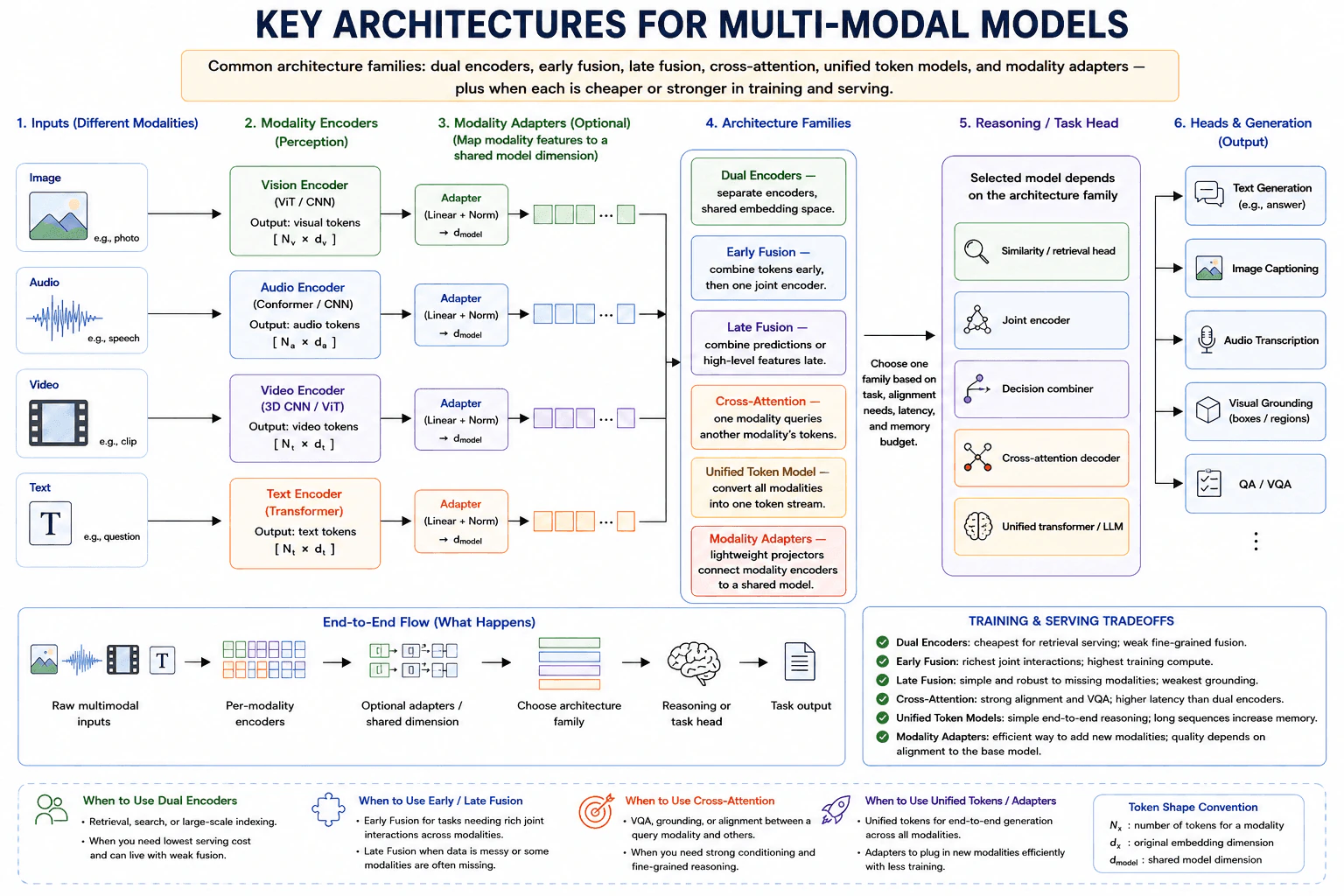
Keep the answer focused on dual encoders, early or late fusion, cross-attention, unified token models, modality adapters, and tradeoffs in training and serving.
Short Interview Answer (30-60 seconds)
The key architectures are dual encoders, early fusion, late fusion, cross attention, unified token models, and modality adapters. The main difference is where the modalities meet. Dual encoders are efficient for retrieval. Early fusion gives rich joint interaction. Late fusion is simple and handles missing inputs well. Cross attention is strong for grounding and visual question answering. Unified token models support shared reasoning and generation. Adapters make it easier to connect modality specific encoders to a shared model.
Detailed Explanation
A multimodal model works with more than one kind of input, such as text, images, audio, or video. The main architecture choice is where those inputs are combined. Some designs keep each modality separate for most of the pipeline. Other designs combine their information earlier so the model can reason across them more deeply. This choice affects serving speed, memory use, training cost, grounding quality, and how easily new modalities can be added. For example, image search often benefits from separate encoders, while visual question answering usually needs stronger interaction between text and image information.
Useful Questions to Ask the Interviewer
Is the main task retrieval, classification, grounding, question answering, or generation?
Is low serving latency more important than rich interaction between modalities?
Can some modalities be missing at inference time?
Do we need to add new modalities later?
How to Explain It in an Interview
I would explain the architectures by asking one question first: where do the modalities meet?
Dual encoders keep modalities separate. For example, an image encoder creates an image representation and a text encoder creates a text representation. Both are mapped into a shared embedding space. A similarity or retrieval head compares them. This is efficient for large retrieval systems because embeddings can be computed and stored before a request arrives. The limitation is weak fine grained interaction between modalities.
Early fusion combines modality tokens or features early and sends them through one joint encoder. This gives rich interaction because the model can learn relationships across modalities from the beginning. The tradeoff is higher training compute and memory use.
Late fusion keeps each modality mostly independent and combines high level features or predictions near the end with a decision combiner. It is simple and works well when some modalities may be missing. The tradeoff is weaker fine grained grounding.
Cross attention lets one modality query another modality's tokens. For example, text tokens can focus on relevant image regions. A cross attention decoder is useful for visual question answering and grounding. It usually costs more latency and memory than a dual encoder.
A unified token model converts all modalities into one compatible token stream and processes that stream with a shared transformer or language model. This supports strong end to end reasoning and generation. Long image, audio, or video sequences can make attention expensive in memory and latency.
Modality adapters are lightweight projection modules. They map modality encoder outputs into the shared model dimension. They are useful when connecting a new encoder to an existing shared model with less retraining. Their quality still depends on good alignment between the modality representation and the shared model.
Where it is used
Dual encoders are common in image and text retrieval, semantic search, and large scale indexing. Early fusion is useful when classification or understanding needs rich joint interaction. Late fusion is useful when modalities are independent, noisy, or sometimes missing. Cross attention is useful for visual question answering, grounding, captioning, and tasks where one modality must focus on specific parts of another. Unified token models are useful for general multimodal reasoning and generation. Modality adapters are useful when connecting new image, audio, or video encoders to an existing shared transformer or language model.
Why Interviewers Ask This
Interviewers ask this to see whether I understand where information from different modalities is combined and how that design choice affects retrieval quality, grounding, training cost, memory use, latency, and serving. They also want to know whether I can choose a suitable architecture for the task instead of treating every multimodal model as the same.
Common interview mistakes
A common mistake is saying all multimodal architectures behave the same because they accept several modalities. The fusion point changes both model behavior and cost. Another mistake is saying dual encoders provide deep interaction between modalities. They usually encode each modality separately and compare the resulting representations. It is also incorrect to assume early fusion is always best. It can provide rich interaction, but it usually costs more compute and memory. Another mistake is ignoring sequence length in unified token and cross attention models. Long video or audio inputs can increase latency and memory use. Finally, adapters do not guarantee good alignment. They only provide a learnable mapping into the shared model space.
Interview tip
Explain the answer around one decision: where do the modalities meet? Then connect each architecture to a practical use. Use dual encoders for efficient retrieval, early fusion for rich joint interaction, late fusion for simple independent processing, cross attention for grounding, unified tokens for shared reasoning, and adapters for flexible modality integration. Finish with training cost, serving latency, memory, and missing modality tradeoffs.
Interviewer may ask next
What happens if one modality is missing at inference time?
The impact depends on the architecture. Late fusion usually handles a missing modality most naturally because each modality is processed independently before the results are combined. Dual encoder systems can also continue with the available encoder when the task allows it. Early fusion, cross attention, and unified token models may need explicit masking, training with missing inputs, or another fallback representation. This matters because a model trained only on complete modality sets may behave poorly when production data is incomplete.
How would you choose between a dual encoder and a cross attention model in production?
I would choose a dual encoder when retrieval scale and low serving latency are the main goals. Its image, text, or other modality embeddings can be computed before the online request, so serving can use efficient similarity search. I would choose cross attention when the task needs fine grained alignment, grounding, or visual question answering because one modality can directly query relevant tokens from another. The tradeoff is higher online compute, memory use, and latency, especially for long input sequences.
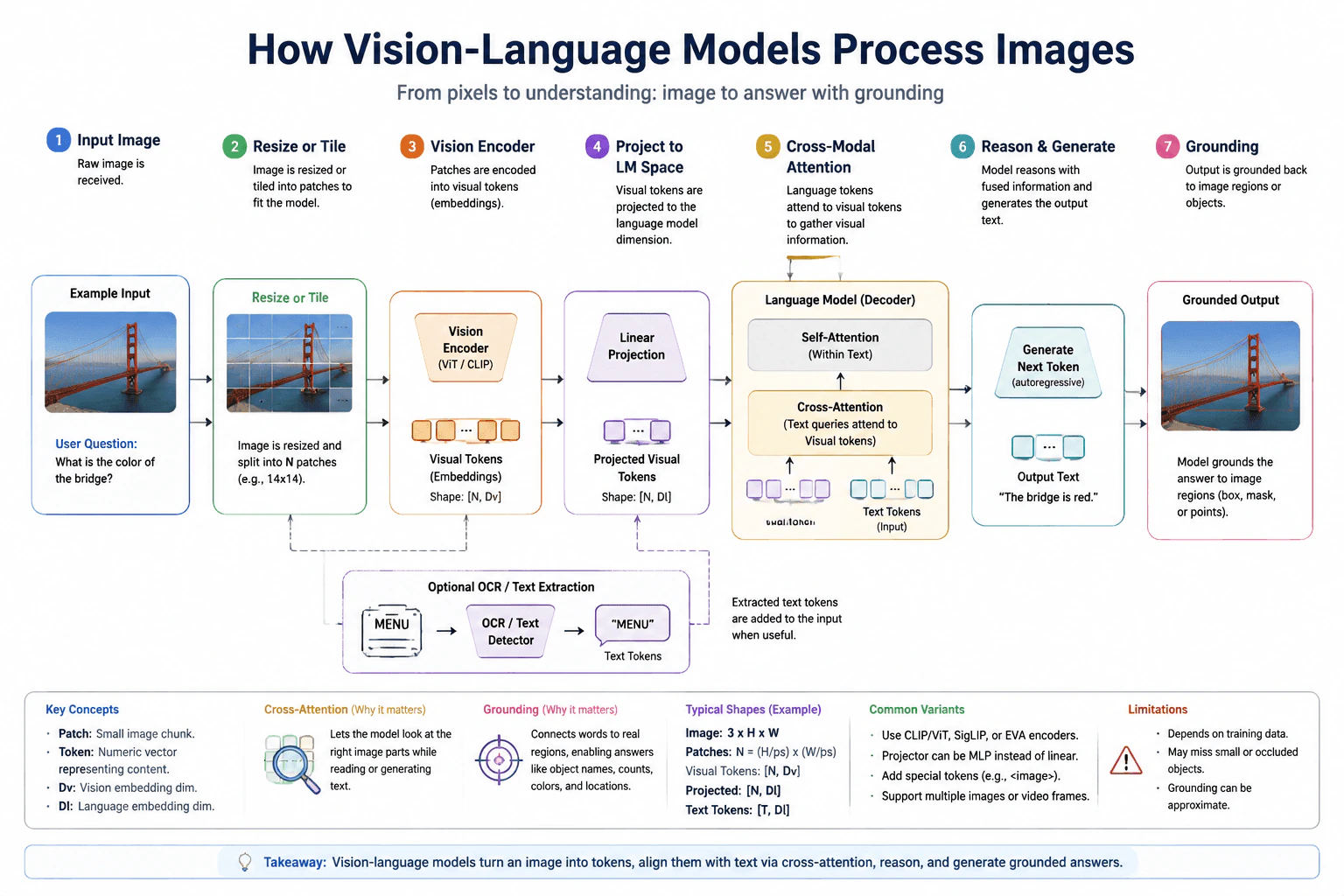
105. How do vision-language models process images?Multimodal AiEasy
i Question Details
Describe the data or control flow across image resizing or tiling, vision encoder outputs, projection into the language model, cross-modal attention, and grounding.
Short Interview Answer (30-60 seconds)
Vision language models process images by first resizing the image or splitting it into patches. A vision encoder converts those image patches into visual tokens. A projection layer maps the visual tokens into the language model space. The language model combines visual tokens with text tokens using cross modal attention and generates a response. If grounding is supported, the model can connect the answer back to image regions.
Detailed Explanation
A vision language model helps a computer understand images and answer questions about them. It changes image information into smaller pieces that the model can process. The model then combines image information with language to create an answer.
Useful Questions to Ask the Interviewer
Which vision language model architecture or provider should I focus on for this discussion?
Should I explain only the inference flow, or also include training and alignment?
How to Explain It in an Interview
A vision language model starts with an image input. The image is resized or divided into patches. This makes the image easier for the model to process.
The vision encoder converts these patches into visual tokens. Visual tokens are numerical representations that contain information about the image. A projection layer changes these visual tokens into the same space used by the language model.
The language model receives visual tokens and text tokens together. Cross modal attention helps the model connect text words with important visual information. For example, when a user asks about the color of a bridge, the model can focus on the image regions containing the bridge and generate an answer.
After reasoning over the combined information, the language model generates text output. When grounding is available, the model can link the answer back to image regions using locations such as boxes, masks, or points.
In production, vision language models are used for visual assistants, document understanding, image search, and image based question answering. Higher image resolution can improve understanding, but it creates more visual tokens and increases memory use, latency, and cost. Models can also fail when objects are too small, hidden, or when grounding predictions are approximate.
Where it is used
Vision language models are used in visual assistants, document understanding systems, image search, accessibility applications, customer support automation, and systems that answer questions about images. They can analyze screenshots, forms, charts, and real world scenes.
Why Interviewers Ask This
Interviewers ask this question to check if the candidate understands how a vision language model converts image data into information that a language model can use. They evaluate knowledge of image preprocessing, vision encoders, visual tokens, projection layers, cross modal attention, and grounding. They also want to know if the candidate understands practical production tradeoffs such as image detail, latency, memory use, and grounding limitations.
Common interview mistakes
Common mistakes include saying the language model reads pixels directly, skipping the vision encoder step, confusing training alignment with inference behavior, and assuming grounding is always exact. Another mistake is ignoring the tradeoff between higher image resolution and increased computation cost.
Interview tip
Explain the complete flow from image input to final answer. Start with preprocessing, then explain visual tokens, projection, cross modal attention, generation, and grounding. Use a simple image question example to show how the parts work together.
Interviewer may ask next
What happens when an important object is very small in the image?
A small object may be lost during resizing or tiling, which can reduce the quality of the model response. Increasing image resolution or using better tiling can preserve details, but it increases the number of visual tokens, memory use, and latency. The tradeoff is better accuracy versus higher production cost.
How does increasing image resolution affect a vision language model in production?
Increasing image resolution usually creates more visual tokens. This can improve image understanding because the model receives more detail, but it increases computation, memory usage, and response time. Production systems choose a suitable resolution based on accuracy, latency, and cost requirements.
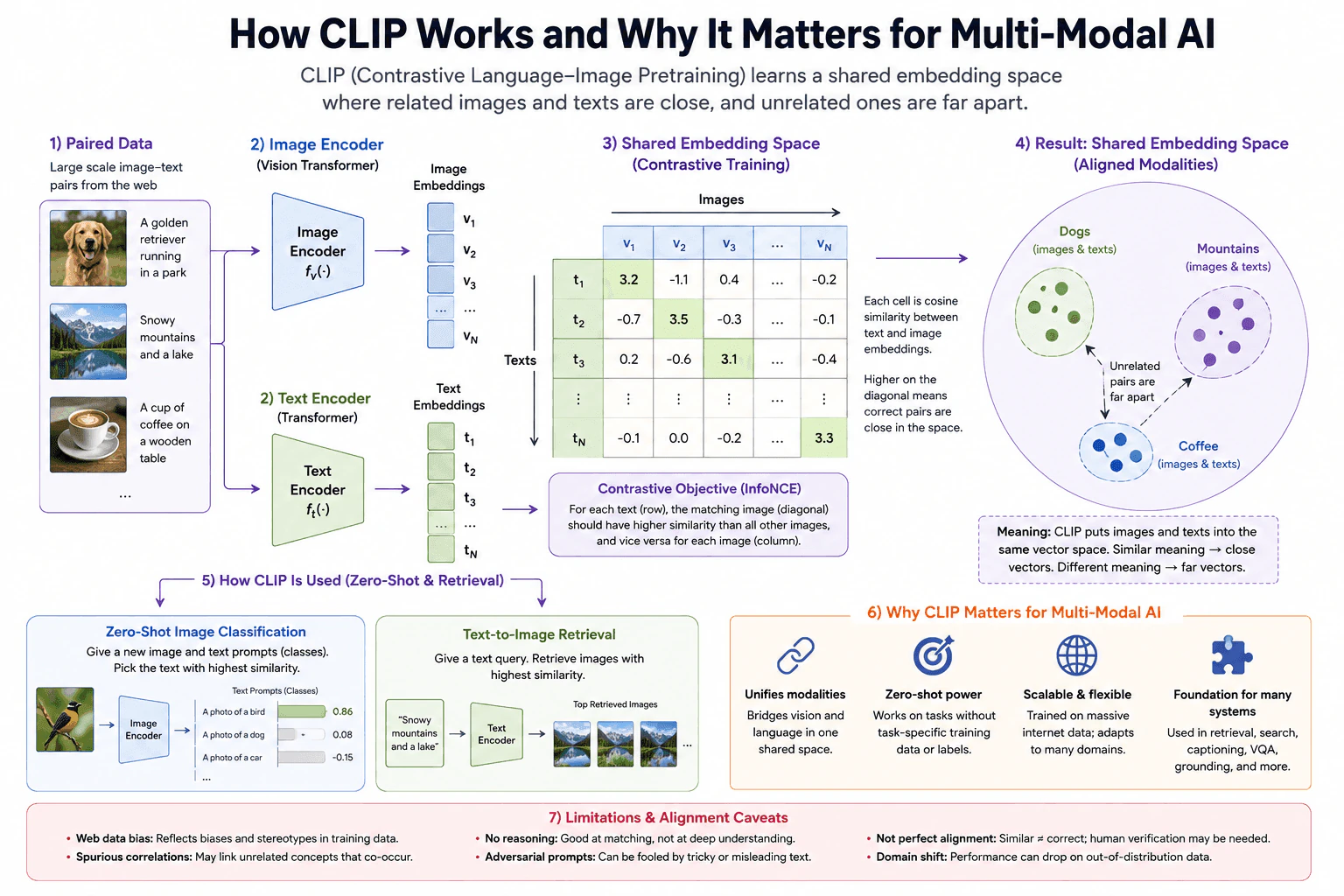
106. How does CLIP work, and why is it important for multi-modal AI?Multimodal AiEasy
i Question Details
Work through contrastive image-text training, paired encoders, shared embedding space, retrieval or zero-shot use, and known alignment limitations without drifting into adjacent topics.
Short Interview Answer (30-60 seconds)
CLIP learns to place matching images and text close together in one shared embedding space. It uses one encoder for images and another for text. During contrastive training, it compares many paired examples and makes matching pairs score higher than mismatched pairs. After training, we can compare a new image with text prompts for zero shot classification, or compare a text query with stored image embeddings for retrieval. It matters because it gives vision and language a common representation, but similarity is not the same as true understanding, so bias, misleading correlations, adversarial text, and domain shift still matter.
Detailed Explanation
CLIP teaches a computer to connect pictures with words that describe them. For example, a photo of a dog should match words about that dog more strongly than words about mountains or coffee. It learns from many picture and text pairs. Later, it can compare a new picture with possible descriptions, or compare a written request with many pictures. This is useful when one system needs to work with both pictures and language without training a separate model for every simple task.
Useful Questions to Ask the Interviewer
Should I explain both training and inference use?
Do you want me to cover both zero shot classification and retrieval?
Should I include the main alignment limitations?
How to Explain It in an Interview
CLIP uses two separate encoders. The image encoder converts an image into an image embedding. An embedding is a vector that represents useful meaning. The text encoder converts a caption or prompt into a text embedding in the same vector space.
During contrastive training, a batch contains matching image and text pairs. CLIP compares every image embedding with every text embedding using scaled cosine similarity. The comparison forms a similarity matrix. Correct image and text pairs lie on the matching diagonal. The contrastive objective, often described as an InfoNCE style objective, raises the relative score of each correct pair and lowers the relative score of mismatched pairs. The loss works in both directions. Each image should prefer its matching text, and each text should prefer its matching image.
The result is a shared embedding space. Images and text with similar meaning tend to be close together, while unrelated items tend to be farther apart.
At inference time, this supports two important uses. For zero shot image classification, encode a new image and several class prompts, such as a photo of a bird, a photo of a dog, and a photo of a car. Choose the prompt with the highest similarity. For text to image retrieval, encode a text query and return images whose embeddings have the highest similarity.
CLIP is important because one learned space connects vision and language and supports retrieval, search, classification, and other systems that use aligned image and text representations. The main tradeoff is imperfect alignment. Web data can contain bias and stereotypes. The model can learn spurious correlations. Tricky wording can mislead it. Similarity does not prove deep reasoning or factual correctness. Performance can also drop when production data is very different from the training distribution, so real domain evaluation and human review can still be necessary.
Where it is used
CLIP style embeddings are useful when a production system needs to compare images with natural language. Common examples include text to image search, image retrieval, zero shot image classification, content organization, and ranking images against user queries. The shared representation can also be one component inside a larger multimodal system. For retrieval, teams can precompute image embeddings for a fixed collection, then encode each incoming text query and compare it with the stored vectors. For sensitive or unfamiliar domains, teams should test the real production data because similarity scores can reflect bias, spurious correlations, weak alignment, or domain shift.
Why Interviewers Ask This
Interviewers ask this to check whether a candidate understands how images and text can be learned together while still using separate encoders. They want to hear about paired image and text data, the shared embedding space, contrastive training, similarity based retrieval, and zero shot use. They also want production judgment. A strong candidate should explain that a high similarity score is useful but does not guarantee true understanding, because training data can contain bias, misleading correlations, adversarial wording, and examples that differ from the training distribution.
Common interview mistakes
A common mistake is saying that CLIP combines raw image pixels and text tokens inside one encoder. The diagram uses separate image and text encoders that meet through their embeddings. Another mistake is saying CLIP learns only from matching pairs. The contrastive objective also compares each item with mismatched items in the batch, so correct pairs become relatively more similar. Candidates also sometimes describe zero shot classification as a new training step. It is an inference comparison between an image embedding and candidate text prompt embeddings. Another mistake is treating the highest similarity as guaranteed truth. Similarity can still be wrong because of bias, spurious correlations, adversarial wording, imperfect alignment, or domain shift.
Interview tip
Explain CLIP in four steps. First, say there are separate image and text encoders. Second, explain that contrastive training makes matching pairs score higher than mismatched pairs. Third, say this creates a shared embedding space that supports retrieval and zero shot classification. Fourth, end with the limitation that semantic similarity is useful but does not guarantee reasoning, factual correctness, or perfect alignment.
Interviewer may ask next
What can go wrong even when CLIP gives a very high similarity score?
A high similarity score can still be wrong because CLIP learns statistical alignment rather than guaranteed understanding. Web training data can contain bias, stereotypes, and spurious correlations. A model may associate two concepts because they often appeared together, not because it understands a causal relationship. Adversarial or misleading text can also produce bad matches. Domain shift matters too, because inputs that differ from the training distribution may produce weaker embeddings. This is why sensitive production uses should test real domain data and should not treat similarity alone as proof that a match is correct.
How would you use CLIP for zero shot classification or large scale retrieval in production?
For zero shot classification, encode the new image and encode one text prompt for each candidate class, then choose the text embedding with the highest similarity to the image embedding. For retrieval, precompute and store image embeddings for the collection. When a text query arrives, encode the query once and search for image embeddings with the highest similarity. Precomputing the fixed image side avoids running the image encoder for every query. The main tradeoff is that retrieval quality still depends on prompt wording, embedding quality, domain match, and the limits of the learned alignment.
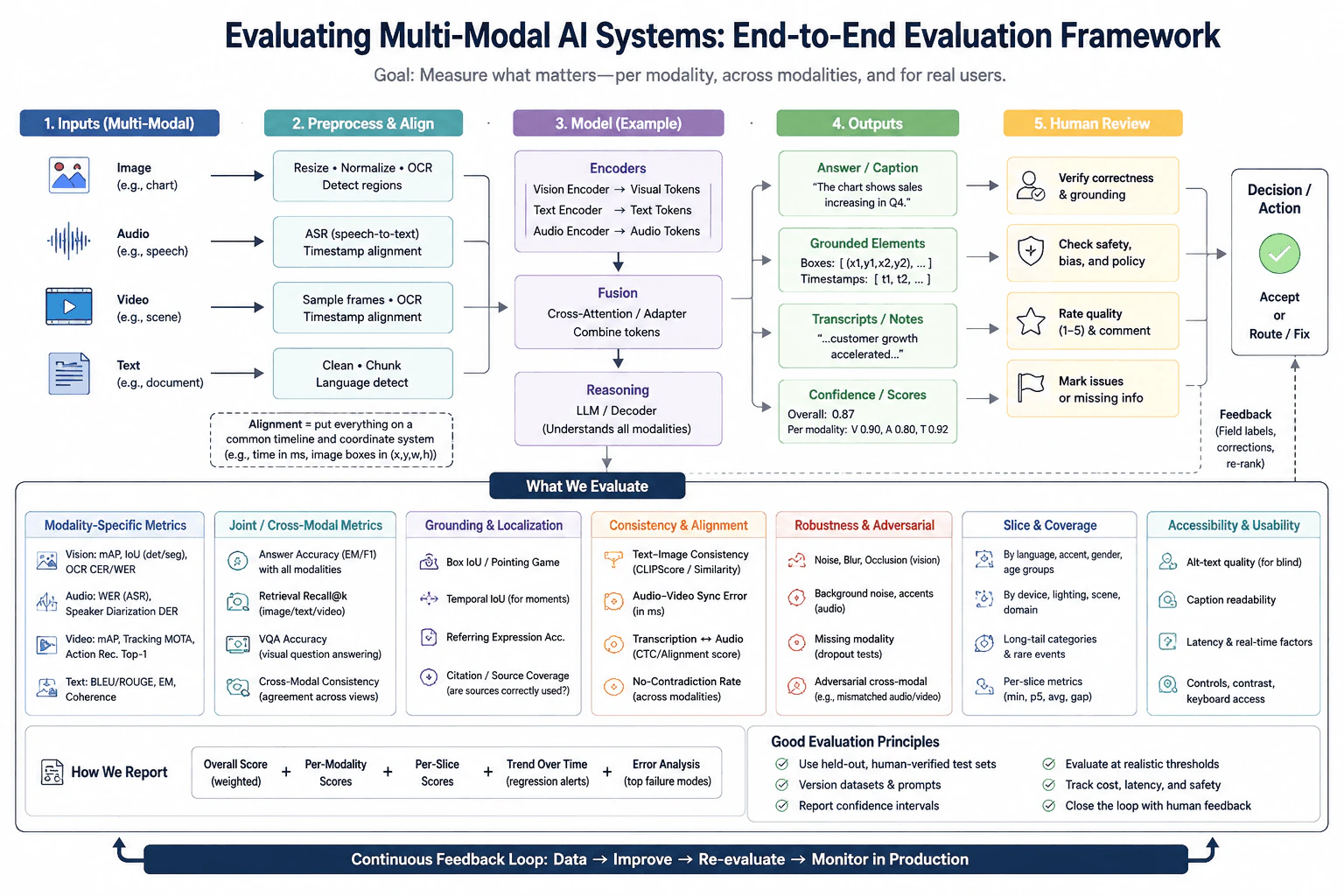
107. How do you evaluate multi-modal AI systems?Multimodal AiMedium
i Question Details
Explain how the system would manage modality-specific and joint metrics, grounding, consistency, human review, accessibility, adversarial cross-modal cases, and slice coverage.
Short Interview Answer (30-60 seconds)
I would evaluate a multimodal system in layers. First, I would define representative data and important slices. Then I would measure each modality separately, measure the combined task, and test grounding, alignment, and consistency across modalities. I would add robustness tests for noise, missing inputs, and conflicting inputs, plus accessibility checks and human review. I would report overall results together with modality scores, slice scores, trends, and failure modes. The release decision should use this full scorecard, not one average number.
Detailed Explanation
A multimodal system can understand an image correctly but fail on speech, timing, or the final combined answer. I would therefore evaluate every stage that matters to the user. I would start with realistic test data and divide it into important groups such as language, accent, device, lighting, scene type, difficulty, and rare events. Then I would measure each input type, how the inputs work together, whether the answer points to the right evidence, and whether people can use the result safely and accessibly. The final report should show both averages and hidden weak areas.
Useful Questions to Ask the Interviewer
Which modalities are supported in production, such as image, audio, video, and text?
What user task matters most, such as question answering, captioning, search, extraction, or classification?
Do we have trusted labels for regions, timestamps, transcripts, sources, and final answers?
Which languages, accents, devices, environments, and user groups must the evaluation cover?
How to Explain It in an Interview
I would first define the evaluation data and slice coverage. A slice is a meaningful group of examples, such as one language, accent, device, lighting condition, scene type, difficulty level, demographic group, or rare event. This matters because a strong average can hide a serious failure for one group.
Next, I would test each modality separately after its normal preprocessing and alignment. For images, useful metrics can include detection or segmentation mAP, region IoU, and OCR character or word error rate. For audio, I can use ASR word error rate and speaker diarization error rate when speaker separation matters. For video, I can measure detection mAP, tracking MOTA, action recognition accuracy, and temporal localization. For generated text, metrics such as exact match, BLEU, ROUGE, or coherence can be used only when they fit the task.
Then I would test the joint system. The model may encode vision, text, and audio separately, combine them through fusion such as cross attention or adapters, and then reason over the combined representation. I would measure final answer accuracy with metrics such as exact match or F1 when appropriate, retrieval Recall at k for multimodal search, VQA accuracy for visual question answering, and direct cross modal consistency checks.
Grounding checks whether the output is supported by the right evidence. For images, I can compare predicted regions with labeled regions using box IoU or a pointing style test. For video, I can use temporal IoU for the correct time span. I can also measure referring expression accuracy and whether citations or source references point to the evidence actually used.
Consistency and alignment need separate tests. Examples include text and image similarity when that score is meaningful for the task, audio and video synchronization error in milliseconds, transcription alignment with audio, and contradiction checks across modalities. I would also change input order, sampling, crops, or other presentation details that should not change the meaning and measure whether the result stays stable.
Robustness testing should include blur, occlusion, image noise, background audio noise, accents, missing modalities, and adversarial cross modal cases such as mismatched audio and video or a misleading caption attached to an image. These cases show whether one modality incorrectly dominates the others or whether the system handles incomplete evidence safely.
Human review is still important. Reviewers can verify correctness and grounding, check safety, bias, and policy concerns, rate overall quality, and mark missing information. Human findings can decide whether a result is accepted or routed for correction and can create labels for later evaluation and reranking.
Accessibility should be measured as part of product quality. Examples include useful alternative text, caption readability, controls and contrast, keyboard access, and latency when the experience must work in real time.
Finally, I would report a weighted overall score only as a summary. I would always keep the individual modality scores, per slice scores, trends over time, and error analysis beside it. I would use held out and human verified test sets, version the datasets and prompts, report confidence intervals when appropriate, evaluate at realistic thresholds, and track cost, latency, and safety. The feedback loop is data, improvement, reevaluation, and production monitoring.
Where it is used
This approach is used for visual question answering, image and document assistants, multimodal search, meeting assistants that combine speech and visual content, video understanding systems, accessibility features, and applications that combine text with sensor information. It is most useful before release and during production monitoring because it can reveal whether failures come from one modality, the fusion step, grounding, reasoning, a particular user slice, or difficult real world conditions.
Why Interviewers Ask This
Interviewers ask this question to see whether you can evaluate a system that combines images, audio, video, and text without hiding failures behind one final score. They want to know whether you can separate perception errors from fusion and reasoning errors, choose metrics that fit each modality and task, test grounding and consistency, cover important user slices, use human review, and turn evaluation results into safe production decisions.
Common interview mistakes
A common mistake is using one overall accuracy number and ignoring the modality and slice breakdowns. Another mistake is measuring the final answer without checking whether it is grounded in the correct image region, transcript, source, or video time span. Teams can also choose familiar metrics that do not match the real task, treat similarity scores as proof of correctness, or forget timing alignment. Other mistakes include skipping missing modality tests, mismatched cross modal inputs, noise, rare events, accessibility, and human review. Reusing development examples too often can also make reported results look better than true production performance.
Interview tip
Explain the framework in the same order that data moves through the system. Start with representative inputs and slices. Then cover preprocessing and alignment, modality metrics, joint metrics, grounding, consistency, robustness, accessibility, and human review. Finish with the scorecard and release decision. Emphasize that no single metric proves a multimodal system is good. Strong evaluation shows where it fails and creates a feedback loop for the next version.
Interviewer may ask next
How would you evaluate the system when one modality is missing or conflicts with another modality?
I would create explicit missing modality and conflicting modality test sets. For example, I could remove audio, remove an image, pair the wrong audio with a video, or attach a misleading caption to an image. I would measure task accuracy, grounding, consistency, and the system response to uncertainty. This matters because real production inputs can be incomplete or contradictory. The main tradeoff is that these cases require careful labels and more evaluation data, but they reveal cross modal failures that ordinary test examples often miss.
How would you decide whether the system is ready for production if the overall score is high but one slice performs poorly?
I would not approve the release from the overall score alone. I would compare the weak slice with the acceptance threshold for that user group or operating condition and examine the failure severity. I would also review modality scores, grounding errors, safety risk, latency, and human findings. The exact action could be to block the release, limit the feature, route affected cases for correction, or improve the data and model before reevaluation. The tradeoff is slower release speed in exchange for lower production risk.
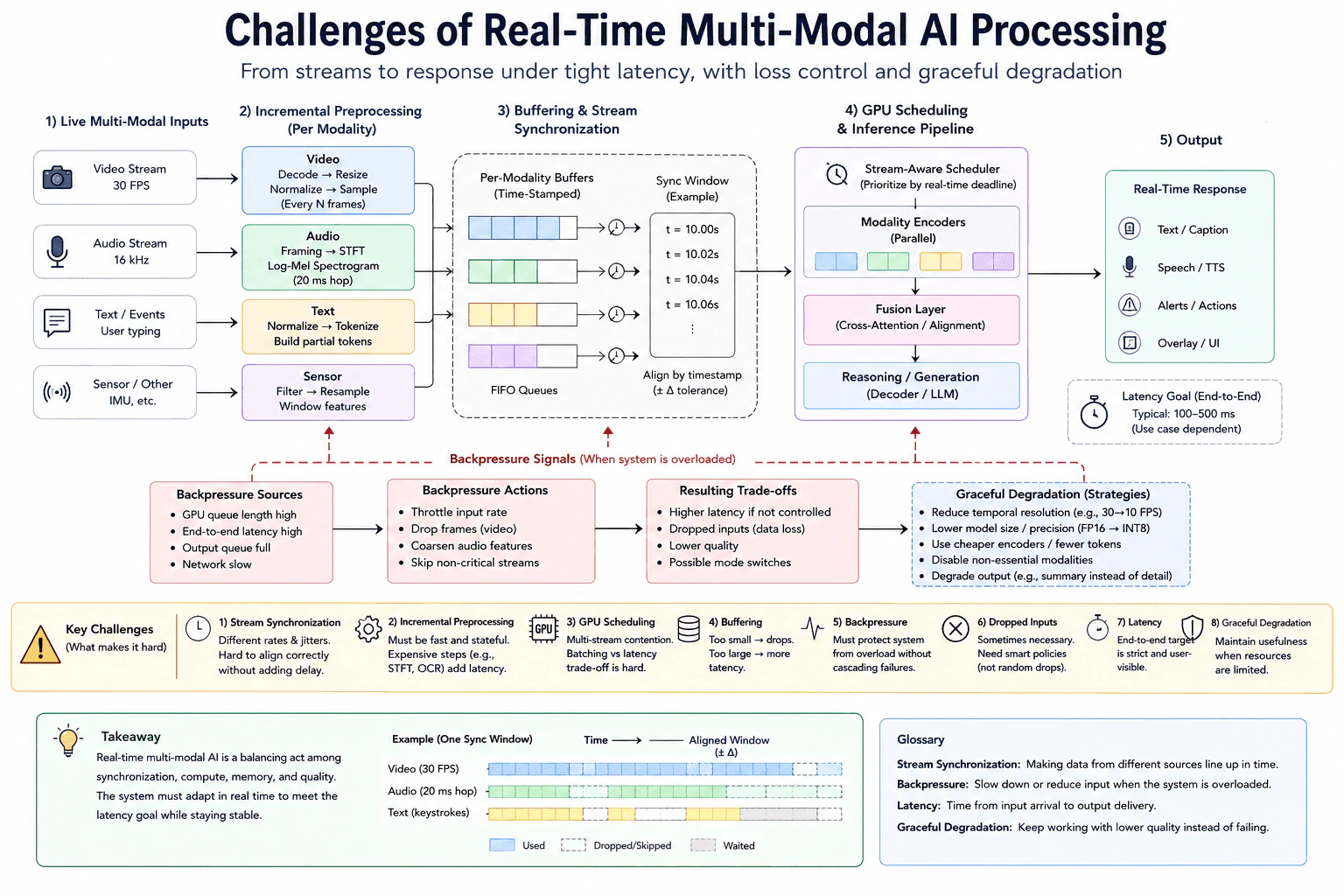
108. What are the challenges of real-time multi-modal AI processing?Multimodal AiMedium
i Question Details
Clarify the relationships among stream synchronization, incremental preprocessing, GPU scheduling, buffering, backpressure, latency, dropped inputs, and graceful degradation.
Short Interview Answer (30-60 seconds)
The main challenge is keeping several live streams aligned while still meeting the latency goal. Video, audio, text, and sensor inputs arrive at different rates, so I would timestamp them, preprocess them incrementally, keep bounded buffers, and align nearby timestamps within a small tolerance. GPU work should favor urgent real time requests. If queues or latency grow, I would apply backpressure, reduce input work, drop stale or noncritical data using a clear policy, and gracefully reduce quality instead of letting the whole pipeline become slow or unstable.
Detailed Explanation
Real time multimodal AI must combine several live inputs without making the user wait too long. Video, audio, text, and sensor data arrive at different rates and may be delayed or missing. The system must line them up in time, process small pieces as they arrive, and keep queues from growing without limit. It also has to share GPU capacity across urgent work. When load becomes too high, it should reduce incoming work or quality in a controlled way instead of letting latency grow until the service becomes unusable.
Useful Questions to Ask the Interviewer
What end to end latency target should the system meet?
How much timestamp difference is acceptable when aligning modalities?
Which modalities are required, and which ones may be reduced or skipped during overload?
How to Explain It in an Interview
I would explain the system as one continuous flow. Live video, audio, text, and sensor inputs first arrive at different rates. Each item gets a timestamp so the system can reason about when it happened.
Preprocessing should happen incrementally. That means processing small pieces as they arrive instead of waiting for a large complete input. Video can be decoded, resized, normalized, and sampled every few frames. Audio can be framed and converted to features such as a log mel spectrogram. Text can be normalized and tokenized as partial input arrives. Sensor data can be filtered and resampled.
Each modality then enters a bounded time stamped buffer. The synchronization step selects items whose timestamps fall inside the same allowed time window. Waiting for perfect alignment can increase latency, while loose alignment can reduce fusion quality. Buffer size has the same tradeoff. A buffer that is too small may drop useful inputs. A buffer that is too large adds memory use and lets old work increase latency.
The GPU scheduler must share accelerator capacity across modality encoders, fusion, and reasoning. Parallel encoders can help use the GPU, but large batches or long jobs can delay urgent requests. Scheduling therefore has to balance throughput with real time deadlines.
Backpressure controls overload. Signals such as a long GPU queue, high end to end latency, a full output queue, or a slow network indicate that downstream work cannot keep up. The application can then throttle input, drop some video frames, coarsen audio features, or skip noncritical streams.
Dropped inputs should follow an explicit policy. Random drops can damage temporal alignment or remove important information. Stale or less important work is usually a better drop target when the product allows it.
Graceful degradation keeps the service useful when resources are limited. The system can lower temporal resolution, use lower precision when supported, use cheaper encoders, process fewer tokens, disable nonessential modalities, or return a simpler result. When load falls, normal quality can be restored. The overall goal is to balance synchronization, compute, memory, quality, and latency while keeping the pipeline stable.
Where it is used
This design is useful in live assistants that combine camera and microphone input, meeting systems that produce captions or actions, robotics systems that combine vision and sensors, accessibility tools, interactive media systems, and live monitoring applications. These systems need results while the input is still arriving, so they must control synchronization delay, queue growth, accelerator use, and overload behavior continuously.
Why Interviewers Ask This
Interviewers ask this to see whether a candidate understands the full real time multimodal pipeline, not only the model. They are testing judgment about stream timing, incremental preprocessing, bounded queues, GPU scheduling, backpressure, latency, dropped inputs, and graceful degradation. A strong answer should show how these parts affect one another during normal load and overload, and how the system stays responsive when compute, memory, or input capacity becomes limited.
Common interview mistakes
One mistake is waiting for every modality to arrive perfectly before processing anything. That can add unnecessary latency. Another is using unbounded buffers, which can increase memory use and turn a temporary slowdown into a growing backlog of stale work. A third mistake is maximizing GPU batch size without considering the wait needed to build the batch. Randomly dropping inputs is also risky because it can break synchronization or remove important information. Finally, graceful degradation should be an explicit policy with a known order of reductions, not an uncontrolled failure response.
Interview tip
Explain the answer as one end to end flow. Start with asynchronous inputs and timestamps. Then cover incremental preprocessing, bounded buffering, and synchronization. Next explain GPU scheduling and the throughput versus latency tradeoff. Finish with overload handling through backpressure, deliberate dropping, and graceful degradation. Make the key point that the goal is not to process every input at maximum quality. The goal is to keep the response timely, stable, and useful.
Interviewer may ask next
What should happen if one modality arrives late or temporarily stops?
The pipeline should not wait forever for that modality. The synchronization stage should wait only within its allowed time tolerance. After that point, the application can continue with the available modalities if the model and product contract support missing inputs, or return a partial result. If the missing modality is required, the system can return an explicit unavailable state instead of silently using mismatched data. The tradeoff is that waiting longer may improve completeness, but it also increases end to end latency and buffer pressure.
How would you keep latency under control during a sudden increase in load?
I would react before queues become large. The system should watch end to end latency, GPU queue length, output queue pressure, and other overload signals. When thresholds are crossed, backpressure can throttle incoming work, video sampling can be reduced, audio features can be coarsened, stale inputs can be dropped, and noncritical modalities can be skipped. If pressure continues, graceful degradation can use fewer tokens, cheaper processing, or simpler output. The tradeoff is lower detail or quality, but the system remains responsive and stable.
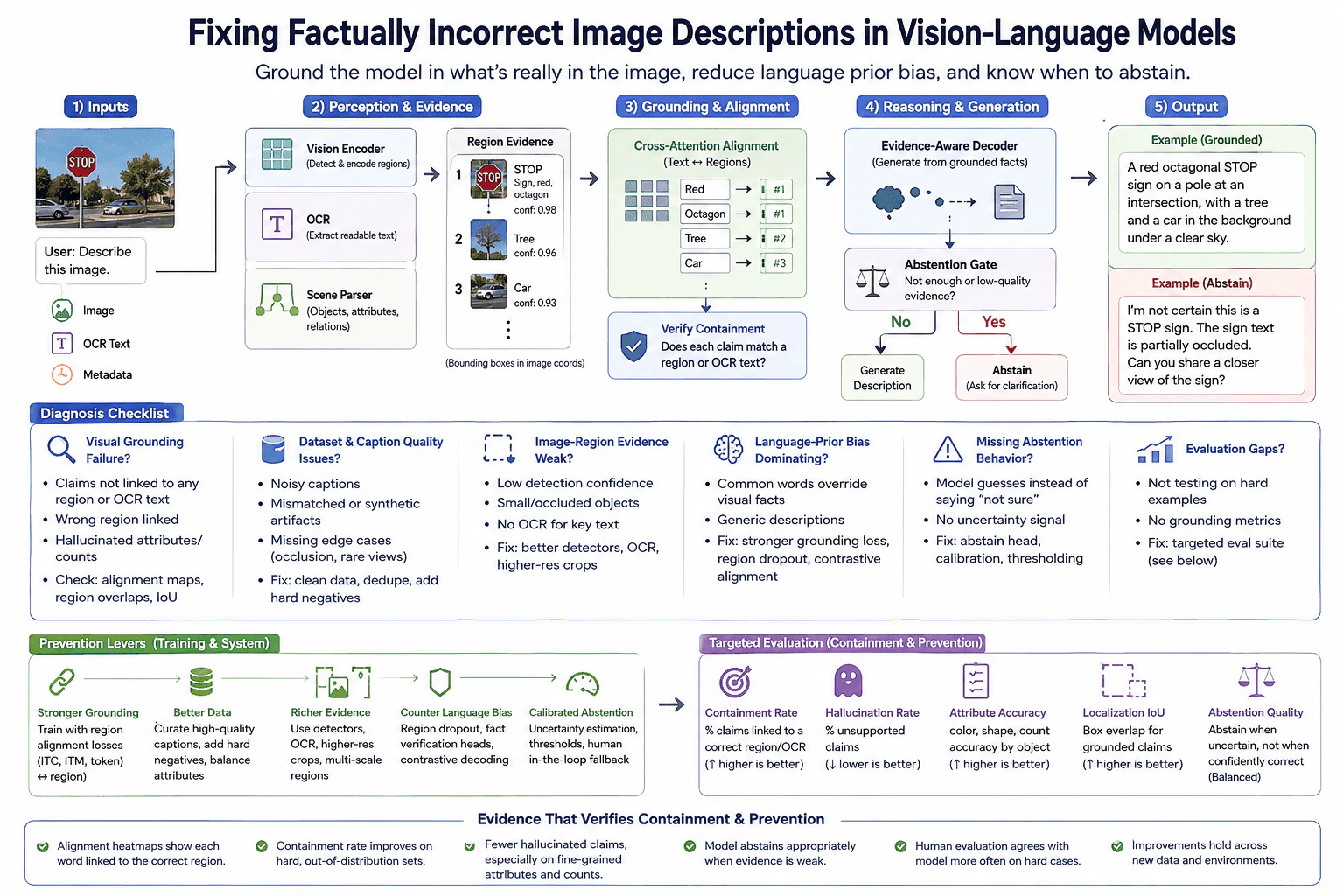
109. Your vision-language model generates factually incorrect image descriptions. How do you fix it?Multimodal AiHard
i Question Details
The diagnosis must cover visual grounding, dataset and caption quality, image-region evidence, language-prior bias, abstention, and targeted evaluation; it should also identify evidence that verifies containment and prevention.
Short Interview Answer (30-60 seconds)
I would first check whether every important claim is supported by a real image region or OCR text. Then I would fix the weak part of the system. I would clean poor captions, strengthen region grounding, reduce language prior bias, and add calibrated abstention when evidence is weak. Finally, I would measure containment rate, hallucination rate, attribute accuracy, localization IoU, and abstention quality on hard and new examples to prove the problem is contained and less likely to return.
Detailed Explanation
The model is describing things that the image does not really support. I would trace each wrong statement back to visible evidence. For example, if the model says a stop sign is blue, I would check the sign region, its color, and any readable text. Then I would find whether the problem comes from weak image evidence, bad training captions, or the model relying too much on common language patterns. If the evidence is weak, the system should say it is uncertain instead of guessing. I would then test hard images to prove the change works.
Useful Questions to Ask the Interviewer
Are the errors mostly invented objects, wrong attributes, wrong counts, or incorrect OCR text?
Do we have region annotations, OCR output, confidence signals, and hard evaluation examples?
How to Explain It in an Interview
I would diagnose the system from perception to output.
First, the vision encoder should detect useful visual information. A scene parser or region detector should identify objects, attributes, and relationships. OCR should extract readable text when text matters. These steps create the region evidence that later claims must use.
Next, I would check visual grounding. Grounding means linking each generated claim to the image region or OCR text that supports it. Cross attention alignment can connect words such as red, octagon, tree, and car to their matching regions. I would verify containment by asking whether every factual claim can be traced to correct visual evidence. A claim with no supporting region is a warning sign.
Then I would inspect the dataset. Noisy captions, mismatched image and caption pairs, duplicate examples, and missing hard cases can teach bad shortcuts. I would clean and deduplicate captions, add hard negative examples, and use stronger region alignment supervision when available.
I would also check language prior bias. This happens when the decoder chooses a common phrase because it sounds likely even when the image does not support it. I can reduce this with stronger grounding losses, region dropout, verification steps, contrastive decoding, or other controls that favor visible evidence.
At inference time, I would use an evidence aware decoder and an abstention gate. If evidence is strong, generate the description. If evidence is weak or low quality, abstain or ask for clarification instead of guessing.
Finally, I would run targeted evaluation. I would measure containment rate, hallucination rate, attribute accuracy, localization IoU, and abstention quality. I would also inspect alignment maps and test hard and new examples. Success means more claims link to correct regions, unsupported claims decrease, the model abstains when evidence is weak, human review agrees more often, and the gains continue on new data.
Where it is used
This approach is useful in image captioning, visual question answering, document understanding, product image descriptions, accessibility systems, inspection systems, and other applications where generated text must stay tied to visible evidence. It is especially important when wrong objects, attributes, counts, or OCR text could mislead a user.
Why Interviewers Ask This
Interviewers want to see whether I can trace a wrong image description back to its real cause instead of only changing the prompt. They are testing whether I understand visual grounding, image region evidence, caption quality, language prior bias, uncertainty, abstention, and multimodal evaluation. They also want to know whether I can prove that a change contains the current problem and helps prevent the same failure on new data.
Common interview mistakes
A common mistake is to change only the prompt and assume the factuality problem is solved. Another mistake is to measure only fluent captions instead of checking whether each claim is supported by an image region or OCR text. Teams may ignore noisy captions, weak region evidence, missing OCR, language prior bias, or poor hard case coverage. Another mistake is forcing the model to answer every time. Without calibrated abstention, it may confidently guess when evidence is weak. Testing only easy examples can also hide the problem.
Interview tip
Explain the answer as one flow. Start with the wrong claim, trace it to region or OCR evidence, diagnose the weak grounding or data source, reduce language prior bias, add abstention for weak evidence, and finish with measurements that prove containment and prevention. Use one stop sign example so the interviewer can follow every step.
Interviewer may ask next
What should the system do when the important object is small, partly hidden, or the OCR text is unclear?
It should not treat weak evidence as a confirmed fact. I would use better region proposals, higher resolution crops, stronger OCR when text matters, and calibrated confidence signals. If the evidence still does not support the claim, the abstention gate should return an uncertain response or ask for a clearer image. This matters because forcing a description in a weak evidence case creates the same factual error we are trying to prevent.
What is the main tradeoff when you make the model abstain more often?
The main tradeoff is factual safety versus answer coverage. A stricter uncertainty threshold can reduce unsupported claims, but it can also make the model abstain on some cases that it could have answered correctly. I would tune the threshold on representative evaluation data and measure hallucination rate together with abstention quality. The goal is to abstain when evidence is weak while still answering when the image provides strong support.
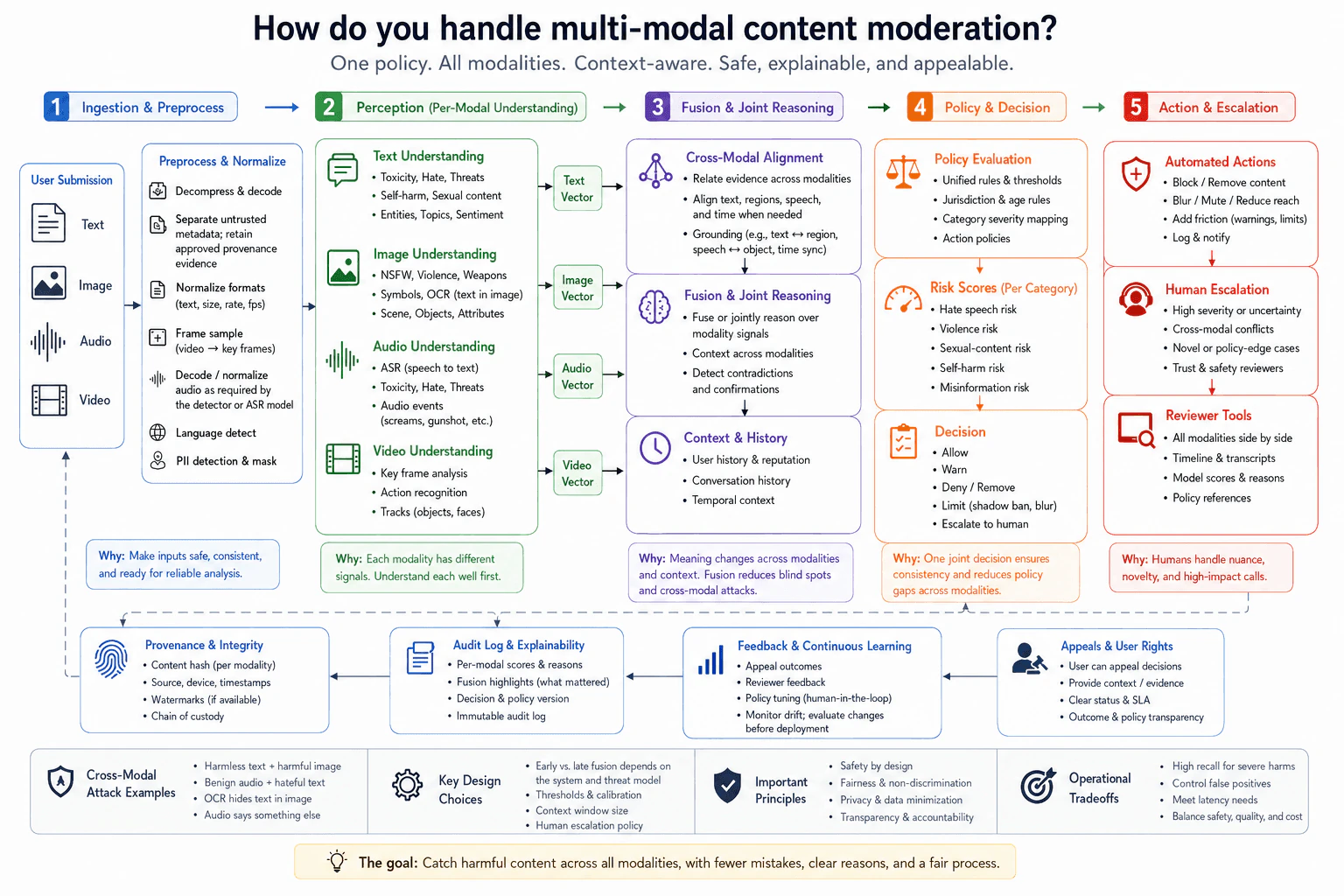
110. How do you handle multi-modal content moderation?Multimodal AiHard
i Question Details
Walk through the choices involved in text-image-audio joint policy, cross-modal attacks, detection stages, context, human escalation, provenance, and appeals.
Short Interview Answer (30-60 seconds)
I would use one consistent policy across supported media, but I would first understand each modality with the right detectors. Text, images, audio, and video produce separate evidence. I would then relate that evidence across modalities, add allowed context, and evaluate category specific risk before applying policy. Low risk cases can be handled automatically. Severe, uncertain, conflicting, or novel cases should go to human review. I would keep provenance and audit evidence, support appeals, and evaluate policy or model changes before deployment.
Detailed Explanation
A good moderation system should judge the complete meaning of a submission, not each part alone. For example, harmless words can become dangerous when paired with an image, while a harmless looking image can hide harmful text. I would first examine each media type, then relate the evidence across them, add useful context, and finally apply one consistent policy. Serious, uncertain, conflicting, or unusual cases should go to a person. I would also keep enough evidence about the decision for later review, auditing, and appeals while limiting unnecessary personal data.
Useful Questions to Ask the Interviewer
Which media types and harm categories must the system support?
Which cases require immediate blocking, reduced reach, added friction, or human review?
What user, conversation, age, and jurisdiction context may be used?
What provenance and decision evidence must be kept for audits and appeals?
How to Explain It in an Interview
I would describe the system as five connected stages.
First, ingest and normalize the submission. Decode supported media, normalize formats, sample useful video frames when needed, detect language, and separate untrusted metadata while retaining approved provenance evidence. Privacy controls can also mask unnecessary personal information.
Second, run perception for each modality. Text detectors can look for threats, hate, self harm, sexual content, entities, and topics. Image analysis can detect relevant scenes, objects, symbols, and OCR text. OCR means reading text inside an image. Audio analysis can use ASR, which converts speech to text, plus audio event detection. Video analysis can use selected frames, actions, tracked objects, and its audio stream.
Third, relate evidence across modalities. Ground text to image regions when useful. Align speech with objects or video time when needed. Look for confirmations and contradictions. This catches attacks where harmful meaning is split across media, such as harmless text paired with a harmful image, hidden OCR text, benign audio paired with harmful text, or speech that conflicts with visible content. The fusion method is a design choice. The system can fuse signals or reason jointly without requiring every modality to share one embedding space.
Fourth, combine those signals with allowed context such as conversation history or user trust signals. Apply versioned policy rules, jurisdiction and age rules, category severity mapping, and action policies. Produce category specific risk signals. The application can allow, warn, limit, blur, mute, reduce reach, add friction, remove content, or escalate to a human according to policy.
Fifth, send severe, uncertain, conflicting, novel, or policy edge cases to trained reviewers. Give reviewers the relevant text spans, image regions, audio or video timestamps, model scores and reasons, and policy references. Keep an immutable decision log where appropriate, including the policy version and provenance evidence. Users should have an appeal path and be able to provide additional context or evidence.
Appeal outcomes and reviewer feedback can support policy tuning and evaluation, but they should not automatically change the deployed system. Monitor drift and evaluate changes before deployment. The main operational tradeoff is balancing high recall for severe harms with false positives, latency, privacy, cost, and reviewer workload.
Where it is used
This design is used in social platforms, messaging systems, creator platforms, marketplaces, media sharing products, live streaming systems, and enterprise tools that accept several media types. It is especially useful when harmful meaning can be distributed across text, images, speech, or video instead of appearing clearly in one modality.
Why Interviewers Ask This
Interviewers ask this to see whether I can design moderation as a complete safety system instead of relying on one classifier. They want to know whether I understand modality specific detection, joint policy, context across modalities, coordinated attacks, human review, provenance, appeals, privacy, and production tradeoffs. They are also testing whether I can separate uncertain model signals from deterministic application policy and explain when a machine decision should become a human decision.
Common interview mistakes
A common mistake is moderating each modality independently and never checking how the modalities interact. Another mistake is treating one model score as the final policy decision. Model outputs are uncertain signals, while application rules control actions. It is also incorrect to assume that every modality must use one shared embedding space or that one fusion method is always best. Other mistakes include using invented universal risk thresholds, discarding useful provenance evidence, sending reviewer feedback directly into production without evaluation, ignoring appeals, storing unnecessary personal data, and failing to test coordinated attacks where harmful meaning is split across modalities.
Interview tip
Explain the system in order: understand each modality, relate the evidence, add allowed context, apply one policy, automate clear cases, escalate difficult cases, then keep provenance, audit, feedback, and appeal paths. Give one concrete cross modal attack example and clearly separate probabilistic model signals from deterministic application decisions.
Interviewer may ask next
What if every individual modality looks safe, but the combined meaning is harmful?
I would treat that as a cross modal attack and rely on the alignment and joint reasoning stage. The system should relate text, image regions, speech, objects, and time when useful, then look for combinations that change the meaning. For example, harmless text may direct attention to a harmful symbol in an image, or separate benign looking signals may become harmful only when interpreted together. This matters because independent detectors can miss coordinated meaning. The tradeoff is that richer joint reasoning adds latency and cost, so expensive checks can be targeted using earlier risk signals.
How would you reduce false positives without weakening protection against severe harm?
I would use category specific thresholds, allowed context, calibrated evaluation, and human review for uncertain or high impact cases instead of lowering sensitivity everywhere. Severe harm categories can favor higher recall, while lower severity categories may require stronger evidence before restrictive action. Reviewer outcomes and appeals should be analyzed, then proposed policy or model changes should be evaluated before deployment. This matters because the system must balance safety with user impact, latency, privacy, cost, and reviewer workload.
More questions load as you scroll
Disclaimer: This interview guide is for educational and informational purposes only. It is designed to help readers prepare, but it does not guarantee any interview result, hiring decision, offer, or outcome. Interview questions, hiring criteria, and preferred answers can vary by employer, interviewer, industry, location, and time. All answers, examples, and explanations in this guide are suggested examples for interview preparation, not definitive answers or instructions for professional practice. They are based on research and judgment, are provided without warranties of any kind, and should be adapted to the question, role, and applicable laws and professional requirements. Diagrams are simplified illustrations intended to highlight the main concepts and their relationships; actual situations, systems, and practices may be more complex. Alternative approaches may be equally valid or better suited to a particular question, context, or interviewer. To the fullest extent permitted by applicable law, the contributors and publisher are not liable for decisions made, actions taken, or losses incurred based on this guide.
State Laws and Professional Responsibilities: Laws and requirements governing an occupation vary by state and jurisdiction. You are responsible for checking the current laws, licensing requirements, and scope-of-practice rules that apply to your location and role, and for ensuring that your answers and actions comply with them. Adapt examples in this guide to those requirements. This guide is not legal advice.
Content Accuracy and Verification: To the fullest extent permitted by applicable law, we do not represent or warrant that interview guides, questions, answers, examples, or diagrams are accurate, complete, current, error-free, or suitable for any particular purpose. You are responsible for independently reviewing and verifying the information before relying on it.