277 AI Engineer Interview Questions & Answers

124 top • 14 Amazon • 15 Anthropic • 14 Cohere • 15 Google DeepMind • 13 Meta • 14 Microsoft AI • 13 Mistral AI • 14 NVIDIA • 15 OpenAI • 11 Perplexity • 15 xAI

AI Engineer icon

Questions with Detailed ExplanationsWith Detailed Explanations

(Last Updated: August 28, 2026)

71. Your vector search returns irrelevant results despite high similarity scores. How do you fix it?Vector Databases And EmbeddingsHard

Question Details

Require a defensible correction plan centered on embedding suitability, normalization and metric choice, hubness, missing filters, hard negatives, reranking, and labeled error analysis and objective proof that the risk is reduced.

Short Interview Answer (30-60 seconds)

I would label good and bad results, then test embedding fit, normalization and metric choice, hubness, required filters, and ANN recall. I would use hard negatives to improve the embedding model, rerank top candidates, and prove the change on held-out data before deployment.

Detailed Explanation

The problem is that the system gives large scores to items that do not really help the user. A large score only means the current matching rules think two items are close. It does not prove the result answers the user's need. I would collect examples of good and bad results, find the pattern behind the mistakes, change one cause at a time, and compare the new results with the old ones. The goal is not larger scores. The goal is more useful results that stay better on unseen examples.

Useful Questions to Ask the Interviewer
  1. Do we have labeled examples showing which results are relevant and irrelevant?
  2. Are query and document embeddings produced by the same compatible embedding model and representation?
  3. Which similarity metric is configured, and are vectors normalized when that setup requires it?
  4. Which metadata rules must restrict retrieval, such as tenant, access scope, document type, language, or time?
  5. Is the problem present with exact nearest-neighbor search too, or only with the approximate index?
  6. Can we retrain or fine-tune the embedding model with hard negatives, or are we limited to retrieval and reranking changes?
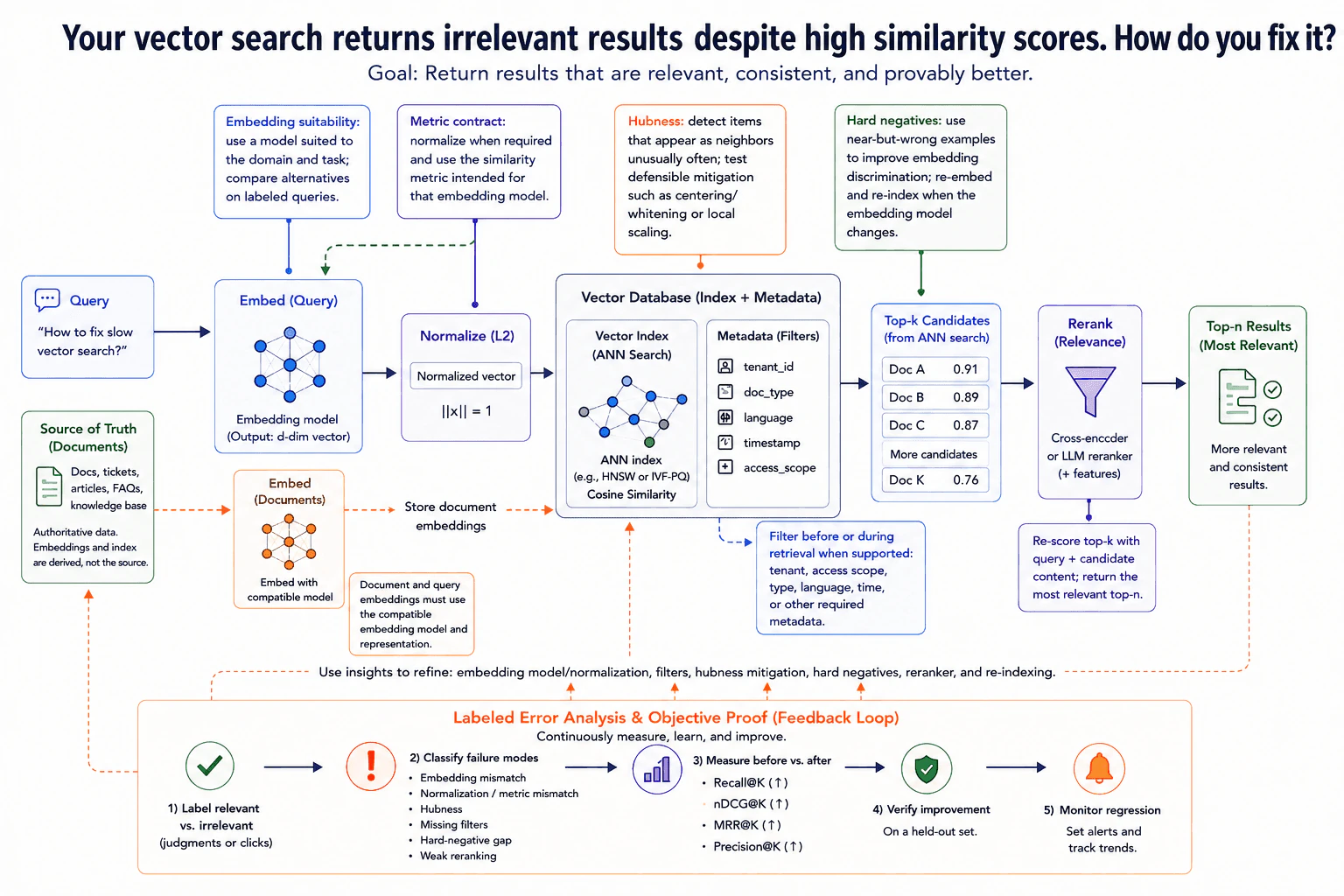
Your vector search returns irrelevant results despite high similarity scores. How do you fix it? diagram
How to Explain It in an Interview

I would treat this as a relevance-debugging problem, not a similarity-threshold problem.

First, I would build a labeled evaluation set. For each query, I need examples marked relevant and irrelevant. I would include hard negatives. A hard negative is a document that looks similar to the query but is still the wrong answer. This gives me a stable test set for comparing changes.

Next, I would check the embedding model. Source documents remain the authoritative data. Their embeddings and the vector index are derived data. Documents are embedded during ingestion, while the user query is embedded at search time. Both sides must use a compatible embedding model and representation. If the model does not represent the domain well, a high similarity score can still describe the wrong meaning. I would compare alternative models or a fine-tuned model on labeled queries rather than choosing one by intuition.

Then I would verify normalization and the similarity metric as one contract. For example, if I use cosine similarity, L2-normalizing vectors makes each vector length equal to 1. On unit-length vectors, cosine similarity and dot-product ranking are equivalent. I would not switch blindly among cosine similarity, dot product, and Euclidean distance because each changes how vectors are ranked. The metric must match the embedding model and the way vectors were prepared.

I would also check for hubness. Hubness means a small set of vectors appears as nearest neighbors for many unrelated queries. Generic documents can then receive high similarity scores again and again. I would measure how often each document appears in retrieved neighborhoods. If the data shows real hubness, I would test a defensible mitigation such as centering or whitening the representation, or a local-scaling method. These transformations change the vector space, so they must be evaluated carefully and may require re-embedding and re-indexing.

Next, I would verify metadata filters. The search should only consider documents allowed for the request. Examples include tenant, access scope, document type, language, and time. A document can be mathematically similar and still be invalid for the user. Authorization-sensitive restrictions must be applied before restricted content is exposed. Different vector databases apply filters differently around approximate search, so I would verify the actual behavior instead of assuming it.

I would also separate document ingestion from query-time retrieval. During ingestion, source documents are embedded with the compatible model and their vectors are stored in the vector index. At query time, the query is embedded, normalized when required, and searched against that index. HNSW and IVF-PQ are examples of approximate nearest-neighbor index approaches. They are alternatives unless a specific implementation explicitly combines techniques.

If I suspect the approximate index, I would compare it with exact nearest-neighbor search on the same embeddings and labeled queries. If exact search finds good neighbors but the approximate index misses them, I would measure ANN recall and tune or rebuild the index. If exact search is also bad, the problem is more likely the embeddings, metric, normalization, filters, or labeling.

If the embedding model cannot separate relevant documents from near-but-wrong ones, I would use hard negatives during training or fine-tuning. Hard negatives are part of model improvement, not a live query-processing stage. When the embedding model or its representation changes, stored document embeddings must be regenerated and the vector index rebuilt or migrated consistently.

After retrieval, I would rerank the top-k candidates. A cross-encoder or another stronger relevance reranker reads the query together with each candidate and assigns a better relevance score. Vector search quickly finds a candidate set. Reranking spends more compute on that smaller set and returns the best top-n results. The tradeoff is extra latency and model cost, so I would choose k from measured quality and latency rather than making it unnecessarily large.

Finally, I would prove that the risk went down. I would classify failures into embedding mismatch, normalization or metric mismatch, hubness, missing filters, hard-negative gaps, weak reranking, or index-recall problems. I would measure Recall@K, nDCG@K, MRR@K, and Precision@K before and after important changes on a held-out set. I would deploy only when relevance improves without breaking required filtering or access rules. After deployment, I would monitor the same signals and alert on regression.

Index and Query Path
  1. Build a labeled set of relevant and irrelevant results, including near-but-wrong hard negatives.
  2. Reproduce failures and group them by likely cause instead of changing the similarity threshold first.
  3. Verify that the embedding model fits the domain and that query and document embeddings use a compatible model and representation.
  4. Verify the normalization and similarity-metric contract. Normalize vectors when the chosen setup requires it.
  5. Measure hubness by checking whether a small set of documents appears unusually often across unrelated queries.
  6. Verify required metadata filters such as tenant, access scope, document type, language, and time.
  7. Compare approximate nearest-neighbor results with exact search on a labeled sample when index recall may be part of the problem.
  8. Add hard negatives during training or fine-tuning when the embedding model cannot separate relevant documents from near-but-wrong documents.
  9. Re-embed documents and rebuild or migrate the vector index when the embedding representation changes.
  10. Retrieve top-k candidates, rerank them with a stronger relevance model, and return the best top-n.
  11. Compare Recall@K, nDCG@K, MRR@K, and Precision@K before and after on held-out data.
  12. Deploy only after objective improvement, then monitor for relevance regression.
Time & Space Complexity

The main costs come from creating embeddings, storing vectors, building and searching the index, applying filters, and reranking candidates. Approximate indexes such as HNSW or IVF-PQ avoid comparing the query with every stored vector, but they add index memory, build time, tuning work, and possible recall loss. Metadata filters can reduce the candidate set, but their interaction with approximate search depends on the vector database. Reranking usually improves final relevance but adds latency and model cost for each candidate. Changing the embedding representation can be expensive because documents may need to be re-embedded and the index rebuilt or migrated. Labeled evaluation also needs ongoing review and maintenance.

Where it is used

This correction process is used in semantic search, retrieval-augmented generation, enterprise knowledge search, support-document retrieval, product discovery, recommendation candidate retrieval, and multi-tenant document systems. It is especially useful when similarity scores look strong but users still receive off-topic results, generic documents dominate many queries, metadata or access rules are missing, ANN recall is weak, or a fast vector retriever needs a stronger reranker for final relevance.

Why Interviewers Ask This

This question tests whether the candidate understands that high vector similarity is not the same as high user relevance. It evaluates judgment across embedding suitability, normalization, metric choice, approximate retrieval, metadata filtering, hubness, hard negatives, reranking, and labeled evaluation. A strong candidate also separates authoritative source documents from derived embeddings and the vector index, understands when re-embedding and re-indexing are required, and proves that a correction works instead of relying on a few good-looking examples.

Common interview mistakes

A common mistake is treating a high similarity score as proof of relevance. Another is changing the similarity threshold before finding the real failure mode. Candidates may also use an embedding model that does not fit the domain, mix incompatible query and document representations, forget required normalization, or change cosine similarity, dot product, and Euclidean distance without understanding how ranking changes. Missing tenant or access filters can return invalid content even when similarity is high. Hard negatives should not be shown as a live processing step on retrieved candidates; they are mainly training and evaluation data. It is also wrong to imply that HNSW and IVF-PQ must run together. They are alternative ANN approaches unless a specific implementation says otherwise. Changing the embedding representation without re-embedding stored documents can make the index incompatible. Finally, testing only a few hand-picked queries is weak evidence; the correction should be measured on labeled held-out data and monitored after deployment.

Interview tip

Start by saying that similarity is only a ranking signal, not proof of relevance. Then move through the failure modes in order: labeled examples, embedding fit, normalization and metric, hubness, filters, ANN recall, hard negatives, reranking, and objective evaluation. Keep source documents, derived embeddings, indexing, and query-time retrieval clearly separated.
Interviewer may ask next
How would you tell whether the problem comes from the embedding model or from the approximate nearest-neighbor index?

Use the same labeled queries and compare approximate retrieval with exact nearest-neighbor search over the same stored embeddings. If exact search is also irrelevant, the main problem is likely the representation, normalization, metric, filters, or labels. If exact search finds the correct neighbors but ANN search misses them, measure index recall and tune or rebuild the approximate index. Keep the embeddings, metric, filters, and evaluation set unchanged during this comparison so the cause is isolated.

When should you add a reranker instead of replacing or fine-tuning the embedding model?

Add a reranker when vector retrieval usually places relevant documents somewhere in the top-k but orders them poorly. The reranker can inspect the query and candidate together and improve final precision without replacing the fast retrieval layer. Replace or fine-tune the embedding model when relevant documents are often missing from the candidate set or hard negatives remain too close in the embedding space. Many systems use both: improve embeddings for candidate recall, then rerank a limited top-k for final relevance. The tradeoff is extra reranking latency and model cost.

72. Your new embedding model has different dimensions from the existing vectors in production. How do you handle the mismatch?Vector Databases And EmbeddingsHard

Question Details

Require root-cause analysis across strict versioned schemas, separate indexes, backfill or re-embedding, dual-read migration, and prevention of mixed-space comparisons, followed by measurable validation of the fix.

Short Interview Answer (30-60 seconds)

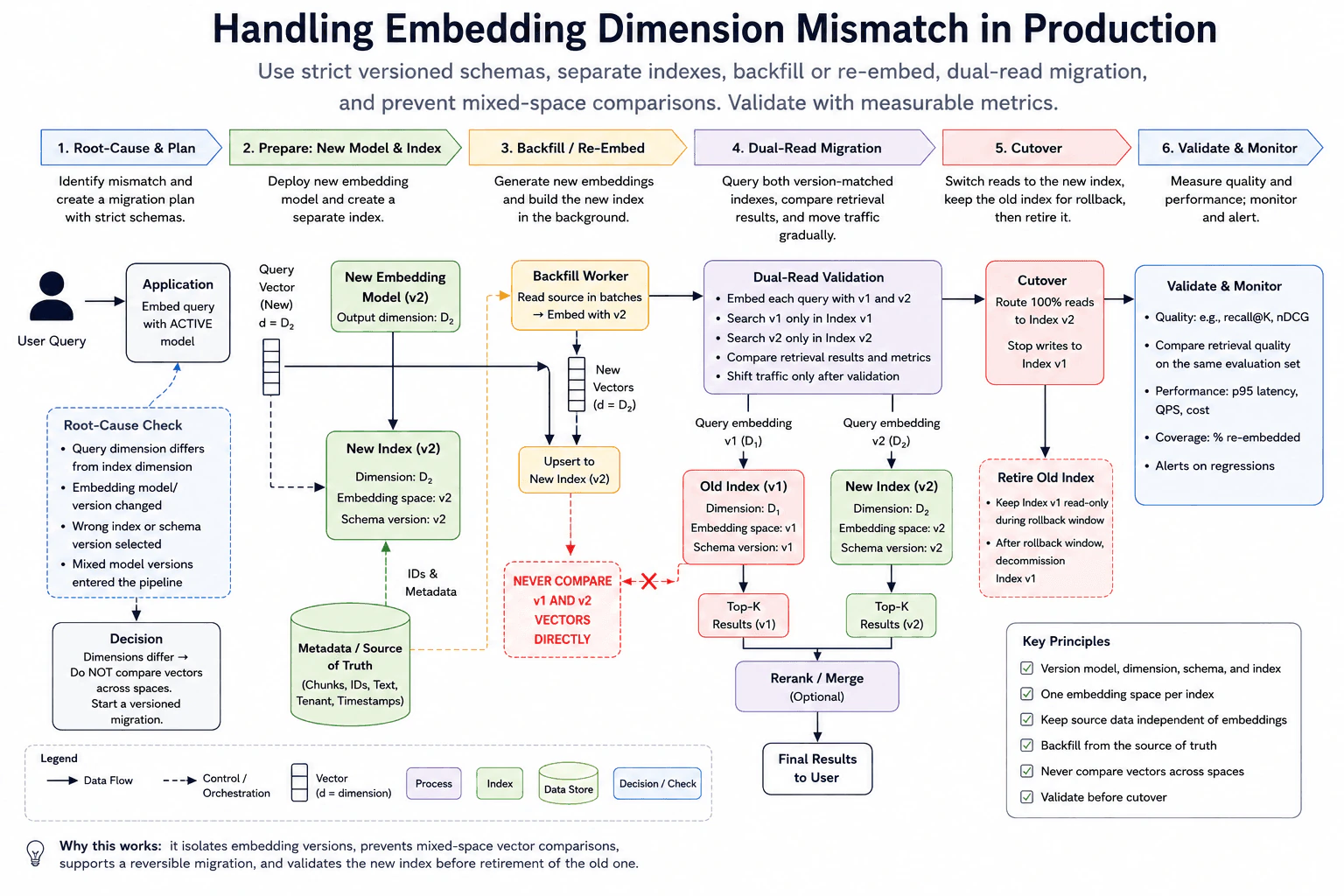
I would not mix the vector spaces. I would create a versioned Index v2, re-embed the source data, dual-read with each query embedding sent only to its matching index, compare retrieval quality and performance, cut over gradually, keep Index v1 for rollback, then retire it.

Detailed Explanation

The safe choice is to keep the old and new representations separate. The new model creates vectors with a different shape, so the existing stored vectors cannot simply be reused with the new model. I would build a new versioned index, rebuild embeddings from the original source data, and validate both versions side by side. Each query representation must go only to the matching index. I would compare returned results, not the vectors themselves. After the new path meets the required quality and performance checks, I would move traffic to it and keep the old path available for rollback.

Useful Questions to Ask the Interviewer
  1. Do we still have the original source documents or records needed to rebuild all embeddings?
  2. Can we run model v1 and model v2 at the same time during migration?
  3. What retrieval-quality and performance measures must Index v2 meet before cutover?
  4. How long should Index v1 remain available for rollback?
Your new embedding model has different dimensions from the existing vectors in production. How do you handle the mismatch? diagram
How to Explain It in an Interview

Start with the main rule: never compare vectors from different embedding spaces directly. An embedding space is the numeric coordinate system created by an embedding-model version. If model v1 creates vectors with dimension D1 and model v2 creates vectors with dimension D2, the two vector types cannot be searched or compared as if they were interchangeable. Even if two models happened to use the same dimension, a model change could still create a different space, so model version matters as well as dimension.

First, find the root cause. Check whether the query-vector dimension differs from the index dimension. Check whether the embedding-model version changed. Check whether the application selected the wrong index or schema version. Also check whether vectors from different model versions entered the same pipeline.

Then make the contract strict and versioned. Track the model version, vector dimension, schema version, and index version together. Keep one embedding space per index. Index v1 contains only vectors created by model v1 with dimension D1. Index v2 contains only vectors created by model v2 with dimension D2. A v1 query embedding searches only Index v1. A v2 query embedding searches only Index v2.

Keep the source of truth separate from embeddings. The source of truth is the original data, such as documents, chunks, IDs, text, tenant information, and timestamps. Embeddings and vector indexes are derived data. This separation matters because the original data lets the team rebuild Index v2 without trying to transform old vectors into new ones.

Next, backfill Index v2. A background worker reads the source data in batches, sends each item through model v2, receives a D2 embedding, and upserts that embedding into Index v2. The old production path can continue serving traffic while this work runs. Track the percentage of source data that has been re-embedded and record failures so incomplete coverage is visible.

After enough of Index v2 is ready, run dual-read validation. For the same user query, create one query embedding with model v1 and another with model v2. Send the v1 embedding only to Index v1. Send the v2 embedding only to Index v2. Never compare the v1 and v2 vectors directly.

Compare what the two retrieval paths return. Use the same evaluation set for both. Measure retrieval quality with suitable measures such as recall@K or nDCG when those measures fit the application. Also measure production behavior such as p95 latency, QPS, cost, re-embedding coverage, and regression alerts. The required thresholds should come from the product requirements rather than being invented during the migration.

The two searches may return separate top-K result lists. If the application already has an optional reranking or merging step, apply it to the retrieved result objects or documents, not to raw vectors from different spaces. A separate reranker may score the returned documents using its own comparable scoring contract. Do not assume vector similarity scores from v1 and v2 are directly comparable.

When Index v2 passes validation, move traffic toward it. At full cutover, route reads to Index v2 and stop writes to Index v1. New writes should use model v2 and the v2 schema. Keep Index v1 read-only during the rollback window. If the new path has a serious problem, switch the request path back to model v1 together with Index v1. Never send a v2 query embedding to Index v1 during rollback.

After the rollback window ends and the new path remains healthy, decommission Index v1. The main tradeoff is temporary duplication. For a period, the system may run two model versions, two indexes, two query paths, and a background backfill. That costs extra compute, storage, and operational work. The benefit is a reversible migration with clear validation before the old production path is removed.

Index and Query Path
  1. Detect the mismatch and confirm whether the query dimension, model version, index version, or schema version is wrong.
  2. Version the model, vector dimension, schema, and index together.
  3. Keep Index v1 and Index v2 separate, with one embedding space per index.
  4. Keep original documents and metadata as the source of truth.
  5. Create Index v2 for model v2 and dimension D2.
  6. Re-embed the source data in batches and upsert the new D2 vectors into Index v2.
  7. Track backfill coverage and failures.
  8. During dual-read validation, embed each query once with v1 and once with v2.
  9. Search the v1 query only in Index v1 and the v2 query only in Index v2.
  10. Compare retrieval results and evaluation metrics, not vectors across spaces.
  11. If needed, rerank or merge returned documents only after retrieval, without treating v1 and v2 vector scores as directly comparable.
  12. Shift traffic toward Index v2 only after validation passes.
  13. Route all reads and new writes to the v2 path, then stop writes to Index v1.
  14. Keep Index v1 read-only during the rollback window.
  15. Monitor quality, latency, QPS, cost, coverage, and regressions.
  16. Decommission Index v1 after the rollback window and successful validation.
Time & Space Complexity

Let N be the number of source records that must be rebuilt. Re-embedding is roughly O(N) model work because every source item must be processed again. During migration, vector storage is roughly the sum of the old and new indexes, plus metadata and index overhead. Because D1 and D2 may be different, the two indexes may use different amounts of space. Dual-read validation can require two query embeddings and two searches for each sampled request, so it increases compute and query cost. The team also has temporary maintenance cost because two models, schemas, indexes, and routing paths must be operated safely until cutover is complete.

Where it is used

This approach is used when a production semantic-search, recommendation, retrieval, or RAG system changes to a different embedding model and the existing vectors cannot safely be reused. It is especially useful when the model changes vector dimension or otherwise changes the embedding space while the service must remain available during re-embedding, validation, cutover, and rollback.

Why Interviewers Ask This

This question tests whether the candidate understands that vectors created by different embedding-model versions belong to different embedding spaces. A strong answer should prevent mixed-space comparisons, use strict versioning for the model, dimension, schema, and index, rebuild vectors safely from source data, validate both paths before cutover, preserve rollback, and retire the old index only after the new path is proven.

Common interview mistakes

A common mistake is inserting D2 vectors into an index that expects D1 vectors. Another is changing the query model while still searching Index v1. A more subtle mistake is directly comparing vectors or raw similarity scores from model v1 and model v2. Teams also create risk by overwriting the old index in place, mixing model versions in one searchable vector field, deleting Index v1 before the rollback window ends, or keeping embeddings as the only copy of the data. Another mistake is declaring success only because Index v2 accepts queries. The migration should also validate retrieval quality, latency, QPS, cost, backfill coverage, and regressions.

Interview tip

Lead with the rule: one embedding space per versioned index, and never compare vectors across model spaces. Then explain root-cause checks, source-of-truth backfill, version-matched dual reads, measurable validation, gradual cutover, rollback, and retirement of Index v1.

Interviewer may ask next
What if the new model has the same vector dimension as the old model?

I would still treat it as a separate embedding space unless compatibility is explicitly guaranteed. Equal dimension only means both vectors contain the same number of values. It does not mean the values use the same coordinate system or have comparable meaning. I would version the new model and index, re-embed the source data, run version-matched dual reads, compare retrieval results, and cut over only after validation.

How do you roll back if retrieval quality becomes worse after cutover?

Keep Index v1 read-only during a defined rollback window instead of deleting it immediately. Keep model v1 and its routing contract available for that period. If a serious regression appears, route requests back through model v1 and Index v1 together. Never send a v2 query embedding to Index v1. Then investigate the model, backfill, schema, routing, or evaluation problem before attempting another cutover.

73. What is AI system design?Ai System DesignEasy

Question Details

Define AI system design and explain how data, models, prompts or retrieval, application services, safety controls, evaluation, deployment, monitoring, latency, reliability, and cost fit into one end-to-end production system.

Short Interview Answer (30-60 seconds)

At a high level, AI system design is about building the complete production system around an AI model, not just choosing the model. I would start with user input, prepare and retrieve useful data, build the prompt, and let the model generate a probabilistic response. Application services then apply deterministic business rules, state, caching, and APIs. Safety controls and evaluation check quality and risk. Deployment, monitoring, reliability, latency, and cost controls keep the system healthy in production. The main trade-off is balancing quality, speed, safety, reliability, and cost.

Detailed Explanation

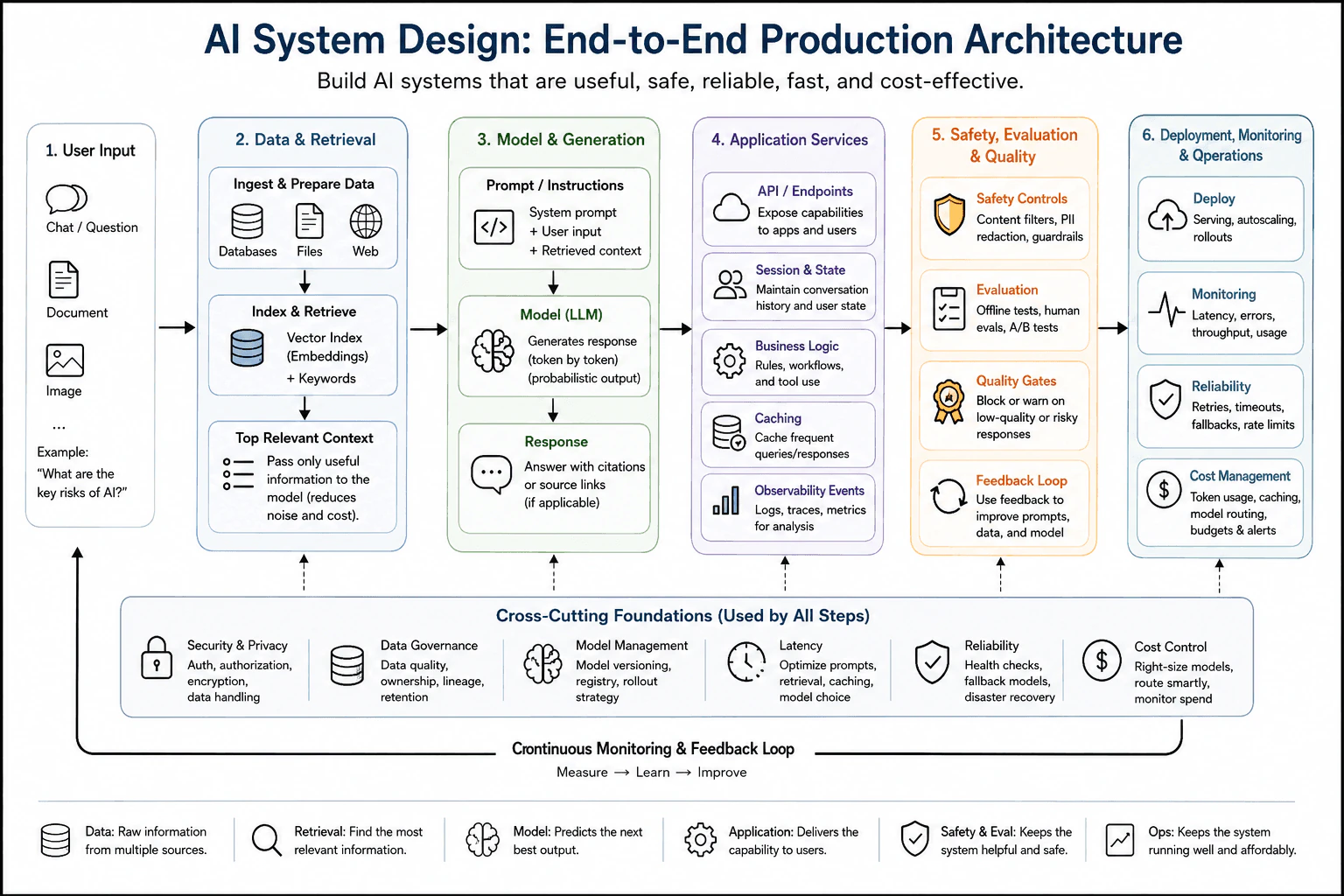
AI system design means deciding how all the parts around an AI model work together. The goal is to turn a user request into a useful and safe answer. We need good information, clear instructions, a model, application logic, safety checks, and a reliable way to run everything. We also need to measure whether the system works well after release. The main challenge is balancing answer quality with speed, reliability, safety, and cost. I would explain the design by following the same end-to-end flow shown in the diagram.

Useful Questions to Ask the Interviewer
  • What kinds of user inputs should the system support?
  • Does the system need retrieval from stored or changing information?
  • Which matters most here: quality, latency, reliability, safety, or cost?
  • What kinds of unsafe or low-quality responses should be blocked or warned about?
What is AI system design? diagram
How to Explain It in an Interview
1. Start with the user input

The flow starts with a user request. It may be a chat question, document, or image. For example, the user might ask, "What are the key risks of AI?" This input starts the end-to-end flow. The important idea is that system design begins with user value. We first understand the request, then decide which data and model capabilities are needed.

2. Prepare data and retrieve useful context

The next stage is Data and Retrieval. Information can come from databases, files, or the web. The system ingests and prepares that data. It can build a vector index using embeddings, which are numeric representations used for similarity search. Keyword search can also help. Retrieval then selects the most relevant context for the request. Passing only useful context reduces noise and can also reduce token cost.

3. Build the prompt and call the model

The retrieved context moves into Model and Generation. The prompt combines system instructions, the user input, and retrieved context. The model then generates a response token by token. Its output is probabilistic, which means wording or answers may vary. This is different from deterministic application logic, where explicit rules should behave predictably. The response can include citations or source links when applicable.

4. Use application services around the model

Application Services turn the model capability into a usable product. APIs or endpoints expose that capability to applications and users. Session and State keep conversation history or user state. Business Logic applies deterministic rules, workflows, and tool use. Caching can reuse frequent queries or responses when appropriate. Observability Events create logs, traces, and metrics for analysis. These services keep product behavior separate from probabilistic model behavior.

5. Add safety, evaluation, and quality controls

The next stage adds Safety Controls, Evaluation, Quality Gates, and a Feedback Loop. Safety Controls can use content filters, PII redaction, and guardrails. PII means personal information that should be protected. Evaluation uses offline tests, human evaluations, or A/B tests. Quality Gates can block or warn about low-quality or risky responses. Feedback can then improve prompts, data, and the model. These controls reduce risk, but they also add processing and operational work.

6. Deploy, monitor, and improve the whole system

Deployment includes model serving, autoscaling, and controlled rollouts. Monitoring watches latency, errors, throughput, and usage. Reliability uses health checks, retries, timeouts, fallbacks, rate limits, and disaster recovery where the design supports them. Cost Management watches token usage, caching, model routing, budgets, and alerts. Cross-cutting foundations also include Security and Privacy, Data Governance, and Model Management. The continuous monitoring and feedback loop measures results, learns from them, and improves the system over time. A strong AI system therefore balances usefulness, safety, reliability, latency, and cost instead of optimizing only the model.

Practical Complexity & Trade-offs

The main design challenge is balancing several goals at once. Retrieval can improve answers by giving the model useful context, but it adds latency and cost. Caching can make common requests faster and cheaper, but cached information can become old. A larger model may improve some answers, but it can use more tokens and take longer. Safety checks reduce harmful output, but they add another step to the flow. Retries and fallbacks improve reliability, but too many retries can increase latency and cost. Monitoring helps find errors, slow requests, and rising usage. The benefit of this layered design is better control. The downside is more system complexity. We accept that complexity because a production AI system needs more than a model call.

Why Interviewers Ask This

Interviewers ask this question to see whether you understand AI as a complete production system. They want to know if you can connect data, retrieval, prompts, models, application services, safety, evaluation, deployment, and monitoring. They also test engineering judgment. A strong answer separates probabilistic model output from deterministic application logic. It should also explain practical trade-offs between quality, latency, reliability, safety, and cost.

Interviewer may ask next
What would you change if traffic suddenly became much higher?

I would keep the same architecture, but I would focus more on scaling, latency, reliability, and cost. The main affected area is Deployment, Monitoring, and Operations, with support from Application Services. Autoscaling can add serving capacity as traffic grows. Caching can reduce repeated work for frequent queries or responses when reuse is safe. Monitoring should watch latency, errors, throughput, and usage so we can find pressure quickly. Rate limits can protect the service from overload. Timeouts stop requests from waiting forever, while retries and supported fallbacks can help with temporary failures. The Data and Retrieval, Model and Generation, Safety, and Evaluation stages still remain part of the same flow. The main downside is higher infrastructure cost and more operational complexity. Caching also creates a freshness trade-off, so it should only be used where older results are acceptable.

How would you keep the system safe and improve answer quality over time?

I would use the Safety, Evaluation, and Quality stage together with the continuous monitoring and feedback loop. Safety Controls can filter unsafe content, redact PII, and apply guardrails. Evaluation can use offline tests, human evaluations, and A/B tests when appropriate. Quality Gates can block or warn about low-quality or risky responses. After deployment, Monitoring collects signals such as latency, errors, throughput, and usage. User feedback provides another source of evidence. That feedback can be used to improve prompts, data, and the model, followed by another evaluation before a new rollout. Security and Privacy, Data Governance, and Model Management remain cross-cutting foundations for these changes. The benefit is continuous improvement instead of trusting one model version forever. The downside is extra review work, processing time, operational complexity, and cost.

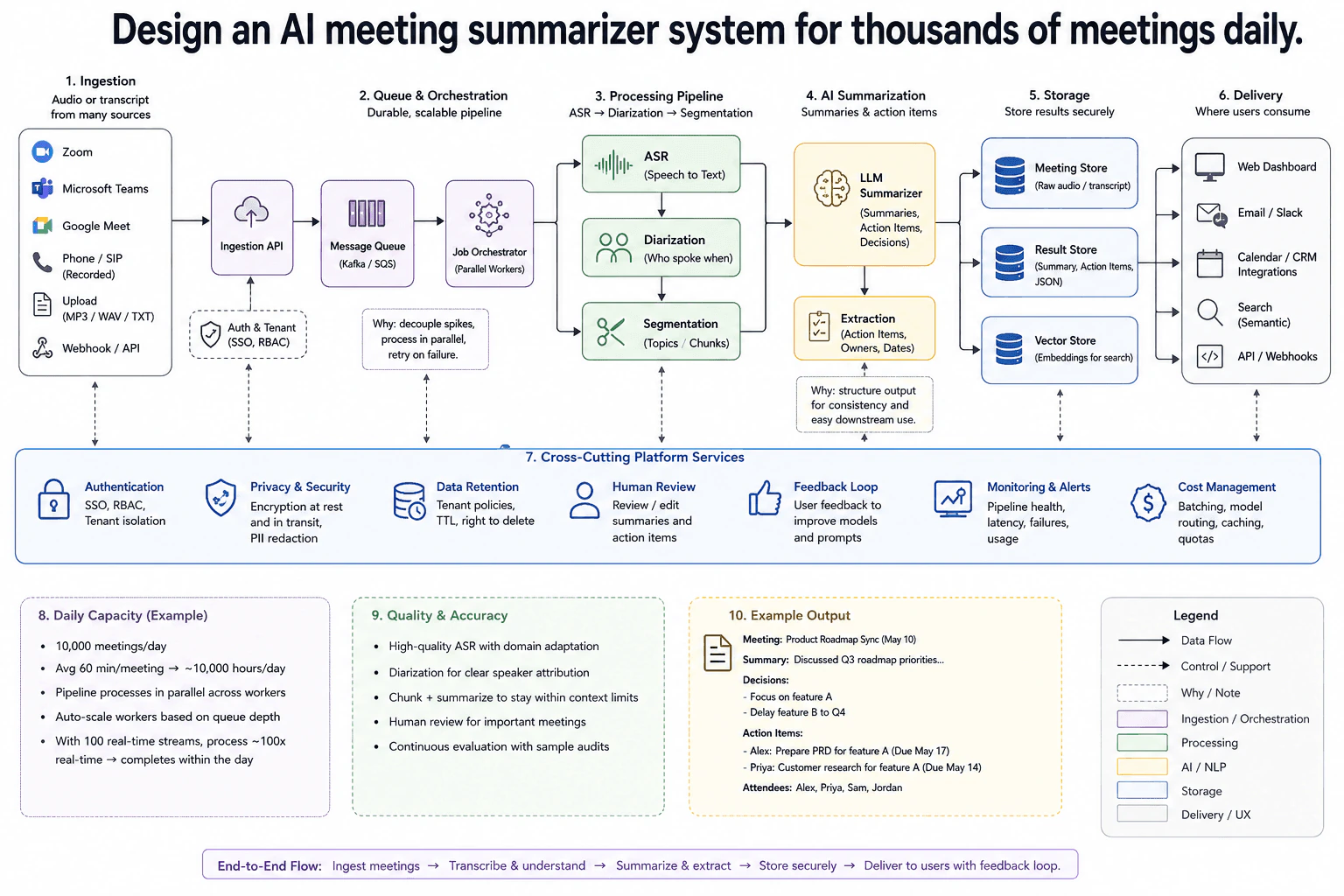
74. Design an AI meeting summarizer system for thousands of meetings daily.Ai System DesignEasy

Question Details

Expected architectural coverage includes audio or transcript ingestion, diarization, segmentation, summaries and action items, privacy, correction workflows, and daily capacity.

Short Interview Answer (30-60 seconds)

At a high level, I would build an asynchronous meeting summarizer. Meetings enter through an Ingestion API as audio or transcripts. A durable Message Queue absorbs traffic spikes, and a Job Orchestrator sends work to parallel workers. The pipeline performs speech-to-text, diarization, segmentation, summarization, and action-item extraction. Results are stored securely and delivered through dashboards, messages, integrations, search, or APIs. I would protect tenant data with access controls and encryption. The main trade-off is accepting some processing delay so the system can handle large daily volume reliably and at controlled cost.

Detailed Explanation

We need a system that turns many daily meetings into useful notes. A meeting may arrive as recorded audio or an existing transcript. The system should identify who spoke, divide the conversation into useful parts, create a summary, and find action items. It must keep private meeting data safe. Users should also be able to review and correct results. The main challenge is processing thousands of long meetings without busy periods overwhelming the system. I would follow the diagram from intake through processing, storage, delivery, and feedback.

Useful Questions to Ask the Interviewer
  • Are most meetings uploaded after they finish, or must some be processed live?
  • How quickly should completed summaries become available?
  • How long should audio, transcripts, and summaries be retained?
  • Which meetings require human review before results are shared?
Design an AI meeting summarizer system for thousands of meetings daily. diagram
How to Explain It in an Interview
1. Start with meeting ingestion

I would accept audio or transcripts from many meeting sources. The diagram shows Zoom, Microsoft Teams, Google Meet, recorded Phone or SIP calls, file uploads, and Webhook or API inputs.

These inputs reach the Ingestion API. Authentication and tenant checks protect this entry point. SSO means users sign in through a trusted identity system. RBAC means permissions depend on the user's role. Tenant isolation keeps one customer's data separate from another customer's data.

2. Buffer and orchestrate the work

The Ingestion API sends accepted work into a durable Message Queue. Kafka or SQS are shown as example queue choices.

The queue separates intake from expensive AI processing and absorbs traffic spikes. The Job Orchestrator sends queued meetings to parallel workers. The diagram also calls out retry on failure, so failed jobs can be attempted again.

3. Process the conversation

For audio input, ASR performs speech-to-text and creates a transcript. ASR means automatic speech recognition.

Next comes diarization. Diarization means identifying who spoke and when. This helps connect statements and action items to the correct person.

Segmentation breaks the transcript into topics or chunks. Chunking helps long meetings stay within model context limits and gives the summarizer smaller pieces to process.

4. Create summaries and structured action items

The segmented content goes to the LLM Summarizer. It produces summaries, action items, and decisions.

A separate Extraction step structures action items, owners, and dates. This makes downstream use more consistent.

These model outputs can be wrong. The Human Review path lets users review or edit summaries and action items. The Feedback Loop can use user feedback to improve models and prompts.

5. Store the right data in the right place

The Meeting Store keeps raw audio or transcripts. The Result Store keeps summaries, action items, and structured JSON. The Vector Store keeps embeddings for semantic search.

The diagram shows encryption at rest and in transit, RBAC, tenant isolation, PII redaction, and data-retention rules. PII means personal information that needs protection. Retention rules can include a TTL, which is a time limit for stored data, plus the right to delete.

6. Deliver results and operate at daily scale

Stored results can be delivered through the Web Dashboard, Email or Slack, Calendar or CRM integrations, semantic Search, and APIs or Webhooks.

The capacity example uses 10,000 meetings per day at 60 minutes each. That is about 10,000 audio-hours per day. Workers should auto-scale based on queue depth. The diagram shows 100 real-time streams as a parallel-processing example. However, 100 streams running at 1x real time would process only about 2,400 audio-hours in 24 hours. Finishing 10,000 audio-hours in one day needs more than about 417x aggregate real-time throughput, plus headroom.

Finally, I would monitor pipeline health, latency, failures, and usage. I would control cost with batching, model routing, caching, and quotas. Quality work includes ASR domain adaptation, speaker attribution, chunking, human review for important meetings, and continuous evaluation with sample audits.

Practical Complexity & Trade-offs

The benefit of this design is that the durable queue separates ingestion from expensive AI work. A traffic spike does not immediately overload every worker. The downside is that some meetings may wait before processing. Parallel workers increase daily capacity, but they also increase compute cost. Segmentation helps long meetings fit within model context limits, but poor chunk boundaries can hurt summary quality. Human review improves important results, but it adds time and operating cost. Separate meeting, result, and vector stores make each access pattern clear, but they add systems to operate. Tenant isolation, encryption, retention rules, and PII redaction reduce privacy risk. They also add implementation work. We accept these costs because meeting data can be sensitive and model output can be wrong.

Why Interviewers Ask This

The interviewer wants to see whether you can turn an AI feature into a complete production system. They are checking how you handle daily volume, asynchronous work, model uncertainty, privacy, and storage. They also want to see whether you understand diarization, segmentation, summarization, and structured action items. A strong answer shows where human correction fits, how workers scale with queue depth, and how you reason about latency, reliability, quality, and cost instead of only naming AI components.

Interviewer may ask next
What would you change if the meeting volume suddenly doubled?

I would keep the same architecture and scale the asynchronous processing path first. The Ingestion API would continue placing accepted meetings into the Message Queue, so a short spike would not directly overload ASR or summarization workers. The Job Orchestrator would increase parallel workers based on queue depth. ASR, diarization, segmentation, summarization, and extraction would still run in the same order.

I would watch pipeline health, latency, failures, usage, and queue growth through Monitoring & Alerts. I would also use the shown cost controls, including batching, model routing, caching, and quotas. Tenant isolation, RBAC, encryption, PII redaction, and retention rules would remain unchanged as capacity grows.

The main downside is cost. More workers mean more processing resources. I would size the fleet from total audio-hours per day and required completion time, not from meeting count alone. If demand grows faster than available capacity, meetings wait longer in the durable queue instead of forcing the system to drop the normal processing steps.

How would you handle a summary or action item that is wrong?

I would use the existing Human Review and Feedback Loop shown in the design. The generated summary, decisions, and extracted action items are model outputs, so users should not treat them as perfectly correct. A reviewer can inspect the stored meeting transcript and edit the summary or action items when needed.

The corrected result stays in the normal result flow. It can then be delivered through the Web Dashboard, Email or Slack, Calendar or CRM integrations, Search, or APIs and Webhooks. Privacy rules still apply during review. RBAC controls who may access the meeting, tenant isolation separates customers, and the retention rules still apply to the underlying data.

User corrections can also feed the Feedback Loop. That information can help improve later models and prompts, as shown in the diagram. The downside is extra human effort and slower completion for reviewed meetings. I would therefore focus manual review on important meetings or cases where users report problems while leaving the rest of the architecture unchanged.

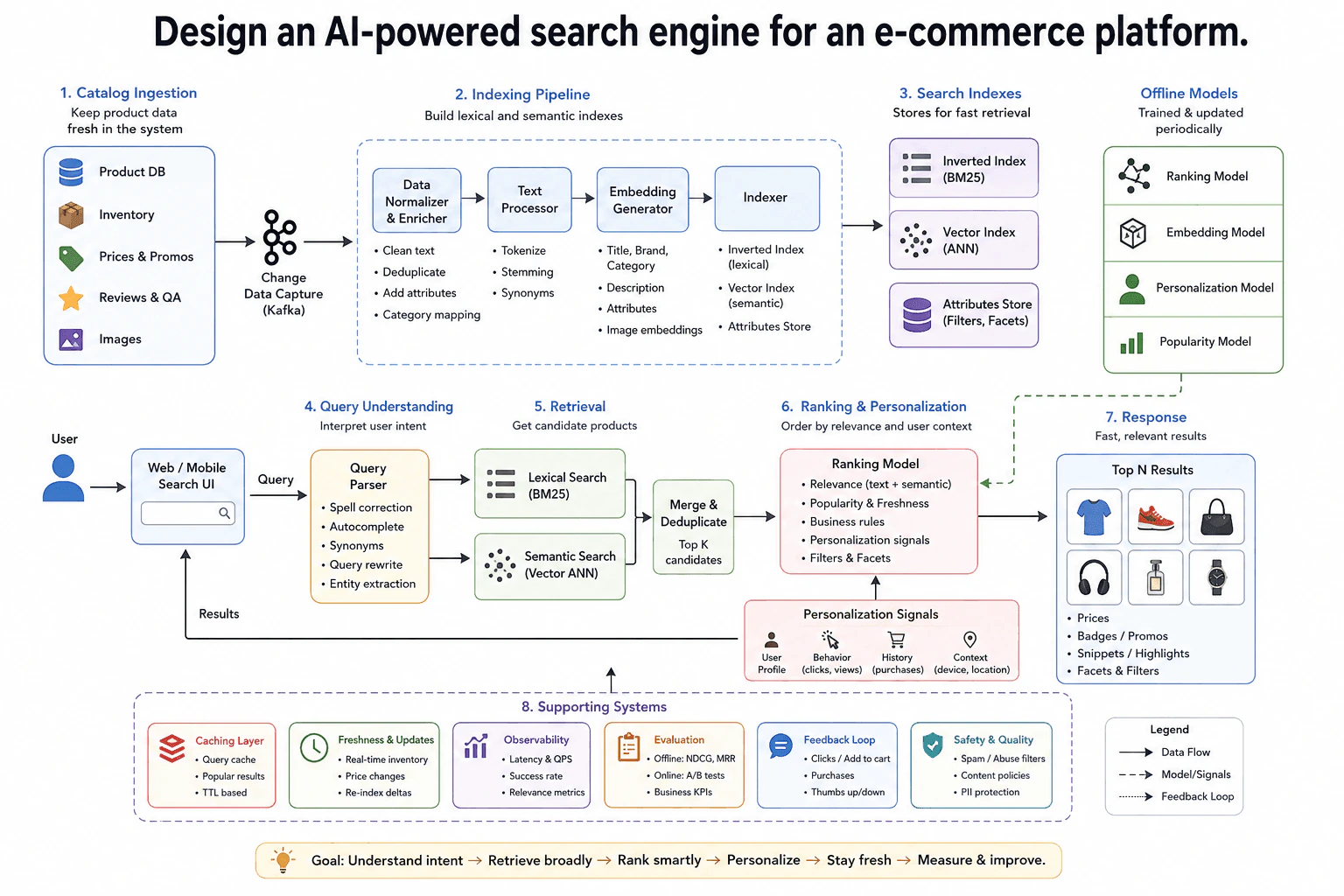
75. Design an AI-powered search engine for an e-commerce platform.Ai System DesignEasy

Question Details

A complete production design addresses catalog ingestion, lexical and semantic retrieval, filters, ranking, personalization, freshness, latency, and relevance evaluation.

Short Interview Answer (30-60 seconds)

At a high level, I would build a hybrid e-commerce search system that combines keyword and semantic search. Product changes flow through Kafka, get cleaned and enriched, and are written to lexical, vector, and attribute indexes. A shopper query is parsed, searched through BM25 and vector ANN retrieval, merged, ranked, personalized, and returned as Top N results. I would use caching for speed, while separate freshness updates keep inventory and prices current. The main trade-off is stronger relevance and personalization versus more latency, compute cost, and operational complexity.

Detailed Explanation

We are building a search experience that helps shoppers find the right products quickly. A shopper may type exact words, make a spelling mistake, or describe an idea instead of a product name. The system should still return useful products. It also needs current prices, inventory information, promotions, and filters. The main challenge is combining several kinds of search without making the experience slow. I would follow the diagram from product updates, through indexing, then query understanding, retrieval, ranking, personalization, and the final response.

Useful Questions to Ask the Interviewer
  • How large is the product catalog and expected search traffic?
  • How fresh must inventory, prices, and promotions be?
  • How much should personalization affect the ranking?
  • Which relevance and business metrics matter most?
Design an AI-powered search engine for an e-commerce platform. diagram
How to Explain It in an Interview
1. Build fresh searchable product data

I would start with catalog ingestion. Product data comes from Product DB, Inventory, Prices & Promos, Reviews & QA, and Images. Change Data Capture sends product changes through Kafka. Change Data Capture means forwarding data changes as events instead of rebuilding everything after every update.

The Data Normalizer & Enricher cleans text, removes duplicates, adds attributes, and maps categories. The Text Processor tokenizes text, applies stemming, and handles synonyms. The Embedding Generator creates semantic representations from title, brand, category, description, attributes, and image information.

The Indexer writes three searchable structures. The Inverted Index supports BM25 keyword search. BM25 is a scoring method for matching query words to product text. The Vector Index supports ANN semantic search. ANN means approximate nearest-neighbor search for similar vectors. The Attributes Store supports filters and facets.

2. Understand the shopper's query

The main request begins when the user enters a query in the Web / Mobile Search UI. The Query Parser prepares that query before retrieval. It can perform spell correction, autocomplete, synonym handling, query rewriting, and entity extraction.

For example, a query such as "red running shoes" can contain useful entities such as product type and color. Better query understanding gives the retrieval stages a cleaner request to search.

3. Retrieve candidates in two ways

I would use both lexical and semantic retrieval. Lexical Search uses BM25 to find products whose words closely match the query. Semantic Search uses the Vector ANN index to find products with similar meaning.

These approaches solve different problems. Keyword search works well when the shopper knows the exact product words. Semantic search helps when meaning matters more than exact wording.

The Merge & Deduplicate component combines the two result sets and removes repeated products. Its output is the Top K candidate set sent to ranking.

4. Rank and personalize the candidates

The Ranking Model orders the merged candidates. It uses text and semantic relevance, popularity and freshness, business rules, personalization signals, and filters or facets.

Personalization Signals include User Profile, Behavior such as clicks and views, History such as purchases, and Context such as device and location. The Offline Models area supplies the Ranking Model, Embedding Model, Personalization Model, and Popularity Model used by the system.

The model-based ranking and personalization steps are probabilistic because they estimate what is most useful. Other steps, such as filtering, deduplication, index lookup, and business rules, are deterministic application logic.

5. Return the final results

The ranking stage sends the best products to Top N Results. The response can contain Prices, Badges / Promos, Snippets / Highlights, and Facets & Filters. Results then return to the Web / Mobile Search UI.

The user therefore sees a small ranked list instead of the much larger candidate set considered internally.

6. Keep search fast, fresh, and measurable

The Supporting Systems improve production quality. The Caching Layer stores query cache entries and popular results with a TTL. TTL means the cached value expires after a set lifetime.

Freshness & Updates handles real-time inventory, price changes, and re-indexed deltas. This keeps important product facts current without requiring a complete rebuild for every change.

Observability tracks Latency & QPS, Success rate, and Relevance metrics. Evaluation uses offline NDCG and MRR, online A/B tests, and Business KPIs. NDCG measures whether highly relevant products appear near the top. MRR measures how early the first useful result appears.

The Feedback Loop collects Clicks / Add to cart, Purchases, and Thumbs up/down. Safety & Quality covers Spam / Abuse filters, Content policies, and PII protection. PII means personal information that needs careful protection.

The overall flow is simple: understand intent, retrieve broadly, rank smartly, personalize, stay fresh, and measure and improve.

Practical Complexity & Trade-offs

The benefit of hybrid retrieval is better coverage. BM25 handles exact words well, while vector search helps with meaning. The downside is that two retrieval paths need more storage, compute, and coordination. Personalization can improve useful results, but it adds model work and requires careful PII protection. Caching popular queries reduces latency and cost, but cached results can become stale. The separate Freshness & Updates path helps by applying inventory changes, price changes, and re-indexed deltas. Ranking more candidates may improve relevance, but it also takes more time and compute. We accept these trade-offs because an e-commerce search engine must balance relevance, latency, freshness, personalization, safety, and operating cost.

Why Interviewers Ask This

The interviewer wants to see whether you can connect AI techniques to a complete production search system. They are testing your understanding of ingestion, indexing, lexical and semantic retrieval, ranking, personalization, freshness, caching, feedback, and evaluation. They also want good engineering judgment. A strong answer separates model-driven decisions from deterministic application logic and explains the trade-offs among relevance, speed, freshness, privacy, safety, scalability, and cost.

Interviewer may ask next
How would this design handle frequent inventory and price changes without rebuilding every index?

I would keep the same architecture and use the Freshness & Updates path already shown in the diagram. Product changes first enter through Change Data Capture and Kafka. The indexing pipeline can process only changed records instead of rebuilding the whole catalog. For inventory and price updates, the system applies re-indexed deltas so searchable data can be refreshed incrementally. The Attributes Store is important because filters and facets may depend on current product facts. Ranking also considers freshness, so recent changes can affect ordering when appropriate. The Caching Layer still improves latency, but cached query and popular-result entries use a TTL and therefore expire after a limited time. Observability continues tracking latency, QPS, success rate, and relevance during these updates. The main downside is more operational complexity because the system must maintain both the normal indexing flow and frequent incremental updates. Retrieval, ranking, personalization, and the final response flow remain unchanged.

How would you know whether the AI-powered search is actually producing better results?

I would use the Evaluation and Feedback Loop already shown in the design. Offline evaluation uses NDCG and MRR to measure ranking quality on known examples. NDCG rewards putting highly relevant products near the top. MRR measures how early the first useful result appears. Offline testing is useful before exposing a ranking change to shoppers. I would then use online A/B tests to compare the current system with a changed retrieval or ranking model. Business KPIs give another view, so we do not judge search only with technical relevance scores. The Feedback Loop also supplies real behavior from clicks, add-to-cart actions, purchases, and thumbs up or down. These signals can support later model updates. Observability continues tracking latency, QPS, success rate, and relevance metrics. The main downside is that user behavior can be noisy, so I would compare several signals instead of trusting one metric alone.

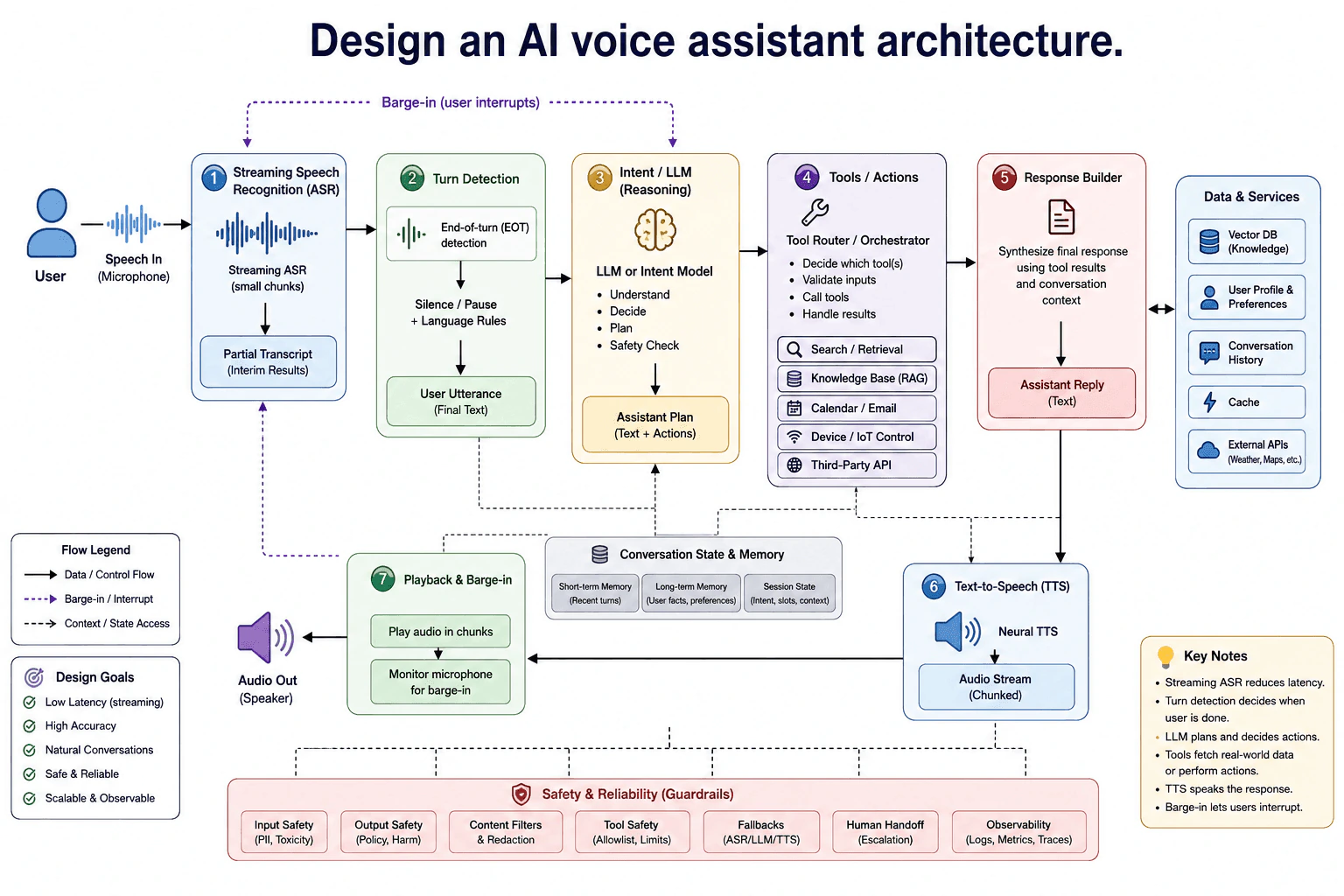
76. Design an AI voice assistant architecture.Ai System DesignEasy

Question Details

Require defensible tradeoffs and failure handling across streaming speech recognition, turn detection, LLM or intent handling, tool calls, text-to-speech, barge-in, latency, and safety.

Short Interview Answer (30-60 seconds)

At a high level, I would build the voice assistant as one streaming speech-to-speech loop. User audio goes to streaming ASR, then turn detection decides when the user is done. An LLM or intent model understands the request and can plan tool actions. A Tool Router or Orchestrator validates and executes those actions. The Response Builder creates the final text, and streaming TTS turns it into audio. I would add barge-in, memory, safety guardrails, fallbacks, human handoff, and observability. The trade-off is lower latency and better control, but with more system complexity.

Detailed Explanation

This system should let a person speak naturally and receive a useful spoken answer. It must listen while the person talks, understand when the turn ends, decide what the person wants, use outside tools when needed, and speak the result back. The main challenge is keeping the conversation fast without losing safety or correctness. It must also handle interruptions and component failures. I would explain the design by following the same end-to-end flow shown in the diagram, then cover memory, safety, and monitoring.

Useful Questions to Ask the Interviewer
  • Which actions should the assistant support, such as search, calendar, email, or device control?
  • How important is low latency compared with answer quality?
  • What should happen when a model or tool cannot complete a request?
  • How much conversation history and user preference data may be stored?
Design an AI voice assistant architecture. diagram
How to Explain It in an Interview
1. Stream speech into ASR

I would start with Speech In from the microphone. The audio goes to Streaming Speech Recognition, or ASR. ASR means converting speech into text. It receives speech in small chunks and produces a Partial Transcript as interim results. Streaming reduces waiting because the system does not need the whole recording first. The partial transcript then feeds the next stage.

2. Detect when the user is done

Turn Detection decides when the user has finished speaking. It uses End-of-turn, or EOT, detection together with silence, pauses, and language rules. Its output is the User Utterance as final text. This matters because the reasoning stage should receive a complete turn instead of acting too early. The playback path also supports barge-in, which means the user can interrupt the assistant while it is speaking.

3. Understand the request and make a plan

The final utterance goes to the Intent / LLM reasoning stage. The LLM or Intent Model understands the request, decides what to do, plans the next action, and performs a safety check. Its result is an Assistant Plan containing text and possible actions. The model can use Conversation State & Memory. That memory includes Short-term Memory for recent turns, Long-term Memory for user facts and preferences, and Session State for intent, slots, and context.

4. Use tools through a controlled orchestrator

When the plan needs outside information or an action, it goes to Tools / Actions. The Tool Router / Orchestrator decides which tool to use, validates inputs, calls the tool, and handles the result. The diagram shows Search / Retrieval, Knowledge Base (RAG), Calendar / Email, Device / IoT Control, and Third-Party API. RAG means retrieving relevant knowledge before answering. Tool Safety adds allowlists and limits so the model cannot freely execute every possible action.

5. Build the final response

The Response Builder synthesizes the final response using tool results and conversation context. Its output is the Assistant Reply as text. Data & Services support this stage with Vector DB (Knowledge), User Profile & Preferences, Conversation History, Cache, and External APIs. These are supporting data paths rather than separate user-facing steps. Output Safety, Content Filters & Redaction, and other guardrails remain cross-cutting protections around the system.

6. Stream speech back to the user

The Assistant Reply goes to Text-to-Speech, or TTS. TTS converts text into spoken audio. The design uses Neural TTS and produces an Audio Stream in chunks. Playback & Barge-in plays those chunks to Audio Out through the speaker. It also monitors the microphone for an interruption. When barge-in happens, the current playback can stop and the new speech enters the recognition flow.

7. Handle failures and observe the system

Safety & Reliability is a cross-cutting layer. It includes Input Safety for PII and toxicity, Output Safety for policy and harm, Content Filters & Redaction, Tool Safety, Fallbacks for ASR, LLM, and TTS, Human Handoff, and Observability. Observability means logs, metrics, and traces that help engineers understand failures and latency. The design goals are low streaming latency, high accuracy, natural conversations, safe and reliable behavior, and a system that is scalable and observable. The main trade-off is that these controls add more components and coordination, but they make the assistant safer and easier to operate.

Practical Complexity & Trade-offs

The biggest design choice is streaming. Streaming ASR and chunked TTS reduce the time the user waits. The downside is more state and coordination between stages. Turn Detection makes conversation timing feel natural, but a bad decision can cut the user off or add delay. The LLM gives flexible reasoning, while the Tool Router / Orchestrator keeps actions validated and controlled. Memory improves continuity, but stored user facts and conversation history increase privacy work. Barge-in improves natural conversation, but playback and microphone handling become harder. Safety checks, fallbacks, Human Handoff, logs, metrics, and traces add operational work. We accept this extra complexity because the assistant becomes safer, easier to debug, and more reliable.

Why Interviewers Ask This

Interviewers use this question to test whether you can connect speech recognition, turn detection, reasoning, tool use, response generation, TTS, and playback into one clear design. They also want to see engineering judgment around streaming latency, barge-in, memory, safety, failures, and observability. A strong answer explains component ownership, follows the real data flow, avoids giving the LLM uncontrolled tool access, and clearly describes the trade-off between a simple architecture and a safer, more reliable system.

Interviewer may ask next
What would you change if ASR, the LLM, or TTS becomes unavailable?

I would keep the same architecture and use the Fallbacks path already shown in the Safety & Reliability layer. The affected ASR, LLM, or TTS stage would use its configured fallback instead of silently producing an unreliable result. The exact fallback implementation is not defined by the diagram, so I would not invent one. If the request still cannot be completed safely, Human Handoff provides the escalation path. Tool failures remain owned by the Tool Router / Orchestrator, which validates inputs, calls tools, and handles their results. It should not tell the Response Builder that an action succeeded when it did not. Observability records logs, metrics, and traces so engineers can see which component failed and how long each stage took. The rest of the flow remains unchanged, including Streaming ASR, Turn Detection, Intent / LLM reasoning, Response Builder, TTS, Playback & Barge-in, and Conversation State & Memory. The downside is added fallback and operational complexity, but the system fails more safely and visibly.

How would you reduce latency while keeping barge-in and safety?

I would keep the same components and stream work as early as the diagram allows. Streaming ASR already processes speech in small chunks and produces a Partial Transcript before the user finishes. Turn Detection then decides when the User Utterance is final. After that, the Intent / LLM stage can understand the request and create the Assistant Plan. When the Response Builder produces the Assistant Reply, TTS streams the resulting Audio Stream in chunks instead of waiting for all speech to be generated. Playback can therefore start sooner. At the same time, Playback & Barge-in continues monitoring the microphone. If the user interrupts, current playback can stop and the new speech enters the recognition flow. I would keep Input Safety, Output Safety, Content Filters & Redaction, Tool Safety, and other guardrails in place. Observability should measure delays across the stages. The downside is greater coordination between streaming components, but the conversation feels faster without removing safety controls.

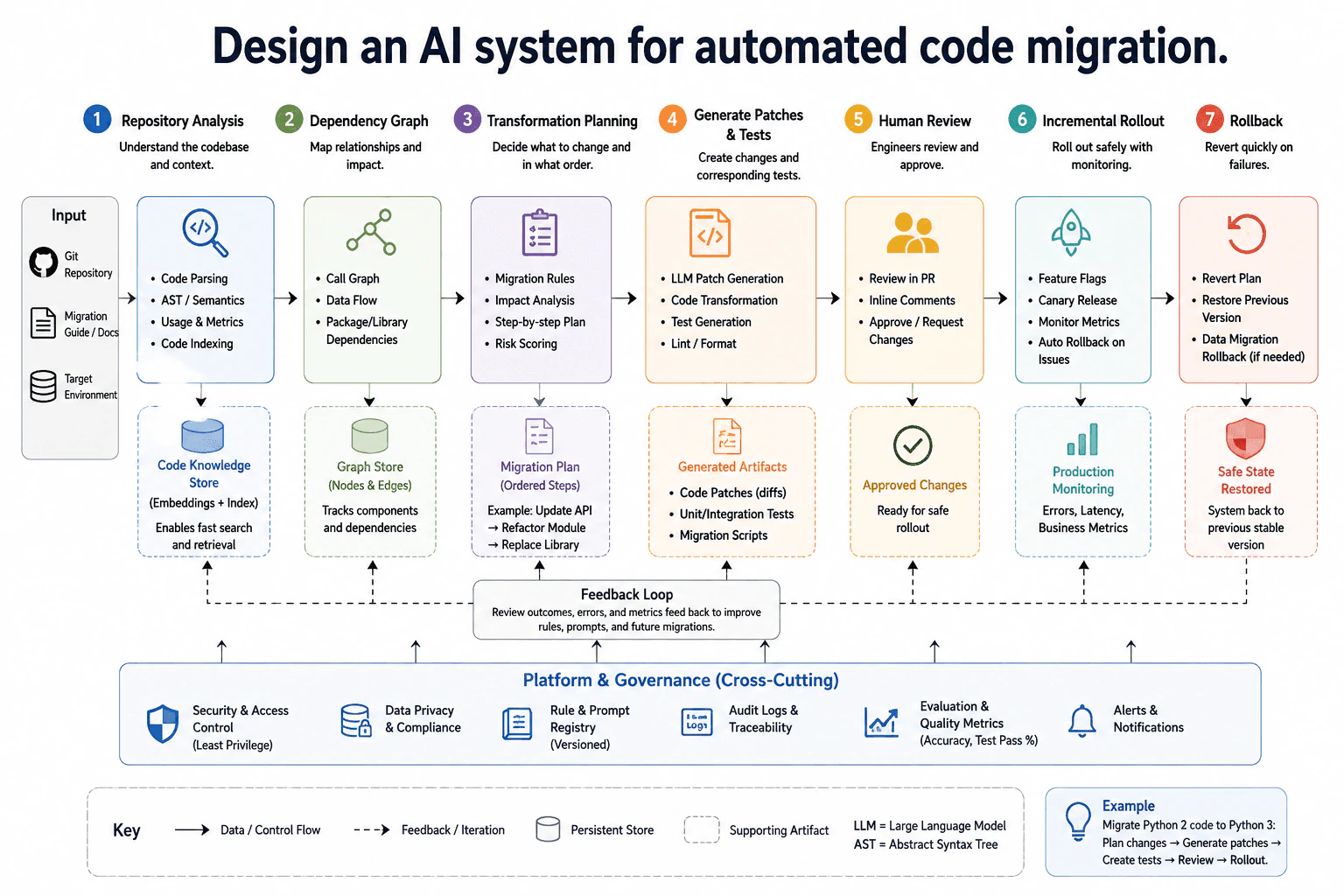
77. Design an AI system for automated code migration.Ai System DesignEasy

Question Details

A complete production design addresses repository analysis, dependency graph, transformation planning, generated patches, tests, human review, incremental rollout, and rollback.

Short Interview Answer (30-60 seconds)

At a high level, I would migrate code in small, reviewable steps instead of changing the whole repository at once. The system first analyzes the repository, builds a dependency graph, and creates an ordered migration plan. It then generates code patches and tests, followed by human review. Approved changes roll out gradually with feature flags, canary releases, and production monitoring. If problems appear, the system rolls back to the previous stable version. The key reliability choice is staged rollout with rollback. The trade-off is slower delivery in exchange for lower migration risk.

Detailed Explanation

The goal is to help a team move an existing codebase to a new language version, library, framework, or platform. The system must first understand the code, how its parts depend on each other, and what should change first. It then prepares small changes, checks them, asks engineers to review them, and releases them carefully. If the release causes problems, the system should return to the previous safe version. The diagram follows this path from repository analysis through planning, patch generation, review, rollout, feedback, and rollback.

Useful Questions to Ask the Interviewer
  • What kind of migration are we doing, such as a library, framework, or language upgrade?
  • How much human approval is required before production rollout?
  • What migration guides, documentation, and existing tests are available?
  • Can the target environment support feature flags and canary releases?
Design an AI system for automated code migration. diagram
How to Explain It in an Interview
1. Analyze the repository

I would start by understanding the codebase before changing anything. The inputs are the Git repository, migration guides or documentation, and the target environment. Repository Analysis performs code parsing, AST and semantic analysis, usage analysis, and code indexing. An AST, or abstract syntax tree, is a structured representation of source code. Useful repository knowledge goes into the Code Knowledge Store, which uses embeddings and an index for retrieval.

2. Build the dependency graph

Next, I would map how parts of the repository depend on each other. The Dependency Graph records call relationships, data flow, and package or library dependencies. The Graph Store keeps these relationships as nodes and edges. A shared package may need to change before modules that depend on it.

3. Create an ordered transformation plan

Transformation Planning decides what should change and in what order. It uses migration rules, impact analysis, step-by-step planning, and risk scoring. The result is a Migration Plan containing ordered steps. The diagram gives a simple example: update an API, refactor a module, then replace a library.

4. Generate patches and tests

The next stage creates the migration artifacts. The diagram shows LLM Patch Generation, code transformation, test generation, and linting or formatting. An LLM, or large language model, helps produce candidate changes, but its output is not automatically trusted. Generated Artifacts contain code patches, unit or integration tests, and migration scripts.

5. Require human review

Engineers review the proposed work in a pull request. They can leave inline comments, approve the changes, or request changes. Approved Changes become the input for safe rollout. Review outcomes also enter the Feedback Loop, together with errors and metrics, so rules, prompts, and future migrations can improve.

6. Roll out incrementally and monitor production

I would release approved changes gradually rather than everywhere at once. Incremental Rollout uses feature flags and canary releases. A canary release exposes the change to a limited part of production first. Production Monitoring watches errors, latency, and business metrics. The diagram also shows automatic rollback on issues, plus alerts and notifications. This gives the team a chance to detect problems before the change reaches more users.

7. Roll back and keep the process traceable

If the rollout fails, the Rollback stage follows the revert plan and restores the previous version. When needed, it can also include a data migration rollback. The target state is Safe State Restored, meaning the system returns to the previous stable version. Across the whole flow, Platform and Governance applies least-privilege security and access control, data privacy and compliance, a versioned Rule and Prompt Registry, Audit Logs and Traceability, Evaluation and Quality Metrics, and Alerts and Notifications. These controls make the migration process safer and easier to inspect.

Practical Complexity & Trade-offs

The main design choice is to favor safe, incremental migration over one large automated rewrite. The benefit is that each change is easier to understand, test, review, and reverse. The downside is that the full migration takes more time. Building a dependency graph adds work, but it helps choose the correct migration order. AI-assisted patch generation can speed up the work, but generated changes may still be wrong, so tests and human review remain important. Feature flags and canary releases reduce production risk, but they add rollout complexity. Versioned rules, audit logs, and stored artifacts improve traceability. Least-privilege access and data privacy controls also protect source code and migration data.

Why Interviewers Ask This

Interviewers ask this question to see whether you can design an AI-assisted workflow without trusting generated code blindly. They want to see clear stages, dependency reasoning, safe patch generation, automated checks, human approval, production monitoring, and rollback. They are also testing whether you can separate probabilistic AI behavior from deterministic safety controls. A strong answer explains the major trade-offs clearly instead of focusing only on model quality.

Interviewer may ask next
What would you change if the repository were very large and the migration could not be completed in one release?

I would keep the same architecture, but I would make the migration plan more incremental. Repository Analysis and the Dependency Graph would divide the codebase into smaller migration units. Transformation Planning would order those units by dependency and risk. The system would generate patches and tests for one group at a time instead of producing one very large change. Human Review would still approve each group before rollout. Incremental Rollout would use feature flags and canary releases so only a small part of production receives each change first. Production Monitoring would watch errors, latency, and business metrics after every step. If a step causes problems, the Rollback stage would restore the previous stable version. The main downside is that the migration takes longer and the team must manage old and new code during the transition. We accept that coordination cost because it keeps failures smaller, easier to diagnose, and easier to reverse.

How would you improve the system when generated patches are repeatedly rejected by engineers?

I would use the existing Feedback Loop instead of replacing the design. Human Review already provides approvals, requested changes, and inline comments. Test failures, production errors, and monitored metrics can also feed the loop. I would use that evidence to improve migration rules and versioned prompts in the Rule and Prompt Registry. The Code Knowledge Store can provide better repository context for later planning and patch generation. I would keep the same safety gates: generated patches still need tests, human approval, incremental rollout, and monitoring. Evaluation and Quality Metrics should show whether the changes improve outcomes, while Audit Logs and Traceability record which rule or prompt version produced each result. The main downside is that feedback can be noisy or specific to one repository. So I would update rules and prompts carefully instead of treating every rejection as a general rule.

78. Design an AI-powered document processing pipeline for financial institutions.Ai System DesignMedium

Question Details

The architecture must cover secure document intake, layout-aware extraction, validation against source records, lineage, human exceptions, retention, and audit controls.

Short Interview Answer (30-60 seconds)

At a high level, I would build a secure pipeline that turns financial documents into trusted structured data. Documents enter through trusted channels and pass authentication, malware, PII, and rate checks. They are cleaned and processed by a layout-aware AI model. Extracted fields are checked against business rules and trusted source records. Passed results move to approved storage and lineage. Failed or low-confidence results go to human review. I would encrypt sensitive data, keep immutable audit records, and accept extra review and control overhead for better accuracy, security, and compliance.

Detailed Explanation

The goal is to take financial documents from trusted sources and turn them into useful, checked data. We must keep each document safe while it moves through the system. We also need to understand its layout and extract important values. Those values must be compared with trusted records before they are approved. Unclear cases need human review. We must also record where each final value came from. Retention rules decide how long information stays. Audit records show important actions later. I would explain the design in the same order as the diagram.

Useful Questions to Ask the Interviewer
  • Which document types and intake channels matter most?
  • Which source systems should be trusted for validation?
  • Which failures or confidence levels require human review?
  • What retention, legal-hold, and data-residency rules apply?
Design an AI-powered document processing pipeline for financial institutions. diagram
How to Explain It in an Interview
1. Start with secure document intake

I would first accept documents through the trusted channels shown in the design. These are the Client Portal using SFTP or HTTPS, Email Ingestion using secure IMAP, Branch Scanners or the Mobile App, and APIs or Integrations such as Core Banking. All of these inputs enter the Ingestion Gateway.

The gateway performs AuthN and AuthZ. AuthN means checking identity. AuthZ means checking what that identity may do. It also performs virus and malware checks, DLP and PII detection, and rate limiting with quotas. DLP means preventing sensitive data from being handled in unsafe ways. PII means personally identifiable information. Traffic is encrypted in transit using TLS 1.2 or later. These controls protect the pipeline before document processing begins.

2. Prepare documents for reliable extraction

The next step is Pre-processing. The system normalizes incoming PDF, image, and similar document formats. It can rotate and de-skew pages, remove noise, enhance image quality, segment and classify pages, and create an OCR text layer when needed. OCR means converting visible document text into machine-readable text.

This stage improves input quality before AI extraction. It also keeps simple document cleanup separate from probabilistic model behavior.

3. Perform layout-aware AI extraction

The Layout-Aware Document AI Model reads both document content and page structure. It detects tables, forms, key-value pairs, handwriting, and reading order. It produces text blocks, fields such as name, date, and amount, table values such as line items and totals, checkbox or signature information, and confidence scores.

For example, a loan application can produce Applicant Name, Income, Loan Amount, and Employment. Confidence scores show how certain the model is about an extraction. They do not prove that the extracted value is correct. That is why validation comes next.

4. Validate and reconcile extracted values

Validation & Reconciliation checks the extracted data before approval. Business rules verify formats, allowed ranges, and required fields. Cross-field checks test logical consistency between related values. The system also matches values with trusted source records, such as Core Banking or CRM data. Duplicate detection and sanctions screening are part of this stage as shown in the diagram.

If the result passes these checks, it follows the green Pass path to Approved Data. If validation fails or confidence is low, the red exception path sends the case to Human-in-the-Loop review. The exception includes the reasons and confidence scores so the reviewer understands the problem.

5. Handle failed or unclear cases with people

Human-in-the-Loop review handles unclear or failed extractions. Reviewer tools show the document beside the extracted data. Reviewers can inspect suggested fixes, confidence information, and rule violations. They can correct data, add comments, and attach supporting documents.

This path prevents weak AI output from becoming trusted financial data. The downside is additional review time and operating cost for difficult cases.

6. Store approved data and preserve lineage

Passed data moves into Approved Data storage for downstream systems such as Core Banking, ERP, or a Data Lake. The next component is Document & Data Lineage. Lineage means keeping a trace from the source document to the final data.

The lineage record captures who changed something, what changed, when it changed, and how data moved from the source file to its final form. It also supports an immutable audit trail. Knowledge Access then makes approved documents and extracted data searchable for authorized operations and users.

7. Use feedback without bypassing validation

Reviewer corrections feed the Learning & Feedback process. The team can capture reviewer corrections, monitor model performance, update rules and dictionaries, and retrain or fine-tune models when appropriate. The feedback path can improve preprocessing and extraction over time.

The important point is that learning does not replace validation. Updated model output still passes through the same validation and exception controls before becoming approved data.

8. Apply retention, audit, security, and operational controls

Retention Management applies retention schedules, legal holds, and secure deletion. Audit & Reporting keeps immutable logs, access records, change history, and regulatory reports.

The whole pipeline also uses cross-cutting controls shown at the bottom of the diagram. Data is encrypted at rest using AES-256. RBAC and least privilege limit access. RBAC means permissions are based on assigned roles. Tenant isolation separates customers or business tenants. Immutable audit logs preserve evidence of important actions. Monitoring and alerts track availability and quality. Data residency and compliance controls keep regulated data in allowed locations. High availability and backups support continued operation and recovery.

Practical Complexity & Trade-offs

The benefit of this design is that AI handles complex document layouts while rules and trusted source records protect the final data. The downside is extra system and review complexity. Human review improves difficult cases, but it adds time and cost. Strong controls such as encryption, RBAC, tenant isolation, immutable logs, retention rules, and data-residency rules reduce risk, but teams must operate them carefully. Layout-aware AI is useful because financial documents are not simple text files. However, a confidence score is not proof of correctness. We therefore accept a slower exception path for failed or low-confidence cases. Reviewer feedback can improve models and rules over time, but new model behavior must still pass the same validation and audit controls.

Why Interviewers Ask This

Interviewers use this question to test whether you can combine AI with normal financial-system controls. They want to see a clear separation between probabilistic extraction and deterministic checks. They also test whether you protect sensitive documents, validate data against trusted records, handle uncertain cases safely, preserve lineage, and support retention and audits. A strong answer shows good judgment about automation, accuracy, security, compliance, human review, reliability, and operating cost rather than treating the AI model as the entire system.

Interviewer may ask next
What would you change if the document AI model starts producing many low-confidence results?

I would keep the same architecture and rely more heavily on the existing exception and feedback paths. Low-confidence results should continue from Validation & Reconciliation into Human-in-the-Loop review. They should not move directly into Approved Data.

Reviewers would compare each source document with the extracted values. They could correct mistakes, record comments, and attach supporting evidence. Those corrections would feed Learning & Feedback. The team could then monitor model performance, update rules and dictionaries, and retrain or fine-tune the model when the evidence supports a change.

I would also inspect Pre-processing. Poor rotation, noise, page segmentation, or OCR quality can lower extraction confidence before the layout-aware model processes the document.

Correctness remains protected because source-record validation and human review stay in place. Security controls also remain unchanged. The main downside is more human-review volume. That increases cost and processing time until extraction quality improves.

How would you prove to an auditor where an approved financial field came from?

I would use the existing Document & Data Lineage, Audit & Reporting, and Retention Management components. Each approved value should remain linked to the source document and its processing history.

Document & Data Lineage records who changed information, what changed, when it changed, and how the value moved from the source file to final approved data. If a reviewer corrected an exception, the review action, comments, and supporting documents become part of that trace.

Audit & Reporting keeps immutable logs, access records, and change history. Immutable means the audit evidence cannot be silently rewritten through normal application use. Retention Management then applies retention schedules and legal holds so required records remain available for the required period.

RBAC and least privilege restrict access. Tenant isolation separates data between tenants, while encryption protects stored information. The main downside is more metadata, storage, and governance work. We accept that cost because financial systems need strong traceability and audit evidence.

79. Design a multi-tenant AI chatbot platform where each business gets a custom chatbot.Ai System DesignMedium

Question Details

The design discussion should connect tenant isolation, configuration, identity, retrieval permissions, quotas, model routing, observability, and safe shared infrastructure.

Short Interview Answer (30-60 seconds)

At a high level, I would build one shared chatbot platform while keeping every business logically isolated. A user message passes through the Edge, then the platform identifies the tenant and loads that tenant’s settings, limits, and permissions. Retrieval only returns documents allowed for that tenant and user. The Model Router chooses an allowed model using capability, cost, latency, and tenant preferences. Safety policies control sensitive data and tool use. Tenant-aware storage, quotas, logs, metrics, and audit records support safe operations. The trade-off is lower shared cost, but isolation checks become critical everywhere.

Detailed Explanation

We need one service that lets many businesses run their own chatbots. Each business should still feel separate from every other business. Its look, instructions, tools, users, documents, limits, and model choices must stay private. The main challenge is sharing costly parts of the platform without mixing customer information or letting one customer use all available capacity. We also need safe answers, controlled document access, useful monitoring, and reliable model choices. I would explain the design by following one message from the user to the model and back.

Useful Questions to Ask the Interviewer
  • How many tenants and active chats should the platform support?
  • Can each tenant choose different models, tools, and usage limits?
  • How strict must tenant data isolation be?
  • Can users inside one tenant have different document permissions?
  • Should responses stream back to the user?
Design a multi-tenant AI chatbot platform where each business gets a custom chatbot. diagram
How to Explain It in an Interview
1. Receive the message and identify the tenant

I would start at the Edge. Users can come from Web, Mobile, Slack, or WhatsApp. Their messages pass through the CDN/WAF and Load Balancer before reaching the multi-tenant orchestration layer.

The Request Router extracts the tenant from the token or domain. It places the request into the correct tenant isolation context. The Tenant Context Resolver then loads that tenant’s configuration, usage plan, limits, and permissions.

Identity & Access is shared infrastructure. It supports OIDC / OAuth 2.0, a Tenant Directory, RBAC roles, API keys, and SSO using SAML. Authentication proves who the caller is. Roles and permissions decide what that caller may access.

2. Load the tenant configuration and enforce quotas

Each tenant has its own chatbot configuration. The diagram shows branding and look, system prompts, tools and integrations, and model preferences.

The Quota & Rate Limiter then enforces per-tenant and per-user limits. These include token limits, requests per minute, tokens per minute, and concurrent chats. This prevents one noisy tenant from consuming shared capacity.

The important rule is that tenant_id stays attached to the request. Data, caches, embeddings, logs, configuration, and model choices remain isolated by tenant.

3. Retrieve only information the user may read

When the chatbot needs business knowledge, the orchestration layer uses the Retrieval & Tenant Data Plane. The Retriever performs hybrid search. This means it combines vector search and keyword search with metadata filters.

The Tenant Knowledge Base keeps each tenant’s embeddings, documents, and files isolated. The diagram also shows encryption at rest. The Permission Filter then checks row-level or document-level access.

This gives two protection layers. Tenant isolation stops one business from reading another business’s data. User permissions stop one employee from reading documents they are not allowed to see.

4. Apply safety rules and choose the model

The Safety & Policy Enforcer controls sensitive data and allowed behavior. It handles PII redaction, content filters, tool allow or deny rules, and data-handling rules.

The Model Router then chooses from the shared model pool. The choice can use capability, cost, latency, and tenant preferences. The diagram also supports failover when needed.

The same orchestration layer can use approved Tools & Integrations. These include APIs, functions, calculators, CRMs, ticketing, payments, and web search. Tenant policy controls which tools are allowed.

5. Keep conversation state isolated

Conversation & State is separated by tenant. Chat History stores each tenant’s conversation history and context. User & Session State keeps session metadata, preferences, and memory.

The Caching Layer stores prompt or response cache entries. The Storage component keeps encrypted data partitioned with tenant_id. Per-tenant encryption keys are part of the isolation strategy shown in the diagram.

This matters because isolation must cover temporary state as well as permanent documents. A cache hit must never return another tenant’s response.

6. Return the response and observe the platform

After the model generates a response, it returns through the Model Router and orchestration layer. The Edge streams the response back to the user.

Observability & Operations receives tenant-aware logs and traces. It tracks latency, errors, token usage, cost, rate-limit events, SLO breaches, quota abuse, and model errors. Audit Logs record admin actions, configuration changes, and data access.

Admin & Tenant Management handles tenant onboarding and offboarding, plan and quota management, user and role management, billing, and usage. The main trade-off is shared efficiency versus isolation complexity. Shared models and runtime reduce cost, but every important path must enforce the correct tenant context.

Practical Complexity & Trade-offs

The benefit of this design is that many businesses can share the same platform and model pool. This can reduce cost and improve resource use. The downside is that tenant isolation becomes a rule across the whole system. Every request, cache entry, document lookup, stored conversation, log, and configuration record must stay connected to the correct tenant. Per-tenant quotas protect shared capacity, but they add control logic. Permission filtering makes retrieval safer, but it adds work to each search. A shared model pool gives flexible routing and failover, but model choices can have different cost and latency. We accept this extra complexity because safe sharing is the main goal of a multi-tenant platform.

Why Interviewers Ask This

The interviewer is testing whether the candidate can safely share AI infrastructure across many customers. They want clear tenant boundaries, correct identity handling, protected retrieval, quota enforcement, sensible model routing, and strong observability. They also want to see that access checks, isolation, billing, and policy are deterministic even though model outputs are probabilistic. A strong answer explains both the value of shared infrastructure and the extra controls required to use it safely.

Interviewer may ask next
What would you change if one very large tenant suddenly creates much more traffic than every other tenant?

I would keep the same architecture and rely more heavily on the existing quota and routing controls. The main affected component is the Quota & Rate Limiter. It already enforces per-tenant and per-user limits for tokens, request rate, token rate, and concurrent chats. Those limits stop one tenant from consuming all shared capacity. The Model Router would still choose models using capability, cost, latency, and tenant preferences. If the chosen model cannot serve the request, the existing failover path can use another allowed model. Tenant context must remain attached to every request, so extra traffic never weakens isolation. Observability should show tenant_id on traces, usage, cost, rate-limit events, and model errors. This makes the noisy tenant easy to identify. The main downside is that strict limits can restrict legitimate traffic from a large customer. Raising that tenant’s plan and quota can support more traffic, but it also increases shared capacity needs and cost.

How would you prevent a user from retrieving a document that belongs to the same tenant but that user is not allowed to read?

I would use the Permission Filter already shown in the retrieval path. The Retriever searches only inside the tenant’s knowledge base using tenant-scoped data and metadata filters. The Permission Filter then checks whether the current user may access each retrieved row or document. Only allowed content can continue into the model flow. This matters because tenant isolation alone is not enough. Two employees can belong to the same business but have different document access. Identity & Access provides the user and role information. The Tenant Context Resolver loads the tenant permissions needed for the request. The permission decision stays deterministic and happens before protected content reaches the model. Tenant-aware Audit Logs can record data-access activity for later review. The downside is extra work during retrieval because results must be checked against access rules. That can add latency, but it is necessary to prevent sensitive information from leaking between users inside the same tenant.

80. Design ChatGPT: Training to Serving (End to End)Ai System DesignHard

Question Details

Expected architectural coverage includes data and training pipeline, post-training, model registry, inference serving, conversation state, safety layers, observability, feedback, and rollback.

Short Interview Answer (30-60 seconds)

At a high level, I would design ChatGPT as one lifecycle from training data to safe online serving and continuous improvement. Data is cleaned, used for pretraining, and improved through post-training and safety work. Evaluated model versions are stored in a registry before serving. Online requests pass through routing and safety checks, then reach model inference, tools, retrieval, and conversation state when needed. We stream responses and collect monitoring signals and feedback. The main trade-off is stronger safety and release control versus extra latency, cost, and operational complexity.

Detailed Explanation

The goal is to build a system that learns from useful data and then serves users safely and reliably. We need a clear path from preparing training data to running a selected model version for real users. The system should also keep conversation state, use tools or retrieved documents when needed, check unsafe content, watch quality, collect feedback, and recover from a bad release. I would explain the design in the same order as the diagram, starting with offline training and ending with serving, monitoring, and improvement.

Useful Questions to Ask the Interviewer
  • What traffic and response speed should we design for?
  • Which safety risks are most important?
  • What conversation data should be stored, and for how long?
  • How quickly should a bad model release be rolled back?
Design ChatGPT: Training to Serving (End to End) diagram
How to Explain It in an Interview
1. Prepare data and pretrain the model

I would start with the offline data path. The diagram uses web pages, books, code, documents and FAQs, APIs, and internal data. Data processing performs deduplication, PII removal, quality filtering, and normalization. PII means personal information that should be removed when required.

The prepared corpus goes to a GPU or TPU training cluster. Distributed training spreads the work across many accelerators. The decoder-only Transformer learns with next-token prediction. This produces the base model for later improvement.

2. Improve behavior with post-training

Next comes post-training. SFT, or supervised fine-tuning, teaches the model with high-quality examples. A Reward Model learns human preferences. The diagram then uses RLHF or DPO to improve model behavior, followed by safety fine-tuning with red-team and policy data.

This stage improves helpfulness and safety after general pretraining.

3. Register and evaluate model versions

The trained models enter Model Registry and Versioning. The registry tracks versions such as v1.0, v1.1, and the production version. A Model Card records dataset information, evaluations, safety notes, limitations, and release notes.

The Evaluation Suite checks quality, safety, robustness, bias, and hallucination behavior. Keeping clear versions supports controlled releases, version pinning, fallback, and rollback.

4. Serve online requests

For online traffic, requests enter the API Gateway. The Serving Layer includes a Request Router for load balancing, a Model Router for selecting the serving version, and Rate Limiter and Auth controls.

Safety checks are applied on requests. Input Moderation checks risks such as jailbreaks, PII, hate, and violence. Prompt Injection Defense can block or sanitize suspicious instructions. Policy Enforcement applies usage and content rules.

The accepted request reaches the Model Inference Cluster. KV cache keeps reusable generation state. Batching improves accelerator use. Streaming sends the response progressively instead of waiting for the complete answer.

5. Use conversation state, tools, and retrieval

The Conversation Store keeps chat state in Redis or a database. Long-term Memory can hold user preferences and history summaries as shown. Tool or Function Executors provide capabilities such as web search, code execution, calculators, and APIs. Retrieval, or RAG, uses a vector database and index to find relevant documents.

These components support the model when the request needs remembered context or outside information.

6. Check output and return the response

Before delivery, Output Moderation checks unsafe generated content. The Grounding Check verifies support from retrieved information and can add citations when needed. The happy path then streams the response to the user and stores state and feedback from the interaction.

7. Observe, improve, and roll back

Logging and Metrics track QPS, latency, errors, and tokens. Tracing follows an end-to-end request. Quality Monitoring watches hallucination, helpfulness, and safety signals. User Feedback and Human Review identify weak or risky cases.

The Data Flywheel turns useful findings into new training or evaluation data. Release Management supports canary or shadow deployments, automatic rollback on alerts, version pinning, and fallback. These controls help the team improve models while retaining a safer previous version when a release performs badly.

Practical Complexity & Trade-offs

The main trade-off is balancing quality, speed, safety, and cost. Large training jobs need many accelerators, so training happens offline and can be expensive. Online serving must respond quickly. Batching improves accelerator use, but waiting for a batch can add delay. KV caching saves repeated generation work, but it uses accelerator memory. Streaming makes answers feel faster because output arrives early. Safety checks reduce harmful responses, but they add work and may increase latency. Conversation storage improves continuity, but stored data needs careful handling. Tools and RAG improve usefulness, but they add external failure points. Versioning, monitoring, canary releases, fallback, and rollback add operational complexity. We accept that complexity because it reduces release risk and helps recovery.

Why Interviewers Ask This

Interviewers use this question to test whether a candidate can connect model development with production engineering. They look for clear boundaries between offline training and online serving. They also test judgment around model versions, routing, conversation state, tools, retrieval, safety, observability, feedback, and rollback. A strong answer explains the end-to-end flow clearly and discusses realistic scaling and reliability trade-offs without inventing guarantees.

Interviewer may ask next
What would you do if a newly released model starts producing unsafe or low-quality answers?

I would use the monitoring and release controls already shown in the design. Quality Monitoring would surface changes in hallucination, helpfulness, safety, latency, or error signals. User Feedback and Human Review would help confirm important cases. If the new version is performing badly, Release Management can use the diagram's automatic rollback, version pinning, and fallback controls. The Model Registry keeps earlier versions available, so serving can return to a previous model version without waiting for another training run.

For future releases, I would use the shown canary or shadow deployment approach before broad rollout. This limits the risk of exposing all traffic to a weak version immediately. The rest of the architecture stays unchanged, including safety checks, conversation state, tools, tracing, and feedback.

The downside is operational complexity. The team must manage several model versions, evaluation results, monitoring signals, and release rules. Rollback also restores service quality but does not fix the model. The bad cases still need to feed evaluation and future training work.

How would this design handle a request that needs fresh information outside the model's learned knowledge?

I would keep the same serving design and use the Retrieval and Tool components already shown. The request still enters through the API Gateway, routing, authentication, rate limiting, and request safety checks. When useful external information is needed, Retrieval, or RAG, searches the Vector DB and Index for relevant documents. Tool or Function Executors can use the capabilities shown in the diagram, including web search, calculators, code execution, or APIs.

The model can use those results as supporting context while generating its response. Output Moderation still checks the generated content. The Grounding Check can verify support from retrieved information and provide citations when needed. The streamed response then returns to the user, while state and feedback are collected as shown.

The downside is extra latency and more failure points. Retrieval can return weak documents, and tools can be slow or unavailable. For that reason, these paths should remain observable through the same logging, tracing, quality monitoring, and feedback system.

More questions load as you scroll

Disclaimer: This interview guide is for educational and informational purposes only. It is designed to help readers prepare, but it does not guarantee any interview result, hiring decision, offer, or outcome. Interview questions, hiring criteria, and preferred answers can vary by employer, interviewer, industry, location, and time. The examples and explanations reflect the authors' research and judgment, are provided without warranties of any kind, and should not be treated as the only correct approach. Diagrams are simplified illustrations intended to highlight the main components and their interactions; actual systems and implementations may be more complex. Alternative approaches may be equally valid or better suited to a particular question, context, or interviewer. To the fullest extent permitted by applicable law, the author, contributors, and publisher are not liable for decisions made, actions taken, or losses incurred based on this guide.