This interview guide is for educational and informational purposes only. It is designed to help readers prepare, but it does not guarantee any interview result, hiring decision, offer, or outcome. Interview questions, hiring criteria, and preferred answers can vary by employer, interviewer, industry, location, and time. All answers, examples, and explanations in this guide are suggested examples for interview preparation, not definitive answers or instructions for professional practice. They are based on research and judgment, are provided without warranties of any kind, and should be adapted to the question, role, and applicable laws and professional requirements. Diagrams are simplified illustrations intended to highlight the main concepts and their relationships; actual situations, systems, and practices may be more complex. Alternative approaches may be equally valid or better suited to a particular question, context, or interviewer. To the fullest extent permitted by applicable law, the contributors and publisher are not liable for decisions made, actions taken, or losses incurred based on this guide.
State Laws and Professional Responsibilities
Laws and requirements governing an occupation vary by state and jurisdiction. You are responsible for checking the current laws, licensing requirements, and scope-of-practice rules that apply to your location and role, and for ensuring that your answers and actions comply with them. Adapt examples in this guide to those requirements. This guide is not legal advice.
Identity, Image, and Privacy Notice
To respect individual privacy, some names, profile photographs, avatars, biographical details, and other identifying information displayed in this guide may be replaced with pseudonyms, licensed stock images, illustrative avatars, composite images, or representative descriptions. Unless a person is expressly identified as an actual contributor, a displayed name, image, or profile should not be understood as depicting or identifying a specific candidate, interviewer, employee, or other real individual. These representations are provided for editorial and illustrative purposes only and do not imply endorsement, employment, participation, or affiliation with this guide or any company mentioned in it. Any resemblance to an actual person is coincidental.
Company Notice
This guide is an independent educational resource and is not affiliated with, endorsed by, sponsored by, or approved by the company named in this guide. Company names identify reported interview experiences or the employer context of clearly labeled original practice exercises. Interview practices can change without notice, and inclusion of company-specific content does not mean these questions are official, complete, or guaranteed to be asked. To the fullest extent permitted by law, the author, contributors, and publisher are not responsible for outcomes related to use of this material.
Content Accuracy and Verification
To the fullest extent permitted by applicable law, we do not represent or warrant that interview guides, questions, answers, examples, or diagrams are accurate, complete, current, error-free, or suitable for any particular purpose. You are responsible for independently reviewing and verifying the information before relying on it.
Questions or comments?
Contact us for general questions, or share feedback, technical corrections, and comments with the community.
41. How do you handle document updates and maintain freshness in a RAG system?Retrieval Augmented Generation RagEasy
i Question Details
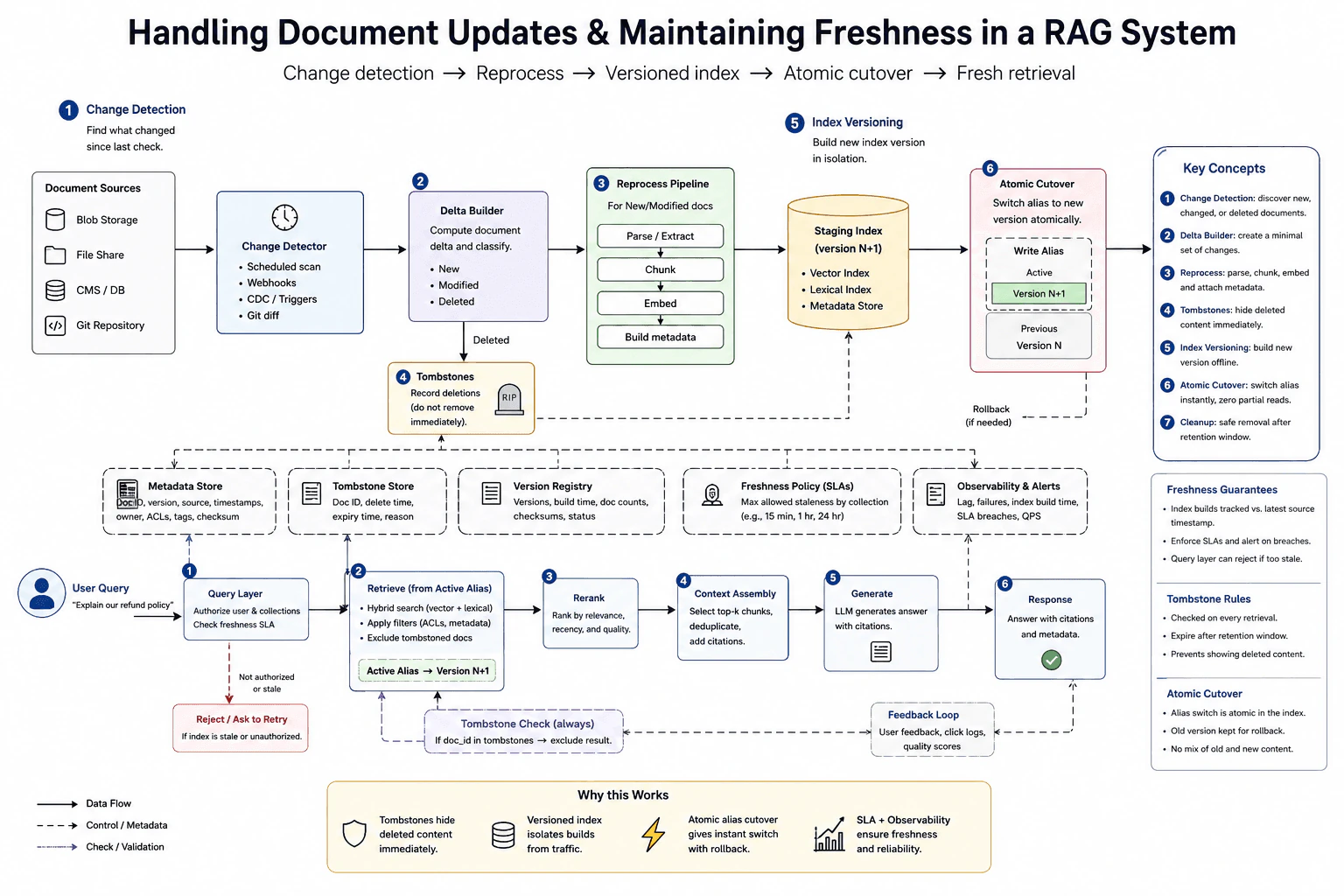
Require an implementation-level account of change detection, reprocessing, index versioning, freshness SLAs, tombstones, and atomic cutover to updated content.
Short Interview Answer (30-60 seconds)
Detect document changes, reprocess only new or modified content, and record deletions as tombstones. Build a new index version away from live traffic, validate it, then atomically move the active alias to it. Keep the old version for rollback and monitor freshness SLAs.
Detailed Explanation
A RAG system should stop old or deleted information from reaching users after the source changes. The safe approach is to notice each change, rebuild only the affected content, and prepare the replacement search data away from live traffic. Deleted documents should be hidden quickly, even if physical cleanup happens later. When the replacement is complete and checked, users should move to it in one controlled switch. The system should also keep the previous good version for recovery and measure how long source changes take to become searchable.
Useful Questions to Ask the Interviewer
How fresh must updated documents be before they are considered too old?
Can the source system send change events, or do we need scheduled scans?
Should deletions disappear from retrieval immediately, even before physical index cleanup finishes?
Do we need rollback to the previous index version if validation or production checks fail?
How to Explain It in an Interview
I separate the update path from the query path. The update path prepares fresh content. The query path serves users from one active, consistent index version.
First, I detect changes. I keep document metadata such as document ID, source version, checksum, or last-updated time. A scheduled scan, webhook, change-data-capture event, file diff, or Git diff can tell the system whether a document is new, modified, or deleted. The exact mechanism depends on the source.
For a new or modified document, I re-run the normal ingestion steps only for that document. I parse it, split it into chunks, create embeddings, and rebuild its metadata. If lexical retrieval is supported, I update that representation too. This avoids rebuilding unchanged documents.
For a deletion, I create a tombstone. A tombstone is a small record that marks a document as deleted. Query-time retrieval checks the tombstone store and excludes those document IDs immediately. Physical vectors, lexical entries, and metadata can be removed later after the retention window. This prevents deleted content from appearing while slower cleanup is still running.
I keep document metadata and lifecycle state separately from the searchable indexes. Metadata can include document ID, source version, timestamps, ownership or access information, tags, and checksums. A version registry records each index build and its status so the system knows which version is active and which version can be used for rollback.
For updates that could expose mixed old and new state, I do not rebuild the active production index in place. I build a staging index, such as version N+1, while queries continue reading version N. The staging version contains the updated vector index, lexical index when used, metadata needed for retrieval, and document status information.
Before promotion, I validate the staging version. I check expected documents and chunks, confirm that deleted documents are excluded, and run representative retrieval checks. I also compare the index state with source timestamps and the configured freshness SLA.
A freshness SLA is the maximum acceptable delay between a source change and that change becoming visible to users. It can be defined per collection because different knowledge sources may need different freshness targets. I monitor source-to-index lag, index build duration, failed updates, SLA breaches, and the version currently serving traffic. If the serving version becomes too stale for a collection's policy, the query layer can reject the request or ask the caller to retry instead of silently serving content that violates the freshness requirement.
After validation passes, I perform an atomic cutover. The query service reads through one active alias or version pointer. I change that pointer from version N to version N+1 in one operation. Readers therefore see either the complete old version or the complete new version, not a partial mixture of both.
I keep the previous version read-only during a rollback window. If the new version has a serious problem, the alias can move back to the previous good version. After the retention window expires, old index data and expired tombstones can be removed according to policy.
At query time, authorization must happen before restricted content reaches the model. The query layer checks the user's allowed collections and metadata filters, then retrieval reads from the active version. Hybrid retrieval can combine vector and lexical search. Tombstoned documents are excluded. Results can then be reranked by relevance and recency. Context assembly selects the useful chunks, removes duplicates when needed, respects the context budget, and attaches citations before generation.
The model generates an answer only from the context it receives, and the response includes citations and useful metadata such as the serving version when appropriate. Retrieval quality, click signals, user feedback, and freshness measurements can feed monitoring and evaluation, but they do not replace the source-of-truth update process.
The main tradeoff is freshness versus cost and operational work. Tighter freshness targets require faster change detection, more frequent embedding and indexing work, and stronger monitoring. Versioned indexes temporarily use more storage, but they isolate builds from production traffic, make cutover consistent, and provide a simple rollback path.
Retrieval Path
Detect whether each source document is new, modified, unchanged, or deleted using events, source versions, timestamps, checksums, or scheduled comparisons.
Reprocess only new or modified documents: parse, chunk, embed, rebuild metadata, and update lexical data when lexical retrieval is used.
Write a tombstone for every deleted document so query-time retrieval can exclude it immediately.
Build the replacement content in a new staging index version instead of partially changing the active version.
Record build metadata and status in a version registry.
Validate document coverage, deletion behavior, representative retrieval quality, and source-to-index freshness before promotion.
Atomically change the active alias or version pointer from the old validated version to the new validated version.
Keep the previous version read-only during a rollback window.
At query time, authorize the user, check the freshness policy, retrieve only from the active version, apply metadata and access filters, exclude tombstoned documents, rerank when useful, assemble context, and generate a cited answer.
Monitor ingestion lag, index build duration, update failures, SLA breaches, serving version, and retrieval quality signals.
Remove expired old versions and tombstones only after their retention windows allow safe cleanup.
Time & Space Complexity
The work is mostly proportional to how much content changes. Incremental updates are cheaper than rebuilding everything because only changed documents are parsed, chunked, embedded, and indexed. Keeping an active version and a staging version at the same time temporarily increases storage. Tombstone checks add a small lookup step during retrieval until cleanup removes deleted entries. Tighter freshness SLAs require more frequent detection and faster reprocessing, so they increase compute and operational work. Versioning adds maintenance work but gives safer deployment, consistent reads, and fast rollback.
Where it is used
This pattern is useful whenever source knowledge changes after a RAG system is deployed. Examples include company policy assistants, product documentation search, customer-support knowledge bases, compliance repositories, engineering documentation, internal wikis, and content systems where documents are edited or deleted. It is especially useful when users must not see partially rebuilt indexes, deleted content, unauthorized content, or data that exceeds an agreed freshness limit.
Why Interviewers Ask This
The interviewer wants to know whether you can keep a RAG system synchronized with changing source data without exposing partially rebuilt indexes, stale documents, deleted content, or inconsistent retrieval results. They are testing your understanding of change detection, incremental reprocessing, versioned indexes, deletion handling, atomic promotion, rollback, freshness targets, and production monitoring.
Common interview mistakes
A common mistake is changing the live index piece by piece without considering what users can retrieve during the rebuild. That can expose a mixture of old and new content. Another mistake is treating deletion only as background cleanup, which can leave deleted content searchable. Teams may also skip document versions or checksums and unnecessarily reprocess everything. Other mistakes include promoting an index before validation, having no rollback version, defining no freshness SLA, failing to monitor source-to-index lag, serving data after the freshness limit is exceeded, and allowing restricted retrieved content to reach the model before authorization checks.
Interview tip
Explain the lifecycle in order: detect changes, reprocess changed documents, tombstone deletions, build a new version, validate it, atomically switch the active alias, retain the old version for rollback, and monitor freshness. Then explain that online queries always read one complete active version and enforce authorization before content reaches the model.
Interviewer may ask next
How would you handle a document deletion if rebuilding the index takes several minutes?
I would write a tombstone as soon as the deletion is detected. The query layer checks the tombstone store and excludes that document ID before returning retrieved chunks, so the deleted content disappears from results immediately. Physical vectors, lexical entries, and metadata can be removed later during cleanup or a later index build. This separates fast user-visible deletion from slower storage cleanup.
What would you do if the new index version fails validation or causes problems after cutover?
If validation fails before promotion, I leave the active alias pointing to the current validated version, record the failure, alert the operator, and retry or investigate the staging build. If a serious problem is discovered after promotion, I atomically point the alias back to the retained previous version. Users therefore continue reading one complete version during both failure paths.
42. What is parent-child chunking, and how does it improve retrieval?Retrieval Augmented Generation RagMedium
i Question Details
Frame the concept using small retrieval units, larger context units, parent linkage, deduplication, and token-budget effects.
Short Interview Answer (30-60 seconds)
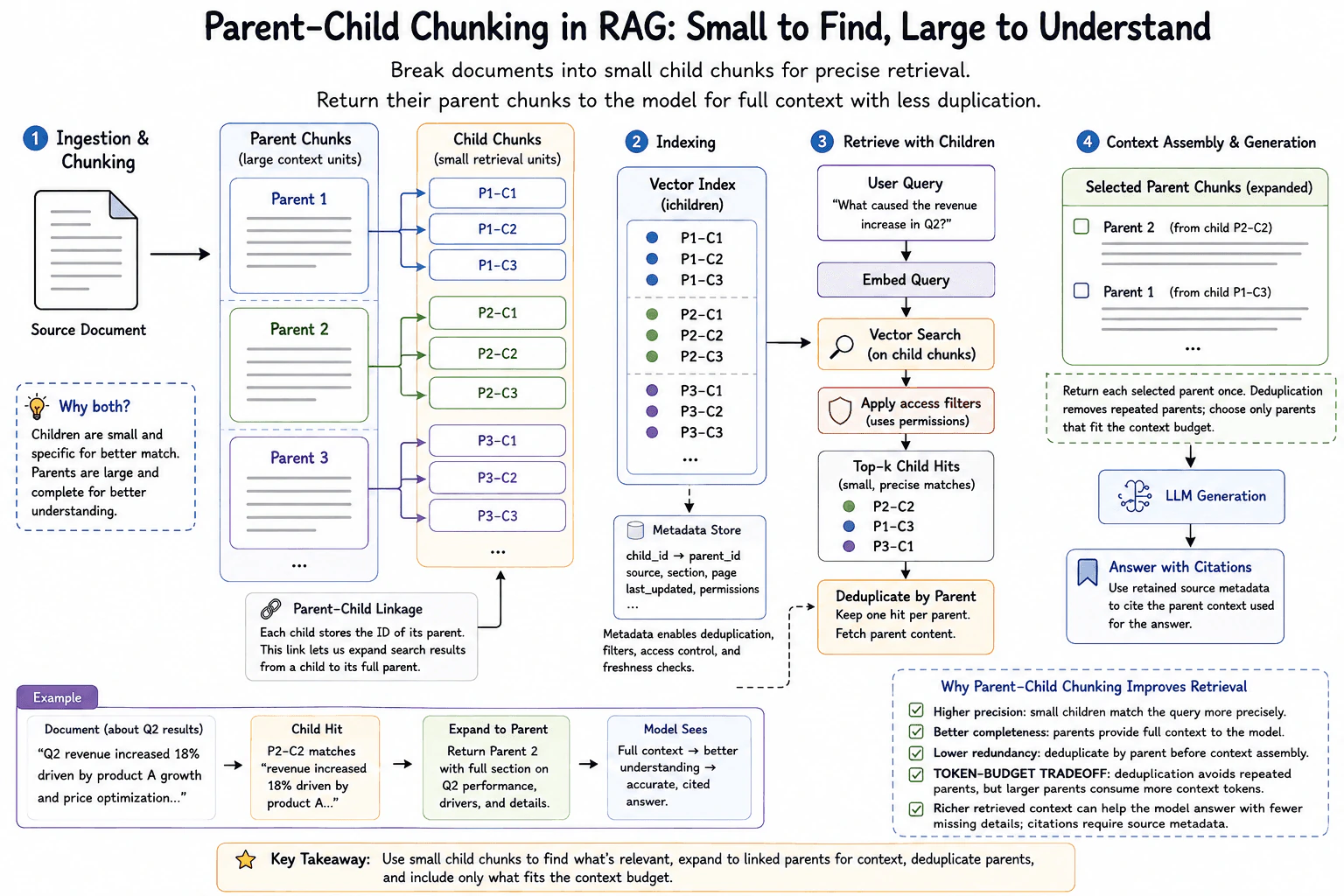
Parent-child chunking retrieves small child chunks for precise matching, then follows each child-to-parent link and returns the larger parent context. Duplicate parents are removed before context assembly. This combines focused retrieval with richer context, but larger parents use more context tokens.
Detailed Explanation
Parent-child chunking solves a simple problem. The best piece of text for finding information is often smaller than the best piece for answering with enough context. A small piece can match a question closely, but it may leave out important surrounding details. A larger piece gives more explanation, but searching only large pieces can make matching less focused. Parent-child chunking uses both sizes. It searches small pieces first, follows their links to larger pieces, removes repeated larger pieces, and sends only useful context that fits the available space.
Useful Questions to Ask the Interviewer
Should each parent represent a section, paragraph group, page, or another meaningful document boundary?
How strict is the context-token budget when several parent chunks are selected?
Do documents have permission rules that must be checked before retrieved content can continue to the model?
How to Explain It in an Interview
During offline ingestion, split each source document into larger parent chunks. A parent should normally follow a meaningful document boundary, such as a section. Then split each parent into smaller child chunks that are used for retrieval.
Each child stores a parent ID. This parent-child link is important because it lets the retrieval system move from a precise child hit back to the larger context that contains it. Metadata can also keep fields such as source, section, last-updated information, and permissions.
The retrieval index stores the child chunks, for example as vector embeddings. At query time, the application embeds the user's question and searches the child index. Because a child covers a smaller and more focused piece of text, it can match a narrow question more precisely than a large parent containing several ideas.
Before restricted content is accepted for downstream use, the system applies the required access filters using permission metadata. Unauthorized results must not continue into context assembly or reach the model.
Suppose the query is about why revenue increased in Q2. The top child hits might include P2-C2, P1-C3, and another child from Parent 2. The system follows each accepted child's parent ID. If several children point to Parent 2, it keeps Parent 2 only once. This is parent deduplication.
Next, the system fetches the selected parent chunks. The larger parents contain the surrounding section, so the model receives more complete context than it would receive from an isolated child. This is the central idea: use small children to find what is relevant, then use their linked parents to understand it.
There is an important token-budget tradeoff. Deduplication prevents the same parent from being added repeatedly, but parent chunks are larger than child chunks. Returning too many parents can consume the model's context budget quickly. Context assembly therefore chooses only the useful parents that fit the available budget.
Parent-child chunking does not automatically guarantee a correct or grounded answer. It improves how retrieval and context expansion are organized. Citations also require retained source metadata. If citations are needed, the system should use that metadata to identify the parent context used for the answer.
Retrieval Path
During offline ingestion, split each source document into meaningful larger parent chunks.
Split every parent into smaller child chunks.
Store a parent ID on each child and retain source and permission metadata.
Create embeddings for the child chunks and index the children for retrieval.
At query time, embed the user's question and search the child index.
Apply required access filters before restricted child hits are accepted.
Map each accepted child hit to its parent ID.
Deduplicate parent IDs so the same parent is included only once.
Fetch the selected parent chunks.
Assemble only parent chunks that fit the available context budget.
Send that context to the model.
When citations are required, use retained source metadata to identify the parent context used for the answer.
Time & Space Complexity
The design adds some storage and lookup work. The system keeps child chunks for retrieval plus metadata that links each child to a parent. Query-time search still runs over the child index, but parent lookup and deduplication add extra steps. Larger parents also consume more model-context tokens, so context assembly must control how many are returned. Updates and deletions are more involved because child entries, embeddings, parent content, and parent links must stay consistent.
Where it is used
Parent-child chunking is useful when documents have meaningful larger sections but users ask narrow questions. Common examples include technical documentation, policy manuals, knowledge bases, support articles, legal documents, research material, and long reports. It is especially useful when a small sentence or paragraph is easy to retrieve, but the model needs the surrounding section to answer clearly.
Why Interviewers Ask This
Interviewers want to know whether you understand the tradeoff between precise retrieval and sufficient context. A strong answer should explain why small child chunks are useful for matching, why larger parents are useful after retrieval, how child-to-parent linkage works, why repeated parents must be deduplicated, and how authorization and context-token limits affect the final context.
Common interview mistakes
A common mistake is retrieving only large parent chunks and losing the precision benefit of smaller children. Another mistake is returning one parent for every child hit without deduplication, which repeats context and wastes tokens. Teams can also forget to store a reliable child-to-parent ID, apply permission checks too late, or choose parents so large that only a few fit in the context budget. Parent-child chunking also does not automatically create citations or guarantee grounded answers.
Interview tip
Explain it as a two-size strategy: small child chunks are for finding, and larger linked parent chunks are for understanding. Then walk through child retrieval, authorization, parent lookup, deduplication, context assembly, and the token-budget tradeoff.
Interviewer may ask next
Why not retrieve the parent chunks directly instead of creating child chunks?
Large parent chunks contain more surrounding context, but they can also contain several topics. That can make a narrow query less precise. Small child chunks are more focused retrieval units. Parent-child chunking combines both benefits by retrieving the focused child first and then expanding that hit to its linked parent for broader context.
What is the main tradeoff when choosing the size of a parent chunk?
A larger parent gives the model more surrounding context, but it also consumes more context tokens. If parents are too large, only a few may fit and useful information can be crowded out. If parents are too small, expansion may not add enough context. Parent size should follow meaningful document boundaries and be tested against retrieval quality and the available context budget.
43. How do you optimize RAG for latency in production?Retrieval Augmented Generation RagMedium
i Question Details
Connect the procedure, failure handling, and measurement across embedding time, index lookup, filtering, reranking, context construction, generation, caching, and per-stage latency budgets.
Short Interview Answer (30-60 seconds)
I set an end-to-end latency target, give each RAG stage its own budget, and measure P50, P95, and P99. I optimize the slowest stage first with caching, fast retrieval, early authorization and filters, small rerank sets, compact context, streamed generation, and graceful fallbacks.
Detailed Explanation
A fast production answer depends on many small steps working together. I would first decide how long a user should wait for the whole answer. Then I would measure how much time each step uses. I would avoid repeating work when the same request appears again. I would reduce unnecessary work before the most expensive steps. I would also prepare safe backup paths when one step becomes slow or unavailable. The goal is not only speed. The answer must still be useful, current, allowed for that user, and supported by the information used.
Useful Questions to Ask the Interviewer
What end-to-end P95 or P99 latency target should the system meet?
Is the priority first-token latency, full-answer latency, or both?
How much answer-quality loss is acceptable when the system degrades under load?
Are exact and semantic response caches allowed, and how fresh must cached data remain?
Are there access-control rules that must be checked before documents can be used?
How to Explain It in an Interview
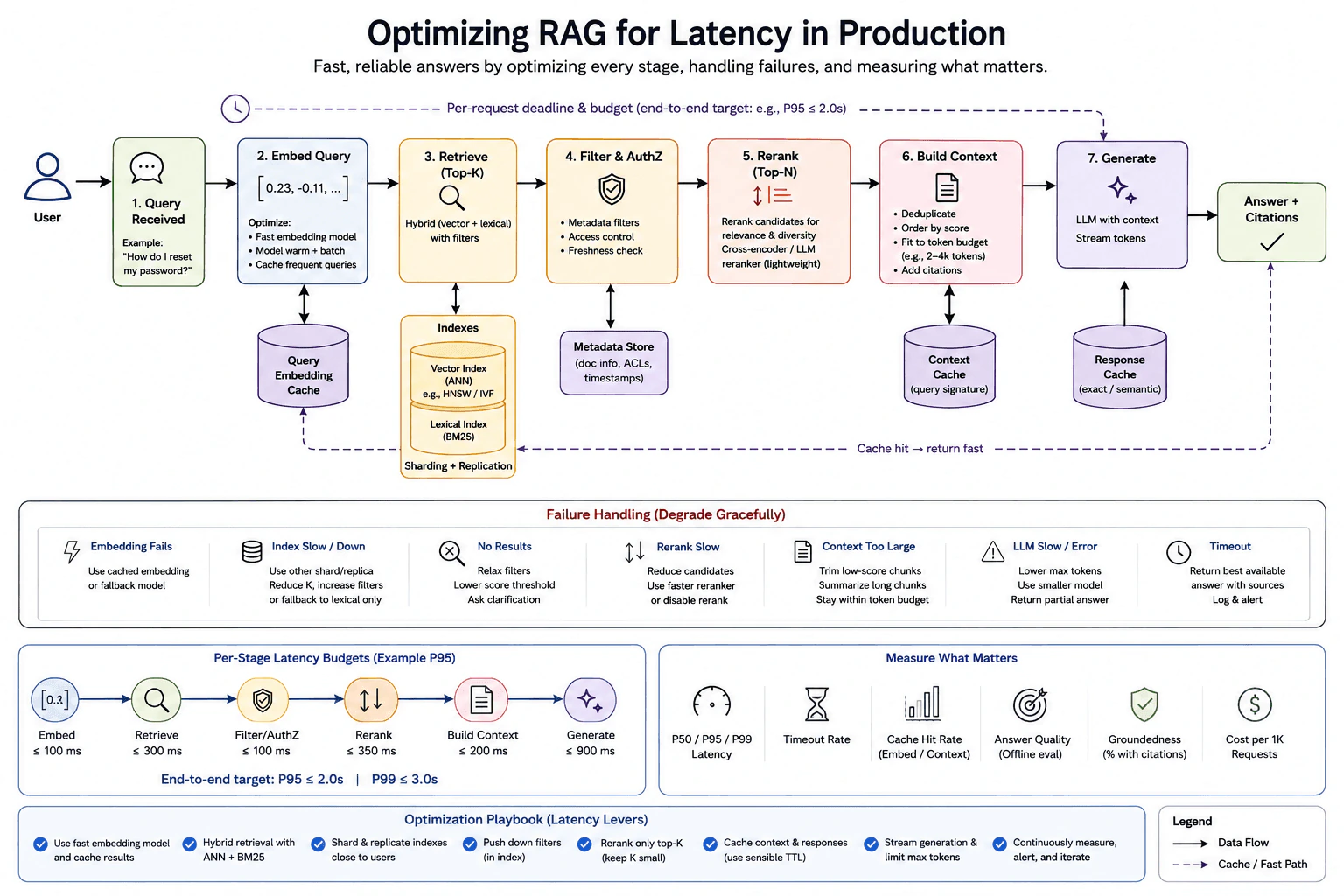
I would optimize the request as one measured pipeline: receive the query, embed it, retrieve candidates, apply filtering and authorization, rerank the best candidates, build a compact context, and generate the answer with citations. Each stage gets a latency budget, and the total must fit the end-to-end service-level objective.
For query embedding, I would use a small fast embedding model when it still meets retrieval-quality needs. I would keep the model warm, batch work when useful, and cache embeddings for frequent or repeated normalized queries. The diagram uses a query embedding cache because computing the same embedding again is wasted work.
For retrieval, I would use a fast approximate nearest-neighbor vector index and, when useful, combine it with lexical retrieval such as BM25. This is hybrid search: vector search finds meaning-based matches, while lexical search finds exact words or phrases. The diagram shows both a vector index and a lexical index. Sharding and replication can reduce load on a single index node and provide another copy when one shard or replica is slow or unavailable.
I would apply metadata filters and access-control checks before restricted content can reach the model. Early filtering also reduces the number of candidates that later stages must process. Freshness checks can remove stale documents when current information matters. Authorization is not just a ranking preference. It is a security boundary.
Next, I would rerank only a small candidate set. Reranking means applying a more accurate but usually more expensive scoring step after initial retrieval. I would choose the smallest Top-N that preserves answer quality. If the reranker becomes slow, I can reduce the candidate count, use a faster reranker, or temporarily skip reranking and use the first-stage retrieval results.
For context construction, I would deduplicate chunks, order them by usefulness, fit them to a token budget, and attach citations. A smaller context reduces prompt-processing work and can reduce generation latency. The context must contain only authorized and useful evidence. If the context is too large, I would trim low-score chunks or summarize long chunks while staying within the token budget.
Generation often takes a large part of the total request time. I would use a model that meets the quality target without unnecessary size or output length. I would cap maximum output tokens and stream tokens to the client as they are produced. Streaming mainly improves time to first token and perceived latency; it does not guarantee lower total generation time.
Caching should exist at stable boundaries. The diagram shows a query embedding cache, a context cache, and a response cache. A cache key must include inputs that can change the result. For example, context caching can use a query signature, and response caching can use exact or semantic matching only when authorization and freshness rules still hold. Cache lifetime must match freshness requirements. Cached restricted content must never be returned to a user who is not authorized to see it.
I would also define graceful failure paths. If embedding fails, use a cached embedding or a fallback embedding model. If the index is slow or unavailable, try another shard or replica, reduce the retrieval candidate count, push safe filters earlier, or fall back to lexical-only retrieval when that path is available. If no useful documents are found, relax only safe retrieval settings, lower the score threshold when appropriate, or ask the user to clarify.
If reranking is slow, reduce candidates, use a faster reranker, or disable reranking temporarily. If context is too large, trim low-score chunks or summarize long chunks. If the language model is slow or overloaded, lower the maximum output tokens, use a smaller model if quality permits, or return the best useful partial answer when the product allows it. If the whole request approaches its deadline, return the best available answer with sources instead of waiting indefinitely, then log and alert on the timeout.
The latency values in the diagram are example P95 budgets: embedding at or below 100 ms, retrieval at or below 300 ms, filtering and authorization at or below 100 ms, reranking at or below 350 ms, context construction at or below 200 ms, and generation at or below 900 ms. Together they illustrate an end-to-end target of P95 at or below 2.0 seconds and P99 at or below 3.0 seconds. These are example budgets for explaining the design, not universal production guarantees.
Measurement tells me what to optimize next. I would track P50, P95, and P99 latency for each stage and end to end. I would also track timeout rate, cache-hit rate, answer quality, groundedness, citation coverage, and cost per request or request volume unit. I would compare latency and quality together because a faster system is not useful if retrieval quality or grounding becomes poor.
The practical rule is simple: measure first, find the stage using the most latency budget, and optimize that stage without breaking authorization, freshness, grounding, or answer quality. The main levers are faster models, smaller candidate sets, early filters, caching, well-placed indexes, compact context, bounded generation, and streaming.
Retrieval Path
Set end-to-end P95 and P99 latency targets.
Split the target into budgets for embedding, retrieval, filtering and authorization, reranking, context building, and generation.
Instrument every stage and measure P50, P95, P99, timeout rate, and errors.
Cache reusable work such as normalized query embeddings, safe contexts, and safe final responses.
Use fast vector retrieval and lexical retrieval when hybrid search improves quality.
Apply metadata filters, authorization checks, and freshness checks early so later stages process fewer documents.
Rerank only the smallest candidate set that preserves answer quality.
Deduplicate and pack only the best authorized chunks into a bounded context with citations.
Use a generation model and output limit that meet the quality target, and stream tokens to improve time to first token.
Define fallbacks for embedding failure, index slowdown, no useful results, reranker slowdown, oversized context, model slowdown, and request timeout.
Continuously compare latency with cache-hit rate, answer quality, groundedness, citations, timeout rate, and cost, then optimize the current bottleneck first.
Time & Space Complexity
The work grows with the amount of data each request sends through the pipeline. More retrieved candidates mean more filtering and reranking work. A larger context means more model input work. More generated tokens mean more generation time and cost. Caches use extra memory or storage but can remove repeated work. Sharding and replicas add infrastructure and maintenance but can reduce load and provide fallback capacity. Smaller Top-K and Top-N values usually reduce latency, but making them too small can hurt retrieval quality. The system therefore trades speed, memory, cost, freshness, reliability, and answer quality against each other.
Where it is used
This approach is used in production assistants, enterprise search, support bots, document question-answering systems, and internal knowledge tools where users expect fast answers backed by retrieved sources. It is especially useful when one request passes through several independent retrieval and model stages and any slow stage can make the whole request miss its latency target.
Why Interviewers Ask This
The interviewer wants to know whether you can make a production RAG system fast without damaging answer quality, security, freshness, or reliability. They also want to see whether you can divide an end-to-end target into stage budgets, measure the real bottleneck, use caching safely, and design fallbacks for slow services.
Common interview mistakes
A common mistake is optimizing only vector lookup while ignoring generation or reranking. Another is retrieving or reranking too many candidates, which increases work without always improving the answer. Sending an oversized context also increases model latency. Teams may cache results without accounting for authorization or freshness, which can return stale or restricted content. Other mistakes include applying filters too late, treating streaming as if it always reduces total generation time, using example latency budgets as universal guarantees, measuring only averages instead of P95 and P99, and optimizing speed without checking retrieval quality or groundedness.
Interview tip
Explain the pipeline from left to right. Start with the end-to-end latency target, then give each stage a budget. For every important stage, name one optimization and one fallback. Finish by saying that you measure tail latency and answer quality together, then optimize the current bottleneck first.
Interviewer may ask next
How would you reduce latency if reranking is the bottleneck?
First measure reranker P95 and confirm that reranking is the real bottleneck. Then reduce the number of documents sent to it by improving first-stage retrieval and applying safe filters earlier. Use the smallest Top-N that preserves answer quality. If needed, switch to a faster reranker or skip reranking during overload and use the original retrieval results. Keep measuring answer and retrieval quality so the latency gain does not silently damage relevance.
How do you use caching in RAG without returning stale or unauthorized answers?
Cache only at boundaries where a result can be reused safely. Include inputs that can change the result in the cache design, such as the normalized query, filters, authorization scope, and freshness or document-version information. Use a cache lifetime that matches the freshness requirement. Never share cached restricted content with a user who lacks the same access. Track cache-hit rate and invalidate or bypass entries when the source data or authorization state makes the cached result unsafe.
44. Your RAG system needs per-user access control on internal documents. How do you implement it?Retrieval Augmented Generation RagHard
i Question Details
Require concrete design decisions, controls, and validation for identity propagation, document-level permissions, security filtering before context assembly, cache isolation, revocation, and audit logs.
Short Interview Answer (30-60 seconds)
Authenticate the user and propagate trusted identity claims to an authorization service. Store document or chunk permissions as metadata, turn current permissions into retrieval filters, and apply them before ranking. Use permission-aware cache keys, invalidate access after revocation, and audit every request, decision, returned document, and outcome.
Detailed Explanation
The system must make sure each employee can search only the internal documents they are allowed to see. A user's identity must travel with every question. Each document needs clear access rules. The system checks those rules before using a document to answer. Restricted text must never enter the answer-building step. Cached results must also stay separate between users. If access changes, old access must stop quickly. The system should record who asked, what was checked, which documents were returned, and what happened.
Useful Questions to Ask the Interviewer
Are permissions based on users, roles, groups, departments, projects, explicit document ACLs, or a combination?
Are permissions enforced for the whole document, or can individual chunks have different access rules?
How quickly must a permission revocation take effect?
Are retrieval or answer caches allowed, and what audit-log retention rules apply?
How to Explain It in an Interview
Start with the security rule: authorization happens before restricted content reaches the model.
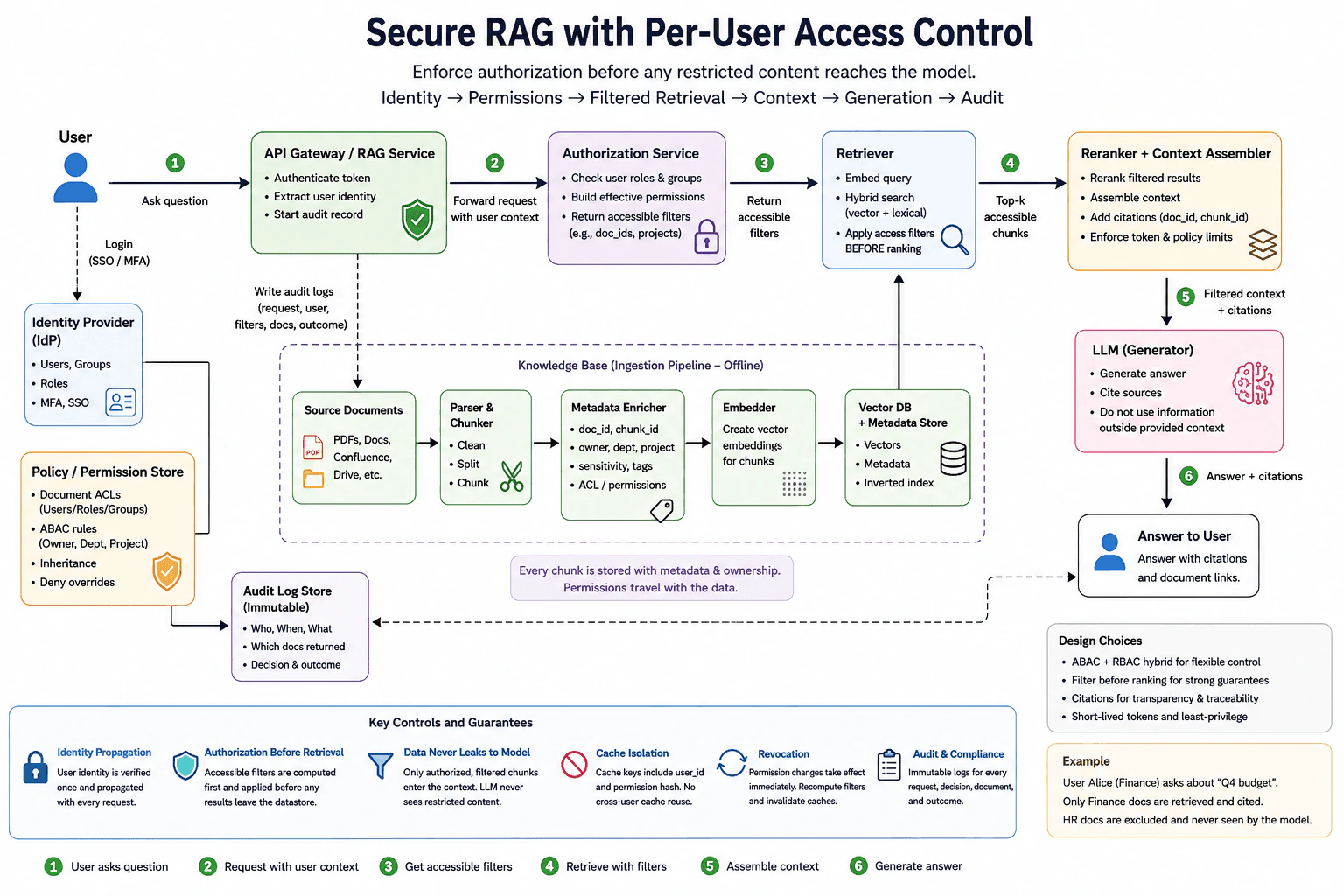
For example, Alice works in Finance and asks about the Q4 budget. The knowledge base contains both Finance and HR documents. Alice's request may retrieve Finance chunks that her permissions allow. HR chunks must be excluded before ranking, context assembly, and generation. The LLM must never receive the blocked HR text.
I would separate the design into an offline ingestion path and an online request path.
In the offline ingestion path, internal source documents are parsed and split into chunks. A metadata-enrichment step adds normal retrieval fields such as doc_id and chunk_id, plus security fields such as owner, department, project, sensitivity, allowed users, allowed roles, allowed groups, or an ACL. ACL means access-control list: it identifies which users or groups may access an item. The embedder creates vector embeddings for the chunks. The vectors and metadata are stored in the vector database and metadata store. A lexical index can also be maintained when hybrid search is needed.
In the online path, the user signs in through the identity provider. The API gateway or RAG service validates the authentication token and extracts trusted identity information such as user ID, roles, groups, and organization. It forwards the request with this user context. Prompt text is never trusted as proof of identity or permission.
The authorization service checks the policy and permission store and builds the user's effective permissions. A practical design can combine RBAC and ABAC. RBAC means role-based access control, such as analyst or manager. ABAC means attribute-based access control, such as department equals Finance or project equals Orion. Explicit document ACLs, inheritance rules, and deny overrides can also contribute to the final decision.
The authorization service returns accessible retrieval filters, such as allowed document IDs, projects, departments, or security labels. The retriever embeds the query and performs vector or hybrid search while applying those access filters before ranking. This ordering matters. Unauthorized candidates must not be sent to the reranker, context assembler, or LLM.
Only authorized chunks become the retrieval candidate set. If a reranker is used, it reranks only that filtered set. The context assembler then builds the prompt from authorized chunks, respects token and policy limits, and attaches citations using document and chunk identifiers. The LLM generates the answer only from this permitted context and returns the answer with citations.
Cache isolation must follow the same security boundary. Cache keys should include the user or security principal plus the permission state, such as a permission hash. This prevents a cached result for one user from being reused by another user who has different access. Cross-user cache reuse is safe only when the authorization scope is proven to be identical.
Revocation must update future access quickly. When a user's permissions change, recompute authorization filters and invalidate affected caches. A changed permission hash makes old permission-scoped cache entries unusable even if their normal time-to-live has not expired. Permission metadata in the policy or retrieval layer must also reflect the new state before future requests are served.
Audit logs should be immutable or strongly protected from modification. Record who made the request, when it happened, the request or correlation ID, the authorization decision, filters applied, document or chunk IDs returned, and the outcome. The RAG service should write these records for access decisions and returned results. Avoid placing full restricted document text in logs unless a specific compliance requirement justifies it.
Use short-lived authentication tokens and least-privilege service accounts so backend services receive only the access they need. Encryption in transit and at rest protects the stored and moving data, but encryption does not replace authorization.
The main tradeoff is security versus retrieval and operational cost. Fine-grained ACL and attribute filtering increases metadata size, policy-check work, cache fragmentation, and sometimes retrieval latency. A separate vector index for every user can reduce some query-time filtering but creates duplication and makes updates and revocation difficult. A shared index with strong metadata filtering is usually simpler when the retrieval store can enforce the required filters correctly.
Validation must include negative tests. Create users with different roles, groups, and projects. Confirm that forbidden document IDs never appear in retriever output, reranker input, assembled context, citations, caches, or generated answers. Then revoke access and verify that new requests immediately use the new permission state. Also test that two users with different permissions cannot share cached restricted results and that the audit log records each decision and outcome.
The key takeaway is: identity follows the request, permissions travel with the data, retrieval is filtered before ranking, and only authorized chunks can reach the model.
Key Insight / Why This Solution Works
Authenticate the user through the identity provider.
Validate the token in the API gateway or RAG service and extract trusted user ID, organization, roles, and groups.
During offline ingestion, parse and chunk documents and attach security metadata such as ACLs, owner, department, project, sensitivity, allowed roles, and allowed groups.
Create embeddings and store vectors together with the permission metadata.
For each online query, send the trusted user context to the authorization service.
Evaluate current policies and compute accessible retrieval filters.
Execute vector or hybrid retrieval with those filters applied before ranking.
Rerank only the authorized candidates.
Assemble context only from authorized chunks and add document and chunk citations.
Generate the answer from that filtered context.
Scope caches by user or security principal plus permission state.
On revocation, recompute filters and invalidate permission-scoped caches.
Write protected audit records containing the user, request, decision, filters, returned document IDs, and outcome.
Validate denied access, cache separation, revocation, and audit completeness with negative tests.
Where it is used
This design is used in enterprise RAG assistants over confidential internal knowledge. Examples include Finance, HR, Legal, engineering, customer-support, project, and compliance document search. It is especially important when one knowledge base serves many departments, projects, customers, tenants, security groups, or users with different permissions.
Why Interviewers Ask This
This question tests whether the candidate understands that RAG authorization must be enforced as part of data access, not delegated to the LLM. The interviewer is looking for correct identity propagation, document-level permission modeling, security filtering before ranking and context assembly, safe caching, revocation, auditability, and a clear separation between offline ingestion and online retrieval.
Common interview mistakes
Common mistakes include trusting identity or roles written in the user's prompt, filtering only after ranking, letting unauthorized chunks reach the reranker and removing them later, storing security metadata without keeping it synchronized with the policy source, using shared cache keys across users with different permissions, relying only on cache expiration after revocation, letting the LLM decide whether access should be allowed, using citations for documents that were not actually authorized and retrieved, logging restricted document text unnecessarily, and testing only successful access instead of proving that forbidden chunks never reach ranking, context assembly, citations, caches, or generation.
Interview tip
Lead with the invariant that unauthorized content must be filtered before ranking and before it reaches the LLM. Then walk through the diagram in order: identity provider, RAG service, authorization service, filtered retriever, reranker and context assembler, LLM, cache isolation, revocation, and audit logs. Use the Finance-versus-HR example to make the security boundary easy to understand.
Interviewer may ask next
How do you handle permission revocation when retrieval results are already cached?
Scope cache entries by the user's security principal and permission state, such as a permission hash. When permissions change, recompute the user's authorization filters and invalidate affected entries. Changing the permission hash also prevents old entries from matching new requests. The policy and retrieval metadata must use the updated access state before subsequent retrieval is allowed.
Would you create a separate vector index for every user to enforce access control?
Usually no. Per-user indexes duplicate data and make ingestion, updates, cache behavior, and revocation harder to maintain. A shared vector and metadata store with authorization filters applied before ranking is usually simpler. Separate indexes can still make sense for strong tenant-isolation or compliance boundaries, but they increase storage and synchronization cost.
45. Your enterprise RAG system returns contradictory answers from different source documents. How do you resolve conflicts?Retrieval Augmented Generation RagHard
i Question Details
The response should investigate source authority, timestamps, version precedence, contradiction detection, evidence presentation, and abstention or escalation rules, then define checks showing that the failure no longer recurs.
Short Interview Answer (30-60 seconds)
Detect conflicts before generation. Compare source authority, freshness, version, scope, access, and business rules. Use the strongest valid source, cite it, and explain the choice. If the conflict remains unresolved, abstain or escalate. Then test and monitor the resolution process.
Detailed Explanation
When company documents disagree, I first decide which evidence should be trusted. I check who owns each source, when it was updated, which version is current, and whether it applies to the same product, region, or situation. For example, an approved policy portal may outrank an older help page or PDF. I do not let the model quietly combine conflicting facts. If the rules clearly identify the correct source, I answer from it and show the evidence. If they do not, I stop and ask for clarification or human review.
Useful Questions to Ask the Interviewer
Do we have a defined source-authority order, such as official policy before help content and archived PDFs?
Does each document include reliable metadata for owner, timestamp, version, scope, and access permissions?
Are there business rules or exceptions that can override simple version or timestamp precedence?
Should unresolved conflicts always be shown to the user, or only sent for human review?
Which types of conflicts require mandatory escalation instead of an automatic answer?
How to Explain It in an Interview
I would use a controlled conflict-resolution flow.
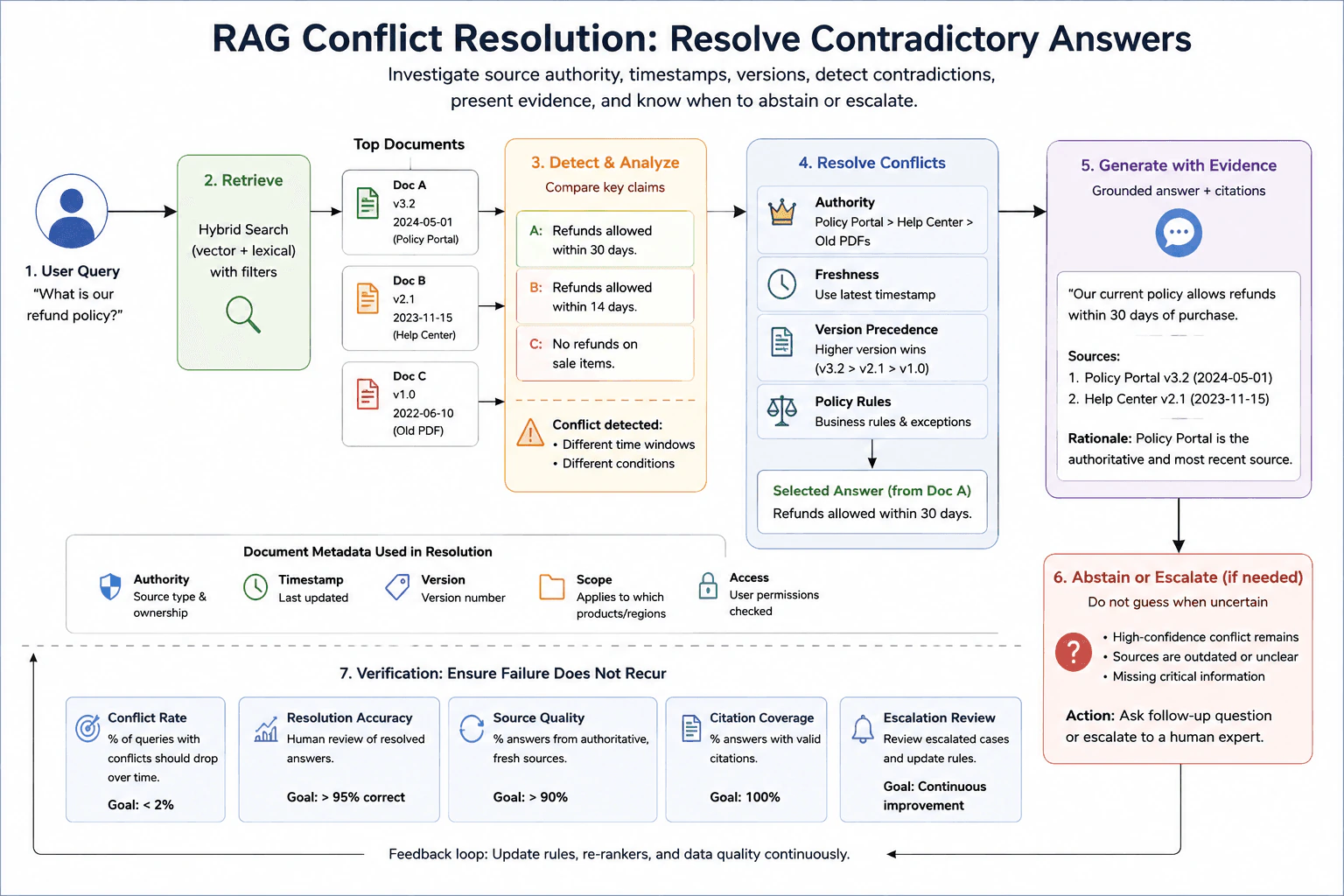
First, retrieve several relevant documents. The diagram uses hybrid search, which combines lexical search for matching words with vector search for similar meaning. Apply filters before generation so only documents that match the required scope and user permissions can continue. Restricted content must not reach the model before authorization.
Next, compare the retrieved documents. I would use metadata such as source authority, timestamp, version, scope, and access permissions. Authority means how trusted the source is. For example, an official Policy Portal can outrank a Help Center page, and both can outrank an old PDF.
Then detect contradictions by comparing the actual claims. In the diagram, Document A says refunds are allowed within 30 days, Document B says 14 days, and Document C says there are no refunds on sale items. The system should check whether these statements apply to the same conditions before declaring a conflict. A difference caused by a valid business exception is not necessarily an error.
After a real conflict is found, apply explicit resolution rules. Prefer the higher-authority source. Within the correct authority and scope, prefer the current approved version and latest relevant timestamp. Also apply business rules and exceptions. Do not use a newer low-authority document to override an authoritative policy just because its timestamp is later.
In the diagram, Document A is selected because the Policy Portal is the authoritative source and it also has the newest applicable version and timestamp. The selected answer is that refunds are allowed within 30 days.
Next, build the model context from the selected evidence instead of mixing incompatible statements. Generate a grounded answer and include citations. The response should show the source, version, and date when useful. It should also explain the reason for the choice, such as: the Policy Portal is the authoritative and most recent applicable source.
If the conflict cannot be resolved safely, do not guess. Abstain when strong sources still disagree, the documents are outdated or unclear, or critical information is missing. Ask a follow-up question if more user context can resolve the issue. Otherwise, escalate to the human owner responsible for the information.
There are tradeoffs. Strong precedence rules make answers more consistent, but they depend on correct metadata. Timestamp alone is not enough. Version alone is not enough. Authority alone can also fail if scope or business exceptions are ignored. The rules must consider these signals together.
Finally, verify that the failure does not recur. Add regression tests with known conflicting documents and expected winners. Review resolved answers with humans. Track conflict rate, resolution accuracy, source quality, citation coverage, and escalated cases. Use those results to update source metadata, lifecycle rules, retrieval filters, reranking rules, and data quality. The goal is not only to answer one conflict correctly. The goal is to keep contradictory answers from returning.
Retrieval Path
Retrieve multiple relevant documents with hybrid lexical and vector search.
Apply metadata and authorization filters before restricted content can reach the model.
Read authority, owner, timestamp, version, scope, and access metadata for each candidate.
Extract the claims that answer the user's question.
Compare the claims and detect real contradictions under the same conditions.
Apply explicit precedence rules: higher source authority first, then the current applicable version and timestamp, while respecting scope and business exceptions.
Select the strongest valid evidence and exclude incompatible evidence from the answer context.
Generate a grounded answer with citations and a short explanation of why that source was selected.
If the conflict remains unresolved, ask for clarification, abstain, or escalate to a human owner.
Add regression tests, human review, conflict monitoring, source-quality checks, citation checks, and escalation review so the same failure is caught again.
Time & Space Complexity
The system must retrieve and compare more than one document, so conflict handling adds latency and processing cost. More candidates can improve evidence coverage, but they also increase retrieval, reranking, comparison, and model-context cost. Metadata such as authority, version, timestamp, scope, and ownership must also stay correct as documents change. Human escalation adds operational cost, but it is safer than guessing when important sources disagree. Regression tests and monitoring require ongoing maintenance, but they help prevent the same contradiction from returning.
Where it is used
This approach is useful in enterprise RAG systems that answer questions from policy portals, help centers, employee handbooks, product documentation, compliance material, legal guidance, pricing rules, and operational procedures. It is especially important when several teams publish overlapping documents, old versions remain searchable, or users need evidence explaining why one source was trusted over another.
Why Interviewers Ask This
This question tests whether the candidate can treat contradictory retrieval as an evidence-governance problem instead of asking the language model to guess. The interviewer wants to see clear precedence rules, conflict detection, evidence presentation, safe failure behavior, and production checks that prevent the same problem from returning.
Common interview mistakes
A common mistake is sending every conflicting document to the language model and hoping it chooses correctly. Another is always choosing the newest document without checking authority or scope. Teams also fail when they do not store reliable metadata for owner, timestamp, version, and applicability. Another mistake is treating different wording as a contradiction without checking conditions or exceptions. Systems should not hide unresolved disagreement and still return a confident answer. Finally, fixing one example without regression tests, monitoring, and document-lifecycle cleanup allows the same failure to return.
Interview tip
Explain the flow in order: retrieve, compare source metadata, detect the contradiction, apply authority and version rules, generate from the selected evidence, cite the source, abstain when the rules cannot decide, and verify the fix with tests and monitoring. Use one simple policy example throughout.
Interviewer may ask next
What would you do if two equally authoritative documents still disagree?
I would first check whether they have different scope, effective dates, versions, products, regions, or business exceptions. If those checks do not resolve the disagreement, I would not let the model choose silently. I would mark the conflict as unresolved, show the evidence when appropriate, abstain from making a definitive claim, and escalate the case to the document owner. I would also record the case so the source-of-truth or precedence rules can be corrected.
How do you prove that the contradictory-answer problem has been fixed?
I would create regression tests with known conflicting document sets and expected resolution decisions. I would review a sample of resolved answers with humans and track conflict rate, resolution accuracy, source quality, citation coverage, and escalation outcomes. I would also verify that outdated versions no longer override authoritative current documents. When recurring conflicts appear, I would update metadata, document lifecycle rules, retrieval filters, reranking rules, or source-governance rules.
46. What is an AI agent?Ai Agents And Agentic SystemsEasy
i Question Details
Ground the definition in the bounded observe-decide-act loop, state, tool calls, stop conditions, and why a plain model response lacks execution authority.
Short Interview Answer (30-60 seconds)
At a high level, an AI agent is a system that works toward a goal through a bounded observe-decide-act loop. The main challenge is letting it take useful actions without giving it unlimited control. I would explain three parts: it observes inputs and state, decides the next step, and acts through approved tools. Results can update state and feed the next observation. Permissions, budgets, retries, and stop conditions control execution. The trade-off is more useful automation, but more safety and failure handling than a plain model response.
Detailed Explanation
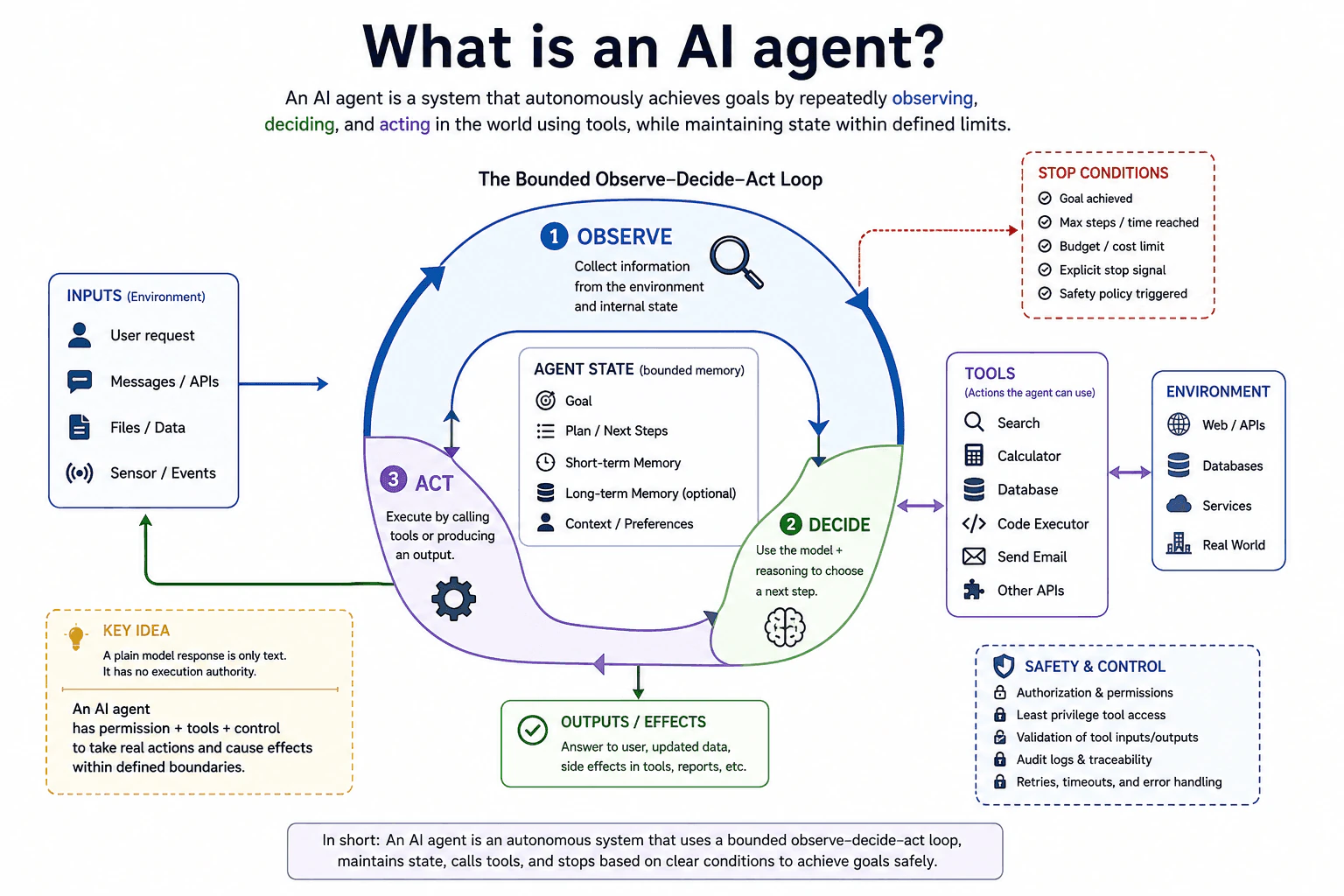
An AI agent is more than a model that produces one response. It is a system that can work toward a goal over several controlled steps. It observes information, decides what to do next, and acts through approved tools. The hard part is giving the system useful execution power without giving it unlimited authority. The diagram explains this with a bounded Observe-Decide-Act loop, agent state, tools, safety controls, outputs, the environment, and clear stop conditions.
Useful Questions to Ask the Interviewer
Which tools is the agent allowed to use?
Which actions need extra permission or approval?
What limits should stop the agent, such as time, cost, or step count?
How to Explain It in an Interview
1. Start with the bounded Observe-Decide-Act loop
I would say that the agent repeatedly observes, decides, and acts. Observe means collecting information from inputs and current state. The inputs shown include a user request, messages or APIs, files or data, and sensor events.
The agent then decides the next useful step. After acting, the result can become new information for the next observation. This repeated cycle is what makes the system agentic instead of a single model response.
2. Explain the agent state
The agent keeps bounded memory, which means only the state allowed for the task. The diagram shows the goal, plan or next steps, short-term memory, optional long-term memory, and context or preferences.
This state lets later decisions use earlier results. It also lets the agent track progress across several steps. The memory is bounded rather than unlimited.
3. Separate deciding from acting
The model helps choose the next step. That probabilistic decision does not itself execute anything. The application controls whether the chosen action is actually allowed.
The agent can use tools such as search, a calculator, a database, a code executor, email, or other APIs. These tools can interact with web APIs, databases, services, or the real world. Tool inputs and outputs should be validated before they affect external systems.
4. Explain execution authority and safety
A plain model response only produces its response. It does not automatically have authority to call tools or create real side effects. An AI agent gains execution authority only through the tools and permissions supplied by the surrounding application.
The diagram shows authorization and permissions, least-privilege tool access, validation, audit logs, retries, timeouts, and error handling. Least privilege means each tool gets only the minimum access it needs. These controls limit what an uncertain model decision can actually do.
5. Explain outputs, feedback, and stopping
An action may answer the user, update data, create a report, or cause another permitted side effect. Those results can feed back into the environment or become new observations for another loop step.
The agent stops when the goal is achieved, a step or time limit is reached, the budget or cost limit is reached, an explicit stop signal appears, or a safety policy is triggered. The benefit is useful multi-step automation. The downside is that real actions need stronger controls, monitoring, and failure handling.
Practical Complexity & Trade-offs
The benefit is that an agent can complete work instead of only suggesting what to do. It can keep state, call tools, use results, and continue toward a goal. The downside is that each real action creates risk. A wrong decision could send a message, change data, or spend resources. That is why the diagram adds permissions, least-privilege access, validation, audit logs, retries, timeouts, budgets, and stop conditions. These controls make the system safer, but they add more application logic. We accept that extra work because execution authority needs stronger limits than simple response generation.
Why Interviewers Ask This
Interviewers ask this to see whether the candidate understands the difference between a model response and an AI agent. They want more than the word autonomy. A strong answer explains the bounded Observe-Decide-Act loop, state, tool use, execution authority, and stop conditions. It also shows good judgment about permissions, safety, and failure handling. The key idea is combining model decisions with controlled application execution.
Interviewer may ask next
What would you change if some agent actions could cause expensive or irreversible side effects?
I would keep the same Observe-Decide-Act loop, but I would make the controls around sensitive tools stricter. The model could still suggest the next action. That suggestion would not automatically give permission to run it.
Before an expensive or irreversible action, the application should check authorization and validate the tool arguments. It may also require an explicit approval before execution. The agent should use least privilege, which means each tool gets only the minimum access needed for its job. Budgets and stop conditions should also limit how many actions or how much cost the workflow can create.
The result would still return as a new observation after the action runs. Audit logs should record what was requested, what was approved, and what tool was called. The main downside is slower execution and more control logic. That extra cost is reasonable when a wrong action could be expensive or hard to undo.
How should the agent behave when a tool call fails or times out?
I would keep the same loop and treat the failure as another observation. The agent should not assume that the requested action succeeded. The application should return a clear failure result so the next decision can use it.
For a temporary failure, the control layer may retry when retrying is safe. A timeout should have a clear limit so the workflow cannot wait forever. If the tool keeps failing, the agent can choose another permitted step, return an error to the user, or stop. The same stop conditions still apply, including step, time, budget, and safety limits.
Audit logs should record the failed tool call and any retry. This helps people understand what happened later. The main downside is that retry and recovery logic adds complexity. It is still important because an agent that performs real actions must handle failures instead of assuming every tool call succeeds.
47. How do you design and define tools for an AI agent?Ai Agents And Agentic SystemsEasy
i Question Details
Walk through the choices involved in narrow capabilities, typed inputs, deterministic errors, idempotency, permissions, observability, and safe defaults.
Short Interview Answer (30-60 seconds)
At a high level, I would make each agent tool small, predictable, and safe to call. The main challenge is that the model chooses actions, but deterministic code must control real execution. I would explain the design in three parts: tool selection, a strict tool contract, and the Execution Layer. The contract defines typed inputs, clear errors, permissions, retry behavior, observability, and safe defaults. The Execution Layer validates and authorizes every call before execution. The trade-off is more setup work for much safer behavior.
Detailed Explanation
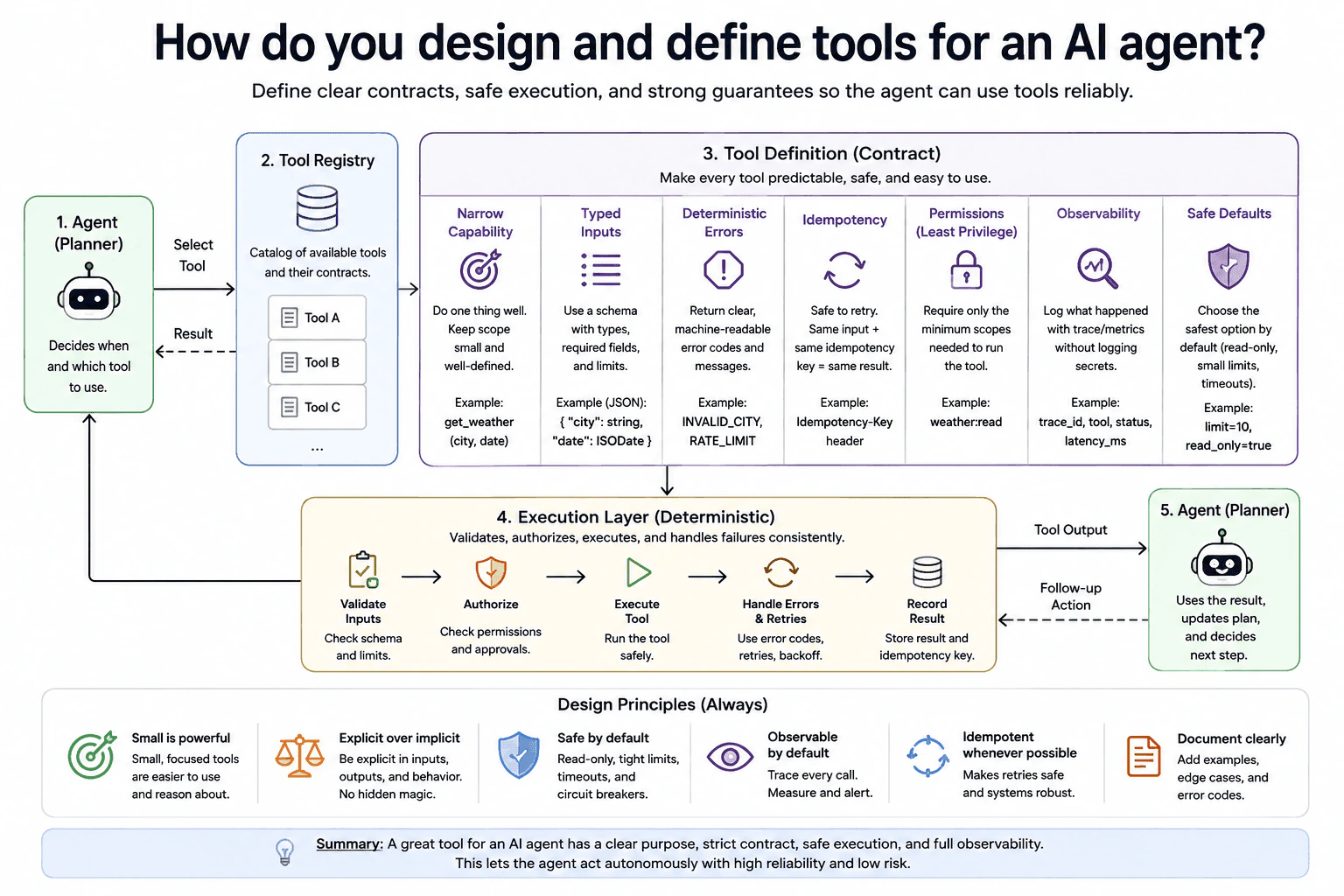
The goal is to let an AI agent use real tools without giving the model uncontrolled access. A tool might read weather data or perform another approved action. The hard part is that the Agent makes uncertain planning choices, while real execution must behave predictably. The diagram handles this by separating the Agent, Tool Registry, Tool Definition, and deterministic Execution Layer. The Agent chooses an approved tool. The rest of the system checks its contract, permissions, inputs, and safety rules before the tool runs.
Useful Questions to Ask the Interviewer
Which tools only read data, and which tools can change data?
Which actions require approval before execution?
Which tool calls can be retried safely?
What limits and timeouts should each tool have?
How to Explain It in an Interview
1. Start with the Agent and Tool Registry
I would start by saying that the Agent decides when a tool is useful. It does not receive permission to execute arbitrary actions. It selects an approved tool from the Tool Registry.
The Tool Registry is the catalog of available tools and their contracts. This gives the Agent a bounded set of choices. The selected Tool Definition then explains exactly how that tool may be called.
2. Define a narrow and typed tool contract
Each tool should do one small job well. The diagram uses get_weather(city, date) as an example. A narrow tool is easier to understand, test, and protect.
Inputs should follow a typed schema. This means the contract states field names, types, required values, and limits. The tool should also return deterministic errors, meaning clear machine-readable codes such as INVALID_CITY or RATE_LIMIT instead of vague failures.
The contract should define idempotency when retries are possible. Idempotency means sending the same input with the same idempotency key produces the same recorded result instead of repeating a side effect.
3. Add permissions, observability, and safe defaults
Permissions should use least privilege. This means the tool gets only the minimum access needed for its job. The authorization step can also require approval when an action is sensitive.
Safe defaults reduce risk. The diagram shows read-only behavior, small limits, and timeouts. Its design principles also include tight limits and circuit breakers, which stop repeated calls when a dependency keeps failing.
Observability means recording enough information to understand each call. The diagram shows traces and metrics such as tool name, status, and latency. Secrets should not be written into those records.
4. Execute through deterministic application code
After tool selection, the Execution Layer takes control. It first validates the input schema and limits. It then checks permissions and approvals.
Only after those checks does it execute the tool. If execution fails, this layer uses known error codes, retries, and backoff. Backoff means waiting before another retry. It then records the result together with the idempotency key.
5. Return the result and continue the plan
The Tool Output returns to the Agent. The Agent uses the result, updates its plan, and decides the next step. Any follow-up action must pass through the same controlled path again.
The benefit is reliable and auditable tool use. The downside is additional engineering for contracts, validation, permissions, retry rules, limits, and monitoring.
Practical Complexity & Trade-offs
The benefit is that tools become easier to understand, test, and control. Narrow tools and typed inputs reduce guessing. Clear error codes make failures easier to handle. Least privilege and safe defaults reduce damage from a bad tool choice. Idempotency makes retries safer because the same request can reuse its recorded result instead of repeating a side effect. Observability also helps the team see what happened. The downside is more setup work. Every tool needs a clear contract, validation rules, permissions, limits, errors, and useful monitoring. Retry behavior also needs care because some actions are unsafe to repeat.
Why Interviewers Ask This
Interviewers ask this to see whether you can separate an AI model's decisions from real tool execution. They want to know whether you design clear contracts instead of exposing loose functions. They also look for judgment around validation, permissions, retries, errors, limits, safe defaults, and observability. A strong answer shows that you can keep an agent useful while placing deterministic safety controls around its actions.
Interviewer may ask next
What would you change if one tool can perform a sensitive write operation, such as changing important user data?
I would keep the same architecture, but I would make that tool much more restricted. The Tool Definition would still use a narrow capability, typed inputs, deterministic errors, idempotency rules, and observability. The main change would be stronger permissions and approval requirements.
The Execution Layer would validate the arguments first. It would then check that the caller has the exact permission required for the write. If the action is sensitive, the Authorize step would require approval before Execute Tool can run.
I would also keep the default behavior conservative. The tool should receive only the minimum scopes it needs. Small limits and timeouts would still apply. The result should be recorded so the team can trace what happened without recording secrets.
Retries need special care. If repeating the write could perform the side effect twice, the request should use an idempotency key. The same input and key can then return the same recorded result instead of repeating the action. The downside is that stronger authorization and approvals add more steps and can make sensitive actions slower.
How would you handle a tool that sometimes fails because an external dependency is temporarily unavailable?
I would keep the same Execution Layer and make the failure behavior explicit in the Tool Definition. The tool should return a deterministic error code instead of giving the Agent an unclear failure message.
The Handle Errors & Retries step would decide whether that error can be retried. If retrying is safe, it can use backoff, which means waiting before trying again. The timeout and other safe limits still apply so one failing dependency cannot keep the workflow running without bounds.
If retries can repeat a side effect, the call should use an idempotency key. The Record Result step keeps the result and key so the same request can be recognized instead of performing the action again.
Observability should record useful details such as the tool name, status, latency, and retry outcome. Secrets should stay out of traces and metrics. The downside is additional retry logic and state. Too many retries can also waste time, so retry limits must remain small and explicit.
48. What are the different types of agent memory (short-term, long-term, episodic)?Ai Agents And Agentic SystemsEasy
i Question Details
Explain how the listed elements interact: short-term working state, durable semantic or episodic memory, retrieval rules, retention, privacy, and deletion.
Short Interview Answer (30-60 seconds)
At a high level, agent memory helps an agent keep the right information for the right amount of time. The main challenge is balancing fast temporary context with useful durable memory. I would explain it in three parts: short-term Working State, durable Episodic and Semantic / Long-Term Memory, and the rules that control retrieval, retention, privacy, and deletion. The trade-off is that richer memory can improve future decisions, but it also adds storage, privacy, and cleanup work.
Detailed Explanation
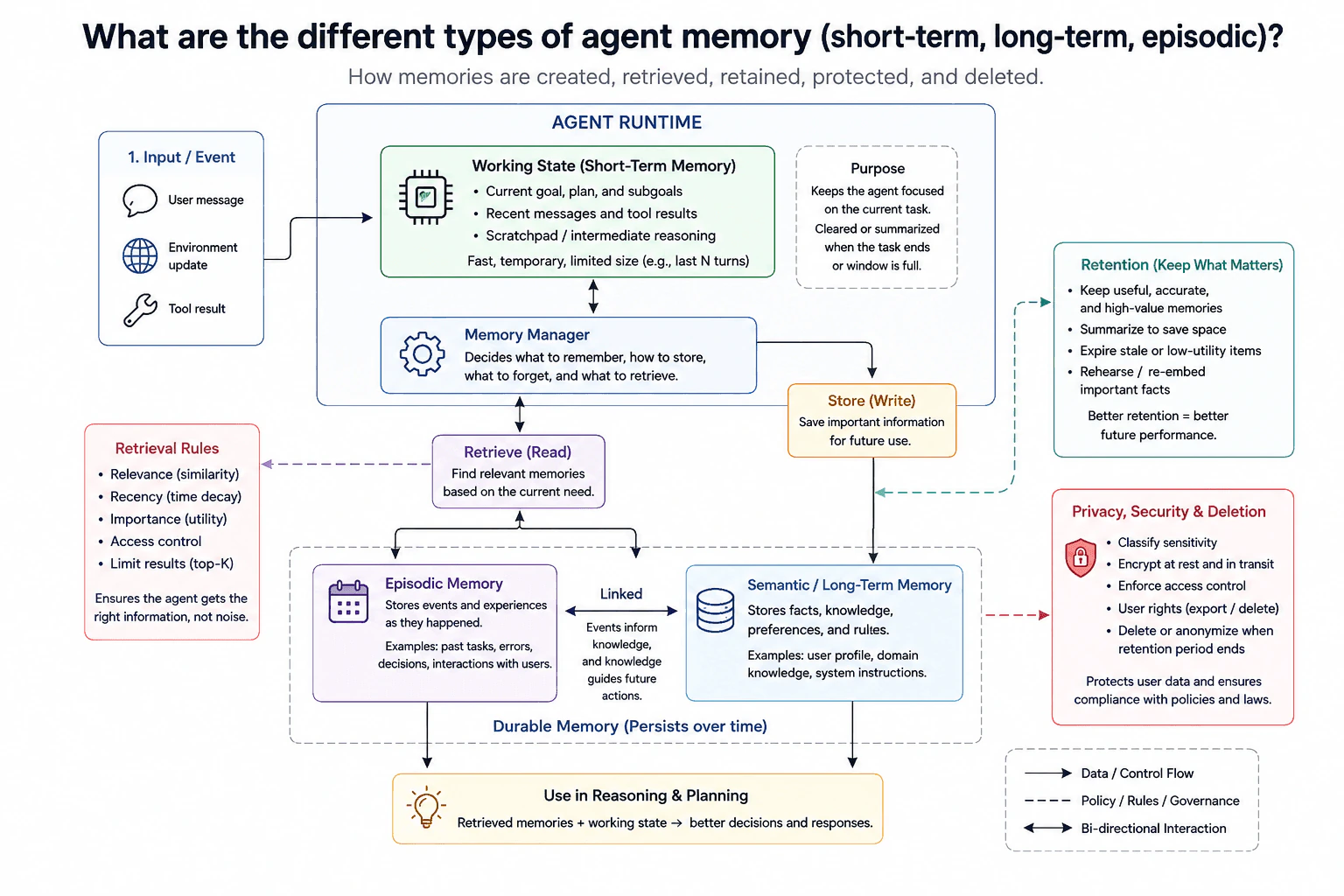
Agent memory lets an agent use information from the current task and from earlier experiences. Some information is useful only while the task is running. Other information should remain available for future tasks. The difficult part is deciding what to remember, what to retrieve, and what to remove later. The diagram organizes this around Working State, a Memory Manager, Retrieve and Store paths, durable Episodic Memory and Semantic / Long-Term Memory, plus rules for retrieval, retention, privacy, and deletion.
Useful Questions to Ask the Interviewer
Which information may remain after the current task ends?
How long should durable memories be kept?
Which users or services may read, export, or delete stored memories?
How to Explain It in an Interview
1. Start with the input and short-term Working State
I would start with the information entering the agent. The input may be a user message, an environment update, or a tool result.
That information enters Working State, which is the agent's short-term memory. It holds the current goal, plan, subgoals, recent messages, tool results, and temporary reasoning state. It is fast, limited in size, and meant for the current task. When the task ends or the working window becomes full, this state can be cleared or summarized.
2. Use the Memory Manager to control reads and writes
The Memory Manager decides what to remember, how to store it, what to forget, and what to retrieve. It connects the temporary Working State with durable memory.
For a write, the Store path saves important information for future use. For a read, the Retrieve path finds memories that match the agent's current need. This separation matters because the agent should not save or load everything automatically.
3. Separate Episodic Memory from Semantic / Long-Term Memory
Episodic Memory stores events and experiences as they happened. Examples include past tasks, errors, decisions, and interactions with users.
Semantic / Long-Term Memory stores facts, knowledge, preferences, and rules. Examples include a user profile, domain knowledge, and system instructions.
The two memory types can be linked. Events can produce new knowledge, while stored knowledge can guide future actions.
4. Apply Retrieval Rules before using durable memory
The Retrieve path should return only useful information. Retrieval Rules can consider relevance, recency, importance, access control, and a result limit such as top-K, meaning only the best few matches are returned.
This reduces noise. Retrieved memories can then be combined with Working State and used in reasoning and planning.
5. Manage retention, privacy, and deletion
Retention rules decide what remains over time. Useful and accurate memories can be kept. Stale or low-value items can expire, while summaries can reduce storage. Important facts may also be refreshed or re-embedded when needed.
Privacy, Security & Deletion rules protect durable memory. Sensitive information can be classified, encrypted at rest and in transit, and limited through access control. Users may have export or deletion rights. When a retention period ends, information can be deleted or anonymized.
The benefit is better continuity and more useful future decisions. The downside is more work around storage, retrieval quality, privacy, retention, and deletion.
Practical Complexity & Trade-offs
The benefit is that each memory type has a clear job. Working State is fast because it keeps information for the current task. Episodic Memory helps the agent remember past experiences. Semantic / Long-Term Memory keeps reusable facts, preferences, and rules. Retrieval Rules reduce noise by returning only useful items. The downside is that durable memory needs careful retention and privacy controls. Keeping too much can waste space or bring back stale information. Keeping too little can remove useful context. Encryption, access control, deletion, and anonymization also add management work, but they protect stored user data.
Why Interviewers Ask This
Interviewers ask this to see whether you understand that agent memory is not one single store. They want to know whether you can separate temporary working state from durable facts and past experiences. They also look for judgment about retrieval quality, retention, privacy, and deletion. A strong answer shows that you understand both how memory helps an agent and why stored information needs clear rules.
Interviewer may ask next
What would you change if the agent handles sensitive user data that must be deleted quickly on request?
I would keep the same memory design, but I would make the Privacy, Security & Deletion rules stricter. Working State would still hold only the current task. Durable Episodic Memory and Semantic / Long-Term Memory would store only information that is allowed to remain.
The Memory Manager would classify sensitive information before it is stored. Access control would limit who can retrieve it. Stored data would remain encrypted at rest and in transit.
For deletion, the request should remove or anonymize the user's information from the durable memories where it is stored. The system should also record that the deletion happened. Retention rules should remove data automatically when its allowed lifetime ends.
The main downside is extra management work. Retrieval, retention, and deletion become harder because the system must know where sensitive information exists and apply the same privacy rules consistently.
How would you keep retrieval useful if the agent stores many years of episodic and semantic memories?
I would keep the same Retrieve path, but I would make the Retrieval Rules more selective. The goal is to avoid loading a large amount of old memory into the current task.
The Retrieve path would still rank memories by relevance. It would also consider recency, importance, access control, and a top-K limit so only the best few results are returned.
Retention rules would reduce the amount of low-value data before retrieval begins. Stale memories could expire. Older information could be summarized to save space. Important facts could be refreshed when needed.
The Memory Manager would then combine the selected memories with the current Working State for reasoning and planning.
The downside is that stronger filtering can hide something useful. The system must balance useful recall against noise, storage cost, and the risk of returning outdated information.
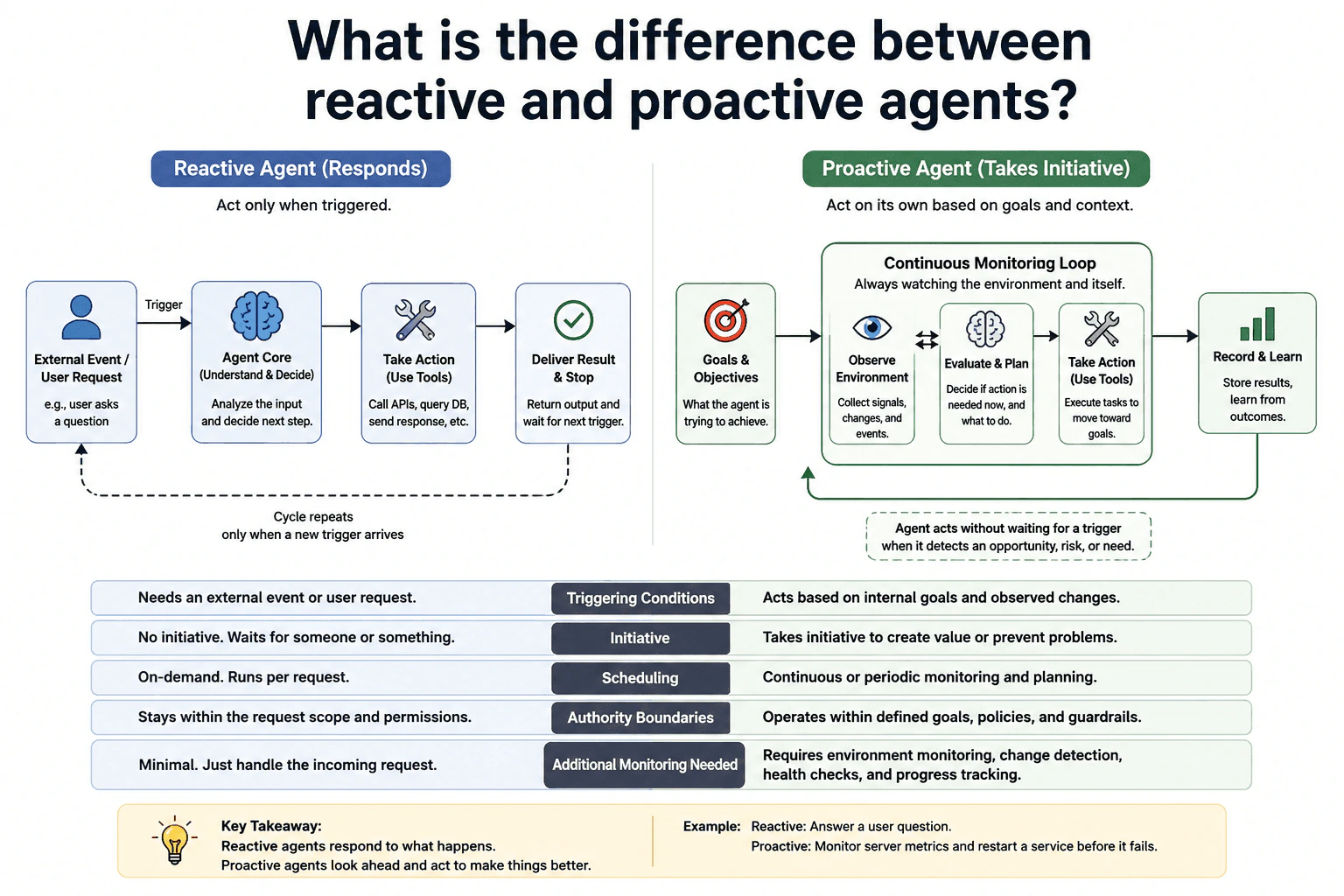
49. What is the difference between reactive and proactive agents?Ai Agents And Agentic SystemsEasy
i Question Details
The response should show what materially changes across triggering conditions, initiative, scheduling, authority boundaries, and the additional monitoring needed for proactive behavior.
Short Interview Answer (30-60 seconds)
At a high level, reactive agents respond to something that already happened, while proactive agents can start work based on goals and observed changes. The main challenge is deciding what starts action and how much monitoring is needed. I would explain this through the reactive request flow and the proactive monitoring loop. Reactive agents wait for a trigger. Proactive agents observe, plan, act, and learn continuously or on a schedule. The trade-off is that proactive behavior needs more monitoring and stronger guardrails.
Detailed Explanation
Reactive and proactive agents differ mainly in what starts their work. A reactive agent waits for an outside event, such as a user request. A proactive agent can notice a change and decide that action is needed. This makes proactive behavior useful for ongoing goals, but it also needs more control. The diagram explains the difference through two flows. One starts with an external trigger. The other starts with goals and keeps observing the environment so it can plan, act, and learn.
Useful Questions to Ask the Interviewer
Should the proactive agent monitor continuously or run periodic checks?
What goals, policies, and guardrails limit what the agent may do?
Which observed changes should be important enough to start an action?
How to Explain It in an Interview
1. Start with what triggers the agent
I would first explain that the biggest difference is the trigger. A reactive agent needs an External Event / User Request before it starts. For example, a user asks a question, and that request begins the flow.
A proactive agent does not always wait for someone to ask. It starts from Goals & Objectives and can react to changes it observes. This is why the proactive side needs a Continuous Monitoring Loop.
2. Follow the reactive flow
For a reactive agent, the External Event / User Request goes to the Agent Core. The Agent Core understands the input and decides the next step. It then moves to Take Action, where the agent can use tools such as APIs or a database.
After that, Deliver Result & Stop returns the result and ends that run. The agent then waits for another trigger. The cycle repeats only when a new external event or user request arrives. This makes the reactive flow on-demand and request-driven.
3. Follow the proactive monitoring loop
For a proactive agent, Goals & Objectives describe what the agent is trying to achieve. The Continuous Monitoring Loop keeps watching the environment and the agent itself. Observe Environment collects signals, changes, and events.
Evaluate & Plan decides whether action is needed now and what should happen next. Take Action can then use tools to move toward the goal. Record & Learn stores results and learns from outcomes. The flow then returns to monitoring so the agent can keep checking progress and new conditions.
4. Compare initiative and scheduling
A reactive agent has little initiative because it waits for something to happen. It normally runs on-demand for each request. A proactive agent can take initiative when it detects an opportunity, risk, or need.
Its monitoring can be continuous or periodic. This requires extra environment monitoring, change detection, health checks, and progress tracking.
5. Keep authority bounded
Proactive does not mean unlimited freedom. The diagram shows that a proactive agent operates within defined goals, policies, and guardrails. A reactive agent also stays within the request scope and its permissions.
The benefit of proactive behavior is earlier action. The downside is more monitoring and more control work. A simple example is answering a user question versus monitoring server metrics and restarting a service before it fails.
Practical Complexity & Trade-offs
The benefit of a reactive agent is simplicity. It waits for a request, handles it, returns a result, and stops. This needs less monitoring and is easier to control. The downside is that it cannot act before a problem or need becomes an external trigger. A proactive agent can notice changes earlier and take useful action sooner. The downside is more work. It needs continuous or periodic monitoring, change detection, health checks, progress tracking, and clear guardrails. We accept this extra complexity when acting early is worth the added monitoring and control.
Why Interviewers Ask This
Interviewers ask this question to see whether you understand that agent behavior is not only about reasoning. They want to know what starts an action, when an agent should take initiative, how scheduling changes its behavior, and why authority boundaries still matter. They also want to see whether you recognize that proactive behavior needs extra monitoring and guardrails rather than simply giving the agent more freedom.
Interviewer may ask next
What changes if a proactive agent monitors continuously instead of checking periodically?
I would keep the same proactive flow, but the Continuous Monitoring Loop would observe the environment more often. Instead of waiting for a periodic check, Observe Environment would keep collecting signals, changes, and events. Evaluate & Plan would still decide whether an action is actually needed, so every observation would not automatically cause a tool call.
The authority boundary would stay the same. Goals, policies, and guardrails would still limit what Take Action can do. Record & Learn would also stay in the loop so the agent can store results and learn from outcomes before monitoring continues.
The benefit is faster response to new opportunities, risks, or needs. For example, the agent could notice a server problem soon after it appears. The downside is more monitoring work and a greater chance of reacting to noisy or unimportant signals. The system therefore needs clear rules for deciding which observed changes should lead to action.
How would you keep a proactive agent from taking actions outside its allowed scope?
I would keep the same proactive loop and make the authority boundary strict. Goals & Objectives tell the agent what it is trying to achieve, but they do not give unlimited freedom. Before Take Action uses a tool, the planned action must remain inside the defined goals, policies, and guardrails shown in the diagram.
If Evaluate & Plan produces an action that falls outside those limits, the action should not be executed. The agent can continue observing and planning, but it must stay inside the allowed scope. Record & Learn can still store the result of allowed actions and feed those outcomes back into the monitoring loop.
The benefit is safer proactive behavior without changing the core architecture. The downside is that tighter guardrails can prevent some useful actions or make the agent less flexible. That is the main trade-off between initiative and control.
50. What is the difference between single-agent and multi-agent systems?Ai Agents And Agentic SystemsEasy
i Question Details
Contrast the choices by examining coordination overhead, specialization, shared state, conflict resolution, failure containment, and when one agent is simpler.
Short Interview Answer (30-60 seconds)
At a high level, a single-agent system gives one agent the whole job, while a multi-agent system divides work across specialized agents. The main choice is simplicity versus coordination. I would compare how each design plans work, uses memory and tools, handles conflicts, and deals with failures. A single agent is easier to build and reason about. Multiple agents can specialize and collaborate, but messaging, shared state, and conflict handling add complexity.
Detailed Explanation
The question asks when one agent should do all the work and when several agents should work together. One agent is simpler because there is one control loop and one place making decisions. Several agents can divide a difficult job into smaller roles, but they must communicate and share information correctly. The diagram compares these designs through coordination, specialization, shared state, conflict handling, and failure containment. It also shows how both designs use tools, interact with the environment, observe results, and adapt.
Useful Questions to Ask the Interviewer
Does the task need different specialist skills, or can one agent handle it well?
Do parts of the task need to run independently or in parallel?
How important is keeping one agent's failure from affecting the rest of the workflow?
How to Explain It in an Interview
1. Start with the single-agent design
I would begin with one agent when the task is simple and self-contained. The User sends the goal to the Single Agent. That agent plans, reasons, and acts inside one control loop.
The Single Agent calls Tools / Systems such as Search, Database, API, or Calculator. Those tools interact with the Environment / World and return results. The agent observes those results and adapts its next step. Its short-term memory stays private to that agent, so there is little coordination work.
2. Explain why multiple agents are different
For a harder task, the User sends the goal to an Orchestrator / Coordinator. This component breaks the goal into tasks, assigns them, monitors progress, and resolves conflicts.
The work then goes to Specialized Agents. The diagram shows Research Agent, Analysis Agent, and Writer Agent as examples. Each agent focuses on one role instead of trying to do everything. This helps when the problem needs several skills, distributed work, or multiple perspectives.
3. Explain shared state and coordination
The Specialized Agents use Shared State / Memory. This stores shared context, results, and knowledge that several agents may need.
Shared state creates extra coordination work. Agents may disagree or work at cross-purposes. The Orchestrator / Coordinator therefore needs conflict-resolution rules. The diagram gives negotiation, voting, and priority rules as examples. Messaging and synchronization also make the multi-agent design more complex than one control loop.
4. Follow the action and feedback flow
The Specialized Agents use Tools / Systems such as Search, Database, API, and Calculator. These tools interact with the Environment / World and return results.
The system observes those results and adapts. In the multi-agent design, feedback can affect the coordinator and several specialized agents. This supports richer collaboration, but it also makes the control flow harder to understand and manage.
5. Finish with failures and the design choice
A single-agent system has one agent to manage. If that agent fails, the task may stop, but there are fewer interactions and shared dependencies.
A multi-agent system needs stronger failure isolation. One agent's failure may affect shared work or spread to other agents if the design does not contain it. I would therefore prefer one agent for simpler, self-contained tasks. I would use multiple agents when specialization, parallel work, distributed tasks, or several perspectives provide enough value to justify the extra coordination.
Practical Complexity & Trade-offs
The benefit of a single agent is simplicity. There is one control loop, one main decision maker, and private short-term memory. This makes the system easier to build, test, and understand. The downside is limited specialization. A multi-agent system can give different jobs to Research, Analysis, Writer, or other agents. The downside is extra messaging, shared state, synchronization, and conflict handling. Failures also need stronger isolation because one agent can affect shared work. We accept that extra complexity only when specialization, parallel work, distributed work, or multiple perspectives provide enough benefit.
Why Interviewers Ask This
Interviewers ask this question to test design judgment. They want to see whether you automatically add more agents or first choose the simplest design that works. A strong answer explains when specialization helps, why shared state creates coordination problems, how conflicts are resolved, and how failures may spread. The main skill is choosing the right amount of complexity for the task.
Interviewer may ask next
What would you change if the task needs several independent research and analysis steps to run in parallel?
I would move from the Single Agent toward the multi-agent design shown in the diagram. The Orchestrator / Coordinator would break the goal into independent tasks and assign them to Specialized Agents, such as the Research Agent and Analysis Agent. Those agents could work on different parts of the problem at the same time instead of one generalist agent handling every step alone.
Their useful results would go into Shared State / Memory. Later agents, such as the Writer Agent, could use that shared context. The coordinator would monitor progress and resolve conflicts when agents produce different conclusions.
The design stays organized because each agent has a clear role and the coordinator controls task assignment. The main downside is coordination overhead. More agents mean more messaging, synchronization, shared-state management, and possible conflicts. I would use this design only when parallel work or specialization gives enough value to justify that extra complexity.
How would you handle a specialized agent failing during a multi-agent workflow?
I would keep the same multi-agent design, but I would focus on failure containment. The Orchestrator / Coordinator should detect that one Specialized Agent did not complete its assigned work. It should stop that failed result from being treated as valid shared output.
Shared State / Memory should contain only results that the workflow accepts. Other Specialized Agents can continue when their work does not depend on the failed agent. If their tasks depend on that missing result, the coordinator should keep that part of the workflow from moving forward until the dependency is handled.
This matches the diagram's warning that one agent's failure may cascade and therefore needs isolation. The benefit is that unrelated work can remain separate from the failure. The downside is more coordination logic. The system becomes harder to reason about because the coordinator must track which tasks and shared results depend on each agent.
More questions load as you scroll
Disclaimer: This interview guide is for educational and informational purposes only. It is designed to help readers prepare, but it does not guarantee any interview result, hiring decision, offer, or outcome. Interview questions, hiring criteria, and preferred answers can vary by employer, interviewer, industry, location, and time. All answers, examples, and explanations in this guide are suggested examples for interview preparation, not definitive answers or instructions for professional practice. They are based on research and judgment, are provided without warranties of any kind, and should be adapted to the question, role, and applicable laws and professional requirements. Diagrams are simplified illustrations intended to highlight the main concepts and their relationships; actual situations, systems, and practices may be more complex. Alternative approaches may be equally valid or better suited to a particular question, context, or interviewer. To the fullest extent permitted by applicable law, the contributors and publisher are not liable for decisions made, actions taken, or losses incurred based on this guide.
State Laws and Professional Responsibilities: Laws and requirements governing an occupation vary by state and jurisdiction. You are responsible for checking the current laws, licensing requirements, and scope-of-practice rules that apply to your location and role, and for ensuring that your answers and actions comply with them. Adapt examples in this guide to those requirements. This guide is not legal advice.
Content Accuracy and Verification: To the fullest extent permitted by applicable law, we do not represent or warrant that interview guides, questions, answers, examples, or diagrams are accurate, complete, current, error-free, or suitable for any particular purpose. You are responsible for independently reviewing and verifying the information before relying on it.