This interview guide is for educational and informational purposes only. It is designed to help readers prepare, but it does not guarantee any interview result, hiring decision, offer, or outcome. Interview questions, hiring criteria, and preferred answers can vary by employer, interviewer, industry, location, and time. All answers, examples, and explanations in this guide are suggested examples for interview preparation, not definitive answers or instructions for professional practice. They are based on research and judgment, are provided without warranties of any kind, and should be adapted to the question, role, and applicable laws and professional requirements. Diagrams are simplified illustrations intended to highlight the main concepts and their relationships; actual situations, systems, and practices may be more complex. Alternative approaches may be equally valid or better suited to a particular question, context, or interviewer. To the fullest extent permitted by applicable law, the contributors and publisher are not liable for decisions made, actions taken, or losses incurred based on this guide.
State Laws and Professional Responsibilities
Laws and requirements governing an occupation vary by state and jurisdiction. You are responsible for checking the current laws, licensing requirements, and scope-of-practice rules that apply to your location and role, and for ensuring that your answers and actions comply with them. Adapt examples in this guide to those requirements. This guide is not legal advice.
Identity, Image, and Privacy Notice
To respect individual privacy, some names, profile photographs, avatars, biographical details, and other identifying information displayed in this guide may be replaced with pseudonyms, licensed stock images, illustrative avatars, composite images, or representative descriptions. Unless a person is expressly identified as an actual contributor, a displayed name, image, or profile should not be understood as depicting or identifying a specific candidate, interviewer, employee, or other real individual. These representations are provided for editorial and illustrative purposes only and do not imply endorsement, employment, participation, or affiliation with this guide or any company mentioned in it. Any resemblance to an actual person is coincidental.
Company Notice
This guide is an independent educational resource and is not affiliated with, endorsed by, sponsored by, or approved by the company named in this guide. Company names identify reported interview experiences or the employer context of clearly labeled original practice exercises. Interview practices can change without notice, and inclusion of company-specific content does not mean these questions are official, complete, or guaranteed to be asked. To the fullest extent permitted by law, the author, contributors, and publisher are not responsible for outcomes related to use of this material.
Content Accuracy and Verification
To the fullest extent permitted by applicable law, we do not represent or warrant that interview guides, questions, answers, examples, or diagrams are accurate, complete, current, error-free, or suitable for any particular purpose. You are responsible for independently reviewing and verifying the information before relying on it.
Questions or comments?
Contact us for general questions, or share feedback, technical corrections, and comments with the community.
61. What is synthetic data generation, and how do you use it for fine-tuning?Fine Tuning And Model AdaptationMedium
i Question Details
Require a mechanism-level account of generation policy, provenance, filtering, diversity, leakage or bias amplification, mixing with real data, and held-out validation.
Short Interview Answer (30-60 seconds)
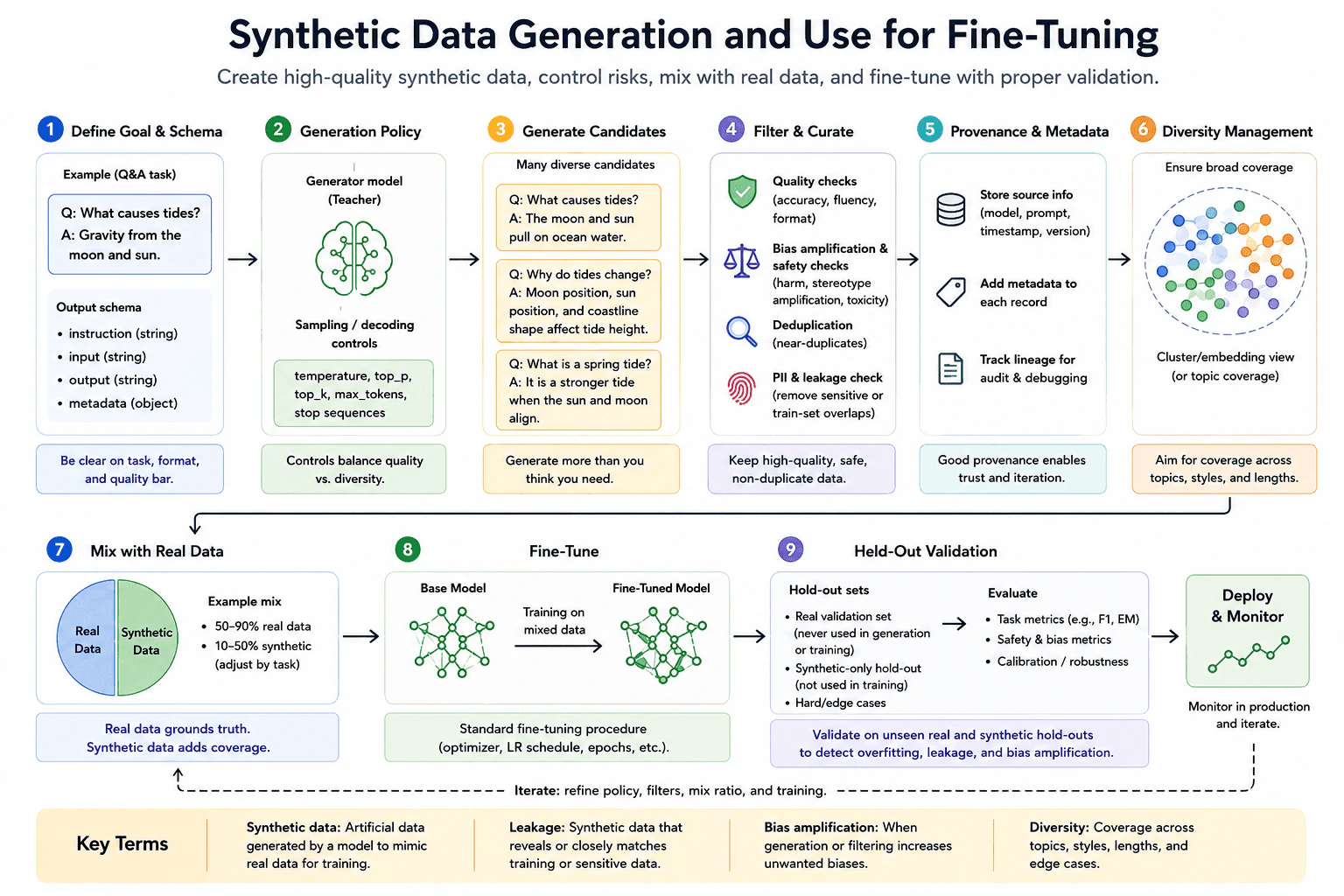
Synthetic data is artificial training data created by a model or rules to add useful examples when real data is limited or misses important cases. I would define the task and output format, generate more candidates than I need, filter for quality, safety, duplicates, leakage, and bias amplification, store provenance for every record, check diversity, mix the approved synthetic data with trusted real data, fine tune the base model, and validate on held out data that was not used for generation or training.
Detailed Explanation
Synthetic data is artificial data created to look like the examples you want a model to learn from. For example, if I need more question and answer pairs about tides, I can create many new pairs that follow the same task and format. The useful part is not only making more data. I also need to remove bad, repeated, unsafe, or misleading examples. I record how each example was created, mix good synthetic examples with trusted real examples, train the model, and test it on separate data it never saw during generation or training.
Useful Questions to Ask the Interviewer
What task and output format should the synthetic examples follow?
Which real data can be used as a trusted reference?
Which safety, privacy, and quality checks are required?
What held out data is available for final validation?
How to Explain It in an Interview
I would start by defining the goal, schema, and generation policy. The policy says what task to create, which topics to cover, what difficulty and style mix to use, what output format is required, and which safety rules apply. A teacher model or another generator can then create many candidate examples. Sampling controls such as temperature, top p, top k, token limits, and stop sequences can change the variety and shape of the outputs, so I would generate more candidates than I plan to keep.
Next, I would filter the candidates. I would check correctness, clarity, format, safety, personal information, near duplicates, and overlap with training or evaluation data. I would also check for bias amplification. This means generated data makes an unwanted pattern or stereotype stronger. Provenance matters here. Provenance is the record of which model, prompt, settings, time, and version produced each example. I would attach that metadata to every record so later audits and debugging are possible.
I would then check diversity across topics, styles, lengths, difficulty levels, and edge cases. After approval, I would mix synthetic data with curated real data. The exact ratio depends on the task. Real data keeps the training set grounded in real behavior, while synthetic data adds coverage. I would adjust the ratio based on validation results rather than treat one ratio as a universal rule.
Finally, I would fine tune the base model on the mixed data. I would validate on a real validation set that was never used for generation or training, a separate synthetic hold out that was not used in training, and hard or edge cases. I would measure task quality, safety, bias, calibration, and robustness. If validation gets worse, I would refine the generation policy, filters, mix ratio, or training settings and repeat the process.
Why Interviewers Ask This
Interviewers ask this to see whether you understand that synthetic data quality is part of model adaptation, not just the training step. They want to know if you can define a generation policy, track provenance, filter bad or repeated samples, maintain diversity, detect leakage and bias amplification, mix synthetic data with trusted real data, and validate the adapted model on data that was not used during generation or training.
Common interview mistakes
Common mistakes are generating a large data set without a clear policy, trusting every generated output, keeping duplicates, losing provenance, and checking only average quality. Another mistake is allowing synthetic examples to overlap with evaluation data. That creates leakage and can make results look better than they really are. Teams can also miss bias amplification when the generator repeats stereotypes or overrepresents common patterns. Finally, using too much synthetic data without enough trusted real data can make the model learn generator artifacts instead of the real task.
Interview tip
Explain this as a controlled data pipeline, not as one generation call. Walk through goal and schema, generation policy, candidate generation, filtering, provenance, diversity, mixing, fine tuning, and held out validation in order. Name leakage and bias amplification as important failure modes. Explain that trusted real data and unseen validation data provide the evidence that synthetic data actually helped.
Interviewer may ask next
What if the synthetic data is high quality but too similar to the generator outputs?
I would treat that as a diversity and overfitting risk. The adapted model may learn narrow patterns from the generator instead of the wider real task. I would increase topic and style coverage, remove near duplicates, add hard cases, keep enough trusted real data in the mix, and compare results on held out real data. This matters because individual synthetic examples can look correct while the full data set still has poor coverage.
How would you choose the mix of real and synthetic data in production?
I would choose the ratio from validation evidence rather than use one fixed rule. I would start with real data as the grounding source and add enough synthetic data to improve coverage. Then I would change the mix only when held out real validation improves without worse safety, bias, calibration, or robustness. More synthetic data can add rare cases and reduce data collection cost, but too much can amplify generator artifacts or bias. The best ratio is task specific.
62. Your RLHF preference data has low annotator agreement. How do you ensure data quality?Fine Tuning And Model AdaptationHard
i Question Details
Require root-cause analysis across rubric clarity, calibration tasks, disagreement analysis, adjudication, annotator quality controls, and uncertainty-aware use of preferences, followed by measurable validation of the fix.
Short Interview Answer (30-60 seconds)
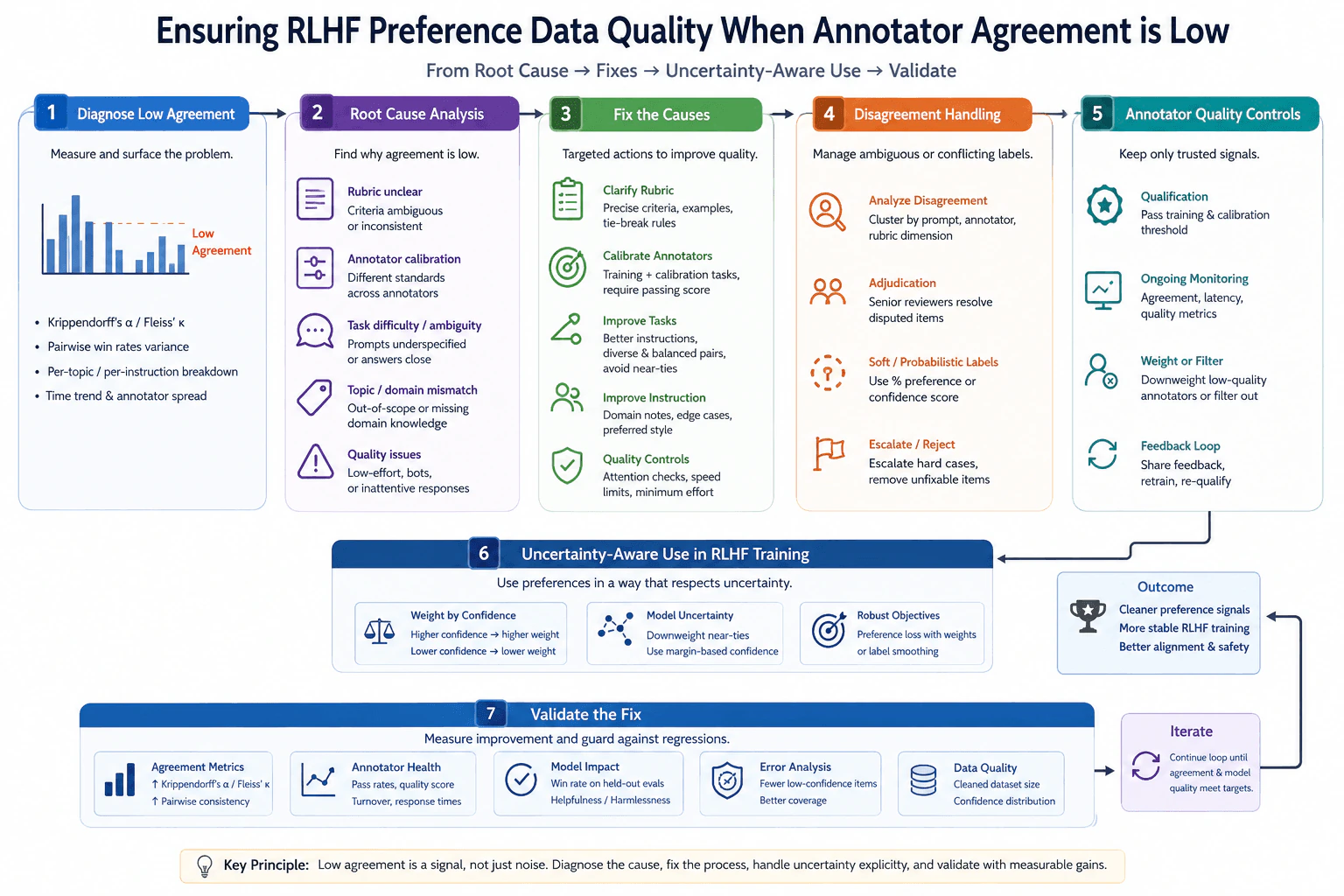
I would treat low agreement as a signal that needs investigation, not as simple noise. I would first measure where disagreement happens and find the root cause. I would check rubric clarity, annotator calibration, task ambiguity, domain knowledge, and annotation quality. Then I would clarify the rubric, run calibration tasks, adjudicate disputed cases, monitor annotator quality, and reject cases that cannot be labeled reliably. I would also keep useful uncertainty by giving weaker preferences less influence. Finally, I would validate the fix with agreement metrics, annotator health, label stability, error analysis, data quality measures, and held out model evaluation.
Detailed Explanation
Low agreement means different people often choose different preferred answers for the same comparison. I would first find out why this is happening instead of immediately deleting the data. The problem may come from unclear instructions, difficult examples, different judging standards, missing domain knowledge, or poor annotation work. I would then change the part of the process that caused the disagreement. Hard cases may need review by experienced people. Some disagreement may also be real, so I would keep that uncertainty when it gives useful information. After making changes, I would measure the results again before trusting the data for training.
Useful Questions to Ask the Interviewer
Is the disagreement concentrated in certain topics, prompts, annotators, or rubric criteria?
Do we have expert reviewed examples that can be used for annotator calibration?
Do we store only the final preference, or also votes, confidence, or other uncertainty information?
Which agreement, annotator quality, and model evaluation measures are already tracked?
How to Explain It in an Interview
I would use a diagnose, fix, control, uncertainty, and validate loop.
First, I would measure the disagreement. I would look at pairwise agreement and metrics such as Krippendorff alpha or Fleiss kappa when they fit the annotation setup. I would break the results down by topic, prompt type, rubric criterion, time period, and annotator. This shows whether the problem is broad or concentrated in certain areas.
Next, I would find the root cause. I would check whether the rubric has unclear or conflicting rules. I would compare annotators on calibration tasks with expert reviewed answers. I would inspect difficult pairs to see whether prompts are underspecified, answers are nearly tied, or special domain knowledge is required. I would also look for low effort, inattentive, or inconsistent annotation patterns.
Then I would fix the process. I would rewrite unclear rubric rules and add examples and tie breaking guidance. I would train annotators with calibration tasks and require a passing quality level. Hard or disputed items can go to experienced reviewers for adjudication. Very unclear items can be escalated or rejected instead of forcing a weak label.
I would also add annotator quality controls. I would monitor agreement, qualification results, response time, and other quality signals. Annotators who repeatedly fail quality checks can be retrained, given less influence, or removed from the task.
Next, I would preserve useful uncertainty. A preference with strong agreement can receive more influence than a near tie. Low confidence preferences can receive less weight, use a soft preference signal, or be filtered when the signal is too weak. This prevents uncertain labels from being treated as equally reliable evidence.
Finally, I would validate the fix. I would check whether agreement improves, annotator quality is stable, repeated labels are more consistent, low confidence cases decrease, and held out model evaluations improve. I would also review remaining errors and the confidence distribution. If the measures do not improve, I would return to the earlier diagnosis steps and repeat the process.
Why Interviewers Ask This
Interviewers ask this to test whether I treat preference data as a training signal that needs measurement and quality control. They want to see if I can find why annotators disagree, improve the labeling process, handle uncertain preferences carefully, control annotator quality, and prove that the changes improve both the data and the model evaluation results.
Common interview mistakes
A common mistake is to remove every disagreement and keep only unanimous examples. That can remove useful difficult cases and hide real uncertainty. Another mistake is to blame annotators before checking whether the rubric or task is unclear. Teams may also use only one global agreement number and miss problems that appear in one topic, rubric criterion, or annotator group. Another mistake is forcing every uncertain comparison into a hard winner and giving it the same training influence as a clear preference. Finally, better agreement alone is not enough. The team should also check annotator health, label stability, remaining errors, confidence patterns, and downstream model behavior.
Interview tip
Explain the answer as a loop. Start by measuring disagreement and finding its cause. Then explain how you would improve the rubric, calibrate annotators, adjudicate hard cases, and monitor annotator quality. Next, explain how uncertain preferences receive less influence instead of being treated as fully reliable. Finish with measurable validation using agreement, annotator health, label stability, error analysis, data quality, and model impact.
Interviewer may ask next
What would you do if agreement stays low even after the rubric and annotator calibration are improved?
I would check whether the remaining disagreement represents real ambiguity instead of poor labeling. I would group disputed examples by prompt, topic, annotator, and rubric criterion and inspect the near tie cases. For genuinely ambiguous pairs, I would keep the uncertainty through confidence values, vote information, soft preference signals, or lower training weight instead of forcing a strong winner. Extremely unclear items can be rejected or sent to expert adjudication. This matters because real uncertainty is useful information, while pretending that every preference is certain can create a misleading training signal.
What is the tradeoff between filtering uncertain preference pairs and keeping them with lower weight?
Filtering creates a cleaner dataset, but it can remove difficult and informative examples. Keeping uncertain pairs with lower weight preserves more coverage while reducing their influence on training. I would give stronger weight to clear preferences, lower weight to near ties, and remove examples only when the signal is too weak or the task itself is invalid. The main tradeoff is cleanliness versus coverage. I would choose the rule using held out evaluation, agreement measures, confidence distributions, label stability, and downstream model quality.
63. Your fine-tuned model memorized training data verbatim instead of learning patterns. How do you fix overfitting?Fine Tuning And Model AdaptationHard
i Question Details
Assess the incident through duplicate or high-frequency examples, train-validation leakage, regularization, early stopping, privacy tests, and comparison with the base model, including the signals used to confirm the corrective action.
Short Interview Answer (30-60 seconds)
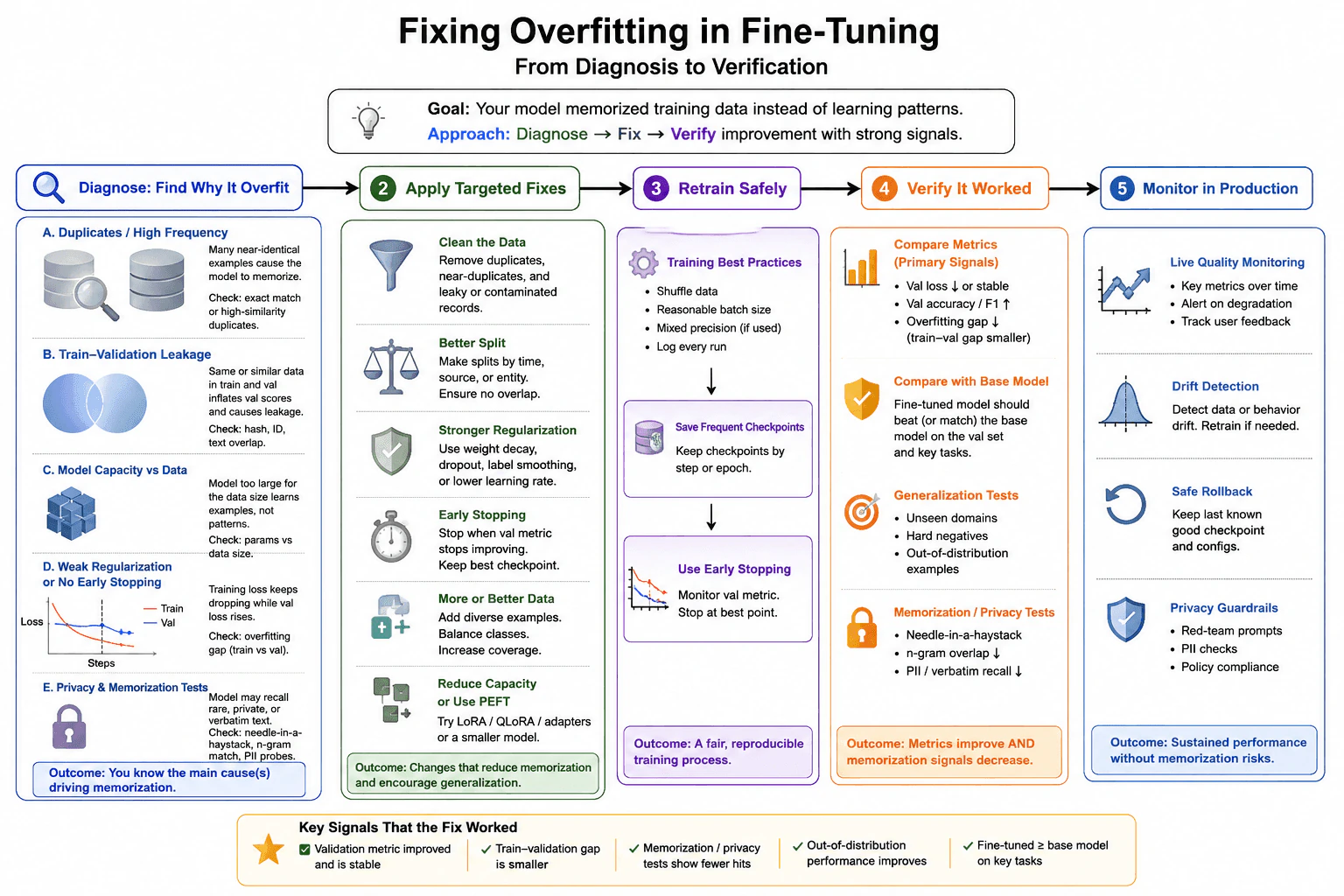
I would first find why the model is memorizing. I would check for duplicate or overused examples, train and validation leakage, weak regularization, excessive adaptation capacity, and verbatim recall of private text. Then I would clean the data, rebuild the split, strengthen regularization, add more diverse examples, reduce capacity when useful, and stop training when validation performance stops improving. I would save checkpoints and keep the best one. Finally, I would compare the corrected model with the base model on the same clean tests. I would only ship it when the train validation gap becomes smaller, validation quality is stable, unseen data performance improves, and memorization signals decrease.
Detailed Explanation
The model is remembering exact training examples instead of learning behavior that works on new inputs. I would not assume training settings are the only cause. I would first inspect the data and evaluation split. Repeated examples can teach the model to copy. Similar examples in both training and validation can make validation results look better than they really are. I would also check whether training continued after validation quality stopped improving. Finally, I would test whether the model can reproduce rare, private, or sensitive text from the training set.
Useful Questions to Ask the Interviewer
Do we have a clean validation set separated by source, time, or entity?
Are duplicate or highly repeated examples known to exist in the training data?
Do we have privacy probes or known sensitive strings that we can test for verbatim recall?
What base model metrics should the adapted model match or beat?
How to Explain It in an Interview
I would start with diagnosis because different causes need different corrections. I would scan for exact duplicates, near duplicates, and examples that appear too often. I would also check train and validation overlap using identifiers, text similarity, source information, or other reliable keys. If the split is contaminated, I would rebuild it so related examples cannot appear on both sides.
Next, I would reduce the chance of memorization. I can use stronger regularization such as weight decay, dropout, or label smoothing when they fit the training method. I can lower the learning rate when training is too aggressive. I can add more diverse examples, balance repeated examples, and reduce adaptation capacity when the model has more flexibility than the data supports. With parameter efficient adaptation, that can mean using a smaller adapter or lower rank.
During retraining, I would shuffle the training data, use a reasonable batch size, log the important metrics, and save checkpoints regularly. Mixed precision can be used as a training efficiency choice when the training stack supports it, but it is not itself an overfitting correction. I would use early stopping when the validation metric no longer improves. I would keep the best validation checkpoint rather than automatically using the final checkpoint.
Then I would verify the correction. I would look for stable or lower validation loss, better validation task metrics, and a smaller gap between training and validation performance. I would test unseen domains, difficult examples, and out of distribution inputs. I would also run memorization and privacy checks such as rare string probes, long text overlap checks, and tests for verbatim recall of sensitive content.
Finally, I would compare the corrected model with the unchanged base model on the same evaluation set and important tasks. The adapted model should provide useful task improvement without unacceptable memorization. In production, I would monitor quality and drift, watch for privacy failures, keep the last known good checkpoint and configuration, and retain a rollback path.
Why Interviewers Ask This
Interviewers ask this to test whether I can separate memorization from useful learning and diagnose why adaptation failed. They want to see whether I understand data quality, train and validation separation, regularization, early stopping, model capacity, privacy testing, evaluation, checkpoints, and production rollback. They also want evidence based judgment. A strong answer does not just change one training setting. It explains how I find the cause, apply targeted corrections, and prove that the model generalizes better without exposing training data.
Common interview mistakes
A common mistake is changing the learning rate immediately without checking the data. Duplicate examples or validation leakage can remain even after training settings change. Another mistake is trusting training loss alone. Very low training loss can exist while validation quality gets worse. Some teams also use the final checkpoint even though an earlier checkpoint generalized better. Another mistake is testing only average task quality and skipping privacy or verbatim recall tests. Teams can also mistake mixed precision or checkpoint frequency for direct regularization. Those choices help training efficiency or recovery, but they do not by themselves stop memorization. Finally, comparing the adapted model with the base model on different data can give a misleading result. Both models should be evaluated on the same important tasks and clean test sets.
Interview tip
Explain the answer as a clear flow. Diagnose the source of memorization. Apply targeted corrections. Retrain with checkpoints and early stopping. Then prove the correction with clean validation data, privacy tests, harder unseen examples, and a base model comparison. Name the signals you expect to change. A smaller train validation gap, stable validation quality, fewer verbatim matches, stronger performance on unseen data, and results that match or beat the base model make the answer concrete.
Interviewer may ask next
What would you do if validation accuracy looks strong but the model still repeats training examples verbatim?
I would treat the model as still overfit because strong validation accuracy does not prove that memorization is gone. I would first check whether the validation set shares duplicate or near duplicate content with training. Then I would run direct memorization tests using rare strings, long text overlap, sensitive text probes, and difficult unseen examples. If those tests show copying, I would clean the split and training data, reduce repeated examples, strengthen regularization when appropriate, and retrain with early stopping. This matters because contaminated validation data can hide the real failure.
How do you decide whether to keep the adapted model or return to the base model?
I would compare both models on the same clean evaluation set and the same important production tasks. I would keep the adapted model only when it provides useful task improvement while maintaining acceptable generalization, privacy, and safety behavior. I would also check difficult and out of distribution inputs because average validation scores can hide weak areas. If the adapted model adds little value or introduces memorization risk, I would keep the base model or iterate on the adaptation. The main tradeoff is task specialization versus worse generalization and increased memorization risk.
64. What are embeddings?Vector Databases And EmbeddingsEasy
i Question Details
Clarify the relationships among the mapping from items to dense vectors, semantic neighborhoods, model and version identity, and downstream retrieval use.
Short Interview Answer (30-60 seconds)
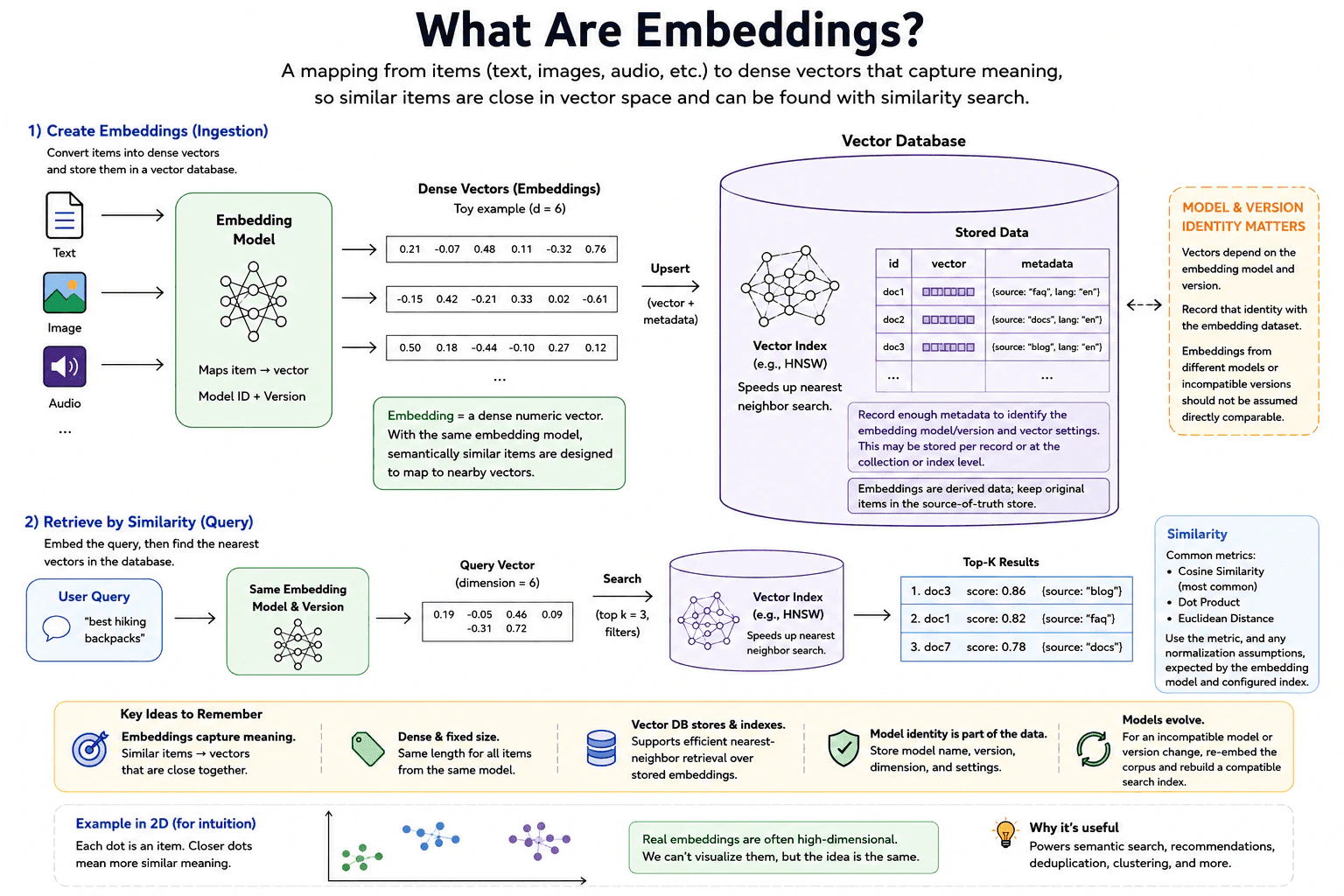
Embeddings are dense numeric vectors produced by a model to represent useful meaning. Similar items are designed to map to nearby vectors. We can index those vectors, embed a query with the same compatible model and version, and retrieve the nearest vectors using the configured similarity metric.
Detailed Explanation
An embedding changes an item into a list of numbers that represents useful meaning. For example, two pieces of text about similar topics may get number lists that are close to each other, while unrelated text may be farther apart. The same idea can apply to images or audio. These number lists let a system compare meaning instead of only matching exact words. The numbers depend on the model that created them. A search system can create vectors for stored items, create another vector for a user query, and then find nearby stored vectors.
Useful Questions to Ask the Interviewer
Are we discussing embeddings in general, or should I also explain how they are used in vector search?
Should I cover model and version compatibility when embeddings are created or changed?
Do you want a brief explanation of similarity metrics and approximate nearest-neighbor indexes?
How to Explain It in an Interview
Start with the mapping. An embedding model takes an item, such as text, an image, or audio, and returns a dense numeric vector. Dense means the vector has a value in most or all dimensions, unlike a sparse vector where most positions are zero. The vector has a fixed length for that model.
A small toy vector might look like [0.21, -0.07, 0.48, 0.11, -0.32, 0.76]. Real embeddings are often high-dimensional. The exact size depends on the model. The important idea is not one individual number. What matters is the position of the whole vector relative to other vectors.
This creates semantic neighborhoods. Semantic means related by meaning. With the same embedding model, items with similar meaning are designed to map to nearby regions of the vector space. The system measures closeness with a similarity or distance function such as cosine similarity, dot product, or Euclidean distance. The chosen metric and any normalization assumptions must match what the embedding model and configured index expect.
For retrieval, the system creates embeddings for stored items and keeps their vectors with useful metadata. A vector index can make nearest-neighbor lookup more efficient. HNSW is one common approximate nearest-neighbor index. Approximate nearest-neighbor search usually trades some exactness for faster retrieval compared with checking every stored vector.
At query time, the application embeds the user's query with the same compatible embedding model and version. It searches the vector index using the configured metric, optionally applies metadata filters, ranks nearby matches, and returns the top-K results. The original items should remain in the source-of-truth store because embeddings are derived data rather than the original records.
Model identity matters. Record enough information to identify the embedding model, version, and relevant vector settings for the embedding dataset. That information may be stored per record or at the collection or index level. Embeddings from different models or incompatible versions should not be assumed directly comparable.
If the system moves to an incompatible embedding model or version, re-create embeddings from the original source data and build a compatible search index. During migration, old and new representations may need separate indexes until the new one is ready and validated.
The main tradeoff is that embeddings make meaning-based retrieval practical, but retrieval quality still depends on the embedding model, input preparation, similarity settings, metadata filters, and index configuration. A vector database does not automatically correct weak embeddings, poor input preparation, missing filters, or an incorrect distance metric.
Index and Query Path
Keep the original item in the source-of-truth store.
Send the item to the chosen embedding model.
Receive a fixed-length dense vector.
Store or upsert the vector with useful metadata and enough information to identify its embedding model, version, and relevant vector settings.
Add the vector to a compatible vector index, such as HNSW when approximate nearest-neighbor search is appropriate.
At query time, embed the query with the same compatible model and version.
Apply any required metadata filters.
Search the vector index using the configured similarity or distance metric.
Rank the nearest matches and return the top-K results.
If the embedding model changes incompatibly, re-embed the source corpus and rebuild a compatible index before fully switching to the new representation.
Time & Space Complexity
Creating embeddings costs model computation for every stored item and every query. Each stored item also needs space for its vector and metadata. A vector index needs extra memory or disk and adds maintenance work during writes, updates, and deletes. Exact nearest-neighbor search may compare a query with every stored vector, so its work grows with the collection. Approximate indexes such as HNSW can reduce retrieval work, but they add index-building, storage, tuning, and maintenance costs. An incompatible model change can also be expensive because the source corpus must be embedded again and a compatible index rebuilt.
Where it is used
Embeddings are used in semantic search, retrieval-augmented generation, recommendations, similar-item lookup, duplicate detection, clustering, content discovery, and other matching tasks where meaning matters more than exact keyword overlap.
Why Interviewers Ask This
Interviewers want to see whether you understand embeddings as learned numeric representations rather than simple IDs or keywords. They also want to know whether you understand semantic neighborhoods, model and version compatibility, similarity metrics, vector indexing, nearest-neighbor retrieval, and what must happen when an incompatible embedding model or version replaces the old one.
Common interview mistakes
Common mistakes include saying that an embedding is the original data instead of a derived numeric representation; treating individual vector values as directly meaningful; assuming embeddings from different models or incompatible versions can be compared safely; using a similarity metric or normalization rule that does not match the model and index assumptions; assuming every embedding must be normalized; storing embeddings without keeping the original source data; assuming an approximate vector index always returns the exact nearest neighbors; and expecting a vector database to correct weak embeddings, poor input preparation, missing metadata filters, or an incorrect distance metric.
Interview tip
Explain embeddings in this order: item to dense vector, similar meaning to nearby vectors, model and version compatibility, then query embedding and nearest-neighbor retrieval. Use one small example. Add vector-index details only after the core idea is clear.
Interviewer may ask next
Why should the query use the same compatible embedding model and version as the stored vectors?
The vector coordinates only have useful meaning inside the representation learned by that embedding model. A different model, or an incompatible version, can produce a different vector space even for the same input. Distances between incompatible spaces are therefore not meaningful. Record the model and version used for the embedding dataset and use a compatible model and version for query embedding.
What should you do when changing to an incompatible embedding model or version?
Create new embeddings from the original source data and build a compatible vector index. Keep the old and new representations separate during the migration. Validate the new retrieval behavior, similarity settings, metadata filters, and result quality before switching fully to the new index. After the migration is complete, retire the old embeddings and index according to the system's lifecycle plan.
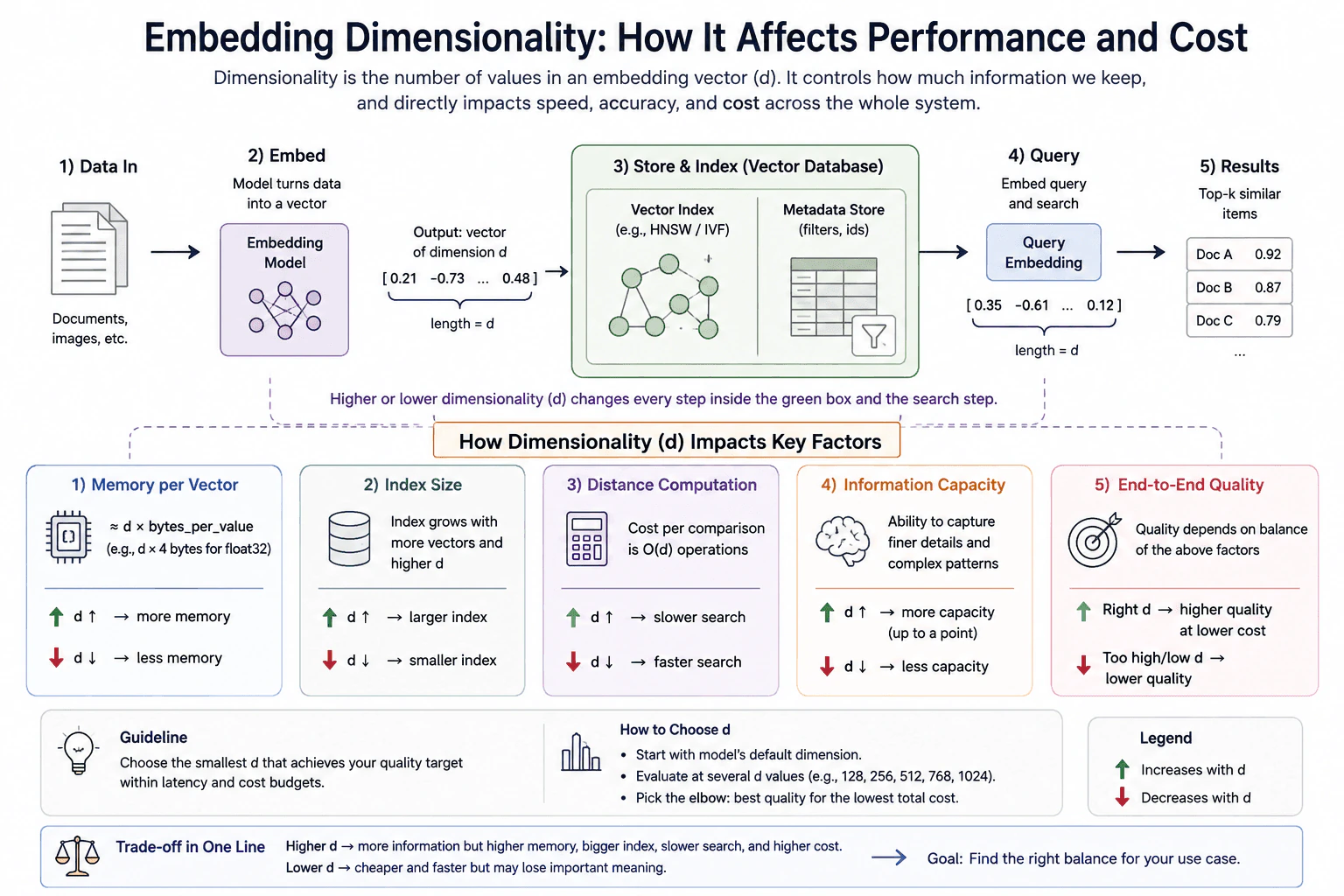
65. What is embedding dimensionality, and how does it affect performance and cost?Vector Databases And EmbeddingsEasy
i Question Details
Explain how the listed elements interact: memory per vector, index size, distance computation, information capacity, and end-to-end quality measurement.
Short Interview Answer (30-60 seconds)
Embedding dimensionality is the number of values in each vector. Higher dimensions can keep more information, but they use more memory, enlarge the vector index, and make each comparison more expensive. I would measure several supported dimensions and choose the smallest one that meets quality, latency, and cost goals.
Detailed Explanation
Embedding dimensionality means how many numbers describe one item. More numbers can keep finer details, but the system must store and compare more data. Fewer numbers reduce storage and search work, but they can remove useful distinctions. This choice affects the whole search path, from creating vectors to storing them and finding similar items. The goal is not to use the biggest possible representation. The goal is to use enough detail for good results while keeping memory, response time, and computing cost within acceptable limits. Real measurements should decide the final size.
Useful Questions to Ask the Interviewer
Does the chosen embedding model support more than one output dimension, or should we use its default dimension?
Which end-to-end quality metric matters most, and what latency, memory, or cost limits must the system meet?
How to Explain It in an Interview
Embedding dimensionality, usually written as d, is the number of numeric values in an embedding vector. A vector such as [0.21, -0.73, ..., 0.48] has length d.
The first effect is memory per vector. Raw vector memory is approximately d multiplied by the bytes used for each value. For example, float32 uses 4 bytes per value, so the raw vector payload is about 4 × d bytes before database and index overhead. Increasing d increases memory per vector. Decreasing d reduces it.
The second effect is index size. A vector database stores the vectors and may build an approximate nearest-neighbor index such as HNSW or IVF. The full index must account for the vector data plus its own graph, cluster, identifier, or other metadata. Larger vectors therefore increase the vector portion of the index and normally increase total index memory or disk use. The index-specific metadata does not necessarily grow in direct proportion to d.
The third effect is distance computation. At query time, the query is converted into an embedding with the same required dimension as the stored vectors. Search compares that query vector with candidate vectors using a compatible similarity or distance measure such as cosine similarity, dot product, or Euclidean distance. A direct comparison processes d values, so its arithmetic work is O(d) per comparison. Higher d means more arithmetic per comparison and can increase query latency and compute cost. Lower d reduces that work.
The fourth effect is information capacity. A larger vector can give the embedding model more room to represent fine details and complex patterns. A dimension that is too small may remove distinctions that matter for retrieval. However, more dimensions do not guarantee better results. Quality can improve, then show diminishing gains or even become worse for a particular model, dataset, index configuration, or task. That is why the correct dimension must be measured rather than guessed.
The fifth effect is end-to-end quality. The useful question is whether the final top-k results are good enough for the application. I would measure a task-appropriate retrieval metric such as Recall@k while also measuring latency, memory use, index size, and cost. The selected dimension should provide the best practical balance, not simply the largest vector.
The end-to-end flow is: source items go through an embedding model and become vectors of length d. Those vectors are stored and indexed in the vector database, together with the identifiers or metadata needed by the application. At query time, the query goes through the compatible embedding process and produces another vector of length d. The vector database searches the index and returns the top-k similar items. Changing d affects the stored vectors, the size of the full index, and the work done during search.
A practical decision process is to start with the embedding model's supported default dimension. If the model supports alternative dimensions, evaluate several supported values on the same representative dataset and workload. Compare end-to-end quality with latency, memory, index size, and total cost. Then choose the smallest supported d that reaches the required quality while staying inside the latency and budget limits. This matches the central tradeoff: higher d can retain more information but costs more memory and computation; lower d is cheaper and faster but may lose important meaning.
Index and Query Path
Start with a dimension that the embedding model supports, normally its default.
If alternative dimensions are supported, choose several candidates to evaluate.
Embed the same representative items and queries for each candidate dimension.
Build the same type of vector index for each candidate.
Measure raw memory per vector and total index size.
Run the same search workload and measure latency and compute cost.
Measure end-to-end retrieval quality with a task-appropriate metric such as Recall@k.
Compare quality against memory, latency, index size, and total cost.
Choose the smallest supported dimension that reaches the quality target while satisfying latency and budget limits.
Practical Complexity & Trade-offs
Raw storage for one vector grows roughly with d. If each vector value uses b bytes, the raw vector needs about d × b bytes before database and index overhead. Total index size also tends to increase because the index contains those larger vectors plus its own metadata. A direct cosine, dot-product, or Euclidean comparison processes d values, so the arithmetic work is O(d) for one comparison. Higher d can therefore increase memory use, index size, CPU or GPU work, latency, and cost. Lower d reduces those costs, but lowering it too far can hurt retrieval quality. Changing d also means stored and query embeddings must remain dimension-compatible, and an existing collection may need re-embedding and index rebuilding if its dimension changes.
Where it is used
This tradeoff appears in semantic search, retrieval-augmented generation, recommendation systems, image or multimodal retrieval, duplicate detection, and other systems that store and search embeddings. It becomes especially important when there are many vectors or many queries, because a small increase in bytes per vector or work per comparison can become a large total storage and compute cost.
Why Interviewers Ask This
The interviewer wants to know whether you see embedding dimensionality as a system tradeoff rather than just a model setting. A strong answer connects d to memory per vector, total vector-index size, distance-computation work, information capacity, retrieval quality, latency, and cost. It should also explain that a larger dimension is not automatically better. The final choice should come from end-to-end measurement on representative data.
Common interview mistakes
One mistake is saying that a larger dimension always gives better quality. It may preserve more detail, but useful gains can flatten, and end-to-end quality must be measured. Another mistake is discussing only raw vector memory and forgetting the full index and query-computation cost. A third mistake is treating any dimension as valid even when the embedding model does not support it. Another mistake is changing the stored-vector dimension without keeping query embeddings compatible. Finally, do not choose d from theory alone. Measure representative retrieval quality, latency, memory, index size, and cost together.
Interview tip
Present the answer as one tradeoff chain: d controls vector length; higher d can keep more information, but it increases raw vector memory, enlarges the full index, and adds work to each comparison. Then give the production decision: measure several supported dimensions and choose the smallest one that reaches the required end-to-end quality within latency and cost limits.
Interviewer may ask next
Why not always use the highest embedding dimension available?
Because higher d increases raw vector memory, normally increases total index size, and requires more arithmetic for each similarity or distance comparison. Quality may improve only up to a point, so extra dimensions can add latency and cost without enough benefit. I would compare supported dimensions on the same representative evaluation set and choose the smallest one that reaches the required end-to-end quality.
How would you decide whether a lower embedding dimension is good enough?
I would evaluate it with the same representative items, queries, index type, and search settings used for the baseline. I would measure an end-to-end quality metric such as Recall@k together with latency, memory per vector, total index size, and cost. If the lower supported dimension still reaches the quality target while reducing resource use, it is the better operating point. If quality falls below the target, I would test a larger supported dimension.
66. What is a vector database?Vector Databases And EmbeddingsEasy
i Question Details
A complete explanation should cover vector storage, approximate index, metadata filtering, update lifecycle, and how this differs from relational access patterns.
Short Interview Answer (30-60 seconds)
A vector database stores embeddings and searches them by similarity instead of only matching exact field values. It usually uses an approximate nearest-neighbor index for fast search, supports metadata filters, and maintains embeddings and indexes as data changes.
Detailed Explanation
This kind of database helps an application find items that are similar in meaning, even when their words or normal fields are different. For example, a person can ask for content about a topic without using the exact words stored in the original item. The system keeps a number-based representation of each item and compares a new request with those stored representations. It can also use ordinary descriptive fields to narrow the choices. When the original content changes, the stored representation may need to change as well.
Useful Questions to Ask the Interviewer
Should I explain only the basic idea, or also cover how indexing and filtering work?
Should I discuss update and delete behavior when source content or the embedding model changes?
Do you want a comparison with relational database access patterns?
How to Explain It in an Interview
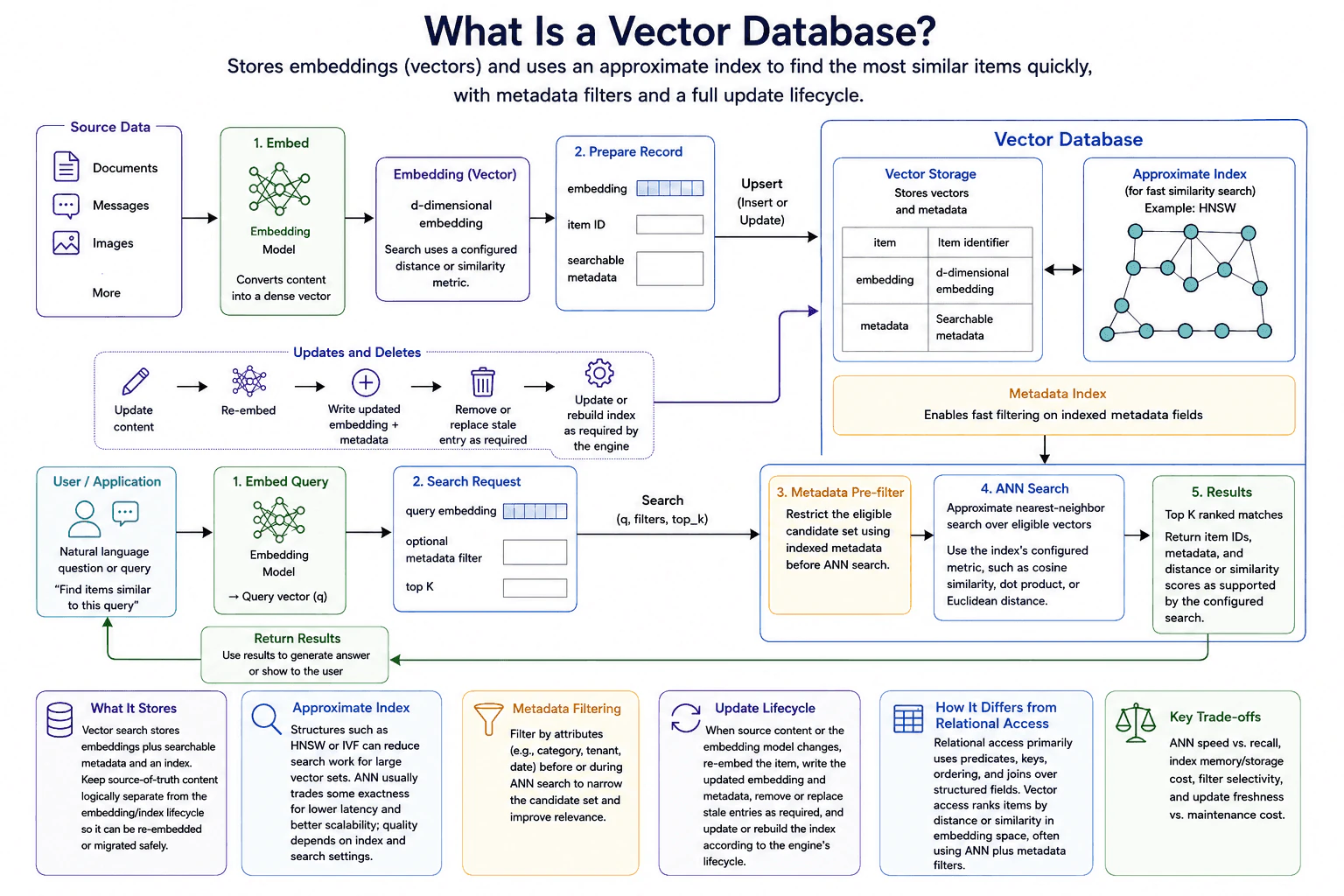
Start with the big picture. A vector database stores embeddings. An embedding is a list of numbers that represents the meaning or features of an item. Text, images, and other content can be converted into embeddings by an embedding model.
During ingestion, source content is sent to an embedding model. The model creates a d-dimensional embedding, where d is the number of values in the vector. The application then prepares a record with an item ID, the embedding, and searchable metadata. Metadata is normal structured information such as a category, date, tenant, or access label. The record is upserted into the vector database.
The database stores the vectors and metadata. It also maintains an approximate index for fast similarity search. Common index families include HNSW and IVF. These support approximate nearest-neighbor search, usually called ANN. Instead of comparing the query with every stored vector, ANN searches promising parts of the index. This reduces search work for large vector sets. The tradeoff is that approximate search can miss a neighbor that an exact scan would find.
At query time, the application converts the user's request into a compatible query embedding. The search request contains that embedding, an optional metadata filter, and top K. Top K means the number of best matches requested.
The diagram uses a metadata pre-filter. Indexed metadata first restricts the eligible candidate set. ANN search then searches the remaining vectors. A configured distance or similarity metric defines what 'close' means. Common choices are cosine similarity, dot product, and Euclidean distance. The metric must match the embedding and index design.
The database returns the top K ranked matches. Results can include item IDs, metadata, and distance or similarity scores when the database supports them. The application can show those matches directly or use them in another AI workflow.
The update lifecycle is also important. If source content changes, the item may need to be embedded again. If the embedding model changes, affected items may also need re-embedding because the old and new vector spaces may not be compatible. The application writes the updated embedding and metadata, removes or replaces stale entries as required, and updates or rebuilds the index according to the database engine's lifecycle.
Keep source-of-truth content logically separate from the embedding and index lifecycle. Embeddings and indexes are derived search data. Keeping the original content separate makes re-embedding and migration safer because the source can be processed again when the model, vector format, or index changes.
The main difference from relational access is the lookup pattern. Relational access mainly uses predicates, keys, ordering, and joins over structured fields. Vector access ranks items by distance or similarity in embedding space. In many systems, both styles work together: metadata fields narrow the eligible set, while vector search ranks the closest matches.
The main production tradeoffs are ANN speed versus recall, index memory and storage cost, filter selectivity, and update freshness versus maintenance cost. A vector database does not automatically fix poor embeddings, weak metadata, the wrong metric, or stale data. Those choices still need careful application design.
Index and Query Path
Keep the original source content as the source of truth.
Convert the source content into a d-dimensional embedding with an embedding model.
Prepare a record with the embedding, an item ID, and searchable metadata.
Upsert the record into vector storage and maintain an approximate index such as HNSW or IVF.
Maintain an index over metadata fields that need fast filtering.
For a query, create a compatible query embedding.
Send the query embedding, an optional metadata filter, and top K to the search path.
In the illustrated design, use the metadata index to pre-filter the eligible candidate set.
Run ANN search over the eligible vectors with the configured metric, such as cosine similarity, dot product, or Euclidean distance.
Return the top K ranked matches with supported item IDs, metadata, and distance or similarity scores.
When source content or the embedding model changes, re-embed affected items, write updated embeddings and metadata, remove or replace stale entries, and update or rebuild the index as required by the engine.
Practical Complexity & Trade-offs
An exact search can compare the query with every stored vector. An approximate index avoids much of that work, so it is usually faster for large collections. The index adds memory, storage, and maintenance cost. ANN can also trade some recall for speed, which means it may miss a match that an exact scan would find. Metadata filtering changes how many vectors remain eligible for search. Updates cost extra work because changed items may need re-embedding, and the index may need to be updated or rebuilt.
Where it is used
Vector databases are used for semantic document search, retrieval for AI assistants, recommendation systems, image or media similarity search, duplicate detection, and other applications where results should be ranked by meaning or similarity instead of only exact field matches.
Why Interviewers Ask This
The interviewer wants to know whether you understand why vector databases exist and how their main parts work together. A strong answer should distinguish source data from embeddings, explain approximate nearest-neighbor indexing, show how metadata filtering narrows search, describe update and delete behavior, and compare similarity-based access with normal relational access. They also want to hear the main tradeoffs, such as search speed versus recall, index cost, filter selectivity, and freshness versus maintenance work.
Common interview mistakes
A common mistake is saying that a vector database only stores vectors. In practice, it also needs item IDs and usually searchable metadata. Another mistake is treating ANN as exact search. ANN can trade some recall for faster search. Candidates also forget metadata filtering, update and delete behavior, index maintenance, and re-embedding when source content or the embedding model changes. Do not assume cosine similarity is always the right metric. The metric must match the embedding and index design. Also do not treat embeddings or the vector index as the source of truth.
Interview tip
Answer in this order: what it stores, how source data becomes embeddings, how a query is embedded, how metadata filtering and ANN search work, how updates are handled, and how this differs from relational access. End with the main tradeoffs: speed versus recall, index cost, filter selectivity, and freshness versus maintenance.
Interviewer may ask next
Why use approximate nearest-neighbor search instead of comparing the query with every vector?
An exact scan compares the query with every stored vector, so its work grows with the collection size. An ANN index such as HNSW or IVF reduces search work by exploring only promising parts of the index. This usually lowers latency for large collections, but it can miss a result that an exact scan would find. That is the main speed-versus-recall tradeoff.
What happens when the source content or embedding model changes?
If source content changes, the affected item may need to be embedded again and its stored embedding and metadata updated. If the embedding model changes, many or all items may need re-embedding because the old and new vector spaces may not be compatible. Stale entries should be removed or replaced as required, and the index must be updated or rebuilt according to the engine's lifecycle. Keeping the original source data separate makes this migration possible.
67. What is the role of metadata in vector databases?Vector Databases And EmbeddingsEasy
i Question Details
Ground the definition in filterable fields, tenant and permission isolation, freshness, pre-filter versus post-filter effects, and schema evolution.
Short Interview Answer (30-60 seconds)
Metadata gives vectors structured context such as tenant, permissions, dates, status, and tags. It lets the database filter eligible vectors, isolate users or tenants, avoid stale content, and return safer and more relevant results without changing the semantic meaning stored in the embedding.
Detailed Explanation
Metadata is extra information stored with each searchable vector. For example, a finance document may have a tenant, document ID, user ID, permissions, creation date, status, and tags. The vector helps find content with similar meaning. The metadata helps decide whether that content is allowed, current, and relevant for this request. This matters because a good semantic match may still belong to another tenant, require a permission the user does not have, or be too old to return. Production search usually needs both meaning and metadata rules.
Useful Questions to Ask the Interviewer
Which metadata fields must be filterable, such as tenant, user, permissions, timestamps, status, or tags?
Must tenant and permission rules be enforced before vector similarity search?
How should stale, deleted, expired, or superseded content be excluded?
Do metadata schema changes need to work without re-embedding unchanged content?
How to Explain It in an Interview
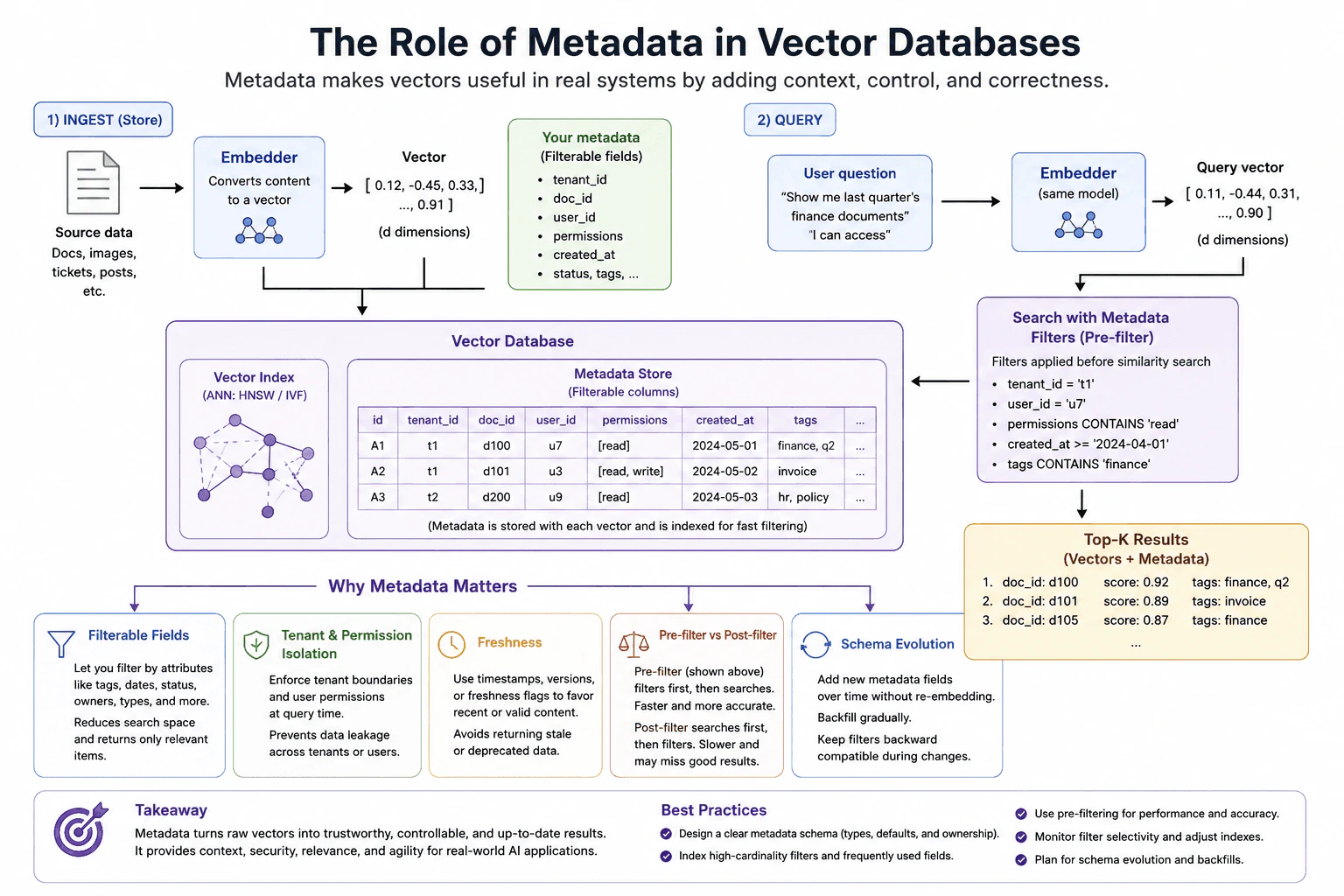
Think of a vector and its metadata as serving two different jobs. The embedding stores semantic meaning. Metadata stores structured facts that the system can filter on. Common fields include tenant_id, doc_id, user_id, permissions, created_at, status, and tags.
During ingestion, the source content is converted into a vector by an embedding model. The vector is placed in a vector index, while its metadata is stored with or associated with that record in filterable fields. The vector index may use approximate nearest-neighbor search, such as HNSW or IVF, but the exact index is provider-specific. The metadata fields can also be indexed when the database supports that, which can make frequent filters more efficient.
At query time, the user's question is converted into a query vector with the same embedding model. The application also creates trusted metadata constraints. For example, it may require the correct tenant, the current user, read permission, a recent date, and a finance tag. Those rules restrict which records can be returned.
Tenant and permission metadata are especially important. They help enforce isolation so one tenant or user does not receive another tenant's restricted data. Authorization should be applied before restricted content is exposed to the caller. Metadata therefore affects both relevance and access control.
Freshness is another important use. Timestamps, versions, status values, or freshness flags can remove stale, deleted, expired, or superseded records. If only these metadata values change and the underlying source content stays the same, the vector usually does not need to be recreated.
With pre-filtering, metadata constraints are applied before similarity search. The vector search then runs only over records that pass those constraints. This is useful for hard rules such as tenant, permission, status, or date. It can reduce the candidate search space, but the exact performance and recall effects depend on the vector database, index type, and filter selectivity. It should not be described as universally faster or more accurate for every workload.
With post-filtering, the system first retrieves vector candidates and then removes records that fail metadata rules. This can be useful when some conditions cannot be pushed into the vector search. The tradeoff is that the system may do more search work, and filtering can leave too few final results. A common mitigation is to retrieve more candidates than the final top-K size before applying the post-filter.
Schema evolution is easier when metadata is kept conceptually separate from vector meaning. New metadata fields can be added, old records can be backfilled gradually, and filtering rules can change without re-embedding unchanged content. During migration, the application should handle both old and new records safely until the backfill is complete.
The main takeaway is simple: embeddings answer, 'Which records are semantically similar?' Metadata answers, 'Which of those records are allowed, current, and relevant for this request?' A production vector search system normally needs both.
Index and Query Path
Ingest the source content and create its embedding.
Store the vector together with filterable metadata such as tenant, user, permissions, timestamps, status, and tags.
Put the vector into the vector index and make frequently used metadata fields filterable or indexed when supported.
Convert the user's question into a query vector with the same embedding model.
Build trusted metadata constraints from tenant, authorization, freshness, and business rules.
Prefer pre-filtering for hard eligibility rules when the database supports it appropriately.
Run similarity search over the eligible vectors and return the top-K results with their metadata.
Use post-filtering when needed, and retrieve enough candidates so filtering does not leave too few final results.
When metadata fields change, migrate and backfill them separately from embeddings unless the source content or embedding model also changes.
Practical Complexity & Trade-offs
Metadata adds storage, indexing, and maintenance cost because the database must keep extra fields and may maintain indexes for commonly filtered values. Pre-filtering can reduce the candidate set before vector search, but its speed and recall depend on the database, index, and filter selectivity. Post-filtering may search more candidates and often needs an over-fetch step so enough results remain after filtering. Schema changes also add operational work because new fields may need defaults, backfills, compatibility logic, and monitoring.
Where it is used
This pattern is common in retrieval-augmented generation, enterprise document search, multi-tenant AI systems, support assistants, knowledge bases, and recommendation systems. For example, an enterprise assistant may use vector similarity to find finance documents while metadata limits results to the correct tenant, user permissions, date range, status, and finance tags.
Why Interviewers Ask This
Interviewers want to know whether you understand that vector similarity alone is not enough for a production retrieval system. You should know how metadata narrows eligible vectors, supports tenant and permission boundaries, keeps results fresh, affects pre-filter and post-filter behavior, and can evolve independently from the embedding when the source content has not changed.
Common interview mistakes
Common mistakes are treating metadata as if it changes the semantic meaning of an embedding, forgetting tenant or permission filters, exposing restricted content before authorization is applied, ignoring freshness fields and returning stale data, assuming pre-filtering is always faster or more accurate, using post-filtering without retrieving enough candidates, and re-embedding everything when only metadata changed. Another mistake is adding new metadata fields without defaults, migration compatibility, and a backfill plan.
Interview tip
State the separation first: embeddings represent semantic meaning, while metadata controls eligibility and context. Then walk through ingestion and query flow using tenant, permission, freshness, and tag filters. Mention the pre-filter versus post-filter tradeoff and finish with schema evolution without unnecessary re-embedding.
Interviewer may ask next
What is the difference between pre-filtering and post-filtering in vector search?
Pre-filtering applies metadata constraints before similarity search, so the vector search considers only eligible records. This is useful for hard rules such as tenant, permissions, status, and date. Post-filtering retrieves vector candidates first and removes records afterward. It can support rules that cannot be pushed into the search, but it may do more work and can leave too few final results unless the system retrieves extra candidates.
Do metadata schema changes require re-embedding all vectors?
Usually no. If only metadata changes, such as adding a status, owner, timestamp, tag, or permission field, the existing embedding can remain because the semantic source content has not changed. The new field can be added and old records can be backfilled gradually. Re-embedding is needed when the source content or embedding model changes in a way that changes the vector representation.
68. How do you benchmark and evaluate embedding model quality?Vector Databases And EmbeddingsEasy
i Question Details
Lay out the implementation or decision path for labeled query-item pairs, recall@k or ranking metrics, hard negatives, domain slices, latency, and statistical comparison.
Short Interview Answer (30-60 seconds)
Use a fixed labeled query-item dataset with hard negatives and domain slices. Run each model through the same retrieval setup, measure Recall@k or ranking metrics, record latency and cost, compare per-query results with confidence intervals or paired tests, and choose the model that meets quality targets consistently.
Detailed Explanation
Start with a fixed set of real questions and items where you already know which items should be returned. Include easy cases and difficult wrong items that look similar to the correct ones. Test every choice on exactly the same data and with the same search setup. Check whether the correct items appear near the top, whether results stay good for important groups, and how long each search takes. Compare the choices using the same rules. Do not trust a tiny difference by itself. Choose the option that gives reliable results while staying within acceptable speed and cost.
Useful Questions to Ask the Interviewer
What counts as a relevant item, and can one query have several relevant items?
Which value of k matters most in production, such as 5 or 10 results?
Which domain slices are important, such as topic, source, or tenant?
Should I compare only the embedding models, or the full retrieval path including filters and index settings?
What latency and cost limits must the selected model meet?
How to Explain It in an Interview
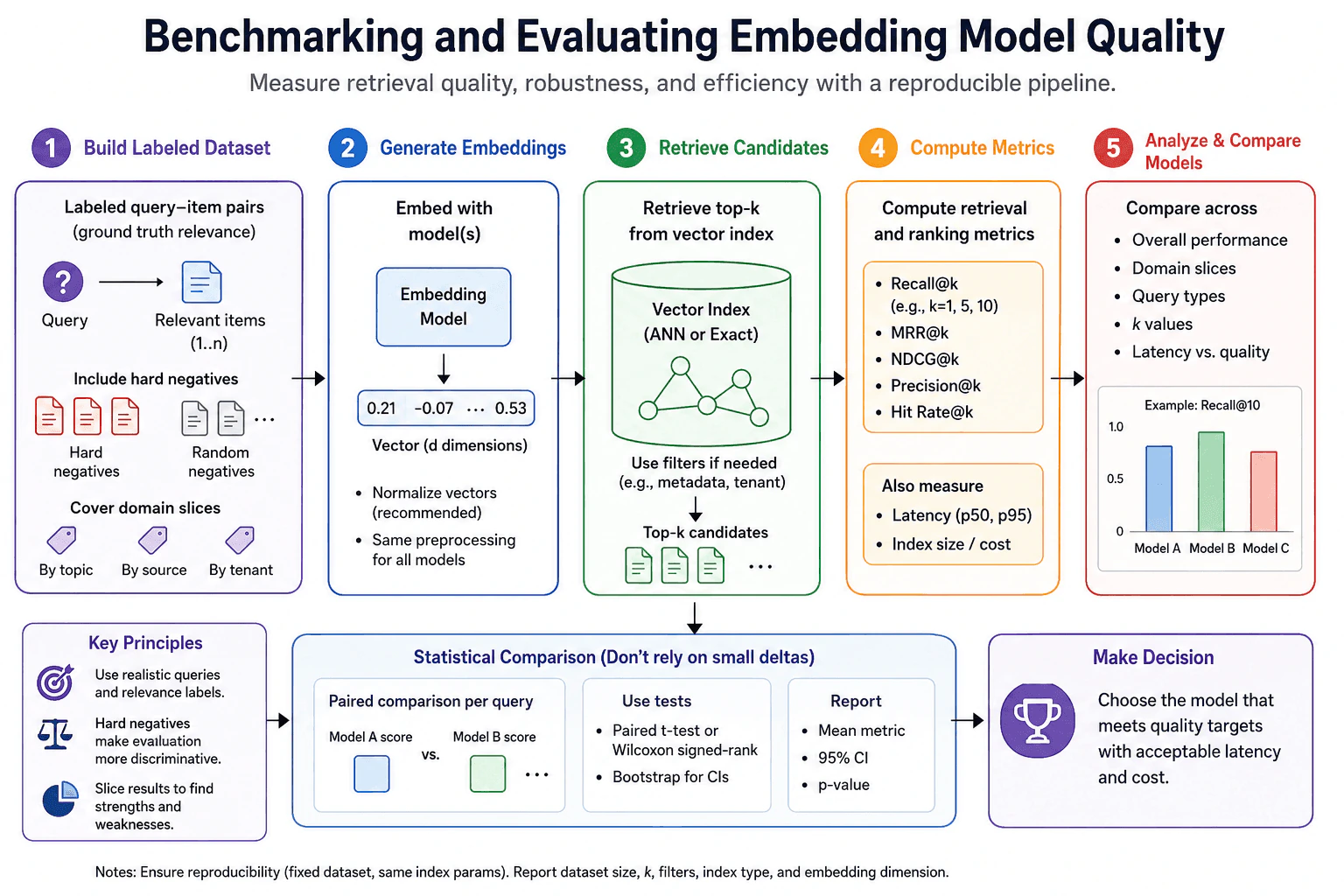
First, build a frozen evaluation dataset of labeled query-item pairs. The label is the ground truth: it tells us which items are relevant for each query. Include realistic queries and relevant items. Also include random negatives and hard negatives. A hard negative is an incorrect item that is semantically similar to the query, so it tests whether the embedding model can separate confusing choices instead of only solving easy cases.
Cover important domain slices in the same dataset. A slice is a meaningful group of examples, such as topic, source, tenant, or query type. This matters because a model can have a strong overall score while performing poorly for one important group.
Next, generate embeddings with every candidate model. Use the same preprocessing for all models. An embedding is a vector, which is a list of numbers representing the meaning of the input. Record each model's vector dimension because dimension affects storage and search cost. If the chosen similarity calculation requires normalized vectors, apply the same normalization rule consistently. Do not change preprocessing or normalization between candidates unless that change is intentionally part of the experiment.
For each query, retrieve the top-k candidates from the vector index. Here, k is simply the number of results returned, such as 5 or 10. Use the same retrieval configuration for every model. The benchmark may use exact search or approximate nearest-neighbor search. Approximate search is faster at large scale but can miss some neighbors, so its index parameters must remain fixed when the goal is to compare embedding models fairly. If production uses metadata or tenant filters, apply the same filters during evaluation because they change the candidate set.
Then compute metrics that match the product goal. Recall@k asks what fraction of the relevant items were found in the first k results. Precision@k asks what fraction of those first k results were relevant. Hit Rate@k checks whether at least one relevant item appeared in the top k. MRR, or Mean Reciprocal Rank, gives more credit when the first relevant result appears earlier. NDCG@k, or Normalized Discounted Cumulative Gain, is useful when result position matters and relevance can have different levels.
Report both overall results and slice results. Also inspect hard-negative performance separately. These views help reveal weaknesses that can disappear inside one overall average.
Measure efficiency as well as retrieval quality. Record useful latency percentiles such as p50 and p95. p50 is the median response time, while p95 shows a slower tail that 95% of requests finish within. Also record index size or another relevant cost measure. A small quality improvement may not be worthwhile if it causes much higher latency, storage use, or serving cost.
Finally, compare candidate models statistically using the same queries. This is a paired comparison because Model A and Model B are evaluated on the same examples. Report the mean metric and a confidence interval. Bootstrap resampling can estimate a confidence interval without requiring a particular score distribution. A paired t-test can be used when its assumptions are reasonable. A Wilcoxon signed-rank test is a common non-parametric alternative. A p-value can describe statistical evidence, but it does not tell you whether the improvement is large enough to matter in production.
Make the final decision using both quality and operational limits. Choose the model that meets the required quality target, remains strong across important slices and hard negatives, and has acceptable latency and cost. Do not choose a model because of a tiny noisy metric difference. Keep the benchmark reproducible by recording the fixed dataset, dataset size, k values, filters, index type and parameters, preprocessing, normalization rule, and embedding dimension.
Index and Query Path
Build a fixed labeled dataset of query-item pairs with known relevant items.
Add realistic hard negatives and ordinary random negatives.
Define important domain slices such as topic, source, tenant, or query type.
Generate embeddings for each candidate model using the same preprocessing.
Apply the same normalization rule when required by the chosen similarity setup.
Record vector dimension for each model.
Use the same vector-index configuration for every candidate, including exact or approximate search settings and production-relevant filters.
Retrieve top-k candidates for every query.
Compute suitable metrics such as Recall@k, Precision@k, Hit Rate@k, MRR, or NDCG@k.
Report overall scores, domain-slice scores, and hard-negative results.
Measure latency at useful percentiles such as p50 and p95, plus index size or another relevant cost measure.
Compare models per query with confidence intervals and an appropriate paired statistical test when useful.
Choose the model that meets quality targets consistently while staying within latency and cost limits.
Record the full benchmark configuration so the experiment can be reproduced.
Time & Space Complexity
The evaluation cost grows with the number of queries, candidate models, and items that must be embedded. Larger embedding vectors usually need more storage and more work during search. Exact search can compare a query against many stored vectors, so its work grows with collection size. Approximate search is usually faster at large scale, but index settings can affect measured retrieval quality. Evaluation also has maintenance cost because labels, hard negatives, and domain slices should stay representative as the product changes. For a fair comparison, keep the dataset, filters, and retrieval configuration fixed.
Where it is used
This approach is used when selecting or replacing embedding models for semantic search, retrieval-augmented generation, recommendation candidate retrieval, document search, support search, and product search. It is also useful when testing changes that can affect retrieval behavior, such as vector dimensions, normalization rules, similarity settings, filters, or vector-index configurations.
Why Interviewers Ask This
The interviewer wants to know whether you can evaluate embedding models with a fair, repeatable experiment instead of relying on a few examples. A strong answer covers labeled query-item pairs, hard negatives, retrieval and ranking metrics, domain slices, latency, cost, and statistical comparison. It also shows that you understand why every candidate model should be tested with the same data, preprocessing, filters, and retrieval configuration.
Common interview mistakes
Common mistakes include testing only a few hand-picked queries, using only easy random negatives, and reporting only one overall average. Another mistake is changing preprocessing, normalization, filters, k values, or index parameters between models, which makes the comparison unfair. Do not use Recall@k alone when result order matters. Do not ignore domain slices or hard negatives, because they can expose failures hidden by the average. Do not compare quality without latency and cost. Finally, do not declare a winner from a tiny score difference without paired analysis and an estimate of uncertainty.
Interview tip
Present the benchmark as one controlled experiment: fixed labeled data, hard negatives and slices, identical retrieval settings, quality metrics, latency and cost, then paired statistical comparison. Explain Recall@k in simple words. End with a clear decision rule: choose the model that meets production quality targets consistently and gives a meaningful benefit within acceptable latency and cost.
Interviewer may ask next
Why are hard negatives important when evaluating embedding models?
Hard negatives are incorrect items that are semantically similar to the query. Random negatives are often easy to reject, so they may make every model look good. Hard negatives test whether the model can separate closely related meanings. I would include them in the fixed evaluation dataset and report their results separately so ranking weaknesses are visible.
How would you decide whether a small Recall@k improvement is meaningful?
I would evaluate both models on the same queries and compare their per-query scores. Then I would report the average difference with a confidence interval, for example from bootstrap resampling. When useful, I would also use a paired test such as a paired t-test when its assumptions are reasonable or a Wilcoxon signed-rank test otherwise. I would still check practical importance: the gain should hold across important slices and justify any extra latency, index size, or cost.
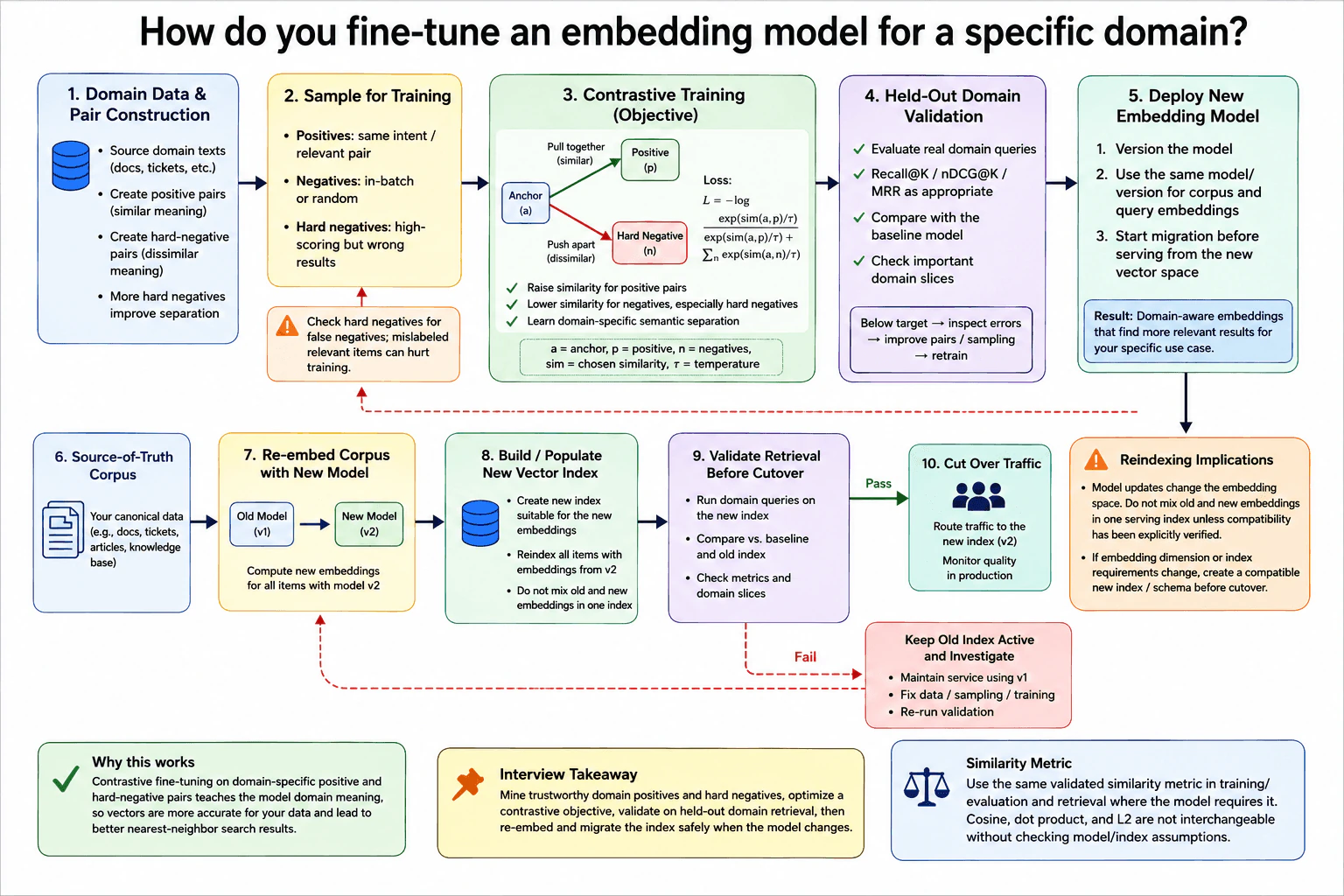
69. How do you fine-tune an embedding model for a specific domain?Vector Databases And EmbeddingsMedium
i Question Details
Lay out the implementation or decision path for positive and hard-negative pairs, contrastive objective, sampling, domain validation, and reindexing implications.
Short Interview Answer (30-60 seconds)
I would create high-quality positive and hard-negative pairs, train with a contrastive objective, and validate on held-out domain queries against the baseline. If the model wins, I would version it, re-embed the corpus, build a compatible new index, validate that index, and cut traffic over safely.
Detailed Explanation
The goal is to teach the embedding model the meaning that matters in a specific domain. For example, two support questions with the same intent should end up close together, while a similar-looking question with a different meaning should stay apart. I would collect trusted domain examples, keep some only for testing, train on the remaining examples, and compare the new model with the current system. I would release it only when it improves real searches and does not make important groups of queries worse.
Useful Questions to Ask the Interviewer
What domain data do we have for creating positive examples and difficult wrong examples?
What retrieval task matters most, and which held-out queries represent real production use?
Which evaluation measures should decide whether the new model is better than the baseline?
Can we build a second vector index and switch traffic only after validating it?
Does the new model change the embedding dimension or any vector-index requirements?
How to Explain It in an Interview
Start with the training data. A positive pair is an anchor and another item that should have similar meaning. For example, two differently worded support questions with the same intent can form a positive pair. A hard negative is an item that looks relevant to the current model but is actually wrong. Hard negatives are useful because they teach the model difficult domain distinctions instead of only obvious ones.
I would sample positives, ordinary negatives, and hard negatives. Ordinary negatives can come from random examples or from other examples in the same training batch. The second approach is called in-batch negatives. Hard negatives can come from high-scoring but incorrect retrieval results. I would review the labels carefully because a supposed negative may actually be relevant. That is a false negative. Training the model to push a true match away can reduce retrieval quality.
Next, I would fine-tune with a contrastive objective. A contrastive objective trains the model to give positive pairs higher similarity and negatives lower similarity. A common setup uses an anchor, a positive item, and several negative items. Hard negatives should receive special attention because they are close enough to confuse the current model. Some contrastive losses also use a temperature value, which controls how strongly differences between similarity scores affect the loss.
The exact loss can vary, but the decision rule stays the same: increase similarity for correct semantic matches and decrease similarity for incorrect matches. I would use the similarity function expected by the model and retrieval setup rather than assuming that cosine similarity, dot product, or Euclidean distance can be exchanged freely.
I would not judge success only from training loss. I would keep a held-out domain validation set containing real queries and known relevant results. Held-out means these examples are not used for training. I would compare the fine-tuned model with the existing baseline using retrieval measures that fit the product, such as Recall@K, nDCG@K, or MRR.
Recall@K asks whether relevant items appear within the first K results. nDCG@K gives more credit when relevant results appear near the top. MRR measures how early the first correct result appears. I would also check important domain slices so an overall improvement does not hide a regression for one query type, content type, language, or other important group.
If validation is below the target, I would inspect the errors instead of simply training for more steps. I would check pair labels, look for false negatives, improve hard-negative mining, adjust the sampling mix, and retrain. This creates a feedback loop from domain validation back to the training data.
If validation passes, I would version the new embedding model. For the new vector space, corpus items and incoming queries should be encoded with the intended compatible model version. I would not immediately replace the serving index. I would keep the canonical source documents separate from their embeddings and from the vector index.
Next, I would re-embed the source-of-truth corpus with the new model version. I would build or populate a separate vector index that is compatible with those new embeddings. This is important because a model change can alter the vector space. Old and new embeddings should not be mixed in one serving index unless compatibility has been explicitly verified.
If the new embedding dimension or another index requirement changes, I would create a compatible new index or schema before cutover. I would then run representative domain queries against the new index, compare its retrieval quality with the baseline and old index, and check the same domain slices used during model validation.
If the new index passes validation, I would cut traffic over to it and monitor retrieval quality in production. If it fails, I would keep the old index active and investigate. The problem might be the training data, sampling, model, re-embedding process, index configuration, or migration procedure. After correcting the issue, I would rebuild or repopulate the new index and validate again before another cutover attempt.
Vector normalization also depends on the selected model and similarity setup. I would not normalize vectors just because a vector database supports it. I would follow the embedding model's retrieval contract and configure the index and query path consistently.
The main tradeoff is that better domain relevance requires more than model training. The team must create reliable domain labels, mine useful hard negatives, run held-out evaluation, version the model, re-embed the corpus, maintain a second index during migration, validate the new index, and keep a rollback path until the new system is proven safe.
Index and Query Path
Collect trusted examples from the domain source data.
Create positive pairs that represent the same meaning or intent.
Sample ordinary negatives using random or in-batch examples when appropriate.
Mine hard negatives from high-scoring but incorrect retrieval results.
Review hard negatives and other negatives for false-negative labels.
Fine-tune the embedding model with a contrastive objective that raises similarity for positives and lowers it for negatives.
Evaluate the model on held-out real domain queries using suitable retrieval measures and important domain slices.
Compare the fine-tuned model with the existing baseline.
If results are below target, inspect errors, improve labels or sampling, and retrain.
If results pass, version the new embedding model.
Re-embed the source-of-truth corpus with the new model version.
Build or populate a separate vector index that is compatible with the new embeddings.
Validate retrieval against the new index before sending production traffic to it.
If validation passes, cut traffic over and monitor quality. If it fails, keep the old index active, investigate, correct the problem, and validate again.
Time & Space Complexity
The main costs are data preparation, training, evaluation, re-embedding, and index migration. Training cost grows with the number of examples, batch size, model size, and number of negatives. Hard-negative mining adds retrieval and label-review work. Validation requires running many domain queries and comparing ranked results. After a model change, every stored item may need a new embedding, so migration work grows with corpus size. Building a second index also needs temporary extra storage and compute. Keeping the old index during validation costs more, but it provides a safe rollback path.
Where it is used
This approach is useful when a general embedding model does not understand important distinctions in a specific domain. Examples include support-ticket search, internal knowledge retrieval, technical-document search, product search, legal-document retrieval, medical knowledge retrieval, and other systems where similar wording can represent different domain meanings. It is especially useful when production retrieval logs provide high-scoring but incorrect results that can become hard-negative candidates.
Why Interviewers Ask This
This question tests whether the candidate can improve embeddings with domain data instead of treating fine-tuning as only a model-training task. A strong answer connects training-pair quality, hard-negative sampling, the contrastive objective, held-out retrieval evaluation, model versioning, and the production work required to re-embed the corpus and migrate the vector index.
Common interview mistakes
Common mistakes include using only easy random negatives, accepting mined hard negatives without checking their labels, and training on false negatives that are actually relevant. Another mistake is evaluating only training loss instead of held-out retrieval quality. Teams may also forget to compare with the existing baseline or check important domain slices. In production, a serious mistake is changing the embedding model without re-embedding the corpus and migrating the index. Old and new embeddings may belong to incompatible vector spaces. It is also wrong to assume that cosine similarity, dot product, Euclidean distance, or vector normalization can be swapped without checking the model and index assumptions.
Interview tip
Present the answer as one lifecycle: domain pairs, negative sampling, contrastive training, held-out retrieval validation, model versioning, corpus re-embedding, new-index validation, safe cutover, and rollback. Spend extra time on hard-negative quality and reindexing because those points show that you understand both model training and production retrieval.
Interviewer may ask next
How would you find good hard negatives for domain-specific embedding fine-tuning?
I would run real domain queries through the current retrieval system and collect items that receive high similarity scores but are known to be wrong. These are useful because they are difficult examples near the model's current decision boundary. I would also use in-batch negatives when appropriate. Before training, I would review or otherwise validate the labels because some high-scoring items may actually be relevant. Those are false negatives, and pushing them away would hurt retrieval quality.
What should you do with the vector index after deploying a newly fine-tuned embedding model?
I would treat the new model as a new embedding version. I would re-embed the source-of-truth corpus with that version and build or populate a separate compatible index. Then I would run representative domain queries against the new index and compare its results with the baseline and old index. If validation passes, I would cut traffic over and monitor quality. If it fails, I would keep the old index active while investigating. I would not mix old and new embeddings unless compatibility had been explicitly verified.
70. Your semantic search fails for short queries. How do you improve it?Vector Databases And EmbeddingsMedium
i Question Details
Treat the case as a production incident involving query expansion, hybrid lexical signals, asymmetric encoders, hard-negative training, and evaluation by short-query slice; include containment, prevention, and post-fix monitoring.
Short Interview Answer (30-60 seconds)
I would contain the incident with a stronger lexical signal, then expand short queries and combine vector search with BM25. I would use asymmetric query and document encoders, rerank candidates, train on hard negatives, evaluate a short-query slice, and monitor that slice after rollout.
Detailed Explanation
A very short search such as "tv" gives the system little information. The search may find documents that are broadly related but not what the user wanted. I would first reduce the production impact. Then I would add more useful meaning to the query and use both meaning-based search and exact-word search. I would rank the best candidates again, teach the models with difficult wrong results, and measure short searches separately. I would also keep the original documents separate from their search indexes so updates and deletes can be handled safely.
Useful Questions to Ask the Interviewer
Is the short-query problem mainly poor recall, poor ranking, or both?
Do we already have a BM25 or other lexical index beside vector search?
Can the system use separate query and document encoders?
Which metadata filters and tenant-isolation rules must remain active during retrieval?
Which short-query metrics are available, such as Recall@K, nDCG@K, MRR, or click-through rate?
How to Explain It in an Interview
I would explain the solution as one online retrieval flow plus one offline improvement loop.
First, I would contain the production incident. Short queries often have too little context for semantic retrieval alone. If the lexical path is healthy, I would temporarily increase the lexical weight. I may also lower the semantic threshold or apply stricter filters when that behavior is safe for the product. I would keep metadata filters and tenant isolation in place. I would not weaken access boundaries just to increase recall.
Next, I would understand and expand the query. For example, the short query "tv" can be enriched with terms such as "television", "smart TV", "flatscreen", "LED", and "4K" when those terms fit the detected intent. Query expansion can use spelling corrections, entities, synonyms, and domain terms. The goal is to add missing meaning. Too much expansion is dangerous because unrelated terms can add noise or change the user's intent.
Then I would run hybrid retrieval. Hybrid retrieval means using semantic vector search and lexical keyword search together.
The semantic branch uses an asymmetric encoder setup. The query encoder is optimized for queries, while the document encoder is optimized for documents. Their jobs are different, but their embeddings must be compatible for similarity search. The vector database stores document embeddings and searches them with the configured similarity metric, such as cosine similarity. The existing vector index may use an approximate nearest-neighbor structure such as HNSW or IVF when that is how the system is built.
The lexical branch uses BM25 over an inverted index. BM25 is useful for exact words, abbreviations, product terms, rare words, and other cases where an embedding may lose an important literal signal. The vector and BM25 branches are parallel retrieval signals. One does not feed into the other.
Each branch returns top candidates. I would merge those candidate sets and send the strongest candidates to a reranker. A cross-encoder reranker is one possible choice. It reads the query and candidate document together, so it can make a stronger relevance decision than the first-stage retrievers. The final online flow is: short query -> understand the query -> expand it -> run vector and BM25 retrieval -> merge candidates -> rerank -> return the top results.
The indexing path stays separate from online querying. Source documents and metadata remain the source of truth. The indexing pipeline chunks documents when needed, creates document embeddings, stores embeddings and metadata in the vector database, and maintains the lexical index used by BM25. Updates and deletes must update the corresponding search entries. If the embedding model changes, the system may need controlled re-embedding and index migration so embeddings from incompatible model versions are not mixed accidentally.
I would then improve the model with hard-negative training. A hard negative is a result that looks relevant and may rank high, but is actually wrong. For example, two documents may discuss very similar topics, but only one answers the user's intent. Training on these close-but-wrong examples helps the embedding model or reranker separate truly relevant results from confusing alternatives.
I would evaluate the fix on a dedicated short-query slice instead of only looking at global search metrics. Recall@K checks whether a relevant result appears in the top K. nDCG@K rewards putting better results near the top. MRR measures how early the first relevant result appears. Click-through rate can add a production user signal. The important point is to compare these metrics specifically for short queries, because strong performance on long queries can hide a short-query regression.
After the fix, I would keep short-query monitoring active. I would alert on short-query quality drops, watch for drift, run controlled A/B tests, and collect production feedback. Prevention includes better expansion rules, model improvements, and quality gates before rollout.
The main tradeoff is cost versus retrieval quality. Query expansion can add noise. Hybrid retrieval needs both vector and lexical infrastructure. Reranking adds latency and compute because it scores candidates again. Hard-negative training needs reliable examples. The benefit is that the system no longer depends on one weak signal when the user's query contains only a few words.
Index and Query Path
Detect that the request is a short or ambiguous query.
Contain the incident by increasing lexical weight and using safe thresholds or stricter filters where appropriate.
Expand the query with controlled synonyms, spelling corrections, entities, and domain terms.
Encode the query with the query-side encoder.
Run semantic vector retrieval against document embeddings in the vector database.
In parallel, run BM25 lexical retrieval over the inverted index.
Collect the top candidates from both retrieval branches.
Merge the candidate sets and rerank the strongest candidates.
Keep required metadata filters and tenant-isolation rules active before returning final results.
Collect close-but-wrong results as hard negatives for offline training.
Evaluate Recall@K, nDCG@K, MRR, and user signals on a dedicated short-query slice.
Deploy gradually and monitor short-query alerts, drift, A/B tests, and feedback.
Keep source documents separate from embeddings and indexes so updates, deletes, and re-embedding can be managed safely.
Time & Space Complexity
This approach costs more than using vector search alone. The system runs both vector and BM25 retrieval, merges their candidates, and may rerank them with another model. That adds latency and compute. The vector index and lexical index also need storage and maintenance. Query expansion adds another processing step and can add noise if it is too broad. Hard-negative training adds offline data and training work. The system must also keep source documents, embeddings, vector indexes, lexical indexes, metadata, updates, and deletes consistent. Re-embedding or model migration adds operational work because old and new embedding spaces should not be mixed without a controlled plan.
Where it is used
This approach is useful in product search, help-center search, enterprise document search, media catalogs, marketplace search, and similar systems where users often type one to three words. It is especially useful when both exact terms and semantic meaning matter, such as abbreviations, product names, categories, technical terms, or ambiguous short phrases.
Why Interviewers Ask This
This question tests whether the candidate can diagnose a search-quality problem across the full retrieval system instead of blaming the vector database alone. A strong answer connects query understanding, query expansion, semantic and lexical retrieval, asymmetric encoders, reranking, hard-negative training, short-query evaluation, production containment, indexing boundaries, metadata filtering, tenant isolation, and post-fix monitoring.
Common interview mistakes
A common mistake is replacing the embedding model immediately without checking whether the real problem is missing lexical signals, weak query understanding, poor ranking, or bad training examples. Another mistake is expanding the query too aggressively and changing the user's intent. Teams also fail when they evaluate only overall search metrics instead of a short-query slice. Hard negatives should be genuinely close-but-wrong results, not automatically treated as negative just because of a noisy click signal. Other mistakes include comparing unrelated retrieval scores without a defined fusion method, weakening metadata or tenant filters to increase recall, mixing incompatible embeddings during re-embedding, and assuming the vector database alone can repair poor short-query semantics.
Interview tip
Present the answer in a clear order: contain the incident, enrich the short query, run hybrid BM25 plus vector retrieval, rerank candidates, improve the model with hard negatives, evaluate a short-query slice, and monitor the fix. Also mention the separate source-of-truth and indexing path.
Interviewer may ask next
How would you combine the lexical and vector candidates?
I would retrieve candidates independently from BM25 and vector search, then merge the two candidate sets with a defined fusion method. I would not directly assume that a BM25 score and a cosine-similarity score are comparable because they use different scales. A rank-based fusion method is one simple option. After fusion, I would rerank the strongest candidates using the query and document together. I would tune the fusion on the short-query evaluation slice and keep the required metadata and tenant filters active.
What would you do if query expansion improves recall but hurts precision?
I would make expansion more conservative. I would keep high-confidence synonyms, spelling corrections, entities, abbreviations, and domain terms, while removing broad related terms that change the user's intent. I would keep the original query as an important retrieval signal instead of replacing it with the expanded text. Then I would retune hybrid fusion and reranking using the short-query Recall@K, nDCG@K, and MRR results so better coverage does not reduce top-result quality.
More questions load as you scroll
Disclaimer: This interview guide is for educational and informational purposes only. It is designed to help readers prepare, but it does not guarantee any interview result, hiring decision, offer, or outcome. Interview questions, hiring criteria, and preferred answers can vary by employer, interviewer, industry, location, and time. All answers, examples, and explanations in this guide are suggested examples for interview preparation, not definitive answers or instructions for professional practice. They are based on research and judgment, are provided without warranties of any kind, and should be adapted to the question, role, and applicable laws and professional requirements. Diagrams are simplified illustrations intended to highlight the main concepts and their relationships; actual situations, systems, and practices may be more complex. Alternative approaches may be equally valid or better suited to a particular question, context, or interviewer. To the fullest extent permitted by applicable law, the contributors and publisher are not liable for decisions made, actions taken, or losses incurred based on this guide.
State Laws and Professional Responsibilities: Laws and requirements governing an occupation vary by state and jurisdiction. You are responsible for checking the current laws, licensing requirements, and scope-of-practice rules that apply to your location and role, and for ensuring that your answers and actions comply with them. Adapt examples in this guide to those requirements. This guide is not legal advice.
Content Accuracy and Verification: To the fullest extent permitted by applicable law, we do not represent or warrant that interview guides, questions, answers, examples, or diagrams are accurate, complete, current, error-free, or suitable for any particular purpose. You are responsible for independently reviewing and verifying the information before relying on it.