This interview guide is for educational and informational purposes only. It is designed to help readers prepare, but it does not guarantee any interview result, hiring decision, offer, or outcome. Interview questions, hiring criteria, and preferred answers can vary by employer, interviewer, industry, location, and time. All answers, examples, and explanations in this guide are suggested examples for interview preparation, not definitive answers or instructions for professional practice. They are based on research and judgment, are provided without warranties of any kind, and should be adapted to the question, role, and applicable laws and professional requirements. Diagrams are simplified illustrations intended to highlight the main concepts and their relationships; actual situations, systems, and practices may be more complex. Alternative approaches may be equally valid or better suited to a particular question, context, or interviewer. To the fullest extent permitted by applicable law, the contributors and publisher are not liable for decisions made, actions taken, or losses incurred based on this guide.
State Laws and Professional Responsibilities
Laws and requirements governing an occupation vary by state and jurisdiction. You are responsible for checking the current laws, licensing requirements, and scope-of-practice rules that apply to your location and role, and for ensuring that your answers and actions comply with them. Adapt examples in this guide to those requirements. This guide is not legal advice.
Identity, Image, and Privacy Notice
To respect individual privacy, some names, profile photographs, avatars, biographical details, and other identifying information displayed in this guide may be replaced with pseudonyms, licensed stock images, illustrative avatars, composite images, or representative descriptions. Unless a person is expressly identified as an actual contributor, a displayed name, image, or profile should not be understood as depicting or identifying a specific candidate, interviewer, employee, or other real individual. These representations are provided for editorial and illustrative purposes only and do not imply endorsement, employment, participation, or affiliation with this guide or any company mentioned in it. Any resemblance to an actual person is coincidental.
Company Notice
This guide is an independent educational resource and is not affiliated with, endorsed by, sponsored by, or approved by the company named in this guide. Company names identify reported interview experiences or the employer context of clearly labeled original practice exercises. Interview practices can change without notice, and inclusion of company-specific content does not mean these questions are official, complete, or guaranteed to be asked. To the fullest extent permitted by law, the author, contributors, and publisher are not responsible for outcomes related to use of this material.
Content Accuracy and Verification
To the fullest extent permitted by applicable law, we do not represent or warrant that interview guides, questions, answers, examples, or diagrams are accurate, complete, current, error-free, or suitable for any particular purpose. You are responsible for independently reviewing and verifying the information before relying on it.
Questions or comments?
Contact us for general questions, or share feedback, technical corrections, and comments with the community.
21. What are properties in C#?Language SpecificEasy
i Question Details
Describe getters, setters, backing behavior, and why properties are preferred over exposing raw fields for most public state.
Short Interview Answer (30-60 seconds)
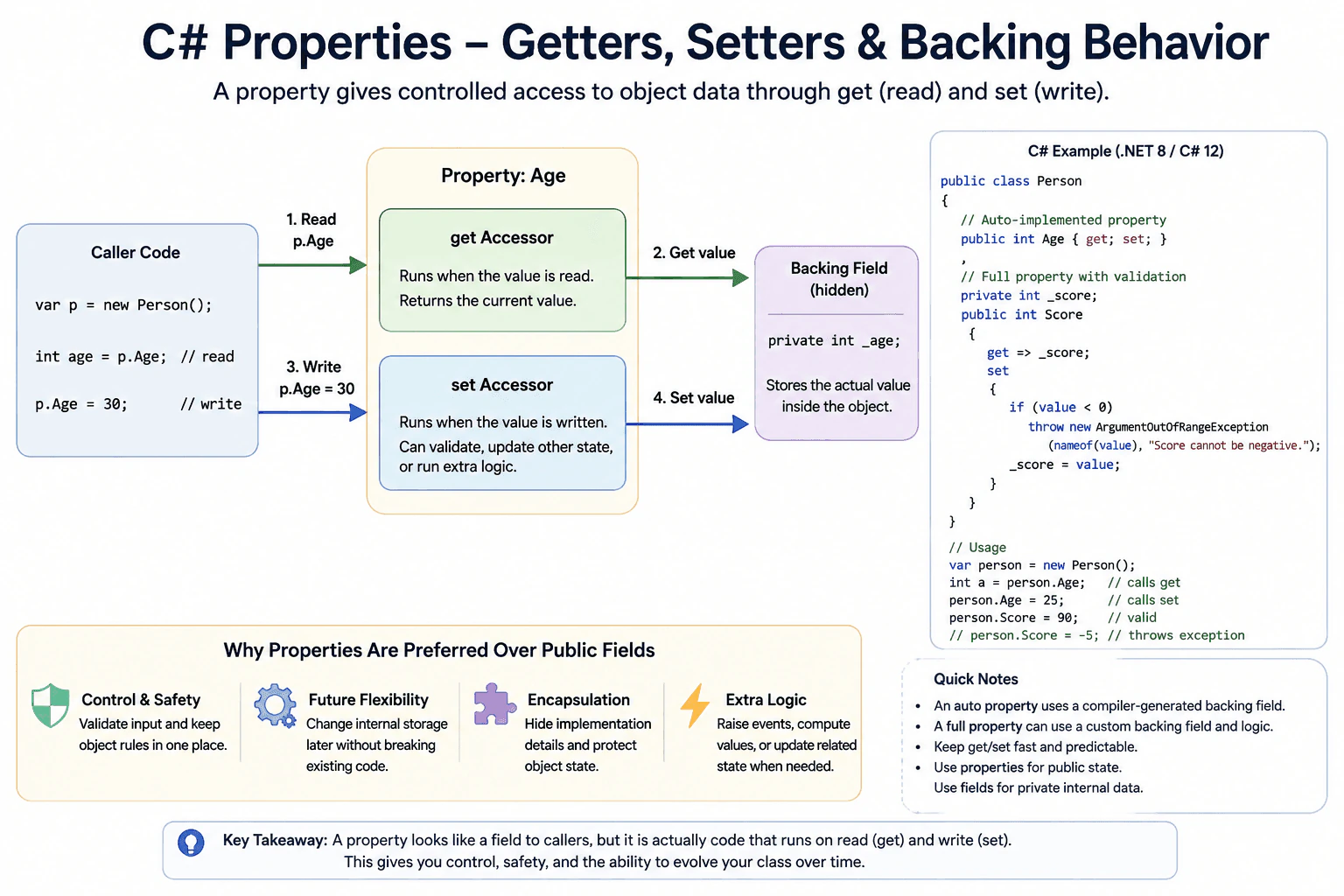
A property is the normal way to expose object data in C#. It gives you a clean way to read and change a value through get and set, while keeping control inside the class. C# can also create the hidden backing field for you in an auto property.
Detailed Explanation
In simple terms, a property is the normal way to expose a value from a C# object. It lets other code read the value with get and change it with set, while the class keeps control over what happens inside. C# can also create the hidden storage for you in an auto property. This is better than making a public field because you can add validation, keep the public shape stable, and change the internal storage later without breaking callers.
Useful Questions to Ask the Interviewer
Should this value ever be read only from outside?
Do you want any validation when the value changes?
Should changing the value trigger any extra work?
How to Explain It in an Interview
A property looks like a field to the caller, but it behaves like a small pair of methods. The get accessor runs when someone reads the value. The set accessor runs when someone writes the value. If you use an auto property, C# creates the hidden backing field for you. If you need custom behavior, you can write a full property and store the value in your own backing field.
This matters because public fields expose data directly and give you no place to check rules or protect the object. Properties let you add validation, compute values, raise events, or keep the same public API while changing the internal storage later. That makes them a better choice for most public state in production code.
Use fields for private internal data when you do not need that control. Use properties for public state, simple computed values, or values that may need rules later. One edge case is that a property can still do work, so keep get and set fast and predictable. Another point is that a property access is still designed like a method call, so the real benefit is design and safety, not raw speed. In practice, the cost is usually tiny and the flexibility is worth it.
Why Interviewers Ask This
Interviewers ask this to check whether you understand how C# exposes state safely, how get and set work, and why public fields are usually a poor choice for most public data.
Common interview mistakes
A common mistake is to think a property is just a public field with a different name. It is not. Another mistake is to put slow or complex work inside get or set, which can make simple reads and writes harder to reason about. A third mistake is exposing public fields when a property would give better control and future flexibility. People also forget that an auto property still has backing storage, just hidden by the compiler.
Interview tip
Start with the rule that public state should usually be a property, not a field. Then say that the get and set accessors let you control reads and writes while keeping the option to add validation or other logic later.
Interviewer may ask next
What is an auto property in C#?
An auto property is a property where C# creates the hidden backing field for you. It is best when get and set only store and return the value. The main tradeoff is that you must change it into a full property later if you need custom logic or validation.
When would you use a field instead of a property?
Use a field for private internal data that only the class should touch directly. That can be simpler inside the class. The tradeoff is that a public field gives up validation and future flexibility, so it is usually not the right choice for public state.
22. What are access modifiers in C#?Language SpecificEasy
i Question Details
Explain the visibility levels in terms of classes, derived types, assemblies, and the practical encapsulation boundary each one creates.
Short Interview Answer (30-60 seconds)
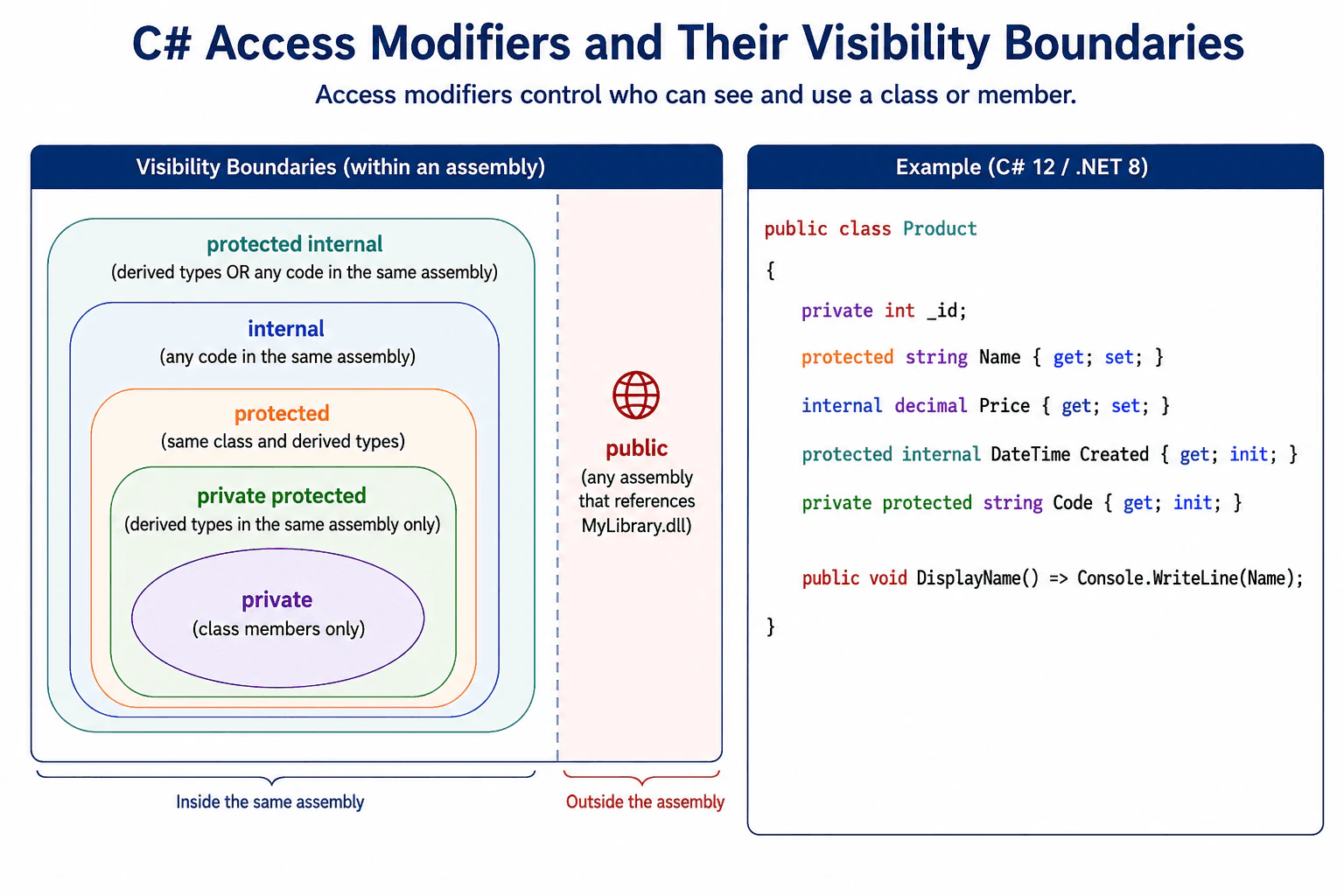
Access modifiers control who can see a class or member in C#. Private keeps it inside the class, protected opens it to derived types, internal opens it to the same assembly, and public opens it to everyone. The practical goal is to protect state and keep the public surface small.
Detailed Explanation
Access modifiers decide who can use a class or part of a class. Some code should stay hidden inside one class. Some should be shared with child classes. Some should be shared inside one project, and some should be open to any code that can reach it. This question is about those visibility levels and the boundary each one creates. The main point is to protect state, keep the public surface small, and make future changes safer. That also helps avoid accidental use from the wrong place.
Useful Questions to Ask the Interviewer
Do you want the answer for class members or for types?
Should I focus on one project or multiple projects?
How to Explain It in an Interview
In C#, access modifiers define who can reach a type or member.
Private means only code inside the same class can use it. This is the tightest boundary and is the best choice for internal state. Protected means the same class and derived classes can use it. That is useful in base classes when child types need to extend behavior.
Internal means any code in the same assembly can use it. An assembly is usually one compiled project such as a DLL or EXE. This is useful for code that should be shared inside one project but not exposed as part of the public API. Public means any code that can reference the assembly can use it.
Protected internal means access is allowed from derived types or from code in the same assembly. Private protected is narrower. It allows access only from derived types in the same assembly.
The practical rule is simple. Start with the smallest visibility that still works. That keeps the API smaller, reduces coupling, and makes later changes safer. In production code, private is common for fields, internal is common for helper types, protected is used when inheritance is truly needed, and public is reserved for the contract you want other code to depend on.
Why Interviewers Ask This
They want to see whether you understand how C# sets boundaries around code and whether you can choose the right level of exposure for fields, methods, types, and inheritance in real projects.
Common interview mistakes
A common mistake is thinking internal means visible only in the same namespace. It actually means visible in the same assembly. Another mistake is using public by default when private or internal would be safer. Some people also mix up protected internal and private protected. Protected internal allows access from a derived type or from the same assembly. Private protected requires both derived type access and same assembly access.
Interview tip
Say the smallest boundary first, then name each modifier with its scope. If you mention class, derived type, assembly, and public API, your answer will sound clear and practical.
Interviewer may ask next
What is the difference between protected internal and private protected?
The direct answer is that protected internal is broader. It allows access from either a derived type or from code in the same assembly. Private protected is narrower. It allows access only from a derived type in the same assembly. This matters when you want inheritance support but still want to keep the member hidden from other assemblies.
When would you choose internal instead of public?
The direct answer is to choose internal when the type or member is only for use inside one assembly and is not part of the public contract. That gives a smaller API surface and makes later changes safer because other assemblies do not depend on it. The main tradeoff is that other projects cannot reuse it directly.
23. What is encapsulation?Language SpecificEasy
i Question Details
Show how a type hides state behind a public contract, and mention why validation and invariants belong there.
Short Interview Answer (30-60 seconds)
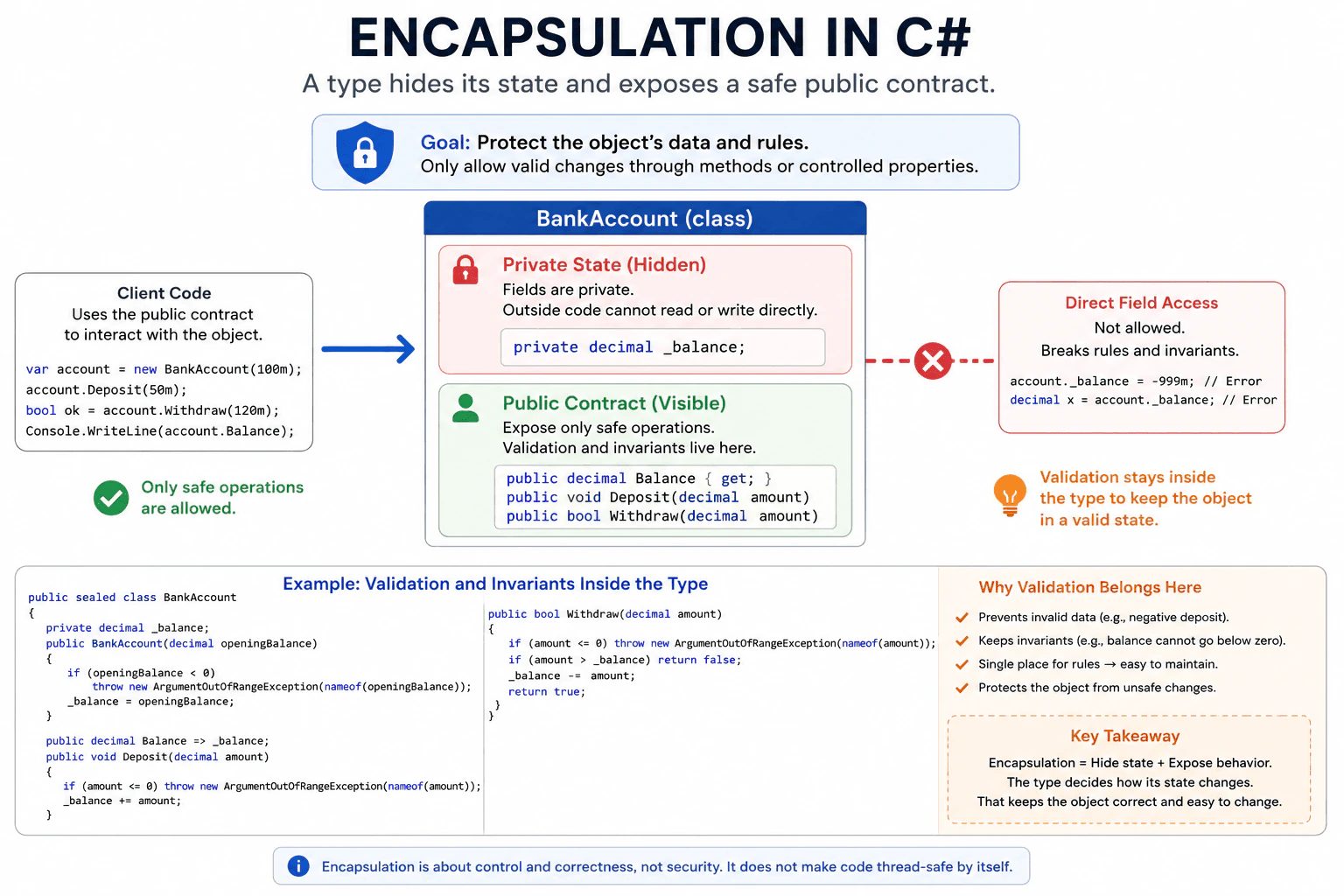
Encapsulation means I keep an object state private and expose only safe methods or properties to use it. In C#, that usually means private fields, public read only access when needed, and validation inside the type so invalid state cannot slip in.
Encapsulation means an object keeps its own data inside and lets other code use it through a small public surface. For example, a bank account can keep the balance private and let other code call Deposit and Withdraw. The type checks the input and protects the rules for that data. This matters because outside code cannot change the balance in unsafe ways. In C#, this is usually done with private fields, public methods, and properties that control access.
Useful Questions to Ask the Interviewer
Should I show this with a class and private fields?
Do you want me to include validation in the example?
How to Explain It in an Interview
In C#, encapsulation means the type owns its data and controls how that data changes. You do not let outside code reach in and change fields directly. Instead, you keep fields private and expose a public contract, such as methods or properties, that only allow valid changes. This is why validation belongs inside the type. The object can reject bad input right away and keep its own rules in one place.
A simple example is a BankAccount class. The balance stays private. Other code can call Deposit or Withdraw, but those methods check the amount before changing the balance. That keeps the object in a valid state and makes the class easier to maintain. If the rules change later, you update one place.
In production, encapsulation helps with maintainability, testing, and safety. It is not the same as security, and it does not make code thread safe by itself. It also does not mean every value must be hidden. Read only properties are fine when outside code only needs to observe state. The key idea is control: the type should decide how its state changes, not random callers.
Code
using System;
publicsealedclassBankAccount
{
privatedecimal _balance;
publicBankAccount(decimal openingBalance)
{
// Keep the object valid from the start.if (openingBalance < 0)
{
thrownew ArgumentOutOfRangeException(nameof(openingBalance),
"Opening balance cannot be negative.");
}
_balance = openingBalance;
}
// Outside code can read the balance, but it cannot assign a new value directly.publicdecimal Balance => _balance;
publicvoidDeposit(decimal amount)
{
// Reject invalid input before changing state.if (amount <= 0)
{
thrownew ArgumentOutOfRangeException(nameof(amount),
"Deposit amount must be greater than zero.");
}
_balance += amount;
}
publicboolWithdraw(decimal amount)
{
// Reject invalid input before changing state.if (amount <= 0)
{
thrownew ArgumentOutOfRangeException(nameof(amount),
"Withdraw amount must be greater than zero.");
}
// Return false instead of making the balance invalid.if (amount > _balance)
{
returnfalse;
}
_balance -= amount;
returntrue;
}
}
publicstaticclassProgram
{
publicstaticvoidMain()
{
var account = new BankAccount(100m);
// The only supported way to change the balance is through the public methods.
account.Deposit(50m);
bool withdrew = account.Withdraw(120m);
Console.WriteLine($"Balance: {account.Balance}");
Console.WriteLine($"Withdrawal approved: {withdrew}");
}
}
Why Interviewers Ask This
They want to see whether you understand how C# uses access modifiers, properties, and methods to keep state private, expose only safe actions, and protect invariants during real use.
Common interview mistakes
A common mistake is thinking encapsulation only means private fields. It also means the type controls its valid changes. Another mistake is exposing a settable property and then calling it encapsulated even though any caller can put the object into a bad state. Some people also move validation outside the class, which spreads the rules around and makes bugs easier to create. Encapsulation is not the same as inheritance, and it is not a security feature.
Interview tip
Say that encapsulation hides state, exposes behavior, and keeps validation close to the data. A small BankAccount example makes the idea easy to understand.
Interviewer may ask next
Can a property still be encapsulation?
Yes. A property can still support encapsulation if it does not let outside code write invalid state. A read only property is fully fine, and a property with a private setter or validation in the setter can also protect the object. The important part is that the type keeps control over its own state.
Why not expose fields directly for a simple class?
Direct fields are simpler to write, but they remove control over validation and future rules. In production, that small convenience is usually not worth it because a public field lets any caller change state in ways the class did not expect. Encapsulation keeps the rules in one place and makes later changes safer.
24. What is the this keyword?Language SpecificEasy
i Question Details
Explain instance qualification, constructor chaining, and how it disambiguates fields from parameters.
Short Interview Answer (30-60 seconds)
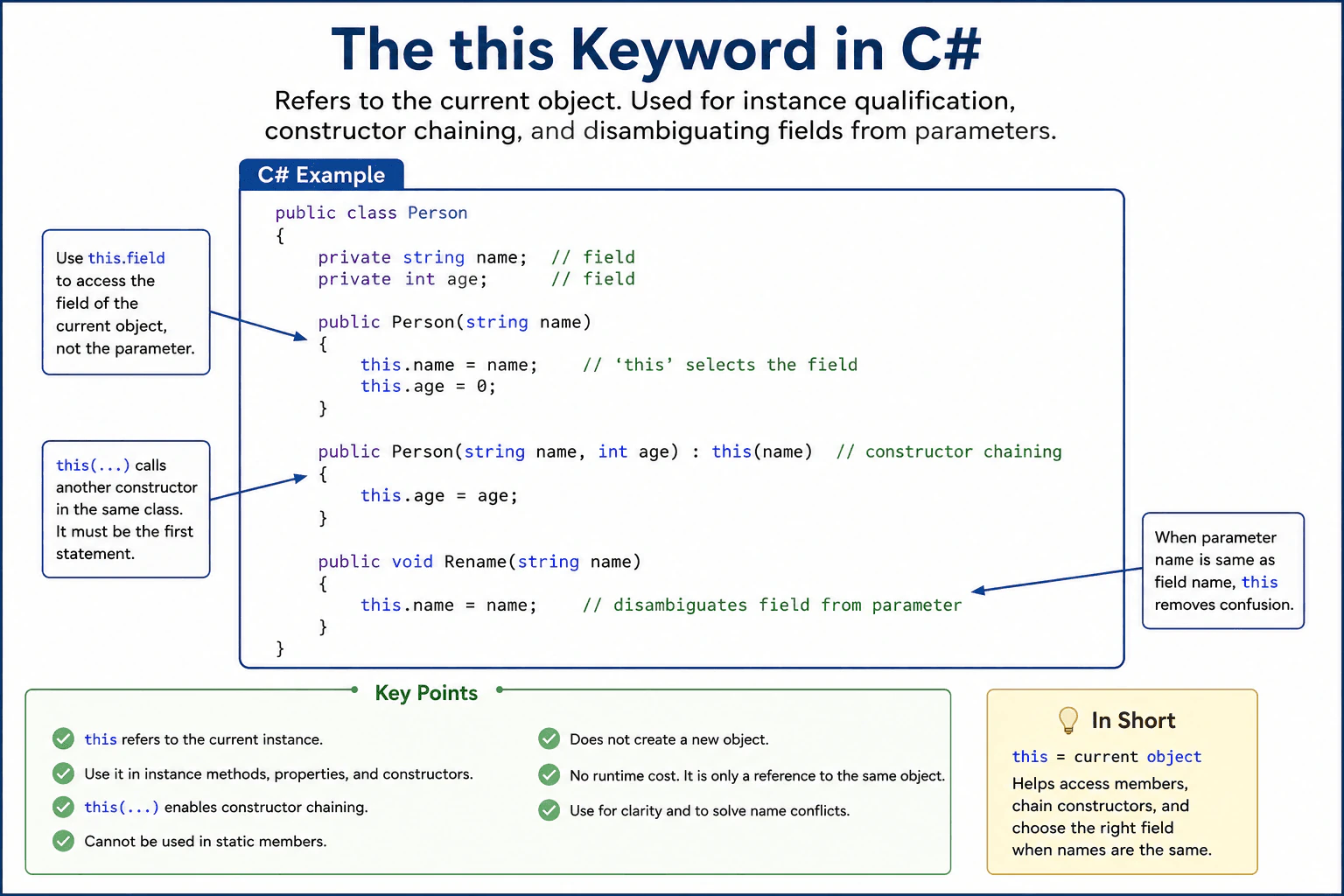
It refers to the current instance. I use it to access that object, chain constructors with this(...), and make it clear when a field belongs to the object instead of a parameter.
Detailed Explanation
this is the current object inside a class. It lets code use the values and methods that belong to that object. If a constructor parameter has the same name as a field, this.field means the field on the object, not the parameter. In a constructor, this(...) can call another constructor in the same class. Interviewers ask this to check that I understand the current object, name conflicts, and constructor chaining.
Useful Questions to Ask the Interviewer
Do you want me to explain constructor chaining too?
Do you want an example with a field and a parameter that share a name?
How to Explain It in an Interview
this refers to the current instance of the class. It is used inside instance methods, property accessors, and constructors. It does not create a new object. It only points to the object that is already being worked on.
The most common use is to remove confusion when names match. If a parameter has the same name as a field, C# lets the local name win. Writing this.field makes it clear that you want the field from the object. That is very common in constructors and setters.
It also supports constructor chaining. Inside one constructor, this(...) can call another constructor in the same class. That keeps shared setup in one place and reduces duplicate code. It is useful when several overloads should end with the same initialization path.
There are important limits. You cannot use this in a static member because static code has no current object. It also does not copy the object or change object identity. It only gives a direct reference to the same instance. In production code, use it when it improves clarity or when names collide. Do not add it everywhere if it makes the code noisy.
Why Interviewers Ask This
Interviewers want to see that I understand the current object, how C# resolves name conflicts, and how constructor chaining works in real code.
Common interview mistakes
Thinking this can be used in a static method. Thinking this creates a new object. Forgetting that it is only needed when names conflict. Using it so often that the code becomes harder to read.
Interview tip
Start with current object, then mention constructor chaining, then explain how it separates fields from parameters.
Interviewer may ask next
Can this be used in a static method?
No. A static method has no current object, so this is not available there. That matters because this only refers to one instance and its members.
Does this add runtime cost?
No meaningful runtime cost. It is only a name for the current object. The main tradeoff is readability, not performance.
25. What is the base keyword?Language SpecificEasy
i Question Details
Cover calling base constructors and base implementations, and note when it is used to reach inherited behavior deliberately.
Short Interview Answer (30-60 seconds)
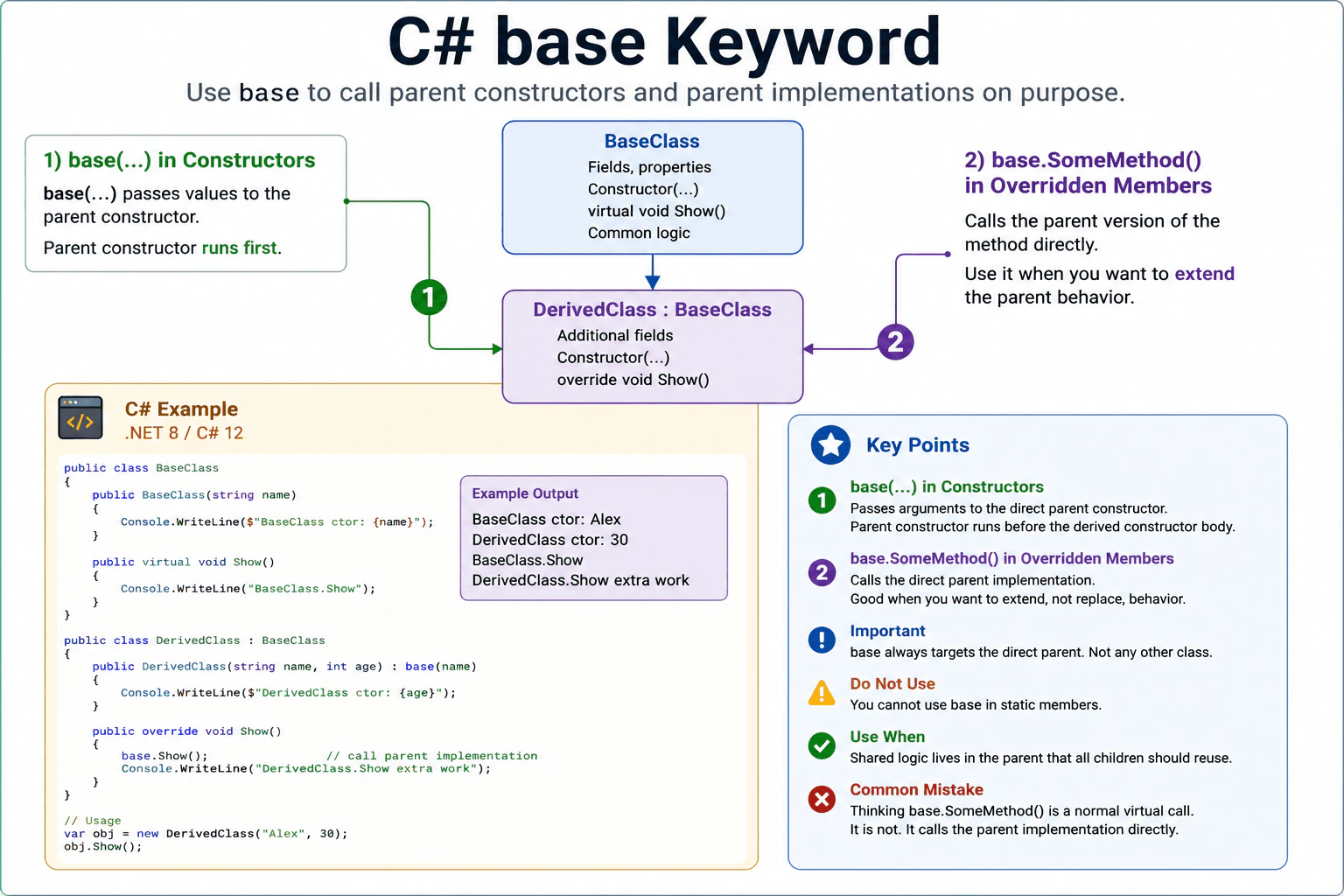
The base keyword lets a derived class call its direct parent on purpose. I use it to pass values to a parent constructor or to call the parent version of an overridden member when I still need the inherited behavior.
Detailed Explanation
When one class is built from another, the base keyword lets the new class reach the parent class on purpose. It can hand values to the parent when an object starts. It can also run the parent version of a member when the new class still wants that shared work. This matters because the parent may already set up common data, check values, or do shared work that should not be lost. So base helps a child class reuse the parent's behavior instead of copying it.
Useful Questions to Ask the Interviewer
Do you want me to focus on constructors or overridden members?
Should I also cover when I would skip the parent behavior?
How to Explain It in an Interview
In C#, base is used inside a derived class to reach the direct parent. In a constructor, base(...) passes arguments to the parent constructor. That parent constructor runs before the derived constructor body, so shared state is ready first. In an instance method, base.SomeMethod() calls the parent implementation directly. It does not continue to other overrides. That is useful when the child class wants to extend behavior instead of fully replacing it.
I would use base when the shared logic belongs in the parent and every child should reuse it. A common case is an override that adds logging, extra checks, or extra work after the parent logic runs. I would not use it for unrelated behavior, and I would not use it in static code. The main limit is that base always targets the direct parent, so the child depends on the parent design. In production, that is fine when the shared behavior is stable and clearly part of the class design.
Why Interviewers Ask This
Interviewers ask this to check whether I understand inheritance in C# and can explain how a derived class reuses its direct parent safely. It also shows whether I know constructor chaining, override behavior, and the difference between replacing parent logic and deliberately calling it.
Common interview mistakes
A common mistake is thinking base can reach any class in the inheritance chain. It only targets the direct parent. Another mistake is thinking base.SomeMethod() is the same as a normal virtual call. It is not. It chooses the parent implementation directly. In constructors, another mistake is expecting the derived body to run first. The parent constructor runs before the derived constructor body.
Interview tip
Say that base is for deliberate reuse of inherited behavior. Then give one example for a constructor and one example for an overridden member.
Interviewer may ask next
Can I use base inside any method?
Yes, inside an instance member of a derived class you can use base.SomeMethod() to run the direct parent implementation, but you cannot use base in a static member. This matters because base belongs to one object instance and its inheritance chain.
What is the tradeoff of calling the parent implementation in an override?
The tradeoff is that you keep shared logic and avoid duplication, but you also depend on the parent's order and side effects. If the parent changes later, the derived class behavior can change too, so I use it only when that shared behavior is truly needed.
26. What is the difference between an abstract class and an interface?Language SpecificEasy
i Question Details
Explain What is the difference between an abstract class and an interface in C# with a simple example, common mistakes, and when it matters in production.
Short Interview Answer (30-60 seconds)
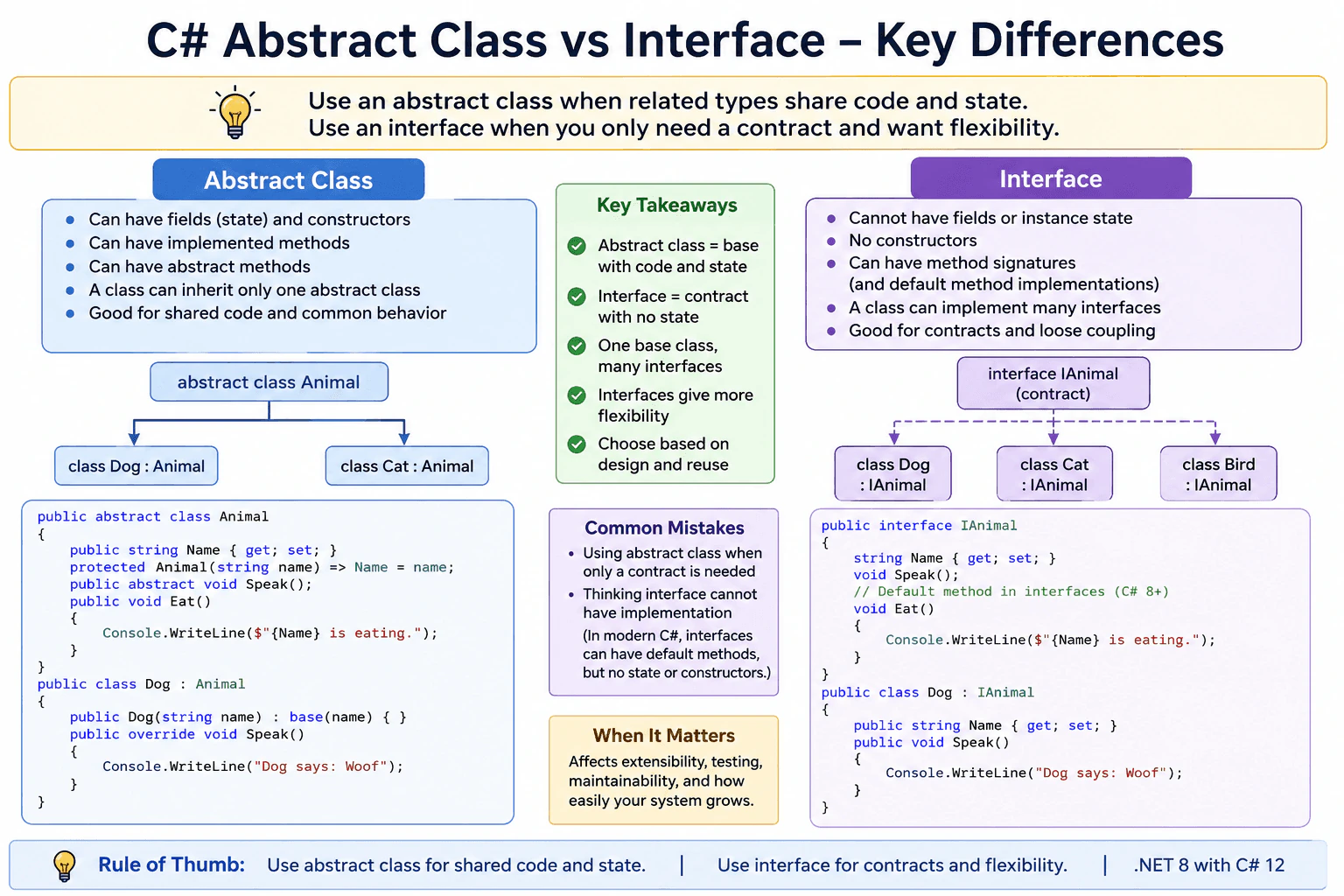
An abstract class is for shared code and shared state. An interface is for a contract that different types can follow. In C#, I use an abstract class when related types need common behavior, and I use an interface when I want flexibility and many implementations.
Detailed Explanation
This question asks which kind of shared type to use in C# when several classes need a common shape. One option gives you a base with shared parts already written. The other option gives you a promise that each class must follow. The choice matters when you decide how much code should be reused, how much freedom each class should keep, and how easy the design will be to change later. In interviews, the main point is to show when each choice fits and why.
Useful Questions to Ask the Interviewer
Do you want shared code in the base type?
Will this type need one parent or many capabilities?
How to Explain It in an Interview
An abstract class is a partly finished base class. It can have fields, constructors, implemented methods, and abstract members that derived classes must finish. It is good when several related types share code and data. An interface is a contract. It tells a type what members it must provide. It is good when you only need a common promise and want more design freedom.
A key C# rule is that a class can inherit from only one base class, but it can implement many interfaces. That is why interfaces are often used for services, adapters, and test doubles. Abstract classes are often used for base workers, shared helper logic, and template style designs where common behavior belongs in one place.
Modern C# also allows some interface implementation, but interfaces still do not hold instance state or constructors. So they are still best thought of as contracts first. The main tradeoff is simple. Abstract classes give more shared behavior, but less flexibility. Interfaces give more flexibility, but less shared code.
In production, I choose an abstract class when shared code reduces duplication and the types are closely related. I choose an interface when I want loose coupling, easier testing, or many different implementations. The runtime cost is usually not the deciding factor. The design fit is the real decision.
Why Interviewers Ask This
They want to see whether I understand how C# type design works, when to share code, when to define a contract, and how that choice affects extensibility and maintenance in production.
Common interview mistakes
A common mistake is thinking an interface is only a list of methods. In modern C#, it can also have default members, but it still cannot hold instance state or constructors. Another mistake is using an abstract class when unrelated types only need the same contract. Another is forgetting that a class can inherit only one base class, so an abstract class can reduce design flexibility.
Interview tip
Start with the rule of thumb. Say abstract class for shared code and state, interface for a contract. Then mention that a class can implement many interfaces but inherit only one base class.
Interviewer may ask next
Can an interface have implementation in C#?
Yes. In modern C#, an interface can have default members, so it can include some implementation. But it still cannot hold instance state or constructors, so it remains a contract first design.
When should I prefer an abstract class over an interface?
Prefer an abstract class when the types share real code, shared data, or protected helper methods. That matters in production because it reduces duplication, but the tradeoff is less flexibility since a class can inherit only one base class.
27. When should you use an interface instead of an abstract class?Language SpecificEasy
i Question Details
Focus on contract shape, shared implementation, versioning pressure, and what changes when a type needs multiple behaviors.
Short Interview Answer (30-60 seconds)
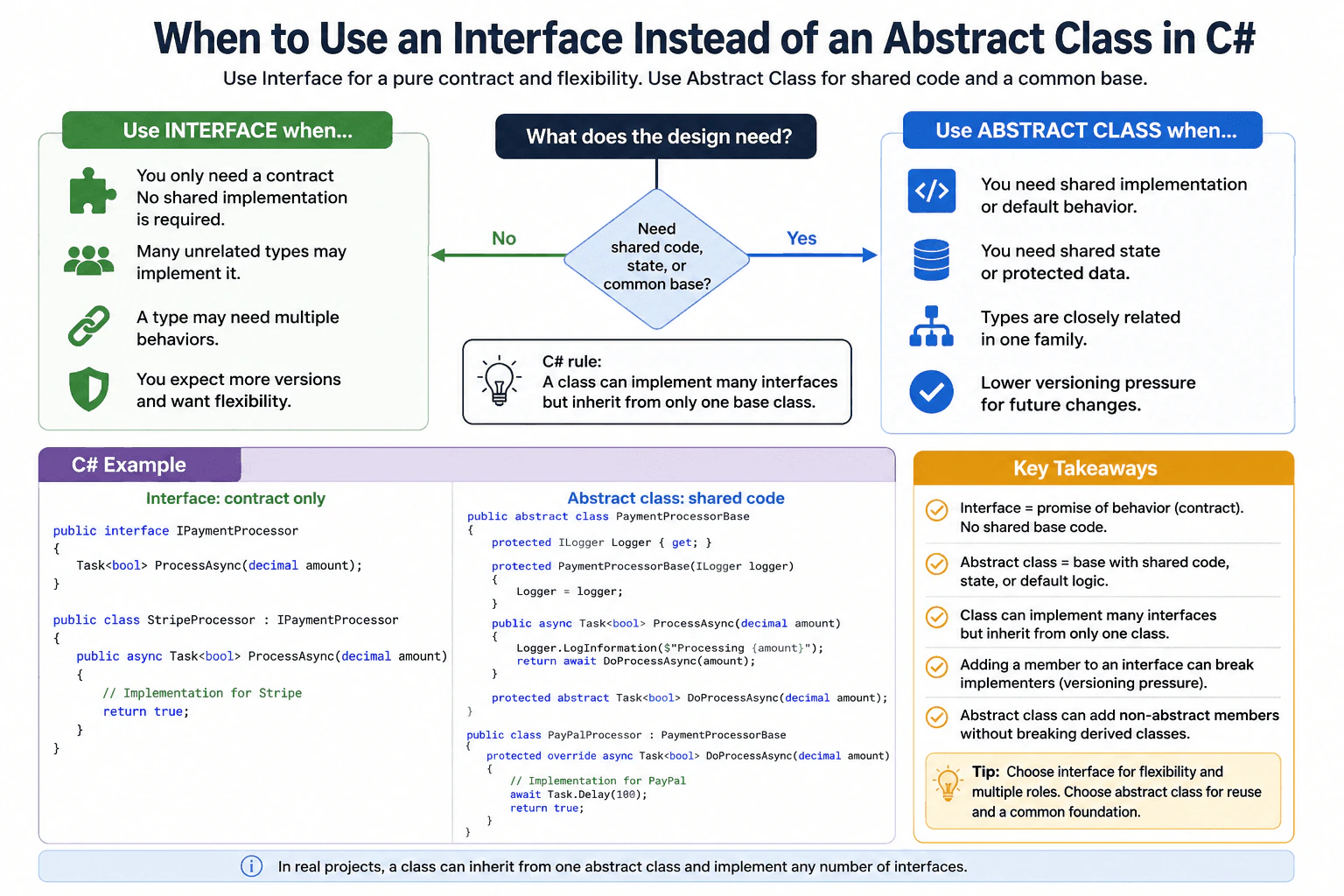
I use an interface when I only need a contract and want many different types to support it. I use an abstract class when I need shared code, shared state, or a common base for closely related types. In C#, a class can implement many interfaces but only inherit from one base class, so that choice matters a lot.
Detailed Explanation
This question asks how to choose between two ways to describe what a class must do. An interface is best when you only need a promise about behavior, and many different classes may share that promise. An abstract class is best when you also want to share code, data, or a common starting point. In C#, a class can use many interfaces but only one base class, so this choice affects how flexible your design stays when you later add new behaviors or new kinds of classes.
Useful Questions to Ask the Interviewer
Do these types need shared code or just a contract?
Will one type need to support more than one role?
Do you expect new implementations from unrelated classes?
How to Explain It in an Interview
I would say an interface is the right choice when I want a clean contract. It tells me what methods or properties a type must provide, but it does not force a shared inheritance chain. That is useful when many unrelated classes need the same behavior. It is also useful when a type may need to already inherit from another class, because C# allows only one base class.
I would choose an abstract class when I need shared implementation. That can mean common helper methods, protected state, or a default flow that several related types can reuse. It works well when the types really are part of one family.
Versioning matters too. If I add a new member to an interface, existing implementers may need to change unless the interface already uses default members. That creates more versioning pressure than an abstract class in many designs. With an abstract class, I can often add a non abstract member without forcing every derived class to change. So in practice, I use interfaces for contracts and flexibility, and abstract classes for shared behavior and controlled inheritance.
Why Interviewers Ask This
To see whether you know the difference between a pure contract and a shared base type, and whether you understand C# inheritance limits and versioning tradeoffs.
Common interview mistakes
A common mistake is choosing an abstract class just to share one small helper method. An interface is often better there. Another mistake is choosing an interface when the design really needs shared state or default logic. People also forget that a class can implement many interfaces but only inherit one base class. Another issue is versioning. Adding a new member to an interface can force changes in every implementer unless the design already planned for that.
Interview tip
Lead with the rule of thumb. Say interface for contract and flexibility, abstract class for shared code and one inheritance path. Then give one simple example of each.
Interviewer may ask next
What happens if I add a new member later?
If I add a new member to an interface, existing implementers may need to change. That is the versioning pressure of interfaces. An abstract class is usually easier to extend with new non abstract members because derived classes can inherit the new behavior without rewriting code. That matters when I expect the design to grow over time.
Can a class use both?
Yes. A class can inherit from one abstract class and also implement any number of interfaces. That is often the best production choice when I want shared base code and also want the type to support several separate behaviors.
28. What is method overloading?Language SpecificEasy
i Question Details
Explain how overload resolution works at a high level and what kinds of signatures count as distinct overloads.
Short Interview Answer (30-60 seconds)
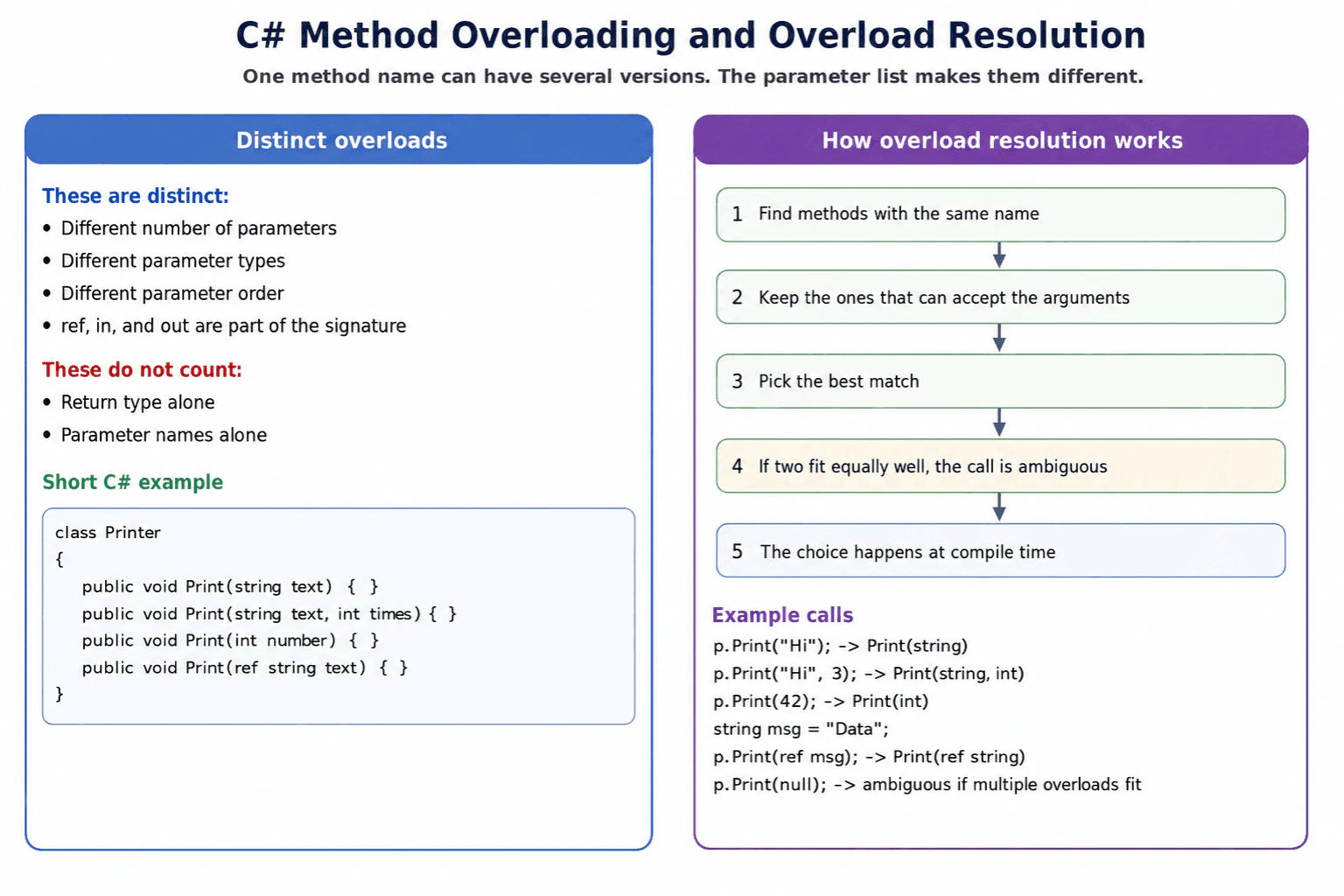
Method overloading means one method name can have several versions, and C# chooses the best one at compile time based on the arguments you pass. The parameter list is what makes each version distinct.
Detailed Explanation
This question asks what it means when one action name is used in more than one way. In C#, those versions are separate only when their parameter list is different. The compiler picks the best match from the arguments in the call. The return type alone does not create a new version, and parameter names do not matter. This matters because it lets an API stay simple to use while still supporting several useful input shapes. It also helps avoid confusion when two calls could match.
Useful Questions to Ask the Interviewer
Do you want a simple C# example or a real project example?
Should I explain ambiguous calls and optional parameters?
How to Explain It in an Interview
In C#, method overloading means one method name can have several versions. Those versions are different only when their parameter list is different. That can mean a different number of parameters, different parameter types, a different order of parameter types, or different ref, in, or out usage. The method name stays the same, but the compiler treats each valid parameter list as a separate overload.
Overload resolution happens at compile time. The compiler looks at the call, finds methods with the same name, and chooses the best match for the arguments you passed. An exact type match wins first. If there is no exact match, C# may use an implicit conversion. If more than one overload fits equally well, the call is ambiguous and the code does not compile.
The return type does not make a new overload. Parameter names do not make a new overload either. That is why Print(int) and Print(string) are different, but two methods that only differ by return type are not allowed. This is useful when one operation has a few natural forms, such as reading by id, reading by id and options, or writing with different input shapes. In production, keep overloads closely related so the API stays clear and predictable.
Why Interviewers Ask This
They want to see if you know what makes overloads different, how the compiler picks one, and that return type alone is not enough.
Common interview mistakes
Many candidates think the return type creates a new overload, but it does not. Some also think method names alone are enough, but the parameter list is what matters. Another common mistake is forgetting that ref, in, and out are part of the signature. Optional parameters can also make a call ambiguous when another overload fits the same call.
Interview tip
Say that overloads are chosen at compile time and that the parameter list is what makes them different.
Interviewer may ask next
Do optional parameters create overloads?
No. Optional parameters do not create a new overload. They only let one method be called with fewer arguments. This matters because they can make a call ambiguous if another overload also fits.
Is method overloading the same as overriding?
No. Method overloading is compile time selection among methods with the same name. Overriding is runtime dispatch through virtual methods. The main tradeoff is that overloading is better for related input shapes, while overriding is for replacing behavior in derived types.
29. What is the difference between method overloading and method overriding?Language SpecificEasy
i Question Details
Compare compile-time overload selection with runtime polymorphism, and clarify how inheritance changes the dispatch path.
Short Interview Answer (30-60 seconds)
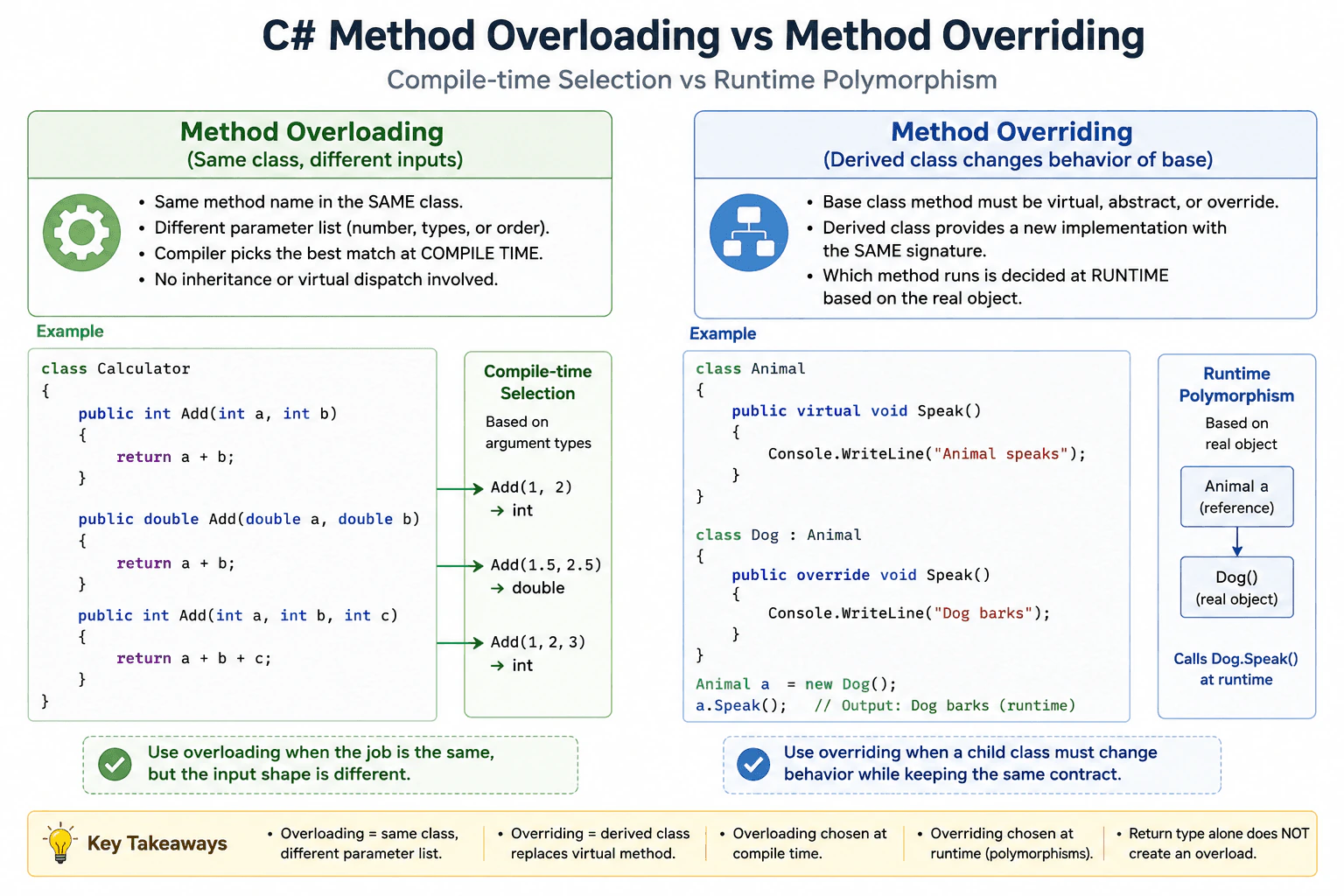
Overloading is when several methods in the same class share a name but take different inputs, and C# picks one at compile time. Overriding is when a derived class replaces a virtual base method, and C# picks the version at run time from the real object.
Detailed Explanation
This question asks about two ways a program can use the same name for an action. One way gives one class several versions for different inputs. The other way lets a child class change what a parent class already does. The first choice is made before the program runs. The second choice is made while the program runs, based on the real object. This matters because it changes how code is designed and which result you get. It also helps you know when the compiler decides and when the object decides.
Useful Questions to Ask the Interviewer
Do you want one name for several input shapes?
Should a child type change parent behavior?
How to Explain It in an Interview
Overloading means you keep the same method name in the same class, but each method has a different parameter list. C# picks the best match at compile time, before the program starts. Overriding means a derived class gives a new body for a base class method that is marked virtual, abstract, or already override. In that case, C# uses virtual dispatch, so the call is chosen at run time from the real object, not just the reference type.
Use overloading when the action is the same but the input shape changes. For example, one method can accept a string, another can accept a stream, and another can accept a file path. Use overriding when a child type must change behavior while still following the same contract from the base type.
A key limitation is that return type alone does not create an overload. The parameter list must differ. Also, a method in a child class is not an override unless the base method allows it. If the base method is not virtual, abstract, or override, the child can only hide it with new, which is a different behavior.
In production, overloading is a convenience for API design. Overriding is the main tool for polymorphism. Overloading has no virtual dispatch cost. Overriding has a small dispatch cost, but it is usually the right choice when you need flexible object behavior. There is no special memory cost from either feature itself.
Why Interviewers Ask This
Interviewers ask this to see if you understand how C# chooses a method and how inheritance changes behavior. They want to know if you can tell compile time selection from run time polymorphism, use the right keyword, and avoid bugs when a derived class is meant to replace or only add a new method.
Common interview mistakes
Thinking return type alone creates an overload. It does not. Thinking a child method with the same name is an override even when the parameter list is different. That hides the base method instead of overriding it. Forgetting that override requires a base method marked virtual, abstract, or override. Also forgetting that overloaded methods are chosen by the compiler, not by the object at run time.
Interview tip
Say overload for same name, different inputs, and override for same contract, new behavior in a child class. Then mention compile time for overload and run time for override.
Interviewer may ask next
Can you override a non virtual method?
No. A method can be overridden only if the base method is virtual, abstract, or already override. Otherwise the child can only hide it with new, which is not the same as polymorphic overriding.
Which one is faster, overloading or overriding?
Overloading is usually cheaper because the compiler chooses the method at compile time. Overriding uses virtual dispatch at run time, which has a small cost, but it gives polymorphism and is usually the right tradeoff.
30. What is the difference between arrays and lists?Language SpecificEasy
i Question Details
Explain fixed versus dynamic size, indexing behavior, and when memory layout or resizing matters.
Short Interview Answer (30-60 seconds)
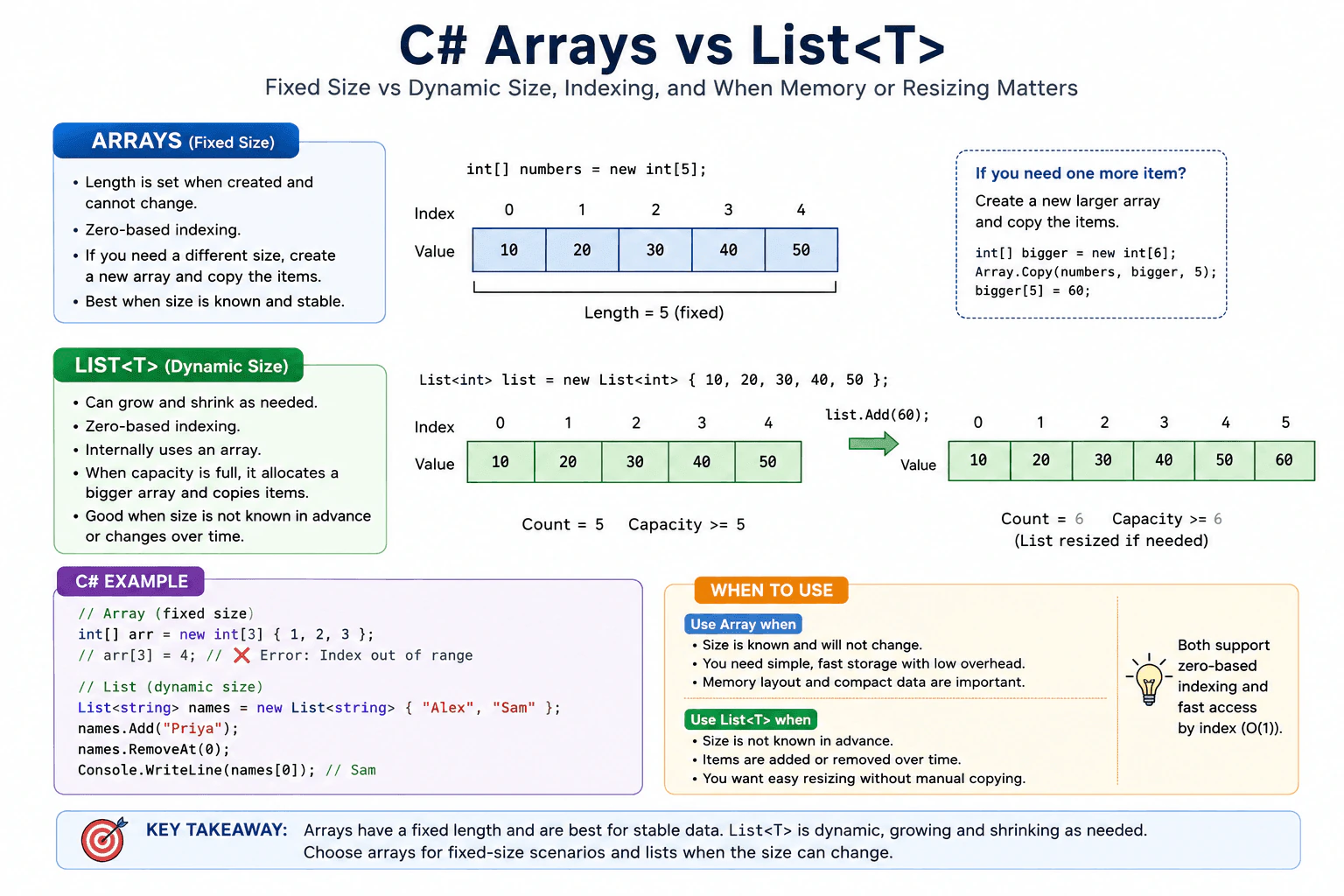
A C# array has a fixed length, while a List<T> can grow and shrink. Arrays are best when you know the size up front. List<T> is better when items may be added or removed later because it handles resizing for you.
Detailed Explanation
The question is about two ways to hold many items in C#. One has a size that stays the same after it is created. The other can grow or shrink as needed. The interviewer wants to see whether I know when fixed size storage is better, when flexible storage is better, and how indexing, resizing, and memory use change the choice. They also want to see if I can pick the right type for a real program.
Useful Questions to Ask the Interviewer
Will the number of items be known ahead of time?
Do you expect items to be added or removed often?
How to Explain It in an Interview
In C#, an array has a fixed length after it is created. You can read and update items by index, and the first item is at index 0. If you need a different size, you must create a new array and copy the values into it. That makes arrays a strong choice when the size is known and stable.
List<T> is a class that gives you a growable sequence of items. You can add and remove items without making a new collection each time. Internally, it uses an array. When it runs out of room, it allocates a bigger array and copies the items over. Indexing is still fast, but growth has a resize cost.
Arrays are a good fit when you want simple storage, a stable size, and compact memory use. They also give predictable layout in memory, which can help when you care about low overhead. List<T> is a better fit when the count is not known in advance, such as user input, query results, or items collected over time. The main tradeoff is flexibility versus resize cost. If the size never changes, an array is usually simpler. If the size changes, List<T> is usually the better default.
Why Interviewers Ask This
This checks whether you know that arrays have a fixed length while List<T> can grow and shrink, and whether you can choose the right type for size, memory, and resizing needs.
Common interview mistakes
A common mistake is to say that a List<T> is just an array. It is not. Another mistake is to think arrays can grow automatically. They cannot. People also forget that List<T> has a Count value for items and a separate internal capacity for storage. Another mistake is assuming resizing has no cost. When List<T> grows, it may allocate a new array and copy items.
Interview tip
Start with the size rule first. Say that arrays are fixed and List<T> is growable. Then mention that arrays are best for stable data and List<T> is best when the size may change.
Interviewer may ask next
What happens if you need one more item in an array?
You cannot grow the existing array in place. You must create a new array with a larger size and copy the old items into it. That matters because the size is fixed after creation.
Is List<T> slower than an array?
For indexing, List<T> is usually very close to an array because it still uses an internal array. The main tradeoff is resizing. When the list grows, it may allocate a new buffer and copy items, so arrays are better when the size never changes.
More questions load as you scroll
Disclaimer: This interview guide is for educational and informational purposes only. It is designed to help readers prepare, but it does not guarantee any interview result, hiring decision, offer, or outcome. Interview questions, hiring criteria, and preferred answers can vary by employer, interviewer, industry, location, and time. All answers, examples, and explanations in this guide are suggested examples for interview preparation, not definitive answers or instructions for professional practice. They are based on research and judgment, are provided without warranties of any kind, and should be adapted to the question, role, and applicable laws and professional requirements. Diagrams are simplified illustrations intended to highlight the main concepts and their relationships; actual situations, systems, and practices may be more complex. Alternative approaches may be equally valid or better suited to a particular question, context, or interviewer. To the fullest extent permitted by applicable law, the contributors and publisher are not liable for decisions made, actions taken, or losses incurred based on this guide.
State Laws and Professional Responsibilities: Laws and requirements governing an occupation vary by state and jurisdiction. You are responsible for checking the current laws, licensing requirements, and scope-of-practice rules that apply to your location and role, and for ensuring that your answers and actions comply with them. Adapt examples in this guide to those requirements. This guide is not legal advice.
Content Accuracy and Verification: To the fullest extent permitted by applicable law, we do not represent or warrant that interview guides, questions, answers, examples, or diagrams are accurate, complete, current, error-free, or suitable for any particular purpose. You are responsible for independently reviewing and verifying the information before relying on it.